Search Results: "jan"

10 July 2017

Steve Kemp: bind9 considered harmful

Recently there was another bind9 security update released by the Debian Security Team. I thought that was odd, so I've scanned my mailbox: So in the year to date there have been 7 months, in 3 of them nothing happened, but in 4 of them we had bind9 updates. If these trends continue we'll have another 2.5 updates before the end of the year. I don't run a nameserver. The only reason I have bind-packages on my system is for the dig utility. Rewriting a compatible version of dig in Perl should be trivial, thanks to the Net::DNS::Resolver module: These are about the only commands I ever run:
dig -t a    steve.fi +short
dig -t aaaa steve.fi +short
dig -t a    steve.fi @8.8.8.8
I should do that then. Yes.

4 July 2017

Raphaël Hertzog: My Free Software Activities in June 2017

My monthly report covers a large part of what I have been doing in the free software world. I write it for my donors (thanks to them!) but also for the wider Debian community because it can give ideas to newcomers and it s one of the best ways to find volunteers to work with me on projects that matter to me. Debian LTS I was allocated 12 hours to work on security updates for Debian 7 Wheezy. During this time I did the following: Debian packaging Django. A last-minute update to Django in stretch before the release, I uploaded python-django 1:1.10.7-2 fixing two bugs (among which one was release critical) and filed the corresponding unblock request. schroot. I tried to prepare another last-minute update, this time for schroot. The goal was to fix the bash completion (#855283) and a problem encountered by the Debian sysadmins (#835104). Those issues are fixed in unstable/testing but my unblock request got turned into a post-release stretch update because the release managers wanted to give the package some more testing time in unstable. Even now, they are wondering whether they should accept the new systemd service file. live-build, live-config and live-boot. On live-build, I merged a patch to add a keyboard shortcut for the advanced option menu entry (#864386). For live-config, I uploaded version 5.20170623 to fix a broken boot sequence when you have multiple partitions (#827665). For live-boot, I uploaded version 1:20170623 to fix the path to udevadm (#852570) and avoiding a file duplication in the initrd (864385). zim. I packaged a release candidate (0.67~rc2) in Debian Experimental and started to use it. I quickly discovered two annoying regressions that I reported upstream (here and here). logidee-tools. This is a package I authored a long time ago and that I m no longer actively using. It does still work but I sometimes wonder if it still has real users. Anyway I wanted to quickly replace the broken dependency on pgf but I ended up converting the Subversion repository to Git and I also added autopkgtests. At least those tests will inform me when the package no longer works otherwise I would not notice since I m no longer using it. Bugs filed. I filed #865531 on lintian because the new check testsuite-autopkgtest-missing is giving some bad advice and probably does its check in a bad way. I also filed #865541 on sbuild because sbuild --apt-distupgrade can under some circumstances remove build-essential and break the build chroot. I filed an upstream ticket on publican to forward the request I received in #864648. Sponsorship. I sponsored a jessie update for php-tcpdf (#814030) and dolibarr 5.0.4+dfsg3-1 for unstable. I sponsored many other packages, but all in the context of the pkg-security team. pkg-security work Now that the Stretch freeze is over, the team became more active again and I have been overwhelmed with the number of packages to review and sponsor: I also updated hashcat to a new upstream release (3.6.0) and had to discuss with upstream about its weird versioning change. Looks like we will have to introduce an epoch to be able to get back in sync with upstream.  To be able to get in sync with Kali, I introduced an hashcat-meta source package (in contrib) providing hashcat-nvidia to make it easy to install hashcat for owners of NVidia hardware. Misc stuff Distro Tracker. I merged a small CSS fix from Aur lien Couderc (#858101) and added a missing constraint on the data model (found through an unexpected traceback that I received by email). I also updated the list of repositories shortly after the stretch release (#865070). Salt formulas. As part of my Kali work, I did setup a build daemon on Debian stretch host and I encountered a couple of issues with my Salt rules. I reported one against salt-formula (here) and I pushed updates for debootstrap-formula, apache-formula and schroot-formula. Thanks See you next month for a new summary of my activities.

No comment Liked this article? Click here. My blog is Flattr-enabled.

30 June 2017

Chris Lamb: Free software activities in June 2017

Here is my monthly update covering what I have been doing in the free software world (previous month):
Reproducible builds

Whilst anyone can inspect the source code of free software for malicious flaws, most software is distributed pre-compiled to end users. The motivation behind the Reproducible Builds effort is to allow verification that no flaws have been introduced either maliciously or accidentally during this compilation process by promising identical results are always generated from a given source. Multiple third-parties then can come to a consensus on whether a build was compromised or not. I have generously been awarded a grant from the Core Infrastructure Initiative to fund my work in this area. This month I:
  • Chaired our monthly IRC meeting. (Summary, logs, etc.)
  • Presented at Hong Kong Open Source Conference 2017.
  • Presented at LinuxCon China.
  • Submitted the following patches to fix reproducibility-related toolchain issues within Debian:
    • cracklib2: Ensuring /var/cache/cracklib/src-dicts are reproducible. (#865623)
    • fontconfig: Ensuring the cache files are reproducible. (#864082)
    • nfstrace: Make the PDF footers reproducible. (#865751)
  • Submitted 6 patches to fix specific reproducibility issues in cd-hit, janus, qmidinet, singularity-container, tigervnc & xabacus.
  • Submitted a wishlist request to the TeX mailing list to ensure that PDF files are reproducible even if generated from a difficult path after identifying underlying cause. (Thread)
  • Categorised a large number of packages and issues in the Reproducible Builds notes.git repository.
  • Worked on publishing our weekly reports. (#110, #111, #112 & #113)
  • Updated our website with 13 missing talks (e291180), updated the metadata for some existing talks (650a201) and added OpenEmbedded to the projects page (12dfcf0).

I also made the following changes to our tooling:
diffoscope

diffoscope is our in-depth and content-aware diff utility that can locate and diagnose reproducibility issues.


strip-nondeterminism

strip-nondeterminism is our tool to remove specific non-deterministic results from a completed build.

  • Add libarchive-cpio-perl with the !nocheck build profile. (01e408e)
  • Add dpkg-dev dependency build profile. (f998bbe)


Debian My activities as the current Debian Project Leader are covered in my "Bits from the DPL" email to the debian-devel-announce mailing list. However, I:
Debian LTS

This month I have been paid to work 16 hours hours on Debian Long Term Support (LTS). In that time I did the following:
  • "Frontdesk" duties, triaging CVEs, etc.
  • Issued DLA 974-1 fixing a command injection vulnerability in picocom, a dumb-terminal emulation program.
  • Issued DLA 972-1 which patches a double-free vulnerability in the openldap LDAP server.
  • Issued DLA 976-1 which corrects a buffer over-read vulnerability in the yodl ("Your Own Document Language") document processor.
  • Issued DLA 985-1 to address a vulnerability in libsndfile (a library for reading/writing audio files) where a specially-crafted AIFF file could result in an out-of-bounds memory read.
  • Issued DLA 990-1 to fix an infinite loop vulnerability in the expat, an XML parsing library.
  • Issued DLA 999-1 for the openvpn VPN server if clients used a HTTP proxy with NTLM authentication, a man-in-the-middle attacker could cause the client to crash or disclose stack memory that was likely to contain the proxy password.

Uploads
  • bfs (1.0.2-1) New upstream release, add basic/smoke autopkgtests.
  • installation-birthday (5) Add some basic autopkgtest smoke tests and correct the Vcs- Git,Browser headers.
  • python-django:
    • 1:1.11.2-1 New upstream minor release & backport an upstream patch to prevent a test failure if the source is not writable. (#816435)
    • 1:1.11.2-2 Upload to unstable, use !nocheck profile for build dependencies that are only required for tests and various packaging updates.

I also made the following non-maintainer uploads (NMUs):
  • kluppe (0.6.20-1.1) Fix segmentation fault caused by passing a truncated pointer instead of a GtkType. (#863421)
  • porg (2:0.10-1.1) Fix broken LD_PRELOAD path for libporg-log.so. (#863495)
  • ganeti-instance-debootstrap (0.16-2.1) Fix "illegal option for fgrep" error by using "--" to escape the search needle. (#864025)
  • pavuk (0.9.35-6.1) Fix segmentation fault when opening the "Limitations" window due to pointer truncation in src/gtkmulticol.[ch]. (#863492)
  • timemachine (0.3.3-2.1) Fix two segmentation faults in src/gtkmeter.c and gtkmeterscale.c caused by passing a truncated pointers using guint instead of a GtkType. (#863420)
  • jackeq (0.5.9-2.1) Fix another segmentation fault caused by passing a truncated pointer instead of a GtkType. (#863416)

Debian bugs filed
  • debhelper: Don't run dh_installdocs if nodoc is specified in DEB_BUILD_PROFILES? (#865869)
  • python-blessed: Non-determistically FTBFS due to unreliable timing in tests. (#864337)
  • apt: Please print a better error message if zero certificates are loaded from the system CA store. (#866377)

28 June 2017

Yakking: What is Time?

Time is a big enough subject that I'd never finish writing about it. Fortunately this is a Linux technical blog, so I only have to talk about it from that perspective. In a departure from our usual article series format, we are going to start with an introductory article and follow up starting from basics, introducing new concepts in order of complexity. What is time? Time is seconds since the unix epoch. The Unix epoch is midnight, Thursday, 1st January 1970 in the UTC time zone. If you know the unix time and how many seconds in each day since then you can use the unix timestamp to work out what time it is now in UTC time. If you want to know the time in another timezone the na ve thing is to apply a timezone offset based on how far or behind the zone is compared to UTC. This is non-trivial since time is a political issue, requiring global coordination with hundreds of countries coming in and out of [daylight saving time][] and various other administrative changes, time often changes. Some times don't exist in some timezones. Samoa skipped a day and changed time zone. A side-effect of your system clock being in Unix time is that to know local time you need to know where you are. The talk linked to in https://fosdem.org/2017/schedule/event/python_datetime/ is primarily about time in python, but covers the relationship between time stamps, clock time and time zones. http://www.creativedeletion.com/2015/01/28/falsehoods-programmers-date-time-zones.html is a good summary of some of the common misconceptions of time zone handling.
Now that we've covered some of the concepts we can discuss in future articles how this is implemented in Linux.

27 June 2017

Reproducible builds folks: Reproducible Builds: week 113 in Stretch cycle

Here's what happened in the Reproducible Builds effort between Sunday June 18 and Saturday June 24 2017: Upcoming and Past events Our next IRC meeting is scheduled for the 6th of July at 17:00 UTC with this agenda currently:
  1. Introductions
  2. Reproducible Builds Summit update
  3. NMU campaign for buster
  4. Press release: Debian is doing Reproducible Builds for Buster
  5. Reproducible Builds Branding & Logo
  6. should we become an SPI member
  7. Next meeting
  8. Any other business
On June 19th, Chris Lamb presented at LinuxCon China 2017 on Reproducible Builds. On June 23rd, Vagrant Cascadian held a Reproducible Builds question and answer session at Open Source Bridge. Reproducible work in other projects LEDE: firmware-utils and mtd-utils/mkfs.jffs2 now honor SOURCE_DATE_EPOCH. Toolchain development and fixes There was discussion on #782654 about packaging bazel for Debian. Dan Kegel wrote a patch to use ar determinitiscally for Homebrew, a package manager for MacOS. Dan Kegel worked on using SOURCE_DATE_EPOCH and other reproduciblity fixes in fpm, a multi plattform package builder. The Fedora Haskell team disabled parallel builds to achieve reproducible builds. Bernhard M. Wiedemann submitted many patches upstream: Packages fixed and bugs filed Patches submitted upstream: Other patches filed in Debian: Reviews of unreproducible packages 573 package reviews have been added, 154 have been updated and 9 have been removed in this week, adding to our knowledge about identified issues. 1 issue type has been updated: Weekly QA work During our reproducibility testing, FTBFS bugs have been detected and reported by: diffoscope development Version 83 was uploaded to unstable by Chris Lamb. It also moved the previous changes from experimental (to where they were uploaded) to unstable. It included contributions from previous weeks. You can read about these changes in our previous weeks' posts, or view the changelog directly (raw form). We plan to maintain a backport of this and future versions in stretch-backports. Ximin Luo also worked on better html-dir output for very very large diffs such as those for GCC. So far, this includes unreleased work on a PartialString data structure which will form a core part of a new and more intelligent recursive display algorithm. strip-nondeterminism development Versions 0.035-1 was uploaded to unstable from experimental by Chris Lamb. It included contributions from: Later in the week Mattia Rizzolo uploaded 0.035-2 with some improvements to the autopkgtest and to the general packaging. We currently don't plan to maintain a backport in stretch-backports like we did for jessie-backports. Please speak up if you think otherwise. reproducible-website development tests.reproducible-builds.org Misc. This week's edition was written by Ximin Luo, Holger Levsen, Bernhard M. Wiedemann, Mattia Rizzolo, Chris Lamb & reviewed by a bunch of Reproducible Builds folks on IRC & the mailing lists.

25 June 2017

Lars Wirzenius: Obnam 1.22 released (backup application)

I've just released version 1.22 of Obnam, my backup application. It is the first release for this year. Packages are available on code.liw.fi/debian and in Debian unstable, and source is in git. A summary of the user-visible changes is below. For those interested in living dangerously and accidentally on purpose deleting all their data, the link below shows that status and roadmap for FORMAT GREEN ALBATROSS. http://distix.obnam.org/obnam-dev/182bd772889544d5867e1a0ce4e76652.html Version 1.22, released 2017-06-25

20 June 2017

Norbert Preining: TeX Live 2017 hits Debian/unstable

Yesterday I uploaded the first packages of TeX Live 2017 to Debian/unstable, meaning that the new release cycle has started. Debian/stretch was released over the weekend, and this opened up unstable for new developments. The upload comprised the following packages: asymptote, cm-super, context, context-modules, texlive-base, texlive-bin, texlive-extra, texlive-extra, texlive-lang, texworks, xindy.
I mentioned already in a previous post the following changes: The last two changes are described together with other news (easy TEXMF tree management) in the TeX Live release post. These changes more or less sum up the new infra structure developments in TeX Live 2017. Since the last release to unstable (which happened in 2017-01-23) about half a year of package updates have accumulated, below is an approximate list of updates (not split into new/updated, though). Enjoy the brave new world of TeX Live 2017, and please report bugs to the BTS! Updated/new packages:
academicons, achemso, acmart, acro, actuarialangle, actuarialsymbol, adobemapping, alkalami, amiri, animate, aomart, apa6, apxproof, arabluatex, archaeologie, arsclassica, autoaligne, autobreak, autosp, axodraw2, babel, babel-azerbaijani, babel-english, babel-french, babel-indonesian, babel-japanese, babel-malay, babel-ukrainian, bangorexam, baskervaldx, baskervillef, bchart, beamer, beamerswitch, bgteubner, biblatex-abnt, biblatex-anonymous, biblatex-archaeology, biblatex-arthistory-bonn, biblatex-bookinother, biblatex-caspervector, biblatex-cheatsheet, biblatex-chem, biblatex-chicago, biblatex-claves, biblatex-enc, biblatex-fiwi, biblatex-gb7714-2015, biblatex-gost, biblatex-ieee, biblatex-iso690, biblatex-manuscripts-philology, biblatex-morenames, biblatex-nature, biblatex-opcit-booktitle, biblatex-oxref, biblatex-philosophy, biblatex-publist, biblatex-shortfields, biblatex-subseries, bibtexperllibs, bidi, biochemistry-colors, bookcover, boondox, bredzenie, breqn, bxbase, bxcalc, bxdvidriver, bxjalipsum, bxjaprnind, bxjscls, bxnewfont, bxorigcapt, bxpapersize, bxpdfver, cabin, callouts, chemfig, chemformula, chemmacros, chemschemex, childdoc, circuitikz, cje, cjhebrew, cjk-gs-integrate, cmpj, cochineal, combofont, context, conv-xkv, correctmathalign, covington, cquthesis, crimson, crossrefware, csbulletin, csplain, csquotes, css-colors, cstldoc, ctex, currency, cweb, datetime2-french, datetime2-german, datetime2-romanian, datetime2-ukrainian, dehyph-exptl, disser, docsurvey, dox, draftfigure, drawmatrix, dtk, dviinfox, easyformat, ebproof, elements, endheads, enotez, eqnalign, erewhon, eulerpx, expex, exsheets, factura, facture, fancyhdr, fbb, fei, fetamont, fibeamer, fithesis, fixme, fmtcount, fnspe, fontmfizz, fontools, fonts-churchslavonic, fontspec, footnotehyper, forest, gandhi, genealogytree, glossaries, glossaries-extra, gofonts, gotoh, graphics, graphics-def, graphics-pln, grayhints, gregoriotex, gtrlib-largetrees, gzt, halloweenmath, handout, hang, heuristica, hlist, hobby, hvfloat, hyperref, hyperxmp, ifptex, ijsra, japanese-otf-uptex, jlreq, jmlr, jsclasses, jslectureplanner, karnaugh-map, keyfloat, knowledge, komacv, koma-script, kotex-oblivoir, l3, l3build, ladder, langsci, latex, latex2e, latex2man, latex3, latexbug, latexindent, latexmk, latex-mr, leaflet, leipzig, libertine, libertinegc, libertinus, libertinust1math, lion-msc, lni, longdivision, lshort-chinese, ltb2bib, lualatex-math, lualibs, luamesh, luamplib, luaotfload, luapackageloader, luatexja, luatexko, lwarp, make4ht, marginnote, markdown, mathalfa, mathpunctspace, mathtools, mcexam, mcf2graph, media9, minidocument, modular, montserrat, morewrites, mpostinl, mptrees, mucproc, musixtex, mwcls, mweights, nameauth, newpx, newtx, newtxtt, nfssext-cfr, nlctdoc, novel, numspell, nwejm, oberdiek, ocgx2, oplotsymbl, optidef, oscola, overlays, pagecolor, pdflatexpicscale, pdfpages, pdfx, perfectcut, pgfplots, phonenumbers, phonrule, pkuthss, platex, platex-tools, polski, preview, program, proofread, prooftrees, pst-3dplot, pst-barcode, pst-eucl, pst-func, pst-ode, pst-pdf, pst-plot, pstricks, pstricks-add, pst-solides3d, pst-spinner, pst-tools, pst-tree, pst-vehicle, ptex2pdf, ptex-base, ptex-fontmaps, pxbase, pxchfon, pxrubrica, pythonhighlight, quran, ran_toks, reledmac, repere, resphilosophica, revquantum, rputover, rubik, rutitlepage, sansmathfonts, scratch, seealso, sesstime, siunitx, skdoc, songs, spectralsequences, stackengine, stage, sttools, studenthandouts, svg, tcolorbox, tex4ebook, tex4ht, texosquery, texproposal, thaienum, thalie, thesis-ekf, thuthesis, tikz-kalender, tikzmark, tikz-optics, tikz-palattice, tikzpeople, tikzsymbols, titlepic, tl17, tqft, tracklang, tudscr, tugboat-plain, turabian-formatting, txuprcal, typoaid, udesoftec, uhhassignment, ukrainian, ulthese, unamthesis, unfonts-core, unfonts-extra, unicode-math, uplatex, upmethodology, uptex-base, urcls, variablelm, varsfromjobname, visualtikz, xassoccnt, xcharter, xcntperchap, xecjk, xepersian, xetexko, xevlna, xgreek, xsavebox, xsim, ycbook.

18 June 2017

Eriberto Mota: Como migrar do Debian Jessie para o Stretch

Bem vindo ao Debian Stretch! Ontem, 17 de junho de 2017, o Debian 9 (Stretch) foi lan ado. Eu gostaria de falar sobre alguns procedimentos b sicos e regras para migrar do Debian 8 (Jessie). Passos iniciais
# apt-get update
# apt-get dist-upgrade
Migrando
deb http://ftp.br.debian.org/debian/ stretch main
deb-src http://ftp.br.debian.org/debian/ stretch main
   
deb http://security.debian.org/ stretch/updates main
deb-src http://security.debian.org/ stretch/updates main
# apt-get update
# apt-get dist-upgrade
Caso haja algum problema, leia as mensagens de erro e tente resolver o problema. Resolvendo ou n o tal problema, execute novamente o comando:
# apt-get dist-upgrade
Havendo novos problemas, tente resolver. Busque solu es no Google, se for necess rio. Mas, geralmente, tudo dar certo e voc n o dever ter problemas. Altera es em arquivos de configura o Quando voc estiver migrando, algumas mensagens sobre altera es em arquivos de configura o poder o ser mostradas. Isso poder deixar alguns usu rios pedidos, sem saber o que fazer. N o entre em p nico. Existem duas formas de apresentar essas mensagens: via texto puro em shell ou via janela azul de mensagens. O texto a seguir um exemplo de mensagem em shell:
Ficheiro de configura o '/etc/rsyslog.conf'
 ==> Modificado (por si ou por um script) desde a instala o.
 ==> O distribuidor do pacote lan ou uma vers o atualizada.
 O que deseja fazer? As suas op es s o:
 Y ou I : instalar a vers o do pacote do maintainer
 N ou O : manter a vers o actualmente instalada
 D : mostrar diferen as entre as vers es
 Z : iniciar uma shell para examinar a situa o
 A a o padr o   manter sua vers o atual.
*** rsyslog.conf (Y/I/N/O/D/Z) [padr o=N] ?
A tela a seguir um exemplo de mensagem via janela: Nos dois casos, recomend vel que voc escolha por instalar a nova vers o do arquivo de configura o. Isso porque o novo arquivo de configura o estar totalmente adaptado aos novos servi os instalados e poder ter muitas op es novas ou diferentes. Mas n o se preocupe, pois as suas configura es n o ser o perdidas. Haver um backup das mesmas. Assim, para shell, escolha a op o "Y" e, no caso de janela, escolha a op o "instalar a vers o do mantenedor do pacote". muito importante anotar o nome de cada arquivo modificado. No caso da janela anterior, trata-se do arquivo /etc/samba/smb.conf. No caso do shell o arquivo foi o /etc/rsyslog.conf. Depois de completar a migra o, voc poder ver o novo arquivo de configura o e o original. Caso o novo arquivo tenha sido instalado ap s uma escolha via shell, o arquivo original (o que voc tinha anteriormente) ter o mesmo nome com a extens o .dpkg-old. No caso de escolha via janela, o arquivo ser mantido com a extens o .ucf-old. Nos dois casos, voc poder ver as modifica es feitas e reconfigurar o seu novo arquivo de acordo com as necessidades. Caso voc precise de ajuda para ver as diferen as entre os arquivos, voc poder usar o comando diff para compar -los. Fa a o diff sempre do arquivo novo para o original. como se voc quisesse ver como fazer com o novo arquivo para ficar igual ao original. Exemplo:
# diff -Naur /etc/rsyslog.conf /etc/rsyslog.conf.dpkg-old
Em uma primeira vista, as linhas marcadas com "+" dever o ser adicionadas ao novo arquivo para que se pare a com o anterior, assim como as marcadas com "-" dever o ser suprimidas. Mas cuidado: normal que haja algumas linhas diferentes, pois o arquivo de configura o foi feito para uma nova vers o do servi o ou aplicativo ao qual ele pertence. Assim, altere somente as linhas que realmente s o necess rias e que voc mudou no arquivo anterior. Veja o exemplo:
+daemon.*;mail.*;\
+ news.err;\
+ *.=debug;*.=info;\
+ *.=notice;*.=warn  /dev/xconsole
+*.* @sam
No meu caso, originalmente, eu s alterei a ltima linha. Ent o, no novo arquivo de configura o, s terei interesse em adicionar essa linha. Bem, se foi voc quem fez a configura o anterior, voc saber fazer a coisa certa. Geralmente, n o haver muitas diferen as entre os arquivos. Outra op o para ver as diferen as entre arquivos o comando mcdiff, que poder ser fornecido pelo pacote mc. Exemplo:
# mcdiff /etc/rsyslog.conf /etc/rsyslog.conf.dpkg-old
Problemas com ambientes e aplica es gr ficas poss vel que voc tenha algum problema com o funcionamento de ambientes gr ficos, como Gnome, KDE etc, ou com aplica es como o Mozilla Firefox. Nesses casos, prov vel que o problema seja os arquivos de configura o desses elementos, existentes no diret rio home do usu rio. Para verificar, crie um novo usu rio no Debian e teste com ele. Se tudo der certo, fa a um backup das configura es anteriores (ou renomeie as mesmas) e deixe que a aplica o crie uma configura o nova. Por exemplo, para o Mozilla Firefox, v ao diret rio home do usu rio e, com o Firefox fechado, renomeie o diret rio .mozilla para .mozilla.bak, inicie o Firefox e teste. Est inseguro? Caso voc esteja muito inseguro, instale um Debian 8, com ambiente gr fico e outras coisas, em uma m quina virtual e migre para Debian 9 para testar e aprender. Sugiro VirtualBox como virtualizador. Divirta-se!

Jonathan Carter: Debian 9 is available!

Congratulations to everyone who has played a part in the creation of Debian GNU/Linux 9.0! It s a great release, I ve installed the pre-release versions for friends, family and colleagues and so far the feedback has been very positive. This release is dedicated to Ian Murdock, who founded the Debian project in 1993, and sadly passed away on 28 December 2015. On the Debian ISO files a dedication statement is available on /doc/dedication/dedication-9.0.txt Here s a copy of the dedication text:
Dedicated to Ian Murdock
------------------------
Ian Murdock, the founder of the Debian project, passed away
on 28th December 2015 at his home in San Francisco. He was 42.
It is difficult to exaggerate Ian's contribution to Free
Software. He led the Debian Project from its inception in
1993 to 1996, wrote the Debian manifesto in January 1994 and
nurtured the fledgling project throughout his studies at
Purdue University.
Ian went on to be founding director of Linux International,
CTO of the Free Standards Group and later the Linux
Foundation, and leader of Project Indiana at Sun
Microsystems, which he described as "taking the lesson
that Linux has brought to the operating system and providing
that for Solaris".
Debian's success is testament to Ian's vision. He inspired
countless people around the world to contribute their own free
time and skills. More than 350 distributions are known to be
derived from Debian.
We therefore dedicate Debian 9 "stretch" to Ian.
-- The Debian Developers
During this development cycle, the amount of source packages in Debian grew from around 21 000 to around 25 000 packages, which means that there s a whole bunch of new things Debian can make your computer do. If you find something new in this release that you like, post about it on your favourite social networks, using the hashtag #newinstretch or look it up to see what others have discovered!

17 June 2017

Jonathan Carter: Debian 9 is available!

Congratulations to everyone who has played a part in the creation of Debian GNU/Linux 9.0! It s a great release, I ve installed the pre-release versions for friends, family and colleagues and so far the feedback has been very positive. This release is dedicated to Ian Murdock, who founded the Debian project in 1993, and sadly passed away on 28 December 2015. On the Debian ISO files a dedication statement is available on /doc/dedication/dedication-9.0.txt Here s a copy of the dedication text:
Dedicated to Ian Murdock
------------------------
Ian Murdock, the founder of the Debian project, passed away
on 28th December 2015 at his home in San Francisco. He was 42.
It is difficult to exaggerate Ian's contribution to Free
Software. He led the Debian Project from its inception in
1993 to 1996, wrote the Debian manifesto in January 1994 and
nurtured the fledgling project throughout his studies at
Purdue University.
Ian went on to be founding director of Linux International,
CTO of the Free Standards Group and later the Linux
Foundation, and leader of Project Indiana at Sun
Microsystems, which he described as "taking the lesson
that Linux has brought to the operating system and providing
that for Solaris".
Debian's success is testament to Ian's vision. He inspired
countless people around the world to contribute their own free
time and skills. More than 350 distributions are known to be
derived from Debian.
We therefore dedicate Debian 9 "stretch" to Ian.
-- The Debian Developers
During this development cycle, the amount of source packages in Debian grew from around 21 000 to around 25 000 packages, which means that there s a whole bunch of new things Debian can make your computer do. If you find something new in this release that you like, post about it on your favourite social networks, using the hashtag #newinstretch or look it up to see what others have discovered!

12 June 2017

Petter Reinholdtsen: Updated sales number for my Free Culture paper editions

It is pleasing to see that the work we put down in publishing new editions of the classic Free Culture book by the founder of the Creative Commons movement, Lawrence Lessig, is still being appreciated. I had a look at the latest sales numbers for the paper edition today. Not too impressive, but happy to see some buyers still exist. All the revenue from the books is sent to the Creative Commons Corporation, and they receive the largest cut if you buy directly from Lulu. Most books are sold via Amazon, with Ingram second and only a small fraction directly from Lulu. The ebook edition is available for free from Github.
Title / languageQuantity
2016 jan-jun2016 jul-dec2017 jan-may
Culture Libre / French 3 6 15
Fri kultur / Norwegian 7 1 0
Free Culture / English 14 27 16
Total 24 34 31
A bit sad to see the low sales number on the Norwegian edition, and a bit surprising the English edition still selling so well. If you would like to translate and publish the book in your native language, I would be happy to help make it happen. Please get in touch.

11 June 2017

Francois Marier: Mysterious 400 Bad Request in Django debug mode

While upgrading Libravatar to a more recent version of Django, I ran into a mysterious 400 error. In debug mode, my site was working fine, but with DEBUG = False, I would only a page containing this error:
Bad Request (400)
with no extra details in the web server logs.

Turning on extra error logging To see the full error message, I configured logging to a file by adding this to settings.py:
LOGGING =  
    'version': 1,
    'disable_existing_loggers': False,
    'handlers':  
        'file':  
            'level': 'DEBUG',
            'class': 'logging.FileHandler',
            'filename': '/tmp/debug.log',
         ,
     ,
    'loggers':  
        'django':  
            'handlers': ['file'],
            'level': 'DEBUG',
            'propagate': True,
         ,
     ,
 
Then I got the following error message:
Invalid HTTP_HOST header: 'www.example.com'. You may need to add u'www.example.com' to ALLOWED_HOSTS.

Temporary hack Sure enough, putting this in settings.py would make it work outside of debug mode:
ALLOWED_HOSTS = ['*']
which means that there's a mismatch between the HTTP_HOST from Apache and the one that Django expects.

Root cause The underlying problem was that the Libravatar config file was missing the square brackets around the ALLOWED_HOSTS setting. I had this:
ALLOWED_HOSTS = 'www.example.com'
instead of:
ALLOWED_HOSTS = ['www.example.com']

1 June 2017

Raphaël Hertzog: My Free Software Activities in May 2017

My monthly report covers a large part of what I have been doing in the free software world. I write it for my donors (thanks to them!) but also for the wider Debian community because it can give ideas to newcomers and it s one of the best ways to find volunteers to work with me on projects that matter to me. Debian LTS I was allocated 12 hours to work on security updates for Debian 7 Wheezy. During this time I did the following: Misc Debian work Debian Handbook. I started to work on the update of the Debian Administrator s Handbook for Debian 9 Stretch. As part of this, I noticed a regression in dblatex and filed this issue both in the upstream tracker and in Debian and got that issue fixed in sid and stretch (sponsored the actual upload, filed the unblock request). I also stumbled on a regression in dia which was due to an incorrect Debian-specific patch that I reverted with a QA upload since the package is currently orphaned. Django. On request of Scott Kitterman, I uploaded a new security release of Django 1.8 to jessie-backports but that upload got rejected because stretch no longer has Django 1.8 and I m not allowed to maintain that branch in that repository. Ensued a long and heated discussion that has no clear resolution yet. It seems likely that some solution will be found for Django (the 1.8.18 that was rejected was accepted as a one-time update already, and our plans for the future make it clear that we would have like to have an LTS version in stretch in the first place) but the backports maintainers are not willing to change the policy to accomodate for other similar needs in the future. The discussion has been complicated by the intervention of Neil Williams who brought up an upgrade problem of lava-server (#847277). Instead of fixing the root-problem in Django (#863267), or adding a work-around in lava-server s code, he asserted that upgrading first to Django 1.8 from jessie-backports was the only upgrade path for lava-server. Thanks See you next month for a new summary of my activities.

No comment Liked this article? Click here. My blog is Flattr-enabled.

Paul Wise: FLOSS Activities May 2017

Changes

Issues

Review

Administration
  • Debian: discuss mail bounces with a hoster, check perms of LE results, add 1 user to a group, re-sent some TLS cert expiry mail, clean up mail bounce flood, approve some debian.net TLS certs, do the samhain dance thrice, end 1 samhain mail flood, diagnose/fix LDAP update issue, relay DebConf cert expiry mails, reboot 2 non-responsive VM, merged patches for debian.org-sources.debian.org meta-package,
  • Debian mentors: lintian/security updates & reboot
  • Debian wiki: delete stray tmp file, whitelist 14 email addresses, disable 1 accounts with bouncing email, ping 3 persons with bouncing email
  • Debian website: update/push index/CD/distrib
  • Debian QA: deploy my changes, disable some removed suites in qadb
  • Debian PTS: strip whitespace from existing pages, invalidate sigs so pages get a rebuild
  • Debian derivatives census: deploy changes
  • Openmoko: security updates & reboots.

Communication
  • Invite Purism (on IRC), XBian (also on IRC), DuZeru to the Debian derivatives census
  • Respond to the shutdown of Parsix
  • Report BlankOn fileserver and Huayra webserver issues
  • Organise a transition of Ubuntu/Endless Debian derivatives census maintainers
  • Advocate against Debian having a monopoly on hardware certification
  • Advocate working with existing merchandise vendors
  • Start a discussion about Debian membership in other organisations
  • Advocate for HPE to join the LVFS & support fwupd

Sponsors All work was done on a volunteer basis.

31 May 2017

Chris Lamb: Free software activities in May 2017

Here is my monthly update covering what I have been doing in the free software world (previous month):
Reproducible builds

Whilst anyone can inspect the source code of free software for malicious flaws, most software is distributed pre-compiled to end users. The motivation behind the Reproducible Builds effort is to permit verification that no flaws have been introduced either maliciously or accidentally during this compilation process by promising identical results are always generated from a given source, thus allowing multiple third-parties to come to a consensus on whether a build was compromised. (I have generously been awarded a grant from the Core Infrastructure Initiative to fund my work in this area.) This month I:
I also made the following changes to our tooling:
diffoscope

diffoscope is our in-depth and content-aware diff utility that can locate and diagnose reproducibility issues.

  • Don't fail when run under perversely-recursive input files. (#780761).

strip-nondeterminism

strip-nondeterminism is our tool to remove specific non-deterministic results from a completed build.

  • Move from verbose_print to nonquiet_print so we print when normalising a file. This is so we can start to target the removal of strip-nondeterminism itself.
  • Only print log messages by default if the file was actually modified. (#863033)
  • Update package long descriptions to clarify that the tool itself is a temporary workaround. (#862029)


Debian My activities as the current Debian Project Leader are covered in my "Bits from the DPL" email to the debian-devel-announce list. However, I:
  • Represented Debian at the OSCAL 2017 in Tirana, Albania.
  • Attended the Reproducible Builds hackathon in Hamburg, Germany. (Report)
  • Finally, I attended Debian SunCamp 2017 in Lloret de Mar in Catalonia, Spain.

Patches contributed
  • xarchiver: Adding files to .tar.xz deletes existing content. (#862593)
  • screen-message: Please invert the default colours. (#862056)
  • fontconfig: fc-cache returns with exit code 0 on 256 errors. (#863427)
  • quadrapassel: Segfaults when unpausing a paused finished game. (#863106)
  • camping: Broken symlink. (#861040)
  • dns-root-data: Does not build if /bin/sh is Bash. (#862252)
  • dh-python: bit.ly link doesn't work anymore. (#863074)

Debian LTS

This month I have been paid to work 18 hours on Debian Long Term Support (LTS). In that time I did the following:
  • "Frontdesk" duties, triaging CVEs, adding links to upstream patches, etc.
  • Issued DLA 930-1 fixing a remote application crash vulnerability in libxstream-java, a Java library to serialize objects to XML and back again
  • Issued DLA 935-1 correcting a local denial of service vulnerability in lxterminal, the terminal emulator for the LXDE desktop environment.
  • Issued DLA 940-1 to remedy an issue in sane-backends which allowed remote attackers to obtain sensitive memory information via a crafted SANE_NET_CONTROL_OPTION packet.
  • Issued DLA 943-1 for the deluge bittorrent client to fix a directory traversal attack vulnerability in the web user interface.
  • Issued DLA 949-1 fixing an integer signedness error in the miniupnpc UPnP client that could allow remote attackers to cause a denial of service attack.
  • Issued DLA 959-1 for the libical calendaring library. A use-after-free vulnerability could allow remote attackers could cause a denial of service and possibly read heap memory via a specially crafted .ICS file.

Uploads
  • redis (3:3.2.9-1) New upstream release.
  • python-django:
    • 1:1.11.1-1 New upstream minor release.
    • 1:1.11.1-2 & 1:1.11.1-3 Add missing Build-Depends on libgdal-dev due to new GIS tests.
  • docbook-to-man:
    • 1:2.0.0-36 Adopt package. Apply a patch to prevent undefined behaviour caused by a memcpy(3) parameter overlap. (#842635, #858389)
    • 1:2.0.0-37 Install manpages using debian/docbook-to-man.manpages over manual calls.
  • installation-birthday Initial upload and misc. subsequent fixes.
  • bfs:
    • 1.0-3 Fix FTBFS on hurd-i386. (#861569)
    • 1.0.1-1 New upstream release & correct debian/watch file.

I also made the following non-maintainer uploads (NMUs):
  • ca-certificates (20161130+nmu1) Remove StartCom and WoSign certificates as they are now untrusted by the major browser vendors. (#858539)
  • sane-backends (1.0.25-4.1) Correct missing error handler in (generated) prerm script. (#862334)
  • seqan2 (2.3.1+dfsg-3.1) Fix broken /usr/bin/splazers symlink on 32-bit architectures. (#863669)
  • jackeq (0.5.9-2.1) Fix a segmentation fault caused by passing a truncated pointer instead of a GtkType. (#863416)
  • kluppe (0.6.20-1.1) Fix segmentation fault at startup. (#863421)
  • coyim (0.3.7-2.1) Skip tests that require internet access to avoid FTBFS. (#863414)
  • pavuk (0.9.35-6.1) Fix segmentation fault when opening "Limitations" window. (#863492)
  • porg (2:0.10-1.1) Fix broken LD_PRELOAD path. (#863495)
  • timemachine (0.3.3-2.1) Fix two segmentation faults caused by truncated pointers. (#863420)

Debian bugs filed
  • acct: Docs incorrectly installed to "accounting.html" directory. (#862180)
  • git-hub: Does not work with 2FA-enabled accounts. (#863265)
  • libwibble: Homepage and Vcs-Darcs fields are outdated. (#861673)


I additionally filed 2 bugs for packages that access the internet during build against flower and r-bioc-gviz.


I also filed 6 FTBFS bugs against cronutils, isoquery, libgnupg-interface-perl, maven-plugin-tools, node-dateformat, password-store & simple-tpm-pk11.

FTP Team

As a Debian FTP assistant I ACCEPTed 105 packages: boinc-app-eah-brp, debug-me, e-mem, etcd, fdroidcl, firejail, gcc-6-cross-ports, gcc-7-cross-ports, gcc-defaults, gl2ps, gnome-software, gnupg2, golang-github-dlclark-regexp2, golang-github-dop251-goja, golang-github-nebulouslabs-fastrand, golang-github-pkg-profile, haskell-call-stack, haskell-foundation, haskell-nanospec, haskell-parallel-tree-search, haskell-posix-pty, haskell-protobuf, htmlmin, iannix, libarchive-cpio-perl, libexternalsortinginjava-java, libgetdata, libpll, libtgvoip, mariadb-10.3, maven-resolver, mysql-transitional, network-manager, node-async-each, node-aws-sign2, node-bcrypt-pbkdf, node-browserify-rsa, node-builtin-status-codes, node-caseless, node-chokidar, node-concat-with-sourcemaps, node-console-control-strings, node-create-ecdh, node-create-hash, node-create-hmac, node-cryptiles, node-dot, node-ecc-jsbn, node-elliptic, node-evp-bytestokey, node-extsprintf, node-getpass, node-gulp-coffee, node-har-schema, node-har-validator, node-hawk, node-jsprim, node-memory-fs, node-pbkdf2, node-performance-now, node-set-immediate-shim, node-sinon-chai, node-source-list-map, node-stream-array, node-string-decoder, node-stringstream, node-verror, node-vinyl-sourcemaps-apply, node-vm-browserify, node-webpack-sources, node-wide-align, odil, onionshare, opensvc, otb, perl, petsc4py, pglogical, postgresql-10, psortb, purl, pymodbus, pymssql, python-decouple, python-django-rules, python-glob2, python-ncclient, python-parse-type, python-prctl, python-sparse, quoin-clojure, quorum, r-bioc-genomeinfodbdata, radlib, reprounzip, rustc, sbt-test-interface, slepc4py, slick-greeter, sparse, te923con, trabucco, traildb, typescript-types & writegood-mode. I additionally filed 6 RC bugs against packages that had incomplete debian/copyright files against: libgetdata, odil, opensvc, python-ncclient, radlib and reprounzip.

27 May 2017

Russ Allbery: Optimistic haul

I never have as much time to read as I wish I did, but I keep buying books, of course. Maybe someday I'll have a good opportunity to take extended time off work and just read for a bit. Well, retirement, at least, right? Charlie Jane Anders All the Birds in the Sky (sff)
Peter C. Brown, et al. Make It Stick (nonfiction)
April Daniels Dreadnought: Nemesis (sff)
T. Kingfisher The Halcyon Fairy Book (sff collection)
T. Kingfisher Jackalope Wives and Other Stories (sff collection)
Margot Lee Shetterly Hidden Figures (nonfiction)
Cordwainer Smith Norstrilia (sff)
Kristine Smith Code of Conduct (sff)
Jonathan Taplin Move Fast and Break Things (nonfiction)
Sarah Zettel Fool's War (sff)
Sarah Zettel Playing God (sff)
Sarah Zettel The Quiet Invasion (sff) It doesn't help that James Nicoll keeps creating new lists of books that all sound great. And there's some really interesting nonfiction being written right now. Make It Stick is the current book for the work book club.

23 May 2017

Dirk Eddelbuettel: Rcpp 0.12.11: Loads of goodies

The elevent update in the 0.12.* series of Rcpp landed on CRAN yesterday following the initial upload on the weekend, and the Debian package and Windows binaries should follow as usual. The 0.12.11 release follows the 0.12.0 release from late July, the 0.12.1 release in September, the 0.12.2 release in November, the 0.12.3 release in January, the 0.12.4 release in March, the 0.12.5 release in May, the 0.12.6 release in July, the 0.12.7 release in September, the 0.12.8 release in November, the 0.12.9 release in January, and the 0.12.10.release in March --- making it the fifteenth release at the steady and predictable bi-montly release frequency. Rcpp has become the most popular way of enhancing GNU R with C or C++ code. As of today, 1026 packages on CRAN depend on Rcpp for making analytical code go faster and further, along with another 91 in BioConductor. This releases follows on the heels of R's 3.4.0 release and addresses on or two issues from the transition, along with a literal boatload of other fixes and enhancements. James "coatless" Balamuta was once restless in making the documentation better, Kirill Mueller addressed a number of more obscure compiler warnings (triggered under under -Wextra and the like), Jim Hester improved excecption handling, and much more mostly by the Rcpp Core team. All changes are listed below in some detail. One big change that JJ made is that Rcpp Attributes also generate the now-almost-required package registration. (For background, I blogged about this one, two, three times.) We tested this, and do not expect it to throw curveballs. If you have an existing src/init.c, or if you do not have registration set in your NAMESPACE. It should cover most cases. But one never knows, and one first post-release buglet related to how devtools tests things has already been fixed in this PR by JJ.

Changes in Rcpp version 0.12.11 (2017-05-20)
  • Changes in Rcpp API:
    • Rcpp::exceptions can now be constructed without a call stack (Jim Hester in #663 addressing #664).
    • Somewhat spurious compiler messages under very verbose settings are now suppressed (Kirill Mueller in #670, #671, #672, #687, #688, #691).
    • Refreshed the included tinyformat template library (James Balamuta in #674 addressing #673).
    • Added printf-like syntax support for exception classes and variadic templating for Rcpp::stop and Rcpp::warning (James Balamuta in #676).
    • Exception messages have been rewritten to provide additional information. (James Balamuta in #676 and #677 addressing #184).
    • One more instance of Rf_mkString is protected from garbage collection (Dirk in #686 addressing #685).
    • Two exception specification that are no longer tolerated by g++-7.1 or later were removed (Dirk in #690 addressing #689)
  • Changes in Rcpp Documentation:
  • Changes in Rcpp Sugar:
    • Added sugar function trimws (Nathan Russell in #680 addressing #679).
  • Changes in Rcpp Attributes:
    • Automatically generate native routine registrations (JJ in #694)
    • The plugins for C++11, C++14, C++17 now set the values R 3.4.0 or later expects; a plugin for C++98 was added (Dirk in #684 addressing #683).
  • Changes in Rcpp support functions:
    • The Rcpp.package.skeleton() function now creates a package registration file provided R 3.4.0 or later is used (Dirk in #692)

Thanks to CRANberries, you can also look at a diff to the previous release. As always, even fuller details are on the Rcpp Changelog page and the Rcpp page which also leads to the downloads page, the browseable doxygen docs and zip files of doxygen output for the standard formats. A local directory has source and documentation too. Questions, comments etc should go to the rcpp-devel mailing list off the R-Forge page.

This post by Dirk Eddelbuettel originated on his Thinking inside the box blog. Please report excessive re-aggregation in third-party for-profit settings.

22 May 2017

Michal Čihař: HackerOne experience with Weblate

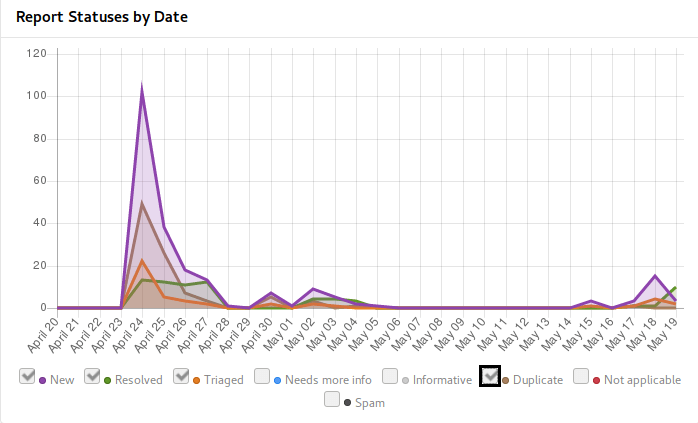
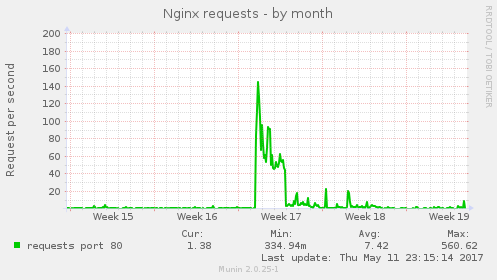
Weblate has started to use HackerOne Community Edition some time ago and I think it's good to share my experience with that. Do you have open source project and want to get more attention of security community? This post will answer how it looks from perspective of pretty small project. I've applied with Weblate to HackerOne Community Edition by end of March and it was approved early in April. Based on their recommendations I've started in invite only mode, but that really didn't bring much attention (exactly none reports), so I've decided to go public. I've asked for making the project public just after coming from two weeks vacation, while expecting the approval to take some time where I'll settle down things which have popped up during vacation. In the end that was approved within single day, so I was immediately under fire of incoming reports: Reports on HackerOne I was surprised that they didn't lie - you will really get huge amount of issues just after making your project public. Most of them were quite simple and repeating (as you can see from number of duplicates), but it really provided valuable input. Even more surprisingly there was second peak coming in when I've started to disclose resolved issues (once Weblate 2.14 has been released). Overall the issues could be divided to few groups: In the end it was really challenging week to be able to cope with the incoming reports, but I think I've managed it quite well. The HackerOne metrics states that there are 2 hours in average to respond on incoming incidents, what I think will not work in the long term :-). Anyway thanks to this, you can now enjoy Weblate 2.14 which more secure than any release before, if you have not yet upgraded, you might consider doing that now or look into our support offering for self hosted Weblate. The downside of this all was that the initial publishing on HackerOne made our website target of lot of automated tools and the web server was not really ready for that. I'm really sorry to all Hosted Weblate users who were affected by this. This has been also addressed now, but the infrastructure really should have been prepared before on this. To share how it looked like, here is number of requests to the nginx server: nxing requests I'm really glad I could make Weblate available on HackerOne as it will clearly improve it's security and security of hosted offering we have. I will certainly consider providing swag and/or bounties on further severe reports, but that won't be possible without enough funding for Weblate.

Filed under: Debian English SUSE Weblate

15 May 2017

intrigeri: GNOME and Debian usability testing, May 2017

During the Contribute your skills to Debian event that took place in Paris last week-end, we conducted a usability testing session. Six people were tasked with testing a few aspects of the GNOME 3.22 desktop environment and of the Debian 9 (Stretch) operating system. A number of other people observed them and took notes. Then, two observers and three testers analyzed the results, that we are hereby presenting: we created a heat map visualization, summed up the challenges met during the tests, and wrote this blog post together. We will point the relevant upstream projects to our results. A couple of other people also did some usability testing but went in much more depth: their feedback is much more detailed and comes with a number of improvement ideas. I will process and publish their results as soon as possible. Missions Testers were provided a laptop running GNOME on a a Debian 9 (Stretch) Live system. A quick introduction (mostly copied from the one we found in some GNOME usability testing reports) was read. Then they were asked to complete the following tasks. A. Nautilus Mission A.1 Download and rename file in Nautilus
  1. Download a file from the web, a PDF document for example.
  2. Open the folder in which the file has been downloaded.
  3. Rename the dowloaded file to SUCCESS.pdf.
  4. Toggle the browser window to full screen.
  5. Open the file SUCCESS.pdf.
  6. Go back to the File manager.
  7. Close the file SUCCESS.pdf.
Mission A.2 Manipulate folders in Nautilus
  1. Create a new folder named cats in your user directory.
  2. Create a new folder named to do in your user directory.
  3. Move the cats folder to the to do folder.
  4. Delete the cats folder.
Mission A.3 Create a bookmark in Nautilus
  1. Create a folder named unicorns in your personal directory.
  2. This folder is important. Add a bookmark for unicorns in order to find it again in a few weeks.
Mission A.4 Nautilus display settings Folders and files are usually listed as icons, but they can also be displayed differently.
  1. Configure the File manager to make it show items as a list, with one file per line.
  2. You forgot your glasses and the font size is too small for you to see the text: increase the size of the text.
B. Package management Introduction On Debian, each application is available as a "package" which contains every file needed for the software to work. Unlike in other operating systems, it is rarely necessary and almost never a good idea, to download and install software from the authors website. We can rather install it from an online library managed by Debian (like an appstore). This alternative offers several advantages, such as being able to update all the software installed in one single action. Specific tools are available to install and update Debian packages. Mission B.1 Install and remove packages
  1. Install the vlc package.
  2. Start VLC.
  3. Remove the vlc package.
Mission B.2 Search and install a package
  1. Find a piece of software which can download files with BitTorrent in a graphical interface.
  2. Install the corresponding package.
  3. Launch that BitTorrent software.
Mission B.3 Upgrade the system Make sure the whole system (meaning all installed packages) is up to date. C. Settings Mission C.1 Change the desktop background
  1. Download an image you like from the web.
  2. Set the downloaded image as the desktop wallpaper.
Mission C.2 Tweak temporary files management Configure the system so that temporary files older than three days are deleted automatically. Mission C.3 Change the default video player
  1. Install VLC (ask for help if you could not do it during the previous mission).
  2. Make VLC the default video player.
  3. Download a video file from the web.
  4. Open the downloaded video, then check if it opens with VLC.
Mission C.4 Add and remove world clocks When you click the time and date in the top bar, a menu pops-up. There, you can display clocks in several time-zones.
  1. Add a clock with Rio de Janeiro timezone, then another showing the current time in Boston.
  2. Check that the time and date menu now displays these two additional clocks.
  3. Remove the Boston clock.
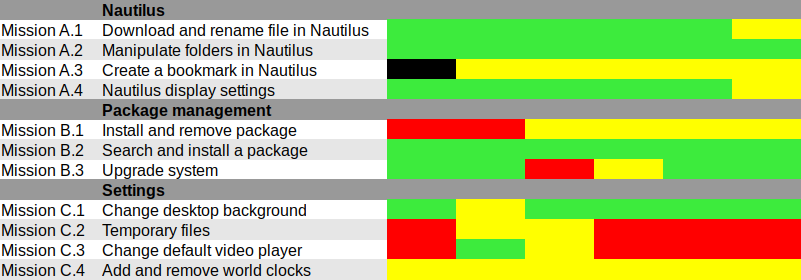
Results and analysis Heat map We used Jim Hall's heat map technique to summarize our usability test results. As Renata puts it, it is "a great way to see how the users performed on each task. The heat map clarifies how easy or difficult it was for the participant to accomplish a certain task.
  1. Scenario tasks (from the usability test) are arranged in rows.
  2. Test participants (for each tester) are arranged in columns.
  3. The colored blocks represent each tester s difficulty with each scenario task.
Green blocks represent the ability of the participant to accomplish the tasks with little or no difficulty. Yellow blocks indicate the tasks that the tester had significant difficulties accomplishing. Red blocks indicate that testers experienced extreme difficulty or where testers completed the tasks incorrectly. Black blocks indicate tasks the tester was unable to complete." Alternatively, here is the spreadsheet that was used to create this picture, with added text to avoid relying on colors only. Most tasks were accomplished with little or no difficulty so we will now focus on the problematic parts. What were the challenges? The heat map shows several "hot" rows, that we will now be looking at in more details. Mission A.3 Create a bookmark in Nautilus Most testers right-clicked the folder first, and eventually found they could simply drag'n'drop to the bookmarks location in the sidebar. One tester thought that he could select a folder, click the hamburger icon, and from there use the "Bookmark this folder" menu item. However, this menu action only works on the folder one has entered, not on the selected one. Mission B.1 Install and remove a package Here we faced a number of issues caused by the fact that Debian Live images don't include package indices (with good reason), so no package manager can list available software. Everyone managed to start a graphical package manager via the Overview (or via the CLI or Alt-F2 for a couple power users). Some testers tried to use GNOME Software, which listed only already installed packages (Debian bug #862560) and provided no way we could find to refresh the package indices. That's arguably a bug in Debian Live, but still: GNOME Software might display some useful information when it detects this unusual situation. We won't list here all the obstacles that were met in Synaptic: it's no news its usability is rather sub-optimal and better alternatives (such as GNOME Software) are in the works. Mission C.2 Tweak temporary files management The mission was poorly phrased: some observers had to clarify that it was specifically about GNOME, and not generic Linux system administration: some power-users were already searching the web for command-line tools to address the task at hand. Even with this clarification, no tester would have succeeded without being told they were allowed to use the web with a search query including the word "GNOME", or use the GNOME help or the Overview. Yet eventually all testers succeeded. It's interesting to note that regular GNOME users had the same problem as others: they did not try searching "temporary" in the Overview and did not look-up the GNOME Help until they were suggested to do so. Mission C.3 Change the default video player One tester configured one single video file format to be opened by default with VLC, via right-click in Nautilus Open with etc. He believed this would be enough to make VLC the default video player, missing the subtle difference between "default video player" and "default player for one single video format". One tester tried to complete this task inside VLC itself and then needed some help to succeed. It might be that the way web browsers ask "Do you want ThisBrowser to become the default web browser?" gave a hint an application GUI is the right place to do it. Two testers searched "default" in the Overview (perhaps the previous mission dealing with temporary files was enough to put them in this direction). At least one tester was confused since the only search result (Details View information about your system), which is the correct one to get there, includes the word View, which suggests that one cannot modify settings there, but only view them. One long-term GNOME user looked in Tweak Tool first, and then used the Overview. Here again, GNOME users experienced essentially the same issues as others. Mission C.4 Add and remove world clocks One tester tried to look for the clock on the top right corner of the screen, then realized it was in the middle. Other than this, all testers easily found a way to add world clocks. However, removing a world clock was rather difficult; although most testers managed to do it, it took them a number of attempts to succeed:
  1. Several testers left-clicked or right-clicked the clock they wanted to remove, expecting this would provide them with a way to remove it (which is not the case).
  2. After a while, all testers noticed the Select button (that has no text label nor tooltip info), which allowed them to select the clock they wanted to remove; then, most testers clicked the 1 selected button, hoping it would provide a contextual menu or some other way to act on the selected clocks (it doesn't).
  3. Eventually, everyone managed to locate the Delete button on the bottom right corner of the window; some testers mentioned that it is less visible and flashy than the blue bar that appears on the top of the screen once they had entered "Selection" mode.
General notes and observations

11 May 2017

Arturo Borrero Gonz lez: Debunk some Debian myths

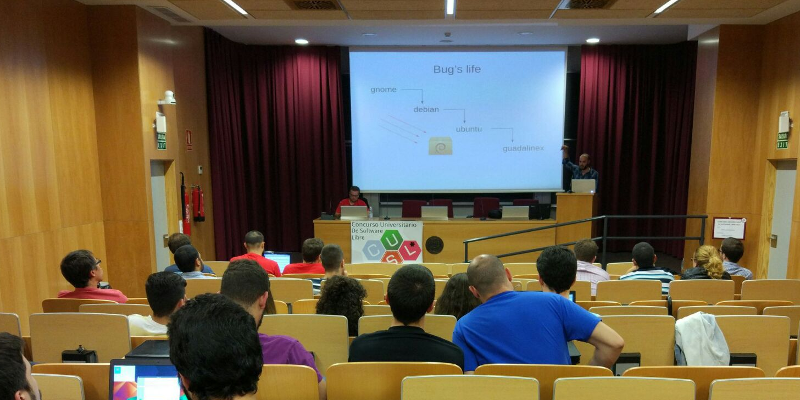
Debian CUSL 11 Debian has many years of history, about 25 years already. With such a long travel over the continous field of developing our Universal Operating System, some myths, false accusations and bad reputation has arisen. Today I had the opportunity to discuss this topic, I was invited to give a Debian talk in the 11 Concurso Universitario de Software Libre , a Spanish contest for students to develop and dig a bit into free-libre open source software (and hardware). In this talk, I walked through some of the most common Debian myths, and I would like to summarize here some of them, with a short explanation of why I think they should be debunked. Picture of the talk myth #1: Debian is old software Please, use testing or stable-backports. If you use Debian stable your system will in fact be stable and that means: updates contain no new software but only fixes. myth #2: Debian is slow We compile and build most of our packages with industry-standard compilers and options. I don t see a significant difference on how fast linux kernel or mysql run in a CentOS or in Debian. myth #3: Debian is difficult I already discussed about this issue back in Jan 2017, Debian is a puzzle: difficult. myth #4: Debian has no graphical environment This is, simply put, false. We have gnome, kde, xfce and more. The basic Debian installer asks you what do you want at install time. myth #5: since Debian isn t commercial, the quality is poor Did you know that most of our package developers are experts in their packages and in their upstream code? Not all, but most of them. Besides, many package developers get paid to do their Debian job. Also, there are external companies which do indeed offer support for Debian (see freexian for example). myth #6: I don t trust Debian Why? Did we do something to gain this status? If so, please let us know. You don t trust how we build or configure our packages? You don t trust how we work? Anyway, I m sorry, you have to trust someone if you want to use any kind of computer. Supervising every single bit of your computer isn t practical for you. Please trust us, we do our best. myth #7: nobody uses Debian I don t agree. Many people use Debian. They even run Debian in the International Space Station. Do you count derivatives, such as Ubuntu? I believe this myth is just pointless, but some people out there really think nobody uses Debian. myth #8: Debian uses systemd Well, this is true. But you can run sysvinit if you want. I prefer and recommend systemd though :-) myth #9: Debian is only for servers No. See myths #1, #2 and #4. You may download my slides in PDF and in ODP format (only in Spanish, sorry for English readers).
Next.

Previous.