Search Results: "hertzog"

5 August 2010

Alexander Reichle-Schmehl: DDs, please feel free to commit to the DPN directly

The svn repository used to draft the Debian Project News just passed the sixth hundreds commit. If my calculations are correct, that's quite more than the number of edits done, back when the DPN was drafted in the wiki. I take it as a hint, that the new work flow works better than the old one. However, playing a bit with statistics (done by horrible shell one liners ;) I noticed, that - while every Debian Developer may commit to the subversion repository - not that many commits from other DDs where made: Of the 602 commits so far, only 70 where done by other DDs:
alex@melusine:~$ svn log --xml svn://svn.debian.org/svn/publicity \
 xmlstarlet sel -t -m "/log/logentry/author" -v "concat(.,' ')"   \
sed -e "s/ /\n/g" sort uniq -c sort -n grep -v guest grep -v tolimar
      1
      1 abe
      1 hertzog
      1 holger
      1 mika
      1 paravoid
      2 pabs
      3 alfie
     15 zobel
     20 gio
     25 spaillard
To give credit where credit is due, here are the guest commits:
     16 tpeteul-guest
     21 jeremiah-guest
     25 gmascellani-guest
     36 madamezou-guest
    122 taffit-guest
Many thanks so far, but I would like to advertise the Debian Project News and invite every DD to help us and to commit directly. It's quite easy: Run svn co svn+ssh://svn.debian.org/svn/publicity/dpn/en/current, edit the index.wml file, and then commit your changes back to the repository. (Well, ideally you would also honor Status flag and won't commit, if it's not open-for-edit.) As for the format: While we indeed use wml, you just need some basic HTML knowledge. To add a paragraph just use the following with proper content:
<a name="X"></a>
<h2>Fancy title</h2>
<p>More details about the topic.</p>
Usually the articles are kind of sorted by importance, so unless you are pretty sure it might be the easiest to just add your article at the end of the regular news, just before the other news sections. Should you not be able to fill an entire paragraph, feel free to just a one or two sentences to the other news section (just add a <p>...</p> with your content to the end of the other news). Don't worry about style, your English or syntax: It won't end up on the web page directly, it's reviewed and checked, so you can't do anything wrong. More details are available in the wiki at http://wiki.debian.org/ProjectNews/HowToContribute. Feel free to ask any questions unanswered on the publicity list at debian-publicity@lists.debian.org. Feel also free to contact us there, if you would like to help by translations or reviews. The more people help, the less work it's for everyone :) If you are not a Debian Developer, but still would like to help us, it's no problem. All you need is an account on our Alioth System (very easy to get, you just need to ask) and request to join the publicity project. See http://wiki.debian.org/ProjectNews/HowToContribute#Becominganeditoryourself for the respective links.

1 August 2010

Rapha&#235;l Hertzog: First Flattr FOSS Suggestions

Flattr FLOSS LogoThe Flattr FOSS project is quite young so very few free software are currently listed in the dedicated directories. It s still advocacy time: if there are free software that you d like to flattr, please tell them and point them to Flattr FOSS. It s too early for any conclusion, but the feedback from users is good and it looks like that people using flattr to support free software are more generous than the average flattr user. You re great people! :-) Anyway, it s time for me to give a few suggestions of projects to flattr.
  1. My first recommendation is Project Hamster, it s a time-tracking application for GNOME but it has come a long way thanks to the work of Toms Bau is. I use everyday and it rocks.
  2. My second recommendation is verallt, it s a Firefox extension that allows usage of Flattr even in places where it was not designed to be used: forums, mailing list archives, etc. The persons using Flattr just put [Flattr=20693] in their signature and the Firefox extension automatically replaces this text with a real Flattr button ready to be clicked. Thanks to Paul Da Silva for the nice idea and the first implementation!
  3. My third recommendation is Mustard, it s a StatusNet client for the Android platform. More concretely you can install it on your Android phone to send updates to identi.ca while traveling. I have no Android phone but Mustard seems to be popular among owners of such phones!
  4. My fourth recommendation is moreutils from Joey Hess. It s set of unix (command line) tools that nobody else thought of writing when unix was young (according to Joey himself). They are all very useful, I use more or less regularly isutf8 (verify if a file is UTF-8 compliant), combine (logical operations on lines of two files), pee (send standard input to two programs, very useful in git hooks when you want to run two programs that both consume the same data), sponge (ever tried grep -v foo file >file and lost your data? now you can use grep -v foo file sponge file ). And Joey is a long time Debian developer who has truly shaped Debian, he s behind several major Debian projects (debconf, debian-installer, debhelper, ). Big kudos to him!
  5. My last recommendation is to flattr Andreas Gohr for his work as dokuwiki lead developer. There s no flattr button on dokuwiki s website but you ll find some in Andreas blog, just pick a dokuwiki related article like this one: Dokuwiki Birthday Bughunting Weekend. Dokuwiki is a simple wiki that works without any database (the pages are stored in flat files) and it s even commonly used to setup simple websites thanks to the numerous themes available.
Okay, that s it for this month. I ll try to keep a broad panel of software (desktop, command line, mobile, web, etc.). Since I have promoted a GNOME desktop application, I would like to be able to promote a KDE or XFCE application next month but I did not discover any KDE/XFCE project using Flattr do you know any? Please share in the comments if you find some. Also I wonder if you have decided of a flattr strategy Personally I m likely to flattr my favorites projects/persons each month and to flattr a few other occasionally as I discover them. What s your own strategy? Flattr this Share/Bookmark 4 comments Support my work

28 July 2010

Rapha&#235;l Hertzog: Do You Want a Free Debian Book? Read on.

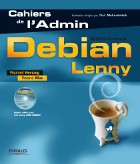
Cover of my French Debian BookWhile I have made good progress on many of my Debian goals for this year, it s not the case for the goal number #1: translating my Debian book into English. The picture on the left is the cover of the current French version based on Debian Lenny (450 pages). But the translation would be based on the next edition that we re currently preparing and it s based on Debian Squeeze of course! We have already translated the table of contents so that you can get an idea of what s in the book. Note that many parts of the book apply to Ubuntu as well. It s quite difficult for Roland and me to allocate several months of our life to such a huge task without any income in that period and without knowing if our book will sell enough to cover for the time invested. For those reasons, we re considering using a service like kickstarter.com or ulule.com or yooook.net to get this project funded. If you don t know those services, they allow you to present your project and to collect pledges so that you can safely complete your project. The money pledged is distributed only if the total amount pledged exceeds the minimal funding level (set by the project creator). Furthermore you can select nice rewards depending on the amount of money pledged. To make things even more exciting we are ready to publish the book under a DFSG-compatible license at the sole condition that we reach 25 000 of donations. That might look like a lot but in fact it s only 5 donated by 5000 persons and then everybody benefits! And for the authors, you have to remove ~10% of fees taken by the funding service (including card processing fees), 16.4% VAT, 9% social taxes and if you consider that the project represents a minimum of 6 months of work, that ends up to at most 2850 /month. We believe this to be reasonable. The next step for us is to pick the service to use and setup the fundraising. We need your input. Please answer a few questions by filling this form. In all cases, we will have those rewards and probably more: A few considerations about the various services: Kickstarter.com is a great service but it s restricted to US-residents so it s complicated for us to use that service since we re French (and live in France) and the supporters need to have an Amazon (payments) account. Ulule.com is open to anyone for project creation but uses a paypal API to deal with the pledge mechanism and thus imposes that all supporters have a paypal account. Is that requirement likely to scare you away? Yooook.net is specialized in liberation fundraising but the interface is not very polished, they don t offer (many) social features nor do they give a public listing of the projects hosted. The choice is difficult and thus we re seeking your feedback to make the right one, take a few minutes and answer our questions: click here to go to the form. Thank you for your help and please spread the word so that we get enough answers to have meaningful results. Update: it has been brought to my attention that kickstarter requires an Amazon (payments) account. I fixed my article and the form to document this. I have also been asked what license we re going to use. It s likely to be dual-licensed GPL2+ / CC-BY-SA 3.0. Flattr this Share/Bookmark 4 comments Support my work

25 July 2010

Rapha&#235;l Hertzog: Ubuntu default bookmarks pointing to Debian

Just noticed that the default bookmarks in Ubuntu include one entry pointing back to Debian. It even says that Ubuntu is based on Debian. It s a small thing but it made my day. It s nice to see this kind of acknowledgement. Click on the screenshot to see the picture in full size (and yes, most favicons suck with a dark background). For those wondering, the screenshot is taken on a default install of Ubuntu 10.04 Netbook Edition. Flattr this Share/Bookmark 3 comments Support my work

23 July 2010

Joey Hess: Flattr FOSS

Raphael's Flattr FOSS is a good idea: Make it really easy for users to pay tips for free software and maybe users who otherwise wouldn't express their appreciation will. I've added Flattr buttons for a few of my Free Software packages. Am interested to see how it works out.
Flattr this
Regarding Flattr itself, I have always wanted a way to easily micropay artists, coders, etc online. Especially musicians like Mosaik! The way it splits your monthly payment amoung everyone you've Flattr'd that month is smart; it takes money out of the picture when deciding whether to click on a Flattr button. I think it would be more honest, though, if rather than taking 10% of everything (which would be just absurd and indefensible if this were used on a large scale, and whiffs faintly of pyramid scheme even now), Flattr took one share of your monthly payment (as if you automatically Flattr'd them each month). That would provide even more incentive to Flattr lots of other things. And if lots of people were Flattring lots of things, Flattr would still make plenty of money.

22 July 2010

Rapha&#235;l Hertzog: Quick news: dpkg, collab-maint, alioth and the future

Dpkg got rid of Perl Let s start with the interesting part and the great news: dpkg 1.15.8 (to be uploaded soon) will no longer need perl! After my changes to rewrite update-alternatives in C, Guillem recently pushed the rewrite of dpkg-divert/mksplit in C. Please test it out (binary package for i386 or .dsc). This is rather exciting news for those who would like to use dpkg in embedded contexts. And it s great to see this completed in time for Squeeze. In Squeeze+1, we might go one step further and merge cdebconf, the C replacement for debconf. I got rid of some recurring administrative tasks I have been administrating the Alioth server since its inception (see the announce I sent in 2003) but I m no longer enjoying the day-to-day administrative work that it represents. That s why I just retired from the team. We recently recruited Tollef Fog Heen so the number of admins is still the same (that said, Alioth could benefit from some more help, if you re a DD and interested, drop a mail to admin@alioth.debian.org or come to #alioth). Same goes for the collab-maint project. I have dealt with hundreds of requests to add new contributors to the project since it s the central repository where all Debian developers have write access and where they put the VCS for their packages that do not belong to a more specialized team. The new administrator that will approve the requests is Xavier Oswald and he s doing the work under the umbrella of the New Maintainer s Front Desk. The future I will continue to spend the same amount of time on Debian, the time freed will quickly be reallocated to other Debian and free software related projects. In fact, I even anticipated a bit by launching Flattr FOSS last week but that s a relatively simple project. :-) The other projects that will never all fit in the freed time: I want to spend more time working on dpkg. I do plan to blog more often too, but I m sure you ll notice that yourself soon. I would like to see my Debian book translated into English (another post coming on the topic sometimes soon). In my dreams, I could even start yet another software project, I have some ideas that I really would like to see implemented but I don t see how that could fit in this year s planning unless I can convince someone else to implement them! Maybe I should blog about them. Flattr this Share/Bookmark 5 comments Support my work

15 July 2010

Rapha&#235;l Hertzog: Social Micropayment Can Foster Free Software, Discover Flattr

Social Micropayment Flattr LogoA social micropayment system allows you to donate a small amount of money (a few pennies/cents) to thank someone else for a good blog post, piece of music, or for a free software that you enjoy. That s what Flattr is all about. How Flattr works With Flattr, donating is as easy as a single click on a Flattr button that content providers (read free software developers ) embed on their websites. A Flattr button is very similar to a Digg button or other social buttons (you can look at the end of this blog post for a sample). The amount donated per flattr varies from month to month because you define a fixed amount of money to spend each month (minimum 2 ) and it s split evenly between all the things that you appreciated. You can flattr as much as you want, it won t cost you more. Support Free Software with Flattr Free Software lacks a good business model to fund the creation of software, yet someone has to pay the time spent in writing the code. Many projects have tried to ask for donations but the amount collected rarely covers more than the expenses for the website hosting. Flattr makes it so easy to donate that this is possibly about to change. Flattr users have to spend their monthly amount each month, otherwise it gets donated to charity. Thus if it takes off, most Flattr users will grow the habit of doing regular donations to projects that they use and appreciate. Bootstrapping the Process Flattr FLOSS LogoFlattr is a new service, not many projects are using it to accept donations and not many users are participating yet. But it s growing quickly on both sides. In order to help users who want to support Free Software with Flattr, I have started the Flattr Free and Open Source Software project. You can subscribe to a newsletter to receive a monthly reminder with recommendations of Free Software to Flattr. If you have more time, you can also browse public directories listing various Free Software projects using Flattr so that you can manually pick your favorites. To learn more about the Flattr FOSS project, click here. I also invite Free Software developers to setup Flattr on their websites, blogs, and to register those sites so that Flattr users can easily find them. To learn more about this, check out the Earn a Living With Free Software page. Share the News Flattr can change the situation of many small but popular free software projects struggling with a single developer who started it as a hobby and who can t afford to spend more free time on it. But this can only happen if lots of users start using Flattr to support the Free Software that they benefit from. So share the news, tell the friends, join Flattr FOSS and give some Flattr-love every month. Get Your Free Flattr Invite! Flattr is still in beta, but they like Free Software a lot and have offered 30 invites for the launch of Flattr FOSS. You can get yours by subscribing either to my main newsletter or to the Flattr FOSS one. Just reply to the welcome email you get after having subscribed and ask for your invite. Flattr this Share/Bookmark No comment Support my work

7 July 2010

Rapha&#235;l Hertzog: Joining Ubuntu as a Debian developer

I m a Debian developer since 1998 and have been fostering cooperation between Debian and Ubuntu since its inception with various levels of success. I recently decided to go one step further and join Ubuntu as an official member. I wanted to be able to vote and to promote best cooperation practices from the Ubuntu side as well (and not only in Debian). Joining as a Debian developer should be relatively easy, it is well known in the Debian community that Mark Shuttleworth once said:
Every Debian developer is also an Ubuntu developer, because one way to contribute to Ubuntu is to contribute to Debian.
So I sought to verify that too! Here s the result. I prepared my application page collecting 2 testimonials from Lucas Nussbaum and Colin Watson, I registered for the next EMEA membership meeting (which happened yesterday, irc logs here), and I attended. (I just followed the instructions on the wiki) During the meeting, when it was my turn, I pasted my short introduction and got immediately +1 votes from several board members, they didn t even want to hear from me, they were already convinced. :-) I still responded to a few questions and elaborated on my goals and was promptly accepted even if I made it clear that my technical contributions will continue to be done within Debian. A few minutes later I was added to the ubuntumembers launchpad group and this morning I followed the instructions to add my feed to Planet Ubuntu and here I am The whole process has been very smooth and the meeting shows a very welcoming attitude. Even someone who was denied the Ubuntu member status was cheered for his work and encouraged to try again when he can present some testimonials from other members. Hello Planet Ubuntu! Flattr this Share/Bookmark 11 comments Support my work

28 June 2010

Carl Chenet: Debian maintainer

As some of you may (or more certainly may not) have noticed reading the Debian Project News, I recently became a Debian maintainer. A hugh thanks to Sandro Tosi (morph) and Piotr O arowski (piotr) for their careful reviews of my work. And thanks to Raphael Hertzog (buxy) to pull the trigger for the beginning of my involvment in Debian. I can t wait to attend Debconf 2010. See you there ! Follow me on Identi.ca: http://identi.ca/carlchenet

25 June 2010

Rapha&#235;l Hertzog: Reorganization of my blog, please update your feeds

Up to now I had a single blog hosted on ouaza.com, I used to blog in French and in English on many topics, even though free software and Debian was the main topic. Sometimes I avoided blogging on something because it would not really match the expectations of my readers (and of the various planets syndicating my blog). And I have always been annoyed by the fact that English readers were second-class on my blog because everything was configured in French. So I decided to fix this once for all, I have created two new blogs in addition to ouaza.com. The latter is now my private blog (in French) with everything that is not free software related. And free software will be the topic of my 2 new blogs : I have setup some HTTP redirections on various feed URLs but if you were subscribed to my main feed, you re now redirected to the new English feed and you might want to subscribe to the French one to continue reading my articles in French. In any case, you might want to update the feed URL that you used. I also profited from this reorganization to switch to WordPress 3.0 and the 3 blogs are hosted on the same installation thanks to the new multisite feature and to the domain mapping plugin. The main regression in those changes is that I m back to the (new) default theme of WordPress with the standard header image. I would like to personalize them but I have no graphics skills but if you do and would like to work on this for me, please get in touch. I ll make sure you get your pony in return. :-) More changes concerning those blogs are in the pipe but that will be the topic of other posts. Thanks for following ! Flattr this Share/Bookmark No comment

11 June 2010

Rapha&#235;l Hertzog: About the Debian Community Poll

While I find the idea interesting, several of the questions can t be correctly answered because the proposed choices are not realistic or too limited. On the question of the usage of money, I believe we should spend money to fund important projects but I don t want to fund people having important positions in Debian and doing important work . What should I reply? (Granted, there s the other item but that doesn t help getting a clear picture of the answers) On the question Do you prefer time based releases instead of the it s ready when it s ready releases? , it is putting two concepts in opposition when the release managers recently proposed a third way that combines both: time based freezes and release when it s ready . This is what I want and I can t adequately express it either in the current poll. Partagez cet article / Share This

27 May 2010

Rapha&#235;l Hertzog: Rewriting update-alternatives in C

Among the goals listed in dpkg s roadmap, there s the C rewrite of the remaining perl scripts provided by the dpkg binary package (dpkg-dev is not concerned, it will remain a collection of perl scripts). Of the remaining scripts, update-alternatives was the largest piece of code (~1100 lines of perl) and I started converting it to C a few weeks ago (based on preliminary work of Guillem). It s now 2200 lines of C Thanks to the relatively extensive test-suite that I wrote last year, I m relatively confident that this new update-alternatives won t break your system. That said, it still needs some real-life usage to ensure everything is really ok (and users actively trying to break it are even better). Thus I would be glad if you could try it out ( binary package for i386 or .dsc) and report back to debian-dpkg@lists.debian.org. The rewrite of the 2 other remaining scripts is almost completed in a branch of Guillem. Hopefully this can be our last project completed in time for Squeeze as far as dpkg goes. It would be a great achievement for people that would like to use dpkg in embedded environments and avoid perl due to its size. Note: nobody sponsored that work. But it s not too late :-) Partagez cet article / Share This

17 May 2010

Rapha&#235;l Hertzog: Open money and Debian

I recently read an introductory article in an IT magazine on the increased usage of new currencies. It briefly mentioned the work of a researcher called Arthur Brock in using those currencies within open source communities. While I did not find more details on the research, it led me to think again about Debian s relation with money. The reason why we have troubles using money to pay the time spent by our developers is that money is scarce and it s thus next to impossible to be fair in the way money is spent among us. So why not invent a new currency that is not scarce and that would encourage the kind of work that we really value? Apparently there is free software out there to build new currencies: see metacurrency.org or openmoney.org. Let s call the new currency swirly/swirlies for the sake of the examples below. There are then multiple ways to create a small economy within the community and/or even create bridges with the national currencies: I m sure we can come up with many similar ideas. Feel free to share yours in the comments. Partagez cet article / Share This

28 March 2010

Clint Adams: DPL Campaign Questions 009

Serafeim Zanikolas:
With respect to attracting new contributors, please ponder the idea of a formal one-on-one mentoring scheme (as opposed to one-off interactions via d-mentors).
I see nothing particularly objectionable about this. A long time ago people were talking about replacing NM with a saner mentoring process, and I am certain that mentoring occurs unofficially. I see no reason that you could not set up a formal one-on-one mentoring infrastructure with or without the Project's blessing. Charles Plessy:
So my question to other candidates is simple: what is your opinion and program about membership?
I think that we have enough inequality in the project as it is. That is why I consider DM to be a bad thing, even though it has practical benefits. I think that NM is probably fundamentally broken, and I get a bit nervous when people are talking about increasing the amount of NM indoctrination or bureaucracy. I would be in favor of exploring the replacement of NM with some kind of mentorship-type process, though I would worry it would not scale. I would be in favor of exploring the replacement of NM with something like Lars's proposal a while back, though I would worry that it would encourage popularity contests and cliques and cabals. Raphael Hertzog:
1/ Do you believe that it's a good move to standardize our packaging tools? (example: debhelper is almost standard, quilt is gaining status of the standard patch system thanks to the new source format) 3/ Do you have any preference on the tools that we should try to standardize on (which source format/patch system, dh7/CDBS/yada/etc., VCS helper, etc.)? 4/ Organizing changes that have an impact on (a large part of all) the archive is very difficult: How can we change our processes so that doing/organizing such changes is less of a burden? 5/ I have the feeling that Debian is innovating less than it used to do. We are more often followers rather than leaders. Do you share that feeling? What shall we do to make that change?
1/ I think that we should standardize on dpkg-dev. If there are features which absolutely every package needs, it would seem the logical place to add them. 3/ Right now I wish everyone were using git, but I do not believe in forcing them. Of the available source formats, I like 3.0 (quilt) with no additional patch system, and no package helpers at all. I am not quite sure what a VCS helper is so I have no known preference to express. 4/ I am not sure whether or not what you are talking about should, in fact, be less of a burden, and why it should or should not, so I do not have a valid opinion on how to change the process. 5/ I do share that feeling. I think that sometimes we get bullied by Ubuntu when there are things we would do for our own benefit which would make their lives difficult. I think that people are generally resistant to change, even when it would be of little cost to them and great benefit to someone else. These problems are social and might be correctable with a better spirit of teamwork and cooperation. However, I do not think we should be innovating just for innovation's sake or to be known as the most innovative kid on the block. We should be making my favorite operating system.

27 March 2010

Clint Adams: DPL Campaign Questions 004

Russ Allbery:
Do you have any thoughts about how to resolve release issues with less hurt and negative impact to the project all around?
I sure do. There has been a trend over many years to conflate the release management role with many other things: QA work, buildd work, ftpmaster-like work (I mean britney here), and in some cases I would even say DPL work. If we relegate release management to a strictly managerial role, I am certain that much of the stress, tension, and burnout will be mitigated. This means putting more access into the hands of many people, which is a good thing anyway. A release manager's job should be to say when a release is ready, what should and should not be in that release, and potentially some coordination with other developers, who are almost their equals. There will still be social conflict when the spirit of teamwork and cooperation is overcome by other factors, but I can conceive of a point where even that would not happen. Raphael Hertzog:
What do you think of this and would you be ready to withdraw a delegation for a delegate that behaved badly towards another DD (even outside of his delegated role), that has been warned once by you and that did it again later on? Do you think we can draft a code of conduct for Debian and do you think you can ensure that it would be respected by delegates?
I do not think that any long-term delegations should exist. I think that if they do, we have a structural problem which should be addressed in another way. Therefore I do not think it should be a big deal to withdraw a delegation for any legitimate reason, and if we are trying to force people to behave better (by a definition I agree with), then it seems reasonable to withdraw a delegation for bad behavior. Of course I would include ignoring people and having secret meetings in Vancouver as bad behavior, so that is perhaps not what you are getting at. I am not particularly in love with any formal codes of conduct, but I do think it is reasonable to hold DPL delegates or anyone who holds privileged positions of power to a much higher standard of behavior than the standard DD. With power should come responsibility, and all that. Presumably I would not delegate anyone who would place self and ego ahead of the well-being of the project, and presumably if there were a formal code of conduct or set of guidelines for delegates, those principles would align.

Clint Adams: DPL Campaign Questions 002

Raphael Hertzog:
Imagine a DD contacts you, she wants to setup an infrastructure to finance Debian related projects (i.e. paying people to enable them to work on the projects that they'd like to do for Debian) but she wants to avoid the main mistakes made during Dunc-Tank; in her project: - everybody can propose projects to be financed - the projects to be financed are selected by the Debian developers and by the donors - eligible projects can only concern new developements and not recurring tasks
I am imagining that this contact took place in public. I see very few legitimate and good reasons to approach the DPL privately, and as DPL I would encourage people to to work toward transparency unless there were very good reasons to do otherwise. I would begin by telling her about the beauty of Debian as a gift economy community, and point out how great it is that I do not need to pay people to respond to my bug reports, apply my patches, release new versions, or develop any code not funded by corporate sponsors. I would recount my recent experience with a different free software community, where there was much talk of the motivational power of money, and how best to link PayPal to bug tracking systems and write a boilerplate email response template suggesting a donation of $5,000 to help facilitate the development of any feature requests. I would confess my suspicion that if this trend continues, any goodness in that community will be driven elsewhere, and the gift economy, which I believe to be a very important basis for free software, will be severely undermined. When I have completed my feeble attempt at political persuasion, if she is still firm and stubborn in her desire to proceed (and when monetary greed is involved, I expect this kind of stubbornness), I would suggest the following points: Then I would ask her once again not to do anything like this. Dmitrijs Ledkovs:
Please finish "In ten years I'd like Debian...."
In ten years I'd like Debian to still be my favorite operating system. In ten years I'd like Debian to be egalitarian and cooperative. In ten years I'd like Debian to be completely free software, without a non-free section.

9 January 2010

Rapha&#235;l Hertzog: Debian related goals for 2010

Here s stuff that I d like to do this year, more or less by decreasing order of importance: All of this probably doesn t fit in my free time (being a father since last month does not help increasing my free time :-) ), so if you re interested in seeing one or more of those projects completed, and if you know some person/company that could sponsor them, get in touch with me! Partagez cet article / Share This

5 January 2010

Rapha&#235;l Hertzog: 5 years of Freexian

5 years ago I founded my own company Freexian SARL with the goal to make a living out of my free software experience. I marketed the company as being specialized on the Debian distribution in the hope to combine my Debian work and my professional work. Given that Freexian is still alive I think I met the first goal. My free software experience allowed me to complete many projects: a large number of development projects for embedded devices running a custom Linux distribution (usually built with debian udebs), the development of a Debian derivative (SLIS) and some recurring tasks of remote system administration. However, even if I use Debian daily for all my work, very few of the projects that I complete for customers have direct results in terms of improvements for Debian (except some bugreports and some related fixes). And even when I m able to contribute something back to Debian, it s usually not in areas that I care about. My focus within Debian is on the technical and organizational infrastructure of the project: as a dpkg/dpkg-dev maintainer I try to improve the packaging infrastructure, as a QA member I maintain the Package Tracking System to ease collaboration, as an Alioth admin I ensure all DD can host VCS repositories for their Debian related projects, as a developers-reference co-maintainer I try to share good packaging practices, etc. Given this bias, it s difficult to find customer projects that would let me contribute in those areas. Thus I think I need to try another approach: the simplest solution would be to find sponsors for some of my own Debian-related projects (if you have something else to suggest, please leave a comment either in the blog or by mail). That said finding sponsors looks like a difficult task in itself. While I can imagine (for example) a company using Debian on embedded devices that would like to sponsor the rewrite of update-alternatives in C in order to get rid of the perl dependency in the dpkg package (if you know such a company, get in touch with me!), I don t see who would have an interest in sponsoring the time that I need to contribute new sections to the developers-reference manual. But who knows maybe I should just try and publicly solicit sponsorship for some of the projects that I care about. In any case, suggestions and comments are welcome! Partagez cet article / Share This

25 November 2009

Gunnar Wolf: Source format 3.0 (quilt) for teh win!

My Debian QA page shows what I consider to be a huge amount of packages I am currently uploader for 207 packages. Why so many? There are many factors The main one is group maintenance (I'm directly responsible only for 19; of course, this should not mean I disregard the rest of them), the second one is regularity. By far, most of my source packages (177) match lib.*perl, followed by lib.*ruby with 20. Anyway A strong factor that allows the pkg-perl group to be successful in maintaining 1411 packages is the regularity of the task: Packaging Perl modules is usually as easy as running dh-make-perl on them (of course, not taking away the merit of packaging the few strange corner cases In Ruby-land, the landscape is quite different. The developer community is quite anchored in agile worldviews, which go beyond coding practices and all the way over to confronting the way most Free Software projects distribute their work. I have previously ranted presented informed and opinionated blog posts on this topic Ruby culture dictates the distribution via Ruby Gems, which are for many reasons not Debian friendly. Besides Gems, most projects have adopted Git for development tracking and are hosted under Github That's why I came up with Githubredir, which basically presents an uscan-friendly listing of tags for a given project. But if you develop in Git, you might want to split a project in its constituent parts for easier organization, without meaning that each subproject should be an independent project by itself, right? After all, that's what Git submodules are for. That's what happened with a great PDF generating library for Ruby, Prawn. Thing is, the three parts of the main project are required for the project to be built. Anyway, that was a great reason to move the package over to the new dpkg 3.0 (quilt) source format. And, yes, it is a straightforward move! If you have not yet done so, take a look at Raphael Hertzog' explanation+FAQ wiki page. It just works, and makes many things way easier. There are still some wrinkles in my packaging, like where I'm getting the orig tarballs from As the submodules are not presently tagged in any way, I was only able to download a snapshot of their respective current master branches. This is suboptimal, I know, but I have talked to the upstream author, and he confirms that for the next major version (which should not be long in coming) the tags will be synchronized, and things will be even cleaner. PS- I love Hpricot. To get the numbers for my QA page, I just had to get three dirty but useful arrays:
  1. require 'hpricot'
  2. require 'open-uri'
  3. url = 'http://qa.debian.org/developer.php?login=gwolf&comaint=yes'
  4. doc = Hpricot(open(url))
  5. tot = ( (doc / 'table' )[1]/'tr').map row
  6. (row%'td' % 'a').inner_html rescue nil .select i i
  7. team = ( (doc / 'table' )[1]/'tr').map row
  8. (row%'td' % 'span.uploader' % 'a').inner_html rescue nil .
  9. select i i
  10. mine = ( (doc / 'table' )[1]/'tr').map row
  11. (row%'td' % 'span:not(.uploader)' % 'a').inner_html rescue nil .
  12. select i i

And work from the three very simple lists there i.e. tot.select pkg pkg =~ /lib.*perl/ .size gives me 177.

6 November 2009

Jaldhar Vyas: The Road to Wigan Dpen

3.0 format source packages can now be uploaded to the Debian archive. (Note: despite the title of this post, this is not the "Wig and Pen" format which is 2.0. See dpkg-source(1) for a detailed description of all the source package formats.) I tried converting my libcgi-application-basic-plugin-bundle-perl package with mostly good results. l-a-b-p-b-p is an aggregation of perl modules (in .tar.gz format) from CPAN. There is no upstream, this is a Debian only package. Currently the source looks something like this:
   
build-area/
    libcgi-application-basic-plugin-bundle-perl-0.5/
        debian/
            [all the standard stuff: control, rules, etc.]
        tarballs/
            CGI-Application-Dispatch-2.16.tar.gz
            CGI-Application-Plugin-AutoRunmode-0.16.tar.gz
            CGI-Application-Plugin-ConfigAuto-1.31.tar.gz
            ...
            [rest of modules]
The files in the tarballs directory are unpacked at build time to create the binary package. This works but has all the disadvantages of "tarballs in tarballs." By adding a file called debian/source format with the single line:
   
3.0 (quilt)
...dpkg-source is directed to use that format. Now I can rename each upstream tarball to
   
<package name>_<package version>.orig-<upstream tarball name with .'s replaced by -'s>.tar.gz
...and organize the source like this:
   
build-area/
    libcgi-application-basic-plugin-bundle-perl-0.5/
        debian/
            [all the standard stuff: control, rules, etc.]
    libcgi-application-basic-plugin-bundle-perl_0.5.orig-CGI-Application-Dispatch-2-16.tar.gz
    libcgi-application-basic-plugin-bundle-perl_0.5.orig-CGI-Application-Plugin-AutoRunmode-0-16.tar.gz
    libcgi-application-basic-plugin-bundle-perl_0.5.orig-CGI-Application-Plugin-ConfigAuto-1-31.tar.gz
    ...
    [rest of modules]
    libcgi-application-basic-plugin-bundle-perl.orig.tar.gz
Each module is now a seperate file in the debianized source with MD5sum etc. The only problem I am having is with the last file. libcgi-application-basic-plugin-bundle-perl.orig.tar.gz makes no sense for me because there is no upstream yet dpkg-source insists on it. I can make a dummy easily enough but this is an unnecessary annoyance so I filed bug #554488. Raphael Hertzog responded quickly. He is considering adding a --create-empty-orig option to dpkg-source which would solve the problem nicely.

Next.

Previous.