Search Results: "gio"

20 November 2014

Gunnar Wolf: UNAM. Viva M xico, viva en paz.

UNAM. Viva M xico, viva en paz.
We have had terrible months in Mexico; I don't know how much has appeared about our country in the international media. The last incidents started on the last days of September, when 43 students at a school for rural teachers were forcefully disappeared (in our Latin American countries, this means they were taken by force and no authority can yet prove whether they are alive or dead; forceful disappearance is one of the saddest and most recognized traits of the brutal military dictatorships South America had in the 1970s) in the Iguala region (Guerrero state, South of the country) and three were killed on site. An Army regiment was stationed few blocks from there and refused to help. And yes, we live in a country where (incredibly) this news by themselves would not seem so unheard of... But in this case, there is ample evidence they were taken by the local police forces, not by a gang of (assumed) wrongdoers. And they were handed over to a very violent gang afterwards. Several weeks later, with far from a thorough investigation, we were told they were killed, burnt and thrown to a river. The Iguala city major ran away, and was later captured, but it's not clear why he was captured at two different places. The Guerrero state governor resigned and a new governor was appointed. But this was not the result of a single person behaving far from what their voters would expect It's a symptom of a broken society where policemen will kill when so ordered, where military personnel will look away when pointed out to the obvious, where the drug dealers have captured vast regions of the country where are stronger than the formal powers. And then, instead of dealing with the issue personally as everybody would expect, the president goes on a commercial mission to China. Oh, to fix some issues with a building company. That coincidentally or not was selling a super-luxury house to his wife. A house that she, several days later, decided to sell because it was tarnishing her family's honor and image. And while the president is in China, the person who dealt with the social pressure and told us about the probable (but not proven!) horrible crime where the "bad guys" for some strange and yet unknown reason (even with tens of them captured already) decided to kill and burn and dissolve and disappear 43 future rural teachers presents his version, and finishes his speech saying that "I'm already tired of this topic". Of course, our University is known for its solidarity with social causes; students in our different schools are the first activists in many protests, and we have had a very tense time as the protests are at home here at the university. This last weekend, supposed policemen entered our main campus with a stupid, unbelievable argument (they were looking for a phone reported as stolen three days earlier), get into an argument with some students, and end up firing shots at the students; one of them was wounded in the leg. And the university is now almost under siege: There are policemen surrounding us. We are working as usual, and will most likely finish the semester with normality, but the intimidation (in a country where seeing a policeman is practically never a good sign) is strong. And... Oh, I could go on a lot. Things feel really desperate and out of place. Today I will join probably tens or hundreds of thousands of Mexicans sick of this simulation, sick of this violence, in a demonstration downtown. What will this achieve? Very little, if anything at all. But we cannot just sit here watching how things go from bad to worse. I do not accept to live in a state of exception. So, this picture is just right: A bit over a month ago, two dear friends from Guadalajara city came, and we had a nice walk in the University. Our national university is not only huge, it's also beautiful and loaded with sights. And being so close to home, it's our favorite place to go with friends to show around. This is a fragment of the beautiful mural in the Central Library. And, yes, the University stands for "Viva M xico". And the university stands for "Peace". And we need it all. Desperately.

4 November 2014

Tiago Bortoletto Vaz: A few words on the recent Brazilian elections

The Brazilian presidential election was exceedingly intense this year. Among many inferences that we can make by following the news and investigating data from the voting results I'd like to share this one, which in my opinion reflects quite well the vote preferences in the country. First, let me introduce you "Bel gua", a small town located in the Northeast region of Brazil. It has 6,524 habitants, 3 buses and 2 hospitals. According to the Brazilian Institute of Geography and Statistics (IBGE), the income per person in Bel gua is $146 BRL (or U$59) per month. Believe it or not, it used to be much less. Actually, the city reported in 2013 the highest economic jump in the country, rising more than a thousand positions in the ranking of GDP per capita (from position 4,991 to 3,849). This recent growth was consequence of the social welfare program of the Brazilian government, which also boosted artisanal and manioc flour production. This federal assistance is called "Bolsa fam lia", which benefits 1.814 families in Bel gua.
"Bolsa Fam lia currently gives families with per-capita monthly income below $140 BRL (poverty line, ~$56 USD) a monthly stipend of $32 BRL (~$13 USD) per vaccinated child (< 16 years old) attending school (up to 5), and $38 BRL (~$15 USD) per youth (16 or 17 years old) attending school (up to 2). Furthermore, to families whose per-capita monthly income below $70 BRL (extreme poverty line, ~$28 USD), the program gives the Basic Benefit $70 BRL per month." (from Wikipedia)
Contrary to what many of my middle-class friends believe, and as you can calculate yourself, this little amount of money does not offer anybody a luxury life. It does not make anybody stopping working, nor stopping looking for paid job (but yes, it makes people to start saying NO to forced labor, which is amazing, right?).
/images/belagua.jpg

Bel gua, where Dilma got 93.93% of votes (photo by Clarissa Carramilo / from G1)

Also, Bel gua has no much physicians around because doctors in Brazil usually wouldn't live in a such city. But now Bel gua population can be treated by foreign doctors imported by the recently launched program "Mais M dicos" (More Physicians for Brazil), which hosts two Cuban doctors 15km away. Finally, Bel gua people have light, due to the "Luz para Todos" ("Light for All") program. It's not surprising that Bel gua has re-elected the party which has motivated these changes. For 2014 presidential election, Bel gua people gave 3.558 votes (93.93%) to Dilma Rousseff (candidate of the current government, from a left-ish party), against 230 (6,07%) to A cio Neves (from the right coalition), being the city with the largest amount of votes for Dilma, proportionally, followed by "Serrano do Maranh o" (93,75%), which is located in the same region. On the other hand, the city which gave, proportionally, the largest amount of votes for A cio Neves has a population of 5,564,635 habitants, where most of citizens are not Brazilians, not yet. Miami, located in US, was the city where Brazilian residents would elect A cio by 7,225 votes (91,79%), against 646 (8,21%) for Dilma, followed by Atlanta/US (89,47%) and Houston/US (89,22%).
/images/miami.jpg

Miami, where 91,79% of Brazilians voted A cio (photo by Marc Averette / from Wikipedia)

It's so clear that we do what people call "selfish vote". In general, we don't care about which party has better proposals for the society as whole. Rich people will go against any serious social equality proposal, which will necessarily be followed by higher taxes on their fortunes. As middle class citizens, we care about dollar rates, because we want to get cheaper iStuff from Miami. We're also very upset by the fact that new apartments are being built without that small room in the back, which has been used to accommodate a subservient housemaid who, until last year was not even legally considered a worker. Those people from Bel gua, who used to live in extreme poverty for decades, serving as slaves, they mostly care about having something to eat. Now they eat, so they can think better, they can work, they can sell what they produce in their little yard. And like middle-class and rich citizens, they will give their vote in exchange of what they think is better for them. The big difference here is, if we ask Bel gua people why they voted for Dilma, with no embarrassment they will make it very clear, that's because her government has provided them lots of benefits. Asking the same question for most Brazilians in Miami, Atlant, Houston or S o Paulo, you'll get not only a bunch of allegedly moral/altruistic reasons, but they will also try to delegitimize in many ways the votes from those marginalized citizens. You'll never get the real reasons from them. They will even try to convince you that whoever receives federal assistance should automatically lose right to vote. Such a statement may seem ridiculous, however it has been very present recently. Actually, such hate speech is happening right now. While I'm writing this post about 2500 people are protesting in S o Paulo streets, asking for an immediate military coup because they don't agree with the elections result. These people keep pushing the limits of ridiculousness. Dilma won with 51.64% of valid votes, a very tight result. The country is clearly divided, mostly by hate, unfortunately.

30 October 2014

Chris Lamb: Are you building an internet fridge?

Mikkel Rasmussen:
If you look at the idea of "The Kitchen of Tomorrow" as IKEA thought about it is the core idea is that cooking is slavery. It's the idea that technology can free us from making food. It can do it for us. It can recognise who we are, we don't have to be tied to the kitchen all day, we don't have to think about it. Now if you're an anthropologist, they would tell you that cooking is perhaps one of the most complicated things you can think about when it comes to the human condition. If you think about your own cooking habits they probably come from your childhood, the nation you're from, the region you're from. It takes a lot of skill to cook. It's not so easy. And actually, it's quite fun to cook. there's also a lot of improvisation. I don't know if you ever tried to come home to a fridge and you just look into the fridge: oh, there's a carrot and some milk and some white wine and you figure it out. That's what cooking is like it's a very human thing to do.
https://chris-lamb.co.uk/wp-content/2014/fridge.jpg

The physical version of your smart recipe site?


Therefore, if you think about it, having anything that automates this for you or decides for you or improvises for you is actually not doing anything to help you with what you want to do, which is that it's nice to cook. More generally, if you make technology for example that has at its core the idea that cooking is slavery and that idea is wrong, then your technology will fail. Not because of the technology, but because it simply gets people wrong. This happens all the time. You cannot swing a cat these days without hitting one of those refrigerator companies that make smart fridges. I don't know you've ever seen them, like a "intelligent fridge". There's so many of them that there is actually a website called "Fuck your internet fridge" by a guy who tracks failed prototypes on intelligent fridges. Why? Because the idea is wrong. Not the technology, but the idea about who we are - that we do not want the kitchen to be automated for us. We want to cook. We want Japanese knives. We want complicated cooking. And so what we are saying here is not that technology is wrong as such. It's just you need to base it especially when you are innovating really big ideas on something that's a true human insight. And cooking as slavery is not a true human insight and therefore the prototypes will fail.
(I hereby nominate "internet fridge" as the term to describe products or ideas that whilst technologically sound is based on fundamentally flawed anthropology.) Hearing "I hate X" and thinking that simply removing X will provide real value to your users is short-sighted, especially when you don't really understand why humans are doing X in the first place.

Alessio Treglia: Handling identities in distributed Linux cloud instances

I ve many distributed Linux instances across several clouds, be them global, such as Amazon or Digital Ocean, or regional clouds such as TeutoStack or Enter. Probably many of you are facing the same issue: having a consistent UNIX identity across all multiple instances. While in an ideal world LDAP would be a perfect choice, letting LDAP open to the wild Internet is not a great idea. So, how to solve this issue, while being secure? The trick is to use the new NSS module for SecurePass. While SecurePass has been traditionally used into the operating system just as a two factor authentication, the new beta release is capable of holding extended attributes , i.e. arbitrary information for each user profile. We will use SecurePass to authenticate users and store Unix information with this new capability. In detail, we will: SecurePass and extended attributes The next generation of SecurePass (currently in beta) is capable of storing arbitrary data for each profile. This is called Extended Attributes (or xattrs) and -as you can imagine- is organized as key/value pair. You will need the SecurePass tools to be able to modify users extended attributes. The new releases of Debian Jessie and Ubuntu Vivid Vervet have a package for it, just:
# apt-get install securepass-tools
ERRATA CORRIGE: securepass-tools hasn t been uploaded to Debian yet, Alessio is working hard to make the package available in time for Jessie though.
For other distributions or previous releases, there s a python package (PIP) available. Make sure that you have pycurl installed and then:
# pip install securepass-tools
While SecurePass tools allow local configuration file, we highly recommend for this tutorial to create a global /etc/securepass.conf, so that it will be useful for the NSS module. The configuration file looks like:
[default]
app_id = xxxxx
app_secret = xxxx
endpoint = https://beta.secure-pass.net/
Where app_id and app_secrets are valid API keys to access SecurePass beta. Through the command line, we will be able to set UID, GID and all the required Unix attributes for each user:
# sp-user-xattrs user@domain.net set posixuid 1000
While posixuid is the bare minimum attribute to have a Unix login, the following attributes are valid: Install and Configure NSS SecurePass In a similar way to the tools, Debian Jessie and Ubuntu Vivid Vervet have native package for SecurePass:
# apt-get install libnss-securepass
For previous releases of Debian and Ubuntu can still run the NSS module, as well as CentOS and RHEL. Download the sources from: https://github.com/garlsecurity/nss_securepass Then:
./configure
make
make install (Debian/Ubuntu Only)
For CentOS/RHEL/Fedora you will need to copy files in the right place:
/usr/bin/install -c -o root -g root libnss_sp.so.2 /usr/lib64/libnss_sp.so.2
ln -sf libnss_sp.so.2 /usr/lib64/libnss_sp.so
The /etc/securepass.conf configuration file should be extended to hold defaults for NSS by creating an [nss] section as follows:
[nss]
realm = company.net
default_gid = 100
default_home = "/home"
default_shell = "/bin/bash"
This will create defaults in case values other than posixuid are not being used. We need to configure the Name Service Switch (NSS) to use SecurePass. We will change the /etc/nsswitch.conf by adding sp to the passwd entry as follows:
$ grep sp /etc/nsswitch.conf
 passwd:  files sp
Double check that NSS is picking up our new SecurePass configuration by querying the passwd entries as follows:
$ getent passwd user
 user:x:1000:100:My User:/home/user:/bin/bash
$ id user
 uid=1000(user)  gid=100(users) groups=100(users)
Using this setup by itself wouldn t allow users to login to a system because the password is missing. We will use SecurePass authentication to access the remote machine. Configure PAM for SecurePass On Debian/Ubuntu, install the RADIUS PAM module with:
# apt-get install libpam-radius-auth
If you are using CentOS or RHEL, you need to have the EPEL repository configured. In order to activate EPEL, follow the instructions on http://fedoraproject.org/wiki/EPEL Be aware that this has not being tested with SE-Linux enabled (check off or permissive). On CentOS/RHEL, install the RADIUS PAM module with:
# yum -y install pam_radius
Note: as per the time of writing, EPEL 7 is still in beta and does not contain the Radius PAM module. A request has been filed through RedHat s Bugzilla to include this package also in EPEL 7 Configure SecurePass with your RADIUS device. We only need to set the public IP Address of the server, a fully qualified domain name (FQDN), and the secret password for the radius authentication. In case of the server being under NAT, specify the public IP address that will be translated into it. After completion we get a small recap of the already created device. For the sake of example, we use secret as our secret password. Configure the RADIUS PAM module accordingly, i.e. open /etc/pam_radius.conf and add the following lines:
radius1.secure-pass.net secret 3
radius2.secure-pass.net secret 3
Of course the secret is the same we have set up on the SecurePass administration interface. Beyond this point we need to configure the PAM to correct manage the authentication. In CentOS, open the configuration file /etc/pam.d/password-auth-ac; in Debian/Ubuntu open the /etc/pam.d/common-auth configuration and make sure that pam_radius_auth.so is in the list.
auth required   pam_env.so
auth sufficient pam_radius_auth.so try_first_pass
auth sufficient pam_unix.so nullok try_first_pass
auth requisite  pam_succeed_if.so uid >= 500 quiet
auth required   pam_deny.so
Conclusions Handling many distributed Linux poses several challenges, from software updates to identity management and central logging. In a cloud scenario, it is not always applicable to use traditional enterprise solutions, but new tools might become very handy. To freely subscribe to securepass beta, join SecurePass on: http://www.secure-pass.net/open
And then send an e-mail to info@garl.ch requesting beta access.

28 October 2014

Keith Packard: Goodbye-Barnes-and-Noble

Goodbye Barnes & Noble I've read books on electronic devices for many years now; the convenience of having a huge library with me while traveling makes up for the lower quality of the presentation. I've read books on a selection of Palm devices, an old OpenInkpot compatible ereader, my phone and, most recently, on my Kobo Aura. To get reading material, I've used a variety of sources, including the venerable Project Gutenberg, the Internet Archive, directly from authors like Cory Doctorow and even our local Multnomah County Public Library. I like to have books in epub format; it's a published standard, based on HTML and CSS. My recent devices have all happily supported that, and it allows for editing when I feel the need to correct typos or formatting problems. Purchasing Books When I wanted to actually purchase a book, I bought from Barnes & Noble; they have a good selection, and reasonable automatic recommendations. According to their web site, since I started shopping there, I've purchased 51 books. I can't tell how much I've spent, but probably in excess of $500. Not knowing which device I'd be reading on at any one time, and liking to have the assurance of ongoing access to my library, I would always download the epub files to my laptop and then transfer them to whichever device I wanted to read on. This ensured that my books would be available even when I didn't have a network connection (as happened yesterday during a wind storm which cut the power to the DSLAM which connects me to the internet). I'd created a simple shell script which captured the file after it was downloaded on my laptop and prepared it for my reader. A bit of browser configuration and it really was as simple as clicking the 'download' button to get a book onto both my laptop and my reading device. Barnes & Noble Disables Downloading I was traveling in Bordeaux a couple of weeks ago and wanted to get the latest volume in a series I was reading. My library didn't have it available, and so I decided that it was worth a few dollars to purchase it for the flight home. After clicking through the Barnes & Noble store, I was ready to download the book so that I could transfer it to my reader. Going to 'My Library', I found my new purchases but the usual 'Download' button was missing. I was a bit surprised as I'd purchased and downloaded the previous volume just before leaving without any troubles. At first, I assumed there was some kind of region restriction on the distribution of this book. I'm familiar with that from DVD region locking of movies, and supposed that the same could be done with books for some reason. However, after setting up a VPN back to home and browsing through that (to ensure that my browser would appear with an Oregon address), the download button was still not present. The unhelpful Barnes & Noble representative that I accessed through the 'help' button disclosed that the 'download' "feature" had been disabled for "security" reasons. Not really having any alternative, I requested a refund for the new book. Barnes & Noble Loses a Customer With no way to actually use ebooks purchased through the Barnes & Noble store, I won't be spending any more money with them. I'm not sure how that helps their "security" issues, although if they lose enough customers and they close their doors, I guess that would make them about as secure as imaginable. Kobo Makes a Sale Having purchased a Kobo Aura, it had built-in access to their book store, which made it easy to download the book that I wanted. Then, I simply connected my reader to my laptop and copied the file over for safe keeping. Buying Books under Linux After I got home, I had to figure out how to get Adobe Digital Editions installed on my laptop. Fortunately, I discovered that version 2.0.1 runs fine under wine. Now, purchasing books can be done with my laptop (a vastly superior browsing experience). The .acsm file can be dragged straight from the iceweasel download menu to Adobe Digital Editions, which happily downloads the actual .epub file and makes it available for transferring to my reader. Of course, now that I've got Adobe Digital Editions working, I can also get digitally restricted books from all over the net, greatly expanding my options for purchasing (or borrowing) books. It's a bit less convenient, and requires that I run an icky Windows binary under wine, but at least I have choices, which is some consolation.

24 October 2014

Daniel Pocock: Positive results from Outreach Program for Women

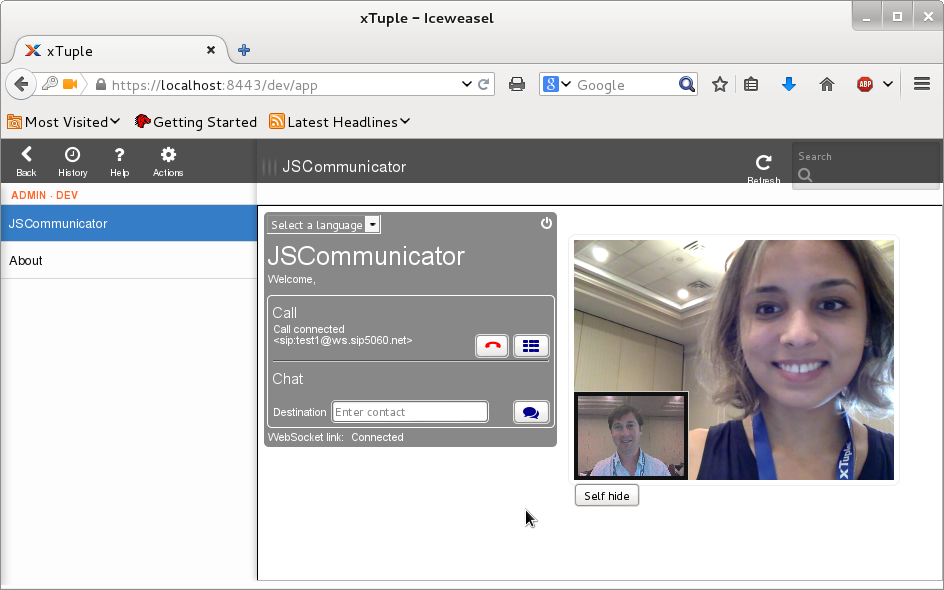
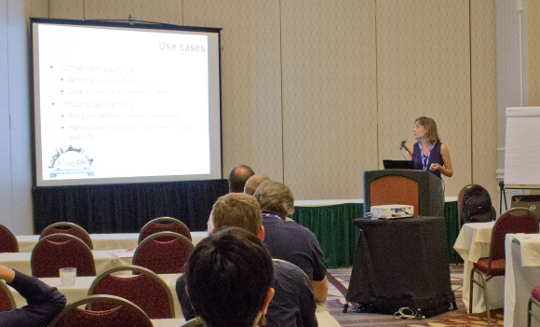
In 2013, Debian participated in both rounds of the GNOME Outreach Program for Women (OPW). The first round was run in conjunction with GSoC and the second round was a standalone program. The publicity around these programs and the strength of the Google and Debian brands attracted a range of female candidates, many of whom were shortlisted by mentors after passing their coding tests and satisfying us that they had the capability to complete a project successfully. As there are only a limited number of places for GSoC and limited funding for OPW, only a subset of these capable candidates were actually selected. The second round of OPW, for example, was only able to select two women. Google to the rescue Many of the women applying for the second round of OPW in 2013 were also students eligible for GSoC 2014. Debian was lucky to have over twenty places funded for GSoC 2014 and those women who had started preparing project plans for OPW and getting to know the Debian community were in a strong position to be considered for GSoC. Chandrika Parimoo, who applied to Debian for the first round of OPW in 2013, was selected by the Ganglia project for one of five GSoC slots. Chandrika made contributions to PyNag and the ganglia-nagios-bridge. Juliana Louback, who applied to Debian during the second round of OPW in 2013, was selected for one of Debian's GSoC 2014 slots working on the Debian WebRTC portal. The portal is built using JSCommunicator, a generic HTML5 softphone designed to be integrated in other web sites, portal frameworks and CMS systems. Juliana has been particularly enthusiastic with her work and after completing the core requirements of her project, I suggested she explore just what is involved in embedding JSCommunicator into another open source application. By co-incidence, the xTuple development team had decided to dedicate the month of August to open source engagement, running a program called haxTuple. Juliana had originally applied to OPW with an interest in financial software and so this appeared to be a great opportunity for her to broaden her experience and engagement with the open source community. Despite having no prior experience with ERP/CRM software, Juliana set about developing a plugin/extension for the new xTuple web frontend. She has published the extension in Github and written a detailed blog about her experience with the xTuple extension API. Participation in DebConf14 Juliana attended DebConf14 in Portland and gave a presentation of her work on the Debian RTC portal. Many more people were able to try the portal for the first time thanks to her participation in DebConf. The video of the GSoC students at DebConf14 is available here. Continuing with open source beyond GSoC Although GSoC finished in August, xTuple invited Juliana and I to attend their annual xTupleCon in Norfolk, Virginia. Google went the extra mile and helped Juliana to get there and she gave a live demonstration of the xTuple extension she had created. This effort has simultaneously raised the profile of Debian, open source and open standards (SIP and WebRTC) in front of a wider audience of professional developers and business users. Juliana describes her work at xTupleCon, Norfolk, 15 October 2014 It started with OPW The key point to emphasize is that Juliana's work in GSoC was actually made possible by Debian's decision to participate in and promote Outreach Program for Women in 2013. I've previously attended DebConf myself to help more developers become familiar with free and open RTC technology. I wasn't able to get there this year but thanks to the way GSoC and OPW are expanding our community, Juliana was there to help out.

23 October 2014

Erich Schubert: Clustering 23 mio Tweet locations

To test scalability of ELKI, I've clustered 23 million Tweet locations from the Twitter Statuses Sample API obtained over 8.5 months (due to licensing restrictions by Twitter, I cannot make this data available to you, sorry.
23 million points is a challenge for advanced algorithms. It's quite feasible by k-means; in particular if you choose a small k and limit the number of iterations. But k-means does not make a whole lot of sense on this data set - it is a forced quantization algorithm, but does not discover actual hotspots.
Density-based clustering such as DBSCAN and OPTICS are much more appropriate. DBSCAN is a bit tricky to parameterize - you need to find the right combination of radius and density for the whole world. Given that Twitter adoption and usage is quite different it is very likely that you won't find a single parameter that is appropriate everywhere.
OPTICS is much nicer here. We only need to specify a minimum object count - I chose 1000, as this is a fairly large data set. For performance reasons (and this is where ELKI really shines) I chose a bulk-loaded R*-tree index for acceleration. To benefit from the index, the epsilon radius of OPTICS was set to 5000m. Also, ELKI allows using geodetic distance, so I can specify this value in meters and do not get much artifacts from coordinate projection.
To extract clusters from OPTICS, I used the Xi method, with xi set to 0.01 - a rather low value, also due to the fact of having a large data set.
The results are pretty neat - here is a screenshot (using KDE Marble and OpenStreetMap data, since Google Earth segfaults for me right now):
Screenshot of Clusters in central Europe
Some observations: unsurprisingly, many cities turn up as clusters. Also regional differences are apparent as seen in the screenshot: plenty of Twitter clusters in England, and low acceptance rate in Germany (Germans do seem to have objections about using Twitter; maybe they still prefer texting, which was quite big in Germany - France and Spain uses Twitter a lot more than Germany).
Spam - some of the high usage in Turkey and Indonesia may be due to spammers using a lot of bots there. There also is a spam cluster in the ocean south of Lagos - some spammer uses random coordinates [0;1]; there are 36000 tweets there, so this is a valid cluster...
A benefit of OPTICS and DBSCAN is that they do not cluster every object - low density areas are considered as noise. Also, they support clusters of different shape (which may be lost in this visualiation, which uses convex hulls!) and different size. OPTICS can also produce a hierarchical result.
Note that for these experiments, the actual Tweet text was not used. This has a rough correspondence to Twitter popularity "heatmaps", except that the clustering algorithms will actually provide a formalized data representation of activity hotspots, not only a visualization.
You can also explore the clustering result in your browser - the Google Drive visualization functionality seems to work much better than Google Earth.
If you go to Istanbul or Los Angeles, you will see some artifacts - odd shaped clusters with a clearly visible spike. This is caused by the Xi extraction of clusters, which is far from perfect. At the end of a valley in the OPTICS plot, it is hard to decide whether a point should be included or not. These errors are usually the last element in such a valley, and should be removed via postprocessing. But our OpticsXi implementation is meant to be as close as possible to the published method, so we do not intend to "fix" this.
Certain areas - such as Washington, DC, New York City, and the silicon valley - do not show up as clusters. The reason is probably again the Xi extraction - these region do not exhibit the steep density increase expected by Xi, but are too blurred in their surroundings to be a cluster.
Hierarchical results can be found e.g. in Brasilia and Los Angeles.
Compare the OPTICS results above to k-means results (below) - see why I consider k-means results to be a meaningless quantization?
k-means clusters
Sure, k-means is fast (30 iterations; not converged yet. Took 138 minutes on a single core, with k=1000. The parallel k-means implementation in ELKI took 38 minutes on a single node, Hadoop/Mahout on 8 nodes took 131 minutes, as slow as a single CPU core!). But you can see how sensitive it is to misplaced coordinates (outliers, but mostly spam), how many "clusters" are somewhere in the ocean, and that there is no resolution on the cities? The UK is covered by 4 clusters, with little meaning; and three of these clusters stretch all the way into Bretagne - k-means clusters clearly aren't of high quality here.
If you want to reproduce these results, you need to get the upcoming ELKI version (0.6.5~201410xx - the output of cluster convex hulls was just recently added to the default codebase), and of course data. The settings I used are:
-dbc.in coords.tsv.gz
-db.index tree.spatial.rstarvariants.rstar.RStarTreeFactory
-pagefile.pagesize 500
-spatial.bulkstrategy SortTileRecursiveBulkSplit
-time
-algorithm clustering.optics.OPTICSXi
-opticsxi.xi 0.01
-algorithm.distancefunction geo.LngLatDistanceFunction
-optics.epsilon 5000.0 -optics.minpts 1000
-resulthandler KMLOutputHandler -out /tmp/out.kmz
and the total runtime for 23 million points on a single core was about 29 hours. The indexes helped a lot: less than 10000 distances were computed per point, instead of 23 million - the expected speedup over a non-indexed approach is 2400.

Don't try this with R or Matlab. Your average R clustering algorithm will try to build a full distance matrix, and you probably don't have an exabyte of memory to store this matrix. Maybe start with a smaller data set first, then see how long you can afford to increase the data size.

9 October 2014

Jan Wagner: Updated Monitoring Plugins Version is coming soon

Three months ago version 2.0 of Monitoring Plugins was released. Since then many changes were integrated. You can find a quick overview in the upstream NEWS. Now it's time to move forward and a new release is expected soon. It would be very welcome if you could give the latest source snapshot a try. You also can give the Debian packages a go and grab them from my 'unstable' and 'wheezy-backports' repositories at http://ftp.cyconet.org/. Right after the stable release, the new packages will be uploaded into Debian unstable. The whole packaging changes can be observed in the changelog. Feedback is very appreciated via Issue tracker or the Monitoring Plugins Development Mailinglist. Update: The official call for testing is available.

8 October 2014

Jan Wagner: Updated Monitoring Plugins Version is coming soon

Three months ago version 2.0 of Monitoring Plugins was released. Since then many changes were integrated. You can find a quick overview in the upstream NEWS. Now it's time to move forward and a new release is expected soon. It would be very welcome if you could give the latest source snapshot a try. You also can give the Debian packages a go and grab them from my 'unstable' and 'wheezy-backports' repositories at http://ftp.cyconet.org/. Right after the stable release, the new packages will be uploaded into Debian unstable. The whole packaging changes can be observed in the changelog. Feedback is very appreciated via Issue tracker or the Monitoring Plugins Development Mailinglist.

2 October 2014

Andrew Pollock: [opinion] On Islamaphobia

It's taken me a while to get sufficiently riled up about Australia's current Islamaphobia outbreak, but it's been brewing in me for a couple of weeks. For the record, I'm an Atheist, but I'll defend your right to practise your religion, just don't go pushing it on me, thank you very much. I'm also not a huge fan of Islam, because it does seem to lend itself to more violent extremism than other religions, and ISIS/ISIL/IS (whatever you want to call them) aren't doing Islam any favours at the moment. I'm against extremism of any stripes though. The Westboro Baptists are Christian extremists. They just don't go around killing people. I'm also not a big fan of the burqa, but again, I'll defend a Muslim woman's right to choose to wear one. They key point here is choice. I got my carpets cleaned yesterday by an ethnic couple. I like accents, and I was trying to pick theirs. I thought they may have been Turkish. It turned out they were Kurdish. Whenever I hear "Kurd" I habitually stick "Bosnian" in front of it after the Bosnian War that happened in my childhood. Turns out I wasn't listening properly, and that was actually "Serb". Now I feel dumb, but I digress. I got chatting with the lady while her husband did the work. I got a refresher on where most Kurds are/were (Northern Iraq) and we talked about Sunni versus Shia Islam, and how they differed. I learned a bit yesterday, and I'll have to have a proper read of the Wikipedia article I just linked to, because I suspect I'll learn a lot more. We briefly talked about burqas, and she said that because they were Sunni, they were given the choice, and they chose not to wear it. That's the sort of Islam that I support. I suspect a lot of the women running around in burqas don't get a lot of say in it, but I don't think banning it outright is the right solution to that. Those women need to feel empowered enough to be able to cast off their burqas if that's what they want to do. I completely agree that a woman in a burqa entering a secure place (for example Parliament House) needs to be identifiable (assuming that identification is verified for all entrants to Parliament House). If it's not, and they're worried about security, that's what the metal detectors are for. I've been to Dubai. I've seen how they handle women in burqas at passport control. This is an easily solvable problem. You don't have to treat burqa-clad women as second class citizens and stick them in a glass box. Or exclude them entirely.

30 September 2014

Russell Coker: Links September 2014

Matt Palmer wrote a short but informative post about enabling DNS in a zone [1]. I really should setup DNSSEC on my own zones. Paul Wayper has some insightful comments about the Liberal party s nasty policies towards the unemployed [2]. We really need a Basic Income in Australia. Joseph Heath wrote an interesting and insightful article about the decline of the democratic process [3]. While most of his points are really good I m dubious of his claims about twitter. When used skillfully twitter can provide short insights into topics and teasers for linked articles. Sarah O wrote an insightful article about NotAllMen/YesAllWomen [4]. I can t summarise it well in a paragraph, I recommend reading it all. Betsy Haibel wrote an informative article about harassment by proxy on the Internet [5]. Everyone should learn about this before getting involved in discussions about controversial issues. George Monbiot wrote an insightful and interesting article about the referendum for Scottish independence and the failures of the media [6]. Mychal Denzel Smith wrote an insightful article How to know that you hate women [7]. Sam Byford wrote an informative article about Google s plans to develop and promote cheap Android phones for developing countries [8]. That s a good investment in future market share by Google and good for the spread of knowledge among people all around the world. I hope that this research also leads to cheap and reliable Android devices for poor people in first-world countries. Deb Chachra wrote an insightful and disturbing article about the culture of non-consent in the IT industry [9]. This is something we need to fix. David Hill wrote an interesting and informative article about the way that computer game journalism works and how it relates to GamerGate [10]. Anita Sarkeesian shares the most radical thing that you can do to support women online [11]. Wow, the world sucks more badly than I realised. Michael Daly wrote an article about the latest evil from the NRA [12]. The NRA continues to demonstrate that claims about good people with guns are lies, the NRA are evil people with guns.

15 September 2014

Julien Danjou: Python bad practice, a concrete case

A lot of people read up on good Python practice, and there's plenty of information about that on the Internet. Many tips are included in the book I wrote this year, The Hacker's Guide to Python. Today I'd like to show a concrete case of code that I don't consider being the state of the art. In my last article where I talked about my new project Gnocchi, I wrote about how I tested, hacked and then ditched whisper out. Here I'm going to explain part of my thought process and a few things that raised my eyebrows when hacking this code. Before I start, please don't get the spirit of this article wrong. It's in no way a personal attack to the authors and contributors (who I don't know). Furthermore, whisper is a piece of code that is in production in thousands of installation, storing metrics for years. While I can argue that I consider the code not to be following best practice, it definitely works well enough and is worthy to a lot of people. Tests The first thing that I noticed when trying to hack on whisper, is the lack of test. There's only one file containing tests, named test_whisper.py, and the coverage it provides is pretty low. One can check that using the coverage tool.
$ coverage run test_whisper.py
...........
----------------------------------------------------------------------
Ran 11 tests in 0.014s

OK
$ coverage report
Name Stmts Miss Cover
----------------------------------
test_whisper 134 4 97%
whisper 584 227 61%
----------------------------------
TOTAL 718 231 67%

While one would think that 61% is "not so bad", taking a quick peak at the actual test code shows that the tests are incomplete. Why I mean by incomplete is that they for example use the library to store values into a database, but they never check if the results can be fetched and if the fetched results are accurate. Here's a good reason one should never blindly trust the test cover percentage as a quality metric. When I tried to modify whisper, as the tests do not check the entire cycle of the values fed into the database, I ended up doing wrong changes but had the tests still pass. No PEP 8, no Python 3 The code doesn't respect PEP 8 . A run of flake8 + hacking shows 732 errors While it does not impact the code itself, it's more painful to hack on it than it is on most Python projects. The hacking tool also shows that the code is not Python 3 ready as there is usage of Python 2 only syntax. A good way to fix that would be to set up tox and adds a few targets for PEP 8 checks and Python 3 tests. Even if the test suite is not complete, starting by having flake8 run without errors and the few unit tests working with Python 3 should put the project in a better light. Not using idiomatic Python A lot of the code could be simplified by using idiomatic Python. Let's take a simple example:
def fetch(path,fromTime,untilTime=None,now=None):
fh = None
try:
fh = open(path,'rb')
return file_fetch(fh, fromTime, untilTime, now)
finally:
if fh:
fh.close()

That piece of code could be easily rewritten as:
def fetch(path,fromTime,untilTime=None,now=None):
with open(path, 'rb') as fh:
return file_fetch(fh, fromTime, untilTime, now)

This way, the function looks actually so simple that one can even wonder why it should exists but why not. Usage of loops could also be made more Pythonic:
for i,archive in enumerate(archiveList):
if i == len(archiveList) - 1:
break

could be actually:
for i, archive in itertools.islice(archiveList, len(archiveList) - 1):

That reduce the code size and makes it easier to read through the code. Wrong abstraction level Also, one thing that I noticed in whisper, is that it abstracts its features at the wrong level. Take the create() function, it's pretty obvious:
def create(path,archiveList,xFilesFactor=None,aggregationMethod=None,sparse=False,useFallocate=False):
# Set default params
if xFilesFactor is None:
xFilesFactor = 0.5
if aggregationMethod is None:
aggregationMethod = 'average'

#Validate archive configurations...
validateArchiveList(archiveList)

#Looks good, now we create the file and write the header
if os.path.exists(path):
raise InvalidConfiguration("File %s already exists!" % path)
fh = None
try:
fh = open(path,'wb')
if LOCK:
fcntl.flock( fh.fileno(), fcntl.LOCK_EX )

aggregationType = struct.pack( longFormat, aggregationMethodToType.get(aggregationMethod, 1) )
oldest = max([secondsPerPoint * points for secondsPerPoint,points in archiveList])
maxRetention = struct.pack( longFormat, oldest )
xFilesFactor = struct.pack( floatFormat, float(xFilesFactor) )
archiveCount = struct.pack(longFormat, len(archiveList))
packedMetadata = aggregationType + maxRetention + xFilesFactor + archiveCount
fh.write(packedMetadata)
headerSize = metadataSize + (archiveInfoSize * len(archiveList))
archiveOffsetPointer = headerSize

for secondsPerPoint,points in archiveList:
archiveInfo = struct.pack(archiveInfoFormat, archiveOffsetPointer, secondsPerPoint, points)
fh.write(archiveInfo)
archiveOffsetPointer += (points * pointSize)

#If configured to use fallocate and capable of fallocate use that, else
#attempt sparse if configure or zero pre-allocate if sparse isn't configured.
if CAN_FALLOCATE and useFallocate:
remaining = archiveOffsetPointer - headerSize
fallocate(fh, headerSize, remaining)
elif sparse:
fh.seek(archiveOffsetPointer - 1)
fh.write('\x00')
else:
remaining = archiveOffsetPointer - headerSize
chunksize = 16384
zeroes = '\x00' * chunksize
while remaining > chunksize:
fh.write(zeroes)
remaining -= chunksize
fh.write(zeroes[:remaining])

if AUTOFLUSH:
fh.flush()
os.fsync(fh.fileno())
finally:
if fh:
fh.close()

The function is doing everything: checking if the file doesn't exist already, opening it, building the structured data, writing this, building more structure, then writing that, etc. That means that the caller has to give a file path, even if it just wants a whipser data structure to store itself elsewhere. StringIO() could be used to fake a file handler, but it will fail if the call to fcntl.flock() is not disabled and it is inefficient anyway. There's a lot of other functions in the code, such as for example setAggregationMethod(), that mixes the handling of the files even doing things like os.fsync() while manipulating structured data. This is definitely not a good design, especially for a library, as it turns out reusing the function in different context is near impossible. Race conditions There are race conditions, for example in create() (see added comment):
if os.path.exists(path):
raise InvalidConfiguration("File %s already exists!" % path)
fh = None
try:
# TOO LATE I ALREADY CREATED THE FILE IN ANOTHER PROCESS YOU ARE GOING TO
# FAIL WITHOUT GIVING ANY USEFUL INFORMATION TO THE CALLER :-(
fh = open(path,'wb')

That code should be:
try:
fh = os.fdopen(os.open(path, os.O_WRONLY os.O_CREAT os.O_EXCL), 'wb')
except OSError as e:
if e.errno = errno.EEXIST:
raise InvalidConfiguration("File %s already exists!" % path)

to avoid any race condition. Unwanted optimization We saw earlier the fetch() function that is barely useful, so let's take a look at the file_fetch() function that it's calling.
def file_fetch(fh, fromTime, untilTime, now = None):
header = __readHeader(fh)
[...]

The first thing the function does is to read the header from the file handler. Let's take a look at that function:
def __readHeader(fh):
info = __headerCache.get(fh.name)
if info:
return info

originalOffset = fh.tell()
fh.seek(0)
packedMetadata = fh.read(metadataSize)

try:
(aggregationType,maxRetention,xff,archiveCount) = struct.unpack(metadataFormat,packedMetadata)
except:
raise CorruptWhisperFile("Unable to read header", fh.name)
[...]

The first thing the function does is to look into a cache. Why is there a cache? It actually caches the header based with an index based on the file path (fh.name). Except that if one for example decide not to use file and cheat using StringIO, then it does not have any name attribute. So this code path will raise an AttributeError. One has to set a fake name manually on the StringIO instance, and it must be unique so nobody messes with the cache
import StringIO

packedMetadata = <some source>
fh = StringIO.StringIO(packedMetadata)
fh.name = "myfakename"
header = __readHeader(fh)

The cache may actually be useful when accessing files, but it's definitely useless when not using files. But it's not necessarily true that the complexity (even if small) that the cache adds is worth it. I doubt most of whisper based tools are long run processes, so the cache that is really used when accessing the files is the one handled by the operating system kernel, and this one is going to be much more efficient anyway, and shared between processed. There's also no expiry of that cache, which could end up of tons of memory used and wasted. Docstrings None of the docstrings are written in a a parsable syntax like Sphinx. This means you cannot generate any documentation in a nice format that a developer using the library could read easily. The documentation is also not up to date:
def fetch(path,fromTime,untilTime=None,now=None):
"""fetch(path,fromTime,untilTime=None)
[...]
"""

def create(path,archiveList,xFilesFactor=None,aggregationMethod=None,sparse=False,useFallocate=False):
"""create(path,archiveList,xFilesFactor=0.5,aggregationMethod='average')
[...]
"""

This is something that could be avoided if a proper format was picked to write the docstring. A tool cool be used to be noticed when there's a diversion between the actual function signature and the documented one, like missing an argument. Duplicated code Last but not least, there's a lot of code that is duplicated around in the scripts provided by whisper in its bin directory. Theses scripts should be very lightweight and be using the console_scripts facility of setuptools, but they actually contains a lot of (untested) code. Furthermore, some of that code is partially duplicated from the whisper.py library which is against DRY. Conclusion There are a few more things that made me stop considering whisper, but these are part of the whisper features, not necessarily code quality. One can also point out that the code is very condensed and hard to read, and that's a more general problem about how it is organized and abstracted. A lot of these defects are actually points that made me start writing The Hacker's Guide to Python a year ago. Running into this kind of code makes me think it was a really good idea to write a book on advice to write better Python code!
The Hacker's Guide to Python
A book I wrote talking about designing Python applications, state of the art, advice to apply when building your application, various Python tips, etc. Interested? Check it out.

10 August 2014

Ian Wienand: Finding out if you're a Rackspace instance

Different hosting providers do things slightly differently, so it's sometimes handy to be able to figure out where you are. Rackspace is based on Xen and their provided images should include the xenstore-ls command available. xenstore-ls vm-data will give you a handy provider and even region fields to let you know where you are.
function is_rackspace  
  if [ ! -f /usr/bin/xenstore-ls ]; then
      return 1
  fi
  /usr/bin/xenstore-ls vm-data   grep -q "Rackspace"
 
if is_rackspace; then
  echo "I am on Rackspace"
fi
Other reading about how this works:

8 August 2014

Daniel Pocock: Help needed reviewing Ganglia GSoC changes

The Ganglia project has been delighted to have Google's support for 5 students in Google Summer of Code 2014. The program officially finishes in ten more days, on 18 August. If you are a user of Ganglia, Nagios, RRDtool or R or just an enthusiastic C or Python developer, you may be able to use and provide feedback for the students while benefitting from the cool new features they have been working on.
Student Technology Comments
Chandrika Parimoo Python, Nagios and some Syslog Chandrika generalized some of my ganglia-nagios-bridge code into the PyNag library. I then used it as the basis for syslog-nagios-bridge. Chandrika has also done some work on improving the ganglia-nagios-bridge configuration file format.
Oliver Hamm C Oliver has been working on metrics about Ganglia infrastructure. If you have a large and dynamic Ganglia cloud, this is for you.
Plamen Dimitrov R, RRDtool Plamen has been building an R plugin for inspecting RRD files from Ganglia or any other type of RRD.
Rana NVIDIA, C Rana has been working on improvements to Ganglia monitoring of NVIDIA GPUs, especially in HPC clusters
Zhi An Java, JMX Zhi An has been extending the JMXetric and gmetric4j projects to provide more convenient monitoring of Java server processes.
If you have any feedback or questions, please feel free to discuss on the Ganglia-general mailing list and CC the student and their mentor.

Jan Wagner: Monitoring Plugins Debian packages

You may wonder why the old good nagios-plugins are not up to date in Debian unstable and testing. Since the people behind and maintaining the plugins <= 1.5 were forced to rename the software project into Monitoring Plugins there was some work behind the scenes and much QA work necessary to release the software in a proper state. This happened 4 weeks ago with the release of the version 2.0 of the Monitoring Plugins. With one day of delay the package was uploaded into unstable, but did hit the Debian NEW queue due the changed package name(s). Now we (and maybe you) are waiting to get them reviewed by ftp-master. This will hopefully happen before the jessie freeze. Until this will happen, you may grab packages for wheezy by the 'wheezy-backports' suite from ftp.cyconet.org/debian/ or 'debmon-wheezy' suite from debmon.org. Feedback is much appreciated.

31 July 2014

Russell Coker: Links July 2014

Dave Johnson wrote an interesting article for Salon about companies ripping off the tax system by claiming that all their income is produced in low tax countries [1]. Seb Lee-Delisle wrote an insightful article about how to ask to get paid to speak [2]. I should do that. Daniel Pocock wrote an informative article about the reConServer simple SIP conferencing server [3]. I should try it out, currently most people I want to conference with are using Google Hangouts, but getting away from Google is a good thing. Fran ois Marier wrote an informative post about hardening ssh servers [4]. S. E. Smith wrote an interesting article I Am Tired of Hearing Programmers Defend Gender Essentialism [5]. Bert Archer wrote an insightful article about lazy tourism [6]. His initial example of love locks breaking bridges was a bit silly (it s not difficult to cut locks off a bridge) but his general point about lazy/stupid tourism is good. Daniel Pocock wrote an insightful post about new developments in taxis, the London Taxi protest against Uber, and related changes [7]. His post convinced me that Uber is a good thing and should be supported. I checked the prices and unfortunately Uber is more expensive than normal taxis for my most common journey. Cory Doctorow wrote an insightful article for The Guardian about the moral issues related to government spying [8]. The Verge has an interesting review of the latest Lytro Lightbox camera [9]. Not nearly ready for me to use, but interesting technology. Prospect has an informative article by Kathryn Joyce about the Protestant child sex abuse scandal in the US [10]. Billy Graham s grandson is leading the work to reform churches so that they protect children instead of pedophiles. Prospect also has an article by Kathryn Joyce about Christians home-schooling kids to try and program them to be zealots and how that hurts kids [11]. The Daily Beast has an interesting article about the way that the extreme right wing in the US are trying to kill people, it s the right wing death panel [12]. Jay Michaelson wrote an informative article for The Daily Beast about right-wing hate groups in the US who promote the extreme homophobic legislation in Russia and other countries [13]. It also connects to the Koch brothers who seem to be associated with most evil. Elias Isquith wrote an insightful article for Salon about the current right-wing obsession with making homophobic discrimination an issue of religious liberty will hurt religious people [14]. He also describes how stupid the right-wing extremists are in relation to other issues too. EconomixComix.com has a really great comic explaning the economics of Social Security in the US [15]. They also have a comic explaining the TPP which is really good [16]. They sell a comic book about economics which I m sure is worth buying. We need to have comics explaining all technical topics, it s a good way of conveying concepts. When I was in primary school my parents gave me comic books covering nuclear physics and other science topics which were really good. Mia McKenzie wrote an insightful article for BlackGirlDangerous.com about dealing with racist white teachers [17]. I think that it would be ideal to have a school dedicated to each minority group with teachers from that group.

29 July 2014

Russell Coker: Happiness and Lecture Questions

I just attended a lecture about happiness comparing Australia and India at the Australia India Institute [1]. The lecture was interesting but the questions were so bad that it makes a good case for entirely banning questions from public lectures. Based on this and other lectures I ve attended I ve written a document about how to recognise worthless questions and cut them off early [2]. As you might expect from a lecture on happiness there were plenty of stupid comments from the audience about depression, as if happiness is merely the absence of depression. Then they got onto stupidity about suicide. One question claimed that Australia has a high suicide rate, Wikipedia however places Australia 49th out of 110 countries, that means Australia is slightly above the median for suicide rates per country. Given some of the dubious statistics in the list (for example the countries claiming to have no suicides and the low numbers reported by some countries with extreme religious policies) I don t think we can be sure that Australia would be above the median if we had better statistics. Another question claimed that Sweden had the highest suicide rate in Europe, while Greenland, Belgium, Finland, Austria, France, Norway, Denmark, Iceland, and most of Eastern Europe are higher on the list. But the bigger problem in regard to discussing suicide is that the suicide rate isn t about happiness. When someone kills themself because they have a terminal illness that doesn t mean that they were unhappy for the majority of their life and doesn t mean that they were any unhappier than the terminally ill people who don t do that. Some countries have a culture that is more positive towards suicide which would increase the incidence, Japan for example. While people who kill themselves in Japan are probably quite unhappy at the time I don t think that there is any reason to believe that they are more unhappy than people in other countries who only keep living because suicide is considered to be wrong. It seems to me that the best strategy when giving or MCing a lecture about a potentially contentious topic is to plan ahead for what not to discuss. For a lecture about happiness it would make sense to rule out all discussion of suicide, anti-depressants, and related issues as they aren t relevant to the discussion and can t be handled in an appropriate manner in question time.

24 July 2014

Martin Pitt: vim config for Markdown+LaTeX pandoc editing

I have used LaTeX and latex-beamer for pretty much my entire life of document and presentation production, i. e. since about my 9th school grade. I ve always found the LaTeX syntax a bit clumsy, but with good enough editor shortcuts to insert e. g. \begin itemize \item...\end itemize with just two keystrokes, it has been good enough for me. A few months ago a friend of mine pointed out pandoc to me, which is just simply awesome. It can convert between a million document formats, but most importantly take Markdown and spit out LaTeX, or directly PDF (through an intermediate step of building a LaTeX document and calling pdftex). It also has a template for beamer. Documents now look soo much more readable and are easier to write! And you can always directly write LaTeX commands without any fuss, so that you can use markdown for the structure/headings/enumerations/etc., and LaTeX for formulax, XYTex and the other goodies. That s how it should always should have been! So last night I finally sat down and created a vim config for it:
"-- pandoc Markdown+LaTeX -------------------------------------------
function s:MDSettings()
    inoremap <buffer> <Leader>n \note[item] <Esc>i
    noremap <buffer> <Leader>b :! pandoc -t beamer % -o %<.pdf<CR><CR>
    noremap <buffer> <Leader>l :! pandoc -t latex % -o %<.pdf<CR>
    noremap <buffer> <Leader>v :! evince %<.pdf 2>&1 >/dev/null &<CR><CR>
    " adjust syntax highlighting for LaTeX parts
    "   inline formulas:
    syntax region Statement oneline matchgroup=Delimiter start="\$" end="\$"
    "   environments:
    syntax region Statement matchgroup=Delimiter start="\\begin .* " end="\\end .* " contains=Statement
    "   commands:
    syntax region Statement matchgroup=Delimiter start=" " end=" " contains=Statement
endfunction
autocmd BufRead,BufNewFile *.md setfiletype markdown
autocmd FileType markdown :call <SID>MDSettings()
That gives me good enough (with some quirks) highlighting without trying to interpret TeX stuff as Markdown, and shortcuts for calling pandoc and evince. Improvements appreciated!

20 July 2014

John Goerzen: Beautiful Earth

Sometimes you see something that takes your breath away, maybe even makes your eyes moist. That happened when I saw this photo one morning: Sunrise on the Prairie Photography has been one of my hobbies since I was a child, and I ve enjoyed it all these years. Recently I was inspired by the growing ease of aerial photography using model aircraft, and now can fly two short-range RC quadcopters. That photo came from the first one, and despite being a low-res 1280 720 camera, tha image of our home in the yellow glow of sunrise brought a deep feeling a beauty and peace. DJI00196 Somehow seeing our home surrounded by the beauty of the immense wheat fields and green pastures drives home how small we all are in comparison to the vastness of the earth, and how lucky we are to inhabit this beautiful planet. DJI00204 As the sun starts to come up over the pasture, the only way you can tell the height of the grass at 300ft is to see the shadow it makes on the mowed pathway Laura and I use to get down to the creek. DJI00149 This is a view of our church in a small town nearby the church itself is right in the center of the photo. Off to the right, you see the grain elevators that can be seen for miles across the Kansas prairie, and of course the fields are never all that far off in the background. Here you can see the quadcopter taking off from the driveway: And here it is flying over my home church out in the country: DJI00120 That s the country church, at the corner of two gravel roads with its lighted cross facing east that can be seen from a mile away at night. To the right is the church park, and the green area along the road farther back is the church cemetery. DJI00063 Sometimes we get in debates about environmental regulations, politics, religion, whatever. We hear stories of missiles, guns, and destruction. It is sad, this damage we humans inflict on ourselves and our earth. Our earth our home is worth saving. Its stunning beauty from all its continents is evidence enough of that. To me, this photo of a small corner of flat Kansas is proof enough that the home we all share deserves to be treated well, and saved so that generations to come can also get damp eyes viewing its beauty from a new perspective. DJI00183






13 July 2014

Russ Allbery: Review: Neptune's Brood

Review: Neptune's Brood, by Charles Stross
Series: Freyaverse #2
Publisher: Ace
Copyright: July 2013
ISBN: 1-101-62453-1
Format: Kindle
Pages: 325
Neptune's Brood is set in the same universe as Saturn's Children, but I wouldn't call it a sequel. It takes place considerably later, after substantial expansion of the robot civilization to the stars, and features entirely different characters (or, if there was overlap, I didn't notice). It also represents a significant shift in tone: while Saturn's Children is clearly a Heinlein pastiche and parody, Neptune's Brood takes its space opera more seriously. There is some situational humor assault auditors, for example but this book is played mostly straight, and I detected little or no Heinlein. This is Stross fleshing out his own space opera concept. This being Stross, that concept is not exactly conventional. This is a space opera about economics. Specifically, it's a space opera about interstellar economics, a debt pyramid, and a very interesting remapping of the continual growth requirements of capitalism to the outward expansion of colonization. The first-person protagonist comes from a "family" (as in Saturn's Children, the concept exists but involves rather more aggressive control of the instantiated "children") of bankers, but she is a forensic accountant and historian who specializes in analysis of financial scams. As you might expect, this is a significant clue about the plot. Neptune's Brood opens with Krina in search of her sister. She is supposed to be an itinerant scholar, moving throughout colonized space to spend some time with various scattered sisters, spreading knowledge and expanding her own. But it's clear from the start of the book that something else is going on, even before an assassin with Krina's face appears on her trail. Unfortunately, it takes roughly a third of the book to learn just what is happening beneath the surface, and most of that time is spent in a pointless interlude on a flying cathedral run by religious fanatics. The religion is a callback to Saturn's Children: robots who are trying to spread original humanity (the Fragiles) to the stars. This mostly doesn't go well, and is going particularly poorly for the ship that Krina works for passage on. But this is a brief gag that I thought went on much too long. The plot happens to Krina for this first section of the book rather than the other way around, little of lasting significance other than some character introductions occurs, and the Church itself, while playing a minor role in the later plot, is not worth the amount of attention that it gets. The best parts of the early book are the interludes in which Krina explains major world concepts to the reader. These are absolutely blatant infodumping, and I'm not sure how Stross gets away with them, but somehow he does, at least for me. They remind me of some of his blog posts, except tighter and fit into an interesting larger structure. Thankfully, once Krina finally arrives on Shin-Tethys, the plot improves considerably. There was a specific moment for me when the book became interesting: when Krina finds her sib's quarters in Shin-Tethys and analyzes what she finds there. It's the first significant thing in the book that she does rather than have done to her or thrust upon her, and she's a much better character when she's making decisions. This is also about the point where Stross starts fully explaining slow money, which is key to both the economics and the plot, and the plot starts to unwind its various mysteries and identify the motives of the players. Even then, Krina suffers from a lack of agency. Only at rare intervals does she get a chance to affect the story. Most of what she did of relevance to this book she did in the past, and while those descriptions of the backstory are interesting, they don't entirely make up for a passive protagonist. Thankfully, the other characters are varied and interesting enough, and the political machinations and cascading revelations captivating enough, that the last part of the book was very satisfying even with Krina on for the ride. This is a Stross novel, so it's full of two-dollar technical words mixed with technobabble. However, it shares with Saturn's Children the recasting of robots as the norm and fleshy humans as the exception, which means much of the technobabble is a straight substitution for our normal babble about meaty bodies and often works as an alienation technique. That makes it a bit more tolerable for me, although I still wished Stross would turn down the manic vocabulary in places. This bothers some people more than others; if you had no trouble with Accelerando, Neptune's Brood will pose no problems. I don't think the first section of this book was successful, but I liked the rest well enough to recommend it. If you like your space opera with a heavy dose of economics, a realistic attitude towards deep space exploration without faster-than-light technology, and a realistic perspective on the hostility of alien planets to Earth life, Neptune's Brood is a good choice. And any book that quotes David Graeber's Debt, and whose author has clearly paid attention to its contents, wins bonus points from me. Rating: 8 out of 10

Next.

Previous.