Search Results: "eric"

12 April 2020

Enrico Zini: Some inventors links

Cleopatra the Alchemist - Wikipedia
history people archive.org
Cleopatra the Alchemist who likely lived during the 3rd century AD, was a Greek alchemist, author, and philosopher. She experimented with practical alchemy but is also credited as one of the four female alchemists that could produce the Philosopher's stone. Some writers consider her to be the inventor of the alembic, a distillation apparatus.
Hedy Lamarr (/ he di/), born Hedwig Eva Maria Kiesler (November 9, 1914[a] January 19, 2000), was an Austrian-born American film actress and inventor who was posthumously inducted into the National Inventors Hall of Fame.[1]
Radia Joy Perlman (born December 18, 1951) is an American computer programmer and network engineer. She is most famous for her invention of the spanning-tree protocol (STP), which is fundamental to the operation of network bridges, while working for Digital Equipment Corporation. She also made large contributions to many other areas of network design and standardization, such as link-state routing protocols.
Stephanie Louise Kwolek (July 31, 1923 June 18, 2014) was an American chemist who is known for inventing Kevlar. She was of Polish heritage and her career at the DuPont company spanned more than 40 years.[1] She discovered the first of a family of synthetic fibres of exceptional strength and stiffness: poly-paraphenylene terephthalamide.
This page aims to list inventions and discoveries in which women played a major role.

7 April 2020

Shirish Agarwal: GMRT 2020 and lots of stories

First of all, congratulations to all those who got us 2022 Debconf, so we will finally have a debconf in India. There is of course, lot of work to be done between now and then. For those who would be looking forward to visit India and especially Kochi I would suggest you to hear this enriching tale
I am sorry I used youtube link but it is too good a podcast not to be shared. Those who don t want youtube can use the invidio.us link for the same as shared below. https://www.invidio.us/watch?v=BvjgKuKmnQ4 I am sure there are lot more details, questions, answers etc. but would direct them gently to Praveen, Shruti, Balasankar and the rest who are from Kochi to answer if you have any questions about that history.

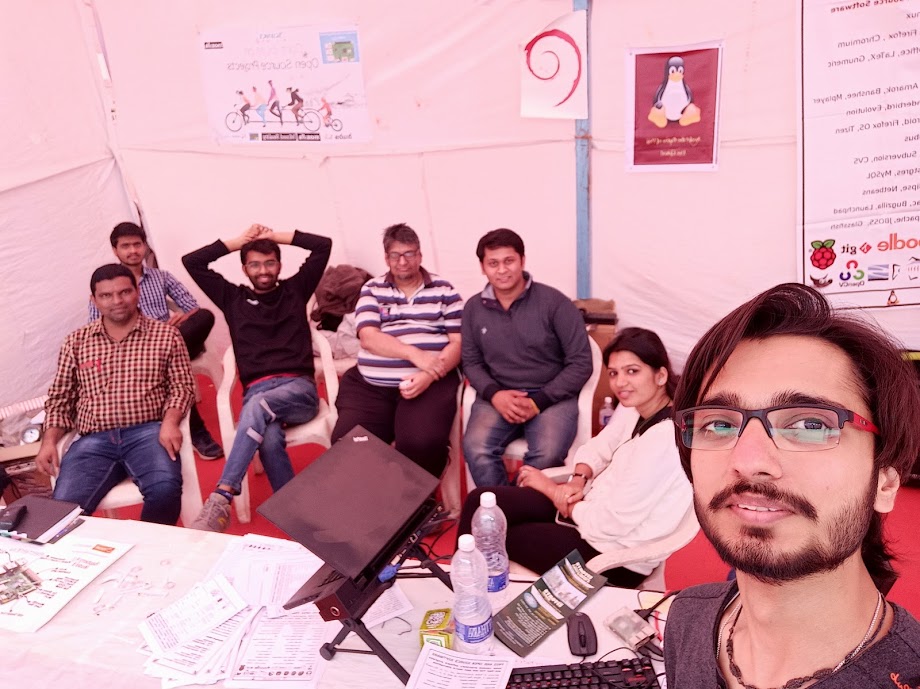
National Science Day, GMRT 2020 First, as always, we are and were grateful to both NCRA as well as GMRT for taking such good care of us. Even though Akshat was not around, probably getting engaged, a few of us were there. About 6-7 from the Mozilla Nasik while the rest representing the foss community. Here is a small picture which commentrates the event
National Science Day, GMRT 2020
While there is and was a lot to share about the event. For e.g. Akshay had bought RPI- Zero as well as RPI-2 (Raspberry Pi s ) and showed some things. He had also bought up a Debian stable live drive with persistence although the glare from the sun was too much that we couldn t show it to clearly to students. This was also the case with RPI but still we shared what and how much we could. Maybe next year, we either ask them to have double screens or give us dark room so we can showcase things much better. We did try playing with contrast and all but it didn t have much of an effect  . Of course in another stall few students had used RPI s as part of their projects so at times we did tell some of the newbies to go to those stalls and see and ask about those projects so they would have a much wider experience of things. The Mozilla people were pushing VR as well as Mozilla lite the browser for the mobile. We also gossiped quite a bit. I shared about indicatelts , a third-party certificate extension although I dunno if I should file a wnpp about it or not. We didn t have a good experience of when I had put an RFP (Request for Package) which was accepted for an extension which had similar functionality which we later come to know was sharing the sites people were using the extension to call home and share both the URL and the IP Address they were using it from. Sadly, didn t leave a good taste in mouth

Delhi Riots One thing I have been disappointed with is the lack of general awareness about things especially in the youth. We have people who didn t know that for e.g. in the Delhi riots which happened recently the law and order (Police) lies with Home Minister of India, Amit Shah. This is perhaps the only capital in the world which has its own Chief Minister but doesn t have any say on its law and order. And this has been the case for last 70 years i.e. since independance. The closest I know so far is the UK but they too changed their tune in 2012. India and especially Delhi seems to be in a time-capsule which while being dysfunctional somehow is made to work. In many ways, it s three body or a body split into three personalities which often makes governance a messy issue but that probably is a topic for another day. In fact, scroll had written a beautiful editorial that full statehood for Delhi was not only Arvind Kejriwal s call (AAP) but also something that both BJP as well as Congress had asked in the past. In fact, nothing about the policing is in AAP s power. All salaries, postings, transfers of police personnel everything is done by the Home Ministry, so if any blame has to be given it has to be given to the Home Ministry for the same.

American Capitalism and Ventilators America had been having a history of high cost healthcare as can be seen in this edition of USA today from 2017 . The Affordable Care Act was signed as a law by President Obama in 2010 which Mr. Trump curtailed when he came into power couple of years back. An estimated 80,000 people died due to seasonal flu in 2018-19 . Similarly, anywhere between 24-63,000 have supposed to have died from Last October to February-March this year. Now if the richest country can t take care of their population which is 1/3rd of the population of this country while at the same time United States has thrice the area that India has. This I am sharing as seasonal flu also strikes the elderly as well as young children more than adults. So in one senses, the vulnerable groups overlap although from some of the recent stats, for Covid-19 even those who are 20+ are also vulnerable but that s another story altogether. If you see the CDC graph of the seasonal flu it is clear that American health experts knew about it. One another common factor which joins both the seasonal flu and covid is both need ventilators for the most serious cases. So, in 2007 it was decided that the number of ventilators needed to be ramped up, they had approximately 62k ventilators at that point in time all over U.S. The U.S. in 2010, asked for bids and got bid from a small californian company called Newport Medic Instruments. The price of the ventilators was approximately INR 700000 at 2010 prices, while Newport said they would be able to mass-produce at INR 200000 at 2010 prices. The company got the order and they started designing the model which needed to be certified by FDA. By 2011, they got the product ready when a big company called Covidgen bought Newport Medic and shutdown the project. This was shared in a press release in 2012. The whole story was broken by New York Times again, just a few days ago which highlighted how America s capitalism rough shod over public health and put people s life unnecessarily in jeopardy. If those new-age ventilators would have been a reality then not just U.S. but India and many other countries would have bought the ventilators as every county has same/similar needs but are unable to pay the high cost which in many cases would be passed on to their citizens either as price of service, or by raising taxes or a mixture of both with public being none the wiser. Due to dearth of ventilators and specialized people to operate it and space, there is possibility that many countries including India may have to make tough choices like Italian doctors had to make as to who to give ventilator to and have the mental and emotional guilt which would be associated with the choices made.

Some science coverage about diseases in wire and other publications Since Covid coverage broke out, the wire has been bringing various reports of India s handling of various epidemics, mysteries, some solved, some still remaining unsolved due to lack of interest or funding or both. The Nipah virus has been amply discussed in the movie Virus (2019) which I shared in the last blog post and how easily it could have been similar to Italy in Kerala. Thankfully, only 24 people including a nurse succumbed to that outbreak as shared in the movie. I had shared about Kerala nurses professionalism when I was in hospital couple of years back. It s no wonder that their understanding of hygeine and nursing procedures are a cut above the rest hence they are sought after not just in India but world-over including US and UK and the middle-east. Another study on respitory illness was bought to my attention by my friend Pavithran.

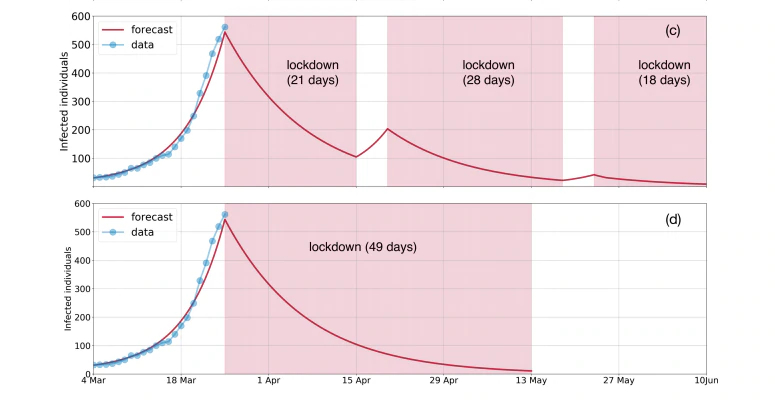
Possibility of extended lockdown in India There was talk in the media of extended lockdown or better put an environment is being created so that an extended lockdown can be done. This is probably in part due to a mathematical model and its derivatives shared by two Indian-origin Cambridge scholars who predict that a minimum 49 days lockdown may be necessary to flatten the covid curve about a week back.
Predictions of the outcome of the current 21-day lockdown (Source: Rajesh Singh, R. Adhikari, Cambridge University)
Alternative lockdown strategies suggested by the Cambridge model (Source: Rajesh Singh, R. Adhikari, Cambridge University)
India caving to US pressure on Hydroxychloroquine While there has been lot of speculation in U.S. about Hydroxychloroquine as the wonder cure, last night Mr. Trump threatened India in a response to a reporter that Mr. Modi has to say no for Hydroxychloroquine and there may be retaliations.
As shared before if youtube is not your cup you can see the same on invidio.us https://www.invidio.us/watch?v=YP-ewgoJPLw Now while there have been several instances in the past of U.S. trying to bully India, going all the way back to 1954. In fact, in recent memory, there were sanctions on India by US under Atal Bihari Vajpayee Government (BJP) 1998 but he didn t buckle under the pressure and now we see our current PM taking down our own notification from a day ago and not just sharing Hydroxychloroquine but also Paracetemol to other countries so it would look as if India is sharing with other countries. Keep in mind, that India, Brazil haven t seen eye to eye on trade agreements of late and Paracetemol prices have risen in India. The price rise has been because the API (Active Pharmaceutical Ingredients) for the same come from China where the supply chain will take time to be fixed and we would also have to open up, although should we, should we not is another question altogether. I talk about supply chains as lean supply chains were the talk since late 90 s when the Japanese introduced Just-in-time manufacturing which lead to lean supply chains as well as lot of outsourcing as consequence. Of course, the companies saved money but at the cost of flexibility and how this model was perhaps flawed was shared by a series of articles in Economist as early as 2004 when there were lot of shocks to that model and would be exaberated since then. There have been frequent shocks to these fragile ecosystem more since 2008 after the financial meltdown and this would put more companies out of business than ever before. The MSME sector in India had already been severely impacted first by demonetization and then by the horrendous implementation of GST whose cries can be heard from all sectors. Also the frequent changing of GST taxes has made markets jumpy and investors unsure. With judgements such as retrospective taxes, AGR (Adjusted Gross Revenue) etc. it made not only the international investors scared, but also domestic investors. The flight of the capital has been noticeable. This I had shared before when Indian Government shared about LRS report which it hasn t since then. In fact Outlook Business had an interesting article about it where incidentally it talked about localcircles, a community networking platform where you get to know of lot of things and whom I am also a member of. At the very end I apologize for not sharing the blog post before but then I was feeling down but then I m not the only one.

6 April 2020

Joachim Breitner: A Telegram bot in Haskell on Amazon Lambda

I just had a weekend full of very successful serious geekery. On a whim I thought: Wouldn't it be nice if people could interact with my game Kaleidogen also via a telegram bot? This led me to learn about how I write a Telegram bot in Haskell and how I can deploy such a Haskell program to Amazon Lambda. In particular the latter bit might be interesting to some of my readers, so here is how went about it.

Kaleidogen Kaleidogen is a little contemplative game (or toy game where, starting from just unicolored disks, you combine abstract circular patterns to breed more interesting patterns. See my FARM 2019 talk for more details, or check out the source repository. BTW, I am looking for help turning it into an Android app!
KaleidogenBot in action

KaleidogenBot in action

Amazon Lambda Amazon Lambda is the Function as a service offering of Amazon Web Services. The idea is that you don t rent a server, where you have to deal with managing the whole system and that you are paying for constantly, but you just upload the code that responds to outside requests, and AWS takes care of the rest: Starting and stopping instances, providing a secure base system etc. When nobody is using the service, no cost occurs. This sounds ideal for hosting a toy Telegram bot: Most of the time nobody will be using it, and I really don't want to have to baby sit yet another service on my server. On Amazon Lambda, I can probably just forget about it. But Haskell is not one of the officially supported languages on Amazon Lambda. So to run Haskell on Lambda, one has to solve two problems:
  • how to invoke the Haskell code on the server, and
  • how to build Haskell so that it runs on the Amazon Linux distribution

A Haskell runtime for Lambda For the first we need a custom runtime. While this sounds complicated, it is actually a pretty simple concept: A runtime is an executable called bootstrap that queries the Lambda Runtime Interface for the next request to handle. The Lambda documentation is phrased as if this runtime has to be a dispatcher that calls the separate function s handler. But it could just do all the things directly. I found the Haskell package aws-lambda-haskell-runtime which provides precisely that: A function
runLambda :: (LambdaOptions -> IO (Either String LambdaResult)) -> IO ()
that talks to the Lambda Runtime API and invokes its argument on each message. The package also provides Template Haskell magic to collect handlers of any JSON-able type and generates a dispatcher, like you might expect from other, more dynamic languages. But that was too much magic for me, so I ignored that and just wrote the handler manually:
main :: IO ()
main = runLambda run
  where
   run ::  LambdaOptions -> IO (Either String LambdaResult)
   run opts = do
    result <- handler (decodeObj (eventObject opts)) (decodeObj (contextObject opts))
    either (pure . Left . encodeObj) (pure . Right . LambdaResult . encodeObj) result
data Event = Event
    path :: T.Text
  , body :: Maybe T.Text
    deriving (Generic, FromJSON)
data Response = Response
    statusCode :: Int
  , headers :: Value
  , body :: T.Text
  , isBase64Encoded :: Bool
    deriving (Generic, ToJSON)
handler :: Event -> Context -> IO (Either String Response)
handler Event body, path  context =
 
I expose my Lambda function to the world via Amazon s API Gateway, configured to just proxy the HTTP requests. This means that my code receives a JSON data structure describing the HTTP request (here called Event, listing only the fields I care about), and it will respond with a Response, again as JSON. The handler can then simply pattern-match on the path to decide what to do. For example this code handles URLs like /img/CAFFEEFACE.png, and responds with an image.
handler :: TC -> Event -> Context -> IO (Either String Response)
handler Event body, path  context
      Just bytes <- isImgPath path >>= T.decodeHex = do
        let pngData = genPurePNG bytes
        pure $ Right Response
              statusCode = 200
            , headers = object [ "Content-Type" .= ("image/png" :: String) ]
            , isBase64Encoded = True
            , body = T.decodeUtf8 $ LBS.toStrict $ Base64.encode pngData
             
     
isImgPath :: T.Text -> Maybe T.Text
isImgPath  = T.stripPrefix "/img/" >=> T.stripSuffix ".png"
If this program would grow more, then one should probably use something more structured for routing here; maybe servant, or bridging towards wai apps (amost like wai-lamda, but that still assumes an existing runtime, instead of simply being the runtime). But for my purposes, no extra layers of indirection or abstraction are needed!

Deploying Haskell to Lambda Building Haskell locally and deploying to different machiens is notoriously tricky; you often end up depending on a shared library that is not available on the other platform. The aws-lambda-haskell-runtime package, and similar projects like serverless-haskell, solve this using stack and Docker two technologies that are probably great, but I never warmed up to them. So instead adding layers and complexities, can I solve this instead my making things simpler? If I compiler my bootstrap into a static Linux binary, it should run on any Linux, including Amazon Linux. Unfortunately, building Haskell programs statically is also notoriously tricky. But it is made much simpler by the work of Niklas Hamb chen and others in the context of the Nix package manager, coordinated in the static-haskell-nix project. The promise here is that once you have set up building your project with Nix, then getting a static version is just one flag away. The support is not completely upstreamed into nixpkgs proper yet, but their repository has a nix file that contains a nixpkgs set with their patches:
let pkgs = (import (sources.nixpkgs-static + "/survey/default.nix")  ).pkgs; in
This, plus a fairly standard nix setup to build the package, yields what I was hoping for:
$ nix-build -A kaleidogen
/nix/store/ppwyq4d964ahd6k56wsklh93vzw07ln0-kaleidogen-0.1.0.0
$ file result/bin/kaleidogen-amazon-lambda
result/bin/kaleidogen-amazon-lambda: ELF 64-bit LSB executable, x86-64, version 1 (SYSV), statically linked, stripped
$ ls -sh result/bin/kaleidogen-amazon-lambda
6,7M result/bin/kaleidogen-amazon-lambda
If we put this file, named bootstrap, into a zip file and upload it to Amazon Lambda, then it just works! Creating the zip file is easily scripted using nix:
  function-zip = pkgs.runCommandNoCC "kaleidogen-lambda"  
    buildInputs = [ pkgs.zip ];
    ''
    mkdir -p $out
    cp $ kaleidogen /bin/kaleidogen-amazon-lambda bootstrap
    zip $out/function.zip bootstrap
  '';
So to upload this, I use this one-liner (line-wrapped for your convenience):
nix-build -A function-zip &&
aws lambda update-function-code --function-name kaleidogen \
  --zip-file fileb://result/function.zip
Thanks to how Nix pins all dependencies, I am fairly confident that I can return to this project in 4 months and still be able to build it. Of course, I want continuous integration and deployment. So I build the project with GitHub Actions, using a cachix nix cache to significantly speed up the build, and auto-deploy to Lambda using aws-lambda-deploy; see my workflow file for details.

The Telegram part The above allows me to run basically any stateless service, and a Telegram bot is nothing else: When configured to act as a WebHook, Telegram will send a request with a message to our Lambda function, where we can react on it. The telegram-api package provides bindigs for the Telegram Bot API (although I had to use the repository version, as the version on Hackage has some bitrot). Slightly simplified I can write a handler for an Update:
handleUpdate :: Update -> TelegramClient ()
handleUpdate Update  message = Just m   = do
  let c = ChatId (chat_id (chat m))
  liftIO $ printf "message from %s: %s\n" (maybe "?" user_first_name (from m)) (maybe "" T.unpack (text m))
  if "/start"  T.isPrefixOf  fromMaybe "" (text m)
  then do
    rm <- sendMessageM $ sendMessageRequest c "Hi! I am @KaleidogenBot.  "
    return ()
  else do
    m1 <- sendMessageM $ sendMessageRequest c "One moment "
    withPNGFile  $ \pngFN -> do
      m2 <- uploadPhotoM $ uploadPhotoRequest c
        (FileUpload (Just "image/png") (FileUploadFile pngFN))
      return ()
handleUpdate _ u =
  liftIO $ putStrLn $ "Unhandled message: " ++ show u
and call this from the handler that I wrote above:
     
      path == "/telegram" =
      case eitherDecode (LBS.fromStrict (T.encodeUtf8 (fromMaybe "" body))) of
        Left err ->  
        Right update -> do
          runTelegramClient token manager $ handleUpdate Nothing update
          pure $ Right Response
              statusCode = 200
            , headers = object [ "Content-Type" .= ("text/plain" :: String) ]
            , isBase64Encoded = False
            , body = "Done"
             
     
Note that the Lambda code receives the request as JSON data structure with a body that contains the original HTTP request body. Which, in this case, is itself JSON, so we have to decode that. All that is left to do is to tell Telegram where this code lives:
curl --request POST \
  --url https://api.telegram.org/bot<token>/setWebhook
  --header 'content-type: application/json'
  --data ' "url": "https://api.kaleidogen.nomeata.de/telegram" '
As a little add on, I also created a Telegram game for Kaleidogen. A Telegram game is nothing but a webpage that runs inside Telegram, so it wasn t much work to wrap the Web version of Kaleidogen that way, but the resulting Telegram game (which you can access via https://core.telegram.org/bots/games) still looks pretty neat.

No /dev/dri/renderD128 I am mostly happy with this setup: My game is now available to more people in more ways. I don t have to maintain any infrastructure. When nobody is using this bot no resources are wasted, and the costs of the service are neglectible -- this is unlikely to go beyond the free tier, and even if it would, the cost per generated image is roughly USD 0.000021. There is one slight disappointment, though. What I find most intersting about Kaleidogen from a technical point of view is that when you play it in the browser, the images are not generated by my code. Instead, my code creates a WebGL shader program on the fly, and that program generates the image on your graphics card. I even managed to make the GL rendering code work headlessly, i.e. from a command line program, using EGL and libgbm and a helper written in C. But it needs access to a graphics card via /dev/dri/renderD128. Amazon does not provide that to Lambda code, and neither do the other big Function-as-a-service providers. So I had to swallow my pride and reimplement the rendering in pure Haskell. So if you think the bot is kinda slow, then that s why. Despite properly optimizing the pure implementation (the inner loop does not do allocations and deals only with unboxed Double# values), the GL shader version is still three times as fast. Maybe in a few years GPU access will be so ubiquitous that it s even on Amazon Lambda; then I can easily use that.

Russ Allbery: Review: Thick

Review: Thick, by Tressie McMillan Cottom
Publisher: The New Press
Copyright: 2019
ISBN: 1-62097-437-1
Format: Kindle
Pages: 247
Tressie McMillan Cottom is an associate professor of sociology at Virginia Commonwealth University. I first became aware of her via retweets and recommendations from other people I follow on Twitter, and she is indeed one of the best writers on that site. Thick: And Other Essays is an essay collection focused primarily on how American culture treats black women. I will be honest here, in part because I think much of the regular audience for my book reviews is similar to me (white, well-off from working in tech, and leftist but privileged) and therefore may identify with my experience. This is the sort of book that I always want to read and then struggle to start because I find it intimidating. It received a huge amount of praise on release, including being named as a finalist for the National Book Award, and that praise focused on its incisiveness, its truth-telling, and its depth and complexity. Complex and incisive books about racism are often hard for me to read; they're painful, depressing, and infuriating, and I have to fight my tendency to come away from them feeling more cynical and despairing. (Despite loving his essays, I'm still procrastinating reading Ta-Nehisi Coates's books.) I want to learn and understand but am not good at doing anything with the information, so this reading can feel like homework. If that's also your reaction, read this book. I regret having waited as long as I did. Thick is still, at times, painful, depressing, and infuriating. It's also brilliantly written in a way that makes the knowledge being conveyed easier to absorb. Rather than a relentless onslaught of bearing witness (for which, I should stress, there is an important place), it is a scalpel. Each essay lays open the heart of a subject in a few deft strokes, points out important features that the reader has previously missed, and then steps aside, leaving you alone with your thoughts to come to terms with what you've just learned. I needed this book to be an essay collection, with each thought just long enough to have an impact and not so long that I became numb. It's the type of collection that demands a pause at the end of each essay, a moment of mental readjustment, and perhaps a paging back through the essay again to remember the sharpest points. The essays often start with seeds of the personal, drawing directly on McMillan Cottom's own life to wrap context around their point. In the first essay, "Thick," she uses advice given her younger self against writing too many first-person essays to talk about the writing form, its critics, and how the backlash against it has become part of systematic discrimination because black women are not allowed to write any other sort of authoritative essay. She then draws a distinction between her own writing and personal essays, not because she thinks less of that genre but because that genre does not work for her as a writer. The essays in Thick do this repeatedly. They appear to head in one direction, then deepen and shift with the added context of precise sociological analysis, defying predictability and reaching a more interesting conclusion than the reader had expected. And, despite those shifts, McMillan Cottom never lost me in a turn. This is a book that is not only comfortable with complexity and nuance, but helps the reader become comfortable with that complexity as well. The second essay, "In the Name of Beauty," is perhaps my favorite of the book. Its spark was backlash against an essay McMillan Cottom wrote about Miley Cyrus, but the topic of the essay wasn't what sparked the backlash.
What many black women were angry about was how I located myself in what I'd written. I said, blithely as a matter of observable fact, that I am unattractive. Because I am unattractive, the argument went, I have a particular kind of experience of beauty, race, racism, and interacting with what we might call the white gaze. I thought nothing of it at the time I was writing it, which is unusual. I can usually pinpoint what I have said, written, or done that will piss people off and which people will be pissed off. I missed this one entirely.
What follows is one of the best essays on the social construction of beauty I've ever read. It barely pauses at the typical discussion of unrealistic beauty standards as a feminist issue, instead diving directly into beauty as whiteness, distinguishing between beauty standards that change with generations and the more lasting rules that instead police the bounds between white and not white. McMillan Cottom then goes on to explain how beauty is a form of capital, a poor and problematic one but nonetheless one of the few forms of capital women have access to, and therefore why black women have fought to be included in beauty despite all of the problems with judging people by beauty standards. And the essay deepens from there into a trenchant critique of both capitalism and white feminism that is both precise and illuminating.
When I say that I am unattractive or ugly, I am not internalizing the dominant culture's assessment of me. I am naming what has been done to me. And signaling who did it. I am glad that doing so unsettles folks, including the many white women who wrote to me with impassioned cases for how beautiful I am. They offered me neoliberal self-help nonsense that borders on the religious. They need me to believe beauty is both achievable and individual, because the alternative makes them vulnerable.
I could go on. Every essay in this book deserves similar attention. I want to quote from all of them. These essays are about racism, feminism, capitalism, and economics, all at the same time. They're about power, and how it functions in society, and what it does to people. There is an essay about Obama that contains the most concise explanation for his appeal to white voters that I've read. There is a fascinating essay about the difference between ethnic black and black-black in U.S. culture. There is so much more.
We do not share much in the U.S. culture of individualism except our delusions about meritocracy. God help my people, but I can talk to hundreds of black folks who have been systematically separated from their money, citizenship, and personhood and hear at least eighty stories about how no one is to blame but themselves. That is not about black people being black but about people being American. That is what we do. If my work is about anything it is about making plain precisely how prestige, money, and power structure our so-called democratic institutions so that most of us will always fail.
I, like many other people in my profession, was always more comfortable with the technical and scientific classes in college. I liked math and equations and rules, dreaded essay courses, and struggled to engage with the mandatory humanities courses. Something that I'm still learning, two decades later, is the extent to which this was because the humanities are harder work than the sciences and I wasn't yet up to the challenge of learning them properly. The problems are messier and more fluid. The context required is broader. It's harder to be clear and precise. And disciplines like sociology deal with our everyday lived experience, which means that we all think we're entitled to an opinion. Books like this, which can offer me a hand up and a grounding in the intellectual rigor while simultaneously being engaging and easy to read, are a treasure. They help me fill in the gaps in my education and help me recognize and appreciate the depth of thought in disciplines that don't come as naturally to me. This book was homework, but the good kind, the kind that exposes gaps in my understanding, introduces topics I hadn't considered, and makes the time fly until I come up for air, awed and thinking hard. Highly recommended. Rating: 9 out of 10

26 March 2020

Axel Beckert: Pictures in pure HTML with chafa and aha

I recently stumbled upon chafa, a tool to display pictures, especially color pictures on your ANSI text terminal, e.g. inside an xterm. And I occasionally use aha, the Ansi HTML Adapter to convert a colorful terminal content into HTML to show off terminal screenshots without the requirement of a picture so that it also works in e.g. text browsers or for blinds. Combining chafa and aha: Examples A moment ago I had the thought what would happen if I feed the output of chafa into aha and expected nothing really usable. But I was surprised by the quality of the outcome.
looks like this after chafa -w 9 -c full -s 160x50 DSCN4692.jpg aha -n:


Checking the Look in Text Browsers It even looks not that bad in elinks as far as I know the only text browser which supports CSS and styles:
In Lynx and Links 2, the text composing the image is displayed only in black and white, but you at least can recognise the edges in the picture:
Same Functionality in One Tool? I knew there was a tool which did this in one step. Seems to have been png2html. Tried to play around with it, too, but neither really understood how to use it (seems to require a text file for the characters to be used why?) nor did I really got it working. It always ran until I aborted it and it never filled the target file with any content. Additionally, png2html insists on one character per pixel, requiring to first properly resize the image before converting to HTML. The Keyboard in the Pictures Oh, and btw., the displayed keyboard is my Zlant. The Zlant is a 40% uniform staggered mechanical keyboard. Currently, only Zlant PCBs are available at 1UP Keyboards (USA), i.e. no complete kits. It is shown with the SA Vilebloom key cap set, currently available at MechSupply (UK).

24 March 2020

Anisa Kuci: Outreachy post 5 - Final report

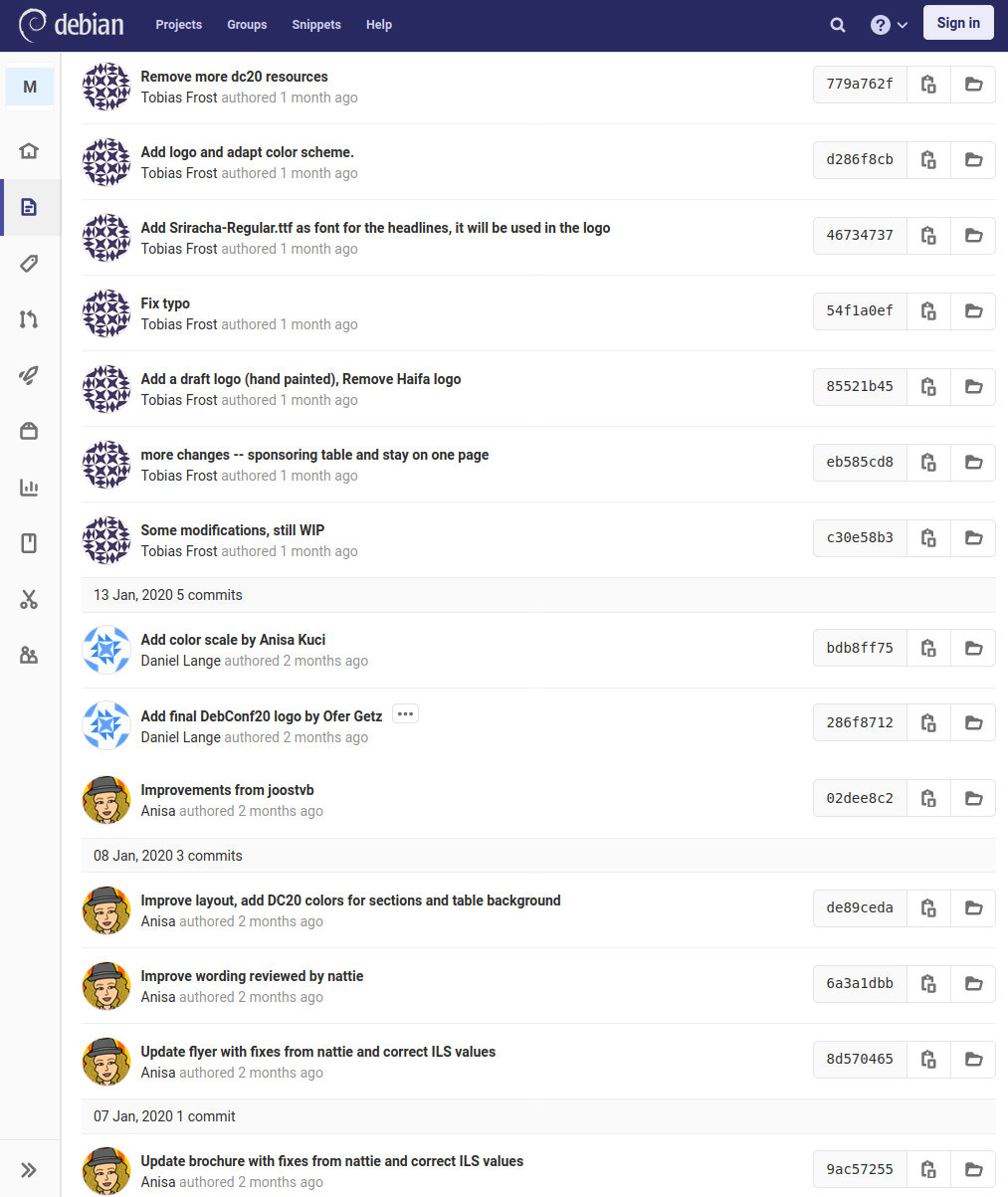
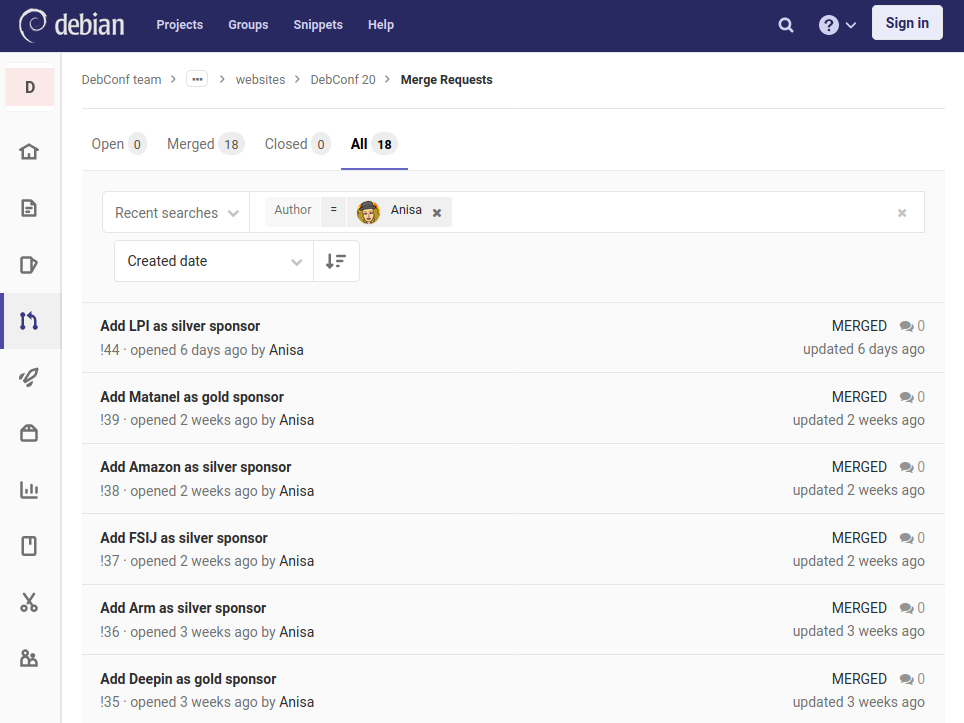
This is my last Outreachy blogpost, as my internship unfortunately has come to an end. It was a blast! Through the Outreachy internship I gained a lot of valuable knowledge and even though I dont know what the future will bring, I am more confident about myself, my skills in fundraising and my technical abilities now. During the contribution phase I did quite a lot of research so I could come up with relevant information to add on the Debian wiki as part of the contribution phase tasks. This was helpful for me to build a more deep understanding of the Debian project, the DebConf conferences and the general style of working within Debian. During this phase I completed most of the tasks given and got onto the mailing lists and IRC channels which are public. This was quite an intense experience by itself as it was like digging into a new job but in a competitive situation as other applicants, of course, were also putting in their best to get one of the 50 Outreachy internships (two in Debian) that were available. When I got selected I also got access to the sponsors@debconf.org email address and the private git repos as they would be needed for me to work on fundraising. I was also provided with an @debconf.org email address that is the one I use for sponsors communication. I learned what makes communication look professional and how to think of the recipient when formulating emails, sending replies or creating marketing messages. As the internship continued I started to learn how the DebConf organizing structure works, with a particular attention on the fundraising team. I have also quickly been given the responsibility to reach out to 100 potential sponsors and combine learning and working experience very nicely. I was given responsibility of working on the fundraising material (flyer and brochure) for DebConf20, so using LaTeX I updated the files in order to remove the translation system, I added the Israeli currency and the visual design chosen from a public logo proposal contest that is held for each DebConf. My creative side could also be put to good use as the team trusted me with selecting the images for the brochure and making sure that the usage rights granted and attribution are all compliant to Free Software/Creative Commons licences. I have continuously maintained those materials and was very happy that long term team members even asked me to approve changes they proposed on the fundraising material. The MiniDebConf team for Regensburg have taken the files I created and made them into their fundraising material (brochure, flyer) which is great to see. MiniDebConf Regensburg commits I have profited so much from other people s work, so I am very happy if community members can build on mine. Afterall sharing is caring! Through the Outreachy travel stipend I was able to attend FOSDEM 2020 and besides meeting many friends from the community and having a fundraising meeting with a sponsor, I was able to also support distributing the DebConf20 fundraising material both in electronic form and as printed versions. During the Outreachy internship I did two communication waves to potential sponsors and maintained the daily communication with them. I followed the documentation that was already available in the Debian wiki guiding me through the process of invoicing sponsors through the organizations that Debian collaborates with. As I have been in frequent contact with the sponsors, I have continuously updated the DebConf20 website with sponsor logos and links through git files, improving web pages on the wafer system and doing 18 merge requests in total. DebConf20 website merge requests I completed six email templates for the DebConf sponsor communication campaigns. While two of them have already been very useful, I hope my other proposals will be the ones used for the next waves of sponsors contacting. I committed them to the sponsors git repo so they can be easily accessible and well documented for other DebConf teams or can be recycled for smaller Debian events. Unfortunately, due to the insecurity about travel around the Corona virus pandemic, the third wave of communication, originally scheduled for the end of my internship in March, has been held. I have committed to the team to do this once the travel restrictions have been lifted and we know that DebConf20 can proceed as planned for August 2020. So yeah, I am definitely going to stay around and continue to help with DebConf fundraising! DebConf has been held for two decades and it also has a generic website, so I also updated the static sponsors page on the main website as it is the first landing page for everyone especially for people who are not necessarily insiders in Debian or DebConf. I have completed a Python tutorial, got the general understanding of the programming language and made some smaller contributions to improve existing tools in the fundraising team based on the learning. The internship was also focused on documentation, so during the whole internship I have kept notes in order to be able to improve existing documentation and I have also written new material, especially on the tasks that I have been working on more closely: Every DebConf has a new team every year, in a new country, so I hope this documentation I have worked on will be useful as a jump-starter for them to organize and finance their events. I would like to take a moment to thank again my mentors Daniel and Karina for all their support, it has been great working with them. Having them as an example, I have learned a lot. Also warm thanks to the DebConf global and local teams which have been very welcoming and always supportive during my internship. So, as you might already know, if you have read my other Outreachy blog posts, this has been a great experience for me! Outreachy provides an awesome opportunity that would not be available if it was not for the generous sponsors and volunteers making such a program for people from underrepresented groups in the FLOSS community. I really encourage people from these groups to find the confidence within themselves and apply for Outreachy! I love Debian

22 March 2020

Enrico Zini: Notable people

Lotte Reiniger. The Unsung Heroine of Early Animation
history people wikipedia
Lotte Reiniger pioneered early animation, yet her name remains largely unknown. We pay homage to her life and work, and reflect on why she never received the recognition she deserves.
Stephen Wolfram shares what he learned in researching Ada Lovelace's life, writings about the Analytical Engine, and computation of Bernoulli numbers.
Elizabeth Cochran Seaman[1] (May 5, 1864[2] January 27, 1922), better known by her pen name Nellie Bly, was an American journalist who was widely known for her record-breaking trip around the world in 72 days, in emulation of Jules Verne's fictional character Phileas Fogg, and an expos in which she worked undercover to report on a mental institution from within.[3] She was a pioneer in her field, and launched a new kind of investigative journalism.[4] Bly was also a writer, inventor, and industrialist.
Delia Ann Derbyshire (5 May 1937 3 July 2001)[1] was an English musician and composer of electronic music.[2] She carried out pioneering work with the BBC Radiophonic Workshop during the 1960s, including her electronic arrangement of the theme music to the British science-fiction television series Doctor Who.[3][4] She has been referred to as "the unsung heroine of British electronic music,"[3] having influenced musicians including Aphex Twin, the Chemical Brothers and Paul Hartnoll of Orbital.[5]
Charity Adams Earley (5 December 1918 13 January 2002) was the first African-American woman to be an officer in the Women's Army Auxiliary Corps (later WACS) and was the commanding officer of the first battalion of African-American women to serve overseas during World War II. Adams was the highest ranking African-American woman in the army by the completion of the war.

11 March 2020

Antoine Beaupr : Font changes

I have worked a bit on the fonts I use recently. From the main font I use every day in my text editor and terminals to this very website, I did a major and (hopefully) thoughtful overhaul of my typography, in the hope of making things easier to use and, to be honest, just prettier.

Editor and Terminal: Fira mono This all started when I found out about the Jetbrains Mono font. I found the idea of ligatures fascinating: the result is truly beautiful. So I do what I often do (sometimes to the despair of some fellow Debian members) and filed a RFP to document my research. As it turns out, Jetbrains Mono is not free enough to be packaged in Debian, because it requires proprietary tools to build. I nevertheless figured I could try another font so I looked at other monospace alternatives. I found the following packages in debian: Those are also "programmer fonts" that caught my interest but somehow didn't land in Debian yet: Because Fira code had ligatures, i ended up giving it a shot. I really like the originality of the font. See, for example, how the @ sign looks when compared to my previous font, Liberation Mono:
A dark terminal window showing the prompt '[SIGPIPE]anarcat@angela:~(master)$' in the Liberation Mono font Liberation Mono
A dark terminal window showing the prompt '[SIGPIPE]anarcat@angela:~(master)$' in the Fira mono font Fira Mono
Interestingly, a colleague (thanks ahf!) pointed me to the Practical Typography post "Ligatures in programming fonts: hell no", which makes the very convincing argument that ligatures are downright dangerous to programming environment. In my experiences with the fonts, it was also not always giving the result I would expect. I also remembered that the Emacs Haskell mode would have this tendency of inserting crazy syntactic sugar like this in source code without being asked, which I found extremely frustrating. Besides, Emacs doesn't support ligatures, unless you count such horrendous hacks which hack at the display time. That's because Emacs' display layer is not based on a modern rendering library like Pango but some scary legacy code that very few people understand. On top of the complexity of the codebase, there is also resistance in including a modern font. So I ended up using Fira mono everywhere I use fixed-width fonts, even though it's not packaged in Debian. That involves the following configuration in my .Xresources (no, I haven't switched to Wayland):
! font settings
Emacs*font: Fira mono
rofi*font: Fira mono 12
! Symbola is to get emojis to display correctly, apt install fonts-symbola
!URxvt*font: xft:Monospace,xft:Symbola
URxvt*font: xft:Fira mono,xft:Symbola
I also dropped this script in ~/.local/share/fonts/download.sh, for lack of a better way, to download all the fonts I'm interested in:
#!/bin/sh
set -e
set -u
wget --no-clobber --continue https://practicaltypography.com/fonts/charter.zip
unzip -u charter.zip
wget --no-clobber --continue https://github.com/adobe-fonts/source-serif-pro/releases/download/3.001R/source-serif-pro-3.001R.zip
unzip -u source-serif-pro-3.001R.zip
wget --no-clobber --continue https://github.com/adobe-fonts/source-sans-pro/releases/download/3.006R/source-sans-pro-3.006R.zip
unzip -u source-sans-pro-3.006R.zip
wget --no-clobber --continue https://github.com/adobe-fonts/source-code-pro/releases/download/2.030R-ro%2F1.050R-it/source-code-pro-2.030R-ro-1.050R-it.zip
unzip -u source-code-pro-2.030R-ro-1.050R-it.zip
wget --no-clobber --continue -O Fira-4.202.zip https://github.com/mozilla/Fira/archive/4.202.zip   true
unzip -u Fira-4.202.zip
Update: I forgot to mention one motivation behind this was to work around a change in the freetype interpreter, discussed in bug 866685 and my upgrades documentation.

Website: Charter That "hell no" article got me interested in the Practical Typography web book, which I read over the weekend. It was an eye opener and I realized I had already some of those concepts implanted; in fact it's probably after reading the Typography in ten minutes guide that I ended up trying Fira sans a few years ago. I have removed that font since then, however, after realising it was taking up an order of magnitude more bandwidth space than the actual page content. I really loved the book, so much that I actually bought it. I liked the concept of it, the look, and the fact that it's a living document. There's a lot of typography work I would need to do on this site to catchup with the recommendations from Matthew Butterick. Switching fonts is only one part of this, but it's something I was excited to work on. So I sat down and reviewed the free fonts Butterick recommends and tried out a few. I ended up settling on Charter, a relatively old (in terms of computing) font designed by Matthew Carter (of Verdana fame) in 1987. Charter really looks great and is surprisingly small. While a single version of Fira varies between 96KiB (Fira Sans Condensed) and 308KiB (Fira Sans Medium Italic), Charter is only 28KiB! While it's still about as large as most of my articles, I found it was a better compromise and decided to make the jump. This site is now in Serif, which is a huge change for me. The change was done with the following CSS:
h1, h2, h3, h4, h5, body  
    /* 
     * Charter: Butterick's favorite, freely available, found on https://practicaltypography.com/free-fonts.html
     * Palatino: Mac OS
     * Palatino Linotype: Windows
     * Noto serif: Android, packaged in Debian
     * Liberation serif: Linux fallback
     * Serif: fallback
     */
    font-family: Charter, Palatino, "Palatino Linotype", "Noto serif", "Liberation serif", serif;
    /* Charter is available from https://practicaltypography.com/charter.html under the liberal Bitstream license */
 
I have also decided to outline headings by making them slanted, using the beautiful italic version of Charter:
h1, h2, h3, h4, h5  
    font-style: italic;
 
I also made the point size larger, if the display is large enough:
/* enlarge body point size for charter for larger displays */
@media (min-device-width: 750px)  
    body  
        font-size: 20px;
        line-height: 1.3; /* default in FF is ~1.48 */
     
 
Modern display (including fonts) have a much higher resolution and the point size on my website was really getting too small to be readable. This, in turn, required a change to the max-width:
#content  
    /* about 2.5 alphabets with charter */
    max-width: 35em;
 
I have kept the footers and "UI" elements in sans-serif though, and kept those aligned on operating system defaults or "system fonts":
/* some hacking at typefaces to get some fresh zest in here
 * fallbacks from:
 * https://en.wikipedia.org/wiki/List_of_typefaces_included_with_Microsoft_Windows
 * https://en.wikipedia.org/wiki/List_of_typefaces_included_with_macOS
 */
.navbar, .footer  
    /*
     * Avenir: Mac, quite different but should still be pretty
     * Gill sans: Mac, Windows, somewhat similar to Avenir (indulge me)
     * Noto sans: Android, packaged in Debian
     * Open sans: Texlive extras AKA Linux, packaged in Debian
     * Fira sans: Mozilla's Firefox OS
     * Liberation sans: Linux fallback
     * Helvetica: general fallback
     * Sans-serif: fallback
     */
    font-family: Avenir, "Gill sans", "Noto sans", "Open sans", "Fira sans", "Liberation sans", Helvetica, sans-serif;
    /* Fira is available from https://github.com/mozilla/Fira/ under the SIL Open Font License */
    /* alternatively, just use system fonts for "controls" instead:
    font-family: -apple-system, BlinkMacSystemFont, "Segoe UI", "Roboto", "Oxygen", "Ubuntu", "Cantarell", "Fira Sans", "Droid Sans", "Helvetica Neue", sans-serif;
    gitlab uses: -apple-system, BlinkMacSystemFont, "Segoe UI", Roboto, "Noto Sans", Ubuntu, Cantarell, "Helvetica Neue", sans-serif, "Apple Color Emoji", "Segoe UI Emoji", "Segoe UI Symbol", "Noto Color Emoji"
    */
 
I've only done some preliminary testing of how this will look like. Although I tested on a few devices (my phone, e-book tablet, an iPad, and of course my laptop), I fully expect things to break on your device. Do let me know if things look better or worse. For future comparison, my site is well indexed in the Internet Wayback Machine and can be used to look at the site before the change. For example, compare the previous article here with its earlier style. The changes to the theme are of course available in my custom ikiwiki bootstrap theme (see in particular commits 0bca0fb7 and d1901fb8), as usual. Enjoy, and let me know what you think! PS: I considered just setting the Charter font in CSS and not adding it as a @font-face. I'm still considering that option and might do so if the performance cost is too big. The Fira mono font is actually set like this for the preformatted sections of the site, but because it's more common (and it's too big) I haven't added it as a font-face. You might want to download the font locally to benefit from the full experience as well. PPS: As it turns out, an earlier version of this post featured exactly that: a non-webfont version of Charter, which works fine if you have a good Charter font available. But it looks absolutely terrible if, like many Linux users, you have the nasty bitmap font shipped with xfonts-100dpi and xfonts-75dpi. So I fixed the webfont and it's unlikely this site will be able to load reasonably well in Linux until those packages are removed or bitmap font rendering is disabled.

2 March 2020

Petter Reinholdtsen: Nikita version 0.5 released - updated free software archive API server

Today, after many months of development, a new release of Nikita Noark 5 core project was finally announced on the project mailing list. The Nikita free software solution is an implementation of the Norwegian archive standard Noark 5 used by government offices in Norway. These were the changes in version 0.5 since version 0.4, see the email link above for links to a demo site: If free and open standardized archiving API sound interesting to you, please contact us on IRC (#nikita on irc.freenode.net) or email (nikita-noark mailing list). As usual, if you use Bitcoin and want to show your support of my activities, please send Bitcoin donations to my address 15oWEoG9dUPovwmUL9KWAnYRtNJEkP1u1b.

23 November 2017

Russ Allbery: Holiday haul

Catching up on accumulated book purchases. I'm going to get another burst of reading time over the holidays (and am really looking forward to it). Alfred Bester The Stars My Destination (sff)
James Blish A Case of Conscience (sff)
Leigh Brackett The Long Tomorrow (sff)
Algis Budrys Who? (sff)
Frances Hardinge Fly By Night (sff)
Robert A. Heinlein Double Star (sff)
N.K. Jemisin The Obelisk Gate (sff)
N.K. Jemisin The Stone Sky (sff)
T. Kingfisher Clockwork Boys (sff)
Ursula K. Le Guin City of Illusions (sff)
Ursula K. Le Guin The Complete Orsinia (historical)
Ursula K. Le Guin The Dispossessed (sff)
Ursula K. Le Guin Five Ways to Forgiveness (sff)
Ursula K. Le Guin The Left Hand of Darkness (sff)
Ursula K. Le Guin Planet of Exile (sff)
Ursula K. Le Guin Rocannon's World (sff)
Ursula K. Le Guin The Telling (sff)
Ursula K. Le Guin The World for Word Is Forest (sff)
Fritz Leiber The Big Time (sff)
Melina Marchetta Saving Francesca (mainstream)
Richard Matheson The Shrinking Man (sff)
Foz Meadows An Accident of Stars (sff)
Dexter Palmer Version Control (sff)
Frederick Pohl & C.M. Kornbluth The Space Merchants (sff)
Adam Rex True Meaning of Smekday (sff)
John Scalzi The Dispatcher (sff)
Julia Spencer-Fleming In the Bleak Midwinter (mystery)
R.E. Stearns Barbary Station (sff)
Theodore Sturgeon More Than Human (sff)
I'm listing the individual components except for the Orsinia collection, but the Le Guin are from the Library of America Hainish Novels & Stories two-volume set. I had several of these already, but I have a hard time resisting a high-quality Library of America collection for an author I really like. Now I can donate a bunch of old paperbacks. Similarly, a whole bunch of the older SF novels are from the Library of America American Science Fiction two-volume set, which I finally bought since I was ordering Library of America sets anyway. The rest is a pretty random collection of stuff, although several of them are recommendations from Light. I was reading through her old reviews and getting inspired to read (and review) more.

13 November 2017

Steve Kemp: Paternity-leave is half-over

I'm taking the month of November off work, so that I can exclusively take care of our child. Despite it being a difficult time, with him teething, it has been a great half-month so far. During the course of the month I've found my interest in a lot of technological things waning, so I've killed my account(s) on a few platforms, and scaled back others - if I could exclusively do child-care for the next 20 years I'd be very happy, but sadly I don't think that is terribly realistic. My interest in things hasn't entirely vanished though, to the extent that I found the time to replace my use of etcd with consul yesterday, and I'm trying to work out how to simplify my hosting setup. Right now I have a bunch of servers doing two kinds of web-hosting: Hosting static-sites is trivial, whether with a virtual machine, via Amazons' S3-service, or some other static-host such as netlify. Hosting for "dynamic stuff" is harder. These days a trend for "serverless" deployments allows you to react to events and be dynamic, but not everything can be a short-lived piece of ruby/javascript/lambda. It feels like I could setup a generic platform for launching containers, or otherwise modernising FastCGI, etc, but I'm not sure what the point would be. (I'd still be the person maintaining it, and it'd still be a hassle. I've zero interest in selling things to people, as that only means more support.) In short I have a bunch of servers, they mostly tick over unattended, but I'm not really sure I want to keep them running for the next 10+ years. Over time our child will deserve, demand, and require more attention which means time for personal stuff is only going to diminish. Simplify things now wouldn't be a bad thing to do, before it is too late.

10 November 2017

Wouter Verhelst: SReview 0.1

This morning I uploaded version 0.1 of SReview, my video review and transcoding system, to Debian experimental. There's still some work to be done before it'll be perfectly easy to use by anyone, but I do think I've reached the point by now where it should have basic usability by now. Quick HOWTO for how to use it: There's still some bits of the above list that I want to make easier to do, and there's still some things that shouldn't be strictly necessary, but all in all, I think SReview has now reached a certain level of maturity that means I felt confident doing its first upload to Debian. Did you try it out? Let me know what you think!

Thadeu Lima de Souza Cascardo: Software Freedom Strategy with Community Projects

It's been some time since I last wrote. Life and work have been busy. At the same time, the world has been busy, and as I would love to write a larger post, I will try to be short here. I would love to touch on the Librem 5 and postmarketOS. In fact, I had, in a podcast in Portuguese, Papo Livre. Maybe, I'll touch a little on the latter. Some of the inspiration for this post include: All of those led me to understand how software freedom is under attack, in particular how copyleft in under attack. And, as I talked during FISL, though many might say that "Open Source has won", end users software freedom has not. Lots of companies have co-opted "free software" but give no software freedom to their users. They seem friends with free software, and they are. Because they want software to be free. But freedom should not be a value for software itself, it needs to be a value for people, not only companies or people who are labeled software developers, but all people. That's why I want to stop talking about free software, and talk more about software freedom. Because I believe the latter is more clear about what we are talking about. I don't mind that we use whatever label, as long as we stablish its meaning during conversations, and set the tone to distinguish them. The thing is: free software does not software freedom make. Not by itself. As Bradley Kuhn puts it: it's not magic pixie dust. Those who have known me for years might remember me as a person who studied free software licenses and how I valued copyleft, the GPL specifically, and how I concerned myself with topics like license compatibility and other licensing matters. Others might remember me as a person who valued a lot about upstreaming code. Not carrying changes to software openly developed that you had not made an effort to put upstream. I can't say I was wrong on both accounts. I still believe in those things. I still believe in the importance of copyleft and the GPL. I still value sharing your code in the commons by going upstream. But I was certaily wrong in valuing them too much. Or not giving as much or even more value to distribution efforts of getting software freedom to the users. And it took me a while in seeing how many people also saw the GPL as a tool to get code upstream. You see that a lot in Linus' discourse about the GPL. And that is on the minds of a lot of people, who I have seen argue that copyleft is not necessary for companies to contribute code back. But that's the problem. The point is not about getting code upstream. But about assuring people have the freedom to run a modified version of the software they received on their computers. It turns out that many examples of companies who had contributed code upstream, have not delivered that freedom to their end-users, who had received a modified version of that same software, which is not free. Bradley Kuhn also alerts us that many companies have been replacing copyleft software with non-copyleft software. And I completely agree with him that we should be writing more copyleft software that we hold copyright for, so we can enforce it. But looking at what has been happening recently in the Linux community about enforcement, even thought I still believe in enforcement as an strategy, I think we need much more than that. And one of those strategies is delivering more free software that users may be able to install on their own computers. It's building those replacements for software that people have been using for any reason. Be it the OS they get when they buy a device, or the application they use for communication. It's not like the community is not doing it, it's just that we need to acknowledge that this is a necessary strategy to guarantee software freedom. That distribution of software that users may easily install on their computers is as much or even more valuable than developing software closer to the hacker/developer community. That doing downstream changes to free software in the effort of getting them to users is worth it. That maintaining that software stable and secure for users is a very important task. I may be biased when talking about that, as I have been shifting from doing upstream work to downstream work and both on the recent years. But maybe that's what I needed to realize that upstreaming does not necessarily guarantees that users will get software freedom. I believe we need to talk more about that. I have seen many people dear to me disregard that difference between the freedom of the user and the freedom of software. There is much more to talk about that, go into detail about some of those points, and I think we need to debate more. I am subscribed to the libreplanet-discuss mailing list. Come join us in discussing about software freedom there, if you want to comment on anything I brought up here. As I promised I would, I would like to mention about postmarketOS, which is an option users have now to get some software freedom on some mobile devices. It's an effort I wanted to build myself, and I applaud the community that has developed around it and has been moving forward so quickly. And it's a good example of a balance between upstream and dowstream code that gets to deliver a better level of software freedom to users than the vendor ever would. I wanted to write about much of the topics I brought up today, but postponed that for some time. I was motivated by recent events in the community, and I am really disappointed at some the free software players and some of the events that happened in the last few years. That got me into thinking in how we need to manifest ourselves about those issues, so people know how we feel. So here it is: I am disappointed at how the Linux Foundation handled the situation about Software Freedom Conversancy taking a case against VMWare; I am disappointed about how Software Freedom Law Center handled a trademark issue against the Software Freedom Conservancy; and I really appreciate all the work the Software Freedom Conservancy has been doing. I have supported them for the last two years, and I urge you to become a supporter too.

8 November 2017

Dirk Eddelbuettel: RQuantLib 0.4.4: Several smaller updates

A shiny new (mostly-but-not-completely maintenance) release of RQuantLib, now at version 0.4.4, arrived on CRAN overnight, and will get to Debian shortly. This is the first release in over a year, and it it contains (mostly) a small number of fixes throughout. It also includes the update to the new DateVector and DatetimeVector classes which become the default with the upcoming Rcpp 0.12.14 release (just like this week's RcppQuantuccia release). One piece of new code is due to Fran ois Cocquemas who added support for discrete dividends to both European and American options. See below for the complete set of changes reported in the NEWS file. As with release 0.4.3 a little over a year ago, we will not have new Windows binaries from CRAN as I apparently have insufficient powers of persuasion to get CRAN to update their QuantLib libraries. So we need a volunteer. If someone could please build a binary package for Windows from the 0.4.4 sources, I would be happy to once again host it on the GHRR drat repo. Please contact me directly if you can help. Changes are listed below:

Changes in RQuantLib version 0.4.4 (2017-11-07)
  • Changes in RQuantLib code:
    • Equity options can now be analyzed via discrete dividends through two vectors of dividend dates and values (Francois Cocquemas in #73 fixing #72)
    • Some package and dependency information was updated in files DESCRIPTION and NAMESPACE.
    • The new Date(time)Vector classes introduced with Rcpp 0.12.8 are now used when available.
    • Minor corrections were applied to BKTree, to vanilla options for the case of intraday time stamps, to the SabrSwaption documentation, and to bond utilities for the most recent QuantLib release.

Courtesy of CRANberries, there is also a diffstat report for the this release. As always, more detailed information is on the RQuantLib page. Questions, comments etc should go to the rquantlib-devel mailing list off the R-Forge page. Issue tickets can be filed at the GitHub repo.

This post by Dirk Eddelbuettel originated on his Thinking inside the box blog. Please report excessive re-aggregation in third-party for-profit settings.

2 November 2017

Steinar H. Gunderson: Introducing Narabu, part 5: Encoding

Narabu is a new intraframe video codec. You probably want to read part 1, part 2, part 3 and part 4 first. At this point, we've basically caught up with where I am, so thing are less set in stone. However, let's look at what qualitatively differentiates encoding from decoding; unlike in interframe video codecs (where you need to do motion vector search and stuff), encoding and decoding are very much mirror images of each other, so we can intuitively expect them to be relatively similar in performance. The procedure is DCT, quantization, entropy coding, and that's it. One important difference is in the entropy coding. Since our rANS encoding is non-adaptive (a choice made largely for simplicity, but also because our streams are so short) works by first signaling a distribution and then encoding each coefficient using that distribution. However, we don't know that distribution until we've DCT-ed all blocks in the picture, so we can't just DCT each block and entropy code the coefficients on-the-fly. There are a few ways to deal with this: As you can see, tons of possible strategies here. For simplicity, I've ended up with the former, although this could very well be changed at some point. There are some interesting subproblems, though: First of all, we need to decide the data type of this temporary array. The DCT tends to concentrate energy into fewer coefficients (which is a great property for compression!), so even after quantization, some of them will get quite large. This means we cannot store them in an 8-bit texture; however, even the bigger ones are very rarely bigger than 10 bits (including a sign bit), so using 16-bit textures wastes precious memory bandwidth. I ended up slicing the coefficients by horizontal index and then pairing them up (so that we generate pairs 0+7, 1+6, 2+5 and 3+4 for the first line of the 8x8 DCT block, 8+15, 9+14, 10+13 and 11+12 for the next line, etc.). This allows us to pack two coefficients into a 16-bit texture, for an average of 8 bits per coefficient, which is what we want. It makes for some slightly fiddly clamping and bit-packing since we are packing signed values, but nothing really bad. Second, and perhaps surprisingly enough, counting efficiently is nontrivial. We want a histogram over what coefficients are used the more often, ie., for each coefficient, we want something like ++counts[dist][coeff] (recall we have four distinct distributions). However, since we're in a massively parallel algorithm, this add needs to be atomic, and since values like e.g. 0 are super-common, all of our GPU cores will end up fighting over the cache line containing counts[dist][0]. This is not fast. Think 10 ms/frame not fast. Local memory to the rescue again; all modern GPUs have fast atomic adds to local memory (basically integrating adders into the cache, as I understand it, although I might have misunderstood here). This means we just make a suitably large local group, build up our sub-histogram in local memory and then add all nonzero buckets (atomically) to the global histogram. This improved performance dramatically, to the point where it was well below 0.1 ms/frame. However, our histogram is still a bit raw; it sums to 1280x720 = 921,600 values, but we want an approximation that sums to exactly 4096 (12 bits), with some additional constraints (like no nonzero coefficients). Charles Bloom has an exposition of a nearly optimal algorithm, although it took me a while to understand it. The basic idea is: Make a good approximation by multiplying each frequency by 4096/921600 (rounding intelligently). This will give you something that very nearly rounds to 4096 either above or below, e.g. 4101. For each step you're above or below the total (five in this case), find the best single coefficient to adjust (most entropy gain, or least loss); Bloom is using a heap, but on the GPU, each core is slow but we have many of them, so it's better just to try all 256 possibilities in parallel and have a simple voting scheme through local memory to find the best one. And then finally, we want a cumulative distribution function, but that is simple through a parallel prefix sum on the 256 elements. And then finally, we can take our DCT coefficients and the finished rANS distribution, and write the data! We'll have to leave some headroom for the streams (I've allowed 1 kB for each, which should be ample except for adversarial data and we'll probably solve that just by truncating the writes and accepting the corruption), but we'll compact them when we write to disk. Of course, the Achilles heel here is performance. Where decoding 720p (luma only) on my GTX 950 took 0,4 ms or so, encoding is 1,2 ms or so, which is just too slow. Remember that 4:2:2 is twice that, and we want multiple streams, so 2,4 ms per frame is eating too much. I don't really know why it's so slow; the DCT isn't bad, the histogram counting is fast, it's just the rANS shader that's slow for some reason I don't understand, and also haven't had the time to really dive deeply into. Of course, a faster GPU would be faster, but I don't think I can reasonably demand that people get a 1080 just to encode a few video streams. Due to this, I haven't really worked out the last few kinks. In particular, I haven't implemented DC coefficient prediction (it needs to be done before tallying up the histograms, so it can be a bit tricky to do efficiently, although perhaps local memory will help again to send data between neighboring DCT blocks). And I also haven't properly done bounds checking in the encoder or decoder, but it should hopefully be simple as long as we're willing to accept that evil input decodes into garbage instead of flagging errors explicitly. It also depends on a GLSL extension that my Haswell laptop doesn't have to get 64-bit divides when precalculating the rANS tables; I've got some code to simulate 64-bit divides using 32-bit, but it doesn't work yet. The code as it currently stands is in this Git repository; you can consider it licensed under GPLv3. It's really not very user-friendly at this point, though, and rather rough around the edges. Next time, we'll wrap up with some performance numbers. Unless I magically get more spare time in the meantime and/or some epiphany about how to make the encoder faster. :-)

Antoine Beaupr : October 2017 report: LTS, feed2exec beta, pandoc filters, git mediawiki

Debian Long Term Support (LTS) This is my monthly Debian LTS report. This time I worked on the famous KRACK attack, git-annex, golang and the continuous stream of GraphicsMagick security issues.

WPA & KRACK update I spent most of my time this month on the Linux WPA code, to backport it to the old (~2012) wpa_supplicant release. I first published a patchset based on the patches shipped after the embargo for the oldstable/jessie release. After feedback from the list, I also built packages for i386 and ARM. I have also reviewed the WPA protocol to make sure I understood the implications of the changes required to backport the patches. For example, I removed the patches touching the WNM sleep mode code as that was introduced only in the 2.0 release. Chunks of code regarding state tracking were also not backported as they are part of the state tracking code introduced later, in 3ff3323. Finally, I still have concerns about the nonce setup in patch #5. In the last chunk, you'll notice peer->tk is reset, to_set to negotiate a new TK. The other approach I considered was to backport 1380fcbd9f ("TDLS: Do not modify RNonce for an TPK M1 frame with same INonce") but I figured I would play it safe and not introduce further variations. I should note that I share Matthew Green's observations regarding the opacity of the protocol. Normally, network protocols are freely available and security researchers like me can easily review them. In this case, I would have needed to read the opaque 802.11i-2004 pdf which is behind a TOS wall at the IEEE. I ended up reading up on the IEEE_802.11i-2004 Wikipedia article which gives a simpler view of the protocol. But it's a real problem to see such critical protocols developed behind closed doors like this. At Guido's suggestion, I sent the final patch upstream explaining the concerns I had with the patch. I have not, at the time of writing, received any response from upstream about this, unfortunately. I uploaded the fixed packages as DLA 1150-1 on October 31st.

Git-annex The next big chunk on my list was completing the work on git-annex (CVE-2017-12976) that I started in August. It turns out doing the backport was simpler than I expected, even with my rusty experience with Haskell. Type-checking really helps in doing the right thing, especially considering how Joey Hess implemented the fix: by introducing a new type. So I backported the patch from upstream and notified the security team that the jessie and stretch updates would be similarly easy. I shipped the backport to LTS as DLA-1144-1. I also shared the updated packages for jessie (which required a similar backport) and stretch (which didn't) and those Sebastien Delafond published those as DSA 4010-1.

Graphicsmagick Up next was yet another security vulnerability in the Graphicsmagick stack. This involved the usual deep dive into intricate and sometimes just unreasonable C code to try and fit a round tree in a square sinkhole. I'm always unsure about those patches, but the test suite passes, smoke tests show the vulnerability as fixed, and that's pretty much as good as it gets. The announcement (DLA 1154-1) turned out to be a little special because I had previously noticed that the penultimate announcement (DLA 1130-1) was never sent out. So I made a merged announcement to cover both instead of re-sending the original 3 weeks late, which may have been confusing for our users.

Triage & misc We always do a bit of triage even when not on frontdesk duty, so I: I also did smaller bits of work on: The latter reminded me of the concerns I have about the long-term maintainability of the golang ecosystem: because everything is statically linked, an update to a core library (say the SMTP library as in CVE-2017-15042, thankfully not affecting LTS) requires a full rebuild of all packages including the library in all distributions. So what would be a simple update in a shared library system could mean an explosion of work on statically linked infrastructures. This is a lot of work which can definitely be error-prone: as I've seen in other updates, some packages (for example the Ruby interpreter) just bit-rot on their own and eventually fail to build from source. We would also have to investigate all packages to see which one include the library, something which we are not well equipped for at this point. Wheezy was the first release shipping golang packages but at least it's shipping only one... Stretch has shipped with two golang versions (1.7 and 1.8) which will make maintenance ever harder in the long term.
We build our computers the way we build our cities--over time, without a plan, on top of ruins. - Ellen Ullman

Other free software work This month again, I was busy doing some serious yak shaving operations all over the internet, on top of publishing two of my largest LWN articles to date (2017-10-16-strategies-offline-pgp-key-storage and 2017-10-26-comparison-cryptographic-keycards).

feed2exec beta Since I announced this new project last month I have released it as a beta and it entered Debian. I have also wrote useful plugins like the wayback plugin that saves pages on the Wayback machine for eternal archival. The archive plugin can also similarly save pages to the local filesystem. I also added bash completion, expanded unit tests and documentation, fixed default file paths and a bunch of bugs, and refactored the code. Finally, I also started using two external Python libraries instead of rolling my own code: the pyxdg and requests-file libraries, the latter which I packaged in Debian (and fixed a bug in their test suite). The program is working pretty well for me. The only thing I feel is really missing now is a retry/fail mechanism. Right now, it's a little brittle: any network hiccup will yield an error email, which are readable to me but could be confusing to a new user. Strangely enough, I am particularly having trouble with (local!) DNS resolution that I need to look into, but that is probably unrelated with the software itself. Thankfully, the user can disable those with --loglevel=ERROR to silence WARNINGs. Furthermore, some plugins still have some rough edges. For example, The Transmission integration would probably work better as a distinct plugin instead of a simple exec call, because when it adds new torrents, the output is totally cryptic. That plugin could also leverage more feed parameters to save different files in different locations depending on the feed titles, something would be hard to do safely with the exec plugin now. I am keeping a steady flow of releases. I wish there was a way to see how effective I am at reaching out with this project, but unfortunately GitLab doesn't provide usage statistics... And I have received only a few comments on IRC about the project, so maybe I need to reach out more like it says in the fine manual. Always feels strange to have to promote your project like it's some new bubbly soap... Next steps for the project is a final review of the API and release production-ready 1.0.0. I am also thinking of making a small screencast to show the basic capabilities of the software, maybe with asciinema's upcoming audio support?

Pandoc filters As I mentioned earlier, I dove again in Haskell programming when working on the git-annex security update. But I also have a small Haskell program of my own - a Pandoc filter that I use to convert the HTML articles I publish on LWN.net into a Ikiwiki-compatible markdown version. It turns out the script was still missing a bunch of stuff: image sizes, proper table formatting, etc. I also worked hard on automating more bits of the publishing workflow by extracting the time from the article which allowed me to simply extract the full article into an almost final copy just by specifying the article ID. The only thing left is to add tags, and the article is complete. In the process, I learned about new weird Haskell constructs. Take this code, for example:
-- remove needless blockquote wrapper around some tables
--
-- haskell newbie tips:
--
-- @ is the "at-pattern", allows us to define both a name for the
-- construct and inspect the contents as once
--
--   is the "empty record pattern": it basically means "match the
-- arguments but ignore the args"
cleanBlock (BlockQuote t@[Table  ]) = t
Here the idea is to remove <blockquote> elements needlessly wrapping a <table>. I can't specify the Table type on its own, because then I couldn't address the table as a whole, only its parts. I could reconstruct the whole table bits by bits, but it wasn't as clean. The other pattern was how to, at last, address multiple string elements, which was difficult because Pandoc treats spaces specially:
cleanBlock (Plain (Strong (Str "Notifications":Space:Str "for":Space:Str "all":Space:Str "responses":_):_)) = []
The last bit that drove me crazy was the date parsing:
-- the "GAByline" div has a date, use it to generate the ikiwiki dates
--
-- this is distinct from cleanBlock because we do not want to have to
-- deal with time there: it is only here we need it, and we need to
-- pass it in here because we do not want to mess with IO (time is I/O
-- in haskell) all across the function hierarchy
cleanDates :: ZonedTime -> Block -> [Block]
-- this mouthful is just the way the data comes in from
-- LWN/Pandoc. there could be a cleaner way to represent this,
-- possibly with a record, but this is complicated and obscure enough.
cleanDates time (Div (_, [cls], _)
                 [Para [Str month, Space, Str day, Space, Str year], Para _])
    cls == "GAByline" = ikiwikiRawInline (ikiwikiMetaField "date"
                                           (iso8601Format (parseTimeOrError True defaultTimeLocale "%Y-%B-%e,"
                                                           (year ++ "-" ++ month ++ "-" ++ day) :: ZonedTime)))
                        ++ ikiwikiRawInline (ikiwikiMetaField "updated"
                                             (iso8601Format time))
                        ++ [Para []]
-- other elements just pass through
cleanDates time x = [x]
Now that seems just dirty, but it was even worse before. One thing I find difficult in adapting to coding in Haskell is that you need to take the habit of writing smaller functions. The language is really not well adapted to long discourse: it's more about getting small things connected together. Other languages (e.g. Python) discourage this because there's some overhead in calling functions (10 nanoseconds in my tests, but still), whereas functions are a fundamental and important construction in Haskell that are much more heavily optimized. So I constantly need to remind myself to split things up early, otherwise I can't do anything in Haskell. Other languages are more lenient, which does mean my code can be more dirty, but I feel get things done faster then. The oddity of Haskell makes frustrating to work with. It's like doing construction work but you're not allowed to get the floor dirty. When I build stuff, I don't mind things being dirty: I can cleanup afterwards. This is especially critical when you don't actually know how to make things clean in the first place, as Haskell will simply not let you do that at all. And obviously, I fought with Monads, or, more specifically, "I/O" or IO in this case. Turns out that getting the current time is IO in Haskell: indeed, it's not a "pure" function that will always return the same thing. But this means that I would have had to change the signature of all the functions that touched time to include IO. I eventually moved the time initialization up into main so that I had only one IO function and moved that timestamp downwards as simple argument. That way I could keep the rest of the code clean, which seems to be an acceptable pattern. I would of course be happy to get feedback from my Haskell readers (if any) to see how to improve that code. I am always eager to learn.

Git remote MediaWiki Few people know that there is a MediaWiki remote for Git which allow you to mirror a MediaWiki site as a Git repository. As a disaster recovery mechanism, I have been keeping such a historical backup of the Amateur radio wiki for a while now. This originally started as a homegrown Python script to also convert the contents in Markdown. My theory then was to see if we could switch from Mediawiki to Ikiwiki, but it took so long to implement that I never completed the work. When someone had the weird idea of renaming a page to some impossible long name on the wiki, my script broke. I tried to look at fixing it and then remember I also had a mirror running using the Git remote. It turns out it also broke on the same issue and that got me looking in the remote again. I got lost in a zillion issues, including fixing that specific issue, but I especially looked at the possibility of fetching all namespaces because I realized that the remote fetches only a part of the wiki by default. And that drove me to submit namespace support as a patch to the git mailing list. Finally, the discussion came back to how to actually maintain that contrib: in git core or outside? Finally, it looks like I'll be doing some maintenance that project outside of git, as I was granted access to the GitHub organisation...

Galore Yak Shaving Then there's the usual hodgepodge of fixes and random things I did over the month.
There is no [web extension] only XUL! - Inside joke

31 October 2017

Chris Lamb: Free software activities in October 2017

Here is my monthly update covering what I have been doing in the free software world in October 2017 (previous month):
Reproducible builds

Whilst anyone can inspect the source code of free software for malicious flaws, most software is distributed pre-compiled to end users. The motivation behind the Reproducible Builds effort is to allow verification that no flaws have been introduced either maliciously or accidentally during this compilation process by promising identical results are always generated from a given source, thus allowing multiple third-parties to come to a consensus on whether a build was compromised. I have generously been awarded a grant from the Core Infrastructure Initiative to fund my work in this area. This month I:


I also made the following changes to our tooling:
diffoscope

diffoscope is our in-depth and content-aware diff utility that can locate and diagnose reproducibility issues.

  • Improve names in output of "internal" binwalk members. (#877525).
  • Don't crash on malformed md5sums files. (#877473).
  • Omit misleading "any of" prefix when only complaining about a single module on import. [...]
  • Adjust tests as ps2ascii now varies its output on timezone. [...]

strip-nondeterminism

strip-nondeterminism is our tool to remove specific non-deterministic results from a completed build.

  • Clojure considers .class file to be stale if it shares the same timestamp of the .clj. We thus adjust the timestamps of the .clj to always be younger. (#877418).
  • Print a message in --verbose mode if no canonical time was specified. [...]

buildinfo.debian.net

buildinfo.debian.net is my experiment into how to process, store and distribute .buildinfo files after the Debian archive software has processed them.

  • Always show SHA-256 checksums, regardless of the browser viewport size. [...]
  • Add an API endpoint to fetch specific .buildinfo files for a certain package/version/architecture. [...]


Debian My activities as the current Debian Project Leader are covered in my "Bits from the DPL" email to the debian-devel-announce mailing list.
Patches contributed
  • devscripts: Please print the actual arguments debuild makes to Lintian. (#880124)
  • hw-detect: Drop reference to floppy disks; it's almost 2018. (#880122)
  • debci:
    • Use deb.debian.org over http.debian.net. (#879654)
    • Document how to use an alternative mirror. (#879655)

Debian LTS

This month I have been paid to work 18 hours on Debian Long Term Support (LTS). In that time I did the following:
  • "Frontdesk" duties, triaging CVEs, etc.
  • Followed up on a large number of upstream "pings" that have been left dormant.
  • Issued DLA 1121-1 to fix an out-of-bounds read vulnerability in curl where a malicious FTP server could abuse this to prevent clients from interacting with it.
  • Issued DLA 1123-1 for the "Go" programming language where an attacker could generate a MIME request such that the server ran out of file descriptors.
  • Issued DLA 1126-1 for the libxfont font selection and rasterisation library, correcting two vulnerabilities, both involving the library being tricked into reading invalid/random memory.
  • Issued DLA 1134-1 for sdl-image1.2, an image loading library. A maliciously-crafted .xcf file could cause a stack-based buffer overflow resulting in potential code execution.

Uploads
  • python-django:
    • 2.0~beta1-1 New upstream 2.x release.
    • 1.11.6-1 New upstream bugfix release.
  • gunicorn (19.6.0-10+deb9u1) Prepared a release for stable to avoid a runtime dependency on a compiler. (#877722)
  • redis:
    • 4:4.0.2-3:
      • Drop the Debian-specific /etc/redis/redis-server.pre-up.d (etc.) hooks and remove them if unchanged.
      • Include systemd redis-server@.service and redis-sentinel@.service template files to easily run multiple Redis instances. (#877702)
      • Patch redis.conf and sentinel.conf with quilt instead of maintaining our own versions under debian/.
    • 4:4.0.2-4:
      • Add input validity checking to cluster config slot numbers to fix CVE-2017-15047. (#878076)
      • Drop debian/bin/generate-parts now we aren't calling it.
      • Correct Bash-ism in NEWS file.
    • 4:4.0.2-5: Replace the existing patch for CVE-2017-15047 with an upstream-blessed version that covers another case.
  • redisearch (0.21.3-5) Initial release.
  • docbook2man (2.0.0-40) Correct spelling mistakes in binaries and other misc packaging tidying.
  • python-redis (2.10.6-1) New upstream release.
  • bfs (1.1.3-1) New upstream release.

FTP Team

As a Debian FTP assistant I ACCEPTed 103 packages: amcheck, argagg, binutils, blockui, bro-pkg, chkservice, citus, django-axes, docker-containerd, doctest, dtkwidget, duktape, feed2exec, fontforge, fonttools, gcc-8, gcc-8-cross, generator-scripting-language, gitgraph.js, haskell-uri-encode, hoel, iniparser, its, jquery-areyousure, kodi, libcatmandu-mods-perl, libcatmandu-template-perl, libcatmandu-xml-perl, libcatmandu-xsd-perl, libcode-tidyall-plugin-sortlines-naturally-perl, libgdamm5.0, libinfinity, libmods-record-perl, libreoffice-dictionaries, libset-intervaltree-perl, libsodium, linux, linux-grsec, ltsp-manager, lxqt-themes, mailman3-core, measurement-kit, mini-buildd, musescore, node-babel, node-babel-eslint, node-babel-loader, node-babel-plugin-add-module-exports, node-babel-plugin-transform-define, node-gulp-newer, node-regenerate-unicode-properties, node-regexpu-core, node-regjsparser, node-unicode-data, node-unicode-loose-match, openjdk-9, orafce, pgaudit, pgsql-ogr-fdw, pk4, postgresql-mysql-fdw, powa-archivist, python-azure-devtools, python-colormap, python-darkslide, python-dotenv, python-karborclient, python-logfury, python-lupa, python-marshmallow, python-murano-pkg-check, python-octaviaclient, python-pathspec, python-pgpy, python-pydub, python-randomize, python-sabyenc, python-searchlightclient, python-stestr, python-subunit2sql, python-twitter, python-utils, python-wsgilog, r-cran-bindr, r-cran-desc, r-cran-hms, r-cran-readstata13, r-cran-rprojroot, r-cran-wikidatar, r-cran-wikipedir, r-cran-wikitaxa, repmgr, requests-file, resteasy3.0, sdl-kitchensink, stardicter, systemd-el, thunderbird, tomcat8.0, uwsgi-plugin-luajit, uwsgi-plugin-mongo, uwsgi-plugin-php & uwsgi-plugin-v8. I additionally filed 3 RC bugs against packages that had incomplete debian/copyright files against: fonttools, generator-scripting-language & libsodium.

17 October 2017

Reproducible builds folks: Reproducible Builds: Weekly report #129

Here's what happened in the Reproducible Builds effort between Sunday October 8 and Saturday October 14 2017: Upcoming events Reproducible work in other projects Pierre Pronchery reported that that he has built the foundations for doing more reproducibility work in NetBSD. Packages fixed Upstream bugs and patches: Reproducibility non-maintainer uploads in Debian: QA fixes in Debian: Reviews of unreproducible packages 6 package reviews have been added, 30 have been updated and 37 have been removed in this week, adding to our knowledge about identified issues. Weekly QA work During our reproducibility testing, FTBFS bugs have been detected and reported by: diffoscope development reprotest development Version 0.7.3 was uploaded to unstable by Ximin Luo. It included contributions already covered by posts of the previous weeks, as well as new ones: Misc. This week's edition was written by Ximin Luo, Chris Lamb and Holger Levsen & reviewed by a bunch of Reproducible Builds folks on IRC & the mailing lists.

Jonathan Dowland: Electric Dreams

No spoilers, for those who have yet to watch it... Channel 4 have been broadcasting a new 10-part series called Electric Dreams, based on some of the short fiction of Philip K Dick. The series was commissioned after Channel 4 lost Black Mirror to Netflix, perhaps to try and find something tonally similar. Electric Dreams is executive-produced by Brian Cranston, who also stars in one of the episodes yet to broadcast. I've read all of PKD's short fiction1 but it was a long time ago so I have mostly forgotten the stories upon which the series is based. I've quite enjoyed going back and re-reading them after watching the corresponding episodes to see what changes they've made. In some cases the changes are subtle or complementary, in other cases they've whittled the original story right out and installed a new one inside the shell. A companion compilation has been published with just the relevant short stories in it, and from what I've seen browsing it in a book shop it also contains short introductions which might be worth a read. Things started strong with The Hood Maker, which my wife also enjoyed, although she was disappointed to realise we wouldn't be revisiting those characters in the future. The world-building was strong enough that it seemed like a waste for a single episode. My favourite episode of those broadcast so far was The Commuter, starring Timothy Spall. The changes made were complementary and immensely expanded the emotional range of the story. In some ways, a key aspect of the original story was completely inverted, which I found quite funny: my original take on Dick's story was Dick implying a particular outcome was horrific, whereas it becomes desirable in the TV episode.
Episode 4, *Crazy Diamond* Episode 4, Crazy Diamond
One of the stories most hollowed-out was Sales Pitch which was the basis for Tony Grisoni s episode Crazy Diamond, starring Steve Buscemi and Sidse Babett Knudsen. Buscemi was good but Knudsen totally stole every frame she was in. Fans of the cancelled Channel 4 show Utopia should enjoy this one: both were directed by Marc Munden and the directing, photography and colour balance really recall it. The last episode broadcast was Real Life directed by Ronald D Moore of Battlestar Galactica reboot fame and starring Anna Paquin. Like Sales Pitch it bears very little resemblance to the original story. It played around with similar ideas explored in a lot of Sci-Fi movies and TV shows but left me a little flat; I didn't think it contributed much that I hadn't seen before. I was disappointed that there was a relatively conclusive ending. There was a subversive humour in the Dick short that was completely lost in the retelling. The world design seemed pretty generic. I'm looking forward to Autofac, which is one of the shorts I can remember particularly enjoying.

  1. as collected in the 5 volumes of The Collected Stories of Philip K Dick, although I don't doubt there are some stragglers that were missed out when that series was compiled.

Russ Allbery: Bundle haul

Confession time: I started making these posts (eons ago) because a close friend did as well, and I enjoyed reading them. But the main reason why I continue is because the primary way I have to keep track of the books I've bought and avoid duplicates is, well, grep on these posts. I should come up with a non-bullshit way of doing this, but time to do more elegant things is in short supply, and, well, it's my blog. So I'm boring all of you who read this in various places with my internal bookkeeping. I do try to at least add a bit of commentary. This one will be more tedious than most since it includes five separate Humble Bundles, which increases the volume a lot. (I just realized I'd forgotten to record those purchases from the past several months.) First, the individual books I bought directly: Ilona Andrews Sweep in Peace (sff)
Ilona Andrews One Fell Sweep (sff)
Steven Brust Vallista (sff)
Nicky Drayden The Prey of Gods (sff)
Meg Elison The Book of the Unnamed Midwife (sff)
Pat Green Night Moves (nonfiction)
Ann Leckie Provenance (sff)
Seanan McGuire Once Broken Faith (sff)
Seanan McGuire The Brightest Fell (sff)
K. Arsenault Rivera The Tiger's Daughter (sff)
Matthew Walker Why We Sleep (nonfiction)
Some new books by favorite authors, a few new releases I heard good things about, and two (Night Moves and Why We Sleep) from references in on-line articles that impressed me. The books from security bundles (this is mostly work reading, assuming I'll get to any of it), including a blockchain bundle: Wil Allsop Unauthorised Access (nonfiction)
Ross Anderson Security Engineering (nonfiction)
Chris Anley, et al. The Shellcoder's Handbook (nonfiction)
Conrad Barsky & Chris Wilmer Bitcoin for the Befuddled (nonfiction)
Imran Bashir Mastering Blockchain (nonfiction)
Richard Bejtlich The Practice of Network Security (nonfiction)
Kariappa Bheemaiah The Blockchain Alternative (nonfiction)
Violet Blue Smart Girl's Guide to Privacy (nonfiction)
Richard Caetano Learning Bitcoin (nonfiction)
Nick Cano Game Hacking (nonfiction)
Bruce Dang, et al. Practical Reverse Engineering (nonfiction)
Chris Dannen Introducing Ethereum and Solidity (nonfiction)
Daniel Drescher Blockchain Basics (nonfiction)
Chris Eagle The IDA Pro Book, 2nd Edition (nonfiction)
Nikolay Elenkov Android Security Internals (nonfiction)
Jon Erickson Hacking, 2nd Edition (nonfiction)
Pedro Franco Understanding Bitcoin (nonfiction)
Christopher Hadnagy Social Engineering (nonfiction)
Peter N.M. Hansteen The Book of PF (nonfiction)
Brian Kelly The Bitcoin Big Bang (nonfiction)
David Kennedy, et al. Metasploit (nonfiction)
Manul Laphroaig (ed.) PoC GTFO (nonfiction)
Michael Hale Ligh, et al. The Art of Memory Forensics (nonfiction)
Michael Hale Ligh, et al. Malware Analyst's Cookbook (nonfiction)
Michael W. Lucas Absolute OpenBSD, 2nd Edition (nonfiction)
Bruce Nikkel Practical Forensic Imaging (nonfiction)
Sean-Philip Oriyano CEHv9 (nonfiction)
Kevin D. Mitnick The Art of Deception (nonfiction)
Narayan Prusty Building Blockchain Projects (nonfiction)
Prypto Bitcoin for Dummies (nonfiction)
Chris Sanders Practical Packet Analysis, 3rd Edition (nonfiction)
Bruce Schneier Applied Cryptography (nonfiction)
Adam Shostack Threat Modeling (nonfiction)
Craig Smith The Car Hacker's Handbook (nonfiction)
Dafydd Stuttard & Marcus Pinto The Web Application Hacker's Handbook (nonfiction)
Albert Szmigielski Bitcoin Essentials (nonfiction)
David Thiel iOS Application Security (nonfiction)
Georgia Weidman Penetration Testing (nonfiction)
Finally, the two SF bundles: Buzz Aldrin & John Barnes Encounter with Tiber (sff)
Poul Anderson Orion Shall Rise (sff)
Greg Bear The Forge of God (sff)
Octavia E. Butler Dawn (sff)
William C. Dietz Steelheart (sff)
J.L. Doty A Choice of Treasons (sff)
Harlan Ellison The City on the Edge of Forever (sff)
Toh Enjoe Self-Reference ENGINE (sff)
David Feintuch Midshipman's Hope (sff)
Alan Dean Foster Icerigger (sff)
Alan Dean Foster Mission to Moulokin (sff)
Alan Dean Foster The Deluge Drivers (sff)
Taiyo Fujii Orbital Cloud (sff)
Hideo Furukawa Belka, Why Don't You Bark? (sff)
Haikasoru (ed.) Saiensu Fikushon 2016 (sff anthology)
Joe Haldeman All My Sins Remembered (sff)
Jyouji Hayashi The Ouroboros Wave (sff)
Sergei Lukyanenko The Genome (sff)
Chohei Kambayashi Good Luck, Yukikaze (sff)
Chohei Kambayashi Yukikaze (sff)
Sakyo Komatsu Virus (sff)
Miyuki Miyabe The Book of Heroes (sff)
Kazuki Sakuraba Red Girls (sff)
Robert Silverberg Across a Billion Years (sff)
Allen Steele Orbital Decay (sff)
Bruce Sterling Schismatrix Plus (sff)
Michael Swanwick Vacuum Flowers (sff)
Yoshiki Tanaka Legend of the Galactic Heroes, Volume 1: Dawn (sff)
Yoshiki Tanaka Legend of the Galactic Heroes, Volume 2: Ambition (sff)
Yoshiki Tanaka Legend of the Galactic Heroes, Volume 3: Endurance (sff)
Tow Ubukata Mardock Scramble (sff)
Sayuri Ueda The Cage of Zeus (sff)
Sean Williams & Shane Dix Echoes of Earth (sff)
Hiroshi Yamamoto MM9 (sff)
Timothy Zahn Blackcollar (sff)
Phew. Okay, all caught up, and hopefully won't have to dump something like this again in the near future. Also, more books than I have any actual time to read, but what else is new.

Next.

Previous.