Search Results: "edd"

28 February 2023

Shirish Agarwal: Cutting off body parts and Lenovo

I would suggest that this blog post would be slightly unpleasant and I do wish that there was a way, a standardized way just like movies where you can put General, 14+, 16+, Adult and whatnot. so people could share without getting into trouble. I would suggest to consider this blog as for somewhat mature and perhaps disturbing.

Cutting off body parts From last couple of months or so we have been getting daily reports of either men or women killed and then being chopped into pieces and this is being normalized . During my growing up years, the only such case I remember was the 1995 Tandoor case and it jolted the conscience of the nation. But it seems lot of water has passe under the bridge. as no one seems to be shocked anymore  Also shocking are the number of heart attacks that young people are getting. Dunno the reason for either. Just saw this yesterday, The first thing to my mind was, at least she wasn t chopped. It was only latter I realized that the younger sister may have wanted to educate herself or have some other drreams, but because of some evil customs had to give hand in marriage. No outrage here for anything, not even child marriage :(. How have we become so insensitive. And it s mostly Hindus killing Hindus but still no outrage. We have been killing Muslims and Christians so that I guess is just par for the course :(. I wish I could say there is a solution but there seems to be not  Even Child abuse cases have been going up but sad to say even they are being normalised. It s only when a US agency or somebody who feels shocked, then we feel shocked otherwise we have become numb

AMD and Lenovo Lappies About couple of months ago I had made a blog post about lappies. Then Russel reached out to me on Twitter and we engaged. One thing lead to other and soon I saw on some other topic somewhere came across this
The above is a video presentation given by Mark Pearson. Sad to say it was not illuminating enough. Especially the whole boothole thing. I did see three blog posts to get some more insight. The security entry did also share some news. I also reached out to Mr. Pearson to know both the status and also to enquire if there are any new lappies without an OS that I can buy from Lenovo. Sadly, both these e-mails went unanswered. Maybe they went to spam or something else, have no clue. While other organizations did work on it, Debian was kinda side-lined. Hence the annoyance from the Debian Maintainers that the whole thing came from the left field. And this doesn t just effect Debian but all those downstream distributions that rely on Debian  . Now while it s almost a year since then and probably all has been fixed but there haven t been any instructions that I could find that tellls me if there is any new way or just the old way works. In any case, I do think bookworm release probably would have all the fixes needed. IIRC, we just entered soft freeze just couple of weeks back. I have to admit something though, I have never used secure-boot as it has been designed, partially because I always run testing, irrespective of whatever device I use. And AFAIK the whole idea of Secure Boot is to have few updates unlike Testing which is kinda a rolling release thing. While Secure Boot wants same bits, all underlying bits, in Testing it s hard to ensure that as the idea is to test new releases of software and see what works and what breaks till we send it to final release (something like Bookworm ). FWIW, currently bookworm and Testing is one and the same till Bookworm releases, and then Testing would have its own updates from the next hour/day after.

24 February 2023

Dirk Eddelbuettel: ttdo 0.0.9 on CRAN: Small Update

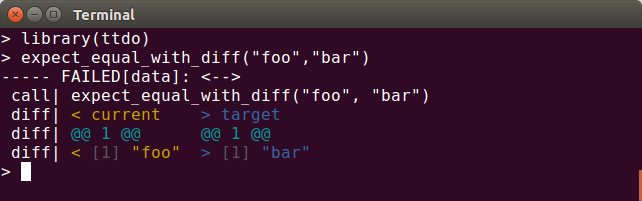
A new minor release of our ttdo package arrived on CRAN a few days ago. The ttdo package extends the excellent (and very minimal / zero depends) unit testing package tinytest by Mark van der Loo with the very clever and well-done diffobj package by Brodie Gaslam to give us test results with visual diffs (as shown in the screenshot below) which seemingly is so compelling an idea that it eventually got copied by another package which shall remain unnamed ttdo screenshot This release adds a versioned dependency on the just released tinytest version 1.4.1. As we extend tinytest (for use in the autograder we deploy within the lovely PrairieLearn framework) by consuming the tinytest code we have to update in sync. There were no other code changes in the package beside the usual maintenance of badges and continuous integration setup. As usual, the NEWS entry follows.

Changes in ttdo version 0.0.9 (2023-02-21)
  • Minor cleanup in README.md
  • Minor continuous integration update
  • Updated (versioned) depends on tinytest to 1.4.1

My CRANberries provides the usual summary of changes to the previous version. Please use the GitHub repo and its issues for any questions. If you like this or other open-source work I do, you can now sponsor me at GitHub.

This post by Dirk Eddelbuettel originated on his Thinking inside the box blog. Please report excessive re-aggregation in third-party for-profit settings.

22 February 2023

Dirk Eddelbuettel: RcppArmadillo 0.12.0.1.0 on CRAN: New Upstream, New Features

armadillo image Armadillo is a powerful and expressive C++ template library for linear algebra and scientific computing. It aims towards a good balance between speed and ease of use, has a syntax deliberately close to Matlab, and is useful for algorithm development directly in C++, or quick conversion of research code into production environments. RcppArmadillo integrates this library with the R environment and language and is widely used by (currently) 1042 other packages on CRAN, downloaded 28.1 million times (per the partial logs from the cloud mirrors of CRAN), and the CSDA paper (preprint / vignette) by Conrad and myself has been cited 513 times according to Google Scholar. This release brings a new upstream release 12.0.1. We found a small regression with the 12.0.0 release when we tested prior to a CRAN upload. Conrad very promptly fixed this with a literal one liner and made it 12.0.1 which we wrapped up as 0.12.0.1.0. Subsequent testing revealed no issues for us, and CRAN autoprocessed it as I tweeted earlier. This is actually quite impressive given the over 1000 CRAN packages using it all of which got tested again by CRAN. All this is testament to the rigour, as well as the well-oiled process at the repository. Our thanks go to the tireless maintainers! The releases actually has a rather nice set of changes (detailed below) to which we added one robustification thanks to Kevin. The full set of changes follows. We include the previous changeset as we may have skipped the usual blog post here.

Changes in RcppArmadillo version 0.12.0.1.0 (2023-02-20)
  • Upgraded to Armadillo release 12.0.1 (Cortisol Profusion)
    • faster fft() and ifft() via optional use of FFTW3
    • faster min() and max()
    • faster index_min() and index_max()
    • added .col_as_mat() and .row_as_mat() which return matrix representation of cube column and cube row
    • added csv_opts::strict option to loading CSV files to interpret missing values as NaN
    • added check_for_zeros option to form 4 of sparse matrix batch constructors
    • inv() and inv_sympd() with options inv_opts::no_ugly or inv_opts::allow_approx now use a scaled threshold similar to pinv()
    • set_cout_stream() and set_cerr_stream() are now no-ops; instead use the options ARMA_WARN_LEVEL, or ARMA_COUT_STREAM, or ARMA_CERR_STREAM
    • fix regression (mis-compilation) in shift() function (reported by us in #409)
  • The include directory order is now more robust (Kevin Ushey in #407 addressing #406)

Changes in RcppArmadillo version 0.11.4.4.0 (2023-02-09)
  • Upgraded to Armadillo release 11.4.4 (Ship of Theseus)
    • extended pow() with various forms of element-wise power operations
    • added find_nan() to find indices of NaN elements
    • faster handling of compound expressions by sum()
  • The package no longer sets a compilation standard, or progagates on in the generated packages as R ensures C++11 on all non-ancient versions
  • The CITATION file was updated to the current format

Courtesy of my CRANberries, there is a diffstat report relative to previous release. More detailed information is on the RcppArmadillo page. Questions, comments etc should go to the rcpp-devel mailing list off the R-Forge page. If you like this or other open-source work I do, you can sponsor me at GitHub.

This post by Dirk Eddelbuettel originated on his Thinking inside the box blog. Please report excessive re-aggregation in third-party for-profit settings.

19 February 2023

Russell Coker: New 18 Core CPU and NVMe

I just got a E5-2696 v3 CPU for my ML110 Gen9 home workstation, this has a Passmark score of 23326 which is almost 3 times faster than the E5-2620 v4 which rated 9224. Previously it took over 40 minutes real time to compile a 6.10 kernel that was based on the Debian kernel configuration, now it takes 14 minutes of real time, 202 minutes of user time, and 37 minutes of system CPU time. That s a definite benefit of having a faster CPU, I don t often compile kernels but when I do I don t want to wait 40+ minutes for a result. I also expanded the system from 96G of RAM to 128G, most of the time I don t need so much RAM but it s better to have too much than too little, particularly as my friend got me a good deal on RAM. The extra RAM might have helped improve performance too, going from 6/8 DIMM slots full to 8/8 might help the CPU balance access. That series of HP machines has a plastic mounting bracket for the CPU, see this video about the HP Proliant Smart Socket for details [1]. I was working on this with a friend who has the same model of HP server as I do, after buying myself a system I was so happy with it that I bought another the same when I saw it going for a good price and then sold it to my friend when I realised that I had too many tower servers at home. It turns out that getting the same model of computer as a friend is a really good strategy so then you can work together to solve problems with it. My friend s first idea was to try and buy new clips for the new CPUs (which would have delayed things and cost more money), but Reddit and some blog posts suggested that you can just skip the smart-socket guide clip and when the chip was resting in the socket it felt secure as the protrusions on the sides of the socket fit firmly enough into the notches in the CPU to prevent it moving far enough to short a connection. Testing on 2 systems showed that you don t need the clip. As an aside it would be nice if Intel made every CPU that fits a particular socket have the same physical dimensions so clips and heatsinks can work well on all CPUs. The TDP of the new CPU is 145W and the old one was 85W. One would hope that in a server class system that wouldn t make a lot of difference but unfortunately the difference was significant. Previously I could have the system running 7/8 cores with BOINC 24*7 and I wouldn t notice the fans being louder. It is possible that 100% CPU use on a hot day might make the fans sound louder if I didn t have an air-conditioner on that was loud enough to drown them out, but the noteworthy fact is that with the previous CPU the system fans were a minor annoyance. Now if I have 16 cores running BOINC it s quite loud, the sort of noise that makes most people avoid using tower servers as workstations! I ve found that if I limit it to 4 or 5 cores then the system is about as quiet as it was before. As a rough approximation I can use as much CPU power as before without making the fans louder but if I use more CPU power than was previously available it gets noisy. I also got some new NVMe devices, I was previously using 2*Crucial 1TB P1 NVMes in a BTRFS RAID-1 and now I have 2*Crucial 1TB P3 NVMes (where P1 is the slowest Crucial offering, P3 is better and more expensive, P5 is even better, etc). When doing the BTRFS migrations to move my workstation to new NVMe devices and my server to the old NVMe devices I found that the P3 series seem to have a limit of about 70MB/s for sustained random writes and the P1 series is about 35MB/s. Apparently with the cheaper NVMe devices they slow down if you do lots of random writes, pity that all the review articles talking about GB/s speeds don t mention this. To see how bad reviews are Google some reviews of these SSDs, you will find a couple of comment threads on places like Reddit of them slowing down with lots of writes and lots of review articles on well known sites that don t mention it. Generally I d recommend not upgrading from P1 to P3 NVMe devices, the benefit isn t enough to cover the effort. For every capacity of NVMe devices the most expensive devices cost more than twice as much as the cheapest devices, and sometimes it will be worth the money. Getting the most expensive device won t guarantee great performance but getting cheap devices will guarantee that it s slow. It seems that CPU development isn t progressing as well as it used to, the CPU I just bought was released in 2015 and scored 23,343 according to Passmark [2]. The most expensive Intel CPU on offer at my local computer store is the i9-13900K which was released this year and scores 62,914 [3]. One might say that CPUs designed for servers are different from ones designed for desktop PCs, but the i9 in question has a TDP Up of 253W which is too big for the PSU I have! According to the HP web site the new ML110 Gen10 servers aren t sold with a CPU as fast as the E5-2696 v3! In the period from 1988 to about 2015 every year there were new CPUs with new capabilities that were worth an upgrade. Now for the last 8 years or so there hasn t been much improvement at all. Buy a new PC for better USB ports or something not for a faster CPU!

10 February 2023

Jonathan Dowland: HLedger, 1 year on

It's been a year since I started exploring HLedger, and I'm still going. The rollover to 2023 was an opportunity to revisit my approach. Some time ago I stumbled across Dmitry Astapov's HLedger notes (fully-fledged hledger, which I briefly mentioned in eventual consistency) and decided to adopt some of its ideas. new year, new journal First up, Astapov encourages starting a new journal file for a new calendar year. I do this for other, accounting-adjacent files as a matter of course, and I did it for my GNUCash files prior to adopting HLedger. But the reason for those is a general suspicion that a simple mistake with those softwares could irrevocably corrupt my data. I'm much more confident with HLedger, so rolling over at years end isn't necessary for that. But there are other advantages. A quick obvious one is you can get rid of old accounts (such as expense accounts tied to a particular project, now completed). one journal per import In the first year, I periodically imported account data via CSV exports of transactions and HLedger's (excellent) CSV import system. I imported all the transactions, once each, into a single, large journal file. Astapov instead advocates for creating a separate journal for each CSV that you wish to import, and keep around the CSV, leaving you with a 1:1 mapping of CSV:journal. Then use HLedger's "include" mechanism to pull them all into the main journal. With the former approach, where the CSV data was imported precisely, once, it was only exposed to your import rules once. The workflow ended up being: import transactions; notice some that you could have matched with import rules and auto-coded; write the rule for the next time. With Astapov's approach, you can re-generate the journal from the CSV at any point in the future with an updated set of import rules. tracking dependencies Now we get onto the job of driving the generation of all these derivative journal files. Astapov has built a sophisticated system using Haskell's "Shake", which I'm not yet familiar, but for my sins I'm quite adept at (GNU-flavoured) UNIX Make, so I started building with that. An example rule
import/jon/amex/%.journal: import/jon/amex/%.csv rules/amex.csv.rules
    rm -f $(@D)/.latest.$*.csv $@
    hledger import --rules-file rules/amex.csv.rules -f $@ $<
This captures the dependency between the journal and the underlying CSV but also to the relevant rules file; if I modify that, and this target is run in the future, all dependent journals should be re-generated.1 opening balances It's all fine and well starting over in a new year, and I might be generous to forgive debts, but I can't count on others to do the same. We need to carry over some balance information from one year to the next. Astapov has a more complex (or perhaps featureful) scheme for this involving a custom Haskell program, but I bodged something with a pair of make targets:
import/opening/2023.csv: 2022.journal
    mkdir -p import/opening
    hledger bal -f $< \
                $(list_of_accounts_I_want_to_carry_over) \
        -O csv -N > $@
import/opening/2023.journal: import/opening/2023.csv rules/opening.rules
    rm -f $(@D)/.latest.2023.csv $@
    hledger import --rules-file rules/opening.rules \
        -f $@ $<
I think this could be golfed into a year-generic rule with a little more work. The nice thing about this approach is the opening balances for a given year might change, if adjustments are made in prior years. They shouldn't, for real accounts, but very well could for more "virtual" liabilities. (including: deciding to write off debts.) run lots of reports Astapov advocates for running lots of reports, and automatically. There's a really obvious advantage of that to me: there's no chance anyone except me will actually interact with HLedger itself. For family finances, I need reports to be able to discuss anything with my wife. Extending my make rules to run reports is trivial. I've gone for HTML reports for the most part, as they're the easiest on the eye. Unfortunately the most useful report to discuss (at least at the moment) would be a list of transactions in a given expense category, and the register/aregister commands did not support HTML as an output format. I submitted my first HLedger patch to add HTML output support to aregister: https://github.com/simonmichael/hledger/pull/2000 addressing the virtual posting problem I wrote in my original hledger blog post that I had to resort to unbalanced virtual postings in order to record both a liability between my personal cash and family, as well as categorise the spend. I still haven't found a nice way around that. But I suspect having broken out the journal into lots of other journals paves the way to a better solution to the above. The form of a solution I am thinking of is: some scheme whereby the two destination accounts are combined together; perhaps, choose one as a primary and encode the other information in sub-accounts under that. For example, repeating the example from my hledger blog post:
2022-01-02 ZTL*RELISH
    family:liabilities:creditcard        -3.00
    family:dues:jon                       3.00
    (jon:expenses:snacks)                 3.00
This could become
2022-01-02 ZTL*RELISH
    family:liabilities:creditcard        -3.00
    family:liabilities:jon:snacks
(I note this is very similar to a solution proposed to me by someone responding on twitter). The next step is to recognise that sometimes when looking at the data I care about one aspect, and at other times the other, but rarely both. So for the case where I'm thinking about family finances, I could use account aliases to effectively flatten out the expense category portion and ignore it. On the other hand, when I'm concerned about how I've spent my personal cash and not about how much I owe the family account, I could use aliases to do the opposite: rewrite-away the family:liabilities:jon prefix and combine the transactions with the regular jon:expenses account heirarchy. (this is all speculative: I need to actually try this.) catching errors after an import When I import the transactions for a given real bank account, I check the final balance against another source: usually a bank statement, to make sure they agree. I wasn't using any of the myriad methods to make sure that this remains true later on, and so there was the risk that I make an edit to something and accidentally remove a transaction that contributed to that number, and not notice (until the next import). The CSV data my bank gives me for accounts (not for credit cards) also includes a 'resulting balance' field. It was therefore trivial to extend the CSV import rules to add balance assertions to the transactions that are generated. This catches the problem. There are a couple of warts with balance assertions on every such transaction: for example, dealing with the duplicate transaction for paying a credit card: one from the bank statement, one from the credit card. Removing one of the two is sufficient to correct the account balances but sometimes they don't agree on the transaction date, or the transactions within a given day are sorted slightly differently by HLedger than by the bank. The simple solution is to just manually delete one or two assertions: there remain plenty more for assurance. going forward I've only scratched the surface of the suggestions in Astapov's "full fledged HLedger" notes. I'm up to step 2 of 14. I'm expecting to return to it once the changes I've made have bedded in a little bit. I suppose I could anonymize and share the framework (Makefile etc) that I am using if anyone was interested. It would take some work, though, so I don't know when I'd get around to it.

  1. the rm latest bit is to clear up some state-tracking files that HLedger writes to avoid importing duplicate transactions. In this case, I know better than HLedger.

6 February 2023

Reproducible Builds: Reproducible Builds in January 2023

Welcome to the first report for 2023 from the Reproducible Builds project! In these reports we try and outline the most important things that we have been up to over the past month, as well as the most important things in/around the community. As a quick recap, the motivation behind the reproducible builds effort is to ensure no malicious flaws can be deliberately introduced during compilation and distribution of the software that we run on our devices. As ever, if you are interested in contributing to the project, please visit our Contribute page on our website.


News In a curious turn of events, GitHub first announced this month that the checksums of various Git archives may be subject to change, specifically that because:
the default compression for Git archives has recently changed. As result, archives downloaded from GitHub may have different checksums even though the contents are completely unchanged.
This change (which was brought up on our mailing list last October) would have had quite wide-ranging implications for anyone wishing to validate and verify downloaded archives using cryptographic signatures. However, GitHub reversed this decision, updating their original announcement with a message that We are reverting this change for now. More details to follow. It appears that this was informed in part by an in-depth discussion in the GitHub Community issue tracker.
The Bundesamt f r Sicherheit in der Informationstechnik (BSI) (trans: The Federal Office for Information Security ) is the agency in charge of managing computer and communication security for the German federal government. They recently produced a report that touches on attacks on software supply-chains (Supply-Chain-Angriff). (German PDF)
Contributor Seb35 updated our website to fix broken links to Tails Git repository [ ][ ], and Holger updated a large number of pages around our recent summit in Venice [ ][ ][ ][ ].
Noak J nsson has written an interesting paper entitled The State of Software Diversity in the Software Supply Chain of Ethereum Clients. As the paper outlines:
In this report, the software supply chains of the most popular Ethereum clients are cataloged and analyzed. The dependency graphs of Ethereum clients developed in Go, Rust, and Java, are studied. These client are Geth, Prysm, OpenEthereum, Lighthouse, Besu, and Teku. To do so, their dependency graphs are transformed into a unified format. Quantitative metrics are used to depict the software supply chain of the blockchain. The results show a clear difference in the size of the software supply chain required for the execution layer and consensus layer of Ethereum.

Yongkui Han posted to our mailing list discussing making reproducible builds & GitBOM work together without gitBOM-ID embedding. GitBOM (now renamed to OmniBOR) is a project to enable automatic, verifiable artifact resolution across today s diverse software supply-chains [ ]. In addition, Fabian Keil wrote to us asking whether anyone in the community would be at Chemnitz Linux Days 2023, which is due to take place on 11th and 12th March (event info). Separate to this, Akihiro Suda posted to our mailing list just after the end of the month with a status report of bit-for-bit reproducible Docker/OCI images. As Akihiro mentions in their post, they will be giving a talk at FOSDEM in the Containers devroom titled Bit-for-bit reproducible builds with Dockerfile and that my talk will also mention how to pin the apt/dnf/apk/pacman packages with my repro-get tool.
The extremely popular Signal messenger app added upstream support for the SOURCE_DATE_EPOCH environment variable this month. This means that release tarballs of the Signal desktop client do not embed nondeterministic release information. [ ][ ]

Distribution work

F-Droid & Android There was a very large number of changes in the F-Droid and wider Android ecosystem this month: On January 15th, a blog post entitled Towards a reproducible F-Droid was published on the F-Droid website, outlining the reasons why F-Droid signs published APKs with its own keys and how reproducible builds allow using upstream developers keys instead. In particular:
In response to [ ] criticisms, we started encouraging new apps to enable reproducible builds. It turns out that reproducible builds are not so difficult to achieve for many apps. In the past few months we ve gotten many more reproducible apps in F-Droid than before. Currently we can t highlight which apps are reproducible in the client, so maybe you haven t noticed that there are many new apps signed with upstream developers keys.
(There was a discussion about this post on Hacker News.) In addition:
  • F-Droid added 13 apps published with reproducible builds this month. [ ]
  • FC Stegerman outlined a bug where baseline.profm files are nondeterministic, developed a workaround, and provided all the details required for a fix. As they note, this issue has now been fixed but the fix is not yet part of an official Android Gradle plugin release.
  • GitLab user Parwor discovered that the number of CPU cores can affect the reproducibility of .dex files. [ ]
  • FC Stegerman also announced the 0.2.0 and 0.2.1 releases of reproducible-apk-tools, a suite of tools to help make .apk files reproducible. Several new subcommands and scripts were added, and a number of bugs were fixed as well [ ][ ]. They also updated the F-Droid website to improve the reproducibility-related documentation. [ ][ ]
  • On the F-Droid issue tracker, FC Stegerman discussed reproducible builds with one of the developers of the Threema messenger app and reported that Android SDK build-tools 31.0.0 and 32.0.0 (unlike earlier and later versions) have a zipalign command that produces incorrect padding.
  • A number of bugs related to reproducibility were discovered in Android itself. Firstly, the non-deterministic order of .zip entries in .apk files [ ] and then newline differences between building on Windows versus Linux that can make builds not reproducible as well. [ ] (Note that these links may require a Google account to view.)
  • And just before the end of the month, FC Stegerman started a thread on our mailing list on the topic of hiding data/code in APK embedded signatures which has been made possible by the Android APK Signature Scheme v2/v3. As part of this, they made an Android app that reads the APK Signing block of its own APK and extracts a payload in order to alter its behaviour called sigblock-code-poc.

Debian As mentioned in last month s report, Vagrant Cascadian has been organising a series of online sprints in order to clear the huge backlog of reproducible builds patches submitted by performing NMUs (Non-Maintainer Uploads). During January, a sprint took place on the 10th, resulting in the following uploads: During this sprint, Holger Levsen filed Debian bug #1028615 to request that the tracker.debian.org service display results of reproducible rebuilds, not just reproducible CI results. Elsewhere in Debian, strip-nondeterminism is our tool to remove specific non-deterministic results from a completed build. This month, version 1.13.1-1 was uploaded to Debian unstable by Holger Levsen, including a fix by FC Stegerman (obfusk) to update a regular expression for the latest version of file(1) [ ]. (#1028892) Lastly, 65 reviews of Debian packages were added, 21 were updated and 35 were removed this month adding to our knowledge about identified issues.

Other distributions In other distributions:

diffoscope diffoscope is our in-depth and content-aware diff utility. Not only can it locate and diagnose reproducibility issues, it can provide human-readable diffs from many kinds of binary formats. This month, Chris Lamb made the following changes to diffoscope, including preparing and uploading versions 231, 232, 233 and 234 to Debian:
  • No need for from __future__ import print_function import anymore. [ ]
  • Comment and tidy the extras_require.json handling. [ ]
  • Split inline Python code to generate test Recommends into a separate Python script. [ ]
  • Update debian/tests/control after merging support for PyPDF support. [ ]
  • Correctly catch segfaulting cd-iccdump binary. [ ]
  • Drop some old debugging code. [ ]
  • Allow ICC tests to (temporarily) fail. [ ]
In addition, FC Stegerman (obfusk) made a number of changes, including:
  • Updating the test_text_proper_indentation test to support the latest version(s) of file(1). [ ]
  • Use an extras_require.json file to store some build/release metadata, instead of accessing the internet. [ ]
  • Updating an APK-related file(1) regular expression. [ ]
  • On the diffoscope.org website, de-duplicate contributors by e-mail. [ ]
Lastly, Sam James added support for PyPDF version 3 [ ] and Vagrant Cascadian updated a handful of tool references for GNU Guix. [ ][ ]

Upstream patches The Reproducible Builds project attempts to fix as many currently-unreproducible packages as possible. This month, we wrote a large number of such patches, including:

Testing framework The Reproducible Builds project operates a comprehensive testing framework at tests.reproducible-builds.org in order to check packages and other artifacts for reproducibility. In January, the following changes were made by Holger Levsen:
  • Node changes:
  • Debian-related changes:
    • Only keep diffoscope s HTML output (ie. no .json or .txt) for LTS suites and older in order to save diskspace on the Jenkins host. [ ]
    • Re-create pbuilder base less frequently for the stretch, bookworm and experimental suites. [ ]
  • OpenWrt-related changes:
    • Add gcc-multilib to OPENWRT_HOST_PACKAGES and install it on the nodes that need it. [ ]
    • Detect more problems in the health check when failing to build OpenWrt. [ ]
  • Misc changes:
    • Update the chroot-run script to correctly manage /dev and /dev/pts. [ ][ ][ ]
    • Update the Jenkins shell monitor script to collect disk stats less frequently [ ] and to include various directory stats. [ ][ ]
    • Update the real year in the configuration in order to be able to detect whether a node is running in the future or not. [ ]
    • Bump copyright years in the default page footer. [ ]
In addition, Christian Marangi submitted a patch to build OpenWrt packages with the V=s flag to enable debugging. [ ]
If you are interested in contributing to the Reproducible Builds project, please visit the Contribute page on our website. You can get in touch with us via:

2 February 2023

Matthew Garrett: Blocking free API access to Twitter doesn't stop abuse

In one week from now, Twitter will block free API access. This prevents anyone who has written interesting bot accounts, integrations, or tooling from accessing Twitter without paying for it. A whole number of fascinating accounts will cease functioning, people will no longer be able to use tools that interact with Twitter, and anyone using a free service to do things like find Twitter mutuals who have moved to Mastodon or to cross-post between Twitter and other services will be blocked.

There's a cynical interpretation to this, which is that despite firing 75% of the workforce Twitter is still not profitable and Elon is desperate to not have Twitter go bust and also not to have to tank even more of his Tesla stock to achieve that. But let's go with the less cynical interpretation, which is that API access to Twitter is something that enables bot accounts that make things worse for everyone. Except, well, why would a hostile bot account do that?

To interact with an API you generally need to present some sort of authentication token to the API to prove that you're allowed to access it. It's easy enough to restrict issuance of those tokens to people who pay for the service. But, uh, how do the apps work? They need to be able to communicate with the service to tell it to post tweets, retrieve them, and so on. And the simple answer to that is that they use some hardcoded authentication tokens. And while registering for an API token yourself identifies that you're not using an official client, using the tokens embedded in the clients makes it look like you are. If you want to make it look like you're a human, you're already using tokens ripped out of the official clients.

The Twitter client API keys are widely known. Anyone who's pretending to be a human is using those already and will be unaffected by the shutdown of the free API tier. Services like movetodon.org do get blocked. This isn't an anti-abuse choice. It's one that makes it harder to move to other services. It's one that blocks a bunch of the integrations and accounts that bring value to the platform. It's one that hurts people who follow the rules, without hurting the ones who don't. This isn't an anti-abuse choice, it's about trying to consolidate control of the platform.

comment count unavailable comments

Dirk Eddelbuettel: RInside 0.2.18 on CRAN: Maintenance

A new release 0.2.18 of RInside arrived on CRAN and in Debian today. This is the first release in ten months since the 0.2.17 release. RInside provides a set of convenience classes which facilitate embedding of R inside of C++ applications and programs, using the classes and functions provided by Rcpp. This release brings a contributed change to how the internal REPL is called: Dominick found the current form more reliable when embedding R on Windows. We also updated a few other things around the package. The list of changes since the last release:

Changes in RInside version 0.2.18 (2023-02-01)
  • The random number initialization was updated as in R.
  • The main REPL is now running via 'run_Rmainloop()'.
  • Small routine update to package and continuous integration.

My CRANberries also provides a short report with changes from the previous release. More information is on the RInside page. Questions, comments etc should go to the rcpp-devel mailing list off the Rcpp R-Forge page, or to issues tickets at the GitHub repo. If you like this or other open-source work I do, you can now sponsor me at GitHub.

This post by Dirk Eddelbuettel originated on his Thinking inside the box blog. Please report excessive re-aggregation in third-party for-profit settings.

31 January 2023

Jonathan McDowell: Enabling retrogaming with Kodi on Debian

For some reason my son has started to be really into watching playthroughs of Mario and similar games on Youtube. I don t understand the appeal, but it s less distracting as background than Paw Patrol, so I m not complaining. He s not quite at the stage he s ready to play the games himself, but it s coming. So I figured it would be neat to sort out some retrogaming bits ready for when that happens. I already have a Kodi box underneath the TV; it doesn t get as much use these days as a lot of our viewing is through commercial streaming services, but it s got all of our DVDs ripped so is still useful. Recent version of Kodi have support for games as well, so I decided it would be perfect if I could tie in to that. However. The normal ways of doing this seems to be to download someone s pre-rolled setup, and I d much rather be able to get the bits I need from Debian, as that s what the machine is running (it does a few minor things other than Kodi). The best retrogaming environment out there seems to be RetroArch. It s available for Linux/OS X/Windows and RetroPie provides a nice easy standalone setup if you re not interested in the Kodi side. If you are then game.libretro provides a wrapper for libretro cores under Kodi. This seemed like the right track. Unfortunately RetroArch and related packages were in need of some love in Debian. So I ended up engaging in some yak shaving to try and get to where I wanted to be. First up was RetroArch itself, which was over 4 years out of date, at 1.7.3. It turned out that wanted an updated assets package which contains the necessary icons etc for the interface. RetroArch is only a frontend. To actually play games you need a suitable core. The first one I tried was genesisplusgx (I have fond memories of Sonic from the Master System era), which again was several years out of date. I pulled recent git (I wish folk would tag releases at least every now and then) and updated things. And successfully managed to play Sonic (badly, I am way out of practice). genesisplusgx is in non-free, due to a prohibition on commercial distribution. So it s not actually part of Debian. I switched my attention to libretro-bsnes-mercury, which would then allow SNES emulation and is part of main. Again, not to hard to update, some packaging cleanups, and I was playing Super Mario. Again, badly. That meant I knew I had working emulation with libretro cores. It was time to integrate with Kodi. That meant taking game.libretro, filing an ITP and doing a bunch of bits to get it ready to upload (including introducing a retroarch-dev binary package that contains the appropriate include files as part of retroarch). It sat in NEW for a while (including an initial reject because I d missed an attribution in the debian/copyright), and was accepted yesterday. There s a final piece of the puzzle, and that s the Kodi config that ties together the libretro core with game.libretro and presents the emulator to Kodi as a fully fledged add-on. The kodi-game folk have a neat tool, kodi-game-scripting which automates the heavy lifting of producing this config. I ve done some local modifications that make it bit more useful for producing config that can be embedded in the Debian libretro-* packages directly, which I should upload somewhere but it s all a bit rough n ready at present. It was enough to allow me to produce some kodi-game-libretro-bsnes-* packages as part of libretro-bsnes-mercury. With that complete, all the packages needed for playing SNES games under Kodi are now present in Debian. I need to upload libretro-bsnes-mercury to unstable (it went to experimental while waiting for kodi-game-libretro to be accepted), and kodi-game-libretro needs another source-only upload, but once that s done both should be in good shape to migrate to testing and be part of the upcoming bookworm release. What else is there to do? I d like to get Kodi config included in the other libretro packages that are already part of Debian. That s going to need the Controller Topology Project to be packaged so that the controller details are available (I was lucky in that the SNES controller is already part of the Kodi package). I need to work out if I can turn kodi-game-scripting into some sort of dh helper to help automate things. But I ve done some local testing with genesisplusgx and it works fine as expected. The other thing is that games are not yet first class citizens in Kodi; the normal browser interface you get for movies, music and TV shows is not available for games. Currently I ve been trying out the ROM Collection Browser though I find its automated scraping isn t as good as I d like. A friend has recommended the Advanced Emulator Launcher but I haven t taken a look at it. Either way I d like to ultimately get one of them packaged up as well, though not in time for bookworm. Anyway. My hope is that these updated and new packages prove useful to someone else. You can tell I m biased towards 90s era consoles, but if you ve enough CPU grunt there are a bunch of more recent cores available too. Big thanks to the Debian FTP Master team for letting these through NEW so close to release. And all the upstream devs - RetroArch is a great framework from my perspective as a user, and the Kodi Game folk have done massive amounts of work that made my life much easier when preparing things for Debian.
Dirk Eddelbuettel: #39: Faster Feedback Systems A Continuous Integration Example

Welcome to the 39th post in the relatively randomly recurring rants, or R4 for short. Today s post picks up where the previous post #38: Faster Feedback Systems started. As we argued in #38, the need for fast feedback loops is fairly universal and widespread. Fairly shortly after we posted #38, useR! 2022 happened and one presentation had the key line
Waiting 1-24 minutes for a build to finish can be a massive time suck.
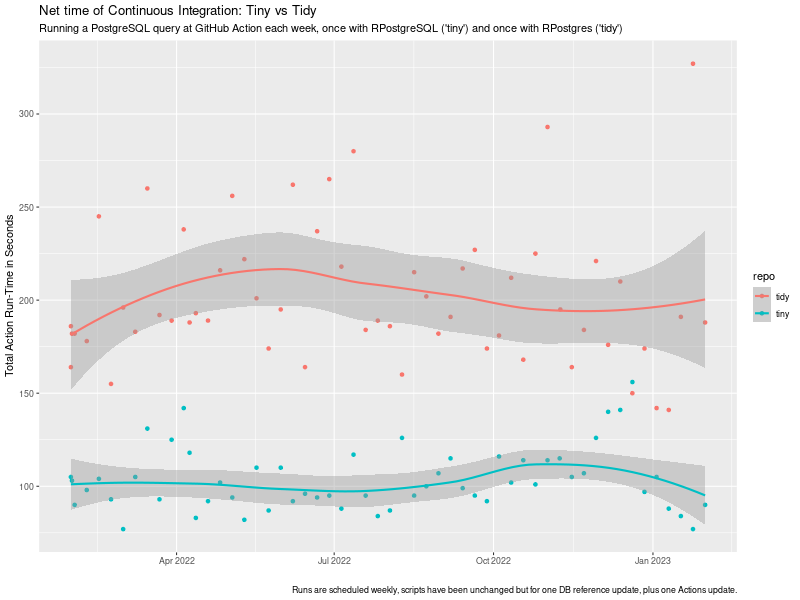
which we would like to come back to today. Furthermore, the unimitable @b0rk had a fabulous tweet just weeks later stating the same point debugging strategy: shorten your feedback loop as a key in a successful debugging strategy. So in sum: shorter is better. Nobody likes to wait. And shorter i.e. faster is a key and recurrent theme in the R4 series. Today we have a fairly nice illustration of two aspects we have stressed before: The combined effects can be staggering as we show below. The example is motivated by a truly surprising (we are being generous here) comment we received as an aside when discussing the eternal topic of whether R users do, or do not, have a choice when picking packages, or approaches, or verses. To our surprise, we were told that packages are not substitutable . Which is both demonstrably false (see below) and astonishing as it came from an academic. I.e. someone trained and paid to abstract superfluous detail away and recognise and compare core features of items under investigation. Truly stunning. But I digress. CRAN by now has many packages, slowly moving in on 20,000 in total, and is a unique success we commented-on time and time before. By now many packages shadow or duplicate each other, reinvent one another, or revise/review. One example is the pair of packages accessing PostgreSQL databases. There are several, but two are key. The older one is RPostgreSQL which has been around since Sameer Kumar Prayaga wrote it as a Google Summer of Code student in 2008 under my mentorship. The package has now been maintained well (if quietly) for many years by Tomoaki Nishiyama. The other entrant is more recent, though not new, and is RPostgres by Kirill M ller and others. We will for the remainder of this post refer to these two as the tiny and the tidy version as either can been as being a representative of a certain verse . The aforementioned comment on non-substitutability struck us as eminently silly, so we set out to prove just how absurd it really is. So about a year ago we set up pair of GitHub repos with minimal code in a pair we called lim-tiny and lim-tidy. Our conjecture was (and is!) that less is more just as post #34 titled Less Is More argued with respect to package dependencies. Each of the repos just does one thing: a query to a (freely accessible but remote) PostgreSQL database. The tiny version just retrieves a data frame using only the dependencies needed for RPostgreSQL namely DBI and nothing else. The tidy version retrieves a tibble and has access to everything else that comes when installing RPostgres: DBI, dplyr, and magrittr plus of course their respective dependencies. We were able to let the code run in (very default) GitHub Actions on a weekly schedule without intervention apart from one change to the SQL query when the remote server (providing public bioinformatics data) changed its schema slighly, plus one update to the action yaml code version. No other changes. We measure the time a standard continuous integration run takes in total using the default GitHub Action setup in the tidy case (which relies on RSPM/PPM binaries, caching, , and does not rebuild from source each time), and our own r-ci script (introduced in #32 for CI with R. It switched to using r2u during the course of this experiment but already had access to binaries via c2d4u so it is always binaries-based (see e.g. #37 or #13 for more). The chart shows the evolution of these run-times over the course of the year with one weekly run each.
tiny vs tidy ci timing impact chart tiny vs tidy ci timing impact chart
This study reveals a few things: The key point there is that while the net-time to fire off a single PostgreSQL is likely (near-)identical, the net cost of continuous integration is not. In this setup, it is about twice the run-time simply because Less Is More which (in this setup) comes out to about being twice as fast. And that is a valid (and concrete, and verifiable) illustration of the overall implicit cost of adding dependencies to creating and using development, test, or run-time environments. Faster feedback loops make for faster builds and faster debugging. Consider using fewer dependencies, and/or using binaries as provided by r2u.

This post by Dirk Eddelbuettel originated on his Thinking inside the box blog. Please report excessive re-aggregation in third-party for-profit settings.

29 January 2023

Dirk Eddelbuettel: RcppTOML 0.2.2 on CRAN: Now with macOS-on-Intel Builds

Just days after a build-fix release (for aarch64) and still only a few weeks after the 0.2.0 release of RcppTOML and its switch to toml++, we have another bugfix release 0.2.2 on CRAN also bringing release 3.3.0 of toml++ (even if we had large chunks of 3.3.0 already incorporated). TOML is a file format that is most suitable for configurations, as it is meant to be edited by humans but read by computers. It emphasizes strong readability for humans while at the same time supporting strong typing as well as immediate and clear error reports. On small typos you get parse errors, rather than silently corrupted garbage. Much preferable to any and all of XML, JSON or YAML though sadly these may be too ubiquitous now. TOML is frequently being used with the projects such as the Hugo static blog compiler, or the Cargo system of Crates (aka packages ) for the Rust language. The package was building fine on Intel-based macOS provided the versions were recent enough. CRAN, however, aims for the broadest possibly reach of binaries and builds on a fairly ancient macOS 10.13 with clang version 10. This confused toml++ into (wrongly) concluding it could not build when it in fact can. After a hint from Simon that Apple in their infinite wisdom redefines clang version ids, this has been reflected in version 3.3.0 of toml++ by Mark so we should now build everywhere. Big thanks to everybody for the help. The short summary of changes follows.

Changes in version 0.2.2 (2023-01-29)
  • New toml++ version 3.3.0 with fix to permit compilation on ancient macOS systems as used by CRAN for the Intel-based builds.

Courtesy of my CRANberries, there is a diffstat report for this release. More information is on the RcppTOML page page. Please use the GitHub issue tracker for issues and bugreports. If you like this or other open-source work I do, you can sponsor me at GitHub.

This post by Dirk Eddelbuettel originated on his Thinking inside the box blog. Please report excessive re-aggregation in third-party for-profit settings.

26 January 2023

Shirish Agarwal: Minidebconf Tamilnadu 2023, Tinnitus, Cooking, Books and Series.

First up is Minidebconf Tamilnadu 2023 that would be held on 28-29 January 2023. You can find rest of the details here. I do hope we get to see/hear some good stuff from the Minidebconf. Best of luck to all those who are applying.

Tinnitus During the lock-down of March 2020, I became aware of noise in ears and subsequently major hearing loss. It took me quite a while to know that Tinnitus happens to both those who have hearing loss as well as not. I keep running into threads like this and as shared by someone nobody knows what really causes it. I did try some of the apps (an app. called Resound on Android) that is supposed to tackle Tinnitus but it hasn t helped much. There is this but at least for me, right now pretty speculative. Also this, and again highly speculative.

Cooking After mum passed away, I haven t cooked anything. This used to give me pleasure but now just doesn t feel right. Cooking is something you enjoy when you are doing for somebody else and not just for yourself, at least that s how I feel and with that the curiosity to know more recipes. I do wanna buy a wok at sometime but when, how I just don t know.

Books Have been reading books quite a bit. And due to that had to again revisit and understand ISBN. Perhaps I might have shared it before. It really is something, the history of ISBN. And that co-relates with the book I read, Raising Steam by Terry Pratchett. Raising Steam is the 40th Book in the Discworld Series and it basically romanticizes and reminisces how the idea of an engine was born, and then a steam engine and how actually Railways started. There has been a lot of history and experiences from the early years of Steam Railway that have been taken and transplanted into the book. Also how Railways is and can be successful if only it is invested wisely and maintenance is done. This is only where imagination and reality come apart as maintenance isn t done and then you have issues. While this is and was in the UK, similar situation exists in India and many other places around the world and doesn t matter whether it is private or public. Exceptions are German, French but then that maybe due to Labor movements that happened and were successful unlike in other places. I could go on but then it will become a different article in itself. Suffice to say there is much to learn and you need serious people to look after it. Both in UK and India we lack that. And not just in Railways but Civil Aviation too, but again that is a story in itself.

Web-series Apart from books, have been seeing web-series that Willow is a good one that I enjoyed even though I hadn t seen the earlier movie. While there has been a flurry of movies and web-series both due to end of year and beginning of 2023 and yet have tried to be a bit partial on what I wanna watch or not. If it has crime, fantasy, drama then usually I like it. For e.g. I saw Blackout and pretty much was engrossed in what will happen next. It also does lead you to ask questions about centralization vs de-centralization for both power and other utilities and does make a case for communities to have their utilities apart from the grid as a fallback. How do we do over decades or centuries about it is a different question perhaps altogether. There were two books that kinda stood out for me, the first was Ian Rankin s Naming of the Dead . The book is about a cynical John Rebus, a man after my own heart. I am probably going to buy a few more of his series. In a way it also tells you why UK is the way it is right now. Another book that I liked was Shades of Grey by Jasper Fforde. This is one of the books that Mum would have clearly liked. It is pretty unusual while at the same time very close to 1984 and other such dystopian novels. The main trope of the book is what color you can see and how much you can see. The main character is somebody who can see Red, around the age of 20. One of the interesting aspects of the book is de-facting which closely resembles the Post-Truth world where alternative facts can be made out of air and they don t need any scientific evidence to back them up. In Jasper s world, they don t care about how things work and most of the technology is banned and curiosity is considered harmful and those who show that are murdered one way or the other. Interestingly, the author has just last year decided to start book 2 in the 3 book series that is supposed to be. This also tells why the U.S. is such a precarious situation in a way. A part of it is also due to the media which is in hands of chosen few, the same goes for UK and India, almost an oligopoly.

The Great Escape This is also a book but also about experiences of people, not in 19th-20th century but today that tells you slavery is alive and well and human-trafficking as well. This piece from NPR tells you about an MNC and Indian workers. What I found interesting is that there barely is an mention of the Indian Embassy that is supposed to help Indian people. I do know for a fact that the embassies of India has seen a drastic shortage of both people and materials even since the new Govt. came in place that was nine years ago. Incidentally, BBC shared about the Gujarat riots 2002 and that has been censored in India. They keep quiet about the UK Govt. who did find out that the Chief Minister was directly responsible for the killings and in facts his number 2, Amit Shah had shared that we would do 2002 again in the election cycle barely a month ago. But sadly, no hate speech FIR or any action was taken against Mr. Shah. There have been attempts by people to showcase the documentary. For e.g. JNU tried it and the rowdies from ABVP (arm of BJP) created violence. Even the questions that has been asked by the Wire, GOI will not acknowledge them. Interestingly, all India s edtechs have taken a beating in the last 6-8 months including the biggest BJYU s. Sharing a story from 2021 where things were best and today all of them are at bottom. In fact, the public has been wary as the prices of the courses has kept on increasing and most case studies have been found to be fake. Also the general outlook on jobs and growth has been pessimistic. In fact, most companies have been shedding jobs truckloads, most in the I.T. sector but other sectors as well. Hospitality and other related sectors have taken a huge beating, part of it post-pandemic, part of it Govt s refusal to either spend money or do any positive policies for either infrastructure, education, medical, you name it, they think private sector has all the answers which has been proven to be wrong again and again. I did not want to end on a discordant note but things are the way they are

Dirk Eddelbuettel: RcppTOML 0.2.1 on CRAN: Small Build Fix for Some Arches

Two weeks after the release of RcppTOML 0.2.0 and the switch to toml++, we have a quick bugfix release 0.2.1. TOML is a file format that is most suitable for configurations, as it is meant to be edited by humans but read by computers. It emphasizes strong readability for humans while at the same time supporting strong typing as well as immediate and clear error reports. On small typos you get parse errors, rather than silently corrupted garbage. Much preferable to any and all of XML, JSON or YAML though sadly these may be too ubiquitous now. TOML is frequently being used with the projects such as the Hugo static blog compiler, or the Cargo system of Crates (aka packages ) for the Rust language. Some architectures, aarch64 included, got confused over float16 which is of course a tiny two-byte type nobody should need. After consulting with Mark we concluded to (at least for now) simply override this excluding the use of float16 . The short summary of changes follows.

Changes in version 0.2.1 (2023-01-25)
  • Explicitly set -DTOML_ENABLE_FLOAT16=0 to permit compilation on some architectures stumbling of the type.

Courtesy of my CRANberries, there is a diffstat report for this release. More information is on the RcppTOML page page. Please use the GitHub issue tracker for issues and bugreports. If you like this or other open-source work I do, you can sponsor me at GitHub.

This post by Dirk Eddelbuettel originated on his Thinking inside the box blog. Please report excessive re-aggregation in third-party for-profit settings.

22 January 2023

Dirk Eddelbuettel: Rcpp 1.0.10 on CRAN: Regular Update

rcpp logo The Rcpp team is thrilled to announce the newest release 1.0.10 of the Rcpp package which is hitting CRAN now and will go to Debian shortly. Windows and macOS builds should appear at CRAN in the next few days, as will builds in different Linux distribution and of course at r2u. The release was prepared a few days ago, but given the widespread use at CRAN it took a few days to be processed. As always, our sincere thanks to the CRAN maintainers Uwe Ligges and Kurt Hornik. This release continues with the six-months cycle started with release 1.0.5 in July 2020. As a reminder, we do of course make interim snapshot dev or rc releases available via the Rcpp drat repo and strongly encourage their use and testing I run my systems with these versions which tend to work just as well, and are also fully tested against all reverse-dependencies. Rcpp has become the most popular way of enhancing R with C or C++ code. Right now, around 2623 packages on CRAN depend on Rcpp for making analytical code go faster and further, along with 252 in BioConductor. On CRAN, 13.7% of all packages depend (directly) on CRAN, and 58.7% of all compiled packages do. From the cloud mirror of CRAN (which is but a subset of all CRAN downloads), Rcpp has been downloaded 67.1 million times. This release is incremental as usual, preserving existing capabilities faithfully while smoothing our corners and / or extending slightly. Of particular note is the now fully-enabled use of the unwind protection making some operations a little faster by default; special thanks to I aki for spearheading this. Kevin and I also polished a few other bugs off as detailed below. The full list of details follows.

Changes in Rcpp release version 1.0.10 (2023-01-12)
  • Changes in Rcpp API:
    • Unwind protection is enabled by default (I aki in #1225). It can be disabled by defining RCPP_NO_UNWIND_PROTECT before including Rcpp.h. RCPP_USE_UNWIND_PROTECT is not checked anymore and has no effect. The associated plugin unwindProtect is therefore deprecated and will be removed in a future release.
    • The 'finalize' method for Rcpp Modules is now eagerly materialized, fixing an issue where errors can occur when Module finalizers are run (Kevin in #1231 closing #1230).
    • Zero-row data.frame objects can receive push_back or push_front (Dirk in #1233 fixing #1232).
    • One remaining sprintf has been replaced by snprintf (Dirk and Kevin in #1236 and #1237).
    • Several conversion warnings found by clang++ have been addressed (Dirk in #1240 and #1241).
  • Changes in Rcpp Attributes:
    • The C++20, C++2b (experimental) and C++23 standards now have plugin support like the other C++ standards (Dirk in #1228).
    • The source path for attributes received one more protection from spaces (Dirk in #1235 addressing #1234).
  • Changes in Rcpp Deployment:
    • Several GitHub Actions have been updated.

Thanks to my CRANberries, you can also look at a diff to the previous release. Questions, comments etc should go to the rcpp-devel mailing list off the R-Forge page. Bugs reports are welcome at the GitHub issue tracker as well (where one can also search among open or closed issues); questions are also welcome under rcpp tag at StackOverflow which also allows searching among the (currently) 2932 previous questions. If you like this or other open-source work I do, you can sponsor me at GitHub.

This post by Dirk Eddelbuettel originated on his Thinking inside the box blog. Please report excessive re-aggregation in third-party for-profit settings.

Dirk Eddelbuettel: BH 1.81.0-1 oon CRAN: New Upstream, New Library, sprintf Change

Boost Boost is a very large and comprehensive set of (peer-reviewed) libraries for the C++ programming language, containing well over one hundred individual libraries. The BH package provides a sizeable subset of header-only libraries for (easier, no linking required) use by R. It is fairly widely used: the (partial) CRAN mirror logs (aggregated from the cloud mirrors) show over 32.6 million package downloads. Version 1.81.0 of Boost was released in December following the regular Boost release schedule of April, August and December releases. As the commits and changelog show, we packaged it almost immediately and started testing following our annual update cycle which strives to balance being close enough to upstream and not stressing CRAN and the user base too much. The reverse depends check revealed about a handful of packages requiring changes or adjustments which is a pretty good outcome given the over three hundred direct reverse dependencies. So we opened issue #88 to coordinate the issue over the winter break during which CRAN also closes (just as we did before), and also send a wider PSA tweet as a heads-up. Our sincere thanks to the two packages that already updated, and the four that likely will soon. Our thanks also to CRAN for reviewing the package impact over the last few days since I uploaded the package earlier this week. There are a number of changes I have to make each time in BH, and it is worth mentioning them. Because CRAN cares about backwards compatibility and the ability to be used on minimal or older systems, we still adjust the filenames of a few files to fit a jurassic constraints of just over a 100 characters per filepath present in some long-outdated versions of tar. Not a big deal. We also, and that is more controversial, silence a number of #pragma diagnostic messages for g++ and clang++ because CRAN insists on it. I have no choice in that matter. Next, and hopefully this time only, we also found and replaced a few remaining sprintf uses and replaced them with snprintf. Many of the Boost libraries did that, so I hope by the next upgrade for Boost 1.84.0 next winter this will be fully taken care of. Lastly, and also only this time, we silenced a warning about Boost switching to C++14 in the next release 1.82.0 in April. This may matter for a number of packages having a hard-wired selection of C++11 as their C++ language standard. Luckily our compilers are good enough for C++14 so worst case I will have to nudge a few packages next December. This release adds one new library for url processing which struck us as potentially quite useful. The more detailed NEWS log follows.

Changes in version 1.81.0-1 (2023-01-17)
  • Upgrade to Boost 1.81.0 (#87)
  • Added url (new in 1.81.0)
  • Converted remaining sprintf to snprintf (#90 fixing #89)
  • Comment-out gcc warning messages in three files

Via my CRANberries, there is a diffstat report relative to the previous release. Comments and suggestions about BH are welcome via the issue tracker at the GitHub repo. If you like this or other open-source work I do, you can now sponsor me at GitHub.

This post by Dirk Eddelbuettel originated on his Thinking inside the box blog. Please report excessive re-aggregation in third-party for-profit settings.

21 January 2023

Dirk Eddelbuettel: RcppSimdJson 0.1.9 on CRAN: New Upstream

The RcppSimdJson package was just updated to release 0.1.9. RcppSimdJson wraps the fantastic and genuinely impressive simdjson library by Daniel Lemire and collaborators. Via very clever algorithmic engineering to obtain largely branch-free code, coupled with modern C++ and newer compiler instructions, it results in parsing gigabytes of JSON parsed per second which is quite mindboggling. The best-case performance is faster than CPU speed as use of parallel SIMD instructions and careful branch avoidance can lead to less than one cpu cycle per byte parsed; see the video of the talk by Daniel Lemire at QCon. This release updates the underlying simdjson library to version 3.0.1, settles on C++17 as the language standard, exports a worker function for direct C(++) access, and polishes a few small things around the package and tests. The NEWS entry for this release follows.

Changes in version 0.1.9 (2023-01-21)
  • The internal function deseralize_json is now exported at the C++ level as well as in R (Dirk in #81 closing #80).
  • simdjson was upgraded to version 3.0.1 (Dirk in #83).
  • The package now defaults to C++17 compilation; configure has been retired (Dirk closing #82).
  • The three main R access functions now use a more compact argument check via stopifnot (Dirk).

Courtesy of my CRANberries, there is also a diffstat report for this release. For questions, suggestions, or issues please use the issue tracker at the GitHub repo. If you like this or other open-source work I do, you can now sponsor me at GitHub.

This post by Dirk Eddelbuettel originated on his Thinking inside the box blog. Please report excessive re-aggregation in third-party for-profit settings.

Dirk Eddelbuettel: RcppFastFloat 0.0.4 on CRAN: New Upstream

A new release of RcppFastFloat arrived on CRAN yesterday. The package wraps fast_float, another nice library by Daniel Lemire. For details, see the arXiv paper showing that one can convert character representations of numbers into floating point at rates at or exceeding one gigabyte per second. This release updates the underlying fast_float library version. Special thanks to Daniel Lemire for quickly accomodating a parsing use case we had encode as a test, namely with various whitespace codes. The default in fast_float, as in C++17, is to be more narrow but we enable the wider use case via two #define statements.

Changes in version 0.0.4 (2023-01-20)
  • Update to fast_float 3.9.0
  • Set two #define re-establish prior behaviour with respect to whitespace removal prior to parsing for as.double2()
  • Small update to continuous integration actions

Courtesy of my CRANberries, there is also a diffstat report for this release. If you like this or other open-source work I do, you can now sponsor me at GitHub.

This post by Dirk Eddelbuettel originated on his Thinking inside the box blog. Please report excessive re-aggregation in third-party for-profit settings.

16 January 2023

Dirk Eddelbuettel: RcppArmadillo 0.11.4.3.1 on CRAN: Updates

armadillo image Armadillo is a powerful and expressive C++ template library for linear algebra and scientific computing. It aims towards a good balance between speed and ease of use, has a syntax deliberately close to Matlab, and is useful for algorithm development directly in C++, or quick conversion of research code into production environments. RcppArmadillo integrates this library with the R environment and language and is widely used by (currently) 1034 packages other packages on CRAN, downloaded 27.6 million times (per the partial logs from the cloud mirrors of CRAN), and the CSDA paper (preprint / vignette) by Conrad and myself has been cited 509 times according to Google Scholar. This release brings another upstream bugfix interation 11.4.3, released in accordance with the aimed-for monthly release cadence. We had hoped to move away from suppressing deprecation warnings in this release, and had prepared over two dozen patch sets all well as pull requests as documented in issue #391. However, it turns out that we both missed with one or two needed set of changes as well as two other sets of changes triggering deprecation warnings. So we expanded issue #391, and added issue #402 and prepared another eleven pull requests and patches today. With that we can hopefully remove the suppression of these warnings by an expected late of late April. The full set of changes (since the last CRAN release 0.11.4.2.1) follows.

Changes in RcppArmadillo version 0.11.4.3.1 (2023-01-14)
  • The #define ARMA_IGNORE_DEPRECATED_MARKER remains active to suppress the (upstream) deprecation warnings, see #391 and #402 for details.

Changes in RcppArmadillo version 0.11.4.3.0 (2022-12-28) (GitHub Only)
  • Upgraded to Armadillo release 11.4.3 (Ship of Theseus)
    • fix corner case in pinv() when processing symmetric matrices
  • Protect the undefine of NDEBUG behind additional opt-in define

Courtesy of my CRANberries, there is a diffstat report relative to previous release. More detailed information is on the RcppArmadillo page. Questions, comments etc should go to the rcpp-devel mailing list off the R-Forge page. If you like this or other open-source work I do, you can sponsor me at GitHub.

This post by Dirk Eddelbuettel originated on his Thinking inside the box blog. Please report excessive re-aggregation in third-party for-profit settings.

14 January 2023

Dirk Eddelbuettel: RApiDatetime 0.0.8 on CRAN: Maintenance

A new release of our RApiDatetime package is now on CRAN. RApiDatetime provides a number of entry points for C-level functions of the R API for Date and Datetime calculations. The functions asPOSIXlt and asPOSIXct convert between long and compact datetime representation, formatPOSIXlt and Rstrptime convert to and from character strings, and POSIXlt2D and D2POSIXlt convert between Date and POSIXlt datetime. Lastly, asDatePOSIXct converts to a date type. All these functions are rather useful, but were not previously exported by R for C-level use by other packages. Which this package aims to change. This release accomodates a CRAN request (as one does) to change (one single) instance of sprintf() to snprintf(). No more, no less.

Changes in RApiDatetime version 0.0.8 (2023-01-14)
  • Update one use of sprint to snprintf
  • Minor edits to DESCRIPTION

Courtesy of my CRANberries, there is are comparisons to the previous release. More information is on the rapidatetime page. For questions or comments please use the issue tracker off the GitHub repo.

This post by Dirk Eddelbuettel originated on his Thinking inside the box blog. Please report excessive re-aggregation in third-party for-profit settings.

13 January 2023

Dirk Eddelbuettel: RcppGSL 0.3.13 on CRAN: Mandated Update

A new release 0.3.13 of RcppGSL is now on CRAN. The RcppGSL package provides an interface from R to the GNU GSL by relying on the Rcpp package. This release contains one change (made at the request of a CRAN email in light of possible future changes for C standard C17 and then C23) and removes a compiler-check from configure.ac. It is both a fair point as our src/Makevars does not actually set a compiler yet also a little marginal? The NEWS entry follows:

Changes in version 0.3.13 (2023-01-12)
  • Remove 'AC_PROG_CC' from 'configure.ac' per CRAN wish

Courtesy of CRANberries, a summary of changes in the most recent release is also available. More information is on the RcppGSL page. Questions, comments etc should go to the issue tickets at the GitHub repo. If you like this or other open-source work I do, you can now sponsor me at GitHub.

This post by Dirk Eddelbuettel originated on his Thinking inside the box blog. Please report excessive re-aggregation in third-party for-profit settings.

Next.

Previous.