Search Results: "dpk"

29 January 2013

Tollef Fog Heen: Abusing sbuild for fun and profit

Over the last couple of weeks, I have been working on getting binary packages for [Varnish] modules built. In the current version, you need to have a built, unpacked source tree to build a module against. This is being fixed in the next version, but until then, I needed to provide this in the build environment somehow. RPMs were surprisingly easy, since our RPM build setup is much simpler and doesn't use mock/mach or other chroot-based tools. Just make a source RPM available and unpack + compile that. Debian packages on the other hand, they were not easy to get going. My first problem was to just get the Varnish source package into the chroot. I ended up making a directory in /var/lib/sbuild/build which is exposed as /build once sbuild runs. The other hard part was getting Varnish itself built. sbuild exposes two hooks that could work: a pre-build hook and a chroot-setup hook. Neither worked: Pre-build is called before the chroot is set up, so we can't build Varnish. Chroot-setup is run before the build-dependencies are installed and it runs as the user invoking sbuild, so it can't install packages. Sparc32 and similar architectures use the linux32 tool to set the personality before building packages. I ended up abusing this, so I set HOME to a temporary directory where I create a .sbuildrc which sets $build_env_cmnd to a script which in turns unpacks the Varnish source, builds it and then chains to dpkg-buildpackage. Of course, the build-dependencies for modules don't include all the build-dependencies for Varnish itself, so I have to extract those from the Varnish source package too. No source available at this point, mostly because it's beyond ugly. I'll see if I can get it cleaned up.

28 January 2013

Russell Coker: My SE Linux Status Report LCA 2013

This morning I gave a status report on SE Linux. The talk initially didn t go too well, I wasn t in the right mental state for it and I moved through the material too fast. Fortunately Casey Schaufler asked some really good questions which helped me to get back on track. The end result seemed reasonably good. Here s a summary of the things I discussed: Transaction hooks for RPM to support SE Linux operations. This supports signing packages to indicate their security status and preventing packages from overwriting other packages or executing scripts in the wrong context. There is also work to incorporate some of the features of that into dpkg for Debian. Some changes to libraries to allow faster booting. Systems with sysvinit and a HDD won t be affected but with systemd and SSD it makes a real difference. Mostly Red Hat s work. Filename transition rules to allow the initial context to be assigned based on file name were created in 2011 but are not starting to get used. When systemd is used for starting/stopping daemons some hacks such as run_init can be avoided. Fedora is making the best progress in this regard due to only supporting systemd while the support for other init systems will limit what we can do for Debian. This improves security by stopping terminal buffer insertion attacks while also improving reliability by giving the daemon the same inherited settings each time it s executed. Labelled NFS has been accepted as part of the NFSv4.2 specification. This is a big deal as labelled NFS work has been going for many years without hitting such a milestone in the past. ZFS and BTRFS support but we still need to consider management issues for such snapshot based filesystems. Filesystem snapshots have the potential to interact badly with relabelling if we don t develop code and sysadmin practices to deal with it properly. The most significant upstream focus of SE Linux development over the last year is SE Android. I hope that will result in more work on the X Access Controls for use on the desktop. During question time I also gave a 3 minute lightning talk description of SE Linux.

25 January 2013

Johannes Schauer: Bootstrappable Debian - New Milestone

This post is about the port bootstrap build ordering tool (naming suggestions welcome) which was started as a Debian Google Summer of Code project in 2012 and continued to be developed afterwards. Sources are available through gitorious. In the end of November 2012, I managed to put down an approximation algorithm to the feedback arc set problem which allowed to break the dependency graph into a directed acyclic graph with only few removed build dependencies. I wrote about this effort on our mailinglist but didnt mention it here because it was still too much of a proof-of-concept. Later, in January 2013, I mentioned the result of this algorithm in an email wookey and me wrote to debian-devel mailinglist. Many things happened since November 2012:

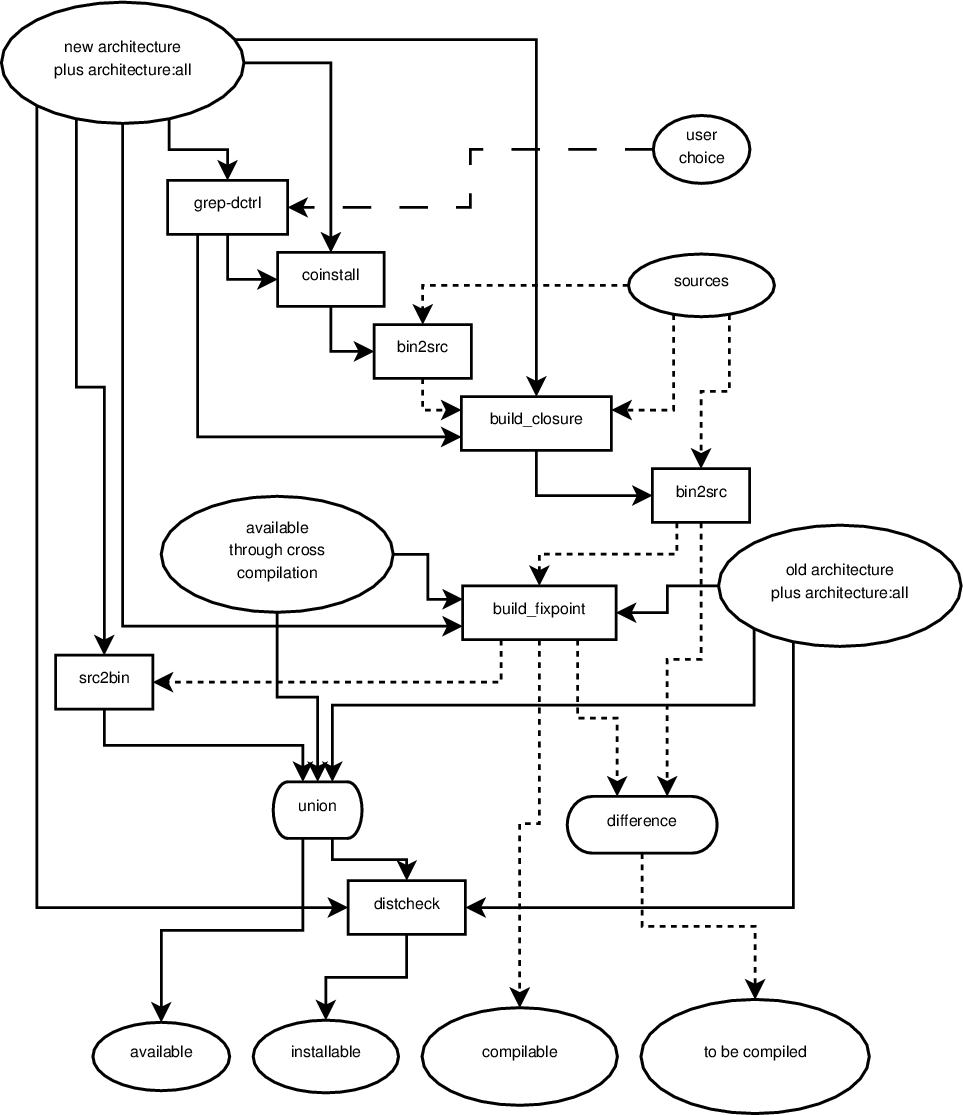
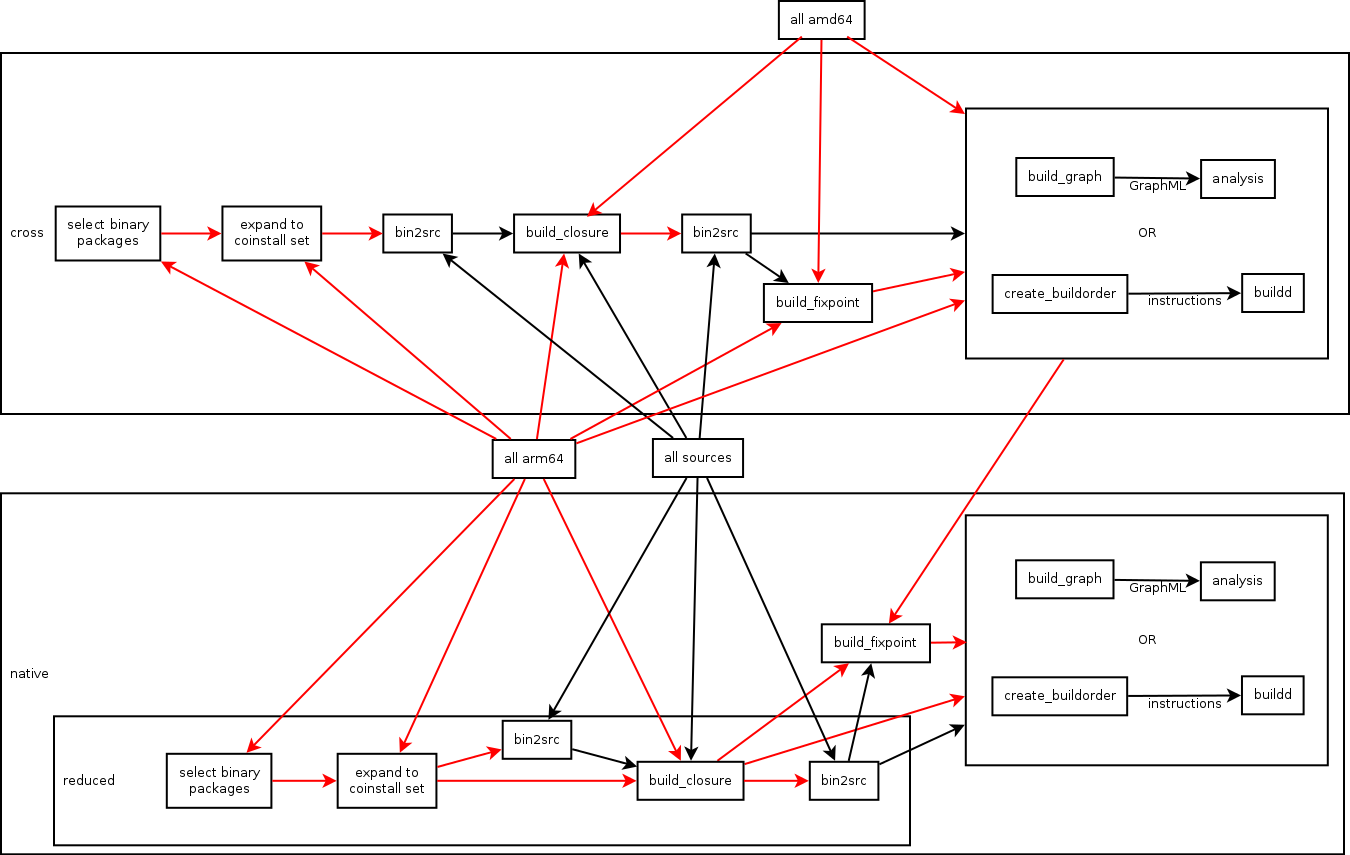
Processing pipeline instead of monolithic tools The tools I developed so far tried to accomplish everything by themselves, reusing functionality implemented in a central library. Therefor, if one wanted to try out even trivial new things, it mostly meant to hack some OCaml code. Pietro Abate suggested to instead develop smaller tools which could work independently of each other, would only execute one algorithm each and could easily be connected together in different ways to achieve different effects. This switch is now done and all functionality from the old tools is moved into a new toolset. The exchange format between the tools is either plain text files in deb822 control format (Packages/Sources files) or a dependency graph. The dependency graph is currently marshalled by OCaml but future versions should work with just passing a GraphML (an XML graph format) representation around. This new way of doing things seems close to the UNIX philosophy (each program does one thing well, data is stored as text, every program is a filter). For example the deb822 control output can easily be manipulated using grep-dctrl(1) and there exist many tools which can read, analyze and manipulate GraphML. It is a big improvement over the old, monolithic tools which did not allow to manipulate any intermediate result by external, existing tools. Currently, a shell script (native.sh) will execute all tools in a meaningful order, connecting them together correctly. The same tools will be used for a future cross.sh but they will be connected differently. I wrote about a first proposal of what the individual tools should do and how they should be connected in this email from which I also linked a confusing overview of the pipeline. This overview has recently been improved to be even more confusing and the current version of the lower half (the native part) now looks like this: native reduced Solid arrows represent a flow of binary packages, dottend arrows represent a flow of source packages, ovals represent a set of packages, boxes with rounded corners represent set operations, rectangular boxes represent filters. There is only one input to a filter, which is the arrow connected to the top of the box. Outgoing arrows from the bottom represent the filtered input. Ingoing arrows to either side are arguments to the filter and control how the filter behaves depending on the algorithm. I will explain this better once the pipeline proved to be less in flux. The pipeline is currently executed like this by native.sh.

Two new ways to break dependency cycles have been discovered So far, we knew of three ways to formally break dependency cycles:
  • remove build dependencies through build profiles
  • find out that the build dependency is only used to build arch:all packages and therefor put it into Build-Depends-Indep
  • cross compile some source packages
Two new methods can be added to the above:

Dependency graph definition changed Back in September when I was visiting irill, Pietro found a flaw in how the dependency graph used to be generated. He supplied a new definition of the dependency graph which does away with the problem he found. After fixing some small issues with his code, I changed all the existing algorithms to use the new graph definition. The old graph is as of today removed from the repository. Thanks to Pietro for supplying the new graph definition - I must still admit that my OCaml foo is not strong enough to have come up with his code.

Added complexity for profile built source packages As mentioned in the introduction, wookey and me addressed the debian-devel list with a proposal on necessary changes for an automated bootstrapping of Debian. During the discussiong, two important things came up which are to be considered by the dependency graph algorithms:
  • profile built source packages may not create all binary packages
  • profile built source packages may need additional build dependencies
Both things make it necessary to alter the dependency graph during the generation of a feedback arc set and feedback vertex set beyond the simple removal of edges. Luckily, the developed approximation algorithms can be extended to support such changes in the graph.

Different feedback arc set algorithms The initially developed feedback arc set algorithm is well suited to discover build dependency edges which should be dropped. It performs far worse when creating the final build order because it only considers edges by itself and not how many edges of a source package can be dropped by profile building it. The adjusted algorithm for generating a build order is more of a feedback vertex set algorithm because instead of greedily finding the edge with most cycles through it, it greedily finds the source package which would break most cycles if it was profile built.

Generating a build order with less profile built source packages After implementing all the features above I now feel more confident to publish the current status of the tools to a wider audience. The following test shows a run of the aforementioned ./native.sh shell script. Its final output is a list of source packages which have to be profile built and a build order. Using the resulting build order, starting from a minimal build system (essential:yes, build-essential and debhelper), all source packages will be compiled which are needed to compile all binary packages in the system. The result will therefor be a list of source and binary packages which fulfill the following property:
  • all binary packages can be built from the available source packages
  • all source packages can be built with the available binary packages
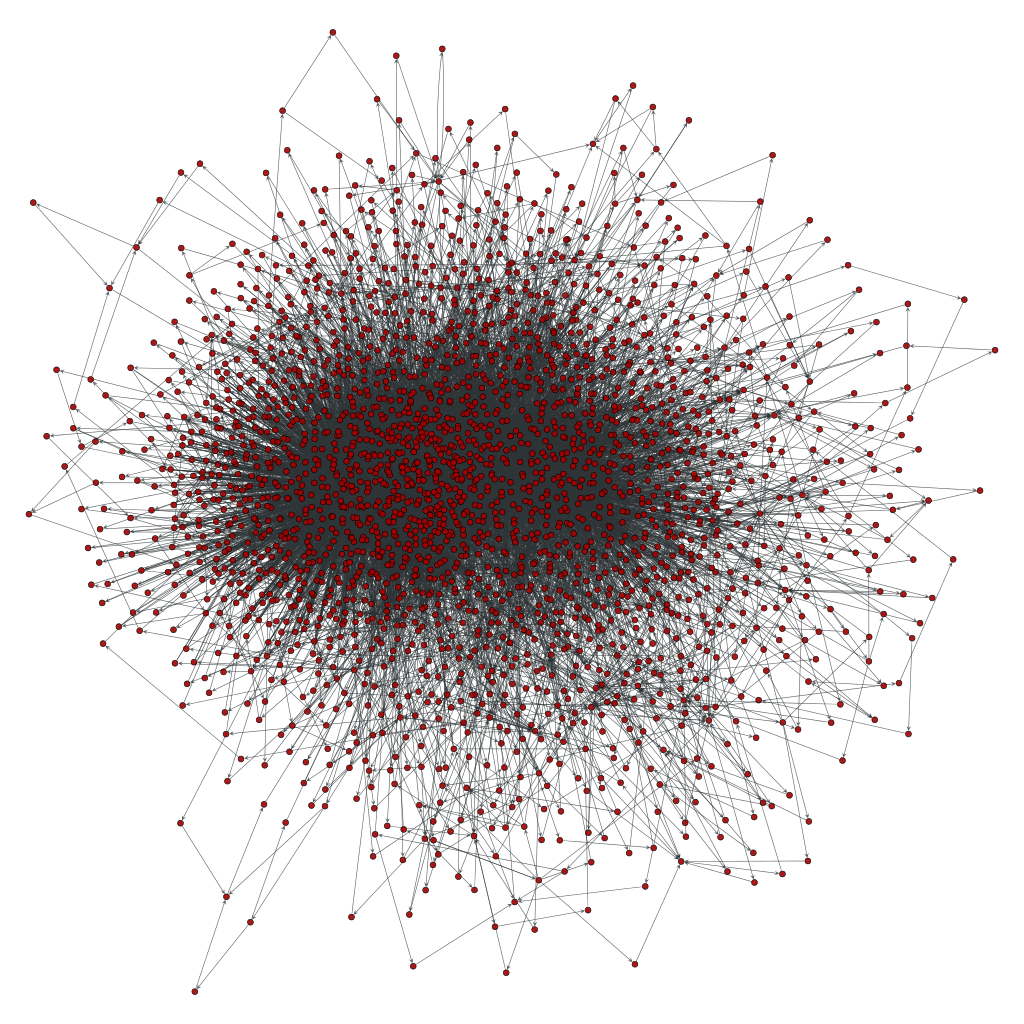
I called this a "reduceded distribution" in earlier posts. The interesting property of this specific selection is, that it contains the biggest problem set of Debian when bootstrapping it: a 900 to 1000 nodes big strongly connected component. Here is a visualization of the problem: hideous mess Source packages do not yet come with build profiles and the cross build situation can not yet be analyzed, so the following assumptions were made: The last point is about 14 build dependencies which were decided to be broken by the feedback arc set algorithm but for which other data sources did not indicate that they are actually breakable. Those 14 are dynamically generated by native.sh. If above assumptions should not be too far from the actual situation, then not more than 73 source packages have to be modified to bootstrap a reduced distribution. This reduced distribution even includes dependency-wise "big" packages like webkit, metacity, iceweasel, network-manager, tracker, gnome-panel, evolution-data-server, kde-runtime, libav and nautilus. By changing one line in native.sh one could easily develop a build order which generates gnome-desktop or really any given (meta-)package selection. All of native.sh takes only 80 seconds to execute on my system (Core i5, 2.5 GHz, singlethreaded). Here is the final build order which creates 2044 binary packages from 613 source packages.
  1. nspr, libio-pty-perl, libmcrypt, unzip, libdbi-perl, cdparanoia, libelf, c-ares, liblocale-gettext-perl, libibverbs, numactl, ilmbase, tbb, check, libogg, libatomic-ops, libnl($), orc($), libaio, tcl8.4, kmod, libgsm, lame, opencore-amr, tcl8.5, exuberant-ctags, mhash, libtext-iconv-perl, libutempter, pciutils, gperf, hspell, recode, tcp-wrappers, fdupes, chrpath, libbsd, zip, procps, wireless-tools, cpufrequtils, ed, libjpeg8, hesiod, pax, less, dietlibc, netkit-telnet, psmisc, docbook-to-man, libhtml-parser-perl, libonig, opensp($), libterm-size-perl, linux86, libxmltok, db-defaults, java-common, sharutils, libgpg-error, hardening-wrapper, cvsps, p11-kit, libyaml, diffstat, m4
  2. openexr, enca, help2man, speex, libvorbis, libid3tag, patch, openjade1.3, openjade, expat, fakeroot, libgcrypt11($), ustr, sysvinit, netcat, libirman, html2text, libmad, pth, clucene-core, libdaemon($), texinfo, popt, net-tools, tar, libsigsegv, gmp, patchutils($), dirac, cunit, bridge-utils, expect, libgc, nettle, elfutils, jade, bison
  3. sed, indent, findutils, fastjar, cpio, chicken, bzip2, aspell, realpath, dctrl-tools, rsync, ctdb, pkg-config($), libarchive, gpgme1.0, exempi, pump, re2c, klibc, gzip, gawk, flex-old, original-awk, mawk, libtasn1-3($), flex($), libtool
  4. libcap2, mksh, readline6, libcdio, libpipeline, libcroco, schroedinger, desktop-file-utils, eina, fribidi, libusb, binfmt-support, silgraphite2.0, atk1.0($), perl, gnutls26($), netcat-openbsd, ossp-uuid, gsl, libnfnetlink, sg3-utils, jbigkit, lua5.1, unixodbc, sqlite, wayland, radvd, open-iscsi, libpcap, linux-atm, gdbm, id3lib3.8.3, vo-aacenc, vo-amrwbenc, fam, faad2, hunspell, dpkg, tslib, libart-lgpl, libidl, dh-exec, giflib, openslp-dfsg, ppl($), xutils-dev, blcr, bc, time, libdatrie, libpthread-stubs, guile-1.8, libev, attr, libsigc++-2.0, pixman, libpng, libssh2, sqlite3, acpica-unix, acl, a52dec
  5. json-c, cloog-ppl, libverto, glibmm2.4, rtmpdump, libdbd-sqlite3-perl, nss, freetds, slang2, libpciaccess, iptables, e2fsprogs, libnetfilter-conntrack, bash, libthai, python2.6($), libice($), libpaper, libfontenc($), libxau, libxdmcp($), openldap($), cyrus-sasl2($), openssl, python2.7($)
  6. psutils, libevent, stunnel4, libnet-ssleay-perl, libffi, readline5, file, libvoikko, gamin, libieee1284, build-essential, libcap-ng($), lcms($), keyutils, libxml2, libxml++2.6, gcc-4.6($), binutils, dbus($), libsm($), libxslt, doxygen($)
  7. liblqr, rarian, xmlto, policykit-1($), libxml-parser-perl, tdb, devscripts, eet, libasyncns, libusbx, icu, linux, libmng, shadow, xmlstarlet, tidy, gavl, flac, dbus-glib($), libxcb, apr, krb5, alsa-lib
  8. usbutils, enchant, neon27, uw-imap, libsndfile, yasm, xcb-util, gconf($), shared-mime-info($), audiofile, ijs($), jbig2dec, libx11($)
  9. esound, freetype, libxkbfile, xvidcore, xcb-util-image, udev($), libxfixes, libxext($), libxt, libxrender
  10. tk8.4, startup-notification, libatasmart, fontconfig, libxp, libdmx, libvdpau, libdrm, libxres, directfb, libxv, libxxf86dga, libxxf86vm, pcsc-lite, libxss, libxcomposite, libxcursor, libxdamage, libxi($), libxinerama, libxrandr, libxmu($), libxpm, libxfont($)
  11. xfonts-utils, libxvmc, xauth, libxtst($), libxaw($)
  12. pmake, corosync, x11-xserver-utils, x11-xkb-utils, coreutils, xft, nas, cairo
  13. libedit, cairomm, tk8.5, openais, pango1.0($)
  14. ocaml, blt, ruby1.8, firebird2.5, heimdal, lvm2($)
  15. cvs($), python-stdlib-extensions, parted, llvm-2.9, ruby1.9.1, findlib, qt4-x11($)
  16. xen, mesa, audit($), avahi($)
  17. x11-utils, xorg-server, freeglut, libva
  18. jasper, tiff3, python3.2($)
  19. openjpeg, qt-assistant-compat, v4l-utils, qca2, jinja2, markupsafe, lcms2, sip4, imlib2, netpbm-free, cracklib2, cups($), postgresql-9.1
  20. py3cairo, pycairo, pam, libgnomecups, gobject-introspection($)
  21. gdk-pixbuf, libgnomeprint, gnome-menus, gsettings-desktop-schemas, pangomm, consolekit, vala-0.16($), colord($), atkmm1.6
  22. libgee, gtk+3.0($), gtk+2.0($)
  23. gtkmm2.4, poppler($), openssh, libglade2, libiodbc2, gcr($), libwmf, systemd($), gcj-4.7, java-atk-wrapper($)
  24. torque, ecj($), vala-0.14, gnome-keyring($), gcc-defaults, gnome-vfs($)
  25. libidn, libgnome-keyring($), openmpi
  26. mpi-defaults, dnsmasq, wget, lynx-cur, ghostscript, curl
  27. fftw3, gnupg, libquvi, xmlrpc-c, raptor, liboauth, groff, fftw, boost1.49, apt
  28. boost-defaults, libsamplerate, cmake, python-apt
  29. qjson, qtzeitgeist, libssh, qimageblitz, pkg-kde-tools, libical, dwarves-dfsg, automoc, attica, yajl, source-highlight, pygobject, pygobject-2, mysql-5.5($)
  30. libdbd-mysql-perl, polkit-qt-1, libdbusmenu-qt, raptor2, dbus-python, apr-util
  31. rasqal, serf, subversion($), apache2
  32. git, redland
  33. xz-utils, util-linux, rpm, man-db, make-dfsg, libvisual, cryptsetup, libgd2, gstreamer0.10
  34. mscgen, texlive-bin
  35. dvipng, luatex
  36. libconfig, transfig, augeas, blas, libcaca, autogen, libdbi, linuxdoc-tools, gdb, gpm
  37. ncurses, python-numpy($), rrdtool, w3m, iproute, gcc-4.7, libtheora($), gcc-4.4
  38. libraw1394, base-passwd, lm-sensors, netcf, eglibc, gst-plugins-base0.10
  39. libiec61883, qtwebkit, libvirt, libdc1394-22, net-snmp, jack-audio-connection-kit($), bluez
  40. redhat-cluster, gvfs($), pulseaudio($)
  41. phonon, libsdl1.2, openjdk-6($)
  42. phonon-backend-gstreamer($), gettext, libbluray, db, swi-prolog, qdbm, swig2.0($)
  43. highlight, libselinux, talloc, libhdate, libftdi, libplist, python-qt4, libprelude, libsemanage, php5
  44. samba, usbmuxd, libvpx, lirc, bsdmainutils, libiptcdata, libgtop2, libgsf, telepathy-glib, libwnck3, libnotify, libunique3, gnome-desktop3, gmime, glib2.0, json-glib, libgnomecanvas, libcanberra, orbit2, udisks, d-conf, libgusb
  45. libgnomeprintui, libimobiledevice, nautilus($), libbonobo, librsvg
  46. evas, wxwidgets2.8, upower, gnome-disk-utility, libgnome
  47. ecore, libbonoboui
  48. libgnomeui
  49. graphviz
  50. exiv2, libexif, lapack, soprano, libnl3, dbus-c++
  51. atlas, libffado, graphicsmagick, libgphoto2, network-manager
  52. pygtk, jackd2, sane-backends, djvulibre
  53. libav($), gpac($), ntrack, python-imaging, imagemagick, dia
  54. x264($), matplotlib, iceweasel
  55. strigi, opencv, libproxy($), ffms2
  56. kde4libs, frei0r, glib-networking
  57. kde-baseapps, kate, libsoup2.4
  58. geoclue, kde-runtime, totem-pl-parser, libgweather, librest, libgdata
  59. webkit
  60. zenity, gnome-online-accounts
  61. metacity, evolution-data-server
  62. gnome-panel
  63. tracker
The final recompilation of profile built source packages is omitted. Source packages marked with a ($) are selected to be profile built. All source packages listed in the same line can be built in parallel as they do not depend upon each other. This order looks convincing as it first compiles a multitude of source packages which have no or only few build dependencies lacking. Later steps allow fewer source packages to be compiled in parallel. The amount of needed build dependencies is highest in the source packages that are built last.

Neil Williams: Hard drive death

My 1Tb laptop drive started misbehaving a few weeks ago, just spending a lot of time spinning when it should have been reading frequently changed files (like the browser cache). I was tempted to blame the browser at that point as no other packages appeared affected.

Wednesday night, a routine package upgrade on unstable brought in a bunch of qt4 updates which I wanted and a virtual box update that I didn't see much point in delaying ... 15 minutes later I couldn't work out why the virtualbox dkms task was still running, spotted it spinning in depmod and found some alarming messages in dmesg about short reads and errors reading from the hard drive. Hmm. The hard drive was out of control at this point, it quickly became apparent that no disc access was going to be possible and I couldn't get to a terminal to kill the current tasks, so I killed the power. The fsck which followed reboot showed more of the errors I'd seen in dmesg and fell back to the manual intervention stage. A few hours of confirming attempts to fix the errors, fsck finally finished. A short amount of usage showed that although fsck had finished, the drive was not happy and was starting to give short reads on other parts of the filesystem, resulting in ~40% of the filesystem appearing to be read-only when the rest was read-write. Somehow, I didn't think this was a welcome feature as the areas affected appeared to be quite random.

The drive in question was a replacement for the original 300Gb drive supplied with the ThinkPad, so a quick bit of switching of drives into a caddy and I could rsync my data off the large drive onto the smaller one. The rsync itself took a lot longer than it should have done because it got lots of short reads too. (Principally in /lib/modules/3.2.0-4/ and in the browser cache directories which had been the original symptom as well as most other places where one could have expected processes to have open files when the drive failed).

Now the 1Tb drive was a pig to fit into the Thinkpad originally because it was too big for the bay but I fitted it anyway. Yes, that was probably a mistake. It certainly meant that in order to fit it I had to not put the drive into the useful caddy provided by Lenovo which makes removal of the drive simple. Indeed the drive was wedged into the bay so tightly that it wasn't going to come out with normal levels of persuasion. This probably contributed to the failure of the drive, so live and learn.

With help from Andy Simpkins (it's always handy to have a hardware engineer on hand at times like this), the keyboard was lifted out, the case was dismantled and just enough room was made to get a screwdriver in behind the sata drive and lever it out of the bay. OK, rebuild laptop, put replacement drive into the caddy (because the smaller capacity drive is also a lot smaller in height than the 1Tb and therefore has plenty of clearance between it and the bay) and move on to the software recovery stage.

Hint: if this happens again, before turning off the broken system for the last time, just remember to download a recent Debian ISO to a USB stick - it saves having to ask someone else or find another machine to do the download. (Thanks Andy...)

OK, so after the usual complaints on reboot that there was no operating system, F12 got the boot order menu up and I was in Debian Installer Rescue Mode. Reinstalling grub failed initially for a few reasons:

  1. I'd deliberately not copied /dev /proc and /sys from the old harddrive but I'd also forgotten to create empty ones on the new drive...
  2. /etc/fstab helpfully referred to / as a UUID which no longer applied, so that had to be edited
  3. grub was confused and couldn't find the root filesystem

A few iterations later, I had a working /dev directory inside the /target chroot, bind mounted from the /dev outside the chroot, I was able to mount proc and sys, so grub was finally happy to reinstall itself and then update the initramfs setup for the new drive.

Reboot, another fsck, all appeared well. I was able to login via the terminal but not in X. Hmmm. Stop xdm, startx manually from the terminal, problems with /tmp/ - permission denied. Oops. Yes, it does help to create /tmp with the right permissions....

The final stage was to complete the dpkg --configure -a from the original failure. I've yet to reinstall the 3.2.0-4 kernel, so I'm back on 3.2.0-3 but that's OK.

So now I'm back on the original drive, albeit temporarily without any swap whatsoever (because I didn't partition the replacement drive to create /dev/sda5 before doing the copy) and now I remember the second reason I wanted to replace the original drive with the 1Tb drive - the original drive is as NOISY as hell. The whole edge of the laptop vibrates constantly, to the point that I can feel the vibration under the keys as I type. It's not that the drive is loose in the bay, it's just a constant vibration.

But, I have kept all my data and I have a usable laptop for the BSP this weekend. I will be looking at an SSD drive to replace this one though and having also found my old Acer laptop with power supply, I can now reference this entry when I transfer the system a second time.

27 December 2012

Jamie McClelland: Live video streaming using vp8enc and webm on Debian

The vp8 video codec and webm container format (which are alternates for theora/ogg and h264/flv) are getting lots of attention, especially as more web browsers are supporting html5 - which includes a new video tag that plays video directly in a web page, rather than requiring a plugin. With Google fully behind these new formats (and converting YouTube videos) and even skype using vp8, it seems as though it could supplant h264/flash as the default video codec and container. After years under the boot of the proprietary flash video, this change could usher in a lot of exciting developments. While the shift in formats is also significant for on-demand video, I'm focusing on live streaming in this blog. There are a lot of tools needed to successfully stream a live video. Enough of them support vp8 and webm to create a live video stream, however, not all of the right versions of these tools have landed in Debian. Without any patches or changes, if you try to send a live video stream to icecast using vp8 encoding and webm, you'll get something like this:
0 jamie@animal:~$ gst-launch v4l2src ! video/x-raw,width=320,height=240 ! vp8enc ! webmmux ! shout2send ip=icecast.server port=8000 password=secret mount=/test.webm
WARNING: erroneous pipeline: could not link webmmux0 to shout2send0
1 jamie@animal:~$
I've documented the steps for patching/upgrading gstreamer and icecast2 so you can get a live video stream using vp8 encoding and the webmc container that originates on a Debian wheezy machine using gstreamer and streams to a Debian squeeze server running icecast2. On the workstation, you'll need libshout3 version 2.3.0 or higher, which is at the moment available in experimental and installable without bringing in any dependencies. In addition, you will need to bring in gstreamer1.0 from sid and you will need to rebuild gstreamer1.0-plugins-good after libshout-dev has been installed from experimental. So, begin by adding experimental and sid to your sources list by creating the files /etc/apt/sources.list.d/experimental.list and /etc/apt/sources/lists.d/sid.list with the respective contents:
deb http://mirror.cc.columbia.edu/debian experimental main
and
deb http://mirror.cc.columbia.edu/debian sid main 
deb-src http://mirror.cc.columbia.edu/debian sid main
In order to avoid upgrading your entire machine to sid (experimental packages won't upgrade by default), you'll also need to add the file /etc/apt/preferences.d/sid:
Package: *
Pin: release n=sid
Pin-Priority: 200
Then update and install:
apt-get update
apt-get install -t experimental libshout3
apt-get install gir1.2-clutter-gst-1.0 gir1.2-gst-plugins-base-1.0 gir1.2-gstreamer-1.0 gstreamer0.10-ffmpeg  gstreamer1.0-libav:amd64 gstreamer1.0-plugins-bad:amd64 gstreamer1.0-plugins-base:amd64 gstreamer1.0-plugins-base-apps gstreamer1.0-plugins-good:amd64 gstreamer1.0-pulseaudio:amd64 gstreamer1.0-tools gstreamer1.0-x:amd64 libclutter-gst-1.0-0:amd64 libgstreamer-plugins-bad1.0-0:amd64 libgstreamer-plugins-base1.0-0:amd64 libgstreamer-plugins-base1.0 libgstreamer1.0-0:amd64 libgstreamer1.0
Fortunately, the version of gstreamer1.0-plugins-good in sid includes a fix for a bug patched on November 31, 2012 that allows the use of the webm container. However, for it to work properly gstreamer1.0-plugins-good has to be built against libshout version 2.3.0 or higher (which is in experimental, not sid). Therefore, you have install libshout-dev from experimental and then rebuild gstreamer1.0-plugins-good.
sudo apt-get build-dep gstreamer1.0-plugins-good
sudo apt-get -t experimental install libshout-dev
apt-get source gstreamer1.0-plugins-good
cd gst-plugins-good1.0-1.0.4
dch -v 1.0.4-1+webmmux
fakeroot debian/rules binary
sudo dpkg -i ../gstreamer1.0-plugins-good_1.0.4-1+webmmux_amd64.deb
Now if you try the command, things should work on the client side. When streaming to an icecast2 server running squeeze, I don't get any errors, however, when opening the streaming page via the icecast URL, there is a play button, which can be clicked, but no picture is shown. That's because the version of Icecast2 in squeeze doesn't support either vp8 or webm. On the server side, you will need icecast2 version 2.4beta or higher. This version hasn't landed anywhere in Debian as of this writing. However, you can build it from source by following these steps (the patches I'm removing have all been applied to the new upstream version).
apt-get source icecast2
wget http://downloads.xiph.org/releases/icecast/icecast-2.4-beta.tar.gz
tar -xzvf icecast-2.4-beta.tar.gz
cp -r icecast2-2.3.2/debian icecast-2.3.99.0/
cd icecast-2.3.99.0/
rm debian/patches/ 1001_autotools_avoid_debian-subdir.patch,1002_add_missing_xspf_file,1003_fix_memory_leak.patch,series 
dch -v 2.3.99.0-1
fakeroot debian/rules binary
When you install it, be sure to replace the icecast2.xml configuration file and update it with your server-specific customizations. Hopefully this version of icecast2 will make it to experimental soon. And now... you can successfully stream via:
gst-launch-1.0 v4l2src ! video/x-raw,width=320,height=240 ! vp8enc ! webmmux !  shout2send ip=icecast.server port=8000 password=secret mount=/test.webm
If you want full audio and video, here's a more complete pipeline: gst-launch-1.0 v4l2src ! queue ! video/x-raw,width=320,height=240 ! tee name=tscreen ! queue ! autovideosink tscreen. ! queue ! videorate ! video/x-raw,framerate=25/2 ! queue ! vp8enc ! queue ! webmmux name=mux pulsesrc ! queue ! audioconvert ! vorbisenc ! queue ! queue ! mux. mux. ! queue ! shout2send ip=hobo port=8000 mount=jamie.webm password=secret Unfortunately, since I'm not sure how to deal with the python2.7 vs python3 dependecies, my elegant mobi python script that creates this pipeline for you using python-gtk as been reduced to a crude bash script. Another item on the todo list is opus audio encoding. gstreamer doesn't seem able to use opus in the webm container (although it seems to work with ogg). In the course of this research I found directions for getting gstreamer-1.0 installed on debian independent of packages installed on the system. If you follow the directions above, these steps should not be necessary. I'm including in case you need the latest sources for another reason. Extra steps I needed were:

23 December 2012

Cyril Brulebois: d-i hacking recipe #3: Debugging debconf

Problem #3: How to find out what s going on with debconf? Slightly longer version: As reported in #679327, the grub prompt during the installation process is entitled Configuring man-db , which isn t exactly great. Given man-db is a known dpkg trigger, I suspected this would be the reason for the broken title, and here s how I debugged it. For starters, using d-i basically means asking a lot of questions, which is implemented using the debconf mechanism. One should note that two implementations are available:
  1. the historic implementation, in Perl: debconf
  2. the C reimplementation: cdebconf
d-i uses cdebconf udebs, but joy begins when packages get installed in /target: debconf is used there. We ll see why that matters. Recipe #3: Set DEBCONF_DEBUG=developer and read logs!
  1. Both implementations support the DEBCONF_DEBUG environment variable. The installer supports passing that as a kernel parameter; example from the syslinux prompt: select the Graphical install entry, press Tab , remove -- quiet and put DEBCONF_DEBUG=developer there instead.
  2. Let s look at /var/log/syslog; there s a tail -f on it in VT4, but one can run grep and friends on it in VT2 or VT3. There, one can see what happens at the debconf level (the debconf protocol is documented in debconf-devel(7)). Tiny excerpt (timestamps removed for clarity):
    frontend: --> GET preseed/early_command
    frontend: <-- 0
     
    frontend: --> GET debian-installer/framebuffer
    frontend: <-- 0 true
     
    debconf: --> GET debconf/language
    debconf: <-- 0 en
    debconf: --> SET debconf/language en
    debconf: Setting debconf/language to en
    debconf: <-- 0 value set
    debconf: --> GET debconf/priority
    debconf: <-- 0 high
    debconf: --> GET rescue/enable
    debconf: <-- 0 false
    
  3. The interesting point was titles, right? So let s look at the last TITLE occurrences:
    debconf: --> SETTITLE debian-installer/main-menu-title
    debconf: --> SETTITLE debian-installer/grub-installer/title
    in-target: debconf (developer): ----> TITLE Configuration de man-db
    debconf: --> TITLE Configuration de man-db
    in-target: debconf (developer): <-- TITLE Configuration de man-db
    in-target: debconf (developer): ----> TITLE Configuration de man-db
    in-target: debconf (developer): ----> TITLE Configuration de grub-pc
    debconf: --> TITLE Configuration de grub-pc
    in-target: debconf (developer): <-- TITLE Configuration de grub-pc
    in-target: debconf (developer): ----> TITLE Configuration de grub-pc
    in-target: debconf (developer): ----> TITLE Configuration de man-db
    debconf: --> TITLE Configuration de man-db
    in-target: debconf (developer): <-- TITLE Configuration de man-db
    in-target: debconf (developer): ----> TITLE Configuration de man-db
    in-target: debconf (developer): ----> TITLE Configuration de grub-pc
    debconf: --> TITLE Configuration de grub-pc
    in-target: debconf (developer): <-- TITLE Configuration de grub-pc
    in-target: debconf (developer): ----> TITLE Configuration de grub-pc
    debconf: --> SETTITLE debian-installer/grub-installer/title
    
    Bad news: the last one is about grub, so the title should be correct, right?
  4. At this point, it might be the Gtk frontend behaving strangely. It s shipped in cdebconf-gtk-udeb, built from the cdebconf source. Let s look:
    • src/modules/frontend/gtk/ui.c has cdebconf_gtk_update_frontend_title(), which does what the function name suggests.
    • src/modules/frontend/gtk/di.c has cdebconf_gtk_di_run_dialog(), which calls the first function.
    • src/modules/frontend/gtk/progress.c has cdebconf_gtk_show_progress() (also calls the first function), which comes with the following comments:
      /** Show the progress widgets.
        *
        * This will actually add the widgets to the corresponding containers.
        * The main title saved when starting the PROGRESS operation will be restored
        * from the value saved when START was called.  This is needed when GO is
        * called during a PROGRESS operation.
      
    Now that s something! Even if the last entry is about grub, some previous value could be restored and could be the reason for the bad behaviour (that is easily confirmed by adding some debug_printf() calls on fe->title in cdebconf, thanks to an extra "debug.h" include). Maybe that s what needs fixing!
  5. Now it s time to take a step back. A d-i environment is nice, but testing things can easily become a burden. Taking a random wheezy or sid chroot, and installing/removing a tiny package shipping a manpage should be enough to run into the man-db trigger. Exporting DEBCONF_DEBUG=developer there too, let s either install or remove x11-apps (the trigger does the same job, and the debconf trace is the same), here s the output:
    Processing triggers for man-db ...
    debconf (developer): frontend started
    debconf (developer): frontend running, package name is man-db
    debconf (developer): starting /var/lib/dpkg/info/man-db.config configure /usr/share/man
    debconf (developer): <-- VERSION 2.0
    debconf (developer): --> 0 2.0
    debconf (developer): <-- INPUT medium man-db/install-setuid
    debconf (developer): --> 30 question skipped
    debconf (developer): <-- GO
    debconf (developer): --> 0 ok
    debconf (developer): starting /var/lib/dpkg/info/man-db.postinst triggered /usr/share/man
    debconf (developer): <-- VERSION 2.0
    debconf (developer): --> 0 2.0
    debconf (developer): <-- GET man-db/auto-update
    debconf (developer): --> 0 true
    
    Even if one didn t know about the cdebconf/debconf thing, the frontend started bit in the d-i syslog would have been the key: it s only found in debconf, in the frontend script. That one has several ways to determine the package being acted on, and it finally calls:
    debug developer => "frontend running, package name is $package";
    $frontend->default_title($package) if length $package;
    
    Tada, that s likely to be the issue.
  6. Tweaking that frontend script, it s easy to make sure that the code path for this use case is:
    elsif ($ARGV[0]=~m!^.*/(.*?)\.(?:postinst postrm prerm)$!)  
            $package=$1;
     
    
    Since $ARGV[1] is the action being passed to the maintainer script, one can intercept the triggered action, and avoid emitting a title update in this case; I ve therefore reassigned #679327 to the debconf package, and proposed a patch implementing that, which Joey Hess seems to find reasonable.
In my message to the bug report I wrote I actually tested it in a d-i environment, and made sure the issue had gone away. How I did that will likely be described in the next d-i hacking recipe.

22 December 2012

Bartosz Fe&#324;ski: Two full-time days to work on Debian

My current employer as a benefit offers two days of paid volunteer time every calendar year. In September I decided to devote this time for Debian project. It wasn t easy to convince HR and my manager (hi Gloria ;) ) that such activity can be considered as volunteering but I eventually did it! So last Thursday and Friday were days I could spent working on my packages and other stuff related to Debian ;) Let s talk about effects. 5 packages updated, 16 bugs closed, more than 50 lintian warnings/errors solved. Here goes changelogs from updated packages:
calcurse (3.1.2-1) unstable; urgency=low
* The Akamai Technologies paid volunteer days release.
* Package made from scratch (this was funny experience):
- uses new quilt source format
- uses new copyright format
- uses debhelper compatibility level 9 w/hardening options
- uses the newest Standards-Version
* New upstream version:
- supports UTF8 (Closes: #558671)
- hopefully fixes problem with accented characters (Closes: #466010) -- Bartosz Fenski <fenio> Thu, 20 Dec 2012 13:51:08 +0100 httpie (0.3.1-1) unstable; urgency=low * The Akamai Technologies paid volunteer days release.
* Includes manual page (Closes: #673067)
Courtesy of Khalid El Fathi <khalid>. Thanks!
* New upstream version. (Closes: #693810)
- handles binary transfers properly (Closes: #689974) -- Bartosz Fenski <fenio> Thu, 20 Dec 2012 14:27:59 +0100 skipfish (2.10b-1) unstable; urgency=low * The Akamai Technologies paid volunteer days release.
* New upstream version.
* Bumped Standards-Version (no changes needed).
* Various path fixes because of upstream changes.
* Added new libpcre3-dev build dependency.
* Totally rewritten copyright file to comply with new copyright standard. -- Bartosz Fenski <fenio> Thu, 20 Dec 2012 14:59:36 +010 ipcalc (0.41-3) unstable; urgency=low * The Akamai Technologies paid volunteer days release.
* ACK previous NMU, thanks Christopher!
* Documents some missing features in the manpage (Closes: #588143)
Thanks Tanguy Ortolo <tanguy>!
* Fixes other minor problems in manpage (Closes: #688148)
* Description now says it's tool IPv4 only (Closes: #628955)
* Fixes lack of </table> tag when printing supernets (Closes: #600251)
* The following changes are courtesy of Jari Aalto <jari.aalto>:
- Remove deprecated dpatch and upgrade to packaging format "3.0 quilt".
- Update to Standards-Version to 3.9.3 and debhelper to 9.
- Add build-arch and build-indep targets; use dh_prep in rules file.
- Patch 03: update with "quilt refresh" to make it apply cleanly.
Thanks to these changes (Closes: #670737) -- Bartosz Fenski <fenio> Fri, 21 Dec 2012 12:30:11 +0100 netw-ib-ox-ag (5.39.0-1) unstable; urgency=low * The Akamai Technologies paid volunteer days release.
* New upstream version.
* Uses Homepage header. (Closes: #615219, #615294, #615321, #615436, #645522)
* Bumped Standards-Version (no changes needed).
* Switch to dpkg-source 3.0 (quilt) format)
* Fixes FTBFS on s390x and sparc64 (Closes: #639493)
* Fixes 29 (sic!) lintian warnings/errors thus many small changes
in packaging scripts.
-- Bartosz Fenski <fenio> Fri, 21 Dec 2012 15:38:29 +0200
Despite this I did something else. I sent end of the world joke-mail to debian-mentors mailing list stating (ignore the fact that my own server marked me as spammer; fixed already ;P) that I m going to review and try to upload every package that will be send to me during end-of-the-world day.
That action was quite successful although no package has been uploaded yet. I reviewed 4 of them and two more are yet to come. So it looks that these two days sponsored by Akamai motivated me enough to spent few more days or even months and help other people to contribute to Debian. Thank you Akamai!

21 December 2012

Daniel Kahn Gillmor: libasound2-plugins is a resource hog!

I run mpd on debian on "igor", an NSLU2 -- a very low-power ~266MHz armel machine, with no FPU and a scanty 32MiB of RAM. This serves nicely to feed my stereo with music that is controllable from anywhere on my LAN. When playing music and talking to a single mpd client, the machine is about 50% idle. However, during a recent upgrade, something wanted to pull in pulseaudio, which in turn wanted to pull in libasound2-plugins, and i distractedly (foolishly) let it. With that package installed, after an mpd restart, the CPU was completely thrashed (100% utilization) and music only played in stutters of 1 second interrupted by a couple seconds of silence. igor was unusable for its intended purpose. Getting rid of pulseaudio was my first attempt to fix the stuttering, but the problem remained even after pulse was all gone and mpd was restarted. Then i did a little search of which packages had been freshly installed in the recent run:
grep ' install .* <none> ' /var/log/dpkg.log
and used that to pick out the offending package. After purging libasound2-plugins and restarting mpd, the igor is back in action. Lesson learned: on low-overhead machines, don't allow apt to install recommends!
echo 'APT::Install-Recommends "0";' >> /etc/apt/apt.conf
And it should go without saying, but sometimes i get sloppy: i need to pay closer attention during an "apt-get dist-upgrade" Tags: alsa, apt, low-power, mpd

17 December 2012

Jaldhar Vyas: Heads Up: Latest Dovecot Package Loses Features

Sometimes it's easy to forget that Debian's unstable branch is...unstable. Unfortunately today I have to remind you of that unpleasant fact. Dovecot 2.1.7-6 which I just uploaded has removed some features present in -5. The reason for this is that I am trying to get dovecot in shape for Wheezy. Unfortunately, as I have been severely pressed for time these past few months, the process did not take place in quite as orderly a fashion as I had hoped. My -5 packages were deemed by the release managers to have too drastic changes for this stage of the pre-Wheezy freeze and this is an attempt to make things more acceptable to them. Hopefully this version will pass into testing without incident and as soon as it does, I will prepare -7 which will put these features back. So if you need any of them, you are advised to skip -6 and stay at -5 until that happens. If you are following testing there is another possible problem you might encounter. When -1 of this version was uploaded, certain extra conf files were accidently omitted from the package. This is also true of -2 which is currently in testing. It was fixed in -3 but that version (or -4 or -5) never made it into testing so -6 is potentially the first time you might be dealing with the conf file fix. If you have manually made changes to files in /etc/dovecot/conf.d make sure you have backups because they may get overriden (as dpkg will be unaware at that point that they are conffiles.) This is a one time only packaging error and will not be a problem going forward but I apologize in advance for any inconvenience caused. And this is a good time to ask anyone interested in Dovecot on Debian (and Ubuntu etc.) to volunteer to help maintain it. It is getting more and more popular at a time when I can give it less and less attention. It is vital that an important package like this needs is team-maintained and it kind of is but so far other people who have expressed an interest in joining the team have been similarly strapped for time so we still need more recruits. All the code is publically accessible at git://git.debian.org/git/collab-maint/dovecot.git and I would be happy to sponsor any non-DD/DMs who need it.

13 December 2012

Neil Williams: perl-cross-debian is ready!

This is the listing for my local cross-build-only repository for perl:

perl 5.14.2-16 unstable armel, source
perl 5.16.2-1 experimental armel, source

Prior to this, 5.14.2-15 also cross-built.

I've just pushed the update which fixes 5.16 from current Debian experimental.

This means that I'm ready to push perl-cross-debian into experimental via NEW. Whilst the package is in NEW, I will be approaching perl upstream about the necessary changes for Makefile.SH and updating the existing bug reports #285559 and #633884 with the necessary changes for debian/rules.

In the meantime, the changes for Makefile.SH and debian/rules exist within the perl-cross-debian source code - the patch for 5.14.2 is the same as I used for 5.16.2 and I don't see a need, yet, for this to be any different with current perl upstream. Equally, the patch for debian/rules works equally well for 5.14.2 and 5.16.2. All the version-specific (and architecture-specific) data lives in perl-cross-debian.

So it's time to tag perl-cross-debian 0.0.1 and upload to ftp-master as a native package aimed at experimental.

What's left to do? TESTING!

I've only tested with armel using the Emdebian cross-building toolchains from Squeeze using the old dpkg-cross style cross-dependency installation paths. There is outline code for armhf and arm64 but these need testing. The code also needs testing using the latest MultiArch cross-building toolchains. This should be a simple matter of checking if the dpkg-cross style paths exist and looking for MultiArch if not.

Right now, all of this is "worksforme" grade. It needs others to have a go and file bugs. Until the package is through NEW, feel free to use the issue tracker on the perl-cross-debian github site.

Please read through the documentation in the source code and the manpages in the package (xml in the source code) and tell me if some of it isn't clear.

7 December 2012

Dominique Dumont: How to fix a configuration model

Hello I ve written a tutorial to show how a configuration model can be updated to cope with new features provided by new software release. This tutorial shows how to add a new parameter provided by OpenSsh 5.9 into Ssh model. This example can be applied to other models (like Dpkg model). I hope that people will be able now to perform simple enhancements to current models. Feedback are welcome
Tagged: config-model, OpenSsh, Perl

26 November 2012

Steve Langasek: Upstart in Debian

Good news, everyone! So as of last Sunday, this works on all Linux archs in Debian unstable and gives you a modern version of upstart:
echo 'Yes, do as I say!'   apt-get -o DPkg::options=--force-remove-essential -y --force-yes install upstart
Thanks to the ifupdown, sysvinit, and udev maintainers for their cooperation in getting upstart support in place; to the Debian release team for accomodating the late changes needed for upstart to be supported in wheezy; and to Scott for his past maintenance of upstart in Debian. Benchmarking One of the consequences is that it's now possible to do meaningful head-to-head comparisons of boot speed between sysvinit (with startpar), upstart, and systemd. At one time or another people have tested systemd vs. sysvinit when using bash as /bin/sh, and upstart vs. sysvinit, and systemd vs. sysvinit+startpar, and there are plenty of bootcharts floating around showing results of one init system or another on one distro or another, but I'm not aware of anyone having done a real, fair comparison of the three solutions, changing nothing but the init system. I've done some initial comparisons in a barebones sid VM, and the results are definitely interesting. Sysvinit with startpar (the default in Debian) can boot a stock sid install, with no added services, in somewhere between 3.37 and 3.42 seconds (three runs). That's not a whole lot, but on the other hand this is a system with a single filesystem and no interesting services yet. Is this really as fast as we can boot? No, even this minimal system can boot faster. Testing with upstart shows that upstart can do the same job in between 3.03 and 3.19 seconds (n=3, mean=3.09). This confirms what we'd already seen in Ubuntu, that it makes a difference to boot speed to have filesystem mounting handled by an integrated process that understands the whole system instead of as a group of serialized shell scripts. What about systemd? The same test gives a boot time between 2.32 and 2.85 seconds (n=4, mean=2.48). Interesting; what would make systemd faster than upstart in sid? Well, a quick look at the system shows one possible contributing factor: the rsyslog package in Debian has a systemd unit file, but not an upstart job file. Dropping in the /etc/init/rsyslog.conf from Ubuntu has a noticeable impact, and brings the upstart boot time down nearer to that of systemd (2.78-3.03s, n=5, mean=2.92). Besides telling me that it's time to start spamming Debian maintainers with wishlist bugs asking them to include upstart jobs in their packages, this suggests that the remaining difference in boot time may be due to the outstanding init scripts in rcS.d that are made built-in no-ops by systemd but not (yet) by upstart in Debian (e.g., hwclock, hostname, udev-mtab). (In Ubuntu, /etc/rcS.d has long since been emptied out in favor of upstart jobs in the common case, since the time it takes to get to runlevel=2 is definitely a major issue for boot speed and boot parallelization.) It also gives the lie to the claim that's been made in various places that spawning shells is a major bottleneck for upstart vs. systemd. More study is certainly needed to confirm this, but at least this naive first test suggests that in spite of the purported benefits of hard-coding boot-time policies in C code, upstart with its default degree of runtime configurability is at least in the ballpark of systemd. Indeed, when OpenSuSE switched from upstart to systemd, it seems that something else in the stack managed to nullify any benefit from improving the boot-time performance of apparmor. Contrary to what some would have you believe, systemd is not some kind of silver bullet for boot speed. Upstart, with its boot-time flexibility and its long history of real-world testing in Ubuntu, is a formidable competitor to systemd in the boot speed department - and a solid solution to the many longstanding boot-time ordering bugs in Debian, which still affect users of sysvinit. I've published the bootcharts for the above tests here. Between the fact that Debian's bootchart package logs by default to /var/log/bootchart.tgz (thus overwriting on every boot) and the fact that these tests are in a VM, I haven't bothered to include the raw data, just the bootcharts themselves. The interested reader can probably generate more interesting boot charts of their own anyway - in particular, it will be interesting to see how the different init systems perform with more complicated filesystem layouts, or when booting a less trivial set of services. Other musings The boot charts have been created with the bootchart package rather than with bootchart2. For one thing, it turns out that bootchart2 includes systemd units, not init scripts; so when replacing bootchart with bootchart2, the non-matching init script is left behind and systemd in particular gets terribly confused. This is now reported as Bug #694403. In an amusing twist, while I was experimenting with bootchart2, I also noticed that having systemd installed would slow down booting with other init systems, because systemd installs udev rules which take a noticeable amount of time to run a helper command at boot even though the helper should be a no-op. So if you're doing boot speed testing of other init systems, be sure you don't have systemd on the system at the time!

18 November 2012

Neil Williams: Long term maintenance of perl cross-build support in Debian

After prompts from Wookey and Steve McIntyre, I decided to look at #285559 and #633884 for perl cross-build support and then port that support forward to the current perl in Wheezy and on to the version of perl currently in experimental. The first patch is for perl 5.8, the second for perl 5.12, neither of which is available currently in Debian. snapshot.debian.org provided the 5.12 source but then that no longer cross-builds with the patch.

The problem, as with any cross build, is that the build must avoid trying to execute binaries compiled within the build to achieve the test results required by ./configure (or in the case of perl, Configure). dpkg-cross has one collection of cache values but the intention was always to migrate the package-specific support data into the packages themselves and keep the architecture-specific data in dpkg-cross or dpkg-dev. Therefore, the approach taken in #633884 would be correct, if only there was a way of ensuring that the cached values remain in sync with the relevant Debian package.

I'll note here that I am aware of other ways of cross-building perl, this is particularly concerned with cross-building the Debian configuration of perl as a Debian package and using Debian or Emdebian cross-compilers. After all, the objective is to support bootstrapping Debian onto new architectures. However, I fully expect this to be just as usable with Ubuntu packages of perl compiled with, e.g. Linaro cross-compilers but I haven't yet looked at the differences between perl in Debian vs Ubuntu in any detail.

I've just got perl 5.14.2 cross-building for armel using the Emdebian gcc-4.4 cross-compiler (4.4.5-8) on a Debian sid amd64 machine without errors (it needs testing, which I'll look at later), so now is the time to document how it is done and what needs to be fixed. I've already discussed part of this with the current perl maintainers in Debian and, subject to just how the update mechanism works, have outline approval for pushing these changes into the Debian package and working with upstream where appropriate. The cache data itself might live in a separate source package which will use a strict dependency on perl to ensure that it remains in sync with the version which it can cross-build. Alternatively, if I can correctly partition the cache data between architecture-specific (and therefore generated from the existing files) and package_$version specific, then it may be possible to push a much smaller patch into the Debian perl package. This would start with some common data, calculate the arch-specific data and then look for some version-specific data, gleaned from Debian porter boxes whilst the version is in Debian experimental.

The key point is that I've offered to provide this support for the long term, ensuring that we don't end up with future stable releases of Debian having a perl package which cannot be cross-built. (To achieve that, we will also end up with versions of perl in Debian testing which also cross-build.)

This cross-build is still using dpkg-cross paths, not MultiArch paths, and this will need to be changed eventually. (e.g. by the source package providing two binaries, one which uses MultiArch and one which expects dpkg-cross paths.) The changes include patches for the upstream Makefile.SH, debian/rules and the cache data itself. Depending on where the cache data finally lives, the new support might or might not use the upstream Cross/ directory as the current contents date from the Zaurus support and don't appear to be that useful for current versions of perl.

The cache data itself has several problems:

  1. It is tightly tied to the version of perl which generated it.

  2. It is, as expected, architecture-dependent

  3. It is, unfortunately, very sensitive to the specific configuration used by the distribution itself


That last point is important because it means that the cache data is not useful upstream as a block. It also means that generating the cache data for a specific Debian package means running the generation code on the native architecture with all of the Debian build-dependencies installed for the full perl build. This is going to complicate the use of this method for new architectures like arm64.

My objective for the long term maintenance of this code is to create sufficient data that a new architecture can be bootstrapped by judicious use of some form of template. Quite how that works out, only time will tell. I expect that this will involve isolating the data which is truly architecture-specific which doesn't change between perl versions from the data which is related to the tests for build-dependencies which does change between perl versions and then work out how to deal with any remainder. A new architecture for a specific perl version should then just be a case of populating the arch-specific data such as the size of a pointer/char and the format specifiers for long long etc. alongside the existing (and correct) data for the current version of perl.

Generating the cache data natively

The perl build repeats twice (three builds in total) and each build provides and requires slightly different cache data - static, debug and shared. Therefore, the maintenance code will need to provide a script which can run the correct configuration step for each mode, copy out the cache data for each one and clean up. The script will need to run inside a buildd chroot on a porter box (I'm looking at using abel.debian.org and harris.debian.org for this work so far) so that the derived data matches what the corresponding Debian native build would use. The data then needs slight modification - typically to replace the absolute paths with PERL_BUILD_DIR. It may also be necessary to change the value of cc, ranlib and other compiler-related values to the relevant cross-compiler executables. That should be possible to arrange within the build of the cache data support package itself, allowing new cache files to be dropped in directly from the porter box.

The configuration step may need to be optimised within debian/rules of perl itself as it currently proceeds on from the bare configuration to do some actual building but I need to compare the data to see if a bare config is modified later. The test step can be omitted already. Each step is performed as:

DEB_BUILD_OPTIONS="nocheck" fakeroot debian/rules perl.static


That is repeated for perl.debug and libperl.so.$(VERSION) where $VERSION comes from :

/bin/bash debian/config.debian --full-version


The files to be copied out are:


There is a lot of scope for templating of some form here, e.g. config.h.debug is 4,686 lines long but only 41 of those lines differ between amd64 and armhf for the same version of perl (and some of those can be identified from existing architecture-specific constants) which should make for a much smaller patch.

Architecture-specific cache data for perl

So far, the existing patches only deal with armel and armhf. If I compare the differences between armel & armhf, it comes down to:

  1. compiler names (config.h.*)

  2. architecture names (config.sh.*)

  3. architecture-based paths (config.sh.*)


However, comparing armel and armhf doesn't provide sufficient info for deriving arm64 or mips etc. Comparing the same versions for armhf and amd64 shows the range of differences more clearly. Typical architecture differences exist like the size of a long, flags to denote if the compiler can cast negative floats to 32bit ints and the sprintf format specifier strings for handling floats and doubles. The data also includes some less expected ones like:

armhf: #define Netdb_host_t const void * /**/
amd64: #define Netdb_host_t char * /**/


I'm not at all sure why that is arch-specific - if anyone knows, email codehelp @ d.o - same address if anyone fancies helping out ....

Cross-builds and debclean

When playing with the cross-build, remember to use the cross-build clean support, not just debclean:


dpkg-architecture -aarmel -c fakeroot debian/rules clean


That wasted quite a bit of my time initially with having to blow away the entire tree, unpack it from original apt sources and repatch it. (Once Wheezy is out, may actually investigate getting debclean to support the -a switch).

OK, that's an introduction, I'm planning on pushing the cross-build support code onto github soon-ish and doing some testing of the cross-built perl binaries in a chroot on an armel box. I'll detail that in another blog post when it's available.

Next step is to look at perl 5.16 and then current perl upstream git to see how to get Makefile.SH fixed for the long term.

15 November 2012

Axel Beckert: Tools to handle archives conveniently

TL;DR: There s a summary at the end of the article. Today I wanted to see why a dependency in a .deb-package from an external APT repository changed so that it became uninstallable. While dpkg-deb --info foobar.deb easily shows the control information, the changelog is in the filesystem part of the package. I could extract that one dpkg-deb, too, but I d have to extract either to some temporary directory or pipe it into tar which then can extract a single file from the archive and sent it to STDOUT:
dpkg-deb --fsys-tarfile foobar.deb   tar xOf - ./usr/share/doc/foobar/changelog.Debian.gz   zless
But that s tedious to type. The following command is clearly less to type and way easier to remember:
acat foobar.deb ./usr/share/doc/foobar/changelog.Debian.gz   zless
acat stands for archive cat is part of the atool suite of commands:
als
lists files in an archive.
$ als foobar.tgz
drwxr-xr-x abe/abe           0 2012-11-15 00:19 foobar/
-rw-r--r-- abe/abe          13 2012-11-15 00:20 foobar/bar
-rw-r--r-- abe/abe          13 2012-11-15 00:20 foobar/foo
acat
extracts files in an archive to standard out.
$ acat foobar.tgz foobar/foo foobar/bar
foobar/bar
bar contents
foobar/foo
foo contents
adiff
generates a diff between two archives using diff(1).
$ als quux.zip
Archive:  quux.zip
  Length      Date    Time    Name
---------  ---------- -----   ----
        0  2012-11-15 00:23   quux/
       16  2012-11-15 00:22   quux/foo
       13  2012-11-15 00:20   quux/bar
---------                     -------
       29                     3 files
$ adiff foobar.tgz quux.zip
diff -ru Unpack-3594/foobar/foo Unpack-7862/quux/foo
--- Unpack-3594/foobar/foo      2012-11-15 00:20:46.000000000 +0100
+++ Unpack-7862/quux/foo        2012-11-15 00:22:56.000000000 +0100
@@ -1 +1 @@
-foo contents
+foobar contents
arepack
repacks archives to a different format. It does this by first extracting all files of the old archive into a temporary directory, then packing all files extracted to that directory to the new archive. Use the --each (-e) option in combination with --format (-F) to repack multiple archives using a single invocation of atool. Note that arepack will not remove the old archive.
$ arepack foobar.tgz foobar.txz
foobar.tgz: extracted to  Unpack-7121/foobar'
foobar.txz: grew 36 bytes
apack
creates archives (or compresses files). If no file arguments are specified, filenames to add are read from standard in.
aunpack
extracts files from an archive. Often one wants to extract all files in an archive to a single subdirectory. However, some archives contain multiple files in their root directories. The aunpack program overcomes this problem by first extracting files to a unique (temporary) directory, and then moving its contents back if possible. This also prevents local files from being overwritten by mistake.
(atool subcommand descriptions from the atool man page which is licensed under GPLv3+. Examples by me.) I though miss the existence of an agrep subcommand. Guess why? atool supports a wealth of archive types: tar (gzip-, bzip-, bzip2-, compress-/Z-, lzip-, lzop-, xz-, and 7zip-compressed), zip, jar/war, rar, lha/lzh, 7zip, alzip/alz, ace, ar, arj, arc, rpm, deb, cab, gzip, bzip, bzip2, compress/Z, lzip, lzop, xz, rzip, lrzip and cpio. (Not all subcommands support all archive types.) Similar Utilities There are some utilities which cover parts of what atool does, too: Tools from the mtools package Yes, they come from the handle MS-DOS floppy disks tool package, don t ask me why. :-)
uz
gunzips and extracts a gzip d tar d archives
Advantage over aunpack: Less to type. :-)
Disadvantage compared to aunpack: Supports only one archive format.
lz
gunzips and shows a listing of a gzip d tar d archive
Advantage over als: One character less to type. :-)
Disadvantage compared to als: Supports only one archive format.
unp unp extracts one or more files given as arguments on the command line.
$ unp -s
Known archive formats and tools:
7z:           p7zip or p7zip-full
ace:          unace
ar,deb:       binutils
arj:          arj
bz2:          bzip2
cab:          cabextract
chm:          libchm-bin or archmage
cpio,afio:    cpio or afio
dat:          tnef
dms:          xdms
exe:          maybe orange or unzip or unrar or unarj or lha 
gz:           gzip
hqx:          macutils
lha,lzh:      lha
lz:           lzip
lzma:         xz-utils or lzma
lzo:          lzop
lzx:          unlzx
mbox:         formail and mpack
pmd:          ppmd
rar:          rar or unrar or unrar-free
rpm:          rpm2cpio and cpio
sea,sea.bin:  macutils
shar:         sharutils
tar:          tar
tar.bz2,tbz2: tar with bzip2
tar.lzip:     tar with lzip
tar.lzop,tzo: tar with lzop
tar.xz,txz:   tar with xz-utils
tar.z:        tar with compress
tgz,tar.gz:   tar with gzip
uu:           sharutils
xz:           xz-utils
zip,cbz,cbr,jar,war,ear,xpi,adf: unzip
zoo:          zoo
So it s very similar to aunpack, just a shorter command and it supports some more exotic archive formats which atool doesn t support. Also part of the unp package is ucat which does more or less the same as acat, just with unp as backend. dtrx From the man page of dtrx:
In addition to providing one command to extract many different archive types, dtrx also aids the user by extracting contents consistently. By default, everything will be written to a dedicated directory that s named after the archive. dtrx will also change the permissions to ensure that the owner can read and write all those files. Supported archive formats: tar, zip (including self-extracting .exe files), cpio, rpm, deb, gem, 7z, cab, rar, and InstallShield. It can also decompress files compressed with gzip, bzip2, lzma, or compress.
dtrx -l lists the contents of an archive, i.e. works like als or lz. dtrx has two features not present in the other tools mentioned so far: Unfortunately you can t mix those two features. But you can use the following tool for that purpose: deepfind deepfind is a command from the package strigi-utils and recursively lists files in archives, including archives in archives. I ve already written a detailed blog-posting about deepfind and its friend deepgrep. tardiff tardiff was written to check what changed in source code tarballs from one release to another. By default it just lists the differences in the file lists, not in the files contents and hence works different than adiff. Summary atool and friends are probably the first choice when it comes to DWIM archive handling, also because they have an easy to remember subcommand scheme. uz and lz and the shortest way to extract or list the contents of a .tar.gz file. But nothing more. And you have to install mtools even if you don t have a floppy drive. unp comes in handy for exotic archive formats atool doesn t support. And it s way easier to remember and type than aunpack. dtrx is neat if you want to extract archives in archives or if you want to extract metadata from some package files with just a few keystrokes. For listing all files in recursive archives, use deepfind.

12 November 2012

Ingo Juergensmann: Resurrecting m68k

In August I picked up Elgar, a m68k machine, from NMMN in Hamburg, where it was ought to run as a buildd (NMMN donated space and network). Unfortunately it was in some kind of bad state: operating system was out of date, expansion cards were getting loose and NMMN wasn't happy about the CRT monitor in its datacenter as well. Elgar is an Amiga 4000 Desktop built into a custom tower case. It took some weeks and months until I found a little time to care about Elgar, but now it's up and running again:
[ 0.000000] Initializing cgroup subsys cpuset
[ 0.000000] Initializing cgroup subsys cpu
[ 0.000000] Linux version 3.2.0-3-amiga (Debian 3.2.23-1) (debian-kernel@lists.debian.org) (gcc version 4.6.3 (Debian 4.6.3-8+m68k.1) ) #1 Wed Jul 25 13:02:31 UTC 2012
[ 0.000000] Enabling workaround for errata I14
[ 0.000000] console [debug0] enabled
[ 0.000000] Amiga hardware found: [A4000] VIDEO BLITTER AUDIO FLOPPY A4000_IDE KEYBOARD MOUSE SERIAL PARALLEL A3000_CLK CHIP_RAM PAULA LISA ALICE_PAL ZORRO3
That's the stock Debian m68k kernel and it already runs on Arrakis and Vivaldi, two other buildds, as well without any problem. The only problem at the moment is the missing SCSI driver for the CyberStorm Mk1 accelerator card. There were some changes in the kernel that need to be dealt with by someone knowing. The other problem was to upgrade from etch-m68k to unstable. I already blogged about this last year. It's not as easy anymore and you'll need to deal with lots of dependency problems and such nowadays. But anyway:
elgar:~# cat /etc/debian_version
wheezy/sid
elgar:~# dpkg -l libc6
Desired=Unknown/Install/Remove/Purge/Hold
Status=Not/Inst/Conf-files/Unpacked/halF-conf/Half-inst/trig-aWait/Trig-pend
/ Err?=(none)/Reinst-required (Status,Err: uppercase=bad)
/ Name Version Architecture Description
+++-====================-===============-===============-==============================================
ii libc6:m68k 2.13-35 m68k Embedded GNU C Library: Shared libraries
It's amazing that the m68k port is in such good condition after more than 4 years. That's because of the real great work of Torsten Glaser who is doing much of the porter work for the tool chain. But m68k has currently 4833 packages in state Needs-Build:
wanna-build statistics - Mon Nov 12 06:51:13 CET 2012
----------------------------------------------------- Distribution unstable:
---------------------
Installed : 1321
Needs-Build : 4833
Building : 0
Uploaded : 0
Failed : 0
Dep-Wait : 0
Reupload-Wait : 0
Install-Wait : 0
Failed-Removed : 0
Dep-Wait-Removed: 0
Not-For-Us : 0
total : 9906 13.34% (1321) up-to-date, 13.34% (1321) including uploaded
48.79% (4833) need building
0.00% ( 0) currently building
0.00% ( 0) failed/dep-wait
0.00% ( 0) old failed/dep-wait
0.00% ( 0) need porting or cause the buildd serious grief
So, there's a lot of work to do, but it's apparent that m68k won't keep up with 10.000 packages in unstable. When I started running an autobuilder back in year 2000 there were 2400 packages for m68k, on Aug. 15th 2005 we had a total of 5949 packages in the archive. For m68k this means that we will have to start adding lots of packages to Not-For-Us. I think m68k will/should end up with approx. 4000 packages at most. In the end m68k is a fairly good shape now. It only needs to get some packages built... Let's see when the buildds are operational again... ;-)
Kategorie:

6 November 2012

Rapha&#235;l Hertzog: My Free Software Activities in October 2012

This is my monthly summary of my free software related activities. If you re among the people who made a donation to support my work (120.46 , thanks everybody!), then you can learn how I spent your money. Otherwise it s just an interesting status update on my various projects. Dpkg At the start of the month, I reconfigured dpkg s git repository to use KGB instead of the discontinued CIA to send out commit notices to IRC (on #debian-dpkg on OFTC, aka irc.debian.org). I didn t do anything else that affects dpkg and I must say that Guillem does not make it easy for others to get involved. He keeps all his work hidden in his private for 1.17.x branch and refuses to open an official jessie branch as can be seen from the lack of answer to this mail. On the bright side, he deals with almost all incoming bugs even before I have a chance to take care of them. But it s a pity that I can never review any of his fixes because they are usually pushed shortly before an upload. Misc packaging I helped to get #689336 fixed so that the initrd properly setups the keymap before asking for a passphrase for an encrypted partition. Related to this I filed #689722 so that cryptsetup gains a dependency ensuring that the required tools for keymap setup are available. I packaged a new upstream version of zim (0.57) and also a security update for python-django that affected both Squeeze and Wheezy. I uploaded an NMU of revelation (0.4.13-1.2) so that it doesn t get dropped from Wheezy (it was on the release team list of leaf packages that would be removed if unfixed) since my wife is using it to store her passwords. I sponsored a new upstream version of ledgersmb. Debian France We managed to elect new officers for Debian France. I m taking over the role of president, Sylveste Ledru is the new treasurer and Julien Danjou is the new secretary. Thank you very much to the former officers: Carl Chenet, Aur lien Jarno and Julien Cristau. We re in the process of managing this transition which will be completed during the next mini-Debconf in Paris so that we can exchange some papers and the like. In the first tasks that I have set myself, there s recruiting two new members for the boards of directors since we re only 7 and there are 9 seats. I made a call for volunteers and we have two volunteers. If you want to get involved and help Debian France, please candidate by answering that message as soon as possible. The Debian Handbook I merged the translations contributed on debian.weblate.org (which led me to file this wishlist bug on Weblate itself) and I fixed a number of small issues that had been reported. I made an upload to Debian to incorporate all those fixes But this is still the book covering Squeeze so I started to plan the work to update it for Wheezy and with Roland we have decided who is going to take care of updating each chapter. Librement Progress is annoyingly slow on this project. Handling money for others is highly regulated, at least in the EU apparently. I only wanted an escrow account to secure the money of users of the service but opening this account requires either to be certified as a payment institution by the Autorit de contr le prudentiel or to get an exemption from the same authority (covering only some special cases) or to sign a partnership with an established payment institution. Being certified is out of scope for now since it requires a minimum of 125000 EUR in capital (which I don t have). My bank can t sign the kind of partnership that I would need. So I have to investigate whether I can make it fit in the limited cases of exemption or I need to find another payment institution that is willing to work with me. Gittip uses Balanced a payment service specialized in market places but unfortunately it s US-only if you want to withdraw money from the system. I would love a similar service in Europe If I can t position Librement as a market place for the free software world (and save each contributor the hassle to open a merchant account), then I shall fallback to the solution where Librement only provides the infrastructure but no account, and developers who want to collect donations will have to use either Paypal or any other supported merchant account to collect funds. That s why my latest spec updates concerning the donation service and the payment service mentions Paypal and the possibility of choosing your payment service for your donation form. Thanks See you next month for a new summary of my activities.

5 comments Liked this article? Click here. My blog is Flattr-enabled.

2 November 2012

Neil Williams: Introducing pyBit - Buildd Integration Toolkit

pyBit - cross-platform package building using AMQP


Message queues provide a simple way to create a distributed, cross-platform buildd toolkit to build packages using a collection of buildds, direct from various VCS clients. pyBit is intended to support rapidly evolving software collections and can support multiple VCS frontends and multiple build backends. Cross building is expected to be supported for some backends. The initial backend uses dpkg for Debian with subversion providing the source and sbuild doing the actual build.

pyBit includes support for cancelling selected builds and using multiple buildd clients per architecture, per platform and per suite.

Hooks are available or in development for subversion and git, other VCS hooks can be added. A RESTful web API provides live build reports and can generate build jobs for specific packages using particular VCS branches on selected architectures to support re-building packages at any point in the development process. Build history is stored using postgresql.

Other buildd systems can rebuild long lists of packages or build lots of binary packages from relatively slow moving source packages. PyBit exists to handle much more rapid software development across a wide range of platforms, VCS inputs and architectures. Buildd clients which are under-used can be tasked with building multiple suites or adding cross-build support. Buildd clients which are over-utilised are easily identified and adding new machines to an existing architecture / platform / suite pool should be easy. Hook activation automatically cancels any ongoing build for the same architecture, platform and suite to avoid wasting time on an interim version.

The emphasis in pyBit is to have fast builds with redundant clients, reliable reporting using a flexible and intuitive frontend. To this end, there is no need for a source package to be uploaded. Depending on the VCS hook in use, builds can happen every time a particular file is changed (e.g. debian/changelog for a native Debian package) or at every push (for a distributed VCS) or whatever is appropriate for a particular software collection. Builds are checked for available build-dependencies and packages re-queued if the build-dependencies are not yet met.

In the longer term, it may well be possible to use more than one server / database combination to support more builds and more platforms.

So far, we've got to a working model and tagged 0.1.0 as the first downloadable release. There is a lot more to do, especially adding more documentation, more VCS hooks, support for more VCS methods on the buildd clients and more buildd client scripts for platforms other than Debian. (The git hook and git source client are expected to let pyBit be self-buildable but a certain amount of configuration will be required for the server and each client which makes it not-quite self-hosting.)

pyBit concentrates on preparing collections of binary packages which can be used to build others, rather than trying to rebuild everything every time - this allows more rapid upstream software development and encourages modular, re-usable software. pyBit will also support rebuilding specific versions, architectures, suites or platforms via the RESTful web API. Access to this frontend can be controlled through any of the standard methods.

Components are loosely coupled via JSON encoded messages sent using rabbitMQ and curl. A new client can be added at any time and it will simply pick up buildd jobs from the relevant queue.

Development has now moved to Github and if anyone wants to look at new clients and new hooks, just contact the team by email or via IRC (#pybit on irc.oftc.net). Current development is based on Debian Squeeze 6.0.6 with backports and also on Debian Wheezy - more testing is welcome. Patches are also very welcome, pyBit is licensed under GPL2+.

There is no intrinsic reason why pyBit could not support any buildd platform capable of taking source from a known location and building a set of binaries. Packages are added to the queues whenever the hook is activated, so adding new packages to the collection is simply a case of triggering the existing hook.

Another interesting challenge for pyBit would be to trigger a hook on a new source code repository and just let it work through every package until everything is built. That probably won't work with the current 0.1.0 code but if that is what you'd like to work on, join the team.

29 October 2012

Paul Wise: Some thoughts on using Debian

I'm currently running Debian's rolling release (aka "testing") on my main machine and have added some stuff to make that nicer. First thing I have is configuration and package management. Since I have relatively few machines, I am using a metapackage per machine that installs some configuration files with changes that I want. The metapackages depend on packages that I need installed so that I can mark all other packages as being automatically installed. The metapackages are also useful for documenting why I have things installed. It depends on things like task-laptop from tasksel, hardware support packages, the GUI I use, games I play often and so on. My laptop does not have a CD/DVD drive so I have some metapackages to fool apt into ignoring dependencies on CD/DVD related packages I don't need. I'm building the metapackages using equivs-build and a small Makefile. I use the File: header supported by equivs-build for installing config files. I have popcon installed and enabled but I don't want it to leak the names of the metapackages so I have added a prefix to my metapackages and modified the popcon cron job to remove anything containing that prefix. I also don't want apt to ever remove the metapackages so I mark them as Important: yes and configure apt to never autoremove them.
--- /etc/cron.daily/popularity-contest~
+++ /etc/cron.daily/popularity-contest
@@ -71,8 +71,8 @@
 # try to post the report through http POST
 if [ "$SUBMITURLS" ] && [ "yes" = "$USEHTTP" ]; then
     for URL in $SUBMITURLS ; do
-   if setsid /usr/share/popularity-contest/popcon-upload \
-       -u $URL -f $POPCON 2>/dev/null ; then
+   if grep -v myprefix- $POPCON   setsid /usr/share/popularity-contest/popcon-upload \
+       -u $URL 2>/dev/null ; then
        SUBMITTED=yes
    else
        logger -t popularity-contest "unable to submit report to $URL."
@@ -94,7 +94,7 @@
        echo "MIME-Version: 1.0"
        echo "Content-Type: text/plain"
        echo
-       cat $POPCON
+       grep -v myprefix- $POPCON
    )   do_sendmail
    SUBMITTED=yes
     else
/etc/apt/apt.conf.d/99metapackages:
APT::NeverAutoRemove   "^myprefix-.*";  ;
I am using Raphael Geissert's mirror redirector in order to automatically use up-to-date and hopefully non-broken mirrors. Unfortunately this often causes apt to complain about hash sum mismatches and then proceed to forget about all packages. I work around this by always running apt-get update in a loop until it succeeds.
while ! apt-get update ; do sleep 1m; done
A lot of the time I need to install packages from outside of testing. So my sources.list contains lines for testing, unstable and experimental. I have some apt pinning so that by default I only have packages from testing but if I manually upgrade some packages to unstable or experimental, then I will get upgrades within that suite until those packages migrate down to unstable or testing. The apt pinning needs priorities between 1000 and 500 for this to work nicely. I also pin some things like lintian, debian-policy and devref to unstable/experimental since having old versions of those is not useful. /etc/apt/sources.list:
# testing
deb http://security.debian.org/ testing/updates main contrib non-free
deb-src http://security.debian.org/ testing/updates main contrib non-free
deb http://http.debian.net/debian/ testing main contrib non-free
deb-src http://http.debian.net/debian/ testing main contrib non-free
# unstable
deb http://http.debian.net/debian/ unstable main contrib non-free
deb-src http://http.debian.net/debian/ unstable main contrib non-free
# experimental
deb http://http.debian.net/debian/ experimental main contrib non-free
deb-src http://http.debian.net/debian/ experimental main contrib non-free
/etc/apt/preferences.d/system:
Package: *
Pin: release a=testing
Pin-Priority: 800
Package: *
Pin: release a=unstable
Pin-Priority: 700
Package: *
Pin: release a=experimental
Pin-Priority: 600
/etc/apt/preferences.d/packages:
Package: lintian
Pin: release a=unstable
Pin-Priority: 900
Package: lintian
Pin: release a=experimental
Pin-Priority: 910
Package: debian-policy
Pin: release a=unstable
Pin-Priority: 999
Package: developers-reference
Pin: release a=unstable
Pin-Priority: 999
I have a few configuration files and a cron job to make all programs dump core files when they crash so that I can file bugs, even for random crashes that are not easy to reproduce. I enabled some kernel settings with sysctl, lifted some security limits to enable core dumps, and added a cron job to delete old core dumps and notify me of new core dumps. In my shell configuration I also turn on two glibc options to cause programs to crash when they have improper memory management. I also have a second machine I use for bug discovery where I have lots of stuff installed and everything apt pinned in the opposite way; experimental > unstable > testing. When I have time I use this machine to do testing of packages I use, classes of packages that I care about (such as games) and sometimes packages I do not use. /etc/sysctl.d/corefiles.conf:
fs.suid_dumpable = 1
kernel.core_uses_pid = 1
kernel.core_pattern = /var/cache/corefiles/core-%p-%u-%g-%s-%t-%h-%e
/etc/security/limits.d/corefiles.conf:
*              soft    core            unlimited
*              hard    core            unlimited
/etc/cron.daily/corefiles:
#!/bin/sh
mkdir -p /var/cache/corefiles
chmod 2777 /var/cache/corefiles
if [ $(find /var/cache/corefiles -mtime +100 -a ! -type d   wc -l) -gt 0 ]; then
    echo deleting:
    find /var/cache/corefiles -mtime +100 -a ! -type d
    find /var/cache/corefiles -mtime +100 -a ! -type d -print0   xargs -0 rm -f
fi
if [ $(find /var/cache/corefiles ! -type d   wc -l) -gt 0 ] ; then
    echo still present:
    find /var/cache/corefiles ! -type d
fi
~/.bash.d/malloc:
export MALLOC_CHECK_=2
export MALLOC_PERTURB_=$(($RANDOM % 255 + 1))
I unfortunately need some packages from contrib/non-free, so I have a cron job to let me know when I accidentally install new packages from contrib/non-free.
@daily diffcmdoutput ~/.cache/non-free-contrib aptitude search ~i~snon-free\ ~i~scontrib
I backup my dpkg package selections and debconf databases.
@daily diffcmdoutput ~/backup/packages dpkg --get-selections
@daily diffcmdoutput ~/backup/config debconf-get-selections 2> /dev/null
I notify myself of changes to the list of new packages so that I can review them, install any useful/interesting ones and tell aptitude to forget them all.
@daily diffcmdoutput ~/.cache/new aptitude search ~N
I notify myself of changes to the list of packages I have installed that are not up-to-date packages from testing. This helps me catch packages removed from testing/unstable/etc that I use.
@daily diffcmdoutput ~/.cache/apt-show-versions sh -c "apt-show-versions   grep -v '/testing uptodate'"
I notify myself of packages that I maintain that are having issues migrating to testing. I considered doing the same for teams I am involved in but they aren't particularly functional teams so there would be a lot of noise.
@daily grep-excuses 'Paul Wise'
I notify myself of RC bugs that apply to testing and are installed. The list is so long that it just makes me depressed instead of motivated to help fix RC bugs so I only notify myself of changes. Even then I rarely do anything other than delete the notifications. If you are looking for ways to help Debian, fixing RC bugs is a great choice.
@daily diffcmdoutput ~/.cache/rcbugs rc-alert -d T --exclude-tags IP+MR
I notify myself of packages that are orphaned or need a new maintainer. There are usually so many packages in this list that it is not useful, so I only notify myself of changes to the list. I rarely adopt packages because I feel overloaded already. If you are looking for ways to help Debian, adopting packages is a good choice.
@daily wnpp-alert --diff
One of my packages is for interacting with servers on the Internet, so I need to run tests periodically to ensure the package works. I do that with a simple Makefile but maybe I need to move to autopkgtest, need to find out if it saves data between runs first.
@monthly cd ~/devel/debian/tests ; make
I install debsecan so that I get notified of security updates in unstable and new security issues that are not fixed yet. The way debsecan works is that it notifies about changes in security issues and updates and also includes a full list of all known unfixed issues. I generally install security updates from unstable when I see them. The list of unchanged issues is so long that it makes me wonder how many times I've been cracked already. The oldest issue goes back to 2002 but most of them are 2010 or later. The various parts of WebKit are by far the worst security offenders. I don't bother with the white-listing functionality due to the quantity of security issues and because it isn't possible to add a comment about each white-list item. If you want to get involved with the security team, reporting issues with the data in the security tracker is a good idea. I subscribe to the ftpmaster RSS feeds for new and removed packages to keep up to date with changes in the archive. A lot of the above applies to running systems based on Debian stable too. If you have any other thoughts about running Debian systems, please blog about them. The diffcmdoutput command used above is a simple shell script:
#!/bin/sh
cache="$1"
shift
temp="$(mktemp "$cache"XXXXXXXXXXXXXX)"
"$@" > "$temp"
diff --unified "$cache" "$temp"
mv --force "$temp" "$cache"

19 October 2012

Martin F. Krafft: Configuration management

Puppet I've really had it with Puppet. I used to be able to put up with all its downsides
  • Non-Unix approach to everything (own transport, self-made PKI, non-intuitive configuration language, a faint attempt at versioning (bitbucket), and much much more )
  • Ruby
  • Abysmal slowness
  • Lack of basic functionality (e.g. replace a line of text)
  • Host management and configuration programming intertwined, lack of a high-level approach to defining functionality
  • Horrific error messages
  • Catastrophic upgrade paths
  • Did I mention Ruby and its speed?
  • Lack of IPv6 support
  • [I could keep going ]
but now that my fourth attempt to upgrade my complex configuration from version 0.25.5 to version 2.7 failed due to a myriad of completely incomprehensible errors ("err: Could not run Puppet configuration client: interning empty string") and many hours were lost in trying to hunt these down using binary searches, I am giving up. Bye bye Puppet.

An alternative But I need an alternative. I want a system that is capable of handling a large number of hosts, but not so complex that one wouldn't put it to use for half a dozen machines. The configuration management system I want looks about as follows: It
  • makes use of existing infrastructure (e.g. SSH transport and public keys, Unix toolchain, Debian package management and debconf)
  • interacts with the package management system (Debian only in my case)
  • can provision files whose contents might depend on context, particular machine data and conditionals. There should be a unified templating approach for static and dynamic files, with the ability to override the source of data (e.g. a default template used unless a template exists for a class of machine, or a specific hostname)
  • can edit files on the target machine in a flexible and robust manner
  • can remove files
  • can run commands when files change
  • can reference data from other machines (e.g. obtain the certificate fingerprint of each hosts that define me as their SMTP smarthost)
  • can control running services (i.e. enable init.d scripts, check that a process is running
  • is written in a sensible language
  • is modular and easily extensible, ideally using a well-known language (e.g. Python!)
  • allows to specify infrastructure with tags ("all webservers", "all machines in Zurich", "machines that are in Munich and receive mail"), but with the ability to override every parameter for a specific host
  • should just do configuration management, and not try to take away jobs from monitoring software
  • logs changes per-machine and collects data about applied configurations in a central location
  • is configured using flat files that are human-readable so that the configuration may be stored in Git (e.g. YAML, not XML)
  • can be configured using scripts in a flexible way
Since for me, Ruby is a downside of Puppet, I won't look at Chef, but from this page, I gleaned a couple of links: Ansible, Quattor, Salt, and bcfg2 (which uses XML though). And of course, there remains the ephemeral cfengine.

cfengine I haven't used cfengine since 2002, but I am not convinced it's worth a new look because it seems to be an academic project with gigantic complexity and a whole vernacular to its own. There is no doubt that it is a powerful solution, and the most mature of all of them, but it's far away from the Unix-like simplicity that I've come to love in almost 20 years of Debian. Do correct me if I am wrong.

Ansible Ansible looks interesting. It seems rather bottom-up, first introducing a way to remotely execute commands on hosts, which you can then later extend/automate to manage the host configurations. It uses SSH for transport, and its reason-to-be made me want to look at it. My ventures into the Ansible domain are not over yet, but I've put them on hold. First of all, it's not yet packaged for Debian (Ubuntu-PPA packages work on Debian squeeze and wheezy). Second, I was put off a bit by its gratuitous use of the shell to run commands, as well as other design decisions. Check this out: there are modules for the remote execution of commands, namely "shell", "command", and "raw". The shell modules should be self-explanatory; the command module provides some idempotency, such as not running the command if a file exists (or not). To do this, it creates a Python script in /tmp on the target and then executes that like so:
$SHELL -c /tmp/ansible/ansible-1350291485.22-74945524909437/command

Correct me if I am wrong, but there is zero need for this shell indirection. My attempts at finding an answer on IRC were met by user "daniel_hozac" with a reason along the lines of "it's needed, believe me", and on the mailing list, I am told that only the shell can execute a script by parsing the interpreter line at the top of the module. Finally, the raw execution module also executes using the shell And there a few other design decisions that I can't quite explain, around the command-line switch --sudo see the aforementioned message In short: running a command like
ansible -v arnold.madduck.net -a "/usr/bin/apt-get update" --sudo

does not invoke apt-get with sudo, as one might like; it invokes the shell that runs the Python script that runs the command. Effectively therefore, you need to allow sudo shell execution, and for proper automation, this has to be possible without a password. And then you might just as well allow root logins again. The author seems to think that "core behaviour" is that sudo allows all execution and that limiting the commands to run is not a use-case that Ansible will support. Apparently, I was the first to ever suggest this. There are always ways around (e.g. skip --sudo and just use sudo as the command, simply ignore the useless shell invocation and trust that your machine can handle it, but when such design decisions remain incomprehensible and get defended by the project people, then I am hesitant to invest more time on principle.

Salt Finally, I've looked at Salt, which is what I've spent most time on so far. From the discussions I started on host targeting and data collection, it soon became apparent that Salt is very thin and flexible, and that the user community is accomodating. Unfortunately, Salt does not use SSH, but at least it reuses existing functionality (ZeroMQ). As opposed to the push/pull model, Salt "minions" interestingly maintain a persistent connection to the server (which is not yet very stable), and while non-root usage is still not unproblematic, at least there has already been work done in this direction. I think I will investigate Salt more as it does look like it can do what I want. The YAML-based syntax does seem a bit brittle, but it's the best I've found so far. NP: The Pineapple Thief: Someone Here is Missing

13 October 2012

Johannes Schauer: Does it become harder to bootstrap Debian?

My last post explained how I retrieved and corrected data from snapshot.debian.org so that dose3 was able to parse it. In this post I will cover some surprising results I found when using my tools on those Packages and Sources files from 2005 until today. For each pair of Packages and Sources files I did the following:
  1. created a reduced distribution
  2. calculated the dependency graph
I call a reduced distribution the smallest set of binary and source packages with the following properties: Creating a reduced distribution first, greatly increases the execution speed of my algorithms as it reduces the amount of binary and source packages by an order of magnitude while still preserving the dependency cycle situation of the core packages. In many cases, once the packages of a reduced distribution are available, all the rest of Debian can be compiled from them without any dependency cycles. As also mentioned in earlier posts, there is always one central, big strongly connected component (SCC) in the dependency graph. I am especially interested in how the size of the reduced distribution and the SCC change over time as both are an indication of: Lets look at the plots I did from the data I gathered. The gray data points indicate that at that point in time, one or more of the core source packages (the ones in the reduced distribution) in Debian Sid was not compilable. This means that the resulting values cannot be fully trusted. But as it is mostly only a single source package that doesnt compile, it doesnt influence the overall result much and therefor I included them anyways. Red and green data points represent a fully successful run. The only thing that I do not yet understand is what happened in 2007... So while a potential porter in 2005 only had to look at a graph of 150 nodes, he now needs to solve a graph of nearly 1000 nodes. The amount of edges in the dependency graph grew even more dramatic from about 500 to over 8000 edges. While the dependency situation for Debian Sid in 2005 can easily be printed using xdot and visually solved, this in not possible anymore in 2012. While dependencies of only a few dozen source packages had to manually be dropped in 2005, now even dropping build dependencies from a few hundred source packages doesnt solve the dependency situation. So my assumption is, that due to a growing amount of interdependencies between source and binary packages (as both gain more features), bootstrapping Debian for a new architecture becomes harder over time. Is this also the perceived subjective impression of people that ported Debian in the past? If my assumption is correct, then there is a growing need for official support of droppable build dependencies (or "stage builds" or "profile builds") to break dependency cycles during the bootstrapping process. Work of a porter would be much easier if source packages would already contain information about what build dependencies can be dropped (if so needed). In the best case, a machine could use those annotations to calculate a build order automatically. As one can see in the graph above, there are currently 370 source packages in the main SCC. This means that no more than this amount of packages (but probably much less) have to be annotated to break the SCC into a directed acyclic graph. Discussion about what syntax to use to mark potentially droppable build dependencies currently happens in bug#661538 but should maybe be discussed by a wider audience. The currently favored solution was proposed in said bugreport by Guillem Jover and is called "build profiles". It has the advantage that it is not only trivial to implement (a patch exist for dpkg and dose3 already supports them) but would also be useful for other purposes like embedded builds. The format is similar to how architecture restrictions for individual dependencies are specified but uses "triangular brackets":
Build-Depends: huge (>= 1.0) [i386 arm] <!embedded !bootstrap>, tiny
The work Patrick McDermott did for his GSoC project over the summer already uses above syntax.

Next.

Previous.