Search Results: "don"

22 July 2025

David Bremner: Hibernate on the pocket reform 9/n

Context Sidequest: Install u-boot-menu Don't be like me and reboot without configuring u-boot-menu. Although the defaults make sense for most people, in my case I lost access to the serial console (because that custom config needed to be re-done), and the default delay was not enough to choose a backup kernel. In consfigurator notation:
  (on-change
      (file:has-content "/etc/u-boot-menu/conf.d/reform.conf"
        '("U_BOOT_TIMEOUT=50"
          "U_BOOT_PARAMETERS=\"ro no_console_suspend cryptomgr.notests \\$ bootargs  console=ttyS2,1500000 keep_bootcon console=tty1\""))
    (cmd:single "u-boot-update"))

The panel, alive.
  • Thanks to a hint from joschc (and a bit of luck) I realized the
    issue I filed was nonsense. Yay?
  • The panel driver is not added by the rk3588 patches (since the build process applies all the patches, this is not a problem for building from reform-debian-packages).
  • After applying the two patches in reform-debian-packages/linux/patches6.15/imx8mp-mnt-pocket-reform/pocket-panel, the patched 6.16 kernel boots, and seems to work, including the panel.
  • The updated source is on branch reform-patches at https://salsa.debian.org/bremner/collabora-rockchip-3588
  • Unsurprisingly hibernate is not working out of the box with 6.16. My next mission is to apply the recommended pci-reset patches on top of 6.16.
previous episode next episode

21 July 2025

Jonathan Dowland: Nine Inch Nails, Paris, 2025-07-07

On July 7th I did a quick one-day trip to Paris to watch Nine Inch Nails, who were performing one of their last shows for the European leg of the tour. I'd missed all the UK dates, which were announced after I was committed to a family holiday. The setup for these shows differs a lot from the norm. First, the support act was German-Iraqi techno DJ Boys Noize, who TR&AR had collaborated with on their soundtrack for the recent movie Challengers. BN did a 75-minute opening set:
Stripped down Set 1 Stripped down Set 1
The main gig was divided into four acts. Act 1 took place on a square "B Stage", situated in the middle of the main floor. Trent and 2-3 band members performed three stripped-down songs, with interpolations to other songs, alternative lyrics, and the like. I enjoyed this section more than I expected to.
Main stage lighting Main stage lighting
They then transition to the main stage for a six-song full-band set. The main stage was draped in layers of transparent curtains. One of the team was on-stage, walking around with a video camera, and the live camera footage was processed and projected onto the curtains in realtime. The visuals were truly fantastic. For the third act, Trent and Atticus returned to the B stage, to be joined by Boys Noize, who then performed four songs in a reworked, remixed, electronic dance format. This ended up being the highlight of the gig for me. I felt the reworkings breathed new life into some old songs.
remix Set 3 remix Set 3
Finally, back to the main stage to close out with a final seven songs. The traditional triad of closers was adjusted, substituting "The Hand That Feeds" for "The Perfect Drug"; a song that wasn't played at all from 1997 to 2018, and has now become a regular fixture. Several tapers recorded the show, and their recordings are up at nin.live. Overall it was great fun: I ended up flying via London and the airport time was a bit of a pain, but I did get a good start on my corrections. I was home the next afternoon. I'm trying not to think of the cost.

20 July 2025

Michael Prokop: What to expect from Debian/trixie #newintrixie

Trixie Banner, Copyright 2024 Elise Couper Update on 2025-07-28: added note about Debian 13/trixie support for OpenVox (thanks, Ben Ford!) Debian v13 with codename trixie is scheduled to be published as new stable release on 9th of August 2025. I was the driving force at several of my customers to be well prepared for the upcoming stable release (my efforts for trixie started in August 2024). On the one hand, to make sure packages we care about are available and actually make it into the release. On the other hand, to ensure there are no severe issues that make it into the release and to get proper and working upgrades. So far everything is looking pretty well and working fine, the efforts seemed to have payed off. :) As usual with major upgrades, there are some things to be aware of, and hereby I m starting my public notes on trixie that might be worth for other folks. My focus is primarily on server systems and looking at things from a sysadmin perspective. Further readings As usual start at the official Debian release notes, make sure to especially go through What s new in Debian 13 + issues to be aware of for trixie (strongly recommended read!). Package versions As a starting point, let s look at some selected packages and their versions in bookworm vs. trixie as of 2025-07-20 (mainly having amd64 in mind):
Package bookworm/v12 trixie/v13
ansible 2.14.3 2.19.0
apache 2.4.62 2.4.64
apt 2.6.1 3.0.3
bash 5.2.15 5.2.37
ceph 16.2.11 18.2.7
docker 20.10.24 26.1.5
dovecot 2.3.19 2.4.1
dpkg 1.21.22 1.22.21
emacs 28.2 30.1
gcc 12.2.0 14.2.0
git 2.39.5 2.47.2
golang 1.19 1.24
libc 2.36 2.41
linux kernel 6.1 6.12
llvm 14.0 19.0
lxc 5.0.2 6.0.4
mariadb 10.11 11.8
nginx 1.22.1 1.26.3
nodejs 18.13 20.19
openjdk 17.0 21.0
openssh 9.2p1 10.0p1
openssl 3.0 3.5
perl 5.36.0 5.40.1
php 8.2+93 8.4+96
podman 4.3.1 5.4.2
postfix 3.7.11 3.10.3
postgres 15 17
puppet 7.23.0 8.10.0
python3 3.11.2 3.13.5
qemu/kvm 7.2 10.0
rsync 3.2.7 3.4.1
ruby 3.1 3.3
rust 1.63.0 1.85.0
samba 4.17.12 4.22.3
systemd 252.36 257.7-1
unattended-upgrades 2.9.1 2.12
util-linux 2.38.1 2.41
vagrant 2.3.4 2.3.7
vim 9.0.1378 9.1.1230
zsh 5.9 5.9
Misc unsorted apt The new apt version 3.0 brings several new features, including: systemd systemd got upgraded from v252.36-1~deb12u1 to 257.7-1 and there are lots of changes. Be aware that systemd v257 has a new net.naming_scheme, v257 being PCI slot number is now read from firmware_node/sun sysfs file. The naming scheme based on devicetree aliases was extended to support aliases for individual interfaces of controllers with multiple ports. This might affect you, see e.g. #1092176 and #1107187, the Debian Wiki provides further useful information. There are new systemd tools available: The tools provided by systemd gained several new options: Debian s systemd ships new binary packages: Linux Kernel The trixie release ships a Linux kernel based on latest longterm version 6.12. As usual there are lots of changes in the kernel area, including better hardware support, and this might warrant a separate blog entry. To highlight some changes with Debian trixie: See Kernelnewbies.org for further changes between kernel versions. Configuration management For puppet users, Debian provides the puppet-agent (v8.10.0), puppetserver (v8.7.0) and puppetdb (v8.4.1) packages. Puppet s upstream does not provide packages for trixie, yet. Given how long it took them for Debian bookworm, and with their recent Plans for Open Source Puppet in 2025, it s unclear when (and whether at all) we might get something. As a result of upstream behavior, also the OpenVox project evolved, and they already provide Debian 13/trixie support (https://apt.voxpupuli.org/openvox8-release-debian13.deb). FYI: the AIO puppet-agent package for bookworm (v7.34.0-1bookworm) so far works fine for me on Debian/trixie. Be aware that due to the apt-key removal you need a recent version of the puppetlabs-apt for usage with trixie. The puppetlabs-ntp module isn t yet ready for trixie (regarding ntp/ntpsec), if you should depend on that. ansible is available and made it with version 2.19 into trixie. Prometheus stack Prometheus server was updated from v2.42.0 to v2.53, and all the exporters that got shipped with bookworm are still around (in more recent versions of course). Trixie gained some new exporters: Virtualization docker (v26.1.5), ganeti (v3.1.0), libvirt (v11.3.0, be aware of significant changes to libvirt packaging), lxc (v6.0.4), podman (v5.4.2), openstack (see openstack-team on Salsa), qemu/kvm (v10.0.2), xen (v4.20.0) are all still around. Proxmox already announced their PVE 9.0 BETA, being based on trixie and providing 6.14.8-1 kernel, QEMU 10.0.2, LXC 6.0.4, OpenZFS 2.3.3. Vagrant is available in version 2.3.7, but Vagrant upstream does not provide packages for trixie yet. Given that HashiCorp adopted the BSL, the future of vagrant in Debian is unclear. If you re relying on VirtualBox, be aware that upstream doesn t provide packages for trixie, yet. VirtualBox is available from Debian/unstable (version 7.1.12-dfsg-1 as of 2025-07-20), but not shipped with stable release since quite some time (due to lack of cooperation from upstream on security support for older releases, see #794466). Be aware that starting with Linux kernel 6.12, KVM initializes virtualization on module loading by default. This prevents VirtualBox VMs from starting. In order to avoid this, either add kvm.enable_virt_at_load=0 parameter into kernel command line or unload the corresponding kvm_intel / kvm_amd module. If you want to use Vagrant with VirtualBox on trixie, be aware that Debian s vagrant package as present in trixie doesn t support the VirtualBox package version 7.1 as present in Debian/unstable (manually patching vagrant s meta.rb and rebuilding the package without Breaks: virtualbox (>= 7.1) is known to be working). util-linux The are plenty of new options available in the tools provided by util-linux: Now no longer present in util-linux as of trixie: The following binaries got moved from util-linux to the util-linux-extra package: And the util-linux-extra package also provides new tools: OpenSSH OpenSSH was updated from v9.2p1 to 10.0p1-5, so if you re interested in all the changes, check out the release notes between those versions (9.3, 9.4, 9.5, 9.6, 9.7, 9.8, 9.9 + 10.0). Let s highlight some notable behavior changes in Debian: There are some notable new features: Thanks to everyone involved in the release, looking forward to trixie + and happy upgrading!
Let s continue with working towards Debian/forky. :)

17 July 2025

Gunnar Wolf: About our proof-of-concept LLM tool for navigating Debian's manpages

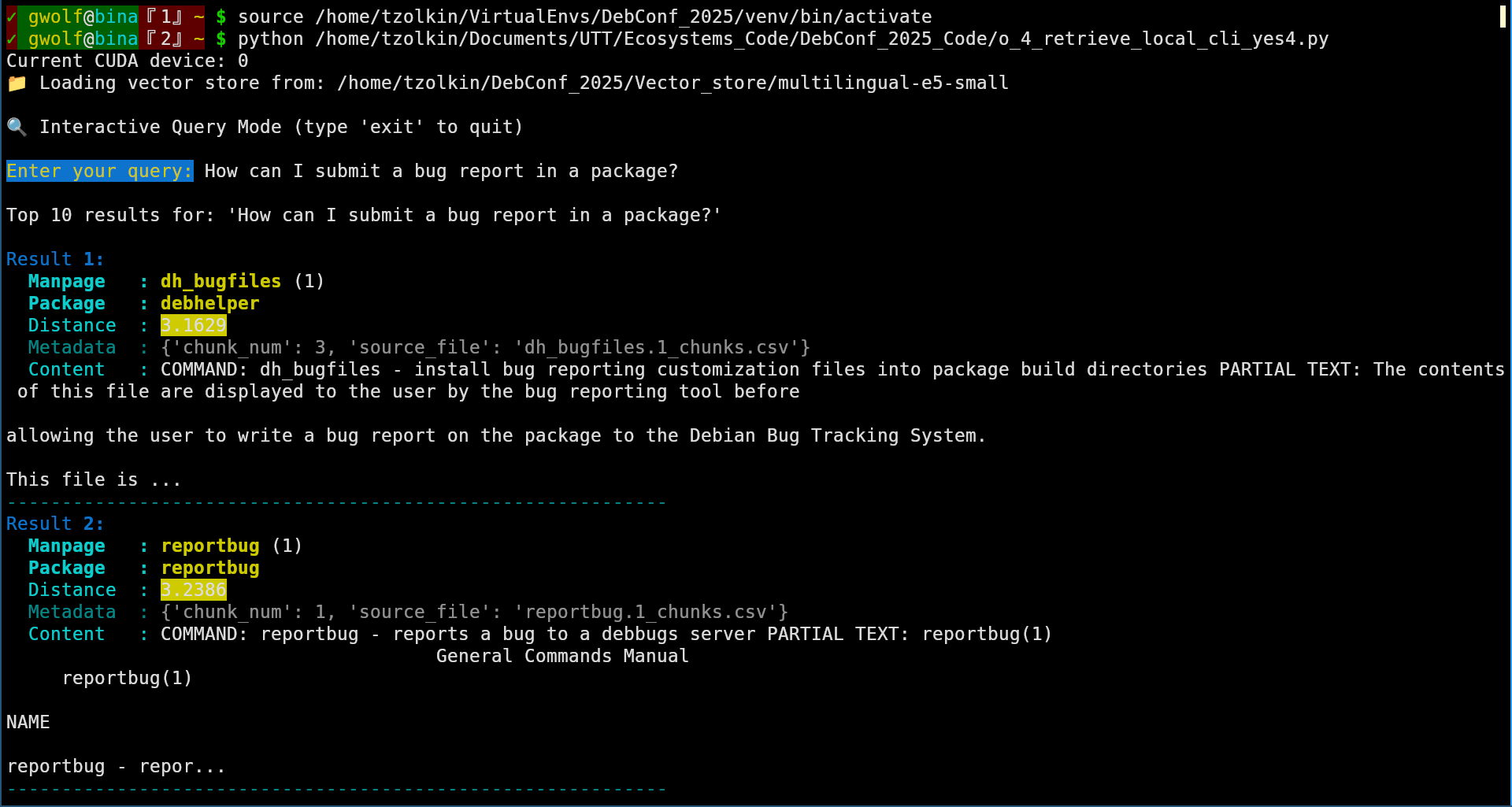
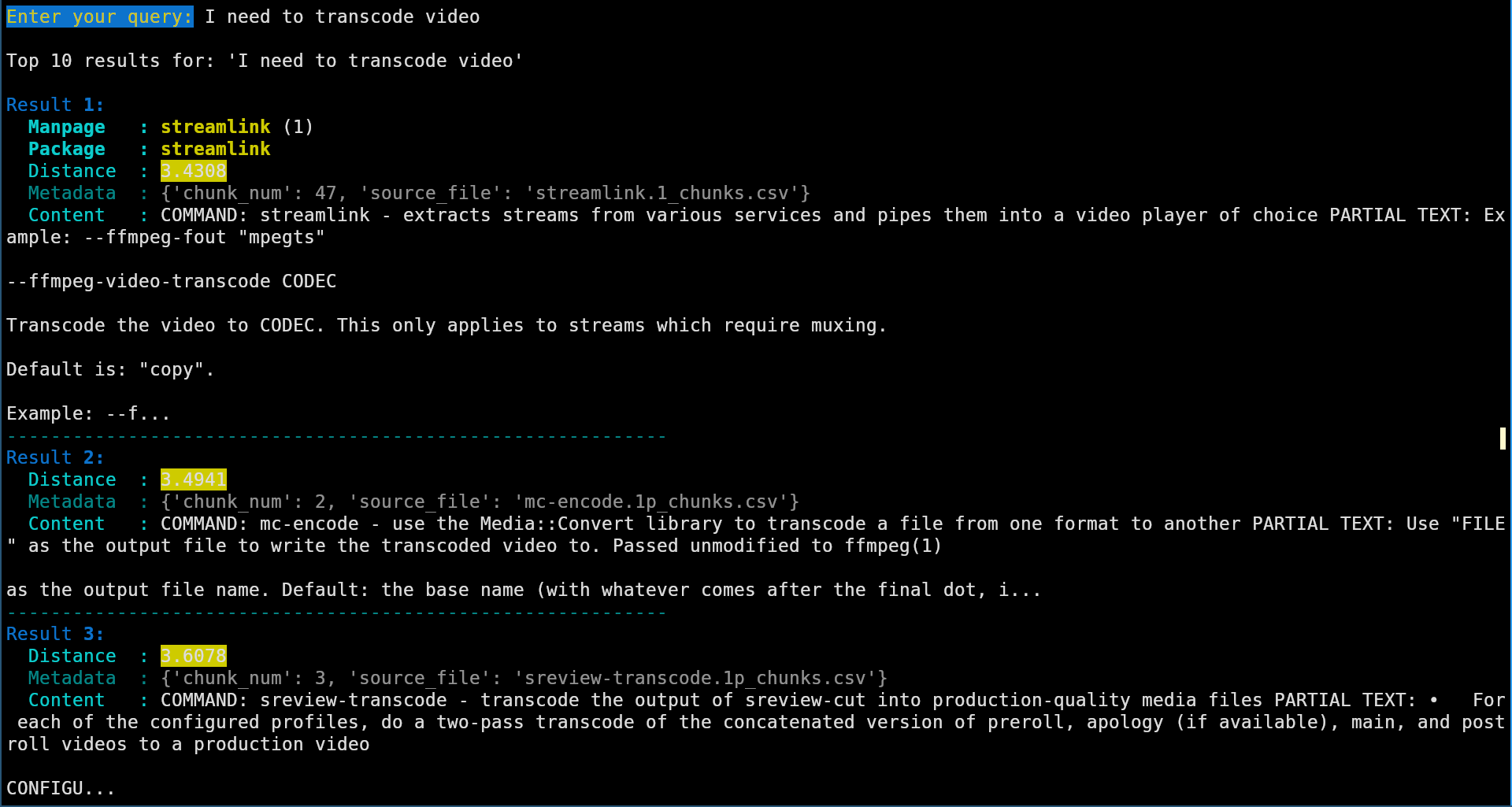
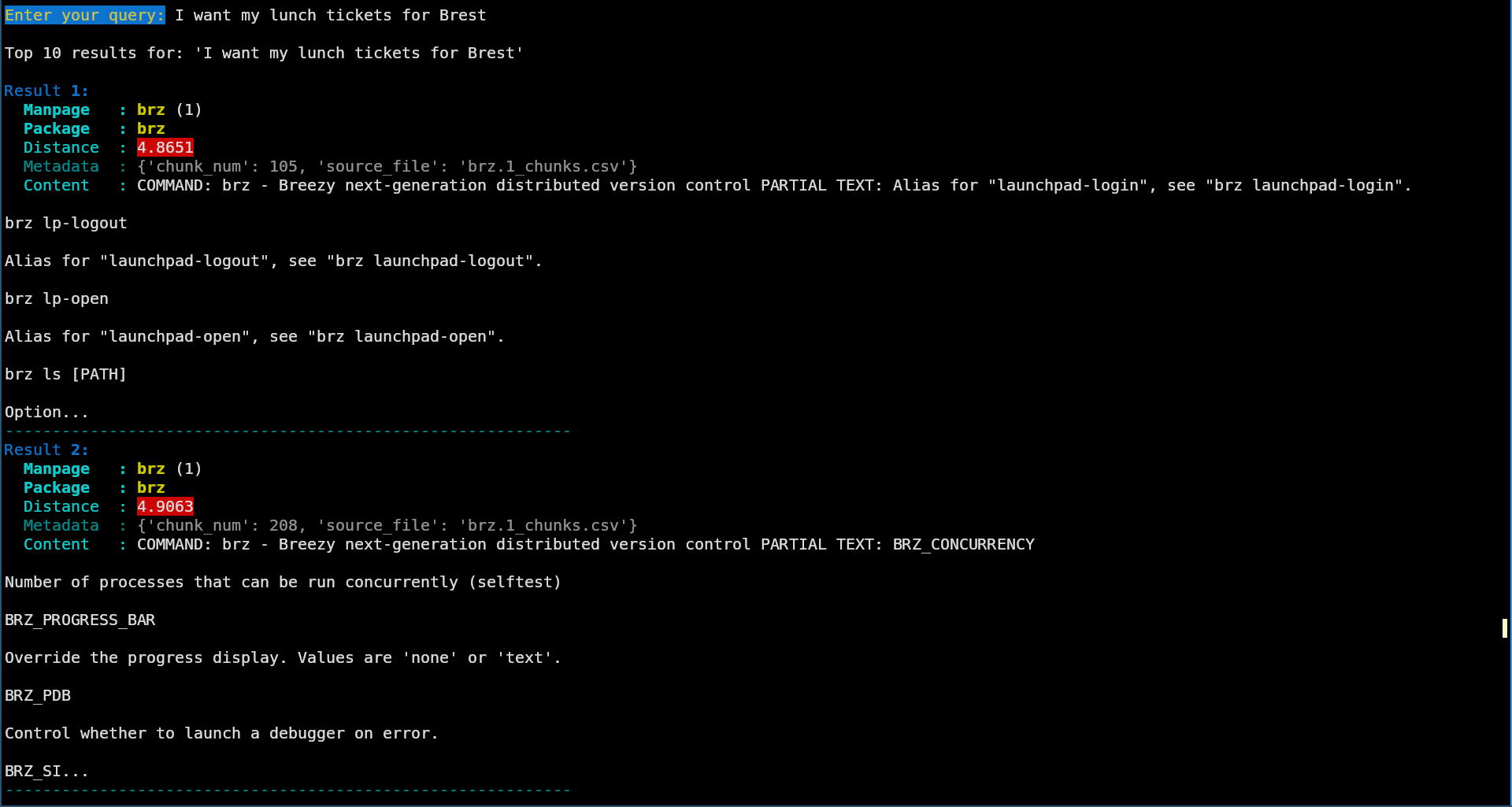
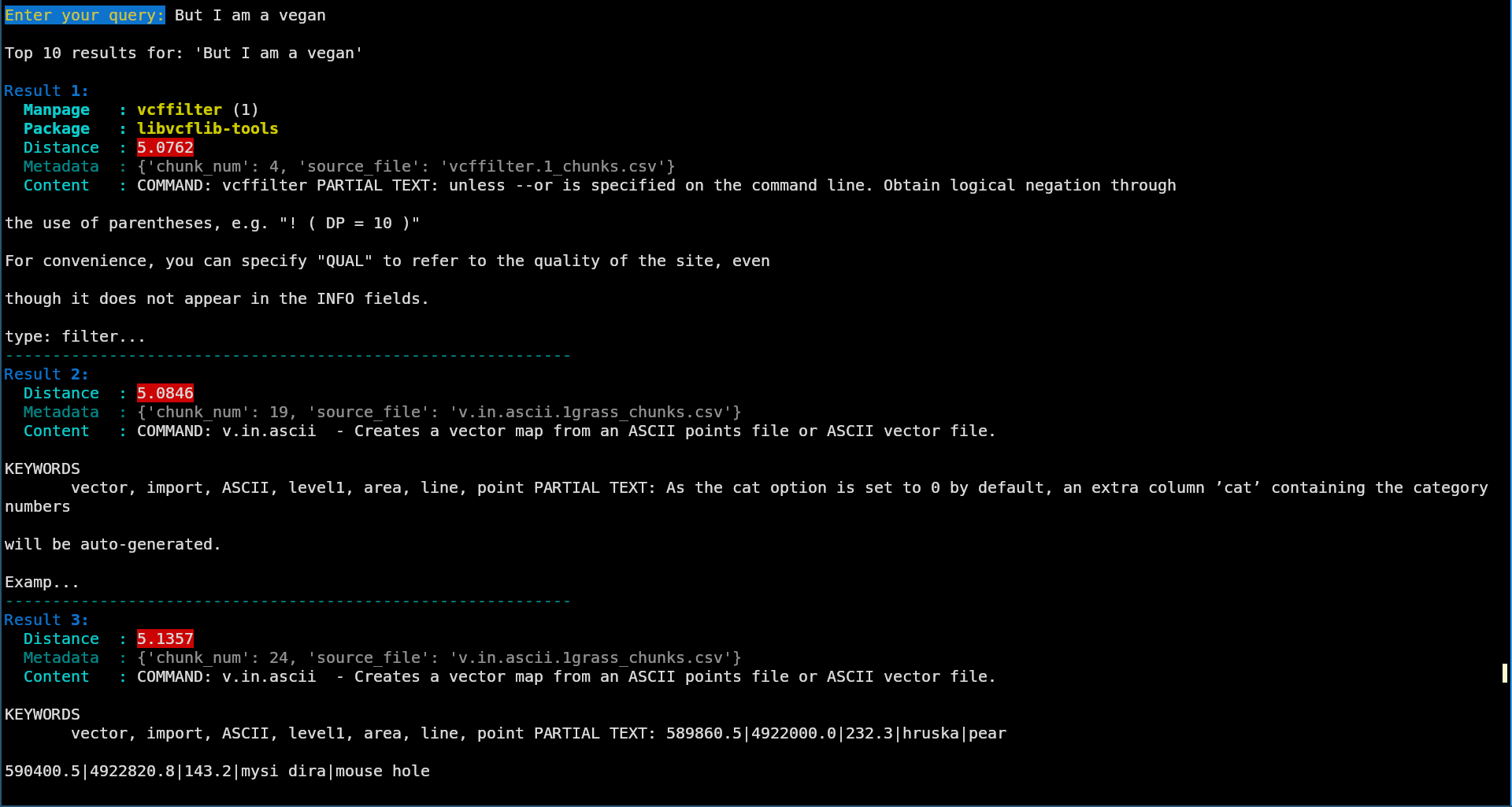
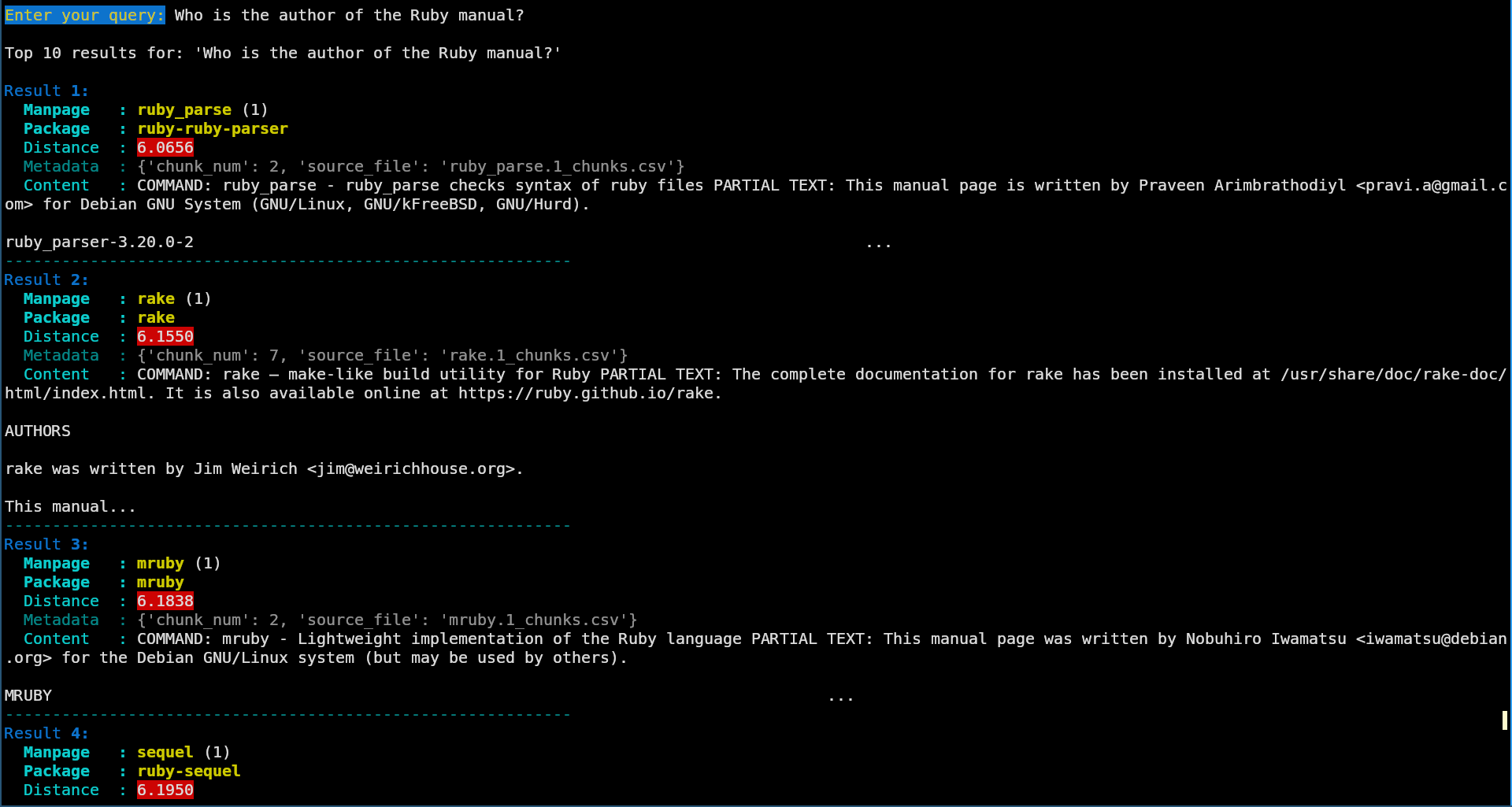
So, for the first year, this year s DebConf had the DebConf Academic Track , that is, content for a one-day-long set of short sessions, for which of them there was a written article presenting the content often with a very academic format, but not necessarily. I hope that for future DebConfs we will continue to hold this track, and that we can help bridge the gap: to get people that are not usually from the academic / universitary prepare content that will be formally expressed and included in a long-lasting, indexed book of proceedings. We did have (informal) proceedings in many of the early DebConfs, and I m very happy to regain that, but with 20 years of better practices. Anyway, of course, I took the opportunity to join this experiment, and together with my Mexican colleague Tzolkin Gardu o who is finishing her PhD here in France (or should I say, second to her, as she is the true leading author of our work). And here you can see the paper we submitted to the DebConf Academic Track, which will be published soon: A retrieval-augmented-generation pipeline to help users query system-provided documentation The corresponding source code is all available at Tzolkin s repository in GitHub. So, what is it about, in shorter words and layman terms? Debian has lots of documentation, but lacks in discoverability. We targetted our venerable manpages: It is well known that manpages are relevant, well-organized documentation describing how to use each of the binaries we ship in Debian. Eric Raymond wrote in his well-known essay The Art of Unix Programming (2003) that the Unix cultural style is telegraphic but complete. It does not hold you by the hand, but it usualy points in the right direction. Our original intent was to digest all of the information in our manpages, but we narrowed it to only the first section of the manual due to the limitations of the hardware a good friend lent us to play with LLMs. We took four different base, redistributable (although, yes, non-DFSG-free) Large Language Models downloaded from HuggingFace (T5-small, MiniLM-L6-v2, BGE-small-en and Multilingual-e5-small), and trained them with the 34579 pages found inside /usr/share/man/man1 of all of the existing Debian packages. We did some interesting fine-tuning (for further details, please refer to the paper itself or to our GitHub repository. The idea is to present an interactive tool that udnerstand natural language queries, and answers with the specific manpage to which they better relate (I d like to say they answer best , but Tzolkin has repeatedly tried to correct my understanding of the resulting vectorial distances). I had prepared some images to present as interaction examples, but I ll wrap up this post with something even better So, this is what you would get with the following queries: We were happy to present like this. During DebCamp, however, I was able to devote some time to translating my client into a Web-accessible system. Do note that it s a bit brittle, and might break now and then. But you are welcome to play with it! Play with the Web interface for our RAG for Debian manuals! I find it worth sharing that, while we used quite a bit of GPU for the training (not too much a couple of nights on an old-although-powerful nVidia 1070 card lent to us by the Felipe Esquivel Fund for Science and Cultural Support), all querying takes place in the CPU, and I usually get between 0.1 and 0.3 seconds per query. My server s architecture is far from rock-solid, and it can break now and then but at least it should respawn upon failure And it should at least be available there for a couple of weeks into August. Anyway, this has been a very interesting journey getting my toes wet in the waters of LLM, and while current results are a bit crude, I think this can be made into an interesting tool for Debian exploration.

Otto Kek l inen: Debcraft Easiest way to modify and build Debian packages

Featured image of post Debcraft   Easiest way to modify and build Debian packagesDebian packaging is notoriously hard. Far too many new contributors give up while trying, and many long-time contributors leave due to burnout from having to do too many thankless maintenance tasks. Some just skip testing their changes properly because it feels like too much toil. Debcraft is my attempt to solve this by automating all the boring stuff, and making it easier to learn the correct practices and helping new and old packagers better track changes in both source code and build artifacts.

The challenge of declarative packaging code Unlike how rpm or apk packages are done, the deb package sources by design avoid having one massive procedural packaging recipe. Instead, the packaging is defined in multiple declarative files in the debian/ subdirectory. For example, instead of a script running install -m 755 bin/btop /usr/bin/btop there is a file debian/btop.install containing the line usr/bin/btop. This makes the overall system more robust and reliable, and allows, for example, extensive static analysis to find problems without having to build the package. The notable exception is the debian/rules file, which contains procedural code that can modify any aspect of the package build. Almost all other files are declarative. Benefits include, among others, that the effect of a Debian-wide policy change can be relatively easily predicted by scanning what attributes and configurations all packages have declared. The drawback is that to understand the syntax and meaning of each file, one must understand which build tools read which files and traverse potentially multiple layers of abstraction. In my view, this is the root cause for most of the perceived complexity.

Common complaints about .deb packaging Related to the above, people learning Debian packaging frequently voice the following complaints:
  • Debian has too many tools to learn, often with overlapping or duplicate functionality.
  • Too much outdated and inconsistent documentation that makes learning the numerous tools needlessly hard.
  • Lack of documentation of the generally agreed best practices, mainly due to Debian s reluctance as a project to pick one tool and deprecate the alternatives.
  • Multiple layers of abstraction and lack of clarity on what any single change in the debian/ subdirectory leads to in the final package.
  • Requirement of Debian packages to be developed on a Debian system.

How Debcraft solves (some of) this Debcraft is intentionally opinionated for the sake of simplicity, and makes heavy use of git, git-buildpackage, and most importantly Linux containers, supporting both Docker and Podman. By using containers, Debcraft frees the user from the requirement of having to run Debian. This makes .deb packaging more accessible to developers running some other Linux distro or even Mac or Windows (with WSL). Of course we want developers to run Debian (or a derivative like Ubuntu) but we want them even more to build, test and ship their software as .deb. Even for Debian/Ubuntu users having everything done inside clean hermetic containers of the latest target distribution version will yield more robust, secure and reproducible builds and tests. All containers are built automatically on-the-fly using best practices for layer caching, making everything easy and fast. Debcraft has simple commands to make it easy to build, rebuild, test and update packages. The most fundamental command is debcraft build, which will not only build the package but also fetch the sources if not already present, and with flags such as --distribution or --source-only build for any requested Debian or Ubuntu release, or generate source packages only for Debian or PPA upload purposes. For ease of use, the output is colored and includes helpful explanations on what is being done, and suggests relevant Debian documentation for more information. Most importantly, the build artifacts, along with various logs, are stored in separate directories, making it easy to compare before and after to see what changed as a result of the code or dependency updates (utilizing diffoscope among others). While the above helps to debug successful builds, there is also the debcraft shell command to make debugging failed builds significantly easier by dropping into a shell where one can run various dh commands one-by-one. Once the build works, testing autopkgtests is as easy as running debcraft test. As with all other commands, Debcraft is smart enough to read information like the target distribution from the debian/changelog entry. When the package is ready to be released, there is the debcraft release command that will create the Debian source package in the correct format and facilitate uploading it either to your Personal Package Archive (PPA) or if you are a Debian Developer to the official Debian archive.

Automatically improve and update packages Additionally, the command debcraft improve will try to fix all issues that are possible to address automatically. It utilizes, among others, lintian-brush, codespell and debputy. This makes repetitive Debian maintenance tasks easier, such as updating the package to follow the latest Debian policies. To update the package to the latest upstream version there is also debcraft update. It will read the package configuration files such as debian/gbp.conf and debian/watch and attempts to import the latest upstream version, refresh patches, build and run autopkgtests. If everything passes, the new version is committed. This helps automate the process of updating to new upstream versions.

Try out Debcraft now! On a recent version of Debian and Ubuntu, Debcraft can be installed simply by running apt install debcraft. To use Debcraft on some other distribution or to get the latest features available in the development version install it using:
git clone https://salsa.debian.org/debian/debcraft.git
cd debcraft
make install-local
To see exact usage instructions run debcraft --help.

Contributions welcome Current Debcraft version 0.5 still has some rough edges and missing features, but I have personally been using it for over a year to maintain all my packages in Debian. If you come across some issue, feel free to file a report at https://salsa.debian.org/debian/debcraft/-/issues or submit an improvement at https://salsa.debian.org/debian/debcraft/-/merge_requests. The code is intentionally written entirely in shell script to keep the barrier to code contribution as low as possible.
By the way, if you aspire to become a Debian Developer, and want to follow my examples in using state-of-the-art tooling and collaborate using salsa.debian.org, feel free to reach out for mentorship. I am glad to see more people contribute to Debian!

Arnaud Rebillout: Acquire-By-Hash for APT packages repositories, and the lack of it in Kali Linux

This is a lenghty blog post. It features a long introduction that explains how apt update acquires various files from a package repository, what is Acquire-By-Hash, and how it all works for Kali Linux: a Debian-based distro that doesn't support Acquire-By-Hash, and which is distributed via a network of mirrors and a redirector. In a second part, I explore some "Hash Sum Mismatch" errors that we can hit with Kali Linux, errors that would not happen if only Acquire-By-Hash was supported. If anything, this blog post supports the case for adding Acquire-By-Hash support in reprepro, as requested at https://bugs.debian.org/820660. All of this could have just remained some personal notes for myself, but I got carried away and turned it into a blog post, dunno why... Hopefully others will find it interesting, but you really need to like troubleshooting stories, packed with details, and poorly written at that. You've been warned! Introducing Acquire-By-Hash Acquire-By-Hash is a feature of APT package repositories, that might or might not be supported by your favorite Debian-based distribution. A repository that supports it says so, in the Release file, by setting the field Acquire-By-Hash: yes. It's easy to check. Debian and Ubuntu both support it:
$ wget -qO- http://deb.debian.org/debian/dists/sid/Release   grep -i ^Acquire-By-Hash:
Acquire-By-Hash: yes
$ wget -qO- http://archive.ubuntu.com/ubuntu/dists/devel/Release   grep -i ^Acquire-By-Hash:
Acquire-By-Hash: yes
What about other Debian derivatives?
$ wget -qO- http://http.kali.org/kali/dists/kali-rolling/Release   grep -i ^Acquire-By-Hash:   echo not supported
not supported
$ wget -qO- https://archive.raspberrypi.com/debian/dists/trixie/Release   grep -i ^Acquire-By-Hash:   echo not supported
not supported
$ wget -qO- http://packages.linuxmint.com/dists/faye/Release   grep -i ^Acquire-By-Hash:   echo not supported
not supported
$ wget -qO- https://apt.pop-os.org/release/dists/noble/Release   grep -i ^Acquire-By-Hash:   echo not supported
not supported
Huhu, Acquire-By-Hash is not ubiquitous. But wait, what is Acquire-By-Hash to start with? To answer that, we have to take a step back and cover some basics first. The HTTP requests performed by 'apt update' What happens when one runs apt update? APT first requests the Release file from the repository(ies) configured in the APT sources. This file is a starting point, it contains a list of other files (sometimes called "Index files") that are available in the repository, along with their hashes. After fetching the Release file, APT proceeds to request those Index files. To give you an idea, there are many kinds of Index files, among which: There's an excellent Wiki page that details the structure of a Debian package repository, it's there: https://wiki.debian.org/DebianRepository/Format. Note that APT doesn't necessarily download ALL of those Index files. For simplicity, we'll limit ourselves to the minimal scenario, where apt update downloads only the Packages files. Let's try to make it more visual: here's a representation of a apt update transaction, assuming that all the components of the repository are enabled:
apt update -> Release -> Packages (main/amd64)
                      -> Packages (contrib/amd64)
                      -> Packages (non-free/amd64)
                      -> Packages (non-free-firmware/amd64)
Meaning that, in a first step, APT downloads the Release file, reads its content, and then in a second step it downloads the Index files in parallel. You can actually see that happen with a command such as apt -q -o Debug::Acquire::http=true update 2>&1 grep ^GET. For Kali Linux you'll see something pretty similar to what I described above. Try it!
$ podman run --rm kali-rolling apt -q -o Debug::Acquire::http=true update 2>&1   grep ^GET
GET /kali/dists/kali-rolling/InRelease HTTP/1.1    # <- returns a redirect, that is why the file is requested twice
GET /kali/dists/kali-rolling/InRelease HTTP/1.1
GET /kali/dists/kali-rolling/non-free/binary-amd64/Packages.gz HTTP/1.1
GET /kali/dists/kali-rolling/main/binary-amd64/Packages.gz HTTP/1.1
GET /kali/dists/kali-rolling/non-free-firmware/binary-amd64/Packages.gz HTTP/1.1
GET /kali/dists/kali-rolling/contrib/binary-amd64/Packages.gz HTTP/1.1
However, and it's now becoming interesting, for Debian or Ubuntu you won't see the same kind of URLs:
$ podman run --rm debian:sid apt -q -o Debug::Acquire::http=true update 2>&1   grep ^GET
GET /debian/dists/sid/InRelease HTTP/1.1
GET /debian/dists/sid/main/binary-amd64/by-hash/SHA256/22709f0ce67e5e0a33a6e6e64d96a83805903a3376e042c83d64886bb555a9c3 HTTP/1.1
APT doesn't download a file named Packages, instead it fetches a file named after a hash. Why? This is due to the field Acquire-By-Hash: yes that is present in the Debian's Release file. What does Acquire-By-Hash mean for 'apt update' The idea with Acquire-By-Hash is that the Index files are named after their hash on the repository, so if the MD5 sum of main/binary-amd64/Packages is 77b2c1539f816832e2d762adb20a2bb1, then the file will be stored at main/binary-amd64/by-hash/MD5Sum/77b2c1539f816832e2d762adb20a2bb1. The path main/binary-amd64/Packages still exists (it's the "Canonical Location" of this particular Index file), but APT won't use it, instead it downloads the file located in the by-hash/ directory. Why does it matter? This has to do with repository updates, and allowing the package repository to be updated atomically, without interruption of service, and without risk of failure client-side. It's important to understand that the Release file and the Index files are part of a whole, a set of files that go altogether, given that Index files are validated by their hash (as listed in the Release file) after download by APT. If those files are simply named "Release" and "Packages", it means they are not immutable: when the repository is updated, all of those files are updated "in place". And it causes problems. A typical failure mode for the client, during a repository update, is that: 1) APT requests the Release file, then 2) the repository is updated and finally 3) APT requests the Packages files, but their checksum don't match, causing apt update to fail. There are variations of this error, but you get the idea: updating a set of files "in place" is problematic. The Acquire-By-Hash mechanism was introduced exactly to solve this problem: now the Index files have a unique, immutable name. When the repository is updated, at first new Index files are added in the by-hash/ directory, and only after the Release file is updated. Old Index files in by-hash/ are retained for a while, so there's a grace period during which both the old and the new Release files are valid and working: the Index files that they refer to are available in the repo. As a result: no interruption of service, no failure client-side during repository updates. This is explained in more details at https://www.chiark.greenend.org.uk/~cjwatson/blog/no-more-hash-sum-mismatch-errors.html, which is the blog post from Colin Watson that came out at the time Acquire-By-Hash was introduced in... 2016. This is still an excellent read in 2025. So you might be wondering why I'm rambling about a problem that's been solved 10 years ago, but then as I've shown in the introduction, the problem is not solved for everyone. Support for Acquire-By-Hash server side is not for granted, and unfortunately it never landed in reprepro, as one can see at https://bugs.debian.org/820660. reprepro is a popular tool for creating APT package repositories. In particular, at Kali Linux we use reprepro, and that's why there's no Acquire-By-Hash: yes in the Kali Release file. As one can guess, it leads to subtle issues during those moments when the repository is updated. However... we're not ready to talk about that yet! There's still another topic that we need to cover: this window of time during which a repository is being updated, and during which apt update might fail. The window for Hash Sum Mismatches, and the APT trick that saves the day Pay attention! In this section, we're now talking about packages repositories that do NOT support Acquire-By-Hash, such as the Kali Linux repository. As I've said above, it's only when the repository is being updated that there is a "Hash Sum Mismatch Window", ie. a moment when apt update might fail for some unlucky clients, due to invalid Index files. Surely, it's a very very short window of time, right? I mean, it can't take that long to update files on a server, especially when you know that a repository is usually updated via rsync, and rsync goes to great length to update files the most atomically as it can (with the option --delay=updates). So if apt update fails for me, I've been very unlucky, but I can just retry in a few seconds and it should be fixed, isn't it? The answer is: it's not that simple. So far I pictured the "package repository" as a single server, for simplicity. But it's not always what it is. For Kali Linux, by default users have http.kali.org configured in their APT sources, and it is a redirector, ie. a web server that redirects requests to mirrors that are nearby the client. Some context that matters for what comes next: the Kali repository is synced with ~70 mirrors all around the world, 4 times a day. What happens if your apt update requests are redirected to 2 mirrors close-by, and one was just synced, while the other is still syncing (or even worse, failed to sync entirely)? You'll get a mix of old and new Index files. Hash Sum Mismatch! As you can see, with this setup the "Hash Sum Mismatch Window" becomes much longer than a few seconds: as long as nearby mirrors are syncing the window is opened. You could have a fast and a slow mirror next to you, and they can be out of sync with each other for several minutes every time the repository is updated, for example. For Kali Linux in particular, there's a "detail" in our network of mirrors that, as a side-effect, almost guarantees that this window lasts several minutes at least. This is because the pool of mirrors includes kali.download which is in fact the Cloudflare CDN, and from the redirector point of view, it's seen as a "super mirror" that is present in every country. So when APT fires a bunch of requests against http.kali.org, it's likely that some of them will be redirected to the Kali CDN, and others will be redirected to a mirror nearby you. So far so good, but there's another point of detail to be aware of: the Kali CDN is synced first, before the other mirrors. Another thing: usually the mirrors that are the farthest from the Tier-0 mirror are the longest to sync. Packing all of that together: if you live somewhere in Asia, it's not uncommon for your "Hash Sum Mismatch Window" to be as long as 30 minutes, between the moment the Kali CDN is synced, and the moment your nearby mirrors catch up and are finally in sync as well. Having said all of that, and assuming you're still reading (anyone here?), you might be wondering... Does that mean that apt update is broken 4 times a day, for around 30 minutes, for every Kali user out there? How can they bear with that? Answer is: no, of course not, it's not broken like that. It works despite all of that, and this is thanks to yet another detail that we didn't go into yet. This detail lies in APT itself. APT is in fact "redirector aware", in a sense. When it fetches a Release file, and if ever the request is redirected, it then fires the subsequent requests against the server where it was initially redirected. So you are guaranteed that the Release file and the Index files are retrieved from the same mirror! Which brings back our "Hash Sum Mismatch Window" to the window for a single server, ie. something like a few seconds at worst, hopefully. And that's what makes it work for Kali, literally. Without this trick, everything would fall apart. For reference, this feature was implemented in APT back in... 2016! A busy year it seems! Here's the link to the commit: use the same redirection mirror for all index files. To finish, a dump from the console. You can see this behaviour play out easily, again with APT debugging turned on. Below we can see that only the first request hits the Kali redirector:
$ podman run --rm kali-rolling apt -q -o Debug::Acquire::http=true update 2>&1   grep -e ^Answer -e ^HTTP
Answer for: http://http.kali.org/kali/dists/kali-rolling/InRelease
HTTP/1.1 302 Found
Answer for: http://mirror.freedif.org/kali/dists/kali-rolling/InRelease
HTTP/1.1 200 OK
Answer for: http://mirror.freedif.org/kali/dists/kali-rolling/non-free-firmware/binary-amd64/Packages.gz
HTTP/1.1 200 OK
Answer for: http://mirror.freedif.org/kali/dists/kali-rolling/contrib/binary-amd64/Packages.gz
HTTP/1.1 200 OK
Answer for: http://mirror.freedif.org/kali/dists/kali-rolling/main/binary-amd64/Packages.gz
HTTP/1.1 200 OK
Answer for: http://mirror.freedif.org/kali/dists/kali-rolling/non-free/binary-amd64/Packages.gz
HTTP/1.1 200 OK
Interlude Believe it or not, we're done with the introduction! At this point, we have a good understanding of what apt update does (in terms of HTTP requests), we know that Release files and Index files are part of a whole, and we know that a repository can be updated atomically thanks to the Acquire-By-Hash feature, so that users don't experience interruption of service or failures of any sort, even with a rolling repository that is updated several times a day, like Debian sid. We've also learnt that, despite the fact that Acquire-By-Hash landed almost 10 years ago, some distributions like Kali Linux are still doing without it... and yet it works! But the reason why it works is more complicated to grasp, especially when you add a network of mirrors and a redirector to the picture. Moreover, it doesn't work as flawlessly as with the Acquire-By-Hash feature: we still expect some short (seconds at worst) "Hash Sum Mismatch Windows" for those unlucky users that run apt update at the wrong moment. This was a long intro, but that really sets the stage for what comes next: the edge cases. Some situations in which we can hit some Hash Sum Mismatch errors with Kali. Error cases that I've collected and investigated over the time... If anything, it supports the case that Acquire-By-Hash is really something that should be implemented in reprepro. More on that in the conclusion, but for now, let's look at those edge cases. Edge Case 1: the caching proxy If you put a caching proxy (such as approx, my APT caching proxy of choice) between yourself and the actual packages repository, then obviously it's the caching proxy that performs the HTTP requests, and therefore APT will never know about the redirections returned by the server, if any. So the APT trick of downloading all the Index files from the same server in case of redirect doesn't work anymore. It was rather easy to confirm that by building a Kali package during a mirror sync, and watch if fail at the "Update chroot" step:
$ sudo rm /var/cache/approx/kali/dists/ -fr
$ gbp buildpackage --git-builder=sbuild
+------------------------------------------------------------------------------+
  Update chroot                                Wed, 11 Jun 2025 10:33:32 +0000  
+------------------------------------------------------------------------------+
Get:1 http://http.kali.org/kali kali-dev InRelease [41.4 kB]
Get:2 http://http.kali.org/kali kali-dev/contrib Sources [81.6 kB]
Get:3 http://http.kali.org/kali kali-dev/main Sources [17.3 MB]
Get:4 http://http.kali.org/kali kali-dev/non-free Sources [122 kB]
Get:5 http://http.kali.org/kali kali-dev/non-free-firmware Sources [8297 B]
Get:6 http://http.kali.org/kali kali-dev/non-free amd64 Packages [197 kB]
Get:7 http://http.kali.org/kali kali-dev/non-free-firmware amd64 Packages [10.6 kB]
Get:8 http://http.kali.org/kali kali-dev/contrib amd64 Packages [120 kB]
Get:9 http://http.kali.org/kali kali-dev/main amd64 Packages [21.0 MB]
Err:9 http://http.kali.org/kali kali-dev/main amd64 Packages
  File has unexpected size (20984689 != 20984861). Mirror sync in progress? [IP: ::1 9999]
  Hashes of expected file:
   - Filesize:20984861 [weak]
   - SHA256:6cbbee5838849ffb24a800bdcd1477e2f4adf5838a844f3838b8b66b7493879e
   - SHA1:a5c7e557a506013bd0cf938ab575fc084ed57dba [weak]
   - MD5Sum:1433ce57419414ffb348fca14ca1b00f [weak]
  Release file created at: Wed, 11 Jun 2025 07:15:10 +0000
Fetched 17.9 MB in 9s (1893 kB/s)
Reading package lists...
E: Failed to fetch http://http.kali.org/kali/dists/kali-dev/main/binary-amd64/Packages.gz  File has unexpected size (20984689 != 20984861). Mirror sync in progress? [IP: ::1 9999]
   Hashes of expected file:
    - Filesize:20984861 [weak]
    - SHA256:6cbbee5838849ffb24a800bdcd1477e2f4adf5838a844f3838b8b66b7493879e
    - SHA1:a5c7e557a506013bd0cf938ab575fc084ed57dba [weak]
    - MD5Sum:1433ce57419414ffb348fca14ca1b00f [weak]
   Release file created at: Wed, 11 Jun 2025 07:15:10 +0000
E: Some index files failed to download. They have been ignored, or old ones used instead.
E: apt-get update failed
The obvious workaround is to NOT use the redirector in the approx configuration. Either use a mirror close by, or the Kali CDN:
$ grep kali /etc/approx/approx.conf 
#kali http://http.kali.org/kali <- do not use the redirector!
kali  http://kali.download/kali
Edge Case 2: debootstrap struggles What if one tries to debootstrap Kali while mirrors are being synced? It can give you some ugly logs, but it might not be fatal:
$ sudo debootstrap kali-dev kali-dev http://http.kali.org/kali
[...]
I: Target architecture can be executed
I: Retrieving InRelease 
I: Checking Release signature
I: Valid Release signature (key id 827C8569F2518CC677FECA1AED65462EC8D5E4C5)
I: Retrieving Packages 
I: Validating Packages 
W: Retrying failed download of http://http.kali.org/kali/dists/kali-dev/main/binary-amd64/Packages.gz
I: Retrieving Packages 
I: Validating Packages 
W: Retrying failed download of http://http.kali.org/kali/dists/kali-dev/main/binary-amd64/Packages.gz
I: Retrieving Packages 
I: Validating Packages 
W: Retrying failed download of http://http.kali.org/kali/dists/kali-dev/main/binary-amd64/Packages.gz
I: Retrieving Packages 
I: Validating Packages 
W: Retrying failed download of http://http.kali.org/kali/dists/kali-dev/main/binary-amd64/Packages.gz
I: Retrieving Packages 
I: Validating Packages 
I: Resolving dependencies of required packages...
I: Resolving dependencies of base packages...
I: Checking component main on http://http.kali.org/kali...
I: Retrieving adduser 3.152
[...]
To understand this one, we have to go and look at the debootstrap source code. How does debootstrap fetch the Release file and the Index files? It uses wget, and it retries up to 10 times in case of failure. It's not as sophisticated as APT: it doesn't detect when the Release file is served via a redirect. As a consequence, what happens above can be explained as such:
  1. debootstrap requests the Release file, gets redirected to a mirror, and retrieves it from there
  2. then it requests the Packages file, gets redirected to another mirror that is not in sync with the first one, and retrieves it from there
  3. validation fails, since the checksum is not as expected
  4. try again and again
Since debootstrap retries up to 10 times, at some point it's lucky enough to get redirected to the same mirror as the one from where it got its Release file from, and this time it gets the right Packages file, with the expected checksum. So ultimately it succeeds. Edge Case 3: post-debootstrap failure I like this one, because it gets us to yet another detail that we didn't talk about yet. So, what happens after we successfully debootstraped Kali? We have only the main component enabled, and only the Index file for this component have been retrieved. It looks like that:
$ sudo debootstrap kali-dev kali-dev http://http.kali.org/kali
[...]
I: Base system installed successfully.
$ cat kali-dev/etc/apt/sources.list
deb http://http.kali.org/kali kali-dev main
$ ls -l kali-dev/var/lib/apt/lists/
total 80468
-rw-r--r-- 1 root root    41445 Jun 19 07:02 http.kali.org_kali_dists_kali-dev_InRelease
-rw-r--r-- 1 root root 82299122 Jun 19 07:01 http.kali.org_kali_dists_kali-dev_main_binary-amd64_Packages
-rw-r--r-- 1 root root    40562 Jun 19 11:54 http.kali.org_kali_dists_kali-dev_Release
-rw-r--r-- 1 root root      833 Jun 19 11:54 http.kali.org_kali_dists_kali-dev_Release.gpg
drwxr-xr-x 2 root root     4096 Jun 19 11:54 partial
So far so good. Next step would be to complete the sources.list with other components, then run apt update: APT will download the missing Index files. But if you're unlucky, that might fail:
$ sudo sed -i 's/main$/main contrib non-free non-free-firmware/' kali-dev/etc/apt/sources.list
$ cat kali-dev/etc/apt/sources.list
deb http://http.kali.org/kali kali-dev main contrib non-free non-free-firmware
$ sudo chroot kali-dev apt update
Hit:1 http://http.kali.org/kali kali-dev InRelease
Get:2 http://kali.download/kali kali-dev/contrib amd64 Packages [121 kB]
Get:4 http://mirror.sg.gs/kali kali-dev/non-free-firmware amd64 Packages [10.6 kB]
Get:3 http://mirror.freedif.org/kali kali-dev/non-free amd64 Packages [198 kB]
Err:3 http://mirror.freedif.org/kali kali-dev/non-free amd64 Packages
  File has unexpected size (10442 != 10584). Mirror sync in progress? [IP: 66.96.199.63 80]
  Hashes of expected file:
   - Filesize:10584 [weak]
   - SHA256:71a83d895f3488d8ebf63ccd3216923a7196f06f088461f8770cee3645376abb
   - SHA1:c4ff126b151f5150d6a8464bc6ed3c768627a197 [weak]
   - MD5Sum:a49f46a85febb275346c51ba0aa8c110 [weak]
  Release file created at: Fri, 23 May 2025 06:48:41 +0000
Fetched 336 kB in 4s (77.5 kB/s)  
Reading package lists... Done
E: Failed to fetch http://mirror.freedif.org/kali/dists/kali-dev/non-free/binary-amd64/Packages.gz  File has unexpected size (10442 != 10584). Mirror sync in progress? [IP: 66.96.199.63 80]
   Hashes of expected file:
    - Filesize:10584 [weak]
    - SHA256:71a83d895f3488d8ebf63ccd3216923a7196f06f088461f8770cee3645376abb
    - SHA1:c4ff126b151f5150d6a8464bc6ed3c768627a197 [weak]
    - MD5Sum:a49f46a85febb275346c51ba0aa8c110 [weak]
   Release file created at: Fri, 23 May 2025 06:48:41 +0000
E: Some index files failed to download. They have been ignored, or old ones used instead.
What happened here? Again, we need APT debugging options to have a hint:
$ sudo chroot kali-dev apt -q -o Debug::Acquire::http=true update 2>&1   grep -e ^Answer -e ^HTTP
Answer for: http://http.kali.org/kali/dists/kali-dev/InRelease
HTTP/1.1 304 Not Modified
Answer for: http://http.kali.org/kali/dists/kali-dev/contrib/binary-amd64/Packages.gz
HTTP/1.1 302 Found
Answer for: http://http.kali.org/kali/dists/kali-dev/non-free/binary-amd64/Packages.gz
HTTP/1.1 302 Found
Answer for: http://http.kali.org/kali/dists/kali-dev/non-free-firmware/binary-amd64/Packages.gz
HTTP/1.1 302 Found
Answer for: http://kali.download/kali/dists/kali-dev/contrib/binary-amd64/Packages.gz
HTTP/1.1 200 OK
Answer for: http://mirror.sg.gs/kali/dists/kali-dev/non-free-firmware/binary-amd64/Packages.gz
HTTP/1.1 200 OK
Answer for: http://mirror.freedif.org/kali/dists/kali-dev/non-free/binary-amd64/Packages.gz
HTTP/1.1 200 OK
As we can see above, for the Release file we get a 304 (aka. "Not Modified") from the redirector. Why is that? This is due to If-Modified-Since also known as RFC-7232. APT supports this feature when it retrieves the Release file, it basically says to the server "Give me the Release file, but only if it's newer than what I already have". If the file on the server is not newer than that, it answers with a 304, which basically says to the client "You have the latest version already". So APT doesn't get a new Release file, it uses the Release file that is already present locally in /var/lib/apt/lists/, and then it proceeeds to download the missing Index files. And as we can see above: it then hits the redirector for each requests, and might be redirected to different mirrors for each Index file. So the important bit here is: the APT "trick" of downloading all the Index files from the same mirror only works if the Release file is served via a redirect. If it's not, like in this case, then APT hits the redirector for each files it needs to download, and it's subject to the "Hash Sum Mismatch" error again. In practice, for the casual user running apt update every now and then, it's not an issue. If they have the latest Release file, no extra requests are done, because they also have the latest Index files, from a previous apt update transaction. So APT doesn't re-download those Index files. The only reason why they'd have the latest Release file, and would miss some Index files, would be that they added new components to their APT sources, like we just did above. Not so common, and then they'd need to run apt update at a unlucky moment. I don't think many users are affected in practice. Note that this issue is rather new for Kali Linux. The redirector running on http.kali.org is mirrorbits, and support for If-Modified-Since just landed in the latest release, version 0.6. This feature was added by no one else than me, a great example of the expression "shooting oneself in the foot". An obvious workaround here is to empty /var/lib/apt/lists/ in the chroot after debootstrap completed. Or we could disable support for If-Modified-Since entirely for Kali's instance of mirrorbits. Summary and Conclusion The Hash Sum Mismatch failures above are caused by a combination of things: At the same time: All in all, it seems that all those issues would go away if only Acquire-By-Hash was supported in the Kali packages repository. Now is not a bad moment to try to land this feature in reprepro. After development halted in 2019, there's now a new upstream, and patches are being merged again. But it won't be easy: reprepro is a C codebase of around 50k lines of code, and it will take time and effort for the newcomer to get acquainted with the codebase, to the point of being able to implement a significant feature like this one. As an alternative, aptly is another popular tool to manage APT package repositories. And it seems to support Acquire-By-Hash already. Another alternative: I was told that debusine has (experimental) support for package repositories, and that Acquire-By-Hash is supported as well. Options are on the table, and I hope that Kali will eventually get support for Acquire-By-Hash, one way or another. To finish, due credits: this blog post exists thanks to my employer OffSec. Thanks for reading!

16 July 2025

Sven Hoexter: Google Cloud Oddities Summer 2025 Edition

Latest oddities I ran into with Google Cloud products before I start to forget about them again. e2 Compute Instances vs CloudNAT Years ago I already had a surprising encounter with the Google Cloud e2 instances. Back then we observed CPU steal time from 20-60%, which made the instances unusable for anything remotely latency sensitive. Now someone started to run a workload which creates many outbound connections to the same destination IP:Port. To connect to the internet we utilize the Google Cloud product "CloudNAT" which implements a NAT solution somewhere in the network layer. Starting the workload let after a few seconds to all sort of connection issues, and of course logs from CloudNAT that it dropped connections. The simplest reproducer I could find was while true; do curl http://sven.stormbind.net; done which already let to connection drops on CloudNAT. We starred a bit at output of gcloud compute routers get-nat-mapping-info our-default-natgw, but allocating additional ports still worked fine in general. Further investigation let to two differences between a project which was fine and those that failed:
  1. c2d or n2d machine types instead of e2 and
  2. usage of gVNIC.
Moving away from the e2 instances instantly fixed our issue. Only some connection drops could be observed on CloudNAT if we set the min_ports_per_vm value too low and it could not allocate new ports in time. Thus we did some additional optimizations: See also upstream documentation regarding timeouts. To complete the setup alignment we also enabled gVNIC on all GKE pools. Noteworthy detail a colleague figured out: If you use terraform to provision GKE pools make sure to use at least google provider v6.33.0 to avoid a re-creation of your node pool. GKE LoadBalancer Force allPorts: true on Forwarding Rule Technically it's possible to configure a forwarding rule to listen on some or all ports. That gets more complicated if you do not configure the forwarding rule via terraform or gcloud cli, but use a GKE resource kind: Service with spec.type: LoadBalancer. The logic documented by Google Cloud is that the forwarding rule will have per port configuration if it's five or less, and above that it will open for all ports. Sadly that does not work e.g. in cases where you've an internal load balancer and a serviceAttachment attached to the forwarding rule. In my experience reconfiguring was also unreliable in cases without a serviceAttachment and required a manual deletion of the service load balancer to have the operator reconcile it and create it correctly. Given that we wanted to have all ports open to allow us to dynamically add more ports on a specific load balancer, but there is no annotation for that, I worked around with this beauty:
      ports:
        - name: dummy-0
          port: 2342
          protocol: TCP
          targetPort: 2342
        - name: dummy-1
          port: 2343
          protocol: TCP
          targetPort: 2343
        - name: dummy-2
          port: 2344
          protocol: TCP
          targetPort: 2344
        - name: dummy-3
          port: 2345
          protocol: TCP
          targetPort: 2345
        - name: service-1
          port: 4242
          protocol: TCP
          targetPort: 4242
        - name: service-2
          port: 4343
          protocol: TCP
          targetPort: 4343
If something in that area did not work out there's basically two things to check:
  1. Is the port open on the forwarding rule / is the forwarding rule configured with allPorts: true?
  2. Got the VPC firewall rule created by the service operator in GKE updated to open all required ports?
Rate Limiting with Cloud Armor on Global TCP Proxy Load Balancer According to the Google Cloud support rate limiting on a TCP proxy is a preview feature. That seems to be the excuse why it's all very inconsistent right now, but it works. Terraform Sample Snippet
  rule  
    description = "L3-L4 Rate Limit"
    action      = "rate_based_ban"
    priority    = "2342"
    match  
      versioned_expr = "SRC_IPS_V1"
      config  
        src_ip_ranges = ["*"]
       
     
    rate_limit_options  
      enforce_on_key = "IP"
      # exceed_action only supports deny() with a response code
      exceed_action = "deny(429)"
      rate_limit_threshold  
        count        = 320
        interval_sec = 60
       
      ban_duration_sec = 240
      ban_threshold  
        count        = 320
        interval_sec = 60
       
      conform_action = "allow"
     
   
Config-Connector Sample Snippet
  - action: rate_based_ban
    description: L3-L4 Rate Limit
    match:
      config:
        srcIpRanges:
          - "*"
      versionedExpr: SRC_IPS_V1
    preview: false
    priority: 2342
    rateLimitOptions:
      banDurationSec: 240
      banThreshold:
        count: 320
        intervalSec: 60
      conformAction: allow
      enforceOnKey: IP
      exceedAction: deny
      rateLimitThreshold:
         count: 320
         intervalSec: 60

David Bremner: Hibernate on the pocket reform 7/n

Context

Building upstream-ish kernel
  • Roughly following the "bisecting upstream linux" section of reform-debian-packages/README.md
$ git clone https://gitlab.collabora.com/hardware-enablement/rockchip-3588/linux.git collabora
$ cd collabora && git git switch -c rockchip-devel origin/rockchip-devel
  • The next step is to apply the the non-collabora patches from reform-debian-packages/linux/patches6.15/rk3588-mnt-reform2
  • Unfortunately these are missing the proper metadata to work with git-am

Sidequest: Fix patches
  • 1000-v3-pci_dw_rockchip_add_system_pm_support.patch doesn't apply, even with added metadata. Start again upstream.
  • Thanks to joshc for the suggestion of the b4 tool.
      b4 am 1744940759-23823-1-git-send-email-shawn.lin@rock-chips.com
    
    This creates a .mbx file ready for git am (roughly equivalent to fetching the /raw version from lore, with some extra checks).
  • Brute force finding a base for the patch:
git rev-list --no-merges --since 2025-01-01 refs/heads/rockchip-devel   \
    while read ref
    do
        echo trying $ref
        git checkout $ref
        git apply --check v3_20250418_shawn_lin_pci_dw_rockchip_add_system_pm_support.mbx && echo SUCCESS && break
    done
  • 122 steps later this yields 9dff55ebaef7 (bisect would be better if we knew a "good" commit).
$ git branch -D tmp ; git switch -c tmp 9dff55ebaef7
$ git am v3_20250418_shawn_lin_pci_dw_rockchip_add_system_pm_support.mbx
$ git rebase -i rockchip-devel
This fails with 3 conflicts. The first is easy, as the one non-comment line just moves around. The other two involve a new function rockchip_pcie_unmask_dll_indicator used to reduce code duplication, and in all 3 cases I just took the version of the code from Shawn's patch. EDIT This rebase turns out to miss (at least) changes in the names of the PCI* constants. By amusing(?) coincidence, as I was discovering that, the patch was being rebased by someone more competent at collabora, and is now in the rockchip-devel branch. previous episode next episode

12 July 2025

Reproducible Builds: Reproducible Builds in June 2025

Welcome to the 6th report from the Reproducible Builds project in 2025. Our monthly reports outline what we ve been up to over the past month, and highlight items of news from elsewhere in the increasingly-important area of software supply-chain security. If you are interested in contributing to the Reproducible Builds project, please see the Contribute page on our website. In this report:
  1. Reproducible Builds at FOSSY 2025
  2. Distribution work
  3. diffoscope
  4. OSS Rebuild updates
  5. Website updates
  6. Upstream patches
  7. Reproducibility testing framework

Reproducible Builds at FOSSY 2025 On Saturday 2nd August, Vagrant Cascadian and Chris Lamb will be presenting at this year s FOSSY 2025. Their talk, titled Never Mind the Checkboxes, Here s Reproducible Builds!, is being introduced as follows:
There are numerous policy compliance and regulatory processes being developed that target software development but do they solve actual problems? Does it improve the quality of software? Do Software Bill of Materials (SBOMs) actually give you the information necessary to verify how a given software artifact was built? What is the goal of all these compliance checklists anyways or more importantly, what should the goals be? If a software object is signed, who should be trusted to sign it, and can they be trusted forever?
The talk will introduce the audience to Reproducible Builds as a set of best practices which allow users and developers to verify that software artifacts were built from the source code, but also allows auditing for license compliance, providing security benefits, and removes the need to trust arbitrary software vendors. Hosted by the Software Freedom Conservancy and taking place in Portland, Oregon, USA, FOSSY aims to be a community-focused event: Whether you are a long time contributing member of a free software project, a recent graduate of a coding bootcamp or university, or just have an interest in the possibilities that free and open source software bring, FOSSY will have something for you . More information on the event is available on the FOSSY 2025 website, including the full programme schedule. Vagrant and Chris will also be staffing a table this year, where they will be available to answer any questions about Reproducible Builds and discuss collaborations with other projects.

Distribution work In Debian this month:
  • Holger Levsen has discovered that it is now possible to bootstrap a minimal Debian trixie using 100% reproducible packages. This result can itself be reproduced, using the debian-repro-status tool and mmdebstrap s support for hooks:
      $ mmdebstrap --variant=apt --include=debian-repro-status \
           --chrooted-customize-hook=debian-repro-status \
           trixie /dev/null 2>&1   grep "Your system has"
       INFO  debian-repro-status > Your system has 100.00% been reproduced.
    
  • On our mailing list this month, Helmut Grohne wrote an extensive message raising an issue related to Uploads with conflicting buildinfo filenames:
    Having several .buildinfo files for the same architecture is something that we plausibly want to have eventually. Imagine running two sets of buildds and assembling a single upload containing buildinfo files from both buildds in the same upload. In a similar vein, as a developer I may want to supply several .buildinfo files with my source upload (e.g. for multiple architectures). Doing any of this is incompatible with current incoming processing and with reprepro.
  • 5 reviews of Debian packages were added, 4 were updated and 8 were removed this month adding to our ever-growing knowledge about identified issues.

In GNU Guix, Timothee Mathieu reported that a long-standing issue with reproducibility of shell containers across different host operating systems has been solved. In their message, Timothee mentions:
I discovered that pytorch (and maybe other dependencies) has a reproducibility problem of order 1e-5 when on AVX512 compared to AVX2. I first tried to solve the problem by disabling AVX512 at the level of pytorch, but it did not work. The dev of pytorch said that it may be because some components dispatch computation to MKL-DNN, I tried to disable AVX512 on MKL, and still the results were not reproducible, I also tried to deactivate in openmpi without success. I finally concluded that there was a problem with AVX512 somewhere in the dependencies graph but I gave up identifying where, as this seems very complicated.

The IzzyOnDroid Android APK repository made more progress in June. Not only have they just passed 48% reproducibility coverage, Ben started making their reproducible builds more visible, by offering rbtlog shields, a kind of badge that has been quickly picked up by many developers who are proud to present their applications reproducibility status.
Lastly, in openSUSE news, Bernhard M. Wiedemann posted another monthly update for their work there.

diffoscope diffoscope is our in-depth and content-aware diff utility that can locate and diagnose reproducibility issues. This month, Chris Lamb made the following changes, including preparing and uploading versions 298, 299 and 300 to Debian:
  • Add python3-defusedxml to the Build-Depends in order to include it in the Docker image. [ ]
  • Handle the RPM format s HEADERSIGNATURES and HEADERIMMUTABLE as a special-case to avoid unnecessarily large diffs. Thanks to Daniel Duan for the report and suggestion. [ ][ ]
  • Update copyright years. [ ]
In addition, @puer-robustus fixed a regression introduced in an earlier commit which resulted in some differences being lost. [ ][ ] Lastly, Vagrant Cascadian updated diffoscope in GNU Guix to version 299 [ ][ ] and 300 [ ][ ].

OSS Rebuild updates OSS Rebuild has added a new network analyzer that provides transparent HTTP(S) interception during builds, capturing all network traffic to monitor external dependencies and identify suspicious behavior, even in unmodified maintainer-controlled build processes. The text-based user interface now features automated failure clustering that can group similar rebuild failures and provides natural language failure summaries, making it easier to identify and understand patterns across large numbers of build failures. OSS Rebuild has also improved the local development experience with a unified interface for build execution strategies, allowing for more extensible environment setup for build execution. The team also designed a new website and logo.

Website updates Once again, there were a number of improvements made to our website this month including:
  • Arnaud Brousseau added Stage , a new Linux distribution, to our Tools page.
  • Chris Lamb improved the docker instructions on the diffoscope website. [ ]


Upstream patches The Reproducible Builds project detects, dissects and attempts to fix as many currently-unreproducible packages as possible. We endeavour to send all of our patches upstream where appropriate. This month, we wrote a large number of such patches, including:

Reproducibility testing framework The Reproducible Builds project operates a comprehensive testing framework running primarily at tests.reproducible-builds.org in order to check packages and other artifacts for reproducibility. In June, however, a number of changes were made by Holger Levsen, including:
  • reproduce.debian.net-related:
    • Installed and deployed rebuilderd version 0.24 from Debian unstable in order to make use of the new compression feature added by Jarl Gullberg for the database. This resulted in massive decrease of the SQLite databases:
      • 79G 2.8G (all)
      • 84G 3.2G (amd64)
      • 75G 2.9G (arm64)
      • 45G 2.1G (armel)
      • 48G 2.2G (armhf)
      • 73G 2.8G (i386)
      • 72G 2.7G (ppc64el)
      • 45G 2.1G (riscv64)
      for a combined saving from 521G 20.8G. This naturally reduces the requirements to run an independent rebuilderd instance and will permit us to add more Debian suites as well.
    • During migration to the latest version of rebuilderd, make sure several services are not started. [ ]
    • Actually run rebuilderd from /usr/bin. [ ]
    • Raise temperatures for NVME devices on some riscv64 nodes that should be ignored. [ ][ ]
    • Use a 64KB kernel page size on the ppc64el architecture (see #1106757). [ ]
    • Improve ordering of some failed to reproduce statistics. [ ]
    • Detect a number of potential causes of build failures within the statistics. [ ][ ]
    • Add support for manually scheduling for the any architecture. [ ]
  • Misc:
    • Update the Codethink nodes as there are now many kernels installed. [ ][ ]
    • Install linux-sysctl-defaults on Debian trixie systems as we need ping functionality. [ ]
    • Limit the fs.nr_open kernel turnable. [ ]
    • Stop submitting results to deprecated buildinfo.debian.net service. [ ][ ]
In addition, Jochen Sprickerhof greatly improved the statistics and the logging functionality, including adopting to the new database format of rebuilderd version 0.24.0 [ ] and temporarily increasing maximum log size in order to debug a nettlesome build [ ]. Jochen also dropped the CPUSchedulingPolicy=idle systemd flag on the workers. [ ]

Finally, if you are interested in contributing to the Reproducible Builds project, please visit our Contribute page on our website. However, you can get in touch with us via:

Louis-Philippe V ronneau: Adulting

In the last past weeks, I have done something I had been meaning to do for a while but always pushed back at the bottom of my TODO pile: prepare for my death. I am still quite young and perfectly healthy (mentally and physically) and I do plan to live a long and full life, but death is something that comes from us all and can strike anytime. Having witnessed friends and colleagues who lost loved ones who did not prepare adequately for their passing, dealing with all this legal stuff ahead of time seems like the best gift you can leave them. Writing my will was the easiest part of this "preparation for death" process. I have few material possessions and I'm leaving everything to my SO. As for the copyright for my code, I have decided everything I wrote will be licensed under CC0 (public domain) when I die. Quebec where I live also accepts holograph wills, which means I didn't have to hire a notary. Apart from the will, I also wrote a protection mandate1, filled out Quebec's organ donation form2, took a contract for prearranged funeral services3 and finally, wrote a disaster recovery plan. This recovery plan was by far the longest and most tedious part of this entire ordeal. If all your machines use full-disk encryption and you die or forget your passwords (for example after a head injury), can your data be recovered? How do you arbitrate between easy recovery and data security? If all your local devices burn down and you also pass away in the process, how will your next of kin access your remote backups and extract the relevant data (in my case, my password manager)? I had to ask myself many complex questions in this process and although I won't be sharing my disaster recovery plan here (security through obscurity), I urge you to take the time to do something similar yourself and make sure you will leave a house in order when you go away.

  1. in case I become incapacitated and can't make choices by myself anymore.
  2. it's sadly still opt-in here...
  3. you pay now for the services you want, the money is kept in a trust in your name and you can't be charged extra when you do pass away. This protects you from inflation and is a great way to make sure your next of kin don't have to deal with the complexities of funeral services while grieving.

11 July 2025

David Bremner: Hibernate on the pocket reform 5/n

Context

A Kernel Patch
  • The follow patch looks potentially relevant:
https://patchwork.kernel.org/project/linux-rockchip/patch/20250509-b4-pci_dwc_reset_support-v3-1-37e96b4692e7@wdc.com/
  • git clone https://github.com/torvalds/linux.git (Is there a better place? kernel.org is pretty opaque)
  • are the pre-reqs in mnt kernel? The patch header contains
    base-commit: 08733088b566b58283f0f12fb73f5db6a9a9de30
    change-id: 20250430-b4-pci_dwc_reset_support-d720dbafb7ea
    prerequisite-change-id: 20250404-pcie-reset-slot-730bfa71a202:v4
    prerequisite-patch-id: 2dad85eb26838d89569b12c19d70f392fa592667
    prerequisite-patch-id: 6238a682bd8e9476e5911b7a59263c3fc618d63e
    prerequisite-patch-id: 37cab00bc255a62b1e8396a48a3afba5e1751abd
    prerequisite-patch-id: ff711f65cf9926374646b76cd38bdd823d576764
    prerequisite-patch-id: 1654cca919d024b9a9190b28e90f722975c797e8
  • First check and see what is upstream. I had to remember how to use git-patch-id and also how to split a long regex disjunction into multiple lines.
git log --patch --no-merges v6.13..   \
  git patch-id --stable   \
  grep -F -e 2dad85eb26838d89569b12c19d70f392fa592667 \
    -e 6238a682bd8e9476e5911b7a59263c3fc618d63e \
    -e 37cab00bc255a62b1e8396a48a3afba5e1751abd \
    -e ff711f65cf9926374646b76cd38bdd823d576764 \
    -e 1654cca919d024b9a9190b28e90f722975c797e8
yields
37cab00bc255a62b1e8396a48a3afba5e1751abd d1c696dba120624256ab335ab8247f535b872309
2dad85eb26838d89569b12c19d70f392fa592667 b06d125e6280603a34d9064cd9c12748ca2edb04
The two commits that are actually found, are only in tag 'v6.16~rc1'
  • The discussion on LKML mentions pci/slot-reset. Where does that branch live?
git remote add pci https://git.kernel.org/pub/scm/linux/kernel/git/pci/pci.git
git fetch pci
git for-each-ref refs/remotes/pci --format "%(refname)"   \
    while read branch
    do
        echo "checking $branch"
        git log --patch --no-merges --since 2025-01-01 $branch   \
            git patch-id --stable   \
            grep -F -e 2dad85eb26838d89569b12c19d70f392fa592667 \
                 -e 6238a682bd8e9476e5911b7a59263c3fc618d63e \
                 -e 37cab00bc255a62b1e8396a48a3afba5e1751abd \
                 -e ff711f65cf9926374646b76cd38bdd823d576764 \
                 -e 1654cca919d024b9a9190b28e90f722975c797e8
    done
This did not find any more commits, but I did learn how to use git-for-each-ref, so I guess not a total loss. previous episode next episode

10 July 2025

Russell Coker: Bad Product Comparisons and EVs

When companies design products a major concern seems to be what the reviewers will have to say about it. For any product of significant value the users are unable to perform any reasonable test before buying, for a casual user some problems may only be apparent after weeks of use so professional reviews are important to many people. The market apparently doesn t want reviews of the form here s a list of products that are quite similar and all do the job well, you can buy any of them, it s no big deal which would be the most technically accurate way of doing it. So the reviewers compare the products on the criteria that are easiest to measure, this lead to phones being compared by how light and thin they are. I think it s often the case that users would be better served by thicker heavier phones that have larger batteries but instead they are being sold phones that have good battery life in a fresh installation but which don t last a day with a full load of apps installed. The latest issue with bad reviews driving poor product design is electric cars. For a while the advocates of old fashioned cars have touted the range of petrol cars which has become an issue for comparing EVs. I have been driving cars for 35 years and so far I have never driven anywhere that s out of range of the current electric charging network, even with the range of the LEAF (which is smaller than many other EVs). If I ever felt the need to drive across the Nullarbor Plain then I could rent a car to do that and the costs of such car rental would be small compared to the money I m saving by driving an EV and also small when compared to the premium I would have to pay for an EV with a larger range. Some of the recent articles I ve seen about EVs have covered vehicles with a battery range over 700Km which is greater than the legal distance a commercial driver can drive without a break. I ve also seen articles about plans to have a small petrol or Diesel motor in an EV to recharge the battery without directly driving the wheels. A 9KW Diesel motor could provide enough electricity on average to keep the charge maintained in a LEAF battery and according to the specs of Diesel generators would take about 55Kg of fuel to provide the charge a LEAF needs to drive 1000Km. The idea of a mostly electric hybrid car that can do 1000Km on one tank of fuel is interesting as a thought experiment but doesn t seem to have much actual use. Apparently a Chinese company is planning to release a car that can do 1400Km one one tank of fuel using such technology which is impressive but not particularly useful. The next issue of unreasonable competition is in charge speed. Charging a car at 2KW from a regular power socket is a real limit to what you can do with a car. It s a limit that hasn t bothered me so far because the most driving I typically do in a week is less than one full charge, so at most I have to charge overnight twice in a week. But if I was going to drive to another city without hiring a car that has better range I d need a fast charger. Most current models of the Nissan LEAF support charging speeds up to 50KW which means fully charging the battery in under an hour (or slightly over an hour for the long range version). If I was to drive from Melbourne to Canberra in my LEAF I d have to charge twice which would be an annoyance at those speeds. There are a variety of EVs that can charge at 100KW and some as high as 350KW. 350KW is enough to fully charge the largest EV batteries in half an hour which seems to be as much as anyone would need. But there are apparently plans for 1MW car chargers which would theoretically be able to charge a Hummer (the EV with the largest battery) in 12 minutes. One obvious part of the solution to EV charging times is to not drive a Hummer! Another thing to note is that batteries can t be charged at a high rate for all charge levels, this is why advertising for fast chargers makes claims like 80% charge in half an hour which definitely doesn t mean 100% charge in 37.5 minutes ! There are significant engineering issues with high power applications. A 1MW cable is not just a bigger version of a regular power cable, there are additional safety issues, user training is required and cooling of the connector is probably required. That s a lot to just get a better number in the table at the end of a review. There is research in progress on the Megawatt Charging System which is designed to charge heavy vehicles (presumably trucks and buses) at up to 3.75MW. Charging a truck at that rate is reasonable as the process of obtaining and maintaining a heavy vehicle license requires a significant amount of effort and some extra training in 3.75MW charging probably doesn t make much difference. A final issue with fast charging is the capacity of the grid. A few years ago I attended a lecture by an electrical engineer who works for the Victorian railway system which was very interesting. The Vic rail power setup involved about 100MW of grid connectivity with special contracts with the grid operators due to the fact that 1MW trains suddenly starting and stopping causes engineering problems that aren t trivial to solve. They were also working on battery packs and super capacitors to deal with regenerative braking and to avoid brownouts in long sections of track. For a medium size petrol station 14 bays for fuelling cars is common. If 6 such petrol stations were replaced with fast charging stations that can charge cars at 1MW each that would draw the same power as the train network for the entire state! There is a need for significant engineering work to allow most cars to be electric no matter how it s done, but we don t need to make that worse just for benchmarks.

Tianon Gravi: Yubi Whati? (YubiKeys, ECDSA, and X.509)

Off-and-on over the last several weeks, I've been spending time trying to learn/understand YubiKeys better, especially from the perspective of ECDSA and signing. I had a good mental model for how "slots" work (canonically referenced by their hexadecimal names such as 9C), but found that it had a gap related to "objects"; while closing that, I was annoyed that the main reference table for this gap lives primarily in either a PDF or inside several implementations, so I figured I should create the reference I want to see in the world, but that it would also be useful to write down some of my understanding for my own (and maybe others') future reference. So, to that end, I'm going to start with a bit ( ) of background information, with the heavy caveat that this only applies to "PIV" ("FIPS 201") usage of YubiKeys, and that I only actually care about ECDSA, although I've been reassured that it's the same for at least RSA (anything outside this is firmly Here Be Not Tianon; "gl hf dd"). (Incidentally, learning all this helped me actually appreciate the simplicity of cloud-based KMS solutions, which was an unexpected side effect. ) At a really high level, ECDSA is like many other (asymmetric) cryptographic solutions you've got a public key and a private key, the private key can be used to "sign" data (tiny amounts of data, in fact, like P-256 can only reasonably sign 256 bits of data, which is where cryptographic hashes like SHA256 come in as secure analogues for larger data in small bit sizes), and the public key can then be used to verify that the data was indeed signed by the private key, and only someone with the private key could've done so. There's some complex math and RNGs involved, but none of that's actually relevant to this post, so find that information elsewhere. Unfortunately, this is where things go off the rails: PIV is X.509 ("x509") heavy, and there's no X.509 in the na ve view of my use case. In a YubiKey (or any other PIV-signing-supporting smart card? do they actually have competitors in this specific niche? ), a given "slot" can hold one single private key. There are ~24 slots which can hold a private key and be used for signing, although "Slot 9c" is officially designated as the "Digital Signature" slot and is encouraged for signing purposes. One of the biggest gotchas is that with pure-PIV (and older YubiKey firmware ) the public key for a given slot is only available at the time the key is generated, and the whole point of the device in the first place is that the private key is never, ever available from it (all cryptographic operations happen inside the device), so if you don't save that public key when you first ask the device to generate a private key in a particular slot, the public key is lost forever (asterisk).
$ # generate a new ECDSA P-256 key in "slot 9c" ("Digital Signature")
$ # WARNING: THIS WILL GLEEFULLY WIPE SLOT 9C WITHOUT PROMPTING
$ yubico-piv-tool --slot 9c --algorithm ECCP256 --action generate
-----BEGIN PUBLIC KEY-----
MFkwEwYHKoZIzj0CAQYIKoZIzj0DAQcDQgAEtGoWRGyjjUlJFXpu8BL6Rnx8jjKR
5+Mzl2Vepgor+k7N9q7ppOtSMWefjFVR0SEPmXqXINNsCi6LpLtNEigIRg==
-----END PUBLIC KEY-----
Successfully generated a new private key.
$ # this is the only time/place we (officially) get this public key
With that background, now let's get to the second aspect of "slots" and how X.509 fits. For every aforementioned slot, there is a corresponding "object" (read: place to store arbitrary data) which is corresponding only by convention. For all these "key" slots the (again, by convention) corresponding "object" is explicitly supposed to be an X.509 certificate (see also the PDF reference linked above). It turns out this is a useful and topical place to store that public key we need to keep handy! It's also an interesting place to shove additional details about what the key in a given slot is being used for, if that's your thing. Converting the raw public key into a (likely self-signed) X.509 certificate is an exercise for the reader, but if you want to follow the conventions, you need some way to convert a given "slot" to the corresponding "object", and that is the lookup table I wish existed in more forms. So, without further ado, here is the anti-climax:
Slot Object Description
0x9A 0x5FC105 X.509 Certificate for PIV Authentication
0x9E 0x5FC101 X.509 Certificate for Card Authentication
0x9C 0x5FC10A X.509 Certificate for Digital Signature
0x9D 0x5FC10B X.509 Certificate for Key Management
0x82 0x5FC10D Retired X.509 Certificate for Key Management 1
0x83 0x5FC10E Retired X.509 Certificate for Key Management 2
0x84 0x5FC10F Retired X.509 Certificate for Key Management 3
0x85 0x5FC110 Retired X.509 Certificate for Key Management 4
0x86 0x5FC111 Retired X.509 Certificate for Key Management 5
0x87 0x5FC112 Retired X.509 Certificate for Key Management 6
0x88 0x5FC113 Retired X.509 Certificate for Key Management 7
0x89 0x5FC114 Retired X.509 Certificate for Key Management 8
0x8A 0x5FC115 Retired X.509 Certificate for Key Management 9
0x8B 0x5FC116 Retired X.509 Certificate for Key Management 10
0x8C 0x5FC117 Retired X.509 Certificate for Key Management 11
0x8D 0x5FC118 Retired X.509 Certificate for Key Management 12
0x8E 0x5FC119 Retired X.509 Certificate for Key Management 13
0x8F 0x5FC11A Retired X.509 Certificate for Key Management 14
0x90 0x5FC11B Retired X.509 Certificate for Key Management 15
0x91 0x5FC11C Retired X.509 Certificate for Key Management 16
0x92 0x5FC11D Retired X.509 Certificate for Key Management 17
0x93 0x5FC11E Retired X.509 Certificate for Key Management 18
0x94 0x5FC11F Retired X.509 Certificate for Key Management 19
0x95 0x5FC120 Retired X.509 Certificate for Key Management 20
See also "piv-objects.json" for a machine-readable copy of this data. (Major thanks to paultag and jon gzip johnson for helping me learn and generally putting up with me, but especially dealing with my live-stream-of-thoughts while I stumble through the dark. )

8 July 2025

Scarlett Gately Moore: KDE Applications snaps 25.04.3 released, plus new snaps and fixes!

I have released 25.04.3 I have upgraded the QT6 content snap to 6.9! Fixed a bug in kde-neon* extensions with cmake prefix path. New snaps!
Audex: A CD ripping application.
GCompris An excellent childrens education application
Labplot Scientific plotting
Digikam 8.7.0 with exiftool bug fixed https://bugs.kde.org/show_bug.cgi?id=501424
Krita 5.2.11 Excellent Graphic art platform ( compares to Photoshop ) kgraphviewer Graphiz .dot file viewer I am happy to report my arm is mostly functional! Unfortunately, maintaining all these snaps is an enormous amount of work, with time I don t have! Please consider a donation for the time I should be spending job hunting / getting a website business off the ground. Thank you for your consideration!

Sahil Dhiman: Five Years of Writing - Now What?

Okay, here s the deal, I pushed my first post on Reimagined Doodle - Alias Command, five years ago on July 8th, 2020. Don t think I ever mentioned that post started out as a Github Gist which I later transferred here seeking a more long-term home on an independent platform. Writing about writings, motivations, and the blog itself has been a recurring theme here over the years. 1 2 3 4 5 6 7 8 9 I m unsure how I sustained expressing myself and writing here for this long. Now and then, I go months without any thought of writing, and then all of a sudden I start in bursts with sequential posts one after another. There isn t a pattern per se in topics other than whatever burning question I have at the moment. So here s to a milestone and then some.

7 July 2025

Sahil Dhiman: Let's Talk About AI

Recently, Seth Godin wrote Productivity, AI and pushback:
Typesetters did not like the laser printer. Wedding photographers still hate the iphone. And some musicians are outraged that AI is now making mediocre pop music.
In the article, Seth connected how AI is increasing productivity and how anything that improves productivity always wins. Nowadays, large language models (LLMs) have become synonymous with AI, while AI is a broader field. AI has brought a shift in how things are done. Use cases might vary, but it s helping in ways like quickly summarizing huge knowledge bases to answer questions or, in my case, helping understand the contextual meaning of complex word (or sentence) usage in language and literature in both English and Hindi, which was sometimes not easy to comprehend with simple web search results. Even if you or I don t really like AI in everything , we can t deny the fact that AI is here to stay. This doesn t take away from the fact that AI needs to become ethical, regulated, and environmentally sustainable.

Thorsten Alteholz: My Debian Activities in June 2025

Debian LTS This was my hundred-thirty-second month that I did some work for the Debian LTS initiative, started by Raphael Hertzog at Freexian. During my allocated time I uploaded or worked on: This month I also did a week of FD duties and attended the monthly LTS/ELTS meeting. Debian ELTS This month was the eighty-third ELTS month. During my allocated time I uploaded or worked on: This month I also did a week of FD duties and attended the monthly LTS/ELTS meeting. Debian Printing This month I uploaded bugfix versions of: Thanks a lot again to the Release Team who quickly handled all my unblock bugs! This work is generously funded by Freexian! Debian Astro This month I uploaded bugfix versions of: Debian Mobcom Unfortunately I didn t found any time to work on this topic. misc This month I uploaded bugfix versions of: Unfortunately I stumbled over a discussion about RFPs. One part of those involved wanted to automatically close older RFPs, the other part just wanted to keep them. But nobody suggested to really take care of those RFPs. Why is it easier to spend time on talking about something instead of solving the real problem? Anyway, I had a look at those open RFPs. Some of them can be just closed because they haven t been closed when uploading the corresponding package. For some others the corresponding software has not seen any upstream activity for several years and depends on older software no longer in Debian (like Python 2). Such bugs can be just closed. Some requested software only works together with long gone technology (for example the open Twitter API). Such bugs can be just closed. Last but not least, even the old RFPs contain nice software, that is still maintained upstream and useful. One example is ta-lib that I uploaded in June. So, please, let s put our money where out mouths are. My diary of closed RFP bugs is on people.d.o. If only ten people follow suit, all bugs can be closed within a year. FTP master It is still this time of the year when just a few packages arrive in NEW: it is Hard Freeze. So please don t hold it against me that I enjoy the sun more than processing packages in NEW. This month I accepted 104 and rejected 13 packages. The overall number of packages that got accepted was 105.

Birger Schacht: Debian on Framework 12

For some time now I was looking for a device to replace my Thinkpad. Its a 14" device, but thats to big for my taste. I am a big fan of small notebooks, so when frame.work announced their 12" laptop, I took the chance and ordered one right away. I was in one of the very early batches and got my package a couple of days ago. When ordering, I chose the DIY edition, but in the end there was not that much of DIY to do: I had to plug in the storage and the memory, put the keyboard in and tighten some screws. There are very detailed instructions with a lot of photos that tell you which part to put where, which is nice. Image of the Framework 12 laptop, assembled but powered off My first impressions of the device are good - it is heavier than I anticipated, but very vell made. It is very easy to assemble and disassemble and it feels like it can take a hit. When I started it the first time it took some minutes to boot because of the new memory module, but then it told me right away that it could not detect an operating system. As usual when I want to install a new system, I created a GRML live usb system and tried to boot from this USB device. But the Framwork BIOS did not want to let me boot GRML, telling me it is blocked by the current security policy. So I started to look in the BIOS where I could find the SecureBoot configuration, but there was no such setting anywhere. I then resorted to a Debian Live image, which was allowed to boot. Image of the screen of the Framework 12 laptop, saying it could not detect an operating system I only learned later, that the SecureBoot setting is in a separate section that is not part of the main BIOS configuration dialog. There is an Administer Secure Boot icon which you can choose when starting the device, but apparently only before you try to load an image that is not allowed. I always use my personal minimal install script to install my Debian systems, so it did not make that much of a difference to use Debian Live instead of GRML. I only had to apt install debootstrap before running the script. I updated the install script to default to trixie and to also install shim-signed and after successful installation booted into Debian 13 on the Framwork 12. Everthing seems to work fine so far. WIFI works. For sway to start I had to install firmware-intel-graphics. The touchscreen works without me having to configure anything (though I don t have frame.work stylus, as they are not yet available), also changing the brightness of the screen worked right away. The keyboard feels very nice, likewise the touchpad, which I configured to allow tap-to-click using the tap enabled option of sway-input. Image of the a Framework 12 laptop, showing the default Sway background image One small downside of the keyboard is that it does not have a backlight, which was a surprise. But given that this is a frame.work laptop, there are chances that a future generation of the keyboard will have backlight support. The screen of the laptop can be turned all the way around to the back of the laptops body, so it can be used as a tablet. In this mode the keyboard gets disabled to prevent accidently pushing keys when using the device in tablet mode. For online meetings I still prefer using headphones with cables over bluetooth once, so I m glad that the laptop has a headphone jack on the side. Above the screen there are a camera and a microphone, which both have separate physical switches to disable them. I ordered a couple of expansion cards, in the current setup I use two USB-C, one HDMI and one USB-A. I also ordered a 1TB expansion card and only used this to transfer my /home, but I soon realized that the card got rather hot, so I probably won t use it as a permanent expansion. I can not yet say a lot about how long the battery lasts, but I will bring the laptop to DebConf 25, I guess there I ll find out. There I might also have a chance to test if the screen is bright enough to be usable outdoors ;)

5 July 2025

Taavi V n nen: Tracking my train travel by parsing tickets in emails

Rumour has it that I might be a bit of a train nerd. At least I want to collect various nerdy data about my travels. Historically that data has lived in manual form in several places,1 but over the past year and a half I've been working on a toy project to collect most of that information into a custom tool. That toy project2 uses various sources to get information about trains to fill up its database: for example, in Finland Fintraffic, the organization responsible for railway traffic management, publishes very comprehensive open data about almost everything that's moving on the Finnish railway network. Unfortunately, I cannot be on all of the trains.3 Thus I need to tell the system details about my journeys. The obvious solution is to make a form that lets me save that data. Which I did, but I got very quickly bored of filling out that form, and as regular readers of this blog know, there is no reason to settle for a simple but boring solution when the alternative is to make something that is ridiculously overengineered.

Parsing data out of my train tickets Finnish long-distance trains generally require train-specific seat reservations, which means VR (the train company) knows which trains I am on. We just need to find a way to extract that information in some machine-readable format. So my plan for the ridiculously overengineered solution was to parse the booking emails to get the details I need. Now, VR ticket emails include the data I want in a couple of different formats: they're included as text in the HTML email body, they're in the embedded calendar invite, as text in the included PDF ticket, and encoded in the Aztec Code in the included PDF ticket. I chose to parse the last option with the hopes of building something that could be ported to parse other operators' tickets with relative ease.
Example Aztec code
Example Aztec code
After a bit of digging (thank you to the KDE Itinerary people for documenting this!) I stumbled upon an European Union Agency for Railways PDF titled ELECTRONIC SEAT/BERTH RESERVATION AND ELECTRONIC PRODUCTION OF TRANSPORT DOCUMENTS - TRANSPORT DOCUMENTS (RCT2 STANDARD) which, in its Appendix C.1, describes how the information is encoded in the code.4 (As a side note, various sources call these codes SSB version 1 codes, although that term isn't used in this specification. So maybe there are more specifications about the format that I haven't discovered yet!) I then wrote a parser in Go for the binary data embedded in these codes. So far it works, although I wouldn't be surprised if there are some edge cases that it doesn't handle. In particular, the spec specifies a custom lookup table for converting between text and binary data, and that only has support for characters 0-9 and A-Z. But Finnish railway station codes can also use and .. maybe I need to buy a ticket to a station with one of those.

Extracting barcodes out of emails A parser just for the binary format isn't enough here if the intended source input is the emails that VR sends upon making a booking. Time to write a single-purpose email server! In short, the logic in the server, again written in Go and with the help of go-smtp and go-message, is:
  • Accept any mail with a reasonable body size
  • Process through all body parts
  • For all PDF parts, extract all images
  • For all images, run them through ZXing
  • For all decoded barcodes, try to parse them with my new ticket parsing library I mentioned earlier
  • If any tickets are found, send the data from them and any metadata to the main backend, which will save them to a database
The custom mail server exposes an LMTP interface over TCP for my internet-facing mail servers to forward to. I chose LMTP for this because it seemed like a better fit in theory than normal (E)SMTP. I've since discovered that curl doesn't support LMTP which makes development much harder, and in practice there's no benefit of LMTP here as all mails are being sent to the backend in a single request regardless of the number of recipients, so maybe I'll migrate it to regular SMTP at some point.

Side quest time The last missing part is automatically forwarding the ticket mails to the new service. I've routed a dedicated subdomain to the new service, and the backend is configured to allocate addresses like i2v44g2pygkcth64stjgyuqz@somedomain.example for each user. That's great if we wanted to manually forward mails to the service, but we can go one step above that. I created a dedicated email alias in my mail server config that routes both to my regular mailbox and the service address. That way I can update my VR account to use the alias and have mails automatically processed while still receiving backup copies of the tickets (and any other important mail that VR might send me). Unfortunately that last part turns out something that's easier said than done. Logging in on the website, I'm greeted by this text stating I need to contact customer service by phone to change the address associated with my account.5 After a bit of digging, I noticed that the mobile app suggests filling out a feedback form in order to change the address. So I filled that, and after a day or two I got a "confirm you want to change your email" mail. Success!

  1. Including (but not limited to): a page of this website, the notes app on my phone, and an uMap map.
  2. Which I'm not directly naming here because I still think it needs a lot more work before being presentable, but if you're really interested it's not that hard to find out.
  3. Someone should invent human cloning so that we can fix this.
  4. People who know much more about railway ticketing than I do were surprised when I told them this format is still in use somewhere. So, uh, sorry if you were expecting a nice universal worldwide standard!
  5. In case you have not guessed yet, I do not like making phone calls.

4 July 2025

Russell Coker: Function Keys

For at least 12 years laptops have been defaulting to not having the traditional PC 101 key keyboard function key functionality and instead have had other functions like controlling the volume and have had a key labelled Fn to toggle the functions. It s been a BIOS option to control whether traditional function keys or controls for volume etc are the default and for at least 12 years I ve configured all my laptops to have the traditional function keys as the default. Recently I ve been working in corporate IT and having exposure to many laptops with the default BIOS settings for those keys to change volume etc and no reasonable option for addressing it. This has made me reconsider the options for configuring these things. Here s a page listing the standard uses of function keys [1]. Here is a summary of the relevant part of that page: The keys F1, F3, F4, F7, F9, F10, and F12 don t get much use for me and for the people I observe. The F2 and F8 keys aren t useful in most programs, F6 is only really used in web browsers but the web browser counts as most programs nowadays. Here s the description of Thinkpad Fn keys [2]. I use Thinkpads for fun and Dell laptops for work, so it would be nice if they both worked in similar ways but of course they don t. Dell doesn t document how their Fn keys are laid out, but the relevant bit is that F1 to F4 are the same as on Thinkpads which is convenient as they are the ones that are likely to be commonly used and needed in a hurry. I have used the KDE settings on my Thinkpad to map the function F1 to F3 keys to the Fn equivalents which are F1 to mute-audio, F2 for vol-down, and F3 for vol-up to allow using them without holding down the Fn key while having other function keys such as F5 and F6 have their usual GUI functionality. Now I have to could train myself to use F8 in situations where I usually use F2, at least when using a laptop. The only other Fn combinations I use are F5 and F6 for controlling screen brightness, but that s not something I use much. It s annoying that the laptop manufacturers forced me to this. Having a Fn key to get extra functions and not need 101+ keys on a laptop size device is a reasonable design choice. But they could have done away with the PrintScreen key to make space for something else. Also for Thinkpads a touch pad is something that could obviously be removed to gain some extra space as the Trackpoint does all that s needed in that regard.

Next.

Previous.