Biella Coleman: Creepy Play Areas?
Perhaps a little more creepy than our playgrounds but certainly more vivid.
 It has been a long time since i posted an entry. Many things have happened. Many things have changed. Let’s summarize them.
I no longer live in Finland. I moved out on January the 29th, almost exactly by the day 8 and half years after I moved there. Right now I am in Dublin, Ireland, but you never know for how long. In any case I am enjoying quite much. Not as dark as Finland in winter, not as rainy as people think it is. Yeah, it rains, but it was rainy in Finland too. And here in not as cold.
I no longer work for Nokia. My employer has changed and I am enjoying every single bit of it.
I have not resigned from Debian, although I have not been active for the last months. If you add the new job (hiring process), moving and settling down, you could understand the lack of time. At least I can. Now things are getting stable (I got my ADSL connected only last weekend, and my server at home with all the mail redirected only yesterday) so I am ready to restart with my commitments. Also my employer will allow me to do some Debian work, so I only need my GPG key to be reinstated in the keyring (there is a ticket for it, so I just have to wait).
And finally, if you want to follow where I have been spending some of my time, follow my flickr photostream.
 Today is the second International Pixel-Stained Technopeasant Day. The call is for the publication of professional-quality fiction freely on the web. I’m not a pro, and I am not qualified to judge the quality of my own work, so this quite isn’t properly a IPSTD contribution, but it is offered in the day’s spirit. Enjoy.
 As I type this my internet connection is being once again powered by my
DG834G. It's also very dark, but that's because I'm observing
Earthhour (I don't think it'll change the
world, but I don't mind sitting in the dark that much and there's only
me in the house).
After my last OpenWRT/AR7 experiment I thought I'd bricked the Netgear.
I ended up using my BT Home Hub as a stop gap solution and wondered how
to proceed. I bought a Conexant Accessrunner USB modem and tried it with
the WGT634U. This proved more stable than the USB Speedtouch, but still
resulted in a couple of line drops a day at least. AR7 still seemed the
way forward. I picked up a D-Link DSL-502T off
eBay. This has a USB port, an ethernet port and
no wireless. However it's AR7 based and has 4MB of flash and 16MB of
RAM; the same as the Netgear. It also has a serial header already
soldered on, so it was easy to connect my level shifter up and have a
play. I built up a recent OpenWRT and managed to install it
successfully and then hook it up to my ADSL. All seemed quite stable and
I was feeling pretty happy.
In parallel with this I'd picked up a cheap D-Link G604T off eBay - this
has a 4 port switch and wireless and is basically the same hardware as
the Netgear. It was listed as faulty, but I was hoping to be able to use
it for parts or at the very least for testing. As it turned out it
worked perfectly; didn't need to reflash it or anything to get it going.
I put the image I had working on the 502T on it and hooked it up. Again,
everything seemed stable. I managed to get the wireless detected ok, but
the driver doesn't seem to support AP mode that well - there are big
warnings in dmesg when you enable it. It's an acx111 chipset and
unfortunately there doesn't seem to be a lot of
upstream activity - there's some work
on a version using the in kernel 802.11 stack, but it doesn't currently
compile with 2.6.24 AFAICT.
Anyway. I had working ADSL with OpenWRT, albeit without wireless (having
the switch was useful though, as the router lives beside the media box
but also needs to be connected to the switch upstairs in the study). I'd
chased Enta a week ago about IPv6 but still not heard anything, so I
gave them another prod. This time I got a speedy response indicated my
account was now enabled for IPv6 and providing me with a /64. I added
+ipv6 to /etc/ppp/options and restarted PPP and it all just
started working. In addition I've configured up
radvd on the box so everything on the
ethernet autoconfigs.
Flush with the success of all this I thought I'd try my Netgear again
and see if it was really dead or if I could get the original firmware
back on it. For some reason that worked first time and the router booted
fine. So I thought I'd try OpenWRT again, given that I had an image I
knew worked fine on another AR7 router - if it didn't work on the
Netgear I'd know there was some sort of hardware difference or problem
rather than a build issue. And it worked. My DG834G is now running
OpenWRT SVN r10685, doing IPv6 and generally everything I need except
for wireless. I've updated my
DG834G page a little
bit, including a link to the OpenWRT config I'm using. Hopefully the
wireless will get there; certainly most chipsets seem to be getting much
improved upstream support these days and I'm sure it must be possible
for the ACX guys to make use of the in kernel stack to reduce their
work.
 There seem to be a number of competing products available at the
moment, and it seems they are all based on the Reciva internet radio platform.
This appears to be an ARM based system running Linux (checkout the GPL compliance area).
It has built-in wireless, so connects up directly to your 802.11
network. It supports WEP and WPA; entering the WPA key is a little
like entering your high score on an arcade game with a built-in
scrolling alphabet. It supports all sorts of codecs, including the
most important Real, WMA and MP3.
Once on the network, it contacts Reciva service (free) to update
and download channel lists. Once there, you can select stations
filtered by region (Europe, Oceania, etc) then country. There are
literally thousands to choose from, and users can contribute streams
which are filtered by Reciva and added to the database periodically.
An excellent feature is the ability to log-in to the website and both
build favourite lists and add your own personal streams. You then
register your radio's serial number with the website and on the next
channel update you get access to your lists.
It also offers you the opportunity to connect to a local PC to
stream music from folders there; I haven't looked into this feature at
all.
Overall, it's a great device. The audio quality is great, and it
seems to have at least a little sub-woofer built in. It has some nice
features; 5 of the buttons on the front are quick access preset
buttons, just hold it down when you are listening to the station and
it remembers it. It supports a wide range of streams, the interface
is simple to understand, it keeps the clock via NTP and directly
connecting to the wireless is great.
My ideal application is for a bedside clock radio, so I can listen
to .au radio as I go to sleep and wake up. It has an inbuilt back-lit
clock, sleep timer and alarm system, but they all take a bit of
fiddling. The buttons are small and black, which doesn't help in the
dark, and most access is done via the big scroll wheel which you press
to make a selection (think iPod). However, the resistance of the
rubber pads is less than that the pressure required to push the button
in, so it really takes two hands. This means when you want to setup
an alarm and put on the sleep timer as you go to bed there is a bit
of fiddling through menus, etc. Also, as it is playing the clock
seems to go away. Initially I had a problem with firewall ports, but
it doesn't seem a big issue on the forums so it must have just been
me.
I also wonder what happens when Reciva go out of business, because
all the tuning happens via their website. Something similar happened
when 3com
Audrey support was dropped; it then became a matter of faking DNS
replies. Sniffing the protocol might be fun :)
All in all, although it sounds a little silly, if you know what you
want it for this is a great little system. I imagine any expat will
get their money's worth listening to home radio stations. If you're
only interested in local radio, I'd still suggest the best thing is
still probably (surprise, surprise) a radio. It leaves a little to be
desired as a bedside radio but is otherwise a very nice toy!
| So nimm denn meine H nde und f hre mich Bis an mein selig Ende und ewiglich! Ich kann allein nicht gehen, nicht einen Schritt; Wo du wirst gehn und stehen, da nimm micht mit. | Take thou my hand, O Father, and lead thou me, until my journey endeth eternally. Alone I will not wander one single day. Be thou my true companion and with me stay. |
Can you imagine what a standing ovation feels like after being told all your life that you are worthless?
It made me feel like maybe I'm not just being punished. I mean, I am being punished for what I did. But being in this program made me think that I can also come out well, better a better person.

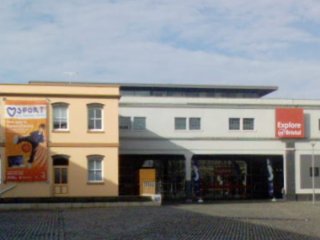 On Saturday 1 March, I attended the Constitutional Review Roadshow at Explore@Bristol (pictured). The review is trying to develop the rules for the Cooperative Group after its merger with United. The event wasn't at all what I expected or hoped for. There were relatively few individual members there. I don't know the split, but most of the 60 or so attendees seemed to be elected members of some sort and this was the first chance they'd had to comment since the open consultation ended last year. Some of the elected members had travelled from the Eastern and South East regions. The initial slide "Purpose of Today" stated three aims:
"I do not want this to turn into a discussion"while the big screen next to him said "questions and discussion"! Headlines from the review: similar elected structures to current Group structure, but regional board nominated by individual members; merge regions to produce six new regions (West Midlands and North West, Wales and South West, London and South East, Eastern England and East and South Midlands, Yorkshire and Humber and North East, Scotland and Northern Ireland); add management and non-executive directors to national board; no clue how to fix diversity problems; no view on fees or job spec until structures are defined. I'll go through the slides in detail and post the questions and answers if anyone leaves a comment asking for them. Otherwise, I think I've lost enough time to this for now.
The notice for the February meeting was posted on Monday. Late again - it's meant to be a week's notice, according to this. I'm disappointed that the current SPI board still hasn't got basic member communications working, even as the year end approaches. Is a default cron-job mail (like we use at TTLLP ) so difficult to set up? Anyway, one of the few interesting items on the agenda is "Decision on new board member"but I've not applied for the post for three reasons. Firstly, on reflection, enough SPI members placed me as last choice (which I think is mostly based on old mud-slinging, but it still happened) in its last election that I don't think being appointed would give me a strong enough mandate for the changes I want (more transparency, consultation and work towards meeting the Better Business Bureau standards). Secondly, I'm finding that my Cooperatives-SW board post is taking more time this year. Finally, I hope to be appointed to a representative post in another organisation soon and it's nearly always better to work where I'm obviously wanted. I've asked if the applications of any candidates for the SPI board post will be posted for member review somewhere (because members are supposed to oversee the board, but how can that happen if we don't see basic info on them?) and for there to be a members Q+A during the meeting, but I don't know whether there's more than one candidate or whether the Q+A will happen. Members are a bit in the dark on this one. Again. I hope to see some other SPI members online about 1900Z tonight (20 Feb). I should actually be online during this one, for a change.
 As Josep asks for it every now and then,
and we really enjoyed this trip, it's time to write about the four days we
spent cycling from Ripoll to Girona, through the Ruta del Carrilet,
a Catalan via verda similar to the one
we completed
a year ago.
I spent this year's 9 d'Octubre cycling trip with totally different trip
mates, not related to my triathlon team. The extensive group was formed by
Sabri, Mar, B rbara, Carles, Desi, Adela, N ria, Amador and myself. We
started our journey by car from Val ncia to Mollet de Mar, where we parked
the cars and take a regional train to Ripoll with our bikes, where the
real journey would start.

Arrival at Ripoll
When we got to Ripoll, it was quite late and dark, but we managed to find
the start of the Ruta del Ferro rail trail which would take us to Sant
Joan de les Abadesses. It was quite cold, but especially really humid, so
we had to think twice before settling on a place to camp and setup our tents.
We had to take special care of covering the bicycles as the air was really wet,
and anything we left uncovered would appear soaking next morning. In part, my
shoes suffered from this.
 Early next morning we had breakfast on the wet grass and then started our
way to Sant Joan through a deliciously well equipped and maintained cycling
track, which unfortunately only lasts for 12 kilometres through a splendind
landscape. After having breakfast in the old railway station in Sant Joan, we
abandoned the Ruta del Ferro to take a road to Olot via Sant Pau de
Seguries, where we had to climb a small mountain and then descend through the
Vall de Bianya until we got to Olot.

Sant Joan de les Abadesses' railway station
Asking the locals for the start of the Ruta del Carrilet was
fun due to the strong oriental accent in the area and we sometimes wouldn't get
a word of what we were told. An old man recommended us finding a big park in
the outskirts of the town, where we prepared our entrepans for
lunch, and after a little rest, we started cycling up the Carrilet,
which would take us to Girona in two stages. This Catalan area is of volcanic
origin, and there are several natural parks dedicated to the phenomenon. There
are many mountains covered with forests and impossible peak shapes, which due
to the time of the year were starting to go from green to brown and yellow,
making fantastic colour schemes in the landscape.

Under a green ceiling in Olot
Just after the few first kilometres, the railroad track starts to descend
most of the way, which makes it easy for people who aren't too trained, and
easier to enjoy your way chatting with people while you cycle. As we consumed
the daylight, we came across a parish church party with lots of old and young
people from the nearby town of Sant Miquel de Pineda. Amador and I were lagging
behind a bit at that point, and when we got there, we found the rest of the
group were already off their bikes and either having a curious look over the
party, or directly following suit and dancing like the others. We had a peek
into the small church and also into a small graveyard in the back, where I was
surprised to find the enemies of my Catalan grandmother: Fam lia Matabosch ,
as one of the headstones revealed.

Partying at Sant Miquel de Pineda
As it was getting late, we eventually started off again, but luckily B rbara
spotted what seemed a good sleeping place for that night. To the right of the
trail there was a hermitage (devoted to Santa Cec lia) up on the hill which,
for bonus points, had a porch with a recently renewed roof which would help
cover ourselves from humidity and rain, as we found soon after starting
cooking dinner.
While the cooks prepared our soup, some others went down to the
Carrilet in order to find out if the next town was close so we could
get some driking water for the dinner. Luckily, Sant Feliu was close enough,
and we found a bar where we got some water... and two bottles of wine, which
made some people back at the hermitage very happy. We were quite tired though,
so we eventually went to sleep after reading some stories from a great tale
book, with the sound of rain hitting the grass outside the porch.
The rain was still with us when we started waking up, so we had breakfast
and packed our stuff very slowly, in an attempt to avoid getting wet. But
rain didn't stop, so we made a few hacks on our bicycle bagpacks to minimise
the amount of rain wetting them. When we were finally ready to set off and
had cycled around 3 kilometres under the light rain, it finally stopped
raining, making the rest of the journey very pleasant.

Sleeping under the porch of Santa Cec lia's hermitage
This part of the route is again quite beautiful, with impressive amounts
of green vegetation at both sides of the track. There's a lot of water
presence in the land, which makes the type of trees and bushes quite different
to the ones we are used to find in the Valencian Country.
After going by a few small towns, we arrived in the old railway station
of Amer, hometown of the Puigdemonts. Even if it was a bit early, we
decided to have lunch there, so a few of us went down to the centre of the
town to buy bread and some other details to eat. Being in my friend Josep's
town for the first time, I wanted to visit his
family's bakery, but unfortunately it
is closed on Mondays. We had lunch back at the cute station, and eventually
kept going on our way to Girona. Outside Amer, the Carrilet was
temporarily cut by the road, and there were two possible alternatives: using
the road, with heavy lorry traffic, or diverting through a very steep track
with very hard slopes. Most of the group preferred the road, but Mar, Amador
and I went up that track, which was hard to climb and really fun to descend.
Apparently, Amer locals call those 1.5 kilometres the Tourmalet . It's
probably not so bad, though. :)

Amer's railway station
Unfortunately, the Ruta del Carrilet starts getting uglier after
Amer, and as you approach the more industrialised towns near the capital
Girona. The area around Angl s wasn't that fun, with the track continuously
being invaded by cars and other vehicles. Soon after we were in the
farmland area surrounding Girona and its Devesa.
Jonathan was waiting for us in the city, after his two month stay in
Scotland, and we were all happy to meet him. We discarded continuing our
way to the coast, which was the initial plan, and instead dropped our stuff
in the house of one of Adela's friends, and went out to have dinner to a
Wok restaurant, where the poor people running it suffered our
childish behaviour involving the rotating central dish on our table and
custard sucking contests.
Jonathan guided us through the Cathedal and city wall areas of the town
centre, which are impressive, and we climbed all of the wall towers to have
great looks over the dark and quiet city. Eventually, we went to sleep, as
Adela had to leave early, and we had to pack to get our train back to
Barcelona.
Back in Mollet, we cooked our last camping-gaz lunch in the park right next
to the station, before noticing the place stinked of dog poo. After the careful
operation of filling the three cars with 9 bicycles, we were finally on our
way back to Val ncia, completing another great cycling journey. If you like
bicycle tourism and can travel to this area in Catalonia, I highly recommend
it, as there's many great places to visit, all of them accessible with
bikes.

Having lunch in Mollet
 could have just been a nice Summer morning, uneventful as they usually are, were it not for the fact that it was already 19:00, and it was mid-winter. (with due apologies, of course, to Bob Dylan and Les Luthiers)
Nadezhda called me, warning me about a very dark sky and strong winds, and went off for her meeting. I told her weather looked decent from mx office... But started paying attention. And yes, wind was crazed. Hints of an upcoming power outage were felt in the Institute. I left my office as soon as I could. Cycling back home was quite a challenge - The 3.1Km route back home, usually much easier than the way there as it's mostly downhill, was quite a challenge: Biking with eyes almost-closed because of the flying leaves and dust, and little but menacing raindrops... Scary, all in all.
Anyway, it gets scary... At least one person was killed because of the winds not far from here. This city has the fame that febrero loco y los vientos otro poco (February is crazy, but the winds are even more). And the first crazy wind of the season are always scary.[update] One person dead because of the strong winds in Mexico City; Power outages in several areas; Three more hours of strong winds expected; Heavy winds caused by the #24 cold front(?); Winds cause mayhem on DF streets;
 but otherwise, everything is so twisted, so jumbled or so gone, it is beyond stunning. She certainly knew I was around and helping for she got upset when she knew I was leaving, often bursting in tears, asking me to take her to New York. But she just knew me as Gabriella from Nueva York who brought her novio bueno to PR and not as anyone else.
It is certainly not easy to see this, to experience it day in and out but it is what it is and there is no running from it. Logistically it is also beyond hard to take care of my mom. To get her to eat, to calm down after one of her morning fits (she always, always, always had a raging fit in the morning, the afternoon and evenings being far more calm periods), to convince her to wear her dentures (which is the only remedy to stop her from spitting all over the place), to dress her, to deal with her in the middle of the night, often twice, are all extraordinarily challenging. Very quickly, your waking hours fill up with seemingly endless tasks and this I guess is, in some respects, a hidden blessing; there is just a lot less time to ruminate over how all of this, frankly, sucks. It is only later, late at night, early in the morning, or on the plane ride home where the darkness of her life would set deeply into my own.
It may be obvious why this state and experience is tough but there are two parts that I find particularly rough. If my mother’s state is one of near total chaos and entropy, there is one thing that is utterly clear. She knows she is suffering and she wants out. On particularly bad days, she would mutter or sometimes yell loudly that she wants to die and would ask for the medicine that would accomplish this. She would even sometimes call me mala for not giving her this medicine. It is certainly not the case that everyone with Alzheimers goes through what my mother does. Apparently, some experience the illness quietly and peacefully. This is so not the case for my mother, who lived a particularly hard yet vibrant life. Donning a difficult personality, she lived lived as fully as she could and it is clear that as life leaves her, she would rather not be around to experience what is a cruel exorcism of self. Thankfully, she is not constantly or not even mostly in a suicidal state. I think she at times forgets how lousy she feels and rather enjoys the rather limited life she has. And at this point, I just hope that she continues to have calm or even happy moments.
The second surprise concerns my own memories. My mother has had this rare form of Alzheimers, Posterior Cortical Atrophy, for at least 6, possible 7 years now, though we only received the official diagnosis 2003, which is the year when when I first started to write the occasional post about my experiences with her. In 2003 and 2004, she was pretty functionally in tact and it has only been the last 2.5 years when the persistent decline has set in, whittling her capacities and memories to what seems to be a bare minimum. But because her presence and reality is nothing short of totally enveloping and drowning, I am starting to lose my own memory of my mother prior to her illness. If Alzheimers robs people of their memories, I have come to realize, that if you are not careful, it is a thief that can also rob your own memories. I think it is for this reason that I have become so attached to my mother’s stuff her furniture, her paintings some of which I have taken back with me. They are material vehicles that transport me back to the past when my mother was in a different state and place. Now it is clear that if the challenge is to deal with the emotional toll this illness causes, it as much summoning the will and performing the labor to retain and recall my older memories of her.

 Six months ago, a political group in Spain made a big fuss and noise when
the Government of Venezuela closed down the anti-chavist RCTV TV station,
and waved the flag of freedom of speech, called the democratically elected
government a regime , and called their president a dictator .
On Sunday night, these very same people, following orders from the leaders
of the Valencian government or should I say regime , drove up to the top of
the Carrasqueta peak in Xixona, in the South of the Valencian Country,
and protected by the winter's darkness, proceeded to force open two locks,
broke into ACPV's property and unplugged
and precincted the equipment which had been broadcasting the signal of
TV3 and the rest of the public Catalan
TV channels to the South of our land, for the last 21 years.
Although
this wasn't unexpected
it is probably one of the biggest attacks to freedom of speech, choice and
plurality since democracy was restored in the state. The political benefit
PP is planning to obtain from this attack is clear: pleasing the regional
right-wing cavemen who think we have nothing to do with the Catalan culture
just 2 months away from some very decisive elections will probably give them a
handful of extra votes. There are also economical interests involved, like
having right-wing media groups control even more digital TV channels that
they already do, but that's really anecdotic now.
Two nights ago, it was the South. In a matter of days, the antennas in the
Bartolo, in the North of the Valencian territory, will also be
unplugged, blackening the screens of thousands of Valencians who think they
have the right to watch decent quality TV in their mother tongue. Thank you,
fascists.
 It’s 106 miles to Chicago. We’ve got a full tank of gas, half a pack of cigarettes, it’s dark and we’re wearing sunglasses.
 Today I finally got a Spyder2 Express monitor calibration kit, and
calibrated my ThinkPad's laptop. I've known it to be shockingly badly
calibrated (although it is an improvement over the X20), but was curious
as to how much it can be corrected.
One word: wow. Thanks to Graeme Gill et al of ArgyllCMS fame for
reverse-engineering how the Spyder2 works, and making calibrating displays
reasonably easy to do. I'll probably write up what I did at some point,
because if you are like me and don't read the documentation there are a
number of stumbling points.
I also blame Jakub entirely for making me think ArgyllCMS was broken by
picking slightly warm grey tones for Darkilouche. My freshly calibrated
screen looked a little warm instead of the usual very cool, and it took me
a good ten minutes to think about checking that the theme is actually pure
grey.
NP: Blue Skied An' Clear - A Morr Music Compilation
Next.
