Search Results: "daniel"

9 May 2015

Daniel Silverstone: Kimchi Trial 1 - Part 3 - Kimchiguk

Earlier this week I allowed some of my colleagues at work to try the Kimchi and one of them (James) liked it enough to ask for a tub of it just for himself. Being a lovely person I obliged. My darling Rob decided that what he really wanted was Kimchiguk or Kimchijijae. Being both wonderful and lacking in ingredients, I set to do achieving something. I read a few recipes, worked out that I lacked critical ingredients and so set about simulating Kimchiguk. I grabbed two and a bit cupfuls of kimchi from the box in the fridge, chopped it up more finely, popped it into a pot along with about a pound of cubed pork belly, two teaspoons of hot pepper flakes, two teaspoons of sugar, and two teaspoons of cornflour. I then topped that off with five cups of water, mixed it up, brought it to the boil and simmered it for 30 minutes. Then I cubed some tofu, popped that in and simmered it for another 10 minutes while some rice cooked. Served in a bowl over rice, my approximation of Kimchiguk turned out pretty well. (Note it fed both of us and there was a serving left over.) Kimchiguk - Kimchi soup With a do-over, I'd try harder to get pork shoulder (belly is quite fatty) and given the option I'd wait until I had hot pepper paste because the malty fermented sweetness of hot pepper paste is pretty much impossible to emulate otherwise.

8 May 2015

Daniel Kahn Gillmor: Cheers to audacity!

When paultag recently announced a project to try to move debian infrastructure to python3, my first thought was how large that undertaking would likely be. It seems like a classic engineering task, full of work and nit-picky details to get right, useful/necessary in the long-term, painful in the short-term, and if you manage to pull it off successfully, the best you can usually hope for is that no one will notice that it was done at all. I always find that kind of task a little off-putting and difficult to tackle, but I was happy to see someone driving the project, since it does need to get done. Debian is potentially also in a position to help the upstream python community, because we have a pretty good view of what things are being used, at least within our own ecosystem. I'm happy to say that i also missed one of the other great benefits of paultag's audacious proposal, which is how it has engaged people who already knew about debian but who aren't yet involved. Evidence of this engagement is already visible on the py3porters-devel mailing list. But if that wasn't enough, I ran into a friend recently who told me, "Hey, I found a way to contribute to debian finally!" and pointed me to the py3-porters project. People want to contribute to the project, and are looking for ways in. So cheers to the people who propose audacious projects and make them inviting to everyone, newcomers included. And cheers to the people who step up to potentially daunting work, stake out a task, roll up their sleeves, and pitch in. Even if the py3porters project doesn't move all of debian's python infrastructure to pyt3 as fast as paultag wants it to, i think it's already a win for the project as a whole. I am looking forward to seeing what comes out of it (and it's reminding me i need to port some of my own python work, too!) The next time you stumble over something big that needs doing in debian, even something that might seem impossible, please make it inviting, and dive in. The rest of the project will grow and improve from the attempt.Tags: py3-porters

4 May 2015

Lunar: Reproducible builds: first week in Stretch cycle

Debian Jessie has been released on April 25th, 2015. This has opened the Stretch development cycle. Reactions to the idea of making Debian build reproducibly have been pretty enthusiastic. As the pace is now likely to be even faster, let's see if we can keep everyone up-to-date on the developments. Before the release of Jessie The story goes back a long way but a formal announcement to the project has only been sent in February 2015. Since then, too much work has happened to make a complete report, but to give some highlights: Lunar did a pretty improvised lightning talk during the Mini-DebConf in Lyon. This past week It seems changes were pilling behind the curtains given the amount of activity that happened in just one week. Toolchain fixes We also rebased the experimental version of debhelper twice to merge the latest set of changes. Lunar submitted a patch to add a -creation-date to genisoimage. Reiner Herrmann opened #783938 to request making -notimestamp the default behavior for javadoc. Juan Picca submitted a patch to add a --use-date flag to texi2html. Packages fixed The following packages became reproducible due to changes of their build dependencies: apport, batctl, cil, commons-math3, devscripts, disruptor, ehcache, ftphs, gtk2hs-buildtools, haskell-abstract-deque, haskell-abstract-par, haskell-acid-state, haskell-adjunctions, haskell-aeson, haskell-aeson-pretty, haskell-alut, haskell-ansi-terminal, haskell-async, haskell-attoparsec, haskell-augeas, haskell-auto-update, haskell-binary-conduit, haskell-hscurses, jsch, ledgersmb, libapache2-mod-auth-mellon, libarchive-tar-wrapper-perl, libbusiness-onlinepayment-payflowpro-perl, libcapture-tiny-perl, libchi-perl, libcommons-codec-java, libconfig-model-itself-perl, libconfig-model-tester-perl, libcpan-perl-releases-perl, libcrypt-unixcrypt-perl, libdatetime-timezone-perl, libdbd-firebird-perl, libdbix-class-resultset-recursiveupdate-perl, libdbix-profile-perl, libdevel-cover-perl, libdevel-ptkdb-perl, libfile-tail-perl, libfinance-quote-perl, libformat-human-bytes-perl, libgtk2-perl, libhibernate-validator-java, libimage-exiftool-perl, libjson-perl, liblinux-prctl-perl, liblog-any-perl, libmail-imapclient-perl, libmocked-perl, libmodule-build-xsutil-perl, libmodule-extractuse-perl, libmodule-signature-perl, libmoosex-simpleconfig-perl, libmoox-handlesvia-perl, libnet-frame-layer-ipv6-perl, libnet-openssh-perl, libnumber-format-perl, libobject-id-perl, libpackage-pkg-perl, libpdf-fdf-simple-perl, libpod-webserver-perl, libpoe-component-pubsub-perl, libregexp-grammars-perl, libreply-perl, libscalar-defer-perl, libsereal-encoder-perl, libspreadsheet-read-perl, libspring-java, libsql-abstract-more-perl, libsvn-class-perl, libtemplate-plugin-gravatar-perl, libterm-progressbar-perl, libterm-shellui-perl, libtest-dir-perl, libtest-log4perl-perl, libtext-context-eitherside-perl, libtime-warp-perl, libtree-simple-perl, libwww-shorten-simple-perl, libwx-perl-processstream-perl, libxml-filter-xslt-perl, libxml-writer-string-perl, libyaml-tiny-perl, mupen64plus-core, nmap, openssl, pkg-perl-tools, quodlibet, r-cran-rjags, r-cran-rjson, r-cran-sn, r-cran-statmod, ruby-nokogiri, sezpoz, skksearch, slurm-llnl, stellarium. The following packages became reproducible after getting fixed: Some uploads fixed some reproducibility issues but not all of them: Patches submitted which did not make their way to the archive yet: Improvements to reproducible.debian.net Mattia Rizzolo has been working on compressing logs using gzip to save disk space. The web server would uncompress them on-the-fly for clients which does not accept gzip content. Mattia Rizzolo worked on a new page listing various breakage: missing or bad debbindiff output, missing build logs, unavailable build dependencies. Holger Levsen added a new execution environment to run debbindiff using dependencies from testing. This is required for packages built with GHC as the compiler only understands interfaces built by the same version. debbindiff development Version 17 has been uploaded to unstable. It now supports comparing ISO9660 images, dictzip files and should compare identical files much faster. Documentation update Various small updates and fixes to the pages about PDF produced by LaTeX, DVI produced by LaTeX, static libraries, Javadoc, PE binaries, and Epydoc. Package reviews Known issues have been tagged when known to be deterministic as some might unfortunately not show up on every single build. For example, two new issues have been identified by building with one timezone in April and one in May. RD and help2man add current month and year to the documentation they are producing. 1162 packages have been removed and 774 have been added in the past week. Most of them are the work of proper automated investigation done by Chris West. Summer of code Finally, we learned that both akira and Dhole were accepted for this Google Summer of Code. Let's welcome them! They have until May 25th before coding officialy begins. Now is the good time to help them feel more comfortable by sharing all these little bits of knowledge on how Debian works.

1 May 2015

Daniel Kahn Gillmor: Preferred Packaging Practices

I just took a few minutes to write up my preferred Debian packaging practices. The basic gist is that i like to use git-buildpackage (gbp) with the upstream source included in the repo, both as tarballs (with pristine-tar branches) and including upstream's native VCS history (Joey's arguments about syncing with upstream git are worth reading if you're not already convinced this is a good idea). I also started using gbp-pq recently -- the patch-queue feature is really useful for at least three things: My preferred packaging practices document is a work in progress. I'd love to improve it. If you have suggestions, please let me know. Also, if you've written up your own preferred packaging practices, send me a link! I'm hoping to share and learn tips and tricks around this kind of workflow at debconf 15 this year. Tags: git, git-buildpackage, packaging

20 April 2015

Daniel Pocock: WebRTC video from mini-DebConf Lyon, France

Thanks to the Debian France community for putting on another very successful mini-DebConf in Lyon recently. It was a great opportunity to meet more people for the first time and share ideas. On the first day, I gave a talk about the current status of WebRTC and the Debian WebRTC portal. You can now watch the video of the talk online. Unfortunately, we had some wifi problems that delayed the demonstration but we did eventually see it work successfully towards the end of the talk.

16 April 2015

Daniel Pocock: Debian Jessie release, 100 year ANZAC anniversary

The date scheduled for the jessie release, 25 April 2015, is also ANZAC day and the 100th anniversary of the Gallipoli landings. ANZAC day is a public holiday in Australia, New Zealand and a few other places, with ceremonies remembering the sacrifices made by the armed services in all the wars. Gallipoli itself was a great tragedy. Australian forces were not victorious. Nonetheless, it is probably the most well remembered battle from all the wars. There is even a movie, Gallipoli, starring Mel Gibson. It is also the 97th anniversary of the liberation of Villers-Bretonneux in France. The previous day had seen the world's first tank vs tank battle between three British tanks and three German tanks. The Germans won and captured the town. At that stage, Britain didn't have the advantage of nuclear weapons, so they sent in Australians, and the town was recovered for the French. The town has a rue de Melbourne and rue Victoria and is also the site of the Australian National Memorial for the Western Front. Its great to see that projects like Debian are able to span political and geographic boundaries and allow everybody to collaborate for the greater good. ANZAC day might be an interesting opportunity to reflect on the fact that the world hasn't always enjoyed such community.

9 April 2015

Daniel Pocock: Never fly Etihad again?

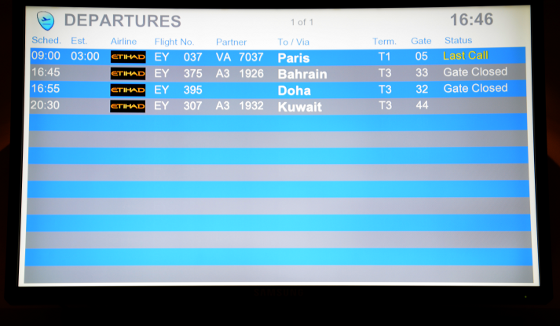
This is the first time we've flown out to Australia with Etihad and it may also be the last. We were due to fly back into Europe at CDG and head down to Lyon for the mini-DebConf this weekend. departure board, 18 hour delay for Paris Lets look at how our Etihad experience has worked out: 21:00 UTC Tuesday - waking up on Wednesday morning in Melbourne (UTC+10) 13:00 UTC Wednesday - leaving Melbourne about 11pm Wednesday night, a 12-13 hour flight to Abu Dhabi. We had heard about the air traffic control strikes in France (where we are going) and asked the airline if we should fly and they told us everything would be OK. 02:30 UTC Thursday - touchdown in Abu Dhabi, 6:30 am local time. Go to the transfer counter to ask for our boarding passes to CDG. At this stage, we were told that the connecting flight to CDG had been delayed 20 hours due to French strikes. As we are trying to reach Lyon for the mini-DebConf this weekend, we asked if we could leave Abu Dhabi on a 09:00 flight to Geneva. The Etihad staff told us to contact our travel agent (the flight was booked through Expedia) and for the next hour everybody's time was wasted making calls to Expedia who kept telling us to speak to Etihad. Whenever the Etihad customer service staff tried to speak to Expedia, the Expedia call center would hang up. Eventually, the Etihad staff told us that the deadline for putting us on the Geneva flight had passed and we would be stuck in Abu Dhabi for at least 20 hours. For flights to and from Europe, airlines have a responsibility to arrange hotels for passengers if there is a lengthy delay. If the airline is at fault, they must also pay some extra cash compensation but for a strike situation that is not applicable. Etihad has repeatedly fobbed us off. Initially we were given vouchers for Burger King or a pizza slice and told to hang around the transfer counter. By about 12:00 UTC (4pm local time, nine hours of waiting around the transfer counter) there was still no solution. One passenger was so upset that the airport security were called to speak to him and he was taken away. The airline staff kept giving excuses. Some passengers had been sent to a hotel but others left behind. I asked them again about our hotel and they kept trying to fob me off. Faced with the possibility that I would miss two nights of sleep and eight hours time difference coming into Europe, I continued asking the Etihad staff to own up to their responsibilities and they eventually offered us access to their airport lounge. We discovered some other passengers in the lounge too, including the passenger who had earlier been escorted away by security. This is unlike anything we've experienced with any other airline. At every opportunity (the check-in at Melbourne, or when the Geneva flight was boarding), the airline has failed to make arrangements that would have avoided cost and inconvenience. Assuming the flight goes ahead with a 20 hour delay, we will arrive in CDG some time Friday morning and not really sleep in a proper bed again until Friday night, about 70 hours after getting up in Melbourne on Wednesday morning. Thanks Etihad, you are a waking nightmare. The airline has been evasive about how they will deal with our onward travel from CDG to Lyon. We had booked a TGV train ticket already but it is not valid after such a long delay and it seems quite possible that trains will be busier than usual thanks to the air traffic control strike. So we don't even know if we will be loitering around a Paris airport or railway station for hours on Friday and nobody from the airline or Expedia really seems to care. Conclusion The only conclusion I can reach from this experience is that Etihad can't be trusted, certainly not for long journies such as Australia to Europe. Having flown through Singapore, Kuala Lumpur and Hong Kong, I know that air passengers have plenty of options available and there are many airlines that do go the extra mile to look after passengers especially on such long journeys. The airline missed opportunities to re-route us at every opportunity. It looks like they help some passengers (like those who did get to hotels) but leave many others high and dry just to stay within their budget.

6 April 2015

Daniel Pocock: Dandenongs

The final part of our latest Australia trip took us to the Dandenong Ranges. To borrow a term from the Germans and Swiss, Mount Dandenong could be considered Melbourne's Hausberg or local mountain. On the south side of the mountain, tourists and children are impressed by the Puffing Billy railway at Belgrave: Keen runners can race the train in about May each year in a 13km course through the mountains. You need to stay at least thirty seconds ahead of the train to avoid being stuck at the level crossings. My own fastest time was about two minutes faster than the train. Leaving Belgrave, there is a short but steep drive up to the Mount Dandenong summit following the road towards Monbulk and Olinda. From the top, you can view the whole city, Port Philip Bay and various other mountain ranges in other directions:

Daniel Leidert: Motion picture capturing: Debian + motion + Logitech C910

Woodpecker near the windowWinter time is a good time for some nature observation. Yesterday I had a woodpecker (picture) in front of my kitchen window. During the recent weeks there were long-tailed tits, a wren and other rarely seen birds. So I thought, it might be a good idea to capture some of these events :) I still own a Logitech C910 USB camera which allows HD video capturing up to 1080p. So I checked the web for some software that would begin video capturing in the case of motion detection and found motion, already available for Debian users. So I gave it a try. I tested all available resolutions of the camera together with the capturing results. I found that the resulting framerate of both the live stream and the captured video is highly depending on the resolution and some few configuration options. Below is a summary of my tests and the results I've achieved so far.

Logitech C910 HD cameraJust a bit of data regarding the camera. AFAIK it allows for fluent video streams up to 720p.
$ dmesg
[..]
usb 7-3: new high-speed USB device number 5 using ehci-pci
usb 7-3: New USB device found, idVendor=046d, idProduct=0821
usb 7-3: New USB device strings: Mfr=0, Product=0, SerialNumber=1
usb 7-3: SerialNumber: 91CF80A0
usb 7-3: current rate 0 is different from the runtime rate 16000
usb 7-3: current rate 0 is different from the runtime rate 32000
uvcvideo: Found UVC 1.00 device (046d:0821)
input: UVC Camera (046d:0821) as /devices/pci0000:00/0000:00:1a.7/usb7/7-3/7-3:1.2/input/input17

$ lsusb
[..]
Bus 007 Device 005: ID 046d:0821 Logitech, Inc. HD Webcam C910
[..]

$ v4l2-ctl -V -d /dev/video1
Format Video Capture:
Width/Height : 1280/720
Pixel Format : 'YUYV'
Field : None
Bytes per Line: 2560
Size Image : 1843200
Colorspace : SRGB
Also the uvcvideo kernel module is loaded and the user in question is part of the video group. Installation and startInstallation of the software is as easy as always:
apt-get install motion
It is possible to run the software as a service. But for testing, I copied /etc/motion/motion.conf to ~/.motion/motion.conf, fixed its permissions (you cannot copy the file as user - it's not world readable) and disabled the daemon mode.
daemon off
Note that in my case the correct device is /dev/video1 because the laptop has a built-in camera, that is /dev/video0. Also the target directory should be writeable by my user:
videodevice /dev/video1
target_dir ~/Videos
Then running motion from the command line ...
$ motion
[..]
[0] [NTC] [ALL] motion_startup: Motion 3.2.12+git20140228 Started
[..]
[1] [NTC] [ALL] motion_init: Thread 1 started , motion detection Enabled
[0] [NTC] [ALL] main: Thread 1 is device: /dev/video1 input -1
[1] [NTC] [VID] v4l2_get_capability:
------------------------
cap.driver: "uvcvideo"
cap.card: "UVC Camera (046d:0821)"
cap.bus_info: "usb-0000:00:1a.7-1"
cap.capabilities=0x84000001
------------------------
[1] [NTC] [VID] v4l2_get_capability: - VIDEO_CAPTURE
[1] [NTC] [VID] v4l2_get_capability: - STREAMING
[1] [NTC] [VID] v4l2_select_input: name = "Camera 1", type 0x00000002, status 00000000
[1] [NTC] [VID] v4l2_select_input: - CAMERA
[..]
[1] [NTC] [ALL] image_ring_resize: Resizing pre_capture buffer to 1 items
... will begin to capture motion detection events and also output a live stream. CTRL+C will stop it again. Live streamThe live stream is available by pointing the browser to localhost:8081. However, the stream seems to run at 1 fps (frames per second) and indeed does. The stream gets more quality by this configuration:
stream_motion on
stream_maxrate 100
The first option is responsible, that the stream only runs at one fps if there is no motion detection event. Otherwise the framerate increases to its maximum value, which is either the one given by stream_maxrate or the camera limit. The quality of the stream picture can be increased a bit further too by increasing the stream_quality value. Because I neither need the stream nor the control feed I disabled both:
stream_port 0
webcontrol_port 0
Picture capturingBy default there is video and picture capturing if a motion event is detected. I'm not interested in these pictures, so I turned them off:
output_pictures off
FYI: If you want a good picture quality, then the value of quality should very probably be increased. Video capturingThis is the really interesting part :) Of course if I will "shoot" some birds (with the camera), then a small image of say 320x240 pixels is not enough. The camera allows for a capture resolution up to 1920x1080 pixels (1080p). It is advertised for fluent video streams up to 720p (1280x720 pixels). So I tried the following resolutions: 320x240, 640x480, 800x600, 640x360 (360p), 1280x720 (720p) and 1920x1080 (1080p). These are easily configured by the width and height variables. For example the following configures motion for 1280x720 pixels (720p):
width 1280
height 720
The result was really disappointing. No event is captured with more then 20 fps. At higher resolutions the framerate drops even further and at the highest resolution of 1920x1080 pixels, the framerate is only two(!) fps. Also every created video runs much too fast and even faster by increasing the framerate variable. Of course its default value of 2 (fps) is not enough for fluent videos. AFAIK the C910 can run with 30 fps at 1280x720 pixels. So increasing the value of framerate, the maximum framerate recorded, is a must-do. (If you wanna test yourself, check the log output for the value following event_new_video FPS.)The solution to the issue, that videos are running too fast, however is to increase the pre_capture value, the number of pre-captured (buffered) pictures from before motion was detected. Even small values like 3..5 result in a distinctive improvement of the situation. Though increasing the value further didn't have any effect. So the values below should almost get the most out of the camera and result in videos in normal speed.
framerate 100
pre_capture 5
Videos in 1280x720 pixels are still captured with 10 fps and I don't know why. Running guvcview, the same camera allows for 30 fps in this resolution (even 60 fps in lower resolutions). However, even if the framerate could be higher, the resulting video runs fluently. Still the quality is just moderate (or to be honest, still disappointing). It looks "pixelated". Only static pictures are sharp. It took me a while to fix this too, because I first thought, the reason is the camera or missing hardware support. It is not :) The reason is, that ffmpeg is configured to produce a moderate(?)-quality video. The relevant variables are ffmpeg_bps and ffmpeg_variable_bitrate. I got the best results just changing the latter:
ffmpeg_variable_bitrate 2
Finally the resulting video quality is promising. I'll start with this configuration setting up an observation camera for the bird feeding ground.There is one more tweak for me. I got even better results by enabling the auto_brightness feature.
auto_brightness on
Complete configurationSo the complete configuration looks like this (only those options changed to the original config file)
daemon off
videodevice /dev/video1
width 1280
height 720
framerate 100
auto_brightness on
ffmpeg_variable_bitrate 2
target_dir /home/user/Videos
stream_port 0 #8081
stream_motion on
stream_maxrate 100
webcontrol_port 0 #8080
Links Continue with part II ...

Daniel Leidert: Correct keyboard layout (QWERTZ) with Logitech K400 attached to an Android HDMI stick

I've bought an HDMI stick with Android 4.4.2 to connect a TV to the local network (stream, DLNA) and the internet (Video portals etc.). The stick comes with no input device whatsoever. So I decided for a wireless Logitech K400r keyboard. Unfortunately the keyboard layout used by Android seems to be American (QWERTY) although the language and location settings are set to German. So I neither get Umlauts nor special signs correct nor do the media keys of the K400 work. But there is an easy way to make all this work. I've recently seen some people suggesting to install an app called External Keyboard Helper to fix things, which comes in a demo and a pro version, the latter with costs. Fortunately I didn't need any of these for the Logitech keyboard plus I got all media keys of this keyboard to work in just three steps without any cost :) Step 1First I went to the Google Play Store and installed the Logitech Keyboard Plus app by Logitech Europe S.A. (See? No external stuff and without costs. Ignore anything that's written in its description about Bluetooth.)App Logitech Keyboard Plus shown at Google Play Store Step 2Then I opened the settings section and went for Settings > Language and Input (Einstellungen > Sprache und Eingabe). Under KEYBOARD & INPUT METHOD (TASTATUR & EINGABEMETHODEN) I activated the entry called Logitech keyboard (Logitech Tastatur) as shown below.Activate the entry &quote;Logitech keyboard&quote; under Settings > Language and Input Step 3Now a click on the field above that is called Default (Standard) and (here) defaults to Deutsch - Android-Tastatur (AOSP) ...Click on the field &quote;Default&quote;... opened a popup called Choose input method and there I've chosen Logitech keyboard (Logitech Tastatur) as shown below and confirmed it.Activate the Logitech keyboard on the popup called &quote;Choose input method&quote;The default now is the Logitech keyboard:The default keyboard now is the Logitech keyboard Finally ...... it's done. The keyboard now behaves as expected and also the media/function keys do work. It is however not possible to adjust or configure anything, because this presumes a confirmed Bluetooth pairing between the keyboard and the android device and the K400 is not a Bluetooth device. It would probably be a good idea for Logitech to make this app usable for all available Logitech keyboards, even USB and Unifying(TM) ones. Update: As of now it is possible to cancel the Bluetooth pairing attempt without leaving the application. So this app in fact can be used for USB and Unifying(TM)-based Logitech keyboards.

5 April 2015

Daniel Pocock: Australian wildlife

Here are some of the animals we have seen so far during our trip to Australia. Kookaburra Some kookaburras flying into the trees around a friend's beach house at Kennett River on the Great Ocean Road. Koala's in the wild It is easy to find koala bears in many of the trees around Kennett River: Python At the Moonlit Sanctuary, we were introduced to a python: BBQ My cousin Hagen prepares the BBQ for lunch at the sanctuary: More koala bears It was also possible to get up close to one of the koala bears at the sanctuary. Be careful not to get so close to them in the wild. Wallaby The wallaby is like a small kangaroo: Kangaroo Carla was able to get up close to a family of kangaroos and feed them some snacks: Tasmanian Devil Saving the best for last, the Tasmanian devil is not just a cartoon character. His jaw is strong enough to crush your finger as if you had been run over by a train and he can run faster than just about anybody except for a trained sprinter. Consequently, we didn't jump in the enclosure to pose with him for this photo:

30 March 2015

Daniel Leidert: Prevent suspend/hibernate if system is remotely backed up via rdiff-backup

I usually use rdiff-backup to backup several of my systems. One is a workstation which goes to sleep after some time of idling around. Now having a user logged in running rdiff-backup (or rsync, rsnapshot etc for that matter) won't prevent the system from being put to sleep. Naturally this happens before the backup is complete. So some time ago I was looking for a resolution and recieved a suggestion to use a script in /etc/pm/sleep.d/. I had to modify the script a bit, because the query result always was true. So this is my solution in /etc/pm/sleep.d/01_prevent_sleep_on_backup now:

#!/bin/sh

. "$ PM_FUNCTIONS "

command_exists rdiff-backup exit $NA

case "$1" in
hibernate suspend)
if ps cax grep -q rdiff-backup
then
exit 1
fi
;;
esac

exit 0
Currently testing ... UpdateThe above works with pm-utils; but it fails with systemd. Seems I have to move and modify the script for my system. Update 2It doesn't work. In short: exit 1 doesn't prevent systemd from going to suspend. I can see, that the script itself leads to the results I want, so the logic is correct. But I cannot find a way to tell systemd, to stop suspend. Shouldn't it be doing this automtically in a case, where a remote user is logged in and runs a command? Update 3There is also a related bug report.

26 March 2015

Daniel Pocock: WebRTC: DruCall in Google Summer of Code 2015?

I've offered to help mentor a Google Summer of Code student to work on DruCall. Here is a link to the project details. The original DruCall was based on SIPml5 and released in 2013 as a proof-of-concept. It was later adapted to use JSCommunicator as the webphone implementation. JSCommunicator itself was updated by another GSoC student, Juliana Louback, in 2014. It would be great to take DruCall further in 2015, here are some of the possibilities that are achievable in GSoC:
  • Updating it for Drupal 8
  • Support for logged-in users (currently it just makes anonymous calls, like a phone box)
  • Support for relaying shopping cart or other session cookie details to the call center operative who accepts the call
Help needed: could you be a co-mentor? My background is in real-time and server-side infrastructure and I'm providing all the WebRTC SIP infrastructure that the student may need. However, for the project to have the most impact, it would also be helpful to have some input from a second mentor who knows about UI design, the Drupal way of doing things and maybe some Drupal 8 experience. Please contact me ASAP if you would be keen to participate either as a mentor or as a student. The deadline for student applications is just hours away but there is still more time for potential co-mentors to join in. WebRTC at mini-DebConf Lyon in April The next mini-DebConf takes place in Lyon, France on April 11 and 12. On the Saturday morning, there will be a brief WebRTC demo and there will be other opportunities to demo or test it and ask questions throughout the day. If you are interested in trying to get WebRTC into your web site, with or without Drupal, please see the RTC Quick Start guide.

24 March 2015

Daniel Pocock: The easiest way to run your own OpenID provider?

A few years ago, I was looking for a quick and easy way to run OpenID on a small web server. A range of solutions were available but some appeared to be slightly more demanding than what I would like. For example, one solution required a servlet container such as Tomcat and another one required some manual configuration of Python with Apache. I came across the SimpleID project. As the name implies, it is simple. It is written in PHP and works with the Apache/PHP environment on just about any Linux web server. It allows you to write your own plugin for a user/password database or just use flat files to get up and running quickly with no database at all. This seemed like the level of simplicity I was hoping for so I created the Debian package of SimpleID. SimpleID is also available in Ubuntu. Help needed Thanks to a contribution from Jean-Michel Nirgal Vourg re, I've just whipped up a 0.8.1-14 package that should fix Apache 2.4 support in jessie. I also cleaned up a documentation bug and the control file URLs. Nonetheless, it may be helpful to get feedback from other members of the community about the future of this package:
  • Is it considered secure enough?
  • Have other people found it relatively simple to install or was I just lucky when I tried it?
  • Are there other packages that now offer such a simple way to get OpenID for a vanilla Apache/PHP environment?
  • Would anybody else be interested in helping to maintain this package?
  • Would anybody like to see this packaged in other distributions such as Fedora?
  • Is anybody using it for any online community?
Works with HOTP one-time-passwords and LDAP servers One reason I chose SimpleID is because of dynalogin, the two-factor authentication framework. I wanted a quick and easy way to use OTP with OpenID so I created the SimpleID plugin for dynalogin, also available as a package. I also created the LDAP backend for SimpleID, that is available as a package too. Works with Drupal I tested SimpleID for login to a Drupal account when the OpenID support is enabled in Drupal, it worked seamlessly. I've also tested it with a few public web sites that support OpenID.

20 March 2015

Lucas Nussbaum: Several improvements to UDD s Bug Search and Maintainer Dashboard

Several improvements have been made to UDD s Bug Search and Maintainer Dashboard recently. On the Maintainer Dashboard side, the main new feature is a QA checks table that provides an overview of results from lintian, reproducible builds, piuparts, and ci.debian.net. Check the dashboard for the Ruby team for an example. Also, thanks to Daniel Pocock, the TODO items can now be exported as iCalendar tasks. Bugs Search now has much better JSON and YAML outputs. It s probably a good start if you want to do some data-mining on bugs. Packages can now be selected using the same form as the Maintainer Dashboard s one, which makes it easy to build your own personal bug list, and will suppress the need for some of the team-specific listings. Many bugs have been fixed too. More generally, thanks to the work of Christophe Siraut, the code is much better now, with a clean separation of the data analysis logic and the rendering sides that will make future improvements easier. As the reminder, it s quite easy to hack on UDD (even if you are not a DD). Please report bugs, including about additional features you would like to see!

16 March 2015

Daniel Kahn Gillmor: Bootable grub USB stick (EFI and BIOS for Intel)

I'm using grub version 2.02~beta2-2. I want to make a USB stick that's capable of booting Intel architecture EFI machines, both 64-bit (x86_64) and 32-bit (ia32). I'm starting from a USB stick which is attached to a running debian system as /dev/sdX. I have nothing that i care about on that USB stick, and all data on it will be destroyed by this process. I'm also going to try to make it bootable for traditional Intel BIOS machines, since that seems handy.I'm documenting what I did here, in case it's useful to other people. Set up the USB stick's partition table:
parted /dev/sdX -- mktable gpt
parted /dev/sdX -- mkpart biosgrub fat32 1MiB 4MiB
parted /dev/sdX -- mkpart efi fat32 4MiB -1
parted /dev/sdX -- set 1 bios_grub on
parted /dev/sdX -- set 2 esp on
After this, my 1GiB USB stick looks like:
0 root@foo:~# parted /dev/sdX -- print
Model:  USB FLASH DRIVE (scsi)
Disk /dev/sdX: 1032MB
Sector size (logical/physical): 512B/512B
Partition Table: gpt
Disk Flags: 
Number  Start   End     Size    File system  Name      Flags
 1      1049kB  4194kB  3146kB  fat32        biosgrub  bios_grub
 2      4194kB  1031MB  1027MB               efi       boot, esp
0 root@foo:~# 
make a filesystem and mount it temporarily at /mnt:
mkfs -t vfat -n GRUB /dev/sdX2
mount /dev/sdX2 /mnt
ensure we have the binaries needed, and add three grub targets for the different platforms:
apt install grub-efi-ia32-bin grub-efi-amd64-bin grub-pc-bin grub2-common
grub-install --removable --no-nvram --no-uefi-secure-boot \
     --efi-directory=/mnt --boot-directory=/mnt \
     --target=i386-efi
grub-install --removable --no-nvram --no-uefi-secure-boot \
     --efi-directory=/mnt --boot-directory=/mnt \
     --target=x86_64-efi
grub-install --removable --boot-directory=/mnt \
     --target=i386-pc /dev/sdX
At this point, you should add anything else you want to /mnt here! For example: And don't forget to cleanup:
umount /mnt
sync
Tags: bios, efi, grub, tip

9 March 2015

Stefano Zacchiroli: interview for The Setup

my setup, take #2 Look Ma, I've been interviewed by The Setup, a popular blog with "interviews asking people from all walks of life what they use to get the job done"; so I now sport a fancy http://stefano.zacchiroli.usesthis.com too. While there is overlap with my previous take on my setup, the questions are different so most of the content is novel. In particular, I quite enjoyed the question about what would be my "dream setup", and indulged in free software/hardware desiderata. Many thanks to Daniel Bogan for running the blog and kudos for his editing work: while it's just a detail, such an abundance and quality of link titles is not easy to come by on the Web.

3 March 2015

Daniel Pocock: Wrong day or wrong volcano?

On our last visit to Chile, we stayed in Pucon for a few days and went to climb the Villarrica volcano: It is demanding (1500 meter rise in elevation from the bus stop, crampons must be worn on the glacier) but the view is breathtaking. While we were there, another nearby volcano erupted. Today, Villarrica Volcano had its turn:

26 February 2015

Daniel Pocock: PostBooks accounting and ERP suite coming to Fedora

PostBooks has been successful on Debian and Ubuntu for a while now and for all those who asked, it is finally coming to Fedora. The review request has just been submitted and the spec files have also been submitted to xTuple as pull requests so future upstream releases can be used with rpmbuild to create packages. Can you help? A few small things outstanding:
  • Putting a launcher icon in the GNOME menus
  • Packaging the schemas - they are in separate packages on Debian/Ubuntu. Download them here and load the one you want into your PostgreSQL instance using the instructions from the Debian package.
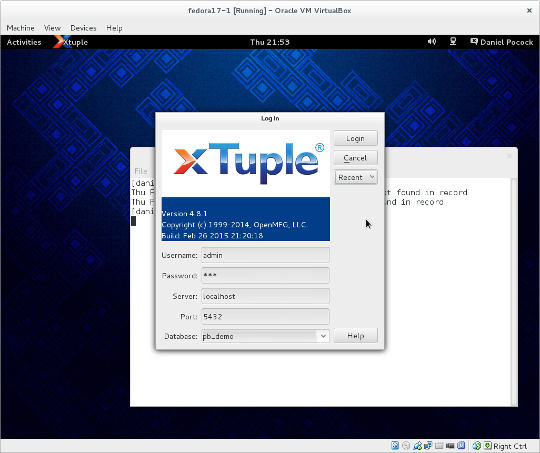
Community support The xTuple forum is a great place to ask any questions and get to know the community. Screenshot Here is a quick look at the login screen on a Fedora 19 host:

13 February 2015

Daniel Leidert: Motion picture capturing: Debian + motion + Logitech C910 - part II

In my recent attempt to setup a motion detection camera I was disappointed, that my camera, which should be able to record with 30 fps in 720p mode only reached 10 fps using the software motion. Now I got a bit further. This seems to be an issue with the format used by motion. I've check the output of v4l2-ctl ...
$ v4l2-ctl -d /dev/video1 --list-formats-ext
[..]
ioctl: VIDIOC_ENUM_FMT
Index : 0
Type : Video Capture
Pixel Format: 'YUYV'
Name : YUV 4:2:2 (YUYV)
[..]
Size: Discrete 1280x720
Interval: Discrete 0.100s (10.000 fps)
Interval: Discrete 0.133s (7.500 fps)
Interval: Discrete 0.200s (5.000 fps)
[..]

Index : 1
Type : Video Capture
Pixel Format: 'MJPG' (compressed)
Name : MJPEG
[..]
Size: Discrete 1280x720
Interval: Discrete 0.033s (30.000 fps)
Interval: Discrete 0.042s (24.000 fps)
Interval: Discrete 0.050s (20.000 fps)
Interval: Discrete 0.067s (15.000 fps)
Interval: Discrete 0.100s (10.000 fps)
Interval: Discrete 0.133s (7.500 fps)
Interval: Discrete 0.200s (5.000 fps)
[..]
... and motion:
$ motion
[..]
[1] [NTC] [VID] v4l2_set_pix_format: Config palette index 17 (YU12) doesn't work.
[1] [NTC] [VID] v4l2_set_pix_format: Supported palettes:
[1] [NTC] [VID] v4l2_set_pix_format: (0) YUYV (YUV 4:2:2 (YUYV))
[1] [NTC] [VID] v4l2_set_pix_format: 0 - YUV 4:2:2 (YUYV) (compressed : 0) (0x56595559)
[1] [NTC] [VID] v4l2_set_pix_format: (1) MJPG (MJPEG)
[1] [NTC] [VID] v4l2_set_pix_format: 1 - MJPEG (compressed : 1) (0x47504a4d)
[1] [NTC] [VID] v4l2_set_pix_format Selected palette YUYV
[1] [NTC] [VID] v4l2_do_set_pix_format: Testing palette YUYV (1280x720)
[1] [NTC] [VID] v4l2_do_set_pix_format: Using palette YUYV (1280x720) bytesperlines 2560 sizeimage 1843200 colorspace 00000008
[..]
Ok, so both formats YUYV and MJPG are supported and recognized and I can choose both via the v4l2palette configuration variable, citing motion.conf:
# v4l2_palette allows to choose preferable palette to be use by motion
# to capture from those supported by your videodevice. (default: 17)
# E.g. if your videodevice supports both V4L2_PIX_FMT_SBGGR8 and
# V4L2_PIX_FMT_MJPEG then motion will by default use V4L2_PIX_FMT_MJPEG.
# Setting v4l2_palette to 2 forces motion to use V4L2_PIX_FMT_SBGGR8
# instead.
#
# Values :
# V4L2_PIX_FMT_SN9C10X : 0 'S910'
# V4L2_PIX_FMT_SBGGR16 : 1 'BYR2'
# V4L2_PIX_FMT_SBGGR8 : 2 'BA81'
# V4L2_PIX_FMT_SPCA561 : 3 'S561'
# V4L2_PIX_FMT_SGBRG8 : 4 'GBRG'
# V4L2_PIX_FMT_SGRBG8 : 5 'GRBG'
# V4L2_PIX_FMT_PAC207 : 6 'P207'
# V4L2_PIX_FMT_PJPG : 7 'PJPG'
# V4L2_PIX_FMT_MJPEG : 8 'MJPEG'
# V4L2_PIX_FMT_JPEG : 9 'JPEG'
# V4L2_PIX_FMT_RGB24 : 10 'RGB3'
# V4L2_PIX_FMT_SPCA501 : 11 'S501'
# V4L2_PIX_FMT_SPCA505 : 12 'S505'
# V4L2_PIX_FMT_SPCA508 : 13 'S508'
# V4L2_PIX_FMT_UYVY : 14 'UYVY'
# V4L2_PIX_FMT_YUYV : 15 'YUYV'
# V4L2_PIX_FMT_YUV422P : 16 '422P'
# V4L2_PIX_FMT_YUV420 : 17 'YU12'
#
v4l2_palette 17
Now motion uses YUYV as default mode as shown by its output. So it seems that all I have to do is to choose MJPEG in my motion.conf:
v4l2_palette 8
Testing again ...
$ motion
[..]
[1] [NTC] [VID] vid_v4lx_start: Using V4L2
[1] [NTC] [ALL] image_ring_resize: Resizing pre_capture buffer to 1 items
[1] [NTC] [VID] v4l2_set_control: setting control "Brightness" to 25 (ret 0 )
Corrupt JPEG data: 5 extraneous bytes before marker 0xd6
[1] [CRT] [VID] mjpegtoyuv420p: Corrupt image ... continue
[1] [NTC] [VID] v4l2_set_control: setting control "Brightness" to 14 (ret 0 )
Corrupt JPEG data: 1 extraneous bytes before marker 0xd5
[1] [CRT] [VID] mjpegtoyuv420p: Corrupt image ... continue
[1] [NTC] [VID] v4l2_set_control: setting control "Brightness" to 36 (ret 0 )
Corrupt JPEG data: 3 extraneous bytes before marker 0xd2
[1] [CRT] [VID] mjpegtoyuv420p: Corrupt image ... continue
[1] [NTC] [VID] v4l2_set_control: setting control "Brightness" to 58 (ret 0 )
Corrupt JPEG data: 1 extraneous bytes before marker 0xd7
[1] [CRT] [VID] mjpegtoyuv420p: Corrupt image ... continue
[1] [NTC] [VID] v4l2_set_control: setting control "Brightness" to 80 (ret 0 )
Corrupt JPEG data: 4 extraneous bytes before marker 0xd7
[1] [CRT] [VID] mjpegtoyuv420p: Corrupt image ... continue
[1] [ERR] [ALL] motion_init: Error capturing first image
[1] [NTC] [ALL] image_ring_resize: Resizing pre_capture buffer to 16 items
Corrupt JPEG data: 4 extraneous bytes before marker 0xd1
[1] [CRT] [VID] mjpegtoyuv420p: Corrupt image ... continue
Corrupt JPEG data: 11 extraneous bytes before marker 0xd1
[1] [CRT] [VID] mjpegtoyuv420p: Corrupt image ... continue
Corrupt JPEG data: 3 extraneous bytes before marker 0xd4
[1] [CRT] [VID] mjpegtoyuv420p: Corrupt image ... continue
Corrupt JPEG data: 7 extraneous bytes before marker 0xd1
[..]
... and another issue is turning up :( The output above goes on and on and on and there is no video capturing. So accordingly to $searchengine the above happens to a lot of people. I just found one often suggested fix: pre-load v4l2convert.so from libv4l-0:
$ LD_PRELOAD=/usr/lib/x86_64-linux-gnu/libv4l/v4l2convert.so motion
But the problem persists and I'm out of ideas :( So atm it lokks like I cannot use the MJPEG format and don't get 30 fps at 1280x720 pixels. During writing I then discovered a solution by good old trial-and-error: Leaving the v4l2_palette variable at its default value 17 (YU12) and pre-loading v4l2convert.so makes use of YU12 and the framerate at least raises to 24 fps:
$ LD_PRELOAD=/usr/lib/x86_64-linux-gnu/libv4lg/v4l2convert.so motion
[..]
[1] [NTC] [VID] v4l2_do_set_pix_format: Testing palette YU12 (1280x720)
[1] [NTC] [VID] v4l2_do_set_pix_format: Using palette YU12 (1280x720) bytesperlines 1280 sizeimage 1382400 colorspace 00000008
[..]
[1] [NTC] [EVT] event_new_video FPS 24
[..]
Finally! :) The results are nice. It would maybe even be a good idea to limit the framerate a bit, to e.g. 20. So that is a tested configuration for the Logitech C910 running at a resolution of 1280x720 pixels:
v4l2_palette 17
width 1280
height 720
framerate 20
minimum_frame_time 0
pre_capture 10 # 0,5 seconds pre-recording
post_capture 50 # 2,5 seconds after-recording
auto_brightness on
ffmpeg_variable_bitrate 2 # best quality
Now all this made me curious, which framerate is possible at a resolution of 1920x1080 pixels now and how the results look like. Although I get 24 fps too, the resulting movie suffers of jumps every few frames. So here I got pretty good results with a more conservative setting. By increasing framerate - tested up to 15 fps with good results - pre_capture needed to be decreased accordingly to values between 1..3 to minimize jumps:
v4l2_palette 17
width 1920
height 1080
framerate 12
minimum_frame_time 0
pre_capture 6 # 0,5 seconds pre-recording
post_capture 30 # 2,5 seconds after-recording
auto_brightness on
ffmpeg_variable_bitrate 2 # best quality
Both configurations lead to satisfying results. Of course the latter will easily fill your hardrive :) TODOI guess, the results can be optimzed further by playing around with ffmpeg_bps and ffmpeg_variable_bitrate. Maybe then it is possible to record without jumps at higher framerates too(?). I also didn't test the various norm settings (PAL, NTSC, etc.).

Next.

Previous.