Search Results: "bod"

9 January 2023

Russ Allbery: Review: Black Stars

Review: Black Stars, edited by Nisi Shawl & Latoya Peterson
Publisher: Amazon Original Stories
Copyright: August 2021
ISBN: 1-5420-3272-5
ISBN: 1-5420-3270-9
ISBN: 1-5420-3271-7
ISBN: 1-5420-3273-3
ISBN: 1-5420-3268-7
ISBN: 1-5420-3269-5
Format: Kindle
Pages: 168
This is a bit of an odd duck from a metadata standpoint. Black Stars is a series of short stories (maybe one creeps into novelette range) published by Amazon for Kindle and audiobook. Each one can be purchased separately (or "borrowed" with Amazon Prime), and they have separate ISBNs, so my normal practice would be to give each its own review. They're much too short for that, though, so I'm reviewing the whole group as an anthology. The cover in the sidebar is for the first story of the series. The other covers have similar designs. I think the one for "We Travel the Spaceways" was my favorite. Each story is by a Black author and most of them are science fiction. ("The Black Pages" is fantasy.) I would classify them as afrofuturism, although I don't have a firm grasp on its definition. This anthology included several authors I've been meaning to read and was conveniently available, so I gave it a try, even though I'm not much of a short fiction reader. That will be apparent in the forthcoming grumbling. "The Visit" by Chimamanda Ngozi Adichie: This is a me problem rather than a story problem, and I suspect it's partly because the story is not for me, but I am very done with gender-swapped sexism. I get the point of telling stories of our own society with enough alienation to force the reader to approach them from a fresh angle, but the problem with a story where women are sexist and condescending to men is that you're still reading a story of condescending sexism. That's particularly true when the analogies to our world are more obvious than the internal logic of the story world, as they are here. "The Visit" tells the story of a reunion between two college friends, one of whom is now a stay-at-home husband and the other of whom has stayed single. There's not much story beyond that, just obvious political metaphor (the Male Masturbatory Act to ensure no potential child is wasted, blatant harrassment of the two men by female cops) and depressing character studies. Everyone in this story is an ass except maybe Obinna's single friend Eze, which means there's nothing to focus on except the sexism. The writing is competent and effective, but I didn't care in the slightest about any of these people or anything that was happening in their awful, dreary world. (4) "The Black Pages" by Nnedi Okorafor: Issaka has been living in Chicago, but the story opens with him returning to Timbouctou where he grew up. His parents know he's coming for a visit, but he's a week early as a surprise. Unfortunately, he's arriving at the same time as an al-Qaeda attack on the library. They set it on fire, but most of the books they were trying to destroy were already saved by his father and are now in Issaka's childhood bedroom. Unbeknownst to al-Qaeda, one of the books they did burn was imprisoning a djinn. A djinn who is now free and resident in Issaka's iPad. This was a great first chapter of a novel. The combination of a modern setting and a djinn trapped in books with an instant affinity with technology was great. Issaka is an interesting character who is well-placed to introduce the reader to the setting, and I was fully invested in Issaka and Faro negotiating their relationship. Then the story just stopped. I didn't understand the ending, which was probably me being dim, but the real problem was that I was not at all ready for an ending. I would read the novel this was setting up, though. (6) "2043... (A Merman I Should Turn to Be)" by Nisi Shawl: This is another story that felt like the setup for a novel, although not as good of a novel. The premise is that the United States has developed biological engineering that allows humans to live underwater for extended periods (although they still have to surface occasionally for air, like whales). The use to which that technology is being put is a rerun of Liberia with less colonialism: Blacks are given the option to be modified into merpeople and live under the sea off the US coast as a solution. White supremacists are not happy, of course, and try to stop them from claiming their patch of ocean floor. This was fine, as far as it went, but I wasn't fond of the lead character and there wasn't much plot. There was some sort of semi-secret plan that the protagonist stumbles across and that never made much sense to me. The best parts of the story were the underwater setting and the semi-realistic details about the merman transformation. (6) "These Alien Skies" by C.T. Rwizi: In the far future, humans are expanding across the galaxy via automatically-constructed wormhole gates. Msizi's job is to be the first ship through a new wormhole to survey the system previously reached only by the AI construction ship. The wormhole is not supposed to explode shortly after he goes through, leaving him stranded in an alien system with only his companion Tariro, who is not who she seems to be. This was a classic SF plot, but I still hadn't guessed where it was going, or the relevance of some undiscussed bits of Tariro's past. Once the plot happens, it's a bit predictable, but I enjoyed it despite the depressed protagonist. (6) "Clap Back" by Nalo Hopkinson: Apart from "The Visit," this was the most directly political of the stories. It opens with Wenda, a protest artist, whose final class project uses nanotech to put racist tchotchkes to an unexpected use. This is intercut with news clippings about a (white and much richer) designer who has found a way to embed memories into clothing and is using this to spread quotes of rather pointed "forgiveness" from a Malawi quilt. This was one of the few entries in this anthology that fit the short story shape for me. Wenda's project and Burri's clothing interact fifty years later in a surprising way. This was the second-best story of the group. (7) "We Travel the Spaceways" by Victor LaValle: Grimace (so named because he wears a huge purple coat) is a homeless man in New York who talks to cans. Most of his life is about finding food, but the cans occasionally give him missions and provide minor assistance. Apart from his cans, he's very much alone, but when he comforts a woman in McDonalds (after getting caught thinking about stealing her cheeseburger), he hopes he may have found a partner. If, that is, she still likes him when she discovers the nature of the cans' missions. This was the best-written story of the six. Grimace is the first-person narrator, and LaValle's handling of characterization and voice is excellent. Grimace makes perfect sense from inside his head, but the reader can also see how unsettling he is to those around him. This could have been a disturbing, realistic story about a schitzophrenic man. As one may have guessed from the theme of the anthology, that's not what it is. I admired the craft of this story, but I found Grimace's missions too horrific to truly like it. There is an in-story justification for them; suffice it to say that I didn't find it believable. An expansion with considerably more detail and history might have bridged that gap, but alas, short fiction. (6) Rating: 6 out of 10

Gunnar Wolf: Back to Xochicalco

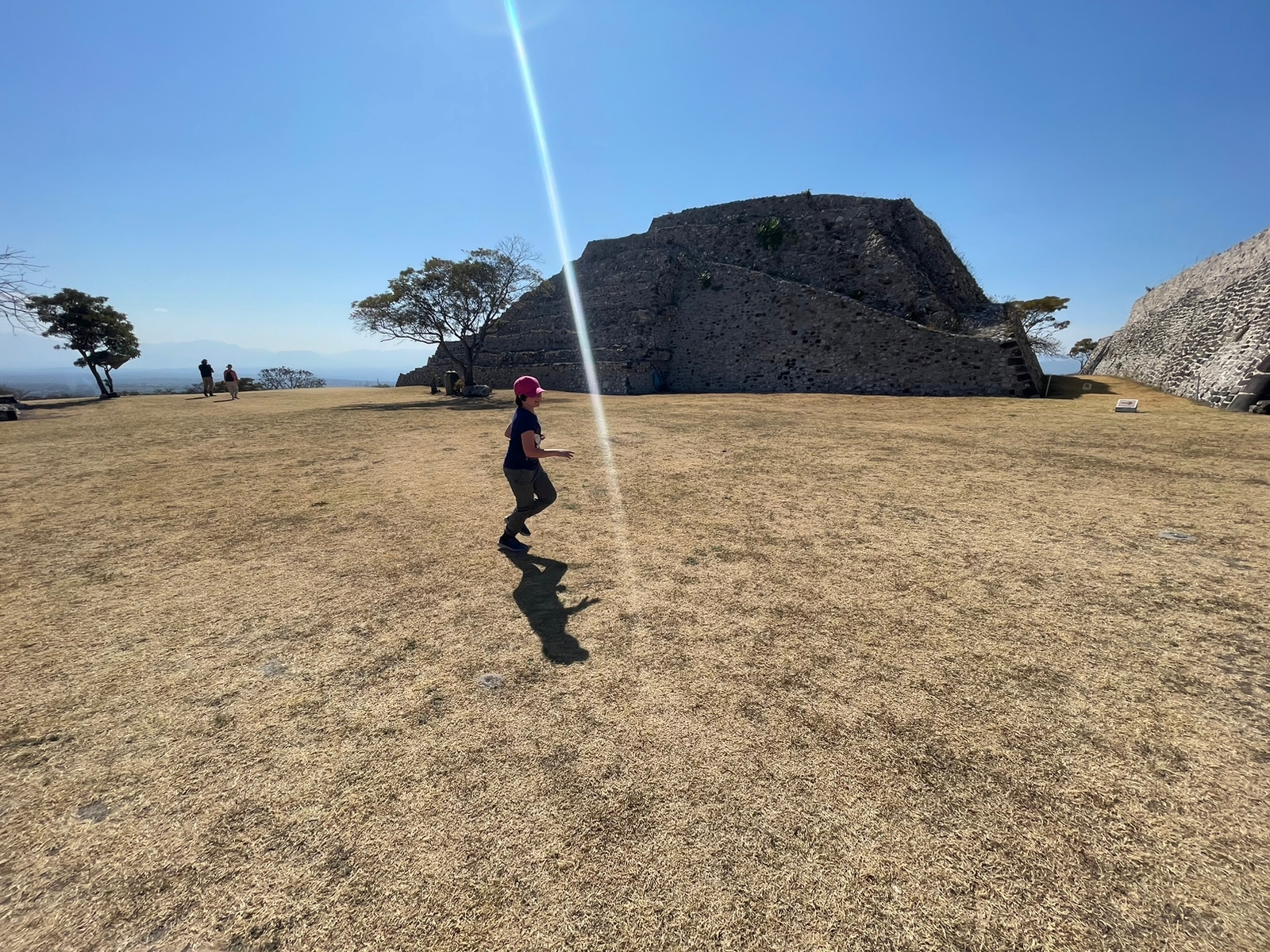
In Mexico, we have the great luck to live among vestiges of long-gone cultures, some that were conquered and in some way got adapted and survived into our modern, mostly-West-Europan-derived society, and some that thrived but disappeared many more centuries ago. And although not everybody feels the same way, in my family we have always enjoyed visiting archaeological sites when I was a child and today. Some of the regulars that follow this blog (or its syndicators) will remember Xochicalco, as it was the destination we chose for the daytrip back in the day, in DebConf6 (May 2006). This weekend, my mother suggested us to go there, as being Winter, the weather is quite pleasant we were at about 25 C, and by the hottest months of the year it can easily reach 10 more; the place lacks shadows, like most archaeological sites, and it does get quite tiring nevertheless! Xochicalco is quite unique among our archaeological sites, as it was built as a conference city: people came from cultures spanning all of Mesoamerica to debate and homogeneize the calendars used in the region. The first photo I shared here is by the Quetzalc atl temple, where each of the four sides shows people from different cultures (the styles in which they are depicted follow their local self-representations), encodes equivalent dates in the different calendaric systems, and are located along representationsof the God of knowledge, the feathered serpent, Quetzalc atl. It was a very nice day out. And, of course, it brought back memories of my favorite conference visiting the site of a very important conference

8 January 2023

Russ Allbery: Review: Postwar

Review: Postwar, by Tony Judt
Publisher: Penguin Books
Copyright: 2005
ISBN: 1-4406-2476-3
Format: Kindle
Pages: 835
Tony Judt (1948 2010) was a British-American historian and Erich Maria Remarque Professor in European Studies at New York University. Postwar is his magnum opus, a history of Europe from 1945 to 2005. A book described as a history of Europe could be anything from a textbook to a political analysis, so the first useful question to ask is what sort of history. That's a somewhat difficult question to answer. Postwar mentions a great deal of conventional history, including important political movements and changes of government, but despite a stated topic that would suit a survey textbook, it doesn't provide that sort of list of facts and dates. Judt expects the reader to already be familiar with the broad outlines of modern European history. However, Postwar is also not a specialty history and avoids diving too deep into any one area. Trends in art, philosophy, and economics are all mentioned to set a broader context, but still only at the level of a general survey. My best description is that Postwar is a comprehensive social and political history that attempts to focus less on specific events and more on larger trends of thought. Judt grounds his narrative in concrete, factual events, but the emphasis is on how those living in Europe, at each point in history, thought of their society, their politics, and their place in both. Most of the space goes to exploring those nuances of thought and day-to-day life. In the US university context, I'd place this book as an intermediate-level course in modern European history, after the survey course that provides students with a basic framework but before graduate-level specializations in specific topics. If you have not had a solid basic education in European history (and my guess is that most people from the US have not), Judt will provide the necessary signposts, but you should expect to need to look up the signposts you don't recognize. I, as the dubious beneficiary of a US high school history education now many decades in the past, frequently resorted to Wikipedia for additional background. Postwar uses a simple chronological structure in four parts: the immediate post-war years and the beginning of the Cold War (1945 1953), the era of rapidly growing western European prosperity (1953 1971), the years of recession and increased turmoil leading up to the collapse of communism (1971 1989), and the aftermath of the collapse of communism and the rise of the European Union (1989 2005). Each part is divided into four to eight long chapters that trace a particular theme. Judt usually starts with the overview of a theme and then follows the local manifestations of it on a spiral through European countries in whatever order seems appropriate. For the bulk of the book that covers the era of the Cold War, when experiences were drastically different inside or outside the Soviet bloc, he usually separates western and eastern Europe into alternating chapters. Reviewing this sort of book is tricky because so much will depend on how well you already know the topic. My interest in history is strictly amateur and I tend to avoid modern history (usually I find it too depressing), so for me this book was remedial, filling in large knowledge gaps that I ideally shouldn't have had. Postwar was a runner up for the Pulitzer Prize for General Non-Fiction, so I think I'm safe saying you won't go far wrong reading it, but here's the necessary disclaimer that the rest of my reactions may not be useful if you're better versed in modern European history than I was. (This would not be difficult.) That said, I found Postwar invaluable because of its big-picture focus. The events and dates are easy enough to find on the Internet; what was missing for me in understanding Europe was the intent and social structures created by and causing those events. For example, from early in the book:
On one thing, however, all were agreed resisters and politicians alike: "planning". The disasters of the inter-war decades the missed opportunities after 1918, the great depression that followed the stock-market crash of 1929, the waste of unemployment, the inequalities, injustices and inefficiencies of laissez-faire capitalism that had led so many into authoritarian temptation, the brazen indifference of an arrogant ruling elite and the incompetence of an inadequate political class all seemed to be connected by the utter failure to organize society better. If democracy was to work, if it was to recover its appeal, it would have to be planned.
It's one thing to be familiar with the basic economic and political arguments between degrees of free market and planned economies. It's quite another to understand how the appeal of one approach or the discredit of another stems from recent historical experience, and that's what a good history can provide. Judt does not hesitate to draw these sorts of conclusions, and I'm sure some of them are controversial. But while he's opinionated, he's rarely ideological, and he offers no grand explanations. His discussion of the Yugoslav Wars stands out as an example: he mentions various theories of blame (a fraught local ethnic history, the decision by others to not intervene until the situation was truly dire), but largely discards them. Judt's offered explanation is that local politicians saw an opportunity to gain power by inflaming ethnic animosity, and a large portion of the population participated in this process, either passively or eagerly. Other explanations are both unnecessarily complex and too willing to deprive Yugoslavs of agency. I found this refreshingly blunt. When is more complex analysis a way to diffuse responsibility and cling to an ideological fantasy that the right foreign policy would have resolved a problem? A few personal grumblings do creep in, particularly in the chapters on the 1970s (and I think it's not a coincidence that this matches Judt's own young adulthood, a time when one is prone to forming a lot of opinions). There is a brief but stinging criticism of postmodernism in scholarship, which I thought was justified but probably incomplete, and a decidedly grumpy dismissal of punk music, which I thought was less fair. But these are brief asides that don't detract from the overall work. Indeed, they, along with the occasional wry asides ("respecting long-established European practice, no one asked the Poles for their views [on Poland's new frontiers]") add a lot of character. Insofar as this book has a thesis, it's in the implications of the title: Europe only exited the postwar period at the end of the 20th century. Political stability through exhaustion, the overwhelming urgency of economic recovery, and the degree to which the Iron Curtain and the Cold War froze eastern Europe in amber meant that full European recovery from World War II was drawn out and at times suspended. It's only after 1989 and its subsequent upheavals that European politics were able to move beyond postwar concerns. Some of that movement was a reemergence of earlier European politics of nations and ethnic conflict. But, new on the scene, was a sense of identity as Europeans, one that western Europe circled warily and eastern Europe saw as the only realistic path forward.
What binds Europeans together, even when they are deeply critical of some aspect or other of its practical workings, is what it has become conventional to call in disjunctive but revealing contrast with "the American way of life" the "European model of society".
Judt also gave me a new appreciation of how traumatic people find the assignment of fault, and how difficult it is to wrestle with guilt without providing open invitations to political backlash. People will go to great lengths to not feel guilty, and pressing the point runs a substantial risk of creating popular support for ideological movements that are willing to lie to their followers. The book's most memorable treatment of this observation is in the epilogue, which traces popular European attitudes towards the history of the Holocaust through the whole time period. The largest problem with this book is that it is dense and very long. I'm a fairly fast reader, but this was the only book I read through most of my holiday vacation and it still took a full week into the new year to finish it. By the end, I admit I was somewhat exhausted and ready to be finished with European history for a while (although the epilogue is very much worth waiting for). If you, unlike me, can read a book slowly among other things, that may be a good tactic. But despite feeling like this was a slog at times, I'm very glad that I read it. I'm not sure if someone with a firmer grounding in European history would have gotten as much out of it, but I, at least, needed something this comprehensive to wrap my mind around the timeline and fill in some embarrassing gaps. Judt is not the most entertaining writer (although he has his moments), and this is not the sort of popular history that goes out of its way to draw you in, but I found it approachable and clear. If you're looking for a solid survey of modern European history with this type of high-level focus, recommended. Rating: 8 out of 10

Charles Plessy: Could somebody patch Firefox to display Markdown files?

When Firefox receives a file with media type text/markdown, it prompts the user to download it, while other browsers display it as plain text. In the ticket 1319262, it is proposed to display Markdown files by default, but there needs a patch

30 December 2022

Chris Lamb: Favourite books of 2022: Non-fiction

In my three most recent posts, I went over the memoirs and biographies, classics and fiction books that I enjoyed the most in 2022. But in the last of my book-related posts for 2022, I'll be going over my favourite works of non-fiction. Books that just missed the cut here include Adam Hochschild's King Leopold's Ghost (1998) on the role of Leopold II of Belgium in the Congo Free State, Johann Hari's Stolen Focus (2022) (a personal memoir on relating to how technology is increasingly fragmenting our attention), Amia Srinivasan's The Right to Sex (2021) (a misleadingly named set of philosophic essays on feminism), Dana Heller et al.'s The Selling of 9/11: How a National Tragedy Became a Commodity (2005), John Berger's mindbending Ways of Seeing (1972) and Louise Richardson's What Terrorists Want (2006).

The Great War and Modern Memory (1975)
Wartime: Understanding and Behavior in the Second World War (1989) Paul Fussell Rather than describe the battles, weapons, geopolitics or big personalities of the two World Wars, Paul Fussell's The Great War and Modern Memory & Wartime are focused instead on how the two wars have been remembered by their everyday participants. Drawing on the memoirs and memories of soldiers and civilians along with a brief comparison with the actual events that shaped them, Fussell's two books are a compassionate, insightful and moving piece of analysis. Fussell primarily sets himself against the admixture of nostalgia and trauma that obscures the origins and unimaginable experience of participating in these wars; two wars that were, in his view, a "perceptual and rhetorical scandal from which total recovery is unlikely." He takes particular aim at the dishonesty of hindsight:
For the past fifty years, the Allied war has been sanitised and romanticised almost beyond recognition by the sentimental, the loony patriotic, the ignorant and the bloodthirsty. I have tried to balance the scales. [And] in unbombed America especially, the meaning of the war [seems] inaccessible.
The author does not engage in any of the customary rose-tinted view of war, yet he remains understanding and compassionate towards those who try to locate a reason within what was quite often senseless barbarism. If anything, his despondency and pessimism about the Second World War (the war that Fussell himself fought in) shines through quite acutely, and this is especially the case in what he chooses to quote from others:
"It was common [ ] throughout the [Okinawa] campaign for replacements to get hit before we even knew their names. They came up confused, frightened, and hopeful, got wounded or killed, and went right back to the rear on the route by which they had come, shocked, bleeding, or stiff. They were forlorn figures coming up to the meat grinder and going right back out of it like homeless waifs, unknown and faceless to us, like unread books on a shelf."
It would take a rather heartless reader to fail to be sobered by this final simile, and an even colder one to view Fussell's citation of such an emotive anecdote to be manipulative. Still, stories and cruel ironies like this one infuse this often-angry book, but it is not without astute and shrewd analysis as well, especially on the many qualitative differences between the two conflicts that simply cannot be captured by facts and figures alone. For example:
A measure of the psychological distance of the Second [World] War from the First is the rarity, in 1914 1918, of drinking and drunkenness poems.
Indeed so. In fact, what makes Fussell's project so compelling and perhaps even unique is that he uses these non-quantitive measures to try and take stock of what happened. After all, this was a war conducted by humans, not the abstract school of statistics. And what is the value of a list of armaments destroyed by such-and-such a regiment when compared with truly consequential insights into both how the war affected, say, the psychology of postwar literature ("Prolonged trench warfare, whether enacted or remembered, fosters paranoid melodrama, which I take to be a primary mode in modern writing."), the specific words adopted by combatants ("It is a truism of military propaganda that monosyllabic enemies are easier to despise than others") as well as the very grammar of interaction:
The Field Service Post Card [in WW1] has the honour of being the first widespread exemplary of that kind of document which uniquely characterises the modern world: the "Form". [And] as the first widely known example of dehumanised, automated communication, the post card popularised a mode of rhetoric indispensable to the conduct of later wars fought by great faceless conscripted armies.
And this wouldn't be a book review without argument-ending observations that:
Indicative of the German wartime conception [of victory] would be Hitler and Speer's elaborate plans for the ultimate reconstruction of Berlin, which made no provision for a library.
Our myths about the two world wars possess an undisputed power, in part because they contain an essential truth the atrocities committed by Germany and its allies were not merely extreme or revolting, but their full dimensions (embodied in the Holocaust and the Holodomor) remain essentially inaccessible within our current ideological framework. Yet the two wars are better understood as an abyss in which we were all dragged into the depths of moral depravity, rather than a battle pitched by the forces of light against the forces of darkness. Fussell is one of the few observers that can truly accept and understand this truth and is still able to speak to us cogently on the topic from the vantage point of experience. The Second World War which looms so large in our contemporary understanding of the modern world (see below) may have been necessary and unavoidable, but Fussell convinces his reader that it was morally complicated "beyond the power of any literary or philosophic analysis to suggest," and that the only way to maintain a na ve belief in the myth that these wars were a Manichaean fight between good and evil is to overlook reality. There are many texts on the two World Wars that can either stir the intellect or move the emotions, but Fussell's two books do both. A uniquely perceptive and intelligent commentary; outstanding.

Longitude (1995) Dava Sobel Since Man first decided to sail the oceans, knowing one's location has always been critical. Yet doing so reliably used to be a serious problem if you didn't know where you were, you are far more likely to die and/or lose your valuable cargo. But whilst finding one's latitude (ie. your north south position) had effectively been solved by the beginning of the 17th century, finding one's (east west) longitude was far from trustworthy in comparison. This book first published in 1995 is therefore something of an anachronism. As in, we readily use the GPS facilities of our phones today without hesitation, so we find it difficult to imagine a reality in which knowing something fundamental like your own location is essentially unthinkable. It became clear in the 18th century, though, that in order to accurately determine one's longitude, what you actually needed was an accurate clock. In Longitude, therefore, we read of the remarkable story of John Harrison and his quest to create a timepiece that would not only keep time during a long sea voyage but would survive the rough ocean conditions as well. Self-educated and a carpenter by trade, Harrison made a number of important breakthroughs in keeping accurate time at sea, and Longitude describes his novel breakthroughs in a way that is both engaging and without talking down to the reader. Still, this book covers much more than that, including the development of accurate longitude going hand-in-hand with advancements in cartography as well as in scientific experiments to determine the speed of light: experiments that led to the formulation of quantum mechanics. It also outlines the work being done by Harrison's competitors. 'Competitors' is indeed the correct word here, as Parliament offered a huge prize to whoever could create such a device, and the ramifications of this tremendous financial incentive are an essential part of this story. For the most part, though, Longitude sticks to the story of Harrison and his evolving obsession with his creating the perfect timepiece. Indeed, one reason that Longitude is so resonant with readers is that many of the tropes of the archetypical 'English inventor' are embedded within Harrison himself. That is to say, here is a self-made man pushing against the establishment of the time, with his groundbreaking ideas being underappreciated in his life, or dishonestly purloined by his intellectual inferiors. At the level of allegory, then, I am minded to interpret this portrait of Harrison as a symbolic distillation of postwar Britain a nation acutely embarrassed by the loss of the Empire that is now repositioning itself as a resourceful but plucky underdog; a country that, with a combination of the brains of boffins and a healthy dose of charisma and PR, can still keep up with the big boys. (It is this same search for postimperial meaning I find in the fiction of John le Carr , and, far more famously, in the James Bond franchise.) All of this is left to the reader, of course, as what makes Longitute singularly compelling is its gentle manner and tone. Indeed, at times it was as if the doyenne of sci-fi Ursula K. LeGuin had a sideline in popular non-fiction. I realise it's a mark of critical distinction to downgrade the importance of popular science in favour of erudite academic texts, but Latitude is ample evidence that so-called 'pop' science need not be patronising or reductive at all.

Closed Chambers: The Rise, Fall, and Future of the Modern Supreme Court (1998) Edward Lazarus After the landmark decision by the U.S. Supreme Court in *Dobbs v. Jackson Women's Health Organization that ended the Constitutional right to abortion conferred by Roe v Wade, I prioritised a few books in the queue about the judicial branch of the United States. One of these books was Closed Chambers, which attempts to assay, according to its subtitle, "The Rise, Fall and Future of the Modern Supreme Court". This book is not merely simply a learned guide to the history and functioning of the Court (although it is completely creditable in this respect); it's actually an 'insider' view of the workings of the institution as Lazurus was a clerk for Justice Harry Blackmun during the October term of 1988. Lazarus has therefore combined his experience as a clerk and his personal reflections (along with a substantial body of subsequent research) in order to communicate the collapse in comity between the Justices. Part of this book is therefore a pure history of the Court, detailing its important nineteenth-century judgements (such as Dred Scott which ruled that the Constitution did not consider Blacks to be citizens; and Plessy v. Ferguson which failed to find protection in the Constitution against racial segregation laws), as well as many twentieth-century cases that touch on the rather technical principle of substantive due process. Other layers of Lazurus' book are explicitly opinionated, however, and they capture the author's assessment of the Court's actions in the past and present [1998] day. Given the role in which he served at the Court, particular attention is given by Lazarus to the function of its clerks. These are revealed as being far more than the mere amanuenses they were hitherto believed to be. Indeed, the book is potentially unique in its the claim that the clerks have played a pivotal role in the deliberations, machinations and eventual rulings of the Court. By implication, then, the clerks have plaedy a crucial role in the internal controversies that surround many of the high-profile Supreme Court decisions decisions that, to the outsider at least, are presented as disinterested interpretations of Constitution of the United States. This is of especial importance given that, to Lazarus, "for all the attention we now pay to it, the Court remains shrouded in confusion and misunderstanding." Throughout his book, Lazarus complicates the commonplace view that the Court is divided into two simple right vs. left political factions, and instead documents an ever-evolving series of loosely held but strongly felt series of cabals, quid pro quo exchanges, outright equivocation and pure personal prejudices. (The age and concomitant illnesses of the Justices also appears to have a not insignificant effect on the Court's rulings as well.) In other words, Closed Chambers is not a book that will be read in a typical civics class in America, and the only time the book resorts to the customary breathless rhetoric about the US federal government is in its opening chapter:
The Court itself, a Greek-style temple commanding the crest of Capitol Hill, loomed above them in the dim light of the storm. Set atop a broad marble plaza and thirty-six steps, the Court stands in splendid isolation appropriate to its place at the pinnacle of the national judiciary, one of the three independent and "coequal" branches of American government. Once dubbed the Ivory Tower by architecture critics, the Court has a Corinthian colonnade and massive twenty-foot-high bronze doors that guard the single most powerful judicial institution in the Western world. Lights still shone in several offices to the right of the Court's entrance, and [ ]
Et cetera, et cetera. But, of course, this encomium to the inherent 'nobility' of the Supreme Court is quickly revealed to be a narrative foil, as Lazarus soon razes this dangerously na ve conception to the ground:
[The] institution is [now] broken into unyielding factions that have largely given up on a meaningful exchange of their respective views or, for that matter, a meaningful explication or defense of their own views. It is of Justices who in many important cases resort to transparently deceitful and hypocritical arguments and factual distortions as they discard judicial philosophy and consistent interpretation in favor of bottom-line results. This is a Court so badly splintered, yet so intent on lawmaking, that shifting 5-4 majorities, or even mere pluralities, rewrite whole swaths of constitutional law on the authority of a single, often idiosyncratic vote. It is also a Court where Justices yield great and excessive power to immature, ideologically driven clerks, who in turn use that power to manipulate their bosses and the institution they ostensibly serve.
Lazurus does not put forward a single, overarching thesis, but in the final chapters, he does suggest a potential future for the Court:
In the short run, the cure for what ails the Court lies solely with the Justices. It is their duty, under the shield of life tenure, to recognize the pathologies affecting their work and to restore the vitality of American constitutionalism. Ultimately, though, the long-term health of the Court depends on our own resolve on whom [we] select to join that institution.
Back in 1998, Lazurus might have had room for this qualified optimism. But from the vantage point of 2022, it appears that the "resolve" of the United States citizenry was not muscular enough to meet his challenge. After all, Lazurus was writing before Bush v. Gore in 2000, which arrogated to the judicial branch the ability to decide a presidential election; the disillusionment of Barack Obama's failure to nominate a replacement for Scalia; and many other missteps in the Court as well. All of which have now been compounded by the Trump administration's appointment of three Republican-friendly justices to the Court, including hypocritically appointing Justice Barrett a mere 38 days before the 2020 election. And, of course, the leaking and ruling in Dobbs v. Jackson, the true extent of which has not been yet. Not of a bit of this is Lazarus' fault, of course, but the Court's recent decisions (as well as the liberal hagiographies of 'RBG') most perforce affect one's reading of the concluding chapters. The other slight defect of Closed Chambers is that, whilst it often implies the importance of the federal and state courts within the judiciary, it only briefly positions the Supreme Court's decisions in relation to what was happening in the House, Senate and White House at the time. This seems to be increasingly relevant as time goes on: after all, it seems fairly clear even to this Brit that relying on an activist Supreme Court to enact progressive laws must be interpreted as a failure of the legislative branch to overcome the perennial problems of the filibuster, culture wars and partisan bickering. Nevertheless, Lazarus' book is in equal parts ambitious, opinionated, scholarly and dare I admit it? wonderfully gossipy. By juxtaposing history, memoir, and analysis, Closed Chambers combines an exacting evaluation of the Court's decisions with a lively portrait of the intellectual and emotional intensity that has grown within the Supreme Court's pseudo-monastic environment all while it struggles with the most impactful legal issues of the day. This book is an excellent and well-written achievement that will likely never be repeated, and a must-read for anyone interested in this ever-increasingly important branch of the US government.

Crashed: How a Decade of Financial Crises Changed the World (2018)
Shutdown: How Covid Shook the World's Economy (2021) Adam Tooze The economic historian Adam Tooze has often been labelled as an unlikely celebrity, but in the fourteen years since the global financial crisis of 2008, a growing audience has been looking for answers about the various failures of the modern economy. Tooze, a professor of history at New York's Columbia University, has written much that is penetrative and thought-provoking on this topic, and as a result, he has generated something of a cult following amongst economists, historians and the online left. I actually read two Tooze books this year. The first, Crashed (2018), catalogues the scale of government intervention required to prop up global finance after the 2008 financial crisis, and it characterises the different ways that countries around the world failed to live up to the situation, such as doing far too little, or taking action far too late. The connections between the high-risk subprime loans, credit default swaps and the resulting liquidity crisis in the US in late 2008 is fairly well known today in part thanks to films such as Adam McKay's 2015 The Big Short and much improved economic literacy in media reportage. But Crashed makes the implicit claim that, whilst the specific and structural origins of the 2008 crisis are worth scrutinising in exacting detail, it is the reaction of states in the months and years after the crash that has been overlooked as a result. After all, this is a reaction that has not only shaped a new economic order, it has created one that does not fit any conventional idea about the way the world 'ought' to be run. Tooze connects the original American banking crisis to the (multiple) European debt crises with a larger crisis of liberalism. Indeed, Tooze somehow manages to cover all these topics and more, weaving in Trump, Brexit and Russia's 2014 annexation of Crimea, as well as the evolving role of China in the post-2008 economic order. Where Crashed focused on the constellation of consequences that followed the events of 2008, Shutdown is a clear and comprehensive account of the way the world responded to the economic impact of Covid-19. The figures are often jaw-dropping: soon after the disease spread around the world, 95% of the world's economies contracted simultaneously, and at one point, the global economy shrunk by approximately 20%. Tooze's keen and sobering analysis of what happened is made all the more remarkable by the fact that it came out whilst the pandemic was still unfolding. In fact, this leads quickly to one of the book's few flaws: by being published so quickly, Shutdown prematurely over-praises China's 'zero Covid' policy, and these remarks will make a reader today squirm in their chair. Still, despite the regularity of these references (after all, mentioning China is very useful when one is directly comparing economic figures in early 2021, for examples), these are actually minor blemishes on the book's overall thesis. That is to say, Crashed is not merely a retelling of what happened in such-and-such a country during the pandemic; it offers in effect a prediction about what might be coming next. Whilst the economic responses to Covid averted what could easily have been another Great Depression (and thus showed it had learned some lessons from 2008), it had only done so by truly discarding the economic rule book. The by-product of inverting this set of written and unwritten conventions that have governed the world for the past 50 years, this 'Washington consensus' if you well, has yet to be fully felt. Of course, there are many parallels between these two books by Tooze. Both the liquidity crisis outlined in Crashed and the economic response to Covid in Shutdown exposed the fact that one of the central tenets of the modern economy ie. that financial markets can be trusted to regulate themselves was entirely untrue, and likely was false from the very beginning. And whilst Adam Tooze does not offer a singular piercing insight (conveying a sense of rigorous mastery instead), he may as well be asking whether we're simply going to lurch along from one crisis to the next, relying on the technocrats in power to fix problems when everything blows up again. The answer may very well be yes.

Looking for the Good War: American Amnesia and the Violent Pursuit of Happiness (2021) Elizabeth D. Samet Elizabeth D. Samet's Looking for the Good War answers the following question what would be the result if you asked a professor of English to disentangle the complex mythology we have about WW2 in the context of the recent US exit of Afghanistan? Samet's book acts as a twenty-first-century update of a kind to Paul Fussell's two books (reviewed above), as well as a deeper meditation on the idea that each new war is seen through the lens of the previous one. Indeed, like The Great War and Modern Memory (1975) and Wartime (1989), Samet's book is a perceptive work of demystification, but whilst Fussell seems to have been inspired by his own traumatic war experience, Samet is not only informed by her teaching West Point military cadets but by the physical and ontological wars that have occurred during her own life as well. A more scholarly and dispassionate text is the result of Samet's relative distance from armed combat, but it doesn't mean Looking for the Good War lacks energy or inspiration. Samet shares John Adams' belief that no political project can entirely shed the innate corruptions of power and ambition and so it is crucial to analyse and re-analyse the role of WW2 in contemporary American life. She is surely correct that the Second World War has been universally elevated as a special, 'good' war. Even those with exceptionally giddy minds seem to treat WW2 as hallowed:
It is nevertheless telling that one of the few occasions to which Trump responded with any kind of restraint while he was in office was the 75th anniversary of D-Day in 2019.
What is the source of this restraint, and what has nurtured its growth in the eight decades since WW2 began? Samet posits several reasons for this, including the fact that almost all of the media about the Second World War is not only suffused with symbolism and nostalgia but, less obviously, it has been made by people who have no experience of the events that they depict. Take Stephen Ambrose, author of Steven Spielberg's Band of Brothers miniseries: "I was 10 years old when the war ended," Samet quotes of Ambrose. "I thought the returning veterans were giants who had saved the world from barbarism. I still think so. I remain a hero worshiper." If Looking for the Good War has a primary thesis, then, it is that childhood hero worship is no basis for a system of government, let alone a crusading foreign policy. There is a straight line (to quote this book's subtitle) from the "American Amnesia" that obscures the reality of war to the "Violent Pursuit of Happiness." Samet's book doesn't merely just provide a modern appendix to Fussell's two works, however, as it adds further layers and dimensions he overlooked. For example, Samet provides some excellent insight on the role of Western, gangster and superhero movies, and she is especially good when looking at noir films as a kind of kaleidoscopic response to the Second World War:
Noir is a world ruled by bad decisions but also by bad timing. Chance, which plays such a pivotal role in war, bleeds into this world, too.
Samet rightfully weaves the role of women into the narrative as well. Women in film noir are often celebrated as 'independent' and sassy, correctly reflecting their newly-found independence gained during WW2. But these 'liberated' roles are not exactly a ringing endorsement of this independence: the 'femme fatale' and the 'tart', etc., reflect a kind of conditional freedom permitted to women by a post-War culture which is still wedded to an outmoded honour culture. In effect, far from being novel and subversive, these roles for women actually underwrote the ambient cultural disapproval of women's presence in the workforce. Samet later connects this highly-conditional independence with the liberation of Afghan women, which:
is inarguably one of the more palatable outcomes of our invasion, and the protection of women's rights has been invoked on the right and the left as an argument for staying the course in Afghanistan. How easily consequence is becoming justification. How flattering it will be one day to reimagine it as original objective.
Samet has ensured her book has a predominantly US angle as well, for she ends her book with a chapter on the pseudohistorical Lost Cause of the Civil War. The legacy of the Civil War is still visible in the physical phenomena of Confederate statues, but it also exists in deep-rooted racial injustice that has been shrouded in euphemism and other psychological devices for over 150 years. Samet believes that a key part of what drives the American mythology about the Second World War is the way in which it subconsciously cleanses the horrors of brother-on-brother murder that were seen in the Civil War. This is a book that is not only of interest to historians of the Second World War; it is a work for anyone who wishes to understand almost any American historical event, social issue, politician or movie that has appeared since the end of WW2. That is for better or worse everyone on earth.

29 December 2022

Chris Lamb: Favourite books of 2022: Memoir/biography

In my two most recent posts, I listed the fiction and classic fiction I enjoyed the most in 2022. I'll leave my roundup of general non-fiction until tomorrow, but today I'll be going over my favourite memoirs and biographies, in no particular order. Books that just missed the cut here include Roisin Kiberd's The Disconnect: A Personal Journey Through the Internet (2019), Steve Richards' The Prime Ministers (2019) which reflects on UK leadership from Harold Wilson to Boris Johnson, Robert Graves Great War memoir Goodbye to All That (1929) and David Mikics's portrait of Stanley Kubrick called American Filmmaker.

Afropean: Notes from Black Europe (2019) Johny Pitts Johny Pitts is a photographer and writer who lives in the north of England who set out to explore "black Europe from the street up" those districts within European cities that, although they were once 'white spaces' in the past, they are now occupied by Black people. Unhappy with the framing of the Black experience back home in post-industrial Sheffield, Pitts decided to become a nomad and goes abroad to seek out the sense of belonging he cannot find in post-Brexit Britain, and Afropean details his journey through Paris, Brussels, Lisbon, Berlin, Stockholm and Moscow. However, Pitts isn't just avoiding the polarisation and structural racism embedded in contemporary British life. Rather, he is seeking a kind of super-national community that transcends the reductive and limiting nationalisms of all European countries, most of which have based their national story on a self-serving mix of nostalgia and postcolonial fairy tales. Indeed, the term 'Afropean' is the key to understanding the goal of this captivating memoir. Pitts writes at the beginning of this book that the word wasn't driven only as a response to the crude nativisms of Nigel Farage and Marine Le Pen, but that it:
encouraged me to think of myself as whole and unhyphenated. [ ] Here was a space where blackness was taking part in shaping European identity at large. It suggested the possibility of living in and with more than one idea: Africa and Europe, or, by extension, the Global South and the West, without being mixed-this, half-that or black-other. That being black in Europe didn t necessarily mean being an immigrant.
In search of this whole new theory of home, Pitts travels to the infamous banlieue of Clichy-sous-Bois just to the East of Paris, thence to Matong in Brussels, as well as a quick and abortive trip into Moscow and other parallel communities throughout the continent. In these disparate environs, Pitts strikes up countless conversations with regular folk in order to hear their quotidian stories of living, and ultimately to move away from the idea that Black history is defined exclusively by slavery. Indeed, to Pitts, the idea of race is one that ultimately restricts one's humanity; the concept "is often forced to embody and speak for certain ideas, despite the fact it can't ever hold in both hands the full spectrum of a human life and the cultural nuances it creates." It's difficult to do justice to the effectiveness of the conversations Pitts has throughout his travels, but his shrewd attention to demeanour, language, raiment and expression vividly brings alive the people he talks to. Of related interest to fellow Brits as well are the many astute observations and comparisons with Black and working-class British life. The tone shifts quite often throughout this book. There might be an amusing aside one minute, such as the portrait of an African American tourist in Paris to whom "the whole city was a film set, with even its homeless people appearing to him as something oddly picturesque." But the register abruptly changes when he visits Clichy-sous-Bois on an anniversary of important to the area, and an element of genuine danger is introduced when Johny briefly visits Moscow and barely gets out alive. What's especially remarkable about this book is there is a freshness to Pitt s treatment of many well-worn subjects. This can be seen in his account of Belgium under the reign of Leopold II, the history of Portuguese colonialism (actually mostly unknown to me), as well in the way Pitts' own attitude to contemporary anti-fascist movements changes throughout an Antifa march. This chapter was an especial delight, and not only because it underlined just how much of Johny's trip was an inner journey of an author willing have his mind changed. Although Johny travels alone throughout his journey, in the second half of the book, Pitts becomes increasingly accompanied by a number of Black intellectuals by the selective citing of Frantz Fanon and James Baldwin and Caryl Phillips. (Nevertheless, Jonny has also brought his camera for the journey as well, adding a personal touch to this already highly-intimate book.) I suspect that his increasing exercise of Black intellectual writing in the latter half of the book may be because Pitts' hopes about 'Afropean' existence ever becoming a reality are continually dashed and undercut. The unity among potential Afropeans appears more-and-more unrealisable as the narrative unfolds, the various reasons of which Johny explores both prosaically and poetically. Indeed, by the end of the book, it's unclear whether Johny has managed to find what he left the shores of England to find. But his mix of history, sociology and observation of other cultures right on my doorstep was something of a revelation to me.

Orwell's Roses (2021) Rebecca Solnit Orwell s Roses is an alternative journey through the life and afterlife of George Orwell, reimaging his life primarily through the lens of his attentiveness to nature. Yet this framing of the book as an 'alternative' history is only revisionist if we compare it to the usual view of Orwell as a bastion of 'free speech' and English 'common sense' the roses of the title of this book were very much planted by Orwell in his Hertfordshire garden in 1936, and his yearning of nature one was one of the many constants throughout his life. Indeed, Orwell wrote about wildlife and outdoor life whenever he could get away with it, taking pleasure in a blackbird's song and waxing nostalgically about the English countryside in his 1939 novel Coming Up for Air (reviewed yesterday).
By sheer chance, I actually visited this exact garden immediately to the publication of this book
Solnit has a particular ability to evince unexpected connections between Orwell and the things he was writing about: Joseph Stalin's obsession with forcing lemons to grow in ludicrously cold climates; Orwell s slave-owning ancestors in Jamaica; Jamaica Kincaid's critique of colonialism in the flower garden; and the exploitative rose industry in Colombia that supplies the American market. Solnit introduces all of these new correspondences in a voice that feels like a breath of fresh air after decades of stodgy Orwellania, and without lapsing into a kind of verbal soft-focus. Indeed, the book displays a marked indifference towards the usual (male-centric) Orwell fandom. Her book draws to a close with a rereading of the 'dystopian' Nineteen Eighty-Four that completes her touching portrait of a more optimistic and hopeful Orwell, as well as a reflection on beauty and a manifesto for experiencing joy as an act of resistance.

The Disaster Artist (2013) Greg Sestero & Tom Bissell For those not already in the know, The Room was a 2003 film by director-producer-writer-actor Tommy Wiseau, an inscrutable Polish immigr with an impenetrable background, an idiosyncratic choice of wardrobe and a mysterious large source of income. The film, which centres on a melodramatic love triangle, has since been described by several commentators and publications as one of the worst films ever made. Tommy's production completely bombed at the so-called 'box office' (the release was actually funded entirely by Wiseau personally), but the film slowly became a favourite at cult cinema screenings. Given Tommy's prominent and central role in the film, there was always an inherent cruelty involved in indulging in the spectacle of The Room the audience was laughing because the film was astonishingly bad, of course, but Wiseau infused his film with sincere earnestness that in a heartless twist of irony may be precisely why it is so terrible to begin with. Indeed, it should be stressed that The Room is not simply a 'bad' film, and therefore not worth paying any attention to: it is uncannily bad in a way that makes it eerily compelling to watch. It unintentionally subverts all the rules of filmmaking in a way that captivates the attention. Take this representative example:
This thirty-six-second scene showcases almost every problem in The Room: the acting, the lighting, the sound design, the pacing, the dialogue and that this unnecessary scene (which does not advance the plot) even exists in the first place. One problem that the above clip doesn't capture, however, is Tommy's vulnerable ego. (He would later make the potentially conflicting claims that The Room was both an ironic cult success and that he is okay with people interpreting it sincerely). Indeed, the filmmaker's central role as Johnny (along with his Willy-Wonka meets Dracula persona) doesn't strike viewers as yet another vanity project, it actually asks more questions than it answers. Why did Tommy even make this film? What is driving him psychologically? And why and how? is he so spellbinding? On the surface, then, 2013's The Disaster Artist is a book about the making of one the strangest films ever made, written by The Room's co-star Greg Sestero and journalist Tom Bissell. Naturally, you learn some jaw-dropping facts about the production and inspiration of the film, the seed of which was planted when Greg and Tommy went to see an early screening of The Talented Mr Ripley (1999). It turns out that Greg's character in The Room is based on Tommy's idiosyncratic misinterpretation of its plot, extending even to the character's name Mark who, in textbook Tommy style, was taken directly (or at least Tommy believed) from one of Ripley's movie stars: "Mark Damon" [sic]. Almost as absorbing as The Room itself, The Disaster Artist is partly a memoir about Thomas P. Wiseau and his cinematic masterpiece. But it could also be described as a biography about a dysfunctional male relationship and, almost certainly entirely unconsciously, a text about the limitations of hetronormativity. It is this latter element that struck me the most whilst reading this book: if you take a step back for a moment, there is something uniquely sad about Tommy's inability to connect with others, and then, when Wiseau poured his soul into his film people just laughed. Despite the stories about his atrocious behaviour both on and off the film set, there's something deeply tragic about the whole affair. Jean-Luc Godard, who passed away earlier this year, once observed that every fictional film is a documentary of its actors. The Disaster Artist shows that this well-worn aphorism doesn't begin to cover it.

Russ Allbery: Review: Sweep of the Heart

Review: Sweep of the Heart, by Ilona Andrews
Series: Innkeeper Chronicles #6
Publisher: NYLA Publishing
Copyright: 2022
ISBN: 1-64197-239-4
Format: Kindle
Pages: 440
Sweep of the Heart is the sixth book of the sci-fi urban fantasy, kitchen-sink-worldbuilding Innkeeper series by husband and wife writing pair Ilona Andrews, assuming one counts the novella Sweep with Me as a full entry (which I do). It's a direct sequel to One Fell Sweep, but also references the events of Sweep of the Blade and Sweep with Me enough to spoil them. Needless to say, don't start here. As always with this series, the book was originally published as a serial on Ilona Andrews's blog. I prefer to read my novels as novels, so I wait until the entries are collected and published, but you can read it on-line for free if you want. Sean and Dina's old friend Wilmos has been kidnapped by an enemy who looks familiar from One Fell Sweep. To get him back, they need to get to a world that is notoriously inaccessible. One player in galactic politics may be able to offer a portal, but it will come as a price. That price? Host a reality TV show. Specifically, a sci-fi version of The Bachelor, with aliens. And the bachelor is the ruler of a galactic empire, whose personal safety is now Dina's responsibility. There is a hand-waving explanation for why the Seven Star Dominion does spouse selection for their rulers this way, but let's be honest: it's a fairly transparent excuse to write a season of The Bachelor with strange aliens, political intrigue, inn-generated special effects and wallpaper-worthy backdrops, ulterior motives, and attempted murder. Oh, and competence porn, as Dina once again demonstrates just how good she's become at being an innkeeper. I'm not much of a reality TV fan, have never watched The Bachelor, and still thoroughly enjoyed this. It helps that the story is more about political intrigue than it is about superficial attraction or personal infighting, and the emperor at the center of the drama is calm, thoughtful, and juggling a large number of tricky problems (which Dina, somewhat improbably, becomes privy to). The contestants range from careful diplomats with hidden political goals to eye candy with the subtlety of a two by four, the latter sponsored by sentient murderous trees, so there's a delightful variety of tone and a ton of narrative momentum. A few of the twists and turns were obvious, but some of the cliches are less cliched than they initially look. This series always leans towards "play with every toy in the toy box at once!" rather than subtle and realistic. This entry is no exception, but the mish-mash of science fiction tropes with nigh-unlimited fantasy power is, as usual, done with so much verve and sheer creative joy that I can't help but love it. We do finally learn Caldenia's past, and... I kind of wish we hadn't? Or at least that her past had been a bit more complicated. I will avoid spoiling it by saying too much, but I thought it was an oddly flat and overdone trope that made Caldenia substantially less interesting than she was before this revelation. That was one mild disappointment. The other is that the opening of Sweep of the Heart teases some development of the overall series plot, but that remains mostly a tease. Wilmos's kidnapping and any relevance to deeper innkeeper problems is, at least in this entry, merely a framing story for the reality TV show that constitutes the bulk of the novel. There are a few small revelations in the conclusion, but only the type that raise more questions. Hopefully we'll get more series plot development in the next book, but even if we don't, I'm happily along for the ride. If you like this series, this is more of the thing you already like. If you haven't read it yet, I highly recommend it (start with Clean Sweep). It's not great literature, and most of the trappings will be familiar from a dozen other novels and TV shows, but it's unabashed fun with loads of competence porn and a wild internal logic that grows on you over time. Also, it has one of the most emotionally satisfying sentient buildings in SF. There will, presumably, be more entries in the series, but they have not yet been announced. Rating: 8 out of 10

28 December 2022

Chris Lamb: Favourite books of 2022: Classics

As a follow-up to yesterday's post detailing my favourite works of fiction from 2022, today I'll be listing my favourite fictional works that are typically filed under classics. Books that just missed the cut here include: E. M. Forster's A Room with a View (1908) and his later A Passage to India (1913), both gently nudged out by Forster's superb Howard's End (see below). Giuseppe Tomasi di Lampedusa's The Leopard (1958) also just missed out on a write-up here, but I can definitely recommend it to anyone interested in reading a modern Italian classic.

War and Peace (1867) Leo Tolstoy It's strange to think that there is almost no point in reviewing this novel: who hasn't heard of War and Peace? What more could possibly be said about it now? Still, when I was growing up, War and Peace was always the stereotypical example of the 'impossible book', and even start it was, at best, a pointless task, and an act of hubris at worst. And so there surely exists a parallel universe in which I never have and will never will read the book... Nevertheless, let us try to set the scene. Book nine of the novel opens as follows:
On the twelfth of June, 1812, the forces of Western Europe crossed the Russian frontier and war began; that is, an event took place opposed to human reason and to human nature. Millions of men perpetrated against one another such innumerable crimes, frauds, treacheries, thefts, forgeries, issues of false money, burglaries, incendiarisms and murders as in whole centuries are not recorded in the annals of all the law courts of the world, but which those who committed them did not at the time regard as being crimes. What produced this extraordinary occurrence? What were its causes? [ ] The more we try to explain such events in history reasonably, the more unreasonable and incomprehensible they become to us.
Set against the backdrop of the Napoleonic Wars and Napoleon's invasion of Russia, War and Peace follows the lives and fates of three aristocratic families: The Rostovs, The Bolkonskys and the Bezukhov's. These characters find themselves situated athwart (or against) history, and all this time, Napoleon is marching ever closer to Moscow. Still, Napoleon himself is essentially just a kind of wallpaper for a diverse set of personal stories touching on love, jealousy, hatred, retribution, naivety, nationalism, stupidity and much much more. As Elif Batuman wrote earlier this year, "the whole premise of the book was that you couldn t explain war without recourse to domesticity and interpersonal relations." The result is that Tolstoy has woven an incredibly intricate web that connects the war, noble families and the everyday Russian people to a degree that is surprising for a book started in 1865. Tolstoy's characters are probably timeless (especially the picaresque adventures and constantly changing thoughts Pierre Bezukhov), and the reader who has any social experience will immediately recognise characters' thoughts and actions. Some of this is at a 'micro' interpersonal level: for instance, take this example from the elegant party that opens the novel:
Each visitor performed the ceremony of greeting this old aunt whom not one of them knew, not one of them wanted to know, and not one of them cared about. The aunt spoke to each of them in the same words, about their health and her own and the health of Her Majesty, who, thank God, was better today. And each visitor, though politeness prevented his showing impatience, left the old woman with a sense of relief at having performed a vexatious duty and did not return to her the whole evening.
But then, some of the focus of the observations are at the 'macro' level of the entire continent. This section about cities that feel themselves in danger might suffice as an example:
At the approach of danger, there are always two voices that speak with equal power in the human soul: one very reasonably tells a man to consider the nature of the danger and the means of escaping it; the other, still more reasonably, says that it is too depressing and painful to think of the danger, since it is not in man s power to foresee everything and avert the general course of events, and it is therefore better to disregard what is painful till it comes and to think about what is pleasant. In solitude, a man generally listens to the first voice, but in society to the second.
And finally, in his lengthy epilogues, Tolstoy offers us a dissertation on the behaviour of large organisations, much of it through engagingly witty analogies. These epilogues actually turn out to be an oblique and sarcastic commentary on the idiocy of governments and the madness of war in general. Indeed, the thorough dismantling of the 'great man' theory of history is a common theme throughout the book:
During the whole of that period [of 1812], Napoleon, who seems to us to have been the leader of all these movements as the figurehead of a ship may seem to a savage to guide the vessel acted like a child who, holding a couple of strings inside a carriage, thinks he is driving it. [ ] Why do [we] all speak of a military genius ? Is a man a genius who can order bread to be brought up at the right time and say who is to go to the right and who to the left? It is only because military men are invested with pomp and power and crowds of sychophants flatter power, attributing to it qualities of genius it does not possess.
Unlike some other readers, I especially enjoyed these diversions into the accounting and workings of history, as well as our narrow-minded way of trying to 'explain' things in a singular way:
When an apple has ripened and falls, why does it fall? Because of its attraction to the earth, because its stalk withers, because it is dried by the sun, because it grows heavier, because the wind shakes it, or because the boy standing below wants to eat it? Nothing is the cause. All this is only the coincidence of conditions in which all vital organic and elemental events occur. And the botanist who finds that the apple falls because the cellular tissue decays and so forth is equally right with the child who stands under the tree and says the apple fell because he wanted to eat it and prayed for it.
Given all of these serious asides, I was also not expecting this book to be quite so funny. At the risk of boring the reader with citations, take this sarcastic remark about the ineptness of medicine men:
After his liberation, [Pierre] fell ill and was laid up for three months. He had what the doctors termed 'bilious fever.' But despite the fact that the doctors treated him, bled him and gave him medicines to drink he recovered.
There is actually a multitude of remarks that are not entirely complimentary towards Russian medical practice, but they are usually deployed with an eye to the human element involved rather than simply to the detriment of a doctor's reputation "How would the count have borne his dearly loved daughter s illness had he not known that it was costing him a thousand rubles?" Other elements of note include some stunning set literary pieces, such as when Prince Andrei encounters a gnarly oak tree under two different circumstances in his life, and when Nat sha's 'Russian' soul is awakened by the strains of a folk song on the balalaika. Still, despite all of these micro- and macro-level happenings, for a long time I felt that something else was going on in War and Peace. It was difficult to put into words precisely what it was until I came across this passage by E. M. Forster:
After one has read War and Peace for a bit, great chords begin to sound, and we cannot say exactly what struck them. They do not arise from the story [and] they do not come from the episodes nor yet from the characters. They come from the immense area of Russia, over which episodes and characters have been scattered, from the sum-total of bridges and frozen rivers, forests, roads, gardens and fields, which accumulate grandeur and sonority after we have passed them. Many novelists have the feeling for place, [but] very few have the sense of space, and the possession of it ranks high in Tolstoy s divine equipment. Space is the lord of War and Peace, not time.
'Space' indeed. Yes, potential readers should note the novel's great length, but the 365 chapters are actually remarkably short, so the sensation of reading it is not in the least overwhelming. And more importantly, once you become familiar with its large cast of characters, it is really not a difficult book to follow, especially when compared to the other Russian classics. My only regret is that it has taken me so long to read this magnificent novel and that I might find it hard to find time to re-read it within the next few years.

Coming Up for Air (1939) George Orwell It wouldn't be a roundup of mine without at least one entry from George Orwell, and, this year, that place is occupied by a book I hadn't haven't read in almost two decades Still, the George Bowling of Coming Up for Air is a middle-aged insurance salesman who lives in a distinctly average English suburban row house with his nuclear family. One day, after winning some money on a bet, he goes back to the village where he grew up in order to fish in a pool he remembers from thirty years before. Less important than the plot, however, is both the well-observed remarks and scathing criticisms that Bowling has of the town he has returned to, combined with an ominous sense of foreboding before the Second World War breaks out. At several times throughout the book, George's placid thoughts about his beloved carp pool are replaced by racing, anxious thoughts that overwhelm his inner peace:
War is coming. In 1941, they say. And there'll be plenty of broken crockery, and little houses ripped open like packing-cases, and the guts of the chartered accountant's clerk plastered over the piano that he's buying on the never-never. But what does that kind of thing matter, anyway? I'll tell you what my stay in Lower Binfield had taught me, and it was this. IT'S ALL GOING TO HAPPEN. All the things you've got at the back of your mind, the things you're terrified of, the things that you tell yourself are just a nightmare or only happen in foreign countries. The bombs, the food-queues, the rubber truncheons, the barbed wire, the coloured shirts, the slogans, the enormous faces, the machine-guns squirting out of bedroom windows. It's all going to happen. I know it - at any rate, I knew it then. There's no escape. Fight against it if you like, or look the other way and pretend not to notice, or grab your spanner and rush out to do a bit of face-smashing along with the others. But there's no way out. It's just something that's got to happen.
Already we can hear psychological madness that underpinned the Second World War. Indeed, there is no great story in Coming Up For Air, no wonderfully empathetic characters and no revelations or catharsis, so it is impressive that I was held by the descriptions, observations and nostalgic remembrances about life in modern Lower Binfield, its residents, and how it has changed over the years. It turns out, of course, that George's beloved pool has been filled in with rubbish, and the village has been perverted by modernity beyond recognition. And to cap it off, the principal event of George's holiday in Lower Binfield is an accidental bombing by the British Royal Air Force. Orwell is always good at descriptions of awful food, and this book is no exception:
The frankfurter had a rubber skin, of course, and my temporary teeth weren't much of a fit. I had to do a kind of sawing movement before I could get my teeth through the skin. And then suddenly pop! The thing burst in my mouth like a rotten pear. A sort of horrible soft stuff was oozing all over my tongue. But the taste! For a moment I just couldn't believe it. Then I rolled my tongue around it again and had another try. It was fish! A sausage, a thing calling itself a frankfurter, filled with fish! I got up and walked straight out without touching my coffee. God knows what that might have tasted of.
Many other tell-tale elements of Orwell's fictional writing are in attendance in this book as well, albeit worked out somewhat less successfully than elsewhere in his oeuvre. For example, the idea of a physical ailment also serving as a metaphor is present in George's false teeth, embodying his constant preoccupation with his ageing. (Readers may recall Winston Smith's varicose ulcer representing his repressed humanity in Nineteen Eighty-Four). And, of course, we have a prematurely middle-aged protagonist who almost but not quite resembles Orwell himself. Given this and a few other niggles (such as almost all the women being of the typical Orwell 'nagging wife' type), it is not exactly Orwell's magnum opus. But it remains a fascinating historical snapshot of the feeling felt by a vast number of people just prior to the Second World War breaking out, as well as a captivating insight into how the process of nostalgia functions and operates.

Howards End (1910) E. M. Forster Howards End begins with the following sentence:
One may as well begin with Helen s letters to her sister.
In fact, "one may as well begin with" my own assumptions about this book instead. I was actually primed to consider Howards End a much more 'Victorian' book: I had just finished Virginia Woolf's Mrs Dalloway and had found her 1925 book at once rather 'modern' but also very much constrained by its time. I must have then unconsciously surmised that a book written 15 years before would be even more inscrutable, and, with its Victorian social mores added on as well, Howards End would probably not undress itself so readily in front of the reader. No doubt there were also the usual expectations about 'the classics' as well. So imagine my surprise when I realised just how inordinately affable and witty Howards End turned out to be. It doesn't have that Wildean shine of humour, of course, but it's a couple of fields over in the English countryside, perhaps abutting the more mordant social satires of the earlier George Orwell novels (see Coming Up for Air above). But now let us return to the story itself. Howards End explores class warfare, conflict and the English character through a tale of three quite different families at the beginning of the twentieth century: the rich Wilcoxes; the gentle & idealistic Schlegels; and the lower-middle class Basts. As the Bloomsbury Group Schlegel sisters desperately try to help the Basts and educate the rich but close-minded Wilcoxes, the three families are drawn ever closer and closer together. Although the whole story does, I suppose, revolve around the house in the title (which is based on the Forster's own childhood home), Howards End is perhaps best described as a comedy of manners or a novel that shows up the hypocrisy of people and society. In fact, it is surprising how little of the story actually takes place in the eponymous house, with the overwhelming majority of the first half of the book taking place in London. But it is perhaps more illuminating to remark that the Howards End of the book is a house that the Wilcoxes who own it at the start of the novel do not really need or want. What I particularly liked about Howards End is how the main character's ideals alter as they age, and subsequently how they find their lives changing in different ways. Some of them find themselves better off at the end, others worse. And whilst it is also surprisingly funny, it still manages to trade in heavier social topics as well. This is apparent in the fact that, although the characters themselves are primarily in charge of their own destinies, their choices are still constrained by the changing world and shifting sense of morality around them. This shouldn't be too surprising: after all, Forster's novel was published just four years before the Great War, a distinctly uncertain time. Not for nothing did Virginia Woolf herself later observe that "on or about December 1910, human character changed" and that "all human relations have shifted: those between masters and servants, husbands and wives, parents and children." This process can undoubtedly be seen rehearsed throughout Forster's Howards End, and it's a credit to the author to be able to capture it so early on, if not even before it was widespread throughout Western Europe. I was also particularly taken by Forster's fertile use of simile. An extremely apposite example can be found in the description Tibby Schlegel gives of his fellow Cambridge undergraduates. Here, Timmy doesn't want to besmirch his lofty idealisation of them with any banal specificities, and wishes that the idea of them remain as ideal Platonic forms instead. Or, as Forster puts it, to Timmy it is if they are "pictures that must not walk out of their frames." Wilde, at his most weakest, is 'just' style, but Forster often deploys his flair for a deeper effect. Indeed, when you get to the end of this section mentioning picture frames, you realise Forster has actually just smuggled into the story a failed attempt on Tibby's part to engineer an anonymous homosexual encounter with another undergraduate. It is a credit to Forster's sleight-of-hand that you don't quite notice what has just happened underneath you and that the books' reticence to honestly describe what has happened is thus structually analogus Tibby's reluctance to admit his desires to himself. Another layer to the character of Tibby (and the novel as a whole) is thereby introduced without the imposition of clumsy literary scaffolding. In a similar vein, I felt very clever noticing the arch reference to Debussy's Pr lude l'apr s-midi d'un faune until I realised I just fell into the trap Forster set for the reader in that I had become even more like Tibby in his pseudo-scholarly views on classical music. Finally, I enjoyed that each chapter commences with an ironic and self-conscious bon mot about society which is only slightly overblown for effect. Particularly amusing are the ironic asides on "women" that run through the book, ventriloquising the narrow-minded views of people like the Wilcoxes. The omniscient and amiable narrator of the book also recalls those ironically distant voiceovers from various French New Wave films at times, yet Forster's narrator seems to have bigger concerns in his mordant asides: Forster seems to encourage some sympathy for all of the characters even the more contemptible ones at their worst moments. Highly recommended, as are Forster's A Room with a View (1908) and his slightly later A Passage to India (1913).

The Good Soldier (1915) Ford Madox Ford The Good Soldier starts off fairly simply as the narrator's account of his and his wife's relationship with some old friends, including the eponymous 'Good Soldier' of the book's title. It's an experience to read the beginning of this novel, as, like any account of endless praise of someone you've never met or care about, the pages of approving remarks about them appear to be intended to wash over you. Yet as the chapters of The Good Soldier go by, the account of the other characters in the book gets darker and darker. Although the author himself is uncritical of others' actions, your own critical faculties are slowgrly brought into play, and you gradully begin to question the narrator's retelling of events. Our narrator is an unreliable narrator in the strict sense of the term, but with the caveat that he is at least is telling us everything we need to know to come to our own conclusions. As the book unfolds further, the narrator's compromised credibility seems to infuse every element of the novel even the 'Good' of the book's title starts to seem like a minor dishonesty, perhaps serving as the inspiration for the irony embedded in the title of The 'Great' Gatsby. Much more effectively, however, the narrator's fixations, distractions and manner of speaking feel very much part of his dissimulation. It sometimes feels like he is unconsciously skirting over the crucial elements in his tale, exactly like one does in real life when recounting a story containing incriminating ingredients. Indeed, just how much the narrator is conscious of his own concealment is just one part of what makes this such an interesting book: Ford Madox Ford has gifted us with enough ambiguity that it is also possible that even the narrator cannot find it within himself to understand the events of the story he is narrating. It was initially hard to believe that such a carefully crafted analysis of a small group of characters could have been written so long ago, and despite being fairly easy to read, The Good Soldier is an almost infinitely subtle book even the jokes are of the subtle kind and will likely get a re-read within the next few years.

Anna Karenina (1878) Leo Tolstoy There are many similar themes running through War and Peace (reviewed above) and Anna Karenina. Unrequited love; a young man struggling to find a purpose in life; a loving family; an overwhelming love of nature and countless fascinating observations about the minuti of Russian society. Indeed, rather than primarily being about the eponymous Anna, Anna Karenina provides a vast panorama of contemporary life in Russia and of humanity in general. Nevertheless, our Anna is a sophisticated woman who abandons her empty existence as the wife of government official Alexei Karenin, a colourless man who has little personality of his own, and she turns to a certain Count Vronsky in order to fulfil her passionate nature. Needless to say, this results in tragic consequences as their (admittedly somewhat qualified) desire to live together crashes against the rocks of reality and Russian society. Parallel to Anna's narrative, though, Konstantin Levin serves as the novel's alter-protagonist. In contrast to Anna, Levin is a socially awkward individual who straddles many schools of thought within Russia at the time: he is neither a free-thinker (nor heavy-drinker) like his brother Nikolai, and neither is he a bookish intellectual like his half-brother Serge. In short, Levin is his own man, and it is generally agreed by commentators that he is Tolstoy's surrogate within the novel. Levin tends to come to his own version of an idea, and he would rather find his own way than adopt any prefabricated view, even if confusion and muddle is the eventual result. In a roughly isomorphic fashion then, he resembles Anna in this particular sense, whose story is a counterpart to Levin's in their respective searches for happiness and self-actualisation. Whilst many of the passionate and exciting passages are told on Anna's side of the story (I'm thinking horse race in particular, as thrilling as anything in cinema ), many of the broader political thoughts about the nature of the working classes are expressed on Levin's side instead. These are stirring and engaging in their own way, though, such as when he joins his peasants to mow the field and seems to enter the nineteenth-century version of 'flow':
The longer Levin mowed, the more often he felt those moments of oblivion during which it was no longer his arms that swung the scythe, but the scythe itself that lent motion to his whole body, full of life and conscious of itself, and, as if by magic, without a thought of it, the work got rightly and neatly done on its own. These were the most blissful moments.
Overall, Tolstoy poses no didactic moral message towards any of the characters in Anna Karenina, and merely invites us to watch rather than judge. (Still, there is a hilarious section that is scathing of contemporary classical music, presaging many of the ideas found in Tolstoy's 1897 What is Art?). In addition, just like the earlier War and Peace, the novel is run through with a number of uncannily accurate observations about daily life:
Anna smiled, as one smiles at the weaknesses of people one loves, and, putting her arm under his, accompanied him to the door of the study.
... as well as the usual sprinkling of Tolstoy's sardonic humour ("No one is pleased with his fortune, but everyone is pleased with his wit."). Fyodor Dostoyevsky, the other titan of Russian literature, once described Anna Karenina as a "flawless work of art," and if you re only going to read one Tolstoy novel in your life, it should probably be this one.

27 December 2022

Chris Lamb: Favourite books of 2022: Fiction

This post marks the beginning my yearly roundups of the favourite books and movies that I read and watched in 2022 that I plan to publish over the next few days. Just as I did for 2020 and 2021, I won't reveal precisely how many books I read in the last year. I didn't get through as many books as I did in 2021, though, but that's partly due to reading a significant number of long nineteenth-century novels in particular, a fair number of those books that American writer Henry James once referred to as "large, loose, baggy monsters." However, in today's post I'll be looking at my favourite books that are typically filed under fiction, with 'classic' fiction following tomorrow. Works that just missed the cut here include John O'Brien's Leaving Las Vegas, Colson Whitehead's Sag Harbor and possibly The Name of the Rose by Umberto Eco, or Elif Batuman's The Idiot. I also feel obliged to mention (or is that show off?) that I also read the 1,079-page Infinite Jest by David Foster Wallace, but I can't say it was a favourite, let alone recommend others unless they are in the market for a good-quality under-monitor stand.

Mona (2021) Pola Oloixarac Mona is the story of a young woman who has just been nominated for the 'most important literary award in Europe'. Mona sees the nomination as a chance to escape her substance abuse on a Californian campus and so speedily decamps to the small village in the depths of Sweden where the nominees must convene for a week before the overall winner is announced. Mona didn't disappear merely to avoid pharmacological misadventures, though, but also to avoid the growing realisation that she is being treated as something of an anthropological curiosity at her university: a female writer of colour treasured for her flourish of exotic diversity that reflects well upon her department. But Mona is now stuck in the company of her literary competitors who all have now gathered from around the world in order to do what writers do: harbour private resentments, exchange empty flattery, embody the selfsame racialised stereotypes that Mona left the United States to avoid, stab rivals in the back, drink too much, and, of course, go to bed together. But as I read Mona, I slowly started to realise that something else is going on. Why does Mona keep finding traces of violence on her body, the origins of which she cannot or refuses to remember? There is something eerily defensive about her behaviour and sardonic demeanour in general as well. A genre-bending and mind-expanding novel unfolded itself, and, without getting into spoiler territory, Mona concludes with such a surprising ending that, according to Adam Thirlwell:
Perhaps we need to rethink what is meant by a gimmick. If a gimmick is anything that we want to reject as extra or excessive or ill-fitting, then it may be important to ask what inhibitions or arbitrary conventions have made it seem like excess, and to revel in the exorbitant fictional constructions it produces. [...]
Mona is a savage satire of the literary world, but it's also a very disturbing exploration of trauma and violence. The success of the book comes in equal measure from the author's commitment to both ideas, but also from the way the psychological damage component creeps up on you. And, as implied above, the last ten pages are quite literally out of this world.

My Brilliant Friend (2011)
The Story of a New Name (2012)
Those Who Leave and Those Who Stay (2013)
The Story of the Lost Child (2014) Elena Ferrante Elena Ferrante's Neopolitan Quartet follows two girls, both brilliant in their own way. Our protagonist-narrator is Elena, a studious girl from the lower rungs of the middle class of Naples who is inspired to be more by her childhood friend, Lila. Lila is, in turn, far more restricted by her poverty and class, but can transcend it at times through her fiery nature, which also brands her as somewhat unique within their inward-looking community. The four books follow the two girls from the perspective of Elena as they grow up together in post-war Italy, where they drift in-and-out of each other's lives due to the vicissitudes of change and the consequences of choice. All the time this is unfolding, however, the narrative is very always slightly charged by the background knowledge revealed on the very first page that Lila will, many years later, disappear from Elena's life. Whilst the quartet has the formal properties of a bildungsroman, its subject and conception are almost entirely different. In particular, the books are driven far more by character and incident than spectacular adventures in picturesque Italy. In fact, quite the opposite takes place: these are four books where ordinary-seeming occurrences take on an unexpected radiance against a background of poverty, ignorance, violence and other threats, often bringing to mind the films of the Italian neorealism movement. Brilliantly rendered from beginning to end, Ferrante has a seemingly studious eye for interpreting interactions and the psychology of adolescence and friendship. Some utterances indeed, perhaps even some glances are dissected at length over multiple pages, something that Vittorio De Sica's classic Bicycle Thieves (1948) could never do. Potential readers should not take any notice of the saccharine cover illustrations on most editions of the books. The quartet could even win an award for the most misleading artwork, potentially rivalling even Vladimir Nabokov's Lolita. I wouldn't be at all surprised if it is revealed that the drippy illustrations and syrupy blurbs ("a rich, intense and generous-hearted story ") turn out to be part of a larger metatextual game that Ferrante is playing with her readers. This idiosyncratic view of mine is partially supported by the fact that each of the four books has been given a misleading title, the true ambiguity of which often only becomes clear as each of the four books comes into sharper focus. Readers of the quartet often fall into debating which is the best of the four. I've heard from more than one reader that one has 'too much Italian politics' and another doesn't have enough 'classic' Lina moments. The first book then possesses the twin advantages of both establishing the environs and finishing with a breathtaking ending that is both satisfying and a cliffhanger as well but does this make it 'the best'? I prefer to liken the quartet more like the different seasons of The Wire (2002-2008) where, personal favourites and preferences aside, although each season is undoubtedly unique, it would take a certain kind of narrow-minded view of art to make the claim that, say, series one of The Wire is 'the best' or that the season that focuses on the Baltimore docks 'is boring'. Not to sound like a neo-Wagnerian, but each of them adds to final result in its own. That is to say, both The Wire and the Neopolitan Quartet achieve the rare feat of making the magisterial simultaneously intimate.

Out There: Stories (2022) Kate Folk Out There is a riveting collection of disturbing short stories by first-time author Kate Fork. The title story first appeared in the New Yorker in early 2020 imagines a near-future setting where a group of uncannily handsome artificial men called 'blots' have arrived on the San Francisco dating scene with the secret mission of sleeping with women, before stealing their personal data from their laptops and phones and then (quite literally) evaporating into thin air. Folk's satirical style is not at all didactic, so it rarely feels like she is making her points in a pedantic manner. But it's clear that the narrator of Out There is recounting her frustration with online dating. in a way that will resonate with anyone who s spent time with dating apps or indeed the contemporary hyper-centralised platform-based internet in general. Part social satire, part ghost story and part comic tales, the blurring of the lines between these factors is only one of the things that makes these stories so compelling. But whilst Folk constructs crazy scenarios and intentionally strange worlds, she also manages to also populate them with characters that feel real and genuinely sympathetic. Indeed, I challenge you not to feel some empathy for the 'blot' in the companion story Big Sur which concludes the collection, and it complicates any primary-coloured view of the dating world of consisting entirely of predatory men. And all of this is leavened with a few stories that are just plain surreal. I don't know what the deal is with Dating a Somnambulist (available online on Hobart Pulp), but I know that I like it.

Solaris (1961) Stanislaw Lem When Kelvin arrives at the planet Solaris to study the strange ocean that covers its surface, instead of finding an entirely physical scientific phenomenon, he soon discovers a previously unconscious memory embodied in the physical manifestation of a long-dead lover. The other scientists on the space station slowly reveal that they are also plagued with their own repressed corporeal memories. Many theories are put forward as to why all this is occuring, including the idea that Solaris is a massive brain that creates these incarnate memories. Yet if that is the case, the planet's purpose in doing so is entirely unknown, forcing the scientists to shift focus and wonder whether they can truly understand the universe without first understanding what lies within their own minds and in their desires. This would be an interesting outline for any good science fiction book, but one of the great strengths of Solaris is not only that it withholds from the reader why the planet is doing anything it does, but the book is so forcefully didactic in its dislike of the hubris, destructiveness and colonial thinking that can accompany scientific exploration. In one of its most vitriolic passages, Lem's own anger might be reaching out to the reader:
We are humanitarian and chivalrous; we don t want to enslave other races, we simply want to bequeath them our values and take over their heritage in exchange. We think of ourselves as the Knights of the Holy Contact. This is another lie. We are only seeking Man. We have no need of other worlds. We need mirrors. We don t know what to do with other worlds. A single world, our own, suffices us; but we can t accept it for what it is. We are searching for an ideal image of our own world: we go in quest of a planet, of a civilisation superior to our own, but developed on the basis of a prototype of our primaeval past. At the same time, there is something inside us that we don t like to face up to, from which we try to protect ourselves, but which nevertheless remains since we don t leave Earth in a state of primal innocence. We arrive here as we are in reality, and when the page is turned, and that reality is revealed to us that part of our reality that we would prefer to pass over in silence then we don t like it anymore.
An overwhelming preoccupation with this idea infuses Solaris, and it turns out to be a common theme in a lot of Lem's work of this period, such as in his 1959 'anti-police procedural' The Investigation. Perhaps it not a dislike of exploration in general or the modern scientific method in particular, but rather a savage critique of the arrogance and self-assuredness that accompanies most forms of scientific positivism, or at least pursuits that cloak themselves under the guise of being a laudatory 'scientific' pursuit:
Man has gone out to explore other worlds and other civilizations without having explored his own labyrinth of dark passages and secret chambers and without finding what lies behind doorways that he himself has sealed.
I doubt I need to cite specific instances of contemporary scientific pursuits that might meet Lem's punishing eye today, and the fact that his critique works both in 2022 and 1961 perhaps tells us more about the human condition than we'd care to know. Another striking thing about Solaris isn't just the specific Star Trek and Stargate SG-1 episodes that I retrospectively realised were purloined from the book, but that almost the entire register of Star Trek: The Next Generation in particular seems to be rehearsed here. That is to say, TNG presents itself as hard and fact-based 'sci-fi' on the surface, but, at its core, there are often human, existential and sometimes quite enormously emotionally devastating human themes being discussed such as memory, loss and grief. To take one example from many, the painful memories that the planet Solaris physically materialises in effect asks us to seriously consider what it actually is taking place when we 'love' another person: is it merely another 'mirror' of ourselves? (And, if that is the case, is that... bad?) It would be ahistorical to claim that all popular science fiction today can be found rehearsed in Solaris, but perhaps it isn't too much of a stretch:
[Solaris] renders unnecessary any more alien stories. Nothing further can be said on this topic ...] Possibly, it can be said that when one feels the urge for such a thing, one should simply reread Solaris and learn its lessons again. Kim Stanley Robinson [...]
I could go on praising this book for quite some time; perhaps by discussing the extreme framing devices used within the book at one point, the book diverges into a lengthy bibliography of fictional books-within-the-book, each encapsulating a different theory about what the mechanics and/or function of Solaris is, thereby demonstrating that 'Solaris studies' as it is called within the world of the book has been going on for years with no tangible results, which actually leads to extreme embarrassment and then a deliberate and willful blindness to the 'Solaris problem' on the part of the book's scientific community. But I'll leave it all here before this review gets too long... Highly recommended, and a likely reread in 2023.

Brokeback Mountain (1997) Annie Proulx Brokeback Mountain began as a short story by American author Annie Proulx which appeared in the New Yorker in 1997, although it is now more famous for the 2005 film adaptation directed by Taiwanese filmmaker Ang Lee. Both versions follow two young men who are hired for the summer to look after sheep at a range under the 'Brokeback' mountain in Wyoming. Unexpectedly, however, they form an intense emotional and sexual attachment, yet life intervenes and demands they part ways at the end of the summer. Over the next twenty years, though, as their individual lives play out with marriages, children and jobs, they continue reuniting for brief albeit secret liaisons on camping trips in remote settings. There's no feigned shyness or self-importance in Brokeback Mountain, just a close, compassionate and brutally honest observation of a doomed relationship and a bone-deep feeling for the hardscrabble life in the post-War West. To my mind, very few books have captured so acutely the desolation of a frustrated and repressed passion, as well as the particular flavour of undirected anger that can accompany this kind of yearning. That the original novella does all this in such a beautiful way (and without the crutch of the Wyoming landscape to look at ) is a tribute to Proulx's skills as a writer. Indeed, even without the devasting emotional undertones, Proulx's descriptions of the mountains and scree of the West is likely worth the read alone.

Luster (2020) Raven Leilani Edie is a young Black woman living in New York whose life seems to be spiralling out of control. She isn't good at making friends, her career is going nowhere, and she has no close family to speak of as well. She is, thus, your typical NYC millennial today, albeit seen through a lens of Blackness that complicates any reductive view of her privilege or minority status. A representative paragraph might communicate the simmering tone:
Before I start work, I browse through some photos of friends who are doing better than me, then an article on a black teenager who was killed on 115th for holding a weapon later identified as a showerhead, then an article on a black woman who was killed on the Grand Concourse for holding a weapon later identified as a cell phone, then I drown myself in the comments section and do some online shopping, by which I mean I put four dresses in my cart as a strictly theoretical exercise and then let the page expire.
She starts a sort-of affair with an older white man who has an affluent lifestyle in nearby New Jersey. Eric or so he claims has agreed upon an 'open relationship' with his wife, but Edie is far too inappropriate and disinhibited to respect any boundaries that Eric sets for her, and so Edie soon becomes deeply entangled in Eric's family life. It soon turns out that Eric and his wife have a twelve-year-old adopted daughter, Akila, who is also wait for it Black. Akila has been with Eric's family for two years now and they aren t exactly coping well together. They don t even know how to help her to manage her own hair, let alone deal with structural racism. Yet despite how dark the book's general demeanour is, there are faint glimmers of redemption here and there. Realistic almost to the end, Edie might finally realise what s important in her life, but it would be a stretch to say that she achieves them by the final page. Although the book is full of acerbic remarks on almost any topic (Dogs: "We made them needy and physically unfit. They used to be wolves, now they are pugs with asthma."), it is the comments on contemporary race relations that are most critically insightful. Indeed, unsentimental, incisive and funny, Luster had much of what I like in Colson Whitehead's books at times, but I can't remember a book so frantically fast-paced as this since the Booker-prize winning The Sellout by Paul Beatty or Sam Tallent's Running the Light.

21 December 2022

Russ Allbery: Review: Shutdown

Review: Shutdown, by Adam Tooze
Publisher: Viking
Copyright: September 2021
ISBN: 0-593-29756-3
Format: Kindle
Pages: 305
Shutdown is a history of the world macroeconomic response to COVID-19, covering 2020 and the very beginning of 2021. But wait, you might be saying. It's only the end of 2022 right now, and this book was published in September of 2021. That's not history, that's journalism. And yes, I think that's a valid critique. Shutdown is doing something rather odd, and I'm not certain it was a good idea, but I do think it has a (somewhat narrow) audience. Descriptions first. After an awkward introduction (more on that later), Tooze launches into an essentially chronological history in four parts: the initial viral spread and early political and public health response, the economic hard stop and macroeconomic response, the summer fallout and political complications, and the more-organized aftershocks of the fall. The early chapters are closer to a history, with a clear timeline and the tracery of cause and effect. The closer the narrative comes to the time Tooze was writing it, the more that clarity drops away. The last few chapters feel like a collection of simultaneous events that may or may not be related or have long-term significance. Everyone reading this lived through those events, and if you're at all like me, consumed far more news coverage of them than was healthy. The obvious question, then, is why read a book that rehashes all of that? For me, there are two answers: Tooze pays attention to more of the world than makes it into the local headlines and tries to synthesize a larger picture, and the focus of this book is the macroeconomic facilities used in the response. I remember the fights over school closures in the US. I didn't know about the impact of unprecedented Federal Reserve action on the bond market for emerging market government debt. If you're the sort of person who reads The Economist religiously (which I am not), you may not learn anything new here. If you're not, and you have a general interest in international finance, there were probably some wrinkles you missed. Even if you stay up-to-date on the more technical news, Shutdown provides an intermediate consolidation and restructuring. It's not ready to be a history in the traditional sense, but it's a first pass at putting events in order and tracing the implications for the global financial system. Read in that sense, Shutdown felt like a continuation of Tooze's Crashed, following the same themes of a hegemonic but unstable dollar system and a Federal Reserve that has increasingly taken on the role of backstop to the entire world (and how the only tools it has available tend to increase wealth inequality). If you've not read Crashed, read it first. I think it's the stronger and more thorough book (not the least because it had more time and data to construct a coherent history), and it's the best introduction to the international macroeconomic risks that Tooze traces in Shutdown. This book was, for me, an update of the Tooze's thinking in Crashed for the COVID era. Tooze is very good at clearly describing macroeconomic shocks. I recently read Lev Menand's The Fed Unbound, which is in part about the same intervention during the COVID shock that Tooze describes here, and yet it wasn't until I read Shutdown that I grasped that the Treasury purchases by the Fed had arguably crossed the political red line of monetizing government debt, even though the Fed probably had no choice and few people noticed in the middle of the crisis. This is where Tooze's background as a historian is helpful. Most people writing on this topic are either economists, who seem to take inferences like that for granted and dive into the technical debate, or journalists, who rarely understand the nuance and often jump to facile conclusions. Tooze is a historian with an extensive economics background; he can explain the mechanics while still focusing on the limitations of politics, which is the sort of analysis that I want to read. The problem with this book as a history is that it necessarily raises more questions than it answers. In the conclusion, Tooze writes:
A severe tightening in U.S. monetary policy or even a full-fledged taper tantrum would put global resilience to a stern test. So too would a violent escalation of geopolitical tension in one of the major regions of the world economy.
Both of those events have subsequently happened, which throws any tentative conclusions Tooze can offer into question. For another example, when Tooze wrote Shutdown, China's zero COVID policy was widely celebrated inside China and had enabled a fast economic recovery while the rest of the world was still in serious difficulty. Before Omicron, it was conceivable (if extremely risky) that China could continue to avoid a major COVID surge. In December of 2022, it's obvious they only managed to delay, and while delay meant vaccination and the price in deaths may well be smaller than was paid for the route taken by most of the rest of the world, the trade-offs are now even harder to analyze. There are, of course, other examples, the most obvious of which is the rise of global inflation simultaneous with a strengthening dollar. A history written from a distance of several decades would have included that aftermath. A snap history with a distance of only a few months cannot. The other problem with this book is that it's not as polished. Viking did an amazing job turning publication around in roughly six months, dramatically faster than publishing normally works, but there are parts that could have used more editing. The introduction, in particular, reads more like a blog post than an edited book, and while I'm a happy reader of Tooze's Chartbook, the recap of COVID's impact was a bit trite and Tooze's abstract musings on polycrisis could have used tightening and clarity. The meat of the book is better, but there is a messy stream-of-consciousness feel that is inherent in a book written to this tight of a timeline. I think the audience of this book is, narrowly, people who have read Crashed and want to follow that line of reasoning into the COVID era. Crashed is one of the better books on macroeconomic history that I've read, and I did indeed want to follow that train of thought, so I am part of that audience. This is not the sort of book that I would widely recommend, however. If you want to read it, you probably know that already; if you are new to Tooze's analysis, Crashed is the place to start. Rating: 7 out of 10

20 December 2022

Russ Allbery: Review: Tess of the Road

Review: Tess of the Road, by Rachel Hartman
Series: Tess of the Road #1
Publisher: Random House
Copyright: 2018
Printing: 2022
ISBN: 1-101-93130-2
Format: Kindle
Pages: 536
Tess of the Road is the first book of a YA fantasy duology set in the same universe as Seraphina and Shadow Scale. It's hard to decide what to say about reading order (and I now appreciate the ambiguous answers I got). Tess of the Road is a sequel to Seraphina and Shadow Scale in the sense that there are numerous references to the previous duology, but it has a different protagonist and different concerns. You don't need to read the other duology first, but Tess of the Road will significantly spoil the resolution of the romance plot in Seraphina, and it will be obvious that you've skipped over background material. That said, Shadow Scale is not a very good book, and this is a much better book. I guess the summary is this: if you're going to read the first duology, read it first, but don't feel obligated to do so. Tess was always a curious, adventurous, and some would say unmanageable girl, nothing like her twin. Jeanne is modest, obedient, virtuous, and practically perfect in every way. Tess is not; after a teenage love affair resulting in an out-of-wedlock child and a boy who disappeared rather than marry her, their mother sees no alternative but to lie about which of the twins is older. If Jeanne can get a good match among the nobility, the family finances may be salvaged. Tess's only remaining use is to help her sister find a match, and then she can be shuffled off to a convent. Tess throws herself into court politics and does exactly what she's supposed to. She engineers not only a match, but someone Jeanne sincerely likes. Tess has never lacked competence. But this changes nothing about her mother's view of her, and Tess is depressed, worn, and desperately miserable in Jeanne's moment of triumph. Jeanne wants Tess to stay and become the governess of her eventual children, retaining their twin bond of the two of them against the world. Their older sister Seraphina, more perceptively, tries to help her join an explorer's expedition. Tess, in a drunken spiral of misery, insults everyone and runs away, with only a new pair of boots and a pack of food. This is going to be one of those reviews where the things I didn't like are exactly the things other readers liked. I see why people loved this book, and I wish I had loved it too. Instead, I liked parts of it a great deal and found other parts frustrating or a bit too off-putting. Mostly this is a preference problem rather than a book problem. My most objective complaint is the pacing, which was also my primary complaint about Shadow Scale. It was not hard to see where Hartman was going with the story, I like that story, I was on board with going there, but getting there took for-EV-er. This is a 536 page book that I would have edited to less than 300 pages. It takes nearly a hundred pages to get Tess on the road, and while some of that setup is necessary, I did not want to wallow in Tess's misery and appalling home life for quite that long. A closely related problem is that Hartman continues to love flashbacks. Even after Tess has made her escape, we get the entire history of her awful teenage years slowly dribbled out over most of the book. Sometimes this is revelatory; mostly it's depressing. I had guessed the outlines of what had happened early in the book (it's not hard), and that was more than enough motivation for me, but Hartman was determined to make the reader watch every crisis and awful moment in detail. This is exactly what some readers want, and sometimes it's even what I want, but not here. I found the middle of the book, where the story is mostly flashbacks and flailing, to be an emotional slog. Part of the problem is that Tess has an abusive mother and goes through the standard abuse victim process of being sure that she's the one who's wrong and that her mother is justified in her criticism. This is certainly realistic, and it eventually lead to some satisfying catharsis as Tess lets go of her negative self-image. But Tess's mother is a narcissistic religious fanatic with a persecution complex and not a single redeeming quality whatsoever, and I loathed reading about her, let alone reading Tess tiptoeing around making excuses for her. The point of this in the story is for Tess to rebuild her self-image, and I get it, and I'm sure this will work for some readers, but I wanted Tess's mother (and the rest of her family except her sisters) to be eaten by dragons. I do not like the emotional experience of hating a character in a book this much. Where Tess of the Road is on firmer ground is when Tess has an opportunity to show her best qualities, such as befriending a quigutl in childhood and, in the sort of impulsive decision that shows her at her best, learning their language. (For those who haven't read the previous books, quigutls are a dog-sized subspecies of dragon that everyone usually treats like intelligent animals, although they're clearly more than that.) Her childhood quigutl friend Pathka becomes her companion on the road, which both gives her wanderings some direction and adds some useful character interaction. Pathka comes with a plot that is another one of those elements that I think will work for some readers but didn't work for me. He's in search of a Great Serpent, a part of quigutl mythology that neither humans or dragons pay attention to. That becomes the major plot of the novel apart from Tess's emotional growth. Pathka also has a fraught relationship with his own family, which I think was supposed to parallel Tess's relationships but never clicked for me. I liked Tess's side of this relationship, but Pathka is weirdly incomprehensible and apparently fickle in ways that I found unsatisfying. I think Hartman was going for an alien tone that didn't quite work for me. This is a book that gets considerably better as it goes along, and the last third of the book was great. I didn't like being dragged through the setup, but I loved the character Tess became. Once she reaches the road crew, this was a book full of things that I love reading about. The contrast between her at the start of the book and the end is satisfying and rewarding. Tess's relationship with her twin Jeanne deserves special mention; their interaction late in the book is note-perfect and much better than I had expected. Unfortunately, Tess of the Road doesn't have a real resolution. It's only the first half of Tess's story, which comes back to that pacing problem. Ah well. I enjoyed this but I didn't love it. The destination was mostly worth the journey, but I thought the journey was much too long and I had to spend too much time in the company of people I hated far more intensely than was comfortable. I also thought the middle of the book sagged, a problem I have now had with two out of three of Hartman's books. But I can see why other readers with slightly different preferences loved it. I'm probably invested enough to read the sequel, although I'm a bit grumbly that the sequel is necessary. Followed by In the Serpent's Wake. Rating: 7 out of 10

19 December 2022

Russ Allbery: Review: Artifact Space

Review: Artifact Space, by Miles Cameron
Series: Arcana Imperii #1
Publisher: Gollancz
Copyright: June 2021
ISBN: 1-4732-3262-7
Format: Kindle
Pages: 483
Artifact Space is a military (mostly) science fiction novel, the first of an expected trilogy. Christian Cameron is a prolific author of historical fiction under that name, thrillers under the name Gordon Kent, and historical fantasy under the name Miles Cameron. This is his first science fiction novel. Marca Nbaro is descended from one of the great spacefaring mercantile families, but it's not doing her much good. She is a ward of the Orphanage, the boarding school for orphaned children of the DHC, generous in theory and a hellhole in practice. Her dream to serve on one of the Greatships, the enormous interstellar vessels that form the backbone of the human trading network, has been blocked by the school authorities, a consequence of the low-grade war she's been fighting with them throughout her teenage years. But Marca is not a person to take no for an answer. Pawning her family crest gets her just enough money to hire a hacker to doctor her school records, adding the graduation she was denied and getting her aboard the Greatship Athens as a new Midshipper. I don't read a lot of military science fiction, but there is one type of story that I love that military SF is uniquely well-suited to tell. It's not the combat or the tactics or the often-trite politics. It's the experience of the military as a system, a collective human endeavor. One ideal of the military is that people come to it from all sorts of backgrounds, races, and social classes, and the military incorporates them all into a system built for a purpose. It doesn't matter who you are or what you did before: if you follow the rules, do your job, and become part of a collaboration larger than yourself, you have a place and people to watch your back whether or not they know you or like you. Obviously, like any ideal, many militaries don't live up to this, and there are many stories about those failures. But the story of that ideal, told well, is a genre I like a great deal and is hard to find elsewhere. This sort of military story shares some features with found family, and it's not a coincidence that I also like found family stories. But found family still assumes that these people love you, or at least like you. For some protagonists, that's a tricky barrier both to cross and to believe one has crossed. The (admittedly idealized) military doesn't assume anyone likes you. It doesn't expect that you or anyone around you have the right feelings. It just expects you to do your job and work with other people who are doing their job. The requirements are more concrete, and thus in a way easier to believe in. Artifact Space is one of those military science fiction stories. I was entirely unsurprised to see that the author is a former US Navy career officer. The Greatships here are, technically, more of a merchant marine than a full-blown military. (The author noted in an interview that he based them on the merchant ships of Venice.) The weapons are used primarily for defense; the purpose of the Greatships is trade, and every crew member has a storage allotment in the immense cargo area that they're encouraged to use. The setting is in the far future, after a partial collapse and reconstruction of human society, in which humans have spread through interstellar space, settled habitable planets, and built immense orbital cities. The Athens is trading between multiple human settlements, but its true destination is far into the deep black: Tradepoint, where it can trade with the mysterious alien Starfish for xenoglas, a material that humans have tried and failed to reproduce and on which much of human construction now depends. This is, to warn, one of those stories where the scrappy underdog of noble birth makes friends with everyone and is far more competent than anyone expects. The story shape is not going to surprise you, and you have to have considerable tolerance for it to enjoy this book. Marca is ridiculously, absurdly central to the plot for a new Middie. Sometimes this makes sense given her history; other times, she is in the middle of improbable accidents that felt forced by the author. Cameron doesn't entirely break normal career progression, but Marca is very special in a way that you only get to be as the protagonist of a novel. That said, Cameron does some things with that story shape that I liked. Marca's hard-won survival skills are not weirdly well-suited for her new life aboard ship. To the contrary, she has to unlearn a lot of bad habits and let go of a lot of anxiety. I particularly liked her relationship with her more-privileged cabin mate, which at first seemed to only be a contrast between Thea's privilege and Marca's background, but turned into both of them learning from each other. There's a great mix of supporting characters, with a wide variety of interactions with Marca and a solid sense that all of the characters have their own lives and their own concerns that don't revolve around her. There is, of course, a plot to go with this. I haven't talked about it much because I think the summaries of this book are a bit of a spoiler, but there are several layers of political intrigue, threats to the ship, an interesting AI, and a good hook in the alien xenoglas trade. Cameron does a deft job balancing the plot with Marca's training and her slow-developing sense of place in the ship (and fear about discovery of her background and hacking). The pacing is excellent, showing all the skill I'd expect from someone with a thriller background and over forty prior novels under his belt. Cameron portrays the tedious work of learning a role on a ship without boring the reader, which is a tricky balancing act. I also like the setting: a richly multicultural future that felt like it included people from all of Earth, not just the white western parts. That includes a normalized androgyne third gender, which is the sort of thing you rarely see in military SF. Faster-than-light travel involves typical physics hand-waving, but the shape of the hand-waving is one I've not seen before and is a great excuse for copying the well-known property of oceangoing navies that longer ships can go faster. (One tech grumble, though: while Cameron does eventually say that this is a known tactic and Marca didn't come up with anything novel, deploying spread sensors for greater resolution is sufficiently obvious it should be standard procedure, and shouldn't have warranted the character reactions it got.) I thoroughly enjoyed this. Artifact Space is the best military SF that I've read in quite a while, at least back to John G. Hemry's JAG in space novels and probably better than those. It's going to strike some readers, with justification, as cliched, but the cliches are handled so well that I had only minor grumbling at a few absurd coincidences. Marca is a great character who is easy to care about. The plot was tense and satisfying, and the feeling of military structure, tradition, jargon, and ship pride was handled well. I had a very hard time putting this down and was sad when it ended. If you're in the mood for that class of "learning how to be part of a collaborative structure" style of military SF, recommended. Artifact Space reaches a somewhat satisfying conclusion, but leaves major plot elements unresolved. Followed by Deep Black, which doesn't have a release date at the time of this writing. Rating: 9 out of 10

18 December 2022

Ian Jackson: Rust needs #[throws]

tl;dr: Ok-wrapping as needed in today s Rust is a significant distraction, because there are multiple ways to do it. They are all slightly awkward in different ways, so are least-bad in different situations. You must choose a way for every fallible function, and sometimes change a function from one pattern to another. Rust really needs #[throws] as a first-class language feature. Code using #[throws] is simpler and clearer. Please try out withoutboats s fehler. I think you will like it. Contents A recent personal experience in coding style Ever since I read withoutboats s 2020 article about fehler, I have been using it in most of my personal projects. For Reasons I recently had a go at eliminating the dependency on fehler from Hippotat. So, I made a branch, deleted the dependency and imports, and started on the whack-a-mole with the compiler errors. After about a half hour of this, I was starting to feel queasy. After an hour I had decided that basically everything I was doing was making the code worse. And, bizarrely, I kept having to make individual decisons about what idiom to use in each place. I couldn t face it any more. After sleeping on the question I decided that Hippotat would be in Debian with fehler, or not at all. Happily the Debian Rust Team generously helped me out, so the answer is that fehler is now in Debian, so it s fine. For me this experience, of trying to convert Rust-with-#[throws] to Rust-without-#[throws] brought the Ok wrapping problem into sharp focus. What is Ok wrapping? Intro to Rust error handling (You can skip this section if you re already a seasoned Rust programer.) In Rust, fallibility is represented by functions that return Result<SuccessValue, Error>: this is a generic type, representing either whatever SuccessValue is (in the Ok variant of the data-bearing enum) or some Error (in the Err variant). For example, std::fs::read_to_string, which takes a filename and returns the contents of the named file, returns Result<String, std::io::Error>. This is a nice and typesafe formulation of, and generalisation of, the traditional C practice, where a function indicates in its return value whether it succeeded, and errors are indicated with an error code. Result is part of the standard library and there are convenient facilities for checking for errors, extracting successful results, and so on. In particular, Rust has the postfix ? operator, which, when applied to a Result, does one of two things: if the Result was Ok, it yields the inner successful value; if the Result was Err, it returns early from the current function, returning an Err in turn to the caller. This means you can write things like this:
    let input_data = std::fs::read_to_string(input_file)?;
and the error handling is pretty automatic. You get a compiler warning, or a type error, if you forget the ?, so you can t accidentally ignore errors. But, there is a downside. When you are returning a successful outcome from your function, you must convert it into a Result. After all, your fallible function has return type Result<SuccessValue, Error>, which is a different type to SuccessValue. So, for example, inside std::fs::read_to_string, we see this:
        let mut string = String::new();
        file.read_to_string(&mut string)?;
        Ok(string)
     
string has type String; fs::read_to_string must return Result<String, ..>, so at the end of the function we must return Ok(string). This applies to return statements, too: if you want an early successful return from a fallible function, you must write return Ok(whatever). This is particularly annoying for functions that don t actually return a nontrivial value. Normally, when you write a function that doesn t return a value you don t write the return type. The compiler interprets this as syntactic sugar for -> (), ie, that the function returns (), the empty tuple, used in Rust as a dummy value in these kind of situations. A block ( ... ) whose last statement ends in a ; has type (). So, when you fall off the end of a function, the return value is (), without you having to write it. So you simply leave out the stuff in your program about the return value, and your function doesn t have one (i.e. it returns ()). But, a function which either fails with an error, or completes successfuly without returning anything, has return type Result<(), Error>. At the end of such a function, you must explicitly provide the success value. After all, if you just fall off the end of a block, it means the block has value (), which is not of type Result<(), Error>. So the fallible function must end with Ok(()), as we see in the example for std::fs::read_to_string. A minor inconvenience, or a significant distraction? I think the need for Ok-wrapping on all success paths from fallible functions is generally regarded as just a minor inconvenience. Certainly the experienced Rust programmer gets very used to it. However, while trying to remove fehler s #[throws] from Hippotat, I noticed something that is evident in codebases using vanilla Rust (without fehler) but which goes un-remarked. There are multiple ways to write the Ok-wrapping, and the different ways are appropriate in different situations. See the following examples, all taken from a real codebase. (And it s not just me: I do all of these in different places, - when I don t have fehler available - but all these examples are from code written by others.) Idioms for Ok-wrapping - a bestiary Wrap just a returned variable binding If you have the return value in a variable, you can write Ok(reval) at the end of the function, instead of retval.
    pub fn take_until(&mut self, term: u8) -> Result<&'a [u8]>  
        // several lines of code
        Ok(result)
     
If the returned value is not already bound to variable, making a function fallible might mean choosing to bind it to a variable. Wrap a nontrivial return expression Even if it s not just a variable, you can wrap the expression which computes the returned value. This is often done if the returned value is a struct literal:
    fn take_from(r: &mut Reader<'_>) -> Result<Self>  
        // several lines of code
        Ok(AuthChallenge   challenge, methods  )
     
Introduce Ok(()) at the end For functions returning Result<()>, you can write Ok(()). This is usual, but not ubiquitous, since sometimes you can omit it. Wrap the whole body If you don t have the return value in a variable, you can wrap the whole body of the function in Ok( ). Whether this is a good idea depends on how big and complex the body is.
    fn from_str(s: &str) -> std::result::Result<Self, Self::Err>  
        Ok(match s  
            "Authority" => RelayFlags::AUTHORITY,
            // many other branches
            _ => RelayFlags::empty(),
         )
     
Omit the wrap when calling fallible sub-functions If your function wraps another function call of the same return and error type, you don t need to write the Ok at all. Instead, you can simply call the function and not apply ?. You can do this even if your function selects between a number of different sub-functions to call:
    fn fmt(&self, f: &mut std::fmt::Formatter<'_>) -> std::fmt::Result  
        if flags::unsafe_logging_enabled()  
            std::fmt::Display::fmt(&self.0, f)
          else  
            self.0.display_redacted(f)
         
     
But this doesn t work if the returned error type isn t the same, but needs the autoconversion implied by the ? operator. Convert a fallible sub-function error with Ok( ... ?) If the final thing a function does is chain to another fallible function, but with a different error type, the error must be converted somehow. This can be done with ?.
     fn try_from(v: i32) -> Result<Self, Error>  
         Ok(Percentage::new(v.try_into()?))
      
Convert a fallible sub-function error with .map_err Or, rarely, people solve the same problem by converting explicitly with .map_err:
     pub fn create_unbootstrapped(self) -> Result<TorClient<R>>  
         // several lines of code
         TorClient::create_inner(
             // several parameters
         )
         .map_err(ErrorDetail::into)
      
What is to be done, then? The fehler library is in excellent taste and has the answer. With fehler: fehler provides: This is precisely correct. It is very ergonomic. Consequences include: Limitations of fehler But, fehler is a Rust procedural macro, so it cannot get everything right. Sadly there are some wrinkles. But, Rust-with-#[throws] is so much nicer a language than Rust-with-mandatory-Ok-wrapping, that these are minor inconveniences. Please can we have #[throws] in the Rust language This ought to be part of the language, not a macro library. In the compiler, it would be possible to get the all the corner cases right. It would make the feature available to everyone, and it would quickly become idiomatic Rust throughout the community. It is evident from reading writings from the time, particularly those from withoutboats, that there were significant objections to automatic Ok-wrapping. It seems to have become quite political, and some folks burned out on the topic. Perhaps, now, a couple of years later, we can revisit this area and solve this problem in the language itself ? Explicitness An argument I have seen made against automatic Ok-wrapping, and, in general, against any kind of useful language affordance, is that it makes things less explicit. But this argument is fundamentally wrong for Ok-wrapping. Explicitness is not an unalloyed good. We humans have only limited attention. We need to focus that attention where it is actually needed. So explicitness is good in situtions where what is going on is unusual; or would otherwise be hard to read; or is tricky or error-prone. Generally: explicitness is good for things where we need to direct humans attention. But Ok-wrapping is ubiquitous in fallible Rust code. The compiler mechanisms and type systems almost completely defend against mistakes. All but the most novice programmer knows what s going on, and the very novice programmer doesn t need to. Rust s error handling arrangments are designed specifically so that we can avoid worrying about fallibility unless necessary except for the Ok-wrapping. Explicitness about Ok-wrapping directs our attention away from whatever other things the code is doing: it is a distraction. So, explicitness about Ok-wrapping is a bad thing. Appendix - examples showning code with Ok wrapping is worse than code using #[throws] Observe these diffs, from my abandoned attempt to remove the fehler dependency from Hippotat. I have a type alias AE for the usual error type (AE stands for anyhow::Error). In the non-#[throws] code, I end up with a type alias AR<T> for Result<T, AE>, which I think is more opaque but at least that avoids typing out -> Result< , AE> a thousand times. Some people like to have a local Result alias, but that means that the standard Result has to be referred to as StdResult or std::result::Result.
With fehler and #[throws] Vanilla Rust, Result<>, mandatory Ok-wrapping

Return value clearer, error return less wordy:
impl Parseable for Secret impl Parseable for Secret
#[throws(AE)]
fn parse(s: Option<&str>) -> Self fn parse(s: Option<&str>) -> AR<Self>
let s = s.value()?; let s = s.value()?;
if s.is_empty() throw!(anyhow!( secret value cannot be empty )) if s.is_empty() return Err(anyhow!( secret value cannot be empty ))
Secret(s.into()) Ok(Secret(s.into()))
No need to wrap whole match statement in Ok( ):
#[throws(AE)]
pub fn client<T>(&self, key: & static str, skl: SKL) -> T pub fn client<T>(&self, key: & static str, skl: SKL) -> AR<T>
where T: Parseable + Default where T: Parseable + Default
match self.end Ok(match self.end
LinkEnd::Client => self.ordinary(key, skl)?, LinkEnd::Client => self.ordinary(key, skl)?,
LinkEnd::Server => default(), LinkEnd::Server => default(),
)
Return value and Ok(()) entirely replaced by #[throws]:
impl Display for Loc impl Display for Loc
#[throws(fmt::Error)]
fn fmt(&self, f: &mut fmt::Formatter) fn fmt(&self, f: &mut fmt::Formatter) -> fmt::Result
write!(f, :? : , &self.file, self.lno)?; write!(f, :? : , &self.file, self.lno)?;
if let Some(s) = &self.section if let Some(s) = &self.section
write!(f, )?; write!(f, )?;
Ok(())
Call to write! now looks the same as in more complex case shown above:
impl Debug for Secret impl Debug for Secret
#[throws(fmt::Error)]
fn fmt(&self, f: &mut fmt::Formatter) fn fmt(&self, f: &mut fmt::Formatter)-> fmt::Result
write!(f, "Secret(***)")?; write!(f, "Secret(***)")
Much tiresome return Ok() noise removed:
impl FromStr for SectionName impl FromStr for SectionName
type Err = AE; type Err = AE;
#[throws(AE)]
fn from_str(s: &str) -> Self fn from_str(s: &str) ->AR< Self>
match s match s
COMMON => return SN::Common, COMMON => return Ok(SN::Common),
LIMIT => return SN::GlobalLimit, LIMIT => return Ok(SN::GlobalLimit),
_ => _ =>
; ;
if let Ok(n@ ServerName(_)) = s.parse() return SN::Server(n) if let Ok(n@ ServerName(_)) = s.parse() return Ok(SN::Server(n))
if let Ok(n@ ClientName(_)) = s.parse() return SN::Client(n) if let Ok(n@ ClientName(_)) = s.parse() return Ok(SN::Client(n))
if client == LIMIT return SN::ServerLimit(server) if client == LIMIT return Ok(SN::ServerLimit(server))
let client = client.parse().context( client name in link section name )?; let client = client.parse().context( client name in link section name )?;
SN::Link(LinkName server, client ) Ok(SN::Link(LinkName server, client ))
edited 2022-12-18 19:58 UTC to improve, and 2022-12-18 23:28 to fix, formatting


comment count unavailable comments

16 December 2022

Charles Plessy: Bad words in Debian.

A discussion on the debian-project mailing list caught my attention to an Italian word meaning something like would you be so kind to please go somewhere else? , but in a more direct and vulgar manner. I then used http://codesearch.debian.net to study its usage more in detail. I found it in: That was a refreshing and pleasant recreation in the Debian package universe.

14 December 2022

Russ Allbery: Review: Contact

Review: Contact, by Carl Sagan
Publisher: Pocket Books
Copyright: 1985
Printing: October 1986
ISBN: 0-671-43422-5
Format: Mass market
Pages: 434
Contact is a standalone first-contact science fiction novel. Carl Sagan (1934 1996) was best known as a non-fiction writer, astronomer, and narrator of the PBS non-fiction program Cosmos. This is his first and only novel. Ellie Arroway is the director of Project Argus, a radio telescope array in the New Mexico desert whose primary mission is SETI: the search for extra-terrestrial intelligence by scanning the skies for unexpected radio signals. Its assignment to SETI is controversial; there are radio astronomy projects waiting, and although 25% of the telescope time is assigned to non-SETI projects, some astronomers think the SETI mission should be scrapped and Argus fully diverted to more useful research. That changes overnight when Argus picks up a signal from Vega, binary pulses representing the sequence of prime numbers. The signal of course doesn't stop when the Earth rotates, so Ellie and her team quickly notify every radio observatory they can get hold of to follow the signal as it passes out of their line of sight. Before long, nearly every country with a radio telescope is involved, and Russian help is particularly vital since they have ship-mounted equipment. The US military and intelligence establishment isn't happy about this and make a few attempts to shove the genie back into the bottle and keep any further discoveries secret, without a lot of success. (Sagan did not anticipate the end of the Cold War, and yet ironically relations with the Russians in his version of the 1990s are warmer by far than they are today. Not that this makes the military types any happier.) For better or worse, making sense of the alien signal becomes a global project. You may be familiar with this book through its 1997 movie adaptation starring Jodie Foster. What I didn't know before reading this book is that it started life as a movie treatment, co-written with Ann Druyan, in 1979. When the movie stalled, Sagan expanded it into a novel. (Given the thanks to Druyan in the author's note, it may not be far wrong to name her as a co-author.) If you've seen the movie, you will have a good idea of what will happen, but the book gives the project a more realistic international scope. Ellie has colleagues carefully selected from all over the world, including for the climactic moment of the story. The biggest problem with Contact as a novel is that Sagan is a non-fiction writer who didn't really know how to write a novel. The long, detailed descriptions of the science and the astronomical equipment fit a certain type of SF story, but the descriptions of the characters, even Ellie, are equally detailed and yet use the same style. The book starts with an account of Ellie's childhood and path into science written like a biography or a magazine profile, not like a novel in which she's the protagonist. The same is true of the other characters: we get characterization of a sort, but the tone ranges from Wikipedia article to long-form essay and never quite feels like a story. Ellie is the most interesting character in the book, partly because the way Sagan writes her is both distant but oddly compelling. Sagan (or perhaps Druyan?) tries hard to show what life is like for a woman born in the middle of the 20th century who is interested in science and I think mostly succeeds, although Ellie's reactions to sexism felt weirdly emotionless. The descriptions of her relationships are even odder and the parts where this book felt the least like a novel, but Sagan does sell some of that tone as reflective of Ellie's personality. She's a scientist, the work is the center of her life, and everything else, even when important, is secondary. It doesn't entirely make the writing style work, but it helps. Sagan does attempt to give Ellie a personal development arc related to her childhood and her relationships with her father and step-father. I thought the conclusion to that was neither believable nor anywhere near as important as Sagan thought it was, which was off-putting. Better were her ongoing arguments with evangelical Christians, one of whom is a close-minded ass and the other of which is a far more interesting character. They felt wedged into this book, and I'm dubious a realistic version of Ellie would have been the person to have those debates, but it's a subject Sagan clearly has deep personal interest in and that shows in how they're written. The other problem with Contact as a novel is that Sagan does not take science fiction seriously as a genre, instead treating it as a way to explore a thought experiment. To a science fiction reader, or at least to this science fiction reader, the interesting bits of this story involve the aliens. Those are not the bits Sagan is interested in. His attention is on how this sort of contact, and project, would affect humanity and human politics. We do get some more traditional science fiction near the end of the book, but Sagan then immediately backs away from it, minimizes that part of the story, and focuses exclusively on the emotional and philosophical implications for humans of his thought experiment. Since I found his philosophical musings about agnosticism and wonder and discovery less interesting than the actual science fiction bits, I found this somewhat annoying. The ending felt a bit more like a cheap trick than a satisfying conclusion. Interestingly, this entire novel is set in an alternate universe, for reasons entirely unexplained (at least that I noticed) in the book. It's set in the late 1990s but was written in 1985, so of course this is an alternate future, but the 1985 of this world still isn't ours. Yuri Gagarin was the first man to set foot on the moon, and the space program and the Cold War developed in subtly different ways. I'm not sure why Sagan made that choice, but it felt to me like he was separating his thought experiment farther from our world to give the ending more plausible deniability. There are, at the time of the novel, permanent orbital colonies for (mostly) rich people, because living in space turns out to greatly extend human lifespans. That gives Sagan an opportunity to wax poetic about the life-altering effects of seeing Earth from space, which in his alternate timeline rapidly sped up nuclear disarmament and made the rich more protective of the planet. This is an old bit of space boosterism that isn't as common these days, mostly because it's become abundantly clear that human psychology doesn't work this way. Sadly, rich sociopaths remain sociopaths even when you send them into space. I was a bit torn between finding Sagan's predictions charmingly hopeful and annoyingly daft. I don't think this novel is very successful as a novel. It's much longer than it needs to be and long parts of it drag. But it's still oddly readable; even knowing the rough shape of the ending in advance, I found it hard to put down once the plot properly kicks into gear about two-thirds of the way through. There's a lot in here that I'd argue with Sagan about, but he's thoughtful and makes a serious attempt to work out the political and scientific ramifications of such a discovery in detail. Despite the dry tone, he does a surprisingly good job capturing the anticipation and excitement of a very expensive and risky scientific experiment. I'm not sure I would recommend this book to anyone, but I'm also the person who found Gregory Benford's Timescape to be boring and tedious, despite its rave reviews as a science fiction novel about the practice of science. If that sort of book is more your jam, you may like Contact better than I did. Rating: 6 out of 10

13 December 2022

Matthew Garrett: Trying to remove the need to trust cloud providers

First up: what I'm covering here is probably not relevant for most people. That's ok! Different situations have different threat models, and if what I'm talking about here doesn't feel like you have to worry about it, that's great! Your life is easier as a result. But I have worked in situations where we had to care about some of the scenarios I'm going to describe here, and the technologies I'm going to talk about here solve a bunch of these problems.

So. You run a typical VM in the cloud. Who has access to that VM? Well, firstly, anyone who has the ability to log into the host machine with administrative capabilities. With enough effort, perhaps also anyone who has physical access to the host machine. But the hypervisor also has the ability to inspect what's running inside a VM, so anyone with the ability to install a backdoor into the hypervisor could theoretically target you. And who's to say the cloud platform launched the correct image in the first place? The control plane could have introduced a backdoor into your image and run that instead. Or the javascript running in the web UI that you used to configure the instance could have selected a different image without telling you. Anyone with the ability to get a (cleverly obfuscated) backdoor introduced into quite a lot of code could achieve that. Obviously you'd hope that everyone working for a cloud provider is honest, and you'd also hope that their security policies are good and that all code is well reviewed before being committed. But when you have several thousand people working on various components of a cloud platform, there's always the potential for something to slip up.

Let's imagine a large enterprise with a whole bunch of laptops used by developers. If someone has the ability to push a new package to one of those laptops, they're in a good position to obtain credentials belonging to the user of that laptop. That means anyone with that ability effectively has the ability to obtain arbitrary other privileges - they just need to target someone with the privilege they want. You can largely mitigate this by ensuring that the group of people able to do this is as small as possible, and put technical barriers in place to prevent them from pushing new packages unilaterally.

Now imagine this in the cloud scenario. Anyone able to interfere with the control plane (either directly or by getting code accepted that alters its behaviour) is in a position to obtain credentials belonging to anyone running in that cloud. That's probably a much larger set of people than have the ability to push stuff to laptops, but they have much the same level of power. You'll obviously have a whole bunch of processes and policies and oversights to make it difficult for a compromised user to do such a thing, but if you're a high enough profile target it's a plausible scenario.

How can we avoid this? The easiest way is to take the people able to interfere with the control plane out of the loop. The hypervisor knows what it booted, and if there's a mechanism for the VM to pass that information to a user in a trusted way, you'll be able to detect the control plane handing over the wrong image. This can be achieved using trusted boot. The hypervisor-provided firmware performs a "measurement" (basically a cryptographic hash of some data) of what it's booting, storing that information in a virtualised TPM. This TPM can later provide a signed copy of the measurements on demand. A remote system can look at these measurements and determine whether the system is trustworthy - if a modified image had been provided, the measurements would be different. As long as the hypervisor is trustworthy, it doesn't matter whether or not the control plane is - you can detect whether you were given the correct OS image, and you can build your trust on top of that.

(Of course, this depends on you being able to verify the key used to sign those measurements. On real hardware the TPM has a certificate that chains back to the manufacturer and uniquely identifies the TPM. On cloud platforms you typically have to retrieve the public key via the metadata channel, which means you're trusting the control plane to give you information about the hypervisor in order to verify what the control plane gave to the hypervisor. This is suboptimal, even though realistically the number of moving parts in that part of the control plane is much smaller than the number involved in provisioning the instance in the first place, so an attacker managing to compromise both is less realistic. Still, AWS doesn't even give you that, which does make it all rather more complicated)

Ok, so we can (largely) decouple our trust in the VM from having to trust the control plane. But we're still relying on the hypervisor to provide those attestations. What if the hypervisor isn't trustworthy? This sounds somewhat ridiculous (if you can't run a trusted app on top of an untrusted OS, how can you run a trusted OS on top of an untrusted hypervisor?), but AMD actually have a solution for that. SEV ("Secure Encrypted Virtualisation") is a technology where (handwavily) an encryption key is generated when a new VM is created, and the memory belonging to that VM is encrypted with that key. The hypervisor has no access to that encryption key, and any access to memory initiated by the hypervisor will only see the encrypted content. This means that nobody with the ability to tamper with the hypervisor can see what's going on inside the OS (and also means that nobody with physical access can either, so that's another threat dealt with).

But how do we know that the hypervisor set this up, and how do we know that the correct image was booted? SEV has support for a "Launch attestation", a CPU generated signed statement that it booted the current VM with SEV enabled. But it goes further than that! The attestation includes a measurement of what was booted, which means we don't need to trust the hypervisor at all - the CPU itself will tell us what image we were given. Perfect.

Except, well. There's a few problems. AWS just doesn't have any VMs that implement SEV yet (there are bare metal instances that do, but obviously you're building your own infrastructure to make that work). Google only seem to provide the launch measurement via the logging service - and they only include the parsed out data, not the original measurement. So, we still have to trust (a subset of) the control plane. Azure provides it via a separate attestation service, but again it doesn't seem to provide the raw attestation and so you're still trusting the attestation service. For the newest generation of SEV, SEV-SNP, this is less of a big deal because the guest can provide its own attestation. But Google doesn't offer SEV-SNP hardware yet, and the driver you need for this only shipped in Linux 5.19 and Azure's SEV Ubuntu images only offer up to 5.15 at the moment, so making use of that means you're putting your own image together at the moment.

And there's one other kind of major problem. A normal VM image provides a bootloader and a kernel and a filesystem. That bootloader needs to run on something. That "something" is typically hypervisor-provided "firmware" - for instance, OVMF. This probably has some level of cloud vendor patching, and they probably don't ship the source for it. You're just having to trust that the firmware is trustworthy, and we're talking about trying to avoid placing trust in the cloud provider. Azure has a private beta allowing users to upload images that include their own firmware, meaning that all the code you trust (outside the CPU itself) can be provided by the user, and once that's GA it ought to be possible to boot Azure VMs without having to trust any Microsoft-provided code.

Well, mostly. As AMD admit, SEV isn't guaranteed to be resistant to certain microarchitectural attacks. This is still much more restrictive than the status quo where the hypervisor could just read arbitrary content out of the VM whenever it wanted to, but it's still not ideal. Which, to be fair, is where we are with CPUs in general.

(Thanks to Leonard Cohnen who gave me a bunch of excellent pointers on this stuff while I was digging through it yesterday)

comment count unavailable comments

12 December 2022

Russ Allbery: Review: The Unbroken

Review: The Unbroken, by C.L. Clark
Series: Magic of the Lost #1
Publisher: Orbit
Copyright: March 2021
ISBN: 0-316-54267-9
Format: Kindle
Pages: 490
The Unbroken is the first book of a projected fantasy trilogy. It is C.L. Clark's first novel. Lieutenant Touraine is one of the Sands, the derogatory name for the Balladairan Colonial Brigade. She, like the others of her squad, are conscript soldiers, kidnapped by the Balladairan Empire from their colonies as children and beaten into "civilized" behavior by Balladairan training. They fought in the Balladairan war against the Taargens. Now, they've been reassigned to El-Wast, capital city of Qaz l, the foremost of the southern colonies. The place where Touraine was born, from which she was taken at the age of five. Balladaire is not France and Qaz l is not Algeria, but the parallels are obvious and strongly implied by the map and the climates. Touraine and her squad are part of the forces accompanying Princess Luca, the crown princess of the Balladairan Empire, who has been sent to take charge of Qaz l and quell a rebellion. Luca's parents died in the Withering, the latest round of a recurrent plague that haunts Balladaire. She is the rightful heir, but her uncle rules as regent and is reluctant to give her the throne. Qaz l is where she is to prove herself. If she can bring the colony in line, she can prove that she's ready to rule: her birthright and her destiny. The Qaz li are uninterested in being part of Luca's grand plan of personal accomplishment. She steps off her ship into an assassination attempt, foiled by Touraine's sharp eyes and quick reactions, which brings the Sand to the princess's attention. Touraine's reward is to be assigned the execution of the captured rebels, one of whom recognizes her and names her mother before he dies. This sets up the core of the plot: Qaz li rebellion against an oppressive colonial empire, Luca's attempt to use the colony as a political stepping stone, and Touraine caught in between. One of the reasons why I am happy to see increased diversity in SFF authors is that the way we tell stories is shaped by our cultural upbringing. I was taught to tell stories about colonialism and rebellion in a specific ideological shape. It's hard to describe briefly, but the core idea is that being under the rule of someone else is unnatural as well as being an injustice. It's a deviation from the way the world should work, something unexpected that is inherently unstable. Once people unite to overthrow their oppressors, eventual success is inevitable; it's not only right or moral, it's the natural path of history. This is what you get when you try to peel the supremacy part away from white supremacy but leave the unshakable self-confidence and bedrock assumption that the universe cares what we think. We were also taught that rebellion is primarily ideological. One may be motivated by personal injustice, but the correct use of that injustice is to subsume it into concepts such as freedom and democracy. Those concepts are more "real" in some foundational sense, more central to the right functioning of the world, than individual circumstance. When the now-dominant group tells stories of long-ago revolution, there is no personal experience of oppression and survival in which to ground the story; instead, it's linked to anticipatory fear in the reader, to the idea that one's privileges could be taken away by a foreign oppressor and that the counter to this threat is ideological unity. Obviously, not every white fantasy author uses this story shape, but the tendency runs deep because we're taught it young. You can see it everywhere in fantasy, from Lord of the Rings to Tigana. The Unbroken uses a much different story shape, and I don't think it's a coincidence that the author is Black. Touraine is not sympathetic to the Qaz li. These are not her people and this is not her life. She went through hell in Balladairan schools, but she won a place, however tenuous. Her personal role model is General Cantic, the Balladairan Blood General who was also one of her instructors. Cantic is hard as nails, unforgiving, unbending, and probably a war criminal, but also the embodiment of a military ethic. She is tough but fair with the conscript soldiers. She doesn't put a stop to their harassment by the regular Balladairan troops, but neither does she let it go too far. Cantic has power, she knows how to keep it, and there is a place for Touraine in Cantic's world. And, critically, that place is not just hers: it's one she shares with her squad. Touraine's primary loyalty is not to Balladaire or to Qaz l. It's to the Sands. Her soldiers are neither one thing nor the other, and they disagree vehemently among themselves about what Qaz l and their other colonial homes should be to them, but they learned together, fought together, and died together. That theme is woven throughout The Unbroken: personal bonds, third and fourth loyalties, and practical ethics of survival that complicate and contradict simple dichotomies of oppressor and oppressed. Touraine is repeatedly offered ideological motives that the protagonist in the typical story shape would adopt. And she repeatedly rejects them for personal bonds: trying to keep her people safe, in a world that is not looking out for them. The consequence is that this book tears Touraine apart. She tries to walk a precarious path between Luca, the Qaz li, Cantic, and the Sands, and she falls off that path a lot. Each time I thought I knew where this book was going, there's another reversal, often brutal. I tend to be a happily-ever-after reader who wants the protagonist to get everything they need, so this isn't my normal fare. The amount of hell that Touraine goes through made for difficult reading, worse because much of it is due to her own mistakes or betrayals. But Clark makes those decisions believable given the impossible position Touraine is in and the lack of role models she has for making other choices. She's set up to fail, and the price of small victories is to have no one understand the decisions that she makes, or to believe her motives. Luca is the other viewpoint character of the book (and yes, this is also a love affair, which complicates both of their loyalties). She is the heroine of a more typical genre fantasy novel: the outsider princess with a physical disability and a razor-sharp mind, ambitious but fair (at least in her own mind), with a trusted bodyguard advisor who also knew her father and a sincere desire to be kinder and more even-handed in her governance of the colony. All of this is real; Luca is a protagonist, and the reader is not being set up to dislike her. But compared to Touraine's grappling with identity, loyalty, and ethics, Luca is never in any real danger, and her concerns start to feel too calculated and superficial. It's hard to be seriously invested in whether Luca proves herself or gets her throne when people are being slaughtered and abused. This, I think, is the best part of this book. Clark tells a traditional ideological fantasy of learning to be a good ruler, but she puts it alongside a much deeper and more complex story of multi-faceted oppression. She has the two protagonists fall in love with each other and challenges them to understand each other, and Luca does not come off well in this comparison. Touraine is frustrated, impulsive, physical, and sometimes has catastrophically poor judgment. Luca is analytical and calculating, and in most ways understands the political dynamics far better than Touraine. We know how this story usually goes: Luca sees Touraine's brilliance and lifts her out of the ranks into a role of importance and influence, which Touraine should reward with loyalty. But Touraine's world is more real, more grounded, and more authentic, and both Touraine and the reader know what Luca could offer is contingent and comes with a higher price than Luca understands. (Incidentally, the cover of The Unbroken, designed by Lauren Panepinto with art by Tommy Arnold, is astonishingly good at capturing both Touraine's character and the overall feeling of the book. Here's a larger version.) The writing is good but uneven. Clark loves reversals, and they did keep me reading, but I think there were too many of them. By the end of the book, the escalation of betrayals and setbacks was more exhausting than exciting, and I'd stopped trusting anything good would last. (Admittedly, this is an accurate reflection of how Touraine felt.) Touraine's inner monologue also gets a bit repetitive when she's thrashing in the jaws of an emotional trap. I think some of this is first-novel problems of over-explaining emotional states and character reasoning, but these problems combine to make the book feel a bit over-long. I'm also not in love with the ending. It's perhaps the one place in the book where I am more cynical about the politics than Clark is, although she does lay the groundwork for it. But this book is also full of places small and large where it goes a different direction than most fantasy and is better for it. I think my favorite small moment is Touraine's quiet refusal to defend herself against certain insinuations. This is such a beautiful bit of characterization; she knows she won't be believed anyway, and refuses to demean herself by trying. I'm not sure I can recommend this book unconditionally, since I think you have to be in the mood for it, but it's one of the most thoughtful and nuanced looks at colonialism and rebellion I can remember seeing in fantasy. I found it frustrating in places, but I'm also still thinking about it. If you're looking for a political fantasy with teeth, you could do a lot worse, although expect to come out the other side a bit battered and bruised. Followed by The Faithless, and I have no idea where Clark is going to go with the second book. I suppose I'll have to read and find out. Content note: In addition to a lot of violence, gore, and death, including significant character death, there's also a major plague. If you're not feeling up to reading about panic caused by contageous illness, proceed with caution. Rating: 7 out of 10

11 December 2022

Russ Allbery: Review: The Fifth Elephant

Review: The Fifth Elephant, by Terry Pratchett
Series: Discworld #24
Publisher: Harper
Copyright: 2000
Printing: May 2014
ISBN: 0-06-228013-9
Format: Mass market
Pages: 455
The Fifth Elephant is the 24th Discworld and fifth Watch novel, and largely assumes you know who the main characters are. This is not a good place to start. The dwarves are electing a new king. The resulting political conflict is spilling over into the streets of Ankh-Morpork, but that's not the primary problem. First, the replica Scone of Stone, a dwarven artifact used to crown the Low King of the Dwarves, is stolen from the Dwarf Bread Museum. Then, Vimes is dispatched to berwald, ostensibly to negotiate increased fat exports with the new dwarven king. And then Angua disappears, apparently headed towards her childhood home in berwald, which immediately prompts Carrot to resign and head after her. The City Watch is left in the hands of now-promoted Captain Colon. We see lots of Lady Sybil for the first time since Guards! Guards!, and there's a substantial secondary plot with Angua and Carrot and a tertiary plot with Colon making a complete mess of things back home, but this is mostly a Vimes novel. As usual, Vetinari is pushing him outside of his comfort zone, but he's not seriously expecting Vimes to act like an ambassador. He's expecting Vimes to act like a policeman, even though he's way outside his jurisdiction. This time, that means untangling a messy three-sided political situation involving the dwarves, the werewolves, and the vampires. There is some Igor dialogue in this book, but thankfully Pratchett toned it down a lot and it never started to bother me. I do enjoy Pratchett throwing Vimes and his suspicious morality at political problems and watching him go at them sideways. Vimes's definition of crimes is just broad enough to get him fully invested in a problem, but too narrow to give him much patience with the diplomatic maneuvering. It makes him an unpredictable diplomat in a clash of cultures way that's fun to read about. Cheery and Detritus are great traveling companions for this, since both of them also unsettle the dwarves in wildly different ways. I also have to admit that Pratchett is doing more interesting things with the Angua and Carrot relationship than I had feared. In previous books, I was getting tired of their lack of communication and wasn't buying the justifications for it, but I think I finally understand why the communication barriers are there. It's not that Angua refuses to talk to Carrot (although there's still a bit of that going on). It's that Carrot's attitude towards the world is very strange, and gets stranger the closer you are to him. Carrot has always been the character who is too earnest and straightforward and good for Ankh-Morpork and yet somehow makes it work, but Pratchett is doing something even more interesting with the concept of nobility. A sufficiently overwhelming level of heroic ethics becomes almost alien, so contrary to how people normally think that it can make conversations baffling. It's not that Carrot is perfect (sometimes he does very dumb things), it's that his natural behavior follows a set of ethics that humans like to pretend they follow but actually don't and never would entirely. His character should be a boring cliche or an over-the-top parody, and yet he isn't at all. But Carrot's part is mostly a side plot. Even more than Jingo, The Fifth Elephant is establishing Vimes as a force to be reckoned with, even if you take him outside his familiar city. He is in so many ways the opposite of Vetinari, and yet he's a tool that Vetinari is extremely good at using. Colon of course is a total disaster as the head of the Watch, and that's mostly because Colon should never be more than a sergeant, but it's also because even when he's taking the same action as Vimes, he's not doing it for the same reasons or with the same stubborn core of basic morality and loyalty that's under Vimes's suspicious conservatism. The characterization in the Watch novels doesn't seem that subtle or deep at first, but it accumulates over the course of the series in a way that I think is more effective than any of the other story strands. Vetinari, Vimes, and Carrot all represent "right," or at least order, in overlapping stories of right versus wrong, but they do so in radically different ways and with radically different goals. Each time one of them seems ascendant, each time one of their approaches seems more clearly correct, Pratchett throws them at a problem where a different approach is required. It's a great reading experience. This was one of the better Discworld novels even though I found the villains to be a bit tedious and stupid. Recommended. Followed by The Truth in publication order. The next Watch novel is Night Watch. Rating: 8 out of 10

10 December 2022

Simon Josefsson: Trisquel 11 on NV41PZ: First impressions

My NovaCustom NV41PZ laptop arrived a couple of days ago, and today I had some time to install it. You may want to read about my purchasing decision process first. I expected a rough ride to get it to work, given the number of people claiming that modern laptops can t run fully free operating systems. I first tried the Trisquel 10 live DVD and it booted fine including network, but the mouse trackpad did not work. Before investigating it, I noticed a forum thread about Trisquel 11 beta3 images, and being based on Ubuntu 22.04 LTS and has Linux-libre 5.15 it seemed better to start with more modern software. After installing through the live DVD successfully, I realized I didn t like MATE but wanted to keep using GNOME. I reverted back to installing a minimal environment through the netinst image, and manually installed GNOME (apt-get install gnome) since I prefer that over MATE, together with a bunch of other packages. I ve been running it for a couple of hours now, and here is a brief summary of the hardware components that works.
CPUAlder Lake Intel i7-1260P
Memory2x32GB Kingston DDR4 SODIMM 3200MHz
StorageSamsung 980 Pro 2TB NVME
BIOSDasharo Coreboot
GraphicsIntel Xe
Screen (internal)14 1920 1080
Screen (HDMI)Connected to Dell 27 2560 1440
Screen (USB-C)Connected to Dell 27 2560 1440 via Wavlink port extender
WebcamBuiltin 1MP Camera
MicrophoneIntel Alder Lake
KeyboardISO layout, all function keys working
MouseTrackpad, tap clicking and gestures
Ethernet RJ45Realtek RTL8111/8168/8411 with r8169 driver
Memory cardO2 Micro comes up as /dev/mmcblk0
Docking stationWavlink 4xUSB, 2xHDMI, DP, RJ45,
ConnectivityUSB-A, USB-C
AudioIntel Alder Lake
Hardware components and status
So what s not working? Unfortunately, NovaCustom does not offer any WiFi or Bluetooth module that is compatible with Trisquel, so the AX211 (1675x) Wifi/Bluetooth card in it is just dead weight. I imagine it would be possible to get the card to work if non-free firmware is loaded. I don t need Bluetooth right now, and use the Technoetic N-150 USB WiFi dongle when I m not connected to wired network. Compared against my X201, the following factors have improved. I m still unhappy about the following properties with both the NV41PZ and the X201. Hopefully my next laptop will have improved on this further. I hope to be able to resolve the WiFi part by replacing the WiFi module, there appears to be options available but I have not tested them on this laptop yet. Does anyone know of a combined WiFi and Bluetooth M.2 module that would work on Trisquel? While I haven t put the laptop to heavy testing yet, everything that I would expect a laptop to be able to do seems to work fine. Including writing this blog post!

Russ Allbery: Review: Trust

Review: Trust, by Mary Sisson
Series: Trang #2
Publisher: Mary Sisson
Copyright: 2012
Printing: December 2013
ASIN: B0087KQDQ0
Format: Kindle
Pages: 375
Trust is a direct sequel to Trang and should not be read out of order. Both the primary and secondary plot deal with the consequences of the ending of Trang and thus spoil it heavily. After a dodgy and unethical debriefing under mental probe (which took far too long to become relevant to the story) Philippe Trang is back at work as the human diplomat to a space station full of aliens in intergalactic space. At first, interspecies relations have not changed much, but soon Philippe will be drawn farther into the consequences of Trang's dramatic conclusion than he would have expected. And there are other complications: a new group of Special Forces soldiers, an extremely grumpy alien who disapproves of his species' current culture, and the continuing incomprehensible behavior of the Magic Man. I was hoping this series would be a hidden gem of diplomatic SF, a subgenre that I want to exist. Unfortunately, this entry takes a strong turn towards more conventional territory: a Star Trek plot. One of the merits of the first novel is that Trang, and the humans in general, didn't have much power. Humans were meeting aliens as equals or inferiors, and both sides were attempting to understand. Although the humans became central to the plot (probably unavoidable when they're the protagonists), it was somewhat by accident. I was hoping Sisson would lean into that setup, stress the equal footing, and focus on the complex diplomacy. Instead, Trust puts Trang in a position of considerable authority over one of the alien races. Like most Star Trek plots, this book is primarily about mapping strange alien behavior onto human morality to solve the problem of the week. As an entry in that genre, it's... okay. I still like Trang as a character, Sisson does an adequate job showing how weird aliens can be (although mostly by jumbling together extremes of human behavior instead of finding something truly alien), and the opinions of the aliens continue to matter. But I feel like this series is sliding towards making the humans central to everything, and I was not enthused by a plot that requires Trang sort out complex political problems for an entire alien race he knows next to nothing about. This book also adds more viewpoints, giving us several chapters from the perspective of one of Trang's escort soldiers and one from one of the aliens. I liked the alien perspective; it was probably the best chapter of the book. Seeing the human characters from an external perspective was amusing, and I liked how both the humans and the aliens surprised and confused each other. That said, it also felt like a bit of a cheat to tell the reader about the cultural forces at play that Trang was missing. I already thought Trang was being exceptionally dim about the alien gifts he was given, pocketing them without attempting to understand them and then never studying them later. Being shown more things he should have tried to figure out didn't help. You're a diplomat in an extended first contact situation: please have some basic curiosity about what's going on and talk it over with the people around you, rather than treating aliens like children. The soldier perspective adds a secondary plot that was okay but a bit silly, and I'm not sure why Sisson needed to introduce a second perspective to tell it. I think the same secondary plot would have been more interesting if she'd stuck with Trang's perspective and forced him to reconstruct what had been happening when he wasn't paying attention. As is, the plot relied too much on people being stupid and not talking to each other. There was nothing seriously wrong with this book, but it's also not fulfilling the potential of the first book of the series. It felt like okay self-published science fiction; that's not nothing, but there are a lot of books like that, and I wanted diplomatic science fiction that goes somewhere different. I may give the third book a chance, but I'm feeling less enthused now. Followed by Tribulations. Rating: 6 out of 10

Next.

Previous.