Matt Brown: Vision, Mission and Strategy

This is the first of a two-part post, covering high-level thoughts around my motivations and vision. Make sure to check out the second part for my specific goals for 2023. A new year is upon us! My plan was to be 6 months into the journey of starting a business by this point. I made some very tentative progress towards that goal in 2022, registering a company and starting some consulting work, but on the whole I ve found it much harder than expected to gather the necessary energy to begin that journey in earnest.
Reflection
I m excited about the next chapter of my career, so the fact that I ve been struggling to get started has been frustrating. The only upside is that the delay has given me plenty of time to reflect on the last few years and what I can learn from them and draw some lessons to help better manage and sustain my energy going forward.
Purpose
A large part of what I ve realised is that I should have left Google years ago. It was a great place to work, and I m incredibly grateful for everything I learned and received during my time there. For years it was my dream job, but my happiness had been declining, and instead of taking the (relatively small) risk of leaving to the unknown, I tried several variations of team and role in the hope of restoring the dream.
The reality is that a significant chunk of my motivation and energy comes from being able to link my work back to a bigger purpose that delivers concrete positive impact in the world. I felt that link through Google s mission to make information universally accessible and useful for the first 10-11 years, but for the latter 4-5 years my ability to see that link was tenuous at best and trying to push through the challenges presented without that link providing a reliable source of energy is what drove my unhappiness and led to needing a longer break to recharge.
I expect the challenges of starting a business to be even greater than what I experienced at Google, so the lesson I m taking from this is that it s crucial for me to understand what the link between my work and the bigger purpose with concrete positive impact in the world that I m aiming to contribute to is.
Community
The second factor that I ve slowly come to realise has been missing from my career in the last few years has been participation in a professional community and a variety of enriching interpersonal relationships. As much as I value and need this type of interaction, fostering and sustaining it unfortunately doesn t come naturally to me. Working remotely since 2016 and then taking a 9 month break out of the industry are not particularly helpful contributors to building and maintaining a wide network either!
The lesson here is simply that I m going to need to push past my comfort zone in reaching out and introducing myself to a range of people in order to grow my professional network, and equally I need to be diligent and disciplined in making time to maintain and regularly connect with people whom I respect and find energising to interact with.
Personal Influences
Lastly, I ve been reflecting on a set of principles that are important to me. These are not so much new lessons, more confirming to myself what I value moving forward. There are many things I could include here, but to keep it somewhat brief, the key influences on my thinking are:
-
Independence - I can t entirely explain why or where it comes from, but since the start of my professional career (which I consider to be my consulting/freelancing development during high school) I ve understood that I m far more motivated by building and growing my own business than I am by working for someone else. Working for myself has always felt like the default and sensible course - I m excited to get back to that.
-
Openness - Open is better than closed, in terms of software, business model and organisational processes. This continues to be a strong belief and something I want to uphold in my business endeavours. Competition should be based on superior technical quality or service, not artificial constraints or barriers to entry that lock customers and users into a single solution or market. Protocols and networks should be open for wide participation and easily accessible to new entrants and competition.
-
People first - This applies both to how we work with each other - respectfully, valuing diversity and with integrity, and to how we apply technology to our world - with consideration for all stakeholders it may affect and awareness of both the intended and potential unintended impacts.
Framework
Using Vision, Mission and Strategy as a planning framework has worked quite well for me when building and growing teams over the years, so I plan to re-use it personally to help organise the above reflections into a hopefully cohesive plan than results in some useful 2023 goals.
Vision
Software systems contribute direct and meaningful impact to solving real problems in our world.
Each word has a fair bit of meaning behind it for me, so breaking it down a little bit:
- software systems - excite me because software is eating the world and has significant potential to do good.
- contribute - Software alone doesn t solve problems, and misapplied can easily make things worse. To contribute software needs to be designed intentionally and evaluated with an awareness of risks it could pose within the complex system that is our modern world.
- direct and meaningful impact - I m not looking for broad outcomes like improving productivity or communication, which apply generally across many problems. I want to see software applied to solve specific blockers whose removal unlocks significant progress towards solving a problem.
- real - as opposed to straightforward problems. The types of issue where the acknowledgement of it as a real problem often ends the sentence as it feels too big to tackle. Climate change and pandemic risk are examples of real problems. Decentralising finance or selling more widgets are not.
- in our world - is mostly filler to round out the sentence nicely, but I do think we should probably sort out the mess we re making on our own planet before trying to colonise anywhere else.
Mission
To lead the development and operation of software systems that deliver new opportunities for individuals, businesses and communities to solve the real problems in their community.
Again breaking down the intent a little bit:
- lead - having a meaningful impact on real problems is a big job. I won t succeed as a one man band. It will require building and growing a larger team.
- development and operation - development is fun and necessary, but I also wanted to highlight that the ongoing operation and integration of those software systems into the broader social and human systems of our world is an equally important and ongoing need.
- new opportunities - are important to drive and motivate investment in the adoption of technology. Building or operating a system that maintains the status quo is not motivating for me.
- individuals, businesses and communities - aka everyone! But each of these groups (as examples, not specific) will have diverse roles, needs and interactions with the software which must be considered to ensure the system achieves the desired contribution and impact.
- their community - refines the ambition from the vision to an achievable scope of action within which to execute the mission. We won t solve our problems by targeting one big global fix, but if we each participate in solving the problems in our community, collectively it will make a difference.
Strategy
Build a sustainable business that provides a home and infrastructure to support a continuous cycle of development, validation and growth of software systems fulfilling the mission and vision above.
- Accumulate meaningful impact via a portfolio of systems rather than one big bet.
- Focus on opportunities that promote the decarbonisation of our economy (the most pressing problem our society faces), but not at the expense of ignoring compelling opportunities to contribute impact to other real problems also.
- Favour the marathon over the sprint - while being first can be fun and convey benefits, it s often the fast-followers who learn from the initial mistakes and deliver lasting change and broader impact.
In keeping with the final bullet point, I aim to evaluate the strategy against a long-term view of success. What excites me about it is that it has the potential to provide structure and clarity for my work while also enabling many future paths - from operating a portfolio of micro-SaaS products that each solve real problems for a specific niche or community, or diving deep into a single compelling opportunity for a year or two, joining with others to partner on shared ventures or some combination of all three and other variations in between.
Your Thoughts
I consider this a first draft, which I intend to revise and evolve further over the next 6-12 months. I don t plan major changes to the intent or underlying ideas, but finding the best words to express and convey that intent clearly is not something I expect to get right on the first take.
I d love to have your feedback and engagement as I move forward with this strategy - please use the box in the sidebar (or on the front page, if you re on a phone) to be notified when I post new writing, drop me an email with your thoughts or even book a meeting to say hi and discuss something in detail.
Goals for 2023
Next up - check out part two of this post to see my goals for 2023.
- Independence - I can t entirely explain why or where it comes from, but since the start of my professional career (which I consider to be my consulting/freelancing development during high school) I ve understood that I m far more motivated by building and growing my own business than I am by working for someone else. Working for myself has always felt like the default and sensible course - I m excited to get back to that.
- Openness - Open is better than closed, in terms of software, business model and organisational processes. This continues to be a strong belief and something I want to uphold in my business endeavours. Competition should be based on superior technical quality or service, not artificial constraints or barriers to entry that lock customers and users into a single solution or market. Protocols and networks should be open for wide participation and easily accessible to new entrants and competition.
- People first - This applies both to how we work with each other - respectfully, valuing diversity and with integrity, and to how we apply technology to our world - with consideration for all stakeholders it may affect and awareness of both the intended and potential unintended impacts.
Framework
Using Vision, Mission and Strategy as a planning framework has worked quite well for me when building and growing teams over the years, so I plan to re-use it personally to help organise the above reflections into a hopefully cohesive plan than results in some useful 2023 goals.
Vision
Software systems contribute direct and meaningful impact to solving real problems in our world.
Each word has a fair bit of meaning behind it for me, so breaking it down a little bit:
- software systems - excite me because software is eating the world and has significant potential to do good.
- contribute - Software alone doesn t solve problems, and misapplied can easily make things worse. To contribute software needs to be designed intentionally and evaluated with an awareness of risks it could pose within the complex system that is our modern world.
- direct and meaningful impact - I m not looking for broad outcomes like improving productivity or communication, which apply generally across many problems. I want to see software applied to solve specific blockers whose removal unlocks significant progress towards solving a problem.
- real - as opposed to straightforward problems. The types of issue where the acknowledgement of it as a real problem often ends the sentence as it feels too big to tackle. Climate change and pandemic risk are examples of real problems. Decentralising finance or selling more widgets are not.
- in our world - is mostly filler to round out the sentence nicely, but I do think we should probably sort out the mess we re making on our own planet before trying to colonise anywhere else.
Mission
To lead the development and operation of software systems that deliver new opportunities for individuals, businesses and communities to solve the real problems in their community.
Again breaking down the intent a little bit:
- lead - having a meaningful impact on real problems is a big job. I won t succeed as a one man band. It will require building and growing a larger team.
- development and operation - development is fun and necessary, but I also wanted to highlight that the ongoing operation and integration of those software systems into the broader social and human systems of our world is an equally important and ongoing need.
- new opportunities - are important to drive and motivate investment in the adoption of technology. Building or operating a system that maintains the status quo is not motivating for me.
- individuals, businesses and communities - aka everyone! But each of these groups (as examples, not specific) will have diverse roles, needs and interactions with the software which must be considered to ensure the system achieves the desired contribution and impact.
- their community - refines the ambition from the vision to an achievable scope of action within which to execute the mission. We won t solve our problems by targeting one big global fix, but if we each participate in solving the problems in our community, collectively it will make a difference.
Strategy
Build a sustainable business that provides a home and infrastructure to support a continuous cycle of development, validation and growth of software systems fulfilling the mission and vision above.
- Accumulate meaningful impact via a portfolio of systems rather than one big bet.
- Focus on opportunities that promote the decarbonisation of our economy (the most pressing problem our society faces), but not at the expense of ignoring compelling opportunities to contribute impact to other real problems also.
- Favour the marathon over the sprint - while being first can be fun and convey benefits, it s often the fast-followers who learn from the initial mistakes and deliver lasting change and broader impact.
In keeping with the final bullet point, I aim to evaluate the strategy against a long-term view of success. What excites me about it is that it has the potential to provide structure and clarity for my work while also enabling many future paths - from operating a portfolio of micro-SaaS products that each solve real problems for a specific niche or community, or diving deep into a single compelling opportunity for a year or two, joining with others to partner on shared ventures or some combination of all three and other variations in between.
Your Thoughts
I consider this a first draft, which I intend to revise and evolve further over the next 6-12 months. I don t plan major changes to the intent or underlying ideas, but finding the best words to express and convey that intent clearly is not something I expect to get right on the first take.
I d love to have your feedback and engagement as I move forward with this strategy - please use the box in the sidebar (or on the front page, if you re on a phone) to be notified when I post new writing, drop me an email with your thoughts or even book a meeting to say hi and discuss something in detail.
Goals for 2023
Next up - check out part two of this post to see my goals for 2023.
- Accumulate meaningful impact via a portfolio of systems rather than one big bet.
- Focus on opportunities that promote the decarbonisation of our economy (the most pressing problem our society faces), but not at the expense of ignoring compelling opportunities to contribute impact to other real problems also.
- Favour the marathon over the sprint - while being first can be fun and convey benefits, it s often the fast-followers who learn from the initial mistakes and deliver lasting change and broader impact.
 As you know,
 There's a bunch of ways you can store cryptographic keys. The most obvious is to just stick them on disk, but that has the downside that anyone with access to the system could just steal them and do whatever they wanted with them. At the far end of the scale you have Hardware Security Modules (HSMs), hardware devices that are specially designed to self destruct if you try to take them apart and extract the keys, and which will generate an audit trail of every key operation. In between you have things like smartcards, TPMs, Yubikeys, and other platform secure enclaves - devices that don't allow arbitrary access to keys, but which don't offer the same level of assurance as an actual HSM (and are, as a result, orders of magnitude cheaper).

 Like each month, have a look at the work funded by
 Hi friends!
I haven t written in a while. I ve been caught up in work. But between working, I ve put together some new equipment in a couple of new racks. I bought an
 In my four most recent posts, I went over the
 I wanted to look back at what changed in phosh in 2022 and figured I
could share it with you. I'll be focusing on things very close to the
mobile shell, for a broader overview see
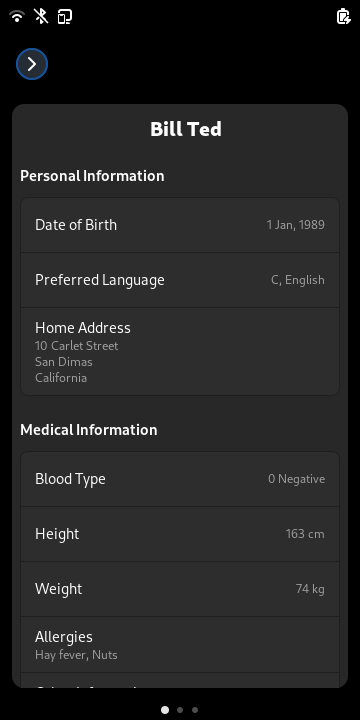
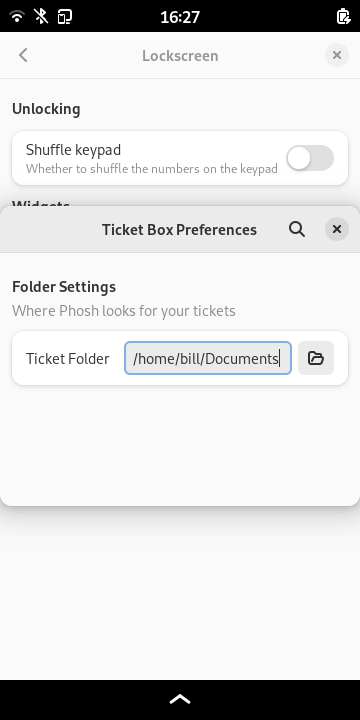
 We also added the possibility to have custom widgets via loadable
plugins on the lock screen so the user can decide which information
should be available. We currently ship plugins to show
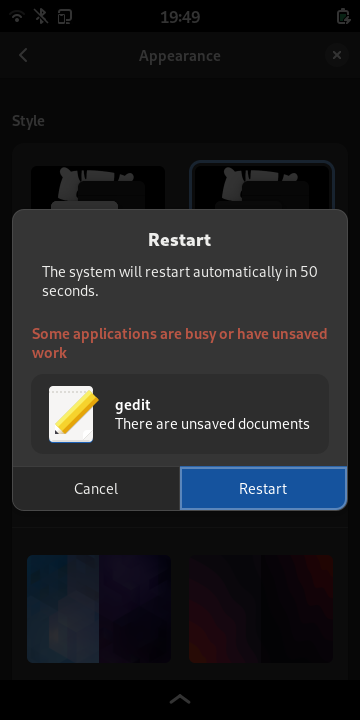
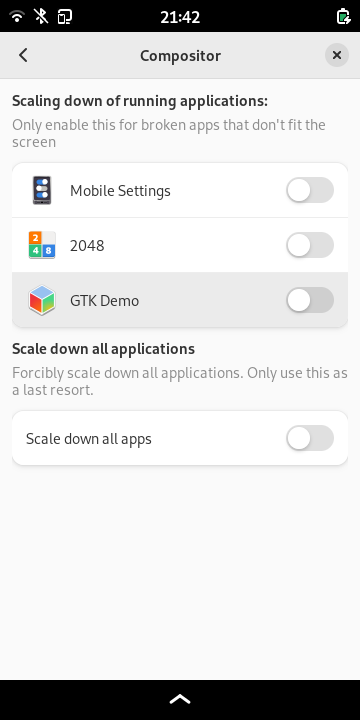
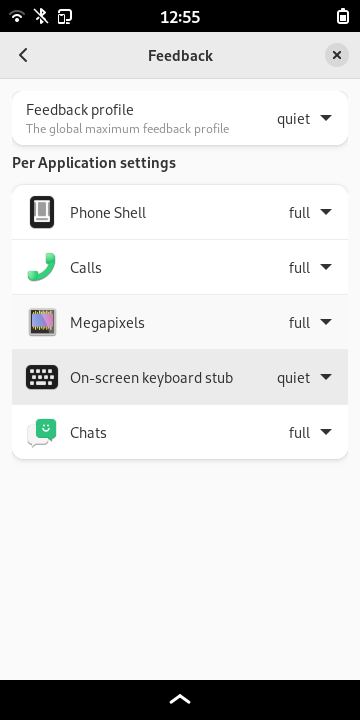
 Speaking of configurability: Scale-to-fit settings (to work around
applications that don't fit the screen) and haptic/led feedback are
now configurable without resorting to the command line:
 We can also have device specific settings which helps to temporarily
accumulate special workaround without affecting other phones.
Other user visible features include the ability to shuffle the digits
on the lockscreen's keypad, a VPN quick settings, improved screenshot
support and automatic high contrast theme switching when in bright
sunlight (based on ambient sensor readings) as shown
 That's it for 2022. If you want to get involved into phosh testing, development
or documentation then just drop by in the
 I had bought a Thinkpad E470 laptop back in 2018 which was lying unused for
quite some time. Recently when I wanted to use it, I found that the keyboard is
not working, especially some keys and after some time the laptop will hang in
Lenovo boot screen. I came back to Bangalore almost after 2 years from my
hometown (WFH due to Covid) and thought it was the right time to get my laptop
back to normal working state. After getting the keyboard replaced I noticed that
1TB HDD is no longer fast enough for my taste!. I've to admit I never thought I
would start disliking HDD so quickly thanks to modern SSD based work laptops. So
as a second upgrade I got the HDD removed from my laptop and got a 240G SSD.
Yeah I know its reduction from my original size but I intend to continue using
my old HDD via USB SATA enclosure as an external HDD which can house the extra
data which I need to save.
So now that I've a SSD I need to install Debian Unstable again on it and this is
where I tried something new. My colleague (name redacted on request) suggested
to me use GRML live CD and install Debian via debootstrap. And after giving a
thought I decided to try this out. Some reason for going ahead with this are
listed below

 I probably would have to get a new motherboard for my desktop probably in a year or two as quite a few motherboards also have WiFi (WiFi 6 ?) think on the southbridge. I at least would have a look in new year and know more as to what s been happening. For last at least 2-3 years there has been a rumor which has been confirmed time and again that the Tata Group has been in talks with multiple vendors to set chip fabrication and testing business but to date they haven t been able to find one. They do keep on giving press conferences about the
 The following contributors got their Debian Developer accounts in the last two months: