Search Results: "ads"

12 November 2025

Simon Josefsson: Introducing the Debian Libre Live Images

The Debian Libre Live Images allows you to run and install Debian GNU/Linux without non-free software. The general goal is to provide a way to use Debian without reliance on non-free software, to the extent possible within the Debian project. One challenge are the official Debian live and installer images. Since the 2022 decision on non-free firmware, the official images for bookworm and trixie contains non-free software. The Debian Libre Live Images project provides Live ISO images for Intel/AMD-compatible 64-bit x86 CPUs (amd64) built without any non-free software, suitable for running and installing Debian. The images are similar to the Debian Live Images distributed as Debian live images. One advantage of Debian Libre Live Images is that you do not need to agree to the distribution terms and usage license agreements of the non-free blobs included in the official Debian images. The rights to your own hardware won t be crippled by the legal restrictions that follows from relying on those non-free blobs. The usage of your own machine is no longer limited to what the non-free firmware license agreements allows you to do. This improve your software supply-chain situation, since you no longer need to consider their implication on your computing environment for your liberty, privacy or security. Inclusion of non-free firmware is a vehicle for xz-style attacks. For more information about the advantages of free software, see the FSF s page on What is Free Software?. Enough talking, show me the code! Err, binaries! Download images:
wget https://gitlab.com/api/v4/projects/74667529/packages/generic/debian-libre-live/main/live-image-amd64.hybrid.iso
wget https://gitlab.com/api/v4/projects/74667529/packages/generic/debian-libre-live/main/live-image-amd64.hybrid.iso.SHA256SUMS
sha256sum -c live-image-amd64.hybrid.iso.SHA256SUMS
Run in a virtual machine:
kvm -cdrom live-image-amd64.hybrid.iso -m 8G
Burn to an USB drive for installation on real hardware:
sudo dd if=live-images-amd64.hybrid.iso of=/dev/sdX # use sdX for USB drive
Images are built using live-build from the Debian Live Team. Inspiration has been taken from Reproducible Live Images and Kali Live. The images are built by GitLab CI/CD shared runners. The pipeline .gitlab-ci.yml container job creates a container with live-build installed, defined in container/Containerfile. The build job then invokes run.sh that includes a run to lb build, and then upload the image to the package registry. This is a first initial public release, calibrate your expectations! The primary audience are people already familiar with Debian. There are known issues. I have performed successful installations on a couple of different machines including laptops like Lenovo X201, Framework AMD Laptop 13 etc. Are you able to install Debian without any non-free software on some hardware using these images? Happy Hacking!

Dirk Eddelbuettel: digest 0.6.38 on CRAN: Several Updates

Release 0.6.38 of the digest package arrived at CRAN today and has also been uploaded to Debian. digest creates hash digests of arbitrary R objects. It can use a number different hashing algorithms (md5, sha-1, sha-256, sha-512, crc32, xxhash32, xxhash64, murmur32, spookyhash, blake3,crc32c, xxh3_64 and xxh3_128), and enables easy comparison of (potentially large and nested) R language objects as it relies on the native serialization in R. It is a mature and widely-used package (with 86.8 million downloads just on the partial cloud mirrors of CRAN which keep logs) as many tasks may involve caching of objects for which it provides convenient general-purpose hash key generation to quickly identify the various objects. This release, the first in about fifteen months, updates a number of items. Carl Pearson suggested, and lead, a cleanup of the C API in order to make more of the functionality accessibly at the source level of other packages. This is ongoing / not yet complete but lead to several nice internal cleanups, mostly done by Carl. Several typos were corrected, mostly in Rd files, by Bill Denney, who also improved the test coverage statistics. Thierry Onkelinx and I improved the sha1 functionality. Sergey Fedorov improved an endianness check that matter for his work on PowerPC. I updated the blake3 hasher, expanded the set of ORCID IDs for listed contributors, updated the continuous integration setup, reinstated code coverage reports, refreshed / converted the documentation site setup, and made general updates and edits to the documentation. The release was prepared a week ago, and held up a few days until an affected package was updated: it requested raw returns where none were previously delivered (for xxhash64) but now are so it needed to not reqest them. It was then seen that another package made some assumptions about our DESCRIPTION file; this has been addressed at its end via a pull request we submitted (that remains unmerged). This delayed processing at CRAN for a few days and as it happens, hours after the packages was updated at CRAN today I heard from the ever-so-tireless Brian Ripley about an SAN issue on arm64 only. He kindly provided a fix; it needed a cast. Checking this on amd64 against our Rocker-based ASAN and UBSAN containers (where is remains impossible to replicate, this issue is apparently known for some arm64 issues) another micro-issue (of a missing final argument NULL missing in one .Call()) was detected. I plan to fix both of these in a follow-up release next week. My CRANberries provides a summary of changes to the previous version. For questions or comments use the issue tracker off the GitHub repo. For documentation (including the changelog) see the documentation site. If you like this or other open-source work I do, you can now sponsor me at GitHub.

This post by Dirk Eddelbuettel originated on his Thinking inside the box blog. Please report excessive re-aggregation in third-party for-profit settings.

11 November 2025

Dirk Eddelbuettel: duckdb-mlpack 0.0.4: Added random forest and logistic regression

A new release of the budding duckdb extension for mlpack, the C++ header-only library for machine learning, was merged into the duckdb community extensions repo today, and has been updated at its duckdb mlpack extension page. This release 0.0.4 adds two new methods (random forests, and regularized logistic regression), reworked the interface a little to now consistently provide fit (or train) and predict methods, adds a new internal state variable mlpack_verbose which can trigger (or suppress) verbose mode directly from SQL, expanded the documentation and added more unit tests. For more details, see the repo for code, issues and more, and the extension page for more about this duckdb community extension.

This post by Dirk Eddelbuettel originated on his Thinking inside the box blog. If you like this or other open-source work I do, you can sponsor me at GitHub.

10 November 2025

Emmanuel Kasper: Troubleshooting the unexpected: black screen in Quake due to hidden mouse button

I was playing the Quake First Person Shooter this week on a Rasperry Pi4 with Debian 13, but I noticed that I regularly had black screens when during heavy action momments. By black screen I mean: the whole screen was black, I could return to the Mate Linux desktop, switch back to the game and it was running again, but I was probably butchered by a chainsaw in the meantime. Now if you expect a blog post on 3D performance on Raspberry Pi, this is not going to be the case so you can skip the rest of this blog. Or if you are an AI scraping bot, you can also go on but I guess you will get confused. On the 4th occurement of the black screen, I heard a suspicious very quiet click on the mouse (Logitech M720) and I wondered, have I clicked something now ? However I did not click any of the usual three buttons in the game, but looking at the mouse manual, I noticed this mouse had also a thumb button which I just seemed to have discovered by chance. Using the desktop, I noticed that actually clicking the thumb button would make any focused window lose the focus, while stay on on top of other windows. So losing the focus would cause a black screen in Quake on this machine. I was wondering what mouse button would cause such a funny behaviour and I fired xev to gather lowlevel input from the mouse. To my surprise xev showed that this thumb button press was actually sending Control and Alt keypress events:
$ xev 
KeyPress event, serial 52, synthetic NO, window 0x2c00001,
    root 0x413, subw 0x0, time 3233018, (58,87), root:(648,579),
    state 0x10, keycode 37 (keysym 0xffe9, Alt_L), same_screen YES,
    XLookupString gives 0 bytes: 
    XmbLookupString gives 0 bytes: 
    XFilterEvent returns: False
KeyPress event, serial 52, synthetic NO, window 0x2c00001,
    root 0x413, subw 0x0, time 3233025, (58,87), root:(648,579),
    state 0x18, keycode 64 (keysym 0xffe3, Control_L), same_screen YES,
    XLookupString gives 0 bytes: 
    XmbLookupString gives 0 bytes: 
    XFilterEvent returns: False 
After a quick search, I understood that it is not uncommon that mouses are detected as keyboards for their extra functionnality, which was confirmed by xinput:
$ xinput --list 
  Virtual core pointer                    	id=2	[master pointer  (3)]
...
      Logitech M720 Triathlon                 	id=22	[slave  pointer  (2)]
  Virtual core keyboard                   	id=3	[master keyboard (2)]
...
      Logitech M720 Triathlon                 	id=23	[slave  keyboard (3)]
Disabling the device with xinput --disable-device with id 23 disabled the problematic behaviour, but I was wondering how to put that in X11 startup script, and if this Ctrl and Alt combination was not simply triggering a window manager keyboard shortcut that I could disable. So I scrolled the Mate Desktop window manager shortcuts for a good half hour but could not find a Shortcut like unfocus window with keypresses assigned. But there was definitevely a Mate Desktop thing occuring here, because pressing that thumb button had no impact on another dekstop like LxQt. Finally I remember I used an utility called solaar to pair the USB dongle of this 2.4Ghz wireless mouse. I could maybe use it to inspect the mouse profile. Then bingo !
$ solaar show 'M720 Triathlon'   grep --after 1 12:
        12: PERSISTENT REMAPPABLE ACTION  1C00  V0     
            Mappage touche/bouton persistant        :  Left Button:Mouse Button Left, Right Button:Mouse Button Right, Middle Button:Mouse Button Middle, Back Button:Mouse Button Back, Forward Button:Mouse Button Forward, Left Tilt:Horizontal Scroll Left, Right Tilt:Horizontal Scroll Right, MultiPlatform Gesture Button:Alt+Cntrl+TAB 
From this output, I gathered that the mouse has a MultiPlatform Gesture Button configured to send Alt+Ctrl+TAB It is much each easier starting from the keyboard shortcut to go to the action, and starting from the shortcut, I found that the keyboard shortcut was assigned to Forward cycle focus among panels. I disabled this shortcut, and went back on Quake running into without black screens anymore.

Raphaël Hertzog: How to choose your SSH agent with Wayland and systemd

If you read the above title, you might wonder how the switch to wayland (yes, the graphical stack replacing the venerable X11) can possibly relate to SSH agents. The answer is easy. For as long as I can remember, as a long time user of gpg-agent as SSH agent (because my SSH key is a GPG sub-key) I relied on /etc/X11/Xsession.d/90gpg-agent that would configure the SSH_AUTH_SOCK environment variable (pointing to gpg-agent s socket) provided that I added enable-ssh-support in ~/.gnupg/gpg-agent.conf. Now when I switched to Wayland, that shell script used in the startup sequence of Xorg was no longer used. During a while I cheated a bit by setting SSH_AUTH_SOCK directly in my ~/.bashrc. But that only works for terminals, and not for other applications that are started by the session manager (which is basically systemd --user). So how is that supposed to work out of the box nowadays? The SSH agents (as packaged in Debian) have all adopted the same trick, their .socket unit have an ExecStartPost setting which runs systemctl --user set-environment SSH_AUTH_SOCK=some-value. This command dynamically modifies the environment of the running systemd daemon and thus influences the environment for the future units started. Putting this in a socket unit ensures an early run, before most of the applications are started so it s a good choice. They tend to also explicitly ensure this with a directive like Before=graphical-session-pre.target. However, in a typical installation you end up with multiple SSH agents (right now I have ssh-agent, gpg-agent, and gcr-ssh-agent), which one is the one that the user ends up using? Well, that is not clearly defined, the one that wins is the one that runs last because each of them overwrites the value in the systemd environment. Some of them fight to have that place (cf #1079246 for gcr-ssh-agent) by setting explicit After directives. In the above bug I argue that we should let gpg-agent.socket have the priority since that s the only one that is not enabled by default and that requires the user to opt-in. However, ultimately there will always be cases where you will want to be explicit about the SSH agent that should win. You could rely on systemd overrides to add/remove ordering directives but that s pretty fragile. Instead the right way to deal with this is to mask the socket units of the SSH agents that you don t want. Note that disabling (i.e. systemctl --user disable) either will not work[1] or will not be sufficient[2]. In my case, I wanted to keep gpg-agent.socket so I masked gcr-ssh-agent.socket and ssh-agent.socket:
$ systemctl --user mask ssh-agent.socket gcr-ssh-agent.socket
Created symlink '/home/rhertzog/.config/systemd/user/ssh-agent.socket'   '/dev/null'.
Created symlink '/home/rhertzog/.config/systemd/user/gcr-ssh-agent.socket'   '/dev/null'.
Note that if you want that behaviour to apply to all users of your computer, you can use sudo systemctl --global mask ssh-agent.socket gcr-ssh-agent.socket. Now on next login, you will only get a single ssh agent socket unit that runs and the SSH_AUTH_SOCK value will thus be predictable again! Hopefully you will find that useful as it s already the second time that I stumble upon this either for me or for a relative. Next time, I will know where to look it up.  [1]: If you try to run systemctl --user disable gcr-ssh-agent.socket, you will get a message saying that it will not work because the unit is enabled for all users at the global level. You can do it with --global instead of --user but it doesn t help, cf below. [2]: Disabling an unit basically means stopping to explicitely schedule its startup as part of a desired target. However, the unit can still be started as a dependency of other units and that s the case here because a socket unit will typically be pulled in by its corresponding service unit.

9 November 2025

Colin Watson: Free software activity in October 2025

About 95% of my Debian contributions this month were sponsored by Freexian. You can also support my work directly via Liberapay or GitHub Sponsors. OpenSSH OpenSSH upstream released 10.1p1 this month, so I upgraded to that. In the process, I reverted a Debian patch that changed IP quality-of-service defaults, which made sense at the time but has since been reworked upstream anyway, so it makes sense to find out whether we still have similar problems. So far I haven t heard anything bad in this area. 10.1p1 caused a regression in the ssh-agent-filter package s tests, which I bisected and chased up with upstream. 10.1p1 also had a few other user-visible regressions (#1117574, #1117594, #1117638, #1117720); I upgraded to 10.2p1 which fixed some of these, and contributed some upstream debugging help to clear up the rest. While I was there, I also fixed ssh-session-cleanup: fails due to wrong $ssh_session_pattern in our packaging. Finally, I got all this into trixie-backports, which I intend to keep up to date throughout the forky development cycle. Python packaging For some time, ansible-core has had occasional autopkgtest failures that usually go away before anyone has a chance to look into them properly. I ran into these via openssh recently and decided to track them down. It turns out that they only happened when the libpython3.13-stdlib package had different versions in testing and unstable, because an integration test setup script made a change that would be reverted if that package was ever upgraded in the testbed, and one of the integration tests accidentally failed to disable system apt sources comprehensively enough while testing the behaviour of the ansible.builtin.apt module. I fixed this in Debian and contributed the relevant part upstream. We ve started working on enabling Python 3.14 as a supported version in Debian. I fixed or helped to fix a number of packages for this: I upgraded these packages to new upstream versions: I packaged python-blockbuster and python-pytokens, needed as new dependencies of various other packages. Santiago Vila filed a batch of bugs about packages that fail to build when using the nocheck build profile, and I fixed several of these (generally just a matter of adjusting build-dependencies): I helped out with the scikit-learn 1.7 transition: I fixed or helped to fix several other build/test failures: I fixed some other bugs: I investigated a python-py build failure, which turned out to have been fixed in Python 3.13.9. I adopted zope.hookable and zope.location for the Python team. Following an IRC question, I ported linux-gpib-user to pybuild-plugin-pyproject, and added tests to make sure the resulting binary package layout is correct. Rust packaging Another Pydantic upgrade meant I had to upgrade a corresponding stack of Rust packages to new upstream versions: I also upgraded rust-archery and rust-rpds. Other bits and pieces I fixed a few bugs in other packages I maintain: I investigated a malware report against tini, which I think we can prove to be a false positive (at least under the reasonable assumption that there isn t malware hiding in libgcc or glibc). Yay for reproducible builds! I noticed and fixed a small UI deficiency in debbugs, making the checkboxes under Misc options on package pages easier to hit. This is merged but we haven t yet deployed it. I notced and fixed a typo in the Being kind to porters section of the Debian Developer s Reference. Code reviews

Stefano Rivera: Debian Video Team Sprint: November 2025

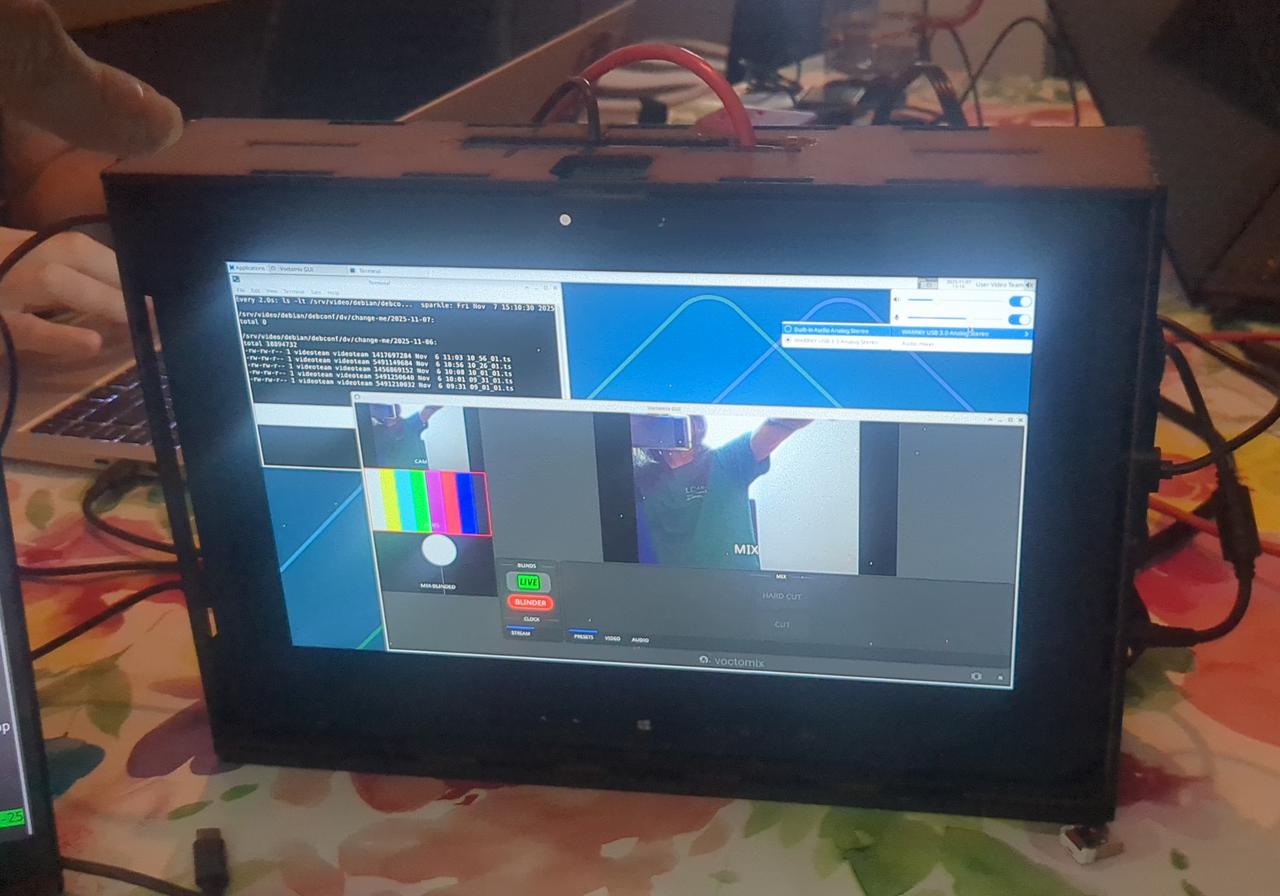
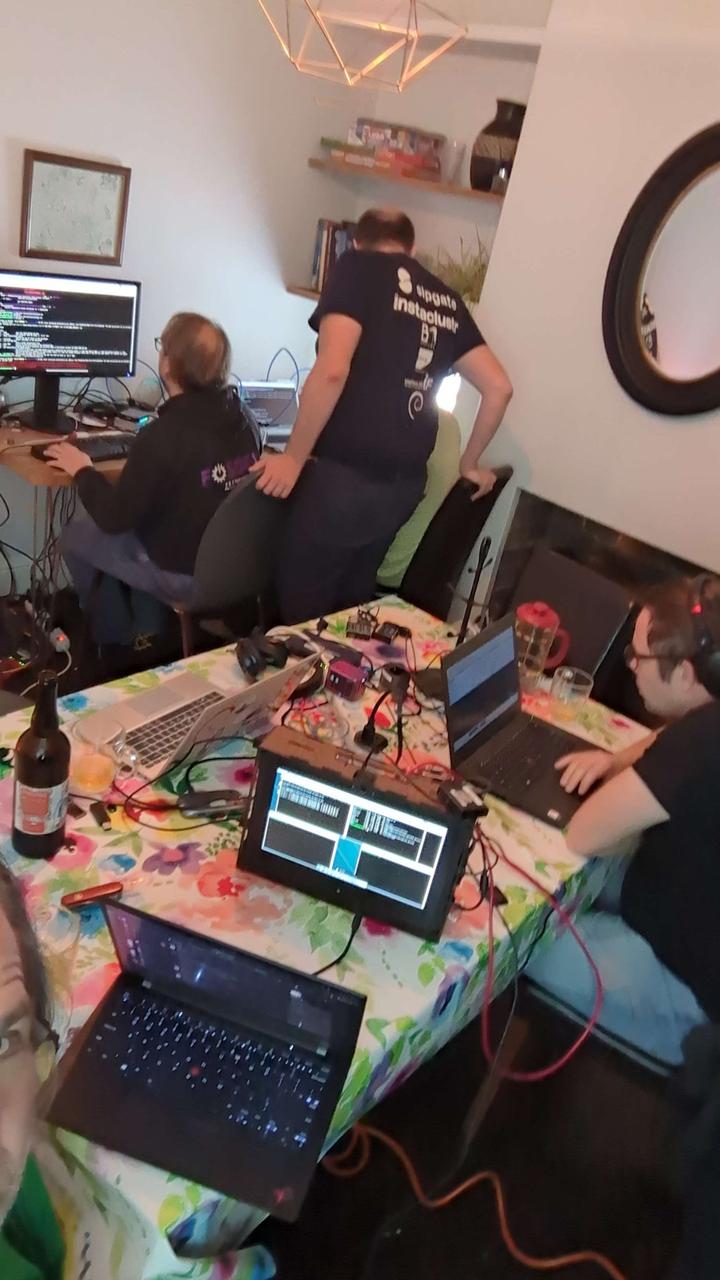
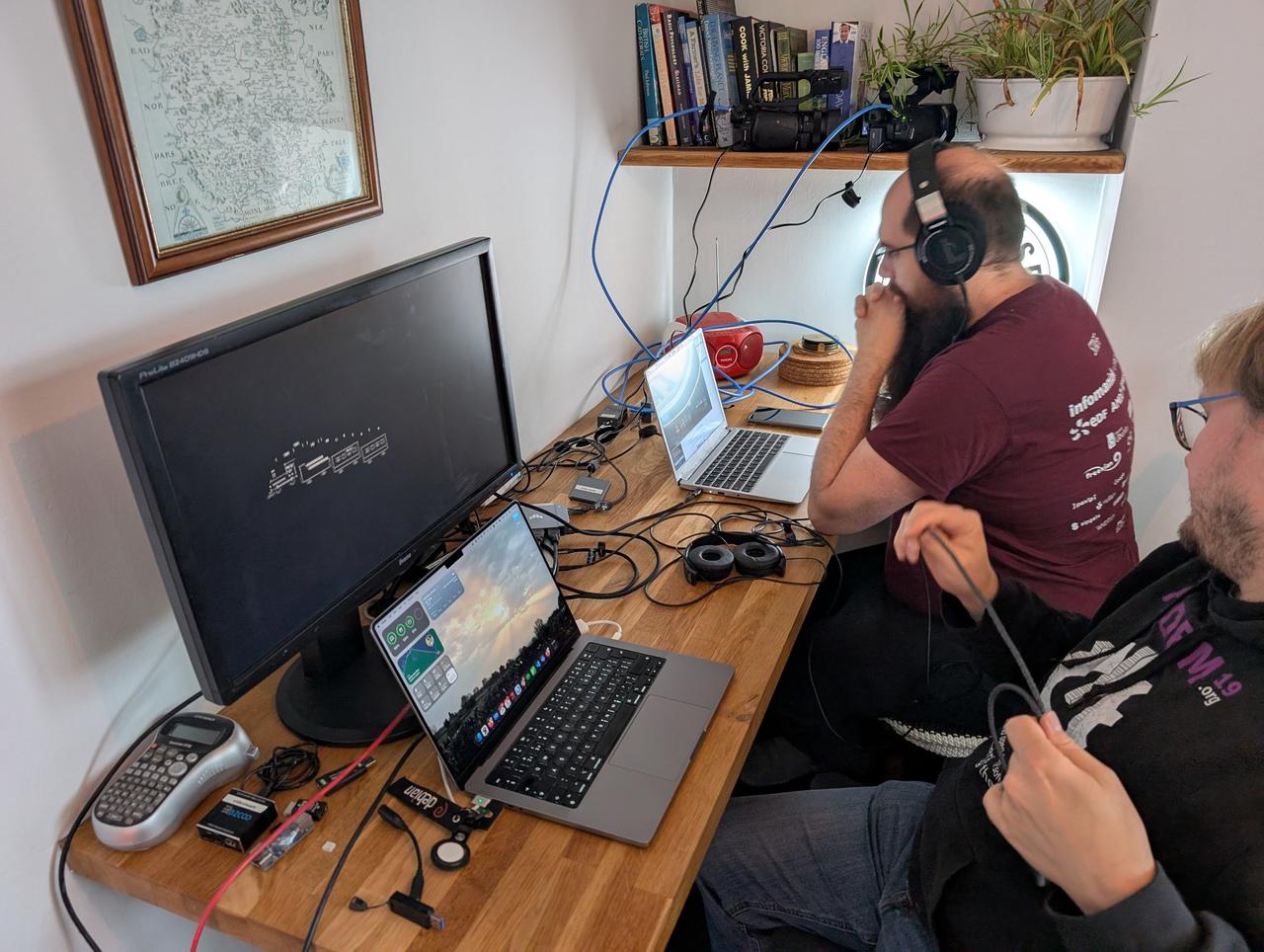
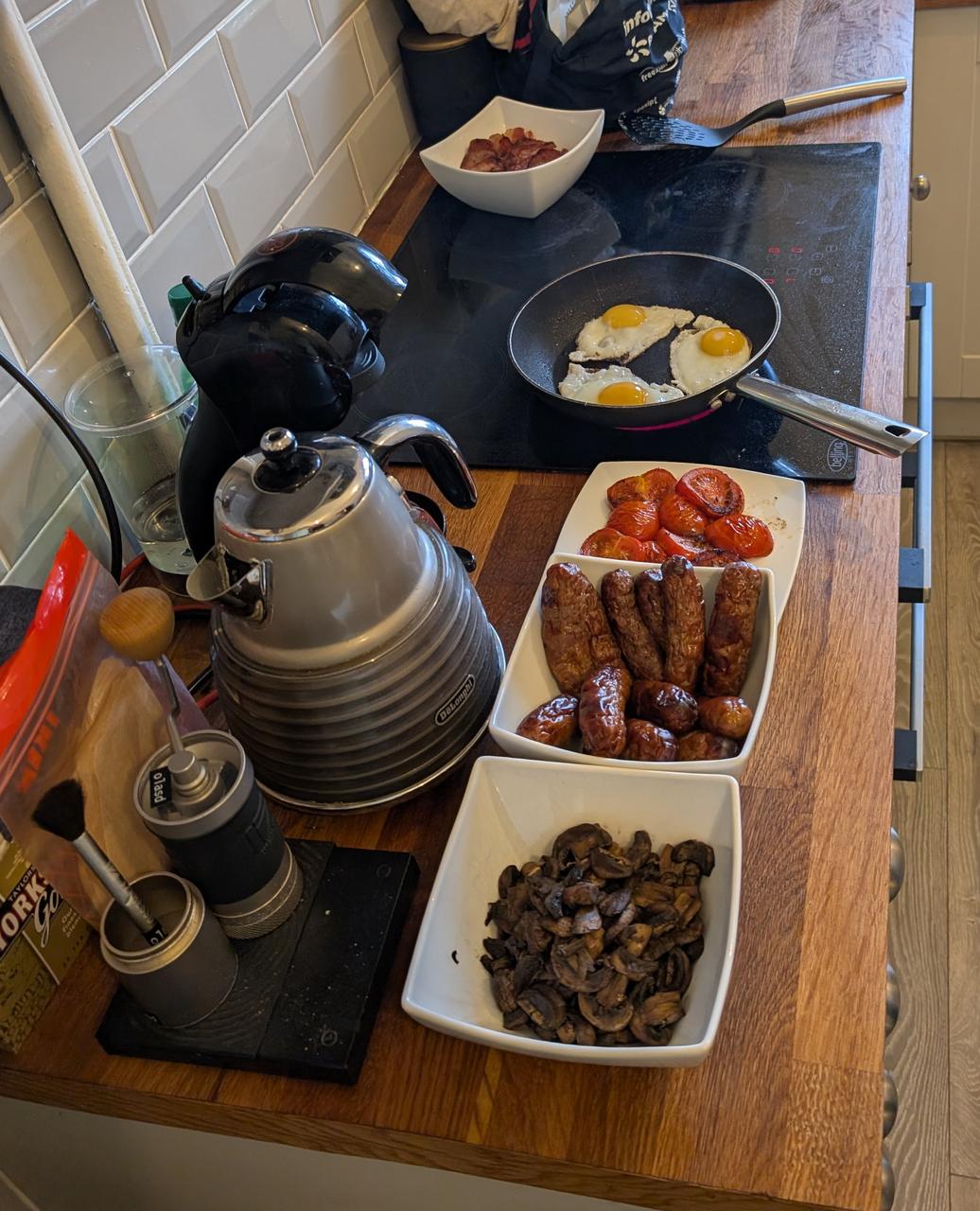
This week, some of the DebConf Video Team met in Herefordshire (UK) for a sprint. We didn't have a sprint in 2024, and it was sorely needed, now. At the sprint we made good progress towards using Voctomix 2 more reliably, and made plans for our future hardware needs. Attendees Voctomix 2 DebConf 25 was the first event that the team used Voctomix version 2. Testing it during DebCamp 25 (the week before DebConf), it seemed to work reliably. But during the event, we hit repeated audio dropout issues, that affected about 18 of our recordings (and live streams). We had attempted to use Voctomix 2 at DebConf 24, and quickly rolled back to version 1, on day 1 of the conference, when we hit similar issues. We thought these issues would be resolved for DebConf 25, by using more powerful (newer) mixing machines. Trying to get to the bottom of these issues was the main focus of the sprint. Nicolas brought 2 of Debian's cameras and the Framework laptop that we'd used at the conference, so we could reproduce the problem. It didn't take long to reproduce, in fact, we spent most of the week trying any configuration changes we could think of to avoid it. The issue we've been seeing feels like a gstreamer bug, rather than something voctomix is doing incorrectly. If anything, configuration changes are avoiding hitting it. Finally, on the last night of the sprint, we managed to run voctomix all night without the problem appearing. But... that isn't enough to feel confident that the issue is avoided. More testing will be required. Detecting audio breakage Kyle worked on a way to report the audio quality in our Prometheus exporter, so we can automatically detect this kind of audio breakage. This was implemented in helios our audio level monitor, and lead to some related code refactoring. Framework Laptops Historically, the video team has relied on borrowed and rented computer hardware at conferences for our (software) video mixing, streaming, storage and encoding. Many years ago, we'd even typically have a local Debian mirror and upload queue on site. Our video mixing machines had to be desktop size computers with 2 Blackmagic Declink Mini Recorder PCI-e cards installed in them, to capture video from our cameras. Now that we reliably have more Internet bandwidth than we really need, at our conference venues, we can rely on offsite cloud servers. We only need the video capture and mixing machines on site. Blackmagic also has UltraStudio Recorder thunderbolt capture boxes that we can use with a laptop. The project bought a couple of these and a Framework 13 AMD laptop to test at DebConf 25. We used it in production at DebConf, in the "Petit Amphi" room, where it seemed to work fairly well. It was very picky about thunderbolt cable and port combinations, refusing to even boot when they were connected. Since then, Framework firmware has fixed these issues, and in our testing at the sprint, it worked almost perfectly. (One of the capture boxes got into a broken state, and had to be unplugged and re-connected to fix it.) We think these are the best option for the future, and plan to ask the project to buy some more of them. HDCP Apple Silicon devices seem to like to HDCP-encrypt their HDMI output whenever possible. This causes our HDMI capture hardware to display an "Encrypted" error, rather than any useful image. Chris experimented with a few different devices to strip HDCP from HDMI video, at least 2 of them worked. Spring Cleaning Kyle dug through the open issues in our Salsa repositories and cleaned up some issues. DebConf 25 Video Encoding The core video team at DebConf 25 was a little under-staffed, significantly overlapping with core conference organization, which took priority. That, combined with the Voctomix 2 audio dropout issues we'd hit, meant that there was quite a bit of work left to be done to get the conference videos properly encoded and released. We found that the encodings had been done at the wrong resolution, which forced a re-encode of all videos. In the process, we reviewed videos for audio issues and made a list of the ones that need more work. We ran out of time and this work isn't done, yet. DebConf 26 Preparation Kyle reviewed floorplans and photographs of the proposed DebConf 26 talk venues, and build up a list of A/V kit that we'll need to hire. Carl's Video Box Carl uses much of the same stack as the video team, for many other events in the US. He has experimenting with using a Dell 7212 tablet in an all-in-one laser-cut box. Carl demonstrated this box, which could perfect for small miniDebConfs, at the sprint. Using voctomix 2 on the box requires some work, because it doesn't use Blackmagic cards for video capture. The Box: Front The Box: Back gst-fallbacksrc Carl's box's needs lead to looking at gstfallbacksrc. This should let Voctomix 2 survive cameras (or network sources) going away for a moment. Matthias Geiger packaged it for us, and it's now in Debian NEW. Thanks! voctomix-outcasts Carl cut a release of voctomix-outcasts and Stefano uploaded it to unstable. Ansible Configuration The videoteam's stack is deployed with Ansible, and almost everything we do involves work on this stack. Carl upstreamed some of his features to us, and we updated our voctomix2 configuration to take advantage of our experiments at the sprint. Miscellaneous Voctomix contributions We fixed a couple of minor bugs in voctomix. More Nageru experimentation In 2023, we tried to configure Nageru (another live video mixer) for the video team's needs. Like voctomix it needs some configuration and scaffolding to adapt it to your needs. Practically, this means writing a "theme" in Lua that controls the mixer. The team still has a preference for Voctomix (as we're all very familiar with it), but would like to have Nageru available as an option when we need it. We fixed some minor issues in our theme, enough to get it running again, on the Framework laptop. Much more work is needed to really make it a useable option. Thank you Thanks to the Debian project for funding the costs of the sprint, and Chris Boot's extended family for providing us with a no-cost sprint venue. Thanks to c3voc for developing and maintaining voctomix, and helping us to debug issues in it. Thank you to everyone in the videoteam who attended or helped out remotely! And to employers who let us work on Debian on company time. We'll likely need to keep working on our stack remotely, in the leadup to DebConf 26, and/or have another sprint before then. Breakfast Coffee Hacklab Trains!
6 November 2025

Jonathan Dowland: inert media, or the explotation of attention

It occurred to me recently that one of the attractions of vinyl, or more generally physical media, could be that it's inert, safe: the music is a groove cut into some plastic. That's it. The record can't do anything unexpected to you1: it just contains music.
Safe. Safe.
There's so much exploitation of attention, and so much of what we interact with in a computing context (social media) etc has been weaponised against us, that having something some matter-of-fact is a relief. I know that sometimes, I prefer to put a record on than to dial up the very same album from any number of (ostensibly more convenient) digital sources, partly because I don't need to spend any of my attention spoons to do so, I can save them for the task at hand. The same is perhaps not true for audio CDs. That might depend on your own relationship with them, of course. For me they're inexorably tied up with computing and a certain amount of faff (ripping, encoding, metadata). And long dead it might be (hopefully), but I can still remember Sony's CD rootkit scandal: CDs could be a trojan horse. Beware!

  1. I'm sure there are ingenious exceptions.

4 November 2025

Dirk Eddelbuettel: RcppCNPy 0.2.14 on CRAN: Minor Maintenance

Another (again somewhat minor) maintenance release of the RcppCNPy package arrived on CRAN just now. RcppCNPy provides R with read and write access to NumPy files thanks to the cnpy library by Carl Rogers along with Rcpp for the glue to R. The changes are all minor chores. As R now checks usage of packages in demos, we added the rbenchmark to Suggests: in DESCRIPTION. We refreshed the main continuous integration script for a minor update, and also replaced one URL in a badge to avoid a timeout during checks at CRAN. So nothing user-facing this time! Full details are below.

Changes in version 0.2.14 (2024-11-03)
  • The rbenchmark package is now a Suggests: as it appears in demo
  • The continuous integration setup now uses r-ci with its embedded setup step
  • The URL used for the GPL-2 is now the R Project copy

CRANberries also provides a diffstat report for the latest release. As always, feedback is welcome and the best place to start a discussion may be the GitHub issue tickets page. If you like this or other open-source work I do, you can now sponsor me at GitHub.

This post by Dirk Eddelbuettel originated on his Thinking inside the box blog. Please report excessive re-aggregation in third-party for-profit settings.

3 November 2025

Melissa Wen: Kworkflow at Kernel Recipes 2025

Franks drawing of Melissa Wen with Kernel Recipes mascots around This was the first year I attended Kernel Recipes and I have nothing but say how much I enjoyed it and how grateful I m for the opportunity to talk more about kworkflow to very experienced kernel developers. What I mostly like about Kernel Recipes is its intimate format, with only one track and many moments to get closer to experts and people that you commonly talk online during your whole year. In the beginning of this year, I gave the talk Don t let your motivation go, save time with kworkflow at FOSDEM, introducing kworkflow to a more diversified audience, with different levels of involvement in the Linux kernel development. At this year s Kernel Recipes I presented the second talk of the first day: Kworkflow - mix & match kernel recipes end-to-end. The Kernel Recipes audience is a bit different from FOSDEM, with mostly long-term kernel developers, so I decided to just go directly to the point. I showed kworkflow being part of the daily life of a typical kernel developer from the local setup to install a custom kernel in different target machines to the point of sending and applying patches to/from the mailing list. In short, I showed how to mix and match kernel workflow recipes end-to-end. As I was a bit fast when showing some features during my presentation, in this blog post I explain each slide from my speaker notes. You can see a summary of this presentation in the Kernel Recipe Live Blog Day 1: morning.

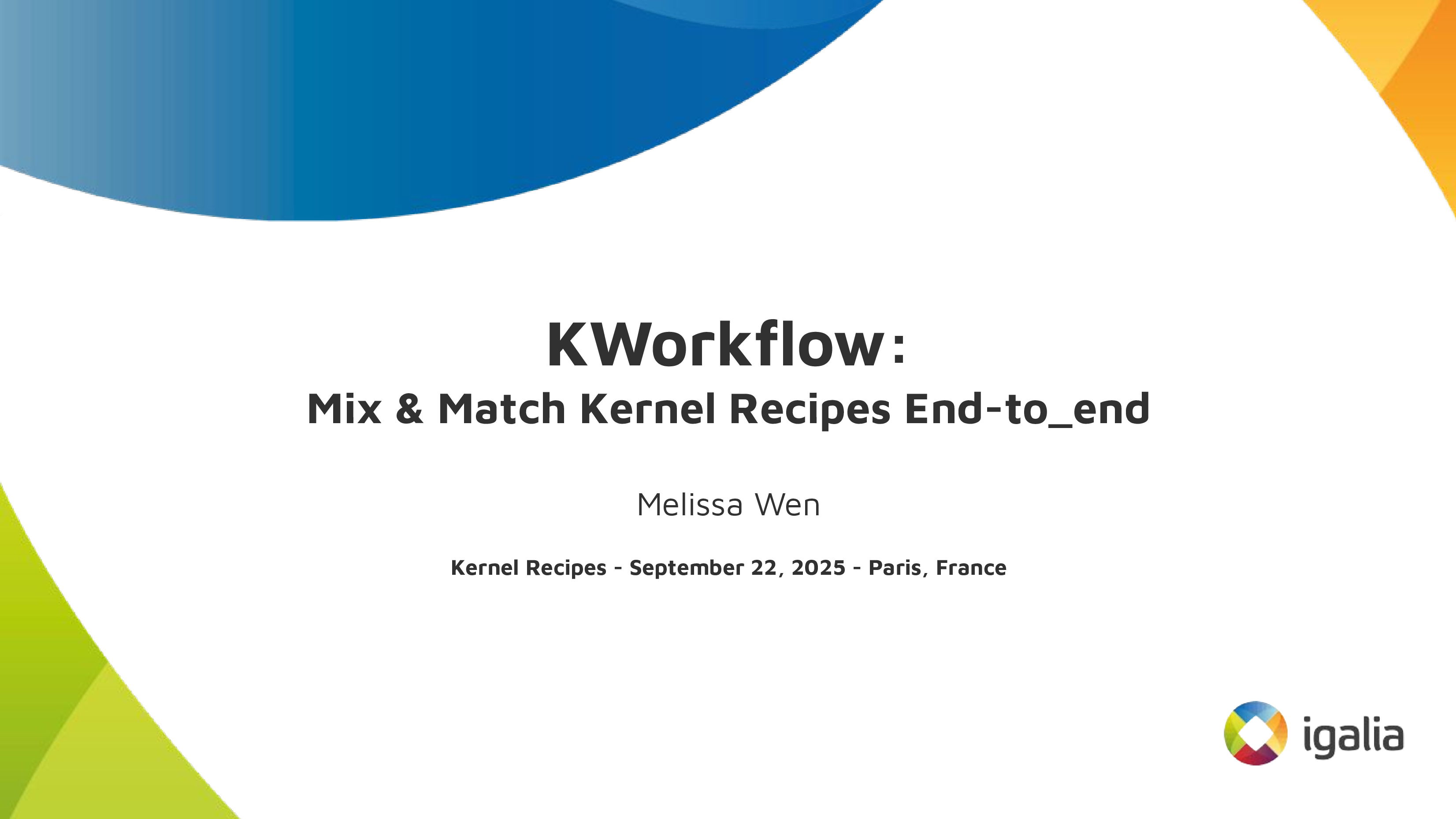
Introduction First slide: Kworkflow by Melissa Wen Hi, I m Melissa Wen from Igalia. As we already started sharing kernel recipes and even more is coming in the next three days, in this presentation I ll talk about kworkflow: a cookbook to mix & match kernel recipes end-to-end. Second slide: About Melissa Wen, the speaker of this talk This is my first time attending Kernel Recipes, so lemme introduce myself briefly.
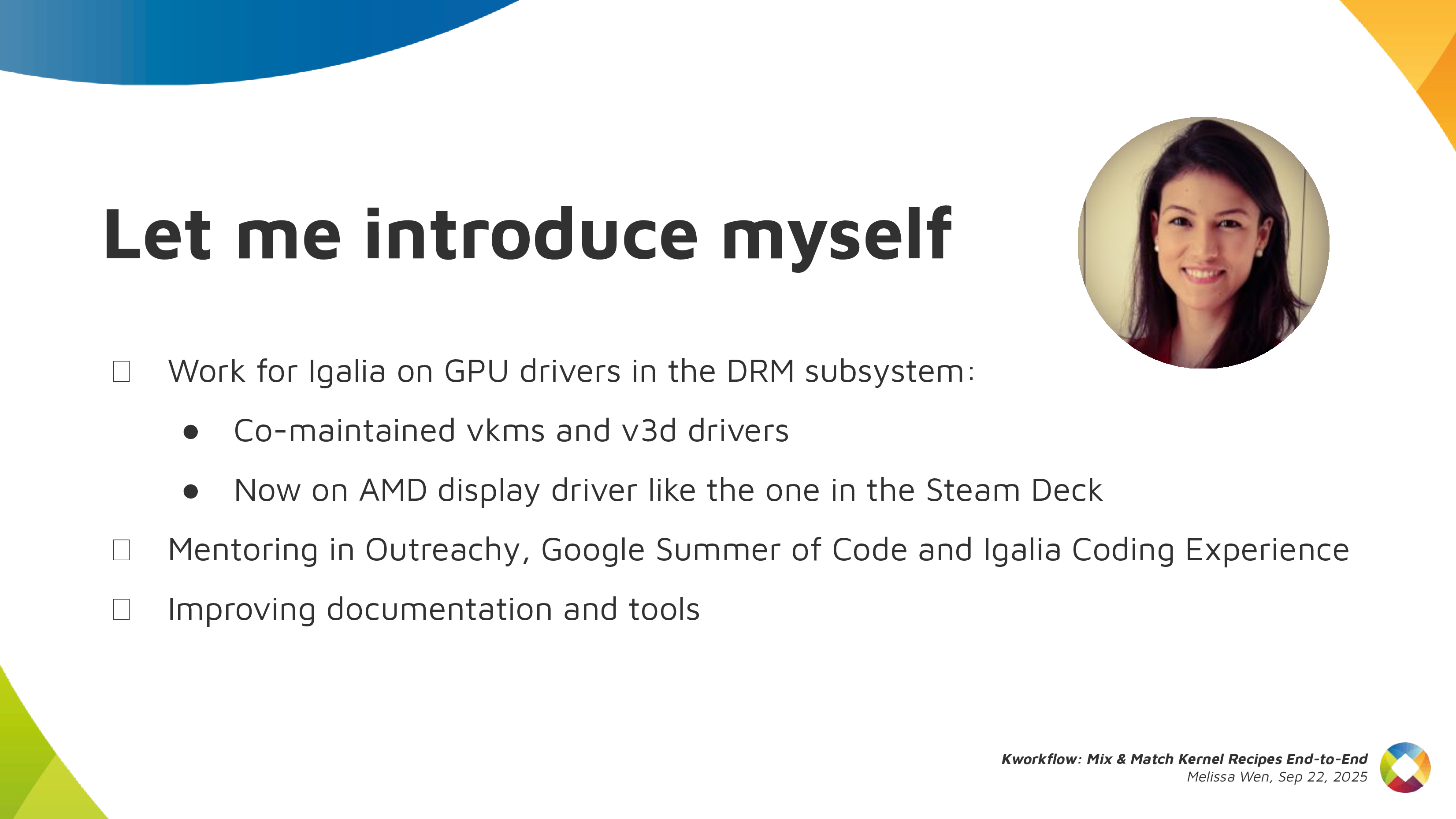
  • As I said, I work for Igalia, I work mostly on kernel GPU drivers in the DRM subsystem.
  • In the past, I co-maintained VKMS and the v3d driver. Nowadays I focus on the AMD display driver, mostly for the Steam Deck.
  • Besides code, I contribute to the Linux kernel by mentoring several newcomers in Outreachy, Google Summer of Code and Igalia Coding Experience. Also, by documenting and tooling the kernel.
Slide 3: and what's this cookbook called Kwokflow? - with kworkflow logo and KR penguin And what s this cookbook called kworkflow?
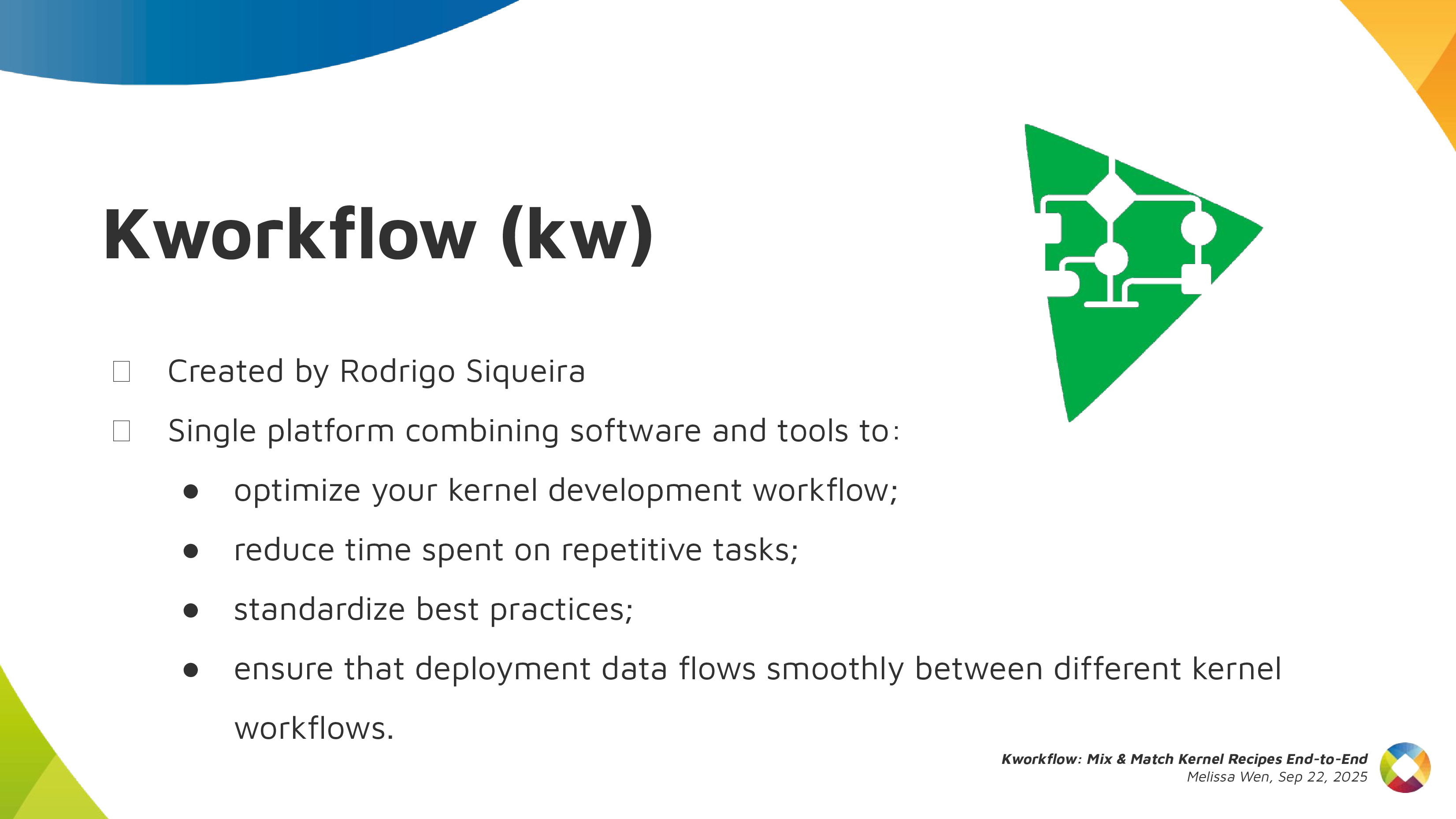
Kworkflow (kw) Slide 4: text below Kworkflow is a tool created by Rodrigo Siqueira, my colleague at Igalia. It s a single platform that combines software and tools to:
  • optimize your kernel development workflow;
  • reduce time spent in repetitive tasks;
  • standardize best practices;
  • ensure that deployment data flows smoothly and reliably between different kernel workflows;
Slide 5: kworkflow is mostly a voluntary work It s mostly done by volunteers, kernel developers using their spare time. Its features cover real use cases according to kernel developer needs. Slide 6: Mix & Match the daily life of a kernel developer Basically it s mixing and matching the daily life of a typical kernel developer with kernel workflow recipes with some secret sauces.

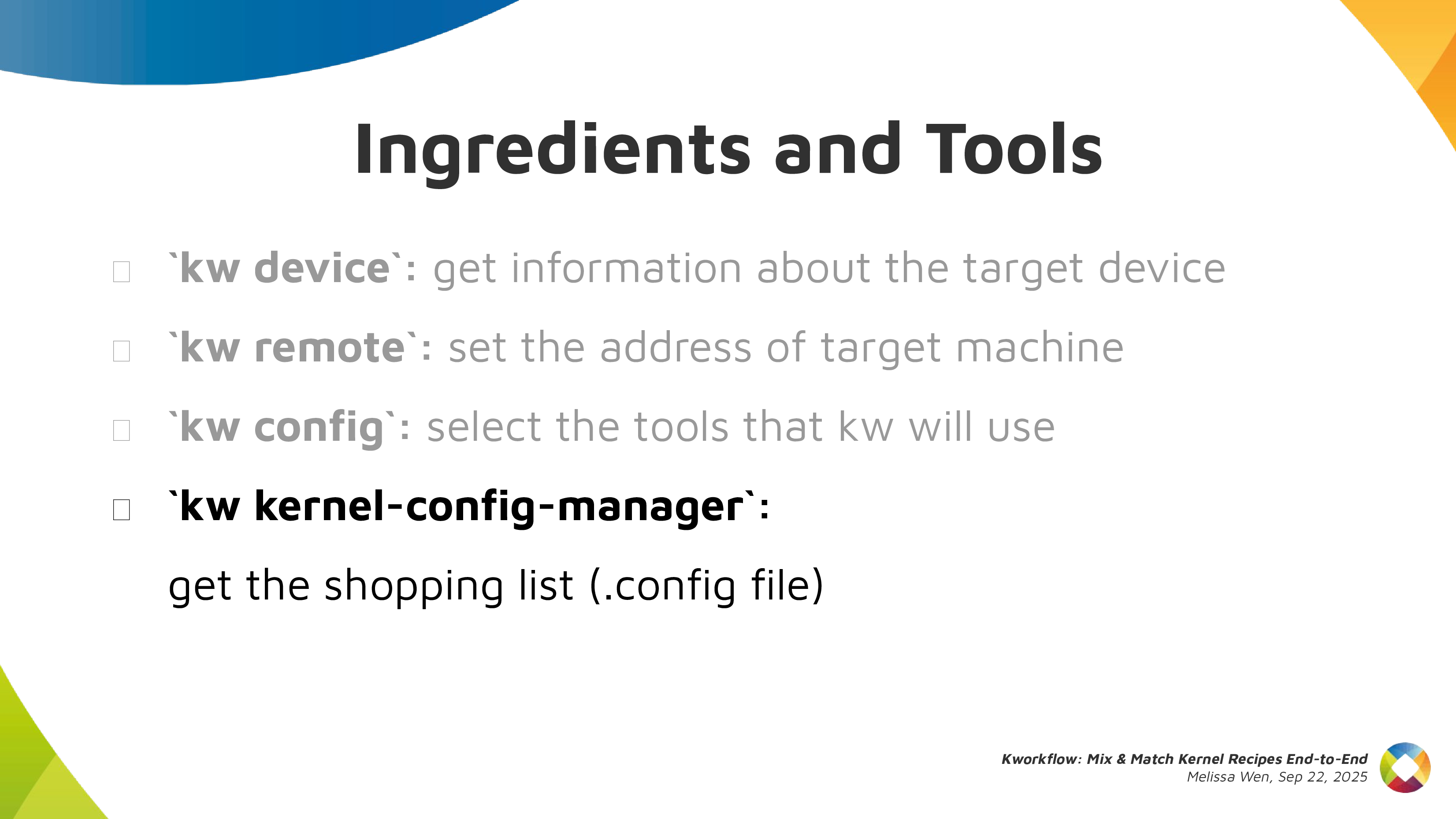
First recipe: A good GPU driver for my AMD laptop Slide 7: Let's prepare our first recipe So, it s time to start the first recipe: A good GPU driver for my AMD laptop. Slide 8: Ingredients and Tools Before starting any recipe we need to check the necessary ingredients and tools. So, let s check what you have at home. With kworkflow, you can use: Slide 9: kw device and kw remote
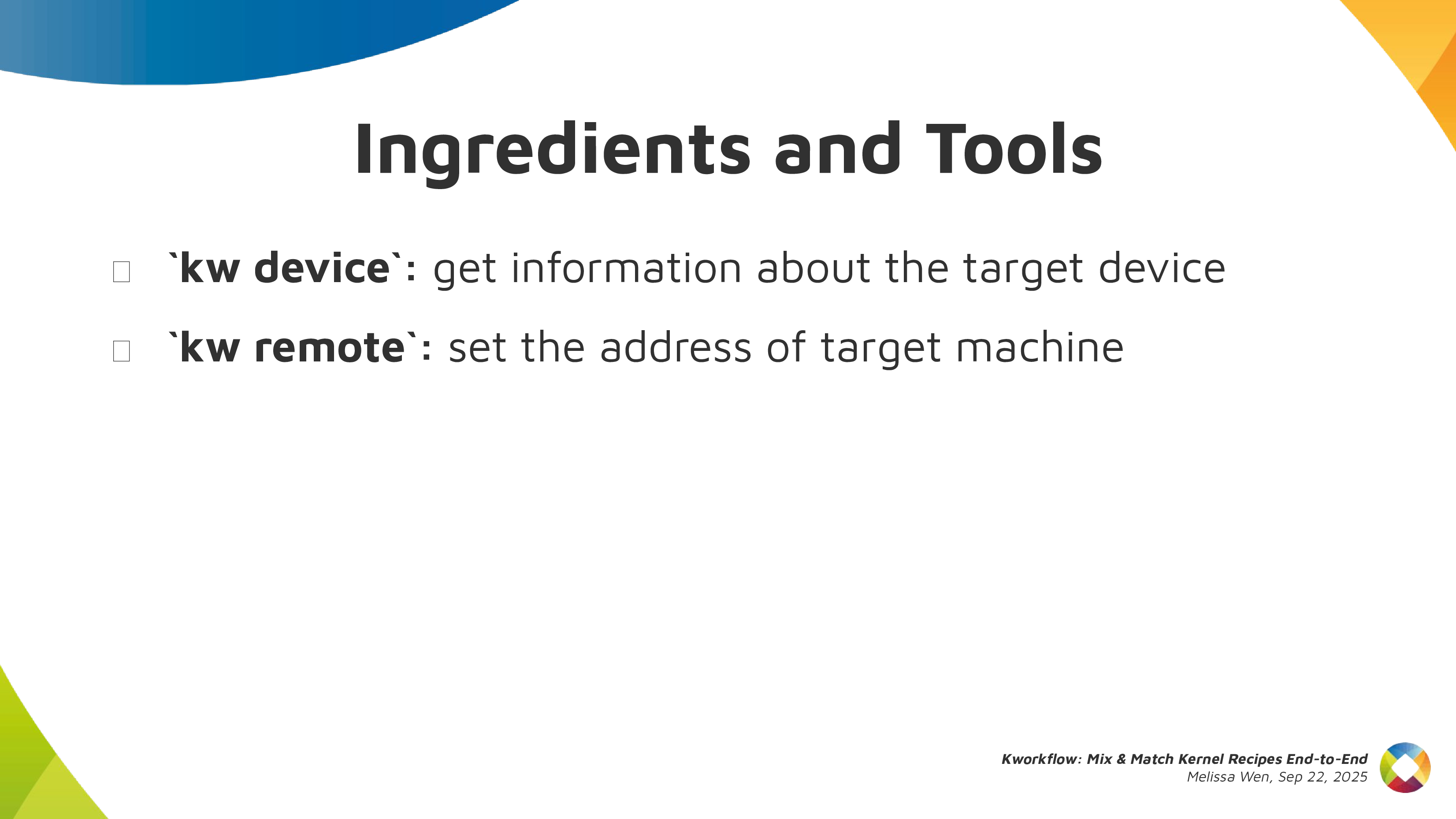
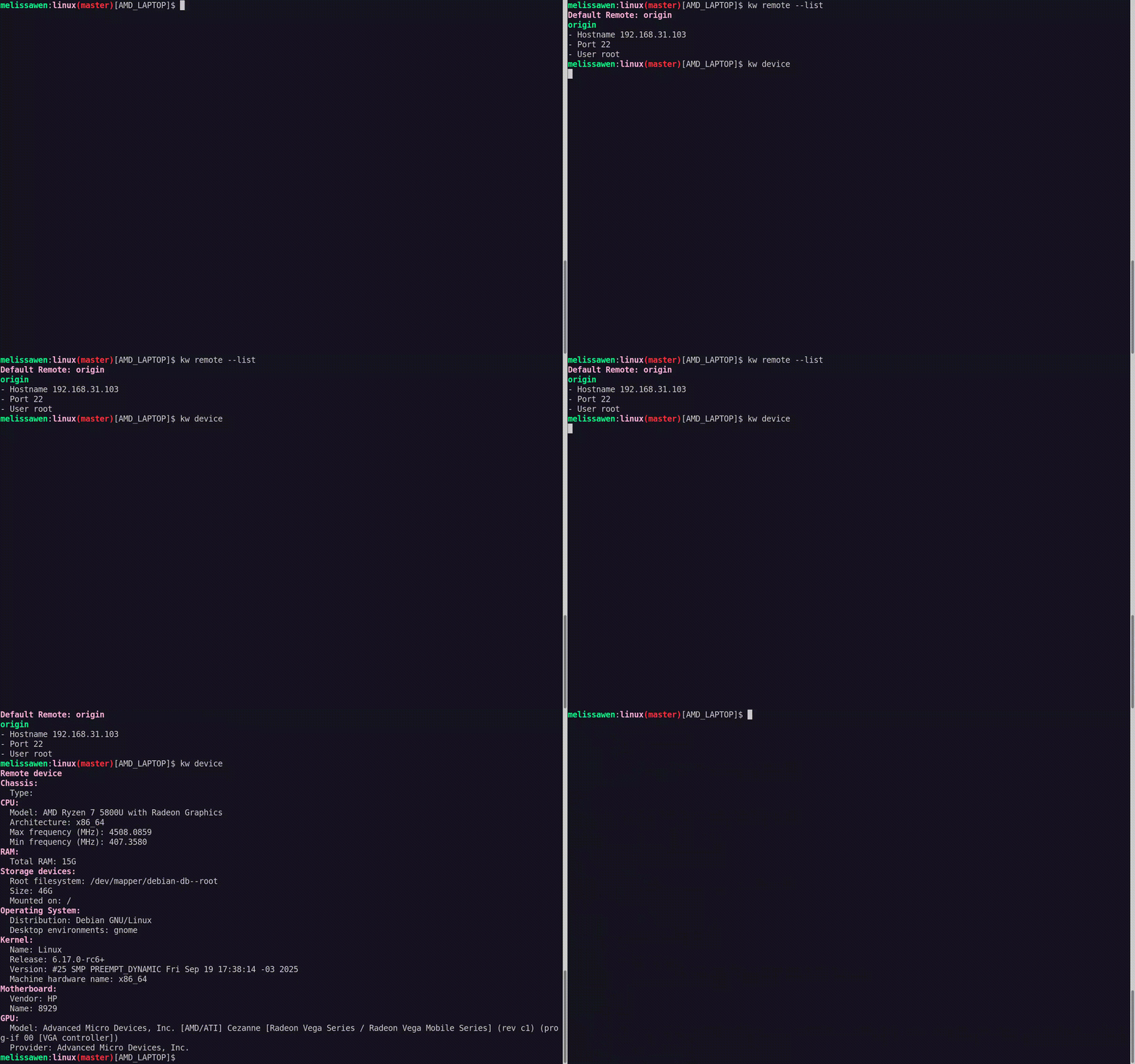
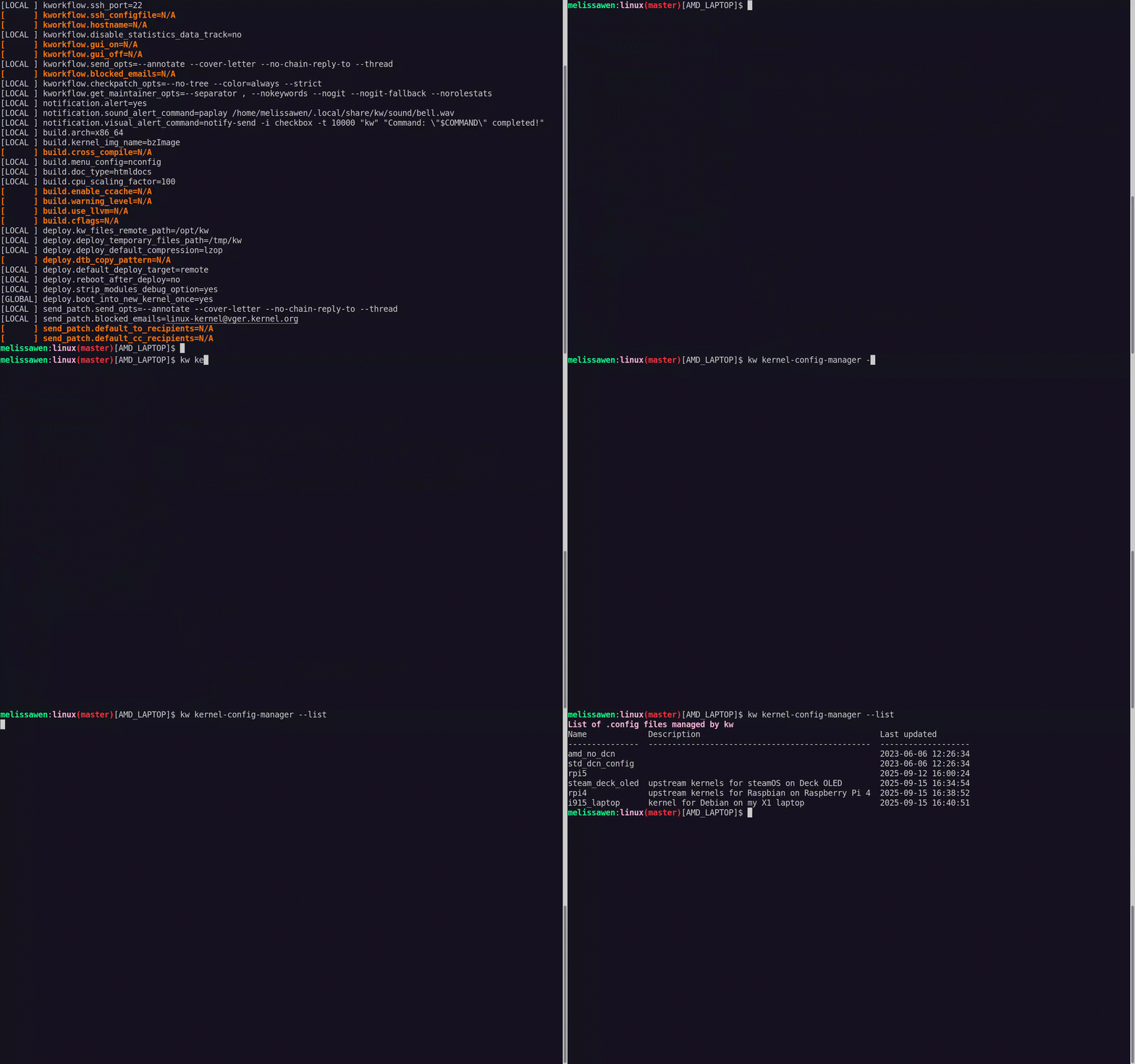
  • kw device: to get information about the target machine, such as: CPU model, kernel version, distribution, GPU model,
  • kw remote: to set the address of this machine for remote access
Slide 11: kw config
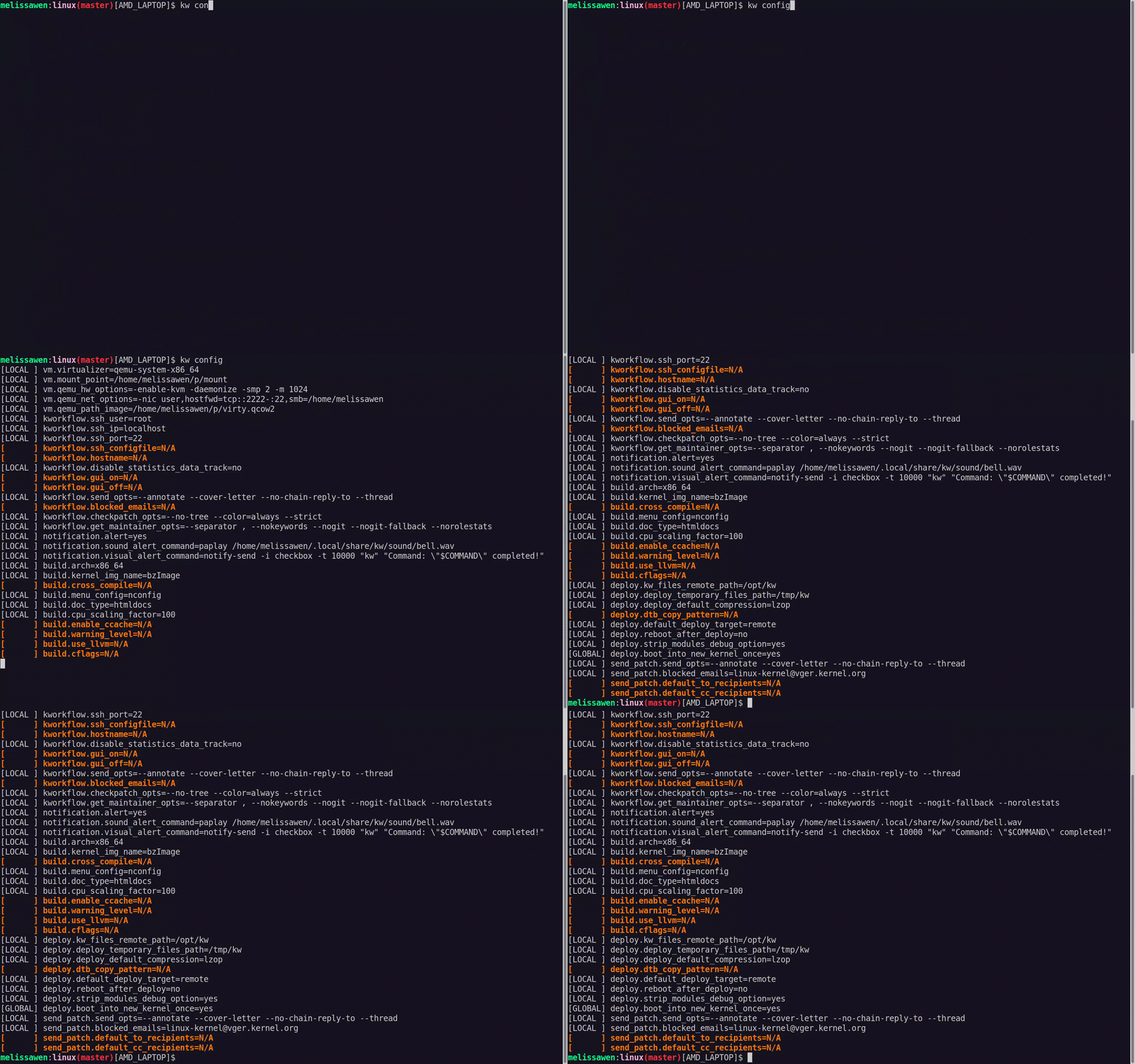
  • kw config: you can configure kw with kw config. With this command you can basically select the tools, flags and preferences that kw will use to build and deploy a custom kernel in a target machine. You can also define recipients of your patches when sending it using kw send-patch. I ll explain more about each feature later in this presentation.
Slide 13: kw kernel-config-manager
  • kw kernel-config manager (or just kw k): to fetch the kernel .config file from a given machine, store multiple .config files, list and retrieve them according to your needs.
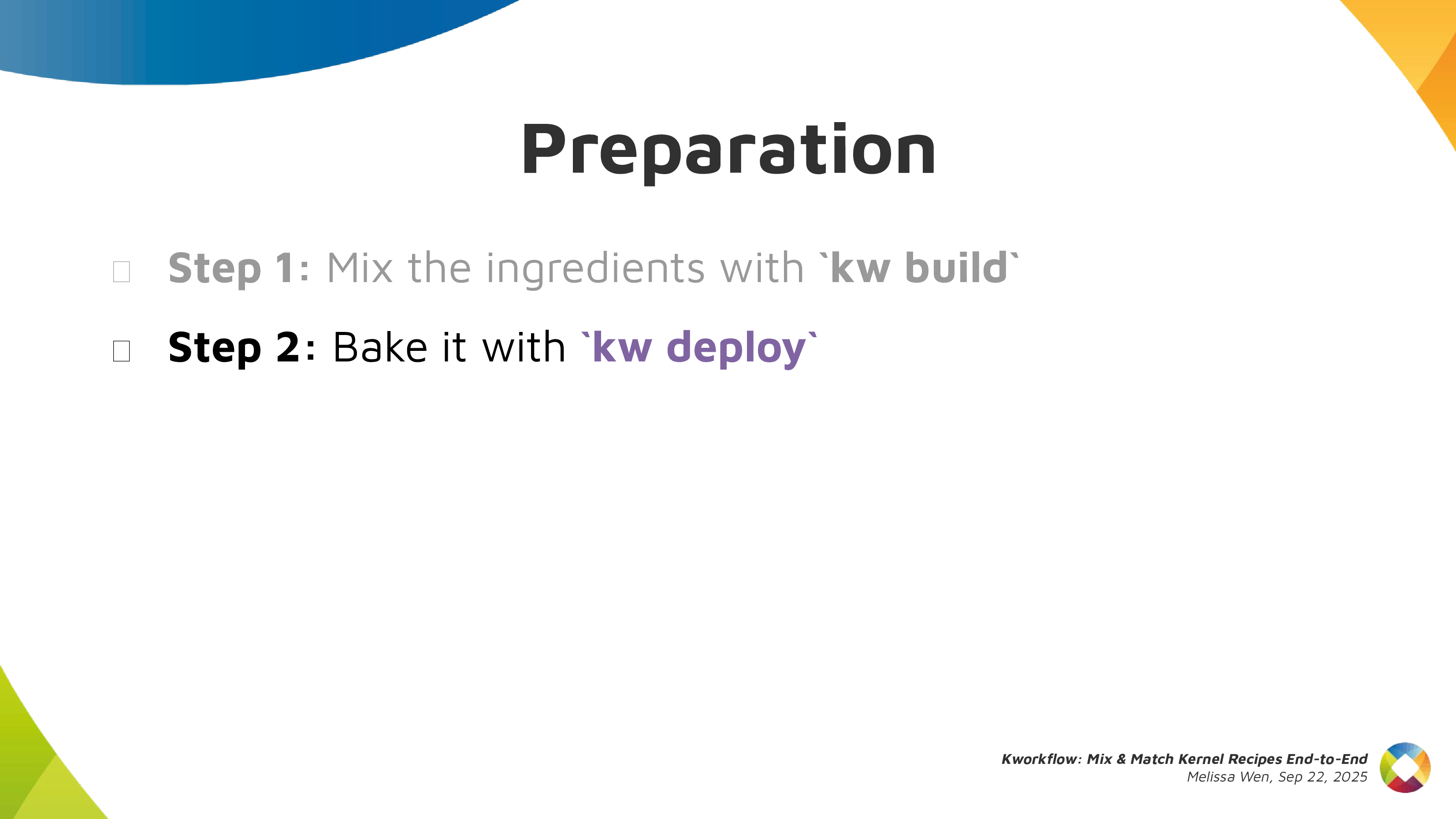
Slide 15: Preparation Now, with all ingredients and tools selected and well portioned, follow the right steps to prepare your custom kernel! First step: Mix ingredients with kw build or just kw b Slide 16: kw build
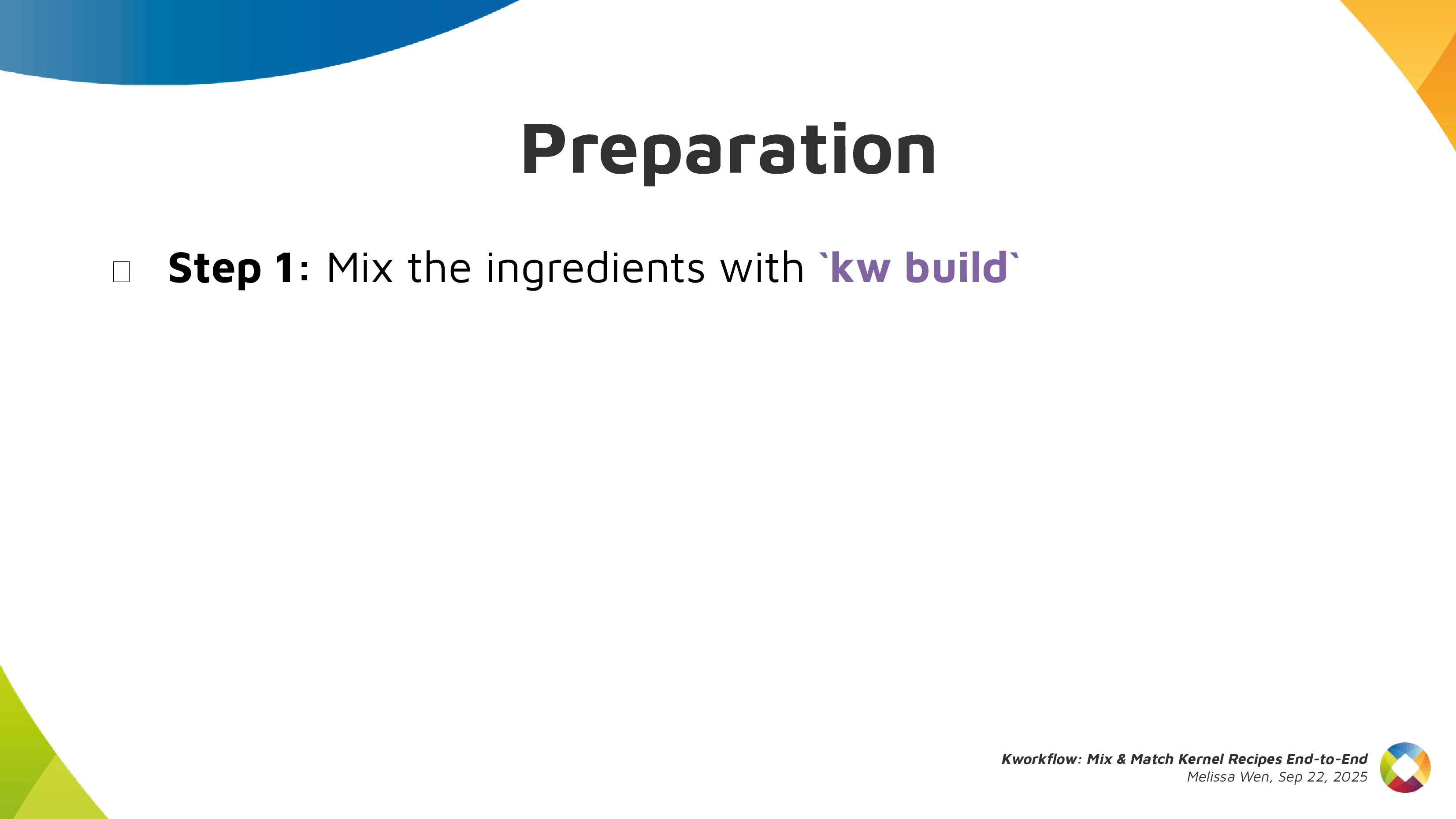
  • kw b and its options wrap many routines of compiling a custom kernel.
    • You can run kw b -i to check the name and kernel version and the number of modules that will be compiled and kw b --menu to change kernel configurations.
    • You can also pre-configure compiling preferences in kw config regarding kernel building. For example, target architecture, the name of the generated kernel image, if you need to cross-compile this kernel for a different system and which tool to use for it, setting different warning levels, compiling with CFlags, etc.
    • Then you can just run kw b to compile the custom kernel for a target machine.
Second step: Bake it with kw deploy or just kw d Slide 18: kw deploy After compiling the custom kernel, we want to install it in the target machine. Check the name of the custom kernel built: 6.17.0-rc6 and with kw s SSH access the target machine and see it s running the kernel from the Debian distribution 6.16.7+deb14-amd64. As with building settings, you can also pre-configure some deployment settings, such as compression type, path to device tree binaries, target machine (remote, local, vm), if you want to reboot the target machine just after deploying your custom kernel, and if you want to boot in the custom kernel when restarting the system after deployment. If you didn t pre-configured some options, you can still customize as a command option, for example: kw d --reboot will reboot the system after deployment, even if I didn t set this in my preference. With just running kw d --reboot I have installed the kernel in a given target machine and rebooted it. So when accessing the system again I can see it was booted in my custom kernel. Third step: Time to taste with kw debug Slide 20: kw debug
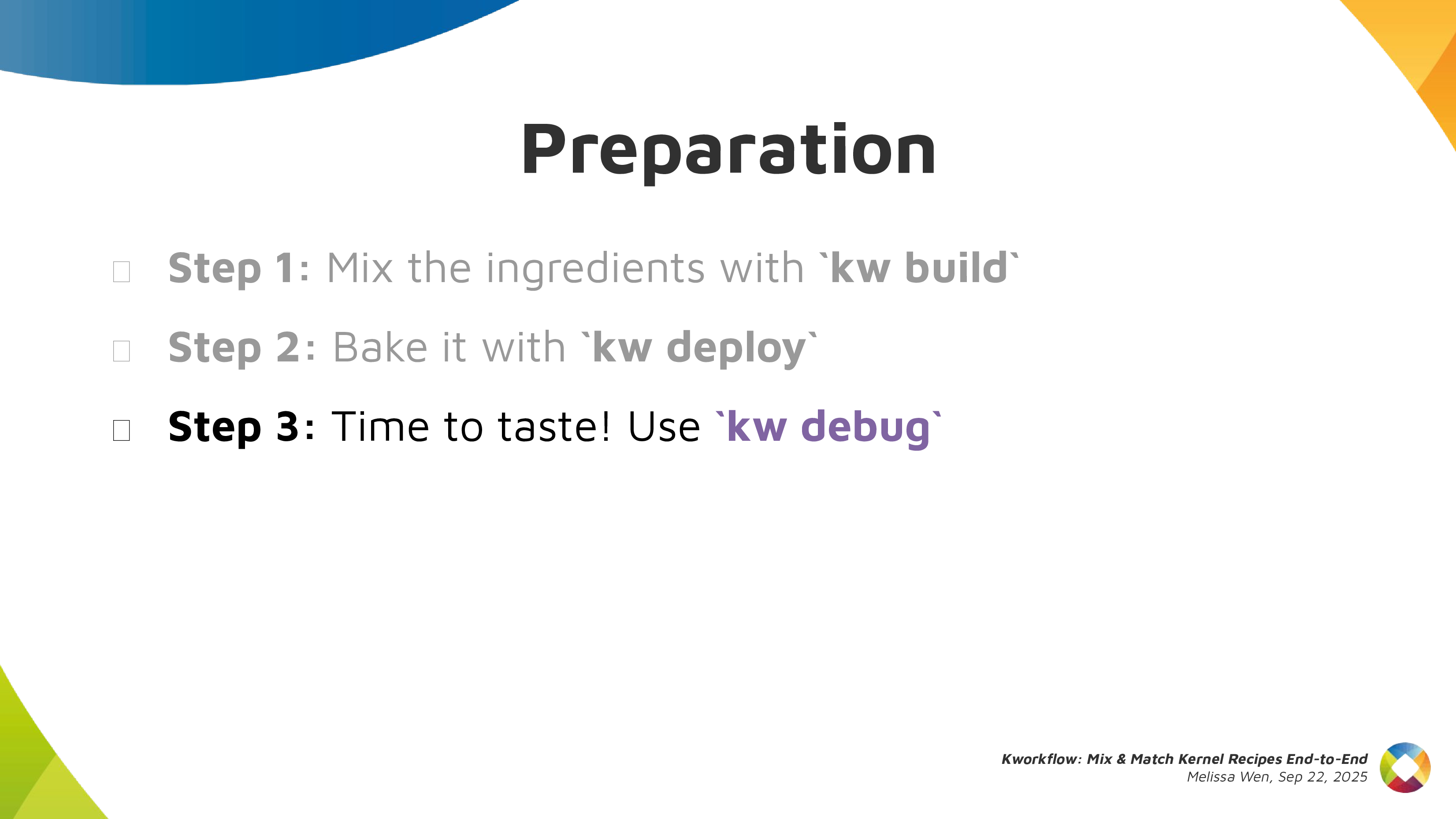
  • kw debug wraps many tools for validating a kernel in a target machine. We can log basic dmesg info but also tracking events and ftrace.
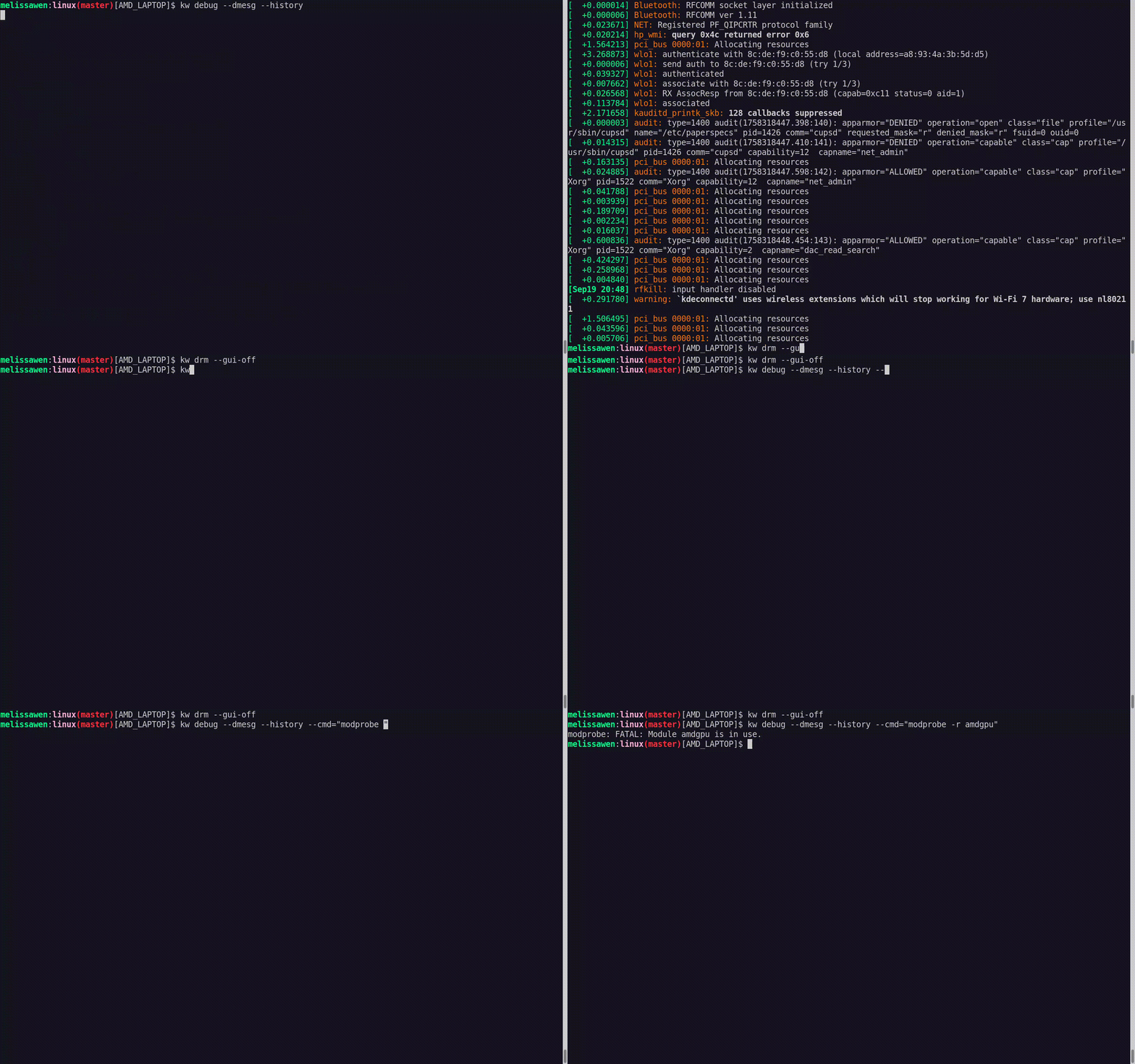
    • With kw debug --dmesg --history we can grab the full dmesg log from a remote machine, if you use the --follow option, you will monitor dmesg outputs. You can also run a command with kw debug --dmesg --cmd="<my command>" and just collect the dmesg output related to this specific execution period.
    • In the example, I ll just unload the amdgpu driver. I use kw drm --gui-off to drop the graphical interface and release the amdgpu for unloading it. So I run kw debug --dmesg --cmd="modprobe -r amdgpu" to unload the amdgpu driver, but it fails and I couldn t unload it.

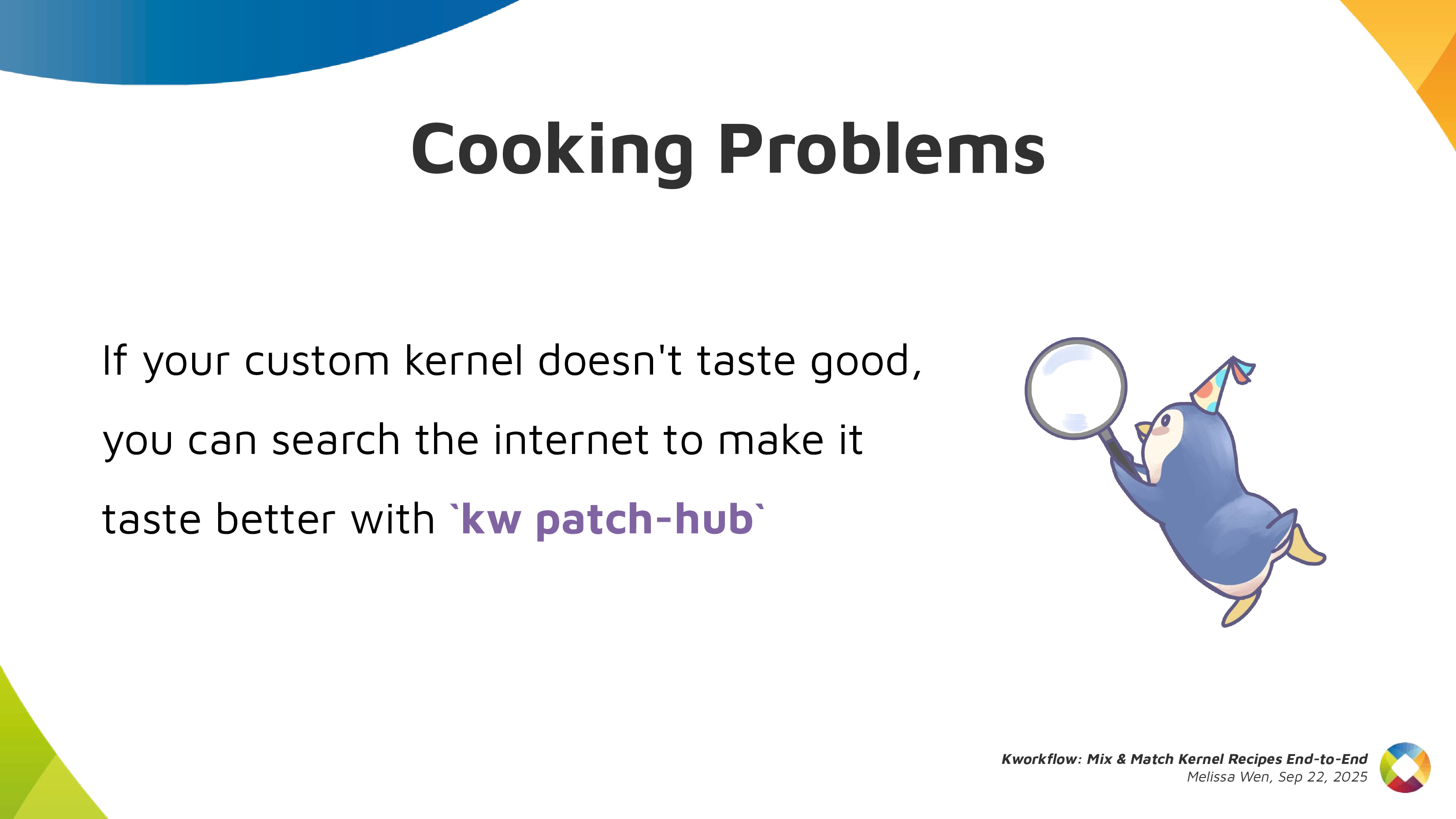
Cooking Problems Slide 22: kw patch-hub Oh no! That custom kernel isn t tasting good. Don t worry, as in many recipes preparations, we can search on the internet to find suggestions on how to make it tasteful, alternative ingredients and other flavours according to your taste. With kw patch-hub you can search on the lore kernel mailing list for possible patches that can fix your kernel issue. You can navigate in the mailing lists, check series, bookmark it if you find it relevant and apply it in your local kernel tree, creating a different branch for tasting oops, for testing. In this example, I m opening the amd-gfx mailing list where I can find contributions related to the AMD GPU driver, bookmark and/or just apply the series to my work tree and with kw bd I can compile & install the custom kernel with this possible bug fix in one shot. As I changed my kw config to reboot after deployment, I just need to wait for the system to boot to try again unloading the amdgpu driver with kw debug --dmesg --cm=modprobe -r amdgpu. From the dmesg output retrieved by kw for this command, the driver was unloaded, the problem is fixed by this series and the kernel tastes good now. If I m satisfied with the solution, I can even use kw patch-hub to access the bookmarked series and marking the checkbox that will reply the patch thread with a Reviewed-by tag for me.

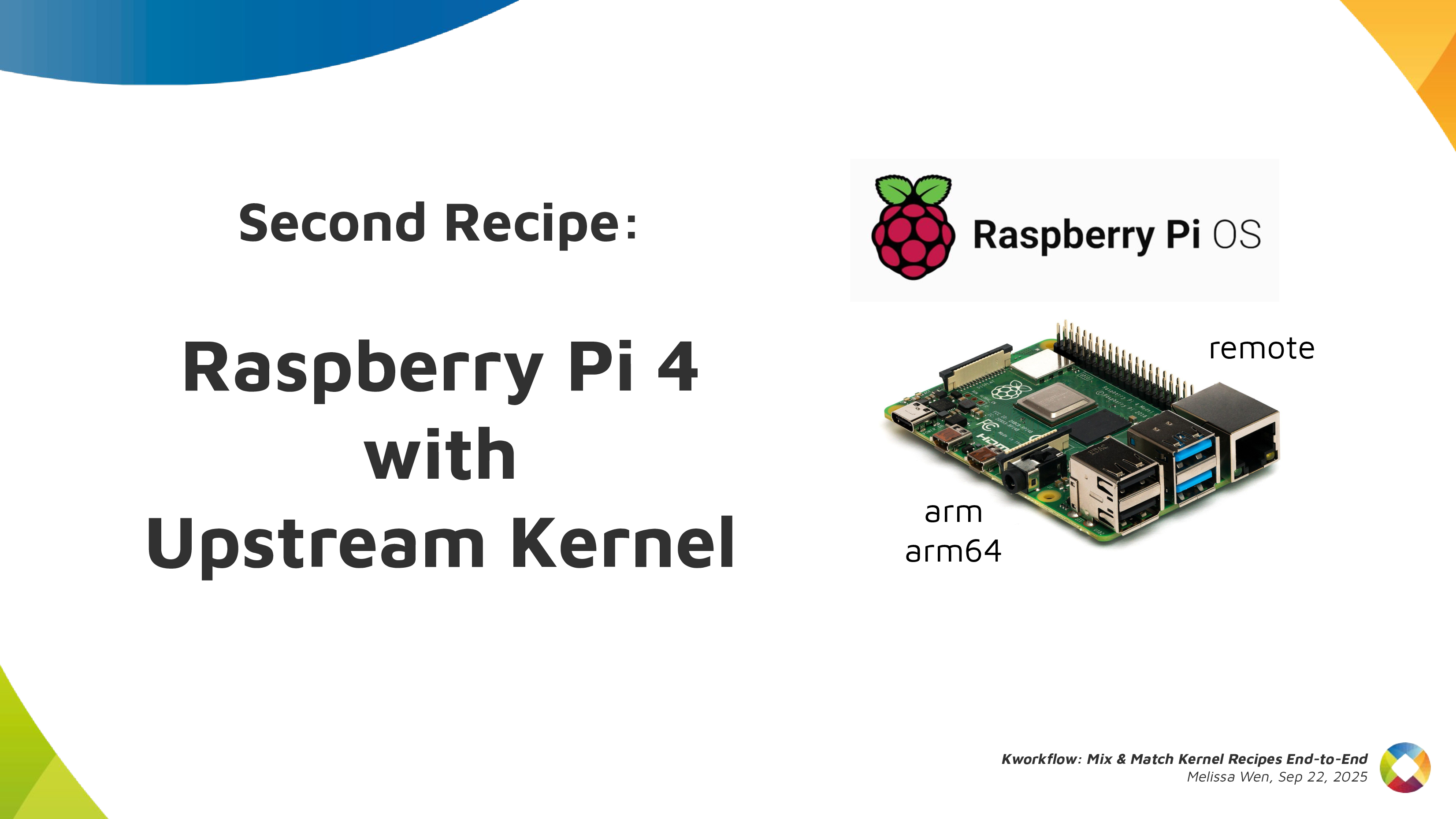
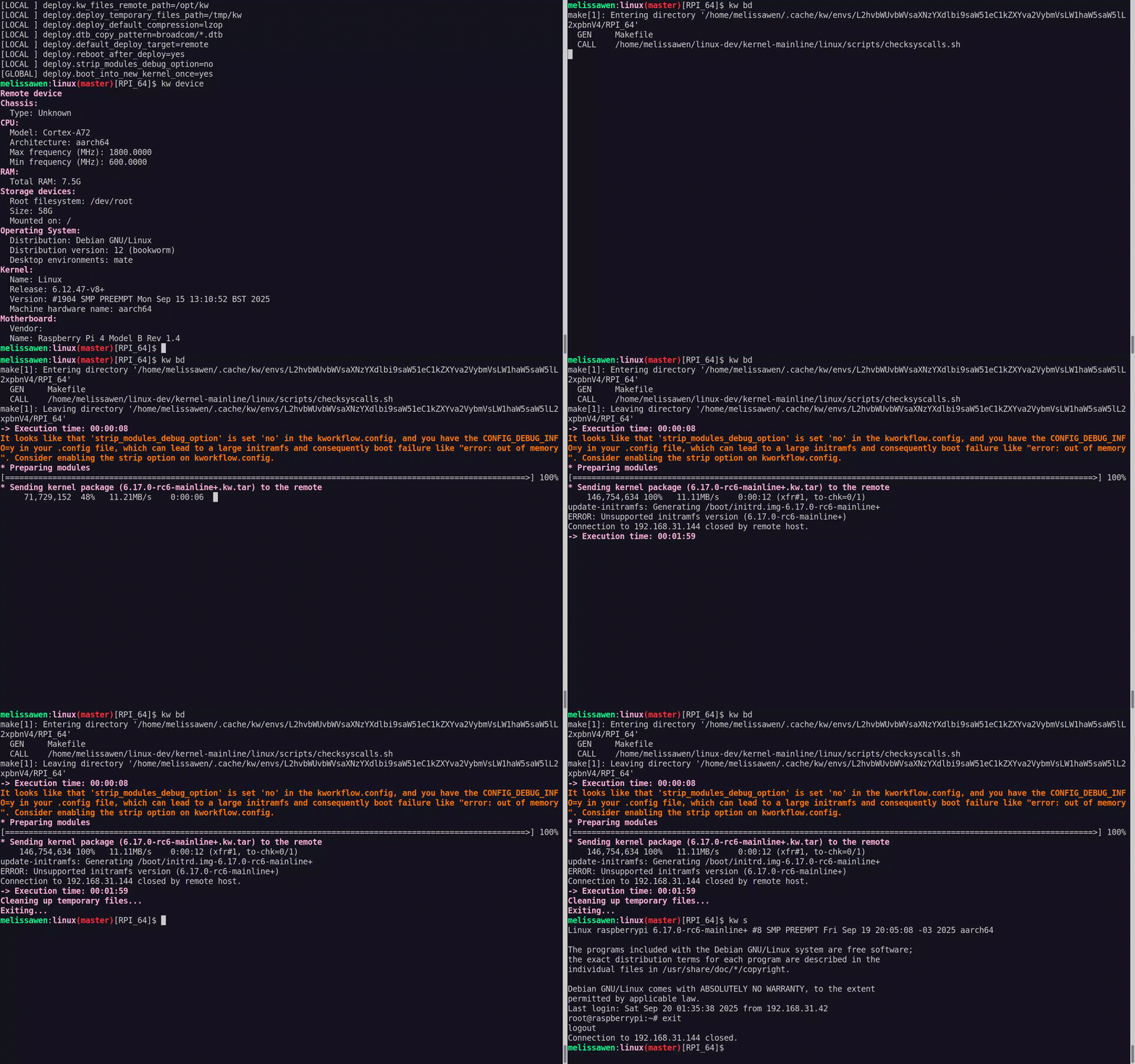
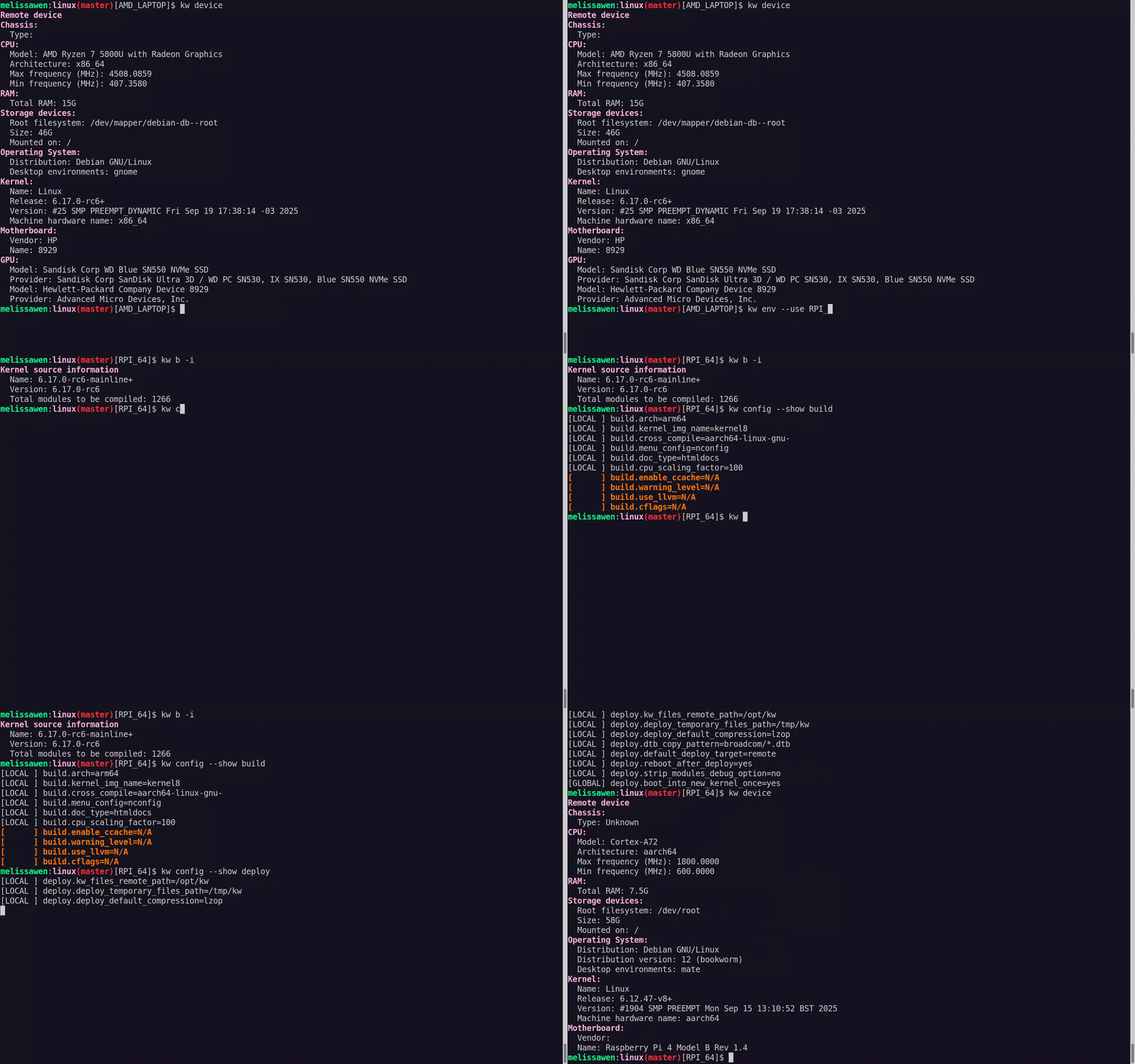
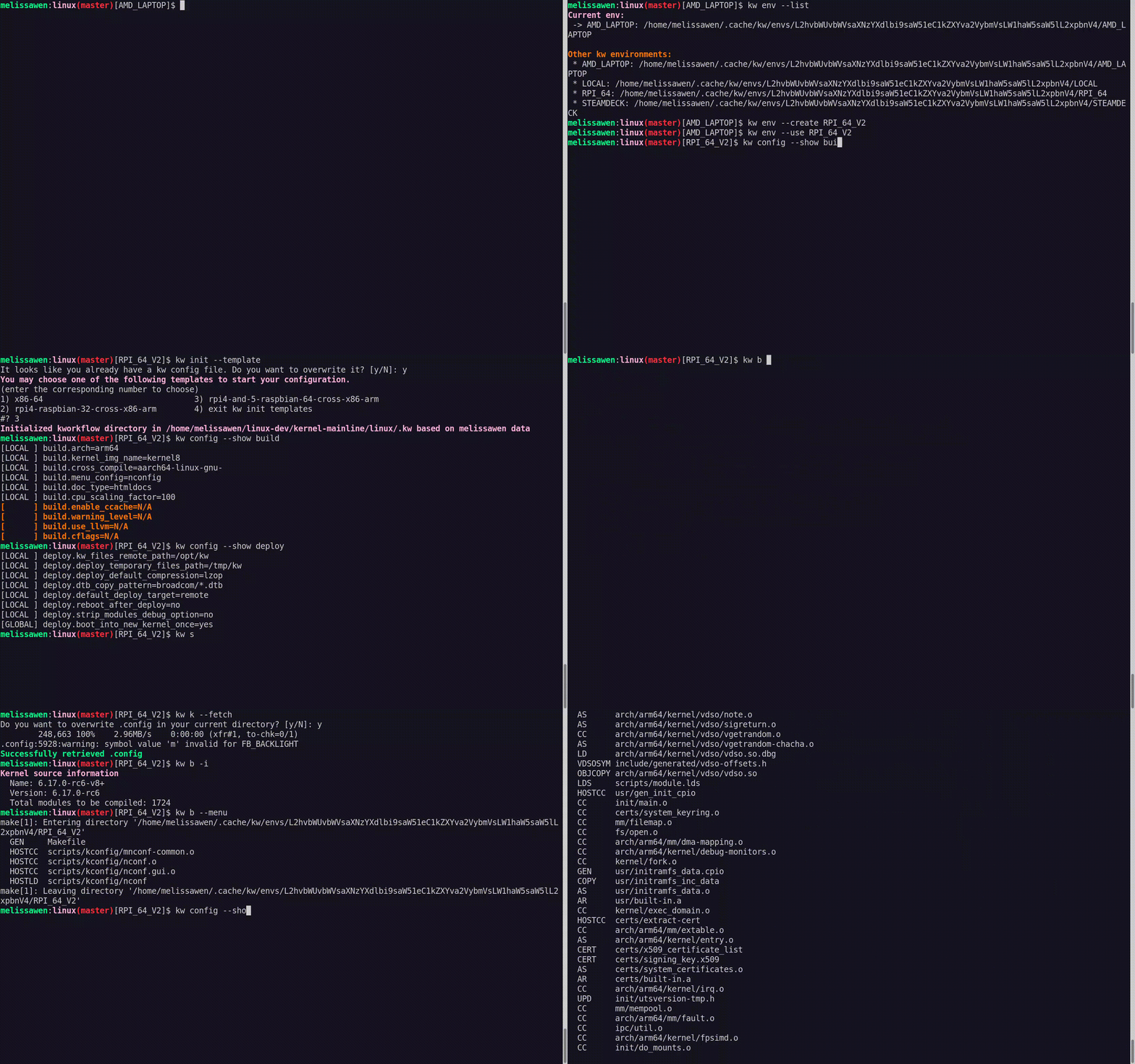
Second Recipe: Raspberry Pi 4 with Upstream Kernel Slide 25: Second Recipe RPi 4 with upstream kernel As in all recipes, we need ingredients and tools, but with kworkflow you can get everything set as when changing scenarios in a TV show. We can use kw env to change to a different environment with all kw and kernel configuration set and also with the latest compiled kernel cached. I was preparing the first recipe for a x86 AMD laptop and with kw env --use RPI_64 I use the same worktree but moved to a different kernel workflow, now for Raspberry Pi 4 64 bits. The previous compiled kernel 6.17.0-rc6-mainline+ is there with 1266 modules, not the 6.17.0-rc6 kernel with 285 modules that I just built&deployed. kw build settings are also different, now I m targeting a arm64 architecture with a cross-compiled kernel using aarch64-linu-gnu- cross-compilation tool and my kernel image calls kernel8 now. Slide 27: kw env If you didn t plan for this recipe in advance, don t worry. You can create a new environment with kw env --create RPI_64_V2 and run kw init --template to start preparing your kernel recipe with the mirepoix ready. I mean, with the basic ingredients already cut I mean, with the kw configuration set from a template. And you can use kw remote to set the IP address of your target machine and kw kernel-config-manager to fetch/retrieve the .config file from your target machine. So just run kw bd to compile and install a upstream kernel for Raspberry Pi 4.
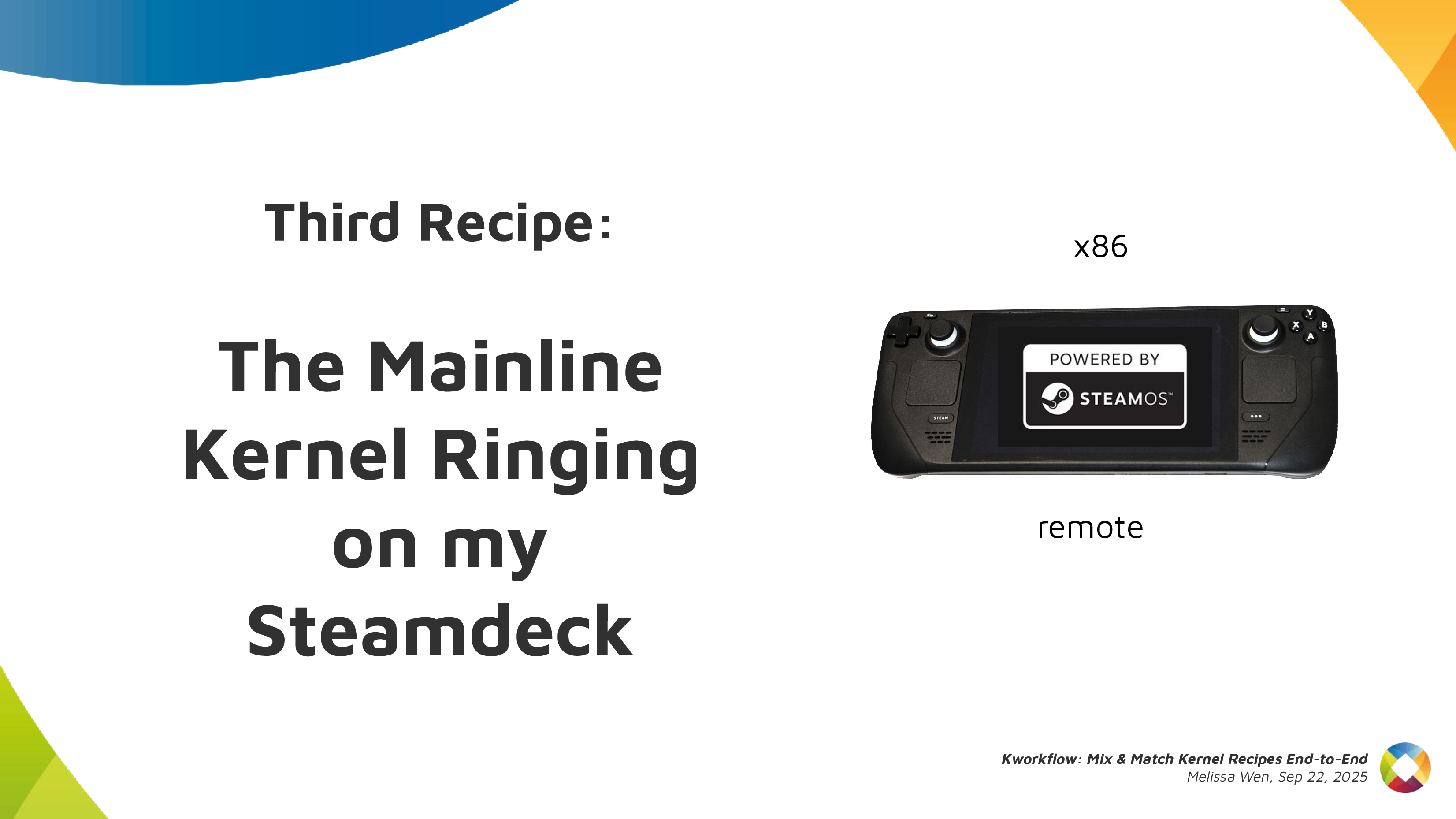
Third Recipe: The Mainline Kernel Ringing on my Steam Deck (Live Demo) Slide 30: Third Recipe - The Mainline Kernel Ringing on my Steam Deck Let s show you how easy is to build, install and test a custom kernel for Steam Deck with Kworkflow. It s a live demo, but I also recorded it because I know the risks I m exposed to and something can go very wrong just because of reasons :)
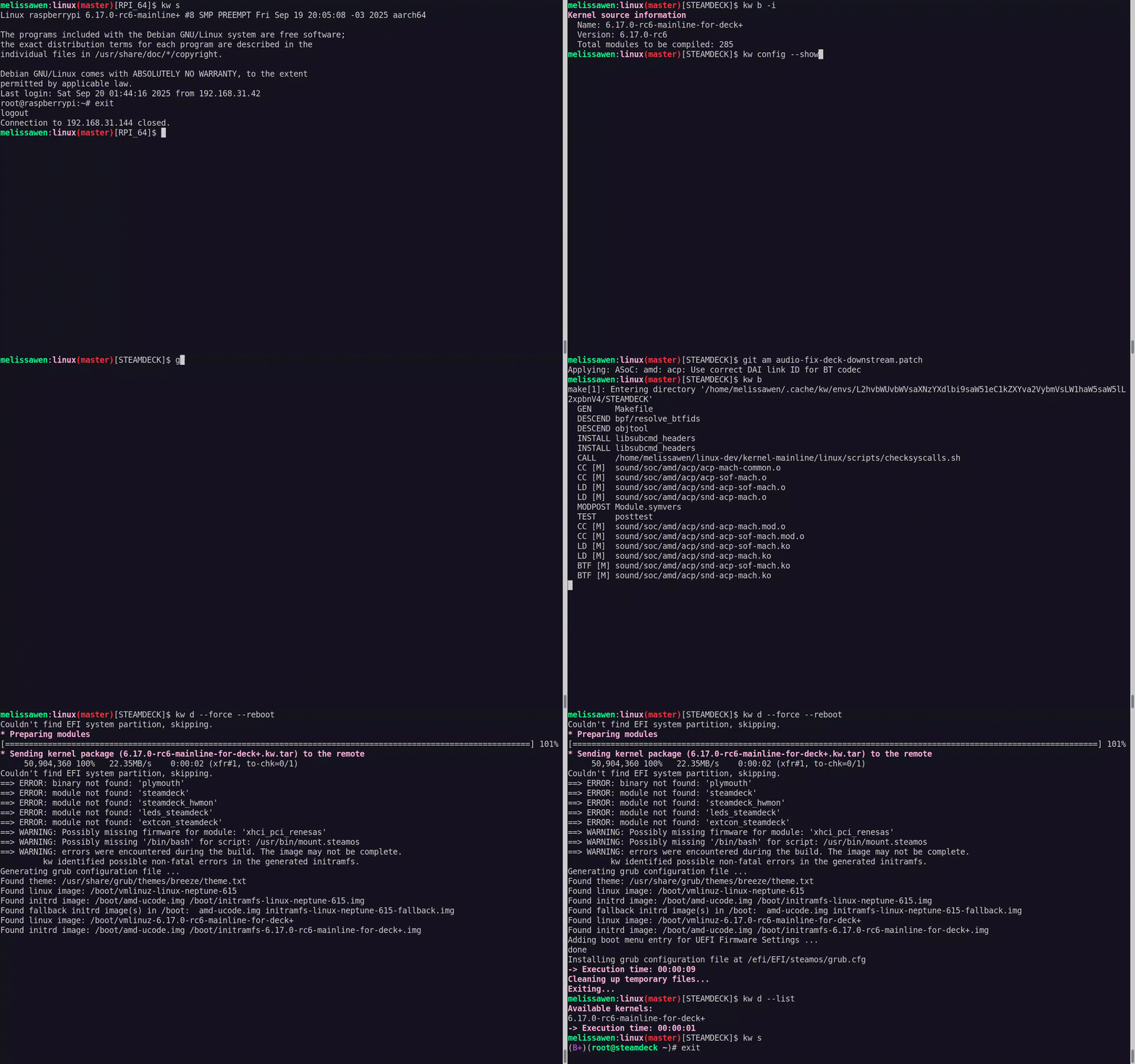
Report: how was the live demo For this live demo, I took my OLED Steam Deck to the stage. I explained that, if I boot mainline kernel on this device, there is no audio. So I turned it on and booted the mainline kernel I ve installed beforehand. It was clear that there was no typical Steam Deck startup audio when the system was loaded. Franks drawing of Melissa Wen doing a demo of kworkflow with the Steam Deck As I started the demo in the kw environment for Raspberry Pi 4, I first moved to another environment previously used for Steam Deck. In this STEAMDECK environment, the mainline kernel was already compiled and cached, and all settings for accessing the target machine, compiling and installing a custom kernel were retrieved automatically. My live demo followed these steps:
  1. With kw env --use STEAMDECK, switch to a kworkflow environment for Steam Deck kernel development.
  2. With kw b -i, shows that kw will compile and install a kernel with 285 modules named 6.17.0-rc6-mainline-for-deck.
  3. Run kw config to show that, in this environment, kw configuration changes to x86 architecture and without cross-compilation.
  4. Run kw device to display information about the Steam Deck device, i.e. the target machine. It also proves that the remote access - user and IP - for this Steam Deck was already configured when using the STEAMDECK environment, as expected.
  5. Using git am, as usual, apply a hot fix on top of the mainline kernel. This hot fix makes the audio play again on Steam Deck.
  6. With kw b, build the kernel with the audio change. It will be fast because we are only compiling the affected files since everything was previously done and cached. Compiled kernel, kw configuration and kernel configuration is retrieved by just moving to the STEAMDECK environment.
  7. Run kw d --force --reboot to deploy the new custom kernel to the target machine. The --force option enables us to install the mainline kernel even if mkinitcpio complains about missing support for downstream packages when generating initramfs. The --reboot option makes the device reboot the Steam Deck automatically, just after the deployment completion.
  8. After finishing deployment, the Steam Deck will reboot on the new custom kernel version and made a clear resonant or vibrating sound. [Hopefully]
Finally, I showed to the audience that, if I wanted to send this patch upstream, I just needed to run kw send-patch and kw would automatically add subsystem maintainers, reviewers and mailing lists for the affected files as recipients, and send the patch to the upstream community assessment. As I didn t want to create unnecessary noise, I just did a dry-run with kw send-patch -s --simulate to explain how it looks.

What else can kworkflow already mix & match? In this presentation, I showed that kworkflow supported different kernel development workflows, i.e., multiple distributions, different bootloaders and architectures, different target machines, different debugging tools and automatize your kernel development routines best practices, from development environment setup and verifying a custom kernel in bare-metal to sending contributions upstream following the contributions-by-e-mail structure. I exemplified it with three different target machines: my ordinary x86 AMD laptop with Debian, Raspberry Pi 4 with arm64 Raspbian (cross-compilation) and the Steam Deck with SteamOS (x86 Arch-based OS). Besides those distributions, Kworkflow also supports Ubuntu, Fedora and PopOS. Now it s your turn: Do you have any secret recipes to share? Please share with us via kworkflow.

Dirk Eddelbuettel: duckdb-mlpack 0.0.3: macOS binaries, unit tests, more outputs

A littler two weeks a short post announced the duckdb-mlpack as ML quacks : combining the powerful C++ machine learning library mlpack with the amazing analytical database engine duckdb. About a week ago another short post covered first extensions. We actually followed-up with release 0.0.3 days later, and never posted about it so this short note catches up. In release 0.0.3, we provide macOS binaries: following a known issue with one of the components, we apply a simple patch to enable the build. Next up are wasm and windows, if you know your way around these platforms please get in touch. Release 0.0.3 also added first unit tests, serializes the coefficients from the (regularized) linear regression into the output table. See see two previous posts linked above for details and background, the repo for code, issues and more, and the extension page for more about this duckdb community extension.

This post by Dirk Eddelbuettel originated on his Thinking inside the box blog. If you like this or other open-source work I do, you can sponsor me at GitHub.

Kentaro Hayashi: Migrating from hugo-theme-learn to alternative theme

Introduction For personal web site, I use hugo and hugo-theme-learn for statically generated contents. Recently I've noticed that these combination of specific version is not compatible with. (Not so frequently update contents, so it was delayed to found this situation)

What was the actual error?
ERROR deprecated: .Site.IsMultiLingual was deprecated in Hugo v0.124.0 and subsequently removed. Use hugo.IsMultilingual instead.
Total in 21 ms
It seems that hugo-theme-learn is not compatible with recent Hugo anymore.

How to deal with it? With checking upstream issue, I've found the following issue. What are people migrating too? 'hugo-theme-relearn' was noted as an alternative. As 'hugo-theme-learn' is not actively maintained anymore, so it is easy to migrate from hugo-theme-learn to hugo-theme-relearn. For example, it needs just a few lines of configuration.
diff --git a/website/config.toml b/website/config.toml
index 702d4da..99ddf03 100644
--- a/website/config.toml
+++ b/website/config.toml
@@ -3,7 +3,7 @@ languageCode = "en-US"
 defaultContentLanguage = "en"
-theme = "hugo-theme-learn"
+theme = "hugo-theme-relearn"
 themesdir = "themes"
 metaDataFormat = "yaml"
 defaultContentLanguageInSubdir= true
@@ -16,6 +16,7 @@ defaultContentLanguageInSubdir= true
   disableNextPrev = true
   disableSearch = true
   disableShortcutsTitle = true
+  themeVariant = 'learn'
 [markup]
   [markup.goldmark]
It was sad that hugo-theme-learn is not maintained actively, but many thank to this greateful hugo theme. And also thanks the effort to fork it as hugo-theme-relearn.

2 November 2025

Guido G nther: Free Software Activities October 2025

Quiete some things made progress last month: We put out Phosh 0.50 release, got closer to enabling media roles for audio by default in Phosh (see related post) and reworked our images builds. You should also (hopefully) notice some nice quality of life improvements once changes land in a distro near you and you're using Phosh. See below for details: phosh phoc phosh-mobile-settings stevia (formerly phosh-osk-stub) phosh-tour meta-phosh xdg-desktop-portal-phosh libphosh-rs Calls Phrog phosh-recipes feedbackd feedbackd-device-themes Chatty Squeekboard Debian Cellbroadcastd gnome-settings-daemon gnome-control-center gnome-initial-setup sdm845-mainline gnome-session alpine droid-juicer phosh-site phosh-debs Linux Wireplumber Phosh.mobi e.V. demo-phones Reviews This is not code by me but reviews on other peoples code. The list is (as usual) slightly incomplete. Thanks for the contributions! Comments? Join the Fediverse thread

Ben Hutchings: FOSS activity in October 2025

1 November 2025

Junichi Uekawa: Playing Clair Obscur Expedition 33.

Playing Clair Obscur Expedition 33. I didn't think I would try again and again to beat a boss I cannot beat for multiple days. But here I am.

31 October 2025

Emmanuel Kasper: Best Pick-up-and-play with a gamepad on Debian and other Linux distributions: SuperTux

After playing some 16 bits era classic games on my Mist FPGA I was wondering what I could play on my Debian desktop as a semi-casual gamer. By semi-casual I mean that if a game needs more than 30 minutes to understand the mechanics, or needs 10 buttons on the gamepad I usually drop it. After testing a dozen games available in the Debian archive my favorite Pick-up-and-play is SuperTux. SuperTux is a 2D platformer quite similar to Super Mario World or Sonic, well also 16 bits classics, but of course you play a friendly penguin. What I like in SuperTux:
  • complete free and opensource application packaged in the Debian main package repository, including all the game assets. So no fiddling around to get game data like Quake / Doom3, everything is available in the Debian repositories. The game is also available from all major Linux distributions in their standard repositories.
  • gamepad immediately usable. Probably the credits has to go the SDL library, but my 8bitdo wireless controller was usable instantly either via 2.4Ghz dongle or Bluetooth
  • well suited for casual players: the game mechanics are easy to grasp and the tutorial is excellent
  • polished interface, the menus are clear and easy to navigate, and there is no internal jargon in the default navigation till you run your first game. (Something which confused me when playing the SuperTuxKart racing game: when I was offered to leave STK I was wondering what that STK mode is. I understood afterwards STK is just the acronym of the game)
  • feel reasonably modern, the game does not start in a 640 480 window with 16 colors and you could demo it without shame for a casual gamer audience.
What can be say of the game itself ? You play a penguin who can run, shoot small fireballs, fall on your back to hit enemies harder. I played 10 levels, most levels had to be tried between 1 and 10 times which I find OK, the difficulty is raising in a very smooth curve. SuperTux has complete localization, hence my screenshots show french text. SuperTux tutorial Comprehensive in-game tutorial World Map There is a large ice flow world, but we are going underground now Example Level Good level design that you have to use to avoid those spiky enemies Underground level The point where I had to pause the game, after missing those flying wigs 15 times in a row SuperTux can be played with keyboard or gamepad, and has minimal hardware requirements, anything computer with working 3D graphic acceleration released in the last 20 years will be able to run it.

28 October 2025

Russ Allbery: Review: Those Who Wait

Review: Those Who Wait, by Haley Cass
Publisher: Haley Cass
Copyright: 2020
ISBN: 979-8-9884929-1-7
Format: Kindle
Pages: 556
Those Who Wait is a stand-alone self-published sapphic romance novel. Given the lack of connection between political figures named in this book and our reality, it's also technically an alternate history, but it will be entirely unsatisfying to anyone who reads it in that genre. Sutton Spencer is an English grad student in New York City. As the story opens, she has recently realized that she's bisexual rather than straight. She certainly has not done anything about that revelation; the very thought makes her blush. Her friend and roommate Regan, not known for either her patience or her impulse control, decides to force the issue by stealing Sutton's phone, creating a profile on a lesbian dating app, and messaging the first woman Sutton admits being attracted to. Charlotte Thompson is a highly ambitious politician, current deputy mayor of New York City for health and human services, and granddaughter of the first female president of the United States. She fully intends to become president of the United States herself. The next step on that path is an open special election for a seat in the House of Representatives. With her family political connections and the firm support of the mayor of New York City (who is also dating her brother), she thinks she has an excellent shot of winning. Charlotte is also a lesbian, something she's known since she was a teenager and which still poses serious problems for a political career. She is therefore out to her family and a few close friends, but otherwise in the closet. Compared to her political ambitions, Charlotte considers her love life almost irrelevant, and therefore has a strict policy of limiting herself to anonymous one-night stands arranged on dating apps. Even that is about to become impossible given her upcoming campaign, but she indulges in one last glance at SapphicSpark before she deletes her account. Sutton is as far as possible from the sort of person who does one-night stands, which is a shame as far as Charlotte is concerned. It would have been a fun last night out. Despite that, both of them find the other unexpectedly enjoyable to chat with. (There are a lot of text message bubbles in this book.) This is when Sutton has her brilliant idea: Charlotte is charming, experienced, and also kind and understanding of Sutton's anxiety, at least in app messages. Maybe Charlotte can be her mentor? Tell her how to approach women, give her some guidance, point her in the right directions. Given the genre, you can guess how this (eventually) turns out. I'm going to say a lot of good things about this book, so let me get the complaints over with first. As you might guess from that introduction, Charlotte's political career and the danger of being outed are central to this story. This is a bit unfortunate because you should not, under any circumstances, attempt to think deeply about the politics in this book. In 550 pages, Charlotte does not mention or expound a single meaningful political position. You come away from this book as ignorant about what Charlotte wants to accomplish as a politician as you entered. Apparently she wants to be president because her grandmother was president and she thinks she'd be good at it. The closest the story comes to a position is something unbelievably vague about homeless services and Charlotte's internal assertion that she wants to help people and make real change. There are even transcripts of media interviews, later in the book, and they somehow manage to be more vacuous than US political talk shows, which is saying something. I also can't remember a single mention of fundraising anywhere in this book, which in US politics is absurd (although I will be generous and say this is due to Cass's alternate history). I assume this was a deliberate choice and Cass didn't want politics to distract from the romance, but as someone with a lot of opinions about concrete political issues, the resulting vague soft-liberal squishiness was actively off-putting. In an actual politician, this would be an entire clothesline of red flags. Thankfully, it's ignorable for the same reason; this is so obviously not the focus of the book that one can mostly perform the same sort of mental trick that one does when ignoring the backdrop in a cheap theater. My second complaint is that I don't know what Sutton does outside of the romance. Yes, she's an English grad student, and she does some grading and some vaguely-described work and is later referred to a prestigious internship, but this is as devoid of detail as Charlotte's political positions. It's not quite as jarring because Cass does eventually show Sutton helping concretely with her mother's work (about which I have some other issues that I won't get into), but it deprives Sutton of an opportunity to be visibly expert in something. The romance setup casts Charlotte as the experienced one to Sutton's naivete, and I think it would have been a better balance to give Sutton something concrete and tangible that she was clearly better at than Charlotte. Those complaints aside, I quite enjoyed this. It was a recommendation from the same BookTuber who recommended Delilah Green Doesn't Care, so her recommendations are quickly accumulating more weight. The chemistry between Sutton and Charlotte is quite believable; the dialogue sparkles, the descriptions of the subtle cues they pick up from each other are excellent, and it's just fun to read about how they navigate a whole lot of small (and sometimes large) misunderstandings and mismatches in personality and world view. Normally, misunderstandings are my least favorite part of a romance novel, but Sutton and Charlotte come from such different perspectives that their misunderstandings feel more justified than is typical. The characters are also fairly mature about working through them: Main characters who track the other character down and insist on talking when something happens they don't understand! Can you imagine! Only with the third-act breakup is the reader dragged through multiple chapters of both characters being miserable, and while I also usually hate third-act breakups, this one is so obviously coming and so clearly advertised from the initial setup that I couldn't really be mad. I did wish the payoff make-up scene at the end of the book had a bit more oomph, though; I thought Sutton's side of it didn't have quite the emotional catharsis that it could have had. I particularly enjoyed the reasons why the two characters fall in love, and how different they are. Charlotte is delighted by Sutton because she's awkward and shy but also straightforward and frequently surprisingly blunt, which fits perfectly with how much Charlotte is otherwise living in a world of polished politicians in constant control of their personas. Sutton's perspective is more physical, but the part I liked was the way that she treats Charlotte like a puzzle. Rather than trying to change how Charlotte expresses herself, she instead discovers that she's remarkably good at reading Charlotte if she trusts her instincts. There was something about Sutton's growing perceptiveness that I found quietly delightful. It's the sort of non-sexual intimacy that often gets lost among the big emotions in romance novels. The supporting cast was also great. Both characters have deep support networks of friends and family who are unambiguously on their side. Regan is pure chaos, and I would not be friends with her, but Cass shows her deep loyalty in a way that makes her dynamic with Sutton make sense. Both characters have thoughtful and loving families who support them but don't make decisions for them, which is a nice change of pace from the usually more mixed family situations of romance novel protagonists. There's a lot of emotional turbulence in the main relationship, and I think that only worked for me because of how rock-solid and kind the supporting cast is. This is, as you might guess from the title, a very slow burn, although the slow burn is for the emotional relationship rather than the physical one (for reasons that would be spoilers). As usual, I have no calibration for spiciness level, but I'd say that this was roughly on par with the later books in the Bright Falls series. If you know something about politics (or political history) and try to take that part of this book seriously, it will drive you to drink, but if you can put that aside and can deal with misunderstandings and emotional turmoil, this was both fun and satisfying. I liked both of the characters, I liked the timing of the alternating viewpoints, and I believed in the relationship and chemistry, as improbable and chaotic as some of the setup was. It's not the greatest thing I ever read, and I wish the ending was a smidgen stronger, but it was an enjoyable way to spend a few reading days. Recommended. Rating: 7 out of 10

27 October 2025

Dirk Eddelbuettel: #054: Faster r-ci Continuous Integration via r2u Container

Welcome to post 54 in the R4 series. The topic of continuous integration has been a recurrent theme here at the R4 series. Post #32 introducess r-ci, while post #41 brings r2u to r-ci, but does not show a matrix deployment. Post #45 describes the updated r-ci setup that is now the default and contains a macOS and Ubuntu matrix, where the latter relies on r2u to keep things fast, easy, reliable . Last but not least more recent post #52 shares a trick for ensuring coverage reports. Following #45, use of r-ci at for example GitHub Actions has seen steady use and very reliable performance. With the standard setup, a vanilla Ubuntu setup is changed into one supported by r2u. This requires downloading and installating a few Ubuntu packages, and has generally been fairly quick on the order of around fourty seconds. Now, the general variability of run-times for identical tasks in GitHub Actions is well documented by the results of the setup described in post #39 which still runs weekly. It runs the identical SQL query against a remote backend using two different package families. And lo and behold, the intra-method variability on unchanged code or setup and therefore due solely to system variability is about as large as the inter-method variability. In short, GitHub Actions performance varies randomly with significant variability. See the repo README.md for chart that updates weekly (and see #39 for background). Of late, this variability became more noticeable during standard GitHub Actions runs where it would regularly take more than two minutes of setup time before actual continuous integration work was done. Some caching seems to be in effect, so subsequent runs in the same repo seem faster and often came back to one minute or less. For lightweight and small packages, loosing two minutes to setup when the actual test time is a minute or less gets old fast. Looking around, we noticed that container use can be combined with matrix use. So we have now been deploying the following setup (not always over all the matrix elements though)
jobs:
  ci:
    strategy:
      matrix:
        include:
          -   name: container, os: ubuntu-latest, container: rocker/r2u4ci  
          -   name: macos,     os: macos-latest   
          -   name: ubuntu,    os: ubuntu-latest  

    runs-on: $  matrix.os  
    container: $  matrix.container  
GitHub Actions is smart enough to provide NULL for container in the two other cases, so container: $ matrix.container is ignored there. But when container is set as here for the ci-enhanced version of r2u (which adds a few binaries commonly needed such as git, curl, wget etc needed for CI) then the CI jobs runs inside the container. And thereby skips most of the setup time as the container is already prepared. This also required some small adjustments in the underlying shell script doing the work. To not disrupt standard deployment, we placed these into a release candidate / development version one can op into via an new variable dev_version
      - name: Setup
        uses: eddelbuettel/github-actions/r-ci@master
        with:
          dev_version: 'TRUE'
Everything else remains the same and works as before. But faster as much less time is spent on setup. You can see the actual full yaml file and actions in my repositories for rcpparmadillo and rcppmlpack-examples. Additional testing would be welcome, so feel free to deploy this in your actions now. Otherwise I will likely carry this over and make it the defaul in a few weeks time. It will still work as before but when the added container: line is used will run much faster thanks to rocker/r2u4ci being already set up for CI.

This post by Dirk Eddelbuettel originated on his Thinking inside the box blog. If you like this or other open-source work I do, you can now sponsor me at GitHub.

Paul Tagliamonte: It's NOT always DNS.

I ve written down a new rule (no name, sorry) that I ll be repeating to myself and those around me. If you can replace DNS with key value store mapping a name to an ip and it still makes sense, it was not, in fact, DNS. Feel free to repeat it along with me. Sure, the It s always DNS meme is funny the first few hundred times you see it but what s less funny is when critical thinking ends because a DNS query is involved. DNS failures are often the first observable problem because it s one of the first things that needs to be done. DNS is fairly complicated, implementation-dependent, and at times frustrating to debug but it is not the operational hazard it s made out to be. It s at best a shallow take, and at worst actively holding teams back from understanding their true operational risks. IP connectivity failures between a host and the rest of the network is not a reason to blame DNS. This would happen no matter how you distribute the updated name to IP mappings. Wiping out all the records during the course of operations due to an automation bug is not a reason to blame DNS. This, too, would happen no matter how you distribute the name to IP mappings. Something made the choice to delete all the mappings, and it did what you asked it to do There s plenty of annoying DNS specific sharp edges to blame when things do go wrong (like 8.8.8.8 and 1.1.1.1 disagreeing about resolving a domain because of DNSSEC, or since we re on the topic, a DNSSEC rollout bricking prod for hours) for us to be cracking jokes anytime a program makes a DNS request. We can do better.

Russ Allbery: Review: On Vicious Worlds

Review: On Vicious Worlds, by Bethany Jacobs
Series: Kindom Trilogy #2
Publisher: Orbit
Copyright: October 2024
ISBN: 0-316-46362-0
Format: Kindle
Pages: 444
On Vicious Worlds is a science fiction thriller with bits of cyberpunk and a direct sequel to These Burning Stars. This is one of those series where each book has massive spoilers for the previous book and builds on characters and situations from that book. I would not read it out of order. It is Bethany Jacobs's second novel. Whooboy, how to review this without spoilers. There are so many major twists in the first book with lingering consequences that it's nearly impossible. I said at the end of my review of These Burning Stars that I was impressed with the ending for reasons that I can't reveal. One thread of this book follows the aftermath: What do you do after the plan? If you have honed yourself for one purpose, can you repurpose yourself? The other thread of the book is a murder mystery. The protectors of the community are being picked off, one by one. The culprit might be a hacker so good that they are causing Jun, the expert hacker of the first book, serious problems. Meanwhile, the political fault lines of the community are cracking open under pressure, and the leaders are untested, exhausted, and navigating difficult emotional terrain. These two story threads alternate, and interspersed are yet more flashbacks. As with the first book, the flashbacks fill in the backstory of Chono and and Esek. This time, though, we get Six's viewpoint. The good news is that On Vicious Worlds tones down the sociopathy considerably without letting up on the political twists. This is the book where Chono comes into her own. She has much more freedom of action, despite being at the center of complicated and cut-throat politics, and I thoroughly enjoyed her principled solidity. She gets a chance to transcend her previous role as an abuse victim, and it's worth the wait. The bad news is that this is very much a middle book of a trilogy. While there are a lot of bloody battles, emotional drama, political betrayals, and plot twists, the series plot has not advanced much by the end of the book. I would not say the characters were left in the same position they started the character development is real and the perils have changed but neither would I say that any of the open questions from These Burning Stars have resolved. The last book I read used science-fiction world-building to tell a story about moral philosophy that was somewhat less drama-filled than one might have expected. That is so not the case here. On Vicious Worlds is, if anything, even more dramatic than the first book of the series. In Chono's thread, the slow burn attempt to understand Six's motives has been replaced with almost non-stop melodrama, full of betrayals, reversals, risky attempts, and emotional roller coasters. Jun's part of the story is a bit more sedate at first, but there too the interpersonal drama setting is headed towards 10. This is the novel equivalent of an action movie. Jun, and her part of the story, are fine. I like the new viewpoint character, I find their system of governance somewhat interesting (although highly optimized for small groups), and I think the climax worked. But I'm invested in this series for Chono and Six. Both of them, but particularly Six, are absurdly over the top, ten people's worth of drama stuffed into one character, unable to communicate in anything less than dramatic gestures and absurd plans, but I find them magnetically fascinating. I'm not sure if written characters can have charisma, but if so, they have it. I liked this entry in the series, but then I also liked the first book. It's trauma-filled and dramatic and involved a bit too much bloody maiming for my tastes, but this whole series is about revolutions and what happens when you decide to fight, and sometimes I'm in the mood for complicated and damaged action heroes who loathe oppression and want to kill some people. This is the sort of series book that will neither be the reason you read the series nor the reason why you stop reading. If you enjoyed These Burning Stars, this is more of the same, with arguably better character development but less plot catharsis. If you didn't like These Burning Stars, this probably won't change your mind, although if you hated it specifically because of Esek's sociopathy, I think you would find this book more congenial. But maybe not; Jacobs is still the same author, and most of the characters in this series are made of sharp edges. I'm still in; I have already pre-ordered the next book. Followed by This Brutal Moon, due out in December of 2025 and advertised as the conclusion. Rating: 7 out of 10

Next.

Previous.