Search Results: "Russ Allbery"

18 January 2016

Russ Allbery: wallet 1.3

It's been over a year since the last release of the wallet, a system for storing and retrieving secure credentials (currently relying on Kerberos authentication). There were a ton of pending changes, mostly thanks to work from Jon Robertson and Bill MacAllister. I'm still really itching to rewrite all of this code, which is also part of why I haven't uploaded packages to Debian proper yet. I no longer like the way that I designed it, particularly in the Perl modules used by the server side, and want to rewrite it rather substantially. Thankfully, I'm starting to use it for work again, although only as a supplement to another in-house key management system. I might just barely be able to justify investing some effort in that as part of my job. We'll see. In the meantime, it feels awkward and clunky to work with, which makes me itch when I'm preparing new releases. In any event, this release adds preliminary support for using Active Directory as a backend for Kerberos keytabs, and adds both nested (ACLs that are groups of other ACLs) and external (run an external command to make authorization decisions) ACLs. It also adds a root instance variant of ldap-attr, and a new object type: password, which will automatically generate a password if one wasn't already stored. There are a few new wallet commands: update, which will always change the content of an object even if marked unchanging, and acl replace, which will replace all instances of an ACL as an owner field with some other ACL. There are also multiple new wallet reports, and various bug fixes to how ACLs are displayed. You can get the latest version from the wallet distribution page.

Russ Allbery: rra-c-util 5.10

Despite the name of the package, most of the changes in this release are actually to the Perl test infrastructure. I decided to finally standardize the versions of the modules embedded in wallet, but discovered the need to add an exclusion list so that I don't have to change the version of the schema module. (That currently drives database schema upgrades.) While doing that, I rediscovered that I have two versions of the module version check that shared a ton of code, so they've now been refactored into a module (and then debugged again, since I broke various things about the Automake integration). This release also fixes use of UNIX-specific path delimiters in my standard Perl docs/synopsis.t test, which fixed some failing tests in podlators. I would have been done with this somewhat sooner, but the Travis-CI tests for rra-c-util started failing in the IPv6 server test, and it took a lot of debugging to figure out why. It turned out that the environment allows creation of IPv6 sockets but not connecting to them, and my test for whether IPv6 was working didn't account for that. Now it does, so those tests are properly skipped when IPv6 is half-configured. You can get the latest version from the rra-c-util distribution page.

16 January 2016

Russ Allbery: podlators 4.05

Getting all the details right in a highly portable Perl core module that tries to support very old versions of Perl is tricky! And I clearly didn't do a good job of documenting previous decisions. This release reintroduces pod2man.PL and pod2text.PL generator scripts to get the right Perl invocation. I thought ExtUtils::MakeMaker and Module::Build now took care of this, but apparently they only take care of this on UNIX platforms, not on the non-UNIX platforms that require special execution logic. Thanks to a patch by Niko Tyni, this version of Pod::Man also falls back to non-utf8 behavior if the utf8 option is specified but the Encode module doesn't exist. This can help with some cross-build situations. I also finally figured out the problem with occasional test failures on random platforms: I was trying to clean up the temporary directory used by tests after each test, but the CPAN test systems run all the tests in parallel, so the tests were racing with each other. This release just leaves the temporary directory around and deletes it in make clean. You can get the latest version from the podlators distribution page.

3 January 2016

Russ Allbery: control-archive 1.7.0

First new release in a while. There haven't been a lot of changes to Usenet hierarchies. The primary change is more aggressive dropping of control messages for reserved hierarchies, mostly to suppress pointless email to news administrators. There were also the following hierarchy updates: These changes are already live on the ftp.isc.org control.ctl file. You can get the latest version from the control-archive distribution page.

Russ Allbery: podlators 4.04

Now that I've fixed the major test suite problems with podlators, failure reports are now (mostly) useful. There's still the occasional failure to create a directory for temporary files, which I think is just a problem with the testing system, but Windows test failures revealed an actual test suite bug. This release also merges the changes made for merging podlators into blead Perl, which were relatively minor, and changes the package metadata to point to GitHub as the repository. That seems to be the growing convention in the Perl community and makes it easier for people to submit pull requests. I'm still maintaining my own public repository, but Git makes it easy to replicate things in multiple places. (Bug tracking will remain in the CPAN RT.) You can get the latest release from the podlators distribution page.

1 January 2016

Russ Allbery: 2015 Book Reading in Review

2015 was another very busy year, but one of stabilization, rebuilding, and recovery. I got through the ramp-up period with my new job, found a better role inside the company for my personal talents and preferences, and ended the year on a professional high note. I also moved, to a place I like much better. It was a year for taking things as they come, focusing on priorities, letting other things slip, and being realistic about how much I can do. All of that, plus quite a lot of company, a business trip, and a few other unexpected distractions, meant less reading than I would have preferred. However, I did catch up completely on review writing, which is another happy sign of stabilization. Reviews came in spotty bursts, but they did come. The only explicit reading goal I'm making for 2016 is to read more than I did in 2015. I'm still working out the best priorities and schedule for me, and finding the best work/life balance points, so a predictable reading schedule will have to wait a while longer. The below statistics are confined to the books I reviewed in 2015, but thanks to significant catch-up work, I've only read one book that I have not yet reviewed (and I finished that one on December 31st). That book will be counted in 2016. Once again, the year saw two 10 out of 10 books, and once again, my favorite book of the year was written by Ann Leckie. The conclusion of the Imperial Radch trilogy, Ancillary Mercy, is as good or better than the start. The second book of the trilogy, Ancillary Sword, was also among my 2015 reviews and got 9 out of 10. I highly recommend the entire trilogy, beginning with Ancillary Justice (my book of the year in 2014), to anyone who hasn't read it. The second 10 out of 10 was non-fiction: Randall Munroe's What If? collection, featuring some material from the web site feature that accompanies xkcd and some original material. These are longer essays exploring interesting bits of science, math, and guesswork in the context of hypothetical questions that usually become surprisingly destructive. As the review says, try a few samples from the web site and see if this is your thing. I loved it. Despite my continuing low reading totals, this was a year full of fiction stand-outs. Becky Chambers's The Long Way to a Small, Angry Planet was the surprise of the year for me: a heart-warming, delightful story of chosen family. Jo Walton's My Real Children was less of a surprise because I already knew she is an excellent writer, but it was probably the best-written book I read all year. In turns sad, thoughtful, and determined, it's slice-of-life fiction so good that it overcame my normal dislike of that subject matter. Other fiction highlights are parts of series: the first two Steerswomen books by Rosemary Kirstein (The Steerswoman and The Outskirter's Secret), which dance between fantasy and scientific discovery, and Seanan McGuire's One Salt Sea, the best of all the October Daye books I've read. In non-fiction, the other book that stands out is Jenny Lawson's Let's Pretend This Never Happened. This combination of memoir and stand-up comedy in book form is one of the funniest things I've read, and it mixes that humor with self-awareness and generous openness. It's a book about being a little crazy and a lot anxious, finding ways to cope by laughing at yourself, and inviting the rest of the world to join in. Finally, Sydney Padua's The Thrilling Adventures of Lovelace and Babbage straddles the line between fiction and non-fiction, but certainly deserves a place in the year-end round-up. Full of great art, humor, steampunk, footnotes galore, and numerous forms of geekery, it's a collection I've been waiting for since Padua's very occasional comic got its moment of Internet fame. The full analysis includes some additional personal reading statistics, probably only of interest to me.

Russ Allbery: Review: One Salt Sea

Review: One Salt Sea, by Seanan McGuire
Series: October Daye #5
Publisher: DAW
Copyright: September 2011
ISBN: 1-101-54760-X
Format: Kindle
Pages: 368
This is the fifth book of the October Daye series. It's the best book of the series to date, at least in my opinion, but this is a series with a substantial cast and political complications. You could probably start here and work out things on the fly, since each story is largely self-contained, but much of the emotional resonance would be lost. As expected for this series, Toby's life doesn't have much time to stabilize after the events of Late Eclipses. This time, though, the initial threat is less personal and more political. The children of the rulers of the Duchy of Saltmist have been kidnapped, and war between Saltmist and the Kingdom of the Mists (Toby's home) is very near. All that stands in the way of horrible casualties, of fae that can scarce afford more death, is Toby's desperate detective work. Toby's confidence and belief in her own abilities has been growing steadily throughout this series. One of my favorite themes in fiction is someone who doesn't really believe in themselves but tries anyway, because they couldn't live with themselves if they didn't, and discovers they're more capable than they thought. In this series, I think that works best when Toby is less scared and more angry, which is very true in One Salt Sea. That's one reason why I liked this book better than either An Artificial Night or Late Eclipses. Another is that I love the politics and the depth of world-building and lore that McGuire brings to this series, and One Salt Sea is a showcase of both. We get the Undersea Duchy of Saltmist, which comes from both different traditions and different fae than the series so far. We get a plot that combines political maneuvering with a more traditional detective story than the last few books. We get more hidden traditions, past alliances and enmity that Toby didn't know about, and further development of Toby's own abilities. She has to tug hard on some threads, move between levels of the fae world, and draw on her network for uniquely fae forms of forensic analysis. I thoroughly enjoyed it, particularly the rocks. (You'll know what I mean when you get to that part.) But the best thing about this book, by far, is the Luidaeg. I've mentioned in reviews of previous books that the Luidaeg is my favorite character of the series. One Salt Sea just cements that. This is the deepest that the Luidaeg has been involved in a story: she gives Toby her mission at the start, substantial help along the way, and is deeply involved in the ending. We even learn some of her own background, and some of her own worries and pain. (And foreshadowing that there's more of this to come, which I'm eagerly looking forward to.) She's moved from a strange ally through a cautious friend to some combination of aunt and mother to Toby, while always staying her irascible and occasionally painful self. The bits with her in this book are the best so far, and there are a lot of them. It's a delightful reading experience. McGuire also uses this story to clear up a plot element that's been lingering since the first book of the series, but that never worked emotionally for me. (I'm talking about this indirectly since it's a significant spoiler.) It's a great resolution, one with heft and emotion and hard choices and pain, and largely makes up for the showing rather than telling that we've gotten in the previous books, while also (at least I suspect) graciously shuffling that plot out of the way in future books. It's a good bit of series work and personal growth for Toby, and I think frees the series to focus on the bits I enjoy the most. The ending of One Salt Sea hurts, but it's a good hurt, full of hard choices made well, bravery, and sacrifice. The best moments of this series have always had that, but I think this book is the most successful delivery of the whole package to date. This has always been a solid urban fantasy series, but I think it's getting better as it goes along. One major reason is that McGuire doesn't seem to be running out of world-building oomph. In a lot of urban fantasy, particularly the werewolf and vampire sort, I feel like the lore gets thinner, more rehashed, and more mundane as the series ages. But McGuire is still introducing new elements, showing existing elements from new directions and in new light, and has been slowly building major puzzles around Toby's life and abilities that intrigue me. And, even more rare, the eventual revelations usually live up to the preceding tension. It's certainly a recipe to keep me reading. Followed by Ashes of Honor. Rating: 9 out of 10

27 December 2015

Russ Allbery: Review: The Outskirter's Secret

Review: The Outskirter's Secret, by Rosemary Kirstein
Series: Steerswomen #2
Publisher: Del Rey
Copyright: 1992, 2001
Printing: 2001
ISBN: 0-345-46105-3
Format: Trade paperback
Pages: 389
This is a direct sequel to The Steerswoman, and I don't recommend starting here. I read this novel as part of The Steerswoman's Road omnibus, which is the edition reflected in the metadata (except for the page count, which is just this novel). There are a few plot constructs that occur depressingly often in SFF and almost always annoy me. One is books where nearly all of the book is just a journey from one place to another, without much interesting landscape along the way. Subtract additional points if the land is hostile and there are constant worries about food. Another is illness, or being unable to trust one's senses, or, worse, both. Somehow, this book manages to do both of those things and was still thoroughly enjoyable. This is exceptionally rare. After the conclusions reached in the previous book, Rowan and Bel are even more determined to reach the origin of the jewels on Bel's belt and gather more information. This means travel into the Outskirts, where Rowan has never been (and where people from the Inner Land almost never go). It also means close contact with Bel's people, who have an entirely different set of social rituals and who are notoriously prickly. Nearly all of The Outskirter's Secret is travel through the Outskirts while navigating Outskirter society, politics, and customs. It's anthropological fiction of a sort, particularly given the inquisitive and analytical mindset that Rowan brings to anything new. Anthropological SFF is another one of those things that normally leaves me cold, but which totally worked for me in this book. I rarely remember being this engaged in, or caring this much about, the customs and traditions of an invented and relatively primitive culture. Partly this is because Rowan's mindset continues to be fascinating and contagious. I kind of want to compare this series to Neal Stephenson's Anathem, but where Stephenson's novel was about the practice of organized science, the Steerswomen series is about the individual scholar and scientist. This could go badly in the hands of a lesser author, but Kirstein brilliantly balances analysis and theories with Rowan's child-like wonder in learning, peculiar and determined ethics, and emotional growth. She isn't a disinterested observer or an engineer with a wrench. She lets the world change her, works hard at finding her place and her own strength, and engages with it emotionally as much as she does intellectually. She's a wonderfully compelling character. Another significant factor to this book's success is the slow and deliberate way Kirstein mixes world-building revelations with the day-to-day struggles of the characters. There's much more to that than just the target of Rowan's investigations, and far more complexity and significance to the Outskirters than showed in first appearances. The world is also set up in a way that lets the readers guess various details before the characters, with their more limited knowledge, can work out: another tricky technique that Kirstein gets almost perfect. I never wanted to shake the characters for being dumb; usually, both Rowan and Bel leap to correct conclusions just shortly after the reader, and long before the reader is tired of following their thought processes. There was only one bit of world-building that took Rowan most of the book to figure out despite being obvious to me early in this novel, and I think that one was fair. She didn't have anywhere near enough information to work it out. Bel continues to be wonderful in numerous ways. But even better, Kirstein introduces us to Bel's people and highlights both similarities and differences. It's an excellent job of building a complex culture that feels human: varied, tradition-laden, practical, but also well-adapted to their environment and situation, and far more sophisticated than they might appear. I'm normally a hard sell for this sort of thing, but Kirstein got me thoroughly invested. One scene late in this novel where a tribe welcomes a newcomer is masterful and probably my favorite single moment of the series so far. Once again, unfortunately, the conclusion is a bit less than satisfying. The characters come away knowing more, planning more, but still with numerous unanswered questions. This is not a series that's in a hurry to get to major plot payoffs. Instead, it's a series that takes a close look at the cultures, relationships, emotions, and lives that it touches, and describes them in deft and engaging ways. The Outskirter's Secret is even better than The Steerswoman. Recommended. I bought the third and fourth books while only a little ways into this one and am eager to read them. Followed by The Lost Steersman. Rating: 9 out of 10

26 December 2015

Russ Allbery: Review: The Steerswoman

Review: The Steerswoman, by Rosemary Kirstein
Series: Steerswomen #1
Publisher: Del Rey
Copyright: 1989, 2003
Printing: 2003
ISBN: 0-345-46105-3
Format: Trade paperback
Pages: 264
I read this novel as part of The Steerswoman's Road omnibus, which is the edition reflected in the metadata (except for the page count, which is just this novel). Rowan is a steerswoman, a member of an order of traveling scholars in a world of generally medieval customs. This is a world of small villages and town blacksmiths, of swords, sailing ships, and lots of walking. Steerswomen (the order does include some men, but only rarely; the gender balance is left delightfully unexplained and unremarked) mostly travel routes through the Inner Lands until they decide to retire and do research and study. Sometimes, though, they get on the trail of something unexplained, and are driven to explain it. That's the case for Rowan at the start of this book: she's run across several peculiar flat jewels. No one seems to know what they are, their pattern of distribution is odd, and they're discovered in some decidedly strange places, such as embedded deep in a tree. It's a puzzle, and Rowan is determined to understand it. The Steerswoman opens with Rowan investigating a jewel owned by an innkeeper, and a chance meeting in his inn with an Outskirter who wears a whole belt of the same jewels. The Outskirters are nomadic tribes from the far west known for their prickly attitude, their ability in warfare, and their occasional raids. Those who live in the Inner Lands consider them barbarians. But Bel is curious, thoughtful, and happy to tell Rowan of the origin of her belt: her father found a huge number of the jewels embedded in the side of a cliff, far into the Outskirts. Rowan is immediately tempted to go there, but she has to report to the Archives first. Much to her surprise, Bel asks to accompany her. And then wizards start trying to kill them. The steerswomen are Kirstein's best bit of world-building and the anchor around which the rest of the story is told. Steerswomen have to answer all questions they're asked, truthfully. In return, they can ask a question of anyone and have to be answered truthfully. If anyone refuses to answer, or tells a deliberate lie, they're placed under the steerswomen's ban, and no steerswoman will answer their questions. This is woven deep into the culture of the Inner Lands... except for the wizards, who refuse to explain what they're doing or how to anyone, are under the ban, and don't care. They protect cities from dragons, build magical lighting, and occasionally start wars with other wizards in which numerous people die. They're effectively the rulers of this world insofar as it has rulers, and they're apparently quite interested in Rowan's search for these unexplained jewels. Rowan is a wonderful character. At the start of the book, she's the only steerswoman that the reader knows, so much of her early behavior is also world-building, showing us steerswomen. But as the story develops, we meet other steerswomen and Rowan develops into her own character: innocent in a way, but determined, ethical, and with a very deep store of self-knowledge and inner contemplation. I found the middle part of the book somewhat frustrating for the same reasons Rowan did. The ending lets her shine, in her own way, and it's deeply satisfying. The Steerswoman does pick up a third character along the way, a young boy named Will who hopes to become a wizard's apprentice, and to whom I never warmed. Part of the problem was structural: he's very suspicious of characters that the reader knows are entirely honorable. This is a difficult tone to pull off without irritating me, and Kirstein doesn't quite manage. She also shifts the story to the Will's perspective from time to time, and I never found his viewpoint very interesting. I warmed to him a bit by the climax, but I still don't think he added much to the story. Bel, though... Bel competes with Rowan as best character of this book. The other characters all have roles to play: Rowan is the steerswoman, integral to the world-building, and Will exemplifies another corner of the analytical process so central to this book and represents the appeal of the wizards. But Bel is just herself: irreverent, curious, loyal, dangerous, decisive, and adventurous. Rowan is the heart of the book and the primary protagonist, but I think Bel is its soul. I haven't said too much about the themes of this book, intentionally. Kirstein is doing something very interesting and subtle with the reader's expectations of a medieval world with wizards, and I think it's better experienced without spoilers. But it's also a character-driven story, a story of unlikely friendship between two very different women, and a story about the value of being true to yourself even when it's exceptionally dangerous. Rowan delighted me immediately, Bel grew on me over the course of the story, and the rough patches in the middle of the book faded in comparison to an excellent ending. Unfortunately, this is only part of a story. There is a climax, and we do know what the jewels are by the end of the book. But the journey has raised many more questions, most of which are not solved. The world has become far more complicated. Rowan has a lot left to learn and investigate. I recommend the omnibus, or getting the ebooks from Amazon where you can quickly get more, because you'll probably want to immediately start the second book. Followed by The Outskirter's Secret. Rating: 8 out of 10

Russ Allbery: kstart 4.2

kstart is a collection of two utilities for managing Kerberos tickets, particularly focused on the needs of long-running commands or daemons. This release has taken embarassingly long to release, given that the last release was in January of 2012. Sorry about that, particularly those who were stuck on various bugs! This code base, particularly the test suite, is in dire need of significant refactoring, which reduces my desire to work on it, and then I ran very, very short on free software time. This release is important because I think I've finally worked through all the various tricky complexity of startup when running a command under k5start. The core problem: the original k5start exited when authentication failed. However, it's very nice to start daemons that need a Kerberos ticket by running them via k5start. But if this is done during system startup, the network may not be up yet, and one may not be able to contact the KDC. It's very difficult to get the timing right just by adjusting init scripts. The core fix in this release is that k5start run as a daemon or with a command, and krenew run with the -i option, now keeps retrying the authentication or renewal until it succeeds. It's retried immediately and then with exponential backoff, starting with a delay of a second, until intervals of one minute, and then retried at a delay of one minute until it succeeds. Any command isn't run until the authentication works, so (unlike previous versions) k5start won't start the command without a Kerberos ticket. That should fix various problems people are having. There are also some new options to tweak the renewal behavior. -H can now be used in combination with -K to specify how long of a minimum ticket lifetime k5start or krenew should try to maintain. Alternately, there's now a -a flag that tells both to attempt an authentication or renewal every time they wake up (at the interval specified with -K). This probably should have been the default for -K originally, but I didn't change the original behavior for backwards compatibility. There are also a couple of bug fixes: the temporary ticket cache created by k5start is cleaned up properly, and the programs no longer incorrectly reject the combination of -b and -K or a command. You can get the latest version from the kstart distribution page.

7 December 2015

Russ Allbery: git-pbuilder 1.39

This update isn't anything particularly exciting, just some more documentation improvements (gbp buildpackage is now the standard invocation instead of git-buildpackage), so instead you get some explanation of this flurry of little software releases. Since the huge transition a year and a half ago, I've been doing lots of adjustment to a different employer, a different commute, a different schedule, different types of work (which has changed several times), different management chains (which have changed even more), and the political and social environment at a new place. Oh, and then moving for the first time in about fifteen years. All of that has meant a lot of distraction and disruption, and that, in turn, really torpedoed my free software work for a while. The silver lining is that it also gave me some distance from all the things I was working on, and an opportunity to think harder about what I want to do and how I want to allocate time. So, I did a bit of a prioritization exercise (although I should do a few more), thought about what I really wanted to focus on, and have been putting some more effort into making time for free software work, community things, and similar work that I'd been letting slip. I'm also doing less of a few things, particularly trying to stay up on random email (so expect me to not be as good of a correspondant), just because there aren't enough hours in the day. Anyway, hence the flurry. Not making any committments, as committment stress is something else I'm getting away from, but it was a fun and productive weekend. You can get the latest version of git-pbuilder from my script distribution page. (Still want to rewrite this in Python at some point.)

Russ Allbery: Term::ANSIColor 4.04

The recent work I've been doing on podlators taught me that the build system of my other core module, Term::ANSIColor, was also doing the wrong thing when installed on Perl versions older than 5.11, even though no one had reported it. While I was there, I also switched back to ExtUtils::MakeMaker for the build system so that I'm testing the same build system that's also used for Perl core. Since it had been more than a year since the last release, I also made some minor cleanup of new perlcritic warnings and fixed a place where coverage analysis was misanalyzing a bit of code. There are no significant code changes. You can get the latest version from the Term::ANSIColor distribution page.

6 December 2015

Russ Allbery: podlators 4.03

There was a bug in the test suite of the last few versions of podlators that caused the test for devising dates to fail if POD_MAN_DATE or SOURCE_DATE_EPOCH were already set. Since I needed to fix that anyway, I decided to poke at the test suite some more, and made some good progress towards refactoring it, breaking out common code, and making it easier to add new tests. It's still in the stage where I've added more code than I've removed, but a lot of that is comments and the new code is much better. It was tempting to keep going until I'd refactored the whole test suite, but that's how I go too long between releases, so here, have another small release. The only changes are in the test suite, not in the code. You can get the latest version from the podlators distribution page.

5 December 2015

Russ Allbery: git-pbuilder 1.38

A minor update to the builder glue script for git-buildpackage. This release just has documentation fixes. I had missed that you no longer need explicit gbp.conf configuration because git-buildpackage now has a --git-pbuilder flag, and, when using that, there are a variety of other command-line flags to use instead of environment variables. Thanks to Ken Dreyer for the fixes. You can get the latest version from scripts distribution page.

3 December 2015

Russ Allbery: podlators 4.02

Another day, another podlators release. This time, a slightly misguided cleanup I did on the build system broke useful installation for versions of Perl prior to 5.11. (The module would be installed, but in a directory shadowed by the Perl core library, so to no real effect.) Thanks very much to Peter Rabbitson for all the help in sorting out these build issues. Now I have better comments about all the interesting traps for dual-life modules. You can get the latest version from the podlators distribution page.

2 December 2015

Russ Allbery: podlators 4.01

The previous release, switching to Module::Build, created a circular dependency with Module::Build itself with older versions of Perl. I pondered various ways to get around this, since I'm no longer a fan of ExtUtils::MakeMaker, but I finally decided that I was being silly. So podlators now just uses ExtUtils::MakeMaker it does support the new metadata keys these days rather than trying to support two separate build systems. (ExtUtils::MakeMaker is required for Perl core integration.) This release also didn't fix the problems with Term::Cap 1.16 in particular (although it worked with 1.17). That's also now fixed in this release by ensuring that Pod::Text::Termcap doesn't override an existing TERMPATH environment variable setting, something it shouldn't have been doing in the first place. You can get the latest release from the podlators distribution page.

30 November 2015

Lunar: Reproducible builds: week 31 in Stretch cycle

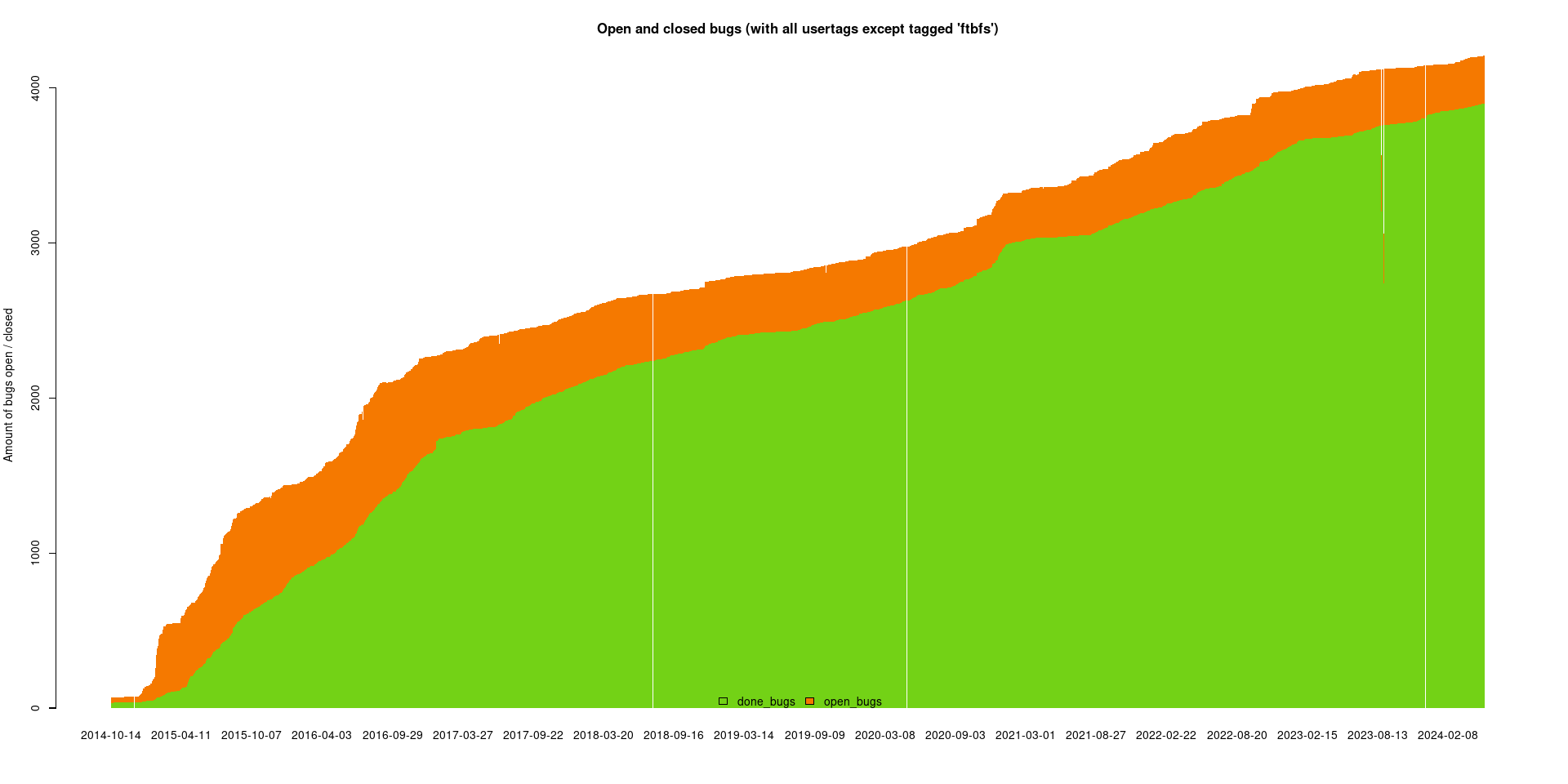
What happened in the reproducible builds effort this week: Toolchain fixes Reiner Herrmann submitted a patch against debhelper to make dh_installinit source files in a stable order. Chris Lamb found how to make cython output deterministic by ordering the keys used to traverse a dict. Reiner Herrmann proposed a patch for pyside-tools to remove the timestamps embedded by rcc in the generated Python code. Mattia Rizzolo rebased our custom version of debhelper on version 9.20151126. As no objections have been made so far, Mattia Rizzolo has filled #805872 asking -Wdate-time to be turned on by default in dpkg-buildflag. Guillem has since sent a final warning before proceeding as such in the next dpkg upload. Russ Allbery added support for SOURCE_DATE_EPOCH in podlators 4.00 which Niko Tyni intend to backport to Perl 5.22. Packages fixed The following packages have become reproducible due to changes in their build dependencies: fontforge, golang-github-tinylib-msgp, libpango-perl, libparanamer-java, libxaw, sqljet, stringtemplate4, uzbl, zope-mysqlda. The following packages became reproducible after getting fixed: Some uploads fixed some reproducibility issues, but not all of them: Patches submitted which have not made their way to the archive yet: Lunar reported two issues making xz-utils unreproducible (#806328, #806331). reproducible.debian.net A seventh armhf build node has been added (resulting of two more armhf build jobs). Thanks to Vagrant Cascadian for putting this Raspberry Pi 2B to help. (h01ger) jenkins.debian.net has been made more robust against network and proxy failures. (h01ger) A new 100 GB partition has been set up on reproducible.debian.net to prevent disk space issues. Thanks to ProfitBricks for its continuous support to our continuous test system. (h01ger) New graphs showing usertagged bugs have been added on the dashboard to measure the progress without FTBFS issues. Please note that comparing the two graphs might be misleading as more than 1300 FTBFS bugs have been inventoried. (h01ger) Package reviews 78 reviews have been removed, 116 added and 49 updated this week. 25 new FTBFS have been filed by Chris West, Chris Lamb and Santiago Vila. New issues identified this week: timestamps_in_documentation_generated_with_libwibble, copyright_year_in_documentation_generated_by_sphinx, timestamps_in_documentation_generated_by_glib_genpod, random_order_of_tmpfiles_in_postinst, random_order_in_cython_output, timestamps_in_python_code_generated_by_pyside. Reiner Herrmann and Lunar improved the prebuilder script: the script can now be called through a symlink, run parallel builds, calls diffoscope by its new name and ensure to install its recommends, and save the text output aside the HTML one. Reiner also added a script to lookup the last update of notes for a given package. Misc. Santiago Villa has been recently working on making sure that Arch:all packages were properly buildable by running dpkg-buildpackage -A. This uncovered a question that is probably not currently addressed by the policy: on which architectures should architecture-independent be buildable?

29 November 2015

Russ Allbery: podlators 4.00

podlators is the distribution that includes the Pod::Man and Pod::Text modules for Perl, plus the pod2man and pod2text driver scripts (among a few other, more minor things). I've been working on a new release of this for a couple of years and got trapped in a cycle of always wanting to finish up one more thing before making a release. (Really need to fix Unicode handling once and for all! Oh, I have a much better idea for how to do testing! I should really revise all of this code for my current coding style!) But some discussions elsewhere reminded me of the merits of release early and often, so I decided to finally put something out. There are quite a few accumulated changes, although not as many as the major version increase would indicate. I did that so that I could standardize on the same version number in all of the modules and switch to a much simpler versioning scheme. That required increasing the major version to something higher than all the component modules. Other than that, there are mostly a bunch of bug fixes, but also a lot of changes to Pod::Man to support Debian's reproducible build effort. The code is now more predictable and reliable about how it generates dates, and supports two new ways of forcing the date in generated documentation to a particular value so that builds are more predictable. I also changed the build system over to Module::Build, although it also provides a Makefile.PL file so that it can be built as part of Perl core. You can get the latest version from the podlators distribution page.

27 November 2015

Russ Allbery: remctl 3.10

remctl is a simple and secure remote command execution protocol using GSS-API. Essentially, it's the thinnest and simplest possible way to deploy remote network APIs for commands using Kerberos authentication and encryption. Most of the work in this release is around supporting anonymous authentication for an upcoming project of mine. This included cleaning up ACL handling so that clients that authenticated with anonymous PKINIT didn't count as ANYUSER (it's not likely this would have been a security problem for existing users, since you would have had to enable anonymous service tickets in your KDC), and adding new anyuser:auth and anyuser:anonymous ACLs that are explicit about whether anonymous users are included. With this change, it's possible, using a KDC with anonymous service tickets enabled, to use anonymous PKINIT to make entirely unauthenticated remctl calls. I plan on using this with wallet to support initial system key bootstrapping using external validation of whether a system is currently allowed to bootstrap keys. Note that you need to be very careful when enabling anonymous service tickets, since many other Kerberos applications (including remctl prior to this release) assume that any client that can get a service ticket is in some way authenticated. Also new in this release, the server now sets the REMOTE_EXPIRES environment variable to the time when the authenticated remote session will expire. This is usually th expiration time of the user's credentials. I'm planning on using this as part of a better kx509 replacement to issue temporary X.509 certificates from Kerberos tickets, limited in lifetime to the lifetime of the Kerberos ticket. This release also includes some portability fixes, a bug fix for the localgroup ACL for users who are members of lots of local groups, and some (mildly backwards-incompatible) fixes for the Python RemctlError exception class. You can get the latest release from the remctl distribution page.

Russ Allbery: rra-c-util 5.9

A minor release of my C utility library, including some changes required for the previous release of pam-afs-session and the upcoming release of remctl. The Kerberos portability layer now correctly defines the strings for dealing with anonymous principals when built with Heimdal, and adds KRB5_ANON_REALM (required for doing the authentication). The PAM testing framework has some improvements for handling pam_modutil_getpwnam and supports testing against PAM_SESSION_ERR. You can get the latest version from the rra-c-util distribution page.

Next.

Previous.