Hey guys Today, I m here talking about how to better ourselves us developers. We re always learning while working and that s bad. We should instead learn in our own time and practice before trying to use our tools to resolve the bugs in the software and the features requests from the clients. Learning on the job Continue reading Become better, learn better, do code katas !
As some of the world knows full well by now, I've been noodling with Go
for a few years, working through its pros, its cons, and thinking a lot
about how humans use code to express thoughts and ideas. Go's got a lot of
neat use cases, suited to particular problems, and used in the right place,
you can see some clear massive wins.
I've started writing Debian tooling in Go, because it's a pretty natural fit.
Go's fairly tight, and overhead shouldn't be taken up by your operating system.
After a while, I wound up hitting the usual blockers, and started to build up
abstractions. They became pretty darn useful, so, this blog post is announcing
(a still incomplete, year old and perhaps API changing) Debian package for Go.
The Go importable name is pault.ag/go/debian. This contains a lot of utilities
for dealing with Debian packages, and will become an edited down "toolbelt"
for working with or on Debian packages.
Module Overview
Currently, the package contains 4 major sub packages. They're a changelog
parser, a control file parser, deb file format parser, dependency parser
and a version parser. Together, these are a set of powerful building blocks
which can be used together to create higher order systems with reliable
understandings of the world.
changelog
The first (and perhaps most incomplete and least tested) is a changelog file
parser.. This provides the
programmer with the ability to pull out the suite being targeted in the
changelog, when each upload was, and the version for each. For example, let's
look at how we can pull when all the uploads of Docker to sid took place:
funcmain()resp,err:=http.Get("http://metadata.ftp-master.debian.org/changelogs/main/d/docker.io/unstable_changelog")iferr!=nilpanic(err)allEntries,err:=changelog.Parse(resp.Body)iferr!=nilpanic(err)for_,entry:=rangeallEntriesfmt.Printf("Version %s was uploaded on %s\n",entry.Version,entry.When)
The output of which looks like:
Version 1.8.3~ds1-2 was uploaded on 2015-11-04 00:09:02 -0800 -0800
Version 1.8.3~ds1-1 was uploaded on 2015-10-29 19:40:51 -0700 -0700
Version 1.8.2~ds1-2 was uploaded on 2015-10-29 07:23:10 -0700 -0700
Version 1.8.2~ds1-1 was uploaded on 2015-10-28 14:21:00 -0700 -0700
Version 1.7.1~dfsg1-1 was uploaded on 2015-08-26 10:13:48 -0700 -0700
Version 1.6.2~dfsg1-2 was uploaded on 2015-07-01 07:45:19 -0600 -0600
Version 1.6.2~dfsg1-1 was uploaded on 2015-05-21 00:47:43 -0600 -0600
Version 1.6.1+dfsg1-2 was uploaded on 2015-05-10 13:02:54 -0400 EDT
Version 1.6.1+dfsg1-1 was uploaded on 2015-05-08 17:57:10 -0600 -0600
Version 1.6.0+dfsg1-1 was uploaded on 2015-05-05 15:10:49 -0600 -0600
Version 1.6.0+dfsg1-1~exp1 was uploaded on 2015-04-16 18:00:21 -0600 -0600
Version 1.6.0~rc7~dfsg1-1~exp1 was uploaded on 2015-04-15 19:35:46 -0600 -0600
Version 1.6.0~rc4~dfsg1-1 was uploaded on 2015-04-06 17:11:33 -0600 -0600
Version 1.5.0~dfsg1-1 was uploaded on 2015-03-10 22:58:49 -0600 -0600
Version 1.3.3~dfsg1-2 was uploaded on 2015-01-03 00:11:47 -0700 -0700
Version 1.3.3~dfsg1-1 was uploaded on 2014-12-18 21:54:12 -0700 -0700
Version 1.3.2~dfsg1-1 was uploaded on 2014-11-24 19:14:28 -0500 EST
Version 1.3.1~dfsg1-2 was uploaded on 2014-11-07 13:11:34 -0700 -0700
Version 1.3.1~dfsg1-1 was uploaded on 2014-11-03 08:26:29 -0700 -0700
Version 1.3.0~dfsg1-1 was uploaded on 2014-10-17 00:56:07 -0600 -0600
Version 1.2.0~dfsg1-2 was uploaded on 2014-10-09 00:08:11 +0000 +0000
Version 1.2.0~dfsg1-1 was uploaded on 2014-09-13 11:43:17 -0600 -0600
Version 1.0.0~dfsg1-1 was uploaded on 2014-06-13 21:04:53 -0400 EDT
Version 0.11.1~dfsg1-1 was uploaded on 2014-05-09 17:30:45 -0400 EDT
Version 0.9.1~dfsg1-2 was uploaded on 2014-04-08 23:19:08 -0400 EDT
Version 0.9.1~dfsg1-1 was uploaded on 2014-04-03 21:38:30 -0400 EDT
Version 0.9.0+dfsg1-1 was uploaded on 2014-03-11 22:24:31 -0400 EDT
Version 0.8.1+dfsg1-1 was uploaded on 2014-02-25 20:56:31 -0500 EST
Version 0.8.0+dfsg1-2 was uploaded on 2014-02-15 17:51:58 -0500 EST
Version 0.8.0+dfsg1-1 was uploaded on 2014-02-10 20:41:10 -0500 EST
Version 0.7.6+dfsg1-1 was uploaded on 2014-01-22 22:50:47 -0500 EST
Version 0.7.1+dfsg1-1 was uploaded on 2014-01-15 20:22:34 -0500 EST
Version 0.6.7+dfsg1-3 was uploaded on 2014-01-09 20:10:20 -0500 EST
Version 0.6.7+dfsg1-2 was uploaded on 2014-01-08 19:14:02 -0500 EST
Version 0.6.7+dfsg1-1 was uploaded on 2014-01-07 21:06:10 -0500 EST
control
Next is one of the most complex, and one of the oldest parts of go-debian,
which is the control file parser
(otherwise sometimes known as deb822). This module was inspired by the way
that the json module works in Go, allowing for files to be defined in code
with a struct. This tends to be a bit more declarative, but also winds up
putting logic into struct tags, which can be a nasty anti-pattern if used too
much.
The first primitive in this module is the concept of a Paragraph, a struct
containing two values, the order of keys seen, and a map of string to string.
All higher order functions dealing with control files will go through this
type, which is a helpful interchange format to be aware of. All parsing of
meaning from the Control file happens when the Paragraph is unpacked into
a struct using reflection.
The idea behind this strategy that you define your struct, and let the Control
parser handle unpacking the data from the IO into your container, letting you
maintain type safety, since you never have to read and cast, the conversion
will handle this, and return an Unmarshaling error in the event of failure.
Additionally, Structs that define an anonymous member of control.Paragraph
will have the raw Paragraph struct of the underlying file, allowing the
programmer to handle dynamic tags (such as X-Foo), or at least, letting
them survive the round-trip through go.
The default decoder
contains an argument, the ability to verify the input control file using an
OpenPGP keyring, which is exposed to the programmer through the
(*Decoder).Signer() function. If the passed argument is nil, it will not
check the input file signature (at all!), and if it has been passed, any
signed data must be found or an error will fall out of the NewDecoder call.
On the way out, the opposite happens, where the struct is introspected,
turned into a control.Paragraph, and then written out to the io.Writer.
Here's a quick (and VERY dirty) example showing the basics of reading and
writing Debian Control files with go-debian.
packagemainimport("fmt""io""net/http""strings""pault.ag/go/debian/control")typeAllowedPackagestructPackagestringFingerprintstringfunc(a*AllowedPackage)UnmarshalControl(instring)errorin=strings.TrimSpace(in)chunks:=strings.SplitN(in," ",2)iflen(chunks)!=2returnfmt.Errorf("Syntax sucks: '%s'",in)a.Package=chunks[0]a.Fingerprint=chunks[1][1:len(chunks[1])-1]returnniltypeDMUAstructFingerprintstringUidstringAllowedPackages[]AllowedPackage control:"Allow" delim:"," funcmain()resp,err:=http.Get("http://metadata.ftp-master.debian.org/dm.txt")iferr!=nilpanic(err)decoder,err:=control.NewDecoder(resp.Body,nil)iferr!=nilpanic(err)fordmua:=DMUAiferr:=decoder.Decode(&dmua);err!=niliferr==io.EOFbreakpanic(err)fmt.Printf("The DM %s is allowed to upload:\n",dmua.Uid)for_,allowedPackage:=rangedmua.AllowedPackagesfmt.Printf(" %s [granted by %s]\n",allowedPackage.Package,allowedPackage.Fingerprint)
Output (truncated!) looks a bit like:
...
The DM Allison Randal <allison@lohutok.net> is allowed to upload:
   parrot [granted by A4F455C3414B10563FCC9244AFA51BD6CDE573CB]
...
The DM Benjamin Barenblat <bbaren@mit.edu> is allowed to upload:
   boogie [granted by 3224C4469D7DF8F3D6F41A02BBC756DDBE595F6B]
   dafny [granted by 3224C4469D7DF8F3D6F41A02BBC756DDBE595F6B]
   transmission-remote-gtk [granted by 3224C4469D7DF8F3D6F41A02BBC756DDBE595F6B]
   urweb [granted by 3224C4469D7DF8F3D6F41A02BBC756DDBE595F6B]
...
The DM     <aelmahmoudy@sabily.org> is allowed to upload:
   covered [granted by 41352A3B4726ACC590940097F0A98A4C4CD6E3D2]
   dico [granted by 6ADD5093AC6D1072C9129000B1CCD97290267086]
   drawtiming [granted by 41352A3B4726ACC590940097F0A98A4C4CD6E3D2]
   fonts-hosny-amiri [granted by BD838A2BAAF9E3408BD9646833BE1A0A8C2ED8FF]
   ...
...
deb
Next up, we've got the deb module. This contains code to handle reading
Debian 2.0 .deb files. It contains a wrapper that will parse the control
member, and provide the data member through the
archive/tar interface.
Here's an example of how to read a .deb file, access some metadata, and
iterate over the tar archive, and print the filenames of each of the
entries.
dependency
The dependency package provides an interface to parse and compute
dependencies. This package is a bit odd in that, well, there's no other
library that does this. The issue is that there are actually two different
parsers that compute our Dependency lines, one in Perl (as part of dpkg-dev)
and another in C (in dpkg).
To date, this has resulted in me filing
threedifferentbugs.
I also found a broken package in the
archive,
which actually resulted in another bug being (totally accidentally)
already fixed.
I hope to continue to run the archive through my parser in hopes of finding
more bugs! This package is a bit complex, but it basically just returns what
amounts to be an AST
for our Dependency lines. I'm positive there are bugs, so file them!
funcmain()dep,err:=dependency.Parse("foo bar, baz, foobar [amd64] bazfoo [!sparc], fnord:armhf [gnu-linux-sparc]")iferr!=nilpanic(err)anySparc,err:=dependency.ParseArch("sparc")iferr!=nilpanic(err)for_,possi:=rangedep.GetPossibilities(*anySparc)fmt.Printf("%s (%s)\n",possi.Name,possi.Arch)
Gives the output:
foo (<nil>)
baz (<nil>)
fnord (armhf)
version
Right off the bat, I'd like to thank
Michael Stapelberg for letting me graft this
out of dcs and into the go-debian package.
This was nearly entirely his work (with a one or two line function I added
later), and was amazingly helpful to have. Thank you!
This module implements Debian version comparisons and parsing, allowing for
sorting in lists, checking to see if it's native or not, and letting the
programmer to implement smart(er!) logic based on upstream (or Debian)
version numbers.
This module is extremely easy to use and very straightforward, and not worth
writing an example for.
Final thoughts
This is more of a "Yeah, OK, this has been useful enough to me at this point
that I'm going to support this" rather than a "It's stable!" or even
"It's alive!" post. Hopefully folks can report bugs and help iterate on
this module until we have some really clean building blocks to build
solid higher level systems on top of. Being able to have multiple libraries
interoperate by relying on go-debian will be a massive ease.
I'm in need of more documentation, and to finalize some parts of the older
sub package APIs, but I'm hoping to be at a "1.0" real soon now.
Wheezy's LTS period started a few weeks ago and the LTS team had to make an
early support decision concerning the Java eco-system since Wheezy ships two Java
runtime environments OpenJDK 6 and
OpenJDK 7. (To be fair, there are
actually three but gcj has
been superseded by OpenJDK a long time ago and the latter should be preferred
whenever possible.)
OpenJDK 6 is currently maintained by Red Hat and we mostly rely on their
upstream work as well as on package updates from Debian's maintainer Matthias Klose and
Tiago St rmer Daitx from Ubuntu. We already knew that both intend
to support OpenJDK 6 until April 2017 when Ubuntu 12.04 will reach its
end-of-life. Thus we had basically two options, supporting OpenJDK 6 for another
twelve months or dropping support right from the start. One of my first steps
was to ask for feedback and advice on
debian-java since
supporting only one JDK seemed to be the more reasonable solution. We agreed on warning users
via various channels about the intended change, especially about possible
incompatibilities
with OpenJDK 7. Even Andrew Haley, OpenJDK 6 project lead, participated in the discussion and confirmed that, while still supported, OpenJDK 6 security
releases are "always the last in the queue when there is urgent work to be
done".
I informed debian-lts about
my findings and issued a call for tests later.
Eventually we decided to concentrate our efforts on OpenJDK
7 because we are confident that for the
majority of our users one Java implementation is sufficient during a stable
release cycle. An immediate positive effect in making OpenJDK 7 the default is that
resources can be relocated to more pressing issues. On the other hand we were
also forced to make compromises. The switch to a newer default implementation
usually triggers a major transition with dozens of FTBFS bugs and the OpenJDK 7
transition
was no exception. I pondered about the usefulness of fixing all these bugs for
Wheezy LTS again and focussing on runtime issues instead and finally decided
that the latter was both more reasonable and more economic.
Different from regular default Java changes, users will still be able to use OpenJDK 6 to
compile their packages and the security impact for development systems is in general neglectable.
More important was to avoid runtime installations of OpenJDK 6. I identified eighteen
packages that strictly depended on the now obsolete JRE and fixed those
issues
on 4 May 2016 together with an update of
java-common and announced the switch to
OpenJDK 7 with a Debian NEWS file.
If you are not a regular reader of Debian
news and also not subscribed to
debian-lts,
debian-lts-announce or
debian-java, remember 26 June
2016 is the day when OpenJDK 7 will be made the default Java implementation in
Wheezy LTS. Of course there is no need to wait. You can switch right now:
The last few months have been a bit of a crazy period of ups and downs, with a
tempest of events beneath the apparent and deceivingly calm surface waters of
being unemployed (still at it).
The daily grind
Chief activities are, of course, those related to the daily grind of
job-hunting, sending applications, and preparing and attending interviews.
It is demoralising when one searches for many days or weeks without seeing
anything suitable for one's skills or interests, or other more general life
expectations. And it takes a lot of time and effort to put one's best in the
applications for positions that one is really, really, interested in. And
even for the ones which are meh, for a variety of reasons (e.g. one is not
very suitable for what the offer demands).
After that, not being invited to interviews (or doing very badly at them) is
bad, of course, but quick and not very painful. A swift, merciful end to the
process.
But it's all the more draining when waiting for many weeks when not a few
months with the uncertainty of not knowing if one is going to be lucky enough
to be summoned for an interview; harbouring some hope one has to appear
enthusiastic in the interviews, after all , while trying to keep it contained
lest it grows too much ; then in the interview hearing good words and some
praises, and feeling the impression that one will fit in, that one did nicely
and that chances are good letting the hope grow again ; start to think about
life changes that the job will require to make a quick decision should the
offer finally arrives ; perhaps make some choices and compromises based on the
uncertain result; then wait for a week or two after the interview to know the
result...
... only to end up being unsuccessful.
All the effort and hopes finally get squashed with a cold, short email or
automatic response, or more often than not, complete radio silence from
prospective employers, as an end to a multi-month-long process. An emotional
roller coaster [1], which
happened to me several times in the last few months.
All in a day's work
The months of preparing and waiting for a new job often imply an impasse that
puts many other things that one cares about on hold, and one makes plans that
will never come to pass.
All in a day's (half-year's?) work of an unemployed poor soul.
But not all is bad.
This period was also a busy time doing some plans about life, mid- and
long-term; the usual and some really unusual! family events; visits to and
from friends, old and new; attending nice little local Debian gatherings or the
bigger gathering of Debian
SunCamp2016, and other
work for side projects or for other events that will happen soon...
And amidst all that, I managed to get some work done on aptitude.
Two pictures worth (less than) a thousand bugs
To be precise, worth 709 bugs 488 bugs in the first graph, plus 221 in the
second.
In 2015-11-15 (link to the post Work on aptitude):
In 2016-06-18:
Numbers
The BTS numbers for aptitude right now are:
221 (259 if counting all merged bugs independently)
1 Release Critical (but it is an artificial bug to keep it from migrating to
testing)
43 (55 unmerged) with severity Important or Normal
160 (182 unmerged) with severity Minor or Wishlist
17 (21 unmerged) marked as Forwarded or Pending
Highlights
Beyond graphs and stats, I am specially happy about two achievements in the last
year:
To have aptitude working today, first and foremost
Apart from the abandon that suffered in previous years, I mean
specifically the critical step of getting it through the troubles of the
last summer, with the GCC-5/C++11 transition in parallel with a
transition of the Boost library (explained in more detail in Work on
aptitude).
Without that, possibly aptitude would not have survived until today.
Improvements to the suggestions of the resolver
In the version 0.8, there were a lot of changes related with improving
the order of the suggestions from the resolver, when it finds conflicts
or other problems with the planned actions.
Historically, but specially in the last few years, there have been many
complaints about the nonsensical or dangerous suggestions from the
resolver. The first solution offered by the resolver was very often
regarded as highly undesirable (for example, removal of many packages),
and preferable solutions like upgrades of one or only a handful of
packages being offered only after many removals; and keeps only
offered as last resort.
Perhaps these changes don't get a lot of attention, given that in the first case
it's just to keep working (with few people realising that it could have
collapsed on the spot, if left unattended), and the second can probably go
unnoticed because it just works or it started to work more smoothly
doesn't get as much immediate attention as it suddenly broke! .
Still, I wanted to mention them, because I am quite proud of those.
Thanks
Even if I put a lot of work on aptitude in the last year, the results of the
graph and numbers have not been solely achieved by me.
Special thanks go to Axel Beckert (abe /
XTaran) and the apt team, David
Kalnischkies and Julian Andres Klode who, despite the claim in that page, does
not mostly work python-aptanymore... but also in the main tools.
They help with fixing some of the issues directly, or changing things in apt
that benefit aptitude, testing changes, triaging bugs or commenting on them,
patiently explaining to me why something in libapt doesn't do what I think it
does, and good company in general.
Not the least, for holding impromptu BTS group therapy / support meetings, for
those cases when prolonged exposure to BTS activity starts to induce very bad
feelings.
Thanks also to people who sent their translation updates, notified about
corrections, sent or tested patches, submitted bugs, or tried to help in other
ways. Change logs for details.
Notes
[1] ^ It's even an example in
the Cambridge Dictionaries Online website, for the entry of roller
coaster:
He was on an emotional roller coaster for a while when he lost his job.
This week I have been gathered with 38 KDE people in Randa, Switzerland. Randa is a place in a valley in the middle of the Alps close to various peaks like Matterhorn. It has been a week of intense hacking, bugfixing, brainstorming and a bit of enjoying the nature.
R is for Reproducible builds
I spent the first couple of days trying to get the Qt Documentation generation tool to reproducible generate documentation. Some of the fixes were of the usual put data in an randomized datastructure, then iterate over it and create output , where the fix is similar well known: Sort the datastructure first. Others were a bit more severe bugs that lead to the documentation to shuffle around the obsolete bit, and the inheritance chains. Most of these fixes have been reviewed and submitted to the Qt 5.6 branch, one is still pending review, but that hopefully gets fixed soon. Then most of Qt (except things containing copies of (parts) of webkit and derivatives) should be reproducible.
R is for Roaming around in the mountains
Sleeping, hacking and dining in the same building sometimes leads to a enormous desire for fresh air. Luckily in the middle of the alps, it is readily available, and at least once a day many people went for a walk. To say hi to a sheep. Or to just go uphill until tired and then going back down. Or just finding a circle around. For this area, OpenStreetMap seems to have better maps than Google. We also went on a nice group trip to Zermatt and surroundings, sponsored by our friends in Edeltech.
R is for Releasing
One of the tasks I set myself for was to get my barcode generation library (prison. you know. being behind bars.) ready for release. A bit of api cleanup, including some future proofing, was done, and all users adapted. Hopefully it will be released as part of the next KDE Frameworks release.
R is for Reviewing code
When signing up for the sprint, one has to declare a couple of tasks to work on. One of the things I put myself up to was reviewing David Faure s code changes. First, he is very productive, and second, he often gets into creating patches in code areas where many other contributors are scared to look. So someone has to do it, and code never scared me.
R is for Running
I planned on going running along the river monday, wednesday and friday. Fortunately that happened, but due to Switzerland having a bit more ups and downs than flat Denmark, it didn t go that fast.
R is for Random bugfixing
When in the hacking mood surrounded by great developers, it is very easy to just fix minor bugs when you encounter them. There is likely someone around who knows the code in question. Or you are just in the mood to actually fix it, rather than living with a missing clock applet or a corner case crash.
R is for Rubber ducking
I am a brilliant person sized rubber duck. And I did get the opportunity to show off my skills a couple of times, as well as using some of the other people for that.
R is for Raising money
These sprints in Randa is only possible because of all the nice donations from people and companies around the world. The fundraiser is still running, and can be found at
I wanted to write this blogpost since April, and even announced it in two previous posts, but never got to actually write it until now. And with the recent events in Snappy and Flatpak land, I can not defer this post any longer (unless I want to answer the same questions over and over on IRC ^^).
As you know, I develop the Limba 3rd-party software installer since 2014 (see this LWN article explaining the project better then I could do ) which is a spiritual successor to the Listaller project which was in development since roughly 2008. Limba got some competition by Flatpak and Snappy, so it s natural to ask what the projects next steps will be.
Meeting with the competition
At last FOSDEM and at the GNOME Software sprint this year in April, I met with Alexander Larsson and we discussed the rather unfortunate situation we got into, with Flatpak and Limba being in competition.
Both Alex and I have been experimenting with 3rd-party app distribution for quite some time, with me working on Listaller and him working on Glick and Glick2. All these projects never went anywhere. Around the time when I started Limba, fixing design mistakes done with Listaller, Alex started a new attempt at software distribution, this time with sandboxing added to the mix and a new OSTree-based design of the software-distribution mechanism. It wasn t at all clear that XdgApp, later to be renamed to Flatpak, would get huge backing by GNOME and later Red Hat, becoming a very promising candidate for a truly cross-distro software distribution system.
The main difference between Limba and Flatpak is that Limba allows modular runtimes, with things like the toolkit, helper libraries and programs being separate modules, which can be updated independently. Flatpak on the other hand, allows just one static runtime and enforces everything that is not in the runtime already to be bundled with the actual application. So, while a Limba bundle might depend on multiple individual other bundles, Flatpak bundles only have one fixed dependency on a runtime. Getting a compromise between those two concepts is not possible, and since the modular vs. static approach in Limba and Flatpak where fundamental, conscious design decisions, merging the projects was also not possible.
Alex and I had very productive discussions, and except for the modularity issue, we were pretty much on the same page in every other aspect regarding the sandboxing and app-distribution matters.
Sometimes stepping out of the way is the best way to achieve progress
So, what to do now? Obviously, I can continue to push Limba forward, but given all the other projects I maintain, this seems to be a waste of resources (Limba eats a lot of my spare time). Now with Flatpak and Snappy being available, I am basically competing with Canonical and Red Hat, who can make much more progress faster then I can do as a single developer. Also, Flatpaks bigger base of contributors compared to Limba is a clear sign which project the community favors more.
Furthermore, I started the Listaller and Limba projects to scratch an itch. When being new to Linux, it was very annoying to me to see some applications only being made available in compiled form for one distribution, and sometimes one that I didn t use. Getting software was incredibly hard for me as a newbie, and using the package-manager was also unusual back then (no software center apps existed, only package lists). If you wanted to update one app, you usually needed to update your whole distribution, sometimes even to a development version or rolling-release channel, sacrificing stability.
So, if now this issue gets solved by someone else in a good way, there is no point in pushing my solution hard. I developed a tool to solve a problem, and it looks like another tool will fix that issue now before mine does, which is fine, because this longstanding problem will finally be solved. And that s the thing I actually care most about.
I still think Limba is the superior solution for app distribution, but it is also the one that is most complex and requires additional work by upstream projects to use it properly. Which is something most projects don t want, and that s completely fine.
And that being said: I think Flatpak is a great project. Alex has much experience in this matter, and the design of Flatpak is sound. It solves many issues 3rd-party app development faces in a pretty elegant way, and I like it very much for that. Also the focus on sandboxing is great, although that part will need more time to become really useful. (Aside from that, working with Alexander is a pleasure, and he really cares about making Flatpak a truly cross-distributional, vendor independent project.)
Moving forward
So, what I will do now is not to stop Limba development completely, but keep it going as a research project. Maybe one can use Limba bundles to create Flatpak packages more easily. We also discussed having Flatpak launch applications installed by Limba, which would allow both systems to coexist and benefit from each other. Since Limba (unlike Listaller) was also explicitly designed for web-applications, and therefore has a slightly wider scope than Flatpak, this could make sense.
In any case though, I will invest much less time in the Limba project. This is good news for all the people out there using the Tanglu Linux distribution, AppStream-metadata-consuming services, PackageKit on Debian, etc. those will receive more attention
An integral part of Limba is a web service called LimbaHub to accept new bundles, do QA on them and publish them in a public repository. I will likely rewrite it to be a service using Flatpak bundles, maybe even supporting Flatpak bundles and Limba bundles side-by-side (and if useful, maybe also support AppImageKit and Snappy). But this project is still on the drawing board.
Let s see
P.S: If you come to Debconf in Cape Town, make sure to not miss my talks about AppStream and bundling
The last few weeks have been pretty hectic in their way, but I ve also had the chance to take some time off work to spend with family, which has been nice.
Memorial Day: breakfast and mud
For Memorial Day, I decided it would be nice to have a cookout for breakfast rather than for dinner. So we all went out to the fire ring. Jacob and Oliver helped gather kindling for the fire, while Laura chopped up some vegetables. Once we got a good fire going, I cooked some scrambled eggs in a cast iron skillet, mixed with meat and veggies. Mmm, that was tasty.
Then we all just lingered outside. Jacob and Oliver enjoyed playing with the cats, and the swingset, and then . water. They put the hose over the slide and made a water slide (more mud slide maybe).
Then we got out the water balloon fillers they had gotten recently, and they loved filling up water balloons. All in all, we all just enjoyed the outdoors for hours.
Flying to Petit Jean, Arkansas
Somehow, neither Laura nor I have ever really been to Arkansas. We figured it was about time. I had heard wonderful things about Petit Jean State Park from other pilots: it s rather unique in that it has a small airport right in the park, a feature left over from when Winthrop Rockefeller owned much of the mountain.
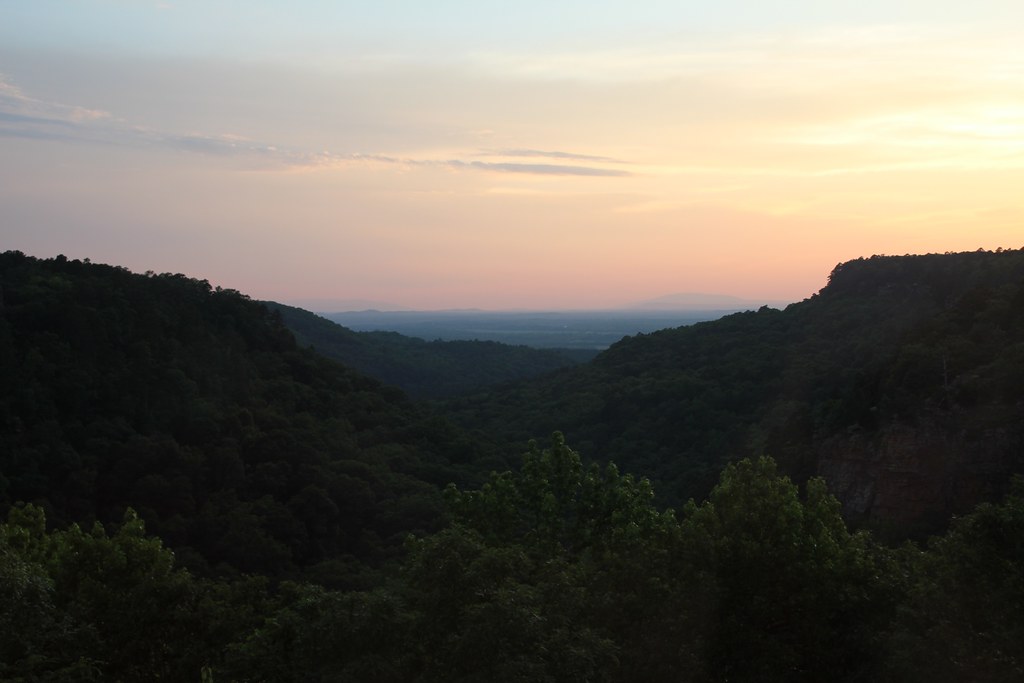
And what a beautiful place it was! Dense forests with wonderful hiking trails, dotted with small streams, bubbling springs, and waterfalls all over; a nice lake, and a beautiful lodge to boot. Here was our view down into the valley at breakfast in the lodge one morning:
And here s a view of one of the trails:
The sunset views were pretty nice, too:
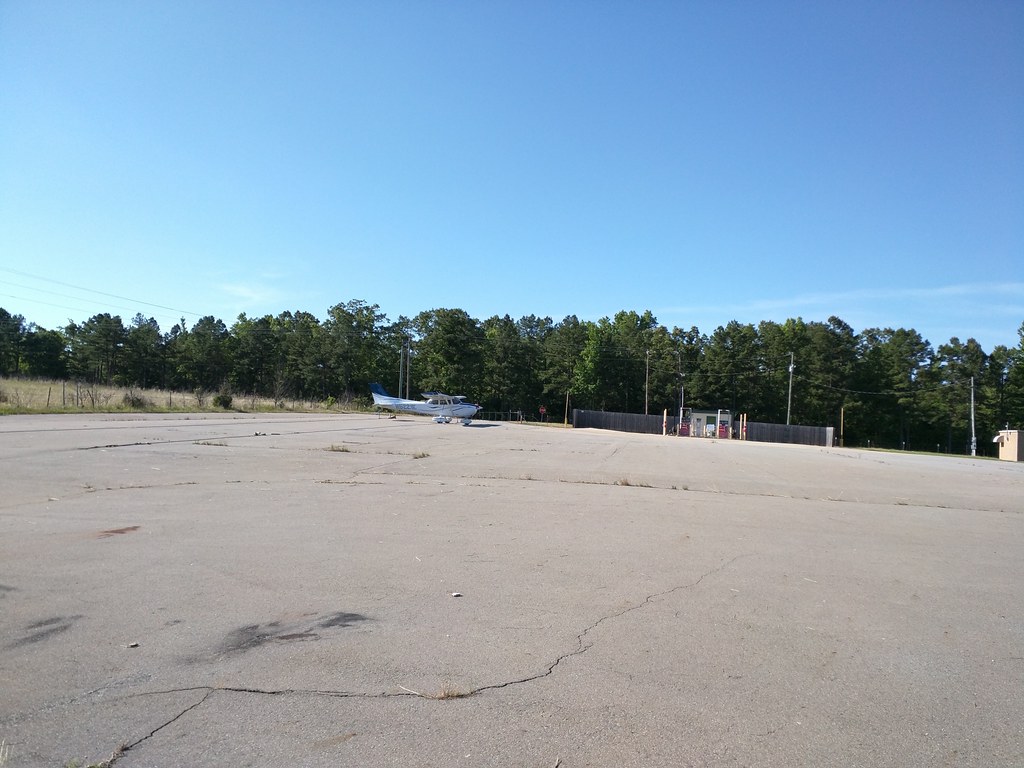
And finally, the plane we flew out in, parked all by itself on the ramp:
It was truly a relaxing, peaceful, re-invigorating place.
Flying to Atchison
Last weekend, Laura and I decided to fly to Atchison, KS. Atchison is one of the oldest cities in Kansas, and has quite a bit of history to show off. It was fun landing at the Amelia Earhart Memorial Airport in a little Cessna, and then going to three museums and finding lunch too.
Of course, there is the Amelia Earhart Birthplace Museum, which is a beautifully-maintained old house along the banks of the Missouri River.
I was amused to find this hanging in the county historical society museum:
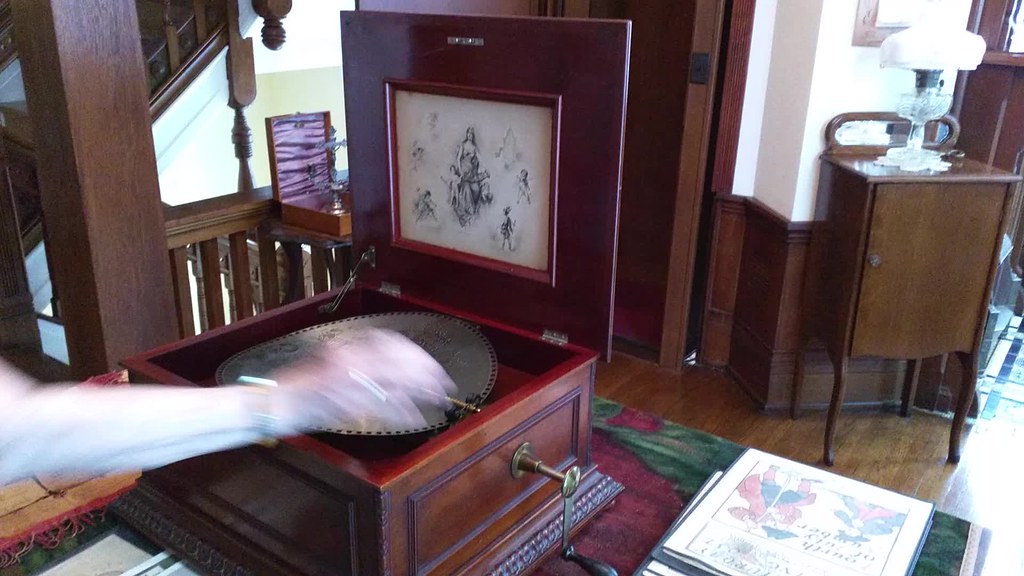
One fascinating find is a Regina Music Box, popular in the late 1800s and early 1900s. It operates under the same principles as those that you might see that are cylindrical. But I am particular impressed with the effort that would go into developing these discs in the pre-computer era, as of course the holes at the outer edge of the disc move faster than the inner ones. It would certainly take a lot of careful calculation to produce one of these. I found this one in the Cray House Museum:
An Arduino Project with Jacob
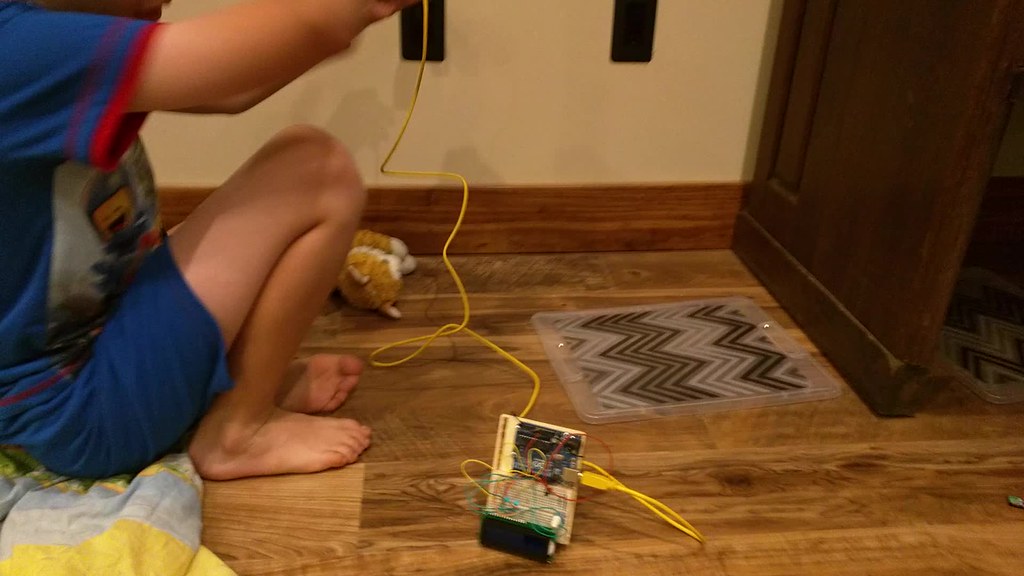
One day, Jacob and I got going with an Arduino project. He wanted flashing blue lights for his police station , so we disassembled our previous Arduino project, put a few things on the breadboard, I wrote some code, and there we go. Then he noticed an LCD in my Arduino kit. I hadn t ever gotten around to using it yet, and of course he wanted it immediately. So I looked up how to connect it, found an API reference, and dusted off my C skills (that was fun!) to program a scrolling message on it. Here is Jacob showing it off:
What happened in the Reproducible
Builds effort between June 5th and June 11th 2016:
Media coverage
Ed Maste gave a talk at BSDCan 2016 on
reproducible builds
(slides,
video).
GSoC and Outreachy updates
Weekly reports by our participants:
Scarlett Clark
worked on making some packages reproducible, focusing on KDE backend and
utility programs.
Ceridwen
published an initial design for the interface for reprotest, including a
discussion on different types of build variations and the difficulties of
specifying certain types of variations.
Valerie Young improved documentation for
building our tests website, began migrating Debian-specific pages into a new
namespace, and planned future work around its navigation.
Documentation update
- Ximin Luo proposed a modification
to our SOURCE_DATE_EPOCH spec explaining FORCE_SOURCE_DATE.
Some upstream build tools (e.g. TeX, see below) have expressed a desire to
control which cases of embedded timestamps should obey SOURCE_DATE_EPOCH.
They were not convinced by our arguments on why this is a bad idea, so we
agreed on an environment variable FORCE_SOURCE_DATE for them to implement
their desired behaviour - named generically, so that at least we can set it
centrally. For more details, see the text just linked. However, we strongly
urge most build tools not to use this, and instead obey SOURCE_DATE_EPOCHunconditionally in all cases.
Toolchain fixes
TeX Live 2016 released
with SOURCE_DATE_EPOCH support for all engines except LuaTeX and original TeX.
Continued discussion
(alternative archive)
with TeX upstream, about SOURCE_DATE_EPOCH corner cases, eventually
resulting in the FORCE_SOURCE_DATE proposal from above.
gcc-5/5.4.0-4 by Matthias Klose now avoids storing
-fdebug-prefix-map in DW_AT_producer, thanks to original patch by
Daniel Kahn Gillmor.
sphinx/1.4.3-1 by Dmitry Shachnev now drops Debian-specific patches
relating to SOURCE_DATE_EPOCH applied upstream, original patch by Alexis
Bienven e.
asciidoctor/1.5.4-2 by C dric Boutillier now supports
SOURCE_DATE_EPOCH, thanks to original patch by Alexis Bienven e.
dh-python/1.5.4-2 by Piotr O arowski now behaves better in some
cases, thanks to original patch by Chris Lamb.
Andrew Ayer uploaded strip-nondeterminism/0.018-2 fixing #826700, a packaging improvement for Multi-Arch to ease cross-build
situations.
2 days later Andrew released strip-nondeterminism/0.019; now
strip-nondeterminism is able to:
recursively normalize JAR files embedded within JAR files (#823917)
clamp the timestamp, the same way tar >=1.28-2.2 can (for now available only for gzip archives)
disorderfs development
Andrew Ayer released disorderfs/0.4.3, fixing a issue with umask handling (#826891)
tests.reproducible-builds.org
Valerie Young namespaced the Debian-specific pages to /debian/
namespace, with redirects to
for the previous URLs.
Holger Levsen improved the reliability of build jobs: the availability of
both build nodes (for a given build) is now being tested when a build job is
started, to better cope when one of the 25 build nodes go down for some reason.
Ximin Luo improved the index of identified
issues to
include the total popcon scores of each issue, which is now also used for
sorting that page.
Misc.
Steven Chamberlain submitted a patch to FreeBSD's
makefs
to allow reproducible builds of the kfreebsd installer.
Ed Maste committed a patch to FreeBSD's
binutils to
enable determinstic archives by default in GNU ar.
Helmut Grohne
experimentedwith
cross+native reproductions of dash with some success, using
rebootstrap.
This week's edition was written by Ximin Luo, Chris Lamb, Holger Levsen, Mattia
Rizzolo and reviewed by a bunch of Reproducible builds folks on IRC.
Suppose you have a gpg keyid like 9F6C6333 that corresponds to both key
1AE0322EB8F74717BDEABF1D44BB1BA79F6C6333 and
88BB08F633073D7129383EE71EA37A0C9F6C6333, and you don't know which of the two
to use.
You go to http://pgp.cs.uu.nl/ and find out that the site uses short key IDs,
so the two keys are indistinguishable.
Building on Clint's hopenpgp-tools,
I made a script that
screenscrapes http://pgp.cs.uu.nl/ for trust paths, downloads all the
potentially connecting keys in a temporary keyring, and runs hkt findpaths on
it:
$ ./verify-trust-paths 1793D6AB75663E6BF104953A634F4BD1E7AD5568 1AE0322EB8F74717BDEABF1D44BB1BA79F6C6333
hkt (hopenpgp-tools) 0.18
Copyright (C) 2012-2016 Clint Adams
hkt comes with ABSOLUTELY NO WARRANTY. This is free software, and you are welcome to redistribute it under certain conditions.
(4,[1,4,3,6])(1,1793D6AB75663E6BF104953A634F4BD1E7AD5568)(3,F8921D3A7404C86E11352215C7197699B29B232A)(4,C331BA3F75FB723B5873785B06EAA066E397832F)(6,1AE0322EB8F74717BDEABF1D44BB1BA79F6C6333)
$ ./verify-trust-paths 1793D6AB75663E6BF104953A634F4BD1E7AD5568 88BB08F633073D7129383EE71EA37A0C9F6C6333
hkt (hopenpgp-tools) 0.18
Copyright (C) 2012-2016 Clint Adams
hkt comes with ABSOLUTELY NO WARRANTY. This is free software, and you are welcome to redistribute it under certain conditions.
(0,[])
This is a start: it could look in the local keyring for all ultimately trusted
key finegrprints and use those as starting points. It could just take as an
argument a short keyid and automatically check all matching fingerprints.
I'm currently quite busy with https://nm.debian.org and at the moment
verify-trust-paths scratches
enough of my itch that I can move on with my other things.
Please send patches, or take it over: I'd like to see this grow.
I should probably document the purple server I hacked together in Perl and mentioned in my last post. In short it allows you to centralise notifications. Send "alerts" to it, and when they are triggered they will be routed from that central location. There is only a primitive notifier included, which sends data to the console, but there are sample stubs for sending by email/pushover, and escalation.
In brief you create alerts by sending a JSON object via HTTP-POST. These objects contain a bunch of fields, but the two most important are:
id
A human-name for the alert. e.g. "disk-space", "heartbeat", or "unread-mail".
raise
When to raise the alert. e.g. "now", "+5m", "1466006086".
When an update is received any existing alert has its values updated, which
makes heartbeat alerts trivial. Send a message with:
"id": "heartbeat",
"raise": "+5m",
..
The existing alert will be updated each time such a new event is submitted,
which means that the time at which that alert will raise will be pushed back
by five minutes. If you send this every 60 seconds then you'll get informed
of an outage five minutes after your server explodes (because the "+5m"
will have been turned into an absolute time, and that time will eventually
become in the past - triggering a notification).
Alerts are keyed on the source IP which sent the submission and
the id field, meaning you can send the same update from multiple
hosts without causing any problems.
Notifications can be viewed in a reasonably pretty Web UI, so you can
clear raised-alerts, see the pending ones, and suppress further notifications
on something that has been raised. (By default notifications are issued
every sixty seconds, until the alert is cleared. There is support for
only raising an alert once, which is useful for services you might deliver
events via, such as pushover which will repeat themselves.)
Anyway this is a fun project, which is a significantly simplified and
less scalable version of a project which is open-sourced already and
used at Bytemark.
Yesterday I was fixing an issue with one of the servers behind kallithea-scm.org: the hook intended to propagage pushes from Our Own Kallithea to Bitbucket stopped working. Until yesterday, that server was using Debian s flavour of System V init and djb s d montools to keep things running. To make the hook asynchronous, I wrote a service to be managed to d montools, so that concurrency issued would be solved by it. However, I didn t implement any timeouts, so when last week wget froze while pulling Weblate s hook, there was nothing to interrupt it, so the hook stopped working since d montools thought it s already running and wouldn t re-trigger it. Killing wget helped, but I decided I need to do something with it to prevent the situation from happening in the future.
I ve been using systemd at work for the last year, so I am now confident I m happier with systemd than with d montools, so I decided to switch the server to systemd. Not surprisingly, I prepared unit files in about 5 minutes without having to look into the manuals again, while with d montools I had to check things every time I needed to change something. The tricky thing was the switch itself. It is a virtual server, presumably running in Xen, and I don t have access to the console, so if I bork break something, I need to summon Bradley Kuhn or someone from Conservancy, who s kindly donated the server to the project. In any case, I decided to attempt to upgrade without a reboot, so that I have more options to roll back my changes in the case things go wrong.
After studying the manpages of both systemd s init and sysvinit s init, I realised I can install systemd as /sbin/init and ask already running System V init to re-exec. However, systemd s init can t talk to System V init, so before installing systemd I made a backup on it. It s also important to stop all running services (except probably ssh) to make sure systemd doesn t start second instances of each. And then: /tmp/init u and we re running systemd! A couple of additional checks, and it s safe to reboot.
Only when I did all that I realised that in the case of systemd not working I d probably not be able to undo my changes if my connection interrupted. So, even though at the end it worked, probably it s not a good idea to perform such manipulations when you don t have an alternative way to connect to the server :)
When you get involved in a new community, such as Debian, find out early
where, if that happens, you can find support, understanding, and help to make
it stop.
Last night I asked a group of friends what do they do if they start feeling
uncomfortable when they are alone in a group of people they don't know. Here
are the replies:
Wait outside the group until I figure the group out.
Find someone to talk for a while until you get comfortable.
If a person is making things uncomfortable for you, let them know, and leave
if nobody cares.
Sit there in silence.
Work around unwelcome people by bearing them for a bit while trying to
integrate with others.
Some people are easy to bribe into friendship, just bring cake.
While you don't know what is going on, you try to replicate what others are
doing.
Spend time trying to get a feeling of what are the consequences of taking
actions.
Purposefully disagree with people in a new environment to figure out if
having a different opinion is accepted.
Once I was new and I was asked to be the person that invites everyone for
lunch, that forced me to talk to everyone, and integrate.
When you are the first one to point something out, you'll probably soon find
out you're not alone.
The reaction on the first time something is exposed, influences how often
similar cases will be reported.
I think a lot of these point are good food for thought about barriers of entry,
and about safety nets that a group has or might want to have.
Sursamen is an Arithmetic, Mottled, Disputed, Multiply Inhabited,
Multi-million Year Safe, and Godded Shellworld. It's a constructed world
with multiple inhabitable levels, each lit by thermonuclear "suns" on
tracks, each level supported above the last by giant pillars. Before the
recorded history of the current Involved Species, a culture called the
Veil created the shellworlds with still-obscure technology for some
unknown purpose, and then disappeared. Now, they're inhabited by various
transplants and watched over by a hierarchy of mentor and client species.
In the case of Sursamen, both the Aultridia and the Oct claim jurisdiction
(hence "Disputed"), and are forced into an uneasy truce by the Nariscene,
a more sophisticated species that oversees them both.
On Sursamen, on level eight to be precise, are the Sarl, a culture with an
early industrial level of technology in the middle of a war of conquest to
unite their level (and, they hope, the next level down). Their mentors
are the Oct, who claim descendance from the mysterious Veil. The Deldeyn,
the next level down, are mentored by the Aultridia, a species that evolved
from a parasite on Xinthian Tensile Aranothaurs. Since a Xinthian,
treated by the Sarl as a god, lives in the heart of Sursamen (hence
"Godded"), tensions between the Sarl and the Aultridians run
understandably high.
The ruler of the Sarl had three sons and a daughter. The oldest was
killed by the people he is conquering as Matter starts. The middle
son is a womanizer and a fop who, as the book opens, watches a betrayal
that he's entirely unprepared to deal with. The youngest is a thoughtful,
bookish youth pressed into a position that he also is not well-prepared
for.
His daughter left the Sarl, and Sursamen itself, fifteen years previously.
Now, she's a Special Circumstances agent for the Culture.
Matter is the eighth Culture novel, although (like most of the
series) there's little need to read the books in any particular order.
The introduction to the Culture here is a bit scanty, so you'll have more
background and understanding if you've read the previous novels, but it
doesn't matter a great deal for the story.
Sharp differences in technology levels have turned up in previous Culture
novels (although the most notable example is a minor spoiler), but this is
the first Culture novel I recall where those technological differences
were given a structure. Usually, Culture novels have Special
Circumstances meddling in, from their perspective, "inferior" cultures.
But Sursamen is not in Culture space or directly the Culture's business.
The Involved Species that governs Sursamen space is the Morthanveld: an
aquatic species roughly on a technology level with the Culture themselves.
The Nariscene are their client species; the Oct and Aultridia are, in
turn, client species (well, mostly) of the Nariscene, while meddling with
the Sarl and Deldeyn.
That part of this book reminded me of Brin's Uplift universe. Banks's
Involved Species aren't the obnoxious tyrants of Brin's universe, and
mentoring doesn't involve the slavery of the Uplift universe. But some of
the politics are a bit similar. And, as with Uplift, all the characters
are aware, at least vaguely, of the larger shape of galactic politics.
Even the Sarl, who themselves have no more than early industrial
technology. When Ferbin flees the betrayal to try to get help, he ascends
out of the shellworld to try to get assistance from an Involved species,
or perhaps his sister (which turns out to be the same thing). Banks
spends some time here, mostly through Ferbin and his servant (who is one
of the better characters in this book), trying to imagine what it would be
like to live in a society that just invented railroads while being aware
of interstellar powers that can do practically anything.
The plot, like the world on which it's set, proceeds on multiple levels.
There is court intrigue within the Sarl, war on their level and the level
below, and Ferbin's search for support and then justice. But the Sarl
live in an artifact with some very mysterious places, including the best
set piece in the book: an enormous waterfall that's gradually uncovering a
lost city on the level below the Sarl, and an archaeological dig that
proceeds under the Deldeyn and Sarl alike. Djan Seriy decides to return
home when she learns of events in Sarl, originally for reasons of family
loyalty and obligation, but she's a bit more in touch with the broader
affairs of the galaxy, including the fact that the Oct are acting very
strangely. There's something much greater at stake on Sursamen than
tedious infighting between non-Involved cultures.
As always with Banks, the set pieces and world building are amazing, the
scenery is jaw-dropping, and I have some trouble warming to the
characters. Dramatic flights across tower-studded landscapes seeking
access to forbidden world-spanning towers largely, but don't entirely,
make up for not caring about most of the characters for most of the book.
This did change, though: although I never particularly warmed to Ferbin, I
started to like his younger brother, and I really liked his sister and his
servant by the end of the book.
Unfortunately, the end of Matter is, if not awful, at least
exceedingly abrupt. As is typical of Banks, we get a lot of sense of
wonder but not much actual explanation, and the denouement is essentially
nonexistent. (There is a coy epilogue hiding after the appendices, but it
mostly annoyed me and provides only material for extrapolation about the
characters.) Another SF author would have written a book about the
Xinthian, the Veil, the purpose of the shellworlds, and the deep history
of the galaxy. I should have known going in that Banks isn't that sort of
SF author, but it was still frustrating.
Still, Banks is an excellent writer and this is a meaty, complex,
enjoyable story with some amazing moments of wonder and awe. If you like
Culture novels in general, you will like this. If you like
set-piece-heavy SF on a grand scale, such as Alastair Reynolds or Kim
Stanley Robinson, you probably like this. Recommended.
Rating: 8 out of 10
Allison Lortie has provoked a lot of comment with her blog post on
a new proposal for how GTK is versioned.
Here's some more context from the discussion at the GTK hackfest that
prompted that proposal: there's actually quite a close analogy in
how new Debian versions are developed.
The problem we're trying to address here is the two sides of a trade-off:
Without new development, a library (or an OS) can't go anywhere new
New development sometimes breaks existing applications
Historically, GTK has aimed to keep compatible within a major version,
where major versions are rather far apart (GTK 1 in 1998, GTK 2 in
2002, GTK 3 in 2011, GTK 4 somewhere in the future). Meanwhile, fixing
bugs, improving performance and introducing new features sometimes
results in major changes behind the scenes. In an ideal world, these
behind-the-scenes changes would never break applications; however, the
world isn't ideal. (The Debian analogy here is that as much as we
aspire to having the upgrade from one stable release to the next not break
anything at all, I don't think we've ever achieved that in practice -
we still ask users to read the release notes, even though ideally
that wouldn't be necessary.)
In particular, the perceived cost of doing a proper ABI break (a fully
parallel-installable GTK 4) means there's a strong temptation to make
changes that don't actually remove or change C symbols, but are clearly
an ABI break, in the sense that an application that previously worked
and was considered correct no longer works. A prominent recent example is
the theming changes in GTK 3.20: the ABI in terms of functions available
didn't change, but what happens when you call those functions changed in
an incompatible way. This makes GTK hard to rely on for applications
outside the GNOME release cycle, which is a problem that needs to
be fixed (without stopping development from continuing).
The goal of
the plan we discussed today
is to decouple the latest branch of development, which moves fast and
sometimes breaks API, from the API-stable branches, which only get bug
fixes. This model should look quite familiar to Debian contributors,
because it's a lot like the way we release Debian and Ubuntu.
In Debian, at any given time we have a development branch
(testing/unstable) - currently "stretch", the future Debian 9. We
also have some stable branches, of which the most recent are Debian
8 "jessie" and Debian 7 "wheezy". Different users of Debian have
different trade-offs that lead them to choose one or the other of
these. Users who value stability and want to avoid unexpected changes,
even at a cost in terms of features and fixes for non-critical bugs,
choose to use a stable release, preferably the most recent; they only
need to change what they run on top of Debian for OS API changes (for
instance webapps, local scripts, or the way they interact with the GUI)
approximately every 2 years, or perhaps less often than that with the
Debian-LTS project supporting non-current stable releases. Meanwhile,
users who value the latest versions and are willing to work with a
"moving target" as a result choose to use testing/unstable.
The GTK analogy here is really quite close. In the new versioning model,
library users who value stability over new things would prefer to use
a stable-branch, ideally the latest; library users who want the latest
features, the latest bug-fixes and the latest new bugs would use the
branch that's the current focus of development. In practice we expect
that the latter would be mostly GNOME projects. There's been some
discussion at the hackfest about how often we'd have a new
stable-branch: the fastest rate that's been considered is a stable-branch
every 2 years, similar to Ubuntu LTS and Debian, but there's no consensus
yet on whether they will be that frequent in practice.
How many stable versions of GTK would end up shipped in Debian depends
on how rapidly projects move from "old-stable" to "new-stable" upstream,
how much those projects' Debian maintainers are willing to patch them
to move between branches, and how many versions the release team will
tolerate. Once we reach a steady state, I'd hope that we might have
1 or 2 stable-branched versions active at a time, packaged as separate
parallel-installable source packages (a lot like how we handle Qt).
GTK 2 might well stay around as an additional active version just
from historical inertia. The stable versions are intended to be
fully parallel-installable, just like the situation with GTK 1.2,
GTK 2 and GTK 3 or with the major versions of Qt.
For the "current development" version, I'd anticipate that we'd probably
only ship one source package, and do ABI transitions for one version
active at a time, a lot like how we deal with libgnome-desktop and the
evolution-data-server family of libraries. Those versions would have
parallel-installable runtime libraries but non-parallel-installable
development files, again similar to libgnome-desktop.
At the risk of stretching the Debian/Ubuntu analogy too far, the
intermediate "current development" GTK releases that would accompany
a GNOME release are like Ubuntu's non-LTS suites: they're more up to
date than the fully stable releases (Ubuntu LTS, which has a release
schedule similar to Debian stable), but less stable and not supported
for as long.
Hopefully this plan can meet both of its goals: minimize breakage for
applications, while not holding back the development of new APIs.
Author: ceridwen
The first, very-alpha release of reprotest is now out at
PyPi. It should hit
Debian experimental later this week. While it only builds on an
existing system (as I'm still working on support for virtualization),
it can now check its own reproducibility, which it does in its own
tests, both using setuptools and debuild. Unfortunately, setuptools
seems to generate file-order-dependent binaries, meaning python
setup.py bdist creates unreproducible binaries. With debuild,
reprotest probably would be reproducible with the modified
packages
from the Reproducible Builds project, though I haven't tested that
yet. It tests 'captures_environment', 'fileordering' (renamed from
'filesystem'), 'home', 'kernel', 'locales', 'path', 'time',
'timezone', and 'umask'. The other variations require superuser
privileges and modifications that would be unsafe to make to a running
system, so they will only be enabled in the containers.
The next major part of the project is integrating autopkgtests's
container management system into reprotest. For the curious,
autopkgtest is composed of a main program, adt-run, which then calls
other command-line programs, adt-virt-chroot, adt-virt-lxd,
adt-virt-schroot, adt-virt-null, adt-virt-schroot, and
adt-virt-qemu, that communicate with the containers. (The
autopkgtest maintainer has since renamed the programs, but the
underlying structure remains the same.) I think this is a bit of an
odd design but it works well for my purposes since the container
programs already have existing CLIs that reprotest can use.
I begin this week by finish my QT tutorial. With that new knowledge, I was able to implemet my method launchSmartInfo(int) on LRC.
After that, I needed to implement the gnome client too. I followed the tutorial on QT so I thought I can just learn GTK+ by reading the code. Finally, I just lost a lot of time by doing that and I didn't learn a lot. In response to that problem I finally use an GTK+ tutorial.
I began to try to show n transparente window with some text in front of the call view. To do that, I want to use clutter library
------------
Conclusion: as you can see, I lost a lot of time in this GUI learning. Now it's done, I can move forward! :)
I begin this week by finish my QT tutorial. With that new knowledge, I was able to implemet my method launchSmartInfo(int) on LRC.
After that, I needed to implement the gnome client too. I followed the tutorial on QT so I thought I can just learn GTK+ by reading the code. Finally, I just lost a lot of time by doing that and I didn't learn a lot. In response to that problem I finally use an GTK+ tutorial.
I began to try to show an transparente window with some text in front of the call view. To do that, I want to use clutter library
------------
Conclusion: as you can see, I lost a lot of time in this GUI learning. Now it's done, I can move forward! :)
This has been approved and I will be pushing it as soon as I patch the qt5 frameworks version.
kxmlgui:
WIP this has been a steep learning curve, according to the notes it was an easy embedded kernel version, that was not the case! After grueling hours of
trying to sort out randomness in debug output I finally narrowed it down to cases where QStringLiteral was used and there were non letter characters eg. ( <")
These were causing debug symbols to generate with ( lambda() ) which caused unreproducible symbol/debug files. It is now a case of fixing all of these in the code to use QString::fromUtf8 seems to fix this. I am working on a mega patch for upstream and it should be ready early in the week.
This last week I spent a large portion making my through a mega patch for kxmlgui, when it was suggested to me to write a small qt app
to test QStringLiteral isolated and sure enough two build were byte for byte identical. So this means that QStringLiteral may not be the issue at all. With some
more assistance I am to expand my test app with several QStringLiterals of varying lengths, we have suspicion it is a padding issue, which complicates things.
KDE:
On the KDE front, I have arrived safe and sound in Randa and aside from some major jetlag, reproducible builds, I have been quite busy with the KDE CI. I am reworking
my DSL to use friendly yaml files to generate jobs for all platforms ( linux, android, osx, windows, snappy, flatpak ) and can easily be extended later.
Major workpoints so far for Randa:
I have delegated the windows backend to Hannah
Andreas has provided a docker build for Android, and upon initial testing it will work great.
I have recruited several nice folks to assist me with my snappy efforts.
Source packages have a very different process of installation and handling while compared to the traditional executable packages which are handled by the sudo apt-get install command. Source packages provide source for a software. These are used to build other packages. Source code can be studied or errors can be fixed in this by downloading these to your system.
To access these you have to add deb-src lines sources.list in /etc/apt/sources.list If you had followed my earlier article on setting up Jessie, this means you have to remove the # in front of the deb-src lines.
First, find the required source package online in the debian packages list here. Be sure to select the Source Package Names option while searching. When you find a package it will have a list of binary packages that are built from this source package.
Make sure you have all the dependencies to build the package by running:
$ apt-get build-dep packagename
Then, download the source package, using the following command:
$ apt-get source packagename
This will download three files: a .orig.tar.gz, a .dsc and a .diff.gz. In the case of packages made specifically for Debian, the last of these is not downloaded and the first usually won t have orig in the name.
The .dsc file is used by dpkg-source for unpacking the source package into the directory packagename-version. Within each downloaded source package there is a debian/ directory that contains the files needed for creating the .deb package.
To auto-build the package when it s been downloaded, just add -b to the command line, like this:
$ apt-get -b source packagename
If you decide not to create the .deb at the time of the download, you can create it later by running:
$ dpkg-buildpackage -rfakeroot -uc -b
from within the directory that was created for the package after downloading. To install the package built by the commands above one must use the package manager directly, like this:
# dpkg -i file.deb
There s a difference between apt-get s source method and its other methods. The source method can be used by normal users, without needing special root powers. The files are downloaded to the directory from which the apt-get source package command was called.
Tip : If you are a developer testing software, you may need to run the make command after this. Be sure to run make check as well later to make sure there are no errors and everything is alright.
Most of the commands I ve used here was by following the APT How To documentation which is marked as obsolete for some reason but turned out to be pretty useful. Hope it works for you too!
 As some of the world knows full well by now, I've been noodling with Go
for a few years, working through its pros, its cons, and thinking a lot
about how humans use code to express thoughts and ideas. Go's got a lot of
neat use cases, suited to particular problems, and used in the right place,
you can see some clear massive wins.
I've started writing Debian tooling in Go, because it's a pretty natural fit.
Go's fairly tight, and overhead shouldn't be taken up by your operating system.
After a while, I wound up hitting the usual blockers, and started to build up
abstractions. They became pretty darn useful, so, this blog post is announcing
(a still incomplete, year old and perhaps API changing) Debian package for Go.
The Go importable name is
 Wheezy's LTS period started a few weeks ago and the LTS team had to make an
early support decision concerning the Java eco-system since Wheezy ships two Java
runtime environments
 In 2016-06-18:
 Numbers
The
 This week I have been gathered with 38 KDE people in Randa, Switzerland. Randa is a place in a valley in the middle of the Alps close to various peaks like Matterhorn. It has been a week of intense hacking, bugfixing, brainstorming and a bit of enjoying the nature.
R is for Reproducible builds
I spent the first couple of days trying to get the Qt Documentation generation tool to reproducible generate documentation. Some of the fixes were of the usual put data in an randomized datastructure, then iterate over it and create output , where the fix is similar well known: Sort the datastructure first. Others were a bit more severe bugs that lead to the documentation to shuffle around the obsolete bit, and the inheritance chains. Most of these fixes have been reviewed and submitted to the Qt 5.6 branch, one is still


 ) which is a spiritual successor to the Listaller project which was in development since roughly 2008. Limba got some competition by
 P.S: If you come to Debconf in Cape Town, make sure to not miss my talks about AppStream and bundling






 I should probably document the
 Allison Lortie has provoked a lot of comment with her blog post on