Search Results: "ron"

11 February 2013

Russell Coker: Phone/Tablet Sizes

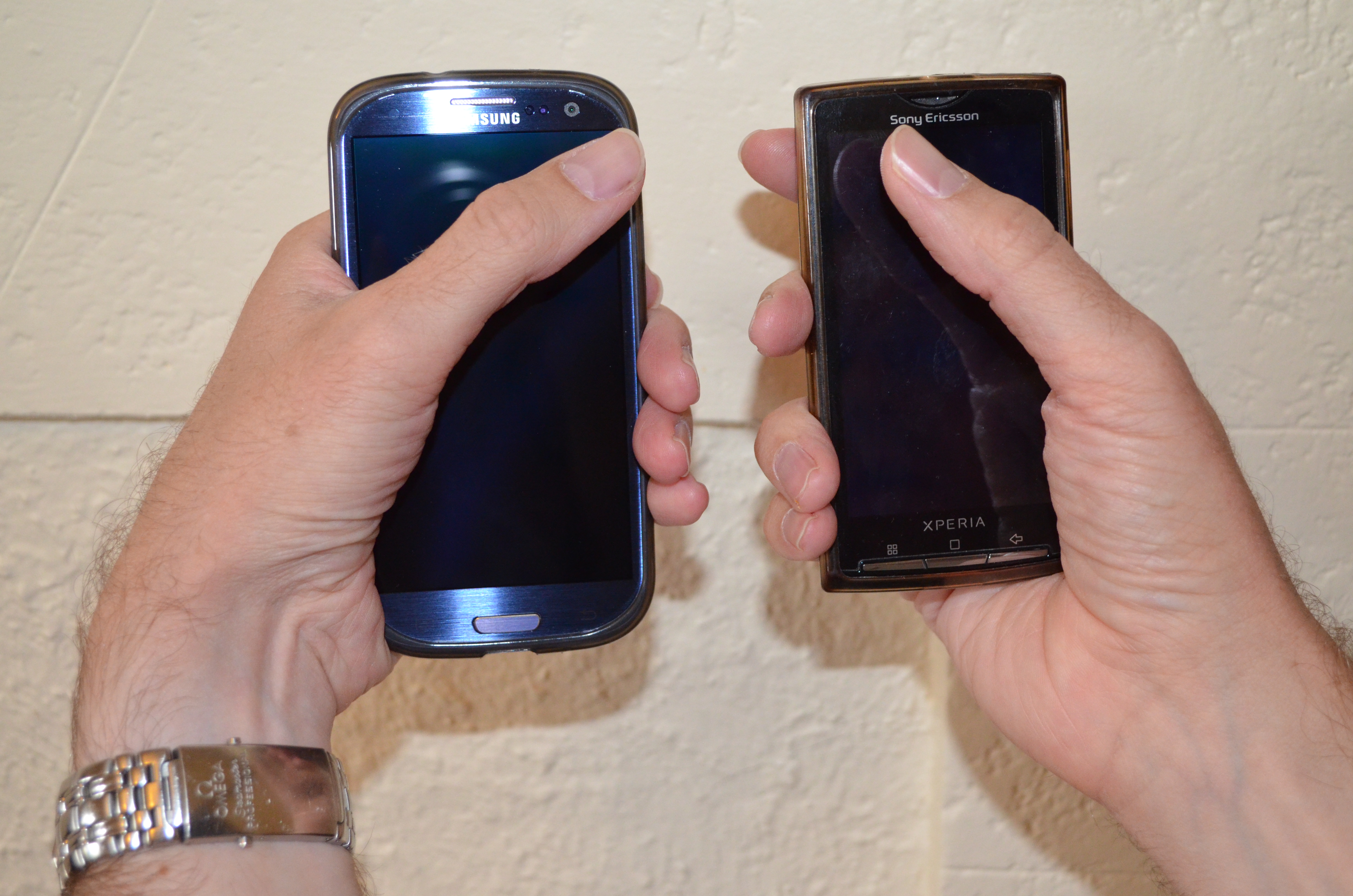
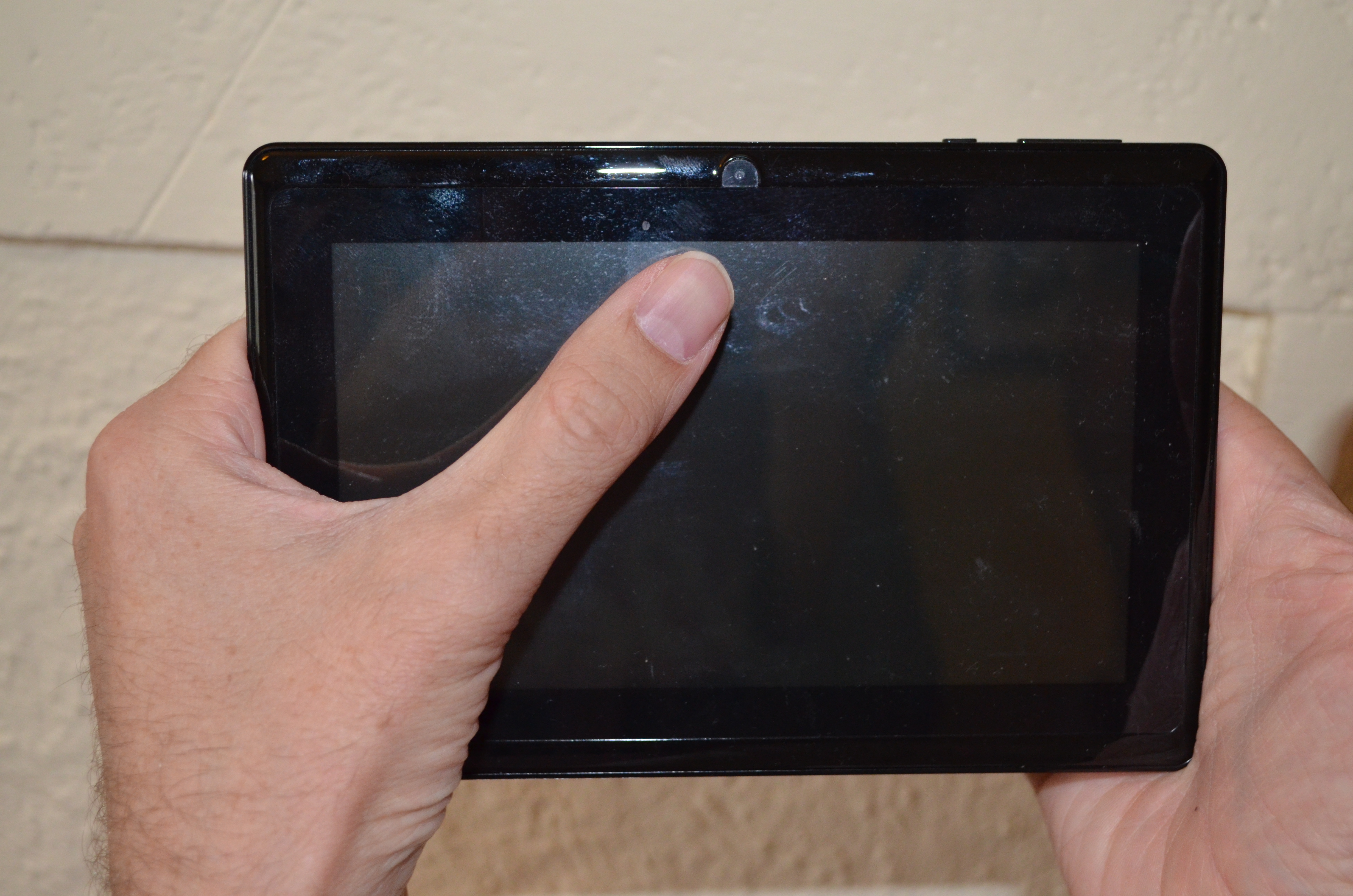
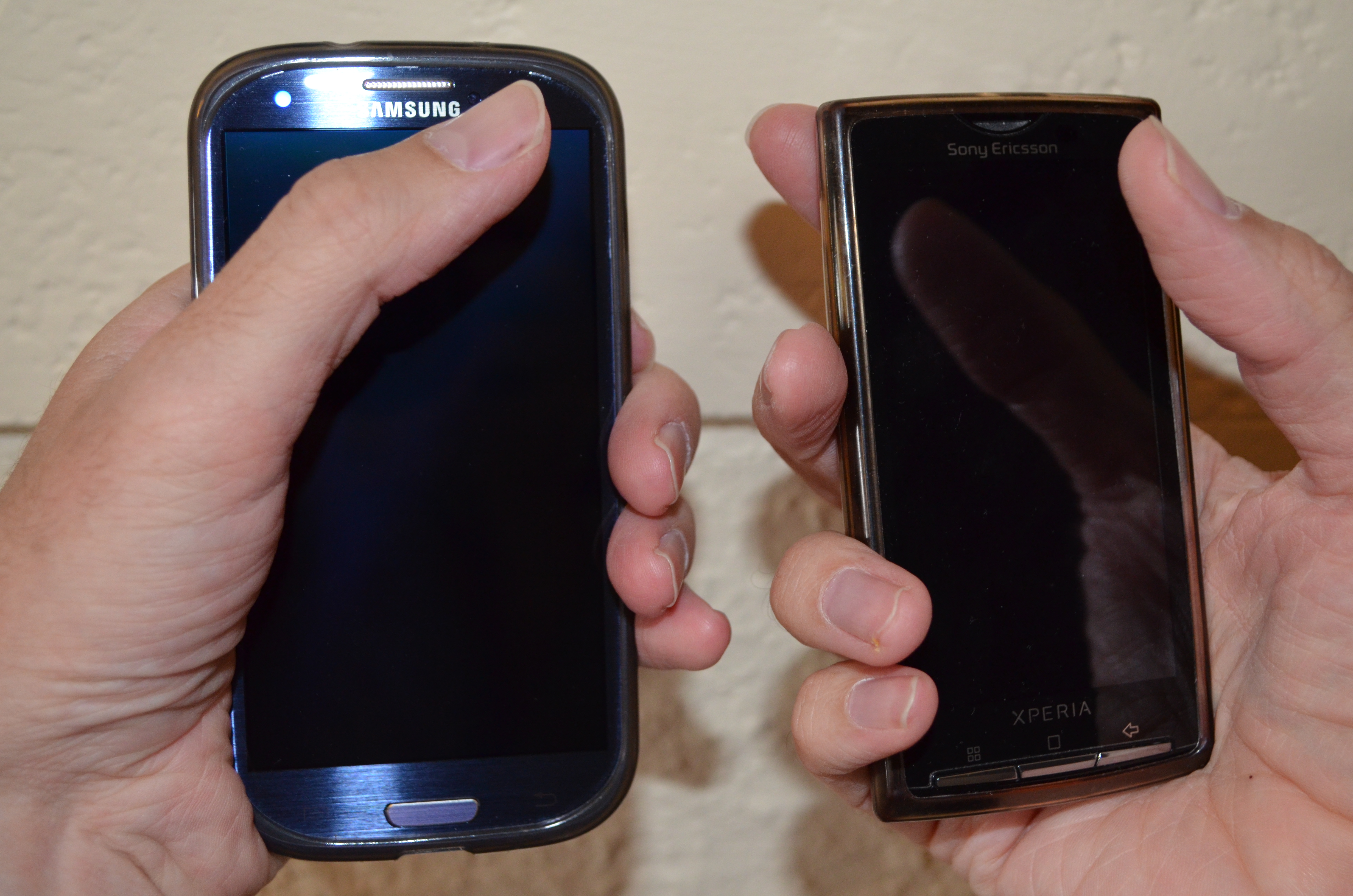
Galaxy S3 vs Xperia X10 1/2Galaxy S3 vs Xperia X10 2/2 The above two pictures show me holding a Samsung Galaxy S3 which has a 4.8 display in my left hand and a Sony Ericsson Xperia X10 which has a 4.0 display in my right hand. I am holding both phones in a manner that allows me to touch the top opposite corner with my thumb the position I need for one-handed phone use. The Xperia X10 can be completely enclosed by my hand, when I have a bottom corner resting in my palm it won t slide down while the Galaxy S3 can slide. Also one thing I didn t realise before having the pictures taken is that my posture is quite different when using the two phones. With the Galaxy S3 my wrist is clearly bent and this seems more likely to cause me to have more problems with Carpal Tunnel Syndrome [1]. I haven t had any serious problems with CTS for the last 2.5 years but I have had minor problems that suggest that I will have to be careful about my posture for the rest of my life. So it seems that a 4.8 phone is just too big for ideal one-handed use (grasping the vertical phone from the bottom). As I had CTS problems with my left hand I will try to use my new phone with my right hand as much as possible. Also I can reach further than the width of the phone screen when I grasp it from the side, so for me a size of about 5.2 would be better than the 4.8 of the Galaxy S3. It s quite likely that the Samsung Galaxy Note with it s 5.3 screen would be a better device for me to grasp from the side. But the Galaxy Note 2 might be a little too large for me. Note that I am only considering ways of holding the device that permit full operation. Anything that involves changing position for different uses or occasionally using two hands for a mostly one-hand operation doesn t count. 7 inch tablet The above picture is of me holding a 7 Android tablet (which I have just returned to Aldi [2]). When holding it from the sides I can reach more than half the screen with one hand so it seems that the ideal size for a tablet to be held in two hands for me would be 8 or even a little larger. A tablet larger than that could only be properly used if resting on my lap or a desk so for me 8 is the size that differentiates things which can be strictly used as tablets (holding with two hands and using thumbs for input) and things which are more like Netbooks (on desk typing). Ideal Device Sizes for people based on Height I am about 190cm tall. If we assume that height and hand size are strongly correlated then we can look at median heights of various age groups and determine what might be a good device size. I am also assuming that everyone wants to have the largest possible device, but some people have other criteria such as the size of their pockets. For me it s 8 tablet, 5.2 side-grip phone, and 4 bottom-grip phone. I used data from a chart of the average heights of American boys [3] and a chart of the average heights of American girls [4] to determine what size devices might suit children of various ages. Note that before the age of 12 the height of boys and girls is near enough to identical.
Device Two Hand Tablet Use Phone Grasp from Side Phone Grasp from Below
7 tablet 14yo boy or 17yo girl noone noone
Galaxy Note 5.3 10yo 95th percentile 17yo boy noone
Galaxy S3 4.8 6yo 17yo boy or 95th percentile 17yo girl almost noone
Galaxy S and iPhone 5 4.0 3yo 10yo 95th percentile 17yo boy
iPhone 4 3.5 noone 8yo 14yo boy or 16yo girl
One thing that particularly interests me is the educational use of Android devices for children. As few people buy new phones and tablets for young children that largely means that children borrow devices from their parents or are given older phones when relatives no longer need them. So it seems that if all other things are equal then an adult might choose a phone with a 4.8 display to allow it to be used as a tablet by children in the 6-10 age range. Conclusion It seems that the iPhone 4 is a good size for one-handed use by women of average height. By the standards of the people who don t regard gripping a phone from below as a significant feature the iPhone 4 would be designed for the hand of an 8yo. By any standards all iPhones other than the iPhone 5 were not the ideal size for most adults to use maybe they are well designed to fit in a pocket while unused. Charles Stross criticised the iPhone because it s too small to be seen well by people with poor vision [5], he also makes many other interesting points about the use of phones and I recommend reading his article (and the rest of his blog). The common tablet size of 7 seems like it might be ideal for women to hold with both hands, but for men of average height a 7.5 tablet might be better suited, it sounds like a small difference but it changes button size (good for people with thicker fingers) and allows displaying more data at once (15% greater screen area). Of course if you want to use a tablet on a desk then something much bigger would be better, maybe 12 or 14 . I think that there is a real market for 14 tablets that are designed to be carried around the home or office and then used on a table or lap which differs from the tablets that are designed to be more portable. There is also the use case of holding the phone in one hand while typing with the other which I haven t considered in this post. I don t think it s interesting because in that case almost everyone will find that the limitation is the size of their pockets and the size of an object that can be held to one s face for a phone call not the size of their hands. I ve previously written about my search for Geeky jeans and the ability to put a 7 tablet in my jeans pocket [6]. So I think that pocket size isn t a phone selection issue for men. The fact that women s clothing tends to have tiny pockets is another issue, if someone knows of a good analysis of phone size vs pockets in women s clothes then please let me know.

10 February 2013

Stefano Zacchiroli: bits from the DPL for January 2013

(insert here: I've been to FOSDEM, I got a nasty flu, and other $lame_excuses for the delay in sending out this report) Dear Project Members, here's the monthly DPL activity report, this time for January 2013. About the next DPL This is the last DPL report before the start of the election process for the next term: around early March, about 20 days from now, the Secretary will send out the call for nominations. I'd like to respond (also) here to inquiries I'm receiving these days: I will not run again as DPL. So you have about 20 days to mob^Wconvince other DDs to run, or decide to run yourself. Do not to wait for the vary last minute, as that makes for lousy campaigns. I'm available to give feedback about my DPL experience to prospective candidates, ... and also to join mobbing^Wconvincing actions toward potential candidates. Just contact me. Call for helps Assets Cloud Images Work has gone on also on the front of supporting Debian installation in public "clouds". Thanks to Arnaud Patard, Jose Miguel Parrella Romero, Pierre Couzy, and Gianugo Rabellino, we now have Debian testing images for Microsoft Azure. Together with Amazon EC2, this is the second large provider supporting Debian via images maintained by Debian Developers. More providers are welcome, exactly as more hardware/CD vendors shipping Debian are always welcome. If you want to contribute support for other providers just show up on the -cloud mailing list and say so. Some documentation effort in view of Wheezy are in need of help too, in order to let our users know about "cloud" options, see #695681. DPL helpers The DPL helpers experiment goes on. We have had 2 more IRC meetings in January (see the minutes). Documentation of the "team" communication channels (mailing list, IRC, Git, etc.) is now available from the DPL wiki page. Talks I've given an invited Debian talk at Polytech'Grenoble, as part of a free software event organized for students of local universities. Slides of the talk are available. I'd like to thank Vincent Danjean for the event organization. Let's release Wheezy now!
Cheers.
PS the day-to-day activity log for January 2013 is available at the usual place master:/srv/leader/news/bits-from-the-DPL.txt.201301

8 February 2013

Philipp Kern: Mozilla's direction

Am I the only one who's disappointed with the route Mozilla's taking and left wondering what the direction is? First they killed off the development of Thunderbird because, as we all know, people mainly use webmail these days. Then they presented us their view that the big Certificate Authorities are too big to fail, as CAs gravely violated our trust (c.f. Trustwave and their MitM authority). And "now" they're also blocking the introduction of new formats into their browser because they cannot be the one who innovates. Instead Microsoft and Apple obviously need to take the lead in introducing a format into their browsers because otherwise it wouldn't be useful. Even though it's safe to say that Chrome and Firefox make up for more than half of the desktop browser market share. It might be that Chrome's nibbling from Firefox's, still IE seems to be in decline and Safari is rather a further mention than something many people would care strongly about.

There were of course some valid reasons for not supporting WebP yet. But most of them got fixed in the meantime and all we hear is the referal to proprietary vendors who need to move first. If I'd want to depend on such vendors I'd go with proprietary operating systems. (Having to deal with hardware products of proprietary vendors at $dayjob is enough.) So what's up Mozilla? The solution is to ignore your users and tag bugs with patches wontfix?

The only real advantage of Firefox over Chromium these days is the vast amount of plugins and extensions (e.g. Pentadactyl, for which there is no real equivalent available). Another sad fact is that you need to pull Firefox from a 3rd party repository (even though packages are coming from the 2nd party) to get a current version onto your Debian system to work with the web. But then it's not Mozilla who's to blame here. Maybe we should've introduced one Iceweasel version that's allowed to have reverse-dependencies and one that cannot.

(This post might contain hyberboles, which should be considered as such.)

Russ Allbery: Still here

Well, I had a very nice run at the start of this year in writing journal entries nearly every day, and then I seem to have gotten much quieter. This is not actually because less stuff is going on, but I started working on larger projects without meaningful daily progress, and I also got drawn into some very rewarding creative work that has kicked my schedule in the ass. Schedules are something that I've always struggled with. I'm fairly convinced that I have even more than the natural human tendency towards a longer than 24-hour schedule. (I lived in 28-hour days and 6-day weeks for one full quarter when I was a college student and rather liked it, but it wasn't practical enough to stay with.) This means that, without applying a lot of discipline, I tend to stay up later and later because I'm engaged in interesting things and don't want to stop, and then drift further and further out of sync with the world. When I was just out of college and working as just another member of a team that wasn't very close-knit, I just shrugged and let it happen. I used to get into work at about two or three in the afternoon and work until well past midnight. It had some lovely properties, such as getting to work most of my "day" after everyone else had left and the building was quiet. Unfortunately, it's really not compatible with a lead position that requires interaction with people and quite a few meetings and other types of coordination. Given that I can't just let my schedule go wherever, I realized a year or two ago that I do much better if I can stick to a fairly reliable and consistent schedule and go to bed at a regular time, even if I'm involved in something. It cuts off my evenings in a way I don't like, but it makes mornings much more pleasant and it makes it easier to schedule and stick with various chores like exercise. But it's remarkably hard to get back into that mode once I've gotten out of it, particularly when I get caught up in things in the evenings. This meander is mostly my way of getting these thoughts out of my head and on a screen in front of me so that I'll think about them and build up enough willpower to go back to a regular schedule. It really is worth it; I was keeping one through most of January and it had a lot to do with why January was awesome. Hopefully a more sustantive update tomorrow.

MJ Ray: Clevo 7872-9040/A built Jan 13 with Debian 6

My trusty Asus seems to have succumbed to graphic fault. I got an OS-free Zoostorm as its replacement, to avoid paying the MS tax. Zoostorm is one brand that Clevo laptops are sold under. It was actually a Clevo 7872-9040/A built Jan 13. I installed Debian 6 on it. The download button was easy to spot on the front page, but I actually used mini.iso so I could use a smaller usb stick. The first larger stick I tried was a dud and I m not sure where other sticks went in the move. The base installation went fine and most things went well, but the wireless networking and sound required an upgrade, but more on that next tech post.

7 February 2013

Russell Coker: Links February 2013

Aaron on Software wrote an interesting series of blog posts about psychology and personal development collectively Titled Raw Nerve , here s a link to part 2 [1]. The best sections IMHO are 2, 3, and 7. The Atlantic has an insightful article by Thomas E. Ricks about the failures in leadership in the US military that made the problems in Afghanistan and Iraq a lot worse than they needed to be [2] Kent Larson gave an interesting TED talk about how to fit more people in cities [3]. He covers issues of power use, transport, space use, and sharing. I particularly liked the apartments that transform and the design for autonomous vehicles that make eye contact with pedestrians. Andrew McAfee gave an interesting TED talk titled Are Droids Taking Our Jobs [4]. I don t think he adequately supported his conclusion that computers and robots are making things better for everyone (he also presented evidence that things are getting worse for many people), but it was an interesting talk anyway. I Psychopath is an interesting documentary about Sam Vaknin who is the world s most famous narcissist [5]. The entire documentary is available from Youtube and it s really worth watching. The movie Toy Story has been recreated in live action by a couple of teenagers [6]. That s a huge amount of work. Rory Stewart gave an interesting TED talk about how to rebuild democracy [7]. I think that his arguments against using the consequences to argue for democracy and freedom (he suggests not using the torture doesn t work and women s equality doubles the workforce arguments) are weak, but he made interesting points all through his talk. Ernesto Sirolli gave an interesting TED talk about aid work and development work which had a theme of Want to help someone? Shut up and listen! [8]. That made me think of Mary Gardiner s much quoted line from the comments section of her Wikimania talk which was also shut up and listen . Waterloo Labs has some really good engineering Youtube videos [9]. The real life Mario Kart game has just gone viral but there are lots of other good things like the iPhone controlled car and eye controlled Mario Brothers. Robin Chase of Zipcar gave an interesting TED talk about various car sharing systems (Zipcar among others), congestion taxes, the environmental damage that s caused by cars, mesh networks, and other things [10]. She has a vision of a future where most cars are shared and act as nodes in a giant mesh network. Madeleine Albright gave an interesting TED talk about being a female diplomat [11]. She s an amazing speaker. Ron Englash gave an interesting TED talk about the traditional African use of fractals [12]. Among the many interesting anecdotes concerning his research in Africa he was initiated as a priest after explaining Georg Cantor s set theories. Racialicious has an insightful article about the low expectations that members of marginalised groups have of members of the privileged groups [13]. Rick Falkvinge has a radical proposal for reforming copyrights with a declared value system [14]. I don t think that this will ever get legislative support, but if it did I think it would work well for books and songs. I think that some thought should be given to how this would work for Blogs and other sources of periodical content. Obviously filing for every blog post would be an unreasonable burden. Maybe aggregating a year of posts into one copyright assignment block would work. Scott Fraser gave an interesting TED talk about the problem with eyewitness testimony [15]. He gave a real-world example of what had to be done to get an innocent man acquitted, it s quite amazing. Sarah Kendzior wrote an interesting article for al Jazeera about the common practice in American universities to pay Adjunct Professors wages that are below the poverty line [16]. That s just crazy, when students pay record tuition fees there s more than enough money to pay academics decent wages, where does all the money go to anyway?

Ian Wienand: Shared libraries and execute permissions

In the few discussions you can find on the web about shared-libraries and execute-permissions, you can find a range of various opinions but not a lot about what goes when you execute a library. The first thing to consider is how the execute-permission interacts with the dynamic loader. When mapping a library, the dynamic-loader doesn't care about file-permissions; it cares about mapping specific internal parts of the .so. Specifically, it wants to map the PT_LOAD segments as-per the permissions specified by the program-header. A random example:
 $ readelf --segments /usr/lib/x86_64-linux-gnu/libcrypto.so.1.0.0
Elf file type is DYN (Shared object file)
Entry point 0x77c00
There are 7 program headers, starting at offset 64
Program Headers:
  Type           Offset             VirtAddr           PhysAddr
                 FileSiz            MemSiz              Flags  Align
  LOAD           0x0000000000000000 0x0000000000000000 0x0000000000000000
                 0x00000000001b5ea4 0x00000000001b5ea4  R E    200000
  LOAD           0x00000000001b6b60 0x00000000003b6b60 0x00000000003b6b60
                 0x0000000000028dc4 0x000000000002c998  RW     200000
The permissions to load the code and data segments are given the Flags output. Code has execute-permissions, and data has write-permissions. These flags are mapped into flags for the mmap call, which the loader then uses to map the various segments of the file into memory. So, do you actually need execute-permissions on the underlying file to mmap that segment as executable? No, because you can read it. If I can read it, then I can copy the segment to another area of memory I have already mapped with PROT_EXEC and execute it there anyway. Googling suggests that some systems do require execute-permissions on a file if you want to directly mmap pages from it with PROT_EXEC (and if you dig into the kernel source, there's an ancient system call uselib that looks like it comes from a.out days, given it talks about loading libraries at fixed addresses, that also wants this). This doesn't sound like a terrible hardening step; I wouldn't be surprised if some hardening patches require it. Maximum compatability and historical-features such as a.out also probably explains why gcc creates shared libraries with execute permissions by default. Thus, should you feel like it, you can run a shared-library. Something trivial will suffice:
int function(void)  
      return 100;
 
$ gcc -fPIC -shared -o libfoo.so foo.c
$ ./libfoo.so
Segmentation fault
This is a little more interesting (to me anyway) to dig into. At a first pass, why does this even vaguely work? That's easy -- an ELF file is an ELF file, and the kernel is happy to map those PT_LOAD segments in and jump to the entry point for you:
$ readelf --segments ./libfoo.so
Elf file type is DYN (Shared object file)
Entry point 0x570
There are 6 program headers, starting at offset 64
Program Headers:
  Type           Offset             VirtAddr           PhysAddr
                 FileSiz            MemSiz              Flags  Align
  LOAD           0x0000000000000000 0x0000000000000000 0x0000000000000000
                 0x000000000000070c 0x000000000000070c  R E    200000
  LOAD           0x0000000000000710 0x0000000000200710 0x0000000000200710
                 0x0000000000000238 0x0000000000000240  RW     200000
What's interesting here is that the shared-library has an entry point (e_entry) at all. ELF defines it as:
This member gives the virtual address to which the system first transfers control, thus starting the process. If the file has no associated entry point, this member holds zero.
First things first, where did that entry point come from? The ld manual tells us that the linker will set the entry point based upon the following hierarchy:
  • the -e entry command-line option;
  • the ENTRY(symbol) command in a linker script;
  • the value of a target specific symbol
  • the address of the first byte of the .text section, if present;
  • The address 0.
We know we're not specifying an entry point. The ENTRY command is interesting; we can check our default-link script to see if that is specified:
$ ld --verbose   grep ENTRY
ENTRY(_start)
Interesting. Obviously we didn't specify a _start; so do we have one? A bit of digging leads to the crt files, for C Run-Time. These are little object files automatically linked in by gcc that actually do the support-work to get a program to the point that main is ready to run. So, if we go and check out the crt files, one can find a definition of _start in crt1.o
$ nm /usr/lib/x86_64-linux-gnu/crt1.o
crt1.o:
0000000000000000 R _IO_stdin_used
0000000000000000 D __data_start
                 U __libc_csu_fini
                 U __libc_csu_init
                 U __libc_start_main
0000000000000000 T _start
0000000000000000 W data_start
                 U main
But do we have that for our little shared-library? We can get a feel for what gcc is linking in by examining the output of -dumpspecs. Remembering gcc is mostly just a driver that calls out to other things, a specs file is what gcc uses to determine which arguments pass around to various stages of a compile:
$ gcc -dumpspecs
...
*startfile:
% !shared: % pg p profile:gcrt1.o%s;pie:Scrt1.o%s;:crt1.o%s 
 crti.o%s % static:crtbeginT.o%s;shared pie:crtbeginS.o%s;:crtbegin.o%s 
The format isn't really important here (of course you can read about it); but the gist is that various flags, such as -static or -pie get passed different run-time initailisation helpers to link-in. But we can see that if we're creating a shared library we won't be getting crt1.o. We can double-confirm this by checking the output of gcc -v (cut down for clarity).
$ gcc -v -fPIC -shared -o libfoo.so foo.c
Using built-in specs.
 ...
/usr/lib/gcc/x86_64-linux-gnu/4.4.5/collect2 -shared -o libfoo.so
/usr/lib/gcc/x86_64-linux-gnu/4.4.5/../../../../lib/crti.o
/usr/lib/gcc/x86_64-linux-gnu/4.4.5/crtbeginS.o
/tmp/ccRpsQU3.o
/usr/lib/gcc/x86_64-linux-gnu/4.4.5/crtendS.o
/usr/lib/gcc/x86_64-linux-gnu/4.4.5/../../../../lib/crtn.o
So this takes us further down ld's entry-point logic to pointing to the first bytes of .text, which is where the entry-point comes from. So that solves the riddle of the entry point. There's one more weird thing you notice when you run the library, which is the faulting address in kern.log:
libfoo.so[8682]: segfault at 1 ip 0000000000000001 sp 00007fffcd63ec48 error 14 in libfoo.so[7f54c51fa000+1000]
The first thing is decoding error; 14 doesn't seem to have any relation to anything. Of course everyone has the Intel 64 Architecture Manual (or mm/fault.c that also mentions the flags) to decode this into 1110 which means "no page found for a user-mode write access with reserved-bits found to be set" (there's another post in all that someday!). So why did we segfault at 0x1, which is an odd address to turn up? Let's disassemble what actually happens when this starts.
00000000000004a0 <call_gmon_start>:
 4a0:   48 83 ec 08             sub    $0x8,%rsp
 4a4:   48 8b 05 2d 03 20 00    mov    0x20032d(%rip),%rax        # 2007d8 <_DYNAMIC+0x190>
 4ab:   48 85 c0                test   %rax,%rax
 4ae:   74 02                   je     4b2 <call_gmon_start+0x12>
 4b0:   ff d0                   callq  *%rax
 4b2:   48 83 c4 08             add    $0x8,%rsp
 4b6:   c3                      retq
We're moving something in rax and testing it; if true we call that value, otherwise skip and retq. In this case, objdump is getting a bit confused telling us that 2007d8 is related to _DYNAMIC; in fact we can check the relocations to see it's really the value of __gmon_start__:
$ readelf --relocs ./libfoo.so
Relocation section '.rela.dyn' at offset 0x3f0 contains 4 entries:
  Offset          Info           Type           Sym. Value    Sym. Name + Addend
000000200810  000000000008 R_X86_64_RELATIVE                    0000000000200810
0000002007d8  000200000006 R_X86_64_GLOB_DAT 0000000000000000 __gmon_start__ + 0
0000002007e0  000300000006 R_X86_64_GLOB_DAT 0000000000000000 _Jv_RegisterClasses + 0
0000002007e8  000400000006 R_X86_64_GLOB_DAT 0000000000000000 __cxa_finalize + 0
Relocation section '.rela.plt' at offset 0x450 contains 1 entries:
  Offset          Info           Type           Sym. Value    Sym. Name + Addend
000000200808  000400000007 R_X86_64_JUMP_SLO 0000000000000000 __cxa_finalize + 0
Thus call_gmon_start, rather unsurprisingly, checks the value of __gmon_start__ and calls it if it is set. Presumably this is set as part of profiling and called during library initialisation -- but it is clearly not an initialiser by itself. The retq ends up popping a value off the stack and jumping to it, which in this case just happens to be 0x1 -- which we can confirm with gdb by putting a breakpoint on the first text address and examining the stack-pointer:
(gdb) x/2g $rsp
0x7fffffffe7d8:        0x0000000000000000      0x0000000000000001
So that gives us our ultimate failure. Of course, if you're clever, you can get around this and initalise yourself correctly and actually make your shared-library do something when executed. The canonical example of this is libc.so itself:
$ /lib/x86_64-linux-gnu/libc-2.13.so
GNU C Library (Debian EGLIBC 2.13-37) stable release version 2.13, by Roland McGrath et al.
Copyright (C) 2011 Free Software Foundation, Inc.
This is free software; see the source for copying conditions.
...
You can trace through how this actually does work in the same way as we traced through why the trivial example doesn't work. If you wondering my opinion on executable-bits for shared-libraries; I would not give them execute permissions. I can't see it does anything but open the door to confusion. However, understanding exactly why the library segfaults the way it does actually ends up being a fun little tour around various parts of the toolchain!
Craig Sanders: Dead Can Dance

I saw Dead Can Dance at the Palais in St Kilda last night their first tour back in Australia in over 20 years. I ve wanted to see them perform live since I first discovered their music in the dim dark past bought the tickets as soon as the tour was announced last year and have been waiting impatiently ever since. The first act was percussionist David Kuckhermann who played solo and then joined DCD for the main act. He mostly played the handpan, which looks a lot like an upside-down wok with dimples on it. His tambourine solo was oustanding. Overall, a great start to the evening. I hadn t heard of him before, but I think I ll be ordering some of his CDs. Lisa Gerrard s voice was, as always, trance-inducingly sublime and Brendan Perry with a fine voice of his own really shines in a live performance. Definitely not a disappointment around three hours of amazing performance, old favourites and new, and the discovery (for me) of a new performer. If I have one (minor) complaint, it s that the volume was a little too loud, causing occasional distortion and difficulty distinguishing the lyrics on some of Brendan Perry s singing. Lisa Gerrard sings without words glossolalia and much higher than Perry so wasn t affected as much. If you haven t heard DCD or Lisa Gerrard s solo albums before, do so you re in for a treat labelled as world fusion , they re impossible to describe accurately while they started out as Dark Wave or as-goth-as-it-gets in the early 80s, they play across many genres and have strong influences from Middle Eastern, Mediaeval, world music, ambient, and more, they re in a genre of their own. You can t even say they re a bit like so-and-so because they aren t. Dead Can Dance is a post from: Errata

6 February 2013

Michael Stapelberg: RC bugs

I recently worked on the following RC bugs: By the way, in case anyone needs to reproduce an armhf bug and wants to do so in a chroot with qemu, here are the steps I used:
sudo qemu-debootstrap --arch=armhf --foreign wheezy armhf http://ftp.de.debian.org/debian
sudo LC_ALL=C chroot armhf /bin/bash
echo 'deb http://ftp.de.debian.org/debian wheezy main' > /etc/apt/sources.list
echo 'nameserver 8.8.8.8' > /etc/resolv.conf
apt-get update
apt-get install clang
Also, here are UDD queries which I prefer to those posted by RichiH. Note that they don t display all bugs, but ignore those which were created in the last 7 days.

Biella Coleman: Edward Tufte was a phreak

It has been so very long since I have left a trace here. I guess moving to two new countries (Canada and Quebec), starting a new job, working on Anonymous, and finishing my first book was a bit much. I miss this space, not so much because what I write here is any good. But it a handy way for me to keep track of time and what I do and even think. My life feels like a blur at times and hopefully here I can see its rhythms and changes a little more clearly if I occasionally jot things down here. So I thought it would nice to start with something that I found surprising: famed information designer, Edward Tufte, a professor emeritus at Yale was a phone phreak (and there is a stellar new book on the topic by former phreak Phil Lapsley. He spoke about his technological exploration during a sad event, a memorial service in NYC which I attended for the hacker and activist Aaron Swartz. I had my wonderful RA transcribe the speech, so here it is [we may not have the right spelling for some of the individuals so please let us know of any mistakes]:
Edward Tufte s Speech From Aaron Swartz s Memorial
Speech starts 41:00 [video cuts out in beginning]
We would then meet over the years for a long talk every now and then, and my responsibility was to provide him with a reading list, a reading list for life and then about two years ago Quinn had Aaron come to Connecticut and he told me about the four and a half million downloads of scholarly articles and my first question is, Why isn t MIT celebrating this? .
[Video cuts out again]
Obviously helpful in my career there, he then became president of the Mellon foundation, he then retired from the Mellon foundation, but he was asked by the Mellon foundation to handle the problem of JSTOR and Aaron. So I wrote Bill Bullen(sp?) an email about it, I said first that Aaron was a treasure and then I told a personal story about how I had done some illegal hacking and been caught at it and what happened. In 1962, my housemate and I invented the first blue box, that s a device that allows for free, undetectable, unbillable long distance telephone calls. And we got this up and played around with it and the end of our research came when we concluded what was the longest long distance call ever made, which was from Palo Alto to New York time-of-day via Hawaii, well during our experimentation, AT&T, on the second day it turned out, had tapped our phone and uh but it wasn t until about 6 months later when I got a call from the gentleman, AJ Dodge, senior security person at AT&T and I said, I know what you re calling about. and so we met and he said You what you are doing is a crime that would , you know all that. But I knew it wasn t serious because he actually cared about the kind of engineering stuff and complained that the tone signals we were generating were not the standard because they record them and play them back in the network to see what numbers they we were that you were trying to reach, but they couldn t break though the noise of our signal. The upshot of it was that uh oh and he asked why we went off the air after about 3 months, because this was to make long distance telephone calls for free and I said this was because we regarded it as an engineering problem and we made the longest long distance call and so that was it. So the deal was, as I explained in my email to Bill Bullen, that we wouldn t try to sell this and we were told, I was told that crime significance would pay a great deal for this, we wouldn t do any more of it and that we would turn our equipment over to AT&T, and so they got a complete vacuum tube isolator kit for making long distance phone calls. But I was grateful for AJ Dodge and I must say, AT&T that they decided not to wreck my life. And so I told Bill Bullen that he had a great opportunity here, to not wreck somebody s life, course he thankfully did the right thing.
Aaron s unique quality was that he was marvelously and vigorously different. There is a scarcity of that. Perhaps we can be all a little more different too.
Thank you very much.

Vincent Sanders: Two years of 3D printing

Almost two years ago my good friend Phil Hands invited me to attend a workshop at bath university to build a 3D printer. I had previously looked at the Reprap project and considered building the Darwin model, alas lack of time and funds had prevented me form proceeding.

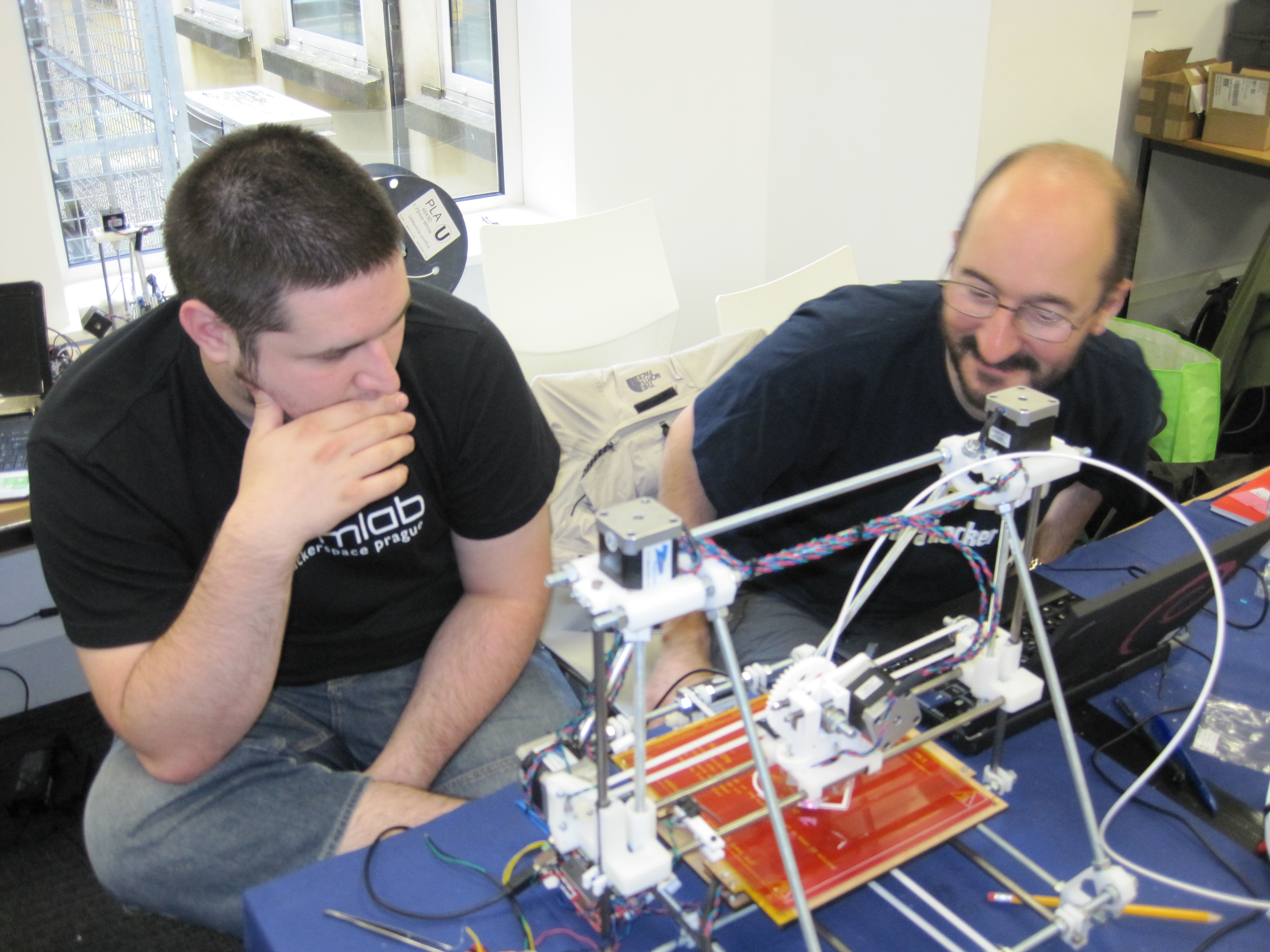
Jo Prusa and Phil Hands watching a heart print.
The workshop was to build a new, much simpler, design called the Prusa. Of course the workshop was booked and paid for well in advance which left me looking forwards to the event with anticipation. Of course I would not betaking the results of the workshop home as Phil had paid for it, so I started investigating what I would need for my own machine.

Of course at this point I muttered the age old phrase of "how hard can it be" and started acquiring parts for my own printer. By the time the workshop happened I already had my machine working as a plotter. I learned a lot from the Bath masterclass and a few days afterwards my own machine was complete.

First print
The results were underwhelming to say the least. There then came months and months of trial and error to fix various issues:
  • The filament feed bolt had to be replaced with a better one with sharper teeth.
  • The thermistor which reads the extruder temperature needed replacing (it still reads completely the wrong temperature even now).
  • The Y axis was completely inverted and needed re-wiring and the limit switches moving.
  • Endlessly replacing the printer firmware with new versions because every setting change requires a complete recompile and re-flash.
  • The bushings on the Y axis were simply not up to the job and the entire assembly needed replacing with ball bearings and a heated bed otherwise prints would be completely warped.
  • The Z axis couplings kept failing until I printed some alternates that worked much better
Once these issues had been fixed I started getting acceptable levels of output though the software in the workflow used to produce toolpaths (skeinforge) was exceptionally difficult to use and prone to producing poor results.

Alas the fundamental design issues of the Prusa remain. The A frame design provides exceptional rigidity in one plane...the other two? not so much. This coupled with an exceptionally challenging calibration to get the frame parallel and square means the printer is almost never true.

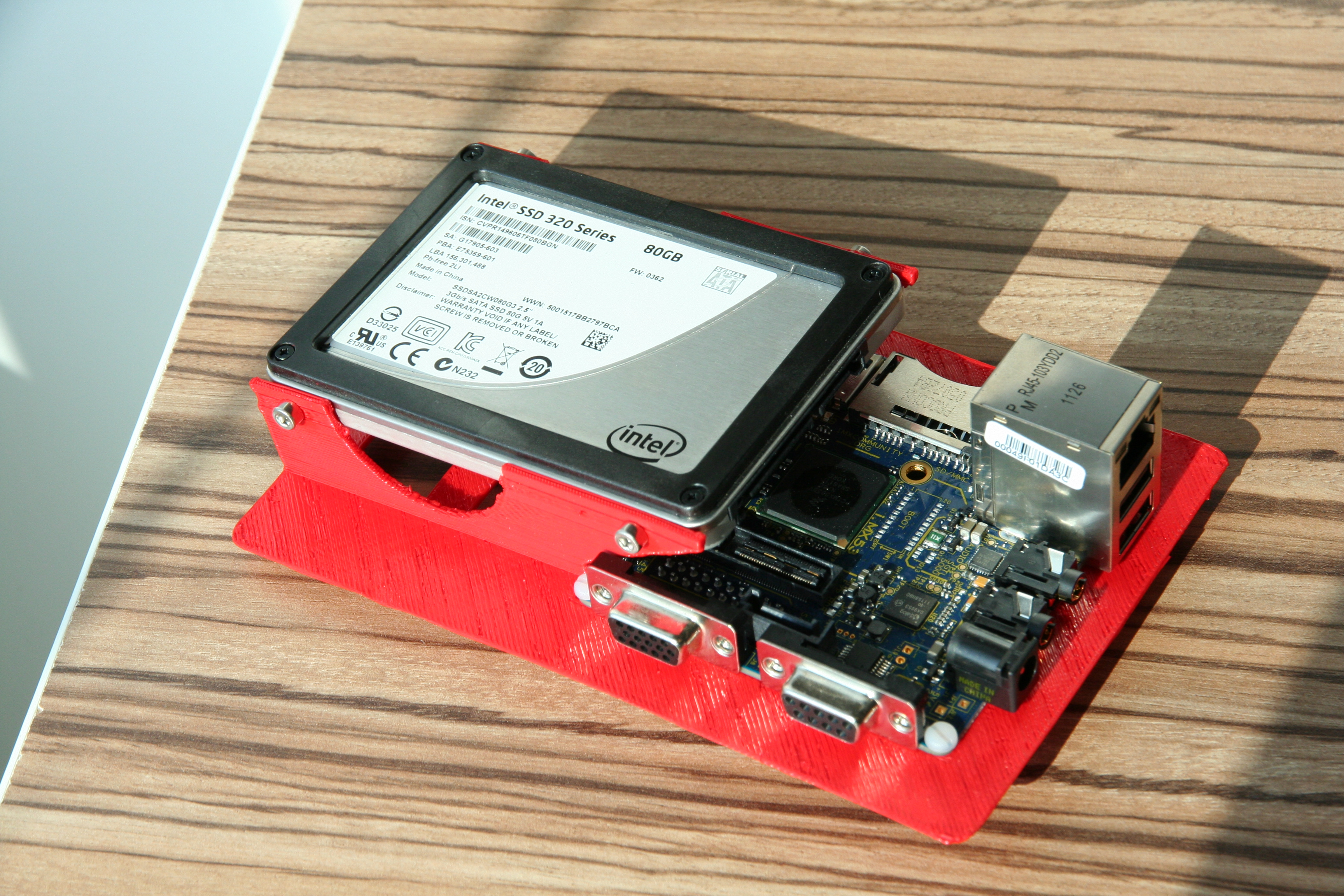
Prototype iMX53 dev board eurocard carrier printed on my printer
In operation the lack of rigidity in the x axis means the whole frame vibrates badly even with extra struts to try and improve its rigidity. I am not the first to notice these design flaws and indeed Chris has done something about it by creating a much superior design.

I do however have a working printer and have developed a workflow and understanding of what I can expect to work.

Improvements in the software means that slic3r has replaced skeinforge and gives superior results and the CAD software is continuously improving.

Currently I mainly use the printer to generate prototypes and simple profiles and then send the resulting designs to shapeways for final production though simpler designs are usable directly from the machine.

Because I am away from home a lot and moving the machine is simply not a workable option the printer does not get used for "fun" anywhere near as much as I had hoped and the workflow limitations mean I have not been able to make it available to my friends to use as a communal device.


Thomas Goirand: Openstack Folsom fully uploaded to Experimental

It s been a long time I wanted to blog about my recent work on the Openstack packaging. I finally can find a bit of time to do it. For those who don t know yet Openstack, it s a fairly recent (less than 3 years) cloud computing suite, which is becoming quite huge. If you plan on deploying a private cloud, you should definitively have a look into it. When the Openstack project started, I immediately was interested. I started packaging the Cactus release (that is, the 3rd version of Openstack), created the Alioth group (at the exact moment when Alioth was migrated to new hardware which added some fun so lucky I was!), and began to work on the Debian version (Openstack used to be an Ubuntu only project). After some success in integrating some Debian specific patches into the Ubuntu packages, I left it a bit aside, and skipped completely the Diablo release (which was never uploaded in Debian). Then, I worked a bit on the Essex release before the freeze of Wheezy last June, together with other DDs (big up to Julien, Loic, Ghe, Sileth!). I (re-)started serious packaging work for Openstack just right after Folsom (eg: version 2012.2) was released early last October. I literally worked days and nights on it, in order to provide more automation so that it could become more easy to install. Indeed, it used to be very complicated and painful, with lots of manual tasks to perform on the shell. It s hopefully a lot easier now, with most of the manual boring shell work replaced by debconf and scripts. But I m sure there s more that can be done still. After 4 months of effort, I finally pressed the red button and uploaded everything at once to Debian Experimental since Openstack Essex (version 2012.1) is in Wheezy, I can t of course upload to SID unless Wheezy is out -. This represent 32 sources packages in total (some of them are already uploaded and approved by the FTP masters: sorry to give you so much more work guys ), and 104 binary packages (and counting ). So this isn t exactly small And I already have some fixes for what s currently waiting in the NEW queue: CVE fixes, missing build-depends which we ve found using the Jenkins server of eNovance who sponsors the packaging work, etc. I probably will post again here to announce when Folsom is completely approved by the FTP masters and reaches Debian experimental. In the mean while, it s available on GPLHost non-official repositories (see the howto linked bellow). If you would like to test the latest Openstack release (called Folsom, or 2012.2, if you are following well ), you can read the quite verbose howto I wrote here: https://wiki.debian.org/OpenStackHowto/Folsom If you do test it (don t be afraid, it s not that hard ), I will be very happy to hear from you, and receive any feedback / critics you may have. Note that I would strongly recommend to use the Folsom release, rather than what is currently in Wheezy, for many reasons which would be too long to list in this blog post (let me still drop a few reasons here: less bugs, more automations and it s more easy to install). Now, Openstack is a constantly evolving software, with so many companies and developers involved. I don t think my work on this beast will ever be finished. But it doesn t mater, as it s been quite some fun, and I will enjoy to do more. The next release of Openstack is schedule for next April (they release at the same time as Ubuntu). I hope to be able to join the Portland summit, and see all the persons I have worked with over IRC and mailing list. This time, I hope to be able to release Openstack packages at the same time as the upstream source code is released (Debian packages have historically been lagging a few months behind). The pre-version is by the way already in Alioth. Last, a (private) message for our famous cheese-master: please wait until everything leaves the NEW queue before bugging everyone with translations. We probably should have a serious talk about how to make it less redundant, easier to translate, and probably find a way to avoid duplication of messages across all packages.

Lior Kaplan: RTL status for Libre Office 4.0.0

LibreOffice 4.0.0 will be released soon, and it s a good time to summarize its RTL status. Similar to 3.5.0, the RTL work started with LibreOffice conference in October, showing the current state (see LibreOffice RTL status 2012 presentation) and listing the top problems. The main goal of this talk is to raise awareness to RTL issues and recruit developer to help fix them. This was exactly what happened with fdo#44657 which is about Calc not having a scroll bar in RTL user interface. This way RTL bug #1 for almost a year. In total, version 4.0.0 has 8 bugs fixed (mainly Calc, Presenter Console and toolbars). In addition it has 5 language specific bugs fixed. Full lists are at https://wiki.documentfoundation.org/RTL_Bugs#4.0.0 and https://wiki.documentfoundation.org/RTL_Bugs#4.0.0_2. Beside working on fixing bugs for the 4.0.0, another focus was put on making sure the fixes are available for the 3.6.x users. This resulted with cherry picking 11 out of 13 bug fixes (part of 3.6.4 and 3.6.5 releases). More fixes are already underway in the master branch, and will also be part of 4.0.1 maintenance release (full list at https://wiki.documentfoundation.org/RTL_Bugs#4.0.1). Beside thanking the core developers for their help (patches, code review), I d like to thank the guys from The National Program for Free and Open Source Software Technologies (Motah) at King Abdulaziz City for Science and Technology (KACST) in Saudi Arabia, which have joined the RTL team during this release, and their effect is well noticed. Despite all the work done, we still have a share of RTL bugs for the next release, these are the 7 top priority RTL bugs, any help would be appreciated.
  1. fdo#33302 Brackets inverted in rtl text (mac only)
  2. fdo#53030 Calc deletes current sheet, not right-clicked on sheet when trying to delete opposite directionality sheets
  3. fdo#56403 RTL UI: with RTL locales presentations appear with text align to the right instead of to the left
  4. fdo#37128 Writer saves text alignment of RTL paragraph not according to the ODF specification
  5. fdo#44029 docx files with RTL paragraphs aren t compatible with Word
  6. fdo#43093 FILEOPEN: [docx] MS Office documents opens with wrong alignment and directionality
  7. fdo#56408 Brackets are not handled correctly with mixed English/Latin and Hebrew/Arabic texts

Filed under: i18n & l10n, LibreOffice

5 February 2013

DebConf team: DebConf13 venue and dates (Posted by Moray Allan, Didier Raboud and the DebConf team)

This post is a quick status update on DebConf13, for those who aren t following the debconf-team mailing list. As you may know, this year s DebConf will be held at Le Camp, in Vaumarcus, Switzerland. Our concept for this DebConf is to hold it in a natural environment, away from distractions. We hope you will enjoy spending time together with other Debian collaborators in this beautiful part of Switzerland, on the shore of Lake Neuch tel. Dates DebConf13 will take place from Sunday 11. August 2013 to Sunday 18. August 2013. (We will use Saturday 10. August 2013 to prepare the venue for the conference.) You may notice that the dates don t cover two weeks like in the last few years (there is no separate DebCamp week). For budget reasons, current plans are to merge the two weeks activities into an 8 day period. If you think that s a pity, it s not too late to change it just join the fundraising team and start working quickly! Travel If you want to start arranging your travel to attend DebConf, some initial travel suggestions may be useful: The DebConf13 map shows the venue and the bus line (with some stops). Registration We expect to open registration around the start of March. Currently we are still evaluating some possible new conference management systems, which we hope might avoid the frustrations some attendees have had in the past with Pentabarf. Help welcome As always, the DebConf team is looking for volunteers. Some jobs need technical skills (e.g. testing conference management system setups, working on the website), but many DebConf tasks are about working to deadlines on non-technical issues (e.g. fundraising, budgeting, talk scheduling). You can see more information about some of the jobs to be done on the DebConf wiki. Please do think about getting involved and sharing your ideas with us, to help us make DebConf an even more useful event for Debian in the future. We look forward to welcoming you to Vaumarcus!

Wouter Verhelst: Transcoding videos

Since some people asked for it, and since it's (unfortunately) fairly nontrivial, here is the script that I'm using currently to transcode a .dv file into webm:
#!/bin/bash
set -e
newfile=$(basename $1 .dv).webm
wavfile=$(basename $1 .dv).wav
normalfile=$(basename $1 .dv)-normal.wav
normalfile=$(readlink -f $normalfile)
oldfile=$(readlink -f $1)
echo "Audio split"
gst-launch-0.10 uridecodebin uri=file://$oldfile ! progressreport ! audioconvert ! audiorate ! wavenc ! filesink location=$wavfile
echo "Audio normalize"
sox --norm $wavfile $normalfile
echo "Pass 1"
gst-launch-0.10 webmmux name=mux ! fakesink \
  uridecodebin uri=file://$oldfile name=demux \
  demux. ! ffmpegcolorspace ! deinterlace ! vp8enc multipass-cache-file=/tmp/vp8-multipass multipass-mode=1 threads=2 ! queue ! mux.video_0 \
  demux. ! progressreport ! audioconvert ! audiorate ! vorbisenc ! queue ! mux.audio_0
echo "Pass 2"
gst-launch-0.10 webmmux name=mux ! filesink location=$newfile \
  uridecodebin uri=file://$oldfile name=video \
  uridecodebin uri=file://$normalfile name=audio \
  video. ! ffmpegcolorspace ! deinterlace ! vp8enc multipass-cache-file=/tmp/vp8-multipass multipass-mode=2 threads=2 ! queue ! mux.video_0 \
  audio. ! progressreport ! audioconvert ! audiorate ! vorbisenc ! queue ! mux.audio_0
rm $wavfile $normalfile
It's fairly non-optimal, because many of these command-line A/V tools are either fairly badly documented, or have a horrific interface, or something similar. avconv is supposed to be able to do audio normalisation, but I haven't been able to figure out exactly how it's done. The options that are specified in the manpage seemingly have no effect. gstreamer has a 'ReplayGain' plugin which can do audio normalisation. Audio normalisation requires two passes; I could in theory just add the element in the gstreamer first-pass pipeline, add a '-t' to the gst-launch-0.10 invocation, and parse out the required gain value that I can then add to the second-pass pipeline. However, the elements that I can then pass that gain value to either have a different range for the gain (rgvolume's fallback-gain parameter) or expect a completely different unit of values with no obvious way to translate between the two (the 'volume' element's 'volume' parameter expects a multiplier, the replaygain plugin produces a dB value; a simple conversion seems wrong as it produces a value way out of range). The 'volume' element reportedly has an interface that takes a dB value, except you can't reach it from gst-launch-0.10. Bummer. So instead we split out the audio, do normalisation in sox, and mux that back in during the second pass of the video transcoding. Sox is good. Sox is easy. If all A/V command-line tools were like sox, I would be smiling now. What's missing from the above script is how to throw away the start or end of a file in case there's several minutes of uninterestingness there. This is easiest (in my experience) with avconv's -t and -ss options. I suspect gstreamer is capable of doing that, too; but I haven't figured out how, and this works. You may want to play with some of options of the vp8enc element. For instance, the threads= value can be increased (or decreased) depending on how many cores your transcoding machine has. You could probably also add a "target-bitrate" value if you find the quality is too low or the system uses too much diskspace. VP8 has several more options; the documentation lists them all. If you've done video recordings for a devroom at FOSDEM outside of the FOSDEM video team, note that FOSDEM is more than willing to host the videos. To do so, the easiest way is if the videos are online somewhere (this does not have to be a public system) that we can wget or scp them from; if you've done that, contact me with the location to the files and we'll put them on the FOSDEM video server.

Joey Hess: LCA2013 wrapup

After 27 hours of travel, I'm finally back from my first Linux.conf.au. This was a great conference! Some of my favorite highlights:
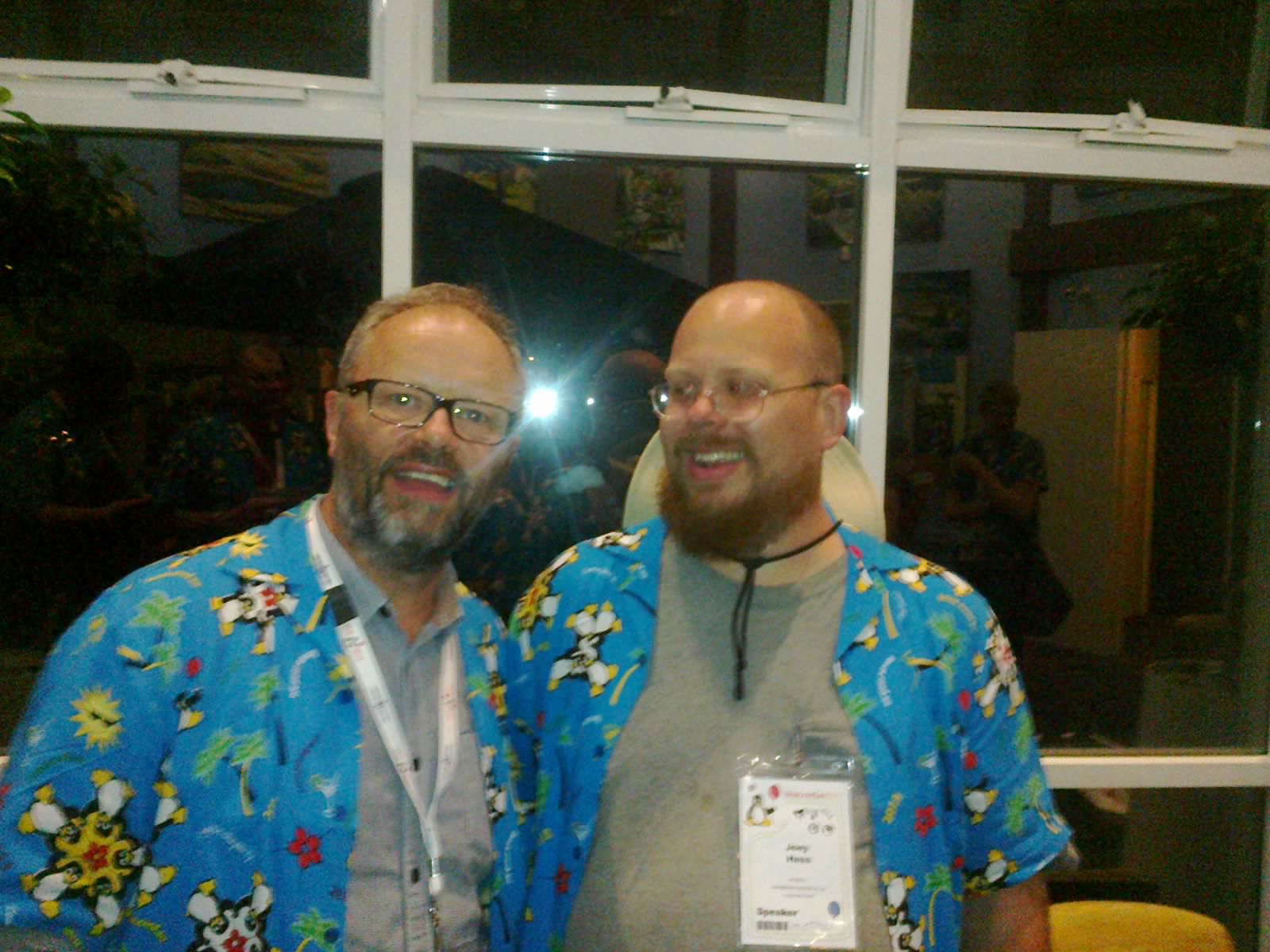
My git-annex talk went ok, despite technical problems with the video output, which the video team did a great job of working around. The first demo went well, and the Q&A was excellent. The demo of the git-annex assistant webapp was marred by, apparently, a bad build of the webapp -- which I ironically used rather than my usual development build because I assumed it'd be less likely to fail. At least I may have a way to reproduce that hang somewhat reliably now, so I can get on with debugging it. I will be redoing a demo of the webapp as a screencast.
Here are some of the best talks I attended. (I have quite a lot more queued up to watch still, and had to cut several due to space.) Click titles for videos, or browse all the videos.

Paul Tagliamonte: Hy: The Next Generation

As many of you know, I ve been spending some time hacking on a Lisp variant that s fully hosted in Python. If you want to read more about it, check out the slides I prepared for Boston Python s meetup in particular, pay attention to the magic REPL . I ve been pondering what to do next, and the natural instinct is for me to take a step back, and properly implement a few things I ve forgotten. Namely: Macros. Yes. Macros. It s a Lisp without Macros. I ve hit a few stumbling blocks in it s implementation, and it s been holding me up. I m mostly concerned with how Hy should treat quoted forms, in particular I m concerned about loosing the distinction between a vector and a list, since both convert into Python lists. There is of course the option to encode Lists as:
 (list foo bar baz)
but that seems wrong. I ve also got some concerns about derefing values in a quoted form I think this is just going to result in a lot of special casing for Macros. More to come soon.

John Goerzen: The Superbowl Pirate Bus

I ll forgive you for not noticing the bus full of pirates at the Superbowl. Because, well, unless you saw my 6-year-old, you have a pretty good excuse for missing it. I ll give you the Goerzen Superbowl play-by-play, just to make sure you re caught up. It involved pirates, cops, tractors, cookies, a card game, and yes, even troubles with HDMI. We were invited to a Superbowl party, and were going to bring a party snack. The boys love to help cook, and I try to give them choices. I started naming off potential snacks, starting with healthy options. They listened attentively, until I mentioned cookies. COOKIES! ***COOKIES!*** Yes, cookies! This reaction was, I must say, not exactly a surprise. Then I asked them what KIND of cookies. Jacob immediately knew what he wanted, so of course Oliver took a minute to come up with something else. No matter; we could make two kinds of cookies. Jacob, of course, picked a kind of cookie that needs cherries, while Oliver picked one that needs chocolate chips. Thus they both had opportunities to have a small taste of ingredients while we prepared the batter. And so make cookies we did. Plus a loaf of bread. Anyhow, once we got to the party, Jacob and Oliver saw a huge tub of Legos and were at it in a flash. One of Jacob s friends was pretending everything was a tractor, but it wasn t long before Jacob started in on his evening s project: building the largest bus he could build. He was pleased when he got 4 lego people into it. Even more happy when he got 10 into it. And by the time he figured out how to get 35 into it, he was quite proud of himself indeed. Oliver, meanwhile, in classic little brother fashion, tried to corner the market on surplus lego people. He appears to have the hardline negotiation skill down already, and perhaps is appreciating the value of artificial scarcity in the lego market <grin> Eventually the bus seemed to hit the limits of engineering and joint strength, and Jacob gave up for a little while. He had a cookie and some carrots, commented on the exciting game of Uno going on, ( Who is the loudest? All of them! ), brought me some carrots, and periodically commented that The ball team is ahead of the SF team. Sure is. They have more points! (This from the BAL and SF text on the screen.) And then he went back to playing. And here s where the pirates come in. Jacob s new bus had a lego flag that he decided was a pirate flag. So the bus was a pirate bus. He built a platform out the back for them to use to steal things . So his pirate bus went around the lego area, stealing this from one pile, stealing that from another, until it got almost as long as his first bus. Pretty soon, along came a police boat to chase the pirates. But the police boat appeared to suffer a humorous series of logistical failures and never could quite disrupt the pirates. But never mind that, for little brother Oliver was getting bored with the lego mountain he was building and decided it would be more fun if he would disrupt the pirates. An opinion that Jacob quite strongly disagreed with. When it was time to go, Jacob tried to extract a promise from the party hosts to not let anyone take apart the pirate bus until next time we would be there. Then this morning, Jacob and I had a discussion about pirates. Dad, are pirates real? Yes, Jacob, they are. Do they steal things? Yes, but they are far away. There are no pirates here. Are there pirates in Kansas? No. There are some pirates in Africa though. Oh. What state is Africa in? Africa is so far away that it isn t even in a state. You d have to take a boat or a plane to get there. Or a train! Nope, a train couldn t get across the ocean. It s too wide! They d build a bridge! It s too wide for a bridge. It s more than a thousand miles! WOW a thousand miles! Great! OK dad, it s time for me to get on that school bus!

4 February 2013

Michal &#268;iha&#345;: FOSDEM 2013 summary (Saturday)

FOSDEM 2013 is over and it's time to look what interesting I have seen there on Saturday. First of all the most important for me is to meet people. As usual, I came with SUSE folks, but it's not that unusual to meet people from company where you work :-). I've met some current and former phpMyAdmin developers and surprisingly I've met few Weblate users or people who consider using it on their project. This gave me some important feedback and one of first thing you will see in near future is remade Weblate website to give more information about some of it's unique features. As for the talks, I think I've managed to visit quite lot of them. How we made the Jenkins community explained some ways Jenkins has used to build good community - mostly focused on extensibility of the code and having everything as an extension, but with some focus on social things as well (and important thing that with Git people are not that motivated to join the team). Better software through user research was about various way to gather information of what your users hate on the software. It was pretty interesting, though many of that can not easily be used on small scale free software product. OSS code goes in and never comes out talk focused about licensing issues of various software as a service platforms. As I've never used Amazon cloud or such, it was quite surprising how these behave in relation to GPL and actually made me thing more about AGPL and attend related panel discussion later. An Integrated Localization Environment is Mozilla approach to online translation, quite different than anything we have before, but mostly for reasons which were explained later on Sunday talk on l20n. Maybe reverse ordering of these would make it easier to understand the motivation. Scale your Jenkins build pipeline automatically to minimize test time was not that useful as I thought - increasing test speed by buying EC2 instances and pushing part of the work to them is not something what will help me in near future. Trends in Open Source Security explained what is going on in distributions security, mostly focused on Redhat (but touching Debian as well). It has some interesting thoughts about sharing the information between vendors, so let's see if it will really work in future. QML s many faces showed some other ways to use QML besides using QtQuick. Some uses were quite interesting, though I'm not really fan of creating yet another buildsystem based on it. Panel Discussion: GNU Affero General Public License, version 3 was last thing I've visited on Sunday and it was really interesting to listen all that opinions on AGPL. Still I was not confirmed to consider switching to this license.

Filed under: Debian English Phpmyadmin Suse Weblate 0 comments Flattr this!

Matthew Garrett: Don't like Secure Boot? Don't buy a Chromebook.

(Edit: It's been suggested that the title of this could give the wrong impression. "Don't like Secure Boot? That's not a reason to buy a Chromebook" may have been better)

People are, unsurprisingly, upset that Microsoft have imposed UEFI Secure Boot on the x86 market. A situation in which one company gets to determine which software will boot on systems by default is obviously open to abuse. What's more surprising is that many of the people who are upset about this are completely fine with encouraging people to buy Chromebooks.

Out of the box, Chromebooks are even more locked down than Windows 8 machines. The Chromebook firmware validates the kernel, and the kernel verifies the filesystem. Want to run a version of Chrome you've built yourself? Denied. Thankfully, Google have provided a way around this - you can (depending on the machine) either flip a physical switch or perform a special keystroke in the firmware to disable the validation. Doing so deletes all your data in the process, in order to avoid the situation where a physically present attacker wants to steal your data or backdoor your system unnoticed, but after that it'll boot any OS you want. The downside is that you've lost the security that you previously had. If a remote attacker manages to replace your kernel with a backdoored one, the firmware will boot it anyway. Want the same level of security as the stock firmware? You can't. There's no way for you to install your own signing keys, and Google won't sign third party binaries. Chromebooks are either secure and running Google's software, or insecure and running your software.

Much like Chromebooks, Windows 8 certified systems are required to permit the user to disable Secure Boot. In contrast to Chromebooks, Windows 8 certified systems are required to permit the user to install their own keys. And, unlike Google, Microsoft will sign alternative operating systems. Windows 8 certified systems provide greater user freedom than Chromebooks.

Some people don't like Secure Boot because they don't trust Microsoft. If you trust Google more, then a Chromebook is a reasonable choice. But some people don't like Secure Boot because they see it as an attack on user freedom, and those people should be willing to criticise Google's stance. Unlike Microsoft, Chromebooks force the user to choose between security and freedom. Nobody should be forced to make that choice.

(Updated to add that some Chromebooks have a software interface for disabling validation)

comment count unavailable comments

Next.

Previous.