Search Results: "reg"

1 July 2011

David Moreno: DebConf 11

Last year, I had all the intention in the world to go to Bosnia and Herzegovina this summer to attend DebConf 11, but given my non-existent involvement on the project for the last couple of years, there's no reason for me to do it. Even last year when the event was held in town, I was not entirely thrilled about it. Life has changed quite a bit in the last few years, allowing me to just find and allocate my priorities on their right places. I hope everybody attending have a great time and snap lots of photos for me to see and regret not being there.

Ian Wienand: Debugging __thead variables from coredumps

I think the old-fashioned coredump is a little under-appreciated these days. I'm not sure when it changed, but I even had to add myself to /etc/security/limits.conf to raise my ulimit to even create one. Anyway, debugging __thread variables from coredumps is a bit of a pain. For the uninitiated, the __thread identifier specifies a thread-local variable, i.e. every thread gets its own copy of the variable automatically. The implementation of this is highly architecture specific. The reason is that TLS entries need to be accessed via a register kept as part of the thread state, and thus every architecture chooses their own register and builds their own ABI. On x86-32, which is very register-limited, you certainly don't want to dedicate a register to a pointer to TLS variables and take it out of operation. Luckily there is the hang-over from the 70's (60's? 50's?) segmentation. Without going into real detail, segment registers can be used to offset into a region of memory based on a look-up of a region descriptor stored in a table. Simple example of gs and the GDT Above, you see a simplified example of the %gs register loaded with the index value 2, and thus when you access %gs:20 what you are saying is "find entry 2 in the global descriptor table (GDT), follow it and offset 20 into that region. The kernel gives each thread its own GDT (i.e. the GDT register is part of the thread-state). Thus __thread variables are stored based on segment offsets and voila thread-local storage. Now, there's a few tricks here. For various reasons, a process can not setup entries in the GDT; this is a privileged operation that must be done by the kernel. There is actually a special system call for threads to setup their TLS areas in the GDT set_thread_area. When a new thread starts, the thread-library and dynamic linker conspire to allocate and load any static TLS data (i.e. if you have a global __thread variable initialised to some value, then every thread must see that value when it starts) and then calls this to make sure the variables are ready to go. After that, the gs register is filled with the index of that GDT entry, and all TLS access goes via it. That, in a nut-shell, is TLS for x86-32. Now, to the problem. Take, for example, the following short program:
#include <stdio.h>
#include <stdlib.h>
#include <unistd.h>
#include <pthread.h>
int __thread foo;
void* thread(void *in)  
        foo = (int)in;
        printf("foo is %d\n", foo);
        while (1)  
                sleep(10);
         
 
int main(void)  
        pthread_t threads[5];
        int i;
        for (i=0; i<5; i++)  
                pthread_create(&threads[i], NULL,
                               thread, (void*)i);
         
        sleep(5);
        abort();
 
We start a few threads and then abort to make it dump core. But, if you try and examine foo:
$ gdb ./thread core 
GNU gdb (GDB) 7.2-debian
Reading symbols from /home/ianw/tmp/thread/thread...done.
[New Thread 4970]
[New Thread 4975]
[New Thread 4974]
[New Thread 4973]
[New Thread 4972]
[New Thread 4971]
Core was generated by  ./thread'.
Program terminated with signal 6, Aborted.
#0  0xffffe424 in __kernel_vsyscall ()
(gdb) print foo
Cannot find thread-local variables on this target
It seems that gdb doesn't know how to find the value of foo because its not a variable in the usual sense ("this target", in this case, means a coredump). It relies on accessing via the gs register, which relies on the current processes' GDT state, which has since been destroyed. If you care to consult the canonical source of TLS info, you can find out exactly why this is so hard to figure out generically. However, with some work, we can start to figure out the value by hand. A coredump is really a ELF file full of just two things: a bunch of LOAD segments that are just dumps of the process memory regions, and a NOTE section that includes a bunch of notes that the kernel dumps out for us such as the current register state, the process id, the signal that killed us, etc. Here's an example of a core file under readelf
$ readelf --headers ./core 
ELF Header:
  Magic:   7f 45 4c 46 01 01 01 00 00 00 00 00 00 00 00 00 
  Class:                             ELF32
...
  OS/ABI:                            UNIX - System V
...
  Type:                              CORE (Core file)
...
There are no sections in this file.
Program Headers:
  Type           Offset   VirtAddr   PhysAddr   FileSiz MemSiz  Flg Align
  NOTE           0x0003d4 0x00000000 0x00000000 0x006b4 0x00000     0
  LOAD           0x001000 0x08048000 0x00000000 0x00000 0x01000 R E 0x1000
  LOAD           0x001000 0x08049000 0x00000000 0x01000 0x01000 RW  0x1000
  LOAD           0x002000 0x0804a000 0x00000000 0x21000 0x21000 RW  0x1000
  LOAD           0x023000 0x46015000 0x00000000 0x00000 0x1b000 R E 0x1000
  LOAD           0x023000 0x46030000 0x00000000 0x01000 0x01000 R   0x1000
  LOAD           0x024000 0x46031000 0x00000000 0x01000 0x01000 RW  0x1000
...
You can examine the notes; with readelf we see:
$ readelf --notes ./core 
Notes at offset 0x000003d4 with length 0x000006b4:
  Owner                 Data size      Description
  CORE                 0x00000090      NT_PRSTATUS (prstatus structure)
  CORE                 0x0000007c      NT_PRPSINFO (prpsinfo structure)
  CORE                 0x000000a0      NT_AUXV (auxiliary vector)      
  LINUX                0x00000030      Unknown note type: (0x00000200) 
  CORE                 0x00000090      NT_PRSTATUS (prstatus structure)
  LINUX                0x00000030      Unknown note type: (0x00000200) 
  CORE                 0x00000090      NT_PRSTATUS (prstatus structure)
  LINUX                0x00000030      Unknown note type: (0x00000200) 
  CORE                 0x00000090      NT_PRSTATUS (prstatus structure)
  LINUX                0x00000030      Unknown note type: (0x00000200)
  CORE                 0x00000090      NT_PRSTATUS (prstatus structure)
  LINUX                0x00000030      Unknown note type: (0x00000200)
  CORE                 0x00000090      NT_PRSTATUS (prstatus structure)
  LINUX                0x00000030      Unknown note type: (0x00000200)
This shows 5 notes of type NT_PRSTATUS; it should be little surprise that each of these notes describes the process status of one running thread. When gdb pops up [New Thread 4973] that's because it just hit another note that describes the new thread. To actually make sense of the note, however, we need some other tools that look deeper. The elfutils based tools give us a better description of the various notes in the coredump; more akin to what GDB is interpreting them as. Below I've extracted one thread's info:
$ eu-readelf --notes core
...
  CORE                 144  PRSTATUS
    info.si_signo: 6, info.si_code: 0, info.si_errno: 0, cursig: 6
    sigpend: <>
    sighold: <>
    pid: 4970, ppid: 4960, pgrp: 4970, sid: 4960
    utime: 0.000000, stime: 0.000000, cutime: 0.000000, cstime: 0.000000
    orig_eax: 270, fpvalid: 0
    ebx:           4970  ecx:           4970  edx:              6
    esi:              0  edi:     1176018932  ebp:     0xbfa5b710
    eax:              0  eip:     0xffffe424  eflags:  0x00000206
    esp:     0xbfa5b6f8
    ds: 0x007b  es: 0x007b  fs: 0x0000  gs: 0x0033  cs: 0x0073  ss: 0x007b
  LINUX                 48  386_TLS
    index: 6, base: 0xb6043b70, limit: 0x000fffff, flags: 0x00000051
    index: 7, base: 0x00000000, limit: 0x00000000, flags: 0x00000028
    index: 8, base: 0x00000000, limit: 0x00000000, flags: 0x00000028
What's particularly interesting here is that the note type that was previously unknown (Unknown note type: (0x00000200)) has been resolved for us it is in fact of type NT_386_TLS and is a dump of the GDT entries for the thread. So, if we examine how our function is accessing our TLS variable by disassembling the thread function:
(gdb) disassemble thread
Dump of assembler code for function thread:
   0x08048514 <+0>:    push   %ebp
   0x08048515 <+1>:    mov    %esp,%ebp
   0x08048517 <+3>:    sub    $0x18,%esp
   0x0804851a <+6>:    mov    0x8(%ebp),%eax
   0x0804851d <+9>:    mov    %eax,%gs:0xfffffffc
   0x08048523 <+15>:   mov    %gs:0xfffffffc,%edx
   0x0804852a <+22>:   mov    $0x8048670,%eax
   0x0804852f <+27>:   mov    %edx,0x4(%esp)
   0x08048533 <+31>:   mov    %eax,(%esp)
   0x08048536 <+34>:   call   0x80483f4 <printf@plt>
   0x0804853b <+39>:   movl   $0xa,(%esp)
   0x08048542 <+46>:   call   0x8048404 <sleep@plt>
   0x08048547 <+51>:   jmp    0x804853b <thread+39>
Examining the disassembly we can see that foo is accessed via an offset of -4 from %gs (this is OK, as our limit value is maxed out. See the TLS ABI doc for more info). Now, we can examine gs and see which selector it is telling us to use:
(gdb) print $gs >> 3
$31 = 6
Above we shift out the last 3 bits, as these refer to the privilege level (bits 0 and 1) and if this is a GDT or LDT reference (bit 2). Thus, looking at the GDT descriptor for index 6:
  LINUX                 48  386_TLS
    index: 6, base: 0xb6043b70, limit: 0x000fffff, flags: 0x00000051
we can finally do some maths from the base-address to figure out the value:
(gdb) print *(int*)(0xb6043b70 - 4)
$34 = 3
Thus we have found our TLS value; in this case for thread 3 the value is indeed 3. I caution this is the simplest possible case; other "models" (see the TLS doc, again) may not be so simple to work out by hand, but this would certainly be how you would start.

Dirk Eddelbuettel: RcppArmadillo 0.2.25

Following a series of pre-releases, Armadillo version 2.0.0 was announced by Conrad Sanderson earlier in the week. As it happens, it contained another minor build regression so version 2.0.1 followed the next day. We created versions 0.2.24 and 0.2.25, respectively, of RcppArmadillo from this, and the latter release is now on CRAN. The NEWS file entries for both releases follow below; they include the aggregate changes some of which were already provided by the pre-releases leading up to Armadillo 2.0.0.
0.2.25  2011-06-30
    o   Upgraded to Armadillo 2.0.1 which fixes two minor compilation issues
0.2.24  2011-06-29
    o   Upgraded to Armadillo release 2.0.0 "Carnivorous Sugar Glider"
          * faster multiplication of tiny matrices (  4x4)
          * faster compound expressions containing submatrices
          * faster inverse of symmetric positive definite matrices
          * faster element access for fixed size matrices
          * added handling of arbitrarily sized empty matrices (eg. 5x0)
          * added loading & saving of matrices as CSV text files
          * added .count() member function to running_stat and
            running_stat_vec 
          * added syl(), strans(), symmatu()/symmatl()
          * added submatrices of submatrices
          * det(), inv() and solve() can be forced to use more precise
          * algorithms for tiny matrices (  4x4)
          * htrans() has been deprecated; use trans() instead
          * API change: trans() now takes the complex conjugate when
            transposing a complex matrix 
          * API change: .is_vec() now outputs true for empty vectors
            (eg. 0x1) 
          * API change: forms of chol(), eig_sym(), eig_gen(), inv(), 
            lu(), pinv(), princomp(), qr(), solve(), svd(), syl() that do not
            return a bool indicating success now throw std::runtime_error
            exceptions when failures are detected 
          * API change: princomp_cov() has been removed; princomp() in 
            conjunction with cov() can be used instead
          * API change: set_log_stream() & get_log_stream() have been 
            replaced by set_stream_err1() & get_stream_err1()
Courtesy of CRANberries, here is the diff to the previous release.
 ChangeLog                                         12 +++++
 DESCRIPTION                                       10 ++--
 inst/NEWS                                         36 +++++++++++++++-
 inst/include/armadillo_bits/arma_version.hpp      10 ++--
 inst/include/armadillo_bits/auxlib_meat.hpp        4 -
 inst/include/armadillo_bits/diagmat_proxy.hpp      4 -
 inst/include/armadillo_bits/fn_misc.hpp           58 ++++++++++++++------------
 inst/include/armadillo_bits/fn_princomp.hpp       31 +++++++++++++
 inst/include/armadillo_bits/subview_meat.hpp       2
 9 files changed, 126 insertions(+), 41 deletions(-)
More information is on the RcppArmadillo page. Questions, comments etc should go to the rcpp-devel mailing list off the R-Forge page.

30 June 2011

Joachim Breitner: Flattr experiments

A while ago I registered with flattr. I found the idea of encouraging people to give kudos to people who do something on the web easily and meaningfully, by attaching a little bit of money to it. I had planned to use my flattr account only as a kudos-forwarder: All funds that I get by being flattred would be spend on flattering things that I like. At that time, flattr did not allow me registering my things without first uploading money, so I did not use my account. But recently, they changed this policy, so I added a few of my projects to the list of things people can now flattr: I almost always use the less intrusive text links. I fear that this means that people have to do an extra click before the have flattred the thing, but I still prefer it this way. Also, I do not use the automatic addition of things for each blog post, on the one hand because that does not seem to work with text links, and on the other hand because I don t think that each post is worth to be flattred. Generally, I avoid such closed-source walled-garden online services. I guess I make an exception this time because it is not a service that I run the risk of becoming dependent on. Flattr makes money per things flattered. It would be nicer if they only charged when people actually withdraw cash from their account, this way, many more people could do forward-only flattering for free, making many other people happy and appreciated, while still eventually making money.

Flattr this post

Russell Coker: Links June 2011

TED has published a list of resources for suicide prevention and to help survivors and their families [1]. Psychology Today has an interesting article by Paula J. Caplan, Ph.D about the recent US Supreme Court decision denying female employees of Walmart the ability to file a class action lawsuit about their poor pay and working conditions [2]. She describes the problem as a focus on rights of the ruling class vs fairness to the workers, it could also be described as prioritising perceived rights of the rich over the rights of workers to fair treatment. It seems to me that her article has relevance to some of the discussions related to the treatment of women in the Free Software community. New Scientist has an interesting article by Ferris Jabr about the use of MRI to discover brain-wave patterns correlated with Autism in sleeping toddlers [3]. This doesn t seem likely to be useful for scanning the entire population as it currently has a false-positive rate of 7/43 (which would make false-positives outnumber true-positives by about 15:1). But it does seem likely to do some good in identifying young children who might be on the Autism Spectrum. Shea Hembry gave an amusing TED talk about how he created art works for 100 fictional artists for his own exhibition [4]. He created a biography for each artist and every one had a unique style of art. Steve Keil gave a passionate TED talk about the benefits of play for children and for adults [5]. He focussed on the benefits for Bulgaria (where his talk was given) but it all applies to all humans. Frederic Bastiat s 1850 essays on economics are interesting, informatice, and well written [6]. Some of the themes such as the supposed economic benefits of maintaining a large army are the subject of political debate today. Paula J. Caplan, Ph.D wrote an insightful article for Psychology Today about the recent US supreme court decision in regard to the Wal-mart case [7]. Her article seems to have some obvious parallels to the situation in the FOSS community. The idea of rights vs fairness, beliefs that are unconscious or unexamined, and the comparison of attitudes towards racial vs sexual discrimination (in terms of not treating sexual discrimination and harassment seriously) seem to all apply clearly. Al Jazeera reports that the Fukushima disaster is worse than is reported in the mainstream western press [8]. Generally I wouldn t be inclined to trust al Jazeera if other news sources were reliable. But unfortunately reliable news related to contentious issues such as nuclear power is quite rare. It will probably be quite a long time before we can be confident that we know much about Fukushima, everyone who knows seems to be lying.

Evgeni Golov: signing data inside your browser?

Let data be textarea->value and browser be (firefox or chrome).I want the user to be able to sign the data he entered in the textarea as I do not trust the website to store the data without modification.So far I found a couple of GnuPG/PGP based solutions:Didn t test any of them yet, so I am asking you, dear Lazyweb: are these any good? Are there any more such tools? What about X.509 client certificates? Can I abuse them for signing in the browser too? So far I found login stuff only. Pointers highly appreciated.

Mike (stew) O'Connor: Trademarks and free software do not mix

Today I was made aware of bug #607839, and it makes me sad. I think its a great example about how trademarks and free software do not coexist well together. This bug started out as a question of the copyright license of a file, but quickly turned into a discussion about the GNOME [0] trademark, and the GNOME Foundation Trademark Usage Guidelines for Third Parties I believe that the GNOME project would be standing on solid legal ground if they wanted to actually try to aggressively protect their trademark. It is easy for me to find hundreds of places we use their mark in ways that are expressly forbidden by their trademark license. Here are some examples:
grep -i "gnome's" /var/lib/dpkg/available  # many package descriptions invalidly using a possessive
grep -i "gnome[^ ]" /var/lib/dpkg/availabe # returns nothing, trademark symbol is required
Probably to be in strict compliance, we would need to allow uppercase letters in package names. (I doubt this would happen, especially not for a reason like this). I am sure that a lawyer would tell us that the safest legal place for Debian would be to abandon all use of their marks. This would unfortunately be a herculean effort on Debian's part; we'd have to rename tons of packages, create and maintain tons of patches, create new logos, etc. And, I believe it would have the unfortunate side-effect of having a negative impact on both projects from a publicity standpoint. As with the firefox/iceweasel situation, the company trying to protect its trademark looks like a bully, and Debian looks like out-of-touch zealots. From the tone of the conversation in the bug report, I do not believe that this is something that the GNOME Foundation would force on us, and I certainly don't believe it would be an outcome they would hope for. They could give us written permission to use their marks in the ways we are already using them, however, lots of people would point at DFSG#8, and this would fail the 'tentacles of evil' test. (We are, of course, already under the grasp of these tentacles, as their current trademark license is subject to change) Better for us would be if they modified their trademark license agreement in order to allow our current usages of their mark. I feel that this quite unlikely to happen. It would certainly weaken their hold on the mark. Trying to apply the DFSG in these situations also doesn't work as well as it should. The DFSG is written with copyrights in mind and not patents and trademarks. This feels to me similar to situations we have with patent encumbered software which is under a perfectly free license. We can distribute the software without fear of a claim that we are violating copyrights, but the software is still not perfectly free since as I user, my rights to use and distribute the software might be severely limited from a legal standpoint. Also by Debian choosing to distribute software which has these kinds of potential problems, we might be putting a legal liability on members of the project and people that run mirrors for us. Of course, to add to the conflict I feel, Debian has its own trademarks, which it is poor at enforcing. On one hand, its bad for all the reasons that this situation is bad. On the other hand I sometimes wish that Debian did a better job of protecting its own trademark. It's clear from how many people show up in #debian expecting support for linuxmint or aptosid claiming "linux mint debian edition IS Debian, it says so on linuxmint.org" that we have allowed our mark to be diluted. NOTE: I became aware of this bug because of Zack CCing the FTP team. I serve on this team as an assistant, however, My comments here come from me personally without any discussion with other members of FTP team and should not be taken as any kind of offical word from the FTP team. [0] I suddently feel compelled to mention that The GNOME name is a registered trademark of GNOME Foundation in the United States or other countries.

29 June 2011

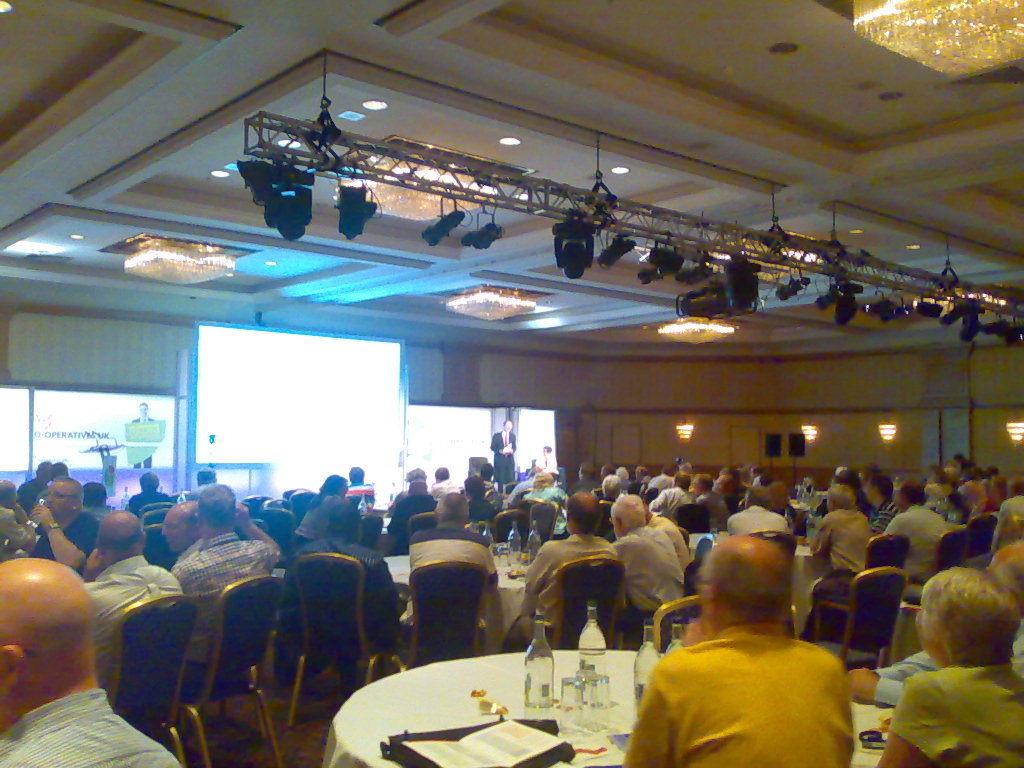
MJ Ray: Co-operatives Fortnight and Congress 2011 (#coops14 and #cc11)

It s Co-operatives Fortnight until 9 July and our co-op is supporting many events: As you may know, we ve already done two events: First, last Friday, Michael attended the Co-operatives UK Annual Meeting on our behalf. Co-operatives UK is our national co-ordinating co-op and the figurehead for the movement in this country. I didn t see the meeting (the live video link didn t work for me, as before), but Michael reports:
The AGM seemed well organized; it was good to hear about the work they re doing and the concerns regarding the co-operative situation in Poland. I think it s important to exercise one s ability to vote, but would have liked more opportunity to speak with people.
We couldn t send anyone to the Mary Portas session on Friday evening, but Paul Dale Smith summarised the session and RuthRosselson described it as Mary Portas tells Co-op Congress how it is . Then on Saturday, I was in Manchester for The Power of Co-operation, thanks to support from software.coop and The Co-operative Bank. The first session I attended, on mutualisting the Post Office was interesting and pretty full, but I found some later sessions rather frustrating. As well as my usual concerns about surrendering to uncritical use of private-sector software, I got quite annoyed by two sessions on member engagement where the presenters seemed to talk for almost the full time without letting the audience engage! Not good for my blood pressure, that, especially when I feel they re missing something! But the real value of the day was in the fascinating discussions I had with many people in the short breaks in the plenary, or while wandering around the exhibition and the marketplace. For example, it was great to see Revolver still selling the T-shirts I mentioned here in 2009 as well as giving out free samples of their brilliant fairtrade coffee. What comes from the various discussions will probably decide whether we attend similar events in future. Were you in Birmingham? How was it for you? Are you supporting Co-operatives Fortnight? How, where, when and why?

Dominique Dumont: New configuration editor for LCDPROC

Hello The last version (1.247, available in Debian unstable as libconfig-model-perl) of Config::Model provides a brand new model for /etc/LCDd.conf. With this model, you can edit or validate your lcdproc configuration. To edit this configuration the first time, you will have to run:
config-edit -application lcdproc -force
The -force option is required to load the file the first time. (because the default LCDd.conf file contains configuration options for all drivers, even though only one them if usefull). You will get this screen:
lcdproc configuration editor

config-edit on lcdproc configuration

In this screen, you can setup the driver for your adress with a right click on Driver parameter. Once youv e selected the driver and clicked on store , the driver will be listed in the left part of the window so you can tune the parameters of this specific driver:

editing imonclcd paramaters

In this screen, I ve turned the backlight off and added a small note to remember why. This small note will be writted in a comment in /etc/LCDd.conf. Once all required modifications are done, it s time to save the configuration file using the menu entry File -> save Now, let s see the resulting file (which is a bit long due to the amount of comments in the original LCDd.conf file):
## This file was written by Config::Model
## You may modify the content of this file. Configuration
## modifications will be preserved. Modifications in
## comments may be mangled.
# LCDd.conf -- configuration file for the LCDproc server daemon LCDd
#
# This file contains the configuration for the LCDd server.
#
# The format is ini-file-like. It is divided into sections that start at
# markers that look like [section]. Comments are all line-based comments,
# and are lines that start with '
#
# The server has a 'central' section named [server]. For the menu there is
# a section called [menu]. Further each driver has a section which
# defines how the driver acts.
#
# The drivers are activated by specifiying them in a driver= line in the
# server section, like:
#
#   Driver=curses
#
# This tells LCDd to use the curses driver.
# The first driver that is loaded and is capable of output defines the
# size of the display. The default driver to use is curses.
# If the driver is specified using the -d  command line option,
# the Driver= options in the config file are ignored.
#
# The drivers read their own options from the respective sections.
[server]
# Where can we find the driver modules ?
# IMPORTANT: Make sure to change this setting to reflect your
#            specific setup! Otherwise LCDd won't be able to find
#            the driver modules and will thus not be able to
#            function properly.
# NOTE: Always place a slash as last character !
DriverPath=/usr/lib/lcdproc/
# Tells the server to load the given drivers. Multiple lines can be given.
# The name of the driver is case sensitive and determines the section
# where to look for further configuration options of the specific driver
# as well as the name of the dynamic driver module to load at runtime.
# The latter one can be changed by giving af File= directive in the
# driver specific section.
#
# The following drivers are supported:
#   bayrad, CFontz, CFontz633, CFontzPacket, curses, CwLnx, ea65,
#   EyeboxOne, g15, glcdlib, glk, hd44780, icp_a106, imon, imonlcd,
#   IOWarrior, irman, joy, lb216, lcdm001, lcterm, lirc, lis, MD8800,
#   mdm166a, ms6931, mtc_s16209x, MtxOrb, mx5000, NoritakeVFD, picolcd,
#   pyramid, sed1330, sed1520, serialPOS, serialVFD, shuttleVFD, sli,
#   stv5730, svga, t6963, text, tyan, ula200, xosd
Driver=imonlcd
# Tells the driver to bind to the given interface
Bind=127.0.0.1
# Listen on this specified port; defaults to 13666.
Port=13666
ReportLevel=3
# Sets the reporting level; defaults to 2 (warnings and errors only).
# ReportLevel=3
# Should we report to syslog instead of stderr ? [default: no; legal: yes, no]
# ReportToSyslog=yes
# User to run as.  LCDd will drop its root priviledges, if any,
# and run as this user instead.
User=nobody
Foreground=no
Hello=    Hello
Hello=    LCDproc!
GoodBye=    GoodBye
GoodBye=    LCDproc!
# The server will stay in the foreground if set to true.
# Foreground=no
# Hello message: each entry represents a display line; default: builtin
# Hello="  Welcome to"
# Hello="   LCDproc!"
# GoodBye message: each entry represents a display line; default: builtin
# GoodBye="Thanks for using"
# GoodBye="   LCDproc!"
# Sets the default time in seconds to displays a screen.
WaitTime=5
# If yes, the the serverscreen will be rotated as a usual info screen. If no,
# it will be a background screen, only visible when no other screens are
# active. The special value 'blank' is similar to no, but only a blank screen
# is displayed. [default: on; legal: on, off, blank]
# ServerScreen=no
# Set master backlight setting. If set to 'open' a client may control the
# backlight for its own screens (only). [default: open; legal: off, open, on]
# Backlight=open
# Set master heartbeat setting. If set to 'open' a client may control the
# heartbeat for its own screens (only). [default: open; legal: off, open, on]
# Heartbeat=open
# set title scrolling speed [default: 10; legal: 0-10]
# TitleSpeed=10
# The "...Key=" lines define what the server does with keypresses that
# don't go to any client.
# These are the defaults:
ToggleRotateKey=Enter
PrevScreenKey=Left
NextScreenKey=Right
ScrollUpKey=Up
ScrollDownKey=Down
# ScrollUpKey=Up
# ScrollDownKey=Down
# If you have only 4 keys, you can choose to use this:
# ToggleRotateKey=Enter
# PrevScreenKey=Up
# NextScreenKey=Down
# If you have only 3 keys, you can choose to use this:
# ToggleRotateKey=Enter
# PrevScreenKey=Up
[menu]
# You can configure what keys the menu should use. Note that the MenuKey
# will be reserved exclusively, the others work in shared mode.
# The following works excellent with 4 keys or more.
MenuKey=Escape
EnterKey=Enter
UpKey=Up
DownKey=Down
LeftKey=Left
RightKey=Right
[imonlcd]
Protocol=0
OnExit=2
Device=/dev/lcd0
# My fishes dont like the glow
Backlight=off
DiscMode=0
You will notice a few things: If you need to update the file, you will have to run:
sudo config-edit -application lcdproc
The -force option is no longer needed. If you don t like to click, you can run:
config-edit -application lcdproc -ui none -save
For instance:
config-edit -application lcdproc -ui none -save 'server driver=imonlcd - imonlcd Device="/dev/lcd1" '
Further reading If you want to know more about lcdproc model, you can view: Under the hood I was too lazy to write myself the models of all drivers (about 3500 lines for them all). All models were generated from the LCDd.conf template file provided by lcdproc project. This blog explains how this was done. But the result is far from perfect. Event though LCDd.conf comments give a lot of semantic information, parameter types could be better adjusted and some of the examples provided in LCDd.conf confuse the model generator.
So the current comments are good, but not enough. In the future, we could decide on better structural conventions for the comments that would give users the information they need and give a model generator enough information to generate better models. This will hopefully be the topic of yet another blog All the best

Charles Plessy: BioPerl and regression tests

Two weeks ago, I updated the packages containing the BioPerl modules bioperl and bioperl-run, which allowed to resume the work done on GBrowse, one of the genome browsers available in Debian. As many Perl modules, BioPerl has extensive regression tests. Some of them need access to external services, and are disabled by default as the Internet is not available in our build farm. Nevertheless, they can be triggered through the environment variable DEB_MAINTAINER_MODE when building the package locally. Bioperl successfully passes all off-line tests, and a part of the on-line tests is already corrected its development branch. In contrary, BioPerl-Run fail the tests for Bowtie, DBA, EMBOSS, Genewise, Hmmer, PAML, SABlastPlus, T-Coffee and gmap-run. In some cases, like EMBOSS, it is because a command has been renamed in Debian. In other cases, in particular DBA et Genewise, it is much more difficult to figure out on which side is the problem. Regression tests are essential to determine if a package works or not on ports others than the one used by the packager (amd64 in my case). Even simple ones can be useful. In the case of T-Coffee, that has a rudimentary test that I have activated recently, it showed that the packages distributed on armel are not working at all. Running regression tests when building packages have advantages, in particular to have the results published for each port automatically as part of the build logs. But is also cause problems. First, a package would need to build-depend on every software it can interact with, in order to test it comprehensively. In the example of bioperl-run, it makes it impossible to build on armel as long as t-coffee is broken there. Second, this approach does not help the user to test similarly a program installed on his computer. Maybe the Debian Enhancement Proposal 8, to test binary packages with material provided by their source packages, will solve these two problems.

28 June 2011

Stefano Zacchiroli: new job

LDAP's "Country" entry reads "France" The correlation among quiet times for a blog and quiet times in its owner's life is often negative. My past two months are no exception. Beside my regular Debian activities, I've used a good chunk of my day time to (try) settle down and stop wandering around Europe, one temporary academic position after another. In the end, it has turned out very well. Starting September 1st, I'll be joinining the PPS laboratory as a Ma tre de Conf rences, a tenured academic position roughly equivalent to US' Associate Professor (at least according to Wikipedia; see the high quality references that tenured people resort to use?). More specifically, I'll continue to work in the context of IRILL (Research and Innovation on Free Software), an exciting new entity that I've helped bootstraping over the past couple of years. Thanks to IRILL and to his director Roberto Di Cosmo, I've been able not only to pursue quite some research on FOSS distros, but I've also been supported (rather than discriminated) in my Debian activities, including acting as DPL around the world. Last but not least, within IRILL I have also been able to offer support to several Free Software communities such as: Debian itself (hosting Sprints and sponsoring DebConf hardware), GNU, OSI, OCaml, Darcs, and many others. I realize how lucky I've been ending up in a place like IRILL and I'm glad to know I'll be around here for quite some time. The main change I'll expect to happen from September on is that I'll get back to do some teaching, trading-off time from research activities. I've been teaching only on and off since I've moved to France in 2008 and I miss that quite a bit. It looks like that next year I'll be teaching various classes on FOSS-related (or at the very least UNIX-y) topics. Time looks scarce, but who knows, maybe I'll also find a way to mix-in the nice packaging tutorial that Lucas has recently put together. Wish me luck!

Sam Hartman: Dream Plug

As part of trying to help with Freedom Box, I gained access to a Dream Plug The Dream Plug is one of the leading possible platforms for Freedom Box. Computationally it s sexy for a low-power device. There s a 1200 mhz arm with 512m of RAM. As a platform to enable people to create novel applications, it s great. It has multiple USB ports, two ethernets, a built-in 802.11B/G access point, bluetooth, audio, ESATA, Micro SD and full-sized SD. So, whether you application needs storage, networking, audio, or some interesting side device, you re covered. With the optional JTAG adapter it s even fairly friendly to developers: there are options for recovering from most failures and full console access. If you re looking at a reference platform that s still nominally embedded, but that allows you to play around thinking about what your application could do, this is a great option. However, especially for Freedom Box, it s important to remember that the reference board a developer wants is not the same as a cost-reduced product on which to actually deploy something for people to buy. The Dream Plug is wrong for every actual deployment I ve imagined. First, it s huge. If you happen to have free power plugs on your wall with lots of space above and below them, it might be an option. If however, you re like everyone I know and have power strips, constrained spacing, etc, then the industrial engineering will disappoint at every turn. I was hoping for something that kind of looked like an Apple Airport Express. It s significantly larger than that in every dimension. Also, the plug is oriented the wrong way for minimizing the fraction of the power strip it takes up. The power supply part of the device can be detached, although even that is way too huge for a power strip, and the cable between the power supply and the computer is fairly short. You can reconfigure the device without its plug nature: running a cord from a normal power outlet to the power supply. But then if you have to detach the power supply for heat management reasons, you get a cord from the outlet to the power supply and another cord from the supply to the device. Add a few USB or ESATA devices and the octopus of cables begins to resemble some arcane mechanism. (So far, no elder gods have appeared though.) The other issue is that you almost never want all the functionality. You pay for the bluetooth, audio and ESATA in terms of cost, heat and space regardless of whether you use them. I don t have a lot of applications that really take advantage of the full array of hardware. The firmware update mechanism is decidedly not targeted at end-users. The version I obtained had a hacked copy of Debian lenny. No mechanism was provided for replacing the image in a safe manner that did not potentially require the optional highly-non-end-user-compatible JTAG board if something got interrupted. You could either unscrew the device and get to the micro SD card containing the image, or run software to replace the image from within Debian lenny. It s possible to configure the boot loader to run an update image off USB or SD until that succeeds, but doing that is also a non-end-user operation. In conclusion, the name is perfect. This is exactly what hackers need to dream about the power of small computers everywhere. However we must not forget that there s a step required to turn dreams into reality. Just as with any fully proprietary product, Freedom Box will require cost reduction steps, semi-custom boards and actual OEMs to truly be usable. The claim in the previous sentence that the Freedom Box may have proprietary elements is disquieting to some. I think we can put together a software stack that is free with the possible exception of some device firmware. However, my suspicion is that anyone who turns that into a fully realized end-user product will add proprietary elements. I suspect some of the results of the cost reduction process such as resulting semi-custom boards will be proprietary. In many cases though, I suspect some proprietary software elements will be introduced.

27 June 2011

NeuroDebian: Neuroscience runs on GNU/Linux

Neuroscience runs on GNU/Linux While everybody else is waiting for Linux to become the standard on the desktop, in the field of neuroscience research we have made this step already so silently that we haven t even realized it ourselves. In the NeuroDebian project we were trying to figure out what software would need to be integrated into Debian to have a maximum impact on enhancing its utility as a research platform. So we ran a survey, asking people to tell us what software they use in their research and what platform they run it on. We also asked people to describe their personal preferences regarding a computing environment and how that might differ from the computing platforms they are institutionally provided with. The main result of this survey was very simple and pretty surprising (even to us): Despite common believe, GNU/Linux is the current standard computing platform in neuroscience and that is both on the big compute clusters and on the laptop and desktop. It turns out that researchers on GNU/Linux are not only the majority, they are also much happier with what they get, and spend less time on non-research maintenance tasks than the guys who are still stuck with Windows. It was also nice to see that Debian-based systems are preferred by neuroscientists among GNU/Linux distributions for their personal computing environments and that even proportions of Red Hat and Debian-based systems together represent the vast majority of GNU/Linux deployments in institutional computing infrastructure. Well done Debian! The results have just been accepted for publication in the journal Frontiers in Neuroinformatics. A link to the manuscript, the original survey form, collected data, as well as supplementary analysis results are available at: http://neuro.debian.net/survey/2011/

Christoph Egger: Unknown Horizons

What is Unknown Horizons? Unknown Horizons is a Free Strategy game I have written about from time to time about and do from time to time contribute. I also build Packages for Debianoids. Unknown Horizons is not a new thing, it has been there for some years now. It currently gets boosted by 3 very active GSoC Students and evolving steadily. Preparing for 2011.2 Unknown Horizons is Preparing for another Release, 2011.2. As part of the effort I have updated the official Unknown Horizons Debian and Ubuntu weekly archives with new rc builds to get some more testing before the release happens. Please test! Why isn't it in Debian main yet? Unknown Horizons hasn't been uploaded to Debian yet. This is mostly due to 2 factors: The game engine Unknown Horizons build upon, FIFE isn't in Debian, evolving fast and not providing much of a stable interface and therefor Unknown Horizons has traditionally had a strict dependency to some VCS state of approximately the same age. Not good for a Debian package obviously. And second, Unknown Horizons got rid of some content that was not free (as in "main") just recently. Personally I'm hoping we can have some packages soon as the freeness stuff is sorted out now and I haven't seen any troubling breakages with regard to the engine recently.

26 June 2011

Junichi Uekawa: Merging and testing.

Merging and testing. I've uploaded pbuilder and cowdancer with all NMUs included. I think the tests pass and things look reasonably good, and nothing should break because all the NMU diffs have been incorporated. In all of the NMUs I saw zero lines of test code change, so these aren't unit tested or regression tested, but manual tested. Something I want to see change is to see people having test code updated on every upload or bugfix.

25 June 2011

Vincent Bernat: Network lab: site to site VPN

The goal of this lab is to setup a site-to-site IPsec VPN. This lab is similar to my first lab using UML. The major differences are:

The lab VPN lab

The big picture The main point of this architecture is that you get two redundant networks for each site. The external ones are used when hosts need Internet access. The internal ones are used when they want to communicate with each other. Because we don t want hosts from the first site to communicate with hosts from the second site through the external network, we extend the internal network with the help of a site-to-site IPsec VPN. Each set of networks is using two layer-3 networks on top of two layer-2 networks. OSPF is used to provide redundancy and aggregation. For example, R1 has two routes through V1 to access R2 which is on the other site:
# ip route show 192.168.96.0/19
192.168.96.0/19  proto zebra  metric 10000 
        nexthop via 192.168.1.100  dev eth0 weight 1
        nexthop via 192.168.2.100  dev eth1 weight 1

Setting up the lab First, grab the source of the lab:
$ git clone https://vincentbernat@github.com/vincentbernat/network-lab.git
$ cd network-lab/lab-s2s-vpn
You may try to run ./setup directly. It may be safer to build an image of Debian inside inside a directory and use it as a base for the lab.
$ sudo debootstrap sid ../sid-chroot http://ftp.fr.debian.org/debian/
[...]
$ sudo chroot ../sid-chroot /bin/bash
# apt-get install iproute zsh rsyslog less makedev tcpdump
# apt-get install bird quagga racoon
# exit
$ ROOT=../sid-chroot ./setup
You still need a working UML kernel. On Ubuntu, the one provided in user-mode-linux does not contain the aufs.ko module. I did not find a simple workaround. You can just grab the package from Debian and install it on your Ubuntu with dpkg -i.

Use of BIRD With the previous lab, Quagga was used as an OSPF routing daemon. We still use it on R1, R2, E1 and E2. However, Quagga is not able to run multiple instances of OSPF. BIRD can. Therefore, we use it on V1 and V2 because we need two OSPF instances: one for the external network and one for the internal network. Since we also need ECMP, we need at least BIRD 1.3.0. BIRD allows the definition of multiple routing tables. Those tables are independant of the kernel routing tables. Each protocol will maintain its own set of routes and will allow to export (or import) routes from one of the routing table maintained by BIRD. In our setup, we use four protocols and only one routing table (the default one). BIRD routing tables The ospf EXTERNAL protocol is one of the two OSPF instances we use on V1. We import all the routes learned through the OSPF process into the internal BIRD routing table. We don t export any route from the BIRD routing table to this OSPF instance. Here is the configuration of this protocol:
protocol ospf EXTERNAL  
   ecmp yes;
   import all;
   export none;
   area 0.0.0.0  
      networks  
         203.0.113.0/26;
         203.0.113.64/26;
         203.0.113.150/32;
       ;
      interface "eth2";
      interface "eth3";
      interface "lo"  
        stub yes;
       ;
    ;
 
203.0.113.150/32 is defined on the loopback interface of V1. This is the IP of the local VPN endpoint. The ospf INTERNAL protocol is the second OSPF instance. We import all routes from this protocol to the BIRD routing table. We also want to advertise the route to the remote site. This route is defined in the static STATIC protocol and imported into BIRD routing table.
protocol static STATIC  
   import all;
   export none;
   route 192.168.96.0/19 via "lo";
 
Therefore, ospf INTERNAL protocol export all routes originating from the static STATIC protocol. This is done using filters:
protocol ospf INTERNAL  
   ecmp yes;
   import all;
   export filter  
     if proto = "STATIC" then accept;
     reject;
    ;
   area 0.0.0.0  
      networks  
         192.168.1.0/24;
         192.168.2.0/24;
       ;
      interface "eth0";
      interface "eth1";
    ;
 
The kernel protocol is managing one kernel routing table. By default, it handles the main table. We don t import any route from the kernel. However, we copy routes that come from other protocols, except the static route because we already have a default route and the static route is some kind of blackhole, we don t want to use it for real routing.
protocol kernel  
   persist;
   import none;
   export filter  
     if proto = "EXTERNAL" then accept;
     if proto = "INTERNAL" then accept;
     reject;
    ;
 
The filtering mechanism built inside BIRD is pretty powerful.

Testing After starting the lab, you need to wait a few seconds. You should then be able to ping R2 from R1:
R1# ping -c3 -I 192.168.15.1 192.168.115.1
PING 192.168.115.1 (192.168.115.1) from 192.168.15.1 : 56(84) bytes of data.
Warning: time of day goes back (-5435us), taking countermeasures.
64 bytes from 192.168.115.1: icmp_req=1 ttl=62 time=0.921 ms
64 bytes from 192.168.115.1: icmp_req=2 ttl=62 time=0.569 ms
64 bytes from 192.168.115.1: icmp_req=3 ttl=62 time=0.698 ms
--- 192.168.115.1 ping statistics ---
3 packets transmitted, 3 received, 0% packet loss, time 2009ms
rtt min/avg/max/mdev = 0.569/0.729/0.921/0.147 ms
On V1, you can check BIRD internal routing table using birdc:
> show route 
0.0.0.0/0          multipath [EXTERNAL 19:43] * E2 (150/10/1) [0.0.0.11]
        via 203.0.113.1 on eth2 weight 1
        via 203.0.113.65 on eth3 weight 1
192.168.96.0/19    dev lo [STATIC 19:42] * (200)
192.168.1.0/24     dev eth0 [INTERNAL 19:42] * I (150/10) [0.0.0.100]
192.168.2.0/24     dev eth1 [INTERNAL 19:42] * I (150/10) [0.0.0.100]
192.168.15.0/24    multipath [INTERNAL 19:43] * I (150/20) [0.0.0.10]
        via 192.168.1.10 on eth0 weight 1
        via 192.168.2.10 on eth1 weight 1
203.0.113.0/26     dev eth2 [EXTERNAL 19:42] * I (150/10) [0.0.0.100]
203.0.113.64/26    dev eth3 [EXTERNAL 19:42] * I (150/10) [0.0.0.100]
203.0.113.150/32   dev lo [EXTERNAL 19:42] * I (150/0) [0.0.0.100]
The kernel routing table is similar except it does not contain the static route.

Adding more redundancy The first goal of this lab was to test multiple OSPF instances and ECMP with BIRD. It could be completed:
  • Adding a redundant VPN is easy: this is just a matter of duplicating the setup of the existing VPN.
  • Each router should be redundant by getting a sibling with the same configuration. In the case of R1 and R2, a VIP could be shared between the router and its sibling with VRRP to allow hosts behind to have a single gateway and not use a routing protocol.
  • Because of the use of static routes instead of BGP, there is nothing to detect a VPN failure (which may be problematic if we setup a redundant VPN). Some VPN are able to invalidate a route when the associated VPN is down. This is not our case. Moreover, there may be some duplication in routing. This is not the case here because each site has its own internal network.

Vincent Bernat: Network lab: site to site VPN

The goal of this lab is to setup a site-to-site IPsec VPN. This lab is similar to my first lab using UML. The major differences are:

The lab VPN lab

The big picture The main point of this architecture is that you get two redundant networks for each site. The external ones are used when hosts need Internet access. The internal ones are used when they want to communicate with each other. Because we don t want hosts from the first site to communicate with hosts from the second site through the external network, we extend the internal network with the help of a site-to-site IPsec VPN. Each set of networks is using two layer-3 networks on top of two layer-2 networks. OSPF is used to provide redundancy and aggregation. For example, R1 has two routes through V1 to access R2 which is on the other site:
# ip route show 192.168.96.0/19
192.168.96.0/19  proto zebra  metric 10000 
        nexthop via 192.168.1.100  dev eth0 weight 1
        nexthop via 192.168.2.100  dev eth1 weight 1

Setting up the lab First, grab the source of the lab:
$ git clone https://vincentbernat@github.com/vincentbernat/network-lab.git
$ cd network-lab/lab-s2s-vpn
You may try to run ./setup directly. It may be safer to build an image of Debian inside inside a directory and use it as a base for the lab.
$ sudo debootstrap sid ../sid-chroot http://ftp.fr.debian.org/debian/
[...]
$ sudo chroot ../sid-chroot /bin/bash
# apt-get install iproute zsh rsyslog less makedev tcpdump
# apt-get install bird quagga racoon
# exit
$ ROOT=../sid-chroot ./setup
You still need a working UML kernel. On Ubuntu, the one provided in user-mode-linux does not contain the aufs.ko module. I did not find a simple workaround. You can just grab the package from Debian and install it on your Ubuntu with dpkg -i.

Use of BIRD With the previous lab, Quagga was used as an OSPF routing daemon. We still use it on R1, R2, E1 and E2. However, Quagga is not able to run multiple instances of OSPF. BIRD can. Therefore, we use it on V1 and V2 because we need two OSPF instances: one for the external network and one for the internal network. Since we also need ECMP, we need at least BIRD 1.3.0. BIRD allows the definition of multiple routing tables. Those tables are independant of the kernel routing tables. Each protocol will maintain its own set of routes and will allow to export (or import) routes from one of the routing table maintained by BIRD. In our setup, we use four protocols and only one routing table (the default one). BIRD routing tables The ospf EXTERNAL protocol is one of the two OSPF instances we use on V1. We import all the routes learned through the OSPF process into the internal BIRD routing table. We don t export any route from the BIRD routing table to this OSPF instance. Here is the configuration of this protocol:
protocol ospf EXTERNAL  
   ecmp yes;
   import all;
   export none;
   area 0.0.0.0  
      networks  
         203.0.113.0/26;
         203.0.113.64/26;
         203.0.113.150/32;
       ;
      interface "eth2";
      interface "eth3";
      interface "lo"  
        stub yes;
       ;
    ;
 
203.0.113.150/32 is defined on the loopback interface of V1. This is the IP of the local VPN endpoint. The ospf INTERNAL protocol is the second OSPF instance. We import all routes from this protocol to the BIRD routing table. We also want to advertise the route to the remote site. This route is defined in the static STATIC protocol and imported into BIRD routing table.
protocol static STATIC  
   import all;
   export none;
   route 192.168.96.0/19 via "lo";
 
Therefore, ospf INTERNAL protocol export all routes originating from the static STATIC protocol. This is done using filters:
protocol ospf INTERNAL  
   ecmp yes;
   import all;
   export filter  
     if proto = "STATIC" then accept;
     reject;
    ;
   area 0.0.0.0  
      networks  
         192.168.1.0/24;
         192.168.2.0/24;
       ;
      interface "eth0";
      interface "eth1";
    ;
 
The kernel protocol is managing one kernel routing table. By default, it handles the main table. We don t import any route from the kernel. However, we copy routes that come from other protocols, except the static route because we already have a default route and the static route is some kind of blackhole, we don t want to use it for real routing.
protocol kernel  
   persist;
   import none;
   export filter  
     if proto = "EXTERNAL" then accept;
     if proto = "INTERNAL" then accept;
     reject;
    ;
 
The filtering mechanism built inside BIRD is pretty powerful.

Testing After starting the lab, you need to wait a few seconds. You should then be able to ping R2 from R1:
R1# ping -c3 -I 192.168.15.1 192.168.115.1
PING 192.168.115.1 (192.168.115.1) from 192.168.15.1 : 56(84) bytes of data.
Warning: time of day goes back (-5435us), taking countermeasures.
64 bytes from 192.168.115.1: icmp_req=1 ttl=62 time=0.921 ms
64 bytes from 192.168.115.1: icmp_req=2 ttl=62 time=0.569 ms
64 bytes from 192.168.115.1: icmp_req=3 ttl=62 time=0.698 ms
--- 192.168.115.1 ping statistics ---
3 packets transmitted, 3 received, 0% packet loss, time 2009ms
rtt min/avg/max/mdev = 0.569/0.729/0.921/0.147 ms
On V1, you can check BIRD internal routing table using birdc:
> show route 
0.0.0.0/0          multipath [EXTERNAL 19:43] * E2 (150/10/1) [0.0.0.11]
        via 203.0.113.1 on eth2 weight 1
        via 203.0.113.65 on eth3 weight 1
192.168.96.0/19    dev lo [STATIC 19:42] * (200)
192.168.1.0/24     dev eth0 [INTERNAL 19:42] * I (150/10) [0.0.0.100]
192.168.2.0/24     dev eth1 [INTERNAL 19:42] * I (150/10) [0.0.0.100]
192.168.15.0/24    multipath [INTERNAL 19:43] * I (150/20) [0.0.0.10]
        via 192.168.1.10 on eth0 weight 1
        via 192.168.2.10 on eth1 weight 1
203.0.113.0/26     dev eth2 [EXTERNAL 19:42] * I (150/10) [0.0.0.100]
203.0.113.64/26    dev eth3 [EXTERNAL 19:42] * I (150/10) [0.0.0.100]
203.0.113.150/32   dev lo [EXTERNAL 19:42] * I (150/0) [0.0.0.100]
The kernel routing table is similar except it does not contain the static route.

Adding more redundancy The first goal of this lab was to test multiple OSPF instances and ECMP with BIRD. It could be completed:
  • Adding a redundant VPN is easy: this is just a matter of duplicating the setup of the existing VPN.
  • Each router should be redundant by getting a sibling with the same configuration. In the case of R1 and R2, a VIP could be shared between the router and its sibling with VRRP to allow hosts behind to have a single gateway and not use a routing protocol.
  • Because of the use of static routes instead of BGP, there is nothing to detect a VPN failure (which may be problematic if we setup a redundant VPN). Some VPN are able to invalidate a route when the associated VPN is down. This is not our case. Moreover, there may be some duplication in routing. This is not the case here because each site has its own internal network.

24 June 2011

Tiago Bortoletto Vaz: Things I love in Debian

00:32 < AbsintheSyringe> I'm with one of the users, that registered and he registered as "sponsored" however now he has no category and of course when he tries doing "sponsored" it doesn't work 00:32 < AbsintheSyringe> is this the way it's suppoused to be 00:33 < nattie> who is this? 00:36 < AbsintheSyringe> he's one of the volunteers, he'll be doing everything that has to do with the sound and concerts and so on, regarding concerts and everything else, in real life he's machinist constructor and works as a dj, very popular and good one 00:36 < nattie> that's not the point. we need the name so we can check his penta logs 00:37 < darst> (and not name publically, preferably) 00:37 < AbsintheSyringe> Mirza Alibalic (nickname: masta)

Rapha&#235;l Hertzog: People behind Debian: Sam Hartman, Kerberos package maintainer

Sam Hartman is a Debian developer since 2000. He has never taken any sort of official role within Debian (that is besides package maintainer), yet I know him for his very thoughtful contributions to discussions both on mailing lists and IRL during Debconf. Until I met him at Debconf, I didn t know that he was blind, and the first reaction was to be impressed because it must be some tremendous effort to read the volume of information that Debian generates on mailing lists. In truth he s at ease with his computer much like I am although he uses it in a completely different way. Read on to learn more, my questions are in bold, the rest is by Sam. Raphael: Who are you? Sam: I m Sam Hartman. I m a 35-year-old software engineer. I am a principal consultant and co-owner of a small consulting company, called Painless Security. I started using Debian in the mid 1990 s around the time of the bo release. I ended up deciding to join the project as a developer in 2000. Raphael: You re blind and yet you re using your computer as effectively as I am. Can you explain us how you setup your computer ? Sam: I gave a talk at Debconf9 on how my computer is set up; you can watch the video for full details. My main laptop runs Debian. I use the gnome-orca package as my primary screen reader. It speaks the Gnome desktop. It does a relatively good job of speaking Iceweasel/Firefox and Libreoffice. While it does speak gnome-terminal, it s not really good enough at speaking terminal programs that I am comfortable using it. So, I run Emacs with the Emacspeak package. Within that, I run the Emacs terminal emulator, and within that, I tend to run Screen. For added fun, I often run additional instances of Emacs within the inner screens. Raphael: Are there important problems in Debian in terms of accessibility to blind people? KDE documentation talks a lot about accessibility, but at least for blind users, the code completely fails to deliver. That means there are a lot of good packages a blind user cannot use. The non-free Adobe Flash player has some accessibility, but it could be a lot better. The free alternatives have none. The free PDF readers have basically no accessibility. You can use pdftotext, but you cannot actually read a PDF in a graphical application. It s way too easy for a misbehaving program to lock up the entire accessibility infrastructure. Gnash is a big culprit here: if my Iceweasel starts Gnash, there s a good chance that either Iceweasel or the entire desktop will appear to hang from an accessibility standpoint. Other programs, including gksu tend to fail in this way. Some of the more dynamic website features like pop up menus or selection lists are really difficult to find and click without causing them to disappear. This gets better and worse over time as the accessibility support in Iceweasel changes and as websites change. Raphael: What s your biggest achievement within Debian? Sam: I decided to be a Debian developer because I thought that in 2000, Debian support for using enterprise security and infrastructure software was lacking. Back then, any software that included crypto functionality was segregated into a special non-us archive. Some of the software was missing; I started by packaging MIT Kerberos for Debian. Other software had security or enterprise features disabled in the packages. At the height of working on this, I was maintaining krb5, some SASL modules, PAM, some PAM modules,OpenAFS, a version of and Ssh with Kerberos support. I was also involved in the effort to resolve the legal issues so that we could move security software into the main archive. I think this work has been a huge success. In fact, it s been such a success that other people are now doing most of the work. I still maintain the krb5 package. When I started I felt like I was pushing against the flow trying to get people to add patches, sometimes even having to fork a package. However, now, I can maintain just one component and there are enough others who shared my original goal that the work continues. These days, I m working on something that s an evolution of this enterprise security work. I m packaging Project Moonshot for Debian and Ubuntu. Project Moonshot is a response to the wide variety of identity management systems such as OpenID, Oauth, SAML, and the like. Moonshot works to create an identity management approach that works well both for the web and for client-server and other applications. The project is a lot of fun, but the role of Debian in the project is also interesting. One of the things we want to show with Moonshot is how our technology can be effective when it is integrated throughout a platform. To really show the potential it needs to work with as many applications in a given platform as possible. The open and collaborative nature of the Debian community makes it possible to introduce a new technology and have that technology evaluated based on its merits. We don t need huge business relationships or marketing deals to integrate our technology: we need some combination of doing the work ourselves and showing others the benefits of working with us. For someone trying to do innovative work, the Debian model is powerful. Raphael: If you could spend all your time on Debian, what would you work on? Sam: I d really love to work with the embedded Debian folks. The vision of a single source base that could be the stack from devices from small embedded devices all the way up to high-end servers is very appealing. Doing that with Debian involves a number of challenges. However with the right people working on meeting these challenges full-time, I think we could offer something promising. I d also love to have the time to contribute to project infrastructure: working on the release team, helping ftpmaster, that sort of thing. However I don t. I m just happy that so much of my consulting practice involves working on open-source software. Raphael: What s the biggest problem of Debian? Sam: There s something really not right about how we transition libraries from unstable to testing. Every time I get involved in a library transition I m shocked at how complicated it is and how disruptive it is both to testing and unstable. We need to look at technology and processes to break up the dependency snarles. For example we don t have good archive tools for keeping old versions of libraries around to ease transitions. If you haven t thought about this issue you ll probably say that I m being overly picky and this can t be the major problem for Debian. However, if you think about how much this impacts our ability to introduce things into unstable around the times of the freeze or about how much it slows the release process, you may begin to appreciate how big of an issue this is. Raphael: Is there someone in Debian that you admire for their contributions? Sam: There are a number of people who have been role models for me over the years. Anthony Towns really helped me understand a lot of what drives free-software projects and what needs to be true for positive motivation. Joey Hess showed us all that sometimes, social problems do have technical solutions. If the tools are so good that doing the right thing is far easier than any other course of action, quality improves.
Thank you to Sam for the time spent answering my questions. I hope you enjoyed reading his answers as I did. Subscribe to my newsletter to get my monthly summary of the Debian/Ubuntu news and to not miss further interviews. You can also follow along on Identi.ca, Twitter and Facebook.

5 comments Liked this article? Click here. My blog is Flattr-enabled.

23 June 2011

Gunnar Wolf: Wow... IP lawyers are from another planet

Second speaker at today'sseminar,Vladimir Mojica. He is talking about th legal backing for DRM and TPM as well as laws against circumvention. He quotes USA's DMCA as one of the most complete, advanced and forward-minded laws,inviting the audience to push for such a law here. I hope he gets to my (written)question, as today is a very important day in this regard: The Senate has requested the presidency to reject signing the ACTA treaty!
[Update] The Senate is sending Resolution agreeing to prompt the Federal Executive Power titular to instruct the State Secretaries and other dependencies involved in the Anti-Counterfeiting Trade Agreement not to sign said agreement, as it would hinder free interchange of legal material. It also mentions the ISPs should not become de-facto authorities to define when an intellectual/intangible properties right violation is in course, and that it would be unacceptable for ISPs to monitor the users' activities in the net, or to analize the content of the IP packets. Very good news, in a document very well made, in a precise, legal and coherent(!) way.

Next.

Previous.