Search Results: "nic"

22 February 2013

Richard Hartmann: Finland I

Finland. Helsinki, Lahti, streets Arriving at Helsinki airport, we filed a claim with Lufthansa as a hard shell suitcase had a splintered corner. We were surprised that so many Finns arrived from Munich with skis, more on that later. We picked up our car and started on our way towards Koli; driving with a top speed of 100 km/h and often being limited to 80 km/h or even 60 km/h is... unusual... Finnish police/authorities seem to be obsessed with enforcing those speed limits as there are a lot of speed cameras along the way. Finnish people seem to be similarly obsessed with slot machines; there is an incredible amount of them at gas stations and a constant stream of people playing them. From an outsider's perspective, it's weird that a country as strict about one form of addiction, alcohol, and working against it vigorously, by means of taxes, would allow another form of addiction, gambling, run as freely and this allow so many slot machines. Speaking of taxes on alcohol: a single 0.33 l bottle of beer is more expensive in a Finnish supermarket than 0.5 l of beer in a German restaurant. Which also explains why supermarkets tend to have a rather large section with relatively cheap alcohol free beer. Anyway, coming back to streets: Highway intersections don't have continuous on/off ramps from which you change from one highway to another; you drive off of the highway, stop at a traffic light, and then continue onto the other highway. Weird system, but given the amount of traffic we witnessed, it's probably Good Enough (tm). Stopping for a short time in Lohti simply because it's apparently famous for winter sports competitions, we arrived at Future Freetime in Koli national park after about five to six gruelling hours of net driving through somewhat bad weather and behind slow drivers. Koli Hiking up to Ukko-Koli and its sister peaks proved to be rather exhausting as we kept on breaking through the snow cover to our knees and sometimes even our hips. Once we were up there, we realized that even though you couldn't see it in between the trees, there was fog all over the plains so we couldn't see anything. Still, it was a nice hike even if somewhat short. Note to self: Even when a trail is marked locally, if OpenStreetMap does not know about it... don't walk along it. Especially not when the going's rough already. And if there's a sign suggesting you wear snow shoes... wear snow shoes. Returning to Koli Hotel and the museum next to it, we walked over to the ski slope. The highest peak within Koli,Ukko-Koli, is 347 meters high, the local ski slope starts a good way below that. This would explain why a lot of Finns came back from Munich with their skis... Afterwards, we rented a snow mobile, without guide or supervision, and drove from Loma-Koli over lake Pielien towards Purnuniemi and in a large circle down towards lake Ryyn skyl where we turned around and went back the same way. If we thought Finnish streets don't have a lot of signs we soon realized that snow mobile tracks have even less. There are at most two or three signs pointing you in the right direction, but on the plus side, there are no posted speed limits for snow mobiles, either. In somewhat related news, snow mobiles can go at least 95 km/h. At that point, the scratched and dirty visor of your rental helmet will keep slamming down, forcing you to take one hand off the handle and thus stop accelerating to maintain stability. To round off the day, we heated up the sauna built into our little wooden hut. Running outside three times to rub myself off with snow from head to toes, I almost slipped and fell while standing still. When your feet are too hot for the snowy ground, you'll start to melt your own little pools of slippery water/snow mush within seconds. File that one under "I would never have guessed unless I had experienced it myself". Generic The MarkDown source of this blog post is not even 5 kiB in size; even in a worst case scenario, pushing this to my ikiwiki instance via git will eat up less 10 kiB of mobile data. Which is good because I have 78 MiB of international data left on this plan. This is also the reason why there are no links in this blog post: I am writing everything off line and don't want to search for the correct URLs to link to. I really wish EU regulators would start to tackle data roaming now that SMS and voice calls are being forced down into somewhat sane pricing regions by regulations. PS:
-rw-r--r-- 1 richih richih 4.6K Feb 11 22:55 11-Finland-I.mdwn
[...]
Writing objects: 100% (7/7), 2.79 KiB, done.

Gunnar Wolf: So ZTE it is

Some weeks ago I posted about the long-expected demise of my old phone. And even given I don't usually don't pay much attention to phones (and could care less about the smartphone fad), I asked for a recommendation here on what to change to. The only thing that made me look for something other than a ~US$15 phone is that I enjoy having a GPS-enabled device. So, with that in mind, I went to my carrier's offices, with a top budget of MX$2,000 (~US$150), and asked for help. After being a Telcel subscriber for ~10 years (and ~6 with the same device), even though I use prepaid cards only (and seldom pay over MX$100 a month), I expected some advice. So, when the employee told me to go to the phone exhibit they have and pick my favorite, I declined, by telling I just want the cheapest unit with a GPS. He almost immediately offered me the ZTE V791, an Android 2.3-based unit, for MX$990 (~US$75), just around half of what I expected to pay. So I got two - One for myself, one for Regina, as her previous "nice" phone died under the Bosnian rain and had one of the sturdy, reliable but utterly boring US$15 phones for over a year ;-) As a new Mexican resident, she can surely use a GPS as well! (and some other tools in it). So, two nice phones, and still (squarely!) in my projected budget! I *did* give some thought to the comments posted in my original post, but given I don't want to bite in to the tendency too much, I let price determine what we get. And after all, I do not plan to ever enable data over the phone network (if at all, I use it on wifi). A recommendation for people with similar profiles/interest than me: Maps with me allows for downloading OpenStreetMap data on a country basis (so I get all of Mexico with me). I also got Vespucci OSM Editor, to be able to do OpenStreetMap updates from the phone, but given it has some stability issues I have not used it much (and it's understandably not so disconnected-mode-friendly) Not much more to add to this. I am writing this prompted by Russell's "iPhone vs. Android" post. My point after getting these two cheap phones? Having a wide range of devices under this same OS (even if it still has long ways to go freedom-wise) makes it a choice for people like me, who don't want to save money for a couple of months in order to get the newest gadget. I hope this phone lasts with me several years as well, without changing my usage pattern!

Russell Coker: iPhone vs Android

A friend who s a long-time iPhone user just asked for my advice about whether to get a Samsung Galaxy S3, a Samsung Galaxy Note 2, or a iPhone 5. Advantages for Android I think that liberty should be the first consideration, I ve previously written about how Android phones won t necessarily give you as much freedom as you desire if you buy on the basis of price and features [1]. But even the least free Android options are way better than the iOS (iPhone and iPad) environment. This isn t necessarily a big deal for my friend, like most of the population he usually just wants things to work being able to hack them isn t such an issue. However unlike most of the population he does make a reasonable portion of his income from software development and it could be that he will have a contract for developing an app on a mobile device in which case the freedom to tinker on Android will help him. He could use an iPhone for his personal use and develop on an Android platform for his clients, but generally it s more efficient if your personal use of technology is similar to that of your clients. The Nexus devices are very good for liberty and they also have nice hardware at a low price, I ve just got a Nexus 4 for my wife and it s very nice. The next issue is that of hardware standards, I ve previously written about the potential for developing a standard form factor for Android phones [2] although this doesn t seem likely to be implemented in the near future. The wide range of Android hardware means that the range of cases etc on the market is rather small. But the advantage of the wide range is that with an Android phone you can have a device that s bigger, smaller, cheaper, cuter, or faster than an iPhone. There are Android devices which have a higher resolution, more RAM, more storage (if you include SD storage), or has other benefits over an iPhone. For whatever reasonable range of specs appeal to you you can probably find a device to match. I ve previously written about the way the ideal size for devices depends on your hand size and your preferred manner of gripping the device [3], so the lack of size range in Apple devices is not just a limitation on personal choice but also a failure to properly support people with different size hands. Depending on the preferred manner of gripping a phone the iPhone 5 is either too big for an average woman or too small for a tall man. The Google Play store apparently has more applications than the iPhone/iPad App Market. This difference can be expected to increase now that the Samsung Galaxy S3 is outselling the iPhone 5. Comparing the number of unit sales of the iPhone vs Android phones is no longer interesting, comparing Samsung to Apple is the interesting thing. Advantages for the iPhone By all accounts it s quite an easy process to backup and restore all iPhone settings. You can expect that after losing an iPhone you can just connect the new one to your PC and have it work in exactly the same way after all the data is transferred. Trying to do such things on Android is merely difficult if you have root access to your phone and the source and destination phones are of exactly the same make and model. But if you have different versions of the phone or if you don t have root access then it may be impossible. I welcome comments from anyone who knows of good solutions to this problem. The iPhone achieved a reasonable share of the smart-phone market before Android really started going well so there are a lot of people who are used to the iPhone. Simply by being unfamiliar Android will be a more difficult option for people who have used the iPhone such as my friend. But it is possible to learn other systems. Generally I think that this may be a big issue for people who use Macs for all their other computing. But if the only Apple product you use is an iPhone then switching to Android shouldn t be a big deal. Update: One feature of the iPhone that is very important to my friend is the ability to add arbitrary tags in the contacts. In addition to name, address, phone number, etc he wants to add arbitrary notes related to his business. While he could put that sort of thing into the Notes field in Android he would rather have several fields with his own names. Android 4.1.x definitely doesn t have this and I can t test Android 4.2.x at this time. Is there any way of doing such things on Android? Conclusion It seems to me that Android devices are better in every way apart from backup, restore, and general management. If I was about to buy 100 phones then I d probably consider the iPhone (not necessarily buy but definitely consider). But for a single user I definitely recommend Android devices. The Android devices which seem good at the moment are the Galaxy S3 (which I m using now), the Nexus 4 (which is really good apart from being unable to change the battery or add more storage), and the Galaxy Note 2 (which is about the biggest phone available). One of the things that my friend wants to do is to use a phone instead of a tablet or laptop. I think that the Galaxy Note 2 is the only option for him.

21 February 2013

Daniel Pocock: US military may need Lumicall

In a remarkable report in Wired Magazine, it has been revealed that US stealth bombers have to communicate with their British allies using conventional radio. What that means in practice is that it would be child's play for the enemy to use basic techniques like triangulation to locate these otherwise invisible aircraft. While the thought of an ineffective multi-billion-dollar stealth bomber program seems preposterous, some may argue that the military has bigger problems maintaining discretion when even the CIA director is busted having an affair via Gmail. After all, it costs nothing to download GnuPG So what could the Americans and British do to put the stealth back into stealth bomber? Maybe it is time that pilots were issued with smartphones running Lumicall - with the built-in encryption features, could it make all their worries go away? At the very least, this issue demonstrates in a remarkable manner the reasons to stick with open standards like XMPP and SIP for building interoperable communications systems. If they missed our talk on Free, open, secure and convenient communications at FOSDEM, that may also be an interesting place to start searching for answers, as the idea of federated real-time communications is just as valuable in the air as it is for business or private purposes on the ground. The video is available now for those who missed it, and my earlier FOSDEM wrap-up provides more food for thought about the relevance of private communications for maintaining individual freedom (with or without the help of airborne supremecy). FOSDEM video: <video controls="controls" preload="none">
<source src="http://video.fosdem.org/2013/maintracks/Janson/Free,_open,_secure_and_convenient_communications.webm" type="video/webm; codecs="vp8, vorbis""></source></video> <object data="http://releases.flowplayer.org/swf/flowplayer-3.2.15.swf" type="application/x-shockwave-flash"> <param name="movie" value="http://releases.flowplayer.org/swf/flowplayer-3.2.15.swf"><param name="allowfullscreen" value="true"><param name="flashvars" value="config= 'clip': 'url': 'http://video.fosdem.org/2013/maintracks/Janson/Free,_open,_secure_and_convenient_communications.webm', 'autoPlay':false, 'autoBuffering':false ">Video tag not supported. Download the video here. </object>

Joey Hess: Kickstarter rewards wrap-up

I finished delivering all my Kickstarter rewards at the end of the year. This is an overview of how that went, both financially and in general.
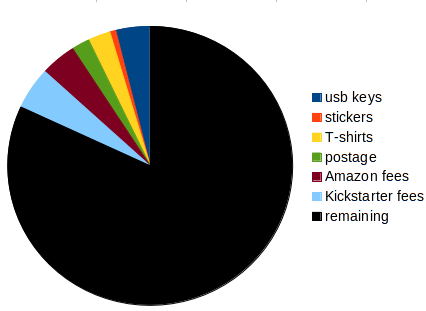
my Kickstarter pie (not including taxes)
While the Kickstarter was under way, several friends warned me that I might end up spending a lot of the money for rewards, or even shipping, and come out a loser. It's happened to some people, but I avoided it. Most of the pie went to its intended purpose.
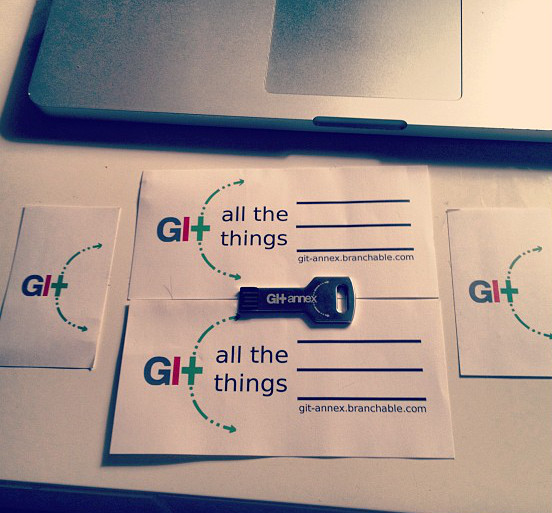
USB key arrives in Amsterdam
I kept shipping cost low by shipping everything by US postal service, including Air Mail for international shipping. This was particularly important for the stickers (which cost $1.05 to ship internationally). But I also shipped USB keys in regular mail envelopes, protected by bubble wrap, which worked very well and avoided the bother of shipping packages. The USPS will be annoyed at you for a rigid letter and add a non-machinable surcharge, but it's still a nice savings.
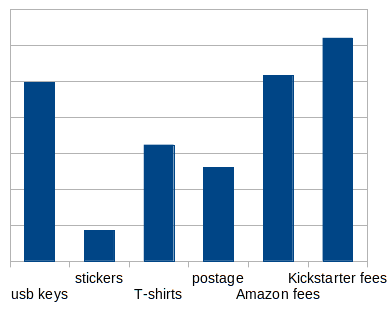
expenses
I spent more on rewards than on transaction fees, but the fees are still pretty large. Being dinged a second time by Amazon is the worst part. I have not been able to work out exactly what formula Kickstarter uses to determine its fee per pledge. It does not seem to be a simple percentage of the pledge. For example, they seem to have charged $0.25 per $10 pledge, but $25 for a $500 pledge. I wanted to solve this, but I'd have to match up all the pledges and fees manually to do it.
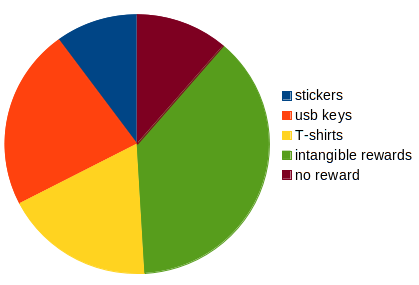
gross income by reward type
This chart is slightly innacurrate, because it puts any money pledged, beyond the amount needed to get a reward, into the "intangibles" category, despite the reward being probably responsible for that money being pledged. (The intangibles also includes people who did not ask for a reward, and several categories of rewards not involving shipping matter around.) But, the surprise for me is how large a peice the T-shirts are responsible for. It was my least favorite reward, and a low volume one, but I made out pretty well on it. However, I'd still try to avoid putting T-shirts on Kickstarter again. It's hard to do a good design (I didn't, really); they're expensive, and were by far the most annoying thing to ship. Also, I was not happy with the countries Cafe Press sourced their shirts from; I've been to Honduras and talked with people who have relatives in las machinas.
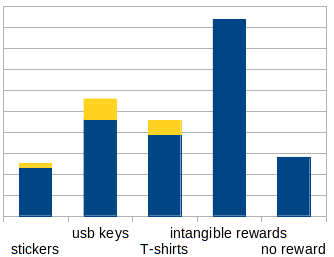
gross and net income by reward type (excluding shipping)
In contrast, the stickers had an amazing margin; they're so inexpensive to print that I printed up two kinds and included multiple with every other reward I mailed. I still have hundreds left over, too.. All the online print shops I tried have very annoying interfaces to upload artwork though. I had to do quite a bit of math to render TIFF files with appropriate DPI and margins. The USB keys were my favorite reward. I got them from USB Memory Direct, who gave me quite a nice deal. I was very happy that I was able to send them a SVG file of my artwork, so I didn't need to worry about lacking resolution for the laser engraving. And it came out looking great. The best part was when their sales guy Mike actually did a minor alteration of the artwork, to better fit on the key, when I, being overloaded with Kickstarter stuff asked him too. A bit above and beyond. There was an issue with their Chinese manufacturer's quality control of the 16 gb drives, but they were willing to send me replacement for all the ones I found problems with.
All told I spent probably 3 full days stuffing and shipping envelopes, and probably spent a week working on Kickstarter reward fullfillment. As work-related overhead goes, that's not bad. Maybe someone considering a Kickstarter will find this information useful somehow. Oh well, back to work. :)

20 February 2013

Vincent Bernat: lldpd 0.7.1

A few weeks ago, a new version of lldpd, a 802.1AB (aka LLDP) implementation for various Unices, has been released. LLDP is an industry standard protocol designed to supplant proprietary Link-Layer protocols such as EDP or CDP. The goal of LLDP is to provide an inter-vendor compatible mechanism to deliver Link-Layer notifications to adjacent network devices. In short, LLDP allows you to know exactly on which port is a server (and reciprocally). To illustrate its use, I have made a xkcd-like strip: xkcd-like strip for the use of LLDP If you would like more information about lldpd, please have a look at its new dedicated website. This blog post is an insight of various technical changes that have affected lldpd since its latest major release one year ago. Lots of C stuff ahead!

Version & changelog UPDATED: Guillem Jover told me how he met the same goals for libbsd :
  1. Save the version from git into .dist-version and use this file if it exists. This allows one to rebuild ./configure from the published tarball without losing the version. This also handles Thorsten Glaser s critic.
  2. Include CHANGELOG in DISTCLEANFILES variable.
Since this is a better solution, I have adopted the appropriate line of codes from libbsd. The two following sections are partly technically outdated.

Automated version In configure.ac, I was previously using a static version number that I had to increase when releasing:
AC_INIT([lldpd], [0.5.7], [bernat@luffy.cx])
Since the information is present in the git tree, this seems a bit redundant (and easy to forget). Taking the version from the git tree is easy:
AC_INIT([lldpd],
        [m4_esyscmd_s([git describe --tags --always --match [0-9]* 2> /dev/null   date +%F])],
        [bernat@luffy.cx])
If the head of the git tree is tagged, you get the exact tag (0.7.1 for example). If it is not, you get the nearest one, the number of commits since it and part of the current hash (0.7.1-29-g2909519 for example). The drawback of this approach is that if you rebuild configure from the released tarball, you don t have the git tree and the version will be a date. Just don t do that.

Automated changelog Generating the changelog from git is a common practice. I had some difficulties to make it right. Here is my attempt (I am using automake):
dist_doc_DATA = README.md NEWS ChangeLog
.PHONY: $(distdir)/ChangeLog
dist-hook: $(distdir)/ChangeLog
$(distdir)/ChangeLog:
        $(AM_V_GEN)if test -d $(top_srcdir)/.git; then \
          prev=$$(git describe --tags --always --match [0-9]* 2> /dev/null) ; \
          for tag in $$(git tag   grep -E '^[0-9]+(\.[0-9]+) 1, $$'   sort -rn); do \
            if [ x"$$prev" = x ]; then prev=$$tag ; fi ; \
            if [ x"$$prev" = x"$$tag" ]; then continue; fi ; \
            echo "$$prev [$$(git log $$prev -1 --pretty=format:'%ai')]:" ; \
            echo "" ; \
            git log --pretty=' - [%h] %s (%an)' $$tag..$$prev ; \
            echo "" ; \
            prev=$$tag ; \
          done > $@ ; \
        else \
          touch $@ ; \
        fi
ChangeLog:
        touch $@
Changelog entries are grouped by version. Since it is a bit verbose, I still maintain a NEWS file with important changes.

Core

C99 I have recently read 21st Century C which has some good bits and also handles the ecosystem around C. I have definitively adopted designated initializers in my coding style. Being a GCC extension since a long time, this is not a major compatibility problem. Without designated initializers:
struct netlink_req req;
struct iovec iov;
struct sockaddr_nl peer;
struct msghdr rtnl_msg;
memset(&req, 0, sizeof(req));
memset(&iov, 0, sizeof(iov));
memset(&peer, 0, sizeof(peer));
memset(&rtnl_msg, 0, sizeof(rtnl_msg));
req.hdr.nlmsg_len = NLMSG_LENGTH(sizeof(struct rtgenmsg));
req.hdr.nlmsg_type = RTM_GETLINK;
req.hdr.nlmsg_flags = NLM_F_REQUEST   NLM_F_DUMP;
req.hdr.nlmsg_seq = 1;
req.hdr.nlmsg_pid = getpid();
req.gen.rtgen_family = AF_PACKET;
iov.iov_base = &req;
iov.iov_len = req.hdr.nlmsg_len;
peer.nl_family = AF_NETLINK;
rtnl_msg.msg_iov = &iov;
rtnl_msg.msg_iovlen = 1;
rtnl_msg.msg_name = &peer;
rtnl_msg.msg_namelen = sizeof(struct sockaddr_nl);
With designated initializers:
struct netlink_req req =  
    .hdr =  
        .nlmsg_len = NLMSG_LENGTH(sizeof(struct rtgenmsg)),
        .nlmsg_type = RTM_GETLINK,
        .nlmsg_flags = NLM_F_REQUEST   NLM_F_DUMP,
        .nlmsg_seq = 1,
        .nlmsg_pid = getpid()  ,
    .gen =   .rtgen_family = AF_PACKET  
 ;
struct iovec iov =  
    .iov_base = &req,
    .iov_len = req.hdr.nlmsg_len
 ;
struct sockaddr_nl peer =   .nl_family = AF_NETLINK  ;
struct msghdr rtnl_msg =  
    .msg_iov = &iov,
    .msg_iovlen = 1,
    .msg_name = &peer,
    .msg_namelen = sizeof(struct sockaddr_nl)
 ;

Logging Logging in lldpd was not extensive. Usually, when receiving a bug report, I asked the reporter to add some additional printf() calls to determine where the problem was. This was clearly suboptimal. Therefore, I have added many log_debug() calls with the ability to filter out some of them. For example, to debug interface discovery, one can run lldpd with lldpd -ddd -D interface. Moreover, I have added colors when logging to a terminal. This may seem pointless but it is now far easier to spot warning messages from debug ones. logging output of lldpd

libevent In lldpd 0.5.7, I was using my own select()-based event loop. It worked but I didn t want to grow a full-featured event loop inside lldpd. Therefore, I switched to libevent. The minimal required version of libevent is 2.0.5. A convenient way to check the changes in API is to use Upstream Tracker, a website tracking API and ABI changes for various libraries. This version of libevent is not available in many stable distributions. For example, Debian Squeeze or Ubuntu Lucid only have 1.4.13. I am also trying to keep compatibility with very old distributions, like RHEL 2, which does not have a packaged libevent at all. For some users, it may be a burden to compile additional libraries. Therefore, I have included libevent source code in lldpd source tree (as a git submodule) and I am only using it if no suitable system libevent is available. Have a look at m4/libevent.m4 and src/daemon/Makefile.am to see how this is done.

Client

Serialization lldpctl is a client querying lldpd to display discovered neighbors. The communication is done through an Unix socket. Each structure to be serialized over this socket should be described with a string. For example:
#define STRUCT_LLDPD_DOT3_MACPHY "(bbww)"
struct lldpd_dot3_macphy  
        u_int8_t                 autoneg_support;
        u_int8_t                 autoneg_enabled;
        u_int16_t                autoneg_advertised;
        u_int16_t                mau_type;
 ;
I did not want to use stuff like Protocol Buffers because I didn t want to copy the existing structures to other structures before serialization (and the other way after deserialization). However, the serializer in lldpd did not allow to handle reference to other structures, lists or circular references. I have written another one which works by annotating a structure with some macros:
struct lldpd_chassis  
    TAILQ_ENTRY(lldpd_chassis) c_entries;
    u_int16_t        c_index;
    u_int8_t         c_protocol;
    u_int8_t         c_id_subtype;
    char            *c_id;
    int              c_id_len;
    char            *c_name;
    char            *c_descr;
    u_int16_t        c_cap_available;
    u_int16_t        c_cap_enabled;
    u_int16_t        c_ttl;
    TAILQ_HEAD(, lldpd_mgmt) c_mgmt;
 ;
MARSHAL_BEGIN(lldpd_chassis)
MARSHAL_TQE  (lldpd_chassis, c_entries)
MARSHAL_FSTR (lldpd_chassis, c_id, c_id_len)
MARSHAL_STR  (lldpd_chassis, c_name)
MARSHAL_STR  (lldpd_chassis, c_descr)
MARSHAL_SUBTQ(lldpd_chassis, lldpd_mgmt, c_mgmt)
MARSHAL_END;
Only pointers need to be annotated. The remaining of the structure can be serialized with just memcpy()1. I think there is still room for improvement. It should be possible to add annotations inside the structure and avoid some duplication. Or maybe, using a C parser? Or using the AST output from LLVM?

Library In lldpd 0.5.7, there are two possible entry points to interact with the daemon:
  1. Through SNMP support. Only information available in LLDP-MIB are exported. Therefore, implementation-specific values are not available. Moreover, SNMP support is currently read-only.
  2. Through lldpctl. Thanks to a contribution from Andreas Hofmeister, the output can be requested to be formatted as an XML document.
Integration of lldpd into a network stack was therefore limited to one of those two channels. As an exemple, you can have a look at how Vyatta made the integration using the second solution. To provide a more robust solution, I have added a shared library, liblldpctl, with a stable and well-defined API. lldpctl is now using it. I have followed those directions2:
  • Consistent naming (all exported symbols are prefixed by lldpctl_). No pollution of the global namespace.
  • Consistent return codes (on errors, all functions returning pointers are returning NULL, all functions returning integers are returning -1).
  • Reentrant and thread-safe. No global variables.
  • One well-documented include file.
  • Reduce the use of boilerplate code. Don t segfault on NULL, accept integer input as string, provide easy iterators,
  • Asynchronous API for input/output. The library delegates reading and writing by calling user-provided functions. Those functions can yield their effects. In this case, the user has to callback the library when data is available for reading or writing. It is therefore possible to integrate the library with any existing event-loop. A thin synchronous layer is provided on top of this API.
  • Opaque types with accessor functions.
Accessing bits of information is done through atoms which are opaque containers of type lldpctl_atom_t. From an atom, you can extract some properties as integers, strings, buffers or other atoms. The list of ports is an atom. A port in this list is also an atom. The list of VLAN present on this port is an atom, as well as each VLAN in this list. The VLAN name is a NULL-terminated string living in the scope of an atom. Accessing a property is done by a handful of functions, like lldpctl_atom_get_str(), using a specific key. For example, here is how to display the list of VLAN assuming you have one port as an atom:
vlans = lldpctl_atom_get(port, lldpctl_k_port_vlans);
lldpctl_atom_foreach(vlans, vlan)  
    vid = lldpctl_atom_get_int(vlan,
                               lldpctl_k_vlan_id));
    name = lldpctl_atom_get_str(vlan,
                                lldpctl_k_vlan_name));
    if (vid && name)
        printf("VLAN %d: %s\n", vid, name);
 
lldpctl_atom_dec_ref(vlans);
Internally, an atom is typed and reference counted. The size of the API is greatly limited thanks to this concept. There are currently more than one hundred pieces of information that can be retrieved from lldpd. Ultimately, the library will also enable the full configuration of lldpd. Currently, many aspects can only be configured through command-line flags. The use of the library does not replace lldpctl which will still be available and be the primary client of the library.

CLI Having a configuration file was requested since a long time. I didn t want to include a parser in lldpd: I am trying to keep it small. It was already possible to configure lldpd through lldpctl. Locations, network policies and power policies were the three items that could be configured this way. So, the next step was to enable lldpctl to read a configuration file, parse it and send the result to lldpd. As a bonus, why not provide a full CLI accepting the same statements with inline help and completion?

Parsing & completion Because of completion, it is difficult to use a YACC generated parser. Instead, I define a tree where each node accepts a word. A node is defined with this function:
struct cmd_node *commands_new(
    struct cmd_node *,
    const char *,
    const char *,
    int(*validate)(struct cmd_env*, void *),
    int(*execute)(struct lldpctl_conn_t*, struct writer*,
        struct cmd_env*, void *),
    void *);
A node is defined by:
  • its parent,
  • an optional accepted static token,
  • an help string,
  • an optional validation function and
  • an optional function to execute if the current token is accepted.
When walking the tree, we maintain an environment which is both a key-value store and a stack of positions in the tree. The validation function can check the environment to see if we are in the right context (we want to accept the keyword foo only once, for example). The execution function can add the current token as a value in the environment but it can also pop the current position in the tree to resume walk from a previous node. As an example, see how nodes for configuration of a coordinate-based location are registered:
/* Our root node */
struct cmd_node *configure_medloc_coord = commands_new(
    configure_medlocation,
    "coordinate", "MED location coordinate configuration",
    NULL, NULL, NULL);
/* The exit node.
   The validate function will check if we have both
   latitude and longitude. */
commands_new(configure_medloc_coord,
    NEWLINE, "Configure MED location coordinates",
    cmd_check_env, cmd_medlocation_coordinate,
    "latitude,longitude");
/* Store latitude. Once stored, we pop two positions
   to go back to the "root" node. The user can only
   enter latitude once. */
commands_new(
    commands_new(
        configure_medloc_coord,
        "latitude", "Specify latitude",
        cmd_check_no_env, NULL, "latitude"),
    NULL, "Latitude as xx.yyyyN or xx.yyyyS",
    NULL, cmd_store_env_value_and_pop2, "latitude");
/* Same thing for longitude */
commands_new(
    commands_new(
        configure_medloc_coord,
        "longitude", "Specify longitude",
        cmd_check_no_env, NULL, "longitude"),
    NULL, "Longitude as xx.yyyyE or xx.yyyyW",
    NULL, cmd_store_env_value_and_pop2, "longitude");
The definition of all commands is still a bit verbose but the system is simple enough yet powerful enough to cover all needed cases.

Readline When faced with a CLI, we usually expect some perks like completion, history handling and help. The most used library to provide such features is the GNU Readline Library. Because this is a GPL library, I have first searched an alternative. There are several of them: From an API point of view, the first three libraries support the GNU Readline API. They also have a common native API. Moreover, this native API also handles tokenization. Therefore, I have developed the first version of the CLI with this API3. Unfortunately, I noticed later this library is not very common in the Linux world and is not available in RHEL. Since I have used the native API, it was not possible to fallback to the GNU Readline library. So, let s switch! Thanks to the appropriate macro from the Autoconf Archive (with small modifications), the compilation and linking differences between the libraries are taken care of. Because GNU Readline library does not come with a tokenizer, I had to write one myself. The API is also badly documented and it is difficult to know which symbol is available in which version. I have limited myself to:
  • readline(), addhistory(),
  • rl_insert_text(),
  • rl_forced_update_display(),
  • rl_bind_key()
  • rl_line_buffer and rl_point.
Unfortunately, the various libedit libraries have a noop for rl_bind_key(). Therefore, completion and online help is not available with them. I have noticed that most BSD come with GNU Readline library preinstalled, so it could be considered as a system library. Nonetheless, linking with libedit to avoid licensing issues is possible and help can be obtained by prefixing the command with help.

OS specific support

BSD support Until version 0.7, lldpd was Linux-only. The rewrite to use Netlink was the occasion to abstract interfaces and to port to other OS. The first port was for Debian GNU/kFreeBSD, then for FreeBSD, OpenBSD and NetBSD. They all share the same source code:
  • getifaddrs() to get the list of interfaces,
  • bpf(4) to attach to an interface to receive and send packets,
  • PF_ROUTE socket to be notified when a change happens.
Each BSD has its own ioctl() to retrieve VLAN, bridging and bonding bits but they are quite similar. The code was usually adapted from ifconfig.c. The BSD ports have the same functionalities than the Linux port, except for NetBSD which lacks support for LLDP-MED inventory since I didn t find a simple way to retrieve DMI related information. They also offer greater security by filtering packets sent. Moreover, OpenBSD allows to lock the filters set on the socket:
/* Install write filter (optional) */
if (ioctl(fd, BIOCSETWF, (caddr_t)&fprog) < 0)  
    rc = errno;
    log_info("privsep", "unable to setup write BPF filter for %s",
        name);
    goto end;
 
/* Lock interface */
if (ioctl(fd, BIOCLOCK, (caddr_t)&enable) < 0)  
    rc = errno;
    log_info("privsep", "unable to lock BPF interface %s",
        name);
    goto end;
 
This is a very nice feature. lldpd is using a privileged process to open the raw socket. The socket is then transmitted to an unprivileged process. Without this feature, the unprivileged process can remove the BPF filters. I have ported the ability to lock a socket filter program to Linux. However, I still have to add a write filter.

OS X support Once FreeBSD was supported, supporting OS X seemed easy. I got sponsored by xcloud.me which provided a virtual Mac server. Making lldpd work with OS X took only two days, including a full hour to guess how to get Apple Xcode without providing a credit card. To help people installing lldpd on OS X, I have also written a lldpd formula for Homebrew which seems to be the most popular package manager for OS X.

Upstart and systemd support Many distributions propose upstart and systemd as a replacement or an alternative for the classic SysV init. Like most daemons, lldpd detaches itself from the terminal and run in the background, by forking twice, once it is ready (for lldpd, this just means we have setup the control socket). While both upstart and systemd can accommodate daemons that behave like this, it is recommended to not fork. How to advertise readiness in this case? With upstart, lldpd will send itself the SIGSTOP signal. upstart will detect this, resume lldpd with SIGCONT and assume it is ready. The code to support upstart is therefore quite simple. Instead of calling daemon(), do this:
const char *upstartjob = getenv("UPSTART_JOB");
if (!(upstartjob && !strcmp(upstartjob, "lldpd")))
    return 0;
log_debug("main", "running with upstart, don't fork but stop");
raise(SIGSTOP);
The job configuration file looks like this:
# lldpd - LLDP daemon
description "LLDP daemon"
start on net-device-up IFACE=lo
stop on runlevel [06]
expect stop
respawn
script
  . /etc/default/lldpd
  exec lldpd $DAEMON_ARGS
end script
systemd provides a socket to achieve the same goal. An application is expected to write READY=1 to the socket when it is ready. With the provided library, this is just a matter of calling sd_notify("READY=1\n"). Since sd_notify() has less than 30 lines of code, I have rewritten it to avoid an external dependency. The appropriate unit file is:
[Unit]
Description=LLDP daemon
Documentation=man:lldpd(8)
[Service]
Type=notify
NotifyAccess=main
EnvironmentFile=-/etc/default/lldpd
ExecStart=/usr/sbin/lldpd $DAEMON_ARGS
Restart=on-failure
[Install]
WantedBy=multi-user.target

OS include files Linux-specific include files were a major pain in previous versions of lldpd. The problems range from missing header files (like linux/if_bonding.h) to the use of kernel-only types. Those headers have a difficult history. They were first shipped with the C library but were rarely synced and almost always outdated. They were then extracted from kernel version with almost no change and lagged behind the kernel version used by the released distribution4. Today, the problem is acknowledged and is being solved by both the distributions which extract the headers from the packaged kernel and by kernel developers with a separation of kernel-only headers from user-space API headers. However, we still need to handle legacy. A good case is linux/ethtool.h:
  • It can just be absent.
  • It can use u8, u16 types which are kernel-only types. To work around this issue, type munging can be setup.
  • It can miss some definition, like SPEED_10000. In this case, you either define the missing bits and find yourself with a long copy of the original header interleaved with #ifdef or conditionally use each symbol. The latest solution is a burden by itself but it also hinders some functionalities that can be available in the running kernel.
The easy solution to all this mess is to just include the appropriate kernel headers into the source tree of the project. Thanks to Google ripping them for its Bionic C library, we know that copying kernel headers into a program does not create a derivative work.

  1. Therefore, the use of u_int16_t and u_int8_t types is a left-over of the previous serializer where the size of all members was important.
  2. For more comprehensive guidelines, be sure to check Writing a C library.
  3. Tokenization is not the only advantage of libedit native API. The API is also cleaner, does not have a global state and has a better documentation. All the implementations are also BSD licensed.
  4. For example, in Debian Sarge, the Linux kernel was a 2.6.8 (2004) while the kernel headers were extracted from some pre-2.6 kernel.

Gunnar Wolf: "No al voto electr nico", Triple W, W Radio

Title"No al voto electr nico", Triple W, W Radio
Publication TypeBroadcast
Year of Publication2013
AuthorsWolf G, Ruiz O
Refereed DesignationNon-Refereed
Keywordse-vote
URLhttp://www.wradio.com.mx/escucha/programas/voto-electronico-octavio-ruiz-y-kunar-wolf-analistas-190213/20130219/programa/1789792.aspx?au=1845636
Full TextIn yet another episode where we push for the population to be aware of the perils that electronic voting represents, Octavio Ruiz (@tacvbo) and me were invited to (briefly) talk about the topic in W Radio, one of the largest radio networks in Mexico.
The interview was short-ish, but we managed to get several points accross. And, of course, one of the best ways to do so is via a radio show with tens of thousands of listeners. So, we were quite happy to be there!
Here is the audio of the segment we presented in Fernanda Tapia's radio show "Triple W", in W Radio, Mexico.
AttachmentSize
Tripe W - Entrevista: no al voto electronico9.97 MB

19 February 2013

Mike Hommey: Ten years

Ten years ago, this very day, my first Debian package entered the Debian unstable repository. It was an addon for Mozilla Composer, Daniel Glazman s Cascades. On the same day, my second Debian package entered the Debian unstable repository as well. It was an addon for Mozilla Browser, Checky. A few days later, my third Debian package entered Debian unstable. It was an addon for Mozilla Browser, Diggler. Do you see a pattern? They are now abandoned software, although I made Checky and Diggler live a little longer (and I m actually considering reviving Diggler) but they had their importance in my journey, and are part of the reason why I am where I am now. My journey on the web started with NCSA Mosaic on VAX/VMS, then continued with Netscape Navigator, Netscape Communicator and Mozilla Suite on Linux. That s where I was ten years ago, sailing between Galeon (a browser using the Mozilla engine) and Mozilla Suite, and filing some layout bugs. Ten years ago, there was a new kid on the block. It used to be called Phoenix, it had just changed its name to Firebird. Eventually, it changed again for Firefox. You may have heard about it. Because Firebird was so much nicer than the browser in the Mozilla Suite, I started using its Debian package, and wanted my packaged addons to work with it. So I contacted Eric Dorland, Phoenix/Firebird package maintainer at the time, and got the addons working. I then ended up fixing a bunch of packaging issues. This is how I got involved in Firefox packaging for Debian, and what eventually led me to work for Mozilla.

18 February 2013

Dirk Eddelbuettel: New Rcpp master class scheduled for New York

A new Rcpp master class is scheduled for March 9 in New York. The format will an updated version of the one-day workshops I have given at the University of Rochester in 2010, in San Franciso in 2011 (organised by Revolution Analytics) and at the UseR! conference in 2012. The style will be hands-on, with numerous concrete examples and solid coverage of most aspects of Rcpp and related packages. As before, about six hours of instruction, split into four sessions of around ninety minutes focussing (loosely) on motivation/intro, core parts, extensions and applications. This should leave ample time for informal discussions and Q+A---as well as for lunch and coffee breaks---for a total of eight hours in the classroom. This is being put together in New York with the help of Jared Lander, and we will have some technical assistance from RStudio in order to use their EC2 farm for exercises with Rcpp. Registrations details are available here; information about other Rcpp events is also available. Feel free to contact me or Jared at our usual email addresses with questions.

Steve McIntyre: Ladies. And Fire Engines. And all for Charity!

My lovely wife Jo has signed up for a charity event in May this year. To help support the UK Fire Fighters Charity, she has committed to a sponsored driving challenge. If she can raise enough funds in sponsorship, she'll get to drive a fire engine, a tractor and (it's rumoured) maybe even a combine harvester too! I've chipped in some money towards the total already; I'm sure Jo would love it if some other nice people pledged on her JustGiving page too. Go on, it's for a good cause! :-)

Jan Wagner: Learning Git Branching

If you are comming from an old SCM like subversion, you may have difficulties to internalize the new workflow. Peter Cottle created Learn Git Branching which is really nice.

Michal &#268;iha&#345;: Weblate charts of activity

Weblate recently got another new feature - charting of translation project activity. It counts and charts daily contributions in last month and weekly contributions in last year and draws nicely looking charts out of that: Weblate activity chart Originally I wanted to use some existing charting library and first implementation was actually done using PyCha, but in the end I ended up rendering charts using completely custom code, what allowed me to draw better graphs.

Filed under: English Weblate 0 comments Flattr this!

Aigars Mahinovs: Istabai.lv installation

So, the price of heating my apartment has gone up significantly since last year and a lot of people have noticed the same trend. As a geek, I want not just any solutions, but geekiest solutions possible to that enter a Smart Home system. The heating in my apartment is separated from all other apartments with a separate heat meter that measures both heating water flow and the temperature difference on the incoming and outgoing pipes, so if I reduce the heating consumption I will immediately see that in lower heating bills. This particular smart home system is very simple and made in Latvia and also relatively cheap, so I decided to give this a try. The start was very simple I filled out a form on their home page and got a call the next day to verify the specifics. They already knew my building and had experience installing there, so they offered me two options: I could have two thermal sensors and a radiator controller on each of the 3 radiators in my apartment or (seeing how my apartment is relatively small and well ventilated thus reducing the efficiency of per-room control) one thermal sensor and one radiator controller installed on a new valve that they would build into the heating pipe just outside my apartment. I chose the second option as that was cheaper, simpler and involved less installation for me. Also they offered a nice discount. A plumber of my building installed the valve at some point during the day, I did not even have to be there or arrange anything special, it was all included in the main bill. Then the next day a friendly guy came by to my office and gave me three very cute boxes. The packaging was very, very Apple-like. The three devices were named mother , spy and puller basically that is a base station, a temperature sensor and a radiator regulator a wireless stepper motor. The installation was straight forward I connected the base station (something very similar to this thin in size and looks) to Ethernet and power, went to the web address specified on the sticker on the base station, completed a registration process there, entered a code from the base of the base station into the website and it just found it. After that I pressed a button on the temperature sensor (a Zippo lighter sized box with a built-in Li-Ion battery rechargeable via microUSB once a year or so) and put that on a shelf. I secured it with some double-sided tape after the cat got to it once and played some hockey while I was away. The temperature sensor immediately showed up in the Web UI and I could assign it to a room. The regulator installation was the most complex bit, but it was trivial as well all I had to do was insert some AA batteries (helpfully included in the box, should last a couple years by their estimates), then go outside to the newly installed inlet valve, put this thing on, screw the thread with my hands and then push and hold a button for 10 seconds. After that the controller came to life, connected with the base station and started spinning the valve, testing its operational range I presume. The range is very good you can see 13% signal in the screenshots that is across the whole of the apartment, trough 3 solid walls and another 5 meters out in the hallway inside another wall. As soon as that was done, the Web UI showed the controller and asked my to assign it to a room. So now I have 1 room defined with 1 temperature sensor and one controller. That is all that is needed. Temperature From the charts I have already found out that at current inside/outside temperatures my apartment cools down at around 0.3 degrees C per hour and with current radiator settings it heats up by around 1 degree C per hour. I should turn the radiators up a bit thus increasing the rate at which the system is able to heat things up. Also I should try to re-inspect all possible cold spots to see why the cooldown speed is so high. I expected it to be lower. At least now I have real data to compare things. Temperature chart At this point you can either fire up your web browser or a Android/iOS client on you mobile device to monitor and control the temperature of the apartment. But that was not enough for me I opted for the PRO upgrade which includes the ability to program a weekly cycle of desired temperatures. The programming is limited and thus simple to do there are three temperature modes: day, night and eco. The idea is that you have the night mode every night, then at some time during the day, you have the day mode (to wake up), then you switch to eco mode (when noone is home) and then in the evening you go back to day mode and later to night mode. There are separate sliders for each day of the week and temperature settings for each of the modes for every programmed room. Time zones Temperatures in zones Devices Total investment so far 210 Ls (or around 3 months worth of just heating bills). The experience of other users tells of 30-50% heating bill reduction, so this should pay for itself in 2-3 years. In addition I get a more stable and predictable temperature at home and some more geeky stuff to brag about yay! These guys have their work cut out for them I have no idea how/of they do international orders, I would definately like to see more information in the web site about how my system is working (more temperature history, valve state history, wireless signal and battery history, mobile apps are a bit wonky it feels like the mobile app does not respect the temperature set over the web and tries to reassert itself when opened and it often shows out-of-date temperature data with no indication that it is out-of-date + the mobile apps are missing charts. All in all this is a great start: easy, quite cheap and stylish home heating automation. Good work! P.S. I am pretty sure they use Linux, but it is so packaged, that there is basically no way to confirm or deny that. P.P.S. Also check out this overnight chart, there is definitely some mode switch anticipation going on :)
Overnight temperatures

John Sullivan: SCALE

I will be speaking at the Southern California Linux Expo (and yes, given the topics covered, it's missing a GNU). My talk, "Four Freedoms for Freedom," is on Sunday, February 24, 2013 from 16:30 to 17:30.
The most obvious people affected by all four of the freedoms that define free software are the programmers. They are the ones who will likely want to -- and are able to -- modify software running on their computers. But free software is a movement to advance and defend freedom for anyone and everyone using any computing device, not just programmers. In many countries now, given the ubiquity of tablets, phones, laptops and desktops, "anyone and everyone using any computing device" means nearly all citizens. But new technological innovations in these areas keep coming with new restrictions, frustrating and controlling users even while creating a perception of empowerment. The Free Software Foundation wants to gain the support and protect the interests of everyone, not just programmers. How do we reach people who have no intention of ever modifying a program, and how do we help them?
Other presentations on my list to check out (in chronological order, some conflicting): If you will be there and want to meet up, drop me a line.

17 February 2013

M nica Ram rez Arceda: The DPL Game

I love playing let's play DPL game! My fantastic four:
  • enrico zini
  • gregor herrmann
  • moray allan
  • christian perrier (*)
And I could think in more people, but rules only allow to present four candidates And I am sure there are more people that I could nominate, but it's difficult to know everybody in Debian (*) Sorry bubulle, I had this list before you wrote your post :-P In fact, I like DPLs who don't like the idea of being a leader ;-)

16 February 2013

Christian Perrier: DPL game or why I'm not your man

I am in some way flattered (en_FR?) that some people think that I should stand as DPL candidate (here, or there, or there). Thank you, ladies and gentlemen, for your confidence, it's appreciated. Still, I won't stand and I feel like I should explain why. Yes, I now have some experience in the Debian Project after more than 11 years as DD. Yes, I like to represent the project and I think I don't do that so badly when I do it (which is not as often as one might imagine). Yes, I feel like I have some experience in acting as a "leader" though I often have doubts about this, probably just like many people who have management duties in their professional life. Yes, I often define myself as a non-technical person which helps in dealing with problems and projects with different perspectives. Still, this is often not so true and that extends to my professionnal activity. I *am* indeed a technical person but I'm more a "specialist of everything and nothing" in this aspect. That's probably good for a DPL. But, still I won't stand. There are indeed many reasons for this and I'll try to give them here. First of all, Debian has always been a hobby for me. A hobby that sometimes ate several hours a day and still eats part of my time. But still a hobby. It can't become the major part of my life. And I think that someone spending one year as DPL "has" to do it as the major part of her his life. I can't free time from my work schedule. My work, though being in IT, has few to relate with Free Software, and I can't divert part of it with Debian duties...or merge it with Debian duties. For about 3 years, I compensate the loss of two people in my team by working hard and VERY fast, in a constant stress....connecting with Onera nearly all time long and maintaining the level of services our users deserve as high as I can. And I like it. I can't free time from my family schedule. Of course, my children don't request much attention right now, they all live their own lives. Jean-Baptiste is now having a full-time paid job and does great things in a geeky style I recognize very well. Sophie will soon be a great graduated social worker and will start working in next Summer. And Magali is studying physical therapy so that she can later help me recovering after too hard running races..:-). However, last and definitely not least, I have a wonderful wife who I want to share as much as I can with. And I can't share Debian with her. Indeed, Elizabeth is the very first reason for my reasoning.....because she is the center of my life for more than 30 years now. You also know that I happen to run a little bit..:-)...and that requires time too. Something I won't sacrifice as it brought more equilibrium in my life (and a great health, at an age where one has to care about one's health, now). All this doesn't leave much room. And I indeed noticed that my involvement in Debian has reduced noticeably in the past months. That is indeed the most important point: I'm "slowing down" in Debian...or, at least, I'm trying to find an equilibrium where it represents only a part of my hobbies....and not an ever-growing one. Last...maybe not least, I'm somehow pessimistic about the future of the project. You may have read that subtly in my writings, here or there. I feel like we are slowing down in innovation and are slowly feeling short of resources. Renewal in project members doesn't come as fast as it used to. You are free to disagree with me and I hope you'll be right to. But, still, that won't remove my pessimism. And, well, it's hard to lead a project when you're partly pessimistic about it, isn't it? In short, all in all, I'm currently "fighting" in some way to keep motivation for something I deeply love being involved in. And that's really important. And that's why I can't stand: it wouldn't be a good service to the project. It would be good for my ego, certainly (yes, I have one....and sometimes not a small one)....but it wouldn't be a good service to the project, and I also feel it could very well lead me to burnout. And, if you "nominated" me...or think I would candidate for DPL, you don't want me to burnout and vanish from Debian, right? So, this is why I won't stand. And this is why you'll continue to have great Cheese and Wine parties at Debconfs....or boring l10n reports....or, here or there, some broken uploads in the archive..:-)....but not another French DPL, at least not /me. PS: by the way, I have my own list of preferred candidates. Not sure I want it to be public, though...:-)...you'll see soon if I change my mind!

15 February 2013

Iustin Pop: Garmin Montana

Garmin Montana notes Sometimes, I get waaay too excited about gadgets, and I have to share it. So, sorry, here it goes :) For some reason that is not very important, I was looking for a better solution for GPSes with maps. Side-note: if you ask why Android is not good enough , here's the story: last year, knowing that Google Maps supports caching (finally), I upgraded Maps, preloaded London, and went on a trip. Only to exit the Victoria underground station and to stare ~20 minutes in light rain at my phone, wondering why it doesn't get a fix. I gave up in the end, and used the cached maps for getting around. Later I learned the reason: Maps was not broken, but without data, Android can't get a lock easily; and more-over, the recent Maps update without GPS active even once afterwards, to do whatever it needed, meant I couldn't get a lock until back in Switzerland. Or, alternatively: while on a trip to Japan, it turns out that Google Maps caching is not supported there, probably because of rights over mapping data. So I had location, but only temporary cached maps (from the wifi in the hotels). Due to this kind of problems makes I consider Android maps a toy, so I wanted a GPS device with proper maps (on the device, not in the cloud), and with good GPS capabilities (no fancy A-GPS or anything, just plain good standalone GPS). Having had good experiences with the sport line of Garmin (but which doesn't have maps, so it's out of the question), I looked at Garmin. Many people complained about some things (same all over the place): The latter is something that jumped at me from many of the blogs/fora that I read; I like customisable power tools , not one-button mice. The other thing that I didn't really like was that most devices are very focused on a niche: the n vi line on automotive, the Zumo line on motorbikes, and the hand-held lines with some blurring of hiking/geocaching/etc. So no one-size fits all device Features! Customisation! That is, until I found out the Montana series. My my, I was blown. Both by the price (I couldn't believe how expensive it was, without maps!) and by the features. As it turns out, the Montana has different profiles , and it can act: That is for flexibility. As for performance/features: Now for the downsides. Being a multi-functional device, it's not as good as a dedicated one: But the small (for me) draw-backs aside, it's definitely not a dumbed-down device. It's the first device that I have which I feel it a bit too customisable . From completely changeable menus, to profiles that remember their maps selection, to many dashboards, to almost-programmable shortcuts (e.g. a shortcut to change profile, set destination to a given way point, reset the trip log, and turn track logging on) a bit overwhelming at first. Add the 3-axis compass, barometric altimeter, ANT+ support and you get a very powerful device. Software As to the software, yes it has some bugs - mainly that the device crashes sometimes (abruptly) if you play too much with the routes (didn't happen to me yet on the road , only when testing it at home). On the PC-side, Garmin's BaseCamp is nice, but doesn't hold a candle to Google Maps, for example, in terms of UI; I don't mean shininess, but simply how well the UI works. The most annoying thing is how it doesn't scale detail appropriately with the zoom level. But it works, and I can plan hikes offline, and upload both tracks and routes to it (this is important: it seems other recent Garmins can't replay tracks, only routes). And I can load many maps, and toggle them at will, etc. The many maps feature is not to be overlooked. I could have, for example, standard Garmin maps loaded, but just in case they're insuficiently detailed or out of date (hey, Navteq is slow ), I can also have Open Street Maps from two days ago. The routing is then done on the currently active maps, so you are not restricted to a single mapping provider. And of course you can also have custom POIs (Point of interest) on it. Bycicle use The bicycle mount is solid enough, so that on a rough roads it's held firmly. From my ~20 minute test this morning, a few things to note: Voice output By default, the unit can only beep, but if coupled via a 3.5" jack to headphones or via the automotive mount, it can properly speak; quality varies with voice, and whether it is TTS or not. I managed to find one voice (non-TTS) that sounds really well, but of course with less information, and one TTS voice that sounds OK-ish but gives full info. By full info , I mean the following: the behaviour of the various TTS voices is not consistent. For example, on a simulated route, various voices were saying the following: I don't know why these differences, or if they are consistent across routes. But I'll keep with voice E for now :) Summary So, sorry again for sounding like an ad (I don't have any relation with Garmin the company), but I find this device awesome - powerful, rugged, and working (so far) very well. I'm glad that there still exist companies who don't believe they know better than their customers, and instead offer you with a tool that you can make it work just like you want. Or almost ;-) Garmin's tag line: Big and Tough Goes anywhere, everywhere . I tend to agree :)

Francesca Ciceri: The DPL game

In his latest bits from the DPL, Stefano wrote:
I'd like to respond (also) here to inquiries I'm receiving these days: I will not run again as DPL. So you have about 20 days to mob\^Wconvince other DDs to run, or decide to run yourself. Do not to wait for the vary last minute, as that makes for lousy campaigns.
Ladies and gentlemen, I am pleased to present you... THE DPL GAME GOALS:
The goal of the game is to let people know you think they'd be nice DPLs.
The point is not to pressure them, but to let them know they're awesome and make them at least consider the idea to run for DPL. The winners are those who have at least one of their Fantastic Four running for DPL. Bonus points if one of them ends being the next DPL. RULES:
Name three persons (plus a reserve, just in case) you'd like to see as candidates for DPL. Publicly list them (on your blog or on identi.ca using the hashtag #DPLgame) or at least let them know that you'd like to have them as candidate for DPL (via private mail).
You may want to add a couple of lines explaining the rationale for your choices. AGE:
0-99 NUMBER OF PLAYERS:
The more the merrier Some suggestions on how to play:
First think of the qualities a DPL needs to do, in your opinion, a good job. Then look around you: the people you work with, the people you see interact on mailing list, etc. There must be someone with those qualities.
Here are my Fantastic Four (in rigorous alphabetic order): In my opinion, they all more or less have: enthusiasm, a general understanding of dynamics inside the project and of various technical sides of the project itself, ability to delegate and coordinate with different people (inside and outside the project), good communication skills and some diplomacy and ability in de-escalating conflicts. These are people I worked with or I observed working and discussing on mailing lists, and I think they'd do a good job. But -hey!- we are almost a thousand of developers and you cannot possibly know everyone or observe all the people who work in the various teams. This is why you should pick your four names!

Robert Collins: More subunit needs

Of course, as happens sadly often, the scope creeps.. Additional pain points Zope s test runner runs things that are not tests, but which users want to know about layers . At the moment these are reported as individual tests, but this is problematic in a couple of ways. Firstly, the same test runs on multiple backend runners, so timing and stats get more complex. Secondly, if a layer fails to setup or teardown, tools like testrepository that have watched the stream will think a test failed, and on the next run try to explicitly run that test but that test doesn t really exist, so it won t run [unless an actual test that needs the layer is being run]. Openstack uses python coverage to gather coverage statistics during test runs. Each worker running tests needs to gather and return such statistics. The current subunit protocol has no space to hand this around, without it pretending to be a test [see a pattern here?]. And that has the same negative side effect test runners like testrepository will try to run that test . While testrepository doesn t want to know about coverage itself, it would be nice to be able to pass everything around and have a local hook handle the aggregation of that data. The way TAP is reflected into subunit today is to mangle each tap test into a subunit test , but for full benefits subunit tests have a higher bar they are individually addressable and runnable. So a TAP test script is much more equivalent to a subunit test. A similar concept is landing in Python s unittest soon subtests which will give very lightweight additional assertions within a larger test concept. Many C test runners that emit individual tests as simple assertions have this property as well there may be 5 or 10 executables each with dozens of assertions, but only the executables are individually addressable there is no way to run just one assertion from an executable as a test . It would be nice to avoid the friction that currently exists when dealing with that situation. Minimum requirements to support these Layers can be supported via timestamped stdout output, or fake tests. Neither is compelling, as the former requires special casing in subunit processors to data mine it, and the latter confuses test runners. A way to record something that is structured like a test (has an id the layer, an outcome in progress / ok / failed, and attachment data for showing failure details) but isn t a test would allow the data to flow around without causing confusion in the system. TAP support could change to just show the entire output as progress on one test and then fail or not at the end. This would result in a cognitive mismatch for folk from the TAP world, as TAP runners report each assertion as a test , and this would be hidden from subunit. Having a way to record something that is associated with an actual test, and has a name, status, attachment content for the TAP comments field that would let subunit processors report both the addressable tests (each TAP script) and the individual items, but know that only the overall scripts are runnable. Python subtests could use a unique test for each subtest, but that has the same issue has layers. Python will ensure a top level test errors if a subtest errors, so strictly speaking we probably don t need an associated-with concept, but we do need to be able to say that a test-like thing happened that isn t actually addressable. Coverage information could be about a single test, or even a subtest, or it could be about the entire work undertaken by the test process. I don t think we need a single standardised format for Coverage data (though that might be an excellent project for someone to undertake). It is also possible to overthink things :) . We have the idea of arbitrary attachments for tests. Perhaps arbitrary attachments outside of test scope would be better than specifying stdout/stderr as specific things. On the other hand stdout and stderr are well known things. Proposal version 2 A packetised length prefixed binary protocol, with each packet containing a small signature, length, routing code, a binary timestamp in UTC, a set of UTF8 tags (active only, no negative tags), a content tag one of (estimate + number, stdin, stdout, stderr, file, test), test-id, runnable, test-status (one of exists/inprogress/xfail/xsuccess/success/fail/skip), an attachment name, mime type, a last-block marker and a block of bytes. The std/stdout/stderr content tags are gone, replaced with file. The names stdin,stdout,stderr can be placed in the attachment name field to signal those well known files, and any other files that the test process wants to hand over can be simply embedded. Processors that don t expect them can just pass them on. Runnable is a boolean, indicating whether this packet is describing a test that can be executed deliberately (vs an individual TAP assertion, Python sub-test etc). This permits describing things like zope layers which are top level test-like things (they start, stop and can error) though they cannot be run.. and it doesn t explicitly model the setup/teardown aspect that they have. Should we do that? Testid is for identifying tests. With the runnable flag to indicate whether a test really is a test, subtests can just be namespaced by the generator reporters can choose whether to be naive and report every test , or whether to use simple string prefix-with-non-character-seperator to infer child elements. Impact on Python API If we change the API to:
class TestInfo(object):
    id = unicode
    status = ('exists', 'inprogress', 'xfail', 'xsuccess', 'success', 'fail', 'error', 'skip')
    runnable = boolean
class StreamingResult(object):
    def startTestRun(self):
        pass
    def stopTestRun(self):
        passs
    def estimate(self, count, route_code=None, timestamp=None):
        pass
    def file(self, name, bytes, eof=False, mime=None, test_info=None, route_code=None, timestamp=None):
        """Inform the result about the contents of an attachment."""
    def status(self, test_info, route_code=None, timestamp=None):
        """Inform the result about a test status with no attached data."""
This would permit the full semantics of a subunit stream to be represented I think, while being a narrow interface that should be easy to implement. Please provide feedback! I ll probably start implementing this soon.

Next.

Previous.