Junichi Uekawa: Learning WebAudio.
 Learning WebAudio.
I wanted to make a multi-track recorder before but I
couldn't. This morning I am starting with single track audio recording
and play back.
here is audio record code.
Learning WebAudio.
I wanted to make a multi-track recorder before but I
couldn't. This morning I am starting with single track audio recording
and play back.
here is audio record code.


export MESA_EXTENSION_OVERRIDE="-GL_EXT_bgra -GL_EXT_texture_format_BGRA8888"Then after the next login things worked as desired! Now the issue is, where is the bug? GL, X, and the internals of KDE are things I don t track much. I welcome suggestions from readers of my blog as to what the culprit might be and where to file a Debian bug or a URL to a Debian bug report if someone has already filed one. Update When I run the game warzone2100 with this setting it crashes with the below output. So this Mesa extension override isn t always a good thing, just solves one corner case of a bug.
$ warzone2100
/usr/bin/gdb: warning: Couldn't determine a path for the index cache directory.
27      ../sysdeps/unix/sysv/linux/wait4.c: No such file or directory.
No frame at level 0x7ffc3392ab50.
Saved dump file to '/home/etbe/.local/share/warzone2100-3.3.0//logs/warzone2100.gdmp-VuGo2s'
If you create a bugreport regarding this crash, please include this file.
Segmentation fault (core dumped)
Update 2 Carsten provided the REAL solution to this, run apt remove libqt5quick5-gles which will automatically install libqt5quick5 which makes things work. Another workstation I run that tracks Testing had libqt5quick5 installed which was why it didn t have the problem. The system in question had most of KDE removed due to package dependency issues when tracking Unstable and when I reinstalled it I guess the wrong one was installed.
 Welcome to the 31th post in the rapturously rampant R recommendations series, or R4 for short. This post will once again feature Docker for use with R.
Earlier this week, I received a note from CRAN about how my RcppTOML package was no longer building with the (as of right now of course unreleased) version 11 of the GNU C++ compiler, i.e.
g++-11. And very kindly even included a hint about the likely fix (which was of course correct). CRAN, and one of its maintainers in particular, is extremely forward-looking in terms of toolchain changes. A year ago we were asked to updated possible use of global variables in C code as gcc-10 tightened the rules. This changes is a C++ one, and a fairly simple one of simply being more explicit with include headers. Previous g++ release had done the same.
The question now was about the least painful way to get g++-11 onto my machine, with the least amount of side-effects. Regular readers of this blog will know where this is headed, but even use of Docker requires binaries. A look at g++-11 within packages.debian.org comes up empty. No Debian means no Ubuntu. But there is a PPA for Ubuntu with toolchain builds we have used before. And voil there we have it: within the PPA for Ubuntu Toolchain repository is the volatile packages PPA with both g++-10 and g++-11. Here Ubuntu 20.10 works with g++-10, but g++-11 requires Ubuntu 21.04. Docker containers are there for either. So with the preliminaries sorted out, the key steps are fairly straightforward:
ubuntu:21.04 to be able to install g++-11 latersoftware-properties-common package to be able to add a PPAsudo add-apt-repository ppa:ubuntu-toolchain-r/volatile command to add the volatile packages PPAg++-11 (along with, for good measure) gcc-11 and gfortran-11update-alternative (a clever Debian/Ubuntu command) to make version 11 the defaultR itself (via r-base-core) which we simply take from the distro as 21.04 is by construction very recentRcpp via the r-cran-rcpp binary which covers all dependencies for the package in questionrocker/r-edge with tags latest and gcc-11), and you can download it from Docker Hub. With that the proof of the (now fixed and uploaded) package building becomes as easy as
edd@rob:~/git/rcpptoml(master)$ docker run --rm -ti -v $PWD:/mnt -w /mnt rocker/r-edge:gcc-11 g++ --version
g++ (Ubuntu 11-20201128-0ubuntu2) 11.0.0 20201128 (experimental) [master revision fb6b29c85c4:a331ca6194a:e87559d202d90e614315203f38f9aa2f5881d36e]
Copyright (C) 2020 Free Software Foundation, Inc.
This is free software; see the source for copying conditions.  There is NO
warranty; not even for MERCHANTABILITY or FITNESS FOR A PARTICULAR PURPOSE.

edd@rob:~/git/rcpptoml(master)$
edd@rob:~/git/rcpptoml(master)$ docker run --rm -ti -v $PWD:/mnt -w /mnt rocker/r-edge:gcc-11 R CMD INSTALL RcppTOML_0.1.7.tar.gz
* installing to library  /usr/local/lib/R/site-library
* installing *source* package  RcppTOML  ...
** using staged installation
** libs
g++ -std=gnu++11 -I"/usr/share/R/include" -DNDEBUG -I../inst/include/ -DCPPTOML_USE_MAP -I'/usr/lib/R/site-library/Rcpp/include'    -fpic  -g -O2 -fdebug-prefix-map=/build/r-base-Fuvi9C/r-base-4.0.3=. -fstack-protector-strong -Wformat -Werror=format-security -Wdate-time -D_FORTIFY_SOURCE=2 -g  -c RcppExports.cpp -o RcppExports.o
g++ -std=gnu++11 -I"/usr/share/R/include" -DNDEBUG -I../inst/include/ -DCPPTOML_USE_MAP -I'/usr/lib/R/site-library/Rcpp/include'    -fpic  -g -O2 -fdebug-prefix-map=/build/r-base-Fuvi9C/r-base-4.0.3=. -fstack-protector-strong -Wformat -Werror=format-security -Wdate-time -D_FORTIFY_SOURCE=2 -g  -c parse.cpp -o parse.o
g++ -std=gnu++11 -shared -L/usr/lib/R/lib -Wl,-Bsymbolic-functions -Wl,-z,relro -o RcppTOML.so RcppExports.o parse.o -L/usr/lib/R/lib -lR
installing to /usr/local/lib/R/site-library/00LOCK-RcppTOML/00new/RcppTOML/libs
** R
** inst
** byte-compile and prepare package for lazy loading
** help
*** installing help indices
** building package indices
** testing if installed package can be loaded from temporary location
** checking absolute paths in shared objects and dynamic libraries
** testing if installed package can be loaded from final location
** testing if installed package keeps a record of temporary installation path
* DONE (RcppTOML)
edd@rob:~/git/rcpptoml(master)$ gcc-11 (and g++-11 and gfortran-11) as well as a recipe for building similar containers with newer clang version will help other developers.
If you like this or other open-source work I do, you can sponsor me at GitHub.
This post by Dirk Eddelbuettel originated on his Thinking inside the box blog. Please report excessive re-aggregation in third-party for-profit settings.
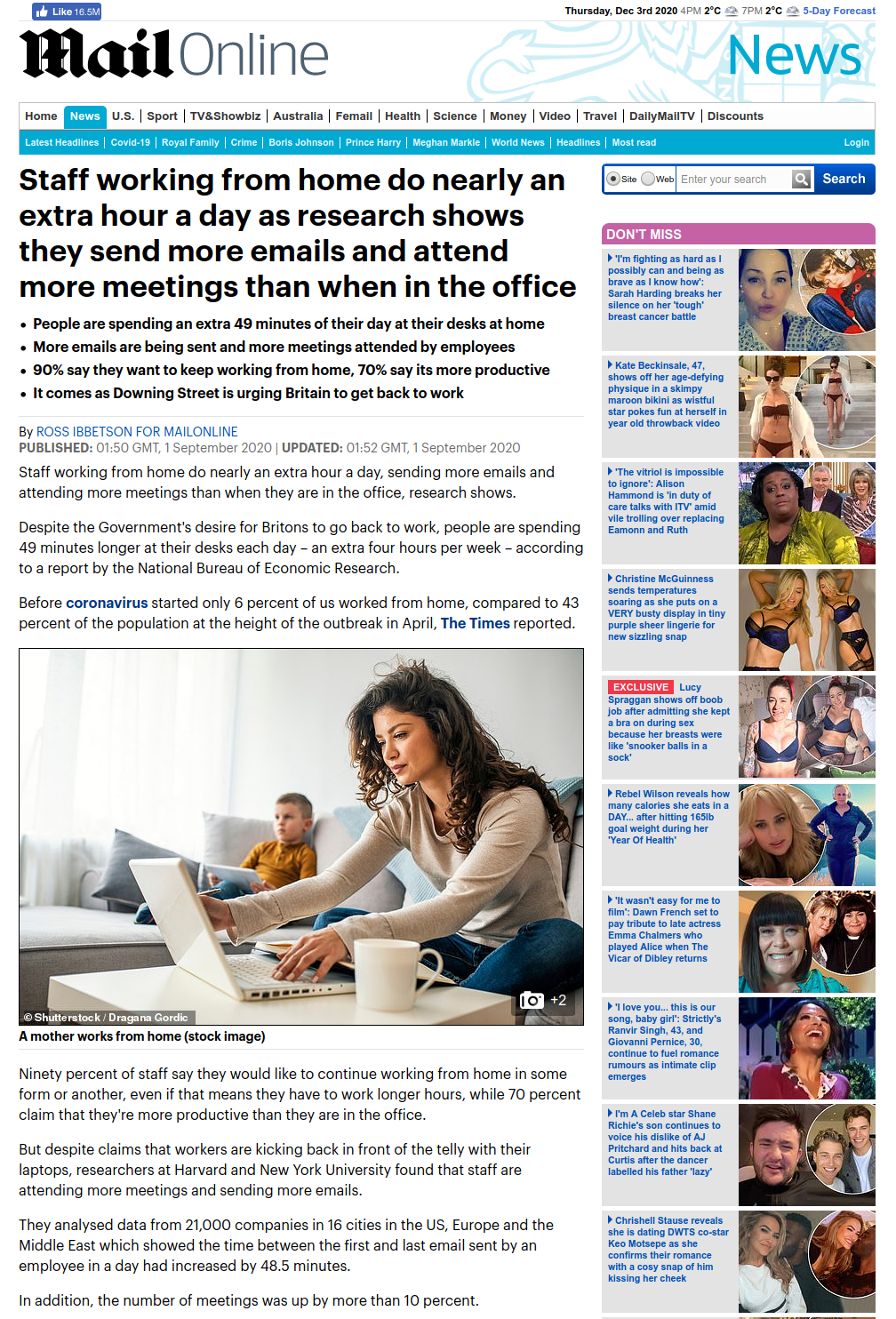
 The Linux Foundation has published its annual report today. LWN calls it glossy and yeah, boy, it is shiny.
So shiny that people that work in the publishing industry immediately see this has been produced with the Adobe toolchain which - unfortunately - is one of the big suites of software not yet available for Linux.
Checking the PDF file metadata reveals the keywords "open source, open standards, open hardware, open data". That is what the Linux Foundation is about. Good stuff.
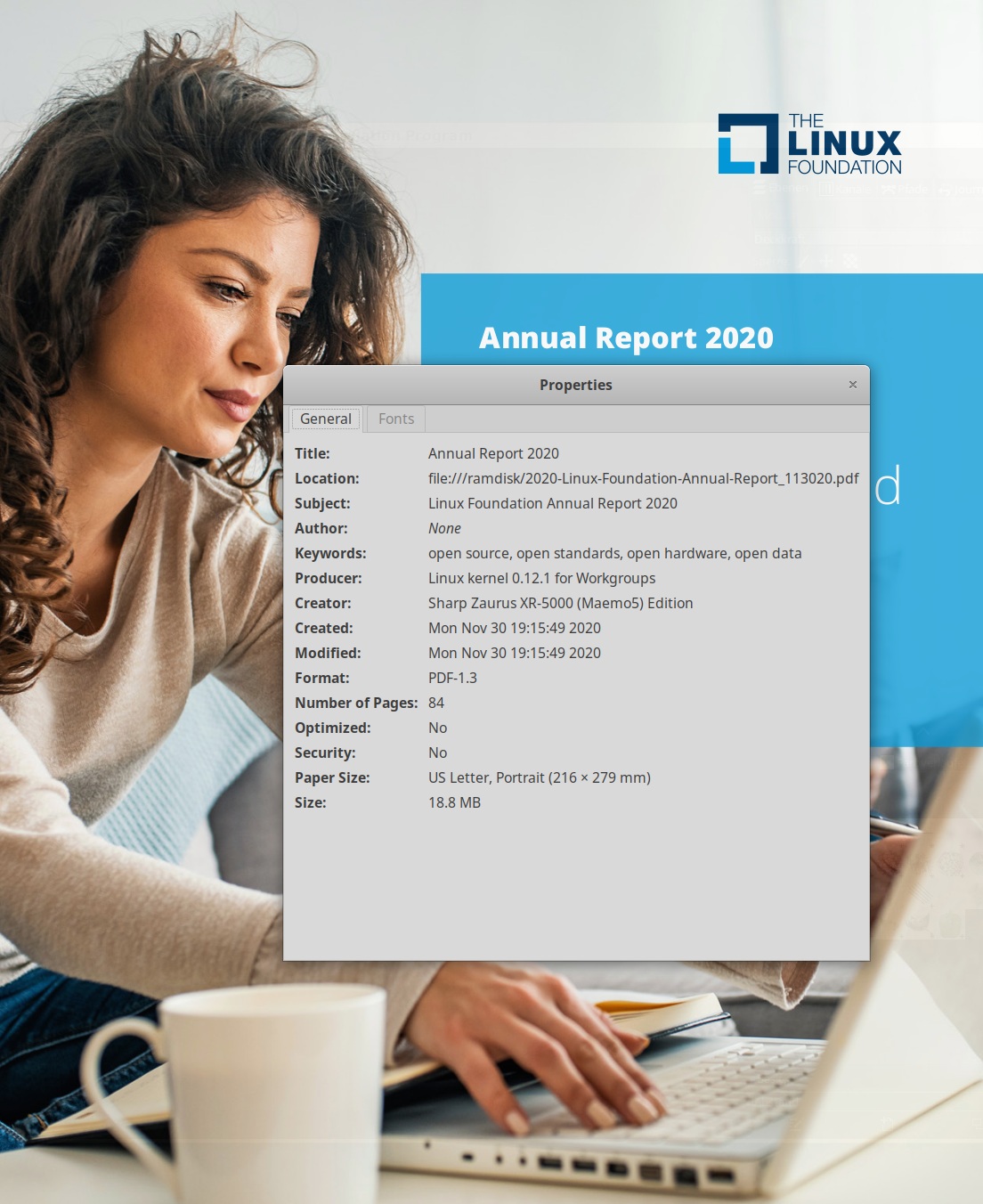 The PDF producer meta data for the annual report PDF has been set to "Linux kernel 0.12.1 for Workgroups" and the PDF creator meta data element to "Sharp Zaurus XR-5000 (Maemo5) Edition". Somebody thought to better hide the real data and had some tongue-in-cheek ideas. Kudos.
But nicer would have been to use Open Source software to produce the report, not?
Running
strings 2020-Linux-Foundation-Annual-Report_113020.pdf grep Adobe wc -l gives us 1229 lines and confirms the suspicion of the toolchain.
A stale /Title (Annual Report 2020) /Producer (macOS Version 10.15.7 \(Build 19H15\) Quartz PDFContext) has been forgotten in the document to tell us about the platform.
So, ladies and gentlemen, the Linux Foundation 2020 annual report has been produced on a Mac.
Running Adobe Creative Cloud on MacOS Catalina 10.15.7.
Which is proprietary software. Its kernel (and some userland pieces) are based on BSD. Not Linux.
 Continue reading "No dog food today - the Linux Foundation annual report"
 In previous blog posts I talked about QEMU s qcow2 file format and how to make it faster. This post gives an overview of how the data is structured inside the image and how that affects performance, and this presentation at KVM Forum 2017 goes further into the topic.
This time I will talk about a new extension to the qcow2 format that seeks to improve its performance and reduce its memory requirements.
Let s start by describing the problem.
Limitations of qcow2
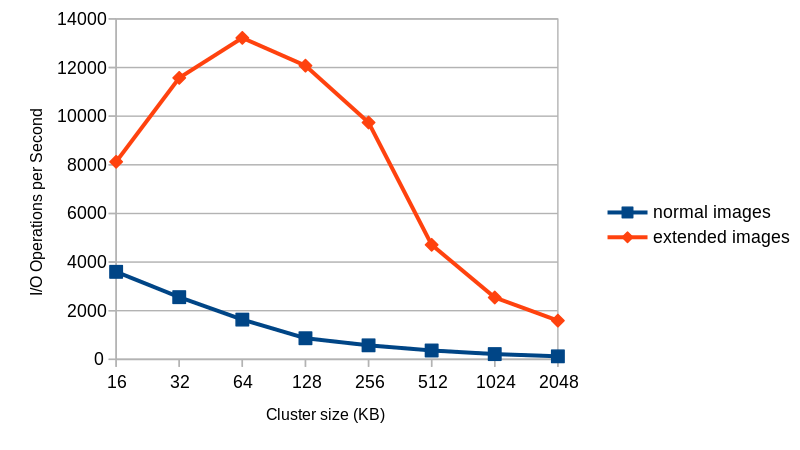
One of the most important parameters when creating a new qcow2 image is the cluster size. Much like a filesystem s block size, the qcow2 cluster size indicates the minimum unit of allocation. One difference however is that while filesystems tend to use small blocks (4 KB is a common size in ext4, ntfs or hfs+) the standard qcow2 cluster size is 64 KB. This adds some overhead because QEMU always needs to write complete clusters so it often ends up doing copy-on-write and writing to the qcow2 image more data than what the virtual machine requested. This gets worse if the image has a backing file because then QEMU needs to copy data from there, so a write request not only becomes larger but it also involves additional read requests from the backing file(s).
Because of that qcow2 images with larger cluster sizes tend to:
 |
$ qemu-img create -f qcow2 -o extended_l2=on,cluster_size=128k img.qcow2 1TAnd that s all you need to do. Once the image is created all allocations will happen at the subcluster level. More information This work was presented at the 2020 edition of the KVM Forum. Here is the video recording of the presentation, where I cover all this in more detail: You can also find the slides here. Acknowledgments This work has been possible thanks to Outscale, who have been sponsoring Igalia and my work in QEMU.
 |
 I joined the
Debian project in late 1994, well before the first
stable release was issued, and have been involved in various ways continuously
ever since. Over the years, I adopted a number of packages that are, or at
least were at one time, fundamental to the distribution.
But, not surprisingly, my interests have shifted over time. In the more than
quarter century I've contributed to Debian, I've adopted existing packages
that needed attention, packaged new software I wanted to use that wasn't yet
in Debian, offered packages up for others to adopt, and even sometimes
requested the removal of packages that became obsolete or replaced by
something better. That all felt completely healthy.
But over the last couple weeks, I realized I'm still "responsible" for some
packages I'd had for a very long time, that generally work well but over time
have accumulated bugs in functionality I just don't use, and frankly haven't
been able to find the motivation to chase down. As one example, I just
noticed that I first uploaded the gzip package 25 years ago today, on
2 December 1995. And while the package works fine for me and most other
folks, there are 30 outstanding bugs and 3 forwarded bugs that I just can't
muster up any energy to address.
So, I just added gzip to a short list of packages I've offered up for
adoption recently. I'm pleased that tar already has a new maintainer, and
hope that both sudo and gzip will get more attention soon.
It's not that I'm less interested in Debian. I've just been busy recently
packaging up more software I use or want to use in designing high
power model
rockets and the solid propellant motors I fly in them, and would rather spend
the time I have available for Debian maintaining those packages and all their
various build dependencies than continuing to be responsible for core
packages in the distribution that "work fine for me" but could use attention.
I'm writing about this partly to mark the passing of more than a quarter
century as a package maintainer for Debian, partly to encourage other Debian
package maintainers with the right skills and motivation to consider adopting
some of the packages I'm giving up, and finally to encourage other long-time
participants in Debian to spend a little time evaluating their own package
lists in a similar way.
A new RcppTOML release arrived on CRAN earlier today evening. RcppTOML brings TOML to R.
TOML is a file format that is most suitable for configurations, as it is meant to be edited by humans but read by computers. It emphasizes strong readability for humans while at the same time supporting strong typing as well as immediate and clear error reports. On small typos you get parse errors, rather than silently corrupted garbage. Much preferable to any and all of XML, JSON or YAML though sadly these may be too ubiquitous now. TOML has been making inroads with projects such as the Hugo static blog compiler, or the Cargo system of Crates (aka packages ) for the Rust language.
CRAN had sent us a note that the package no longer compiled under the [unreleased, of course, never change, BDR ;-) ]
g++-11 compiler, but were kind enough to hint that it was only lacking an #include <limits>. These things happen: newer compilers are generally more strict, and that is generally a good things. (Last year this time we prepped code for the more stringent view on global variables under gcc-10. Earlier g++ version had similar demands to clarify include headers.) I set up a simple Docker contain with on Ubuntu 21.04 with g++-11, R, and Rcpp to build the package and make this change (which was of course also PR ed upstream at cpptoml), plus some other small ones that update the package since the last release roughly 18 months ago. We also switched CI use to the r-ci setup I should blog about a little more, removed a bashism and updated a few URLs. The bulleted list of changes in this version follows.
Courtesy of my CRANberries, there is a diffstat report for this release. More information is on the RcppTOML page page. Please use the GitHub issue tracker for issues and bugreports. If you like this or other open-source work I do, you can sponsor me at GitHub.Changes in version 0.1.7 (2020-12-01)
- Add
#include <limits>to header file, also contributed upstream, to permit compilation under the (unreleased)g++-11.- Switch the simple
cleanupscript tosh.- Switch CI use to
r-cifor focal and bspm.- Update several TOML URLs to
https://toml.io/en/.
This post by Dirk Eddelbuettel originated on his Thinking inside the box blog. Please report excessive re-aggregation in third-party for-profit settings.
 I have recently become an OpenJDK Author. Practically this means I can query
the Java Bug Database directly, and I can author
Mercurial for committing to the relevant OpenJDK project myself, rather than
needing sponsors in both cases.
A small milestone but one I'm proud of! Thanks to my team members who have
encouraged me and helped me by sponsoring and reviewing my work so far.
Next step, Committer!
 Another month worth of updates on KDE/Plasma in Debian has accumulated, so here we go. The highlights are: Plasma 5.19.5 based on Qt 5.15 is in Debian/unstable and testing, Plasma 5.20.4 is waiting to be uploaded soon to experimental, and my own builds at OBS have been updated to Plasma 5.20.4, Frameworks 5.76, Apps 20.08.3.
 OBS packages
The OBS packages as usual follow the latest release, and currently ship KDE Frameworks 5.76, KDE Apps 20.08.3, and new, Plasma 5.20.4. The package sources are as usual (only the
other-dep has disappeared, these packages are now all in Debian proper), for Debian/unstable:
deb https://download.opensuse.org/repositories/home:/npreining:/debian-kde:/frameworks/Debian_Unstable/ ./
deb https://download.opensuse.org/repositories/home:/npreining:/debian-kde:/plasma520/Debian_Unstable/ ./
deb https://download.opensuse.org/repositories/home:/npreining:/debian-kde:/apps2008/Debian_Unstable/ ./
deb https://download.opensuse.org/repositories/home:/npreining:/debian-kde:/other/Debian_Unstable/ ./
Testing instead of Unstable for Debian/testing.
The latest update to 5.20.4 will probably need one or two install cycles due to missing Replaces. The reason is that the packages in OBS have been synced with the work we have done for the official Debian packages, and thus some files have moved between packages.
Debian main packages
After a few hiccups, the whole Plasma 5.19.5 stack has landed in Debian/testing, and we are working on an upload of 5.20.4 to Debian/experimental. This takes a bit, because we want to add infrastructure to automatically force all packages to be upgraded only together, so that there is no mix between old and new packages. This has shown quite some problems during the upgrade from 5.17 to 5.19 in testing. Also, I don t think Debian needs to do something else than everybody else by allowing to mix Plasma released.
That said, I hope that we have an upload of 5.20 to experimental soon, followed by testing and an upload to unstable, so that it can migrate to testing in time for the freeze of Bullseye. Getting 5.20.5 into Bullseye is possible, but not guaranteed, not too much time between the release of 5.20.5 and proper freeze in Debian. But we will see.
Enjoy.
Been implementing something for pair programming.
Sharing the display is probably the most core part and the
rest are minor improvements.


 Stick figure by Sanitary Panels on SC
 I was assigned 16 hours of work by Freexian's Debian LTS initiative
and carried over 4.5 hours from earlier months. I worked 11.5 hours
this month, so I will carry over 9 hours to December.
I continued working on backporting fixes for some less urgent
security issues in Linux 4.9. I had to give up on some filesystem
fixes as they caused regressions. The others have now been applied
to the 4.9 stable branch at kernel.org.
I updated the linux packaging branch for stretch to Linux 4.9.246,
but haven't made a new package upload yet.

phpmyadmin for William and libexif for Hugh.
:wq for today.
 This month just went past way too fast, didn t get to all the stuff I wanted to, but managed to cover many essentials (not even listed here) that I ll cover in follow-up posts. In particular, highlights that I m thankful for are that we ve selected the final artwork for Bullseye. We ve also successfully hosted another two MiniDebConfs. One that was gaming themed, and a Brazilian event all in Portuguese! Videos are up on Debian s PeerTube instance (Gaming Edition Brazil) and on the DebConf video archive for direct download.
Remember to take care of yourself out there! Physical safety is high on everyone s mind in these times, but remember to pay attention to your mental health too. It s ok if you won t hit all your usual targets and goals in these times, don t be too hard on yourself and burn out!
2020-11-01: Upload package gtetrinet (0.7.11+git20200916.46e7ade-2~bpo10+1) to Debian buster-backports.
2020-11-01: Upload package gnome-shell-extension-disconnect-wifi (26-1) to Debian unstable.
2020-11-02: Merge MR!2, MR!4 and MR!5 for zram-tools, follow 3-way merge closing MR!1 and MR!3.
2020-11-02: Upload package zram-swap (0.3.3-1) to Debian unstable (Closes: #917643, #928439, #928443).
2020-11-02: Close live-installer bugs #646704 (fix released a few years ago already), #700642 (nothing left to fix), #835391 (unproducible on latest images), #847446 (graphical d-i installer no longer provided). #714710 (problem not present on latest installation media)
2020-11-02: File ROM for calcoo (#973638) no longer maintained upstream, GTK-2 only.
2020-11-03: Upload package bundlewrap (4.2.2-1) to Debian unstable.
2020-11-03: Upload package feed2toot (0.14-1) to Debian unstable.
2020-11-03: Upload package feed2toot (0.14-2) to Debian unstable.
2020-11-03: Upload package flask-autoindex (0.6.6-2) to Debian unstable.
2020-11-03: Upload package flask-caching (1.9.0-1) to Debian unstable.
2020-11-03: Upload package flask-restful (0.3.8-5) to Debian unstable.
2020-11-08: Upload package s-tui (1.0.2-2) to Debian unstable (Closes: #961534).
2020-11-09: Merge MR!1 for bluefish (remove old icon).
2020-11-10: Upload package bluefish (2.2.12-1) to Debian unstable.
2020-11-10: Upload package calamares (3.2.33-1) to Debian unstable.
2020-11-11: Upload package calamares-settings-debian (11.0.4-1) to Debian unstable.
2020-11-17: Upload package gnome-shell-extension-multiple-workspaces (22-1) to Debian-unstable.
2020-11-24: Sponsor package xmodem (0.4.6+dfsg-2) for Debian unstable (Python Team request).
2020-11-24: Sponsor package python-opentracing (2.4.0-1) for Debian unstable (Python Team request).
2020-11-24: Sponsor package python-css-parser (1.0.6-1) for Debian unstable (Python Team request).
2020-11-24: Review package buildbot (2.8.4-1) (Needs some more work) (Python Team request).
2020-11-24: Review package gbsplay (0.0.94-1) (Needs some more work) (Games Team request).
2020-11-24: Sponsor package goverlay (0.4.2-1) for Debian unstable (Games Team request).
2020-11-24: Sponsor package lutris (0.5.8-1) for Debian unstable (Games Team request).
2020-11-24: Review package mangohud (0.5.1-1) for Debian unstable (Needs some more work) (Games Team request).
2020-11-24: Sponsor package vkbasalt (0.3.2.3-1) for Debian unstable (Games Team request).
2020-11-25: Sponsor package starfighter (2.3.3-1) for Debian unstable (Games Team request).
2020-11-25: Sponsor package pentobi (18.3-1) for Debian unstable (Games Team request).
2020-11-30: Sponsor package lutris (0.5.8-1) for Debian unstable (Games Team request) (New upload).
 I now have four six-port Qotom systems and one four-port Qotom system in my rack. I have successfully verified that the newest of these is capable of pulling about 745Mbit/s of 1500-byte frames through the switch from six other hosts. I bet it will push data at the same rate. but I can t get iperf to distribute it over the LAG evenly. That s another problem for another day. I know it can handle six large streams at the same time, which is great.
Next.
