Search Results: "don"

30 November 2014

Thorsten Alteholz: My Debian Activities in November 2014

FTP assistant In contrast to the last month, this month has been rather quiet and I really liked that :-) . The stress has moved to the next team. So all in all I marked 101 packages for accept and had to reject 27 packages. As I mostly reviewed really new packages, I didn t have to file any RC bug this month. Squeeze LTS This was my fifth month that I did some work for the Squeeze LTS initiative, started by Raphael Hertzog at Freexian. This month I got assigned a workload of 14.25h and I spent these hours to upload new versions of: I also uploaded [DLA 85-1] libxml-security-java security update, but as nobody of the LTS sponsors had any interest in this package, I did this in my spare time. A package with security in its name should not be affected by security issues. This month my failure of the month has been the binutils package. Although the security team prepared the way for finding the correct patches for all those CVEs, I somehow managed to not find them. This is embarassing I am also a bit disappointed by current LTS users. All important packages have been made available for testing before uploading them to the archive. Apart from some brave fellow DDs, no other feedback was reported on debian-lts. Complaints arrived only when the packages have been finally uploaded. Do admins have enough time nowadays and don t need to use some kind of testbed? Times are changing Other packages This month I even found some time to sponsor uploads, so please welcome a new version of fastaq in experimental and patiently wait for aegaen and kmc to pass NEW. At this point I also want to mention the Debian Med Advent Calendar, which was announced in this email and already mentioned by Andreas in his latest Debian Med bits. Everybody is invited to take care of as much as possible poor souls. Support If you would like to support my Debian work you could either be part of the Freexian initiative (see above) or consider to send some bitcoins to 1JHnNpbgzxkoNexeXsTUGS6qUp5P88vHej. Contact me at donation@alteholz.eu if you prefer another way to donate. Every kind of support is most appreciated.

Enrico Zini: cxx11-talk-notes

C++11 talk notes On 2014-11-27 I gave a talk about C++ and new features introduced with C++11: these are the talk notes. See cxx11-talk-examples for the examples. (note: I had to add U+2063 INVISIBLE SEPARATOR to prevent noreturn statements to be misinterpreted by the blog formatter. If you copypaste the code and encounter issues, you may want to delete the noreturn statements and retype them) Overview of programming languages
It has to be as fast as possible, so interpreted languages are out. You don't want to micro manage memory, so C is out. You don't want to require programmers to have a degree, so C++ is out. You want fast startup and not depend on a big runtime, so Java is out. [...] (Bram Moolenaar)
C++ secret cultist protip
Do not call up what you cannot put down.
C++ is a compiled language It is now possible to use the keyword constexpr to mark functions and objects that can be used at compile time:
/*
 * constexpr tells the compiler that a variable or function can be evaluated at
 * compile time.
 *
 * constexpr functions can also be run at run time, if they are called with
 * values not known at compile time.
 *
 * See http://en.cppreference.com/w/cpp/language/constexpr for more nice examples
 *
 * It can be used to avoid using constants in code, and using instead functions
 * for computing hardware bitfields or physical values, without losing in
 * efficiency.
 */
#include <iostream>
using namespace std;
constexpr int factorial(int n)
 
    return n <= 1 ? 1 : (n * factorial(n-1));
 
int main()
 
    cout << "Compile time factorial of 6: " << factorial(6) << endl;
    cout << "Enter a number: ";
    int a;
    cin >> a;
    cout << "Run time factorial of " << a << ": " << factorial(a) << endl;
 
See also this for more nice examples. See this and this for further discussion. Multiline strings
        const char* code = R"--(
          printf("foo\tbar\n");
          return 0;
        )--";
See this. C++ memory management protip RAII: Resource Acquisition Is Instantiation This is not new in C++11, but in my experience I have rarely seen it mentioned in C++ learning material, and it does make a huge difference in my code. See this and this for details. Constructors and member initializer lists Initializers in curly braces now have their own type: std::initializer_list:
#include <string>
#include <iostream>
#include <unordered_set>
using namespace std;
// std::initializer_list< >
//   will have as its value all the elements inside the curly braces
string join(initializer_list<string> strings)
 
    string res;
    for (auto str: strings)
     
        if (!res.empty())
            res += ", ";
        res += str;
     
    return res;
 
int main()
 
    unordered_set<string> blacklist  ".", "..", ".git", ".gitignore"  ;
    cout << join(  "antani", "blinda"  ) << endl;
 
See this for details, including the new uniform initialization trick of omitting parentesis in constructors so that you can call normal constructors and initializer_list constructors with the same syntax, which looks like an interesting thing when writing generic code in templates. Type inference I can now use auto instead of a type to let the compiler automatically compute the value of something I assign to:
        auto i = 3 + 2;
        // See also https://github.com/esseks/monicelli
        vector<string> names  "antani", "blinda", "supercazzola"  ;
        for (auto i = names.cbegin(); i != names.cend(); ++i)
            cout << i;
        template<typename T>
        T frobble(const T& stuff)
         
             // This will work whatever type is returned by stuff.read()
             auto i = stuff.read();
             //  
         
See this for more details. Range-based for loop C++ now has an equivalent of the various foreach constructs found in several interpreted languages!
        for (auto i: list_of_stuff)
                cout << i << endl;
        for (auto n:  0,1,2,3,4,5 )
                cout << n << endl;
        // This construct:
        for (auto i: stuff)
        // If stuff is an array, it becomes:
        for (i = stuff, i < stuff + sizeof(stuff) / sizeof(stuff[0]); ++i)
        // If stuff has .begin() and .end() methods it becomes:
        for (i = stuff.begin(); i != stuff.end(); ++i)
        // Otherwise it becomes:
        for (i = begin(stuff); i != end(stuff); ++i)
        // And you can define begin() and end() functions for any type you
        // want, at any time
See this and this for details. Lambda functions and expressions Lambdas! Closures! Something like this:
// JavaScript
var add = function(a, b)   return a + b;  
# Python
add = lambda a, b: a + b
Becomes this:
auto add = [](int a, int b)   return a + b;  
And something like this:
// JavaScript
var a = 0;
$.each([1, 2, 3, 4], function(idx, el)   a += el  );
Becomes this:
unsigned a = 0;
std::for_each(  1, 2, 3, 4  , [&a](int el)   return a += el;  );
See this, this and this. Tuple types C++ now has a std::tuple type, that like in Python can be used to implement functions that return multiple values:
        tuple<int, string, vector<string>> parse_stuff()
         
                return make_tuple(id, name, values);
         
        string name; vector<string> values;
        // std::ignore can be used to throw away a result
        tie(ignore, name, values) = parse_stuff();
        // std::tie can also be used to do other kind of
        // multi-operations besides assignment:
        return tie(a, b, c) < tie(a1, b1, c1);
        // Is the same as:
        if (a != a1) return a < a1;
        if (b != b1) return b < b1;
        return c < c1;
See here, here and here. Regular expressions We now have regular expressions!
        std::regex re(R"((\w+)\s+(\w+))");
        string s("antani blinda");
        smatch res;
        if (regex_match(s, res, re))
            cout << "OK " << res[1] << " -- " << res[2] << endl;
The syntax is ECMAScript by default and can be optionally changed to basic, extended, awk, grep, or egrep. See here and here. General-purpose smart pointers There is std::unique_ptr to code memory ownership explicitly, and std::shared_ptr as a reference counted pointer, and smart pointers can have custom destructors:
    unique_ptr<dirent, std::function<void(void*)>> dirbuf((dirent*)malloc(len), free);
See here and here. Miscellaneous other cool things Standard attribute specifiers
string errno_str(int error)
 
    char buf[256];
#if (_POSIX_C_SOURCE >= 200112L   _XOPEN_SOURCE >= 600) && ! _GNU_SOURCE
    strerror_r(errno, buf, 256);
    string res(buf);
#else
    string res(strerror_r(errno, buf, 256));
#endif
    return res;
 
[ [noreturn]] void throw_libc_error(int error)
 
    throw runtime_error(errno_str(error));
 
See here. Hash tables See here and look at the new containers unordered_set, unordered_map, unordered_multiset, and unordered_multimap. Multithreading There is a standard threading model, with quite a bit of library support: see here, here, here, and here for atomic data structures. Variadic templates Templates can now take variable number of arguments, and that opens possibilities for interesting code generation, like implementing a generic, type-safe printf statement, or something like this:
db.query(R"(
   INSERT INTO table NAMES (id, name, description)
     VALUES (?, ?, ?)
)", 4, "genio", "fantasia, intuizione, decisione, e velocit  di esecuzione");
See here and here. Essential tools You need at least g++ 4.8 or clang 3.3 to have full C++11 support. They will be both available in jessie, and for wheezy you can use the nightly clang packages repository. I cannot think of a good excuse not to use -Wall on new code. scan-build from clang is another nice resource for catching even more potential problems at compile time. valgrind is a great tool for runtime code analysis: valgrind --tool=memcheck (the default) will check your program for wrong memory accesses and memory leaks. valgrind --tool=callgrind will trace function calls for profiling, to be analyzed with kcachegrind. valgrind --tool=helgrind can check multi-threaded programs for suspicious concurrent memory accesse patterns. And of course gdb: a nice trick with C++ is to issue catch throw to get a breakpoint at the point where an exception is being thrown. help catch provides a list of other interesting catch examples. Coredump tips: ulimit -c to enable core dumps, triggering a core dump with ^\, opening a core with gdb program core, and more details on man 5 core. An extra gdb tip, which is not related to C++ but helped me considerably recently, is that it can be attached to running python programs to get a live Python traceback.

Johannes Schauer: simple email setup

I was unable to find a good place that describes how to create a simple self-hosted email setup. The most surprising discovery was, how much already works after:
apt-get install postfix dovecot-imapd
Right after having finished the installation I was able to receive email (but only in in /var/mail in mbox format) and send email (bot not from any other host). So while I expected a pretty complex setup, it turned out to boil down to just adjusting some configuration parameters.

Postfix The two interesting files to configure postfix are /etc/postfix/main.cf and /etc/postfix/master.cf. A commented version of the former exists in /usr/share/postfix/main.cf.dist. Alternatively, there is the ~600k word strong man page postconf(5). The latter file is documented in master(5).

/etc/postfix/main.cf I changed the following in my main.cf
@@ -37,3 +37,9 @@
mailbox_size_limit = 0
recipient_delimiter = +
inet_interfaces = all
+
+home_mailbox = Mail/
+smtpd_recipient_restrictions = permit_mynetworks reject_unauth_destination permit_sasl_authenticated
+smtpd_sasl_type = dovecot
+smtpd_sasl_path = private/auth
+smtp_helo_name = my.reverse.dns.name.com
At this point, also make sure that the parameters smtpd_tls_cert_file and smtpd_tls_key_file point to the right certificate and private key file. So either change these values or replace the content of /etc/ssl/certs/ssl-cert-snakeoil.pem and /etc/ssl/private/ssl-cert-snakeoil.key. The home_mailbox parameter sets the default path for incoming mail. Since there is no leading slash, this puts mail into $HOME/Mail for each user. The trailing slash is important as it specifies qmail-style delivery'' which means maildir. The default of the smtpd_recipient_restrictions parameter is permit_mynetworks reject_unauth_destination so this just adds the permit_sasl_authenticated option. This is necessary to allow users to send email when they successfully verified their login through dovecot. The dovecot login verification is activated through the smtpd_sasl_type and smtpd_sasl_path parameters. I found it necessary to set the smtp_helo_name parameter to the reverse DNS of my server. This was necessary because many other email servers would only accept email from a server with a valid reverse DNS entry. My hosting provider charges USD 7.50 per month to change the default reverse DNS name, so the easy solution is, to instead just adjust the name announced in the SMTP helo.

/etc/postfix/master.cf The file master.cf is used to enable the submission service. The following diff just removes the comment character from the appropriate section.
@@ -13,12 +13,12 @@
#smtpd pass - - - - - smtpd
#dnsblog unix - - - - 0 dnsblog
#tlsproxy unix - - - - 0 tlsproxy
-#submission inet n - - - - smtpd
-# -o syslog_name=postfix/submission
-# -o smtpd_tls_security_level=encrypt
-# -o smtpd_sasl_auth_enable=yes
-# -o smtpd_client_restrictions=permit_sasl_authenticated,reject
-# -o milter_macro_daemon_name=ORIGINATING
+submission inet n - - - - smtpd
+ -o syslog_name=postfix/submission
+ -o smtpd_tls_security_level=encrypt
+ -o smtpd_sasl_auth_enable=yes
+ -o smtpd_client_restrictions=permit_sasl_authenticated,reject
+ -o milter_macro_daemon_name=ORIGINATING
#smtps inet n - - - - smtpd
# -o syslog_name=postfix/smtps
# -o smtpd_tls_wrappermode=yes

Dovecot Since above configuration changes made postfix store email in a different location and format than the default, dovecot has to be informed about these changes as well. This is done in /etc/dovecot/conf.d/10-mail.conf. The second configuration change enables postfix to authenticate users through dovecot in /etc/dovecot/conf.d/10-master.conf. For SSL one should look into /etc/dovecot/conf.d/10-ssl.conf and either adapt the parameters ssl_cert and ssl_key or store the correct certificate and private key in /etc/dovecot/dovecot.pem and /etc/dovecot/private/dovecot.pem, respectively. The dovecot-core package (which dovecot-imapd depends on) ships tons of documentation. The file /usr/share/doc/dovecot-core/dovecot/documentation.txt.gz gives an overview of what resources are available. The path /usr/share/doc/dovecot-core/dovecot/wiki contains a snapshot of the dovecot wiki at http://wiki2.dovecot.org/. The example configurations seem to be the same files as in /etc/ which are already well commented.

/etc/dovecot/conf.d/10-mail.conf The following diff changes the default email location in /var/mail to a maildir in ~/Mail as configured for postfix above.
@@ -27,7 +27,7 @@
#
# <doc/wiki/MailLocation.txt>
#
-mail_location = mbox:~/mail:INBOX=/var/mail/%u
+mail_location = maildir:~/Mail

# If you need to set multiple mailbox locations or want to change default
# namespace settings, you can do it by defining namespace sections.

/etc/dovecot/conf.d/10-master.conf And this enables the authentication socket for postfix:
@@ -93,9 +93,11 @@


# Postfix smtp-auth
- #unix_listener /var/spool/postfix/private/auth
- # mode = 0666
- #
+ unix_listener /var/spool/postfix/private/auth
+ mode = 0660
+ user = postfix
+ group = postfix
+

# Auth process is run as this user.
#user = $default_internal_user

Aliases Now Email will automatically put into the '~/Mail' directory of the receiver. So a user has to be created for whom one wants to receive mail...
$ adduser josch
...and any aliases for it to be configured in /etc/aliases.
@@ -1,2 +1,4 @@
-# See man 5 aliases for format
-postmaster: root
+root: josch
+postmaster: josch
+hostmaster: josch
+webmaster: josch
After editing /etc/aliases, the command
$ newaliases
has to be run. More can be read in the aliases(5) man page.

Finishing up Everything is done and now postfix and dovecot have to be informed about the changes. There are many ways to do that. Either restart the services, reboot or just do:
$ postfix reload
$ doveadm reload
Have fun!

29 November 2014

Dirk Eddelbuettel: CRAN Task Views for Finance and HPC now (also) on GitHub

The CRAN Task View system is a fine project which Achim Zeileis initiated almost a decade ago. It is described in a short R Journal article in Volume 5, Number 1. I have been editor / maintainer of the Finance task view essentially since the very beginning of these CRAN Task Views, and added the High-Performance Computing one in the fall of 2008. Many, many people have helped by sending suggestions or even patches; email continues to be the main venue for the changes. The maintainers of the Web Technologies task view were, at least as far as I know, the first to make the jump to maintaining the task view on GitHub. Karthik and I briefly talked about this when he was in town a few weeks ago for our joint Software Carpentry workshop at Northwestern. So the topic had been on my mind, but it was only today that I realized that the near-limitless amount of awesome that is pandoc can probably help with maintenance. The task view code by Achim neatly converts the very regular, very XML, very boring original format into somewhat-CRAN-website-specific html. Pandoc, being as versatile as it is, can then make (GitHub-flavoured) markdown out of this, and with a minimal amount of sed magic, we get what we need. And hence we now have these two new repos: Contributions are now most welcome by pull request. You can run the included converter scripts, it differs between both repos only by one constant for the task view / file name. As an illustration, the one for Finance is below.
#!/usr/bin/r
## if you do not have /usr/bin/r from littler, just use Rscript
ctv <- "Finance"
ctvfile  <- paste0(ctv, ".ctv")
htmlfile <- paste0(ctv, ".html")
mdfile   <- "README.md"
## load packages
suppressMessages(library(XML))          # called by ctv
suppressMessages(library(ctv))
r <- getOption("repos")                 # set CRAN mirror
r["CRAN"] <- "http://cran.rstudio.com"
options(repos=r)
check_ctv_packages(ctvfile)             # run the check
## create html file from ctv file
ctv2html(read.ctv(ctvfile), htmlfile)
### these look atrocious, but are pretty straight forward. read them one by one
###  - start from the htmlfile
cmd <- paste0("cat ", htmlfile,
###  - in lines of the form  ^<a href="Word">Word.html</a>
###  - capture the 'Word' and insert it into a larger URL containing an absolute reference to task view 'Word'
  "   sed -e 's ^<a href=\"\\([a-zA-Z]*\\)\\.html <a href=\"http://cran.rstudio.com/web/views/\\1.html\" '   ",
###  - call pandoc, specifying html as input and github-flavoured markdown as output
              "pandoc -s -r html -w markdown_github   ",
###  - deal with the header by removing extra  , replacing  ** with ** and **  with **:              
              "sed -e's/ //g' -e's/ \\*\\*/\\*\\*/g' -e's/\\*\\* /\\*\\* /g' -e's/ $/  /g' ",
###  - make the implicit URL to packages explicit
              "-e's ../packages/ http://cran.rstudio.com/web/packages/ g' ",
###  - write out mdfile
              "> ", mdfile)
system(cmd)                             # run the conversion
unlink(htmlfile)                        # remove temporary html file
cat("Done.\n")
I am quite pleased with this setup---so a quick thanks towards the maintainers of the Web Technologies task view; of course to Achim for creating CRAN Task Views in the first place, and maintaining them all those years; as always to John MacFarlance for the magic that is pandoc; and last but not least of course to anybody who has contributed to the CRAN Task Views.

This post by Dirk Eddelbuettel originated on his Thinking inside the box blog. Please report excessive re-aggregation in third-party for-profit settings.

28 November 2014

Richard Hartmann: Release Critical Bug report for Week 48

Holy bug-count-drop, Batman! Some bugs which need loving: The UDD bugs interface currently knows about the following release critical bugs: How do we compare to the Squeeze release cycle?
Week Squeeze Wheezy Jessie
43 284 (213+71) 468 (332+136) 319 (240+79)
44 261 (201+60) 408 (265+143) 274 (224+50)
45 261 (205+56) 425 (291+134) 295 (229+66)
46 271 (200+71) 401 (258+143) 427 (313+114)
47 283 (209+74) 366 (221+145) 342 (260+82)
48 256 (177+79) 378 (230+148) 274 (189+85)
49 256 (180+76) 360 (216+155)
50 204 (148+56) 339 (195+144)
51 178 (124+54) 323 (190+133)
52 115 (78+37) 289 (190+99)
1 93 (60+33) 287 (171+116)
2 82 (46+36) 271 (162+109)
3 25 (15+10) 249 (165+84)
4 14 (8+6) 244 (176+68)
5 2 (0+2) 224 (132+92)
6 release! 212 (129+83)
7 release+1 194 (128+66)
8 release+2 206 (144+62)
9 release+3 174 (105+69)
10 release+4 120 (72+48)
11 release+5 115 (74+41)
12 release+6 93 (47+46)
13 release+7 50 (24+26)
14 release+8 51 (32+19)
15 release+9 39 (32+7)
16 release+10 20 (12+8)
17 release+11 24 (19+5)
18 release+12 2 (2+0)
Graphical overview of bug stats thanks to azhag:

Ian Wienand: rstdiary

I find it very useful to spend 5 minutes a day to keep a small log of what was worked on, major bugs or reviews and a general small status report. It makes rolling up into a bigger status report easier when required, or handy as a reference before you go into meetings etc. I was happily using an etherpad page until I couldn't save any more revisions and the page got too long and started giving javascript timeouts. For a replacement I wanted a single file as input with no boilerplate to aid in back-referencing and adding entries quickly. It should be formatted to be future-proof, as well as being emacs, makefile and git friendly. Output should be web-based so I can refer to it easily and point people at it when required, but it just has to be rsynced to public_html with zero setup. rstdiary will take a flat RST based input file and chunk it into some reasonable looking static-HTML that looks something like this. It's split by month with some minimal navigation. Copy the output directory somewhere and it is done. It might also serve as a small example of parsing and converting RST nodes where it does the chunking; unfortunately the official documentation on that is "to be completed" and I couldn't find anything like a canonical example, so I gathered what I could from looking at the source of the transformation stuff. As the license says, the software is provided "as is" without warranty! So if you've been thinking "I should keep a short daily journal in a flat-file and publish it to a web-server but I can't find any software to do just that" you now have one less excuse.

26 November 2014

Francois Marier: Hiding network disconnections using an IRC bouncer

A bouncer can be a useful tool if you rely on IRC for team communication and instant messaging. The most common use of such a server is to be permanently connected to IRC and to buffer messages while your client is disconnected. However, that's not what got me interested in this tool. I'm not looking for another place where messages accumulate and wait to be processed later. I'm much happier if people email me when I'm not around. Instead, I wanted to do to irssi what mosh did to ssh clients: transparently handle and hide temporary disconnections. Here's how I set everything up.

Server setup The first step is to install znc:
apt-get install znc
Make sure you get the 1.0 series (in jessie or trusty, not wheezy or precise) since it has much better multi-network support. Then, as a non-root user, generate a self-signed TLS certificate for it:
openssl req -x509 -sha256 -newkey rsa:2048 -keyout znc.pem -nodes -out znc.crt -days 365
and make sure you use something like irc.example.com as the subject name, that is the URL you will be connecting to from your IRC client. Then install the certificate in the right place:
mkdir ~/.znc
mv znc.pem ~/.znc/
cat znc.crt >> ~/.znc/znc.pem
Once that's done, you're ready to create a config file for znc using the znc --makeconf command, again as the same non-root user:
  • create separate znc users if you have separate nicks on different networks
  • use your nickserv password as the server password for each network
  • enable ssl
  • say no to the chansaver and nickserv plugins
Finally, open the IRC port (tcp port 6697 by default) in your firewall:
iptables -A INPUT -p tcp --dport 6697 -j ACCEPT

Client setup (irssi) On the client side, the official documentation covers a number of IRC clients, but the irssi page was quite sparse. Here's what I used for the two networks I connect to (irc.oftc.net and irc.mozilla.org):
servers = (
   
    address = "irc.example.com";
    chatnet = "OFTC";
    password = "fmarier/oftc:Passw0rd1!";
    port = "6697";
    use_ssl = "yes";
    ssl_verify = "yes";
    ssl_cafile = "~/.irssi/certs/znc.crt";
   ,
   
    address = "irc.example.com";
    chatnet = "Mozilla";
    password = "francois/mozilla:Passw0rd1!";
    port = "6697";
    use_ssl = "yes";
    ssl_verify = "yes";
    ssl_cafile = "~/.irssi/certs/znc.crt";
   
);
Of course, you'll need to copy your znc.crt file from the server into ~/.irssi/certs/znc.crt. Make sure that you're no longer authenticating with the nickserv from within irssi. That's znc's job now.

Wrapper scripts So far, this is a pretty standard znc+irssi setup. What makes it work with my workflow is the wrapper script I wrote to enable znc before starting irssi and then prompt to turn it off after exiting:
#!/bin/bash
ssh irc.example.com "pgrep znc   znc"
irssi
read -p "Terminate the bouncer? [y/N] " -n 1 -r
echo
if [[ $REPLY =~ ^[Yy]$ ]]
then
  ssh irc.example.com killall -sSIGINT znc
fi
Now, instead of typing irssi to start my IRC client, I use irc. If I'm exiting irssi before commuting or because I need to reboot for a kernel update, I keep the bouncer running. At the end of the day, I say yes to killing the bouncer. That way, I don't have a backlog to go through when I wake up the next day.

25 November 2014

Sune Vuorela: QImage and QPixmap in a Qt Quick item

For reasons I don t know, apparantly a Qt Quick Item that can show a QImage or a QPixmap is kind of missing. The current Image QML item only works with data that can be represented by a URL. So I wrote one that kind of works. Comments most welcome. It is found on git.kde.org: http://quickgit.kde.org/?p=scratch/sune/imageitem.git Oh, and the KDE End of Year fundraiser is still running. https://www.kde.org/fundraisers/yearend2014/. Go support it if you haven t already.

Scott Kitterman: On being excellent to each other

There has been a lot of discussion recently where there is strong disagreement, even about how to discuss the disagreement. Here s a few thoughts on the matter. The thing I personally find the most annoying is when someone thinks what someone else says is inappropriate and says so, it seems like the inevitable response is to scream censorship. When people do that, I m pretty sure they don t know what the word censorship actually means. Debian/Ubuntu/Insert Project Name Here resources are not public spaces and no government is telling people what they can and can t say. When you engage in speech and people respond to that speech, even if you don t feel all warm and fuzzy after reading the response, it s not censorship. It s called discussion. When someone calls out speech that they think is inappropriate, the proper response is not to blame a Code of Conduct or some other set of rules. Projects that have a code, also have a process for dealing with claims the code has been violated. Unless someone invokes that process (which almost never happens), the code is irrelevant. What s relevant is that someone is having a problem with what or how you are saying something and are in some way hurt by it. Let s focus on that. The rules are irrelevant, what matters is working together in a collegial way. I really don t think project members actively want other project members to feel bad/unsafe, but it s hard to get outside ones own defensive reaction to being called out. So please pay less attention to how you re feeling about things and try to see things from the other side. If we can all do a bit more of that, then things can be better for all of us. Final note: If you ve gotten this far and thought Oh, that other person is doing this to me , I have news for you it s not just them.

Chris Lamb: Validating Django model attribute assignment

Ever done the following?
>>> user = User.objects.get(pk=102)
>>> user.superuser = True
>>> user.save()
# Argh, why is this user now not a superuser...
Here's a dirty hack to validate these:
import sys
from django.db import models
from django.conf import settings
FIELDS =  
EXCEPTIONS =  
    'auth.User': ('backend',),
 
def setattr_validate(self, name, value):
    super(models.Model, self).__setattr__(name, value)
    # Real field names cannot start with underscores
    if name.startswith('_'):
        return
    # Magic
    if name == 'pk':
        return
    k = '%s.%s' % (self._meta.app_label, self._meta.object_name)
    try:
        fields = FIELDS[k]
    except KeyError:
        fields = FIELDS[k] = set(
            getattr(x, y) for x in self._meta.fields
            for y in ('attname', 'name')
        )
    # Field is in allowed list
    if name in fields:
        return
    # Field is in known exceptions
    if  name in EXCEPTIONS.get(k, ()):
        return
    # Always allow Django internals to set values (eg. aggregates)
    if 'django/db/models' in sys._getframe().f_back.f_code.co_filename:
        return
    raise ValueError(
        "Refusing to set unknown attribute '%s' on %s instance. "
        "(Did you misspell %s?)" % (name, k, ', '.join(fields))
    )
# Let's assume we have good test coverage
if settings.DEBUG:
    models.Model.__setattr__ = setattr_validate
Now:
>>> user = User.objects.get(pk=102)
>>> user.superuser = True
...
ValueError: Refusing to set unknown attribute 'superuser' on auth.User instance. (Did you misspell 'username', 'first_name', 'last_name', 'is_active', 'email', 'is_superuser', 'is_staff', 'last_login', 'password', 'id', 'date_joined')
(Django can be a little schizophrenic on this Model.save()'s update_fields keyword argument validates its fields, as does prefetch_related, but it's taking select_related a little while to land.)

Erich Schubert: Installing Debian with sysvinit

First let me note that I am using systemd, so these things here are untested by me. See e.g. Petter's and Simon's blog entries on the same overall topic.
According to the Debian installer maintainers, the only accepted way to install Debian with sysvinit is to use preseeding. This can either be done at the installer boot prompt by manually typing the magic spell:
preseed/late_command="in-target apt-get install -y sysvinit-core"
or by using a preseeding file (which is a really nice feature I used for installing my Hadoop nodes) to do the same:
d-i preseed/late_command string in-target apt-get install -y sysvinit-core
If you are a sysadmin, using preseeding can save you a lot of typing. Put all your desired configuration into preseeding files, put them on a webserver (best with a short name resolvable by local DNS). Let's assume you have set up the DNS name d-i.example.com, and your DHCP is configured such that example.com is on the DNS search list. You can also add a vendor extension to DHCP to serve a full URL. Manually enabling preseeding then means adding
auto url=d-i
to the installer boot command line (d-i is the hostname I suggested to set up in your DNS before, and the full URL would then be http://d-i.example.com/d-i/jessie/./preseed.cfg. Preseeding is well documented in Appendix B of the installer manual, but nevertheless will require a number of iterations to get everything work as desired for a fully automatic install like I used for my Hadoop nodes.

There might be an easier option.
I have filed a wishlist bug suggesting to use the tasksel mechanism to allow the user to choose sysvinit at installation time. However, it got turned down by the Debian installer maintainers quire rudely in a "No." - essentially this is a "shut the f... up and go away", which is in my opinion an inappropriate to discard a reasonable user wishlist request.
Since I don't intend to use sysvinit anymore, I will not be pursuing this option further. It is, as far as I can tell, still untested. If it works, it might be the least-effort, least-invasive option to allow the installation of sysvinit Jessie (except for above command line magic).
If you have interest in sysvinit, you (because I don't use sysvinit) should now test if this approach works.
  1. Get the patch proposed to add a task-sysvinit package.
  2. Build an installer CD with this tasksel (maybe this documentation is helpful for this step).
  3. Test whether the patch works. Report results to above bug report, so that others interested in sysvinit can find them easily.
  4. Find and fix bugs if it didn't work. Repeat.
  5. Publish the modified ("forked") installer, and get user feedback.
If you are then still up for a fight, you can try to convince the maintainers (or go the nasty way, and ask the CTTE for their opinion, to start another flamewar and make more maintainers give up) that this option should be added to the mainline installer. And hurry up, or you may at best get this into Jessie reloaded, 8.1. - chance are that the release manager will not accept such patches this late anymore. The sysvinit supporters should have investigated this option much, much earlier instead of losing time on the GR.
Again, I won't be doing this job for you. I'm happy with systemd. But patches and proof-of-concept is what makes open source work, not GRs and MikeeUSA's crap videos spammed to the LKML...
(And yes, I am quite annoyed by the way the Debian installer maintainers handled the bug report. This is not how open-source collaboration is supposed to work. I tried to file a proper wishlist bug reporting, suggesting a solution that I could not find discussed anywhere before and got back just this "No. Shut up." answer. I'm not sure if I will be reporting a bug in debian-installer ever again, if this is the way they handle bug reports ...)
I do care about our users, though. If you look at popcon "vote" results, we have 4179 votes for sysvinit-core and 16918 votes for systemd-sysv (graph) indicating that of those already testing jessie and beyond - neglecting 65 upstart votes, and assuming that there is no bias to not-upgrade if you prefer sysvinit - about 20% appear to prefer sysvinit (in fact, they may even have manually switched back to sysvinit after being upgraded to systemd unintentionally?). These are users that we should listen to, and that we should consider adding an installer option for, too.

24 November 2014

Rog rio Brito: Problems with Emacs 24.4

This is, essentially, a call for help, as I don't really know which program is at a fault here. Given that Emacs's upstream converted their repository from bzr to git, all the commits in mirror repositories became "invalid" in relation to the official repository. What does this mean in practical terms, in my case? Well, bear with me while I try to report my steps.
Noticing a regression and reporting a bug There is a regression with Emacs 24.4 relative to 24.3, which I discovered after Emacs 24.4 became available in Debian's sid. The regression in particular is that Emacs 24.4 doesn't seem to respect my Xresources, while 24.3 does (and this is 100% reproducible: I kept the binary packages of version 24.3 of emacs24 and I can install and reinstall things). When I reported this to upstream, I received a reply that it worked fine with another person that was using XFCE with unstable.

Testing various Desktop environments As I am using the MATE desktop environment, I proceeded to test this assertion by installing XFCE. Emacs 24.4 read my Xresources. I went ahead and installed LXDE. It worked again. I tried once more with GNOME 3, but "regular" GNOME 3 just crashed. I tried with GNOME 3 Classic and Emacs 24.4 just worked again.

Going deep into the rabbit's hole Then, I got more curious and I tried to see why things worked the way that they did and given that there was a mirror of the Emacs repo on github, I cloned it and started to git bisect to find the first problematic commit (I have no idea if bzr even offers something like git's bisect and I wouldn't really know how to do it as quickly as I do with git). To cut short a long story, after many recompiles, many wasted hours, a lot of wasted electrical energy, I found a bad commit and reported it. I received no response after that.

The new repo enters in action Of course, all my hard work bisecting things was completely invalidated after the transition to the new repository went live. To make things relevant again, I used the awesome powers of git, restricting the changes of the newly cloned repository to the e-mail of the committer in question (Chong Yidong) and, from there, I proceeded to another painful process of git bisects. And, sure enough, the first bad commit was the same one that I found with the previous tree. Semi-blindly reverting this commit, and also semi-blindly resolving the conflicts make Emacs's from master work again on my system, but I highly suspect that (given the way that I did it), it would not really be appropriate for upstream. But given also that I failed to receive feedback after my original report, I am not too confident that this bug can be solved soon (even if it doesn't qualify for being fixed in Debian 8). After all this, I don't really know what else to do. I even filed a bug report (more like a request for help) to the Debian MATE maintainers. As a side note, I would have filed a bug to upstream MATE, but it is not really clear what the proper procedure to report bugs to them is---they seem to use github's issues system, but given that they have separate repositories for each component of the project, and that I don't know precisely what repository to report to (or even if it applies to MATE after all), I am more or less paralyzed.

A side note I must say that the conversion was well done by Eric Raymond, because the whole .git repository of the new repo is only about 200MB, with history going back to 1985, while the other repository had about 800GB.

John Goerzen: My boys love 1986 computing

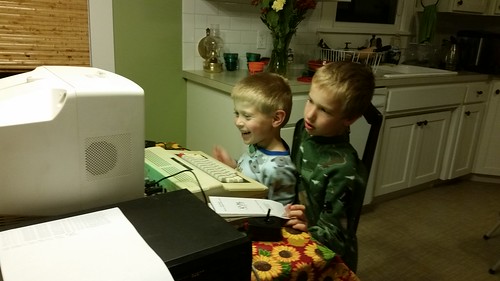
Yesterday, Jacob (age 8) asked to help me put together a 30-year-old computer from parts in my basement. Meanwhile, Oliver (age 5) asked Laura to help him learn cursive. Somehow, this doesn t seem odd for a Saturday at our place. 2014-11-22 18.58.36 Let me tell you how this came about. I ve had a project going on for a while now to load data from old floppies. It s been fun, and had a surprise twist the other day: my parents gave me an old TRS-80 Color Computer II (aka CoCo 2 ). It was, in fact, my first computer, one they got for me when I was in Kindergarten. It is nearly 30 years old. I have been musing lately about the great disservice Apple did the world by making computers easy to learn namely the fact that few people ever bother to learn about them. Who bothers to learn about them when, on the iPhone for instance, the case is sealed shut, the lifespan is 1 or 2 years for many purchasers, and the platform is closed in lots of ways? I had forgotten how finicky computers used to be. But after some days struggling with IDE incompatibilities, booting issues, etc., when I actually managed to get data off a machine that had last booted in 1999, I had quite the sense of accomplishment, which I rarely have lately. I did something that was hard to do in a world where most of the interfaces don t work with equipment that old (even if nominally they are supposed to.) The CoCo is one of those computers normally used with a floppy drive or cassette recorder to store programs. You type DIR, and you feel the clack of the drive heads through the desk. You type CLOAD and you hear the relay click closed to turn on the tape motor. You wiggle cables around until they make contact just right. You power-cycle for the times when the reset button doesn t quite do the job. The details of how it works aren t abstracted away by innumerable layers of controllers, interfaces, operating system modules, etc. It s all right there, literally vibrating your desk. So I thought this could be a great opportunity for Jacob to learn a few more computing concepts, such as the difference between mass storage and RAM, plus a great way to encourage him to practice critical thinking. So we trekked down to the basement and came up with handfulls of parts. We brought up the computer, some joysticks, all sorts of tangled cables. We needed adapters, an old TV. Jacob helped me hook everything up, and then the moment of truth: success! A green BASIC screen! I added more parts, but struck out when I tried to connect the floppy drive. The thing just wouldn t start up right whenever the floppy controller cartridge was installed. I cleaned the cartridge. I took it apart, scrubbed the contacts, even did a re-seat of the chips. No dice. So I fired up my CoCo emulator (xroar), and virtually saved some programs to cassette (a .wav file). I then burned those .wav files to an audio CD, brought up an old CD player from the basement, connected the cassette in plug to the CD player s headphone jack, and presto instant programs. (Well, almost. It takes a couple of minutes to load a program from audio codes.) The picture above is Oliver cackling at one of the very simplest BASIC programs there is: number find. The computer picks a random number between 1 and 2000, and asks the user to guess it, giving a too low or too high clue with each incorrect guess. Oliver delighted in giving invalid input (way too high numbers, or things that weren t numbers at all) and cackled at the sarcastic error messages built into the program. During Jacob s turn, he got very serious about it, and is probably going to be learning about how to calculate halfway points before too long. But imagine my pride when this morning, Jacob found the new CD I had made last night (correcting a couple recordings), found my one-line instruction on just part of how to load a program, and correctly figured out by himself all the steps to do in order (type CLOAD on the CoCo, advance the CD to the proper track, press play on the player, wait for it to load on the CoCo, then type RUN). I ordered a replacement floppy controller off eBay tonight, and paid $5 for a coax adapter that should fix some video quality issues. I rescued some 5.25 floppies from my trash can from another project, so they should have plenty of tools for exploration. It is so much easier for them to learn how a disk drive works, and even what the heck a track is, when you can look at a floppy drive with the cover off and see the heads move. There are other things we can do with more modern equipment Jacob has shown a lot of interest in Arduino projects but I have so far drawn a blank on ways to really let kids discover how a modern PC (let alone a modern phone or tablet) works. Update Nov. 24: Every so often, the world surprises me by deciding to, well, read one of my random blog posts. For the benefit of those of you that don t already know my boys, you might want to know that among their common play activites are turning trees into pretend trains, typing at a manual typewriter, reading, writing their own books, using a cassette recorder, building a PC and learning to use bash or xmonad, making long paper tapes with an adding machine, playing records on a record player, building electric gizmos, and even making mud balls. I am often asked about the role of the computer in the lives, given that my hobby and profession involves computers. The answer: less than that of most of their peers. I look for opportunities for them to learn by doing, discovering, playing, or imagining. I make no presumption that they will develop the passion for computers that I did. What I want is for them to have the curiosity and drive to learn everything there is to know about whatever they do develop a passion for, so they will be great at it.

23 November 2014

Matthew Palmer: You stay classy, Uber

You may have heard that Uber has been under a bit of fire lately for its desires to hire private investigators to dig up dirt on journalists who are critical of Uber. From using users ride data for party entertainment, putting the assistance dogs of blind passengers in the trunk, adding a surcharge to reduce the number of dodgy drivers, or even booking rides with competitors and then cancelling, or using the ride to try and convince the driver to change teams, it s pretty clear that Uber is a pretty good example of how companies are inherently sociopathic. However, most of those examples are internal stupidities that happened to be made public. It s a very rare company that doesn t do all sorts of shady things, on the assumption that the world will never find out about them. Uber goes quite a bit further, though, and is so out-of-touch with the world that it blogs about analysing people s sexual activity for amusement. You ll note that if you follow the above link, it sends you to the Wayback Machine, and not Uber s own site. That s because the original page has recently turned into a 404. Why? Probably because someone at Uber realised that bragging about how Uber employees can amuse themselves by perving on your one night stands might not be a great idea. That still leaves the question open of what sort of a corporate culture makes anyone ever think that inspecting user data for amusement would be a good thing, let alone publicising it? It s horrific. Thankfully, despite Uber s fairly transparent attempt at whitewashing ( clearwashing ?), the good ol Wayback Machine helps us to remember what really went on. It would be amusing if Uber tried to pressure the Internet Archive to remove their copies of this blog post (don t bother, Uber; I ve got a Save As button and I m not afraid to use it). In any event, I ve never used Uber (not that I ve got one-night stands to analyse, anyway), and I ll certainly not be patronising them in the future. If you re not keen on companies amusing themselves with your private data, I suggest you might consider doing the same.

22 November 2014

Jonathan Wiltshire: Getting things into Jessie (#7)

Keep in touch We don t really have a lot of spare capacity to check up on things, so if we ask for more information or send you away to do an upload, please stay in touch about it. Do remove a moreinfo tag if you reply to a question and are now waiting for us again. Do ping the bug if you get a green light about an upload, and have done it. (And remove moreinfo if it was set.) Don t be afraid of making sure we re aware of progress.
Getting things into Jessie (#7) is a post from: jwiltshire.org.uk Flattr

21 November 2014

Joey Hess: propelling containers

Propellor has supported docker containers for a "long" time, and it works great. This week I've worked on adding more container support. docker containers (revisited) The syntax for docker containers has changed slightly. Here's how it looks now:
example :: Host
example = host "example.com"
    & Docker.docked webserverContainer
webserverContainer :: Docker.Container
webserverContainer = Docker.container "webserver" "joeyh/debian-stable"
    & os (System (Debian (Stable "wheezy")) "amd64")
    & Docker.publish "80:80"
    & Apt.serviceInstalledRunning "apache2"
    & alias "www.example.com"
That makes example.com have a web server in a docker container, as you'd expect, and when propellor is used to deploy the DNS server it'll automatically make www.example.com point to the host (or hosts!) where this container is docked. I use docker a lot, but I have drank little of the Docker KoolAid. I'm not keen on using random blobs created by random third parties using either unreproducible methods, or the weirdly underpowered dockerfiles. (As for vast complicated collections of containers that each run one program and talk to one another etc ... I'll wait and see.) That's why propellor runs inside the docker container and deploys whatever configuration I tell it to, in a way that's both replicatable later and lets me use the full power of Haskell. Which turns out to be useful when moving on from docker containers to something else... systemd-nspawn containers Propellor now supports containers using systemd-nspawn. It looks a lot like the docker example.
example :: Host
example = host "example.com"
    & Systemd.persistentJournal
    & Systemd.nspawned webserverContainer
webserverContainer :: Systemd.Container
webserverContainer = Systemd.container "webserver" chroot
    & Apt.serviceInstalledRunning "apache2"
    & alias "www.example.com"
  where
    chroot = Chroot.debootstrapped (System (Debian Unstable) "amd64") Debootstrap.MinBase
Notice how I specified the Debian Unstable chroot that forms the basis of this container. Propellor sets up the container by running debootstrap, boots it up using systemd-nspawn, and then runs inside the container to provision it. Unlike docker containers, systemd-nspawn containers use systemd as their init, and it all integrates rather beautifully. You can see the container listed in systemctl status, including the services running inside it, use journalctl to examine its logs, etc. But no, systemd is the devil, and docker is too trendy... chroots Propellor now also supports deploying good old chroots. It looks a lot like the other containers. Rather than repeat myself a third time, and because we don't really run webservers inside chroots much, here's a slightly different example.
example :: Host
example = host "mylaptop"
    & Chroot.provisioned (buildDepChroot "git-annex")
buildDepChroot :: Apt.Package -> Chroot.Chroot
buildDepChroot pkg = Chroot.debootstrapped system Debootstrap.BuildD dir
    & Apt.buildDep pkg
  where
    dir = /srv/chroot/builddep/"++pkg
   system = System (Debian Unstable) "amd64"
Again this uses debootstrap to build the chroot, and then it runs propellor inside the chroot to provision it (btw without bothering to install propellor there, thanks to the magic of bind mounts and completely linux distribution-independent packaging). In fact, the systemd-nspawn container code reuses the chroot code, and so turns out to be really rather simple. 132 lines for the chroot support, and 167 lines for the systemd support (which goes somewhat beyond the nspawn containers shown above). Which leads to the hardest part of all this... debootstrap Making a propellor property for debootstrap should be easy. And it was, for Debian systems. However, I have crazy plans that involve running propellor on non-Debian systems, to debootstrap something, and installing debootstrap on an arbitrary linux system is ... too hard. In the end, I needed 253 lines of code to do it, which is barely one magnitude less code than the size of debootstrap itself. I won't go into the ugly details, but this could be made a lot easier if debootstrap catered more to being used outside of Debian. closing Docker and systemd-nspawn have different strengths and weaknesses, and there are sure to be more container systems to come. I'm pleased that Propellor can add support for a new container system in a few hundred lines of code, and that it abstracts away all the unimportant differences between these systems. PS Seems likely that systemd-nspawn containers can be nested to any depth. So, here's a new kind of fork bomb!
infinitelyNestedContainer :: Systemd.Container
infinitelyNestedContainer = Systemd.container "evil-systemd"
    (Chroot.debootstrapped (System (Debian Unstable) "amd64") Debootstrap.MinBase)
    & Systemd.nspawned infinitelyNestedContainer
Strongly typed purely functional container deployment can only protect us against a certian subset of all badly thought out systems. ;)

Richard Hartmann: Release Critical Bug report for Week 47

There's a BSP this weekend. If you're interested in remote participation, please join #debian-muc on irc.oftc.net. The UDD bugs interface currently knows about the following release critical bugs: How do we compare to the Squeeze release cycle?
Week Squeeze Wheezy Jessie
43 284 (213+71) 468 (332+136) 319 (240+79)
44 261 (201+60) 408 (265+143) 274 (224+50)
45 261 (205+56) 425 (291+134) 295 (229+66)
46 271 (200+71) 401 (258+143) 427 (313+114)
47 283 (209+74) 366 (221+145) 342 (260+82)
48 256 (177+79) 378 (230+148)
49 256 (180+76) 360 (216+155)
50 204 (148+56) 339 (195+144)
51 178 (124+54) 323 (190+133)
52 115 (78+37) 289 (190+99)
1 93 (60+33) 287 (171+116)
2 82 (46+36) 271 (162+109)
3 25 (15+10) 249 (165+84)
4 14 (8+6) 244 (176+68)
5 2 (0+2) 224 (132+92)
6 release! 212 (129+83)
7 release+1 194 (128+66)
8 release+2 206 (144+62)
9 release+3 174 (105+69)
10 release+4 120 (72+48)
11 release+5 115 (74+41)
12 release+6 93 (47+46)
13 release+7 50 (24+26)
14 release+8 51 (32+19)
15 release+9 39 (32+7)
16 release+10 20 (12+8)
17 release+11 24 (19+5)
18 release+12 2 (2+0)
Graphical overview of bug stats thanks to azhag:

Jonathan Wiltshire: On kFreeBSD and FOSDEM

Boy I love rumours. Recently I ve heard two, which I ought to put to rest now everybody s calmed down from recent events. kFreeBSD isn t an official Jessie architecture because <insert systemd-related scare story> Not true. Our sprint at ARM (who kindly hosted and caffeinated us for four days) was timed to coincide with the Cambridge Mini-DebConf 2014. The intention was that this would save on travel costs for those members of the Release Team who wanted to attend the conference, and give us a jolly good excuse to actually meet up. Winners all round. It also had an interesting side-effect. The room we used was across the hall from the lecture theatre being used as hack space and, later, the conference venue, which meant everybody attending during those two days could see us locked away there (and yes, we were in there all day for two days solid, except for lunch times and coffee missions). More than one conference attendee remarked to me in person that it was interesting for them to see us working (although of course they couldn t hear what we were discussing), and hadn t appreciated before that how much time and effort goes into our meetings. Most of our first morning was taken up with the last pieces of architecture qualification, and that was largely the yes/no decision we had to make about kFreeBSD. And you know what? I don t recall us talking about systemd in that context at all. Don t forget kFreeBSD already had a waiver for a reduced scope in Jessie because of the difficulty in porting systemd to it. It s sadly impossible to capture the long and detailed discussion we had into a couple of lines of status information in a bits mail. If bits mails were much longer, people would be put off reading them, and we really really want you to take note of what s in there. The little space we do have needs to be factual and to the point, and not include all the background that led us to a decision. So no, the lack of an official Jessie release of kFreeBSD has very little, if anything, to do with systemd. Jessie will be released during (or even before) FOSDEM Not necessarily true. Debian releases are made when they re ready. That sets us apart from lots of other distributions, and is a large factor in our reputation for stability. We may have a target date in mind for a freeze, because that helps both us and the rest of the project plan accordingly. But we do not have a release date in mind, and will not do so until we get much closer to being ready. (Have you squashed an RC bug today?) I think this rumour originated from the office of the DPL, but it s certainly become more concrete than I think Lucas intended. However, it is true that we ve gone into this freeze with a seriously low bug count, because of lots of other factors. So it may indeed be that we end up in good enough shape to think about releasing near (or even at) FOSDEM. But rest assured, Debian 8 Jessie will be released when it s ready, and even we don t know when that will be yet. (Of course, if we do release before then, you could consider throwing us a party. Plenty of the Release Team, FTP masters and CD team will be at FOSDEM, release or none.)
On kFreeBSD and FOSDEM is a post from: jwiltshire.org.uk Flattr

Gunnar Wolf: Status of the Debian OpenPGP keyring November update

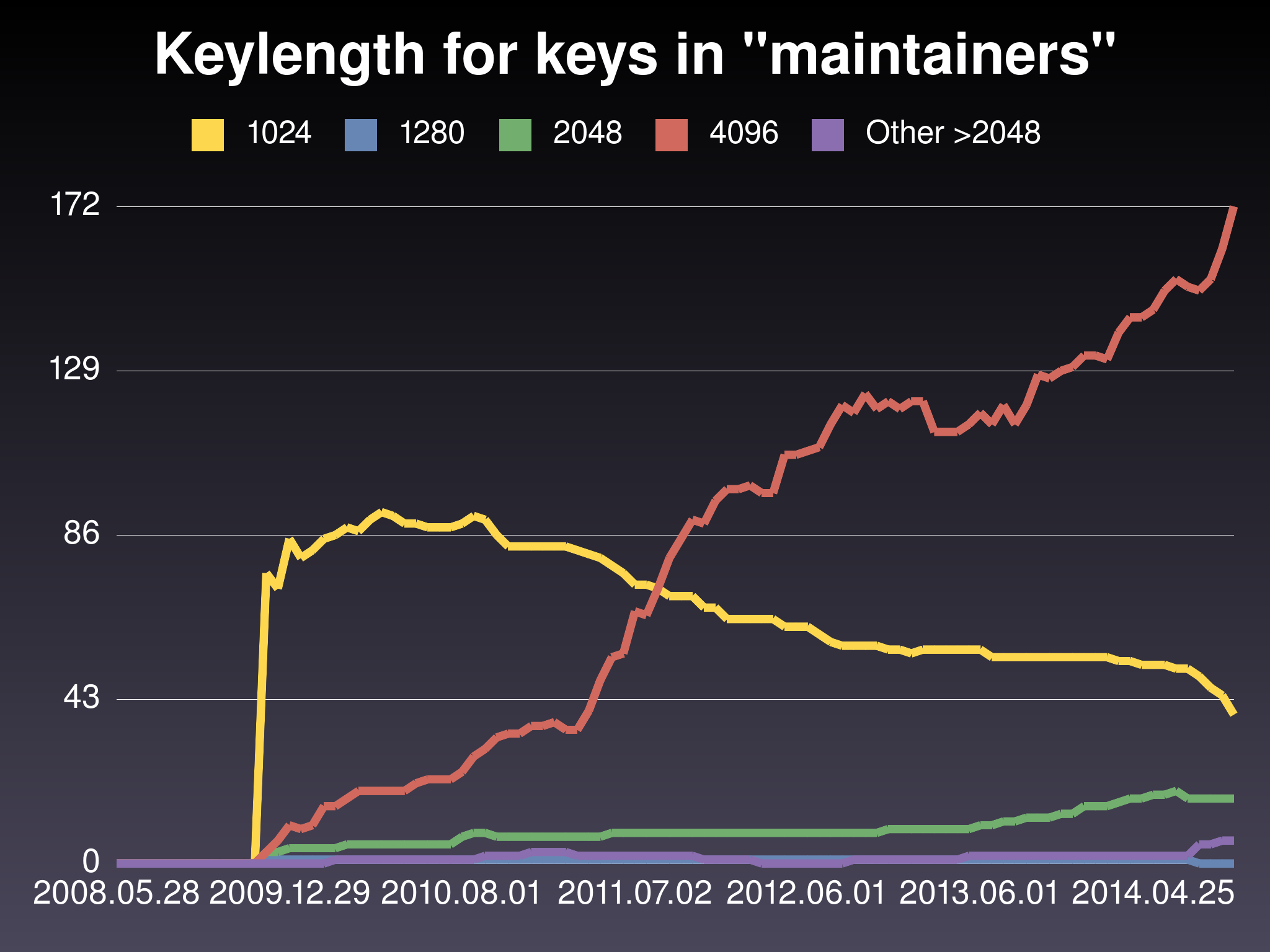
Almost two months ago I posted our keyring status graphs, showing the progress of the transition to >=2048-bit keys for the different active Debian keyrings. So, here are the new figures. First, the Non-uploading keyring: We were already 100% transitioned. You will only notice a numerical increase: That little bump at the right is our dear friend T ssia finally joining as a Debian Developer. Welcome! \o/ As for the Maintainers keyring: We can see a sharp increase in 4096-bit keys. Four 1024-bit DM keys were migrated to 4096R, but we did have eight new DMs coming in To them, also, welcome \o/. Sadly, we had to remove a 1024-bit key, as Peter Miller sadly passed away. So, in a 234-key universe, 12 new 4096R keys is a large bump! Finally, our current-greatest worry If for nothing else, for the size of the beast: The active Debian Developers keyring. We currently have 983 keys in this keyring, so it takes considerably more effort to change it. But we have managed to push it noticeably. This last upload saw a great deal of movement. We received only one new DD (but hey welcome nonetheless! \o/ ). 13 DD keys were retired; as one of the maintainers of the keyring, of course this makes me sad but then again, in most cases it's rather an acknowledgement of fact: Those keys' holders often state they had long not been really involved in the project, and the decision to retire was in fact timely. But the greatest bulk of movement was the key replacements: A massive 62 1024D keys were replaced with stronger ones. And, yes, the graph changed quite abruptly: We still have a bit over one month to go for our cutoff line, where we will retire all 1024D keys. It is important to say we will not retire the affected accounts, mark them as MIA, nor anything like that. If you are a DD and only have a 1024D key, you will still be a DD, but you will be technically unable to do work directly. You can still upload your packages or send announcements to regulated mailing lists via sponsor requests (although you will be unable to vote). Speaking of votes: We have often said that we believe the bulk of the short keys belong to people not really active in the project anymore. Not all of them, sure, but a big proportion. We just had a big, controversial GR vote with one of the highest voter turnouts in Debian's history. I checked the GR's tally sheet, and the results are interesting: Please excuse my ugly bash, but I'm posting this so you can play with similar runs on different votes and points in time using the public keyring Git repository:
  1. $ git checkout 2014.10.10
  2. $ for KEY in $( for i in $( grep '^V:' tally.txt
  3. awk ' print "<" $3 ">" ' )
  4. do
  5. grep $i keyids cut -f 1 -d ' '
  6. done )
  7. do
  8. if [ -f debian-keyring-gpg/$KEY -o -f debian-nonupload-gpg/$KEY ]
  9. then
  10. gpg --keyring /dev/null --keyring debian-keyring-gpg/$KEY \
  11. --keyring debian-nonupload-gpg/$KEY --with-colons \
  12. --list-key $KEY 2>/dev/null \
  13. head -2 tail -1 cut -f 3 -d :
  14. fi
  15. done sort uniq -c
  16. 95 1024
  17. 13 2048
  18. 1 3072
  19. 371 4096
  20. 2 8192
So, as of mid-October: 387 out of the 482 votes (80.3%) were cast by developers with >=2048-bit keys, and 95 (19.7%) were cast by short keys. If we were to run the same vote with the new active keyring, 417 votes would have been cast with >=2048-bit keys (87.2%), and 61 with short keys (12.8%). We would have four less votes, as they retired:
  1. 61 1024
  2. 14 2048
  3. 2 3072
  4. 399 4096
  5. 2 8192
So, lets hear it for November/December. How much can we push down that pesky yellow line? Disclaimer: Any inaccuracy due to bugs in my code is completely my fault!

Daniel Pocock: PostBooks 4.7 packages available, xTupleCon 2014 award

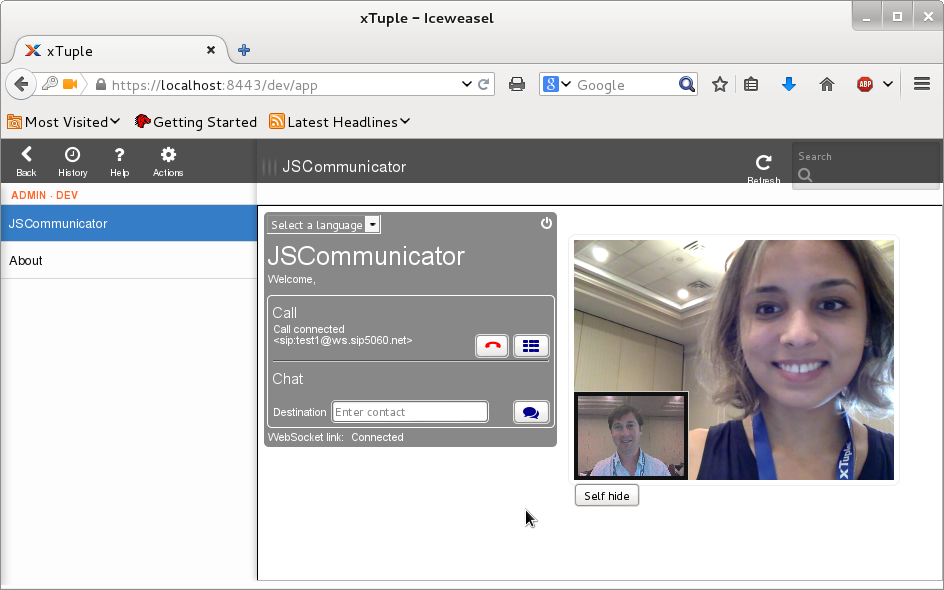
I recently updated the PostBooks packages in Debian and Ubuntu to version 4.7. This is the version that was released in Ubuntu 14.10 (Utopic Unicorn) and is part of the upcoming Debian 8 (jessie) release. Better prospects for Fedora and RHEL/CentOS/EPEL packages As well as getting the packages ready, I've been in contact with xTuple helping them generalize their build system to make packaging easier. This has eliminated the need to patch the makefiles during the build. As well as making it easier to support the Debian/Ubuntu packages, this should make it far easier for somebody to create a spec file for RPM packaging too. Debian wins a prize While visiting xTupleCon 2014 in Norfolk, I was delighted to receive the Community Member of the Year award which I happily accepted not just for my own efforts but for the Debian Project as a whole. Steve Hackbarth, Director of Product Development at xTuple, myself and the impressive Community Member of the Year trophy This is a great example of the productive relationships that exist between Debian, upstream developers and the wider free software community and it is great to be part of a team that can synthesize the work from so many other developers into ready-to-run solutions on a 100% free software platform. Receiving this award really made me think about all the effort that has gone into making it possible to apt-get install postbooks and all the people who have collectively done far more work than myself to make this possible: Here is a screenshot of the xTuple web / JSCommunicator integration, it was one of the highlights of xTupleCon: and gives a preview of the wide range of commercial opportunities that WebRTC is creating for software vendors to displace traditional telecommunications providers. xTupleCon also gave me a great opportunity to see new features (like the xTuple / Drupal web shop integration) and hear about the success of consultants and their clients deploying xTuple/PostBooks in various scenarios. The product is extremely strong in meeting the needs of manufacturing and distribution and has gained a lot of traction in these industries in the US. Many of these features are equally applicable in other markets with a strong manufacturing industry such as Germany or the UK. However, it is also flexible enough to simply disable many of the specialized features and use it as a general purpose accounting solution for consulting and services businesses. This makes it a good option for many IT freelancers and support providers looking for a way to keep their business accounts in a genuinely open source solution with a strong SQL backend and a native Linux desktop interface.

Next.

Previous.