Search Results: "dom"

3 January 2007

Lars Wirzenius: Random thought: "You write free software, therefore you..."

In a discussion on a mailing list, on a topic that isn't relevant to this log entry, someone wrote: "I just have expectations that if there is going to be progress in the [civil liberties/equality issue], that the 'Free' software world would be at the forefront of that effort". This is a common mistake. The thing that unites the free software developers, and the only thing that unites us, is that we make free software. Even though many of the us are liberal, or libertarian, or "leftist", or "green", or whatever you perceive as the common trait, it is wrong to assume all of us are. Some free software developers are very much "leftist", to the extent of being members of the communist party. Some are stout, Bush-voting Republicans. A couple are neo-Nazis. Some are worried about global warming; others are working full time to prove it isn't happening. ESR has a gun fetish, I'm nervous even of policemen carrying guns. All free software developers aren't even united in their opinions on matters that affect free software development directly. Some organize campaigns against software patents, others (although admittedly very few) apply for them. I'm a free software developer and the only thing about me you can deduce from that is that I develop free software.

Andreas Schuldei: GTD software, Work meetings

Since I am on "maternity leave" now and basicly run the household and try to keep the children entertained, my time to get things done is randomly fragmented and I want to plan the things better that I have on the plate. Liw's blog post reminded me of GTD and today I was looking for planning tools. On Wikipedia's GTD page they mention two: A Firefox plugin to use with gmail (and therefor everywhere where I would have internet) and ThinkingRock, a java app which aparently would fit on a USB key. Of course i wonder which one might be better? The ThinkingRock one seems to be a heavy weight GTD tool. Does that spoil GTD's light weight character? I watched the demos and it seems to be pretty feature complete. I would like to hear from people who use GTD and am interested in their oppinions. Thanks!

Debian Work Meetings - Extremadura evaluation
8 people already managed to send in their evaluations or feedback mails to me regarding the Extremadura work meetings. That is surprisingly few, given the fact that we had 6 meetings with an average of 20 people. And so far I got only one reply from someone who could not attend eventhough she was very interested, explaining why (different continent, too far, too expensive) etc. I had expected more replies in that category, given that we had mostly europeans coming to Extremadura and I had intended to spread out future meetings over the globe more evenly. So I ask both those that attended and did not manage to send in some evaluation and also those that would have liked to come and could not to mail me!

Marc 'Zugschlus' Haber: New DNS setup getting productive

For nearly two years, I have been pondering about a good and failure-resilient DNS setup to implement for my own domains. In the last days, I have set the first prototype into use. No, I haven’t dared to touch zugschlus.de, my most important domain, yet. This is planned for the weekend. So, if you experience difficulties in accessing any of my Internet services, please inform me and allow me to fix the issue. However, zugschl.us, marc-haber.de and a number of less important test domains have already been moved to the new, svn-driven Scheme and delegation has been changed to the new DNS servers, dns1.nosuid.net, dns2.notwork.de and dns3.mxonly.de. q.bofh.de, my old main DNS server, continues to run as a slave for a transition period, and it continues to feed the slave servers run by various commercial and non-commercial entities that have kindly been serving the zones in the last years. The new servers are all run by myself. dns1 and dns2 are dedicated servers (“real” machines that both have other duties as well) located at two different ISPs/hosters located in different parts of Germany, while dns3 is a vServer located in the US (which only does DNS due to its rather severely limited amount of memory). The three domains the servers are located in are in two different top level domains, are registered through two different registrars and are not used for anything besides DNS (and providing the host name for ivanova.notwork.de, one of the DNS servers and the machine hosting this blog). The two .de-Domains mxonly.de and notwork.de are MX only domains, which means that they are not delegated outside of the .de zone but their resource records are directly written to the .de TLD zone. This reduces the chance of the domains becoming unavailable due to failures in the delegated servers (because there are none), and we depend on .de being available anyway. A downside of MX only domains is that the number of registrars that support them through their automatisms is rather limited. The .net zone is served by the registrar’s name servers since .de is the only TLD I know of that has reasonable prices and offers MX only domains. One can argument that the .net zone is a weak point here, but I suspect that I’m reasonably safe with the MX only .de domains that the .net domain is only a paranoid safety catch anyway.

Uwe Hermann: 23C3 - Day 2, 3, 4

Sputnik A bit late, but here are some more random notes from 23C3:

Lars Wirzenius: Random thought: A touch of neophilia

I'm not going to make any New Year's resolutions this year. I will, however, use the New Year as an excuse to re-think many things in my life. To start with, I have re-subscribed to several Debian mailing lists, even debian-private. A second new thing is that I have a new toy, an iRobot Roomba GR. In other words, an automatic vacuum cleaner. I used it for the first time today, and it was hilariously funny. Not excessively expensive, either. A third new thing is that I re-installed my laptop, with the Debian-Installer daily build from 2006-12-31. It worked like a charm. The old installation on this laptop had deteriorated over several months, as I did unspeakably evil things to it, so starting from fresh was a bit of a relief. Now I have an encrypted hard disk, and a working suspend and hibernation (suspend-to-ram and suspend-to-disk), apart from the backlight not coming back on automatically after resume. Yay! Etch is going to totally rock. A fourth new thing is that I switched over my web log from CVS to Bazaar (bzr). It was the last vestige of my youth. When I was a child, I used RCS. When I was young, I used CVS. Now in my old age, I use Bazaar, because it is comfortable. Incidentally, Notetak is up to version 0.4, and I'm getting comfortable with it, too. I'm going to experiment with adding tags to notes. I don't yet have an idea what would be a good UI design for that, but it will come to me eventually. New things are good, even for neophobic luddites like myself.

Russell Coker: Xen shared storage

disk = [ 'phy:/dev/vg/xen1,hda,w', 'phy:/dev/vg/xen1-swap,hdb,w', 'phy:/dev/vg/xen1-drbd,hdc,w', 'phy:/dev/vg/san,hdd,w!' ]

For some work that I am doing I am trying to simulate a cluster that uses fiber channel SAN storage (among other things). The above is the disk line I'm using for one of my cluster nodes, hda and hdb are the root and swap disks for a cluster node, hdc is a DRBD store (DRBD allows a RAID-1 to be run across the cluster nodes via TCP), and hdd is a SAN volume. The important thing to note is the "w!" mode for the device, this means write access is granted even in situations whre Xen thinks it's unwise (IE it's being used by another Xen node or is mounted on the dom0). I've briefly tested this by making a filesystem on /dev/hdd on one node, copying data to it, then umounting it and mounting it on another node to read the data.

There are some filesystems that support having multiple nodes mounting the same device at the same time, these include CXFS, GFS, and probably some others. It would be possible to run one of those filesystems across nodes of a Xen cluster. However that isn't my aim at this time. I merely want to have one active node mount the filesystem while the others are on standby.

One thing that needs to be solved for Xen clusters is fencing. When a node of a cluster is misbehaving it needs to be denied access to the hardware in case it recovers some hours later and starts writing to a device that is now being used by another node. AFAIK the only way of doing this is via the xm destroy command. Probably the only way of doing this is to have a cluster node ssh to the dom0 and then run a setuid program that calls xm destroy.

Russell Coker: multiple ethernet devices in Xen

It seems that no-one has documented what needs to be done to correctly run multiple Ethernet devices (with one always being eth0 and the other always being eth1) in a Linux Xen configuration (or if it is documented then google wouldn't find it for me).

vif = [ 'mac=00:16:3e:00:01:01', 'mac=00:16:3e:00:02:01, bridge=xenbr1' ]

Firstly I use a vif line such as the above in the Xen configuration. This means that there is one ethernet device with the hardware address of 00:16:3e:00:01:01 and another with the address of 00:16:3e:00:02:01. I just updated this section, the 00:16:3e prefix has officially been allocated to the Xen project for virtual machines. Therefore on your Xen installation you can do whatever you like with MAC addresses in that range without risk of competing with real hardware. The Xen code uses random MAC addresses in that range if you let it.

I have two bridge devices, xenbr0 and xenbr1. I only need to specify one as Xen can figure the other out.

Now when my domU's boot they assign ethernet device names from the range eth0 to eth8. If there is only one virtual Ethernet device then it is always eth0 and things are easy. But for multiple devices I need to rename the interfaces.

eth0 mac 00:16:3e:00:01:01
eth1 mac 00:16:3e:00:02:01

This is done through the ifrename program (package name ifrename in Debian). I create a file named /etc/iftab with the above contents and then early in the boot process (before the interfaces are brought up) the devices will be renamed.

In the Red Hat model you edit the files such as /etc/sysconfig/networking/devices/ifcfg-eth0 and change the line that starts with HWADDR to cause a device rename on boot.

Update: the original version of this post used MAC addresses with a prefix of 00:00:00, the officially allocated prefix for Xen is 00:16:3e which I now use. Thanks to the person who commented about this.

2 January 2007

Thijs Kinkhorst: On Cross Site Request Forgeries

Web applications suffer from a lot of security issues. This may be attributed in part to the ease of use of the most popular web scripting language, but I think the most important cause is that it's inherently easier to exploit web applications. They run in a browser that will run JavaScript code that has access to login data when any small piece of information hasn't been explicitly sanitised. While one would not recognise copy-pasting rm -rf / from a web page into a terminal as a security issue, when a web application user clicks a malicious link it is, because these links can be obscured in various ways. A relatively new issue is the Cross Site Request Forgery (CSRF/XSRF). In short: a malicious site has a hidden form that POSTs to the web application. If the user presses some harmless-looking button, it will be submitted to the original web application which then accepts it because the user has the right cookie. There have been lots of web applications that have introduced some kind of shield against CSRF, mostly it boils down to the form having a random string inserted which is checked upon form submission. I do not think that this is sufficient: it will fend off the most simple attacks, but an attacker investing a little more time can use things like AJAX to request the form from the remote website, get the random string out of it and put it into the malicious form. Won't this kind of "protection" only provide a false sense of security? Is there a technique that web application developers can use to to thoroughly prevent CSRF with their app?

1 January 2007

Russell Coker: installing Xen domU on Debian Etch

I have just been installing a Xen domU on Debian Etch. I'll blog about installing dom0 later when I have a test system that I can re-install on (my production Xen machines have the dom0 set up already). The following documents a basic Xen domU (virtual machine) installation that has an IP address in the 10.0.0.0/8 private network address space and masquerades outbound network data. It is as general as possible.

lvcreate -n xen1 -L 2G /dev/vg

Firstly use the above command to create a block device for the domU, this can be a regular file but a LVM block device gives better performance. The above command is for a LV named xen1 on an LVM Volume Group named vg.

mke2fs -j /dev/vg/xen1

Then create the filesystem with the above command.

mount /dev/vg/xen1 /mnt/tmp
mount -o loop /tmp/debian-testing-i386-netinst.iso /mnt/cd
cd /mnt/tmp
debootstrap etch . file:///mnt/cd/
chroot . bin/bash
vi /etc/apt/sources.list
/etc/hosts /etc/hostname
apt-get update
apt-get install libc6-xen
linux-image-xen-686 openssh-server
apt-get dist-upgrade

Then perform the basic Debian install with the above commands. Make sure that you change to the correct directory before running the debootstrap command. The /etc/hosts and /etc/hostname files need to be edited to have the correct contents for the Xen image (the default is an empty /etc/hosts and /etc/hostname has the name of the parent machine). The file /etc/apt/sources.list needs to have the appropriate configuration for the version of Debian you use and for your preferred mirror. libc6-xen is needed to stop a large number of kernel warning messages on boot. It's a little bit of work before you get the virtual machine working on the network so it's best to do these commands (and other package installs) before the following steps. After the above type exit to leave the chroot and run umount /mnt/tmp.

lvcreate -n xen1-swap -L 128M /dev/vg
mkswap /dev/vg/xen1-swap

Create a swap device with the above commands.

auto xenbr0
iface xenbr0 inet static
pre-up brctl addbr xenbr0
post-down brctl delbr xenbr0
post-up iptables -t nat -F
post-up iptables -t nat -A POSTROUTING -o eth0 -s 10.1.0.0/24 -j MASQUERADE
address 10.1.0.1
netmask 255.255.255.0
bridge_fd 0
bridge_hello 0
bridge_stp off

Add the above to /etc/network/interfaces and use the command ifup xenbr0 to enable it. Note that this masquerades all outbound data from the machine that has a source address in the 10.1.0.0/24 range.

net.ipv4.conf.default.forwarding=1

Put the above in /etc/sysctl.conf, run sysctl -p and echo 1 > /proc/sys/net/ipv4/conf/all/forwarding to enable it.

cp /boot/initrd.img-2.6.18-3-xen-686 /boot/xen-initrd-18-3.gz

Set up an initial initrd (actually initramfs) for the domU with a command such as the above. Once the Xen domU is working you can create the initrd from within it which gives a smaller image.

kernel = "/boot/vmlinuz-2.6.18-3-xen-686"
ramdisk = "/boot/xen-initrd-18-3.gz"
memory = 64
name = "xen1"
vif = [ '' ]
disk = [ 'phy:/dev/vg/xen1,hda,w', 'phy:/dev/vg/xen1-swap,hdb,w' ]
root = "/dev/hda ro"
extra = "2 selinux=1 enforcing=0"

The above is a sample Xen config file that can go in /etc/xen/xen1. Note that this will discover an appropriate bridge device by default, if you only plan to have one bridge then it's quite safe, if you want multiple bridges then things will be a little more complex. Also note that there are two block devices created as /dev/hda and /dev/hdb, obviously if we wanted to have a dozen block devices then we would want to make them separate partitions with a virtual partition table. But in most cases a domU will be a simple install and won't need more than two block devices.

xm create -c xen1

Now start the Xen domU with the above command. The -c option means to take the Xen console (use ^] to detach). After that you can login as root at the Xen console with no password, now is a good time to set the password.

Run the command apt-get install udev, this could not be done in the chroot before as it might mess up the dom0 environment. Edit /etc/inittab and disable gettys on tty2 to tty6, I don't know if it's possible to use them (the default and only option for xen console commands is tty1) and in any case you would not want 6, saving a few getty processes will save some memory.

Now you should have a basically functional Xen domU. Of course a pre-requisite for this is having a machine with a working dom0 installation. But the dom0 part is easier (and I will document it in a future blog post).

30 December 2006

Russell Coker: more about vista security

While reading the discussion of Vista security on Bruce Schneier's blog it occurred to me that comparing the issues of DRM that face MS with the issues faced by SE Linux developers provides some benefits.

SE Linux is designed to enable the owner of a computer to effectively enforce security policies to protect their system integrity and the confidentiality of their data. Some of the SE Linux users (military users) use all the available features, but most people only use the targeted policy which provides a sub-set of the system integrity and data confidentiality protections that are available to give a greater ease of use.

Fedora and Red Hat Enterprise Linux ship with the SE Linux targeted policy enabled by default. This policy is not something that most users notice. The main program that is commonly used which might have an issue with the default SE Linux policy is Apache. Fedora and RHEL systems that do not run Apache (which is most of them) can run SE Linux with almost no costs.
setsebool -P httpd_disable_trans 1
/etc/init.d/httpd restart
It seems clear to me that there is no good reason for disabling SE Linux by default. There are reasons for running a particular daemon in the unconfined_t domain via the FOO_disable_trans boolean. EG to run Apache without restrictions you would type the above commands.

In spite of the SE Linux targeted policy being so easy to use, the fact that it prevents certain daemon compromises from allowing immediate control of the system, and also prevents some kernel exploits from working, there are still some people who turn it off when installing Fedora and RHEL systems and advise others to do so.

Given this great fear of some people to use a technology that is specifically designed for their own benefit I find it difficult to imagine that any users will be inclined to accept the MS DRM technology that is specifically designed to go against their interests.

ESR claims that the 64bit transition is the critical period for Linux to move on the desktop. While he makes many interesting observations I don't find his argument convincing. Firstly current P4 CPUs with PAE can handle significantly more than 4G of RAM (64G is possible now). Secondly it's quite possible to run a 64bit kernel with 32bit applications, this means that you can use a 64bit kernel to access >64G of RAM with each 32bit application getting direct access to something slightly less than 4G of virtual memory. As ESR's point seems based on total system memory the 4G per application doesn't seem to be an issue. As an aside the only applications I've used which could benefit from >4G are database servers (in the broadest interpretation - consider an LDAP server as a database) and JVM environments. Again it would not be difficult to ship an OS with mostly 32bit code that has a 64bit kernel, JVM, and database servers.

I hope that Vista will be a good opportunity for mass transition to Linux. Vista offers little that users desire, many things that will hurt them, and is expensive too!

With Vista you pay more for the OS and more for the hardware (Vista has the usual excessive Windows hardware requirements plus the extra hardware for TPM encryption) without providing anything substantial in return.

What I want to see next is support for Security Enhanced X to protect desktop environments against hostile X clients. This will make a significant difference to the security of Linux desktop environments and provide another significant benefit for choosing Linux over Windows. While MS is spending their effort in making their OS act against the best interests of the users we will keep making Linux enforce the access controls that users need to protect their systems. Hopefully Linux users will choose to use SE-X, but if they don't they are given the freedom to make that choice - unlike the poor sods who use Windows.

29 December 2006

Evan Prodromou: 7 Niv se CCXV

I've been feeling sick since the day after Christmas. Maj says that when you push your body too hard, it gives you a cold to tell you to sit back and take it easy for a little while, fercryinoutloud. I think that's what happened to me -- almost as soon as I had some free time, I got a sore throat, body aches, stuffy sinuses, fatigue. It's been OK, though -- I've had a lot of time to sit at my parents' house, fool around on the computer without doing anything serious, and read books. I got a proposal for a new project done, and some API designs, but I also am almost finished with James Fenimore Cooper's The Pathfinder, which has been a real enjoyable book. I picked it up in Lake Placid while we were there at the beginning of the month, and I'm just getting around to finishing it. I guess I'm just getting myself on a Colonial New York kick. I've also watched about 400 episodes of It's a Big, Big World, a great kids show starring a good-natured stoner sloth and some spazzy monkeys. They deal with lots of interesting issues, but mostly the answer to their problems is, "Get over yourself, chill the hell out, and do some tai chi." Which I think is a pretty good piece of advice for everybody. tags:

Edinburgh So, I just registered for Debconf7, the 7th annual Debian conference, to be held in June 2007 in Edinburgh. I'm excited to go -- I've never been to Scotland, and I'm looking forward to the visit. Nor have I been to a Debconf before! I also submitted an abstract for a paper on the Debian Creative Commons Workgroup, a kind of extended history from the Debian Creative Commons Workgroup Report?. I want to cover the details of the relationship between Debian and CC, the history of the workgroup, and give some lessons learned from the process. I'd also like to draw some conclusions about using one of Debian's greatest assets -- our moral authority in the Free Software world -- to shape the future of FLOSS and Free Content. tags:

Mysteries of Web comics I guess there are just some things I'll never understand about the aesthetics and economics of Web comics. Like, why hasn't Patrick Farley, author of the great e-sheep comics, published anything since 2003? e-sheep is some of the most moving, intelligent, and deep work of any kind on the Internet. I'd really love to see more. Conversely, why did the lurid, absurd, and obnoxious Leisuretown go off the air entirely for a few years? And why did it come back? And if it's back, why hasn't the enigmatic Tristan A. Farnon added any new comics? Also, I still wonder if that's his given name, or if he's stuck with a BBS handle from back in the day when he thought All Creatures Great and Small was really cool. Leisuretown is another of the best things on the Web -- crude, angry, existential. I really like it. tags:

28 December 2006

Norbert Tretkowski: SLES10 as a mailserver

Using SLES10 as a mailserver is a bad idea, especially when you want to use virtual users and domains with postfix, courier and mysql. Why? SLES10 ships neither a courier-authlib-mysql package, nor a postfix-mysql package, nor a maildrop package. I really wonder what the 'E' in SLES stands for...

Daniel Burrows: I'm a top contributor too!

Adrian von Bidder notes that he got a message from a random survey group asking for feedback.


[...] we analysed the debian mailing list archives, especially the debian-devel mailing list, as it is a good representation of the whole network. [...] we identified the 100 main actors and therefor came across your email address.


So, somebody who talks quite a bit on the mailing lists, but really only maintains one package is already one of the top 100 "actors" in Debian? I seriously doubt it.


It gets better. In the last couple years I've barely posted on any public Debian mailing lists at all. And yet I'm apparently also in the top 100 "actors". Say what?

27 December 2006

Lars Wirzenius: Random hacks: Notetak

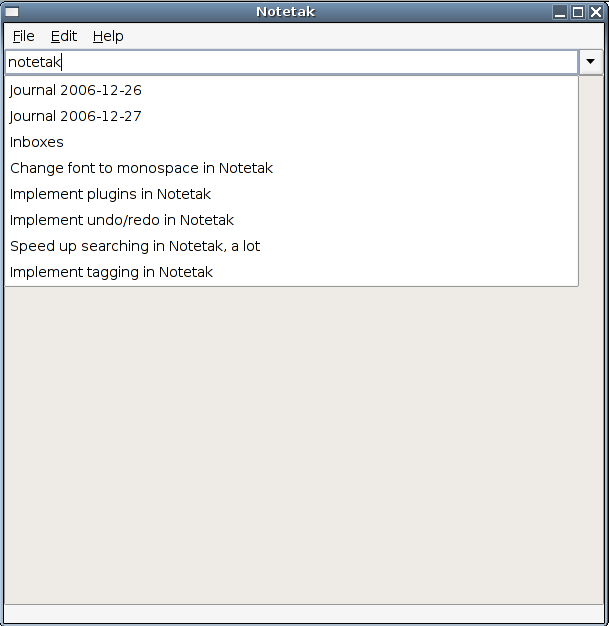
I always spend my Christmas with my parents, and for the past few years, I've always started some new little hobby hacking project or another. Three years ago I started writing a new text editor, sex.py. I still use it, although I haven't had much time to improve it further. This year, I wanted to see if I could come up with a little something to jot down random little notes easier, to keep track of said notes, and to help me manage a GTD workflow better. Last summer, I started dabbling with the "Getting Things Done" method by David Allen. It's basically a way of keeping track of things that you need to do. A bit more sophisticated than a simple todo list, without getting seriously bureaucratic or tedious. So far, whenever I follow the method, it seems to be working, although I'm not sure if it is because of using this particular method, or because I'm a method at all. GTD requires keeping a few lists of things: todo items that can be done now (assuming suitable context, but with no unfilled dependencies), todo items that might be done some day, etc. The tool I chose for this last summer is Gjots2. It's a GUI outliner tool that works adequately, but is not smooth enough to prevent me from looking at better tools. One of the things missing from Gjots2 is a good search facility. You can't do things like "show me all items containing the words 'Debian' and 'upload'", for example. Some time ago, while browsing 43Folders, I learned about a small application for MacOS X, called Notational Velocity. I don't have a Mac, so I can't try it out myself, but it works by keeping track of small text-only notes, each with a title, and has a user interface geared at searching. Instead of having a tree or a list of notes, it has a title bar where you enter some words, and it shows you a list of the notes that match those words. You can then either select something from the list, or press Enter to create a new note, with the text you entered as a title. This sounded intriguiging to me, and I thought it might be interesting to experiment with it for my note taking and GTD needs. So I spent one night at my parent's writing a first approximation of a prototype. I'm calling it Notetak.
Notetak screen shot Notetak, first prototype. The drop-down menu shows the notes that contain the word "notetak", in upper or lower case.
I've today switched from Gjots2 to Notetak, and it's already clear that it's a completely different approach to things. So far I like it, but I'll have to experiment with this for a few days or weeks to see if it really works. I'm pretty sure the basic approach would benefit from having additional tags for notes, or possibly having stored searches. I keep finding myself searching for, say, "@next" a lot to get a list of GTD next actions. The source (and a preliminary .deb) is on my home page, in case you're interested. Please note (ahem) that this is highly experimental and may eat your data. I may abandon it at any moment, if I decide that it's not worth it, but if not, it might also change frequently. If you do use it, I'd be happy to receive any bug reports, suggestions for improvements, and patches you may come up with.

26 December 2006

Biella Coleman: Free Science, Free Culture

When I was on the job market last year, by far the toughest hurdle was convincing interviewing eyes and ears that my hacker and survivor project were connected in some fundamental ways. I think in the end, I was successful at times but it was difficult for some folks to see the connection in part because most professors knew little or zilch about survivor politics so I had to lay that ground work and then toss out the connections, which included free speech, the politics of freedom and self-determination, attacks on corporate/closed science. Now with the Zyprexa scandal and the support coming from Free Culture, these two worlds have indeed moved even closer together than before. (Thanks Jonah for pointing out).

Joey Hess: new tech for xmas

Rather than hardware, I got some software for Christmas this year. Actually, I've had the software for a while, but lacked the time to learn how to use it, so I took the time today. First was xen, which is great -- now I have many additional systems on my network, all without messing around with hardware. I'd tried to set up xen before and gave it up as needing too much work at the time, and while some of my systems, including kite, run as xen instances on systems adminned by others, I didn't feel I understood it well. Debian's xen support still has a few rough edges; I ran into issues with running out of loop devices, and was suprised that bridged networking wasn't set up by default. I also filed a lot of bugs on xen-tools (sorry Steve). But overall it wasn't particularly hard to get working, and I feel I understand it reasonably well now. I even figured out how to get pygrub fixed and working, which is spiffy -- one of my issues with xen has always been that the choice of kernel is left up to the dom0 admin, and it's good to know that pygrub lets domU provide its own kernel. Next up was SE Linux, which is another piece of tech I've had a general understanding of for a long time, but never deployed. Now that I can dedicate a system to playing with it, thanks to xen, there was no reason not to try it out, and while there are still rather too many manual steps, the instructions are clear and easy to follow, and the result seems to work ok.

Steve Kemp: Lets go dancing on the backs of the bruised

My Christmas day was primarily spent at home watching Red Dwarf. Apart from that I made new releases of xen-shell and xen-tools. I was suprised to recieve a sudden flurry of bug reports. No less than ten bugs reported by two users in one day! Still I fixed most of them and made a new release. It was nice to notice Isaac Clerencia writing about using xen-tools for automated testing. The idea has occurred to me before: Create a fresh Xen installation of Debian then run a test suite and trash the system afterwards. I even setup a test Yawns builder for a while. Are people finding interesting users for xen-tools? I’d love to have some use-cases, and more user-feedback is always appreciated. Feel free to get in touch or comment here. Personally I use a few Xen guests on my home LAN and I regularly create new Sarge images for building backported Xen packages. Only recently did I move my home cfengine setup onto a domU. In other news I recently received a copy of Programming Ruby from my Amazon wishlist, I’m learning a lot about Ruby and I think I’m in love. The only downside is the mental confusion I experience when I see “@variable” and “$variable” used. I am too wedded to Perl to stop thinking “array” and “string” respectively. I should find a toy project to write in Ruby to get used to it. Right now nothing occurs, but I’m sure it is just a matter of time.

Biella Coleman: Zyprexa Kills Campaign

So this is a little old news but it is still interesting news about freeing the suppressed zyprexa documents. Here is some additional background information .

25 December 2006

Russell Coker: DOSing Windows Vista

Chris Samual writes a good summary of Peter Gutmann's analysis of the cost of Vista (in terms of DRM).

The following paragraph in the article however seemed more interesting to me:
Once a weakness is found in a particular driver or device, that driver will have its signature revoked by Microsoft, which means that it will cease to function (details on this are a bit vague here, presumably some minimum functionality like generic 640x480 VGA support will still be available in order for the system to boot). This means that a report of a compromise of a particular driver or device will cause all support for that device worldwide to be turned off until a fix can be found.

Now just imagine that you want to cause widespread disruption - a DOS (Denial Of Service) attack against Windows users. What better option than to cause most of them to have hardware that's not acceptable to the OS? I expect that there will be many instances of security holes in drivers and hardware being concealed by MS because they can't afford the PR problems resulting from making millions of machines cease functioning. But just imagine that someone finds hardware vulnerabilities in a couple of common graphics drivers or pieces of hardware and publicly releases exploits shortly before a major holiday. If it's public enough (EG posted to a few mailing lists and faxed to some major newspapers) then MS would be forced to invoke the DRM measures or lose face in a significant way. Just imagine the results of stopping 1/3 of machines working just before Christmas!

Of course after the first few incidents people will learn. It shouldn't be difficult to configure a firewall to prevent all access to MS servers so that they can't revoke access, after all our PCs are important enough to us that we don't want some jerk in Redmond just turning them off. Of course disabling connections to MS would also disable security updates - but we all know that usability is more important than security to the vast majority of users (witness the number of people who happily keep using a machine that they know to be infected with a virus or trojan).

If this happens and firewalling MS servers becomes a common action, I wonder if MS will attempt the typical malware techniques of using servers in other countries with random port numbers to get past firewalls. Maybe Windows updates could be spread virally between PCs, this method would allow infecting machines that aren't connected to the net via laptops.

Finally, I recommend that people who are interested in such things read Eastern Standard Tribe by Cory Doctorow, he has some interesting ideas about people DOSing corporations that they work for which seem surprisingly similar to what MS is doing to itself. I'll post about my own observations of corporations DOSing themselves in the near future.

24 December 2006

Uwe Hermann: Donations for a good cause

You still got some money left after buying all those Christmas presents? How about donating some of it for a good cause:
Wikipedia is entering 2007 as one of the 10 most visited websites in the world. That's a great proof of our success. However, with this success comes a new set of challenges and responsibilities. As we plan for the future of Wikipedia and all of the Wikimedia projects, our two most important goals now are the reliability of our content and the long-term sustainability of every project in which we are involved. To meet these goals we have a lot of work to do, so I am asking for your help. In the coming year, the Wikimedia Foundation anticipates dramatically increasing spending to keep up with server and traffic capacity demands, add new staff on the organizational level, improve our software and develop methods to better ensure high quality content, all while making progress toward our goal of giving free knowledge to everyone.
-- Florence Devouard, Chair of the Wikimedia Foundation
  • Creative Commons
  • It's once again time to show your support for Creative Commons. Digital technologies are connecting people in ways that were never before possible but that network is fragile. Creative Commons needs your support to help enable a participatory culture a culture in which everyone can actively engage in the creativity that surrounds us. We need your support to assure access to cultural, scientific, and educational content that has been pre-cleared for use by its authors.
  • Free Software Foundation (FSF)
  • Freedom is more precious than anything else we have and we need to protect it while we still can.
    -- Eben Moglen in his FSF year end video appeal (OGG, 24 MB)
  • Electronic Frontier Foundation (EFF)
  • EFF is a nonprofit group of passionate people lawyers, technologists, volunteers, and visionaries working to protect your digital rights.
  • Tor: anonymity online
  • Tor is a toolset for a wide range of organizations and people that want to improve their safety and security on the Internet. Using Tor can help you anonymize web browsing and publishing, instant messaging, IRC, SSH, and other applications that use the TCP protocol. Tor also provides a platform on which software developers can build new applications with built-in anonymity, safety, and privacy features.
    Or how about some organizations not directly related to Free Culture or Free Software?
    Amnesty International (AI) is a worldwide movement of people who campaign for internationally recognized human rights. AI s vision is of a world in which every person enjoys all of the human rights enshrined in the Universal Declaration of Human Rights and other international human rights standards.
  • Red Cross
  • The International Red Cross (and Red Crescent Movement) is an international humanitarian movement whose stated mission is to protect human life and health, to ensure respect for the human being, and to prevent and alleviate human suffering, without any discrimination based on nationality, race, religious beliefs, class or political opinions.

    Next.

    Previous.