Search Results: "ads"

21 August 2016

Gregor Herrmann: RC bugs 2016/30-33

not much to report but I got at least some RC bugs fixed in the last weeks. again mostly perl stuff:

David Moreno: WIP: Perl bindings for Facebook Messenger

A couple of weeks ago I started looking into wrapping the Facebook Messenger API into Perl. Since all the calls are extremely simple using a REST API, I thought it could be easier and simpler even, to provide a small framework to hook bots using PSGI/Plack. So I started putting some things together and with a very simple interface you could do a lot:
use strict;
use warnings;
use Facebook::Messenger::Bot;
my $bot = Facebook::Messenger::Bot->new( 
    access_token   => '...',
    app_secret     => '...',
    verify_token   => '...'
 );
$bot->register_hook_for('message', sub  
    my $bot = shift;
    my $message = shift;
    my $res = $bot->deliver( 
        recipient => $message->sender,
        message =>   text => "You said: " . $message->text()  
     );
    ...
 );
$bot->spin();
You can hook a script like that as a .psgi file and plug it in to whatever you want. Once you have some more decent user flow and whatnot, you can build something like:


using a simple script like this one. The work is not finished and not yet CPAN-ready but I m posting this in case someone wants to join me in this mini-project or have suggestions, the work in progress is here. Thanks!

David Moreno: Cosmetic changes to my posts archive

I ve been doing a lot of cosmetic/layout changes to the nearly 750 posts in my blog s archive. I apologize if this has broken some feed readers or aggregators. It appears like Hexo still needs better syndication support.

David Moreno: Running find with two or more commands to -exec

I spent a couple of minutes today trying to understand how to make find (1) to execute two commands on the same target. Instead of this or any similar crappy variants:
$ find . -type d -iname "*0" -mtime +60 -exec scp -r -P 1337 " " "meh.server.com:/mnt/1/backup/storage" && rm -rf " " \;
Try something like this:
$ find . -type d -iname "*0" -mtime +60 -exec scp -r -P 1337 " " "meh.server.com:/mnt/1/backup/storage" \; -exec rm -rf " " \;
Which is:
$ find . -exec command   \; -exec other command   \;
And you re good to go.

Dirk Eddelbuettel: RcppEigen 0.3.2.9.0

A new upstream release 3.2.9 of Eigen is now reflected in a new RcppEigen release 0.3.2.9.0 which got onto CRAN late yesterday and is now going into Debian. Once again, Yixuan Qiu did the heavy lifting of merging upstream (and two local twists we need to keep around). Another change is by James "coatless" Balamuta who added a row exporter. The NEWS file entry follows.
Changes in RcppEigen version 0.3.2.9.0 (2016-08-20)
  • Updated to version 3.2.9 of Eigen (PR #37 by Yixuan closing #36 from Bob Carpenter of the Stan team)
  • An exporter for RowVectorX was added (thanks to PR #32 by James Balamuta)
Courtesy of CRANberries, there is also a diffstat report for the most recent release.

This post by Dirk Eddelbuettel originated on his Thinking inside the box blog. Please report excessive re-aggregation in third-party for-profit settings.

20 August 2016

Francois Marier: Remplacer un disque RAID d fectueux

Traduction de l'article original anglais https://feeding.cloud.geek.nz/posts/replacing-a-failed-raid-drive/. Voici la proc dure que j'ai suivi pour remplacer un disque RAID d fectueux sur une machine Debian.

Remplacer le disque Apr s avoir remarqu que /dev/sdb a t expuls de mon RAID, j'ai utilis smartmontools pour identifier le num ro de s rie du disque retirer :
smartctl -a /dev/sdb
Cette information en main, j'ai ferm l'ordinateur, retir le disque d fectueux et mis un nouveau disque vide la place.

Initialiser le nouveau disque Apr s avoir d marr avec le nouveau disque vide, j'ai copi la table de partitions avec parted. Premi rement, j'ai examin la table de partitions sur le disque dur non-d fectueux :
$ parted /dev/sda
unit s
print
et cr une nouvelle table de partitions sur le disque de remplacement :
$ parted /dev/sdb
unit s
mktable gpt
Ensuite j'ai utilis la commande mkpart pour mes 4 partitions et je leur ai toutes donn la m me taille que les partitions quivalentes sur /dev/sda. Finalement, j'ai utilis les commandes toggle 1 bios_grub (partition d'amorce) et toggle X raid (o X est le num ro de la partition) pour toutes les partitions RAID, avant de v rifier avec la commande print que les deux tables de partitions sont maintenant identiques.

Resynchroniser/recr er les RAID Pour synchroniser les donn es du bon disque (/dev/sda) vers celui de remplacement (/dev/sdb), j'ai ex cut les commandes suivantes sur mes partitions RAID1 :
mdadm /dev/md0 -a /dev/sdb2
mdadm /dev/md2 -a /dev/sdb4
et j'ai gard un oeil sur le statut de la synchronisation avec :
watch -n 2 cat /proc/mdstat
Pour acc l rer le processus, j'ai utilis le truc suivant :
blockdev --setra 65536 "/dev/md0"
blockdev --setra 65536 "/dev/md2"
echo 300000 > /proc/sys/dev/raid/speed_limit_min
echo 1000000 > /proc/sys/dev/raid/speed_limit_max
Ensuite, j'ai recr ma partition swap RAID0 comme suit :
mdadm /dev/md1 --create --level=0 --raid-devices=2 /dev/sda3 /dev/sdb3
mkswap /dev/md1
Par que la partition swap est toute neuve (il n'est pas possible de restorer une partition RAID0, il faut la re-cr er compl tement), j'ai d faire deux choses:
  • remplacer le UUID pour swap dans /etc/fstab, avec le UUID donn par la commande mkswap (ou bien en utilisant la command blkid et en prenant le UUID pour /dev/md1)
  • remplacer le UUID de /dev/md1 dans /etc/mdadm/mdadm.conf avec celui retourn pour /dev/md1 par la commande mdadm --detail --scan

S'assurer que l'on peut d marrer avec le disque de remplacement Pour tre certain de bien pouvoir d marrer la machine avec n'importe quel des deux disques, j'ai r install le boot loader grub sur le nouveau disque :
grub-install /dev/sdb
avant de red marrer avec les deux disques connect s. Ceci confirme que ma configuration fonctionne bien. Ensuite, j'ai d marr sans le disque /dev/sda pour m'assurer que tout fonctionnerait bien si ce disque d cidait de mourir et de me laisser seulement avec le nouveau (/dev/sdb). Ce test brise videmment la synchronisation entre les deux disques, donc j'ai d red marrer avec les deux disques connect s et puis r -ajouter /dev/sda tous les RAID1 :
mdadm /dev/md0 -a /dev/sda2
mdadm /dev/md2 -a /dev/sda4
Une fois le tout fini, j'ai red marrer nouveau avec les deux disques pour confirmer que tout fonctionne bien :
cat /proc/mdstat
et j'ai ensuite ex cuter un test SMART complet sur le nouveau disque :
smartctl -t long /dev/sdb

19 August 2016

Joey Hess: keysafe alpha release

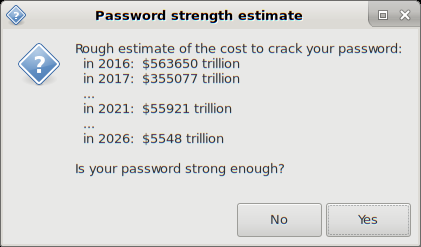
Keysafe securely backs up a gpg secret key or other short secret to the cloud. But not yet. Today's alpha release only supports storing the data locally, and I still need to finish tuning the argon2 hash difficulties with modern hardware. Other than that, I'm fairly happy with how it's turned out. Keysafe is written in Haskell, and many of the data types in it keep track of the estimated CPU time needed to create, decrypt, and brute-force them. Running that through a AWS SPOT pricing cost model lets keysafe estimate how much an attacker would need to spend to crack your password. 4.png
(Above is for the password "makesad spindle stick") If you'd like to be an early adopter, install it like this:
sudo apt-get install haskell-stack libreadline-dev libargon2-0-dev zenity
stack install keysafe
Run ~/.local/bin/keysafe --backup --store-local to back up a gpg key to ~/.keysafe/objects/local/ I still need to tune the argon2 hash difficulty, and I need benchmark data to do so. If you have a top of the line laptop or server class machine that's less than a year old, send me a benchmark:
~/.local/bin/keysafe --benchmark   mail keysafe@joeyh.name -s benchmark
Bonus announcement: http://hackage.haskell.org/package/zxcvbn-c/ is my quick Haskell interface to the C version of the zxcvbn password strength estimation library. PS: Past 50% of my goal on Patreon!

Dirk Eddelbuettel: RQuantLib 0.4.3: Lots of new Fixed Income functions

A release of RQuantLib is now on CRAN and in Debian. It contains a lot of new code contributed by Terry Leitch over a number of pull requests. See below for full details but the changes focus on Fixed Income and Fixed Income Derivatives, and cover swap, discount curves, swaptions and more. In the blog post for the previous release 0.4.2, we noted that a volunteer was needed for a new Windows library build of QuantLib for Windows to replace the outdated version 1.6 used there. Josh Ulrich stepped up, and built them. Josh and I tried for several month to get the win-builder to install these, but sadly other things took priority and we were unsuccessful. So this release will not have Windows binaries on CRAN as QuantLib 1.8 is not available there. Instead, you can use the ghrr drat and do
if (!require("drat")) install.packages("drat")
drat::addRepo("ghrr")
install.packages("RQuantLib")
to fetch prebuilt Windows binaries from the ghrr drat. Everybody else gets sources from CRAN. The full changes are detailed below.
Changes in RQuantLib version 0.4.3 (2016-08-19)
  • Changes in RQuantLib code:
    • Discount curve creation has been made more general by allowing additional arguments for day counter and fixed and floating frequency (contributed by Terry Leitch in #31, plus some work by Dirk in #32).
    • Swap leg parameters are now in combined variable and allow textual description (Terry Leitch in #34 and #35)
    • BermudanSwaption has been modfied to take option expiration and swap tenors in order to enable more general swaption structure pricing; a more general search for the swaptions was developed to accomodate this. Also, a DiscountCurve is allowed as an alternative to market quotes to reduce computation time for a portfolio on a given valuation date (Terry Leitch in #42 closing issue #41).
    • A new AffineSwaption model was added with similar interface to BermudanSwaption but allowing for valuation of a European exercise swaption utlizing the same affine methods available in BermudanSwaption. AffineSwaption will also value a Bermudan swaption, but does not take rate market quotes to build a term structure and a DiscountCurve object is required (Terry Leitch in #43).
    • Swap tenors can now be defined up to 100 years (Terry Leitch in #48 fising issue #46).
    • Additional (shorter term) swap tenors are now defined (Guillaume Horel in #49, #54, #55).
    • New SABR swaption pricer (Terry Leitch in #60 and #64, small follow-up by Dirk in #65).
    • Use of Travis CI has been updated and switch to maintained fork of deprecated mainline.
Courtesy of CRANberries, there is also a diffstat report for the this release. As always, more detailed information is on the RQuantLib page. Questions, comments etc should go to the rquantlib-devel mailing list off the R-Forge page. Issue tickets can be filed at the GitHub repo.

This post by Dirk Eddelbuettel originated on his Thinking inside the box blog. Please report excessive re-aggregation in third-party for-profit settings.

Olivier Gr goire: Conclusion Google Summer of Code 2016

SmartInfo project with Debian alt text 1. Me Before getting into the thick of my project, let me present myself:

I am Olivier Gr goire (Gasuleg), and I study IT engineering at cole de Technologie sup rieure in Montreal.
I am an technician in electronics, and I began object-oriented programming just last year.
I applied to GSoC because I loved the concept of the project that I would work on and I really wanted to be part of it. I also wanted to discover the word of the free software. 2. My Project During this GSoC, I worked on the Ring project. Ring is a free software for communication that allows its users to make audio or video calls, in pairs or groups, and to send messages, safely and freely, in confidence. Savoir-faire Linux and a community of contributors worldwide develop Ring. It is available on GNU/Linux, Windows, Mac OSX and Android. It can be associated with a conventional phone service or integrated with any connected object. Under this very easy to use software, there is a combination of technologies and innovations opening all kinds of perspectives to its users and developers. Ring is a free software whose code is open. Therefore, it is not the software that controls you. With Ring, you take control of your communication! Ring is an open source software under the GPL v3 license. Everyone can verify the codes and propose new ones to improve the software s performace. It is a guarantee of transparency and freedom for everyone!
Source: ring.cx The problem is about the typical user of Ring, the one who don t use the terminal to launch Ring. He has no information about what has happened in the system. My goal is to create a tool that display statistics of Ring. 3. Quick Explanation of What My Program Can Do The Code
Here are the links to the code I was working on all throughout the Google Summer of Code (You can see what I have done after the GSoC by clicking on the newest patchs):
Patch Status
Daemon On Review
Lib Ring Client (LRC) On Review
Gnome client On review
Remove unused code Merged
!!!!!CHANGE LINK TO PUT THE LATEST PATCHES BEFORE THE END OF GSOC!!!!! What Can Be Displayed?
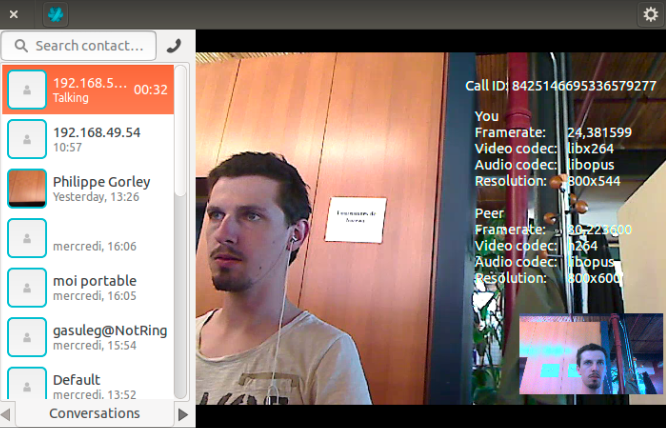
This is the final list of information I can display and some ideas on what information we could display in the future:
Information Details Done?
Call ID The identification number of the call Yes
Resolution Local and remote Yes
Framerate Local and remote Yes
Codec Audio and video in local and remote Yes
Bandwidth Download and upload No
Performance use CPU, GPU, RAM No
Security level In SIP call No
Connection time No
Packets lost No

To launch it you need to right click on the call and click on Show advanced information .
alt text
To stop it, same thing: right click on the call and click on Hide advanced information .
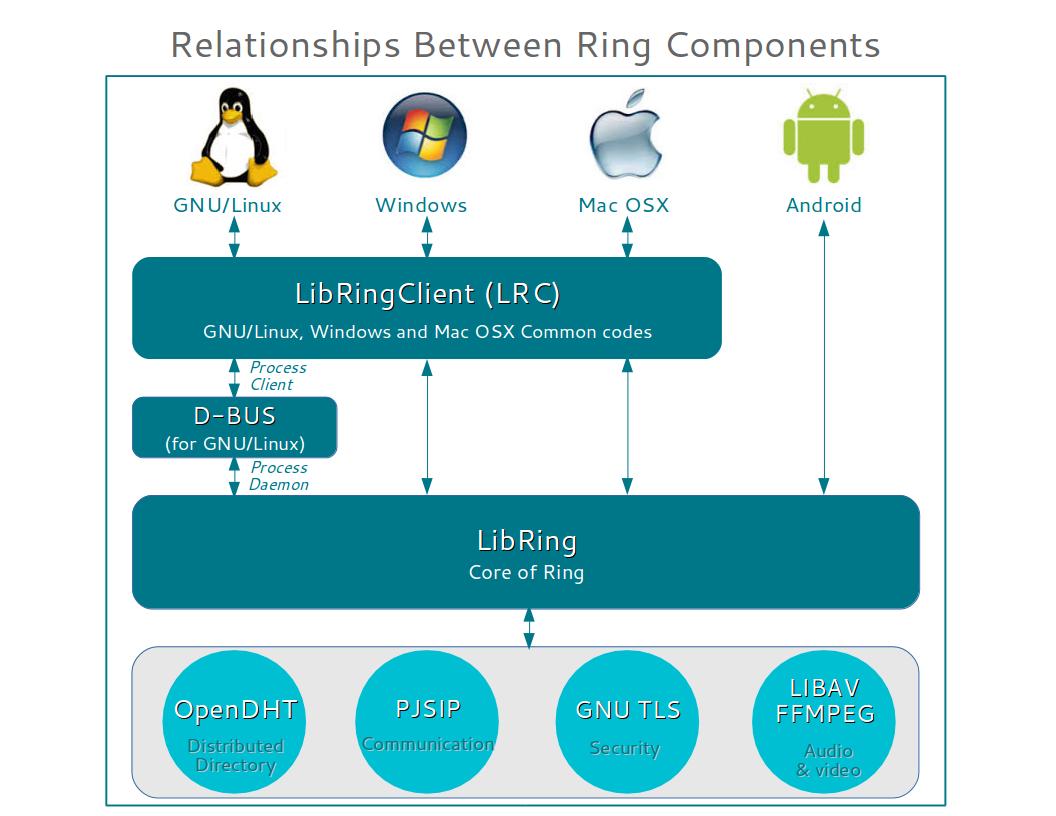
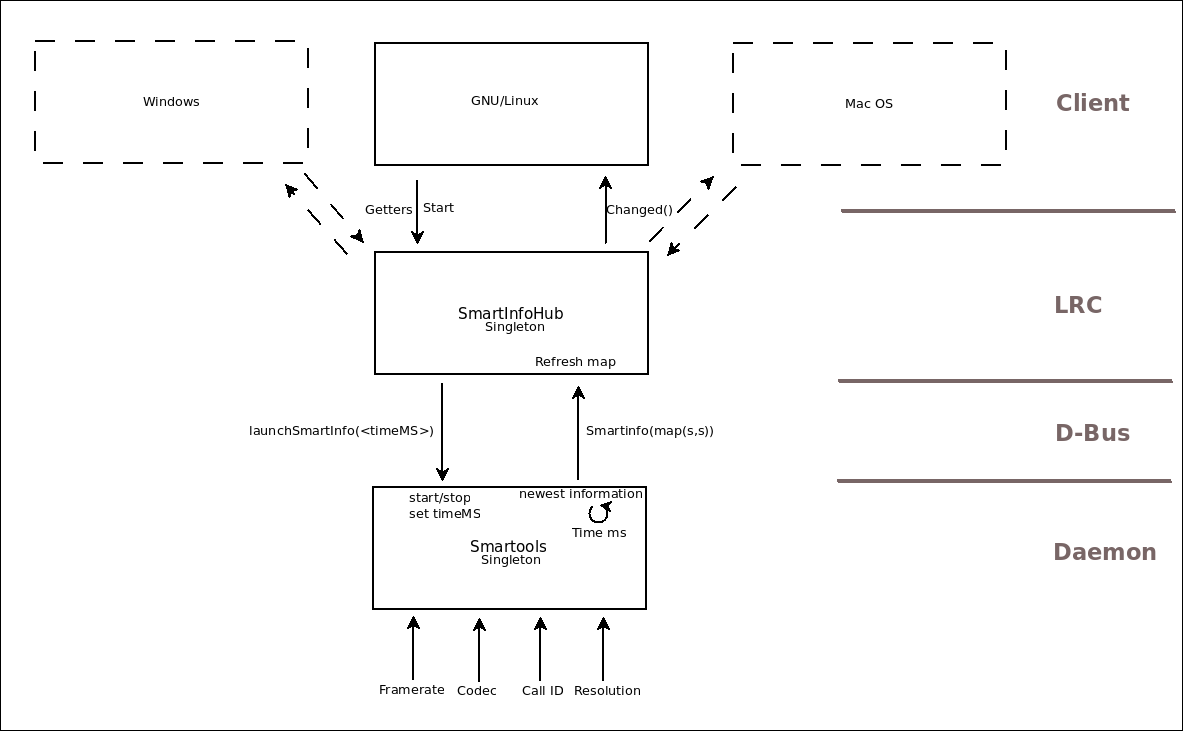
4. More Details About My Project My program needs to retrieve information from the daemon (LibRing) and then display it in gnome client. So, I needed to create a patch for the daemon, the D-Bus layer (in the daemon patch), LibRingClient and the GNU/Linux (Gnome) client.
This is what the architecture of the project looks like.
alt text
source: ring.cx And this is how I implemented my project.
alt text
5. Future of the Project 6. Thanks I would like to thank the following:
- The Google Summer of Code organisation, for this wonderful experience.
- Debian, for accepting my project proposal and letting me embark on this fantastic adventure.
- My mentor, Mr Guillaume Roguez, and all his team, for being there to help me.

Olivier Gr goire: Conclusion Google Summer of Code 2016

SmartInfo project with Debian alt text 1. Me Before getting into the thick of my project, let me present myself:
I am Olivier Gr goire (Gasuleg), and I study IT engineering at cole de Technologie sup rieure in Montreal.
I am a technician in electronics, and I began object-oriented programming just last year.
I applied to GSoC because I loved the concept of the project that I would work on and I really wanted to be part of it. I also wanted to discover the word of the free software. 2. My Project During this GSoC, I worked on the Ring project. Ring is a free software for communication that allows its users to make audio or video calls, in pairs or groups, and to send messages, safely and freely, in confidence. Savoir-faire Linux and a community of contributors worldwide develop Ring. It is available on GNU/Linux, Windows, Mac OSX and Android. It can be associated with a conventional phone service or integrated with any connected object. Under this very easy to use software, there is a combination of technologies and innovations opening all kinds of perspectives to its users and developers. Ring is a free software whose code is open. Therefore, it is not the software that controls you. With Ring, you take control of your communication! Ring is an open source software under the GPL v3 license. Everyone can verify the codes and propose new ones to improve the software s performace. It is a guarantee of transparency and freedom for everyone!
Source: ring.cx The problem is about the typical user of Ring, the one who don t use the terminal to launch Ring. He has no information about what has happened in the system. My goal is to create a tool that display statistics of Ring. 3. Quick Explanation of What My Program Can Do The Code
Here are the links to the code I was working on all throughout the Google Summer of Code (You can see what I have done after the GSoC by clicking on the newest patchs):
Patch Status
Daemon Merged
Lib Ring Client (LRC) On Review
Gnome client On Review
Remove unused code Merged

What Can Be Displayed?
This is the final list of information I can display and some ideas on what information we could display in the future:
Information Details Done?
Call ID The identification number of the call Yes
Resolution Local and remote Yes
Framerate Local and remote Yes
Codec Audio and video in local and remote Yes
Bandwidth Download and upload No
Performance use CPU, GPU, RAM No
Security level In SIP call No
Connection time No
Packets lost No

To launch it you need to right click on the call and click on Show advanced information .
alt text
To stop it, same thing: right click on the call and click on Hide advanced information .
4. More Details About My Project My program needs to retrieve information from the daemon (LibRing) and then display it in gnome client. So, I needed to create a patch for the daemon, the D-Bus layer (in the daemon patch), LibRingClient and the GNU/Linux (Gnome) client.
This is what the architecture of the project looks like.
alt text
source: ring.cx And this is how I implemented my project.
alt text
5. Future of the Project Weekly report link Thanks I would like to thank the following:
- The Google Summer of Code organisation, for this wonderful experience.
- Debian, for accepting my project proposal and letting me embark on this fantastic adventure.
- My mentor, Mr Guillaume Roguez, and all his team, for being there to help me.

Norbert Preining: Debian/TeX Live 2016.20160819-1

A new and unplanned release in quick succession. I have uploaded testing packages to experimental which incorporate tex4ht into the TeX Live packages, but somehow the tex4ht transitional updated slipped into sid, and made many packages uninstallable. Well, so after a bit more testing let s ship the beast to sid, meaning that tex4ht will finally updated from the last 2009 version to what is the current status in TeX Live. texlive2016-debian From the list of new packages I want to pick out the group of phf* packages that seem from a quick reading over the package documentations as very interesting. But most important is the incorporation of tex4ht into the TeX Live packages, so please report bugs and shortcomings to the BTS. Thanks. New packages aurl, bxjalipsum, cormorantgaramond, notespages, phffullpagefigure, phfnote, phfparen, phfqit, phfquotetext, phfsvnwatermark, phfthm, table-fct, tocdata. Updated packages acmart, acro, biblatex-abnt, biblatex-publist, bxdpx-beamer, bxjscls, bxnewfont, bxpdfver, dccpaper, etex-pkg, europasscv, exsheets, glossaries-extra, graphics-def, graphics-pln, guitarchordschemes, ijsra, kpathsea, latexpand, latex-veryshortguide, ledmac, libertinust1math, markdown, mcf2graph, menukeys, mfirstuc, mhchem, mweights, newpx, newtx, optidef, paralist, parnotes, pdflatexpicscale, pgfplots, philosophersimprint, pstricks-add, showexpl, tasks, tetex, tex4ht, texlive-docindex, udesoftec, xcolor-solarized.


Guido G nther: Foreman's Ansible integration

Gathering from some recent discussions it seems to be not that well known that Foreman (a lifecycle tool for your virtual machines) does not only integrate well with Puppet but also with ansible. This is a list of tools I find useful in this regard: There's also support for triggering ansible runs from within Foreman itself but I've not used that so far.

Michal Čihař: Wammu 0.42

Yesterday, I've released Wammu 0.42. There are no major updates, more likely it's usual localization and minor bugfixes release. As usual up to date packages are now available in Debian sid, Gammu PPA for Ubuntu or openSUSE buildservice for various RPM based distros. Want to support further Wammu development? Check our donation options or support Gammu team on BountySource Salt.

Filed under: Debian English Gammu 0 comments

Eriberto Mota: Debian: GnuPG 2, chroot and debsign

Since GPG 2 was set as default for Debian (Sid, August 2016), an error message appeared inside jails triggered by chroot, when using debuild/debsign commands:
clearsign failed: Inappropriate ioctl for device
The problem is that GPG 2 uses a dialog window to ask for a passphrase. This dialog window needs a tty (from /dev/pts/ directory). To solve the problem, you can use the following command (inside the jail):
# mount devpts -t devpts /dev/pts
Alternatively, you can add to /etc/fstab file in jail:
devpts /dev/pts devpts defaults 0 0
and use the command:
# mount /dev/pts
Enjoy!

17 August 2016

Gunnar Wolf: Talking about the Debian keyring in Investigaciones Nucleares, UNAM

For the readers of my blog that happen to be in Mexico City, I was invited to give a talk at Instituto de Ciencias Nucleares, Ciudad Universitaria, UNAM.

I will be at Auditorio Marcos Moshinsky, on August 26 starting at 13:00. Auditorio Marcos Moshinsky is where we met for the early (~1996-1997) Mexico Linux User Group meetings. And... Wow. I'm amazed to realize it's been twenty years that I arrived there, young and innocent, the newest of what looked like a sect obsessed with world domination and a penguin fetish.
AttachmentSize
llavero_chico.png220.84 KB
llavero_orig.png1.64 MB

Raphaël Hertzog: Freexian s report about Debian Long Term Support, July 2016

A Debian LTS logoLike each month, here comes a report about the work of paid contributors to Debian LTS. Individual reports In July, 136.6 work hours have been dispatched among 11 paid contributors. Their reports are available: Evolution of the situation The number of sponsored hours jumped to 159 hours per month thanks to GitHub joining as our second platinum sponsor (funding 3 days of work per month)! Our funding goal is getting closer but it s not there yet. The security tracker currently lists 22 packages with a known CVE and the dla-needed.txt file likewise. That s a sharp decline compared to last month. Thanks to our sponsors New sponsors are in bold.

2 comments Liked this article? Click here. My blog is Flattr-enabled.

Raphaël Hertzog: My Free Software Activities in July 2016

My monthly report covers a large part of what I have been doing in the free software world. I write it for my donators (thanks to them!) but also for the wider Debian community because it can give ideas to newcomers and it s one of the best ways to find volunteers to work with me on projects that matter to me. DebConf 16 I was in South Africa for the whole week of DebConf 16 and gave 3 talks/BoF. You can find the slides and the videos in the links of their corresponding page: I was a bit nervous about the third BoF (on using Debian money to fund Debian projects) but discussed with many persons during the week and it looks like the project evolved quite a bit in the last 10 years and while it s still a sensitive topic (and rightfully so given the possible impacts) people are willing to discuss the issues and to experiment. You can have a look at the gobby notes that resulted from the live discussion. I spent most of the time discussing with people and I did not do much technical work besides trying (and failing) to fix accessibility issues with tracker.debian.org (help from knowledgeable people is welcome, see #830213). Debian Packaging I uploaded a new version of zim to fix a reproducibility issue (and forwarded the patch upstream). I uploaded Django 1.8.14 to jessie-backports and had to fix a failing test (pull request). I uploaded python-django-jsonfield 1.0.1 a new upstream version integrating the patches I prepared in June. I managed the (small) ftplib library transition. I prepared the new version in experimental, ensured reverse build dependencies do still build and coordinated the transition with the release team. This was all triggered by a reproducible build bug that I got and that made me look at the package last time upstream had disappeared (upstream URL was even gone) but it looks like he became active again and he pushed a new release. I filed wishlist bug #832053 to request a new deblog command in devscripts. It should make it easier to display current and former build logs. Kali related Debian work I worked on many issues that were affecting Kali (and Debian Testing) users: Thanks See you next month for a new summary of my activities.

3 comments Liked this article? Click here. My blog is Flattr-enabled.

Michal Čihař: Weekly phpMyAdmin contributions 2016-W32

Tonight phpMyAdmin 4.0.10.17, 4.4.15.8, and 4.6.4 were released and you can probably see that there are quite some security issues fixed. Most of them are not really exploitable unless your PHP and webserver are poorly configured, but still it's good idea to upgrade. If you are running Debian unstable, use our phpMyAdmin PPA for Ubuntu or use phpMyAdmin Docker image upgrading should be as simple as pulling new version. Besides fixing security issues, we're generally hardening our infrastructure. I'm really grateful that Emanuel Bronshtein (@e3amn2l) is doing great review of all of our code and helps us in this area. This will really make our code and infrastructure much better. Handled issues:

Filed under: Debian English phpMyAdmin 0 comments

Michal Čihař: Revoking old PGP key

It has been already six years since I've moved to using RSA4096 PGP key. For various reasons, the old DSA key was still kept valid till today. This is no longer true and it has been revoked now. The revoked key is DC3552E836E75604 and new one is 9C27B31342B7511D. In case you've signed the old one and not the new one (quite unlikely if you did not sign it more than six years ago), there has been migration document, where you can verify my new key being signed by the old one.

Filed under: Debian English 0 comments

Next.

Previous.