Search Results: "spa"

26 May 2012

Tanguy Ortolo: Fun with spammers

Email spam is a plague, but sometimes there is at least on category of spammers it is easy to have fun with: naive manual spammers. People that try to do more or less legal business, using Internet in an illegitimate way, for instance (this is a real example, including the spammer's address: spamming bots, please use it ;-) !): Reporting Well, in that case it may or may not be a scam, but even if it is not a criminal activity such as selling fake drugs, it is not a very honest business. Anyway, that lady is using her Google account to send her crap, so neutralizing her is quite easy:
  1. checking that it really comes from Google Mail, using DKIM or SPF;
  2. writing to Google, reporting that spam (and, in that specific case, the abuse they are offering to commit on Google +1);
  3. optional, do not do that with scammers: replying to the spammer explaining that this is spamming, that you reported it and that she can expect to loose her Google account and everything on it.
That should work with any good email provider, that is, any provider that listens to complaints at <abuse@> and takes action on them. For what I have seen, Google and Yahoo! are, but fossils such as traditional national telephonists are not. If the message headers allow you to identify it, you can also report the abuse to the spammer's network operator if it is a good one (this is rarely the case). Consequences With a bit of luck, that can seriously damage the business of the spammer, and if he was really careless (e.g. storing important documents on the same Google account with no local backup), cause serious trouble in his personal stuff. If you replied to the spammer, you can get fun answers such as (these are taken from real examples I got): Conclusion This is too complicated to be done for each spam of course, but it is worth doing for spam messages that are not catch by one's antispam. And the rules for email marketing are well known: only write to people that explicitly allowed you to do so, full stop, so there is no reason to show any mercy for a spammer.

Craig Small: JFFNMS 0.9.3

jffnms version 0.9.3 has been released today. This is a vast improvement over the 0.9.x releases and anyone using that train is strongly recommended to upgrade.So what changed? What didn t change! A nice summary would be fixing a lot of things that were broken or needed some tweaking. A really, really big thanks to Marek for all the testing and bug reports and also patient just run this and tell me what it says tests he did too. If something wasn t right before and works now, it is quite likely it is working because Marek told me how it broke. A brief overview of what has changed: You can download the file off sourceforge at https://sourceforge.net/projects/jffnms/files/JFFNMS%20Releases/

25 May 2012

Johannes Schauer: setting up mailman, postfix, lighttpd

I was worried about having to learn hundreds of configuration options to properly set up mailman, postfix and lighttpd on Debian Squeeze. Turned out, that except for lighttpd it all works out of the box.
apt-get install postfix
When asked by debconf, I specified lists.mister-muffin.de as the fully qualified domain name.
apt-get install mailman
newlist mailman
The newlist command reminds me that I have to add its output to /etc/aliases. After doing so, I have to run:
newaliases
From now on, I can add any mailinglist by running newlist, editing /etc/aliases and running newaliases. Mailinglists can also be added through the mailman webinterface but one still has to put the according entries into /etc/aliases. Following is a working lighttpd configuration that works out of the box with the default settings of mailman on Debian squeeze. This was the only part that caused me some headaches.
server.modules += ("mod_alias", "mod_cgi", "mod_accesslog")
$HTTP["host"] == "lists.mister-muffin.de"   accesslog.filename =
    accesslog.filename = "/var/log/lighttpd/lists-access-log"
    alias.url += (
        "/cgi-bin/mailman/private/" => "/var/lib/mailman/archives/private/",
        "/cgi-bin/mailman/public/" => "/var/lib/mailman/archives/public/",
        "/pipermail/" => "/var/lib/mailman/archives/public/",
        "/cgi-bin/mailman/"=> "/var/lib/mailman/cgi-bin/",
        "/images/mailman/" => "/usr/share/images/mailman/",
    )
    cgi.assign = (
        "/admin" => "",
        "/admindb" => "",
        "/confirm" => "",
        "/create" => "",
        "/edithtml" => "",
        "/listinfo" => "",
        "/options" => "",
        "/private" => "",
        "/rmlist" => "",
        "/roster" => "",
        "/subscribe" => "")
 
server.document-root        = "/var/www"
server.errorlog             = "/var/log/lighttpd/error.log"
server.pid-file             = "/var/run/lighttpd.pid"
server.username             = "www-data"
server.groupname            = "www-data"
index-file.names            = ( "index.html" )
server.dir-listing          = "disable"
include_shell "/usr/share/lighttpd/create-mime.assign.pl"
As a bonus, I wanted to import my existing email exchange with my GSoC mentors into the mailinglist. First I was planning on manually sending the email messages to the list, but a much easier option is to just import them in mbox format. To extract all email messages, I first wrote the following python snippet:
import mailbox, itertools
box = mailbox.mbox('~/out')
for message in itertools.chain(mailbox.mbox('~/sent'), mailbox.Maildir('~/Mail/Web/', factory=None)):
if (("wookey" in message.get('to', "").lower()
or "wookey" in message.get('cc', "").lower()
or "wookey" in message.get('from', "").lower()
or "abate" in message.get('to', "").lower()
or "abate" in message.get('cc', "").lower()
or "abate" in message.get('from', "").lower())
and not message['subject'][0] == '['
and not message['subject'] == "multistrap"):
box.add(message)
box.close()
It iterates through messages in my mbox and maildir mailboxes, filters them for emails by wookey or pietro, strips away some messages I found to not be relevant and then saves the filtered result into the mbox mailbox ~/out. It is important to specify factory=None for the Maildir parser, because it otherwise defaults to rfc822.Message instead of MaildirMessage. Also do not forget to call box.close(). I initially forgot to do so and ended up with missing messages in ~/out. I then copy the archive in its place:
scp out lists.mister-muffin.de:/var/lib/mailman/archives/private/debian-bootstrap.mbox/debian-bootstrap.mbox
Another thing that initially caused me trouble, was that the mbox didnt have the correct permissions due to the scp. Fixing them:
chown -R list:www-data /var/lib/mailman/archives/private/
chmod 664 /var/lib/mailman/archives/private/debian-bootstrap.mbox/debian-bootstrap.mbox
And update the mailman archive like this:
sudo -u list /usr/lib/mailman/bin/arch debian-bootstrap /var/lib/mailman/archives/private/debian-bootstrap.mbox/debian-bootstrap.mbox
Initially I was running the above command as root which screws up permissions as well.

Matthew Garrett: Fedora 17 and Mac support

Fedora 17 will be shipping next week. It's got a bunch of new features, none of which I contributed to in the slightest. What I did work on was improving our support for installation on x86 Apple hardware. There's still a few shortcomings in this so it's not an announced or supported feature, but it's sufficient progress that it's worth writing about.

There's a few ways that Apple platforms differs from normal PC hardware. The first is that Apples are very much intended to be EFI first and BIOS second, while that's still not really true for commodity PC hardware. Apple launched Boot Camp shortly after they started shipping x86 Macs (and shortly after I'd got Ubuntu running on one for the first time[1]) but the focus of Boot Camp has always been to be good enough to boot Windows and not much else[2]. The other is the integration with the boot environment. You can boot Linux easily enough by setting the standard EFI boot variables, but if you ever boot back into OS X it's easy to trigger deletion of those. There's then no straightforward way of resetting them, and you're left having to recover your installation.

The other difficult bit has been actually starting the installer at all. If you're happy to use BIOS emulation than this can be done without too much misery, but you're then left with dealing with Apple's custom synchronised GPT/MBR. More modern Macs will boot via the standard EFI mechanisms, but there's a range of problems that can be caused that way. Fedora 17 is the first Linux distribution to ship install media that will EFI boot a Mac when either written to optical media or a USB stick[3]. Put the install media in your system and then either select it in the OS X Startup Disk preferences menu and reboot, or reboot and hold down the alt key. In the latter case there'll be a nice Fedora logo. Click on it and it'll boot.

The biggest difference between Apple hardware and anyone else is that we'd normally put the bootloader in a FAT partition that's shared with any other installed operating systems. That does actually work on Apples, but then you run into the earlier point I mentioned. The Apple startup picker that you get by holding down the alt key doesn't pay any attention to the standard EFI boot variables, so it won't show a FAT partition merely because it's got an EFI bootloader on it. The same is true of the OS X Startup Disk preferences. The best way to get a drive to appear in the menu is to make it look like an OS X drive.

This was problematic in a few ways, due to the requirement for an OS X drive to be HFS+. The first was that we didn't have any support for that in our installer, so work had to be done there. The second was that the state of HFS+ was woefully poor in Linux[4]. Linux will refuse to write to an HFS+ filesystem if it hasn't been cleanly unmounted or fscked, and since we can't rely on everyone always shutting their machine down cleanly that means a working fsck.hfsplus. In theory we were shipping one of those. In practice, it reliably segfaulted on 64-bit systems[5]. So I had to package the latest version of Apple's code, and doing that involved dealing with the fact that Apple now use blocks almost as much as Grub 2 uses nested functions, and that meant using Clang and that meant dealing with a bug where Clang segfaulted if it had been built with gcc 4.7[6], but finally once all of those yaks had been shaven we could trust our filesystem.

Of course, more problems existed. You can't just drop a bootloader onto an HFS+ partition and expect it to work. You need to write its inode value into the superblock. Trivial, except that if you do this from userspace then the kernel kindly overwrites your update when you unmount the disk and it updates the superblock. That required a mechanism for updating that data via the kernel, which meant adding an ioctl. This would have been fine, except the OS X Startup Disk preference looks for a bootloader in a location other than where Fedora installs it. Changing our bootloader install path wasn't a great option, so the easiest thing to do was just to link them together. Except HFS+ doesn't really support hardlinks. When you hardlink something the original file gets moved into a magic directory in the filesystem root and the links are special files that refer to it. And it turns out that it's not actually the inode that the firmware wants when finding the bootloader, it's the catalogue ID, and these aren't the same when hardlinks are involved. So, another kernel patch.

All that was left for the boot partition then was adding an icon and a drive label. We already had code for generating the icon, and the drive label wasn't that difficult. Hurrah!

Ok, so we can construct a filesystem that (a) appears in the bootpicker, and (b) appears in the OS X Startup Disk preferences. We can even put a bootloader on it. This led to the next problem. The bootloader started without any trouble. But the bootloader couldn't read any files off the boot partition, including its configuration. This should have been obvious with hindsight - the problem was simply that grub legacy[7] doesn't support HFS+. Writing an HFS+ driver seemed like an excessive amount of work, especially since the firmware already supported reading HFS+, so instead I wrote a simple grub filesystem driver that uses the UEFI interfaces to read files.

A working bootloader! One more problem there. grub looks in its startup directory to find its configuration file. We have two "copies" of grub hardlinked to each other, each looking in a different directory for configuration. Hardlinking the config files together worked fine, except that most tools that update config files have this irritating habit of writing to a temporary file and moving that over the original, thus breaking the hardlink. Easily solved by using a symlink instead, except that the UEFI filesystem semantics don't really support symlinks because UEFI only really envisaged using FAT. If you use Apple's UEFI HFS+ driver to open a symlink, you get a short file containing the target path of the symlink. Rather less than ideal, and a rather gross hack to cope with it.

All set now, other than a bug in some older Mac firmware where read would return BUFFER_TOO_SMALL without returning the real buffersize and the odd way that Apple treat CDs. Oh, and a bug in Apple's Broadcom wifi driver that could overwrite the kernel, and case-sensitivity, something that obviously isn't something you often hit on UEFI when all you usually see is FAT.

Kernel-side, we had a couple of things. Obviously there the bugs I'd mentioned in the past, but those had already been dealt with. New issues included the fact that we were frequently picking the wrong framebuffer address, especially on machines with multiple GPUs. Fixed now, along with another issue where we'd sometimes get confused by models with different GPU configurations. And at that point, most of the implementation work was done.

Of course, there was also the work of integrating this into the tools that we use to generate our install media, and I'd like to thank Will Woods, Brian Lane and Dennis Gilmore for the work they put into that, along with anyone I've forgotten. Tom Calloway handled getting the device label graphics generated right before deadline. A cast of thousands helped with testing.

So why did I mention shortcomings? First, this only works on machines with 64-bit firmware. Early 64-bit Apples still had 32-bit firmware. In theory we can support that case - in practice it's a moderate amount of writing, including some mildly awkward kernel code. But anything later than mid-2007 should have 64-bit firmware, so it's not a massive concern. Second, we seem to have fairly significant trouble with Radeon hardware on a lot of Macs. We fixed one bug there, but something's still going wrong in setup and you'll frequently end up with a black screen. And thirdly, I'm sure there's some other machines that still don't work for (as yet) undetermined reasons.

With luck we'll get these things dealt with by Fedora 18. But even with these flaws, Fedora 17 will work fine on a lot of Apple hardware, and testing it is as simple as downloading and booting a live image. Bugs go in the usual place.

[1] Note my charming belief that the Ubuntu installer would fully support this hardware via EFI in the near future. 6 years ago. It still doesn't.
[2] This can be fairly easily seen from little things like the name "Windows" being hardcoded into every UI that sees a Boot Camp drive.
[3] I cover this in more depth here
[4] To be fair, it mostly still is - there's plenty of work to be done there.
[5] Approximately nobody had noticed this, which is all kinds of unreassuring.
[6] Thanks to Kalev Lember for dealing with that
[7] Still the EFI bootloader in Fedora 17. We've already swapped Fedora 18 over to grub 2.

comment count unavailable comments

23 May 2012

Pietro Abate: configure a local apt repository for puppet

Puppet has a built-in functionality to serve small files to its clients. However, for my internal use I sometimes find easier to create a custom debian package to install a specific component then to write a puppet recipe and to copy files around. To create a local debian repository I use the package reprepro. This is a simple tool that creates and manages apt repository, it is easy to configure and for the moment it lived fully to my expectations. First of all you need to create a configuration file where you describe your distribution. In this case I choose /var/www/debian/conf/distributions and add the following content :
Origin: PCPool
Label: PCPool
Suite: stable
Codename: pcpool
Version: 3.0
Architectures: i386 amd64
Components: contrib
Description: puppet support package repository
SignWith: D3CF695E
Notice that since reprepro wants to sing you repository, you need to provide a gpg keyid for it. To add a package to the repository it is straightforward :
reprepro -Vb /var/www/debian/ includedeb pcpool /tmp/msm_1-2_all.deb
As I said, since the repository is signed, we need to make have a way to add the keyid to the known keys of the target machine. In order to achieve this, we add the following puppet recipe :
class apt
#local repo sign key
$keyid = "D3CF695E"

exec "apt-update":
command => "/usr/bin/apt-get update",
refreshonly => true;


file "/root/pcpool.key":
source => "puppet://$server/files/root/pcpool.key"


exec "apt-key":
path => '/bin:/usr/bin',
environment => 'HOME=/root',
command => "apt-key add /root/pcpool.key",
unless => "apt-key list grep $keyid",
subscribe => File["/root/pcpool.key"]


file "/etc/apt/sources.list.d/puppet.list":
content => "deb http://puppet/debian/ pcpool contrib\n",
owner => root,
group => root,
mode => 0644,
notify => Exec["apt-update"]


class msm
package "msm": ensure => installed
First we copy the keyid that we have stored in the puppet file bucket in the root directory of the client, then we exec the apt-key command. Note that since puppet executes each action in parallel, we must specify an execution order using the attributes subscribe and notify. Similarly as soon as the file /etc/apt/sources.list.d/puppet.list is added to the machine, we run apt-get update to refresh the cache of apt. The last stanza simply installs the package that we added to the local repository.

Pietro Abate: configuring a local apt repository for puppet

Puppet has a built-in functionality to serve small files to its clients. However, for my internal use I sometimes find easier to create a custom debian package to install a specific component then to write a puppet recipe and to copy files around. To create a local debian repository I use the package reprepro. This is a simple tool that creates and manages apt repository, it is easy to configure and for the moment it lived fully to my expectations. First of all you need to create a configuration file where you describe your distribution. In this case I choose /var/www/debian/conf/distributions and add the following content :
Origin: PCPool
Label: PCPool
Suite: stable
Codename: pcpool
Version: 3.0
Architectures: i386 amd64
Components: contrib
Description: puppet support package repository
SignWith: D3CF695E
Notice that since reprepro wants to sign your repository, you need to provide a gpg keyid for it. To add a package to the repository it is straightforward :
reprepro -Vb /var/www/debian/ includedeb pcpool /tmp/msm_1-2_all.deb
As I said, since the repository is signed, we need to make have a way to add the keyid to the known keys of the target machine. In order to achieve this, we add the following puppet recipe :
class apt
#local repo sign key
$keyid = "D3CF695E"

exec "apt-update":
command => "/usr/bin/apt-get update",
refreshonly => true;


file "/etc/apt/trusted.gpg.d/pcpool.gpg":
source => "puppet://$server/etc/apt/trusted.gpg.d/pcpool.gpg"


# file "/root/pcpool.key":
# source => "puppet://$server/files/root/pcpool.key"
#

# exec "apt-key":
# path => '/bin:/usr/bin',
# environment => 'HOME=/root',
# command => "apt-key add /root/pcpool.key",
# unless => "apt-key list grep $keyid",
# subscribe => File["/root/pcpool.key"]
#

file "/etc/apt/sources.list.d/puppet.list":
content => "deb http://puppet/debian/ pcpool contrib\n",
owner => root,
group => root,
mode => 0644,
notify => Exec["apt-update"]


class msm
package "msm": ensure => installed
First we copy the keyid that we have stored in the puppet file bucket in the root directory of the client, then we exec the apt-key command. Note that since puppet executes each action in parallel, we must specify an execution order using the attributes subscribe and notify. Similarly as soon as the file /etc/apt/sources.list.d/puppet.list is added to the machine, we run apt-get update to refresh the cache of apt. The last stanza simply installs the package that we added to the local repository.

Update There is a better way to add a gpg key, that is to put it in the /etc/apt/trusted.gpg.d directory. Thanks for the suggestion !

Christian Perrier: 2012 update 23 for Debian Installer localization

Status for D-I level 1 (core D-I files): Status for D-I level 2 (packages that have localized material that may appear during default installs, such as iso-codes, tasksel, etc.): Status for D-I level 3 (packages that have localized material that may appear during non-default installs, such as win32-loader) Full 100% completeness (hall of fame) for 26 languages: Asturian, Belarusian, Bulgarian, Catalan, Czech, Danish, German, Esperanto, Spanish, Persian, French, Hebrew, Indonesian, Italian, Japanese, Kazakh, Khmer, Dutch, Polish, Portuguese, Russian, Slovak, Slovenian, Swedish, Turkish, Simplified Chinese

Anand Kumria: Lifelong learning

Below are four of my (150!) browser tabs opened, that I oddly had in sequence. Various tabs open to online learning websites. There has been much made of the pheonmen of lifelong learning and although I thought I had finished my exams when I finished University, I'm still doing them. From left to right:
Duolingo, where I am learning Spanish.
Quite a reasonable site, currently invite-only. My worry is my pronounciation will be crap though. I do wish that it did not have to use Flash to accomplish things though.
Udacity, where I am doing CS212 - Design of Computer Programs
Nice interface, annoying that it uses YouTube to host videos as that meant I had to whitelist YouTube in Flashblock.I picked this course as one of the other ones I wanted to do had already closed. I suspect I'll eventually do each of the courses they have on offer. One nice thing is that courses run every 8 weeks or so.
Codeacademy, I am currently doing their Codeyear course.
Well presented, but I find that their Javascript interface is extremely slow to startup. It consistently lags behind my typing speed by about 3 seconds.I'm using Firefox beta, so I'm always running something fairly fast and modern too.I'm primarily doing this course to see how/what they are trying to teach non-programmers. My feedback is that it is not geared towards someone with no programming knowledge. The initial 10 weeks of Javascript presentation proceeded at a very fast pace. If I weren't a programmer already, I'd have stuggled to keep up.
Coursera, here I am doing the Machine Learning class.
I'm not a fan of this interface at all, which is why I find it hard to come back to the site each week. I'm not sure exactly why though, since it uses WebM and no Flash. Hurray!!Either way, I'm doing the Machine Learning class. I tried this last time it was offered and got to week 5 same week I'm on now and then I got suddenly busy IRL, so was not able to complete the course.Unlike Udacity, courses run at set times and you have to do the work on the required dates in order to get the statement of attainment, which can be hard when you are juggling multiple things
Keep in mind, these are just the extra things I have decided to learn. I'm also learning more about Django, Puppet and Python in my work everyday. Plus I'm actually doing a Spanish course in real life too. Oh, and I have a job and I go out. I'm generally actually pushed for time. Which probably explains why I have not been keeping up with the blog. It isn't because I hate you, although it might be too ;-) , I'm just busy.

Craig Small: procps-ng 3.3.3 released

top

Top in colour mode

This weekend procps-ng version 3.3.3 was tagged and released for distribution. There have been many patches and fixes involved in this release as we move from an unchanging static sort of code into something that is easier to maintain and build on various architectures. The good thing is I m down to 1 or 2 patches in the debian archive which is a big change from the 30 or 40-odd I used to carry. For the sole metric of getting that number down, the project fork has been a success. There were some post-release bugs I found and these were more to do with the various options turned on or off rather than what you d see if you did the basic ./configure && make. One of them was how the version numbers are defined in git, but would only appear if certain files were older than others (such as aclocal.m4 versus config.h.in) Others were when certain features were turned on. The make check doesn t see all of this because it uses the default configure flags. One annoying thing of the autotools is conditionally installing man pages. This is where you don t or cannot compile a binary so you don t install the corresponding man page. The automake documentation is of course obscure about this but I cannot see a way of distributing only a man page, so we have this fiddle where a file goes into distmanMANS or EXTRA_DIST depending. Interestingly, there has been some bike-shedding around Fedora-land (see the link below) regarding the name procps-ng versus procps. Debian is lucky that we do have different upstream and package names (though not ideal) so apt-get install procps still gives you procps. There also has been discussion about merging procps-ng into util-linux whichin the short-term won t be happening.

22 May 2012

Gunnar Wolf: e-voting: Bad when it's near, worse when it's far.

Note: All of the information linked to from this post is in Spanish and related to Mexico Part of it will be translatable via automated means, some will not. Sorry, that's what I have, and it's too much text to invest the effort to hand-translate
I have been following the development of the different e-vote modalities in Mexico for several years already, although I have only managed to do so methodically in the last half year or so. If you are interested in my line of reasoning as to why I completely oppose e-voting, you can look at the short article I published in 2010 or the slightly longer and more updated version published in our book in 2011. Currently, in Mexico there are two different venues of e-vote that are being pushed: Bad and worse. The bad one will be carried out for about 10% of the population of the state of Jalisco and somewhat less for the state of Coahuila (Distrito Federal was also to be in this list, but the contract was cancelled due to the provider company delivering booths with too many problems and unable to deliver in the due time). The worse one is, fortunately, likely to have the least impact. Why? Because it regards votes cast by Distrito Federal residents (the capital entity, where part of Mexico City is located) living abroad. And it will have less impact because of the amount of the population registered for it: We are about 9 million residents in DF, and in the last election (first time IIRC there was the right to vote from abroad) there were only about 10,000 people registered for casting a (enveloped and sent by post) vote. Even if this year we the campaign for this was better (and I'm not yet sure about it), the number of voters will not be enough to make a dent on the results. I'm not going into details as to why it is bad in this post I requested information from the DF Electoral Institute (IEDF) with academic interest, to try to find more information about it, and I want to share my results with you and, of course, to request for your input on how to continue with this. On May 3rd, I sent the following request (this I am translating to English :) You can look at the receipt for the request for the original redaction) to the official contact address, oficinadeinformacionpublica@iedf.org.mx: Of course, I wasn't very optimistic when receiving this information. Still, I have to share my results: My information request was largely denied:
( )
III. The divulgation of this information harms the interest it protects
Given that, were it to be divulged it would affect the informatic security of the refered system. Anyway, we have to point out that said systems have enough measures and security provisions, so that the citizen can emit his vote in a universal, free, secret and direct way.
IV. The damage that can be produced by making this information public is larger than the public interest to know it
This is so because making this information public puts at risk the correct development of the Internet-based voting, because were the technical, purpose-specific information be made public, it could be misused to carry out informatic attacks.
It is also important to mention that a confidentiality agreement was signed with the company that developed said systems.
( )
VI. The time for the information to be reserved
It will be seven years starting at the present resolution, this information will be made public when the reserve period is over or when the target is reached, except for the confidemtial information that it could contain. ( )
In case some other person is interested in following this information, the other two points were answered, and I'll try to get some relevant information from it: So, I don't have any real conclusions yet. I'm just reporting how work is unfolding. Tomorrow evening (Wednesday May 23) I'll give a talk on the "e-voting in Mexico 2012" subject in Congreso Internacional de Software Libre in Zacatecas, Mexico. I'll talk on the situation on this and the other topics I have been able to work on.
AttachmentSize
Receipt of my information request11.64 KB
Transparency Committee resolution354.66 KB
Information request answered by UTCSTyPDP (IEDF)85.75 KB

Pietro Abate: bootstrap puppet with ganeti

Third post about ganeti. Ganet-debootstrap-instance contains a nice set of scripts to create a debian (or derivatives) image using debootstrap. Images can be configured and customized by writing simple hooks script to modify various aspects of the default installation. However writing these script is not really fun and pushing it too far can lead to long messy scripts, loosing the overall benefit of automatic configuration. Puppet is my configuration management tool of choice, but installing puppet on a new machine requires few magic incantations that the user should perform manually, or in a semi automatic mode (autosign=true) to make it work. My goal is to install puppet automatically on the newly created instance so it will run and configure the new instance at the first boot. From that moment on I'll forget about ganeti and configure all remaining services of my new VM using puppet. In order to do so, we need to install puppet (and apt-get update/upgrade...), create the ssl certificates for the client and enabling the puppet daemon on the client. We add another hook in /etc/ganeti/instance-debootstrap/hooks/ :
if [ -z "$TARGET" -o ! -d "$TARGET" ]; then
echo "Missing target directory"
exit 1
fi

LANG=C
chroot "$TARGET" apt-get -y --force-yes update
chroot "$TARGET" apt-get -y --force-yes upgrade

# install puppet on the client
chroot "$TARGET" apt-get -y --force-yes install puppet

DOMAIN=localnet.org
instance=$INSTANCE_NAME.$DOMAIN

echo "Installing puppet certificates for $instance"
puppetca clean $instance
puppetca -g $instance

mkdir -p $TARGET/etc/puppet
mkdir -p $TARGET/var/lib/puppet/ssl/private_keys/
mkdir -p $TARGET/var/lib/puppet/ssl/certs/

cp /var/lib/puppet/ssl/private_keys/$instance.pem $TARGET/var/lib/puppet/ssl/private_keys/
rm -f $TARGET/var/lib/puppet/ssl/public_keys/$instance.pem

cp /var/lib/puppet/ssl/certs/$instance.pem $TARGET/var/lib/puppet/ssl/certs/
cp /var/lib/puppet/ssl/certs/ca.pem $TARGET/var/lib/puppet/ssl/certs/

chown root. $TARGET/var/lib/puppet/ssl/private_keys/$instance.pem
chmod 0400 $TARGET/var/lib/puppet/ssl/private_keys/$instance.pem

chown root. $TARGET/var/lib/puppet/ssl/certs/$instance.pem
chmod 0640 $TARGET/var/lib/puppet/ssl/certs/$instance.pem

chown root. $TARGET/var/lib/puppet/ssl/certs/ca.pem
chmod 0641 $TARGET/var/lib/puppet/ssl/certs/ca.pem

#echo "server=puppet" >> /etc/puppet/puppet.conf

echo "START=yes" > $TARGET/etc/default/puppet
echo "DAEMON_OPTS=\"\"" >> $TARGET/etc/default/puppet
This script uses puppetca to create on the puppet (and ganeti) server the client key, sign it, and then copy it to the target machine. Notice that we create the certificate for a fqnd name $INSTANCE_NAME.$DOMAIN or otherwise puppet will complain loudly. This is not strictly needed, but if you want to do otherwise, you'll need to fiddle with the puppet configuration a bit more. The procedure to create a puppet certificate server-side is well documented on the puppet website, so if you are curious about the details duck-duck-it .

Russell Coker: Another USB Flash Failure

I previously wrote about a failure of a USB flash device in my Internet gateway [1]. I have since had another failure in the same system, so both the original 4G devices are now dead. That s two dead devices in 10 weeks. It could be that the USB devices that I got for free at an exhibition were just really cheap, I m sure that they weren t expecting them to be used in that way. The devices from the same batch which are used for their intended purpose (sneaker-net file sharing) are still working well. But in any case I m not going to resume this experiment until warmer weather. At this time of year some extra heat dissipation from computer gear in my home is more like a feature and less like a bug. The second USB device to fail appeared to have it s failure in the Ext4 journal (the errors were reported at around sector 2000), I didn t keep a record of the problem with the first device, but from memory I think it was much the same. Rumor has it that cheap flash storage devices don t implement wear-levelling to avoid patent infringement. If that rumor is correct then any filesystem that uses a fixed journal in the same way as Ext3/4 is probably unsuitable for any serious use on such devices, while a filesystem based on Copy On Write will probably perform better. In Spring I ll try using BTRFS on cheap USB flash devices and see if that works better. I have another spare device from the same batch to test so I can eliminate hardware differences. I can t do enough tests to be a good statistical sample, but if a device lasts from Spring to Autumn using BTRFS with the same use that caused failures with Ext4 in a few weeks then I will consider it a strong indication that BTRFS is better than Ext3/4 for such uses. For the next 5 months or so I ll be using a hard drive in my Internet gateway system again. Related posts:
  1. Flash Storage Update Last month I wrote about using USB flash storage devices...
  2. flash for main storage I was in a discussion about flash on a closed...
  3. USB Flash Storage For some years I have had my Internet gateway/firewall system...

21 May 2012

Pietro Abate: add swap hook for ganeti-deboostrap-instance

Second post about ganeti. This time I'll talk about adding a swap partition to an image added with ganeti-deboostrap-instance. Browsing the web, it seems that an old version of the ganeti debostrap script allowed for the creation of a swap partition from the command line. The actual version in sid does not, so, if you want to add a swap partition, you need to write a small hook in /etc/ganeti/instance-debootstrap/hooks/. Part of the code below is taken from the instance-debootstrap script.
if [ $DISK_COUNT -lt 2 -o -z "$DISK_1_PATH" ]; then
log_error "Skip swap creation"
exit 0
fi

swapdev=$DISK_1_PATH

# Make sure we're not working on the root directory
if [ -z "$TARGET" -o "$TARGET" = "/" ]; then
echo "Invalid target directory '$TARGET', aborting." 1>&2
exit 1
fi

if [ "$(mountpoint -d /)" = "$(mountpoint -d "$TARGET")" ]; then
echo "The target directory seems to be the root dir, aborting." 1>&2
exit 1
fi

if [ -f /sbin/blkid -a -x /sbin/blkid ]; then
VOL_ID="/sbin/blkid -o value -s UUID"
VOL_TYPE="/sbin/blkid -o value -s TYPE"
else
for dir in /lib/udev /sbin; do
if [ -f $dir/vol_id -a -x $dir/vol_id ]; then
VOL_ID="$dir/vol_id -u"
VOL_TYPE="$dir/vol_id -t"
fi
done
fi

if [ -z "$VOL_ID" ]; then
log_error "vol_id or blkid not found, please install udev or util-linux"
exit 1
fi

if [ -n "$swapdev" ]; then
mkswap $swapdev
swap_uuid=$($VOL_ID $swapdev true )
fi

[ -n "$swapdev" -a -n "$swap_uuid" ] && cat >> $TARGET/etc/fstab <<EOF
UUID=$swap_uuid swap swap defaults 0 0
EOF
This script does two things: first it checks if the user passed a second disk argument to the gnt-instance add call. I decided arbitrarily that the second disk is going to be used a swap disk. Second it figures out the vol-id of this disk, create the swap partition and write an entry in the fstab. All in all it's a straightforward procedure, but I love when I can cut and paste easy scripts :) The call to create the instance is as follows, using a disk of 5G for the system and a disk of 1G for the swap.
gnt-instance add -t plain --disk 0:size=5G --disk 1:size=1G -B memory=1024 -o debootstrap+unstable --no-ip-check --no-name-check node1

Johannes Schauer: sisyphus wins ICRA 2012 VMAC

Sisyphus is a piece of software that I wrote as a member of a team from Jacobs University led by Prof. Dr. Andreas N chter. It managed to place our team first in this year's IEEE ICRA 2012 Virtual Manufacturing Automation Competition in all three rounds. The goal was, to stack a given set of boxes of different length, height and width on a pallet in a way that achieved optimal volume utilization, center of mass and interlock of the boxes. Besides the cartesian placement of a box on the pallet, the only other degree of freedom was a 90 rotation of the box around a vertical axis. Since the arrangement of boxes into a three dimensional container is NP hard (three dimensional orthogonal knapsack), I decided for a heuristic for an approximate solution. The premise is, that there are many boxes of equal height which was the case in the test cases that were available from the 2011 VMAC. Given this premise, my heuristic was, to arrange the boxes into layers of equal height and then stack these layers on top of each other. A set of boxes that would be left over or too little from the start to form its own full layer, would then be stacked on the top of the completed layers. There is a video of how this looked like. My code is now online on github and it even documented for everybody who is not me (or a potential future me of course). This blog post is about the "interesting" parts of sisyphus. You can read about the overall workings of it in the project's README. Python dict to XML and XML to Python dict The evaluation program for the challenge is reading XML files and the pallet size and the list of articles with their sizes are also given in XML format. So I had to have a way to easily read article information from XML and to easily dump my data into XML format. Luckily, all the XML involved was not making use of XML attributes at all, so the only children a node had, where other nodes. Thus, the whole XML file could be represented as an XML dictionary with keys being tagnames and the values being other dictionaries or lists or strings or integers. The code doing that uses xml.etree.ElementTree and turns out to be very simple:
from xml.etree import ElementTree

def xmltodict(element):
def xmltodict_handler(parent_element):
result = dict()
for element in parent_element:
if len(element):
obj = xmltodict_handler(element)
else:
obj = element.text
if result.get(element.tag):
if hasattr(result[element.tag], "append"):
result[element.tag].append(obj)
else:
result[element.tag] = [result[element.tag], obj]
else:
result[element.tag] = obj
return result
return element.tag: xmltodict_handler(element)

def dicttoxml(element):
def dicttoxml_handler(result, key, value):
if isinstance(value, list):
for e in value:
dicttoxml_handler(result, key, e)
elif isinstance(value, basestring):
elem = ElementTree.Element(key)
elem.text = value
result.append(elem)
elif isinstance(value, int) or isinstance(value, float):
elem = ElementTree.Element(key)
elem.text = str(value)
result.append(elem)
elif value is None:
result.append(ElementTree.Element(key))
else:
res = ElementTree.Element(key)
for k, v in value.items():
dicttoxml_handler(res, k, v)
result.append(res)
result = ElementTree.Element(element.keys()[0])
for key, value in element[element.keys()[0]].items():
dicttoxml_handler(result, key, value)
return result

def xmlfiletodict(filename):
return xmltodict(ElementTree.parse(filename).getroot())

def dicttoxmlfile(element, filename):
ElementTree.ElementTree(dicttoxml(element)).write(filename)

def xmlstringtodict(xmlstring):
return xmltodict(ElementTree.fromstring(xmlstring))

def dicttoxmlstring(element):
return ElementTree.tostring(dicttoxml(element))
Lets try this out:
>>> from util import xmlstringtodict, dicttoxmlstring
>>> xmlstring = "<foo><bar>foobar</bar><baz><a>1</a><a>2</a></baz></foo>"
>>> xmldict = xmlstringtodict(xmlstring)
>>> print xmldict
 'foo':  'baz':  'a': ['1', '2'] , 'bar': 'foobar' 
>>> dicttoxmlstring(xmldict)
'<foo><baz><a>1</a><a>2</a></baz><bar>foobar</bar></foo>'
The dict container doesnt preserve order, but as XML doesnt require that, this is also not an issue. Arranging items in layers When it was decided, that I wanted to take the layered approach, it boiled down the 3D knapsack problem to a 2D knapsack problem. The problem statement now was: how to best fit small rectangles into a big rectangle? I decided for a simple and fast approach as it is explained in Jake Gordon's blog article. There is a demo of his code and should the site vanish from the net, the code is on github. This solution seemed to generate results that were "good enough" while simple to implement and fast to execute. If you look very hard, you can still see some design similarities between my arrange_spread.py and his packer.js code. Jake Gordon got his idea from Jim Scott who wrote an article of arranging randomly sized lightmaps into a bigger texture. There is also an ActiveState Code recipe from 2005 which looks very similar to the code by Jake Gordon. The posts of Jake Gordon and Jim Scott explain the solution well, so that I dont have to repeat it. Should the above resources go offline, I made backups of them here and here. There is also a backup of the ActiveState piece here. Spreading items out The algorithm above would cram all rectangles into a top-left position. As a result, there would mostly be space at the bottom and left edge of the available pallet surface. This is bad for two reasons:
  1. the mass is distributed unequally
  2. articles on the layer above at the bottom or left edge, are prone to overhang too much so that they tumble down
Instead all articles should be spread over the available pallet area, creating small gaps between them instead big spaces at the pallet borders. Since articles were of different size, it was not clear to me from the start what "equal distribution" would even mean because it was obvious that it was not as simple as making the space between all rectangles equal. The spacing had to be different between them to accommodate for differently sized boxes. The solution I came up with, made use of the tree structure, that was built by the algorithm that arranged the rectangles in the first place. The idea is, to spread articles vertically first, recursively starting with the deepest nodes and spreading them out in their parent rectangle. And then spreading them horizontally, spreading the upper nodes first, recursively resizing and spreading child nodes. The whole recursion idea created problems of its own. One of the nicest recursive beauty is the following function:
def get_max_horiz_nodes(node):
if node is None or not node['article']:
return [], []
elif node['down'] and node['down']['article']:
rightbranch, sr = get_max_horiz_nodes(node['right'])
rightbranch = [node] + rightbranch
downbranch, sd = get_max_horiz_nodes(node['down'])
ar = rightbranch[len(rightbranch)-1]['article']
ad = downbranch[len(downbranch)-1]['article']
if ar['x']+ar['width'] > ad['x']+ad['width']:
return rightbranch, sr+[downbranch[0]]
else:
return downbranch, sd+[rightbranch[0]]
else:
rightbranch, short = get_max_horiz_nodes(node['right'])
return [node] + rightbranch, short
get_max_horiz_nodes() traverses all branches of the tree that node has below itself and returns a tuple containing the list of nodes that form the branch that stretches out widest plus the list of nodes that are in the other branches (which are shorter than the widest). Another interesting problem was, how to decide on the gap between articles. This was interesting because the number resulting of the subtraction of the available length (or width) and the sum of the articles lengths (or widths), was mostly not divisible by the amount of gaps without leaving a rest. So there had to be an algorithm that gives me a list of integers, neither of them differing by more than one to any other, that when summed up, would give me the total amount of empty space. Or in other words: how to divide a number m into n integer pieces such that each of those integers doesnt differ more than 1 from any other. Surprisingly, generating this list doesnt contain any complex loop constructs:
>>> m = 108 # total amount
>>> n = 7 # number of pieces
>>> d,e = divmod(m, n)
>>> pieces = (e)*[(d+1)]+(n-e)*[d]
>>> print pieces
[16, 16, 16, 15, 15, 15, 15]
>>> sum(pieces) == m
True
>>> len(pieces) == n
True
You can test out the algorithms that arrange rectangles and spread them out by cloning the git and then running:
PYTHONPATH=. python legacy/arrange_spread.py
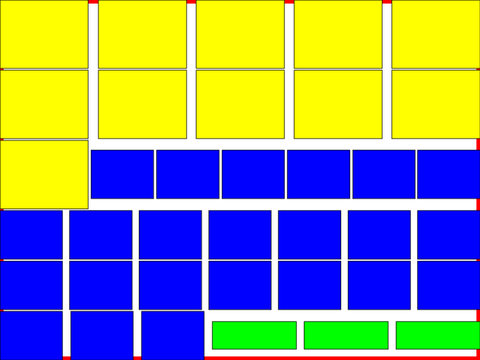
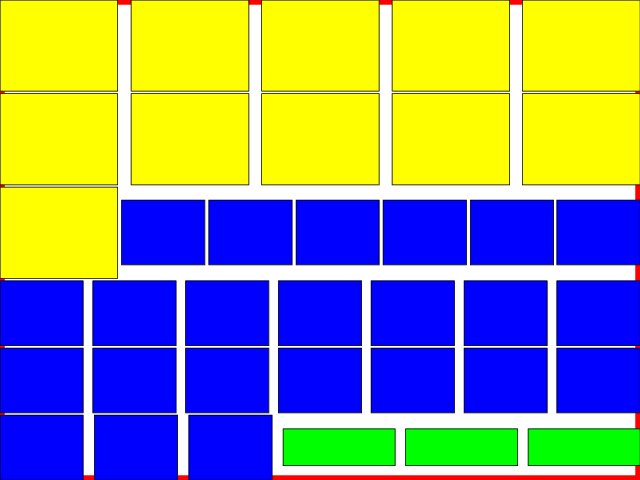
The results will be svg files test1.svg and test2.svg, the latter showing the spread-out result. Here is an example how the output looks like (without the red border which is drawn to mark the pallet border): arrange_spread2.py contains an adaption of arrange_spread.py for the actual problem. Permutations without known length When creating a layer out of articles of same height, then there are four strategies that I can choose from. It is four because there are two methods that I can either use or not. I can rotate the article by 90 per default or not and I can rotate the pallet or not. So every time that I build a new layer, there are those four options. Depending on which strategy I choose, there is a different amount of possible leftover articles that did not fit into any layer. The amount is different because each strategy is more or less efficient. To try out all combinations of possible layer arrangements, I have to walk through a tree where at each node I branch four times for each individual strategy. Individual neighboring nodes might be the same but this outcome is unlikely due to the path leading to those neighboring nodes being different. To simplify, lets name the four possible strategies for each layers 0, 1, 2 and 3. I now want an algorithm that enumerates through all possible permutations of those four numbers for "some" length. This is similar to counting. And the itertools module comes with the product() method that nearly does what I want. For example, should I know that my tree does not become deeper than 8 (read: no more than eight layers will be built), then I can just run:

>>> for i in itertools.product([0,1,2,3], repeat=8):
...     print i
...
(0,0,0,0,0,0,0,0)
(0,0,0,0,0,0,0,1)
(0,0,0,0,0,0,0,2)
(0,0,0,0,0,0,0,3)
(0,0,0,0,0,0,1,0)
(0,0,0,0,0,0,1,1)
(0,0,0,0,0,0,1,2)
(0,0,0,0,0,0,1,3)
This would work if the number of layers created with each strategy was the same. But as each strategy behaves differently depending on the input, it cannot be known before actually trying out a sequence of strategies, how many layers it will yield. The strategy (0,0,0,0,0,0,0,0) might create 7 layers, resulting in (0,0,0,0,0,0,0,1), (0,0,0,0,0,0,0,2) and (0,0,0,0,0,0,0,3) yielding the same output as only the first 7 strategies count. This would create duplicates which I should not waste cpu cycles on later. It might also be that (0,0,0,0,0,0,1,0) turns out to be a combination of strategies that creates more than 8 layers in which case the whole thing fails. So what I need is a generator, that gives me a new strategy depending on how often it is asked for one. It should dynamically extend the tree of possible permutations to accommodate for any size. Since the tree will become humongous (4^11 = 4194304), already traversed nodes should automatically be cleaned so that only the nodes that make the current list of strategies stays in memory at any point in time. This sounded all complicated which made me even more surprised by how simple the solution was in the end. Here a version of the algorithm that could easily be ported to C:
class Tree:
def __init__(self, branch_factor):
self.branch_factor = branch_factor
self.root = "value": None, "parent": None, "children": []
self.current = self.root

def next(self):
if not self.current["children"]:
self.current["children"] = [ "value":val, "parent":self.current, "children":[] for val in range(self.branch_factor)]
self.current = self.current["children"][0]
return self.current["value"]

def reset(self):
if self.current["parent"]:
self.current["parent"]["children"].pop(0)
else:
return False
if self.current["parent"]["children"]:
self.current = self.root
return True
else:
self.current = self.current["parent"]
return self.reset()

def __str__(self):
return str(self.root)
It would be used like this:
>>> tree = Tree(4)
>>> print tree.next(), tree.next(), tree.next()
>>> while tree.reset():
...     print tree.next(), tree.next(), tree.next()
Which would be equivalent to calling itertools.product([1,2,3,4], 3). The special part is, that in each iteration of the loop I can call tree.next() an arbitrary amount of times, just how much it is needed. Whenever I cannot generate an additional layer anymore, I can call tree.reset() to start a new permutation. For my code I used a python specific version which is a generator:
def product_varlength(branch_factor):
root = "value": None, "parent": None, "children": []
current = root
while True:
if not current["children"]:
current["children"] = [ "value":val, "parent":current, "children":[] for val in range(branch_factor)]
current = current["children"][0]
if (yield current["value"]):
while True:
if current["parent"]:
current["parent"]["children"].pop(0)
else:
return
if current["parent"]["children"]:
current = root
break
else:
current = current["parent"]
It is used like this:
it = product_varlength(4)
print it.next(), it.send(False), it.send(False)
while True:
    print it.send(True), it.send(False), it.send(False)
Again, the expression in the loop can have any number of it.send(False). The first it.send(True) tells the generator to do a reset.

19 May 2012

Richard Hartmann: Mongolia

I will start linking to places we stayed at etc, from now on. On the one hand, we already left those places so my paranoid self can rest assured that no one will come hunt us down, on the other hand, I decided to only to name and link to those places which really deserve a mention. If they are linked here, I can whole-heartedly recommend them. Mongolia After leaving through the Russian border fortifications, Mongolia was an instant and welcome change. Trees growing right next to the tracks, branches forming a bit of a natural tunnel; the trains passing by keeping branches at bay, but the trees free to grow wherever else they pleased. A few hundred meters later below a rocky ledge, a cow had apparently fallen down and died. Partially decomposed flesh still clinging halfway to its rib-cage, it proved to be a sign of the (mostly) more laid-back attitude Mongolians tend to take. After finally getting our passports back and being allowed to leave the train, we first headed to the station to get some money. At ~1800:1, the exchange rate for Tugruk against Euro speaks volumes about inflation; imagine my surprise that the MNT 20,000 note is the largest one. It's also the one and only amount any and all ATMs will default to. We were quite surprised by how cheap everything was, even in the one single store within the station directly behind the border. In Russia, travellers expect to pay hefty markups when shopkeepers know they can charge them, not so in Mongolia. The woman in the trash Upon returning from the station, our waggon was just merrily being driving away on its own by a lone engine, something we had not anticipated or appreciated a whole lot. A woman (we hadn't noticed her before) who was busy scavenging a trash container for food for herself and her scrawny-looking son happily stopped what she was doing and, with a big smile, moved her hands around and smacked them back together, signalling us that our waggon would be attached to a different train for the subsequent journey. To put it mildly, I was stunned; we had met people eating from the trash in Russia as well (yes, I always make a point of giving them enough for a few decent meals; anyone eating out of the trash actually needs and definitely deserves something good happening to them), but they were glum and disheartened. Here, there was someone who not only had to look out for herself, but for a three or four year old boy as well, and still was just so... positive... I don't know if I would have it in me to act the same way... As an aside, even though we were just a few kilometers across the border from Russia, she did not actually take the money from me, she cupped her hands to receive it by having me place it into her hands; this is a very Asian thing in my experience and something we would see both in Mongolia and China consistently. Later, when we were back in our waggon, she passed by and happened to see the Spot Messgenger 2 dangling in front of our window, its lights blinking every five seconds. For a solid twenty minutes, until the train started moving again, she squatted down with her son, oggling the Spot. I have no idea what she was thinking it was and I had no chance to explain it to her, but she was really fascinated and just kept staring and staring. When we finally left the station, we waved to and smiled at each other, she ran after us, and then she was gone. All in all, this was one the more memorable things which happened to us. Mongolian Infrastructure When I say that Mongolians as a whole tend to be a lot more laid back than Russians, this extends to infrastructure as well, but not in the good way. Ulan Bator Little Dhingis Khan We arrived in Ulan Bator at six in the morning and started haggling with taxi drivers. Our hostel had (stale, it turned out) information about acceptable fare from station to their place on their website, 5,000 MNT was supposedly OK. Our driver tried to get 20,000, then 15,000, then 12,000, then 10,000, went down to 7,000 and finally settled for 5,000, all this interspersed with frequent "no" by us and walking away. Once on the road, he wanted to convince me that we had agreed upon 5,000 per person, something that did not quite work out for him. When we arrived, he started to tell me that he was good friends with the hostel manager and that said manager would surely want us to pay more; again, that did not work too well. He made the mistake of getting our luggage out of his trunk immediately (we always kept all our stuff in the passenger area afterwards...) before I paid and even though I only had a 10,000 or 20,000 note, I insisted on correct change. The same old dance began anew, with him edging closer to the correct change in steps of 1,000 MNT. He tried to get away several times, but I stood in his door and held it open; if he had just driven off, I couldn't have stopped him, but that thankfully didn't occur to him. After he shoved all small change (MNT is bill only, no coins) he had with him at me and wanted to make off yet again, I was close to throwing all the small crap at him, but after he, a man of maybe 1.65 meter and sitting down, tried to signal his willingness for a fist fight and me, a man of 1.94 meter and standing started laughing, he gave me 2,000 more and drove off cursing. In case you forgot, at that exchange rate, we argued about two to three Euro, but as he tried to cheat, it became a matter of principle. The Hostel, part one All parking lots and other property in Ulan Bator have a small watchtower with private 24/7 guards; said guard ambled down, let us in and woke the poor woman who was forced to let us check in. As she was Mongolian as well, we were a bit surprised when she switched from broken English to perfect German, but the owners of the OASIS are a German-Austrian couple so I guess that makes sense. Fighting through the war Traffic in Ulan Bator is war. Lonely Planet talks about the city being too newly motorized and that it did not have to develop a culture of driving, yet. This is a euphemism for "no one has any qualms maiming or killing you". Everyone is driving like mad, nudging and racing their way in front of each other. If a driver has an oppurtunity to get ahead by a few centimeters with his small car, thereby blocking the way for several buses, making a whole parking lot grind to a halt and thereby deadlocking themselves, they will take said opportunity, and gladly. Red lights are gentle suggestions, there to be mainly ignored; police will not drive over red lights, but they will not stop anybody else from doing so, either. A hearse will have a dozen or more cars following it, all driving in a tight pack, aggressively attacking anyone who dares to wedge in between them and expecting all other traffic to make way even if they are driving over a red light. Crossing a main street in Ulan Bator as a pedestrian is hell. There are a few traffic lights and they help to some extent, but you still need to be extremely careful when crossing a street. Thailand, India, Russia, China, no matter where it's supposedly hard to cross a street by foot, I never had any issues weaseling through. In UB, it takes planning, determination, and a lot of attention, especially as there are stretches where there's not a traffic light in sight. While maintaining eye contact with a driver usually ensures that they will try not to hit you, this does not work in the least in UB. In the evening, I took to shining a high-powered flashlight at the ground to the oncoming traffic's side to mark ourselves and decrease the likelihood of being hit. This worked well in combination with sprinting through gaps in the traffic, except for one guy who actively aimed for us and did not slow down. He even changed lanes, just to keep us in front of his car... Shining the flashlight directly at him in highest mode made him break quite violently though; a good thing, as he may have hit us had he not slowed down. UB itself Ulan Bator is weird. It has clear signs of westernization, but it's still very much an old city. There is one large store which would fit into any random shopping center in Germany (which are tiny when compared to most other countries) and which carries most goods, if with a limited selection. Its supermarket is extremely well stocked with food and drink from all other the world and laughably cheap (for us) prices. While its infrastructure is definitely crumbling, the city is clean, especially when compared to Russia. Two girls from Stuttgart who we met during our Trans-Siberian travels commented on how clean Russian cities were when compared to home, but that may be more of a statement about Stuttgart than about Russia... Anyway, in Mongolia in general and in UB in particular, there's a concise effort to make what they have look nice and clean. There is no trash in the streets, loose gravel and earth is removed from the curb by dedicated workers, all areas of packed earth are sieved and all large stones removed. All in all, it's a lot cleaner (if more dusty and sandy) than Russian cities if somewhat older and more shabby-looking. That being said, Mongolia's countryside is littered There were several street stalls consisting of nothing more than a cardboard box on a stool selling single chewing gums and cigarettes from the original packaging; it's normal for people to buy one cigarette or one piece of chewing gum and walk on. The sights of UB were nice, but nothing too special. Outlook In the next part, I'll cover "The Hostel, part disaster" and generally talk more about excrement than I thought one could write before moving on to China (were I am located at the time of this writing).

Pietro Abate: how to create VMs with ganeti / xen and dnsmaq

I'll start here a small series of posts about ganeti, xen and puppet. For my work I run few servers sitting on xen and it has always been a bit of a pain to create a new instance and keep it up to date. Up to now I've used the excellent xen-create-image tool to create my VMs, but I wanted to try something new and more sexy... Last week I finally found some time to learn (and a spare box to run my experiments) how to use ganeti. Ganeti is the only tool I tried out, but it seems to fit the bill for my use and it seems polished and mature project to me... Moreover I've seen a presentation about it in every FLOSS conference I've attended in the last few years and I thought it was time to give it a try. Installing and configuring ganeti is fairly easy, there is a lot of documentation available and this post is not going to be about installing it, but rather how to create a new bare instance with ganeti-deboostrap-instance. There is also a way to create a new instance from an image, but I didn't go that way yet. This first post is about the first problem I've encountered, that is, how to automatically assign a network address and a name to each new instance created by gnt-instance add. Since all my instances should be able to communicate together on the same subnet, I've decided to configure xen to create a NATted private network and add each new instance to this network. The first step is to create an interface in /etc/network/interfaces .
auto xen-br0
iface xen-br0 inet static
address 10.0.0.1
netmask 255.255.255.0
pre-up brctl addbr xen-br0
post-down brctl delbr xen-br0
bridge_stp off
bridge_fd 0
This is the standard debian way but since xen uses a different naming convention (here I'm using ganeti naming convention xenbr0 vs xen-br0), I need to convince tell xen what I intend to do by adding these lines in /etc/xen/xend.config :
(network-script 'network-virtual bridgeip="10.0.0.1/24" brnet="10.0.0.0/24" bridge="xen-br0"')
(vif-script vif-bridge)
Next I have to connect my real network interface to the private network using few iptables rules in /etc/rc.local (probably there is a better place to do this...):
echo 1 > /proc/sys/net/ipv4/ip_forward
/sbin/iptables -t nat -A POSTROUTING -o eth0 -j MASQUERADE
/sbin/iptables -A FORWARD -i eth0 -o xen-br0 -m state --state RELATED,ESTABLISHED -j ACCEPT
/sbin/iptables -A FORWARD -i xen-br0 -o eth0 -j ACCEPT
The xen setup is complete and every new image should have a vif connected to the subbet 10.0.0.0. The xen setup corresponds to the physical wiring of the network. The next step is to configure each instance so to allow them to communicate on this subnet. Since I build my VMs using ganeti-debootstrap-instance, and by default debootstrap does not configure the network, we need to add a new hook in the directory /etc/ganeti/instance-debootstrap/hooks.
#!/bin/bash
if [ -z "$TARGET" -o ! -d "$TARGET" ]; then
echo "Missing target directory"
exit 1
fi

if [ ! -d "$TARGET/etc/network" ]; then
echo "Missing target network directory"
exit 1
fi

if [ -z "$NIC_COUNT" ]; then
echo "Missing NIC COUNT"
exit 1
fi

if [ "$NIC_COUNT" -gt 0 ]; then

cat > $TARGET/etc/network/interfaces <<EOF
# This file describes the network interfaces available on your system
# and how to activate them. For more information, see interfaces(5).

auto lo
iface lo inet loopback

auto eth0
iface eth0 inet dhcp

EOF


fi

DAEMON_PID_FILES="/var/run/dnsmasq.pid /var/run/dnsmasq/dnsmasq.pid"

instance=$INSTANCE_NAME
[ -n "$instance" ] exit 1
nic_count=$((NIC_COUNT - 1))
mac_var="NIC_$ nic_count _MAC"
echo $mac_var
echo $nic_count
mac=$ !mac_var
echo $mac
echo "dhcp-host=$mac,$instance" > /etc/dnsmasq.d/$instance.conf
This hook will do two things. First it will configure the interfaces of the new instance to get configured using dhcp, second, it will add an entry to the dnsmasq configuration file to make this instance known to the world. This basically boils down to add a file in /etc/dnsmasq.d/ with the mac address of the new instance and its designated name. Dnsmasq will then provide an ip address for this instance and add it to the dns. dhcp-host=aa:00:00:24:6c:8a,node1 Configuring dnsmasq is pretty easy as well. First I want it to answer dhcp queries only on the internal network, second I want to configure my clients passing 10.0.0.1 as nameserver and gataway. You can just add the following lines in /etc/dnsmasq.d/general to get it going.
interface=xen-br0
interface=lo
dhcp-range=10.0.0.128,10.0.0.250
domain=localnet.org,10.0.0.128,10.0.0.250
dhcp-option=3,10.0.0.1
bogus-priv
#expand-hosts
local=/localnet.org/
To create your new instance you can just run the following command :
gnt-instance add -t plain -s 5g -B memory=1024 -o debootstrap+unstable --no-ip-check --no-name-check node1
I use --no-ip-check and --no-name-check to skip ip and dns check performed by ganeti and to avoid a sort of chicken-egg problem, where the name and address of this new instance is yet unknown to dnsmasq and that node1 is the name that will be used by the hook to add an entry in the dnsmasq configuration. debootstrap+unstable is a variant of the default configuration and you need to add it to the list of variants used by ganeti-deboostrap-instance. That should be it. The new instance should come up with a dynamically assigned ip address, able to talk to the outside world and automatically known by all the other machine on the subnet via dns. Next post will be about how to add a swap hook for ganete-debootstrap-istance.

Pietro Abate: how to create VMs with ganeti / xen and dnsmasq

I'll start here a small series of posts about ganeti, xen and puppet. For my work I run few servers sitting on xen and it has always been a bit of a pain to create a new instance and keep it up to date. Up to now I've used the excellent xen-create-image tool to create my VMs, but I wanted to try something new and more sexy... Last week I finally found some time to learn (and a spare box to run my experiments) how to use ganeti. Ganeti is the only tool I tried out, but it seems to fit the bill for my use and it seems polished and mature project to me... Moreover I've seen a presentation about it in every FLOSS conference I've attended in the last few years and I thought it was time to give it a try. Installing and configuring ganeti is fairly easy, there is a lot of documentation available and this post is not going to be about installing it, but rather how to create a new bare instance with ganeti-deboostrap-instance. There is also a way to create a new instance from an image, but I didn't go that way yet. This first post is about the first problem I've encountered, that is, how to automatically assign a network address and a name to each new instance created by gnt-instance add. Since all my instances should be able to communicate together on the same subnet, I've decided to configure xen to create a NATted private network and add each new instance to this network. The first step is to create an interface in /etc/network/interfaces .
auto xen-br0
iface xen-br0 inet static
address 10.0.0.1
netmask 255.255.255.0
bridge_stp off
bridge_fd 0
bridge_ports none
This is the standard debian way but since xen uses a different naming convention (here I'm using ganeti naming convention xenbr0 vs xen-br0), I need to convince tell xen what I intend to do by adding these lines in /etc/xen/xend.config :
(network-script 'network-virtual bridgeip="10.0.0.1/24" brnet="10.0.0.0/24" bridge="xen-br0"')
(vif-script vif-bridge)
Next I have to connect my real network interface to the private network using few iptables rules in /etc/rc.local (probably there is a better place to do this...):
echo 1 > /proc/sys/net/ipv4/ip_forward
/sbin/iptables -t nat -A POSTROUTING -o eth0 -j MASQUERADE
/sbin/iptables -A FORWARD -i eth0 -o xen-br0 -m state --state RELATED,ESTABLISHED -j ACCEPT
/sbin/iptables -A FORWARD -i xen-br0 -o eth0 -j ACCEPT
The xen setup is complete and every new image should have a vif connected to the subbet 10.0.0.0. The xen setup corresponds to the physical wiring of the network. The next step is to configure each instance so to allow them to communicate on this subnet. Since I build my VMs using ganeti-debootstrap-instance, and by default debootstrap does not configure the network, we need to add a new hook in the directory /etc/ganeti/instance-debootstrap/hooks.
#!/bin/bash
if [ -z "$TARGET" -o ! -d "$TARGET" ]; then
echo "Missing target directory"
exit 1
fi

if [ ! -d "$TARGET/etc/network" ]; then
echo "Missing target network directory"
exit 1
fi

if [ -z "$NIC_COUNT" ]; then
echo "Missing NIC COUNT"
exit 1
fi

if [ "$NIC_COUNT" -gt 0 ]; then

cat > $TARGET/etc/network/interfaces <<EOF
# This file describes the network interfaces available on your system
# and how to activate them. For more information, see interfaces(5).

auto lo
iface lo inet loopback

auto eth0
iface eth0 inet dhcp

EOF


fi

DAEMON_PID_FILES="/var/run/dnsmasq.pid /var/run/dnsmasq/dnsmasq.pid"

instance=$INSTANCE_NAME
[ -n "$instance" ] exit 1
nic_count=$((NIC_COUNT - 1))
mac_var="NIC_$ nic_count _MAC"
echo $mac_var
echo $nic_count
mac=$ !mac_var
echo $mac
echo "dhcp-host=$mac,$instance" > /etc/dnsmasq.d/$instance.conf
This hook will do two things. First it will configure the interfaces of the new instance to get configured using dhcp, second, it will add an entry to the dnsmasq configuration file to make this instance known to the world. This basically boils down to add a file in /etc/dnsmasq.d/ with the mac address of the new instance and its designated name. Dnsmasq will then provide an ip address for this instance and add it to the dns. dhcp-host=aa:00:00:24:6c:8a,node1 Configuring dnsmasq is pretty easy as well. First I want it to answer dhcp queries only on the internal network, second I want to configure my clients passing 10.0.0.1 as nameserver and gataway. You can just add the following lines in /etc/dnsmasq.d/general to get it going.
interface=xen-br0
interface=lo
dhcp-range=10.0.0.128,10.0.0.250
domain=localnet.org,10.0.0.128,10.0.0.250
dhcp-option=3,10.0.0.1
bogus-priv
#expand-hosts
local=/localnet.org/
To create your new instance you can just run the following command :
gnt-instance add -t plain -s 5g -B memory=1024 -o debootstrap+unstable --no-ip-check --no-name-check node1
If you are running your dom0 on debian squeeze before running this command you should configure ganeti to pass the right xen parameters to the newly created instance :
gnt-cluster modify --hypervisor-parameter xen-pvm:root_path='/dev/xvda1'
gnt-cluster modify --hypervisor-parameter xen-pvm:initrd_path='/boot/initrd-2.6-xenU'
I use --no-ip-check and --no-name-check to skip ip and dns check performed by ganeti and to avoid a sort of chicken-egg problem, where the name and address of this new instance is yet unknown to dnsmasq and that node1 is the name that will be used by the hook to add an entry in the dnsmasq configuration. debootstrap+unstable is a variant of the default configuration and you need to add it to the list of variants used by ganeti-deboostrap-instance. That should be it. The new instance should come up with a dynamically assigned ip address, able to talk to the outside world and automatically known by all the other machine on the subnet via dns. Next post will be about how to add a swap hook for ganete-debootstrap-istance.

18 May 2012

Pietro Abate: How to convince cupt and smartpm to ignore the gpg signature of a Release file

I'm blogging about this small configuration issue as it took me some time to figure out how to configure cupt and smart to solve this problem. The reason I'm playing with cupt and smartpm is that I'm working to compare again a number of package managers in debian against the state of the art cudf solvers using mpm, and I'm suffering quite a bit to configure my virtual environment. Last year I promised to revise and fix our results. I didn't forget my promise, but it seems it took longer then expected. Anyway, back to the main topic. The release-problem arises because the key used to sign sarge (that I'm using as baseline for my experiments) is long expired. If you try to retrieve sarge from archive.debian.org you will find that sarge is signed with the key A70DAF536070D3A1 and apt-get will complain loudly if you try to use an archive signed with an expired key.

cupt For cupt this is documented in the man page and there are a number of options to add either to /etc/apt/apt.conf to the the cupt own conf file. Then cupt will happily accept the sarge Packages file and let you run update.
cupt::cache::release-file-expiration::ignore "true";
cupt::update::check-release-files "false";
cupt::update::keep-bad-signatures "true";

smartpm For smart I could not found this information anywhere, but reading the source code (tnx good it's python !). To cut it short, you need to set the key trustdb to an empty value for a specific channel. On the command line you get something like : smart channel --set aptsync-614482cb2c7e08d5722af3498232ba52 keyring= --config-file=/root/var/lib/smart/config where aptsync-614482cb2c7e08d5722af3498232ba52 is the channel name corresponding to sarge in my conf. Since I'm using a simulated environment, I save the result of this option in a non-default config file in my chroot.

17 May 2012

Philipp Kern: Lazyweb question: How to avoid leaking process info?

Dear Lazyweb,

is there a simple way to block some users who login with SSH to read /proc/<pid>/cmdline of processes they don't own? Or better yet: don't see these pids at all?

I know that there are PID namespaces, but they seem to require a special PID 1. Seems hard to get for a simple SSH login. (I wouldn't mind changing a user's shell. But brittle shell startup scripts wouldn't cut it.) systemd-nspawn wants to boot a full Linux distribution in a container and even then I'd be unsure how to wire it up so that it cannot be skipped. I wouldn't mind a read-only bind mount of the outermost Linux installation into a chroot environment, as long as the parent SSH process can get the user jailed into it securely. (No need for someone to be root in the chroot.)

I know that there are RBAC frameworks, but they're cumbersome to use. I don't need file labelling or path-based access control, as I do trust the Linux file permissions for this. I think SMACK wouldn't help here, AppArmor isn't really useable in Debian testing and TOMOYO is a tad crazy to use with its domain transitions through process invocations.

I bet that grsecurity would have something for me up its sleeve. But it's not in a Debian kernel. Even though I know how to compile my own kernel I'd only do that if everything else fails.

Thanks in advance for your help.

UPDATE: That was quick, thanks to everyone who participated! Vasiliy Kulikov came up with a kernel patch to my problem (a hidepid mount option for procfs) that landed in 3.3. I tested it with the kernel in experimental and it works just fine and as expected. With hidepid set to 1, it will still leak the process count and their euids and egids. With hidepid set to 2, you only see your own processes, unless you're root. For ps there's no visible distinction between the two. So to test it you can just invoke this as root on a host running 3.3+:
mount -o remount,hidepid=1 /proc
There's even a backport request in the Debian BTS to get the feature into the wheezy kernel (3.2).

16 May 2012

Christian Perrier: Bug #1000000 in Launchpad

Way before Debian, Launchpad bug tracking system just reached 1 million bugs reported with one "bug" reported against Edubuntu basically mentioning it should invade schools. What to say about this? Hard without being harsh towards my friends working in the Ubuntu "world", indeed. Still, I really think that here, too much noise kills signal and the LP BTS is often hardly usable. I counted up to 217 bugs reported against samba4 (which is, after all, not so widely used yet) just because it apparently has upgrading issues between pre 12.04 versions of Ubuntu and Oneiric. It indeed seems that some automated bug reporting is now active and whenever a user encouters an upgrade issue with a package, a bug is being reported. I guess this is somehow an opt-in system (I hope so..:-)) but the default is very clearly using it. This feature is apparently what caused the recent bump in number of bugs reported in LP, making them even less useful, particularly to Debian package maintainers. I'm sure there are tools to help dealing with that and I was already answered that work is in progress to change this (and use a dedicated website for such reports or something like this). But, still, that seems to be the scary side of popularity...the very same popularity that is slowly but constantly hiding the work we're doing in Debian to indirectly make Ubuntu popular. (moving to more general concerns) I know that things are not all black or all white, but it always saddens me to feel that slowly....but, again, constantly, more and more people tend to forget that Debian is behind Ubuntu, is the ground on which it is built and Ubuntu wouldn't exist without it. When doing work, a human need is to get reward for it...and we are getting less of it...slowly, but constantly. Don't take me wrong. I have many friends working directly for Ubuntu. Some paid by Canonical for this. Some really involved up to "top level" (yes, including the very very top level even if I killed him once). I don't want to throw offense on them. I don't even know if they can do something about what I'm expressing below. I would just have them (and others) know. Let's take an example. I recently activated a few languages in D-I (Burmese, Tibetan, Uyghur). I'm happy with that, this is something I'm doing for 8 years now. But all these new translators were indeed only interested in one thing : "have Ubuntu translated in their language". No offense intended, but they didn't really care about *Debian* being translated in their language. I think that some didn't even know what Debian is. In the same field, I am more and more "fighting" to keep the level of translation completeness in Debian (see my regular spa^W reports). In some way, I still succeed, but the price to pay is more and more and more personal investment and work. That's still working for the strong set of languages we support. That works much less for most others. When someone "disappears" (or just switches to some other priorities), it's more and more difficult to find someone else popping up. And, for the "strong set", something else is happening : work duplication. There are "strong" French, German, Italian, whatever, l10n teams in Debian.....and there are similar teams for Ubuntu. And, mostly, those do not really work together. And sometimes, this is kinda discouraging. So, seeing the explosion happening on what is, whatever we think or write, the "other side", is not somethnig that can make one entirely happy. And this is why I won't celebrate Launchpad's millionth bug report. Particularly when I see that millionth bug report not even ack'ing that this Edubuntu marvel is based on the grounds set by some pionneers many years ago in a few schools in Norway (hello, Petter and others). Yeah, sometimes sad. To balance this, let's release wheezy and have millions of people benefit from it without even knowing.

Next.

Previous.