Search Results: "reg"

13 July 2011

Kai Wasserb ch: Vim: How to prevent trailing whitespaces

As the local geek I get all sorts of (Linux) questions asked, like "How can you delete the nth line with Sed?" or "Is there a way to search for the following in a file?" (the latter being a request to construct a regular expression for grep). And while I'm pretty sure, you can find answers for such questions quickly with $SEARCH_ENGINE I find myself generally typing the answer into the IM session. This, and just seeing Bernd's post about Vim on Planet Debian, prompted me to start a little, irregular series of posts, to which I can point people, whenever I get asked such questions. I start this off with a tip for Vim, a very powerful text editor. The problem is simple: you get (source code) files with trailing whitespaces (sometimes accumulated in "empty" lines). This makes diffing (and merging) difficult. Thus the question is: how do I prevent that from happening? How do I notice, that I have whitespaces at the end of a line? The solution consists of two lines in your .vimrc:
:highlight TrailWhitespace ctermbg=red guibg=red
:match TrailWhitespace /\s\+$\  \+\ze\t/
If you just want this functionality if syntax highlighting is also active, then you should use
:autocmd Syntax * syn match TrailWhitespace /\s\+$\  \+\ze\t/
instead of the :match line. The regular expression used in both cases matches trailing whitespaces and whitespaces in front of tabs. Of course there are several other options on how to do this or what you might want to highlight, but that would be beyond the scope of this little post.

11 July 2011

Thorsten Glaser: Yugoslawia, I ll be back

So yes, this means I m going to DebConf 11 to what used to be Yugoslawia when I was there the last time, although in the Pore region of Istria, Hrvatska. Thanks to my my boss who s sending me there.

Paul Wise: Looking at the logos of Debian derivatives

The logos of the Debian derivatives registered in the derivatives census are overwhelmingly stored in PNG format, with a handful of JPEG and GIF images. One derivative (LMDE) doesn't have a logo registered in the census. Half of the logo image files have some embedded indication of which program was used to create them or which program they passed through last. Just over half of these were created with some proprietary Adobe or Macromedia program. The one that surprised me was Emdebian's logo indicating it was created in Adobe Photoshop 3.0, but to be fair it looks like several of the Debian logo files were also created in Adobe Photoshop 3.0 so that might just be copied from the Debian logos. Two of the logos have an easter-egg reminding everyone who looks about the obsession some part of Adobe has with rubber ducks. Just under half of them were created using Free Software, with most of those being produced in the GIMP and a few in Inkscape. One of them looks like a derivative work of the KDE logo. Two of them incorporate the Debian swirl indicating their Debian heritage. Two of them in some way incorporate the Tux Linux mascot indicating that they use Linux. One of the logos contains the word Debian and one contains "sid". Three of the logos mention both GNU and Linux and another mentions only GNU. One of them mentions the government organisation sponsoring the distro (LinEx). A few logos consist solely of text and a few have no text, but most combine both elements. Three have some indication of a URL in them. Several of them have some sort of indication of what the distribution's focus is. One has Adobe's XMP XML cruft embedded in it indicating document identifiers and two logos have an embedded ICC profile. One logo has the author's name in it.

Raphaël Hertzog: 7 tips to file useful Debian bug reports and get your problem solved

Filing bug reports is the most common way for users to contribute. Even if it s not too difficult, I ll give you some advice to improve the quality of your reports. After all, when you go out of your way to report a bug, it is in the hope to see it fixed so let s see how we can make this more likely. 1. Try to reproduce the bug If you can t reproduce the bug, it s next to impossible to find the root cause and thus to fix it. In that case, I would suggest you to wait until you experienced the bug multiple times. Maybe you ll be able to find something that triggers it (or that makes it more likely to encounter it). If the application has a debug/verbose mode, it might be a good idea to enable it until you experience the bug a second time. The generated log might be helpful for the developer to understand what happens exactly. So don t file bug reports straight away unless you can reproduce it. The exception to the rule is when the application gives some useful information like a core-dump, a back-trace or an error message. Obviously if the bug happens during an upgrade, it s difficult to reproduce it (unless you have multiple computers) but you should still report it. Be sure to include all the relevant information (versions of packages before and after the upgrade, logs of the upgrade, etc.). 2. Do your best to identify the faulty package When you report a bug to Debian, you must assign it to a package. While there are pseudo-packages useful for problems which are not directly attributable to a real package, in most of the cases you should report a bug against the specific package that seems to be the cause of the problem you encountered. In turn this often requires you to attribute the problem to a file (for example the executable of the application that triggers the bug). Once you have a filename you can use dpkg -S to identify the corresponding package.
$ dpkg -S /usr/bin/hamster-time-tracker
hamster-applet: /usr/bin/hamster-time-tracker
Note that reportbug accepts a filename as parameter and will do the above conversion for you. If you only know the name of the application (but not the filename of the associated executable), you can use dpkg -S with a pattern to let it return all possible matches:
$ dpkg -S hamster
hamster-applet: /usr/share/applications/hamster-applet.desktop
hamster-applet: /usr/share/gnome/help/hamster-applet/es/statistics.page
[ ]
hamster-applet: /usr/bin/hamster-time-tracker
[ ]
Or you can also verify in the list of installed packages:
$ dpkg -l "*hamster*"
Desired=Unknown/Install/Remove/Purge/Hold
  Status=Not/Inst/Conf-files/Unpacked/halF-conf/Half-inst/trig-aWait/Trig-pend
 / Err?=(none)/Reinst-required (Status,Err: uppercase=bad)
 / Name            Version         Description
+++-===============-===============-==============================================
ii  hamster-applet  2.32.1-1        time tracking applet for GNOME
3. Verify that the bug is not already reported and/or fixed If there s a newer version of the software available, it s a good idea to try to reproduce the problem with this version too. Because the developers tend to care only about the latest version, they will want to reproduce it with this version, and they will be annoyed if the problem that you reported is already fixed. That s why bug reports of users of testing/unstable tend to be more useful than bug reports of stable users. In any case, you want to verify that the bug has not yet been reported: filing a duplicate bug is useless and only generates more work for the developers to merge both bugs together. On the opposite, it s highly appreciated to add supplementary information to an existing bug report, even a simple confirmation that the bug still exists on a newer version is useful. Note that reportbug will automatically show you the list of open bugs before allowing you to submit a new one. 4. Use reportbug While the Debian bug tracking system allows anyone to submit a new bug with a simple mail, you should really use a dedicated program like reportbug (or reportbug-ng) because it will automatically include lots of useful information in the generated report (version of dependencies, current architecture, etc.) and will assist you in all the steps. 5. Describe the problem so that the developer can reproduce it Ideally your report should include everything required so that the developer can reproduce the problem on his system. If a given document triggers the bug, attach it. Describe the steps required to reproduce the bug in great details just like you would explain it to your grand-ma. Explain how you expected the program to react and what happened instead. You can learn much more on how to draft a good bug report in this article: How to report bugs effectively. It s a bit long but well worth it if you intend to report bugs and thus interact with developers. 6. Be kind and willing to help When you draft a bug report, keep in mind that you re writing to a volunteer free software developer and not to a customer service. You should be respectful and follow the usual rules of courtesy. Developers attention is scarce and should not be wasted. Be willing to help, if the developer starts investigating your problem, he might need your help to get supplementary information (in particular if he can t reproduce it) and you should be ready to provide it. Thus it s important to keep whatever you need to reproduce the problem. In some cases, the Debian maintainer might be overworked and you can offer your help to forward the bug to the upstream bug tracker, it s always appreciated. If you re reasonably confident that the problem is not Debian-specific, you can do it straight away and set the forwarded field to the URL of the upstream bug report (for example with bts forwarded <bug> <url>). 7. Use the correct severity The Debian bug tracking system lets you set the initial severity of the bug report (in decreasing severity: critical, grave, serious, important, normal, minor, wishlist). Pick the correct severity according to the official definitions but don t misread them. In particular, don t over-inflate the severity: for instance if you lost some data due to a misuse of the software, it s not critical (i.e. rm -rf * doesn t warrant a critical bug against rm). If you use only a tiny part of a software, and that part doesn t work, the package might be unusable for you but it s not unusable for everybody, so it doesn t warrant the grave severity. The important severity is often a good choice in those cases. Do not under-estimate the severity either, if a problem is important enough that it must be fixed before the next stable release (for example a regression compared to the previous release), pick a release-critical severity (i.e. at least serious ). The maintainer and the release manager can always lower the severity if they do not agree with your initial judgment. And now, happy bug-reporting!
Follow me on Identi.ca, Twitter and Facebook. Or subscribe to this blog by RSS or by email.

6 comments Liked this article? Click here. My blog is Flattr-enabled.

10 July 2011

NeuroDebian: NeuroDebian@HBM2011.ca

NeuroDebian@HBM2011.ca On June 26-30 the annual meeting of the Organization for Human Brain Mapping (HBM2011) took place in Quebec City, Canada. Encouraged by our positive experience at last year s SfN in San Diego and enthusiasm of our scientific adviser, James V. Haxby, we hosted another NeuroDebian booth. The setup was pretty much the same as last year: Some chairs and tables, lots of people, our tri-fold flyers, a Debian mirror and some virtual machine images to show Debian in action. This time we also had an LCD display attracting visitors with the package swarm, some demos, and our recent paper. We had many curious people have their first exposure to Debian, long-time users expressing their gratitude to Debian, and our upstream developers getting together to discuss various topics. Having registered the booth as NeuroDebian , we had the additional pleasure of explaining visitors the concept of a project inside Debian, in contrast to a derived distribution. But that is nothing new really, so let s talk about the differences from last year s booth. First of all, we had more people at the booth. Dominique Belhachemi volunteered to help us out and that was very much appreciated. Although HBM has only about a tenth of the attendees that SfN has, we had significantly more traffic. While last year people were primarily interested in knowing about the project, this time many of them wanted to give it a try immediately. People came with their laptops, got the VM images and started playing with Debian. After a day or so, some came back and asked for recommendations on particular software after having been exposed to the wealth of the Debian archive. What also had increased was the number of developers, or rather research labs developing neuroimaging software that came to the booth to discuss how to get their software into Debian and how to arrange ongoing maintenance of these future Debian packages. As we have our plates already quite full, we have been spending some time on mentoring interested developers to learn the art of Debian packaging and making them familiar with Debian s procedures and standards (e.g. working on #609820 with Yannick Schwartz, upstream, at the booth). ../../_images/BusyBooth216.jpg Two promising new developments need to be mentioned. First, we were approached by companies that develop hardware for brain-imaging and psychophysics research. They were curious to learn about Debian as an integrated platform that offers free software solutions that an increasing amount of their customers demands (e.g. PsychoPy). Apparently, the movement towards open research software has finally made it into the business plans of companies, as they seem to start perceiving compatibility with free software systems as a competitive advantage. We explained how software gets into Debian, and how its release cycle is managed. To foster their motivation we also pointed them to the existing open-source software that is already available or even present in Debian. Let s see whether we see more Debian-certified research products in the future. Lastly, we started talking with folks from the INCF to explore possibilities of collaborating on INCF projects using Debian as the integration and development platform. The INCF is an OECD-funded organization that develops collaborative neuroinformatics infrastructure and promotes the sharing of data and computing resources to the international research community. At least one INCF project is already relying on the efforts of the NeuroDebian project. We are going to continue this discussion during a workshop in September. A report will follow...
../../_images/DDs13.jpg

Debian people at the booth (f.l.t.r): Michael Hanke, Yaroslav Halchenko, Stephan Gerhard, Dominique Belhachemi. Not shown: Swaroop Guntupalli.

Acknowledgments This booth has been made possible by the generous support of Prof. James V. Haxby (Dartmouth College, New Hampshire, USA).

Christian Perrier: 33094 spam posts removed from Debian mailing lists in two years

Debian mailing lists' standard policy is to allow posts from unsubscribed users. That of course fits our standards for opened development but has the drawback of allowing a lot of spam to reach our mailing lists. This spam also clutters the mailing lists archives. Since 2009, a working system allows removing spam from the mailing list archives. Today, I would like to put some light on the results of this system : Results are impressive for mailing lists where a coordinated effort is done over time: the debian-boot mailing list (first coorindated effort, initiated by regretted Frans Pop), the Italian and French mailing lists. You want to help? You can. Reporting spam is as easy as reading Debian mailing lists. When you see a mail that you consider being a spam mail, just bounce it to report-listspam at lists dot debian dotte org. Don't forward it, you need to bounce it ("b" keyboard shortcut in mutt). Alternatively, you can check for this message on Debian mailing lists archives and hit the "Report as spam" button. If you're a Debian developer, you can help in reviewing nominated spam. It takes me about 20 minutes every week. Go to the spam review home page and register for an account there. Then, you'll be able to process through nominated posts. Once a given post is confirmed as spam by at least 3 reviewers with nobody else reporting it as "ham", it is removed the next week from the archive. Feel free to join the game and be part of the Debian moppers team!

8 July 2011

Russell Coker: Multiple Filesystems for Security

There is always been an ongoing debate about how to assign disk space into multiple partitions. I think that nowadays the best thing to do is to assign about 10G for the root filesystem for every desktop and server system because 10G is a small fraction of the disk space available (even the smallest laptops seem to all have disks larger than 100G nowadays). Even if 10G turns out not to be enough using separate filesystems for /var or /usr provides little benefit now that it s easy to resize the root filesystem with LVM and a separate /usr is known to be broken [1]. In a discussion on a private mailing list there was a suggestion that multiple filesystems should be used for security. DoS Attacks There are some minor security benefits in having multiple filesystems. If a critical program will fail when there is no free disk space then allowing an unprivileged process to use up all the space on that filesystem is a minor security issue, so having unprivileged processes not being permitted to write to important filesystems is a benefit. But most failures of this type are merely DoS attacks which usually aren t a big deal if you can control a local process there are usually lots of other ways of DoSing a system. Links Links have been the cause of many security issues in Unix over the years. Using different filesystems for different tasks can prevent the use of hard links in attacks aimed at exploiting race conditions. But even if you prevent hard links there are similar issues with symbolic links. SE Linux is one of many security improvements for Linux which allow restrictions on the creation of hard links. SE Linux also allows restricting the ability of processes to follow symbolic links, so a privileged process can be denied access to follow a sym-link that was created by an unprivileged process. NFS The subtree_check option in /etc/exports causes the NFS server to verify that file access is in the correct subtree. So if you export only one subdirectory of a filesystem to a given server then hostile code on that server (or on a network device which impersonates that server) can t access other subdirectories. This option is documented as having performance implications and working best for filesystems that are mostly read-only, for this reason it s turned off by default in recent versions of the NFS utilities. So if you want to NFS export /home then it s probably a good idea to have /home be on a separate filesystem to prevent attacks on the root filesystem. But of the systems with significant use of /home (IE anything other than accounts used solely for su - ) most of them have a separate filesystem for /home anyway so this shouldn t be an issue. SE Linux When mounting filesystems with SE Linux there is a context= mount option that allows specifying the context for all files on the filesystem. This can save a small amount of storage space for XATTRs and theoretically improve performance (although the difference is unlikely to show up on benchmarks for anything other than fsck). Generally the context mount option is only used for a filesystem that has a huge number of files with the same context, such as a mail spool that uses Maildir, Cyrus, or any of the other formats that involve one file per message. But again such data is generally stored on a separate filesystem for other reasons anyway. I found one interesting corner case in regard to SE Linux systems mounting files from an NFS server. When an NFS server exports multiple subdirectories of a filesystem mounted on /foo then if one NFS client running SE Linux is to mount two subdirectories of /foo with different contexts then the second mount attempt will give the error an incorrect mount option was specified . This is because as of kernel 2.6.18 by default it s not permitted to mount parts of the same filesystem with different mount options. The option nosharecache allows you to use different mount options, but does apparently permit some undesirable behavior in the case of hard links that cross between the subtrees. Thanks to Eric Paris for the tip about nosharecache. The best example I can think of for which you might want context mount options that differ among files that are used for the same purpose on an NFS mount is a web server which has data files and CGI-BIN scripts. So it seems that a SE Linux web server that mounts it s data over NFS and is at risk of having hard links between the CGI-BIN directory and the data directory is a corner case in which multiple filesystems is required for security. This seems to be a very unlikely case. Conclusion Servers that are deployed in the real world are complex enough that there are always systems with some unusual corner cases demanding configuration choices that aren t expected. There are some real corner cases for SE Linux where multiple filesystems are compelled for security or for a combination of security and best performance. But I wouldn t make a generic recommendation of using lots of filesystems for security. I think that the people who encounter the strange corner cases can usually work out that they need to do something different. So a small number of filesystems seems like a good general aim that doesn t conflict with security.

6 July 2011

Ritesh Raj Sarraf: Console Gaming - Sony Playstation 3

I have been thinking of this topic for some time. I am a happy owner of the old Phat PS3 Model. At one time, I use to do a fair amount of gaming on my computers. So when Sony marketed the PlayStation 3 product, it was cool to see a machine that did:
  1. Gaming
  2. Movies, Music, Pictures
  3. Blu-Ray
  4. Ran Linux
I convinced myself to buy a PlayStation 3, that I'd use it for playing with Linux apart from gaming. The regular gaming did not excite any more, perhaps it had to do with the limitation of time. On running Debian on it, was when I realized that the Linux support was merely a joke. The Linux support included running a Linux distribution in a VM with not much access to the full hardware resources. Not a Great Experienceread more

John Goerzen: Geeks, Hobbies, and Free/Open Source: Feedback Wanted

I ve been thinking lately about ways to improve ways in which I interact with Free Software projects, and ways in which they interact with me. Before I proceed to take steps or make suggestions, I d like to see if others share my traits and observations. Here are some questions I have been thinking of. If you d like to help give me anecdotal evidence, please post a comment below this post. Identify the question numbers you are answering. It helps me if you can give specific examples, but if you don t have the time or memory for that, no problem. I will post my own answers in a day or two, but the point of this post is listening, not talking, so I ll not post them immediately. Hobbies (General any geeks) Examples: video games might be a challenging hobby (depending on the person) but in most cases aren t educational. A hobby might be video game playing or being a Debian developer. A sub-hobby might be playing GTA IV , playing RPGs , or maintaining mutt . Free/Open Source Hobbies Examples on F9: If, say, you are a long-time Perl user and have gone to Perl conferences, but now you are interested in Ruby, would your involvement with the Perl community cause you to avoid taking up the Ruby programming hobby? Or would it cause you to cut your ties with Perl less quickly than your changing interest might dictate? (This is a completely arbitrary example and isn t meant to start a $LANGUAGE thread.) Changes over time

Dirk Eddelbuettel: Even faster linear model fits with R using RcppEigen

Linear regression models are a major component of every applied researcher's toolbox. Obtaining results more quickly is therefore of central importance, particularly when many such models have to be fit. Common examples in this context are Monte Carlo simulation or bootstrapping. My talks introducing High Performance Computing with R (see e.g. these slides from a five-hour workshop at the ISM in Tokyo) frequently feature an example of how to extend R with dedicated compiled code for linear regressions. Romain and I also frequently use this a motivating examples with our Rcpp package for seamless R and C++ integration. In fact, the examples directory for Rcpp still contains an earlier version of a benchmark for fastLm(), a faster alternative for R's lm() and lm.fit() functions. We have also extended this with the RcppArmadillo package which brings Conrad Sanderson's excellent Armadillo library with templated C++ code for linear algebra to R, as well as a simple integration to the GNU GSL via our RcppGSL package. The Rcpp section on my blog contains several posts about fastLm benchmarks. Doug Bates has been a key Rcpp contributor, helping particularly with the initial Armadillo integration. His research, however, also requires highly performing sparse matrix operations which Armadillo does not yet offer. So Doug has started to explore the Eigen project---a free C++ template math library mainly focused on vectors, matrices, and linear algebra (note that we will refer to the Eigen, Eigen2 and Eigen3 APIs as just 'Eigen' here, focusing on the latest version, Eigen3). Better still, Doug went to work and pretty much single-handedly wrote a new package RcppEigen which integrates the templated C++ library Eigen with R using Rcpp. RcppEigen also provides a fastLm implementation and benchmark script. In fact, it contains a full six different implementations as Doug is keenly interested in rank-revealing decompositions which can guard against ill-conditioned model matrices. Some more background information on this is also available in Doug's article on Least Squares Calculations in R in R News 4(1). Doug's implementation also uses an elegant design. It comprises a base class with common functionality, and six subclasses which specialize accordingly for these six different decompositions approaches: On my server, the result of running the included benchmark script lmBenchmark is as follows:
lm benchmark for n = 100000 and p = 40: nrep = 20
     test   relative elapsed user.self sys.self
7     LLt   1.000000   0.918      0.91     0.00
3    LDLt   1.002179   0.920      0.92     0.00
5 SymmEig   3.021786   2.774      2.19     0.57
6      QR   5.136166   4.715      4.24     0.48
2   PivQR   5.303922   4.869      4.27     0.58
8    arma   6.592593   6.052      6.03     0.02
1  lm.fit   9.386710   8.617      7.14     1.45
4     SVD  33.858388  31.082     30.19     0.84
9     GSL 114.972767 105.545    104.79     0.63
From this first set of results, the preferred method may be 'PivQR', the pivoted QR. Strictly-speaking, it is the only one we can compare to lm.fit() which also uses a pivoting scheme. In the case of a degenerated model matrix, all the other methods, including the four fastest approaches, are susceptible to producing incorrect estimates. Doug plans to make SVD and SymmEig rank-revealing too. As for pure speed, the LL and LDL decomposition have almost identical performance, and are clearly faster than the other approaches. Compared to lm.fit(), which is the best one could do with just R, we see an improvement by a factor of eight which is quite impressive (albeit not robust to rank-deficient model matrices). Apart from the SVD, all approaches using Eigen are faster than the one using Armadillo, which itself is still faster than R's lm.fit(). Doug and I were very surprised by the poor performance of the GNU GSL (which also uses SVD) via RcppGSL. Now, Eigen uses its own code for all linear algebra operations, bypassing BLAS and LAPACK libraries. The results above were achieved with the current Atlas package in Ubuntu. If we take advantage of the BLAS / LAPACK plug-in architecture offered on Debian / Ubuntu systems (see the vignette in my gcbd package for more) and use Goto BLAS which provide tuning as well as parallelism on multi-core machines, the results are as follow:
lm benchmark for n = 100000 and p = 40: nrep = 20
     test   relative elapsed user.self sys.self
3    LDLt   1.000000   0.907      0.90     0.00
7     LLt   1.000000   0.907      0.91     0.00
5 SymmEig   2.981257   2.704      2.14     0.56
6      QR   5.004410   4.539      4.03     0.50
8    arma   5.072767   4.601     15.30     3.05
2   PivQR   5.307607   4.814      4.27     0.55
1  lm.fit   8.302095   7.530      9.55    12.25
4     SVD  33.015436  29.945     29.06     0.85
9     GSL 195.413451 177.240    244.64   319.89
We see that the BLAS-using Armadillo approach improves a little and moves just slightly ahead of the pivoted QR. On the other hand, lm.fit(), which also uses a pivoting scheme and hence only level 1 BLAS operations, changes less. GSL performs even worse (and it is unclear why). Doug's post announcing RcppEigen on the Eigen list has a few more sets of results. This post has illustrated some of the performance gains that can be obtained from using Eigen via RcppEigen. When not using rank-revealing methods, computing time can be reduced by up to eight times relative to lm.fit(). Rank-revealing method can still improve by almost a factor of two. The main disadvantage of Eigen may be one of the reasons behind its impressive performance: its heavily templated code does not use BLAS, and the resulting object code (as e.g. in RcppEigen) becomes enormous (when compiling with debugging symbols). As one illustration, the shared library for RcppEigen on my Ubuntu 64-bit system has a size of 24.6 mb whereas RcppArmadillo comes in at a mere 0.78 mb; without debugging symbols it is a more reasonable 0.52 mb. The performance of Eigen is certainly intriguiging, and its API is rather complete. It seems safe to say that we may see more R projects going to make use of Eigen thanks to the RcppEigen wrapper.

Update: Clarified statement about large object size which was entirely due to building with debugging support.

5 July 2011

Rudy Godoy: Compute Clusters Integration for Debian Development and Testing Report 3

Hello this is the third report regarding my project. As usual, quick
summary first. From my last report I have progressed much little than I
would like but, as stated previously also, I m finishing semester
and between exams and projects it takes almost all my time. However, I m
free of academic duties next week and I ll double the speed on the project. What was done so far

- Started working on the modifications to the Eucalyptus code, as
expected.
I ve almost complete the code for the Libvirt s XML Domain
definition. I ve abstracted the wrapper in order to support a broader
number of arches. Previously it was tailored for supporting x86/amd64
based machines. The idea is to have a list of supported arches and
generate the XML file according that. For ARM some parameters and
elements are different than for the others. This would allow for
people to support another architectures, given they are well supported
by KVM-Qemu.
Started working on changes to util/data.c to make sure the correct
parameters are being passed to the XML generator and to libvirt kvm
calls.
- Define and start to setup the testing / demo environment. Basically
involves having one machine to run KVM as hypervisor so the Eucalyptus
handler uses it to run ARM kvm-qemu images.
- Over this weekend I ll be publising the code changes on my
website. Steffen suggested to create some docs regarding the progress
too. I ll do that once I feel I m on track again for my current
pending work, that s coding. What I ll be working over the next two weeks

- My primary goal is to catch up on the work pace and finish the neccesary
code for Eucalyptus to support ARM images. This means to finish
modifications to:
node/handlers_kvm.c handling nc creation. Little changes are need
here from what I ve indentified already.
util/data. c,h handling instance creation. This is the part where
most of the work shall be done. I ve started to work here already.
- Test the code I ve complete already and send the patches to the teams
involved. To date I m still working on a local environment, because no
usable patches have been generated already, just little pieces here
and there.
- Since this is a sort of gluing project, that is code here and there
and make it work together. I m in the process of finding a machine to
be able to test parts of it once they are complete. I m still
contacting people to get such machine, in anycase I gues I can manage
to get one myself. I can t use my current machine since it involves
reinstalling and working at the OS level.
- For the project s demo I ll use both machines, one as the front-end
and the kvm one for NCs (nodes). That s the goal. What is required after that

- I d like to release a package that includes my changes, so it can be
installed either from official packages or my own packages, this
involves:
Updating the packaging bits to the pkg-Eucalyptus repo.
Talking to upstream about it.
- Write the reference Steffen suggested. I believe that I can finish the first part in one week, because of the
work I ve done in the past weeks to understand the Eucalyptus code. I m
also will be talking more to the Eucalyptus team and also to the
maintainers about such changes. I guess that s all for now.

John Goerzen: The Lives of Others

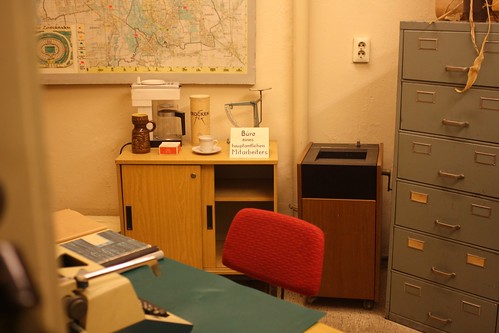
It s not very often that I watch a movie anymore. It s been a few years since I ve actually purchased one (normally I see them from Netflix). But yesterday I saw one that may change that. The Lives of Others is an incredible film set in the former East Germany (GDR/DDR) mostly in 1984. The authenticity of it is incredible and so is the story. It s subtitled, but if you re an American wary of subtitled European films, don t be wary of this one. It is easy to watch and worth every minute. The story revolves around the Stasi, the GDR Ministry for State Security ( secret police ). It is an incredible picture of what living in a police state was like, and how many of the informants were victims of the regime too. My breath caught near the beginning of the film, showing the inside of a Stasi building. A prisoner was being interrogated for helping someone attempt to escape to the west. But the reason my breath caught was this incredible feeling of I was there . Last year, Terah and I were in Leipzig and visited the Stasi museum there, Museum in der Runden Ecke . I always have an incredible sense of history when being in a preserved place, and this building was literally the Stasi headquarters for Leipzig. Much of it was preserved intact, and seeing it in the film brought home even more vividly the terrible things that happened in that building, and others like it, not so very long ago. IMG_2717 We watched the special features on the Blu-Ray disc, and one of them was an interview with director Florian Henckel von Donnersmarck. He described how he spent a lot of time interviewing both victims of the Stasi, as well as ex-Stasi officers. One of the most disturbing things to me was his almost offhand comment that most of the former Stasi officers still had some pride in performing their jobs well. Even now, freed of the state s ideology, they were proud of the work they did which could be put most charitably as ruining people s lives. What leads a person to view life that way? How can we try to make sure it doesn t happen again elsewhere? I am happy to say that most of us have never experienced anything like the Stasi. And yet, small reflections of that mindset can be seen almost everywhere. Societies at wartime or feeling under threat, even Western democracies, can drum up those feelings. In the USA, for instance, the McCarthyism era saw people s careers ruined for alleged anti-state behavior. Contemporary examples include the indefinite detention (I hate that word; shouldn t we say imprisonment ?) of terrorism suspects at Guantanamo Bay, and the terrible treatment of Bradley Manning, who revealed some true but embarrassing things about the US military which really needed to be revealed. Even tobacco farmers and companies are selling a product they know ruins lives, but somehow keep doing it. And there are still members of the public that try to make life difficult for people that don t think like they do. From organizing campaigns of telephone harassment of colleges that don t perform the American national anthem before sporting events, to tossing about the term un-American (a loaded McCarthyist one, which many may not even be aware) at an inflated rate, we are not immune from attempts at forcing conformity or silence in others, and blind loyalty to state. I am never in a particularly celebratory mood on July 4, the biggest day for American boasting, faux patriotism, militarism, and general flag-waving. We do have a lot to be proud of and thankful for, but it seems that we celebrate all the wrong things on July 4, and see it as an occasion to proclaim American exceptionalism rather than as one to see how far we ve come and bolster hope for how far we can, and should, yet go. No, I don t think that the land of the free ought to have operated secret prisons in Europe (nor the Europeans to have been complicit in it), or that the American military was defending our freedom 100% of the time they were deployed, or that it is right for governments to mandate daily recitation of an untrue document (the pledge of allegiance) in schools. And yet, I am mindful that I have a lot to be thankful for stability, lack of much internal violent conflict, etc. And this particular day I am happy that a post like this is not something that gets the attention of some government agency and mostly that I will have a handful of angry emails to delete.

4 July 2011

Joachim Breitner: gtk-vector-screenshot works with epiphany

Martin Borgert uses my gtk-vector-screenshot application to take screenshots of a web page opened in the browser, in his case, epiphany. I find this a very good idea and was surprised to hear that it works flawlessly: The rendered web page not only shows up, it even shows up as vector graphic with fully selectable text. It s also neat that a HTML5 video appears. One feature that is hard to replicate with regular screenshots is taking a shot of a window that is larger than the current screen. This PDF file (of which the image on the left is a thumbnail preview) contains a whole web page that would not fit on my screen. To achieve that you need a window manager that allows resizing windows beyond the size of your screen (e.g. xmonad). Then just keep resizing and moving the window until the scroll bar disappears and take the shot. BTW, gtk-vector-screenshot is available in Debian unstable.
Flattr this post

3 July 2011

Clint Adams: A very little bit about how herb works

This information is pieced together from no fewer than five informants. As such it is likely to contain inaccuracies. Every year, through the conference registration system, a fork of an old version of Pentabarf, attendees declare that they need sponsorship. They state their cost of travel as well as how much of this amount they can afford to pay themselves. In addition, there is a text field in which one is to answer what you do for Debian and why you request sponsorship. Next a committee is assembled. The head of the committee hand-picks its members. In 2011, twenty-four people were asked if they would like to participate, thirteen people were named to the committee, and twelve of those ended up voting. This committee is named herb , after Herbert Powell. The members of herb each individually rate the applicants on two factors: contribution to Debian and amount requested. Each factor is rated on a five-point scale (-2 to +2). Raters may leave, at their option, a comment regarding the applicant. The raters are able to see previous ratings and comments. In the interest of avoiding the appearance of conflict of interest, each rater will refrain voluntarily from self-rating. Individual raters use exercise judgment during this process.
Contribution to Debian is very subjective, and some raters will vote either on total travel cost, requested amount, the ratio of the two, or something else. At a certain point in time, a weighted average of all the ratings is used to order all the applicants into a list. At the top will be the people ranked most highly. The herb team will then conduct an IRC meeting in which ranking may be arbitrarily changed and two thresholds will be established. The result of this process is three lists of people: queue A, for people who should definitely get sponsorship; queue B, for people that might get sponsorship if people from queue A cancel or other circumstances arise; and queue C, which is not really a queue, but a rejection pile. In some cases, the structure of these queues are decided before definite budget numbers are known. Applicants are emailed to let them know which queues they are in, and their rankings within those queues.

Asheesh Laroia: How I feel about Google+ (not thrilled)

Image credit: Lake Shimmer by (nc-sa) cobalt123. The beautiful photo above is what reflections should look like. If you don't like Google's shimmering +1 buttons, try the convenient AdBlock filter Tom Morris wrote. I also block this image.

I have been reading a lot about Google+. I'm sure a lot of people put a lot of hard work into it. Lots of people seem to enjoy using it and appreciate its features. For my part, right now, when I see Google+ mentioned, the smile vanishes from my face. I just have a few thoughts. It's anti-competitive. If you could ask Google, "How much for a shimmering +1 button next to every search result?" you would be laughed out of the room. But they managed to offer themselves that unique marketing opportunity. I know that (1) most regulators who see this anti-competitive behavior won't see it as an anti-trust violation, and (2) the damage is already done, and no retribution in the future can act fast enough to fix the unfair advantage Google gave itself in the Internet-mediated personal communication (and ad sales) markets. The shimmering is distracting, making my online search experience worse. I know that Google is holding nothing back; they are willing to distract me from my intended use of Google in order to branch out their business. (If you haven't seen the shimmering +1 button, it's next to every web search result, and if you mouse over any part of the result, it does a wavy dance.) The most-touted feature is a clone of Diaspora. This by itself is fine; software should help users by having the best features imaginable. But the enthusiasm I've seen within the free software community (like when I read about Google+ on Slashdot and Planet Debian) should at least recognize that Google "circles" are a clone of Diaspora's Aspects. Centralization on the web feels like a personal attack. Corporations on the web are like unstoppable machines rolling us toward a future of corporate eavesdropping, central points of failure, and end-users sold en masse to advertisers. It enables a future of individual "platform owners" who can change the lived experience of untold hundreds of millions with tweaks that benefit their actual customers (the advertisers). There's not much I can do about that. I happen to take this personally: I am part of a small culture of people who run their own mail and web servers and understand the importance of software freedom. This is a part of my identity. I watch as its traces online vanish, replaced by something more efficient and terrifying. It makes me sad. I'm probably going to end up using it despite all these pain points. That's how I know that I am being steamrolled. The reasons I have given above are not reasons to not use Google+. They're just reasons that I'm going to frown all the way to the address bar. In weeks to months to years, the service will grow an enthusiastic userbase. At that point, personally, I'll have to make a choice between connecting with those people on their terms, or not staying in touch with them. Already, professionally, the idea has already come up on #openhatch that Google+ could help us reach people willing to contribute to open source. Are my gripes worth holding OpenHatch back, or worth isolating myself over? Probably not.


Dominique Dumont: Generate a configuration editor from a config template file with Perl: lcdproc example

Hello Creating a configuration model for Config::Model can be a boring task: When a configuration system has a lot of parameters, a lot of details need to be specified to have a complete configuration validation tool. So, all tricks are permitted to make this task more bearable. Let s see how this can be applied to lcdproc. This project requires a configuration file that supports more than 40 drivers. Each driver has it own set of parameters for a total of about 250 parameters. That s a lot to specify.. Fortunately, LCDd.conf template file is written in a way which makes it relatively easy to parse and get all required information to build a model. All drivers are listed in this template file, most parameters have default values and legal values are written in comments in a uniform way. Hence this file (and comments) can be parsed to retrieve information required for the model. This blog will describe how this task can be implemented in Perl using Config::Model modules. The code will be slightly trimmed down to keep this blog (relatively) short. All initialisation code and error checks are removed. You can get the whole script on sourceforge. The main steps are:
  1. prepare a parser for LCDd.conf template
  2. parse LCDd.conf template
  3. prepare a LCDd model skeleton
  4. translate LCDd.conf template information in a format suitable to create a model.
  5. Write the resulting LCDd model
First, here s the necessary incantation to start properly a Perl program:
use strict;
use warnings;
Then load all required libraries. Their use will be described later:
use Config::Model;
use Config::Model::Itself 1.225;
use Config::Model::Backend::IniFile;
use 5.10.0;
use IO::File;
use IO::String;
Perform some initialisation to avoid upsetting the logging system:
use Log::Log4perl qw(:easy);
Log::Log4perl->easy_init($WARN);
Let s also initialize a model object that will be very useful later:
my $model = Config::Model->new();
Now we can really start the fun part. Step 1: Create a parser for LCDd.conf (INI file)
Problem: LCDd.conf comments must also be analysed to get more semantic information. The comments must be retrieved and associated with the INI classes and parameters found in this file. Fortunately, Config::Model::Backend::IniFile is able to associate comments with the relevant parameters. But Config::Model::Backend::IniFile must store its values in a configuration tree. So let s create a model suitable for LCDd.conf template that accepts any INI class and any INI parameter Dummy::Class is used to store any parameter found in an INI class. The accept keyword with .* regular expression means that any INI parameter will be accepted in each INI class.
$model->create_config_class(
  name   => 'Dummy::Class',
  accept => [
    '.*' =>  
       type => 'leaf',
       value_type => 'uniline'
        ,
    ],
);
Now the Dummy model must provide a configuration class to hold all INI classes:
$model->create_config_class(
    name   => 'Dummy',
    accept => [
       '.*' =>  
           type => 'node',
           config_class_name => 'Dummy::Class'
        ,
    ],
);
Note that an INI backend could be specified directly here. But, some useful parameters are commented out in LCD.conf. Some some processing is required to be able to create a model with these commented parameters. See below for this processing. Step 2: Parse LCDd.conf Now the dummy configuration class is created. Let s create a configuration tree from this dummy class to store the data from LCDd.conf
my $dummy = $model->instance(
    instance_name   => 'dummy',
    root_class_name => 'Dummy',
)-> config_root;
Now, read LCDd.conf:
my $lcd_file
  = IO::File->new('examples/lcdproc/LCDd.conf');
my @lines    = $lcd_file->getlines;
And perform the pre-processing on LCDd.conf mentioned above. Just un-commenting commented parameters is required:
foreach (@lines)   s/^#(\w+=)/$1/  
Store the pre-processed LCDd.conf in a IO::Handle usable by INI backend
my $ioh = IO::String->new( join( '', @lines ) );
Create an INI backend to read the data from pre-processed LCDd.conf and store it in the configuration tree:
my $ini_backend = Config::Model::Backend::IniFile
  ->new( node => $dummy );
$ini_backend->read( io_handle => $ioh );
Step 3: Prepare LCDd configuration model Your attention please. You may remember that we invoked instance on object to create the dummy configuration tree to hold LCDd.conf data. The instance method used the Dummy configuration class. Now, we must invoke instance again on object. But this time, instance will use Config::Model::Itself. This model is Config::Model s way of eating its own dog food. The configuration tree created there will be able to hold LCDd model. Hence the root of this special configuration tree will be called meta_root to avoid confusion with the other configuration root defined above (for the Dummy model). Still with me? Good, let s create this meta tree that will contain LCDd model:
my $meta_root = $model->instance(
    root_class_name => 'Itself::Model',
    instance_name   => 'meta_model',
) -> config_root;
Create the main LCDd configuration class and store the first comment from LCDd.conf as class description:
my $first_comment = $dummy->annotation ;
$meta_root
  ->grab("class:LCDd class_description")
  ->store( $first_comment );
Append my own text in this description:
my $extra_description =
    "Model information extracted from template /etc/LCDd.conf"
  . "\n\n=head1 BUGS\n\nThis model does not support to load "
  . "several drivers. Loading several drivers is probably a "
  . "marginal case. Please complain to the author if this "
  . "assumption is false";
$meta_root->load(
     qq!class:LCDd
        class_description.="\n\n$extra_description"!
);
Add legal stuff in the model:
$meta_root->load( qq!
  class:LCDd
    copyright:0="2011, Dominique Dumont"
    copyright:1="1999-2011, William Ferrell and others"
    license="GPL-2"
!
);
Add INI backend so configuration object created from LCDd model will be able to read user s INI files:
$meta_root->load( qq!
  class:LCDd
    read_config:0
      backend=ini_file
      config_dir="/etc"
      file="LCDd.conf"
!
);
Note that all the load calls above could be done as one call. They were split for better clarity. Step 4:Extracting LCDd.conf information Now that all information from LCDd.conf template file is stored in $dummy configuration tree, it s time to use this information to enhance the skeleton of LCDd model created above. Let s first find all the INI classes defined in LCDd.conf:
my @ini_classes = $dummy->get_element_name;
Now before actually mining LCDd.conf information, we must prepare several subs to handle them. This is done using a dispatch table:
my %dispatch;
First create the default entry which will be used for most parameters. This subs is passed: the INI class name, the INI parameter name, the comment attached to the parameter, the INI value, and an optional value type. It will return a string describing a model for simple elements. For instance: class:"LCDd::MD8800" element:Device type=leaf value_type=uniline default="/dev/ttyS1" description="device to use [default: /dev/ttyS1]" Here s the subroutine invoked by default. Let s create a an anonymous subroutine and store it in the dispatch table:
$dispatch _default_  = sub  
    my ( $ini_class, $ini_param, $ini_note,
         $ini_v, $value_type ) = @_;
    $value_type  = 'uniline';
Now, prepare a string that will be used later to create the ini_class model. This string uses Config::Model s serialisation format described in Config::Model::Loader:
    my $load = qq!class:"$ini_class"
                  element:$ini_param type=leaf !;
Get semantic information from LCDd.conf template comments (written between square brackets):
    my $info = $ini_note =~ /\[(.*)\]/ ? $1 : '';
    $info =~ s/\s+//g;
Use this semantic information to better specify the parameter:
    $load .=
        $info =~ /legal:(\d+)-(\d+)/
           ? " value_type=integer min=$1 max=$2"
      : $info =~ /legal:([\w\,]+)/
           ? " value_type=enum choice=$1"
      :    " value_type=$value_type";
    if ( $info =~ /default:(\w+)/ )  
        # specify upstream default value
        # if it was found in the comment
        $load .= qq! upstream_default="$1"!
           if length($1);
     
    else  
        # or use the value found in INI
        # file as default
        $ini_v =~ s/^"//g;
        $ini_v =~ s/"$//g;
        $load .= qq! default="$ini_v"!
           if length($ini_v);
     
The model (in serialised format) is ready, let s return it and exit the subroutine:
    return $load;
 ;
Now let s take care of the special cases. This one deals with Driver parameter found in INI [server] class. This sub will create a string for an enum element. The possible values of the enum are extracted from the comment found in the LCDd.conf file:
$dispatch "LCDd::server" Driver  = sub  
    my ( $class, $elt, $info, $ini_v ) = @_;
    my $load = qq!class:"$class"
                    element:$elt
                      type=leaf
                      value_type=enum
    !;
    my @drivers = split /\W+/, $info;
    while ( @drivers
            and ( shift @drivers ) !~ /supported/ )  
      # nothing, the work is done by shift operator
      # in loop test to skip all words in $info until
      # 'The following drivers are supported:'.
      # ok, that's a hack
     
    $load .= 'choice='
          . join( ',', @drivers ) . ' ';
    return $load;
 ;
This sub invokes the default sub and add a small feature to the model to ensure that DriverPath ends with / . This is ensured by the match="/$" snippet:
$dispatch "LCDd::server" DriverPath  = sub  
    my ( $class, $elt, $info, $ini_v ) = @_;
    return   $dispatch _default_ ->(@_)
           . q! match="/$" !;
 ;
Likewise, this sub invokes the default sub with the optional 4th parameter that forces the value_type of the element. In this case, we enforce an integer element:
 $dispatch "LCDd::server" WaitTime 
 = $dispatch "LCDd::server" ReportLevel 
 = $dispatch "LCDd::server" Port 
 = sub  
    my ( $class, $elt, $info, $ini_v ) = @_;
    return $dispatch _default_ ->( @_, 'integer' );
   ;
This sub returns a string for a list element with default values:
  $dispatch "LCDd::server" GoodBye 
= $dispatch "LCDd::server" Hello 
= sub  
    my ( $class, $elt, $info, $ini_v ) = @_;
    my $ret = qq( class:"$class"
                    element:$elt
                      type=list
                ) ;
    $ret .= 'cargo type=leaf
             value_type=uniline - ' ;
    $ret .= 'default_with_init:0="\" '.$elt.'\"" ' ;
    $ret .= 'default_with_init:1="\" LCDproc!\""';
    return $ret ;
 ;
Now that the dispatch table is ready, let s really mine LCDd.conf information. First handle all INI classes in the foreach loop:
foreach my $ini_class (@ini_classes)  
Let s retrieve parameters for this INI class from the LCDd.conf template:
  my $ini_obj = $dummy->grab($ini_class);
This will be the name of the lcdproc driver configuration class (e.g. LCDd::imonlcd):
  my $config_class   = "LCDd::$ini_class";
The configuration class will also be created in a serialised format. Let s create config class in case there s no parameter in INI file:
  $meta_root->load(qq!class:"LCDd::$ini_class"!);
Now, loop over all INI parameters and create LCDd::$ini_class elements:
  my @all_ini_params = $ini_obj->get_element_name ;
  foreach my $ini_param ( @all_ini_params )  
Retrieve the value provided in template LCDd.conf:
    my $ini_v = $ini_obj->grab_value($ini_param);
Retrieve the comment attached to the value provided in template LCDd.conf:
    my $ini_comment
      = $ini_obj->grab($ini_param)->annotation;
    # escape embedded quotes
    $ini_comment =~ s/"/\\"/g;
Retrieve the correct sub from dispatch table:
    my $sub = $dispatch $config_class $ini_param 
              $dispatch _default_ ;
Run the sub to get the model string:
    my $model_spec
      = $sub->( $config_class, $ini_param,
                   $ini_comment, $ini_v );
Attach the comment from LCDd.conf as class description:
    $model_spec .= qq! description="$ini_comment"!
      if length($ini_comment);
Then, last but not least, load class specification in the model, and end the loop aroung INI parameters:
    $meta_root->load($model_spec);
   
Now create a an $ini_class element in LCDd class (to link LCDd class and LCDd::$ini_class):
  my $driver_class_spec = qq!
    class:LCDd
      element:$ini_class
  ! ;
Since server and menu are not drivers, they have a special treatment:
  if (   $ini_class eq 'server'
      or $ini_class eq 'menu' )  
    $driver_class_spec .= qq!
      type=node
      config_class_name="LCDd::$ini_class"
    ! ;
   
Here s the treatment for LCDd drivers. Setup the model with a warped node so that a driver configuration class is shown only if the driver was selected in the [server] class:
  else  
    $driver_class_spec .= qq!
      type=warped_node
      config_class_name="LCDd::$ini_class"
      level=hidden
      follow:selected="- server Driver"
      rules:"\$selected eq '$ini_class'"
        level=normal
    !;
   
Now we can load the LCDd driver model in meta root:
  $meta_root->load($driver_class_spec);
 
Step 5: save LCDd model Still with me ? Good. Here s the last part, now that the model was created in memory, let s save it in files. Config::Model::Itself constructor returns an object to read or write the data:
my $rw_obj = Config::Model::Itself
     ->new( model_object => $meta_root );
say "Writing all models in file (please wait)";
$rw_obj->write_all(
    model_dir => 'lib/Config/Model/models/'
);
That s it. Once this script is run, the directory lib/Config/Model/models/ contains a bunch of files: You can see the resulting editor in my first blog on lcdproc. Conclusion and future steps (with you?) As mentioned at the end of this blog, the result of this model generation process is far from perfect, because the information retrieved from LCDd.conf template are not complete for this task (which is normal since these comments were targeted for users). Now, I d really like to discuss with project developers to improve configuration template to generate better models. For project owner, such an improvement would give them: Please leave a comment on this blog (or send a message to config-model-users at lists.sourceforge.net) if you are interested in configuration tool generation for a project you contribute to. All the best

Russell Coker: Can Online Dating make You Depressed?

Anne Rettenberg wrote an article for Psychology Today that is critical of the idea of online dating [1], she cites one example of a man who visited a prostitute due to being depressed at his lack of success in online dating to support her claim. The first big problem with her article is that she doesn t mention the different experiences that male and female customers presumably have on online dating sites. I don t know what it s like for women on the dating sites so I can t comment on that. But I m sure that someone who works as a counselor could provide some useful insight into this matter. Also she didn t even give a mention to the issue of gay/lesbian dating sites. The next issue is that she didn t offer any good advice for who should use online dating sites and what their aims should be. Rejection In dating in real life (IRL) it s expected that the man make the first move, and therefore women end up rejecting lots of guys for various reasons. Anne seems to think that rejection online is somehow worse than rejection IRL, it probably is for some people but that certainly isn t the case for everyone. The way that lots of dating sites seem to work is that women place adverts, men respond to them, and then the women reply to a small subset of the email that they receive. Rejection in this case isn t a matter of telling someone that you aren t interested, but of merely not replying to their mail. From my discussions with a few men who ve used online dating sites the strategy seems to be to send out initial messages to a few dozen women every day and then maybe get a few responses a day. For the messages that get no response you will never know whether the other person found someone else first, wasn t interested in you for some reason, or just didn t bother checking their email. The only comparison to IRL rejection is that which happens after phone numbers have been exchanged, which isn t going to be that common (and has the same issues regardless of how the people met). Guys, relax about the women who don t respond to your first message. They probably get 100+ responses to their advert and don t have time to even read half of them. If you get rejected later in the process then you can look through your email archive at a later date to try and discover what went wrong. The Aim of Online Dating The fact that Anne s client visited a prostitute suggests that maybe he wasn t really after a relationship. In which case using one of the many online services for finding sex partners might have been a better option. Generally it seems that a good strategy is to try and have fun. I don t know any men who have married someone from a dating site, but the general opinion seems to be that they are still worth using. If you meet someone in a bar then you might end up having a drunken conversation that is drowned out by loud music. If you meet someone over the Internet then you can have a quiet conversation over the phone which seems to be a better way to get to know someone (and generally more pleasant for anyone who s not an alcoholic). I think that men who have no immediate aim other than finding someone nice to talk to will do better than those who aim to score quickly. Of the men I know who married women they met over the Internet (but not through online dating sites) I wonder how many of them would have ended up married if they hadn t used the online dating sites first. It seems that men who regularly communicate with women outside formal situations (work etc) will have a better chance of impressing someone that they like than those who lack such experience. Introverts There are a lot of people who really can t function in a bar. With the way our society works it seems that anyone who can t handle the bar scene really should consider online dating. How Counselors can Help It seems to me that someone who is seeing a counselor and who is considering a new way of finding a SO should ask their counselor for advice first. It also seems to me that a good option might be to ask their counselor for advice in online dating. Instead of being unsuccessful and depressed a man who was seeing a female counselor could do well to ask her advice for how to impress women on the Internet. This is probably a business opportunity for female counselors who can advise men on such things, among other things it seems that seeing an online relationship coach would be perceived in a more positive manner than seeing a counselor or psychologist for the more traditional reasons.

Rog rio Brito: Installing Meego on the N900

My last cellphone was a dumb phone. I seem to remember that it was called something like Samsung Voicer. It didn't have those hip things like SIM cards. OK. Fast forward to December of 2010, and after a long hiatus, I decided to get a new phone. It was this shiny Nokia N900. The biggest thing that made me want this one was that some people at DebConf 10 were praising it for having a Debian-like distribution in it, and that it worked very well. I saw that Phil Hands was enthusiastically talking about the bargain of getting one in New York and that it would have cost him many pounds in the UK and, so, he was happy with it. Ot vio Salvador also got one in NY and during one of the nights of that DebConf with him, Tiago Vaz, Daniel Baumann, and Chris Lamb, I asked him to call my parents here in Brazil and he let me use his N900. I had more time with it and played a little bit with the command line, opened the stock media player and played a beautiful trailer of 9 (2009 film), leaving me a very good impression. I bought one, and, indeed, it is a very good machine that can even make phone calls. The ability to run Linux on it (even if it contains some non-free pieces of software) was decisive in me getting it. It runs this distribution called Maemo 5 which is loosely based on Debian. But now, Maemo is not the "cool thing" to run, regarding Linux on these portable devices. Meego is. But with the advent of many Internet forums has brought many people writing some long, convoluted howto documents for things that would be better done as, say, providing a script or, better yet, preparing a package. In the case of getting Meego running on the N900, only three things are required:
  1. Install uboot-pr13 while in Maemo.
  2. Uncompress the MeeGo 1.2 Community Edition for Nokia N900 image to a SD card.
  3. Turn the phone off, plug in the SD card, and PUT THE BACK COVER on the phone.
The last bit of the third step is crucial, as, otherwise, the SD card won't be detected and you will get kernel panics with the device trying to mount the root filesystem from a device that is not there. As an aside, the official documentation tells us one should uncompress the available pre-made images and write them with dd to the device. In my experience, it is completely unnecessary to use it and, in fact, it is so 6 times slower than using a simple shell redirection. That is, instead of:
bzip2 -d < mg-handset-armv7nhl-n900-whateverwhatever-mmcblk0p.raw.bz2   dd bs=4096 of=/dev/mmcblk0
you can get better results with the simpler:
bzip2 -d < mg-handset-armv7nhl-n900-whateverwhatever-mmcblk0p.raw.bz2 > /dev/mmcblk0
I actually used lbzip2 instead of bzip2, but that shouldn't matter. The use of the small block size for the dd command is probably the culprit, but I don't see the need to write the uncompressed data in chunks this small. If there is a problem, I would love to be informed of that. As trying it with uboot and a SD card doesn't mess with your "safe" Maemo installation, this is a good way to play with the successor of Maemo. Perhaps, if we give good feedback to the project, we can influence the direction that it is taking. It will surely be nice to learn about this new "consumer-oriented" distribution.

Gunnar Wolf: DebConf13 at home? Why not?

We are few weeks away from the start of DebConf11. Excitement runs high in Debian-land. The two most worthy weeks of the year, every year, loom close. Our Bosnian friends have done a great job of finding and defending an amazing proposal, and are now facing the hard work and permanent adrenaline levels of being in charge of the closest I have seen to a herd of (well-behaved but wild and untamable) cats. I have organized DebConf in my country. It was hellish, but at the same time, it's one of my most cherished experiences. And I'm sure the same will be said by the leaders of each successive bid It is one of the most rewarding experiences you can imagine. Next year, DebConf will be held in tropical Managua, Nicaragua. But, where will we meet in 2013? Well, that depends on you, my dear reader! Do you want to work your ass off for Debian and have utter fun? Do you want to show and share your country with this huge family of developers? Start thinking about pushing for a DebConf13 bid! Do you have to be at Banja Luka to propose your bid? No. You can proxy via somebody I'd suggest to do it via somebody who knows the location you are suggesting, but basically, choose a friend that you trust that trusts you. Of course, you can participate in the presentation session via IRC. Do you have to be a Debian Developer to propose a bid? No. For DebConf9, none of the C ceres guys was a DD; for DebConf10, some of the people most involved from the local New Yorkers were not DDs. For DC11, none of our dear and overworked hosts in Bosnia are DDs. And for DC12, the Nicaraguan crew is also made from people interested in getting closer to the Debian project, but not DDs. Do you have to decide now? No. This is just a call for a first presentation, but the decision regarding DC13 will be taken probably around March 2012. However, giving a nice presentation at DebConf helps a lot, gives you visibility, and will get the ball rolling. Is there a geographical bias? Slight. So far, and since the second DebConf, we have kept the tradition not to repeat continents on two successive DebConfs. This is not a hard condition, however! What do you need to start thinking about? Go visit our prospective location checklist at http://wiki.debconf.org/wiki/LocationCheckList. You can also look at what other teams have historically presented. Finally, I just learnt about the existence of http://wiki.debconf.org/wiki/DebConf13 Register there, even if you are just in the early phases of finding data. We will be holding a DebConf13 bids presentation session, most probably (the schedule is close to being presented officially!) on 30-07-2011, at 17:00.

2 July 2011

Guillaume Mazoyer: Status report Jigsaw num. 3 for GSoC 2011

code.pngAt beginning of the last two weeks, I was working on the final package of JTReg. I was working on generating man pages and I finally found a solution. I decided to use help2man to generate the man pages but I had to patch the two scripts jtreg.sh and jtdiff.sh . Basically, these two scripts launch main classes of the jtreg.jar JAR file. The problem with them is that they don t know where they can find the JAR file on Debian. So I patched the two scripts shell so they can locate JAR files in /usr/share/java .

To be able to generate man pages with help2man, I needed to be able to use the scripts. But with jtdiff.sh and jtreg.sh using jtreg.jar which is not in /usr/share/java during the build, I had to find a way to make the scripts work. I decided to patch the scripts (again) and make them depend of some environment variables. So in each script, there are 4 used variables: So during the packaging only JTREG_HOME needed to be changed to be able to use the script. Once the scripts patch done, I finally wrote the rules file of the package. Once again, I used javahelper so the rules file contains the following code:

#!/usr/bin/make -f
JAVA_HOME = /usr/lib/jvm/default-java

override_dh_auto_build:
ant -f make/build.xml
dh_auto_build
JTREG_HOME=./dist/jtreg/lib/ help2man \
--name="Regression Test Harness" \
--help-option="-help" \
./dist/jtreg/linux/bin/jtdiff > jtdiff.1
JTREG_HOME=./dist/jtreg/lib/ help2man \
--name="Regression Test Harness" \
--help-option="-help" \
./dist/jtreg/linux/bin/jtreg > jtreg.1

override_dh_auto_clean:
rm -r dist :
rm -r build :
rm jtdiff.1 :
rm jtreg.1 :
dh_auto_clean

%:
dh $@ --with javahelper


As you can see it is not really complicated. The most interesting part is the one when the man pages are generated. The JTREG_HOME variable is set to ./dist/jtreg/lib/ because it is the path where jtreg.jar is once it is built. I also used the help-option option of help2man because the help option of jtreg and jtdiff is -help and not help .
The jtreg package is now on the Debian Java team SVN so anyone can get it using:

svn checkout svn+ssh://$ SVN_USER @svn.debian.org/svn/pkg-java/trunk/jtreg

Thanks to Sylestre Ledru, jtreg is now available in Sid and the ITP is now closed.

The second part of my work consisted in testing Jigsaw and fixed tests if necessary. All the packaging work is now useful since the tests need JTReg to be run. The problem with the current build system of Jigsaw is that it is enough generic to be used on any system. So I had to patch several makefiles. To find them:

cd jigsaw-tests
find . -name 'Makefile' grep '/test/Makefile'

Then, the path to find jtreg has to be modified to match /usr/bin/jtreg . After that it is possible to run the tests with the following command:

make test

Passing all the tests is something which takes a lot of time. After that, I identified 42 (that s a cool number right?) failing tests. Some of them came from the lack of X11 server and other from unreachable network hosts. Some hackers of IcedTea gave me some ideas to fix several tests. They told me to look here and here because I just had the same problems that they had before.
With this, I was able to fix the tests related to unreachable hosts and to the lack of X server. I used Xvfb to fix the X server depending tests.
After running the tests again, only 13 tests were still failing. That is a good result. Tom Marble and me decided to apply the patch of Alan Bateman and re-run the tests to see if it will break something:

cd jigsaw-tests
mkdir patches && cd patches
wget http://cr.openjdk.java.net/~alanb/jigsaw-mp-prototype1/webrev/jdk.patch
cd jdk
patch -p1 < ../patches/jdk.patch
make clean
make sanity
make all
make modules
xvfb-run -e xvfb-errors -a -s -ac make test -k


15 tests failed against 13 before. The 2 new failing tests are: I didn t go further but I ll try to understand why we have 15 failing tests in few days. All the modifications that I have made on the source code of Jigsaw can be found in a patch format here:

This 2 weeks were also dedicated to the understanding of Jigsaw and its modules. Reading the jigsaw-dev mailing list, I have found some interesting conversation about jigsaw and how to write modules. So I decided to write a module to see how it works. I followed the instruction of the quick start guide but when compiling the module didn t work. So I tried to understand why and then to fix it. I eventually compiled and installed my module and here is how I did it:

mkdir -p src/com.greetings/com/greetings/
mkdir -p src/org.astro/org/astro/
mkdir modules
vim src/com.greetings/module-info.java
vim src/com.greetings/com/greetings/Hello.java
vim src/org.astro/module-info.java
vim src/org.astro/org/astro/World.java
./jigsaw/build/linux-amd64/bin/javac -d modules \
-modulepath ./jigsaw/build/linux-amd64/modules/modules \
-sourcepath src find src -name '*.java'
./jigsaw/build/linux-amd64/bin/jmod create -L mlib
./jigsaw/build/linux-amd64/bin/jmod install \
modules org.astro com.greetings -L mlib
./jigsaw/build/linux-amd64/bin/java -L mlib -m com.greetings


And here it is, we have a nice hello world module. The documentation says to put the module-info.java of org.astro in src/org.astro/org/astro/ but it didn t work for me so I tried to put it in src/org.astro/ and it worked. Also the quick start guide says that we have to use the -modulepath option to specify where the modules are. I first tried to use ./jigsaw/build/linux-amd64/modules/ but javac told me he could not find java.lang so I noticed that there is a subdirectory called modules in ./jigsaw/build/linux-amd64/modules/ so I used it as module path and it worked.

Writing a module and seeing how Jigsaw modules are made started to make me think about the packaging of Jigsaw. Dependencies being available, knowing how to build and test Jigsaw and seeing how modules are made, I think that I will soon try to start the packaging of Jigsaw and getting started with the packaging will be my goal for the next two weeks.

Next.

Previous.