Search Results: "ms"

3 March 2016

Simon Richter: UI Design is Hard, Let's Go Shopping

As I have a few hours of downtime on the train, I'm working on one of my favourite KiCad features again: the pin table. This silently appeared in the last KiCad release -- when you have a schematic component open in the editor, there is a new icon, currently on the right of the toolbar, that brings up a table of all pins. Currently, I have the pin number, name and type in the table (as well as the coordinates on the grid, but that's probably not that useful). For the release, this table is read-only, but can at least be useful for proofreading: left mouse click on a column header sorts (as would be expected), and right mouse click on a column header creates a grouping (i.e. all pins that have the same value in this column are collapsed into a single row). The latter is entirely unintuitive, but I have no idea how to show the user that this option exists at all. The good old DirectoryOpus on Amiga had a convention that buttons that had right-click functionality had an earmark to indicate that a "backside" exists, but that is a fairly obscure UI pattern, and would be hard to reproduce across all platforms. I could make the right click drop down a menu instead of immediately selecting this column for grouping -- at least this way it would be explained what is happening, but advanced users may get annoyed at the extra step. I could add a status bar with a hint, but that will always cost me screen space, and this only papers over the issue. I could add a menu with sorting/grouping options, which would allow novice and intermediate users to find the function, but that still does not hint at the shortcut, and the functions to set the sorting would have to be disabled on Linux because wxGTK cannot set the sort column from a program. For editing, another problem turns up in the collapsed rows: what should editing do when we are basically editing multiple pins at once. The most useful mapping would be: However, I'd like to later on introduce multiple-function pins, which would add multiple (partially) exclusive pin names per pin number, which would change the semantics: At the moment, I'm mostly inclined to have separate modes for "grouped by pin number" and "grouped by pin name" -- these modes could be switched by the current grouping column, but that is neither intuitive, nor does it provide a full solution (because grouping by pin type is also supported). Time to look at the use cases: At 32C3, I've implemented a quick completeness check, consisting of a summary line that collapses the pin number column into a comma-separated list of ranges (where a range is defined as consecutive numbers in the last group of digits). I wonder if there is a group of developers with an UI focus who are happy about solving problems like these...

Antonio Terceiro: Debian Ruby Sprint 2016 - day 3: Ruby 2.3 in unstable, Reproducible Builds, and Data Structures for Dinner Booths

Day 3 was again a full of useful work. Since the beginning of the sprint, we were able to fix more than 50 FTBFS bugs, alongside general quality improvements in the packages.
in the Debian jargon, FTBFS means that a package fails to build from source , which in Debian is a critical bug because users need to be able to produce binary packages from their source code to fully exercise the free software principles.
An important milestone that was also achieved on day 3 was the upload of ruby-defaults 1:2.3.0+1, making ruby2.3 the new default version of Ruby. That is the version that will shipped in the next Debian release, codenamed stretch. This is the culmination of a joint effort between the Ruby team and Debian Release Team that involves rebuilding a little more than 130 packages that use the Ruby C API to make sure everything will just work on upgrades, both from the previous stable release, and from earlier snapshots of the current development release. Another small change that will have a big impact for Debian and for free software was an improvement to gem2deb that fixes a reproducibility issue in Ruby packages and will help currently more than 100 Ruby packages become reproducible. The full list of items that have been worked on is this: The day ended at Outback, where we had an amount of beer that led us to formulate what we will now call the One-Sided Dinner Booth Problem. In a party arranged like above, when the people closest to wall need to go alleviate themselves of some beer, you basically have to perform a removal from the bottom of a stack, which requires popping all the elements at the top. When they come back, you have to options: The One-Sided Dinner Booth Problem is finding the optimal data structure and algorithm for this situation. It is postulated that this is an NP-complete problem, and that only probabilistic solutions are cost-effective.

Arturo Borrero Gonz lez: Current status of iptables & nftables in Debian


I would like to give an overview of what is the current status of iptables & nftables in Debian.
Some information contained in this article is not new, this post is about what happened to iptables & nftables in the last 3 months, focusing on the integration with Debian.
versionsBy the time of this article, upstream versions are:
Debian testing (stretch) contains updated versions of all of them:
  • iptables 1.6.0-2
  • nftables 0.5+snapshot20151106-1
  • libnftnl 1.0.5+snapshot20151106-1
The snapshot versioning thing in nftables and libnftnl is the result of packaging a few commits ahead of last upstream release to workaround some nasty bugs.
the iptables-compat stuff
The iptables 1.6.0 release contains a new set of tools called 'compat'. These tools uses the same syntax of iptables,ip6tables,arptables,ebtables but internally read/write data to the nf_tables kernel subsystem.
You can find these compat tools in a binary pacakge: 'iptables-nftables-compat'.

That is one of the approaches available to help admins migrate from iptables to nftables.

Other approach is textual translations. In this case, the admin calls the translation utility using iptables syntax to get the same rule written in native nft syntax.
However, this approach is a work in progress and Debian lacks of this functionality right now . I hope next upstream release of iptables will include some of this.
iptables maintenance
In Debian bug #805018, I contacted former maintainer Laurence J. Lane about the 1.6.0 upstream release and the need to pay attention to such a big release.
Unfortunately, it seems Laurence got his key expired, and he can no longer maintain any package until a new key is in place. Hope we can see him back soon.

So, I took over the maintenance of iptables, with the help of Ana Guerrero, which has been reviewing my work and sponsoring the uploads. Thanks Ana!

As part of this new maintenance, I cleaned up a bit the iptables bug tracker. I closed some very old bugs (see for example #295567 and #118187) which are no longer useful.
ready for stable?
With the stretch freeze coming by the end of 2016, I want to be sure that the main Netfilter packages are in shape for a Debian stable release.
I won't let packages migrate to stable if there is no extensive testing. It should be clear that packages are ready for Debian stable for me to let them go stable.

My concerns regarding nftables & iptables in stable are different actually:
  • iptables: piece of software too widespread. I don't want to break any system with the 1.6.0 migration.
  • nftables: the 0.5 release is old already with regards to the upstream development.
So please, let me know any feedback you may have :-)

Ben Hutchings: Last week 'flu by

Last Monday, I began a new project at Codethink - working on kernel support for the next generation of an interactive system fitted in some high-performance cars. I travelled up to Manchester the night before, and on Monday I met Codethink's team (most of whom I was familiar with). My first chore was to set up VPN access to the development resources (source control, wiki, etc.). I sandboxed the proprietary VPN client in a VM with a systemd unit to run it at boot, so I can control it by starting and stopping that VM. I then set to work on unpacking and exploring the SoC vendor's evaluation module (EVM), starting by looking at serial output - of which there was none. Nothing on the LCD panel or network port either. A frustrating day. On Tuesday, the architect from our immediate customer, already a friend of mine, joined us in Manchester. As for the EVM, without any obvious change in cabling it was now reliably spitting out the expected u-boot and kernel boot messages, unfortunately ending with errors from the touchscreen driver intermingled with messages from various graphics drivers. I looked at the u-boot environment to see how the kernel parameters were controlled and started tweaking them with the aim of working around the errors. None of this worked. I looked for more documentation on the EVM, but found none beyond the quick start guide. Had I been given the wrong kernel or device tree? They matched the available downloads though the device tree looked very different from the upstream version. I started trying to edit the vendor's device tree to remove the troublesome devices before realising that the decompiled tree was full of absolute cross-references that would be invalid after recompiling. So, a second day of frustration. In the evening I started to feel a cold coming on. I slept poorly, and just dragged myself out of bed in time for 11:00 checkout. In the office, I remembered that u-boot had commands for manipulating device trees in memory. I tried stepping through the boot script and then removing device tree nodes for the touchscreen and graphics hardware before booting the kernel. Success! I got a login prompt where of course username:root, password:[empty] worked. (It doesn't run sshd, but does run telnetd.) Then it was time for a team lunch at the excellent Samsi, though I hesitated to go as I was feeling quite poorly. Shortly after lunch I found myself falling asleep at my desk in the middle of reading documentation. I had to take a nap on the sofa. I got a little more work done that day, but I got progressively feebler. The train journey home was thankfully uneventful. I arrived home at midnight and soon went to sleep. I spent most of Thursday in a high fever, dreaming of abstract entities and their relationships that I struggled to name, but in retrospect might correspond to various kinds of software component. It was incredibly tedious. I had no appetite and little ability to process the real world. Nattie tended to me as she could. I called my mum to cancel her visit planned for the next day. On Friday my fever started to recede and I drank some soup. I was able to look after myself to some extent, though I sorely missed Nattie when she went out. I spent most of the day watching comedy and music docs on the BBC iPlayer, something far too passive for me to do normally. On Saturday morning I felt well enough to tackle the meze platter that Nattie brought back from her previous evening's outing. It tasted pretty damn good. I felt better hour by hour, and in the evening we both went out to a group dinner in a pub. Hot food smelled and tasted even more amazing! I was able to start catching up on email and some real work, preparing kernel stable updates. I even migrated DNS service for decadent.org.uk late that night, driven by anger at the incompetence of my previous provider that had prevented my mails reaching bugs.debian.org. Despite the awfulness of Thursday and the symptoms I still have (tickly throat and runny nose), this bout of the 'flu has been a positive experience for me, but I'll explain why that is in a subsequent entry.

Ben Hutchings: Debian LTS work, February 2016

February marked the end of Debian 6.0 "squeeze" LTS, though there was some initial confusion (partly my fault) over which day of month it should end. I carried over 10 hours from January and was assigned another 11.25 hours of work by Freexian's Debian LTS initiative. I worked a total of 14 hours. I started the month with "the final" update to the linux-2.6 kernel package (DLA-412-1), fixing 5 CVEs and incorporating upstream stable update 2.6.32.70. After it was agreed that support would continue to the end of the month, I made one more update on the last day (DLA-439-1), fixing 4 CVEs, a regression, and some issues I had found lacking CVEs (one is now CVE-2012-6701). I helped to edit the end-of-life announcement for Squeeze LTS. I spent a fairly quiet week in the front desk, triaging new issues for squeeze. As I've volunteered to handle embargoed issues, I prepared security updates to libssh and libssh2 and issued them minutes after the public disclosure of the similarly disastrous CVE-2016-0739 and CVE-2016-0787 issues.

1 March 2016

Vincent Sanders: Hope is tomorrow's veneer over today's disappointment.

Recently I have been very hopeful about the 96boards Hikey SBC and as Evan Esar predicted I have therefore been very disappointed. I was given a Hikey after a Linaro connect event some time ago by another developer who could not get the system working usefully and this is the tale of what followed.
The Standard Design
This board design was presented as Linaro creating a standard for the 64bit Single Board Computer (SBC) market. So I had expected that a project with such lofty goals would have considered many factors and provided at least as good a solution as the existing 32bit boards.

The lamentable hubris of creating a completely new form factor unfortunately sets a pattern for the whole enterprise. Given the aim towards "makers" I would have accepted that the system would not be a ATX PC size motherboard, but mini/micro/nano and pico ITX have been available for several years.

If opting for a smaller "credit card" form factor why not use one of the common ones that have already been defined by systems such as the Raspberry Pi B+? Instead now every 96Board requires special cases and different expansion boards.

Not content with defining their own form factor the design also uses a 8-18V supply, this is the only SBC I own that is not fed from a 5V supply. I understand that a system might require more current than a micro USB connector can provide, but for example the Banana Pi manages with a DC barrel jack readily capable of delivering 25W which would seem more than enough

The new form factor forced the I/O connectors to be placed differently to other SBC, given the opportunity to concentrate all connectors on one edge (like ATX designs) and avoid the issues where two or three sides are used. The 96board design instead puts connectors on two edges removing any possible benefit this might have given.

The actual I/O connectors specified are rather strange. There is a mandate for HDMI removing the possibility of future display technology changes. The odd USB arrangement of two single sockets instead of a stacked seems to be an attempt to keep height down but the expansion headers and CPU heatsink mean this is largely moot.

The biggest issue though is mandating WIFI but not Ethernet (even as an option), everything else in the design I could logically understand but this makes no sense. It means the design is not useful for many applications without adding USB devices.

Expansion is presented as a 2mm pitch DIL socket for "low speed" signals and a high density connector for "high speed" signals. The positioning and arrangement of these connectors proffered an opportunity to improve upon previous SBC designs which was not taken. The use of 2mm pitch and low voltage signals instead of the more traditional 2.54mm pitch 3.3v signals means that most maker type applications will need adapting from the popular Raspberry Pi and Arduino style designs.

In summary the design appears to have been a Linaro project to favour one of their members which took a Hisilicon Android phone reference design and put it onto a board with no actual thought beyond getting it done. Then afterwards attempted to turn that into a specification, this has simply not worked as an approach.

My personal opinion is that this specification is fatally flawed and, is a direct cause of, the bizarre situation where the "consumer" specification exists alongside the "enterprise" edition which itself has an option of microATX form factor anyhow!
The ImplementationIf we ignore the specification appearing to be nothing more than a codification of the original HiKey design we can look at the HiKey as an implementation.

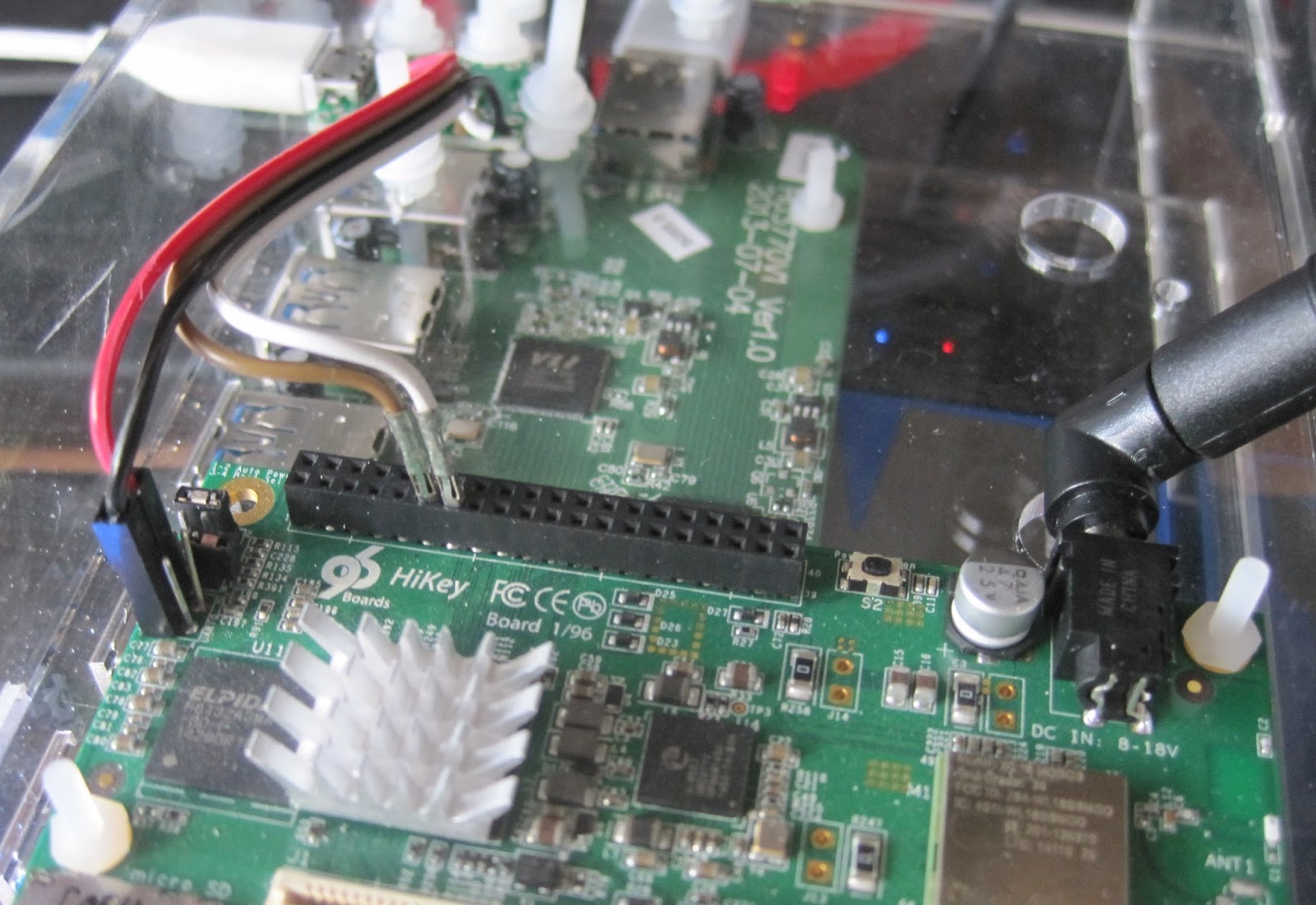
Initially the board required modifying to add headers to attach a USB to 1.8V LVTTL serial adaptor on the UART0 serial port. Once Andy Simpkins had made this change for me I was able to work through the instructions and attempt to install a bootloader and OS image.

The initial software was essentially HiSilicon vendor code using the Android fastboot system to configure booting. There was no source and the Ubuntu OS images were an obvious afterthought to the Android images. Just getting these images installed required a great deal of effort, repetition and debugging. It was such a dreadful experience this signalled the commencement one of the repeated hiatuses throughout this project, the allure of 64 bit ARM computing has its limits even for me.

When I returned to the project I attempted to use the system from the on-board eMMC but the pre-built binary only kernel and OS image were very limited. Building a replacement kernel , or even modules for the existing one proved fruitless and the system was dreadfully unstable.

I wanted to use the system as a builder for some Open Source projects but the system instability ruled this out. I considered attempting to use virtualisation which would also give better system isolation for builder systems. By using KVM running a modern host kernel and OS as a guest this would also avoid issues with the host systems limitations. At which point I discovered the system had no virtualisation enabled apparently because the bootloader lacked support.

In addition to these software issues there were hardware problems, despite forcing the use of USB for all additional connectivity the USB implementation was dreadful. For a start all USB peripherals have to run at the same speed! One cannot mix full (12Mbit) and high speed (480Mbit) devices which makes adding a USB Ethernet and SATA device challenging when you cannot use a keyboard.

And because I needed more challenges only one of the USB root hubs was functional. In effect this made the console serial port critical as it was the only reliable way to reconfigure the system without a keyboard or network link (and WIFI was not reliable either)
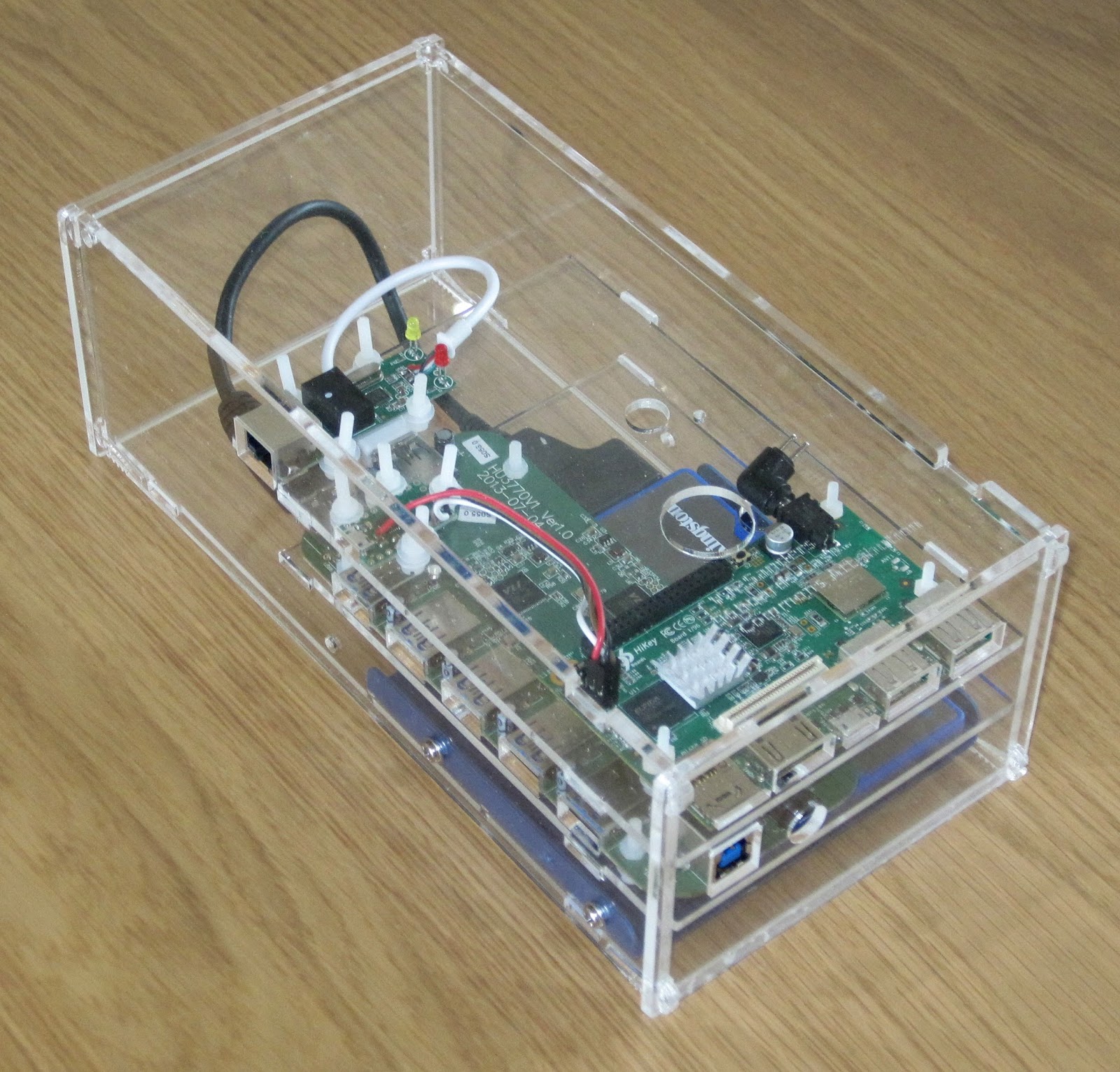
After another long pause in proceedings I decided that I should house all the components together and that perhaps being out on my bench might be the cause of some instability. I purchased a powered Amazon basics USB 2 hub, an Ethernet adaptor and a USB 2 SATA interface in the hope of accessing some larger mass storage.

The USB hub power supply was 12V DC which matched the Hikey requirements so I worked out I could use a single 4A capable supply and run a 3.5inch SATA hard drive too. I designed a laser cut enclosure and mounted all the components. As it turned out I only had a 2.5inch hard drive handy so the enclosure is a little over size. If I were redoing this design I would attempt to make it fit in 1U of height and be mountable in a 19inch rack instead it is an 83mm high (under 2U) box.

A new software release had also become available which purported to use an UEFI bootloader after struggling to install this version unsuccessfully, made somewhat more problematic by the undocumented change from UART0 (unpopulated header) to UART3 on the low speed 2mm pitch header. The system seemed to start the kernel which panicked and hung either booting from eMMC or SD card. Once again the project went on hold after spending tens of hours trying to make progress.
Third time's a charmAs the year rolled to a close I once again was persuaded to look at the hikey, I followed the much improved instructions and installed the shiny new November software release which appears to have been made for the re-release of the Hikey through LeMaker. This time I obtained a Debian "jessie" system that booted from the eMMC.

Having a booted system meant I could finally try and use it. I had decided to try and use the system to host virtual machines used as builders within the NetSurf CI system.

The basic OS uses a mixture of normal Debian packages with some replacements from Linaro repositories. I would have prefered to see more use of Debain packages even if they were from the backports repositories but on the positive side it is good to see the use of Debian instead of Ubuntu.

The kernel is a heavily patched 3.18 built in a predominantly monolithic (without modules) manner with the usual exceptions such as the mali and wifi drivers (both of which appear to be binary blobs). The use of a non-mainline capable SoC means the standard generic distribution kernels cannot be used and unless Linaro choose to distribute a kernel with the feature built in it is necessary to compile your own from sources.

The default install has a linaro user which I renamed to my user and ensured all the ssh keys and passwords on the system were changed. This is an important step when using this pre-supplied images as often a booted system is identical to every other copy.

To access mass storage my only option was via USB, indeed to add any additional expansion that is the only choice. The first issue here is that the USB host support is compiled in so when the host ports are initialised it is not possible to select a speed other than 12MBit. The speed is changed to 480Mbit by using a user space application found in the users home directory (why this is not a tool provided by a package and held in sbin I do not know).

When the usb_speed tool is run there is a chance that the previously enumerated devices will be rescanned and what was /dev/sda has become /dev/sdb if this happens there is a high probability that the system must be rebooted to prevent random crashes due to the "zombie" device.

Because the speed change operation is unreliable it cannot be reliably placed in the boot sequence so this must be executed by hand on each boot to get access to the mass storage.

NetSurf project already uses a x86_64 virtual host system which runs an LLVM physical volume from which we allocate logical volumes for each VM. I initially hoped to do this with the hikey but as soon as I tried to use the logical volume with a VM the system locked up with nothing shown on console. I did not really try very hard to discover why and instead simply used files on disc for virtual drives which seemed to work.

To provide reliable network access I used a USB attached Ethernet device, this like the mass storage suffered from unreliable enumeration and for similar reasons could not be automated requiring manually using the serial console to start the system.

Once the system was started I needed to install the guest VM. I had hoped I might be able to install locally from Debian install media as I do for x86 using the libvirt tools. After a great deal of trial and error I finally was forced to abandon this approach when I discovered the Linaro kernel is lacking iso9660 support so installing from standard media was not possible.

Instead I used the instructions provided by Leif Lindholm to create a virtual machine image on my PC and copied the result across. These instructions are great except I used version 2.5 of Qemu instead of 2.2 which had no negative effect. I also installed the Debian backports for Jessie to get an up to date 4.3 kernel.

After copying the image to the Hikey I started it by hand from the command line as a four core virtual machine and was successfully able to log in. The guest would operate for up to a day before stopping with output such as

$
Message from syslogd@ciworker13 at Jan 29 07:45:28 ...
kernel:[68903.702501] BUG: soft lockup - CPU#0 stuck for 27s! [mv:24089]

Message from syslogd@ciworker13 at Jan 29 07:45:28 ...

kernel:[68976.958028] BUG: soft lockup - CPU#2 stuck for 74s! [swapper/2:0]

Message from syslogd@ciworker13 at Jan 29 07:47:39 ...
kernel:[69103.199724] BUG: soft lockup - CPU#3 stuck for 99s! [swapper/3:0]

Message from syslogd@ciworker13 at Jan 29 07:53:21 ...
kernel:[69140.321145] BUG: soft lockup - CPU#3 stuck for 30s! [rs:main Q:Reg:505]

Message from syslogd@ciworker13 at Jan 29 07:53:21 ...
kernel:[69192.880804] BUG: soft lockup - CPU#0 stuck for 21s! [jbd2/vda3-8:107]

Message from syslogd@ciworker13 at Jan 29 07:53:21 ...
kernel:[69444.805235] BUG: soft lockup - CPU#3 stuck for 22s! [swapper/3:0]

Message from syslogd@ciworker13 at Jan 29 07:55:21 ...
kernel:[69570.177600] BUG: soft lockup - CPU#1 stuck for 112s! [systemd:1]

Timeout, server 192.168.7.211 not responding.

After this output the host system would not respond and had to be power cycled never mind the guest!

Once I changed to single core operation the system would run for some time until the host suffered from the dreaded kernel OOM killer. I was at a loss as to why the oom killer was running as the VM was only allocated half the physical memory (512MB) allowing the host what I presumed to be an adequate amount.

By adding a 512MB swapfile the system was able to push the few hundred kilobytes it wanted to swap and the system was now stable! The swapfile of course has to be started by hand as the external storage is unreliable and unavailable at boot.

I converted the qemu command line to a libvirt config using the virsh tool
virsh domxml-from-native qemu-argv cmdln.args
The converted configuration required manual editing to get a working system but now I have a libvirt based VM guest I can control along with all my other VM using the virt-manager tool.

This system is now stable and has been in production use for a month at time of writing. The one guest VM is a single core 512MB aarch64 system which takes over 1100 seconds (19 minutes) to do what a Banana Pi 2 dual core 1GB memory 32bit native ARM system manages in 300 seconds.

It seems the single core limited memory system with USB SATA attached storage is very, very slow.

I briefly attempted to run the CI system job natively within the host system but within minutes it crashed hard and required a power cycle to retrieve, it had also broken the UEFI boot. I must thank Leif for walking me through recovering the system otherwise I would have needed to start over.
ConclusionsI must stress these conclusions and observations are my own and do not represent anyone else.

My main conclusions are:

This project has taken almost a year to get to the final state and has been one of the least enjoyable within that time. The only reason I have a running system at the end of it is sheer bloody mindedness because after spending hundreds of hours of my free time I was not prepared to see it all go to waste.

To be fair, the road I travelled is now much smoother and if the application is suited to having a mobile phone without a screen then the Hikey probably works as a solution. For me, however, the Hikey product with the current hardware and software limitations is not something I would recommend in preference to other options.

Ritesh Raj Sarraf: Linux Power Savings 2016

Having moved to a new place, now at times, I also have to deal with power outages. As heat increases, the power outages will be much longer and more frequent. So much, that UPS and Power Inverters run out. Such are ideal times to measure idle power consumption for my laptop. Here's what my default (and idle) OS looks like. It should be standard to most "typical" users. Some minor odds could be apport, dnsmasq, and maybe, tor. Also, thanks to systemd, there are some native services which are now converted to socket activation based ones. There's also Laptop Mode Tools for userspace power savings. But huge thanks to Intel's work in making the kernel more power efficient. With things like Runtime PM and Intel P-State, we can now define, default and aggressive power-savings modes, helping conserve more power. We still have challenges with things like binary-only drivers; and also stock GPL drivers but with an external firmware blob. There have been many instances when my previous machines (which had both) ran into severe power drain. The challenge with power savings is that it is not just the job of the kernel. All components, kernel and userspace, need to be made aware of, and work in unison. Otherwise, one ill behaving web browser tab can be the cause of power drain. P-State driver seems to already be doing some scale down of CPU resources. And with CGroups maturing moe I think we'll eventually have all Desktop Environments making use of it.
systemd-+-ModemManager-+- gdbus 
                        - gmain 
         -NetworkManager-+- gdbus 
                          - gmain 
         -accounts-daemon-+- gdbus 
                           - gmain 
         -agetty
         -apport-notifyd
         -atd
         -avahi-daemon---avahi-daemon
         -bluetoothd
         -colord-+- gdbus 
                  - gmain 
         -cron
         -dbus-daemon
         -dnsmasq
         -evolution-+- book-client-dbu 
                     - dconf worker 
                     -7*[ evolution ]
                     - gdbus 
                     - gmain 
         -gdm3-+-gdm-session-wor-+-gdm-x-session-+-Xorg
                                                  -gnome-session-b-+-gnome-settings--+- dconf worker 
                                                                                      - gdbus 
                                                                                      - gmain 
                                                                                      - pool 
                                                                                      - threaded-ml 
                                                                    -gnome-shell-+-ibus-daemon-+-ibus-dconf-+- dconf worker 
                                                                                                             - gdbus 
                                                                                                             - gmain 
                                                                                                -ibus-engine-sim-+- gdbus 
                                                                                                                  - gmain 
                                                                                                - gdbus 
                                                                                                - gmain 
                                                                                  - JS GC Helper 
                                                                                  - JS Sour~ Thread 
                                                                                  - dconf worker 
                                                                                  - gdbus 
                                                                                  - gmain 
                                                                                  - threaded-ml 
                                                                    - dconf worker 
                                                                    - gdbus 
                                                                    - gmain 
                                                  - gdbus 
                                                  - gmain 
                                  - gdbus 
                                  - gmain 
                -gdm-session-wor-+-gdm-x-session-+-Xorg
                                                  -gnome-session-b-+-evolution-alarm-+- cal-client-dbus 
                                                                                      - dconf worker 
                                                                                      - evolution-alarm 
                                                                                      - gdbus 
                                                                                      - gmain 
                                                                    -gnome-settings--+- dconf worker 
                                                                                      - gdbus 
                                                                                      - gmain 
                                                                                      - pool 
                                                                                      - threaded-ml 
                                                                    -gnome-shell-+-2*[redshift-+- gdbus ]
                                                                                                - gmain ]
                                                                                  - JS GC Helper 
                                                                                  - JS Sour~ Thread 
                                                                                  - dconf worker 
                                                                                  - gdbus 
                                                                                  - gmain 
                                                                                  - threaded-ml 
                                                                    -parcimonie
                                                                    -parcimonie-appl-+- gdbus 
                                                                                      - gmain 
                                                                    -python3---libinput-debug-
                                                                    -ssh-agent
                                                                    -tracker-extract-+- dconf worker 
                                                                                      - gdbus 
                                                                                      - gmain 
                                                                                      -10*[ pool ]
                                                                    -tracker-miner-a-+- gdbus 
                                                                                      - gmain 
                                                                    -tracker-miner-f-+- dconf worker 
                                                                                      - gdbus 
                                                                                      - gmain 
                                                                    -tracker-miner-u-+- gdbus 
                                                                                      - gmain 
                                                                    - dconf worker 
                                                                    - gdbus 
                                                                    - gmain 
                                                  - gdbus 
                                                  - gmain 
                                  - gdbus 
                                  - gmain 
                - gdbus 
                - gmain 
         -geoclue-+- gdbus 
                   - gmain 
         -gnome-keyring-d-+- gdbus 
                           - gmain 
                           - timer 
         -gpg-agent
         -gsd-printer-+- gdbus 
                       - gmain 
         -ibus-daemon-+-ibus-dconf-+- dconf worker 
                                    - gdbus 
                                    - gmain 
                       -ibus-engine-sim-+- gdbus 
                                         - gmain 
                       - gdbus 
                       - gmain 
         -ibus-x11-+- gdbus 
                    - gmain 
         -iio-sensor-prox-+- gdbus 
                           - gmain 
         -inetd---leafnode
         -libvirtd---15*[ libvirtd ]
         -lvmetad
         -master-+-pickup
                  -qmgr
                  -tlsmgr
         -mcelog
         -minissdpd
         -mount.ntfs
         -onboard-+- dconf worker 
                   - gdbus 
                   - gmain 
         -packagekitd-+- gdbus 
                       - gmain 
         -polkitd-+- gdbus 
                   - gmain 
         -2*[pulseaudio-+-gconf-helper]
                         - alsa-sink-ALC23 ]
                         - alsa-sink-HDMI  ]
                         - alsa-sink-pcspe ]
                         - alsa-source-ALC ]
         -rtkit-daemon---2*[ rtkit-daemon ]
         -systemd-+-(sd-pam)
                   -at-spi-bus-laun-+-dbus-daemon
                                     - dconf worker 
                                     - gdbus 
                                     - gmain 
                   -at-spi2-registr-+- gdbus 
                                     - gmain 
                   -dbus-daemon
                   -dconf-service-+- gdbus 
                                   - gmain 
                   -goa-daemon-+- dconf worker 
                                - gdbus 
                                - gmain 
                   -goa-identity-se-+- gdbus 
                                     - gmain 
                                     - pool 
                   -gvfs-afc-volume-+- gdbus 
                                     - gmain 
                                     - gvfs-afc-volume 
                   -gvfs-goa-volume-+- gdbus 
                                     - gmain 
                   -gvfs-gphoto2-vo-+- gdbus 
                                     - gmain 
                   -gvfs-mtp-volume-+- gdbus 
                                     - gmain 
                   -gvfs-udisks2-vo-+- gdbus 
                                     - gmain 
                   -gvfsd-+- gdbus 
                           - gmain 
                   -gvfsd-fuse-+- gdbus 
                                - gmain 
                                - gvfs-fuse-sub 
                                -2*[ gvfsd-fuse ]
                   -gvfsd-metadata-+- gdbus 
                                    - gmain 
                   -mission-control-+- dconf worker 
                                     - gdbus 
                                     - gmain 
         -systemd-+-(sd-pam)
                   -at-spi-bus-laun-+-dbus-daemon
                                     - dconf worker 
                                     - gdbus 
                                     - gmain 
                   -at-spi2-registr-+- gdbus 
                                     - gmain 
                   -dbus-daemon
                   -gconfd-2
         -systemd-+-(sd-pam)
                   -at-spi-bus-laun-+-dbus-daemon
                                     - dconf worker 
                                     - gdbus 
                                     - gmain 
                   -at-spi2-registr-+- gdbus 
                                     - gmain 
                   -dbus-daemon
                   -dconf-service-+- gdbus 
                                   - gmain 
                   -evolution-addre-+-2*[evolution-addre-+- dconf worker ]
                                                          - evolution-addre ]
                                                          - gdbus ]
                                                          - gmain ]
                                     - dconf worker 
                                     - evolution-addre 
                                     - gdbus 
                                     - gmain 
                   -evolution-calen-+-evolution-calen-+- dconf worker 
                                                       - evolution-calen 
                                                       - gdbus 
                                                       - gmain 
                                                       -6*[ pool ]
                                     -evolution-calen-+- book-client-dbu 
                                                       - dconf worker 
                                                       - evolution-calen 
                                                       - gdbus 
                                                       - gmain 
                                                       - pool 
                                     -2*[evolution-calen-+- dconf worker ]
                                                          - evolution-calen ]
                                                          - gdbus ]
                                                          - gmain ]
                                     - dconf worker 
                                     - evolution-calen 
                                     - gdbus 
                                     - gmain 
                   -evolution-sourc-+- dconf worker 
                                     - gdbus 
                                     - gmain 
                   -gconfd-2
                   -gnome-shell-cal-+- cal-client-dbus 
                                     - dconf worker 
                                     - gdbus 
                                     - gmain 
                                     - gnome-shell-cal 
                   -gnome-terminal--+-bash---pstree
                                     -bash
                                     - dconf worker 
                                     - gdbus 
                                     - gmain 
                   -goa-daemon-+- dconf worker 
                                - gdbus 
                                - gmain 
                   -goa-identity-se-+- gdbus 
                                     - gmain 
                                     - pool 
                   -gpaste-daemon-+- dconf worker 
                                   - gdbus 
                                   - gmain 
                   -gvfs-afc-volume-+- gdbus 
                                     - gmain 
                                     - gvfs-afc-volume 
                   -gvfs-goa-volume-+- gdbus 
                                     - gmain 
                   -gvfs-gphoto2-vo-+- gdbus 
                                     - gmain 
                   -gvfs-mtp-volume-+- gdbus 
                                     - gmain 
                   -gvfs-udisks2-vo-+- gdbus 
                                     - gmain 
                   -gvfsd-+- gdbus 
                           - gmain 
                   -gvfsd-burn-+- gdbus 
                                - gmain 
                   -gvfsd-dnssd-+- gdbus 
                                 - gmain 
                   -gvfsd-fuse-+- gdbus 
                                - gmain 
                                - gvfs-fuse-sub 
                                -2*[ gvfsd-fuse ]
                   -gvfsd-metadata-+- gdbus 
                                    - gmain 
                   -gvfsd-network-+- dconf worker 
                                   - gdbus 
                                   - gmain 
                   -gvfsd-trash-+- gdbus 
                                 - gmain 
                   -mission-control-+- dconf worker 
                                     - gdbus 
                                     - gmain 
                   -nautilus-+-gedit
                              - dconf worker 
                              - gdbus 
                              - gmain 
                   -tracker-store-+- dconf worker 
                                   - gdbus 
                                   - gmain 
                                   -4*[ pool ]
         -systemd-journal
         -systemd-logind
         -systemd-network
         -systemd-timesyn--- sd-resolve 
         -systemd-udevd
         -thermald--- thermald 
         -tor
         -udisksd-+- cleanup 
                   - gdbus 
                   - gmain 
                   - probing-thread 
         -upowerd-+- gdbus 
                   - gmain 
         -wpa_supplicant
So I used the standard power measurement tool, powertop. Below is a screenshot of PowerTop claiming 9 - 10 hours of possible battery backup. This is idle state. "Idle" would mean when the user is not interacting with the machine. When under basic usage (email, web), the actual battery backup I've sensed is somewhere around 6-7 hrs, which is still good from what we got a couple years ago. There's one oddity in the screenshot though. The estimated power consumption reported is 4.55W, where as, the power consumption of just the wifi card is reported 6.17W. That too, when the wifi was disconnected. This reminded me of the bug report against PowerTop, which is now more than 2 years old. We've still not concluded in that bug report, so if anyone can shed some light on PowerTop's reporting, please do share it in the bug report. Note: Please ignore the terminal's title in the screenshot. That is wrong and I've not bothered to figure out why it is displaying the title name constructed from an outdated session, which is already terminated.

Categories:

Keywords:

Like:

Enrico Zini: Static site generators

I decided to rethink the state of my personal site, and try out some of the new static site generators that are available now. To do that, I jotted down a series of things that I want in a static site generator, then wrote a tool to convert my ikiwiki site to other formats, and set out to evaluate things. As a benchmark I did a full rebuild of my site, which currently contains 1164 static files and 458 markdown pages. My requirements Free layout for my site My / is mostly a high-level index to the site contents. Blog posts are at /blog. My talk archive is organised like a separate blog at /talks. I want the freedom to create other sections of the site, each with its own rss feed, located wherever I want in the site hierarchy. Assets next to posts I occasionally blog just a photo with a little comment, and I would like the .md page with the comment to live next to the image in the file system. I did not even know that I had this as a requirement until I found static site generators that mandated a completely different directory structure for markdown contents and for static assets. Multiple RSS/Atom feeds I want at least one RSS/Atom feed per tag, because I use tags for marking which articles go to http://planet.debian.org. I also want RSS/Atom feeds for specific parts of the site, like the blog and talks. Arbitrary contents in /index.html I want total control over the contents of the main home page of the site. Quick preview while editing contents I do not like to wait several seconds for the site to be rebuilt at every review iteration of the pages I write. This makes me feel like the task of editing is harder than it should, and makes me lose motivation to post. Reasonable time for a full site rebuild I want to be able to run a full rebuild of the site in a reasonable time. I could define "reasonable" in this case as how long I can stare at the screen without getting bored, starting to do something else, and forgetting what it was that I was doing with the site. It is ok if a rebuild takes something like 10 or 30 seconds. It is not ok if it takes minutes. Code and dependency ecosystems that I can work with I can deal with Python and Go. I cannot deal with Ruby or JavaScript. I forgot all about Perl. Also, if it isn't in Debian it does not exist. Decent themes out of the box One of my hopes in switching to a more mainstream generator is to pick and choose themes and easily give my site a more modern look. Hugo Hugo is written in Go and is in Debian testing. Full rebuild time for my site is acceptable, and it can even parallelize:
  $ time hugo
  real      0m5.285s
  user      0m9.556s
  sys       0m1.052s
Free layout for my site was hard to get. I could replace /index.html by editing the template page for it, but then I did not find out how to create another similar index in an arbitrary place. Also, archetypes are applied only on the first path component of new posts, but I would like them instead to be matched on the last path component first, and failing that traveling up to the path until the top. This should be easy to fix by reorganizing the content a bit around here For example, a path for a new blog post of mine could be blog/2016/debian/ and I would like it to match the debian archetype first, and failing that the blog archetype. Assets next to posts almost work. Hugo automatically generates one feed per taxonomy element, and one feed per section. This would be currently sufficient for me, although I don't like the idea that sections map 1 to 1 to toplevel directories in the site structure. Hugo has a server that watches the file system and rerenders pages as they are modified, so the quick preview while editing works fine. About themes, it took me several tries to find a theme that would render navigation elements for both sections and tags, and most themes would render by pages with white components all around, and expect me to somehow dig in and tweak them. That frustrated me, because for quite a while I could not tell if I had misconfigured Hugo's taxonomies or if the theme was just somehow incomplete. Nikola Nikola is written in Python and is in Debian testing. Full rebuild time for my site is almost two orders of magnitude more than Hugo, and I am miffed to find the phrases "Nikola is fast." or "Fast building process" in its front page and package description:
  $ time nikola build
  real      3m31.667s
  user      3m4.016s
  sys       0m24.684s
Free layout could be achieved fiddling with the site configuration to tell it where to read sources. Assets next to post work after tweaking the configuration, but they require to write inconsistent links in the markdown source: https://github.com/getnikola/nikola/issues/2266 I have a hard time accepting that that, because I want to author content with consistent semantic interlinking, because I want to be able 10 years from now to parse it and convert it to something else if a new technology comes out. Nikola generates one RSS/Atom feed per tag just fine. I have not tried generating feeds for different sections of the site. Incremental generation inside its built in server works fine. Pelican Pelican is written in Python and is in Debian testing. Full rebuild time for my site is acceptable:
  $ time pelican -d
  real      0m18.207s
  user      0m16.680s
  sys       0m1.448s
By default, pelican seems to put generate a single flat directory of html files regardless of the directory hierarchy of the sources. To have free layout, pelican needs some convincing in the configuration:
  PATH_METADATA = r"(?P<relpath>.+)\.md"
  ARTICLE_SAVE_AS = " relpath /index.html"
but even if I do that, the urls that it generates still point to just slug /index.html and I have not trivially found a configuration option to fix that accordingly. I got quite uncomfortable at the idea of needing to configure content generation and linking to match, instead of having one automatically being in sync with the other. Having assets next to posts seems to be possible (also setting STATIC_PATHS = ["."]), but I do not recall making progress on this front. I did not manage to generate a feed for each tag out of the box, and probably there is some knob in the configuration for it. I gave up with Pelican as trying it out felt like a constant process of hacking the configuration from defaults that do not make any sense for me, withouth even knowing if a configuration exists that would do what I need Ikiwiki Ikiwiki is written in Perl and is in Debian. Although I am not anymore proficient with Perl, I was already using it, so it was worth considering. Full rebuild time feels a bit on the slow side but is still acceptable:
  $ time ikiwiki --setup site.setup
  real      0m37.356s
  user      0m34.488s
  sys       0m1.536s
In terms of free site structure, all feeds for all or part of the site, ikiwiki just excels. I even considered writing a python web server that monitors the file system and calls ikiwiki --refresh when anything changes, and calling it a day. However, when I tried to re-theme my website around a simple bootstrap boilerplate, I found that to be hard, as a some of the HTML structure is hardcoded in Perl (and it's also my fault) and there is only so much that can be done by tweaking the (rather unreadable) templates. siterefactor During all these experiments I had built siterefactor to generate contents for all those static site engines, and it was going through all the contents quite fast:
  $ time ./siterefactor src dst -t hugo
  real  0m1.222s
  user  0m0.904s
  sys   0m0.308s
So I wondered how slow it would become if, instead of making it write markdown, I made it write HTML via python markdown and Jinja2:
  $ time ./siterefactor ~/zz/ikiwiki/pub/ ~/zz/ikiwiki/web -t web
  real  0m6.739s
  user  0m5.952s
  sys   0m0.416s
I then started wondering how slower it would become if I implemented postprocessing of all local URLs generated by Markdown to make sure they are kept consistent even if the path of a generated page is different than the path of its source. Not much slower, really. I then added taxonomies. And arbitrary Jinja2 templates in the input, able to generate page lists and RSS/Atom feeds. And theming. And realised that reading all the sources and cross-linking them took 0.2 seconds, and the rest was generation time. And that after cross-linking, each page can be generated independently from all the others. staticsite So my site is now generated with staticsite:
  $ time ssite build
  real  0m6.833s
  user  0m5.804s
  sys   0m0.500s
It's comparable with Hugo, and on a single process.

Michal &#268;iha&#345;: Weekly phpMyAdmin contributions 2016-W08

As you could see tonight, last week was again full of security work. Mostly again XSS issues, but nothing really easily exploitable. On the refactoring side, the most time was spent on bringing php-gettext to better shape. In the it ended up as being separate library which can be used by others as well - motranslator. Another major task was to identify some easier tasks for prospective GSoC students and help them with implementing the changes. This worked quite well, but we will most likely loose those students as we were not selected this year to participate. List of handled issues:

Filed under: English phpMyAdmin 0 comments

Erich Schubert: Stop abusing lambda expressions - this is not functional programming

I know, all the Scala fanboys are going to hate me now. But:
Stop overusing lambda expressions.
Most of the time when you are using lambdas, you are not even doing functional programming, because you often are violating one key rule of functional programming: no side effects.
For example:
collection.forEach(System.out::println);
is of course very cute to use, and is (wow) 10 characters shorter than:
for (Object o : collection) System.out.println(o);
but this is not functional programming because it has side effects.
What you are doing are anonymous methods/objects, using a shorthand notion. It's sometimes convenient, it is usually short, and unfortunately often unreadable, once you start cramming complex problems into this framework.
It does not offer efficiency improvements, unless you have the propery of side-effect freeness (and a language compiler that can exploit this, or parallelism that can then call the function concurrently in arbitrary order and still yield the same result).
Here is an examples of how to not use lambdas:
DZone Java 8 Factorial (with boilerplate such as the Pair class omitted):
Stream<Pair> allFactorials = Stream.iterate(
  new Pair(BigInteger.ONE, BigInteger.ONE),
  x -> new Pair(
    x.num.add(BigInteger.ONE),
    x.value.multiply(x.num.add(BigInteger.ONE))));
return allFactorials.filter(
  (x) -> x.num.equals(num)).findAny().get().value;
When you are fresh out of the functional programming class, this may seem like a good idea to you... (and in contrast to the examples mentioned above, this is really a functional program).
But such code is a pain to read, and will not scale well either. Rewriting this to classic Java yields:
BigInteger cur = BigInteger.ONE, acc = BigInteger.ONE;
while(cur.compareTo(num) <= 0)  
  cur = cur.add(BigInteger.ONE); // Unfortunately, BigInteger is immutable!
  acc = acc.multiply(cur);
 
return acc;
Sorry, but the traditional loop is much more readable. It will still not perform very well (because of BigInteger not being designed for efficiency - it does not even make sense to allow BigInteger for num - the factorial of 2**63-1, the maximum of a Java long, needs 1020 bytes to store, i.e. about 500 exabyte.
For some, I did some benchmarking. One hundred random values num (of course the same for all methods) from the range 1 to 1000.
I also included this even more traditional version:
BigInteger acc = BigInteger.ONE;
for(long i = 2; i <=x; i++)  
  acc = acc.multiply(BigInteger.valueOf(i));
 
return acc;
Here are the results (Microbenchmark, using JMH, 10 warum iterations, 20 measurement iterations of 1 second each):
functional    1000     100  avgt   20  9748276,035   222981,283  ns/op
biginteger    1000     100  avgt   20  7920254,491   247454,534  ns/op
traditional   1000     100  avgt   20  6360620,309   135236,735  ns/op
As you can see, this "functional" approach above is about 50% slower than the classic for-loop. This will be mostly due to the Pair and additional BigInteger objects created and garbage collected.
Apart from being substantially faster, the iterative approach is also much simpler to follow. (To some extend it is faster because it is also easier for the compiler!)
There was a recent blog post by Robert Br utigam that discussed exception throwing in Java lambdas and the pitfalls associated with this. The discussed approach involves abusing generics for throwing unknown checked exceptions in the lambdas, ouch.

Don't get me wrong. There are cases where the use of lambdas is perfectly reasonable. There are also cases where it adheres to the "functional programming" principle. For example, a stream.filter(x -> x.name.equals("John Doe")) can be a readable shorthand when selecting or preprocessing data. If it is really functional (side-effect free), then it can safely be run in parallel and give you some speedup.
Also, Java lambdas were carefully designed, and the hotspot VM tries hard to optimize them. That is why Java lambdas are not closures - that would be much less performant. Also, the stack traces of Java lambdas remain somewhat readable (although still much worse than those of traditional code). This blog post by Takipi showcases how bad the stacktraces become (in the Java example, the stream function is more to blame than the actual lambda - nevertheless, the actual lambda application shows up as the cryptic LmbdaMain$$Lambda$1/821270929.apply(Unknown Source) without line number information). Java 8 added new bytecodes to be able to optimize Lambdas better - earlier JVM-based languages may not yet make good use of this.
But you really should use lambdas only for one-liners. If it is a more complex method, you should give it a name to encourage reuse and improve debugging.
Beware of the cost of .boxed() streams!
And do not overuse lambdas. Most often, non-Lambda code is just as compact, and much more readable. Similar to foreach-loops, you do lose some flexibility compared to the "raw" APIs such as Iterators:
for(Iterator<Something>> it = collection.iterator(); it.hasNext(); )  
  Something s = it.next();
  if (someTest(s)) continue; // Skip
  if (otherTest(s)) it.remove(); // Remove
  if (thirdTest(s)) process(s); // Call-out to a complex function
  if (fourthTest(s)) break; // Stop early
 
In many cases, this code is preferrable to the lambda hacks we see pop up everywhere these days. Above code is efficient, and readable.
If you can solve it with a for loop, use a for loop!
Code quality is not measured by how much functionality you can do without typing a semicolon or a newline!
On the contrary: the key ingredient to writing high-performance code is the memory layout (usually) - something you need to do low-level.
Instead of going crazy about Lambdas, I'm more looking forward to real value types (similar to a struct in C, reference-free objects) maybe in Java 9 (Project Valhalla), as they will allow reducing the memory impact for many scenarios considerably. I'd prefer a mutable design, however - I understand why this is proposed, but the uses cases I have in mind become much less elegant when having to overwrite instead of modify all the time.

Russ Allbery: Review: The Lost Steersman

Review: The Lost Steersman, by Rosemary Kirstein
Series: Steerswomen #3
Publisher: Rosemary Kirstein
Copyright: 2003, 2014
Printing: 2014
ISBN: 0-9913546-2-1
Format: Kindle
Pages: 432
This is the third book in the Steerswomen series and a direct follow-up to the events of The Outskirter's Secret. It does, marvel of marvels, feature an in-character summary of the events of the series to date! I do love when authors do this; it helps immensely if you come back to a series after a bit of a break between books. But this whole series is so good, and the emotional tone and development of Rowan as a character is so strong, that I recommend against starting here. After the events of the last book, Rowan has returned to the Inner Lands. She's sent her report back to the Archives, but stopped at the Annex in Alemeth. This is an auxiliary library that should have copies of the journals and other research that Rowan wants to search, and stopping there saves substantial travel time. However, she finds the steerswoman who was custodian of the Annex is deceased and the Annex is, from Rowan's perspective, a mess. Nothing is organized, the books aren't properly cared-for, and Mira's interactions with the townsfolk were far different than Rowan's natural attitude. The start of this book was a surprising shift. After the large-scale revelations at the end of The Outskirter's Secret, and the sense of escalating danger, Rowan's return to small-town life in the Inner Lands comes as a shock. That's true for both the reader and for Rowan, and the parallels make it a remarkably effective bit of writing. At the beginning of the story, the reader is already familiar with Rowan (at least if you've read the previous books) and how she thinks of being a steerswoman. Rowan is very much on edge and in a hurry given what's going on in the broader world. But the town is used to Mira: a gregarious socializer who cared far more about town gossip and her role as coordinator of it than she cared about most of her steerswoman duties. (At least as seen from Rowan's perspective. By the end of the book, we have a few hints that something else might be going on, but the damage to the books at least feels unforgivable.) Rowan is resented and even disliked at first, particularly by Steffie and Gwen who did most of the chores at the Annex and were closest to Mira. One of the reasons why I love this series so much is that Kirstein has a gift for characterization. Rowan (and Bel, who largely doesn't appear in this book) are brilliant characters, but it's not just them. At the start of this book, the reader tends to share Rowan's opinion of the town: a sort of half-bemused, half-exasperated indifference. Even as the characters start to grow on one, it seems like a backwater and a diversion from the larger story. But it becomes clear that Rowan is very on-edge from her experience in the Outskirts, that she's underestimated the relevance of Mira to at least the town's happiness, and she's greatly underestimated the ability of the townsfolk to help her. Steffie, in particular, is a wonderful character; by the end of the book, he had become one of my favorite people in the series so far. He doesn't think he's particularly smart, and his life before Rowan is very simple, but there are depths to him that no one, including him, expected. There is a plot here, apart from small town politics and Rowan's slow relaxation. (Although those were so compelling that I'm not sure I would have minded if that were the entire book.) The lost steersman of the title is an old student friend of Rowan that she unexpectedly meets in town, a former steersman who quit the order and refused to explain why. Rowan, of course, cannot resist trying to fix this situation. The second plot driver is a dangerous invasion of Outskirts monsters into the town. Those who have read the previous books will have some immediate guesses as to why this might be, and Rowan does as well. But there's more going on than it might first appear. This book is not entirely a diversion. It returns to the main plot of the series by the end of the book, and we learn much more about Rowan's world. But, somewhat surprisingly, that was my least favorite part of the book. It has some nice bits of exploration and puzzle-solving, and Rowan is always a delight to spend time with. But the last section of the book is similar to many other genre books I've read before well-written, to be sure, but not as unique. It also features a rather long section following a character who is severely physically ill, which is something I always find very hard to read (a personal quirk). But there's a lot of meat here for the broader plot, and I have no idea what will happen in the next book. The part of The Lost Steersman that I'm going to remember, though, are the town bits, up through the arrival of Zenna (another delightful character who adds even more variety to Kirstein's presentation of steerswomen). Kirstein is remarkably good at mixing small-town characters with the scientific investigation of the steerswomen and letting them bounce off of each other to reveal more about the character of both. If it weren't for the end of the book, which bothered me for partly idiosyncratic reasons, I think this would have been my favorite book of the series. Followed by The Language of Power, and be warned that this book ends on something close to a cliffhanger. Rating: 8 out of 10

Clint Adams: Can you see them?

Sydney Ruth's sister is Nova Rochelle.

29 February 2016

Chris Lamb: Free software activities in February 2016

Here is my monthly update covering a large part of what I have been doing in the free software world (previously):
  • Various improvements to django-slack, a library to easily post messages to the Slack group-messaging utility from projects using the Django web development framework:
    • Added explicit support to send messages asynchronously via the Celery distributed task queue. (#29)
    • Worked with Patrick Clope to add an escapeslack template filter to ensure the correct characters for Slack's API are escaped using Django's built-in safe is too invasive. (#36)
    • Corrected an issue where custom endpoints and channel names were incompatible. (#27)
    • Overhaul of the field/option/block parsing. (49ff3c4)
    • Moved away from using a django.template.Context instance, preventing a deprecation warning. (#31)
  • Added a create-folders subcommand to my tickle-me-email Getting Things Done (GTD) email toolbox to create numbered folders for the rotate "tickler" functionality. (#3)
  • Wrote and released a Django template tag to collapse multiple whitespace/newline characters in order to correctly format, for example, plaintext emails that make extensive use of for-loops. These would normally require careful and fragile placement of the % for .. % and % endfor % tags. (Repo)
  • Pushed a number of updates to my Strava Enhancement Suite, a Chrome extension that improves and fixes annoyances in the web interface of the Strava cycling and running tracker:
    • Fix unit conversion where the element was wrapped in an another HTML element. (#48)
    • Hide premium indicator from top-level navigation. (#45)
    • Correct matching of the "shop" link in top-level navigation and footer module. (#47 & #46)
    • Remove "premium" pages on Club pages. (#44)
  • Added a security-oriented warning to Ansible's documentation regarding the behaviour if an UFW firewall application profile is added and subsequently removed. (#1740)
  • Added support to my django-staticfiles-dotd "staticfiles" library which concatenates Javascript and CSS files from .d-style directories to support an arbitrary file rendering method. This allows the use of media pre-processors such as SASS within such directories. (#1)
  • Corrected my Chrome extension for the FastMail web interface to correctly hook into the internal "send" mechanism. (#2)
  • Moved my stravabot IRC bot to use dh-virtualenv and systemd, improving security and reliability. (1c48709)
  • Updated django-pedantic-http-methods a tool to raise an exception during development when attempting to perform side effects in GET and HEAD HTTP methods to support the latest version of Django. (#1)

Debian
  • Updated travis.debian.net a hosted script to easily test and build Debian packages on the Travis CI continuous integration platform to support:
    • Automatic bumping of the version number in debian/changelog based on TRAVIS_BUILD_NUMBER. (#14)
    • Security repositories. Thanks to Stefan Jenkner for the initial pull request. These are additionally now enabled by default. (#15)
    • The backports repositories. (#13)
  • Applied #812830 and #812830 from James Clark to the Debian Archive Kit to improve the interface of various webpages it generates.
  • Updated the SSL certificate for try.diffoscope.org, a hosted version of the diffoscope in-depth and content-aware diff utility. Thanks to Bytemark for sponsoring the hardware.
  • Worked on my slides for Reproducible Builds - fulfilling the original promise of free software, to be presented at FOSSASIA '16.
My work in the Reproducible Builds project was also covered in more depth in Lunar's weekly reports (#40, #41, #42, #43)
LTS

This month I have been paid to work 18 hours on Debian Long Term Support (LTS). In that time I did the following:
  • "Frontdesk" duty for the week of 22nd 28th, triaging CVEs, etc.
  • Proofread announcements, etc. for the upcoming migration to wheezy-lts.
  • Issued DLA 417-1 for xdelta3 to fix a buffer overflow that allowed arbitrary code execution from input files.
  • Issued DLA 420-1 for libmatroska, correcting a heap information leak.
  • Issued DLA 428-1 for websvn fixing a cross-site scripting vulnerability.
  • Issued DLA 429-1 for pixman fixing a buffer overflow issue.
  • Issued DLA 430-1 & DLA 431-1 for libfcgi and libfcgi-perl respectfully, fixing a remote denial-of-service (DoS) vulnerability.

Uploads
  • redis (2:3.0.7-2) Correcting my SOURCE_DATE_EPOCH reproducibility patch as the conditional was accidentally inverted. Thanks to Reiner Herrmann (deki).
  • disque (1.0~rc1-5) Making the parallel SOURCE_DATE_EPOCH patch change and additionally tidying the packaging after introducing procps as a build-dependency.


RC bugs


I also filed 137 FTBFS bugs against aac-tactics, angular.js, astyle, bcftools, blacs-mpi, bogofilter, boxes, caldav-tester, ccdproc, ckeditor, coq-float, cqrlog, dasher, django-recurrence, dspdfviewer, eclipse-egit, ess, etcd, felix-latin, fio, flexml, funny-manpages, gap-atlasrep, garmin-plugin, gitlab, gnome-mines, graphicsmagick, haskell-nettle, healpy, hg-git, hunspell, hwloc, ijs, ipset, janest-core-extended, jpathwatch, kcompletion, kcompletion, keyrings.alt, kodi-pvr-hts, kodi-pvr-vdr-vnsi, libcommons-compress-java, libgnome2-wnck-perl, libkate, liblrdf, libm4ri, libnet-server-mail-perl, libsis-jhdf5-java, libspectre, libteam, libwnck, libwnckmm, libxkbcommon, lombok, lombok-patcher, mako, maven-dependency-analyzer, mopidy-mpris, mricron, multcomp, netty-3.9, numexpr, ocaml-textutils, openimageio, openttd-openmsx, osmcoastline, osmium-tool, php-guzzle, php-net-smartirc, plexus-component-metadata, polari, profitbricks-client, pyentropy, pynn, pyorbital, pypuppetdb, python-aioeventlet, python-certifi, python-hglib, python-kdcproxy, python-matplotlib-venn, python-mne, python-mpop, python-multipletau, python-pbh5tools, python-positional, python-pydot-ng, python-pysam, python-snuggs, python-tasklib, r-cran-arm, r-cran-httpuv, r-cran-tm, rjava, ros-geometry-experimental, ros-image-common, ros-pluginlib, ros-ros-comm, rows, rr, ruby-albino, ruby-awesome-print, ruby-default-value-for, ruby-fast-gettext, ruby-github-linguist, ruby-gruff, ruby-hipchat, ruby-omniauth-crowd, ruby-packetfu, ruby-termios, ruby-thinking-sphinx, ruby-tinder, ruby-versionomy, ruby-zentest, sbsigntool, scikit-learn, scolasync, sdl-image1.2, signon-ui, sisu-guice, sofa-framework, spykeutils, ssreflect, sunpy, tomcat-maven-plugin, topmenu-gtk, trocla, trocla, tzdata, verbiste, wcsaxes, whitedune, wikidiff2, wmaker, xmlbeans, xserver-xorg-input-aiptek & zeroc-icee-java.

FTP Team

As a Debian FTP assistant I ACCEPTed 107 packages: androguard, android-platform-dalvik, android-platform-development, android-platform-frameworks-base, android-platform-frameworks-native, android-platform-libnativehelper, android-platform-system-core, android-platform-system-extras, android-platform-tools-base, android-sdk-meta, apktool, armci-mpi, assertj-core, bart, bind9, caja, caldav-tester, clamav, class.js, diamond, diffoscope, django-webpack-loader, djangocms-admin-style, dnsvi, esptool, fuel-astute, gcc-6-cross, gcc-6-cross-ports, gdal, giella-core, gnupg, golang-github-go-ini-ini, golang-github-tarm-serial, gplaycli, gradle-jflex-plugin, haskell-mountpoints, haskell-simple, hurd, iceweasel, insubstantial, intellij-annotations, jetty9, juce, keyrings.alt, leptonlib, libclamunrar, libdate-pregnancy-perl, libgpg-error, libhtml5parser-java, libica, libvoikko, linux, llvm-toolchain-3.8, lombok-patcher, mate-dock-applet, mate-polkit, mono-reference-assemblies, mxt-app, node-abab, node-array-equal, node-array-flatten, node-array-unique, node-bufferjs, node-cors, node-deep-extend, node-original, node-setimmediate, node-simplesmtp, node-uglify-save-license, node-unpipe, oar, openjdk-8, openjdk-9, pg8000, phantomjs, php-defaults, php-random-compat, php-symfony-polyfill, pnetcdf, postgresql-debversion, pulseaudio-dlna, pyconfigure, pyomo, pysatellites, python-fuelclient, python-m3u8, python-pbh5tools, python-qtpy, python-shellescape, python-tunigo, pyutilib, qhull, r-cran-rjsonio, r-cran-tm, reapr, ruby-fog-dynect, scummvm-tools, symfony, talloc, tesseract, twextpy, unattended-upgrades, uwsgi, vim-command-t, win-iconv, xkcdpass & xserver-xorg-video-ast. I additionally REJECTed 4 packages.

Antonio Terceiro: Debian Ruby Sprint 2016 - day 1

This year s Debian Ruby team sprint started today here at Curitiba. Everyone arrived fine, and we started working at the meeting room we have booked for the week at Curitiba campus of the Federal Technical University of Paran . The room is at the Department of Business and Community Relations , what makes a lot of sense! :-) The day started with a quick setup, with a simple 8-port switch, and a couple of power strips. It tooks us a few minutes to figure what was blocked or not on the corporate network, and almost everyone who needs connections that are usually blocked in such environments already had their VPN setups so we were able to get started right after that. We are taking notes live on mozilla s piblic etherpad site Today we accomplished quite a lot:
  • analyzed the pending issues for the ruby2.3 transition issues, categorizing the missing packages into needs a binNMU now , needs a binNMU after switching the default to ruby2.3 , and broken .
  • ruby-defaults uploaded to experimental switching to ruby2.3 as default, and dropping support for ruby2.2
  • ruby-gsl fixed to build against GSL 2.x (was blocking ruby2.3 transition)
  • #816253: ruby-fast-gettext: fix FTBFS issue and import a new upstream
  • ruby-aws: several issues fixed
  • ruby-binding-of-caller: fixed rubygems-integration
  • fixed ruby-kakasi-ffi (again)
  • made ruby-blockenspiel arch:any again
  • ruby-fast-gettext 1.0.0-1 (fix ftbfs 816253)
  • ruby-aws-sdk: new upstream, debcheck fix and several bumps
  • ruby-fcgi dropped transitional packages + refreshed packaging with -w
  • ruby-sshkit 1.8.0
  • ruby-beautify: new upstream and few minor fixes
  • asciidoctor (new version sponsored)
  • capistrano 3.4.0 (ftbfs #795724, #802734)
  • #816254: ruby-packetfu: FTBFS: expected NameError with uninitialized constant PacketFu::FakePacket , got #
  • updated rake to 10.5.0; making it not include -I/usr/lib/ruby/vendor_ruby when running tests
  • triaged an closed open bugs on ruby-httpclient that do not apply anymore.
  • updated ruby-httpclient to get rid of warnings in apt-listbugs under Ruby 2.3
  • ruby-packetfu (fix ftbfs #816254) by @kanashiro
  • investigated extension/rdepends build failing with ruby2.3-only
  • applied upstream patch to ruby to fix extension ftbfs when extension uses c++
  • ruby-albino 1.3.3-4 (#813644)
  • basic user-level testing using ruby2.3 as default:
    • chef WORKS mostly; it seems ohai segfaults some times
    • rails autopkgtest FIXED Could not find gem binding_of_caller (>= 0.7.2) , which is required by gem web-console (~> 2.0) , in any of the sources.
    • vagrant WORKS
    • redmine autopkgtest WORKS
    • apt-listbugs FIXED warnings (e.g. try apt-listbugs list $pkg ); caused by ruby-httpclient
    • nanoc WORKS
  • capistrano 3.4.0-1 (#795724, #802734) by @sbadia + @terceiro

Tom Marble: is-slfc-shooting-open-source-in-the-foot

Is SFLC Shooting Open Source in the Foot? The academic article by SFLC about ZFS is troubling and may unintentionally shoot free software licensing in the foot. When I was at Sun (as part of the team that released the Java Programming Language by starting the OpenJDK project) I often heard community concerns about the CDDL license. At the time the big complaint was about the "Choice of Venue" clause. I got involved because Sun had developed many essential Java libraries and distributed them under CDDL. The community requested a more permissive license and I was able to convince internal project leaders (and Sun's lawyers) to make a licensing change for a handful of these projects. And there was much rejoicing. Based on my experience in helping Java to become open source I came to appreciate the legal hacks on copyright which make open source possible. It's the free software license which uses copyright to enable sharing (vs. the default of disabling sharing).

Open Source Licenses
And so I have appreciated many of the writings and speeches from SFLC on the mechanisms of software freedom. I was particularly moved by the talks about the "Freedom Box" concept. That's why this SFLC post on ZFS sounds so off key: if open source works because of free software licenses it seems weird to weaken that foundation by prioritizing the "equity" (or intended spirit) of the license. Allow me to mention that as I do most of my computing these days on GNU/Linux I miss the super cool features of ZFS from Solaris. I did try an early version of btrfs and was quite disappointed (but that's another story). In this happy case the source code for ZFS is available, but what about the future, when we aren't so lucky and someone asserts in court that the "you know, the software license was really about the spirit of sharing and that means we are allowed to use it -- and not be held to the pesky details as written in the license". A lawyer I respect called this out: "Equity" has no place in US law. The point is that for lawyers software licenses work because they have clear, written rules to guarantee the spirit is upheld; but spirit doesn't work in front of a judge -- clear rules do. Free and open source software has made so much progress in all facets of life why on earth would we second guess the licensing tools that made it possible? And why would SFLC try to shift the spotlight (and in this case the legal burden) to "a good-faith belief that the conduct falls within the equity of the license". Especially given the earlier comment which clearly states "[the combination] is inconsistent with the literal meaning of GPLv2 section 2(b)."
Wat?

The entire raison d' tre for open source software licenses was so that developers (and users) would have clarity and wouldn't have to ask permission to use the software!!! As stated elsewhere (and like I did with those Java libraries) the easy solution is to have the ZFS copyright holder (now Oracle) reclicense (or dual license) the code under a compatible license (permissive or copyleft). If OpenSolaris was still a thing I might understand some hesitancy, but why not liberate ZFS now? So we have to wonder what could possibly be motivating this odd "spirit of the license" position on the part of SFLC? Fortunately charities that enjoy non-profit status are required to make public filings of their income in something called a "Form 990". The latest SFLC 990 I could find shows SFLC getting 78% (or just over $5 million) from "non public support" (see page 14). A number with "two commas" would even be interesting to for-profit companies. Just whom is making these "donations" and what exactly do they get in return? Apparently I'm not the only one wondering about this question. On one hand it's important to know if SFLC as a non-profit is, indeed, acting in the public interest (as the IRS requires). Yet the even bigger issue here is would "asking for a consensus about the spirit" trump the written copyright license and set a scary precedent for open source software in general?

Norbert Preining: Debian/TeX Live full update 20160223

Only one week has passed since the last Debian/TeX Live update, and there is already a new one? The explanation is simple: consolidation of packages and preparation for 2016. The update comprises of uploads of texlive-base, texlive-lang, texlive-extra, texlive-bin, musixtex, pmx, m-tx, xmltex, jadetex. Besides the usual changes it brings a merge back in of several hitherto separately packaged packages. Debian - TeX Live 2015 The details are as follows:
  • Music related packages (musixtex, pmx, m-tx) have been merged into texlive-music, and temporary upgrade packages for the old packages have been uploaded
  • HTML/SGML/XML related packages (jadetex, xmltex) have been merged into the new package texlive-htmlxml, and temporary upgrade packages for the old ones have been uploaded
Furthermore, since some packages ship binaries, texlive-bin has been updated to build the new binaries, too. Lots of changes, but in the long run I see less work and better upgrades. Especially keeping the music-related packages uptodate was a bit a pain, and using the standard TeX Live update mechanisms looks much more promising. And, not to forget, a few more new and updated packages: New packages bibletext, cochineal, hyphen-occitan, libertinegc, lroundrect, miama, mparrows, scrlttr2copy, visualpstricks. Updated packages animate, babel-friulan, babel-russian, bxjscls, caption, celtic, cmtiup, crimson, crossrefware, droit-fr, dvips, fibeamer, fira, fithesis, forest, geschichtsfrkl, gost, hobby, hyperxmp, hyphen-base, hyph-utf8, inconsolata, ipaex-type1, mcf2graph, media9, reledmac, roundrect, showhyphens, spath3, splitindex, unicode-data. Enjoy.

Scott Kitterman: Debian LTS Work February 2016

This was my tenth month as a Freexian sponsored LTS contributor. I was assigned 8 hours for the month of February. As I did last month, I worked on updating clamav in wheezy and squeeze-lts. As with previous updates to clamav, we updated it to the new upstream version[1]. As an added complexity, this version bumped soname, so it s now libclamav7 instead of libclamav6. This bump necessitated a small transition in jessie/wheezy-proposed-updates and squeeze-lts. The update for Jessie (included for completeness here) was done early in the month by other pkg-clamav team members. It and the rebuilt/update libclamav reverse-depends will be included in the next Jessie point release. For wheezy, I uploaded libclamunrar (which bumped soname as well) and worked with other pkg-clamav team members on getting clamav to build on sparc and preparing a fix for c-icap. It and the rebuilt/update libclamav reverse-depends will be included in the next Wheezy point release. As a result of the amount of time it took, the squeeze-lts update landed later than I hoped it would, but it is there. As documented in DLA 437-1, there are new packages for clamav, libclamunrar, python-clamav, and klamav. The last squeeze libclamav reverse-depend, dansguardian, took more work, but it too is updated, see DLA 440-1.
[1] The primary reason for this is that anti-virus is an arms race. Unlike other types of packages being stable with only fixes for severe bugs and security issues does not result in a stable capability. It will regress over time. In order to keep up, the new version is needed.

Steve Kemp: If line-noise is a program, all fuzzers are developers

Recently I had a conversation with a programmer who repeated the adage that programming in perl consists of writing line-noise. This isn't true but it reminded me of my love of fuzzers. Fuzzers are often used to generate random input files which are fed to tools, looking for security problems, segfaults, and similar hilarity. To the untrained eye the output of most fuzzers is essentially line-noise, since you often start with a valid input file and start flipping bits, swapping bytes, and appending garbage. Anyway this made me wonder what happens if you fed random garbage into a perl interpreter? I wasn't brave enough to try it, because knowing my luck the fuzzer would write a program like so:
system( "rm -rf /home/steve" );
But I figured it was still an interesting idea, and I could have a go at fuzzing something else. I picked gawk, the GNU implementation of awk because the codebase is pretty small, and I understand it reasonably well. Almost immediately my fuzzer found some interesting segfaults and problems. Here's a nice simple example:
 $ gawk 'for (i = ) in steve kemp rocks'
 ..
 gawk: cmd. line:1: fatal error: internal error: segfault
 Aborted
I look forward to seeing what happens when other people fuzz perl..

Daniel Silverstone: Kicad hacking - Intra-sheet links and ERC

This is a bit of an odd posting since it's about something I've done but is also here to help me explain why I did it and thus perhaps encourage some discussion around the topic within the Kicad community...
Recently (as you will know if you follow this blog anywhere it is syndicated) I have started playing with Kicad for the development of some hardware projects I've had a desire for. In addition, some of you may be aware that I used to work for a hardware/software consultancy called Simtec, and there I got to play for a while with an EDA tool called Mentor Designview. Mentor was an expensive, slow, clunky, old-school EDA tool, but I grew to understand and like the workflow. I spent time looking at gEDA and Eagle when I wanted to get back into hardware hacking for my own ends; but neither did I really click with. On the other hand, a mere 10 minutes with Kicad and I knew I had found the tool I wanted to work with long-term. I designed the beer'o'meter project (a flow meter for the pub we are somehow intimately involved with) and then started on my first personal surface-mount project -- SamDAC which is a DAC designed to work with our HiFi in our study at home. As I worked on the SamDAC project, I realised that I was missing a very particular thing from Mentor, something which I had low-level been annoyed by while looking at other EDA tools -- Kicad lacks a mechanism to mark a wire as being linked to somewhere else on the same sheet. Almost all of the EDA tools I've looked at seem to lack this nicety, and honestly I miss it greatly, so I figured it was time to see if I could successfully hack on Kicad. Kicad is written in C++, and it has been mumble mumble years since I last did any C++, either for personal hacking or professionally, so it took a little while for that part of my brain to kick back in enough for me to grok the codebase. Kicad is not a small project, taking around ten minutes to build on my not-inconsiderable computer. And while it beavered away building, I spent time looking around the source code, particularly the schematic editor eeschema. To skip ahead a bit, after a couple of days of hacking around, I had a proof-of-concept for the intra-sheet links which I had been missing from my days with Mentor, and some ERC (electrical rules checking) to go alongside that to help produce schematics without unwanted "sharp corners". In total, I added:
  • an "intra-sheet link" schematic element, including: Intra-sheet linking tool
    • the schematic element itself
    • loading and saving of the element (which required a bump in schematic file format versioning)
    • UI for adding intra-sheet links to your schematic
    • netlist build support to ensure that the links found their way into the internal netlist content.
  • an ERC tickybox "Strict wiring checks" and behind that I hid: Strict wiring checks
    • checks for wires with dangling ends (dangles are bad)
    • junctions which have no point in being present (pointless junctions are confusing to readers)
    • checks that intra-sheet links exist in groups of two or more on any given net, since individual links are pointless.
I forked the Kicad mirror on Github and pushed my own branch with this work to my Kicad fork. All of this is meant to allow schematic capture engineers to more clearly state their intentions regarding what they are drawing. The intra-sheet link could be thought of like a no-connect element, except instead of saying "this explicitly goes nowhere" we're saying "this explicitly goes somewhere else on this sheet, you can go look for it". Obviously, people who dislike (or simply don't want to use) such intra-sheet link elements can just disable that ERC tickybox and not be bothered by them in the least (well except for the toolbar button and menu item I suppose). Whether this work gets accepted into Kicad, or festers and dies on the vine, it was good fun developing it and I'd like to illustrate how it could help you, and why I wrote it in the first place:

A contrived story
Note, while this story is meant to be taken seriously, it is somewhat contrived, the examples are likely electrical madness, but please just think about the purpose of the checks etc.
To help to illustrate the feature and why it exists, I'd like to tell you a somewhat contrived story about Fred. Fred is a schematic capture engineer and his main job is to review schematics generated by his colleagues. Fred and his colleagues work with Kicad (hurrah) but of late they've been having a few issues with being able to cleanly review schematics. Fred's colleagues are not the neatest of engineers. In particular they tend to be quite lazy when it comes to running busses, which are not (for example) address and data busses, around their designs and they tend to simply have wires which end in mid-space and pick up somewhere else on the sheet. All this is perfectly reasonable of course, and Kicad handles it with aplomb. Sadly it seems quite error prone for Fred's workplace. As an example, Fred's colleague Ben has been designing the power supply for a particular board. As with most power supplies, plenty of capacitors are needed to stabilise the regulators and smooth the output. In the example below, the intent is that all of the capacitors are on the FOO net. Contrived problem example 1 Sadly there's a missing junction and/or slightly misplaced label in the upper section which means that C2 and C3 simply don't join to the FOO net. This could easily be missed, but the ERC can't spot it at all since there's more than one thing on each net, so the pins of the capacitors are connected to something. Fred is very sad that this kind of problem can sometimes escape notice by the schematic designer Ben, Fred himself, and the layout engineer, resulting in boards which simply do not work. Fred takes it upon himself to request that the strict wiring checks ERC is made mandatory for all designs, and that the design engineers be required to use intra-sheet link symbols when they have signals which wander off to other parts of the sheet like FOO does in the example. Without any further schematic changes, strict wiring checks enabled gives the following points of ERC concern for Ben to think about: Contrived problem example 2 As you can see, the ERC is pointing at the wire ends and the warnings are simply that the wires are dangling and that this is not acceptable. This warning is very like the pin-not-connected warnings which can be silenced with an explicit no-connect schematic element. Ben, being a well behaved and gentle soul, obeys the design edicts from Fred and seeks out the intra-sheet link symbols, clearing off the ERC markers and then adding intra-sheet links to his design: Contrived problem example 3 This silences the dangling end ERC check, which is good, however it results in another ERC warning: Contrived problem example 4 This time, the warning for Ben to deal with is that the intra-sheet links are pointless. Each exists without a companion to link to because of the net name hiccough in the top section. It takes Ben a moment to realise that the mistake which has been made is that a junction is missing in the top section. He adds the junction and bingo the ERC is clean once more: Contrived problem example 5 Now, this might not seem like much gain for so much effort, but Ben can now be more confident that the FOO net is properly linked across his design and Fred can know, when he looks at the top part of the design, that Ben intended for the FOO net to go somewhere else on the sheet and he can look for it.

Why do this at all? Okay, dropping out of our story now, let's discuss why these ERC checks are worthwhile and why the intra-sheet link schematic element is needed.
Note: This bit is here to remind me of why I did the work, and to hopefully explain a little more about why I think it's worth adding to Kicad...
Designers are (one assumes) human beings. As humans we (and I count myself here too) are prone to mistakes. Sadly mistakes are often subtle and could easily be thought of as deliberate if the right thought processes are not followed carefully when reviewing. Anyone who has ever done code review, proofread a document, or performed any such activity, will be quite familiar with the problems which can be introduced by a syntactically and semantically valid construct which simply turns out to be wrong in the greater context. When drawing designs, I often end up with bits of wire sticking out of schematic sections which are not yet complete. Sadly if I sleep between design sessions, I often lose track of whether such a dangling wire is meant to be attached to more stuff, or is simply left because the net is picked up elsewhere on the sheet. With intra-sheet link elements available, if I had intended the latter, I'd have just dropped such an element on the end of the wire before I stopped for the day. Also, when drawing designs, I sometimes forget to label a wire, especially if it has just passed through a filter or current-limiting resistor or similar. As such, even with intra-sheet link elements to show me when I mean for a net to go bimbling off across the sheet, I can sometimes end up with unnamed nets whose capacitors end up not used for anything useful. This is where the ERC comes in. By having the ERC complain if a wire dangles -- the design engineer won't forget to add links (or check more explicitly if the wire is meant to be attached to something else). By having junctions which don't actually link anything warned about, the engineer can't just slap a junction blob down on the end of a wire to silence that warning, since that doesn't mean anything to a reviewer later down the line. By having the ERC warn if a net has exactly one intra-sheet link attached to it, missing net names and errors such as that shown in my contrived example above can be spotted and corrected. Ultimately this entire piece of work is about ensuring that the intent of the design engineer is captured clearly in the schematic. If the design engineer meant to leave that wire dangling because it's joining to another bit of wire elsewhere on the sheet, they can put the intra-sheet links in to show this. The associated ERC checks are there purely to ensure that the validation of this intent is not bypassed accidentally, or deliberately, in order to make the use of this more worthwhile and to increase the usefulness of the ERC on designs where signals jump around on sheets where wiring them up directly would just create a mess.

28 February 2016

Ian Campbell: Hotswapping a failed RAID device

Recently I started getting SMART warnings from on of the disks in my home NAS (a QNAP TS-419P II armel/kirkwood device running Debian Jessie):
Device: /dev/disk/by-id/ata-ST3000DM001-1CH166_W1F2QSV6 [SAT], Self-Test Log error count increased from 0 to 1
Meaning it was now time to switch out that disk from the RAID5 array. Since everytime this happens I have to go and lookup again what to do I've decided to write it down this time. I configure SMART to talk about devices by-id (giving me their name and model number) so first I needed to figure out what the kernel was calling this device (although mdadm is happy with the by-id path, various other bits are not):
# readlink /dev/disk/by-id/ata-ST3000DM001-1CH166_W1F2QSV6 
../../sdd
Next I needed to mark the device as failed in the array:
# mdadm --detail /dev/md0 
/dev/md0:
[...]
          State : clean 
 Active Devices : 4
Working Devices : 4
 Failed Devices : 0
  Spare Devices : 0
[...]
    Number   Major   Minor   RaidDevice State
       5       8       48        0      active sync   /dev/sdd
       1       8       32        1      active sync   /dev/sdc
       6       8       16        2      active sync   /dev/sdb
       4       8        0        3      active sync   /dev/sda
# mdadm --fail /dev/md0 /dev/disk/by-id/ata-ST3000DM001-1CH166_W1F2QSV6 
mdadm: set /dev/disk/by-id/ata-ST3000DM001-1CH166_W1F2QSV6 faulty in /dev/md0
# mdadm --detail /dev/md0 
/dev/md0:
[...]
 Active Devices : 3
Working Devices : 3
 Failed Devices : 1
  Spare Devices : 0
[...]
Number   Major   Minor   RaidDevice State
   0       0        0        0      removed
   1       8       32        1      active sync   /dev/sdc
   6       8       16        2      active sync   /dev/sdb
   4       8        0        3      active sync   /dev/sda
   5       8       48        -      faulty   /dev/sdd
If it had been the RAID subsystem rather than SMART monitoring which had first spotted the issue then this would have happened already (and I would had received a different mail from the RAID checks instead of SMART). Once the disk is marked as failed then actually remove it from the array:
# mdadm --remove /dev/md0 /dev/disk/by-id/ata-ST3000DM001-1CH166_W1F2QSV6 
mdadm: hot removed /dev/disk/by-id/ata-ST3000DM001-1CH166_W1F2QSV6 from /dev/md0
And finally tell the kernel to delete the device:
# echo 1 > /sys/block/sdd/device/delete 
At this point I can physically swap the disks. At this point I noticed there were some interesting messages in dmesg, either from the echo to the delete node in sysfs or from the physical switch of the disks:
[1779238.656459] md: unbind<sdd>
[1779238.659455] md: export_rdev(sdd)
[1779258.686720] sd 3:0:0:0: [sdd] Synchronizing SCSI cache
[1779258.700507] sd 3:0:0:0: [sdd] Stopping disk
[1779259.377589] ata4.00: disabled
[1779371.126202] ata4: exception Emask 0x10 SAct 0x0 SErr 0x180000 action 0x6 frozen
[1779371.133740] ata4: edma_err_cause=00000020 pp_flags=00000000, SError=00180000
[1779371.141003] ata4: SError:   10B8B Dispar  
[1779371.145309] ata4: hard resetting link
[1779371.468708] ata4: SATA link down (SStatus 0 SControl 300)
[1779371.474340] ata4: EH complete
[1779557.416735] ata4: exception Emask 0x10 SAct 0x0 SErr 0x4010000 action 0xe frozen
[1779557.424356] ata4: edma_err_cause=00000010 pp_flags=00000000, dev connect
[1779557.431264] ata4: SError:   PHYRdyChg DevExch  
[1779557.436008] ata4: hard resetting link
[1779563.357089] ata4: link is slow to respond, please be patient (ready=0)
[1779567.449096] ata4: SRST failed (errno=-16)
[1779567.453316] ata4: hard resetting link
I wonder if I should have used another method to detach the disk, perhaps poking the controller rather than the disk (which rang a vague bell in my memory from last time this happened) but in the end the disk is broken and the kernel seems to have coped so I'm not too worried about it. It looked like the new disk had already been recognised:
[1779572.593471] scsi 3:0:0:0: Direct-Access     ATA      HGST HDN724040AL A5E0 PQ: 0 ANSI: 5
[1779572.604187] sd 3:0:0:0: [sdd] 7814037168 512-byte logical blocks: (4.00 TB/3.63 TiB)
[1779572.612171] sd 3:0:0:0: [sdd] 4096-byte physical blocks
[1779572.618252] sd 3:0:0:0: Attached scsi generic sg3 type 0
[1779572.626754] sd 3:0:0:0: [sdd] Write Protect is off
[1779572.631771] sd 3:0:0:0: [sdd] Mode Sense: 00 3a 00 00
[1779572.632588] sd 3:0:0:0: [sdd] Write cache: enabled, read cache: enabled, doesn't support DPO or FUA
[1779572.665609]  sdd: unknown partition table
[1779572.671522] sd 3:0:0:0: [sdd] Attached SCSI disk
[1779855.362331]  sdd: unknown partition table
So I skipped trying to figure out how to perform a SCSI rescan and went straight to identifying that the new disk was called:
/dev/disk/by-id/ata-HGST_HDN724040ALE640_PK1338P4GY8ENB
and then tried to do a SMART conveyancing self-test with:
# smartctl -t conveyance /dev/disk/by-id/ata-HGST_HDN724040ALE640_PK1338P4GY8ENB
But this particular drive seems to not support that, so I went straight to editing /etc/smartd.conf to replace the old disk with the new one and:
# service smartmontools reload
With all that I was ready to add the new disk to the array:
# mdadm --add /dev/md0 /dev/disk/by-id/ata-HGST_HDN724040ALE640_PK1338P4GY8ENB
mdadm: added /dev/disk/by-id/ata-HGST_HDN724040ALE640_PK1338P4GY8ENB
# mdadm --detail /dev/md0 
/dev/md0:
[...] 
      State : clean, degraded, recovering 
 Active Devices : 3
Working Devices : 4
 Failed Devices : 0
  Spare Devices : 1
[...]
 Rebuild Status : 0% complete
[...]
Number   Major   Minor   RaidDevice State
   5       8       48        0      spare rebuilding   /dev/sdd
   1       8       32        1      active sync   /dev/sdc
   6       8       16        2      active sync   /dev/sdb
   4       8        0        3      active sync   /dev/sda
# cat /proc/mdstat 
Personalities : [raid6] [raid5] [raid4] 
md0 : active raid5 sdd[5] sda[4] sdb[6] sdc[1]
      5860538880 blocks super 1.2 level 5, 512k chunk, algorithm 2 [4/3] [_UUU]
      [>....................]  recovery =  0.0% (364032/1953512960) finish=1162.4min speed=28002K/sec
So now all that was left was to wait about 20 hours (with fingers crossed a second disk didn't die! spoiler: it didn't)

Next.

Previous.