Search Results: "ads"

29 August 2016

Russell Coker: Monitoring of Monitoring

I was recently asked to get data from a computer that controlled security cameras after a crime had been committed. Due to the potential issues I refused to collect the computer and insisted on performing the work at the office of the company in question. Hard drives are vulnerable to damage from vibration and there is always a risk involved in moving hard drives or systems containing them. A hard drive with evidence of a crime provides additional potential complications. So I wanted to stay within view of the man who commissioned the work just so there could be no misunderstanding. The system had a single IDE disk. The fact that it had an IDE disk is an indication of the age of the system. One of the benefits of SATA over IDE is that swapping disks is much easier, SATA is designed for hot-swap and even systems that don t support hot-swap will have less risk of mechanical damage when changing disks if SATA is used instead of IDE. For an appliance type system where a disk might be expected to be changed by someone who s not a sysadmin SATA provides more benefits over IDE than for some other use cases. I connected the IDE disk to a USB-IDE device so I could read it from my laptop. But the disk just made repeated buzzing sounds while failing to spin up. This is an indication that the drive was probably experiencing stiction which is where the heads stick to the platters and the drive motor isn t strong enough to pull them off. In some cases hitting a drive will get it working again, but I m certainly not going to hit a drive that might be subject to legal action! I recommended referring the drive to a data recovery company. The probability of getting useful data from the disk in question seems very low. It could be that the drive had stiction for months or years. If the drive is recovered it might turn out to have data from years ago and not the recent data that is desired. It is possible that the drive only got stiction after being turned off, but I ll probably never know. Doing it Properly Ever since RAID was introduced there was never an excuse for having a single disk on it s own with important data. Linux Software RAID didn t support online rebuild when 10G was a large disk. But since the late 90 s it has worked well and there s no reason not to use it. The probability of a single IDE disk surviving long enough on it s own to capture useful security data is not particularly good. Even with 2 disks in a RAID-1 configuration there is a chance of data loss. Many years ago I ran a server at my parents house with 2 disks in a RAID-1 and both disks had errors on one hot summer. I wrote a program that s like ddrescue but which would read from the second disk if the first gave a read error and ended up not losing any important data AFAIK. BTRFS has some potential benefits for recovering from such situations but I don t recommend deploying BTRFS in embedded systems any time soon. Monitoring is a requirement for reliable operation. For desktop systems you can get by without specific monitoring, but that is because you are effectively relying on the user monitoring it themself. Since I started using mon (which is very easy to setup) I ve had it notify me of some problems with my laptop that I wouldn t have otherwise noticed. I think that ideally for desktop systems you should have monitoring of disk space, temperature, and certain critical daemons that need to be running but which the user wouldn t immediately notice if they crashed (such as cron and syslogd). There are some companies that provide 3G SIMs for embedded/IoT applications with rates that are significantly cheaper than any of the usual phone/tablet plans if you use small amounts of data or SMS. For a reliable CCTV system the best thing to do would be to have a monitoring contract and have the monitoring system trigger an event if there s a problem with the hard drive etc and also if the system fails to send a I m OK message for a certain period of time. I don t know if people are selling CCTV systems without monitoring to compete on price or if companies are cancelling monitoring contracts to save money. But whichever is happening it s significantly reducing the value derived from monitoring.

Joey Hess: hiking the Roan

Three moments from earlier this week.. Sprawled under a tree after three hours of hiking with a heavy, water-filled pack, I look past my feet at six ranges of mountains behind mountains behind flowers. From my campsite, I can see the rest of the path of the Appalachian Trail across the Roan balds, to Big Hump mountain. It seems close enough to touch, but not this trip. Good to have a goal. Near sunset, land and sky merge as the mist moves in.

28 August 2016

Mart n Ferrari: On speaking at community conferences

Many people reading this have already suffered me talking to them about Prometheus. In personal conversation, or in the talks I gave at DebConf15 in Heidelberg, the Debian SunCamp in Lloret de Mar, BRMlab in Prague, and even at a talk on a different topic at the RABS in Cluj-Napoca. Since their public announcement, I have been trying to support the project in the ways I could: by packaging it for Debian, and by spreading the word. Last week the first ever Prometheus conference took place, so this time I did the opposite thing and I spoke about Debian to Prometheus people: I gave a 5 minutes lightning talk on Debian support for Prometheus. What blew me away was the response I've got: from this tiny non-talk I prepared in 30 minutes, many people stopped me later to thank me for packaging Prometheus, and for Debian in general. They told me they were using my packages, gave me feedback, and even some RFPs! At the post-conference beers, I had quite a few interesting discussions about Debian, release processes, library versioning, and culture clashes with upstream. I was expecting some Debian-bashing (we are old-fashioned, slow, etc.), instead I had intelligent and enriching conversations. To me, this enforces once again my support and commitment to community conferences, where nobody is a VIP and everybody has something to share. It also taught me the value of intersecting different groups, even when there seems to be little in common. Comment

Dirk Eddelbuettel: rfoaas 1.1.0

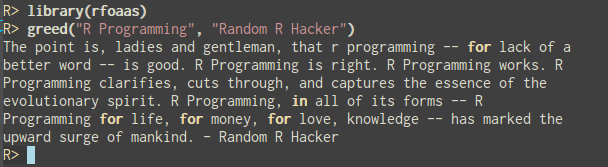
rfoaas greed example FOAAS upstream came out with release 1.1.0 earlier last week. Tyler Hunt was kind enough to provide an almost immediate pull request adding support for the extended capabilties. Following yesterday's upload we now have version 1.1.0 of rfoaas on CRAN. It brings six more accessors: maybe(), blackadder(), horse(), deraadt(), problem(), cocksplat() and too(). As usual, CRANberries provides a diff to the previous CRAN release. Questions, comments etc should go to the GitHub issue tracker. More background information is on the project page as well as on the github repo

This post by Dirk Eddelbuettel originated on his Thinking inside the box blog. Please report excessive re-aggregation in third-party for-profit settings.

27 August 2016

Dirk Eddelbuettel: RcppCNPy 0.2.5

A maintenance release of the RcppCNPy package is now on CRAN. RcppCNPy provides R with read and write access to NumPy files thanks to the cnpy library by Carl Rogers. This release just updates a few package internals such as the vignette, the DESCRIPTION and the README.md file as well as under Travis script used for continuous integration.
Changes in version 0.2.5 (2016-08-26)
  • Synchronized code with the cnpy repository
  • Updated vignette
  • Expanded DESCRIPTION
CRANberries also provides a diffstat report for the latest release. As always, feedback is welcome and the best place to start a discussion may be the GitHub issue tickets page.

This post by Dirk Eddelbuettel originated on his Thinking inside the box blog. Please report excessive re-aggregation in third-party for-profit settings.

26 August 2016

Norbert Preining: ESSLLI 2016 Course: Algebraic Specification and Verification with CafeOBJ

During this year s ESSLLI (European Summer School in Logic, Language and Information) I was teaching a course on Algebraic Specification and Verification with CafeOBJ. Now that the course is over I can relax a bit and enjoy the beauty of the surrounding North Tyrol.
ESSLLI-2016-logo-darkblue-small For those who couldn t attend the ESSLLI or the course, here are the course materials: Thanks to the participants for the interesting questions and participation. What follows is the original description of the course. Abstract Ensuring correctness of complex systems like computer programs or communication protocols is gaining ever increasing importance. For correctness it does not suffice to consider the finished system, but correctness already on the level of specification is necessary, that is, before the actual implementation starts. To this aim, algebraic specification and verification languages have been conceived. They are aiming at a mathematically correct description of the properties and behavior of the systems under discussion, and in addition often allow to prove (verify) correctness within the same system. This course will give an introduction to algebraic specification, its history, logic roots, and actuality with respect to current developments. Paired with the theoretical background we give an introduction to CafeOBJ, a programming language that allows both specification and verification to be carried out together. The course should enable students to understand the theoretical background of algebraic specification, as well as enable them to read and write basic specifications in CafeOBJ. Description CafeOBJ is a specification language based on three-way extensions to many-sorted equational logic: the underlying logic is order-sorted, not just many-sorted; it admits unidirectional transitions, as well as equations; it also accommodates hidden sorts, on top of ordinary, visible sorts. A subset of CafeOBJ is executable, where the operational semantics is given by a conditional order-sorted term rewriting system. The language system CafeOBJ has been under constant development at the institute of the lecturers since the late 80ies. It is closely related to other algebraic specification languages in the OBJ family, including Maude. The CafeOBJ language and the range of verification methods and tools it supports including its support for inductive theorem proving, verification of behavioral specifications, deductive invariant proof, and reachability analysis of concurrent systems has played a key role in both extending and bringing algebraic specification techniques into contact with many software engineering applications. The following topics will be discussed: To make the lectures not too heavy , we will structure each lecture into two parts: A first part providing an introduction of some theoretical concept, or framework, and a second part dealing with actual programming and implementation. Especially for the second part of each lecture students are encouraged to use their laptops to try out code and experiment.

Michal Čihař: CI coverage from Windows, Linux and OSX

Once I got CI working on multiple platforms the obvious next step was to be able to aggregate coverage reports across them. This should not be that hard, right? Well I've spent couple of hours on that during last few days. On Linux and OSX it was pretty much straightforward. Both GCC and Clang do support coverage, so it's just matter of configuring them properly and collect the coverage reports. I've used own solution for that in past and that was really far from working well (somehow I never managed to get coverage fully uploaded to Codecov). Fortunately there exists CMake script called CMake-codecov which does all needed work and works out of the box on GCC and Clang (even on OSX). Well it works on Travis only once you update the compilers and install llvm-cov tool. The Windows part on AppVeyor was much harder for me. This can be heavily accounted to lack of my experience with Windows and especially development on Windows in past ten years (probably even more). First challenge was to find something what can generate code coverage there. After lot of googling I've settled down on OpenCppCoverage what seems to be the only free solution I was able to find. The good thing is that it can generate coverage in Cobertura format that Codecov undestands. There are also bad things that I've learned. First of all it's quite hard to integrate this with CTest. There is no support for wrapping test calls in custom commands, so I've misused the memory checks for that purpose. I've written small python script which pretends the valgrind interface and does call OpenCppCoverage in the background. Now I had around 800 coverage files (one for each test case) and we need to deal with them somehow. The Codeconv command line client doesn't deal wit this out of the box so the obvious choice was to merge them before upload. There even seems to be script doing that, but unfortunately trying that on our coverage data make it nowhere near completion within hour, so that's not really good choice. Second thing I've tried was merging binary coverage in OpenCppCoverage and then exporting to Cobertura format. Obviously Gammu is special project as all I got from this attempt was crashing OpenCppCoverage (it did merge some of the coverages, but it failed in the end without indicating any error). In the end I've settled down to uploading files in chunks to Codecov. This seems to work quite okay, though is a bit slow, mostly due to way how Codecov bash uploader prepares data to upload (but this will be hopefully fixed soon). Anyway the goal has been reached, both Windows and Linux code shows in coverage reports.

Filed under: Debian English Gammu 0 comments

Dirk Eddelbuettel: RcppArmadillo 0.7.400.2.0

armadillo image Another Armadillo 7.* release -- now at 7.400. We skipped the 7.300.* serie release as it came too soon after our most recent CRAN release. Releasing RcppArmadillo 0.7.400.2.0 now keeps us at the (roughly monthly) cadence which works as a good compromise between getting updates out at Conrad's sometimes frantic pace, while keeping CRAN (and Debian) uploads to about once per month. So we may continue the pattern of helping Conrad with thorough regression tests by building against all (by now 253 (!!)) CRAN dependencies, but keeping release at the GitHub repo and only uploading to CRAN at most once a month. Armadillo is a powerful and expressive C++ template library for linear algebra aiming towards a good balance between speed and ease of use with a syntax deliberately close to a Matlab. The new upstream release adds new more helper functions. Detailed changes in this release relative to the previous CRAN release are as follows:
Changes in RcppArmadillo version 0.7.400.2.0 (2016-08-24)
  • Upgraded to Armadillo release 7.400.2 (Feral Winter Deluxe)
    • added expmat_sym(), logmat_sympd(), sqrtmat_sympd()
    • added .replace()
Changes in RcppArmadillo version 0.7.300.1.0 (2016-07-30)
  • Upgraded to Armadillo release 7.300.1
    • added index_min() and index_max() standalone functions
    • expanded .subvec() to accept size() arguments
    • more robust handling of non-square matrices by lu()
Courtesy of CRANberries, there is a diffstat report. More detailed information is on the RcppArmadillo page. Questions, comments etc should go to the rcpp-devel mailing list off the R-Forge page.

This post by Dirk Eddelbuettel originated on his Thinking inside the box blog. Please report excessive re-aggregation in third-party for-profit settings.

Matthew Garrett: Priorities in security

I read this tweet a couple of weeks ago:

and it got me thinking. Security research is often derided as unnecessary stunt hacking, proving insecurity in things that are sufficiently niche or in ways that involve sufficient effort that the realistic probability of any individual being targeted is near zero. Fixing these issues is basically defending you against nation states (who (a) probably don't care, and (b) will probably just find some other way) and, uh, security researchers (who (a) probably don't care, and (b) see (a)).

Unfortunately, this may be insufficient. As basically anyone who's spent any time anywhere near the security industry will testify, many security researchers are not the nicest people. Some of them will end up as abusive partners, and they'll have both the ability and desire to keep track of their partners and ex-partners. As designers and implementers, we owe it to these people to make software as secure as we can rather than assuming that a certain level of adversary is unstoppable. "Can a state-level actor break this" may be something we can legitimately write off. "Can a security expert continue reading their ex-partner's email" shouldn't be.

comment count unavailable comments

25 August 2016

Alessio Treglia: The Breath of Time

For centuries man has hunted, he brought the animals to pasture, cultivated fields and sailed the seas without any kind of tool to measure time. Back then, the time was not measured, but only estimated with vague approximation and its pace was enough to dictate the steps of the day and the life of man. Subsequently, for many centuries, hourglasses accompanied the civilization with the slow flow of their sand grains. About hourglasses, Ernst Junger writes in Das Sanduhrbuch 1954 (no English translation): This small mountain, formed by all the moments lost that fell on each other, it could be understood as a comforting sign that the time disappears but does not fade. It grows in depth . For the philosophers of ancient Greece, the time was just a way to measure how things move in everyday life and in any case there was a clear distinction between quantitative time (Kronos) and qualitative time (Kair s). According to Parmenides, time is guise, because its existence <Read More [by Fabio Marzocca]>

Norbert Preining: Gaming: Deus Ex Go

Long flights and lazy afternoons relaxing from teaching, I tried out another game on my Android device, Deus Ex Go. It is a turn based game in the style of the Deus Ex series (long years ago I was beta tester for the Deus Ex version of LGP). A turn based game where you have to pass through a series of levels, each one consisting of an hexagonal grid with an entry and exit point, and some nasty villains or machines trying to kill you. Deus-ex-go Without any explanations given you are thrown into the game and it takes a few iterations until you understand what kind of attacks you are facing, but once you have figured that out, it is a more or less simple game of combination how to manage to get to the exit. I played through the around 50 levels of the story mode and I think it was only in the last five that I once or twice had to actually try and think hard to find a solution. I found the game quite amusing at the beginning, but soon it became repetitive. But since you can play through the whole story mode in probably one long afternoon, that is not so much of a problem. More a problem is the apparently incredible battery usage of this game. Playing without checking for some time leaves you soon with a near empty battery. Graphically well done, with more or less interesting gameplay, it still does not stand up to Monument Valley.

Francois Marier: Debugging gnome-session problems on Ubuntu 14.04

After upgrading an Ubuntu 14.04 ("trusty") machine to the latest 16.04 Hardware Enablement packages, I ran into login problems. I could log into my user account and see the GNOME desktop for a split second before getting thrown back into the LightDM login manager. The solution I found was to install this missing package:
apt install libwayland-egl1-mesa-lts-xenial

Looking for clues in the logs The first place I looked was the log file for the login manager (/var/log/lightdm/lightdm.log) where I found the following:
DEBUG: Session pid=12743: Running command /usr/sbin/lightdm-session gnome-session --session=gnome
DEBUG: Creating shared data directory /var/lib/lightdm-data/username
DEBUG: Session pid=12743: Logging to .xsession-errors
This told me that the login manager runs the gnome-session command and gets it to create a session of type gnome. That command line is defined in /usr/share/xsessions/gnome.desktop (look for Exec=):
[Desktop Entry]
Name=GNOME
Comment=This session logs you into GNOME
Exec=gnome-session --session=gnome
TryExec=gnome-shell
X-LightDM-DesktopName=GNOME
I couldn't see anything unexpected there, but it did point to another log file (~/.xsession-errors) which contained the following:
Script for ibus started at run_im.
Script for auto started at run_im.
Script for default started at run_im.
init: Le processus gnome-session (GNOME) main (11946) s'est achev  avec l' tat 1
init: D connect  du bus D-Bus notifi 
init: Le processus logrotate main (11831) a  t  tu  par le signal TERM
init: Le processus update-notifier-crash (/var/crash/_usr_bin_unattended-upgrade.0.crash) main (11908) a  t  tu  par le signal TERM
Seaching for French error messages isn't as useful as searching for English ones, so I took a look at /var/log/syslog and found this:
gnome-session[4134]: WARNING: App 'gnome-shell.desktop' exited with code 127
gnome-session[4134]: WARNING: App 'gnome-shell.desktop' respawning too quickly
gnome-session[4134]: CRITICAL: We failed, but the fail whale is dead. Sorry....
It looks like gnome-session is executing gnome-shell and that this last command is terminating prematurely. This would explain why gnome-session exits immediately after login.

Increasing the amount of logging In order to get more verbose debugging information out of gnome-session, I created a new type of session (GNOME debug) by copying the regular GNOME session:
cp /usr/share/xsessions/gnome.desktop /usr/share/xsessions/gnome-debug.desktop
and then adding --debug to the command line inside gnome-debug.desktop:
[Desktop Entry]
Name=GNOME debug
Comment=This session logs you into GNOME debug
Exec=gnome-session --debug --session=gnome
TryExec=gnome-shell
X-LightDM-DesktopName=GNOME debug
After restarting LightDM (service lightdm restart), I clicked the GNOME logo next to the password field and chose GNOME debug before trying to login again. This time, I had a lot more information in ~/.xsession-errors:
gnome-session[12878]: DEBUG(+): GsmAutostartApp: starting gnome-shell.desktop: command=/usr/bin/gnome-shell startup-id=10d41f1f5c81914ec61471971137183000000128780000
gnome-session[12878]: DEBUG(+): GsmAutostartApp: started pid:13121
...
/usr/bin/gnome-shell: error while loading shared libraries: libwayland-egl.so.1: cannot open shared object file: No such file or directory
gnome-session[12878]: DEBUG(+): GsmAutostartApp: (pid:13121) done (status:127)
gnome-session[12878]: WARNING: App 'gnome-shell.desktop' exited with code 127
which suggests that gnome-shell won't start because of a missing library.

Finding the missing library To find the missing library, I used the apt-file command:
apt-file update
apt-file search libwayland-egl.so.1
and found that this file is provided by the following packages:
  • libhybris
  • libwayland-egl1-mesa
  • libwayland-egl1-mesa-dbg
  • libwayland-egl1-mesa-lts-utopic
  • libwayland-egl1-mesa-lts-vivid
  • libwayland-egl1-mesa-lts-wily
  • libwayland-egl1-mesa-lts-xenial
Since I installed the LTS Enablement stack, the package I needed to install to fix this was libwayland-egl1-mesa-lts-xenial. I filed a bug for this on Launchpad.

24 August 2016

Don Armstrong: H3ABioNet Hackathon (Workflows)

I'm in Pretoria, South Africa at the H3ABioNet hackathon which is developing workflows for Illumina chip genotyping, imputation, 16S rRNA sequencing, and population structure/association testing. Currently, I'm working with the imputation stream and we're using Nextflow to deploy an IMPUTE-based imputation workflow with Docker and NCSA's openstack-based cloud (Nebula) underneath. The OpenStack command line clients (nova and cinder) seem to be pretty usable to automate bringing up a fleet of VMs and the cloud-init package which is present in the images makes configuring the images pretty simple. Now if I just knew of a better shared object store which was supported by Nextflow in OpenStack besides mounting an NFS share, things would be better. You can follow our progress in our git repo: [https://github.com/h3abionet/chipimputation]

23 August 2016

Reproducible builds folks: Reproducible Builds: week 69 in Stretch cycle

What happened in the Reproducible Builds effort between Sunday August 14 and Saturday August 20 2016: Fasten your seatbelts Important note: we enabled build path variation for unstable now, so your package(s) might become unreproducible, while previously it was said to be reproducible given a specific build path it probably still is reproducible but read on for the details below in the tests.reproducible-builds.org section! As said many times: this is still research and we are working to make it reality. Media coverage Daniel Stender blogged about python packaging and explained some caveats regarding reproducible builds. Toolchain developments Thomas Schmitt uploaded xorriso which now obeys SOURCE_DATE_EPOCH. As stated in its man pages:
ENVIRONMENT
[...]
SOURCE_DATE_EPOCH  belongs to the specs of reproducible-builds.org.  It
is supposed to be either undefined or to contain a decimal number which
tells the seconds since january 1st 1970. If it contains a number, then
it is used as time value to set the  default  of  --modification-date=,
--gpt_disk_guid,  and  --set_all_file_dates.  Startup files and program
options can override the effect of SOURCE_DATE_EPOCH.
Packages reviewed and fixed, and bugs filed The following packages have become reproducible after being fixed: The following updated packages appear to be reproducible now, for reasons we were not able to figure out. (Relevant changelogs did not mention reproducible builds.) The following 2 packages were not changed, but have become reproducible due to changes in their build-dependencies: tagsoup tclx8.4. Some uploads have addressed some reproducibility issues, but not all of them: Patches submitted that have not made their way to the archive yet: Bug tracker house keeping: Reviews of unreproducible packages 55 package reviews have been added, 161 have been updated and 136 have been removed in this week, adding to our knowledge about identified issues. 2 issue types have been updated: Weekly QA work FTBFS bugs have been reported by: diffoscope development Chris Lamb, Holger Levsen and Mattia Rizzolo worked on diffoscope this week. Improvements were made to SquashFS and JSON comparison, the https://try.diffoscope.org/ web service, documentation, packaging, and general code quality. diffoscope 57, 58, and 59 were uploaded to unstable by Chris Lamb. Versions 57 and 58 were both broken, so Holger set up a job on jenkins.debian.net to test diffoscope on each git commit. He also wrote a CONTRIBUTING document to help prevent this from happening in future. From these efforts, we were also able to learn that diffoscope is now reproducible even when built across multiple architectures:
< h01ger>   https://tests.reproducible-builds.org/debian/rb-pkg/unstable/amd64/diffoscope.html shows these packages were built on amd64:
< h01ger>    bd21db708fe91c01ba1c9cb35b9d41a7c9b0db2b 62288 diffoscope_59_all.deb
< h01ger>    366200bf2841136a4c8f8c30bdc87057d59a4cdd 20146 trydiffoscope_59_all.deb
< h01ger>   and on i386:
< h01ger>    bd21db708fe91c01ba1c9cb35b9d41a7c9b0db2b 62288 diffoscope_59_all.deb
< h01ger>    366200bf2841136a4c8f8c30bdc87057d59a4cdd 20146 trydiffoscope_59_all.deb
< h01ger>   and on armhf:
< h01ger>    bd21db708fe91c01ba1c9cb35b9d41a7c9b0db2b 62288 diffoscope_59_all.deb
< h01ger>    366200bf2841136a4c8f8c30bdc87057d59a4cdd 20146 trydiffoscope_59_all.deb
And those also match the binaries uploaded by Chris in his diffoscope 59 binary upload to ftp.debian.org, yay! Eating our own dogfood and enjoying it! tests.reproducible-builds.org Debian related: The last change probably will have an impact you will see: your package might become unreproducible in unstable and this will be shown on tracker.debian.org, while it will still be reproducible in testing. We've done this, because we think reproducible builds are possible with arbitrary build paths. But: we don't think those are a realistic goal for stretch, where we still recommend to use .buildinfo to record the build patch and then do rebuilds using that path. We are doing this, because besides doing theoretical groundwork we also have a practical goal: enable users to independently verify builds. And if they only can do this with a fixed path, so be it. For now :) To be clear: for Stretch we recommend that reproducible builds are done in the same build path as the "original" build. Finally, and just for our future references, when we enabled build path variation on Saturday, August 20th 2016, the numbers for unstable were:

suite all reproducible unreproducible ftbfs depwait not for this arch blacklisted
unstable/amd64 24693 21794 (88.2%) 1753 (7.1%) 972 (3.9%) 65 (0.2%) 95 (0.3%) 10 (0.0%)
unstable/i386 24693 21182 (85.7%) 2349 (9.5%) 972 (3.9%) 76 (0.3%) 103 (0.4%) 10 (0.0%)
unstable/armhf 24693 20889 (84.6%) 2050 (8.3%) 1126 (4.5%) 199 (0.8%) 296 (1.1%) 129 (0.5%)
Misc. Ximin Luo updated our git setup scripts to make it easier for people to write proper descriptions for our repositories. This week's edition was written by Ximin Luo and Holger Levsen and reviewed by a bunch of Reproducible Builds folks on IRC.

22 August 2016

Lars Wirzenius: Linux 25 jubilee symposium

I gave a talk about the early days of Linux at the jubilee symposium arranged by the University of Helsinki CS department. Below is an outline of what I meant to speak about, but the actual talk didn't follow it exactly. You can compare these to the video once it comes online.

DebConf team: Proposing speakers for DebConf17 (Posted by DebConf17 team)

As you may already know, next DebConf will be held at Coll ge de Maisonneuve in Montreal from August 6 to August 12, 2017. We are already thinking about the conference schedule, and the content team is open to suggestions for invited speakers. Priority will be given to speakers who are not regular DebConf attendees, who are more likely to bring diverse viewpoints to the conference. Please keep in mind that some speakers may have very busy schedules and need to be booked far in advance. So, we would like to start inviting speakers in the middle of September 2016. If you would like to suggest a speaker to invite, please follow the procedure described on the Inviting Speakers page of the DebConf wiki.

DebConf17 team

Michal &#268;iha&#345;: Continuous integration on multiple platforms

Over the weekend I've played with continuous integration for Gammu to make it run on more platforms. I had to remember many things from the Windows world on the way and the solution is not yet complete, but the basic build is working, the only problematic part are external dependencies. First of all we already have Linux builds on Travis CI. These cover compilation with both GCC and Clang compilers, hopefully covering most of the possible problems. Recently I've added OS X builds on Travis CI, what was pretty much painless and worked out of the box. The next major architecture to support is Windows. Once I've discovered AppVeyor I thought it might be the way to go. The have free plans for open-source projects (though it has only one parallel build compared to four provided by Travis CI). As our build system is cross platform based on CMake, it should work pretty much out of the box, right? Well almost, tweaking the basics took some time (unfortunately there is no CMake support on AppVeyor, so you have to script it a bit). The most painful things on the way: You can check our current appveyor.yml in case you're going to try something similar. Current build results are on AppVeyor. As a nice side effect, we now have up to date Windows binaries for Gammu.

Filed under: Debian English Gammu 0 comments

Christian Perrier: [LIFE] Running activities - Ultra Trail du Mont-Blanc

Hello dear readers, It's been ages since I last blogged. Being far less active in Debian than I've been in the past, I guess this is a logical consequence. However, I'm still active as you may witness if you read the debian-boot mailing list : I still consider myself part of the D-I team and I'm maintaining a few sports-related packages. Most know what has taken precedence over Debian development, namely trail and ultra-trail running. And, well, it hasn't decreased, far from that : I ran about 10 races already this year....6 of them being above 50km and I ran my favourite 100km moutain race in early July for the second year in a row. So, the upcoming week, I'll be trying to reach what is usually considered as the Grail of ultra-trail runners : the Ultra-Trail du Mont-Blanc race in Chamonix. The race is fairly simple : run all around the Mont-Blanc summits, for a 160km race with a bit less than 10,000 meters positive climb. The race itself takes place between 800 and 2700 meters (so no "high mountain") and I expect to complete it (if I succeed) in about 40 hours. I'm very confident (maybe too much?) as I successfully completed a much more difficult race last year (only 144km, but over 11,000 meters positive climb and a much more difficult path...it took me over 50 hours to complete it). You can follow me on the live tracking site. The race starts on Friday August 26th, 18:00 CET DST. I everything goes well, I have great projects for next year, including a 100-mile race in Colorado in August (we'll be traveling in USA for over 3 weeks, peaking with the solar eclipse of August 21st in Kansas City).

Paul Tagliamonte: go-wmata - golang bindings to the DC metro system

A few weeks ago, I hacked up go-wmata, some golang bindings to the WMATA API. This is super handy if you are in the DC area, and want to interface to the WMATA data. As a proof of concept, I wrote a yo bot called @WMATA, where it returns the closest station if you Yo it your location. For hilarity, feel free to Yo it from outside DC. For added fun, and puns, I wrote a dbus proxy for the API as weel, at wmata-dbus, so you can query the next train over dbus. One thought was to make a GNOME Shell extension to tell me when the next train is. I d love help with this (or pointers on how to learn how to do this right).

21 August 2016

Cyril Brulebois: Freelance Debian consultant: running DEBAMAX

Executive summary Since October 2015, I've been running a FLOSS consulting company, specialized on Debian, called DEBAMAX. DEBAMAX logo Longer version Everything started two years ago. Back then I blogged about one of the biggest changes in my life: trying to find the right balance between volunteer work as a Debian Developer, and entrepreneurship as a Freelance Debian consultant. Big change because it meant giving up the comfort of the salaried world, and figuring out whether working this way would be sufficient to earn a living I experimented for a while under a simplified status. It comes with a number of limitations but that s a huge win compared to France s heavy company-related administrativia. Here s what it looked like, everything being done online: A number of things became quite clear after a few months: Thankfully I was eligible to being accompanied by the local Chamber of Commerce and Industry (CCI Rennes), which provides teaching sessions for new entrepreneurs, coaching, and meeting opportunities (accountants, lawyers, insurance companies, ). Summer in France is traditionally rather quiet (read: almost everybody is on vacation), so DEBAMAX officially started operating in October 2015. Besides different administrative and accounting duties, running this company doesn't change the way I've been working since July 2014, so everything is fine! As before, I won't be writing much about it through my personal blog, except for an occasional update every other year; if you want to follow what's happening with DEBAMAX:

Next.

Previous.