Search Results: "ed"

29 October 2020

Norbert Preining: Deleting many files from an S3 bucket

So we found ourselves in the need to delete a considerable amount of files (around 500000, amounting to 1.6T) from an S3 bucket. With the list of files in hand my first shot was calling
aws s3 rm s3://BUCKET/FILE
for each file. That wasn t the best idea I have to say, since first of all, it makes 500000 requests, and then it takes a looong time. And this command does not allow to pass in multiple files. Fortunately there is aws s3api delete-objects which takes a json input and can delete multiple files:
aws 3api delete-objects --bucket BUCKET --delete ' "Objects": [   "Key" : "FILE1"  ,   "Key" : "FILE2"  ... ] '
That did help, and with a bit of magic from bash (mapfile which can read in lines from stdin in batches) and jq, at the end it was a business of some 20min or so:
cat files-to-be-deleted    while mapfile -t -n 500 ary && (($ #ary[@] )); do
        objdef=$(printf '%s\n' "$ ary[@] "   jq -nR ' Objects: (reduce inputs as $line ([]; . + [ "Key":$line ])) ')
        aws s3api --no-cli-pager  delete-objects --bucket BUCKET --delete "$objdef"
done
This reads 500 files a time, and reformats it using jq into the proper json format: reduce inputs is a jq filter that iterates over the input lines and does a map/reduce step. In this case we use an empty array as start and add new key/filename pairs on the go. Finally, the whole bunch is send to AWS with the above API call. Puuuh, 500000 files and 1.6T less, in 20min.

28 October 2020

Daniel Lange: Git shared hosting quirk

Show https://github.com/torvalds/linux/blob/b4061a10fc29010a610ff2b5b20160d7335e69bf/drivers/hid/hid-samsung.c#L113-L118 to a friend. Oops 'eh? Yep, Linux has been backdoored. Well, or not. Konstantin Ryabitsev explains it nicely in a cgit mailing list email:
It is common for git hosting environments to configure all forks of the same repo to use an "object storage" repository. For example, this is what allows git.kernel.org's 600+ forks of linux.git to take up only 10GB on disk as opposed to 800GB. One of the side-effects of this setup is that any object in the shared repository can be accessed from any of the forks, which periodically confuses people into believing that something terrible has happened.
The hack was discussed on Github in Dec 2018 when it was discovered. I forgot about it again but Konstantin's mail brought the memory back and I think it deserves more attention. I'm sure putting some illegal content into a fork and sending a made up "blob" URL to law enforcement would go quite far. Good luck explaining the issue. "Yes this is my repo" but "no, no that's not my data" ... "yes, it is my repo but not my data" ... "no we don't want that data either, really" ... "but, but there is nothing we can do, we host on github...1". Update 05.11.20 Nate Friedman (CEO of Github) promises
[..] we are going to make it much more obvious when you're viewing an orphaned commit.
For context: The source code of Github (the product) had been leaked as a commit to Github's own DMCA repository. The repository has turned into a playground since Github took down the hosting for youtube-dl as the result of a DMCA complaint. 14.11.20 Seems Github now adds a warning to commits that are not in a reachable branch Github commit warning message

  1. Actually there is something you can do. Making a repo private takes it out of the shared "object storage". You can make it public again afterwards. Seems to work at least for now.

Kentaro Hayashi: lltsv 0.6.1-2: applied background color patch for readability

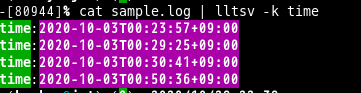
Original version of lltsv doesn't specify background color, so it is hard to recognize texts in dark background. I've fixed this issue by specifying background color explicitly. Here is the screenshot of fixed version. Yay! f:id:kenhys:20201028223848p:plain This issue was already forwarded as PR github.com

27 October 2020

Noah Meyerhans: Debian STS: Short Term Support

In another of my frequent late-night bouts with insomnia, I started thinking about the intersection of a number of different issues facing Debian today, both from a user point of view and a developer point of view. Debian has a reputation for shipping stale software. Versions in the stable branch are often significantly behind the latest development upstream. Debian s policy here has been that this is fine, our goal is to ship something stable, not something bleeding edge. Unofficially, our response to users is: If you need bleeding edge software, Debian may not be for you. Officially, we have no response to users who want fresher software. Debian also has a problem with a lack of manpower. I believe that part of why we have a hard time attracting contributors is our reputation for stale software. It might be worth it for us to consider changes to our approach to releases.

What about running testing? People who want newer software often look to Debian s testing branch as a possible solution. It s tempting, as it s a dynamically generated release based on unstable, so it should be quite current. In practice, it s not at all uncommon to find people running testing, and in fact I m running it right now on the ThinkPad on which this is being typed. However, testing comes with a glaring issue: a lack of timely security support. Security updates must still propagate through unstable, and this can take some time. They can be held up by dependencies, library transitions, or other factors. Nearly every list of best practices for computer security lists keeping software up-to-date at or near the top of most important steps to take to safely use networked computer. Debian s testing branch makes this very difficult, especially when faced with a zero-day with potential for real-world exploit.

What about stable-backports? Stable backports is both better and worse than testing. It s better in that it allows you to run a system comprised mainly of packages from the stable branch, which receive updates from the security team in a timely manner. However, it s worse in that the packages from the backports repository incur an additional delay. The expectation around backports is that a package migrates naturally from unstable to testing, and then requires a maintainer to upload a new package based on the version in testing specifically targeted at stable backports. The migration can potentially be bypassed, and we used to have a mechanism for announcing the availability of security updates for the stable backports archive, but it has gone unused for several years now. The documentation describes a workflow for posting security updates that involves creating a ticket in Debian s RT system, which is going to be quite foreign to most people. News from mid 2019 suggests that this process might change, but nothing appears to have come of this in over a year, and we still haven t seen a proper security advisory for stable backports in years.

Looking to LTS for ideas The Long-Term Support project is an alternative branch of Debian, maintained outside the normal stable release infrastructure. It s stable, and expected to behave that way, but it s not supported by the stable security team or release team. LTS provides a framework for providing security updates via targeted uploads by a team of interested individuals working outside the structure of the existing stable releases. This project seems to be quite active (how much of this is because at least some members are being paid?), and as of this writing has actually published more security advisories in the past month than the stable security team has published for the current stable branch. This is also interesting in that the software in LTS is quite old, first appearing in a Debian stable release in 2017. LTS is particularly interesting here as it s an example an initiative within the Debian community taken specifically to address user needs. For some of our users, remaining on an old release is a perfectly valid thing for them to do, and we recognize this and support them in doing so.

Debian Short-Term Support So, what would it take to create an LTS-like initiative in the other direction? Instead of providing ongoing support for ancient versions of software that previously comprised a stable release, could we build a distribution branch based on something that hasn t yet reached stable? What would that look like? How would it fit in the existing unstable testing migration process? What impact would it have on the size of the archive? Would we want a rolling release, or discrete releases? If the latter, how many would we want between proper stable releases? The security tracker already tracks outstanding issues in unstable and testing, and can even show issues that have been fixed in unstable but haven t yet propagated to testing. If we want a rolling release, maybe we could just open up the testing-security repository more broadly? There was once a testing security team, which IIRC was chartered to publish updated packages directly to testing security, along with associated security advisory. Based on the mailing list history, that effort seems to have shut down around the time of the squeeze (Debian 6.0) release in early 2011. Would it be worth resurrecting it? We ve probably got much of the infrastructure required in place already, since it previously existed. Personally I m not really a fan of a pure rolling release. I d rather see a light-weight release. Maybe a snapshot of testing that gets just a date, not a Toy Story codename. Probably skip building a dedicated installer for it. Upgrade from stable or use a d-i snapshot from testing if needed. This mini release is supported until the next one comes out, maybe 6 or 8 months later. By supported, I mean that the Short Term Release team is responsible for it. They can upload security or other critical bug fixes directly to a dedicated repository. When the next STS snapshot is released, packages in the updates repository are either archived, if they re a lower version than the one in the new mini release, or rebuilt against the new mini release and preserved. Using some of the same mechanisms as the LTS release, we d need
  1. Something to take the place of oldstable, that is the base release against which updates are released. This could be something that effectively maps to a date snapshot served by http://snapshot.debian.org/. (Snapshot itself could not currently handle the increased load, as I understand it, but conceptually it s similar.)
  2. Something to take the place of the dist/updates apt repository that hosts the packages that are updated.
In theory, if the infrastructure could support hose things, then we could in effect generate a mini release at any time based on a snapshot. I wonder if this could start as something totally unofficial; mirror an arbitrary testing snapshot and provide a place for interested people to publish package updates.

Not a proposal, nor a criticism To be clear, I don t really intend this as a proposal; It s really half-baked. Maybe these ideas have already been considered and dismissed. I don t know if people would be interested in working on such a project, and I m not nearly familiar enough with the Debian archive tooling to even make a guess as to how hard it would be to implement much of it. I m just posting some ideas that I came up with while pondering something that, from my perspective, is an area where Debian is clearly failing to meet the needs of some of our users. We know Debian is a popular and respected Linux distribution, and we know people value our stability. However, we also know that people like running Fedora and Ubuntu s non-LTS releases. People like Arch Linux. Not just end-users , but also the people developing the software shipped by the distros themselves. There are a lot of potential contributors to Debian who are kept away by our unwillingness to provide a distro offering both fresh software and security support. I think that we could attract more people to the Debian community if we could provide a solution for these people, and that would ultimately be good for everybody. Also, please don t interpret this as being critical of the release team, the stable security team, or any other team or individual in Debian. I m sharing this because I think there are opportunities for Debian to improve how we serve our users, not because I think anybody is doing anything wrong. With all that said, though, let me know if you find the ideas interesting. If you think they re crazy, you can tell me that, too. I ll probably agree with you.

26 October 2020

Molly de Blanc: Digital Self

When we talk about the digital self, we are talking about the self as it exists within digital spaces. This holds differently for different people, as some of us prefer to live within an pseudonymous or anonymous identity online, divested from our physical selves, while others consider the digital a more holistic identity that extends from the physical. Your digital self is gestalt, in that it exists across whatever mediums, web sites, and services you use. These bits are pieces together to form a whole picture of what it means to be you, or some aspect of you. This may be carefully curated, or it may be an emergent property of who you are. The way your physical self has rights, so too does your digital self. Or, perhaps, it would be more accurate to say that your rights extend to your digital self. I do not personally consider that there is a separation between these selves when it comes to rights, as both are aspects of you and you have rights. I am explicitly not going to list what these rights are, because I have my own ideas about them and yours may differ. Instead, I will briefly talk about consent. I think it is essential that we genuinely consent to how others interact with us to maintain the sanctity of our selves. Consent is necessary to the protection and expression of our rights, as it ensures we are able to rely on our rights and creates a space where we are able to express our rights in comfort and safety. We may classically think of consent as it relates to sex and sexual consent: only we have the right to determine what happens to our bodies; no one else has the right to that determination. We are able to give sexual consent, and we are able to revoke it. Sexual consent, in order to be in good faith, must be requested and given from a place of openness and transparency. For this, we discuss with our partners the things about ourselves that may impact their decision to consent: we are sober; we are not ill; we are using (or not) protection as we agree is appropriate; we are making this decision because it is a thing we desire, rather than a thing we feel we ought to do or are being forced to do; as well as other topics. These things also all hold true for technology and the digital spaces in which we reside. Our digital autonomy is not the only thing at stake when we look at digital consent. The ways we interact in digital spaces impact our whole selves, and exploitation of our consent too impacts our whole selves. Private information appearing online can have material consequences it can directly lead to safety issues, like stalking or threats, and it can lead to a loss of psychic safety and have a chilling effect. These are in addition to the threats posed to digital safety and well being. Consent must be actively sought, what one is consenting to is transparent, and the potential consequences must be known and understood. In order to protect and empower the digital self, to treat everyone justly and with respect, we must hold the digital self be as sacrosanct as other aspects of the self and treat it accordingly.

Reproducible Builds: Second Reproducible Builds IRC meeting

After the success of our previous IRC meeting, we are having our second IRC meeting today. Monday 26th October, at 18:00 UTC: Please join us on the #reproducible-builds channel on irc.oftc.net an agenda is available. As mentioned in our previous meeting announcement, due to the unprecedented events in 2020, there will be no in-person Reproducible Builds event this year, but we plan to run these IRC meetings every fortnight.

Marco d'Itri: RPKI validation with FORT Validator

This article documents how to install FORT Validator (an RPKI relying party software which also implements the RPKI to Router protocol in a single daemon) on Debian 10 to provide RPKI validation to routers. If you are using testing or unstable then you can just skip the part about apt pinnings. The packages in bullseye (Debian testing) can be installed as is on Debian stable with no need to rebuild them, by configuring an appropriate pinning for apt:
cat <<END > /etc/apt/sources.list.d/bullseye.list
deb http://deb.debian.org/debian/ bullseye main
END
cat <<END > /etc/apt/preferences.d/pin-rpki
# by default do not install anything from bullseye
Package: *
Pin: release bullseye
Pin-Priority: 100
Package: fort-validator rpki-trust-anchors
Pin: release bullseye
Pin-Priority: 990
END
apt update
Before starting, make sure that curl (or wget) and the web PKI certificates are installed:
apt install curl ca-certificates
If you already know about the legal issues related to the ARIN TAL then you may instruct the package to automatically install it. If you skip this step then you will be asked at installation time about it, either way is fine.
echo 'rpki-trust-anchors rpki-trust-anchors/get_arin_tal boolean true' \
    debconf-set-selections
Install the package as usual:
apt install fort-validator
You may also install rpki-client and gortr on Debian 10, or maybe cfrpki and gortr. I have also tried packaging Routinator 3000 for Debian, but this effort is currently on hold because the Rust ecosystem is broken and hostile to the good packaging practices of Linux distributions.

Marco d'Itri: RPKI validation with OpenBSD's rpki-client and Cloudflare's gortr

This article documents how to install rpki-client (an RPKI relying party software, the actual validator) and gortr (which implements the RPKI to Router protocol) on Debian 10 to provide RPKI validation to routers. If you are using testing or unstable then you can just skip the part about apt pinnings. The packages in bullseye (Debian testing) can be installed as is on Debian stable with no need to rebuild them, by configuring an appropriate pinning for apt:
cat <<END > /etc/apt/sources.list.d/bullseye.list
deb http://deb.debian.org/debian/ bullseye main
END
cat <<END > /etc/apt/preferences.d/pin-rpki
# by default do not install anything from bullseye
Package: *
Pin: release bullseye
Pin-Priority: 100
Package: gortr rpki-client rpki-trust-anchors
Pin: release bullseye
Pin-Priority: 990
END
apt update
Before starting, make sure that curl (or wget) and the web PKI certificates are installed:
apt install curl ca-certificates
If you already know about the legal issues related to the ARIN TAL then you may instruct the package to automatically install it. If you skip this step then you will be asked at installation time about it, either way is fine.
echo 'rpki-trust-anchors rpki-trust-anchors/get_arin_tal boolean true' \
    debconf-set-selections
Install the packages as usual:
apt install rpki-client gortr
And then configure rpki-client to generate its output in the the JSON format needed by gortr:
echo 'OPTIONS=-j' > /etc/default/rpki-client
You may manually start the service unit to immediately generate the data instead of waiting for the next timer run:
systemctl start rpki-client &
gortr too needs to be configured to use the JSON data generated by rpki-client:
echo 'GORTR_ARGS=-bind :323 -verify=false -checktime=false -cache /var/lib/rpki-client/json' > /etc/default/gortr
And then it needs to be restarted to use the new configuration:
systemctl restart gortr
You may also install FORT Validator on Debian 10, or maybe cfrpki with gortr. I have also tried packaging Routinator 3000 for Debian, but this effort is currently on hold because the Rust ecosystem is broken and hostile to the packaging practices of Linux distributions.

24 October 2020

Dirk Eddelbuettel: digest 0.6.27: Build fix

Exactly one week after the previous release 0.6.26 of digest, a minor cleanup release 0.6.27 just arrived on CRAN and will go to Debian shortly. digest creates hash digests of arbitrary R objects (using the md5, sha-1, sha-256, sha-512, crc32, xxhash32, xxhash64, murmur32, spookyhash, and blake3 algorithms) permitting easy comparison of R language objects. It is a fairly widely-used package (currently listed at one million monthly downloads, 282 direct reverse dependencies and 8068 indirect reverse dependencies, or just under half of CRAN) as many tasks may involve caching of objects for which it provides convenient general-purpose hash key generation. Release 0.6.26 brought support for the (nice, even cryptographic) blake3 hash algorithm. In the interest of broader buildability we had already (with a sad face) disabled a few very hardware-specific implementation aspects using intrinsic ops. But to our chagrin, we left one #error define that raised its head on everybody s favourite CRAN build platform. Darn. So 0.6.27 cleans that up and also removes the check and #error as all the actual code was already commented out. If you read this and tears start running down your cheeks, then by all means come and help us bring blake3 to its full (hardware-accelerated) potential. This (probably) only needs a little bit of patient work with the build options and configurations. You know where to find us My CRANberries provides the usual summary of changes to the previous version. For questions or comments use the issue tracker off the GitHub repo. If you like this or other open-source work I do, you can now sponsor me at GitHub. For the first year, GitHub will match your contributions.

This post by Dirk Eddelbuettel originated on his Thinking inside the box blog. Please report excessive re-aggregation in third-party for-profit settings.

Sandro Tosi: Multiple git configurations depending on the repository path

For my work on Debian, i want to use my debian.org email address, while for my personal projects i want to use my gmail.com address.One way to change the user.email git config value is to git config --local in every repo, but that's tedious, error-prone and doesn't scale very well with many repositories (and the chances to forget to set the right one on a new repo are ~100%).The solution is to use the git-config ability to include extra configuration files, based on the repo path, by using includeIf: Content of ~/.gitconfig:
[user]
name = Sandro Tosi
email = <personal.address>@gmail.com

[includeIf "gitdir:~/deb/"]
path = ~/.gitconfig-deb
Every time the git path is in ~/deb/ (which is where i have all Debian repos) the file ~/.gitconfig-deb will be included; its content:
[user]
email = morph@debian.org
That results in my personal address being used on all repos not part of Debian, where i use my Debian email address. This approach can be extended to every other git configuration values.

Jelmer Vernooij: Debian Janitor: Hosters used by Debian packages

The Debian Janitor is an automated system that commits fixes for (minor) issues in Debian packages that can be fixed by software. It gradually started proposing merges in early December. The first set of changes sent out ran lintian-brush on sid packages maintained in Git. This post is part of a series about the progress of the Janitor. The Janitor knows how to talk to different hosting platforms. For each hosting platform, it needs to support the platform- specific API for creating and managing merge proposals. For each hoster it also needs to have credentials. At the moment, it supports the GitHub API, Launchpad API and GitLab API. Both GitHub and Launchpad have only a single instance; the GitLab instances it supports are gitlab.com and salsa.debian.org. This provides coverage for the vast majority of Debian packages that can be accessed using Git. More than 75% of all packages are available on salsa - although in some cases, the Vcs-Git header has not yet been updated. Of the other 25%, the majority either does not declare where it is hosted using a Vcs-* header (10.5%), or have not yet migrated from alioth to another hosting platform (9.7%). A further 2.3% are hosted somewhere on GitHub (2%), Launchpad (0.18%) or GitLab.com (0.15%), in many cases in the same repository as the upstream code. The remaining 1.6% are hosted on many other hosts, primarily people s personal servers (which usually don t have an API for creating pull requests). Packages per hoster

Outdated Vcs-* headers It is possible that the 20% of packages that do not have a Vcs-* header or have a Vcs header that say there on alioth are actually hosted elsewhere. However, it is hard to know where they are until a version with an updated Vcs-Git header is uploaded. The Janitor primarily relies on vcswatch to find the correct locations of repositories. vcswatch looks at Vcs-* headers but has its own heuristics as well. For about 2,000 packages (6%) that still have Vcs-* headers that point to alioth, vcswatch successfully finds their new home on salsa.
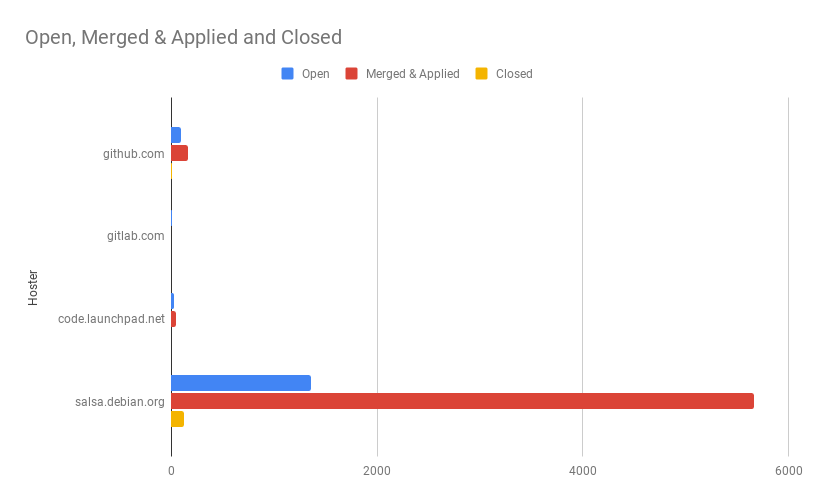
Merge Proposals by Hoster These proportions are also visible in the number of pull requests created by the Janitor on various hosters. The vast majority so far has been created on Salsa.
Hoster Open Merged & Applied Closed
github.com921685
gitlab.com1230
code.launchpad.net24511
salsa.debian.org1,3605,657126
Merge Proposal statistics In this graph, Open means that the pull request has been created but likely nobody has looked at it yet. Merged means that the pull request has been marked as merged on the hoster, and applied means that the changes have ended up in the packaging branch but via a different route (e.g. cherry-picked or manually applied). Closed means that the pull request was closed without the changes being incorporated. Note that this excludes ~5,600 direct pushes, all of which were to salsa-hosted repositories. See also:

For more information about the Janitor's lintian-fixes efforts, see the landing page.

23 October 2020

Dirk Eddelbuettel: RcppSpdlog 0.0.3: New features and much more docs

A good month after the initial two releases, we are thrilled to announce relase 0.0.3 of RcppSpdlog. This brings us release 1.8.1 of spdlog as well as a few local changes (more below). RcppSpdlog bundles spdlog, a wonderful header-only C++ logging library with all the bells and whistles you would want that was written by Gabi Melman, and also includes fmt by Victor Zverovic. This version of RcppSpdlog brings a new top-level function setLogLevel to control what events get logged, updates the main example to show this and to also make the R-aware logger the default logger, and adds both an extended vignette showing several key features and a new (external) package documentation site. The NEWS entry for this release follows.

Changes in RcppSpdlog version 0.0.3 (2020-10-23)
  • New function setLogLevel with R accessor in exampleRsink example
  • Updated exampleRsink to use default logger instance
  • Upgraded to upstream release 1.8.1 which contains finalised upstream use to switch to REprintf() if R compilation detected
  • Added new vignette with extensive usage examples, added compile-time logging switch example
  • A package documentation website was added

Courtesy of my CRANberries, there is also a diffstat report. More detailed information is on the RcppSpdlog page. If you like this or other open-source work I do, you can now sponsor me at GitHub. For the first year, GitHub will match your contributions.

This post by Dirk Eddelbuettel originated on his Thinking inside the box blog. Please report excessive re-aggregation in third-party for-profit settings.

Birger Schacht: An Analysis of 5 Million OpenPGP Keys

In July I finished my Bachelor s Degree in IT Security at the University of Applied Sciences in St. Poelten. During the studies I did some elective courses, one of which was about Data Analysis using Python, Pandas and Jupyter Notebooks. I found it very interesting to do calculations on different data sets and to visualize them. Towards the end of the Bachelor I had to find a topic for my Bachelor Thesis and as a long time user of OpenPGP I thought it would be interesting to do an analysis of the collection of OpenPGP keys that are available on the keyservers of the SKS keyserver network. So in June 2019 I fetched a copy of one of the key dumps of the one of the keyservers (some keyserver publish these copies of their key database so people who want to join the SKS keyserver network can do an initial import). At that time the copy of the key database contained 5,499,675 keys and was around 12GB. Using the hockeypuck keyserver software I imported the keys into an PostgreSQL database. Hockeypuck uses a table called keys to store the keys and in there the column doc stores the OpenPGP keys in JSON format (always with a data field containing the original unparsed data). For the thesis I split the analysis in three parts, first looking at the Public Key packets, then analysing the User ID packets and finally studying the Signature Packets. To analyse the respective packets I used SQL to export the data to CSV files and then used the pandas read_csv method to create a dataframe of the values. In a couple of cases I did some parsing before converting to a DataFrame to make the analysis step faster. The parsing was done using the pgpdump python library. Together with my advisor I decided to submit the thesis for a journal, so we revised and compressed the whole paper and the outcome was now

PUBLISHED in the Journal of Wireless Mobile Networks, Ubiquitous Computing, and Dependable Applications (JoWUA). I think the work gives some valuable insight in the development of the use of OpenPGP in the last 30 years. Looking at the public key packets we were able to compare the different public key algorithms and for example visualize how DSA was the most used algorithm until around 2010 when it was replaced by RSA. When looking at the less used algorithms a trend towards ECC based crytography is visible. What we also noticed was an increase of RSA keys with algorithm ID 3 (RSA Sign-Only), which are deprecated. When we took a deeper look at those keys we realized that most of those keys used a specific User ID string in the User ID packets which allowed us to attribute those keys to two software projects both using the Bouncy Castle Java Cryptographic API (resp. the Spongy Castle version for Android). We also stumbled over a tutorial on how to create RSA keys with Bouncycastle which also describes how to create RSA keys with code that produces RSA Sign-Only keys. In one of those projects, this was then fixed. By looking at the User ID packets we did some statistics about the most used email providers used by OpenPGP users. One domain stood out, because it is not the domain of an email provider: tellfinder.com is a domain used in around 45,000 keys. Tellfinder is a Big Data analysis software and the UID of all but two of those keys is TellFinder Page Archiver- Signing Key <support@tellfinder.com>. We also looked at the comments used in OpenPGP User ID fields. In 2013 Daniel Kahn Gillmor published a blog post titled OpenPGP User ID Comments considered harmful in which he pointed out that most of the comments in the User ID field of OpenPGP keys are duplicating information that is already present somewhere in the User ID or the key itself. In our dataset 3,133 comments were exactly the same as the name, 3,346 were the same as the domain and 18,246 comments were similar to the local part of the email address Last but not least we looked at the signature subpackets and the development of some of the preferences (Preferred Symmetric Algorithm, Preferred Hash Algorithm) that are being published using signature packets. Analysing this huge dataset of cryptographic keys of the last 20 to 30 years was very interesting and I learned a lot about the history of PGP resp. OpenPGP and the evolution of cryptography overall. I think it would be interesting to look at even more properties of OpenPGP keys and I also think it would be valuable for the OpenPGP ecosystem if these kinds analysis could be done regularly. An approach like Tor Metrics could lead to interesting findings and could also help to back decisions regarding future developments of the OpenPGP standard.

Enrico Zini: Hetzner build machine

This is part of a series of posts on compiling a custom version of Qt5 in order to develop for both amd64 and a Raspberry Pi. Building Qt5 takes a long time. The build server I was using had CPUs and RAM, but was very slow on I/O. I was very frustrated by that, and I started evaluating alternatives. I ended up setting up scripts to automatically provision a throwaway cloud server at Hetzner. Initial setup I got an API key from my customer's Hetzner account. I installed hcloud-cli, currently only in testing and unstable:
apt install hcloud-cli
Then I configured hcloud with the API key:
hcloud context create
Spin up I wrote a quick and dirty script to spin up a new machine, which grew a bit with little tweaks:
#!/bin/sh
# Create the server
hcloud server create --name buildqt --ssh-key   --start-after-create \
                     --type cpx51 --image debian-10 --datacenter  
# Query server IP
IP="$(hcloud server describe buildqt -o json   jq -r .public_net.ipv4.ip)"
# Update ansible host file
echo "buildqt ansible_user=root ansible_host=$IP" > hosts
# Remove old host key
ssh-keygen -f ~/.ssh/known_hosts -R "$IP"
# Update login script
echo "#!/bin/sh" > login
echo "ssh root@$IP" >> login
chmod 0755 login
I picked a datacenter in the same location as where we have other servers, to get quicker data transfers. I like that CLI tools have JSON output that I can cleanly pick at with jq. Sadly, my ISP doesn't do IPv6 yet. Since the server just got regenerated, I remove a possibly cached host key. Provisioning the machine One git server I need is behind HTTP authentication. Here's a quick hack to pass the relevant .netrc credentials to ansible before provisioning:
#!/usr/bin/python3
import subprocess
import netrc
import tempfile
import json
login, account, password = netrc.netrc().authenticators(" ")
with tempfile.NamedTemporaryFile(mode="wt", suffix=".json") as fd:
    json.dump( 
        "repo_user": login,
        "repo_password": password,
     , fd)
    fd.flush()
    subprocess.run([
        "ansible-playbook",
        "-i", "hosts",
        "-l", "buildqt",
        "--extra-vars", f"@ fd.name ",
        "provision.yml",
        ], check=True)
And here's the ansible playbook:
#!/usr/bin/env ansible-playbook
- name: Install and configure buildqt
  hosts: all
  tasks:
   - name: Update apt cache
     apt:
        update_cache: yes
        cache_valid_time: 86400
   - name: Create build user
     user:
        name: build
        comment: QT5 Build User
        shell: /bin/bash
   - name: Create sources directory
     become: yes
     become_user: build
     file:
        path: ~/sources
        state: directory
        mode: 0755
   - name: Download sources
     become: yes
     become_user: build
     get_url:
        url: "https:// / item "
        dest: "~/sources/ item "
        mode: 0644
     with_items:
      - "qt-everywhere-src-5.15.1.tar.xz"
      - "qt-creator-enterprise-src-4.13.2.tar.gz"
   - name: Populate home directory
     become: yes
     become_user: build
     copy:
        src: build
        dest: ~/
        mode: preserve
   - name: Write .netrc
     become: yes
     become_user: build
     copy:
        dest: ~/.netrc
        mode: 0600
        content:  
           machine  
           login  repo_user 
           password  repo_password 
   - name: Write .screenrc
     become: yes
     become_user: build
     copy:
        dest: ~/.screenrc
        mode: 0644
        content:  
           hardstatus alwayslastline
           hardstatus string '% = cw %-Lw% = KW %50>%n%f* %t% = cw %+Lw%< % = kK %-=%D %Y-%m-%d %c% - '
           startup_message off
           defutf8 on
           defscrollback 10240
   - name: Install base packages
     apt:
        name: git,mc,ncdu,neovim,eatmydata,devscripts,equivs,screen
        state: present
   - name: Clone git repo
     become: yes
     become_user: build
     git:
        repo: https:// @ / .git
        dest: ~/ 
   - name: Copy Qt license
     become: yes
     become_user: build
     copy:
        src: qt-license.txt
        dest: ~/.qt-license
        mode: 0600
Now everything is ready for a 16 core, 32Gb ram build on SSD storage. Tear down When done:
#!/bin/sh
hcloud server delete buildqt
The whole spin up plus provisioning takes around a minute, so I can do it when I start a work day, and take it down at the end. The build machine wasn't that expensive to begin with, and this way it will even be billed by the hour. A first try on a CPX51 machine has just built the full Qt5 Everywhere Enterprise including QtWebEngine and all its frills, for amd64, in under 1 hour and 40 minutes.

Molly de Blanc: Endorsements

Transparency is essential to trusting a technology. Through transparency we can understand what we re using and build trust. When we know what is actually going on, what processes are occurring and how it is made, we are able to decide whether interacting with it is something we actually want, and we re able to trust it and use it with confidence. This transparency could mean many things, though it most frequently refers to the technology itself: the code or, in the case of hardware, the designs. We could also apply it to the overall architecture of a system. We could think about the decision making, practices, and policies of whomever is designing and/or making the technology. These are all valuable in some of the same ways, including that they allow us to make a conscious choice about what we are supporting. When we choose to use a piece of technology, we are supporting those who produce it. This could be because we are directly paying for it, however our support is not limited to direct financial contributions. In some cases this is because of things hidden within a technology: tracking mechanisms or backdoors that could allow companies or governments access to what we re doing. When creating different types of files on a computer, these files can contain metadata that says what software was used to make it. This is an implicit endorsement, and you can also explicitly endorse a technology by talking about that or how you use it. In this, you have a right (not just a duty) to be aware of what you re supporting. This includes, for example, organizational practices and whether a given company relies on abusive labor policies, indentured servitude, or slave labor.
Endorsements inspire others to choose a piece of technology. Most of my technology is something I investigate purely for functionality, and the pieces I investigate are based on what people I know use. The people I trust in these cases are more inclined than most to do this kind of research, to perform technical interrogations, and to be aware of what producers of technology are up to. This is how technology spreads and becomes common or the standard choice. In one sense, we all have the responsibility (one I am shirking) to investigate our technologies before we choose them. However, we must acknowledge that not everyone has the resources for this the time, the skills, the knowledge, and therein endorsements become even more important to recognize. Those producing a technology have the responsibility of making all of these angles something one could investigate. Understanding cannot only be the realm of experts. It should not require an extensive background in research and investigative journalism to find out whether a company punishes employees who try to unionize or pay non-living wages. Instead, these must be easy activities to carry out. It should be standard for a company (or other technology producer) to be open and share with people using their technology what makes them function. It should be considered shameful and shady to not do so. Not only does this empower those making choices about what technologies to use, but it empowers others down the line, who rely on those choices. It also respects the people involved in the processes of making these technologies. By acknowledging their role in bringing our tools to life, we are respecting their labor. By holding companies accountable for their practices and policies, we are respecting their lives.

22 October 2020

Bastian Blank: Salsa updated to GitLab 13.5

Today, GitLab released the version 13.5 with several new features. Also Salsa got some changes applied to it. GitLab 13.5 GitLab 13.5 includes several new features. See the upstream release postfix for a full list. Shared runner builds on larger instances It's been way over two years since we started to use Google Compute Engine (GCE) for Salsa. Since then, all the jobs running on the shared runners run within a n1-standard-1 instance, providing a fresh set of one vCPU and 3.75GB of RAM for each and every build. GCE supports several new instance types, featuring better and faster CPUs, including current AMD EPICs. However, as it turns out, GCE does not support any single vCPU instances for any of those types. So jobs in the future will use n2d-standard-2 for the time being, provinding two vCPUs and 8GB of RAM.. Builds run with IPv6 enabled All builds run with IPv6 enabled in the Docker environment. This means the lo network device got the IPv6 loopback address ::1 assigned. So tests that need minimal IPv6 support can succeed. It however does not include any external IPv6 connectivity.

Vincent Fourmond: QSoas tips and tricks: generating smooth curves from a fit

Often, one would want to generate smooth data from a fit over a small number of data points. For an example, take the data in the following file. It contains (fake) experimental data points that obey to Michaelis-Menten kinetics: $$v = \frac v_m 1 + K_m/s $$ in which \(v\) is the measured rate (the y values of the data), \(s\) the concentration of substrate (the x values of the data), \(v_m\) the maximal rate and \(K_m\) the Michaelis constant. To fit this equation to the data, just use the fit-arb fit:
QSoas> l michaelis.dat
QSoas> fit-arb vm/(1+km/x)
After running the fit, the window should look like this:
Now, with the fit, we have reasonable values for \(v_m\) (vm) and \(K_m\) (km). But, for publication, one would want to generate "smooth" curve going through the lines... Saving the curve from "Data.../Save all" doesn't help, since the data has as many points as the original data and looks very "jaggy" (like on the screenshot above)... So one needs a curve with more data points. Maybe the most natural solution is simply to use generate-buffer together with apply-formula using the formula and the values of km and vm obtained from the fit, like:
QSoas> generate-buffer 0 20
QSoas> apply-formula y=3.51742/(1+3.69767/x)
By default, generate-buffer generate 1000 evenly spaced x values, but you can change their number using the /samples option. The two above commands can be combined to just one call to generate-buffer:
QSoas> generate-buffer 0 20 3.51742/(1+3.69767/x)
This works, but it is quite cumbersome and it is not going to work well for complex formulas or the results of differential equations or kinetic systems... This is why to each fit- command corresponds a sim- command that computes the result of the fit using a "saved parameters" file (here, michaelis.params, but you can also save it yourself) and buffers as "models" for X values:
QSoas> generate-buffer 0 20
QSoas> sim-arb vm/(1+km/x) michaelis.params 0
This strategy works with every single fit ! As an added benefit, you even get the fit parameters as meta-data, which are displayed by the show command:
QSoas> show 0
Dataset generated_fit_arb.dat: 2 cols, 1000 rows, 1 segments, #0
Flags: 
Meta-data:	commands =	 sim-arb vm/(1+km/x) michaelis.params 0	fit =	 arb (formula: vm/(1+km/x))	km =	 3.69767
	vm =	 3.5174
They also get saved as comments if you save the data. Important note: the sim-arb command will be available only in the 3.0 release, although you can already enjoy it if you use the github version. About QSoasQSoas is a powerful open source data analysis program that focuses on flexibility and powerful fitting capacities. It is released under the GNU General Public License. It is described in Fourmond, Anal. Chem., 2016, 88 (10), pp 5050 5052. Current version is 2.2. You can download its source code and compile it yourself or buy precompiled versions for MacOS and Windows there.

21 October 2020

Christian Kastner: RStudio is a refreshingly intuitive IDE

I currently need to dabble with R for a smallish thing. I have previously dabbled with R only once, for an afternoon, and that was about a decade ago, so I had no prior experience to speak of regarding the language and its surrounding ecosystem. Somebody recommended that I try out RStudio, a popular IDE for R. I was happy to see that an open-source community edition exists, in the form of a .deb package no less, so I installed it and gave it a try. It's remarkable how intuitive this IDE is. My first guess at doing something has so far been correct every. single. time. I didn't have to open the help, or search the web, for any solutions, either -- they just seem to offer themselves up. And it's not just my inputs; it's the output, too. The RStudio window has multiple tiles, and each tile has multiple tabs. I found this quite confusing and intimidating on first impression, but once I started doing some work, I was surprised to see that whenever I did something that produced output in one or more of the tabs, it was (again) always in an intuitive manner. There's a fine line between informing with relevant context and distracting with irrelevant context, but RStudio seems to have placed itself on the right side of it. This, and many other features that pop up here and there, like the live-rendering of LaTeX equations, contributed to what has to be one of the most positive experiences with an IDE that I've had so far.

Dirk Eddelbuettel: RcppZiggurat 0.1.6

ziggurats A new release, now at version 0.1.6, of RcppZiggurat is now on the CRAN network for R. The RcppZiggurat package updates the code for the Ziggurat generator by Marsaglia and other which provides very fast draws from a Normal distribution. The package provides a simple C++ wrapper class for the generator improving on the very basic macros, and permits comparison among several existing Ziggurat implementations. This can be seen in the figure where Ziggurat from this package dominates accessing the implementations from the GSL, QuantLib and Gretl all of which are still way faster than the default Normal generator in R (which is of course of higher code complexity). This release brings a corrected seed setter and getter which now correctly take care of all four state variables, and not just one. It also corrects a few typos in the vignette. Both were fixed quite a while back, but we somehow managed to not ship this to CRAN for two years. The NEWS file entry below lists all changes.

Changes in version 0.1.6 (2020-10-18)
  • Several typos were corrected in the vignette (Blagoje Ivanovic in #9).
  • New getters and setters for internal state were added to resume simulations (Dirk in #11 fixing #10).
  • Minor updates to cleanup script and Travis CI setup (Dirk).

Courtesy of my CRANberries, there is a diffstat report for this release. More information is on the RcppZiggurat page. If you like this or other open-source work I do, you can now sponsor me at GitHub. For the first year, GitHub will match your contributions.

This post by Dirk Eddelbuettel originated on his Thinking inside the box blog. Please report excessive re-aggregation in third-party for-profit settings.

Bits from Debian: Debian donation for Peertube development

The Debian project is happy to announce a donation of 10,000 to help Framasoft reach the fourth stretch-goal of its Peertube v3 crowdfunding campaign -- Live Streaming. This year's iteration of the Debian annual conference, DebConf20, had to be held online, and while being a resounding success, it made clear to the project our need to have a permanent live streaming infrastructure for small events held by local Debian groups. As such, Peertube, a FLOSS video hosting platform, seems to be the perfect solution for us. We hope this unconventional gesture from the Debian project will help us make this year somewhat less terrible and give us, and thus humanity, better Free Software tooling to approach the future. Debian thanks the commitment of numerous Debian donors and DebConf sponsors, particularly all those that contributed to DebConf20 online's success (volunteers, speakers and sponsors). Our project also thanks Framasoft and the PeerTube community for developing PeerTube as a free and decentralized video platform. The Framasoft association warmly thanks the Debian Project for its contribution, from its own funds, towards making PeerTube happen. This contribution has a twofold impact. Firstly, it's a strong sign of recognition from an international project - one of the pillars of the Free Software world - towards a small French association which offers tools to liberate users from the clutches of the web's giant monopolies. Secondly, it's a substantial amount of help in these difficult times, supporting the development of a tool which equally belongs to and is useful to everyone. The strength of Debian's gesture proves, once again, that solidarity, mutual aid and collaboration are values which allow our communities to create tools to help us strive towards Utopia.

Next.

Previous.