Search Results: "nic"

22 March 2013

Guido G nther: gst0.10-crystalhd ported to gstreamer 1.0

Following up on using Debian on the WeTab with GNOME Shell I figured accelerated video using the built in CrystalHD to save battery power and CPU cycles would be nice to have. There's even a Debian package available but not for gstreamer 1.0 (which is used by GNOME 3.6) so I had a look at gstreamer's plugin writers guide and porting guide and updated the driver. Packages are here until there's a new upstream version or Debian package release. This blog is flattr enabled.

21 March 2013

Martin Pitt: python-dbusmock 0.6 released

I just pushed out a new python-dbusmock release 0.6. Calling a method on the mock now emits a MethodCalled signal on the org.freedesktop.DBus.Mock interface. In some cases this is easier to track than parsing the mock s log or using GetMethodCalls. Thanks to Lars Uebernickel for this. DBusMockObject.AddTemplate() and DBusTestCase.spawn_server_template() can now load local templates from your own project by specifying a path to a *.py file as template name. Thanks to Lucas De Marchi for this feature. I also wrote a quite comprehensive template for systemd s logind. It stubs out the power management functionality as well as user/seat/session objects, and is convincing enough for loginctl. Some bits like AttachDevice is missing, as this sounds unlikely to be required for D-BUS mock tests, but please let me know if you need anything else. The mock processes now terminate automatically if their connected D-BUS goes down, as advertised in the documentation. You can get the new tarball from Launchpad, and I uploaded it to Debian experimental now. Enjoy!

20 March 2013

DebConf team: DebConf13 matching fund (Posted by Didier Raboud)

As part of the DebConf13 fundraising effort, a generous sponsor, Brandorr Group, has proposed to start a matching fund in USD for DebConf13; in place through the end of April 30th. The rules are quite simple: For details, please see our Monetary support from individuals page, which also has a short url, for convenience: http://deb.li/dc13donate. Help welcome As always, the DebConf team is looking for volunteers. Some jobs need technical skills, but many DebConf tasks are about working to deadlines on non-technical issues (e.g. fundraising, budgeting, talk scheduling). You can see more information about some of the jobs to be done on the DebConf wiki. Please do think about getting involved and sharing your ideas with us, to help us make DebConf an even more useful event for Debian in the future. We look forward to welcoming you to Vaumarcus!

Kartik Mistry: New laptop or how to teach tech to anyone? Part 1

* So, we got new laptop last week. The entire plan was to introduce my wife into tech world or atleast in Debian and/or OpenSouce world. I visited home for one of this and other personal reason(s) [Expect next post on this!]. My wife reported her first bug (installation-report, with help from me) which was closed by mighty bubulle! I handed over couple of freely available Python books and we started with codecademy s Python track. So far, things are good, but being really non-tech person, I m currently working as support system for her. I ve used KDE as desktop. Machine runs on latest kernel from experimental due to issues with hardware mentioned here. I was not able to explain IRC in much depth, so we re using non-free methods like Google Talk for communicating and reporting. Wish us luck! :) I ll report Part 2 when things will be enough to report the progress.

19 March 2013

Gergely Nagy: Rebuttals, or the lack of thereof

It is customary during Debian Project Leader elections to write a rebuttal of the other candidate's platform. However, this is very hard to do this year, as there are a lot of overlaps between platforms, goals and ideas this time around. It is hard to rebute another platform, without also rebuting one's own. So instead of trying to highlight where I disagree (there's very little of that, if at all), I'd like to point out where I found each platform lacking.Mind you, these notes are primarily based off of the platforms, because I'm sadly still behind on my debian-vote@ reading list. Furthermore, due to the high level of similarity between platforms, I will not always single out one or the other, but mention what I found lacking, or troublesome in general instead. So unless stated otherwise, my thoughts below apply to both Moray's and Lucas' platforms.The thing I miss most from both platforms is the curious lack of plans about non-packaging project members (something which I strongly emphasize in my own platform). Similarly, even though Moray does mention encouraging more local events, I find those few paragraphs a little bit lacking; and Lucas does not even mention local teams in his platform, even though they are a very, very important part of the wider Debian community, and a terrific tool in our asset. They can further our reach by long miles! Considering their importance, little's said about either local teams or local events, even when the candidate does explicitly recognise their importance.On the other hand, Lucas writes about innovation within Debian (which I found lacking in Moray's platform) - but while he does bring up the topic, I sadly found that section of his platform vague, a mistake I made last year myself, and which I tried to avoid this time, by explicitly listing a few of my ideas on how I'd imagine inspiring & motivating people (which, in turn, would foster innovation within the project).From what I see - and I may be wrong here, and I am obviously biased - both platforms are reasonably explicit when it comes to easier topics, things that we know to work, and which we'd all continue doing in the very same spirit as our predecessor. But when it comes to experimenting, to new ideas, I found both platforms too vague. There are exceptions, of course, Moray's intern idea for example is sufficiently well explained, as far as it is possible within the limits of a platform. I found no similar thing in Lucas' platform, however, most of the ideas he explained were technical things, and those are the areas where we're fairly good at, where we already have a reasonably chance of improving - and thus, an easier topic. I was suprised by Lucas' platform, because even though he lists the need for experimentation important, the lack of truly experimental ideas was lacking - I found more in Moray's platform.All in all, I found the discussions on debian-vote@ much more useful so far, than the platforms, a lot of things were asked and answered there that the platforms did not touch.

18 March 2013

Gerfried Fuchs: Backports Integrated Into The Main Archive

Dear users and supporters of the backports service! The Backports Team is pleased to announce the next important step on getting backports more integrated. People who are reading debian-infrastructure-announce will have seen that there was an archive maintenance last weekend: starting with wheezy-backports the packages will be accessible from the regular pool instead of a separate one, and all backports uploads will be processed through the regular upload queue (including those for squeeze-backports and squeeze-backports-sloppy). For Users What exactly does that mean for you? For users of wheezy, the sources.list entry will be different, a simple substitute of squeeze for wheezy won't work. The new format is:
deb http://ftp.debian.org/debian/ wheezy-backports main
So it is debian instead of debian-backports, and offered through the regular mirror network. Feel invited to check your regular mirror if it carries backports and pull from there. For Contributers What does it mean for contributing developers? Uploads for backports are no longer to be pushed to backports-master but to ftp.upload.debian.org, like any other regular package. Also, given that the packages are served from the same archive install there is no need to include the original tarball in the upload any longer because the archive knows it (Squeeze and beyond). Also, given that the upload goes to the same upload queue, there is only one keyring used anymore, so no more pain with expired or replaced keys. We though still keep the rule of adding your UID to an ACL list (this also includes DM additions). This is mostly only to give us the chance to remind you that uploads to backports are directly available for installation onto stable systems and you thus should take special care there. We carefully tried to take over the old ACLs, in case you can't upload anymore, please tell us so we can look into the issue. I've mentioned wheezy-backports (and squeeze-backports-sloppy) a few times here already, and you might wonder when it will be available. Technically, it is available from now on. Practically, while you could already upload to it, the set up of the buildd network is more painful than expected, so please allow the Buildd Team some days for setting them up. The upload rules for wheezy-backports are the same: packages that are in the next suite are accepted. Given that Jessie isn't created yet, we want you to think about whether the package you want to upload will go into Jessie final, and that you are taking a closer look once Jessie is created and the package entered there about the upgradeability. For the time until the suite is available, you can see this as relaxed upload rule. The same goes for squeeze-backports-sloppy: packages from two suites after Squeeze are acceptable, which turns it into the same relaxed rule as wheezy-backports above. Please also keep in mind that uploads to squeeze-backports-sloppy usually should be accompanied by uploads to wheezy-backports so people are able to upgrade from squeeze-backports-sloppy to wheezy with wheezy-backports. Thanks Finally, we want to thank the FTP-Master Team for their fine work on making this happen. The documentation on backports-master has been updated, and in case of any doubt or question, feel free to ask them on either the debian-backports mailinglist, or in case of sensitive topics ask us directly. Enjoy!
Rhonda for the Backports Team

/debian permanent link Comments: 1 Flattr this

17 March 2013

Daniel Pocock: Spotting Cypriots with Bitcoin

For anybody in Cyrpus right now, it should be relatively easy to spot those residents who keep their wealth in physical gold, silver or Bitcoin. Why? They will be the only people smiling this week, as everybody else has just had 6-10% of their bank account gouged by a once-off tax. What is really scary is that Cyprus is a Eurozone country. Will we now see the panic spread to Italy and Spain as citizens fear a copy-cat raid on their funds in the coming days or at some uncertain moment in the future? This latest development should not be seen as a small country' issue. The US did similar things with gold confiscation in the 1930s. Australia has decided to prop up the stock market by raising forced pension contributions on 1 July. What is different in Cyprus is that people will feel the pain immediately, and that modern technology will let the shockwaves spread. It might be worth refreshing my earlier blog will 2013 be the year of BitCoin?

Petter Reinholdtsen: Skolelinux 6 got a video review from Pcwizz

Via twitter I just discovered that Pcwizz have done a video review on Youtube of Skolelinux / Debian Edu version 6. He installed the standalone profile and the video show a walk-through of of the menu content, demonstration of a few programs and his view of our distribution. There is also some really nice quotes (transcribed by me, might have heard wrong). While looking thought the Graphics menu:
"Basically everything you ever need in a school environment."
And as a general evaluation of the entire distribution:
"So, yeah, a bit bloated. It kept all the Debian stuff in there, just to keep it nice and GNU. So, I do not want to go on about it, but lets give it 7 out of 10. I am not going to use it. That is because I am not deploying a school network. There may be some mythical feature to help you deploy Skolelinux on a school network."
To bad he did not test the server profile, and discovered the PXE installation option. It make it possible to install only the main server from CD, and the rest of the machines via the net, and might be considered the mythical feature he talk about. :) While looking through the menus, there is also this funny comment about the part of the K menu generated from the Debian menu subsystem:
"[The K menu] have a special Debian section for software that no-one is going to look at, because it contain lots of junky stuff that you actually don't need in the education distribution, but have just been included because it isn't stripped out for some reason."
I guess it is yet another argument for merging the Debian menu and Gnome/KDE desktop menu entries into one consistent menu system instead of two incomplete and partly inconsistent menu systems. The entire video is available below for those accepting iframe embedding: <iframe allowfullscreen="allowfullscreen" frameborder="0" height="315" src="http://www.youtube.com/embed/wPzTZ61Pcuc" width="560"></iframe>

16 March 2013

Lars Wirzenius: Obnam 1.4 (backup software) release

I've just pushed out the release files for Obnam version 1.4, my backup application, and Larch, my B-tree library, which Obnam uses. They are available via my home page (http://liw.fi/). Since Debian is frozen, I am not uploading packages to Debian, but .deb files are available from my personal apt repository for intrepid explorers. (I will be uploading to Debian again after the freeze. I am afraid I'm too lazy to upload to experimental, or do backports. Help is welcome!) From the Obnam NEWS file: Bug fixes:

Stefano Zacchiroli: bits from the DPL for February 2013 and a half

Dear project members, here's another report of DPL activities, this time for a period longer than usual (February + 1st week of March), so that the next one will be at the very end of the current DPL term. Highlights Appointments DPL helpers Two more DPL helpers IRC meetings have happened, minutes and logs of both are available. Assets Events Past At the beginning of February, I've attended FOSDEM 2013, together with many other Debian people. I didn't have any specific talk this year, but it's been a chance to talk F2F about several ongoing issues (see logs), and help mediating in some conflicts. I've also accepted the invitation to participate in the GNOME Advisory Board meeting, together with Laurent Bigonville of our GNOME team. No report of that has been prepared as of yet (sorry about that), but we have both reported "live" to the rest of the team on IRC. Future Miscellaneous A couple of months ago I've mentioned that I had filed an application, as Debian representative, to participate in a working table to define software procurement rules for the Italian public administration. Good news: my application has been accepted, together with those of other well-known FOSS communities and organizations (e.g. KDE, FSFE). I'll keep you posted of how it goes. Let's go back to elect a new DPL and release Wheezy now,
Cheers.
PS the day-to-day activity logs for February and March 2013 are available at the usual place master:/srv/leader/news/bits-from-the-DPL.txt.20130 2,3

15 March 2013

Jon Dowland: list filtering

The classic procmail recipe for (reasonably) safe automatic mailing list filtering is
:0
* ^List-Id:[^<]+<\/[a-z0-9-.]+
$MAILDIR/MATCH/
This relies on mailing lists being configured such that the first part of the ID, up to the first dot, is a good identifier for the list. this is not always the case (*.lists.fedoraproject.org, I'm looking at you). Removing the dot from the expression above means you end up with unambiguous, albeit long, folder names (devel.lists.fedoraproject.org). If you access this mail over IMAP, you have another problem: the dots create a nested folder heirarchy that probably doesn't make any sense (devel lists fedoraproject org). It's possible to change the configuration of IMAP clients and servers to use a different delimiter, but this is not an oft travelled road, and I don't feel like finding the pot holes. Better to substitute the dot for something else. I'd recommend an ASCII character, Unicode seems to throw up a whole bunch of client problems. Here's a variation that solves the problem:
:0
* ^List-Id:[^<]+<\/[a-z0-9-.]+
 
  :0
  subst=  echo "$MATCH"   tr . :
  :0
  $MAILDIR/$subst/
 
At the cost of elegance, you can add rules to give friendlier names to lists from folks who have well-defined list-ids (integration left as an exercise to the reader):
:0
* ^List-Id:.*debian.*lists\.debian\.org
subst=  echo "$MATCH"   sed 's/\([A-Za-z0-9-]\+\)\..*/\1/'
Finally, there are some "lists" you probably don't want to file in their own individual folders. Inject these into the top-most rule:
* ! ^List-Id.*groups\.facebook\.com
Finally thanks to Brett for showing me some exim filter snippets that would let me implement the above in a (slightly) nicer looking way. Sadly I think I'm stuck with procmail for some other features I use, but it's been a while since I looked.

MJ Ray: Debian Project Leader 2013 election campaign links: part 1

This is basically a link-post to the Debian Project Leader election email discussions on GMANE s blog-style interface to debian-vote. After only 3 days of the 21, there s already a pageful, so if I don t start collecting links now, I ll probably miss some. Right or wrong, I ve grouped these into three topics: The Job
  1. Why do you think you are a good candidate for DPL (10 Mar 2013)
  2. How do you plan to represent Debian externally? (10 Mar 2013)
  3. about a DPL board (12 Mar 2013)
  4. DPL term duration (12 Mar 2013)
  5. Work balance and traveling (12 Mar 2013)
  6. trying to do awesome and risking to fail (11 Mar 2013)
  7. To Lucas: how do you plan to push your ideas (12 Mar 2013)
  8. All candidates quotes for the press if you win (13 Mar 2013)
Money
  1. using debian funds for Debian s hardware infrastru (12 Mar 2013)
  2. Usage of Debian s Money (12 Mar 2013)
  3. Debian s relationship with money and the economy (12 Mar 2013)
Project Management
  1. getting new people to Debian (10 Mar 2013)
  2. Free Software challenges and Debian role (11 Mar 2013)
  3. Development and technical issues and challenges (10 Mar 2013)
  4. Are there problematic infrastructure or processes in Debian? (12 Mar 2013)
  5. to Moray: encourage teams to take interns (11 Mar 2013)
So, what do you think are the key points or differences? Leave me a comment, or get involved in the discussions. Campaigning ends and voting begins 30/31 March.

John Goerzen: It s Warm Enough For Mud

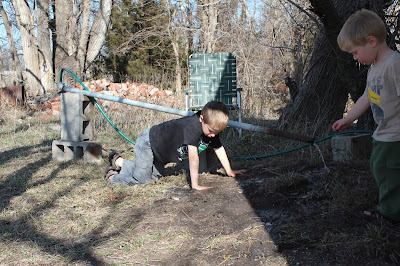
Today the outdoor temperatures got to nearly 75F/24C. The boys had this idea to go play with their streams . Here s one of the cleaner moments: I had set up an old pipe and a hose, with the water coming slowly out of the pipe onto a little mound of dirt. They can then use their fingers to make channels in the dirt for the water to flow through. They ve found that sticks can become bridges, making a hole in the earth makes a pond, and, oh yes, it s quite muddy and a lot of fun. Oliver at one point realized that he could splash the mud all around quite nicely. And he wanted to make sure I took photos of his hands. They could have played out there for hours, I m sure. When it was time to clean up, they enjoyed seeing the mud come off their sandals, arms, hands, and feet. It was a perfect use for the first really warm day of spring.

14 March 2013

Richard Hartmann: Gitify your life

sage@guug This January, I held an updated version of my "Gitify your life" talk at sage@guug, which is the Munich chapter of the German Unix User Group. Once again, it was quite successful and turnout was about three times that of normal attendance. Afterwards, I was asked if I would be willing to hold the same talk at the German Unix User Group's Spring Meeting in 2014 as the programme for 2013 has been finalized for quite some time, already. Obviously, I said I would be willing to do that and will submit the talk once registration opens. Open Source Days By the way, I am writing this post from a hotel room in Copenhagen. Tomorrow, there will be a world first... "Gitify your life" will not only be held as a talk, it will be expanded into a full three hour workshop (with the option of extending it if there's interest as the room will be free after my workshop). Having never held a workshop of this scope, I am really looking forward to this experience. Besides enabling me to get people up and running with their personal data, this will allow me to see where new users are having issues with vcsh. I keep hearing of people not getting their heads around the concept easily, but no matter how many promises of updates to my docs I get while helping them, no one really follows through with that promise once they know how to use vcsh. Maybe I will find someone willing to follow through and/or simply gather enough material for docs 2.0. Your place? As an aside, and I will probably try to put a real announcement together as well, if you know of a conference, user group or other place where a lightning talk, a full talk, or a workshop about one or all of these topics would fit, please let me know. I will gladly submit proposals to or accept invitations from most places as long as I can spread this message. Especially if the venue happens to be reasonably close to Southern Germany, covers travel cost, or if they can guarantee video recording of the talk. Joey Hess has speculated if the talk isn't really called "git naked" as I seem to keep on giving that particular talk at venues which don't have video recordings. Please help me make Joey happy... ...with a video recording, I mean.

Matthias Klumpp: Tanglu

Hi everyone! Today I make an announcement I thought I would never ever make. But things changed. Discussion about this has a long history, starting as a non-serious suggestion at DesktopSummit 2011, continued with people on IRC, but it was decided back then that it wouldn t be worth the effort. This has changed too, and a small team has formed to work on it. We hereby announce Tanglu, a new Debian-based-Linux distribution. A new logo?Why do we need another one? Let me explain the concepts of that distro: Tanglu will be based on Debian Testing and follow the Debian development closely. It will have a 6-months release-cycle and it s target audience are Linux desktop users. We will make installing and setting up the distro as easy as possible. Tanglu will be usable for both developers of upstream software and the average Linux user and Linux newbie. This is possible because in our opinion developers and users don t have different needs for a desktop system. Both kinds of users like a polished desktop which just works . We will, hwever, not apply any kind of fancy modification on upstream software, we will basically just distribute what upstream created, so users can get an almost pure GNOME and KDE experience. Tanglu is designed to be able to solve the issue that Debian is frozen for a long time and Debian Developers can t make new upstream versions available for testing easily. During a Debian freeze, DDs can upload their software to the current Tanglu development version and later start the new Debian cycle with already tested packages from Tanglu. The delta between Tanglu and Debian should be kept as minimal as possible. However, Tanglu is not meant as experimental distribution for Debian, so please upload experimental stuff to Experimental. Only packages good enough for a release should go into Tanglu. Ideally, Tanglu and Debian should be working well together in mixed environments, where you for example have Debian servers and multiple Tanglu desktops with the new software, targeted at desktop user. Since the differences between Tanglu and Debian should not be very high, administering both systems should be very easy (if you know Debian). Tanglu will be an open project, driven by community. At the beginning of each cycle, people can make suggestions for release goals they want to implement (similar to Fedora, but without FESCo). These proposals are discussed in public and are rejected if there are major technical concerns. If consensus about a certain proposal is lacking, a vote is done for it. The proposal can be accepted with absolute majority. If this does not happen, the proposal is postponed for the next release, where people can vote for it again. If nobody wants that function, it is rejected. In general, decisions made by Debian are superior and have to be followed. We don t think we know every package and every software better than the original upstream. That s why it makes much sense to rely on feedback from others and to have a community-based and peer-reviewed distribution, instead of secretly developing stuff and dumping it on the community. Tanglu will have a highly predictable set of features, defined at the beginning of a cycle, so you will know what you can expect from the next release as soon as possible and plan for it. Tanglu will make it easy to deploy applications for it. It will contain a software-center, similar to what Ubuntu has. We will also try to establish a solution for a Linux-AppCenter , a place for Linux applications, which will be open not only for Tanglu, but can be implemented in any other distribution too. Possible income will flow back into development of the platform. Now, let s answer the FQA (Future Questions Asked): Why don t you contribute to Debian directly and create yet another distribution? First of all, we contribute to Debian ;-) And for me, I can say that I will contribute to Debian even more. The point is that Debian can not cover all possible use-cases, and with Tanglu we want to make a distro which solves this. You might ask why we have to create a new distro for that, instead of creating improvements inside Debian? Creating a new distro allows us to do stuff we can never do in Debian. For example, we will include proprietary firmware in that distro, we will make installations of proprietary stuff possible easily (but don t ship with it by default) and we will have a time-based release cycle. These are already things which are a no-go for Debian, and that s fine. We don t want Debian to support these cases, as it is already a great distribution. We want to offer a distro as close to Debian as possible, but with a few modifications for use-cases which are not covered by Debian itself. Of course we will participate in DEX. If Debian Developers contribute to Tanglu, freezes will take even longer! This is an often-heard concern, it comes up on every mailinglist discussion about continuing development while freeze. I would disagree here, packaging new upstream stuff is not slowing down testing and improving of packages in Testing. Also, Tanglu is an offer for Debian developers to participate (we will sync privileges for their packages) we don t expect anyone to work on it, but as we think DDs know their packages best, we will make it possible for them to participate without extra barriers. We hope that Tanglu can add value to Debian and that Debian cycles can start with better-tested packages. You said you are a small team you cannot develop a whole distribution with it! Let s put that to the test! ;-) All people working on this are well aware of the issue that the project can not survive without much community-involvement on the long run. But we see a chance that many people are interested in it and that there is a high demand for it. At the beginning, we will just start with a small set of packages. We will also sync many packages from Ubuntu, to reduce workload. For example, it is planned to use the Ubuntu-Kernel and KDE packaging. By doing this, we keep the workload at the beginning low. We also reduce duplicate work with that. We even have some possible sponsors for the new distribution. But nothing is set in stone yet, so just wait for it to happen. :) Why not participate in Arch, OpenSUSE $other_distro? These are not Debian ;-) . I know, it sounds odd, but if you like the Debian way of doing things, you want to use a Debian-based distribution. There is nothing wrong with OpenSUSE. And Debian has issues too. But we want to be close to Debian and use it s tools and way of doing things. I hate you!!! You are doing it wrong!! The project is useless!

Well, that s fine. But there is no reason for hating us. If you dislike our idea, there are basically two options: First, you hate us but the project is successful. In that case, you have been wrong with hate, as there are definitely people who liked the project and contributed to it. Second, you hate us and we fail. In this case, there is no reason for hate, as the project will just vanish and you don t have to worry about it. So hating it would ve been just a big waste of energy. Also keep in mind that forking is a way to keep development healthy and to adapt software to new use-cases which it didn t target before. And we are not introducing incompatibilities here (like e.g. writing our own display server could). Instead, we want to stay close to Debian and reuse as much code as possible. Which desktop will you use? Everyone can add a new desktop to Tanglu, as long as the desktop-environment is present in Debian. Long term, we will have to offer Linux-newbies a default flavour, probably by setting a default download on the website. But as long as there is a community for a given desktop-environment, the desktop is considered as supported. At the beginning, we will focus on KDE, as many people have experience with it. But adding vanilla GNOME is planned too. Can you say something about the software used in Tanglu? Yes, but this is still in flow, so I can t promise final decisions here. On the server, side, we will try to use the Dak for repository management, as soon as we have enough server capacity. We will also use the standard Debian repository GUI and basically reuse most of the software there, to diverge less from Debian. The distribution itself will use a Linux Kernel from Ubuntu and systemd as the primary init system, as well as the login manager logind. It will be based on current Debian Testing with some fresh packages from Unstable and Experimental. We might also use the Ubuntu driver packages and KDE packaging. We expect to have a very rough start with the first release, but there will be enough time to polish Tanglu. Nice idea! How can I help? Well, you can help with basically anything at time from writing manuals, over designing logos and pages to administering a webserver and create packages. We are at an early stage of development at the moment, but we wanted to go public with it as soon as possible, to include the community and receive feedback so we can make that distro community-centric from the beginning. Most of the infrastructure is currently in progress too. So, if you want to get started with Tanglu, subscribe to our mailinglist tanglu-devel and write a mail to it, intruducing yourself. We can then include you in the loop. Generally, if you want to get access to our machines, a trusted GPG-signature will help a lot. If you want to talk to us, join #tanglu-devel or Freenode! Most discussions are currently happening there. And that s it! Tanglu will be awesome!

Some other projects of mine will develop a bit slower because I am now involved in Tanglu. But nothing will stop, and there is some pretty cool stuff coming for both GNOME and KDE (and I still have to implement DEP-11 for Debian). :)

Joerg Jaspert: zsh config - and prompt

As most people that are using that funny grey on black thing with the blinking white box AKA a commandline, I do have a heavily configured shell. zsh in my case. Some while ago my old configuration for it started to annoy me and so I set out to redo it. With the basic requirement to be flexible and able to adjust to various zsh versions (back as far as Lenny). I ve set out and looked how others do it and took the (I hope) best bits and put them together in a way I like it. Maybe others want to pick from me, so here I describe a little, maybe someone is interested First - the config is completly inside .zsh. The only thing directly in my $HOME is a symlink from $HOME/.zshenv to $HOME/.zsh/zshenv.home. All in one place, nicer this way. The zshenv just sets ZDOTDIR, so zsh then uses the .zsh itself. Next I am using modules . Well, actually everything is splitted out in small(er) files, so its way easier to maintain. And to overwrite stuff wherever I need to. So my .zshrc just loads those module files - and then goes and checks if it finds the same file inside a series of subdirectories. Those subdirectories are based on the hostname, the kernel name, the username, the domain name and the name of the distribution of the system. And a number of combinations of those. That system allows me, for example, to have a set of aliases defined only on Debian systems (like those to do with apt-get & co). Or define some extra variables if I login to the host franck, domain debian.org. Or whatever more. I m also on the way of doing something similar for all my dotfiles. While I was working at that I finally got fed up with the fact that my prompt, which is based on Phil! s wasn t doing what I wanted it on various of the hosts I access. Thankfully someone pointed me at a change to the grml zsh config: Frank Terbeck rewrote their prompt to make use of the zstyle system. Now that got me going, I like the idea of having the whole prompt easily configurable and changeable. My prompt always has shown slight differences depending on where the shell runs, which meant I had to carefully craft PS1 for every such change, and when one changes something one had to check all the places to adjust them too. No longer. I took Franks work and extended it for me. I wanted to still have a design matching my old prompt (minus colors, I changed color themes anyways), but with full flexibility the zstyle system can offer here. Now I am at a point where As an example, on the ftp-master host my prompt, while otherwise being the same as everywhere else, contains one extra item - displaying the current status of the archive (dinstall). If you want to try it, the setup file is available, but note that I don t give any warranty. :) Works for me . I load it in my Prompts module, while having the prompt setup file in my function path. The 4 commented lines, my testcase, are a nice example of a custom token, though a real life one, the setup for the ftp-master prompt with the one extra item can be found over here. Comments? Bugfixes? Enhancements? Update: Got asked for an example how to use my prompt to fake another. So here is what you need to do to use my prompt setup to imitate the prompt clint, as delivered with zsh:
autoload promptinit && promptinit
zstyle ':prompt:ganneff' vcs_info true
# Alternatively you can set whatever you like it to be.
zstyle ':prompt:ganneff' set_vcs_info_defaults true
zstyle ':prompt:ganneff' colors true
## no right prompt
zstyle ':prompt:ganneff:right:setup' use-rprompt false
## color of brackets depending on variable
zstyle ':prompt:ganneff:*:items:openbracket' pre '$ $ SSH_CLIENT+"$ PR_YELLOW " :-"$ PR_RED " '
zstyle ':prompt:ganneff:*:items:openbracket' post '$ PR_NO_COLOR '
zstyle ':prompt:ganneff:*:items:closebracket' pre '$ $ SSH_CLIENT+"$ PR_YELLOW " :-"$ PR_RED " '
zstyle ':prompt:ganneff:*:items:closebracket' post '$ PR_NO_COLOR '
zstyle ':prompt:ganneff:*:items:openanglebracket' pre '$ $ SSH_CLIENT+"$ PR_YELLOW " :-"$ PR_RED " '
zstyle ':prompt:ganneff:*:items:openanglebracket' post '$ PR_NO_COLOR '
zstyle ':prompt:ganneff:*:items:closeanglebracket' pre '$ $ SSH_CLIENT+"$ PR_YELLOW " :-"$ PR_RED " '
zstyle ':prompt:ganneff:*:items:closeanglebracket' post '$ PR_NO_COLOR '
## extra date format, and its color
zstyle ':prompt:ganneff:*:items:date' token '%D %a %y/%m/%d %R %Z '
zstyle ':prompt:ganneff:*:items:date' pre '$ PR_CYAN '
## pts. %l instead of %y, also color again
zstyle ':prompt:ganneff:*:items:pts' token '%l'
zstyle ':prompt:ganneff:*:items:pts' pre '$ PR_GREEN '
zstyle ':prompt:ganneff:*:items:pts' post '$ PR_NO_COLOR '
## host ends with :
zstyle ':prompt:ganneff:*:items:host' token '%m:'
## and a different style for the rc level
zstyle ':prompt:ganneff:*:items:rc' token '%(?..[%?%1v] )'
zstyle ':prompt:ganneff:*:items:rc' pre ''
## change color for other parts that differ to my default
zstyle ':prompt:ganneff:*:items:user' pre '$ PR_GREEN '
zstyle ':prompt:ganneff:*:items:host' pre '$ PR_GREEN '
zstyle ':prompt:ganneff:*:items:at' pre '$ PR_GREEN '
zstyle ':prompt:ganneff:*:items:path' pre '$ PR_GREEN '
zstyle ':prompt:ganneff:*:items:history' pre ''
## Show the shell level in a different way
zstyle ':prompt:ganneff:*:items:shell-level' pre ''
zstyle ':prompt:ganneff:*:items:shell-level' token 'zsh%(2L./$SHLVL.) '
## And history is just a bold number. Lazy here, not using pre and post
zstyle ':prompt:ganneff:*:items:history' token '%B%h%b '
## And the last part in prompt, a # or % depending on privileges
## Using standard zsh tokens for bold
zstyle ':prompt:ganneff:*:items:privileges' pre '%B'
zstyle ':prompt:ganneff:*:items:privileges' post '%b'
## Now there are two parts not defined by default, so lets create them
## Both are simple existing variables, no need for extra precmd functions
## system info
zstyle ':prompt:ganneff:extra:ostype' pre '$ PR_CYAN '
zstyle ':prompt:ganneff:extra:ostype' post '$ PR_NO_COLOR '
zstyle ':prompt:ganneff:extra:ostype' token "$ MACHTYPE /$ OSTYPE /$(uname -r)"
## zsh version
zstyle ':prompt:ganneff:extra:zshvers' pre '$ PR_CYAN '
zstyle ':prompt:ganneff:extra:zshvers' post '$ PR_NO_COLOR '
zstyle ':prompt:ganneff:extra:zshvers' token "$ ZSH_VERSION "
zstyle ':prompt:ganneff:left:full:setup' items \
    openbracket date closebracket openbracket pts closebracket openbracket ostype closebracket \
    openbracket zshvers closebracket newline openanglebracket user at host \
    path closeanglebracket newline \
    shell-level space history rc space vcs privileges space
prompt ganneff
And if you now tell me Uh, thats so much more than just saying /prompt clint/ , then you are right. But then: This way is flexible. As I wrote above, my prompt on the ftpmaster host is different. Actually, my prompt on all machines inside the domain debian.org differs, by having
zstyle ':prompt:ganneff:*:items:host' pre '$ PR_YELLOW '
in the Prompts definition for domain:debian.org. And thats enough to show me im on a .debian.org machine by a yellow hostname, instead of my default red. On the ftpmaster host I have the additional few lines: # Want one more piece in my prompt here, dinstall status zstyle :prompt:ganneff:left:full:setup items \ ulcorner line openparentheses user at host pts closeparentheses line history \ line dinstall line shell-level line flexline openparentheses path closeparentheses line urcorner newline \ llcorner line rc openparentheses time closeparentheses line vcs line change-root pipe space
zstyle ':prompt:ganneff:extra:dinstall' pre '$ PR_CYAN '
zstyle ':prompt:ganneff:extra:dinstall' post '$ PR_NO_COLOR '
zstyle ':prompt:ganneff:extra:dinstall' token '$DINSTALL'
zstyle ':prompt:ganneff:extra:dinstall' precmd jj_update_dinstall
zmodload zsh/mapfile
jj_update_dinstall ()  
    DINSTALL="$ $ (z)$ (f)mapfile[/srv/ftp.debian.org/web/dinstall.status] [2] [3,99] "
 
And woo, thats simple. I think. (There ought to be a way to just easily add the item at a defined place in the items zstyle, but meh, too lazy to look).

Rudy Godoy: Subversion auth using SSH external key-pair

Normally when using Subversion s SSH authentication facility you ll use your own SSH generated key-pair that svn will read from the proper location, usually $HOME/.ssh. However, there could be situations when you ll need to use a different key-pair. In such case you can use a nice trick to make svn+ssh authentication work smoothly. Let s say you have an external key-pair and the public key it s already set on the svn server. You store the private key somewhere in your home directory. Now when doing a svn checkout you ll find that you have to use SSH s -i parameter. However, when used together with svn it won t work as expected as you ll normally do when using ssh with an external key-pair. Subversion makes your life easier by using the $SVN_SSH environment variable, so you can put the ssh command and modifiers that fit your needs. In the external key case you can do something like:

export SVN_SSH="ssh -i </path/to/external-key>"
Next time you use svn s ssh auth it will read $SVN_SSH then use it. So now you can use svn commands such checkout, etc in the same fashion you normally do.
svn co svn+ssh://rudy@somesvnserver.at.somwhere.org/repo/for/software
Update: Jeff Epler offered great advice for using .ssh/config and key-pairs based on hostname. See the comments below.

Mike Hommey: Google Reader death, or how the cloud model can fail you

If you re a Google Reader user, you probably read in one of your subscriptions that Google is pulling the plug on Google Reader. It is yet another demonstration of why putting data in the cloud isn t so much of a nice idea: the service you rely on may well disappear some day, with all the data it contains. Sure Google, in its extreme goodness, allows you to take out the Google Reader data. Or does it?
These are what you ll get from Google Takeout for Reader: Interestingly, while looking into shared-by-followers.json, I found urls that would correspond to friend streams. For instance, Tim Bray s is http://www.google.com/reader/public/atom/user/05198174665841271019/state/com.google/broadcast. But it s useless: all it displays is permission denied . As for subscriptions, one of the strengths of Google Reader is that it allowed to search though past items, which means a big part of the interesting data is the archived items. But that s not part of the take out . Sure, you have the feed urls, but most RSS feeds contain a limited amount of items, not the entire history of items for the given feed. So, history is more or less lost. Except if I star, like or share all items in all my subscriptions and take out again. So much goodness. It could have been worse, though.

Russ Allbery: Review: Higher Order Perl

Review: Higher Order Perl, by Mark Jason Dominus
Publisher: Morgan Kaufmann
Copyright: 2005
ISBN: 1-55860-701-3
Format: Trade paperback
Pages: 563
Disclaimer: The author and I both used to be (technically still are, but the newsgroup is dead) moderators of comp.lang.perl.moderated, and I knew him electronically from answering questions on the Perl Usenet newsgroups many years ago. Perl is, in general construction, a typical imperative language in the style of C, with object-oriented capabilities bolted (somewhat awkwardly) on. Most Perl code looks remarkably like C code with more powerful built-in data types and no memory management. A minority of Perl programs embrace object-oriented techniques and remind one of C++ or Java (or Python). But Perl also has powerful capabilities borrowed from functional programming languages and the Lisp tradition, even though many Perl programmers rarely use them and aren't familiar with them. Higher Order Perl focuses on those capabilities and how to use them effectively, starting with callbacks and uses of function pointers and moving into recursion and analysis of recursive functions, iterators, currying, and parsers. It concludes with a fully-worked example of constructing a declarative programming system using the techniques developed earlier in the book. Higher Order Perl is a programming book for an intermediate to advanced Perl programmer, already a rare topic. This is not a look at how to apply Perl to another area of programming, or a cookbook of techniques. It's an attempt to help a Perl programmer think about and use the language differently, and it follows through on that. It's refreshing and rare to read a programming technique book that's targeted at the practicing expert. (I think the size of the audience is often too small for publishers to target it.) Even the most experienced Perl programmer is probably going to learn something fundamental from this book, not just interesting trivia around the edges. On the negative side, though, I found the book a bit too focused on computer science and mathematics problems, particularly in the choice of examples and sample scripts. (And I say this as someone who has a master's degree in computer science with a software theory focus.) This is a bit hard to avoid for topics like recursion, where problems like computing Fibonacci numbers are classic, but throughout the book I struggled to focus past feelings of "but why would I ever do that"? The extended discussion of the Newton-Raphson method is the most memorable; I'm not sure that's a problem many Perl programmers would have and need a higher-order technique for. There's also a lot of discussion of recursion analysis and transformations between recursive and iterative expressions of problems, which is ground I remember well from my degree but which I've rarely had any practical use for in day-to-day programming. This is not a uniform problem, though, just a tendency. There are some great examples that I think are more in the mainstream of Perl problems, including a reinvention of File::Find that shows how to add more flexibility, a web spider, and a great discussion on how to construct a conventional queryable database on top of a flat file (a topic that's near and dear to my heart). And then there's the chapter on infinite streams. Dominus presents a method of using closures to create a version of an interator: a sort of infinite linked list that can keep generating additional elements. He presents this in several contexts, but one of them is log parsing, and that turned out to be exactly the solution that I needed for a problem I was working on while reading this book. I've written about this elsewhere, but this was a wonderful idea that helped me think about both Perl and a major application area in a completely new way, and I wrote an application using that knowledge that would have taken me much longer using different techniques and would have been much less fun. So, for me, this chapter was more than worth the entire book, and blankets the rest of it in a delighted feeling. Other people may or may not have that experience. I think it will depend on whether one of these techniques hits home for you the way that one did for me. This is a book with some idiosyncracies, and some sections that may drag. Having lots of fully-worked examples is a major plus, but some of those are so comprehensive that one can get a bit lost in the details. That particularly hit me with the last couple of chapters on parsing and on the example declarative programming application. Quite a bit of that text involved reinventing a recursive descent parser (another very computer science example), when I'm not quite sure why one wouldn't use one of the existing parser generators on CPAN for practical purposes, and inventing a lot of new syntax to try to make parser Perl code more readable. But one certainly can't complain that Dominus omits necessary details, and there is some appeal in watching an experienced programmer work through a problem from analysis to implementation. But, despite the idiosyncracies, I recommend this book to any experienced Perl programmer who wants to expand their view of the language. The techniques here closures, higher-order functions, iterators and streams, and formal parsers are powerful and underused in the Perl community. You may want to pick and choose which sections you pay close attention to, but I think everyone will find something of interest here. In the weeks since I read this book, my opinion of it has only grown. And I can't tell you just how much I loved the infinite stream concept. Rating: 8 out of 10

13 March 2013

Steve Kemp: So I'm a year older

Last week I had another birthday, which was nice. I'm now all mature, and everything. Honest. I received a few surprise gifts from friends and strangers alike, which was pretty good. Other than that I didn't do too much. This weekend I'm going to be using "airbnb" to spend the weekend in Dundee with my partner who is regularly commuting between Edinburgh and Perth/Dundee, to work in various hospitals. With all the commuting time she's not had too much time to explore the actual city, and I've only been there once before so I'm sure it will be a fun weekend. The templer static site generator got a little bit of pimping on LWN.net the other day, thanks to Martin Michlmayr, although embarassingly I seem to have read the article and repeated the content in the conclusion, and duplicated that in my own comment. Ooops. Beyond that I've done little coding recently, although I suspect now that nodejs has had a stable release I might do something interesting soon. I don't want to dwell on the failure of Sim City - because I don't run windows and couldn't have tried it even if I wanted to - but I'm pondering the idea of a persistant grid-space where different items can be placed. I've not tried anything browser-based before, but the popularity of things like minecraft make me wonder if you had an "infinite grid" where folk could store "stuff", and scroll around in a browser you might be able to do interesting things. Starting small, with a 100x100 grid, and some kind of updated play-by-mail turfwars/drug-war like experience should be simple. But then again enthusiasm is easy to generate until you start working out how you'd interface with the server and what kind of client you'd need. Now to enjoy some 21 year old whisky and call it a night..

Next.

Previous.