Search Results: "ms"

22 March 2016

Ben Hutchings: I'm super, thanks for asking!

Some of you (but though probably not many) will know that I've suffered from depression at times. It has made it very difficult for me to do my job, to keep my home in order, even to have real conversations. Many important tasks seemed to require more energy than I had, and every setback left me feeling hopeless. I have sought treatment on several occasions, with very limited results. Certainly I would get better eventually, but it was hard to tell whether this had anything to do with the medication or therapy I received. And even while I felt better, I still didn't feel particularly happy or hopeful except when going to my favourite social events like DebConf. As I was recovering from the 'flu a weeks ago, I realised that I was feeling enthusiastic and energetic for no particular reason. Obviously I was recovering from physical illness, but that was brief. I had also just started a new project at work, but it isn't that exciting (at this stage) and I'm already aware of plenty of problems with it. So nothing external seemed to have changed to make me feel better, and yet my mood was so high that I worried that my illness could have changed to bipolar disorder and that I was entering a manic phase. Thankfully, I'm not behaving manically. I have been doing a lot more shopping than usual, but almost the first purchase was a whiteboard to maintain the to-do list that I had been keeping rather unreliably in my head, and mostly I've been buying things off that list - that I've intended to get for months or years. It's just been so long since I could feel generally positive and optimistic about my life - outside of any special event - that I didn't immediately recognise this state of mind as normality. It's now been two three weeks since my recovery, and I still feel so much better: As I feel better in myself I also find myself less self-centred and more able to focus on other people's needs, particularly my wife Nattie. Frankly I've been an asshole pretty often while I was depressed, so I apologise to those who've been the brunt of that. I hope you'll find me more pleasant to deal with from now on. There's lots more I could write, but I'll end this entry now and maybe say more at a later date.

21 March 2016

Lunar: Reproducible builds: week 47 in Stretch cycle

What happened in the reproducible builds effort between March 13th and March 19th 2016:

Toolchain fixes
  • Petter Reinholdtsen uploaded naturaldocs/1.51-1.1 which makes the output reproducible. Original patch by Chris Lamb.
  • Damyan Ivanov uploaded libpdf-api2-perl/2.025-2 which will make internal font ID reproducible.
  • Christian Hofstaedtler uploaded ruby2.3/2.3.0-5 which sets gzip embedded mtime field to fixed value for rdoc-generated compressed javascript data.

Packages fixed The following packages have become reproducible due to changes in their build dependencies: diction, doublecmd, ruby-hiredis, vdr-plugin-epgsearch. The following packages became reproducible after getting fixed: Some uploads fixed some reproducibility issues, but not all of them: Patches submitted which have not made their way to the archive yet:
  • #818128 on nethack by Reiner Herrmann: implement support for SOURCE_DATE_EPOCH, set LC_ALL to C, and ensure deterministic build order when running parallel builds.
  • #818111 on debian-keyring by Satyam Zode: fix the order of files in md5sums.
  • #818067 on ncurses by Niels Thykier: strip trailing whitespaces introduced when using dash as system shell.
  • #818230 on aircrack-ng by Reiner Herrmann: build assembly code as a separate .o file.
  • #818419 on mutt by Daniel Shahaf: use C locale when listing files to be put in README.Patches.
  • #818430 on ruby-coveralls by Dhole: ensure UTC is used as the timezone when generating the documentation.
  • #818686 on littlewizard by Reiner Herrmann: use the C locale in the script for iterating over the files.
  • #818704 on strigi by Reiner Herrmann: sort keys when traversing hashes in makecode.pl.

Package reviews 44 reviews have been removed, 40 added and 5 updated in the previous week. Chris Lamb has reported 16 FTBFS.

20 March 2016

Sean Whitton: Spring Break in San Francisco

Last night I got back from spending around 5 days in the Bay Area for Spring Break. I stayed in a hostel in downtown SF for three nights and then I stayed with a friend who is doing a PhD at Stanford. When initially planning this trip my aim was just to visit somewhere interesting on the west coast of the continental United States. I chose the Bay Area because I wanted to get my PGP key signed by some Debian Developers and that area has a high concentration of DDs, and because I wanted to see my friend at Stanford. But in the end I liked San Francisco a lot more than expected to and am very glad that I had an opportunity to visit. The first thing that I liked was how easy it seemed to be to find people interested in the same kind of tech stuff that I am. I spent my first afternoon in the city exploring the famous Mission district, and at one point while sitting in the original Philz Coffee I found that the person sitting next to me was running Debian on her laptop and blogs about data privacy. We had an discussion about how viable OpenPGP is as a component of a technically unsophisticated user s attempts to stay safe online. Later that same day while riding the subway train, someone next to me fired up Emacs on their laptop. And over the course of my trip I met five Debian Developers doing all sorts of different kinds of work both in and outside of Debian, and some Debian users including one of Stanford s UNIX sysadmins. This is a far cry from my day-to-day life down in the Sonoran Desert where new releases of iOS are all anyone seems to be interested in. Perhaps I should have expected this before my trip, but I think I had assumed that most of the work being done in San Francisco was writing web apps, so I was pleased to find people working on the same kind of things that I am currently putting time into. And in saying the above, I don t mean to demean the interests of the people around me in Arizona for a moment (nor those writing web apps; I d like to learn how to write good ones at some point). I m very grateful to be able to discuss my philosophical interests with the other graduate students. It s just that I miss being able to discuss tech stuff. I guess you can t have everything you want! One particular encouraging meeting I had was with a Debian Developer employed by Google and working on Git. While my maths background sets me up with the right thinking skills to write programs, I don t have knowledge typically gained from an education in computer science that enables one to work on the most interesting software. In particular, low-level programming in C is something that I had thought it wouldn t be possible for me to get started with. So it was encouraging to meet the DD working on Git at Google because his situation was similar: his undergraduate background is in maths and he was able to learn how to code in C by himself and is now working on a exciting project at a company that it is hard to get hired by. I don t mean that doing exactly what he s doing is something that I aiming for, just that it is very encouraging to know the field is more open to me than I had thought. I was also reminded of how fortunate I am to have the Internet to learn from and projects like Debian to get involved with. Moving on from tech, I enjoyed the streets of San Francisco, and the Stanford campus. San Francisco is fantastically multicultural though with clear class and wealth divisions. A very few minutes walk from the Twitter headquarters with its tech bros , as the maths PhD students I met at Stanford call them, are legions of the un- and barely-employed passing their time on the concrete. I enjoyed riding one of the old cable cars through the aesthetically revealing and stark combination of a west coast grid system on some very steep hills. I was fortunate to be able to walk across the Golden Gate Bridge on a perfectly clear and mist-free day. Meeting people involved with Debian and meeting my old friend at Stanford had me reflecting on and questioning my life in the desert even more than usual. I try to remind myself that there is an end date in sight and I will regret spending my time here just thinking about leaving. I sometimes worry that I could easily find myself moving to the big city London, San Francisco or elsewhere and letting myself be carried by the imagined self-importance of that, sidelining and procrastinating things that I should prize more highly. I should remember that the world of writing software in big cities isn t going away and my time in the desert is an opportunity to prepare myself better for that, building my resistance to being swept away by the tides of fashion.

Norbert Preining: Debian/TeX Live 2015.20160320-1 and biber 2.4-1

About one month has passed and here is the usual updated of TeX Live packages for Debian, this time also with an update to biber to accompany the updated version of biblatex. This will be (probably) the last upload before TeX Live 2015 gets frozen in preparation for 2016. After the freeze there will be some time of piece, and updates will got to experimental with the new binaries. Debian - TeX Live 2015 From the list of updated and new packages I want to mention that biblatex has been updated together with biber, and most biblatex styles should already by updated to work with the new biblatex, too. From the new packages one has in particular caught my attention: prooftrees. As I am writing a lot of proofs in my research, I am happy to see new package dealing with this, especially because this package is built on top of the excellent package forest (which in turn uses tikz), allowing for very compact proofs. Updated packages aastex, abntex2, academicons, acro, amsmath, animate, archaeologie, asciilist, babel, babel-french, babel-friulan, babel-russian, babel-spanish, beamertheme-metropolis, bibexport, biblatex, biblatex-apa, biblatex-bookinarticle, biblatex-caspervector, biblatex-chem, biblatex-fiwi, biblatex-gost, biblatex-manuscripts-philology, biblatex-nature, biblatex-philosophy, biblatex-phys, biblatex-publist, biblatex-realauthor, biblatex-science, bxjscls, cabin, caption, cbfonts-fd, celtic, chemmacros, computational-complexity, crimson, csplain, datetime2-english, diagbox, disser, droit-fr, dtk, dvips, ejpecp, emisa, factura, fibeamer, fithesis, forest, gost, hobby, hyperxmp, inconsolata, lualatex-math, mandi, mcf2graph, media9, nameauth, ocgx2, parades, pdftex, pkuthss, poetrytex, ptex, reledmac, roundrect, showhyphens, siunitx, spath3, splitindex, suftesi, tcolorbox, tetex, tex4ht, texinfo, texlive-scripts, thuthesis, titlesec, turabian-formatting, unicode-data, uptex, velthuis, venndiagram, xassoccnt, xint, xsavebox. New packages beamercolorthemeowl, bibletext, cochineal, formation-latex-ul, gobble, keyvaltable, lroundrect, luatex85, mathpartir, miama, multidef, parades, pgfornament, prooftrees, visualpstricks, visualtikz, xsavebox, ycbook. Enjoy.

19 March 2016

Petter Reinholdtsen: UsingQR - "Electronic" paper invoices using JSON and QR codes

Back in 2013 I proposed a way to make paper and PDF invoices easier to process electronically by adding a QR code with the key information about the invoice. I suggested using vCard field definition, to get some standard format for name and address, but any format would work. I did not do anything about the proposal, but hoped someone one day would make something like it. It would make it possible to efficiently send machine readable invoices directly between seller and buyer. This was the background when I came across a proposal and specification from the web based accounting and invoicing supplier Visma in Sweden called UsingQR. Their PDF invoices contain a QR code with the key information of the invoice in JSON format. This is the typical content of a QR code following the UsingQR specification (based on a real world example, some numbers replaced to get a more bogus entry). I've reformatted the JSON to make it easier to read. Normally this is all on one long line:
 
 "vh":500.00,
 "vm":0,
 "vl":0,
 "uqr":1,
 "tp":1,
 "nme":"Din Leverand r",
 "cc":"NO",
 "cid":"997912345 MVA",
 "iref":"12300001",
 "idt":"20151022",
 "ddt":"20151105",
 "due":2500.0000,
 "cur":"NOK",
 "pt":"BBAN",
 "acc":"17202612345",
 "bc":"BIENNOK1",
 "adr":"0313 OSLO"
 
The interpretation of the fields can be found in the format specification (revision 2 from june 2014). The format seem to have most of the information needed to handle accounting and payment of invoices, at least the fields I have needed so far here in Norway. Unfortunately, the site and document do not mention anything about the patent, trademark and copyright status of the format and the specification. Because of this, I asked the people behind it back in November to clarify. Ann-Christine Savlid (ann-christine.savlid (at) visma.com) replied that Visma had not applied for patent or trademark protection for this format, and that there were no copyright based usage limitations for the format. I urged her to make sure this was explicitly written on the web pages and in the specification, but unfortunately this has not happened yet. So I guess if there is submarine patents, hidden trademarks or a will to sue for copyright infringements, those starting to use the UsingQR format might be at risk, but if this happen there is some legal defense in the fact that the people behind the format claimed it was safe to do so. At least with patents, there is always a chance of getting sued... I also asked if they planned to maintain the format in an independent standard organization to give others more confidence that they would participate in the standardization process on equal terms with Visma, but they had no immediate plans for this. Their plan was to work with banks to try to get more users of the format, and evaluate the way forward if the format proved to be popular. I hope they conclude that using an open standard organisation like IETF is the correct place to maintain such specification. Update 2016-03-20: Via Twitter I became aware of some comments about this blog post that had several useful links and references to similar systems. In the Czech republic, the Czech Banking Association standard #26, with short name SPAYD, uses QR codes with payment information. More information is available from the Wikipedia page on Short Payment Descriptor. And in Germany, there is a system named BezahlCode, (specification v1.8 2013-12-05 available as PDF), which uses QR codes with URL-like formatting using "bank:" as the URI schema/protocol to provide the payment information. There is also the ZUGFeRD file format that perhaps could be transfered using QR codes, but I am not sure if it is done already. Last, in Bolivia there are reports that tax information since november 2014 need to be printed in QR format on invoices. I have not been able to track down a specification for this format, because of my limited language skill sets.

18 March 2016

Daniel Pocock: FOSSASIA 2016 at the Science Centre Singapore

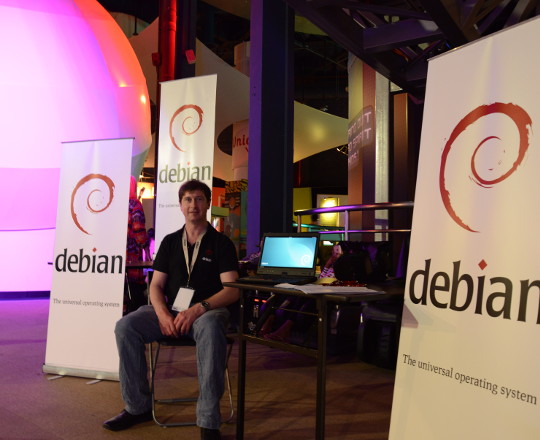
FOSSASIA 2016 is now under way. The Debian, Red Hat and Ring (Savoir-Faire Linux) teams are situated beside each other in the exhibit area. Thanks to Hong Phuc from the FOSSASIA team for helping us produce these new Debian banners Google Summer of Code 2016 If you are keen to participate in GSoC 2016, please feel free to come and discuss it with me in person or attend any of my sessions at FOSSASIA this weekend. Please also see my blog about getting selected for GSoC, attending a community event like FOSSASIA is a great way to distinguish yourself from the many applications we receive each year. (Debian Outreach / GSoC information). Real-time communications, WebRTC and mobile VoIP at FOSSASIA There are a number of events involving real-time communications technology throughout FOSSASIA 2016, please come and join us at these:
Event Time
Hands-on workshop with WebRTC and mobile VoIP (1 hr) Saturday, 14:30
Talk: Free Communications with Free Software (20 min) Saturday, 17:40
Ring: a decentralized and secure communication platform Sunday, 13:00
and the full program details, including locations, are in the schedule.

17 March 2016

Enrico Zini: Enhanced xkcd password generator

gpw and xkcdpass have entered testing. How about putting them together?
#!/usr/bin/python3
import subprocess
import random
import re
re_spaces = re.compile(r"\s+")
def get_words(cmd):
    out = subprocess.check_output(cmd, universal_newlines=True)
    return (x for x in re_spaces.split(out) if x)
words = set()
words.update(get_words(["xkcdpass", "-c", "10"]))
for l in range(6, 9):
    words.update(get_words(["gpw", "10", str(l)]))
for i in range(7):
    print(" ".join(random.sample(words, 5)))
Let's check the results:
#!/usr/bin/python
from __future__ import print_function
from zxcvbn import password_strength
import sys
for line in sys.stdin:
    pw = line.strip()
    info = password_strength(pw)
    print(" pw :  crack_time_display   entropy ".format(pw=pw, **info))
$ xkcdpass -n 5 -c 7   ./checkpass
moribund fasten cologne enamor by-and-by: centuries 132.586
woolen leptonic pogrom roster Serra: centuries 127.145
shorthand Piman suctional elution unholy: centuries 119.809
Blackwell mauvish covey selenium finished: centuries 112.936
asthma bloat crenulate clean-cut cytoplasm: centuries 150.181
agreeable refined racism Captain Cyrenaic: centuries 104.28
Bothnia stagnant atomist these revise: centuries 97.91
$ gpw 7   ./checkpass
ncenspri: 11.0 days 33.903
orsterma: instant 19.54
entsssel: 14.0 hours 29.788
tempispi: instant 20.058
nidgersi: 14.0 hours 29.725
oligalin: 51.0 minutes 25.824
iseartio: 10.0 minutes 23.207
$ ./metapass   ./checkpass
herups icirop overdub oldster cingsape: centuries 147.265
mujahidin usufruct rition porky prignam: centuries 153.684
cannula irenics tableaux ntshed calcific: centuries 152.196
stopgap stale orthente Amazonia sharer: centuries 113.474
edudives mmingsso eremab prignam tableaux: centuries 147.354
tingei heroism Nathaniel cannula molasses: centuries 103.007
Torres blood lewdness prignam eremab: centuries 118.475
The strength, according to zxcvbn, seems only marginally better, and it's a wonderful way to grow a vocabulary of nonexisting words that can be dropped into cheap talk conversation to confuse the innocents.

Patrick Matth i: Debian Jessie 8.3: Short howto for Corosync+Pacemaker Active/Passive Cluster with two nodes and DRBD/LVM

Hello, since I had to change my old heartbeat v1 setup to an more modern Corosync+Pacemaker setup, because heartbeat v1 does not support systemd (it first looks like it is working, but it fails on service start/stops), I want to share a simple setup: First you have to activate the jessie-backports repository, because the cluster stack is not available/broken in Debian Jessie. Install the required packages with:
apt-get install -t jessie-backports libqb0 fence-agents pacemaker corosync pacemaker-cli-utils crmsh drbd-utils
After that configure your DRBD and LVM (VG+LV) on it (there are enough tutorials for it). Then deploy this configuration to /etc/corosync/corosync.conf:
totem
version: 2
token: 3000
token_retransmits_before_loss_const: 10
clear_node_high_bit: yes
crypto_cipher: none
crypto_hash: none
transport: udpu
interface
ringnumber: 0
bindnetaddr: 192.168.99.0

logging
to_logfile: yes
logfile: /var/log/corosync/corosync.log
debug: off
timestamp: on
logger_subsys
subsys: QUORUM
debug: off

quorum
provider: corosync_votequorum
two_node: 1
wait_for_all: 1
nodelist
node
ring0_addr: node1-1

node
ring0_addr: node1-2

Both nodes require a passwordless keypair, which is copied to the another node, so that you can ssh from one to each other. Then you can start with crm configure:
property stonith-enabled=no
property no-quorum-policy=ignore
property default-resource-stickiness=100 primitive DRBD_r0 ocf:linbit:drbd params drbd_resource= r0 op start interval= 0 timeout= 240 \
op stop interval= 0 timeout= 100 \
op monitor role=Master interval=59s timeout=30s \
op monitor role=Slave interval=60s timeout=30s
primitive LVM_r0 ocf:heartbeat:LVM params volgrpname= data1 op monitor interval= 30s
primitive SRV_MOUNT_1 ocf:heartbeat:Filesystem params device= /dev/mapper/data1-lv1 directory= /srv/storage fstype= ext4 options= noatime,nodiratime,nobarrier op monitor interval= 40s primitive IP-rsc ocf:heartbeat:IPaddr2 params ip= 123.123.123.123 nic= eth0 cidr_netmask= 24 meta migration-threshold=2 op monitor interval=20 timeout=60 on-fail=restart
primitive IPInt-rsc ocf:heartbeat:IPaddr2 params ip= 192.168.99.4 nic= eth1 cidr_netmask= 24 meta migration-threshold=2 op monitor interval=20 timeout=60 on-fail=restart primitive MariaDB-rsc lsb:mysql meta migration-threshold=2 op monitor interval=20 timeout=60 on-fail=restart
primitive Redis-rsc lsb:redis-server meta migration-threshold=2 op monitor interval=20 timeout=60 on-fail=restart
primitive Memcached-rsc lsb:memcached meta migration-threshold=2 op monitor interval=20 timeout=60 on-fail=restart
primitive PHPFPM-rsc lsb:php5-fpm meta migration-threshold=2 op monitor interval=20 timeout=60 on-fail=restart
primitive Apache2-rsc lsb:apache2 meta migration-threshold=2 op monitor interval=20 timeout=60 on-fail=restart
primitive Nginx-rsc lsb:nginx meta migration-threshold=2 op monitor interval=20 timeout=60 on-fail=restart group APCLUSTER LVM_r0 SRV_MOUNT_1 IP-rsc IPInt-rsc MariaDB-rsc Redis-rsc Memcached-rsc PHPFPM-rsc Apache2-rsc Nginx-rsc
ms ms_DRBD_APCLUSTER DRBD_r0 meta master-max= 1 master-node-max= 1 clone-max= 2 clone-node-max= 1 notify= true colocation APCLUSTER_on_DRBD_r0 inf: APCLUSTER ms_DRBD_APCLUSTER:Master
order APCLUSTER_after_DRBD_r0 inf: ms_DRBD_APCLUSTER:promote APCLUSTER:start commit
The last (bold marked) lines made me some headache. In short they define that the DRBD device on the active node has to be the primary one and that it is required to start the APCLUSTER on the host, since the LVM, filesystem and services require to access its data. Just a short copy paste howto for an simple use case with not so much deep explanaitions..

16 March 2016

Enrico Zini: Postprocessing files saved by vim

Processing vim buffers through an external program on save, is a technique that is probably in use, and that I have not found documented anywhere, so here we go. Skip to the details for the entertaining example. I wanted to integrate egt with TaskWarrior so that every time I am editing an egt project file in vim, if I write a line in a certain way then a new taskwarrior task is created. Also, I have never written a vim plugin, and I don't want to dive into another rabbit hole just yet. Lynoure brought to my attention that taskwiki processes things when the file is saved, so I thought that I can probably get a long way by piping the file from vim into egt and reading it back before saving. I created a new egt annotate command that reads a project file, tweaks it, and then prints it out; I opened a project file in vim; I typed :%!egt annotate %:p --stdin and saw that it could be done. I find the result quite fun: I type 15 March: 18:00-21:00 in a log in egt, save the file, and it becomes 15 March: 18:00-21:00 3h. I do something in TaskWarrior, save the file in egt, and the lines that are TaskWarrior tasks update with the new task states. Details Here's a step by step example of how to hook into vim in this way. First thing, create a filter script that processes text files in some way. Let's call this /usr/local/bin/pyvimshell:
#!/usr/bin/python3
import sys
import subprocess
for line in sys.stdin:
    print(line.rstrip(), file=sys.stdout)
line = line.strip()
if line == "$":
    pass
elif line.startswith("$"):
    out = subprocess.check_output(["sh", "-c", line[1:].strip()], universal_newlines=True)
    sys.stdout.write(out)
    if not out.endswith("\n"):
        sys.stdout.write("\n")
    print("$ ", file=sys.stdout)
Then let's create a new filetype in ~/.vim/filetype.vim for our special magic text files:
if exists("did_load_filetypes")
  finish
endif
augroup filetypedetect
  au! BufNewFile,BufRead *.term setf SillyShell
augroup END
If you create a file example.term, open it in vim and type :set ft it should say SillyShell. Finally, the hook in ~/.vim/after/ftplugin/SillyShell.vim:
function! SillyShellRun()
    :%!/home/enrico/dev/egt/pyvimshell
    :$
endfunction
autocmd BufWritePre,FileWritePre <buffer> :silent call SillyShellRun()
Now you can create a file example.term, open it in vim, type $ ls, save it, and suddenly you have a terminal with infinite scrollback. For egt, I actually want to preserve my cursor position across saves, and egt also needs to know the path to the project file, so here is the egt version of the hook:
function! EgtAnnotate()
    let l:cur_pos = getpos(".")
    :%!egt annotate --stdin %:p
    call setpos(".", l:cur_pos)
endfunction
autocmd BufWritePre,FileWritePre <buffer> :silent call EgtAnnotate()
I find this adorably dangerous. Have fun.

Dirk Eddelbuettel: Rblpapi 0.3.3

A new release of Rblpapi is now on CRAN. It provides a direct interface between R and the Bloomberg Terminal via the C++ API provided by Bloomberg Labs (but note that a valid Bloomberg license and installation is required). This marks the fourth release since the package first appeared on CRAN last year. Thanks to multiple contributors, it packs a number of changes (including two new functions bsrch() and fieldInfo()), numerous internal as well as build improvements, additional documentation and last but not least use of unit testing (provided a Bloomberg connection is available, ie not at CRAN or on Travis CI). See the NEWS.Rd extract for more details:
Changes in Rblpapi version 0.3.3 (2016-03-14)
  • configure adds a missing method="libcurl" options (PR #109 by Martin Bel).
  • New function bsrch() adds basic search functionality (PR #111 by Morgan Williams fixing ticket #82).
  • The licensing status of the Rblpapi source package was clarified (PR #119).
  • The bds() help page now shows an example using an overrides argument (PR #121).
  • A new function fieldInfo was added, and field information is used in bdh and bdp (PRs #122, #123, #125, and #127).
  • The bdp function now checks the order (PR #126).
  • Unit testing was added (PRs #129 and #131).
  • Data retrieval is now smarter about the types returned from Bloomberg (PR #132 and #133; and #141 and #142).
  • The bdh and bds functions now support an option verbose (PRs #138).
Courtesy of CRANberries, there is also a diffstat report for the this release. As always, more detailed information is on the Rblpapi page. Questions, comments etc should go to the issue tickets system at the GitHub repo.

This post by Dirk Eddelbuettel originated on his Thinking inside the box blog. Please report excessive re-aggregation in third-party for-profit settings.

15 March 2016

Joerg Jaspert: Removing checksums

And as just announced on d-d-a, I m trying to break all the tools dealing with the (Debian) archive. Or something like it. But its about time to get rid of MD5Sum checksums, and SHA1 can go with it directly. As it is only in experimental for now, we can test and see what still breaks. I hope it won t be too much, so we can get it over all the archive (minus the stable stuff, of course). For some reason, what I like most in this change is the following python code that ended up in our InRelease file generation tool:
import apt_pkg
# Note: suite.checksums being an array with possible values of md5sum, sha1, sha256
hashfuncs = dict(zip([x.upper().replace('UM', 'um') for x in suite.checksums],
                      [getattr(apt_pkg, "%s" % (x)) for x in [x.replace("sum", "") + "sum" for x in suite.checksums]]))
Though I m sure this can be done in much more readable ways, it s doing what we need, but heck, took me a while to get it. But probably the change to get rid of gzip will be much more challenging / hard to get through. Lets see, in the few minutes after my mail, I already got some notices about possible breakage here. Fortunately those indices and the release file stuff are nicely seperated settings, so if it turns out we only take the checksums drop for now into the other suites, thats doable.

14 March 2016

Julian Andres Klode: Dropping SHA-1 support in APT

Tomorrow is the anniversary of Caesar s assassination APT will see a new release, turning of support for SHA-1 checksums in Debian unstable and in Ubuntu xenial, the upcoming LTS release. While I have no knowledge of an imminent attack on our use of SHA1, Xenial (Ubuntu 16.04 LTS) will be supported for 5 years, and the landscape may change a lot in the next 5 years. As disabling the SHA1 support requires a bit of patching in our test suite, it s best to do that now rather than later when we re forced to do it. This will mean that starting tomorrow, some third party repositories may stop working, such as the one for the web browser I am writing this with. Debian Derivatives should be mostly safe for that change, if they are registered in the Consensus, as that has checks for that. This is a bit unfortunate, but we have no real choice: Technical restrictions prevent us from just showing a warning in a sensible way. There is one caveat, however: GPG signatures may still use SHA1. While I have prepared the needed code to reject SHA1-based signatures in APT, a lot of third party repositories still ship Release files signed with signatures using SHA-1 as the digest algorithms. Some repositories even still use 1024-bit DSA keys. I plan to enforce SHA2 for GPG signatures some time after the release of xenial, and definitely for Ubuntu 16.10, so around June-August (possibly during DebConf). For xenial, I plan to have a SRU (stable release update) in January to do the same (it s just adding one member to an array). This should give 3rd party providers a reasonable time frame to migrate to a new digest algorithm for their GPG config and possibly a new repository key. Summary
Filed under: Debian, Ubuntu

13 March 2016

Vincent Sanders: I changed my mind, Erase and rewind

My recent rack design turned out to simply not be practical. It did not hold all the SBC I needed it to and most troubling accessing connectors was impractical. I was forced to remove the enclosure from the rack and go back to piles of SBC on a shelf.

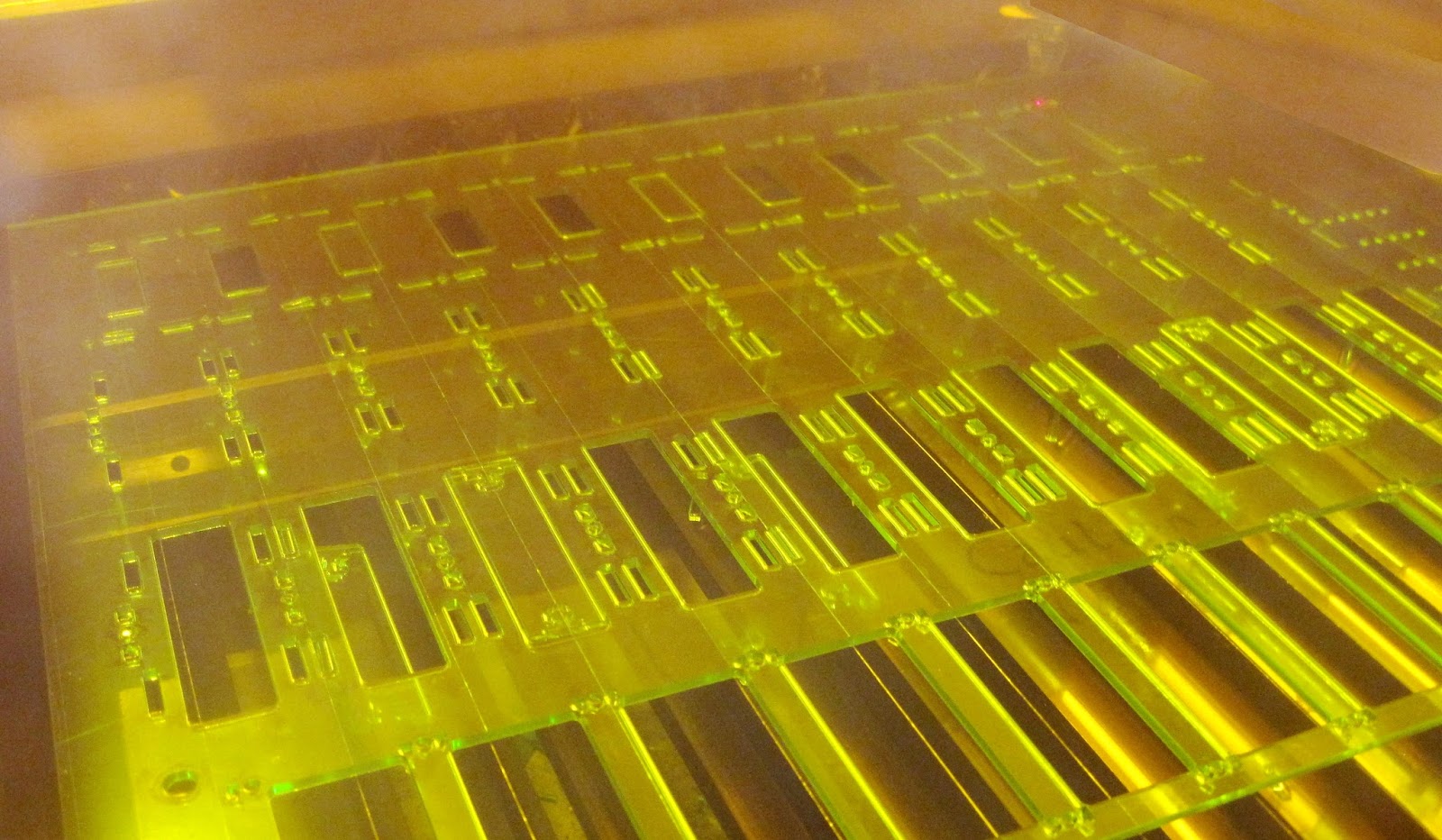
View of the acrylic being laser cut through the heavily tinted window
This sent me back to the beginning of the design process. The requirement for easy access to connectors had been compromised on in my first solution because I wanted a compact 1U size. This time I returned to my initial toast rack layout but retaining the SBC inside their clip cases.

By facing the connectors downwards and providing basic cable management the design should be much more practical.

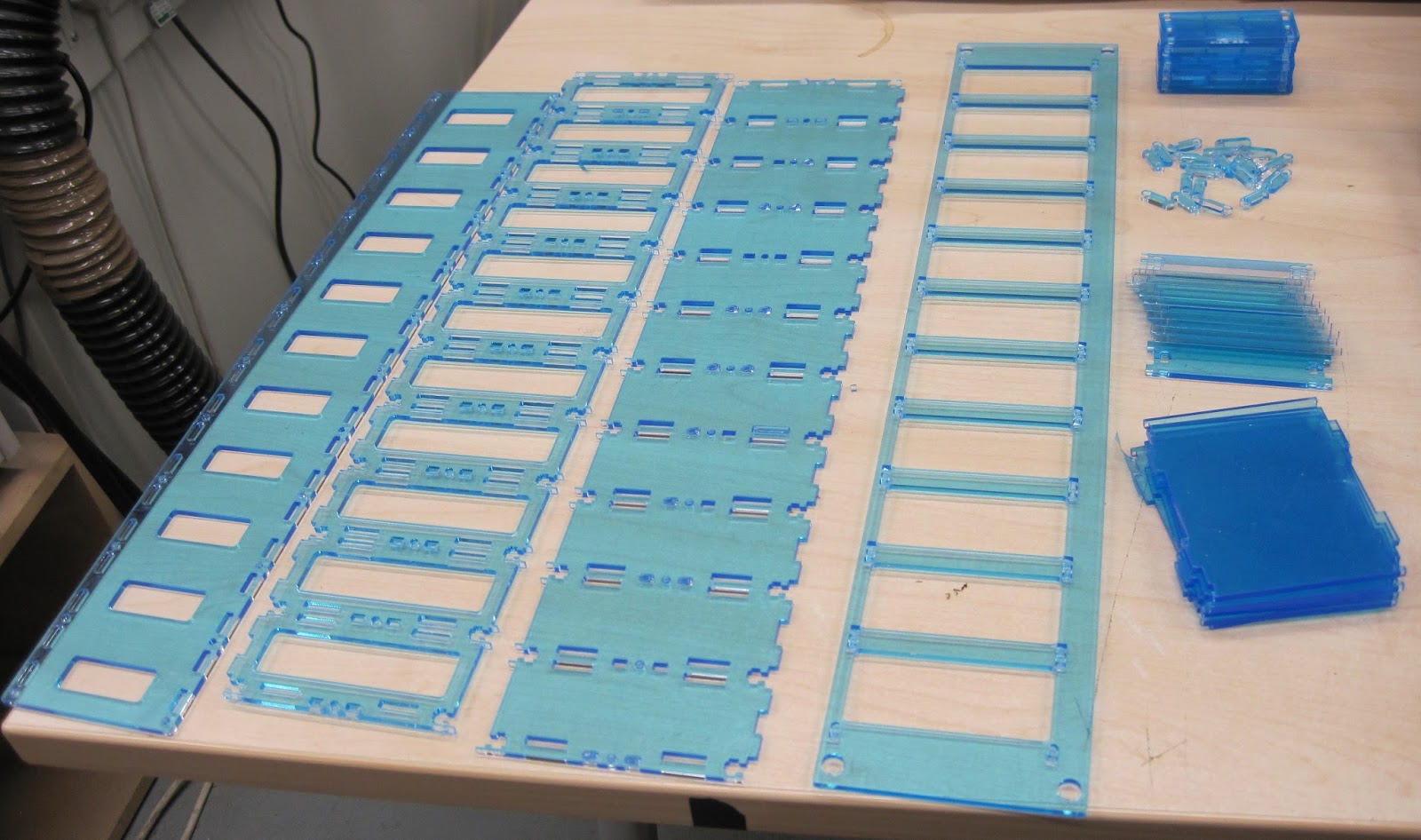
My design process is to use the QCAD package to create layered 2D outlines which are then converted from DXF into toolpaths with Lasercut CAM software. The toolpaths are then uploaded to the laser cutter directly from the PC running Lasercut.

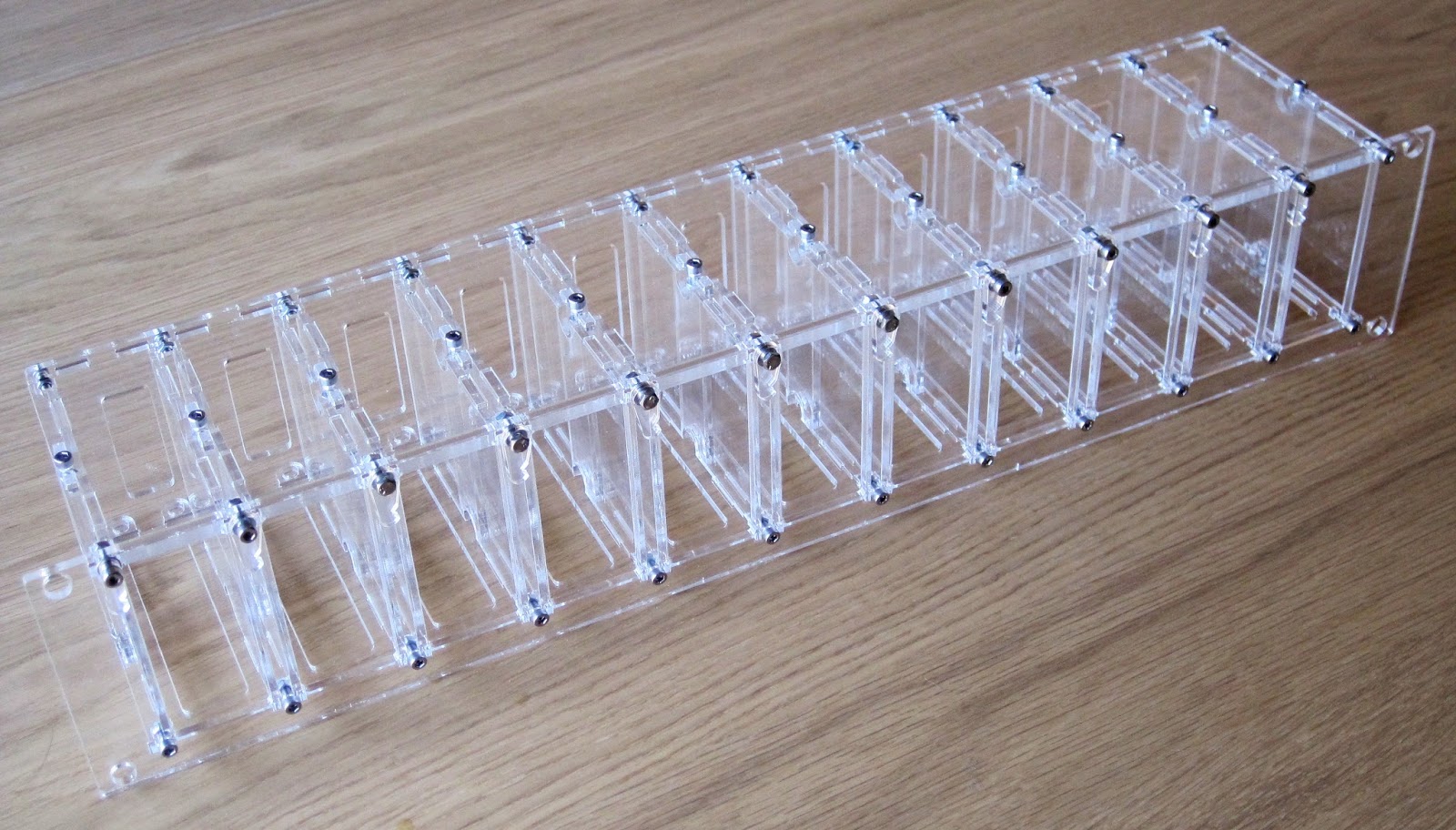
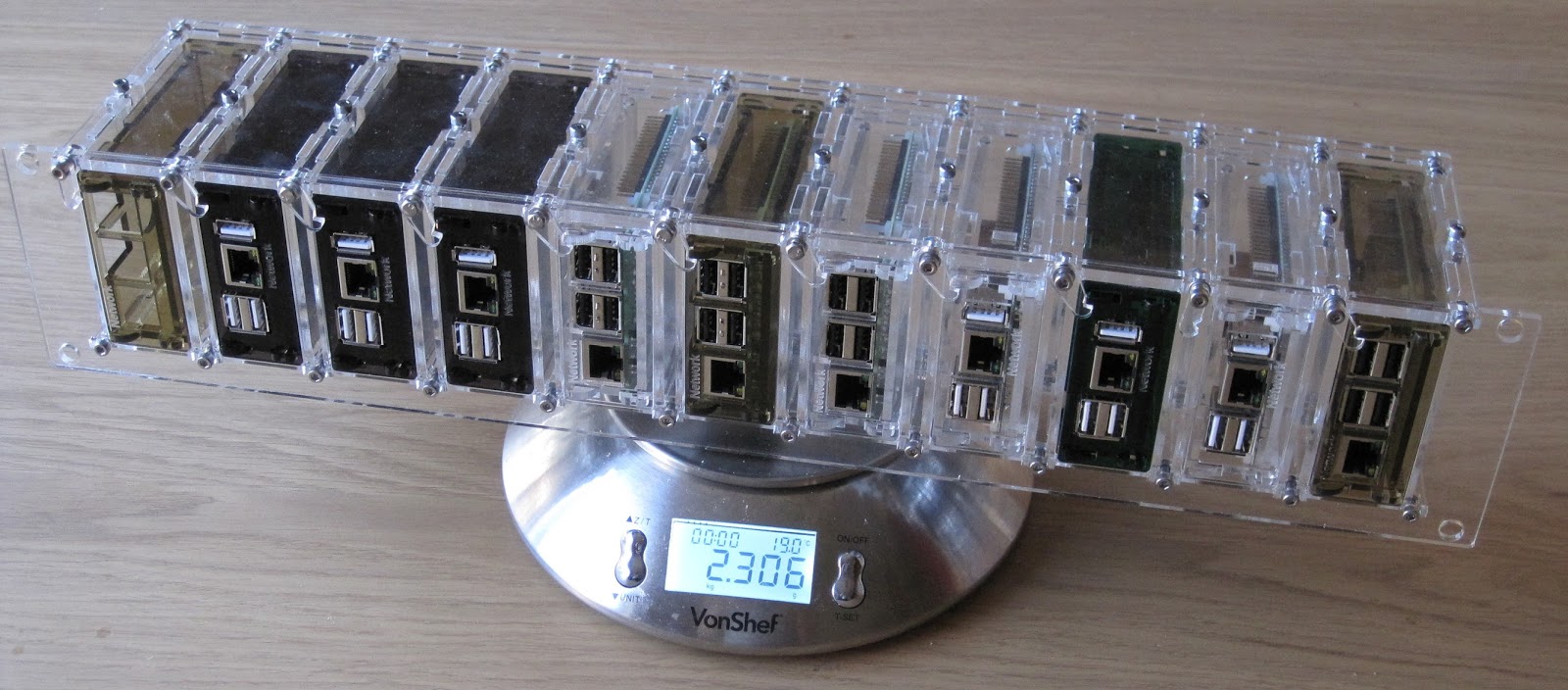
Assembled sub rack enclosureDespite the laser cutters being professional grade systems the Lasercut software is a continuous cause of issues for many users, it is the only closed source piece of software in the production process and it has a pretty poor user interface. On this occasion my main issue with it was my design was quite large at 700mm by 400mm which caused the software to crash repeatedly. I broke the design down into two halves and this allowed me to continue.

Once I defeated the software the design was laser cut from 3mm clear extruded acrylic. The assembled is secured with 72 off M3 nuts and bolts. The resulting construction is very strong and probably contains much more material than necessary.

One interesting thing I discovered is that in going from a 1U enclosure holding 5 units to a 2U design holding 11 units I had increased the final weight from 320g to 980g and when all 11 SBC are installed that goes up to a whopping 2300g. Fortunately this is within the mechanical capabilities of the material but it is the heaviest thing I have ever constructed from 3mm acrylic.

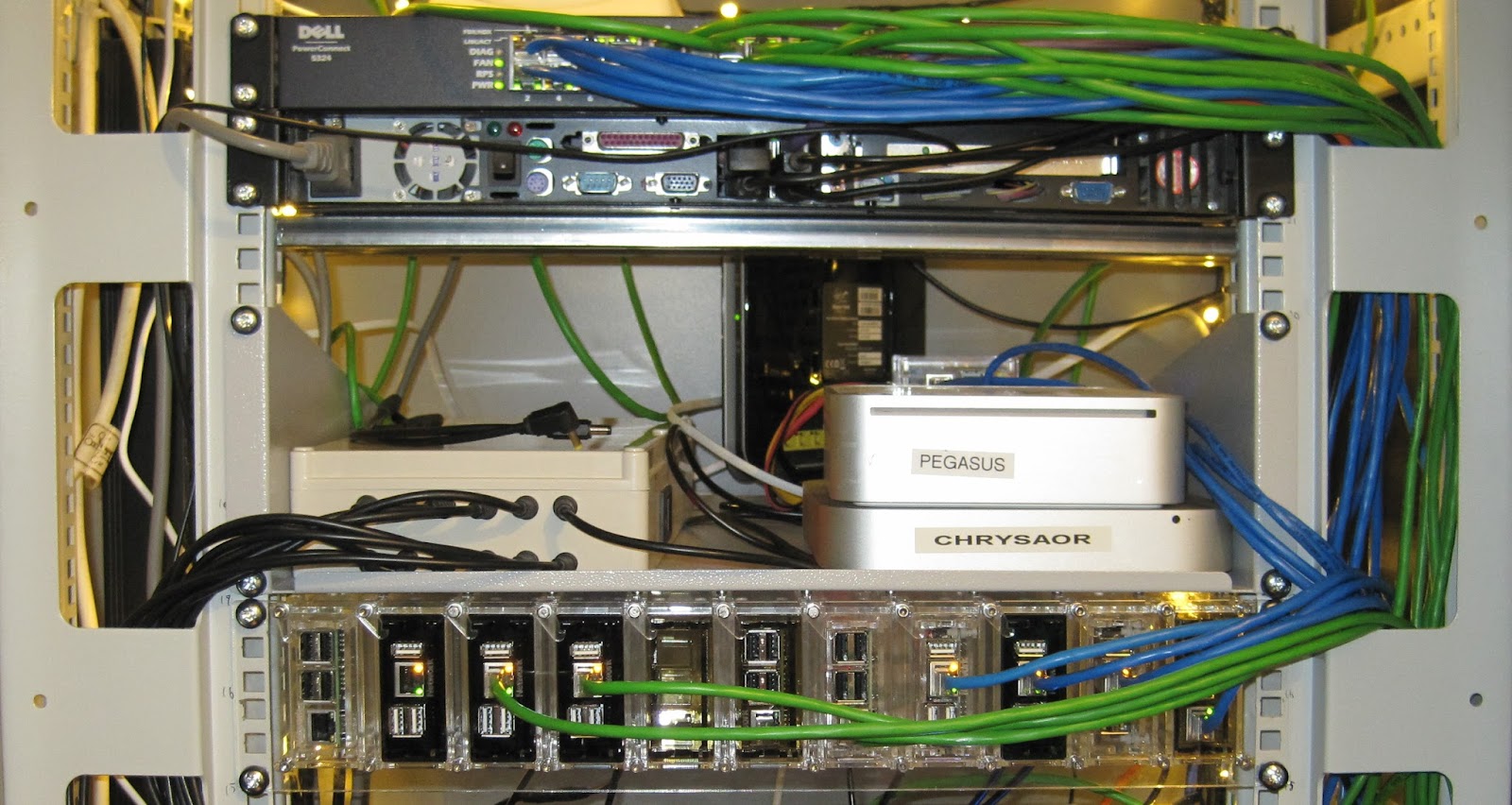
bolted into the rack and operatingOnce installed in the rack with all SBC inserted and connected this finally actually works and provides a practical solution. The self is finally clear of SBC and has enough space for all the other systems I need to accommodate for various projects.

As usual the design files are all freely available though I really cannot see anyone else needing to replicate this.

Antoine Beaupr : State of Mapping on the Debian Desktop

TL;DR: Mapbox Studio classic is not as good as Tilemill, Mapbox studio is very promising, but you still need to signup for access, and kosmtik seems to be working right now. Use kosmtik and help getting it in Debian.

The requirement I have been following the development of fascinating tools from the Development seed people, now seemingly all focused on the Mapbox brand. They created what seemed to me a revolutionary desktop tool called Tilemill. Tilemill allowed you to create custom map stylesheets on your desktop to outline specific areas or patterns or "things". My interest was to create outdoor maps - OSM has pretty good biking maps, but no generic outdoor tiles out there (I need stuff for skiing, canoeing, biking)... Mapbox has Mapbox outdoors but that's a paid plan as well. Oh and there's a place to download Garmin data files especially made for outdoors as well, and that could be loaded in Qmapshack, but they don't have coverage in Canada at all. Besides, I would like to print maps, I know, crazy... So I have been looking forward to seeing Tilemill packaged in Debian given how annoying it is to maintain Node apps (period). Unfortunately, by the time Debian people figured out all the Node dependencies, the Tilemill project stopped and has been stalled since 2012. It seems the Mapbox people have now been working on other products, and in the meantime, the community, scratching their heads, just switched to other projects.

Overview of alternatives I wrote this long post to the Debian bugtrackers to try to untangle all of this, but figured this would be interesting to a wider community than the narrow group of people working on Javascript packages, so I figured I would send this on Debian planet. So Here's a summary of what happened so far, after Tilemill development stopped. Hang on to your tiles boys and girls, there's a lot going on!

Mapbox Studio classic Mapbox people have released a new product in September 2014 named Mapbox studio classic. The code is still freely available and seems to be a fork of tilemill. Mapbox classic still has releases on github, last one is from November 2015. It looks like Mapbox studio classic has some sort of Mapbox.com lock-in, and there are certainly new copyright issues, if only with the bundled fonts, but it could probably be packaged after addressing those issues. There is an ITP for Mapbox Studio classic as well.

Mapbox Studio Then there's Mapbox Studio, which is a full rewrite of Mapbox Studio classic. You need to "signup" somehow to get access, even though parts of the code are free, namely the Mapbox GL studio project. It is an interesting project because it aims to make all this stuff happen in a web browser, which means it "should" work everywhere. Unfortunately for us, it means it doesn't work anywhere without a signup form, so that's out for me at least. There is an [ITP for Mapbox-studio][] yet it is unclear to me what that one means because the source code to Mapbox-studio doesn't seem to be available, as far as i can tell (and the ITP doesn't say either). That is actually the ITP for Mapbox studio classic.

Kosmtik The Openstreetmap-carto developers have mostly switched to kosmtik instead of Mapbox. Kosmtik is another Node desktop app that seems fairly lightweight and mostly based on plugins. Ross has an ITP for kosmtik. The package is waiting on other node dependencies to be uploaded (yes, again).

The future of Tilemill And there's still this RFP for tilemill, which should probably be closed now because the project seems dead and plenty of alternatives exist. I wonder if node some dependencies that were packaged for Tilemill actually now need to be removed from Debian, because they have become useless leaf packages... I am leaving the Tilemill RFP open for someone to clean that up.

CartoCSS Oh, and finally one could mention another Mapbox project, Carto, a command line CSS tools that implements some sort of standard CSS language that all those tools end up using to talk to Mapnik, more or less. There are no RFPs for that.

Ingo Juergensmann: Letsencrypt: challenging challenges solved

A few weeks ago I was wondering in Letsencrypt: challenging challenges about how to setup Letsencrypt when a domain is spread across several virtual machines (VM). One of the possible solutions would be to consolidate everything on one single VM, which is nothing I would like to do. The second option would need to generate the Letsencrypt certs on the webserver and copy over the certs to the appropriate VM on a regular basis or event driven. The third option is to use a network share - and this is what I'm using right now. So, my setup is as following after I solved the GlusterFS issue with rpcbind binding to all interfaces, although it has been configured to only listen to certain interfaces (solution was: simply remove all NFS related stuff): On Dom0 (or the host machine) I run GlusterFS as a server on a small 1 GB LVM as part of a replicate with the VM that will do the actual Letsencrypt work:
Volume Name: le
Type: Replicate
Status: Started
Number of Bricks: 1 x 2 = 2
Transport-type: tcp
Bricks:
Brick1: 192.168.x.254:/srv/gfs/le
Brick2: 192.168.x.1:/srv/gfs/le
This is to ensure that on reboot of the machine every other VM using Letsencrypt certs can mount the GlusterFS share, because the host machine will be there for sure whereas the other VM generating the certs with the letsencrypt.sh script might still be booting. And when the GlusterFS share is missing services will not start on the other VMs because of the missing certs, of course. So, the replica on the virtualization host (Dom0) is only acting as some kind of always-being-available network share, because, well, the other VM will not always be there... for example during a kernel update when a reboot is required. The same setup is on my mailserver, acting as the second GlusterFS brick of that replica drive. The mailserver hosts the bind9 nameserver as well and I might do something that new domains with Letsencrypt certs get added to my DNSSEC setup as well. Of course, when the letsencrypt.sh script creates or updates the certs, it needs the certs being mounted in that configured location, so I needed to add a line to /etc/fstab:
192.168.x.254:/le /etc/letsencrypt.sh/certs glusterfs noexec,nodev,_netdev 0 0
Basically the same needs to be done on the other VMs where you want to use the certs as well, but you may want to mount the share as read-only there. The next step was a little more tricky. When letsencrypt.sh generates new certs, Letsencrypt will contact the webserver for that domain to respond to the ACME challenge. This requires that on each VM you want to use letsencrypt you have to run a webserver. Well, actually at least that there is somewhere a webserver that can answer these requests for that specific domain... Now, the setup of the webserver (Apache in my case) is like this: I'm using the Apache macro module to make it more easy, so I generated two small configs in /etc/apache/conf-available and enabled them bei a2enconf: letsencrypt-proxy.conf to do some setup for proxying the ACME challenges to a common website called acme.example.org. And then letsencrypt-sslredir.conf to setup SSL redirection when everything is in place and the domain can be switched over to HTTPS-only. letsencrypt-proxy.conf:
<Macro le_proxy>
ProxyRequests Off
<Proxy *>
Order deny,allow
Allow from all
</Proxy>
ProxyPass /.well-known/acme-challenge/ http://acme.windfluechter.net/
ProxyPassReverse / http://% HTTP_HOST /.well-known/acme-challenge/
</Macro>
letsencrypt-sslredir.conf:
<Macro le_sslredir>
RewriteEngine on
RewriteCond % HTTPS !=on
RewriteRule . https://% HTTP_HOST % REQUEST_URI [L]
</Macro>
So, after all the setup of a virtual host for Apache looks like this:
<Macro example.org>
(lots of setup stuff)
</Macro>
<VirtualHost 31.172.31.x:443 [2a01:a700:4629:x::1]:443>
Header always set Strict-Transport-Security "max-age=31556926; includeSubDomains"
SSLEngine on
# letsencrypt certs:
SSLCertificateFile /etc/letsencrypt.sh/certs/example.org/fullchain.pem
SSLCertificateKeyFile /etc/letsencrypt.sh/certs/example.org/privkey.pem
SSLHonorCipherOrder On
Use example.org
Use le_proxy
</VirtualHost>
<VirtualHost 31.172.31.x:80 [2a01:a700:4629:x::1]:80>
Use example.org
Use le_proxy
Use le_sslredir
</VirtualHost>
le_sslredir is only needed when you are sure that you want all traffic being redirected to HTTPS. For example when your blog is listed on planet.debian.org or other Planets you might want to omit this from your HTTP config because bug #813313 is not yet solved. In the end, when creating a new Letsencrypt cert, you need to add the le_proxy macro to your website, add the domain to letsencrypt.sh config in /etc/letsencrypt.sh/domains.txt and then the scripts will request a new cert from Letsencrypt, handling the ACME challenge stuff via the URL redirection in le_proxy being redirected to your acme.exmaple.org site and finally writes your new cert to the GlusterFS share. From that share you can then use the new cert on all needed VMs, be it your mailserver, webserver or XMPP/SIP server VMs. At least this works for me.
Kategorie:

12 March 2016

Daniel Pocock: Google Summer of Code opportunities for ham radio and SDR

I've started preparing some ideas for Google Summer of Code projects I'd be willing to help mentor this year and one of them is for ham radio, with a focus on software defined radio (SDR). Can you help? If you can help as a co-mentor or simply help refer students for this project please get in touch with me. Ander the terms of the program students are paid a $US 5,500 stipend by Google and source code is fully published under a genuine free software license . Details about the project and how students can apply Students applying for this project are invited to submit two applications, one under the GNU Radio project and another under the Debian Project. The aim of this project is to make ready-to-run solutions for ham radio enthusiasts. The typical use case is a ham who has a spare computer in his shack, he should be able to boot the computer from DVD or USB stick using the Debian Ham Radio Live Blend or the GNU Radio Live SDR and have a functional transceiver within a few minutes. A student may not be able to do everything required for this project in one summer. We are looking for a student who can make any incremental improvement to bring us closer to this goal. Here are some of the tasks that may be involved:
  • survey the existing GNU Radio samples for ham radio, many are listed on the HamRadio page of the GNU Radio wiki.
  • design user interface improvements for the samples to make them more intuitive to new users and traditional radio operators. Consider how they can interact with Hardware such as a VFO tuning knob, PTT microphone switch and even a morse key.
  • look through the other packages in the Debian Ham Radio metapackage list and consider how they could interact with GNU Radio. In particular, we are interested in the use of message bus solutions, such as ZeroMQ or D-Bus - for example, GNU Radio could send alerts on the bus when incoming signals exceed the squelch threshold. GNU Radio could also receive events over a message bus, for example, patching GPredict to send Doppler shift information.
  • developing and packaging libraries needed to process digital voice transmissions
  • look at how one or more of the samples can be deployed as a Debian package so users can just install the package and have a working radio
Prerequisites The following experience is highly desirable:
  • ham radio license
  • GNU/Linux skills (Debian or Ubuntu or another distribution like Fedora)
  • use of version control systems (Git)
  • C++ or Python or both
Mentor(s)
  • Daniel Pocock (VK3TQR/M0GLR/HB9FZT)
Application process To apply
  • please introduce yourself on both the GNU Radio mailing list and the Debian Hams mailing list
  • Fill in the formal application for both GNU Radio and Debian
  • Pick some items from the list above or feel free to suggest another piece of work relevant to this theme. Give us a detailed, week-by-week plan for completing the task over the summer.
  • find at least one other member of the GNU Radio or Debian community who is willing to be a co-mentor on the project. Please try communicating with us over IRC or email and give us examples of your existing work on Github or elsewhere.

Bits from Debian: Debian is looking for three interns in the Outreachy Program

Outreachy logo As part of its diversity outreach initiatives, Debian will be participating in the upcoming 12th round (May - August 2016) of Outreachy, an internship program open worldwide to women (cis and trans), trans men and genderqueer people, as well as nationals and residents of the United States of any gender who are Black/African American, Hispanic/Latin@, American Indian, Alaska Native, Native Hawaiian, or Pacific Islander. Thanks to the generosity of our donors, and specifically of our sponsor Intel who has given us funds specifically for one intern, Debian will be able to welcome three interns this round. Applications for the program are open until March 22nd, so don't wait up! Debian has a lot of interesting internship opportunities this year. More info about the program is available on the Debian specific program page, as well as on the official website. Feel free to contact the outreach team and mentors on our mailing list or IRC channel #debian-soc in irc.oftc.net If you want Debian to keep participating in such programs, and expand its outreach efforts, you can donate to one of the organizations supporting the Debian project, or volunteer some time by participating in discussions on our mailing list.

Lars Wirzenius: Not-platform for Debian project leader elections 2016

After some serious thinking, I've decided not to nominate myself in the Debian project leader elections for 2016. While I was doing that, I wrote the beginnings of a platform, below. I'm publishing it to have a record of what I was thinking, in case I change my mind in the future, and perhaps it can inspire other other people to do something I would like to happen. Why not run? I don't think I want to deal with the stress. I already have more than enough stress in my life, from work. I enjoy my obscurity in Debian. It allows me to go away for long periods of time, and to ignore any discussions, topics, and people that annoy or frustrate me, if I don't happen to want to tackle them at any one time. I couldn't do that if I was DPL. NOT a platform for Debian project leader election, 2016 Apart from what the Debian constitution formally specifies, I find that the important duties of the Debian project leader are: I do not feel it is the job of the DPL to set goals for the project, technical or otherwise, any more than any other member of the project. Such goals tend to best come from enthusiastic individual developer who want something and are willing to work on it. The DPL should enable such developers, and make sure they have what they need to do the work. My plan, if elected
  1. Keep Debian running. Debian can run for a long time effectively on autopilot, even if the DPL vanishes, but not indefinitely. At minimum, the DPL should delegate the secretary and technical committee members, and decide on how money should be spent. I will make sure this minimum level is achieved.
  2. While I have no technical goals to set for the project, I have an organisational one. I believe it is time for the project to form a social committee whose mandate is to step in and help resolve conflicts in their early stages, before they grow big enough that the DPL, the tech-ctte, listmasters, or the DAM needs to involved. See below for more details on this. If I am elected, I will do my best to get a social committee started, and I will assume that any vote for me is also a vote for a social committee.
Social committee (Note: It's been suggested that this is a silly name, but I haven't had time to come up with anything better. I already rejected "nanny patrol".) We are a big project now. Despite our reputation, we are a remarkably calm project, but there are still occasional conflicts, and some of them spill out into our big mailing lists. We are not very good, as a project, in handling such situations. It is not a new idea, but I think its time has come, and I propose that we form a new committee, a social committee, whose job is to help de-escalate conflict situations while they are still small conflicts, to avoid them growing into big problems, and to help resolve big conflicts if they still happen. This is something the DPL has always been doing. People write to the DPL to ask for mediation, or other help, when they can't resolve a situation by themselves. We also have the technical committee, listmasters, GRs, and the expulsion process defined by the DAM. These are mostly heavy-weight tools and by the time it's time to consider their use, it's already too late to find a good solution. Having the DPL do this alone puts too much pressure on one person. We've learnt that important tasks should generally be handled by teams rather than just one person. Thus, I would like us to have a social committee that: About me I've been a Debian developer since 1996. I've been retired twice, while I spent large amounts of time on other things. I haven't been a member of any important team in Debian, but I've been around long enough that I know many people, and have a reasonable understanding of how the projects works.

11 March 2016

Steinar H. Gunderson: Agon and the Candidates tournament

The situation where Agon (the designated organizer of the Chess World Championship, and also the Candidates tournament, the prequalifier to said WC) is trying to claim exclusive rights of the broadcasting of the moves (not just the video) is turning bizarre. First of all, they have readily acknowledged they have no basis in copyright to do so; chess moves, once played, are facts and cannot be limited. They try to jump through some hoops with a New York-specific doctrine (even though the Candidates, unlike the World Championship, is played in Moscow) about hot news , but their main weapon seems to be that they simply will throw out anyone from the hall who tries to report on the moves, and then try to give them only to those that promise not to give them on. This leads to the previously unheard-of situation where you need to register and accept their terms just to get to watch the games in your browser. You have to wonder what they will be doing about the World Championship, which is broadcast unencrypted on Norwegian television (previous editions also with no geoblock). Needless to say, this wasn't practically possible to hold together. All the big sites (like Chessdom, ChessBomb and Chess24) had coverage as if nothing had happened. Move sourcing is a bit of a murky business where nobody really wants to say where they get the moves from (although it's pretty clear that for many tournaments, the tournament organizers will simply come to one or more of the big players with an URL they can poll at will, containing the games in the standard PGN format), and this was no exception ChessBomb went to the unusual move of asking their viewers to download Tor and crowdsource the moves, while Chessdom and Chess24 appeared to do no such thing. In fact, unlike Chessdom and ChessBomb, Chess24 didn't seem to say a thing about the controversy, possibly because they now found themselves on the other side of the fence from Norway Chess 2015, where they themselves had exclusive rights to the PGN in a similar controversy although it would seem from a tweet that they were perfectly okay with people just re-broadcasting from their site if they paid for a (quite expensive) premium membership, and didn't come up with any similar legal acrobatics to try to scare other sites. However, their ToS were less clear on the issue, and they didn't respond to requests for clarification at the time, so I guess all of this just continues to be on some sort of gentleman's agreement among the bigger players. (ChessBomb also provides PGNs for premium members for the tournaments they serve, but they expressly prohibit rebroadcast. They claim that for the tournaments they host, which is a small minority, they provide free PGNs for all.) Agon, predictably, sent out angry letters where they threatened to sue the sites in question, although it's not clear at all to me what exactly they would sue for. Nobody seemed to care, except one entity TWIC, which normally has live PGNs from most tournaments, announced they would not be broadcasting from the Candidats tournament. This isn't that unexpected, as TWIC (which is pretty much a one-man project anyway) mainly is about archival, where they publish weekly dumps of all top-level games played that week. This didn't affect a lot of sites, though, as TWIC's live PGNs are often not what you'd want to base a top-caliber site on (they usually lack clock information, and moves are often delayed by half a minute or so). I run a hobby chess relay/analysis site myself (mainly focusing on the games of Magnus Carlsen), though, so I've used TWIC a fair bit in the past, and if I were to cover the Candidates tournament (I don't plan to do so, given Agon's behavior, although I plan to cover the World Championship itself), I might have been hit by this. So, that was the background. The strange part started when worldchess.com, Agon's broadcasting site, promptly went down during the first round of the Candidates tournament today Agon blamed DDoS, which I'm sure is true, but it's unclear exactly how strong the DDoS was, and if they did anything at all to deal with it other than to simply wait it out. But this lead to the crazy situation where the self-declared monopolist was the only big player not broadcasting the tournament in some form. And now, in the trully bizarre move, World Chess is publishing a detailed rebuttal of Agon's arguments, explaining how it is bad for chess, not juridically sound, and also morally wrong. Yes, you read that right; Agon's broadcast site is carrying an op-ed saying Agon is wrong. You at least have to give them credit for not trying to censor their columinst when he says something they don't agree with. Oh, and if you want those PGNs? I will, at least for the time being, be pushing them out live on http://pgn.sesse.net/. I have not gone into any agreement with Agon, and they're hosted in Norway, far from any New York-specific doctrines. So feel free to relay from them, although I would of course be happy to know if you do.

Alessio Treglia: We need creativity: which one?

A constant demand for creativity is raising from every corner of the Western world, from any business sector or professional activity, by individual or communities. This term is used everywhere, even in advertising to attract the attention of consumers: as a thirsty wanderer lost in the desert sand, the need for creativity seems to be the source of an oasis of salvation. albaJulien Ries anthropological research showed us that, already more than two million years ago, Homo Habilis looks like Symbolicus, with aesthetic sensibility, sense of symmetry and consciousness of creativity. Gilbert Durand confirms that the specific activity of man, the identity card of Homo Sapiens, is the symbolic activity, an essential part of his creativity. Then, man is creative at the moment when his first activates his imaginative feature. So we can ask ourselves, how did we miss the creativity of man, of which so much we feel the need, or at least where is it hiding now? But above all which kind of creativity are we talking about? <Read More >

Next.

Previous.