Search Results: "ema"

15 March 2011

David Welton: Coming Soon: Easy Kindle Publishing with LiberWriter.com

The Kindle isn't the most beautiful device out there - it's not "beautiful", the keyboard takes away some elegance, but I'm absolutely smitten with mine. I like to read, a lot, and being able to instantly beam books to my house is just fantastic. Kindles and other devices like them are also changing the world of publishing, going from the known world of physical books that can't be easily copied to another information good like movies or songs with something of an uncertain future. Yet they're also opening up many possibilities: thanks to Amazon's Kindle Direct Publishing program, it just got very easy to publish books to a platform that a lot of people regularly search for good things to read. Once upon a time, "vanity publishing" was something done by those who simply wanted to see their names in print, but couldn't actually find a publisher, and thus carried some stigma. Now, though, why not publish something you've always wanted to? Granted, without an editor, and publisher to promote your work, you probably won't become rich or famous, but many people write for the enjoyment of doing so. And who knows... there are already several cases of people publishing directly to the Kindle and making a decent income at it. Indeed, I have several things I'm thinking of writing about that clicked when I found the Kindle publishing program. Maybe now it's time to dust off some ideas I've had and start working on them a little bit at a time. Then, of course, my geeky side took over and I started wondering how the mechanics of it actually work. Messily, it turns out: the preferred format for Kindle authoring is variant of HTML that's not at all what we're used to in these days of ever more potent CSS. The good side of it is that books mostly come out looking the same on the Kindle, and the end user can control how they want to visualize them. The bad side of the system utilized is that there are a lot of tips and tricks and little things to know about the whole process that can be annoying even for someone who knows HTML pretty well. For someone who just wants to write stuff and not worry about it, and who perhaps is not very familiar with HTML, the whole thing can be a huge mess and very frustrating. Which of course looks like an interesting challenge. I set out to work on LiberWriter.com several weeks ago, and it should be ready within the next week or two. In short, it's a system that lets you concentrate on writing and, as much as possible, tries to get out of your way in order to let you concentrate on your content. It is also targeted very specifically at the Kindle (for the time being at least), so as to really focus on making things work on that platform. For instance, it can automatically generate a table of contents, a noted pain point in writing for the Kindle. I have a number of other ideas up my sleeve too, that I'm excited to work on. I'm also definitely abandoning the "let's release it for free, for fun, and see if I can find a way to make money later" model of many past projects, and treating it like a business. I think the price I have in mind is very competitive, if you look at, for instance, conversion services that take word and spit out Kindle-specific HTML. Anyway, have a look at the site and sign up if you're interested: as soon as it's ready, I'll email and let you know. There'll be a somewhat limited trial version so that you can play around with it and see if you like it before buying the full version.

Josselin Mouette: Copyright assignment is killing the free in free software

A few weeks ago, at work, we were looking for a solution to a tricky printing problem: how to manage, in a centralized infrastructure, a large number of locations, worstations and printers? One of the consultants working for us came up with a great idea. With only a 20-line patch to CUPS, workstations would be able to find which printers are on the same location. 20 lines of code, instead of a complex virtualisation solution? This is exactly the kind of reasons why we use free software: when there s something wrong, you can fix it. When you need something more, you can code it. Now, many others could benefit of such an improvement, and we don t want to maintain a forked version of CUPS, so we forwarded it upstream, who looked interested. But upstream now being Apple, they requested a stupid copyright assignment agreement. I will leave to the reader s imagination the complexity of getting such a document signed in a Fortune 500 company with no business with Apple. This will, of course, not happen - and if the decision was mine, the answer would have been a clear No. No, because I want to improve free software, not to contribute to Apple s proprietary version. No, because copyleft is about giving as much as you take. How many contributions are being left out of CUPS because of this stupid copyright assignment? It looks to me that such software is doomed to remain crippled as long as companies like Apple are in charge of their maintenance. There is free software. And there is free software by Apple. And Oracle. And Canonical.

Michal Čihař: phpMyAdmin translation status

Last weekend we've released phpMyAdmin 3.4.0-beta4, hopefully last beta and there are still lot of translations missing. The only new complete translation compared to last week is German, so we now have 13 translations at 100%: There are still lot of translations which would need some love, for example: I'm happy that not only translation status is improving, but some translators also reviewed older translations, so that it is more consistent. The great work in this area was done in Russian. And of course there is still great ongoing effort on Urdu translation. You can help make translation to your language better! If your language is missing just let me know (either in comments or by email).

Filed under: English Phpmyadmin 0 comments Flattr this!

14 March 2011

Axel Beckert: Planet Commandline officially online

Around the first bunch of postings in my Useful but Unknown Unix Tools, Tobias Klauser of inotail and Symlink fame came up with the idea of making a Planet (i.e. a blog aggregator) of all the comandline blogs and blog categories out there. A first Planet Venus running prototype based on the template and style sheets of Planet Symlink was quickly up and running. I just couldn t decide if I should use an amber or phosphor green style for this new planet. Marius Rieder finally had the right idea to solve this dilemma: Offer both, an amber and a phosphor green style. Christian Herzog pointed me to the right piece of code at A List Apart. So here is it, available in you favourite screen colors:

Planet Commandline For a beginning, the following feeds are included:

Which leads us to the discussion what kind of feeds should be included in Planet Commandline. Of course, all blogs or blog categories which (nearly) solely post neat tips and tricks about the command line in English are welcome. Microblogging feeds containing (only) small but useful command line tips are welcome, too, if they neither permanently contain dozens of posts per day nor have a low signal-to-noise ratio. Unfortunately most identi.ca groups do, so they re not suitable for such a planet. What I m though unsure about are non-English feeds. Yes, there s one in already, but I noticed this only after including Beat s Chr tertee and his FreeBSD command line tips are really good. So if it doesn t go overboard, I think it s ok. If there are too many non-English feeds, I ll probably split Planet Commandline off into at least three Planets: One with all feeds, one with English only and one with all non-English feeds or maybe even one feed per language. But for now that s still a long way off. Another thing I m unsure about are more propgram specific blogs like the impressive Mastering Emacs blog about mastering the world s best text editor . *g* (Yeah, I didn t include that one yet. But as soon someone shows me the vi-equivalent of that blog, I ll include both. Anyone thinks, spf13 s vim category is up to that?) Oh, and sure, any shell-specific (zsh, tcsh, bash, mksh, busybox) tips & tricks blogs don t count as program-specific blogs like some $EDITOR, $BROWSER, or $VCS specific blogs do. :-) Of course I m happy about further suggestions for feeds to include in Planet Commandline. Just remember that the feed should provide (at least nearly) exclusively command line tips, tricks or howtos. Suggestions for links to other commandline related planets are welcome, too.

Erich Schubert: Google Circles rumor

The media are spreading a rumor about a social networking platform by Google, called Circles.
So far, these things have been debunked.
I do not believe that Google could succeed with a "Facebook clone". The market is already taken, Facebook is too big and had successfully been taking away international markets from local clones. For example in Germany, the other social networks used to be a lot bigger, but Facebook overtook them in just a few months, and the people I know pretty much quit the other networks then.
And I assume Google is aware that unless they have a strong strategy, the network would go the Wave-Buzz route.
At least here in Germany, people are surprisingly concerned by the amount of data Google might have on them, while at the same time they give it to Facebook for free. This is probably due to the media attention received with StreetView. It's not fair, but that's life.
However, "social network" is a broad term. Just think of what people actually use facebook for:
  • Games (often even not with their social circle!)
  • Microblogging
  • Photo sharing
  • Email
  • Automatic address book
Now, if you look closely at this list, Google pretty much has all of these, if we ignore the browser games (and they are all over the internet by now, Facebook and without!), then there is just one key ingredient missing for Google: the address book thing.
I believe this "Google circles" thing will largely by a "smart address book" that helps people managing their social contacts in a social network style. And obviously, this can be integrated in various products such as Mail, Picasa, Buzz, ...
If Google manages to launch a "contact manager" that makes it really easy for people to manage their social circles, this can be quite a killer. Facebook has "lists" but they are awful to use. It likes to "hide" friends to reduce the amount of information it throws at you. But it doesn't really organize it for you, for example by social circles or topics. These days for example Facebook could split the news feed into "Japan" and "everything else" I guess.

Raphaël Hertzog: Missing firmware in Debian? Learn how to deal with the problem

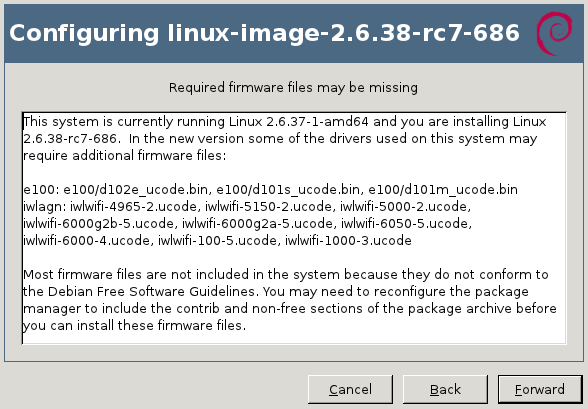
You know it already, since Debian 6.0 non-free firmware are no longer provided by a standard Debian installation. This will cause some troubles to users who need them. I m thus going to do a small overview on the topic and teach you what you need to know to deal with the problem. What are firmware and how are they used? From the user s point of view, a firmware is just some data that is needed by some piece of hardware in order to function properly. The driver for that hardware typically loads the firmware on the device as part of its initialization. In the Linux kernel, the drivers are all using a standardized interface (request_firmware) to retrieve the firmware before sending it to the device. Thanks to this standardization, it s possible to either embed the firmware in the kernel or to have it request the firmware from user-space when needed. Debian (like most distributions) has selected the latter option. Thus when the kernel needs a firmware, it sends out a request to user-space. udev is getting the request with the name of the firmware, and in its default configuration (see /lib/udev/rules.d/80-drivers.rules) it executes /lib/udev/firmware.agent in response. Where are firmware stored? firmware.agent is a simple shell script that tries to locate a firmware before sending it back to the kernel through a sysfs entry. It looks into the following directories: Firmware provided by packages are thus usually in /lib/firmware and you can use /usr/local/lib/firmware for manually installed firmware. How do I know whether I need a firmware? First of, you can notice messages from the kernel telling you that it tried to load a firmware but it failed. They look like this:
e100: eth0: e100_request_firmware: Failed to load firmware "e100/d101m_ucode.bin": -2
But you might be informed sooner. When you install a new version of the Linux kernel with the official Debian packages, the post-installation script will go through all loaded modules (those listed by lsmod) and it will verify whether this module as provided by the newly installed kernel might require firmware files. This information can be retrieved with modinfo:
$ modinfo -F firmware /lib/modules/2.6.32-5-amd64/kernel/drivers/net/e100.ko
e100/d102e_ucode.bin
e100/d101s_ucode.bin
e100/d101m_ucode.bin
If one (or more) of those firmware is (are) not yet available on the system, you will get a warning message similar to this one:
update-initramfs will also generate a similar warning on the terminal:
update-initramfs: Generating /boot/initrd.img-2.6.32-5-amd64
W: Possible missing firmware /lib/firmware/e100/d102e_ucode.bin for module e100
W: Possible missing firmware /lib/firmware/e100/d101s_ucode.bin for module e100
W: Possible missing firmware /lib/firmware/e100/d101m_ucode.bin for module e100
The Debian installer also detects when you have hardware that might require a missing firmware file. You have the option to supply the missing files on a USB stick (either directly or through the corresponding package). How do I find and install the missing firmware? Now that you have the name of the firmware file that you want, it s relatively easy to identify the package that provides the required file. You can use apt-cache search <filename> because the firmware packages embed the list of firmware files in their description. You can also use apt-file (provided by the package of the same name) or the web interface at packages.debian.org.
$ apt-cache search d101m_ucode.bin
firmware-linux-nonfree - Binary firmware for various drivers in the Linux kernel
$ apt-file search d101m_ucode.bin
firmware-linux-nonfree: /lib/firmware/e100/d101m_ucode.bin
If the above commands return nothing, you probably need to enable the non-free repository in your /etc/apt/sources.list (you can also enable it within synaptic). And you also want to run sudo apt-file update to have the latest information. Now you can install the right package, in the example above it was firmware-linux-nonfree. How do I install all firmware just to be sure I don t miss any? There s no meta-package depending on all firmware packages so there s no easy answer to this question. Furthermore not all firmware packages respect the naming convention firmware-* (there s for example zd1211-firmware). So your best bet is to look up all the packages with a generic search like this one:
$ apt-file --package-only search /lib/firmware/
atmel-firmware
[...]
And then install them all. Are there DVD or CD images with non-free firmware? Yes. Debian provides an unofficial netinst image for i386/amd64/powerpc with the non-free firmware, you can find it here: http://cdimage.debian.org/cdimage/unofficial/non-free/cd-including-firmware/. I provide complete DVD sets with firmware, and Multi-Arch CD/DVD with firmware, it s over there in my DVD shop: http://raphaelhertzog.com/go/debian-cd/ (i386/amd64 only) When using those installation discs, the Debian-installer will be able to find the required firmware immediately. There s no need for you to provide them on a USB stick. Other questions? I think I covered the most important things you have to know about firmware on Debian. But should you still have a question, feel free to share it in the comments so that I can improve this article.
Click here to subscribe to my free newsletter and get my monthly analysis on what s going on in Debian and Ubuntu. Or just follow along via the RSS feed, Identi.ca, Twitter or Facebook.

6 comments Liked this article? Click here. My blog is Flattr-enabled.

Russell Coker: Effective Computers for Schools

Sam Varghese has written an article that is very skeptical of the educational value of the OLPC project [1].Are Laptops Any Good for Schools?Sam cites an article in the New York Times by Winnie Hu about schools removing laptop programs due to a lack of success [2]. Winnie s article gives an example of a school shutting a program because of getting new teachers who lacked computer skills and some examples of schools which had issues with the repair cost. The solution to that would be computers that are more robust and easier to use by all accounts the OLPC systems are solidly constructed and easy to use!It is claimed that using laptops doesn t increase test scores. Using only test scores to compare educational methods is a way to lose, probably any school which does nothing other than try to increase test scores is worth avoiding. One example from Winnie s article is a report by Mr. Warschauer of students at a middle school in Yarmouth, Me., who used their laptops to create a Spanish book for poor children in Guatemala and debate Supreme Court cases found online . What value can you place on having students develop books for poor children in other countries and debate Supreme Court cases? If this sort of program became popular then it would lead to the countries which do it becoming better places to live in future decades!Mr. Warschauer also claims that If the goal is to get kids up to basic standard levels, then maybe laptops are not the tool. But if the goal is to create the George Lucas and Steve Jobs of the future, then laptops are extremely useful . I would go further than that, I think that providing the educational environment that involves international charity work and analysis of important court cases would lead to students having the skills to become good engineers, designers, and artists who work for people like George Lucas and Steve Jobs. No matter what you might do the vast majority of children will not grow up to be like George Lucas and Steve Jobs, there is a very limited number of positions for such people. But those people employ a huge number of creative people who do interesting and enjoyable work for good pay.I don t think that Winnie s article supports criticism of the OLPC project. I don t think that Winnie s article even contains sufficient evidence to match the headline.Playing GamesSam also cites an article about the misuse of school computers for playing games [3]. Of course there are ways of limiting access to games based on time etc. For a Linux system you could have a root cron job that runs chmod on /usr/games at various times, and preventing users from easily running programs that they install isn t difficult.Not that games are all bad, the flash-based games on www.physicsgames.net do teach kids some things about physics although I admit that much of that could be learned by playing with balls, skate-boards, etc.The Problem with the OLPC ProjectI think that the policy change to make OLPC systems only available to disadvantaged children was a mistake. The give one get one program was a great idea, maybe not the most effective way of getting funding but good for getting developers. While the new Sugar on a Stick project to put the OLPC GUI on a bootable USB device [4] it doesn t compare well to having dedicated hardware IMHO.Minimal Use of ComputersI have previously written about the weight of school bags and how laptops can alleviate the risk of health problems related to carrying heavy text books [5]. Since that time ebook readers and tablets have become incredibly cheap. Ebook readers are really light and the recent tablets are also very light (particularly the smaller ones). It seems to me that every school should at least be moving towards every student having an ebook reader and to use ebooks for all books that are part of the curriculum.At the moment there are a bunch of tablets on sale for about $150, that includes tablets that can access the Internet via Wifi or via 3G and a cheap 3G plan costs less than $150 per annum. If tablets were used for some of the computer tasks related to schools then a lot of the difficulty of repairing hardware would be removed. Tablets don t offer as many options for messing up the software configuration and if the hardware breaks it s easy to transfer the data onto a new tablet from the cloud with a maximum cost of $150 to replace the hardware.Also a cloud-based computing model could permit students to access all the same data from school and home while using desktop computers at both locations.Current SuccessNatalie Craig wrote an interesting article for The Age about The Lab a drop-in computer center for kids on the Autism Spectrum run by Dale Linegar and Stefan Schutt [6]. The fact that kids who have communication difficulties can find it easier to communicate electronically should be fairly obvious to everyone in the free software community, but the creation of an organisation to support such kids is noteworthy I think that such centers should be funded by the government and run in every city.Salman Khan gave an interesting TED talk about his project the Khan Academy [7] which is an online video-based teaching system that evolved from some Youtube videos he produced to tutor his cousins. Salman pointed out that his cousins said that they would rather watch his videos than have him teach them in person, it seems that they liked being able to pause and rewind the talk as well as avoiding the pressure of human interaction. The Khan Academy has videos in Adobe flash format, but conveniently they have download links so those of us who don t have the Flash plugin can still view the content [8].One of the interesting things about the Khan Academy is that in school use the videos are being assigned to kids as homework and the class time is used for teaching children to do worked examples what has traditionally been homework.So it seems that there are real examples of special-needs kids and average kids benefiting from different types of electronic learning.ConclusionI think that almost everything about the education system is broken. I also think that in many ways the education system has reached a local maximum, so there is no small way of improving things, and adding computers without making any of the significant changes needed to fix the big problems probably can t do a lot of good. In spite of this computers can provide some real benefits and I expect that those benefits can be better than the benefits of other potential ways of spending the money (IE it s worth the opportunity cost). I also have no doubt that almost anything can give a negative result if done badly enough, so I don t interpret examples of computer use failing in a school as anything other than evidence of a failing school.While the Khan Academy has some results that seem very positive I think that s only the first step of what needs to be done. It also seems to be based around users who have good Internet access which often isn t the case in places where the OLPC is being deployed. This implies that we need to get systems like the Khan Academy designed to operate in a disconnected manner, maybe with a remote server that s not connected to the Internet. This should be possible if funding is available.Sam suggested that there needs to be a scientific study of the effectiveness of the OLPC. I think that every project which involves significant amounts of public funding should be researched to ensure that it s an effective use of resources. 400,000 laptops is going to cost something more than $40,000,000 so it seems reasonable to devote a few person-years of research to determine how effective they are and which of the possible ways of using an OLPC will give the best results.I am confident that a good study of the effectiveness of the OLPC would demonstrate that it provides real educational benefits when correctly incorporated into an educational program. I also expect that such a study would show some significant differences in the effectiveness of various ways of using them. But we shouldn t be relying on confidence, we need some test results.

13 March 2011

Mark Brown: Changing core code

One of the biggest differences between working on most other OSs and working upstream on drivers for the Linux kernel is that elsewhere the core is usually a fixed thing that has been released and can t really be changed, even if source is available (which may not even be the case). If whatever subsystem you re working in can t cope with the thing you re trying to express then one of the things it s really useful to be good at is working out ways to implement the behaviour that s required behind the back of the subsystem. It s very common to see such code in drivers submitted by hardware vendors, particularly those that are new to Linux, as this is such a big mindset shift. With kernel development the approach is much more to make sure that the core can cope with whatever needs expressing. It s not always done in the core for example, sometimes the issue is due to unusually limited hardware and very likely to never come up again but it s very unusual to see code merged that doesn t at least fit in with the design of the subsystem. This post is inspired by a brief exchange with Thomas Gleixner on linux-kernel who articulated the advantages of doing things this way very well:
 - It's usually simpler and faster as the core code has all the
   necessary information. So that's even an argument which managers
   might understand.
 - Such workarounds, when not caught, tend to spread themself
   magically because driver writers checkout the existing code of
   similar devices and copy/paste/modify^Wuglify them over and over.
 - In the worst case such workarounds make the core maintainence
   harder and in some cases impossible, because they silently imply
   semantics on the core w/o the core maintainer knowing about them.
The last point is the most important one to me as a subsystem maintainer I really don t want to be merging code that is going to create issues with ongoing development of the subsystem. This is all another facet of the policy on stable APIs: APIs are only worth working around if they re fixed, and the assumptions that end up embedded in a workaroud are as much part of the API as the explicit interfaces. It s things like this that make Linux such a pleasure to work on.

Gregor Herrmann: RC bugs 2011/08 - 2011/10

again, nothing exciting to report. as you can see below, I've only worked on pkg-perl packages. we get a surprising amount of FTBFS bugs at the moment; many of them caused by changes in depended-upon packages, some also by human errors (like not building in a chroot and missing build dependencies upfront). at least the latter could be avoided quite easily ...

11 March 2011

Pietro Abate: On equivalent debian versions

For one of our experiments, we ended up analyzing all versions mentioned in a Debian Packages file if mentioned in a constraint or in a version field of a package. It seems that there are a lot of DDs that like to use strange 'formatting' when writing down a versioned constraint. This is might be not a choice done directly by the debian maintainer, but just a consequence of a particular version schema from upstream. The debian policy is rigorous with relation to the algorithm to compare version .
 The strings are compared from left to right.
 First the initial part of each string consisting entirely of non-digit characters is determined. These two parts 
 (one of    which may be empty) are compared lexically. If a difference is found it is returned. The lexical 
 comparison is a comparison of ASCII values modified so that all the letters sort earlier than all the non-letters 
 and so that a tilde sorts before anything, even the end of a part. For example, the following parts are in sorted 
 order from earliest to latest: ~~, ~~a, ~, the empty part, a.[34]
 Then the initial part of the remainder of each string which consists entirely of digit characters is determined. 
 The numerical values of these two parts are compared, and any difference found is returned as the result of 
 the comparison. For these purposes an empty string (which can only occur at the end of one or both version 
 strings being compared) counts as zero.
 These two steps (comparing and removing initial non-digit strings and initial digit strings) are repeated until a
 difference is found or both strings are exhausted.
I think the important part is about the numerical comparison The numerical values of these two parts are compared, and any difference found is returned as the result of the comparison . Our tool finds a number of examples of equivalent versions : For example version '0.00001-1' is from package libbenchmark-progressbar-perl. I don't know why so many equivalent way of writing a version string are used. Probably they appear in completely unrelated packages I'm pretty sure no harm is intended :) However, to avoid confusion, it might be a good idea to settle on a non-normative canonical representation of versions. Like no '0' in front of dots and hyphen... Maybe we could add a warning in lintian ? If somebody is interested I can generate a full report that associates each version to a package name.

Eddy Petri&#537;or: HOWTO: Making Windows usable and avoiding accidental sending of mails in Microsoft Outlook

I've changed jobs recently and after 5 years of not having to work with a Windows system I am having all sorts of adaptation-to-Windows problems at the new job.

First I just had to have the usual X-mouse behaviour and so I installed True X-Mouse Gizmo for Windows. This provides focus under mouse, middle click paste after select (not perfect, but it works), right click to push to bottom the window.

Second I had to have a virtual desktop, so I installed Microsoft's Virtual Desktop Manager from the PowerToys page. I tried another virtual desktop manager before using MSVDM, but I found it too clumsy so I switched to MSVDM which I knew from way back when I used Windows the last time. Good, now I can have my applications organised the way I am used to.

UPDATE:
I gave up on MSVDM in favour of Virtual Dimension since I wasn't able to send a particular window to the intended desktop unless I had in the taskbar all apps visible (Shared Desktop option). I might try other suggestions (Virtual Dimension does not have a way to send a window directly to a specific desktop, but just to the neighbours of the current one.)


Third, I had to make Caps Lock work as Ctrl. I just can't go back to an inferior setup. I found information on this page and ended up at this page from where I got a zip file with various registry keys which allow the deactivation of caps, or turning it into another Ctrl.

Fourth, I am used to write with diacritics in Romanian with the secondary layout of the standard (SR 13392:2004), so I rushed to Cristian Secar 's page for the keyboard driver since on XP the Romanian layout is retarded (some history in which some arbitrary German guy decided y and z had to be switched on Romanian keyboards and some other similarly weird stuff). Since the installation, my keyboard behaves according to this layout:


Things started to look well, but I soon was reminded that Outlook is an idiotic mailer since it doesn't require a confirmation on send, not even if you didn't set a subject. And this is problematic since sending the mail is done via Alt+S, so if the current layer is NOT Romanian, when I want to type (s with a comma below), a fairly common character in Romanian words, you end up looking like an idiot on the recipient side since they receive an incomplete mail. Remember, no confirmation AND no default spell checking before send. Yay!

At my second such accidental mail sending (of which the last two were sent to the same person), I decided to see if this can't be fixed. I initially looked for changing the short cut, but I couldn't find it (I might be inept at finding things in Windows, remember, I haven't touched Windows systems in the last 5 years) but I found another workaround and decided it's good enough to share with other people that might hit the problem.

Just setup a delay rule following these steps.
1. Go to Tools....Rules Wizard
2. Click 'New' Rule
3. Select "Check messages after sending"
4. Click Next on "Which conditions you want to Check?" dialog.
5. Press yes to "This Rule will be applied to every message" message box
6. In the "What do you want to do with message?" dialog, Select "Defer delivery by a number of minutes"
7. Select your favourite number of minutes.... I usually select 2 mins.
8. Select Finish. and close the Rules Wizard.

Now everytime you send an email it will sit in your outbox
for specified number of minutes. If you ever wanted to change it, delete it etc, You have sufficient time to do it :)


I used 3 minutes for the delay. At least now I can prevent looking retarded in front of people... more than necessary :D .


Oh, and Windows' clock display is retarded. It shows, by default, the hour and minutes, but there's no way to change that in a sane way. If you want the date, you must hover over the clock and it shows it, but the day of week is missing. Great job! You can see that information, too, but you have to drag the toolbar to be 2 or even 3 rows high (here it requires 2, but I've seen people saying they needed 3) to get that information, too. Great! One has to choose between wasting desktop real estate and having access to useful information. Or you could install an independent application for the clock... retarded. I am not making this shit up.

I hope this helped.

10 March 2011

Peter Eisentraut: My new Git pre-commit hook

This appears to be kind of useful:
#!/bin/sh

output=$(find . -name '.#*' -print)
if [ -n "$output" ]; then
echo "unsaved Emacs files:" 1>&2
echo "$output" 1>&2
exit 1
fi
Had that kind of problem a few times. :-)

Now what would be really handy are system-wide Git hooks that apply to all repositories, like ~/.gitignore complements .git/info/exclude.

Rapha&#235;l Hertzog: My Debian package maintainer pledge

When coming back from DebConf9, I wrote this pledge:
As a package maintainer, I will do my best to help the Debian project release a stable version of our operating system. In particular, I will work together with the release team and I will keep all packages associated to my name free of release critical bugs. To this effect, if I m not registered as being busy or in vacation, I will start working on my release critical bugs as soon as possible (in less than 1 week in common cases). If I can t deal with them in a timely fashion, I will state it clearly in the associated bug reports, tag them help and invite other contributors either to provide a patch or to do a non-maintainer upload. If I do not manage to handle release critical bugs in the above described way, or if I almost never deal with any of my RC bugs by myself, I will:
  • not refuse help and even propose co-maintenance to good contributors
  • recognize my failure and actively try to find a new maintainer and/or co-maintainers
  • not complain if the quality assurance team decides to orphan the package
I recognize that my work is not limited to unstable. I will also work with the stable release team and the security team to provide updated packages for the stable and/or testing distribution when some issues deserve it. I am aware of the limits of my skills and my available time and I will avoid packaging software that I would not be able to maintain properly.
It tries to sum up the minimal expectations that Debian should have towards the package maintainers. I tried first to get this pledge integrated into the NM/DM process but the discussion concluded that it would be best to document this in the developers-reference. There s already a chapter called Debian Developer s Duties where this can nicely fit. I submitted this as a wishlist request for the developers-reference soon after and it s still open. Now I went to the next step and prepared a patch that restructures the chapter about developer duties. See #548867 for details.
Follow me on Identi.ca, Twitter and Facebook. Or subscribe to this blog by RSS or by email.

4 comments Liked this article? Click here. My blog is Flattr-enabled.

9 March 2011

Sean Finney: compiz updates!

For those who are interested in the world of compiz, new development snapshots have been trickling their way into experimental for the past week and are now available for widespread testing. They're being sent to experimental instead of straight to unstable for a few reasons: So, anyway, the packages are all uploaded now--give them a try!

8 March 2011

Michal &#268;iha&#345;: phpMyAdmin translation status

Another week is over and it's time to spam^W look again at state of translations for phpMyAdmin 3.4. There are no changes to list of complete translations, so we still have 12 translations at 100%: There are still lot of translations which would need some love: And I'm really happy to see progress of some exotic languages (at least for me) such as Urdu. You can help make translation to your language better! If your language is missing just let me know (either in comments or by email).

Filed under: English Phpmyadmin 2 comments Flattr this!

7 March 2011

Jonathan Wiltshire: Response from ALLOW Ltd.

I ve had a very courteous email from one of the founders of ALLOW, following my analysis of their password reset procedure.
Thank you for your feedback regarding the security of our platform. We are constantly reviewing these processes and regard our members security as paramount, whilst ensuring our processes are navigable to the majority of the UK. We have had the platform professionally penetration tested but your email demonstrates an excellent understanding of the challenges and we would welcome your suggestions on our options of improving the password reset process. We will be extending our SSL certificate to the publicly accessible website and please be assured that this is held on a different architecture to that of the Member application.
This is very promising!
Comments
Response from ALLOW Ltd. is a post from: jwiltshire.org.uk Flattr

3 March 2011

Rapha&#235;l Hertzog: People behind Debian: Christian Perrier, translation coordinator

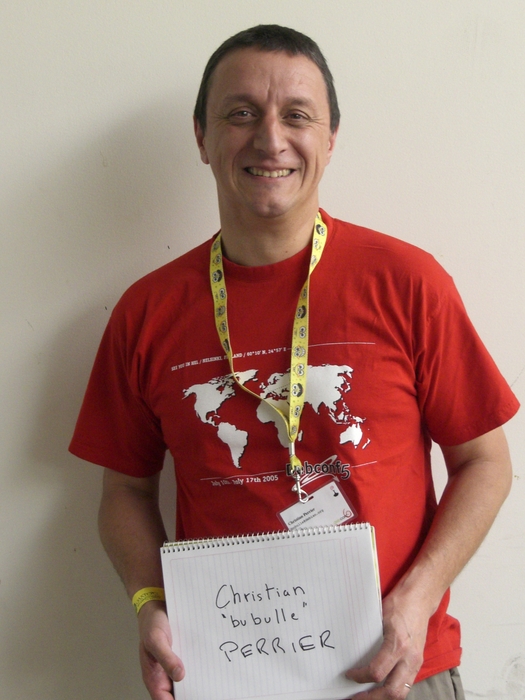
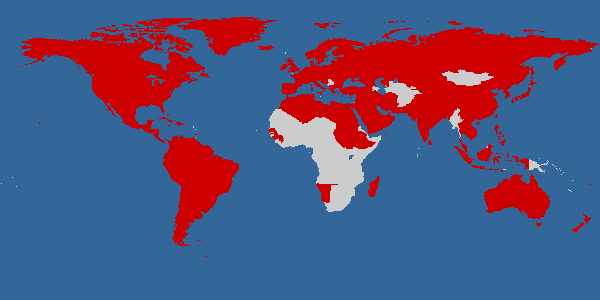
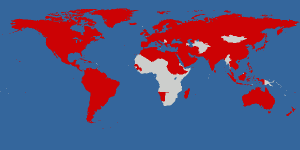
Christian is a figure of Debian, not only because of the tremendous coordination work that he does within the translation project, but also because he s very involved at the social level. He s probably in the top 5 of the persons who attended most often the Debian conference. Christian is a friend (thanks for hosting me so many times when I come to Paris for Debian related events) and I m glad that he accepted to be interviewed. He likes to speak and that shows in the length of his answers :-) but you ll be traveling the world while reading him. My questions are in bold, the rest is by Christian. Who are you? I am a French citizen (which is easy to guess unless you correct my usual mistakes in what follows). I m immensely proud of being married for nearly 26 years with Elizabeth (who deserves a statue from Debian for being so patient with my passion and my dedication to the project). I m also the proud father of 3 wonderful kids , aged 19 to 23. I work as team manager in the Networks and Computers Division of Onera the French Aerospace lab , a public research institute about Aeronautics, Space and Defense. My team provides computer management services for research divisions of Onera, with a specific focus put on individual computing. I entered the world of free software as one of the very first users of Linux in France. Back in the early 1990 s, I happened (though the BBS users communities) to be a friend of several early adopters of Linux and/or BSD386/FreeBSD/NetBSD in France. More specifically, I discovered Linux thanks with my friend Ren Cougnenc (all my free software talks are dedicated to Ren , who passed away in 1996). You re not a programmer, not even a packager. How did you come to Debian? I m definitely not a programmer and I never studied computing (I graduated in Materials Science and worked in that area for a few years after my PhD). However, my daily work always involved computing (I redesigned the creep testing laboratory and its acquisition system all by myself during my thesis research work). An my hobbies often involved playing with home computers, always trying to learn about something new. So, first learning about a new operating system then trying to figure out how to become involved in its development was quite a logical choice. Debian is my distro of choice since it exists. I used Slackware on work machines for a while, but my home server, kheops, first ran Debian 1.1 when I stopped running a BBS on an MS-DOS machine to host a news server. That was back in October 1996. I then happened to be a user, and more specifically a user of genealogy software, also participating very actively in Usenet from this home computer and server, that was running this Debian thing. So, progressively, I joined mailing lists and, being a passionate person, I tried to figure out how I could bring my own little contribution to all this. This is why I became a packager (yes, I am one!) by taking over the geneweb package, which I was using to publish my genealogy research. I applied as DD in January 2001, then got my account in July 2001. My first upload to the Debian archive occurred on August 22nd 2001: that was of course geneweb, which I still maintain. Quite quickly, I became involved in the work on French localization. I have always been a strong supporter of localized software (I even translated a few BBS software back in the early 90 s) as one of the way to bring the power and richness of free software to more users. Localization work lead me to work on the early version of Debian Installer, during those 2003-2005 years where the development of D-I was an incredibly motivating and challenging task, lead by Joey Hess and his inspiring ideas. From user to contributor to leader, I suddenly discovered, around 2004, that I became the coordinator of D-I i18n (internationalization) without even noticing :-) You re the main translation coordinator in Debian. What plans and goals have you set for Debian Wheezy? As always: paint the world in red. Indeed, this is my goal for years. I would like our favorite distro to be able to be used by anyone in the world, whether she speaks English, Northern Sami, Wolof, Uyghur or Secwepemcts n. As a matter of symbol, I use the installer for this. My stance is that one should be able to even install Debian in one s own language. So, for about 7 years, I use D-I as a way to attract new localization contributors. This progress is represented on this page where the world is gradually painted in red as long as the installer supports more languages release after release. The map above tries to illustrate this by painting in red countries when the most spoken language in the country is supported in Debian Installer. However, that map does not give enough reward to many great efforts made to support very different kind of languages. Not only various national languages, but also very different ones: all regional languages of Spain, many of the most spoken languages in India, minority languages such as Uyghur for which an effort is starting, Northern Sami because it is taught in a few schools in Norway, etc., etc. Still, the map gives a good idea of what I would like to see better supported: languages from Africa, several languages in Central Asia. And, as a very very personal goal, I m eagerly waiting for support of Tibetan in Debian Installer, the same way we support its sister language, Dzongkha from Bhutan. For this to happen, we have to make contribution to localization as easy as possible. The very distributed nature of Debian development makes this a challenge, as material to translate (D-I components, debconf screens, native packages, packages descriptions, website, documentation) is very widely spread. A goal, for years, is to set a centralized place where translators could work easily without even knowing about SVN/GIT/BZR or having to report bugs to send their work. The point, however, would be to have this without making compromises on translation quality. So, with peer review, use of thesaurus and translation memory and all such techniques. Tools for this exist: we, for instance, worked with the developers of Pootle to help making it able to cope with the huge amount of material in Debian (think about packages descriptions translations). However, as of now, the glue between such tools and the raw material (that often lies in packages) didn t come. So, currently, translation work in Debian requires a great knowledge of how things are organized, where is the material, how it can be possible to make contribution reach packages, etc. And, as I m technically unable to fulfill the goal of building the infrastructure, I m fulfilling that role of spreading out the knowledge. This is how I can define my coordinator role. Ubuntu uses a web-based tool to make it easy to contribute translations directly in Launchpad. At some point you asked Canonical to make it free software. Launchpad has been freed in the mean time. Have you (re)considered using it? Why not? After all, it more or less fills in the needs I just described. I still don t really figure out how we could have all Debian material gathered in Rosetta/Launchpad .and also how Debian packagers could easily get localized material back from the framework without changing their development processes. I have always tried to stay neutral wrt Ubuntu. As many people now in Debian, I feel like we have reached a good way to achieve our mutual development. When it comes at localization work, the early days where the everything in Rosetta and translates who wants stanza did a lot of harm to several upstream localization projects is, I think, way over. Many people who currently contribute to D-I localization were indeed sent to me by Ubuntu contributors .and by localizing D-I, apt, debconf, package descriptions, etc., they re doing translation work for Ubuntu as well as for Debian. Let s say I m a Debian user and I want to help translate Debian in my language. I can spend 1 hour per week on this activity. What should I do to start? Several language teams use Debian mailing lists to coordinate their work. If you re lucky enough to be a speaker of one of these languages, try joining debian-l10n-<yourlanguage> and follow what s happening there. Don t try to immediately jump in some translation work. First, participate to peer reviews: comment on others translations. Learn about the team s processes, jargon and habits. Then, progressively, start working on a few translations: you may want to start with translations of debconf templates: they are short, often easy to do. That s perfect if you have few time. If no language team exists for your language, try joining debian-i18n and ask about existing effort for your language. I may be able to point you to individuals working on Debian translations (very often along with other free software translation efforts). If I am not, then you have just been named coordinator for your language :-) I may even ask you if you want to work on translating the Debian Installer. What s the biggest problem of Debian? We have no problems, we only have solutions :-) We are maybe facing a growth problem for a few years. Despite the increased welcoming aspects of our processes (Debian Maintainers), Debian is having hard times in growing. The overall number of active contributors is probably stagnating for quite a while. I m still amazed, however, to see how we can cope with that and still be able to release over the years. So, after all, this is maybe not a problem :-) Many people would point communication problems here. I don t. I think that communication inside the Debian project is working fairly well now. Our famous flame wars do of course still happen from time to time, but what large free software project doesn t have flame wars? In many areas, we indeed improved communication very significantly. I want to take as an example the way the release of squeeze has been managed. I think that the release team did, even more this time, a very significant and visible effort to communicate with the entire project. And the release of squeeze has been a great success in that matter. So, there s nearly nothing that frustrates me in Debian. Even when a random developer breaks my beloved 100% completeness of French translations, I m not frustrated for more than 2 minutes. You re known in the Debian community as the organizer of the Cheese & Wine Party during DebConf. Can you tell us what this is about? This is an interesting story about how things build themselves in Debian. It all started in July 2005, before DebConf 5 in Helsinki. Denis Barbier, Nicolas Fran ois and myself agreed to bring at Debconf a few pieces of French cheese as well as 1 or 2 bottles of French wine and share them with some friends. Thus, we settled an informal meeting in the French room where we invited some fellows: from memory, Benjamin Mako Hill, Hannah Wallach, Matt Zimmermann and Moray Allan. All of us fond of smelly cheese, great wine plus some extra p t home-made by Denis in Toulouse. It finally happened that, by word of mouth, a few dozens of other people slowly joined in that French room and turned the whole thing into an improvized party that more or less lasted for the entire night. The tradition was later firmly settled in 2006, first in Debconf 6 in Mexico where I challenged the French DDs to bring as many great cheese as possible, then during the Debian i18n meeting in Extremadura (Sept 2006) where we reached the highest amount of cheese per participant ever. I think that the Creofonte building in Casar de C ceres hasn t fully recovered from it and is still smelling cheese 5 years after. This party later became a real tradition for DebConf, growing over and over each year. I see it as a wonderful way to illustrate the diversity we have in Debian, as well as the mutual enrichment we always felt during DebConfs. My only regret about it is that it became so big over the years that organizing it is always a challenge and I more and more feel pressure to make it successful. However, over the years, I always found incredible help by DebConf participants (including my own son, last year a moment of sharing which we will both remember for years, i think). And, really, in 2010, standing up on a chair, shouting (because the microphone wasn t working) to thank everybody, was the most emotional moment I had at Debconf 10. Is there someone in Debian that you admire for their contributions? So many people. So, just like it happens in many awards ceremonies, I will be very verbose to thank people, sorry in advance for this. The name that comes first is Joey Hess. Joey is someone who has a unique way to perceive what improvements are good for Debian and a very precise and meticulous way to design these improvements. Think about debconf. It is designed for so long now and still reaching its very specific goal. So well designed that it is the entire basis for Joey s other achievement: designing D-I. Moreover, I not only admire Joey for his technical work, but also for his interaction with others. He is not he loudest person around, he doesn t have to .just giving his point in discussion and, guess what? Most of the time, he s right. Someone I would like to name here, also, is Colin Watson. Colin is also someone I worked with for years (the D-I effect, again ) and, here again, the very clever way he works on technical improvements as well as his very friendly way to interact with others just make it. And, how about you, Rapha l? :-) I m really admirative of the way you work on promoting technical work on Debian. Your natural ability to explain things (as good in English as it is in French) and your motivation to share your knowledge are a great benefit for the project. Not to mention the technical achievements you made with Guillem on dpkg of course! Another person I d like to name here is Steve Langasek. We both maintain samba packages for years and collaboration with him has always been a pleasure. Just like Colin, Steve is IMHO a model to follow when it comes at people who work for Canonical while continuing their involvment in Debian. And, indeed, Steve is so patient with my mistakes and stupid questions in samba packaging that he deserves a statue. We re now reaching the end of the year where Stefano Zacchiroli was the Debian Project Leader. And, no offense intended to people who were DPL before him (all of them being people I consider to be friends of mine), I think he did the best term ever. Zack is wonderful in sharing his enthusiasm about Debian and has a unique way to do it. Up to the very end of his term, he has always been working on various aspects of the project and my only hope is that he ll run again (however, I would very well understand that he wants to go back to his hacking activities!). Hat off, Zack!I again have several other people to name in this Bubulle hall of Fame : Don Armstrong, for his constant work on improving Debian BTS, Margarita Manterola as one of the best successes of Debian Women (and the most geeky honeymoon ever), Denis Barbier and Nicolas Fran ois because i18n need really skilled people, Cyril Brulebois and Julien Cristau who kept X.org packaging alive in lenny and squeeze, Otavio Salvador who never gave up on D-I even when we were so few to care about it. I would like to make a special mention for Frans Pop. His loss in 2010 has been a shock for many of us, and particularly me. Frans and I had a similar history in Debian, both mostly working on so-called non technical duties. Frans has been the best release manager for D-I (no offense intended, at all, to Joey or Otavio .I know that both of them share this feeling with me). His very high involvment in his work and the very meticulous way he was doing it lead to great achievements in the installer. The Installation Guide work was also a model and indeed a great example of non technical work that requires as many skills as more classical technical work. So, and even though he was sometimes so picky and, I have to admit, annoying, that explains why I m still feeling sad and, in some way, guilty about Frans loss. One of my goals for wheezy is indeed to complete some things Frans left unachieved. I just found one in bug #564441: I will make this work reach the archive, benefit our users and I know that Frans would have liked that.

Thank you to Christian for the time spent answering my questions. I hope you enjoyed reading his answers as I did. Subscribe to my newsletter to get my monthly summary of the Debian/Ubuntu news and to not miss further interviews. You can also follow along on Identi.ca, Twitter and Facebook.

7 comments Liked this article? Click here. My blog is Flattr-enabled.

2 March 2011

Jonathan Wiltshire: Privacy specialists should hire security specialists

I was interested to hear about a company here in the UK called ALLOW Ltd., offering marketing database management under a we ll get you off lists, then pay you to go back on at your pleasure basis. That sounds a fair deal to me, so I decided to sign up for it.
Our technology is built using some of the best and most secure tools in the industry. We have partnered with infrastructure providers who handle some of the most sensitive data in the UK (such as medical and financial records). Both the digital and physical security measures we have implemented are amongst the strongest available anywhere. This includes full encryption of all data at all times, full implementation of secure socket layers, security certificates and physical restriction of access to the data, our servers and our offices. Our systems have been fully penetration tested (that means we ve asked people to try and break in).
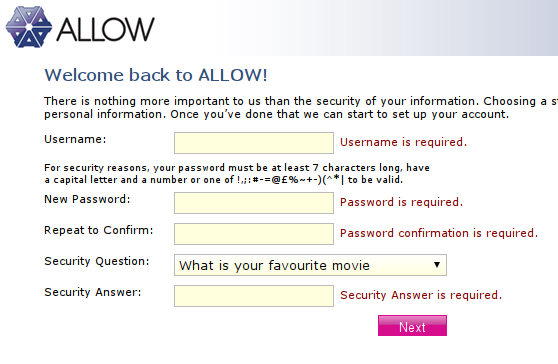
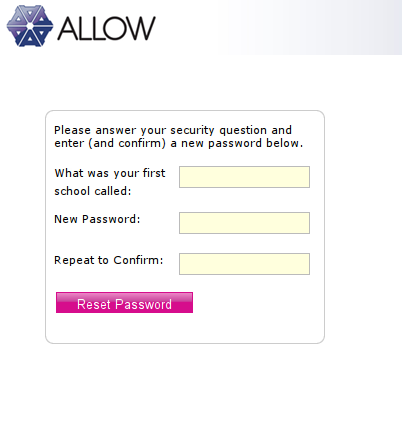
(There are other suitable assertions in various places they even have a set of principles about safeguarding data.) Unfortunately, this promise is rather undermined in several ways after noticing the first couple, I did a little digging to see what else was exploitable. Here s the final part of the joining process, where you choose a username and password combination: The text I ve cropped too eagerly says Choosing a secure password is an essential part of protecting your personal information , or thereabouts. I duly chose a complex password that fitted the requirements, and to my surprise it was rejected. I tried another, and it was rejected; then a third and a fourth. By trial and error I worked out what was going on: 1. The password must contain only the listed special characters, not just include one of them. That s a bit of a problem, because even assuming a basic ASCII set, 15 characters are unavailable to users; 80 are left, so that s about a 15% fall in the available combinations*. Not a good start. More concerning is the presence of a security question field. It s used for resetting the password in the event losing it, but this technique for recovery has long been ridiculed the shared secret is often common knowledge amongst friends, and sometimes (as in this case) the available questions are fairly easy for an attacker to find the answer to in public records or solicit from the victim without arousing much suspicion: 2. The security questions available include First pet s name and worse, First school name . It s pretty pointless enforcing stringent password requirements, and then bypassing them with something so susceptible to a dictionary attack. I was pleased to find that failing to log in to an account more than a few times results in a temporary lockout, which should deter casual brute force attacks. But I wanted to know how that security question would be used, so I forgot my password and followed the links to reset it. Here s the form: Actually the first form, not shown here, initially just asks for a username, giving an error message if it isn t registered, and here s another problem: 3. The password reset process confirms the existence, or non-existence, of a given username half the credentials required to log in to any visitor. I d be prepared to take a bet that most users will choose What was the name of your first school? as a security question. The first pet you have is often at such a young age you can t remember it clearly; the name of the street you grew up on might change a couple of times if you moved house. But first school I attended? I ll never forget that, so it makes most sense to use as a backup password . It s also the best one for an attacker to try and find out from public sources. But that aside, as you can see the password is not generated at random and communicated to the real account holder out-of-band, in the manner of many other sites. Instead: 4. A new password is immediately set to a value already known by the attacker. Once inside, an attacker can also change the security question or answer, or both, so you can t even regain your account by telephoning the company unless you can convince them you re genuine, in which case the security question was a total waste of time anyway. I awarded some marks for notifying the user by email that the password has been changed, but immediately docked them again because bingo! You re now a victim of identity theft! Let s assume you ve been locked out, the security question has been changed and you want your account back. ALLOW don t let you telephone them; you either have to dig around and find an address to send an email, which we all know can be intercepted, or (and you re encouraged to) contact them through a form on the site. You ll probably include some personal details, because you want to convince them of your real identity; indeed, two of the options on the form are I ve got a question and Something doesn t work . I sent my findings through this very form, under the latter heading, and to my surprise: 5. Despite promises of full encryption of all data at all times, full implementation of secure socket layers , the contact form is transmitted to ALLOW in the clear, with no protection whatsoever. So now anyone listening in your connection knows all about you too: your ISP, any of the peers along the route, the deep packet inspection advertisers if your ISP is less than reputable, and the neighbour who connects to your wireless and slips you a fiver every month for the privilege. Nice work, privacy specialists. (For the record: * please feel free to correct my maths. It was never my strongest subject.
Comments
Privacy specialists should hire security specialists is a post from: jwiltshire.org.uk Flattr

Joachim Breitner: Tor exit node shut down by server4you

As mentioned earlier this week, I changed the server for my hoster from server4you to Hetzner. Because the contract for my old server is still running until the 14th of April, I thought I can make some good use of it by running an Tor exit node on it. Tor, The onion router is a world-wide network of server to anonymize network connections, and used for example by freedom-loving people in repressive countries, or by Facebook users in repressively proxied university networks Naturally, such a system is also used by people with lesser motives, and after nearly one week of running the server, some complaints were reaching server4you a honeynet supposedly detected botnet activity from my IP address, another company hired by Paramount Pictures claimed that someone downloaded Iron Man 2 over BitTorrent via my server. These were forwarded to my by server4you, demanding an explanation. I explained that I am running a Tor node, that such things are unavailable, and that neither I nor server4you is going to be held responsible. Nevertheless, they insist that I should stop whatever I am doing (I am not sure if they really understood what tor is), and when I said that I won t, they decided to unilaterally and immediately end my contract by tomorrow. Thus a powerful exit node that might have made life better for Tor users is doing to disappear again. They will not reimburse the advance fee that I had paid in advance and made a non-specific threat about further claims they might have. So server4you was, at least in my case, not only an unreliable and inflexible provider, they also prefer to cut off their customer s server just because of two complaints by third parties. I conclude that this is not a hoster that you should trust important services to. And I am not a unique case: There are reports of similar server shut-downs by server4you (in German).

1 March 2011

Daniel Kahn Gillmor: Turning my back on the IEEE

I used to maintain a membership with IEEE. I no longer do. The latest nonsense to come from them is a change for the worse in their copyright assignment policy, which i thought was already problematic. Other engineering societies (IETF, USENIX, etc) continue to do socially relevant, useful work without attempting to control copyright of work contributed to them. This just makes IEEE look like a power- and money-hungry organization, rather than a force for positive advancement of technology. For shame, IEEE. I will not consider reinstating my membership unless the organization changes their copyright assignment and publication policy to better reflect the spirit of scientific inquiry and technological advancement they should stand for.Tags: freedom, ieee, policy

Next.

Previous.