Search Results: "ean"

5 October 2012

Keith Packard: fd-passing

FD passing for DRI.Next Using the DMA-BUF interfaces to pass DRI objects between the client and server, as discussed in my previous blog posting on DRI-Next, requires that we successfully pass file descriptors over the X protocol socket. Rumor has it that this has been tried and found to be difficult, and so I decided to do a bit of experimentation to see how this could be made to work within the existing X implementation. (All of the examples shown here are licensed under the GPL, version 2 and are available from git://keithp.com/git/fdpassing) Basics of FD passing The kernel internals that support FD passing are actually quite simple POSIX already require that two processes be able to share the same underlying reference to a file because of the semantics of the fork(2) call. Adding some ability to share arbitrary file descriptors between two processes then is far more about how you ask the kernel than the actual file descriptor sharing operation. In Linux, file descriptors can be passed through local network sockets. The sender constructs a mystic-looking sendmsg(2) call, placing the file descriptor in the control field of that operation. The kernel pulls the file descriptor out of the control field, allocates a file descriptor in the target process which references the same file object and then sticks the file descriptor in a queue for the receiving process to fetch. The receiver then constructs a matching call to recvmsg that provides a place for the kernel to stick the new file descriptor. A helper API for testing I first write a stand-alone program that created a socketpair, forked and then passed an fd from the parent to the child. Once that was working, I decided that some short helper functions would make further testing a whole lot easier. Here s a function that writes some data and an optional file descriptor:
ssize_t
sock_fd_write(int sock, void *buf, ssize_t buflen, int fd)
 
    ssize_t     size;
    struct msghdr   msg;
    struct iovec    iov;
    union  
        struct cmsghdr  cmsghdr;
        char        control[CMSG_SPACE(sizeof (int))];
      cmsgu;
    struct cmsghdr  *cmsg;
    iov.iov_base = buf;
    iov.iov_len = buflen;
    msg.msg_name = NULL;
    msg.msg_namelen = 0;
    msg.msg_iov = &iov;
    msg.msg_iovlen = 1;
    if (fd != -1)  
        msg.msg_control = cmsgu.control;
        msg.msg_controllen = sizeof(cmsgu.control);
        cmsg = CMSG_FIRSTHDR(&msg);
        cmsg->cmsg_len = CMSG_LEN(sizeof (int));
        cmsg->cmsg_level = SOL_SOCKET;
        cmsg->cmsg_type = SCM_RIGHTS;
        printf ("passing fd %d\n", fd);
        *((int *) CMSG_DATA(cmsg)) = fd;
      else  
        msg.msg_control = NULL;
        msg.msg_controllen = 0;
        printf ("not passing fd\n");
     
    size = sendmsg(sock, &msg, 0);
    if (size < 0)
        perror ("sendmsg");
    return size;
 
And here s the matching receiver function:
ssize_t
sock_fd_read(int sock, void *buf, ssize_t bufsize, int *fd)
 
    ssize_t     size;
    if (fd)  
        struct msghdr   msg;
        struct iovec    iov;
        union  
            struct cmsghdr  cmsghdr;
            char        control[CMSG_SPACE(sizeof (int))];
          cmsgu;
        struct cmsghdr  *cmsg;
        iov.iov_base = buf;
        iov.iov_len = bufsize;
        msg.msg_name = NULL;
        msg.msg_namelen = 0;
        msg.msg_iov = &iov;
        msg.msg_iovlen = 1;
        msg.msg_control = cmsgu.control;
        msg.msg_controllen = sizeof(cmsgu.control);
        size = recvmsg (sock, &msg, 0);
        if (size < 0)  
            perror ("recvmsg");
            exit(1);
         
        cmsg = CMSG_FIRSTHDR(&msg);
        if (cmsg && cmsg->cmsg_len == CMSG_LEN(sizeof(int)))  
            if (cmsg->cmsg_level != SOL_SOCKET)  
                fprintf (stderr, "invalid cmsg_level %d\n",
                     cmsg->cmsg_level);
                exit(1);
             
            if (cmsg->cmsg_type != SCM_RIGHTS)  
                fprintf (stderr, "invalid cmsg_type %d\n",
                     cmsg->cmsg_type);
                exit(1);
             
            *fd = *((int *) CMSG_DATA(cmsg));
            printf ("received fd %d\n", *fd);
          else
            *fd = -1;
      else  
        size = read (sock, buf, bufsize);
        if (size < 0)  
            perror("read");
            exit(1);
         
     
    return size;
 
With these two functions, I rewrote the simple example as follows:
void
child(int sock)
 
    int fd;
    char    buf[16];
    ssize_t size;
    sleep(1);
    for (;;)  
        size = sock_fd_read(sock, buf, sizeof(buf), &fd);
        if (size <= 0)
            break;
        printf ("read %d\n", size);
        if (fd != -1)  
            write(fd, "hello, world\n", 13);
            close(fd);


void
parent(int sock)
 
    ssize_t size;
    int i;
    int fd;
    fd = 1;
    size = sock_fd_write(sock, "1", 1, 1);
    printf ("wrote %d\n", size);
 
int
main(int argc, char **argv)
 
    int sv[2];
    int pid;
    if (socketpair(AF_LOCAL, SOCK_STREAM, 0, sv) < 0)  
        perror("socketpair");
        exit(1);
     
    switch ((pid = fork()))  
    case 0:
        close(sv[0]);
        child(sv[1]);
        break;
    case -1:
        perror("fork");
        exit(1);
    default:
        close(sv[1]);
        parent(sv[0]);
        break;
     
    return 0;
 
Experimenting with multiple writes I wanted to know what would happen if multiple writes were made, some with file descriptors and some without. So I changed the simple example parent function to look like:
void
parent(int sock)
 
    ssize_t size;
    int i;
    int fd;
    fd = 1;
    size = sock_fd_write(sock, "1", 1, -1);
    printf ("wrote %d without fd\n", size);
    size = sock_fd_write(sock, "1", 1, 1);
    printf ("wrote %d with fd\n", size);
    size = sock_fd_write(sock, "1", 1, -1);
    printf ("wrote %d without fd\n", size);
 
When run, this demonstrates that the reader gets two bytes in the first read along with a file descriptor followed by one byte in a second read, without a file descriptor. This demonstrates that a file descriptor message forms a barrier within the socket; multiple messages will be merged together, but not past a message containing a file descriptor. Reading without accepting a file descriptor What happens when the reader isn t expecting a file descriptor? Does it just get lost? Does the reader not get the message until it asks for the file descriptor? What about the boundary issue described above? Here s my test case:
void
child(int sock)
 
    int fd;
    char    buf[16];
    ssize_t size;
    sleep(1);
    size = sock_fd_read(sock, buf, sizeof(buf), NULL);
    if (size <= 0)
        return;
    printf ("read %d\n", size);
    size = sock_fd_read(sock, buf, sizeof(buf), &fd);
    if (size <= 0)
        return;
    printf ("read %d\n", size);
    if (fd != -1)  
        write(fd, "hello, world\n", 13);
        close(fd);
     
 
void
parent(int sock)
 
    ssize_t size;
    int i;
    int fd;
    fd = 1;
    size = sock_fd_write(sock, "1", 1, 1);
    printf ("wrote %d without fd\n", size);
    size = sock_fd_write(sock, "1", 1, 2);
    printf ("wrote %d with fd\n", size);
 
This shows that the first passed file descriptor is picked up by the first sockfdread call, but the file descriptor is closed. The second file descriptor passed is picked up by the second sockfdread call. Zero-length writes Can a file descriptor be passed without sending any data?
void
parent(int sock)
 
    ssize_t size;
    int i;
    int fd;
    fd = 1;
    size = sock_fd_write(sock, "1", 1, -1);
    printf ("wrote %d without fd\n", size);
    size = sock_fd_write(sock, NULL, 0, 1);
    printf ("wrote %d with fd\n", size);
    size = sock_fd_write(sock, "1", 1, -1);
    printf ("wrote %d without fd\n", size);
 
And the answer is clearly no the file descriptor is not passed when no data are included in the write. A summary of results
  1. read and recvmsg don t merge data across a file descriptor message boundary.
  2. failing to accept an fd in the receiver results in the fd being closed by the kernel.
  3. a file descriptor must be accompanied by some data.
Make X pass file descriptors I d like to get X to pass a file descriptor without completely rewriting the internals of both the library and the X server. Ideally, without making any changes to the existing code paths for regular request processing at all. On the sending side, this seems pretty straightforward we just need to get the X connection file descriptor and call sendmsg directly, passing the desired file descriptor along. In XCB, this could be done by using the xcbtakesocket interface to temporarily hijack the protocol as Xlib does. It s the receiving side where things are messier. Because a bare read will discard any delivered file descriptor, we must make sure to use recvmsg whenever we want to actually capture the file descriptor. Kludge X server fd receiving Because a passed fd creates a barrier in the bytestream, when the X server reads requests from a client, the read will stop sending data after the message with the file descriptor is consumed. Of course, this process consumes the passed file descriptor, and if that call isn t made with recvmsg set up to receive it, the fd will be lost. As a simple kludge, if we pass a meaningless fd with the X request and then the real fd with a following XNoOperation request, the existing request reading code will get the request, discard the meaningless fd and then stop reading at that point due to the barrier. Once into the request processing code, recvmsg can be called to get the real file descriptor and the associated XNoOperation request. I wrote a test for this that demonstrates how this works:
static void
child(int sock)
 
    uint8_t xreq[1024];
    uint8_t xnop[4];
    uint8_t req;
    int i, reqlen;
    ssize_t size, fdsize;
    int fd = -1, *fdp;
    int j;
    sleep (1);
    for (j = 0;; j++)  
        size = sock_fd_read(sock, xreq, sizeof (xreq), NULL);
        printf ("got %d\n", size);
        if (size == 0)
            break;
        i = 0;
        while (i < size)  
            req = xreq[i];
            reqlen = xreq[i+1];
            i += reqlen;
            switch (req)  
            case 0:
                break;
            case 1:
                if (i != size)  
                    fprintf (stderr, "Got fd req, but not at end of input %d < %d\n",
                         i, size);
                 
                fdsize = sock_fd_read(sock, xnop, sizeof (xnop), &fd);
                if (fd == -1)  
                    fprintf (stderr, "no fd received\n");
                  else  
                    FILE    *f = fdopen (fd, "w");
                    fprintf(f, "hello %d\n", j);
                    fflush(f);
                    fclose(f);
                    close(fd);
                    fd = -1;
                 
                break;
            case 2:
                fprintf (stderr, "Unexpected FD passing req\n");
                break;


int
tmp_file(int j)  
    char    name[64];
    sprintf (name, "tmp-file-%d", j);
    return creat(name, 0666);
 
static void
parent(int sock)
 
    uint8_t xreq[32];
    uint8_t xnop[4];
    int i, j;
    int fd;
    for (j = 0; j < 4; j++)  
        /* Write a bunch of regular requests */
        for (i = 0; i < 8; i++)  
            xreq[0] = 0;
            xreq[1] = sizeof (xreq);
            sock_fd_write(sock, xreq, sizeof (xreq), -1);
         
        /* Write our 'pass an fd' request with a 'useless' FD to block the receiver */
        xreq[0] = 1;
        xreq[1] = sizeof(xreq);
        sock_fd_write(sock, xreq, sizeof (xreq), 1);
        /* Pass an fd */
        xnop[0] = 2;
        xnop[1] = sizeof (xnop);
        fd = tmp_file(j);
        sock_fd_write(sock, xnop, sizeof (xnop), fd);
        close(fd);
     
 
Fixing XCB to receive file descriptors Multiple threads may be trying to get replies and events back from the X server at the same time, which means the kludge of having the real fd follow the message will likely lead to the wrong thread getting the file descriptor. Instead, I suspect the best plan will be to fix XCB to internally capture passed file descriptors and save them with the associated reply. Because the file descriptor message will form a barrier in the read stream, xcb can associate any received file descriptor with the last reply in the read data. The X server would then send the reply with an explicit sendmsg call to pass both reply and file descriptor together. Next steps The next thing to do is code up a simple fd passing extension and try to get it working, passing descriptors back and forth to the X server. Once that works, design of the rest of the DRM-Next extension should be pretty straightforward.

3 October 2012

Stefano Zacchiroli: put some Debian salt in the Ubuntu charity marathon

Fellow geeks of the Canonical community team will be doing something pretty weird this week. They're fund-raising for charity, for causes ranging from environment to autism, from homeless support to kids education, from poverty fight to water supplies. But that's not weird. What's weird is that the fund-raising will culminate in a 24-hour work marathon stream live, which will kick off tomorrow (Thursday) at 10:00 UTC. As I like charity, and as I like contributing to Free Software, I gladly accepted to rely here a challenge to the Debian community by one of the marathon "horsemen", Michael Hall: Raising the stakes, Nick Skaggs has decided to propose a similar challenge: Wanna take the challenge? And how about the other 4 horsemen? No challenges to the Debian community? Feel free to leave a comment and I'll raise the stakes even more, updating the list above. Update 4/10/2012, 13:35 +0200: Daniel Holbach added his own challenge to the Debian community:

1 October 2012

Jonas Smedegaard: Building a remote-control for real cars

SMS is used to lock car doors Copenhagen Carpool soon receive a new batch of electric cars. The new cars will contain a cellphone tied to the door locks, to only let into the car the member who booked its current timeslot. I am setting up the system to connect the cars with their booking calendar. The general idea is to
  1. Connect a standard cellphone to a computer.
  2. Forward sms messages received on the phone to the calendar.
  3. Send messages from the calendar through the phone.
  4. Leave the system in a corner, turned on 24/7.
Most of my work is in trying to avoid ways things might go wrong which so often happens when computers are involved. What if
  • messages are delayed or lost?
  • a chain of messages arrive out of order?
  • messages are sent faster than they can be delivered?

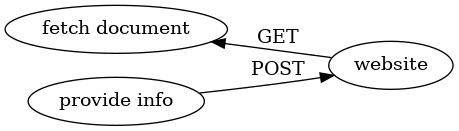
Reliable conversation Human conversation is most reliable when using plain speak. Slang, sarcasm or jokes raise the risk of misunderstandings. This is quite similar in computer conversation. When surfing the Web, you normally "GET" a web page or "POST" new data like a search query. The words "GET" and "POST" are "plain speak" of the World Wide Web defined as a principle called "REST" or "RESTful design". I use the Kannel tool to talk directly to the phones. When an sms arrives on the phone, Kannel "GET"s it to the calendar. That's weakly expressed better if it had "POST"ed the message instead. Kannel is a quite reliable tool, but not RESTful in conversations. That requires extra attention at other parts of the setup to avoid breakage in special situations. That worries me.

Each car has a blog So I setup a gateway from Kannel to RESTful conversation. And choose classic blogging as style of conversation:
  • The carpool fleet is a blogroll
  • each car has a blog
  • each sms emitted from a car is a blog entry
Blogging comes in two flavors, RSS and Atom. Both cover distribution of messages. I use Atom because it is newest and coolest, and because it also covers creating and editing meesages with the AtomPub extension. AtomPub allows the calendar to create an empty message which then triggers an sms from the car which "fills it in." AtomPub also let the calendar "PUT" tags onto existing messages, to mark them as processed, read etc., and let an admin or a cleanup script "DELETE" outdated entries or blogs. The words "PUT" and "DELETE" are RESTful conversation as well.

The system is dancing! My sms-to-blog gateway is written in Perl, using the Dancer toolkit. Dancer makes it simple to setup a RESTful web conversation, and when I contacted the authors on IRC, they swiftly added support for the non-RESTful quirk that I needed. My sms-to-blog gateway is not yet ready, but basic routines work. The project is public, and code is Free Software.

Cyril Brulebois: d-i hacking recipe #2: Adding a wireless module

Problem #2: How to add a wireless module to a d-i image? Slightly longer version: As reported in #686605, a whole wireless module family is missing from the linux kernel udebs, meaning they re missing from the d-i images. Please note the hypothesis here is that the regular linux kernel images contain the relevant modules, only the udebs don t. Recipe #2: Craft a local udeb!
  1. The following assumes one is interested in adding a wireless module, but that can be adapted to other module families. The relevant udeb base name is nic-wireless-modules.
  2. When it comes to linux kernel modules, picking the right ones is important, so one has to consider the ABI. Right now, the current ABI in testing is 3.2.0-3-amd64. The complete udeb name is therefore nic-wireless-modules-3.2.0-3-amd64-di.
  3. If you re running a kernel with the same ABI, all good, relevant modules should be available under /lib/modules/$(uname -r), which is what will be assumed below. Otherwise, one would have to download a proper linux-image-$ABI package, and extract it into a temporary directory to grab the wanted module(s).
  4. Determine the relevant module and its dependencies. As an example, I ll pick a Realtek module: rtl8192cu.ko. If it s loaded, one can use the following to detect its dependencies:
    $ lsmod grep rtl8192cu
    rtl8192cu              78863  0
    rtlwifi                81350  1 rtl8192cu
    rtl8192c_common        52602  1 rtl8192cu
    mac80211              192768  4 iwlwifi,rtl8192c_common,rtlwifi,rtl8192cu
    cfg80211              137140  3 mac80211,iwlwifi,rtlwifi
    usbcore               128498  7 ehci_hcd,usbhid,uvcvideo,rtlwifi,rtl8192cu
    
    But it isn t even needed to load the module to get those dependencies:
    $ /sbin/modinfo /lib/modules/3.2.0-3-amd64/kernel/drivers/net/wireless/rtlwifi/rtl8192cu/rtl8192cu.ko grep ^depends
    depends:        rtlwifi,mac80211,rtl8192c-common,usbcore
    
    Compared to what the d-i image contains, only rtlwifi and rtl8192c-common are missing.
  5. Fetch the udeb using http://packages.debian.org/ or browsing your favourite mirror if you know the paths by heart.
  6. Extract the udeb into a temporary data/ directory, along with its meta data:
    dpkg -x nic-wireless-modules-3.2.0-3-amd64-di_3.2.23-1_amd64.udeb data
    dpkg --control nic-wireless-modules-3.2.0-3-amd64-di_3.2.23-1_amd64.udeb data/DEBIAN
    
  7. Copy the 3 modules under the relevant subdirectory under data/.
  8. Update the version in data/DEBIAN/control, for example by adding the +local1 suffix.
  9. Build a new binary package, using fakeroot to avoid owner/group noise in the diff:
    fakeroot dpkg -b data nic-wireless-modules-3.2.0-3-amd64-di_3.2.23-1+local1_amd64.udeb
    
  10. Use debdiff to check the results:
    $ debdiff nic-wireless-modules-3.2.0-3-amd64-di_3.2.23-1*_amd64.udeb
    Files in second .deb but not in first
    -------------------------------------
    -rw-r--r--  root/root   /lib/modules/3.2.0-3-amd64/kernel/drivers/net/wireless/rtlwifi/rtl8192cu/rtl8192c-common.ko
    -rw-r--r--  root/root   /lib/modules/3.2.0-3-amd64/kernel/drivers/net/wireless/rtlwifi/rtl8192cu/rtl8192cu.ko
    -rw-r--r--  root/root   /lib/modules/3.2.0-3-amd64/kernel/drivers/net/wireless/rtlwifi/rtlwifi.ko
    Control files: lines which differ (wdiff format)
    ------------------------------------------------
    Version: [-3.2.23-1-]  +3.2.23-1+local1+ 
    
  11. Put the resulting udeb under localudebs/ in your d-i build tree, and rebuild your image as usual. Almost-tada!
Why almost ? Because a firmware is needed, so one can go back to the 7th step, extract the proper file (lib/firmware/rtlwifi/rtl8192cufw.bin) from the non-free firmware-realtek package, and add it under data/lib/firmware/realtek/. Rebuild the udeb, rebuild the d-i image. Then: tada!

29 September 2012

Jonathan Carter: LLXC: My little python3-lxc based project


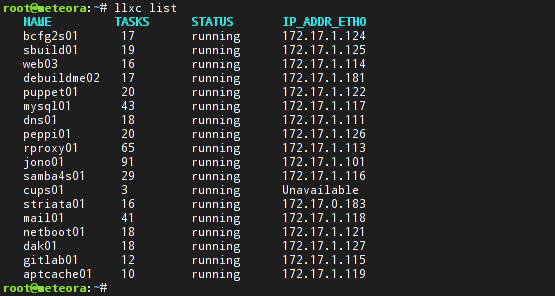
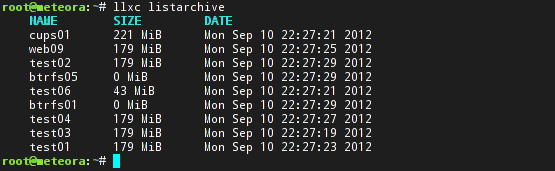
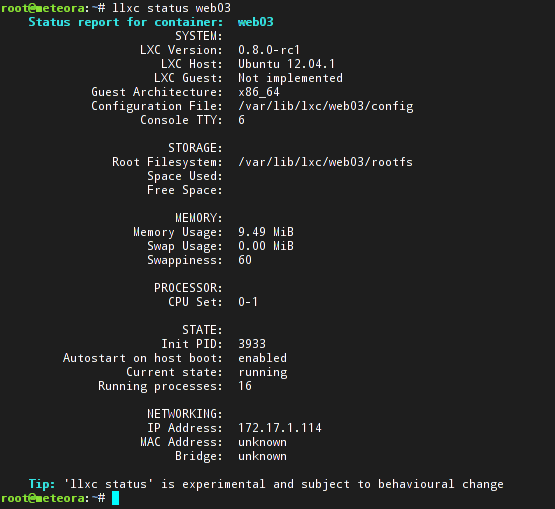
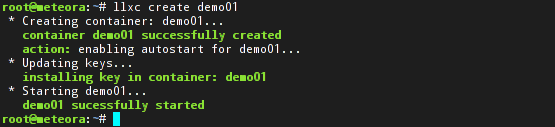
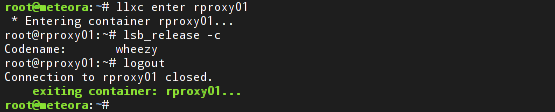
My foray into the world of LXC and RLXC A few months ago, I started trying out LXC (Linux Containers). Before that I used to use OpenVZ, which is an older and more mature contextualization implementation. I was pleased with how well LXC worked and started replacing my personal OpenVZ hosts with LXC. It worked great, but it had a few quirks. While LXC itself works well, the user scripts that ship with it has some space for improvement. The lxc-list command lists anything that s a directory in /var/lib/lxc, so if you have a lost+found directory, it will list it as a container (This has since been fixed upstream). Also, in some cases it would list containers twice or not at all. I was a bit annoyed with that, since OpenVZ s vzlist tool prints out a nice table of your containers along with their IP addresses and other information. Since it s very trivial to implement what I want in a shell script, I went ahead and did just that and called it RLXC. I also missed the vzctl exec <containername> command to execute commands in containers and vzctl enter <containername> to gain a shell inside the container, so I added some more functionality to it so that I could configure ssh keys for these containers and use rlxc enter and rlxc exec like I used to do with the OpenVZ tools, but by using SSH. I also realised that there are others too who wanted similar improvements in the LXC scripts and decided to continue improving RLXC and making it public. Enter LLXC I spoke to St phane about my ideas at the time and he introduced me to python3-lxc that he introduced on his blog yesterday. It provides Python bindings for liblxc, so I took the advantage of that and mostly re-implemented RLXC in Python and called it LLXC. The name doesn t particularly mean anything, I m open to suggestions for what to call it, if anyone cares. Here are some screenshots that explains some of it better than I could do in words: How to get it As St phane mentioned in the python3-lxc blog entry, the API hasn t yet been finalized and llxc itself is in an early state and many changes are planned, so it s definitely not meant for production use yet, but since we believe in release early, release often in the free software community, here goes Currently, llxc.py itself is *very* Ubuntu specific and its only been tested on Ubuntu 12.04, but that will be fixed once more of its kinks have been ironed out. Some people are also working on getting python3-lxc on other distributions, which will help a lot. The llxc.py script itself is hosted on Github: https://github.com/highvoltage/llxc For python3-lxc and friends, you need to enable St phane s experimental PPA: https://launchpad.net/~stgraber/+archive/experimental You will then need to install the following packages: lxc, python3-lxc, python3-crypto, lvm, btrfs-tools To generate the ssh keys used for ssh interaction between the containers, you need to run llxc gensshkeys . The enter and exec commands also rely on your containers being in dns or in your /etc/hosts file, at least for now, which you may have to configure manually. The Future There is a lot that I m planning to add, mostly to scratch my own itches. These include: I ll have some packaging for this available soon and work on making more things work right out of the box, updates will follow. Also, feedback and patches are very welcome!

Steve Kemp: I should bite my tongue.

Too often requests of the form "I'm looking for an open source solution to ..." mean "I'm looking to spend zero money, contribute nothing, and probably not even read your excellent documentation".

28 September 2012

Keith Packard: DRI-Next

Thoughts about DRI.Next On the way to the X Developer s Conference in Nuremberg, Eric and I chatted about how the DRI2 extension wasn t really doing what we wanted. We came up with some fairly rough ideas and even held an informal presentation about it. We didn t have slides that day, having come up with the content for the presentation in the hours just before the conference started. This article is my attempt to capture both that discussion and further conversations held over roast pork dinners that week. A brief overview of DRI2 Here s a list of the three things that DRI2 currently offers. Application authentication. The current kernel DRM authentication mechanism restricts access to the GPU to applications connected to the DRM master. DRI2 implements this by having the application request the DRM cookie from the X server which can then be passed to the kernel to gain access to the device. This is fairly important because once given access to the GPU, an application can access any flink d global buffers in the system. Given that the application sends screen data to the X server using flink d buffers, that means all screen data is visible to any GPU-accessing application. This bypasses any GPU hardware access controls. Allocating buffers. DRI2 defines a set of attachment points for buffers which can be associated with an X drawable. An application needing a specific set of buffers for a particular rendering operation makes a request of the X server which allocates the buffers and passes back their flink names. The server automatically allocates new buffers when window sizes change, sending an event to the application so that it knows to request the new buffers at some point in the future. Presenting data to the user. The original DRI2 protocol defined only the DRI2CopyRegion request which copied data between the allocated buffers. SwapBuffers was implemented by simply copy data from the back buffer to the front buffer. This didn t provide any explicit control over frame synchronization, so a new request, DRI2SwapBuffers, was added to expose controls for that. This new request only deals with the front and back buffers, and either copies from back to front or exchanges those two buffers. Along with DRI2SwapBuffers, there are new requests that wait for various frame counters and expose those to GL applications through the OMLsynccontrol extension What s wrong with DRI2? DRI2 fixed a lot of the problems present with the original DRI extension, and made reliable 3D graphics on the Linux desktop possible. However, in the four years since it was designed, we ve learned a lot, and the graphics environment has become more complex. Here s a short list of some DRI2 issues that we d like to see fixed. Proposed changes for DRI.Next Given the three basic DRI2 operations (authentication, allocation, presentation), how can those be improved? Eliminate DRI/DRM magic-cookie based authentication Kristian H gsberg, Martin Peres, Timoth e Ravier & Daniel Vetter gave a talk on DRM2 authentication at XDC this year that outlined the problems with the current DRM access control model and proposed some fairly simple solutions, including using separate device nodes one for access to the GPU execution environment and a separate, more tightly controlled one, for access to the display engine. Combining that with the elimination of flink for communicating data between applications and there isn t a need for the current magic-cookie based authentication mechanism; simple file permissions should suffice to control access to the GPU. Of course, this ignores the whole memory protection issue when running on a GPU that doesn t provide access control, but we already have that problem today, and this doesn t change that, other than to eliminate the global uncontrolled flink namespace. Allocate all buffers in the application DRI2 does buffer allocation in the X server. This ensures that that multiple (presumably cooperating) applications drawing to the same window will see the same buffers, as is required by the GLX extension. We suspected that this wasn t all that necessary, and it turns out to have been broken several years ago. This is the traditional way in X to phase out undesirable code, and provides an excellent opportunity to revisit the original design. Doing buffer allocations within the client has several benefits: Present buffers through DMA-buf The new DMA-buf infrastructure provides a cross-driver/cross-process mechanism for sharing blobs of data. DMA-buf provides a way to take a chunk of memory used by one driver and pass it to another. It also allows applications to create file descriptors that reference these objects. For our purposes, it s the file descriptor which is immediately useful. This provides a reliable and secure way to pass a reference from an underlying graphics buffer from the client to the X server by sending the file descriptor over the local X socket. An additional benefit is that we get automatic integration of data from other devices in the system, like video decoders or non-primary GPUs. The Prime support added in DRI version 2.8 hacks around this by sticking a driver identifier in the driverType value. Once the buffer is available to the X server, we can create a request much like the current DRI2SwapBuffers request, except instead of implicitly naming the back and front buffers, we can pass an arbitrary buffer and have those contents copied or swapped to the drawable. We also need a way to copy a region into the drawable. I don t know if that needs the same level of swap control, but it seems like it would be nice. Perhaps the new SwapBuffers request could take a region and offset as well, copying data when swapping isn t possible. Managing buffer allocations One trivial way to use this new buffer allocation mechanism would be to have applications allocate a buffer, pass it to the X server and then simply drop their reference to it. The X server would keep a reference until the buffer was no longer in use, at which point the buffer memory would be reclaimed. However, this would eliminate a key optimization in current drivers the ability to re-use buffers instead of freeing and allocating new ones. Re-using buffers takes advantage of the work necessary to setup the buffer, including constructing page tables, allocating GPU memory space and flushing caches. Notifying the application of idle buffers Once the X server is finished using a buffer, it needs to notify the application so that the buffer can be re-used. We could send these notifications in X events, but that ends up in the twisty mess of X client event handling which has already caused so much pain with Invalidate events. The obvious alternative is to send them back in a reply. That nicely controls where the data are delivered, but causes the application to block waiting for the X server to send the reply. Fortunately, applications already want to block when swapping buffers so that they get throttled to the swap buffers rate. That is currently done by having them wait for the DRI2SwapBuffers reply. This provides a nice place to stick the idle buffer data. We can simply list buffers which have become idle since the last SwapBuffers reply was delivered. Releasing buffer memory Applications which update only infrequently end up with a back buffer allocated after their last frame which can t be freed by the system. The fix for this is to mark the buffer purgable, but that can only be done after all users of the buffer are finished with it. With this new buffer management model, the application effectively passes ownership of its buffers to the X server, and the X server knows when all use of the buffer are finished. It could mark buffers as purgable at that point. When the buffer was sent back in the SwapBuffers reply, the application would be able to ask the kernel to mark it un-purgable again. A new extension? Or just a new DRI2 version? If we eliminate the authentication model and replace the buffer allocation and presentation interfaces, what of the existing DRI2 protocol remains useful? The only remaining bits are the other synchronization requests: DRI2GetMSC, DRI2WaitMSC, DRI2WaitSBC and DRI2SwapInterval. Given this, does it make more sense to leave DRI2 as it is and plan on deprecating, and eventually eliminating, it? Doing so would place a support burden on existing applications, as they d need to have code to use the right extension for the common requests. They ll already need to support two separate buffer management versions though, so perhaps this burden isn t that onerous?

Joachim Breitner: The might applicative left fold

Just about three years ago, I created the automatic rule-based time tracker (arbtt), a tool that quietly runs in the background, records your current windows and their titles, and allows you to later process this data using, well, rules. By now, I have almost half a million records, spanning 317 days of me working at the computer. Processing this amount of data has become very memory-hungry: It takes 1G of RAM to process my data. Other users, with a presumably higher sampling rate, report even worse performance, which finally made me approach the problem again. Naturally, one wonders why it is such a memory hog, after all it takes just one run over the data to produce a report. The data itself is a lazy list so the garbage collector should the be able to drop the seen elements immediately. But arbtt is able to print several reports in one run; there is even an option (--each-category) that creates a number of reports based on the data itself. The code was structured that first a number of values that are possibly used by several reports are first created one and then re-used by the reports. And then there is the issue of the filters: The user specifies a what predicates are interesting (e.g., those where he was active) and some reports need to know not only which samples were matched, but also distinguish the consecutive runs of selected samples. Lots of reasons that made it hard to not use the list of of samples several times, which causes it to be completely retained in memory. The idea of completely rewriting everything in a much more imperative way was not appealing. But luckily Haskell s good abstraction possibilities can help here. What is the correct way to traverse a lazy list and calculate some information about it? It is a strict left fold, i.e. an algorithm that can be represented as arguments to
foldl' :: (s -> x -> s) -> s -> [x] -> s
For those who are new to folds: The first argument is a function that processes one element from the list, returning the new state of the processing. The second argument is the initial state. And foldl' can apply such an algorithm to a list to return a final state. So obviously I had to express my reports as left folds. To think clearer about it, I gave them a name. I also added a finishing step to the mix, which is handy:
data LeftFold x a = forall s. LeftFold  
  start :: s,
  process :: s -> x -> s,
  finish :: s -> a
   
A value of type LeftFold x a is then an algorithm that traverses a list of xes and returns something of type a. The forall s. means that the user of such a processor must not make any assumptions about the type of the state. I also have a function that runs such a list processor, simply by invoking foldl' with the arguments stored in the LeftFold constructor:
runLeftFold :: LeftFold x a -> [x] -> a
runLeftFold (LeftFold st1 p1 f1) xs = f1 (foldl' p1 st1 xs)
Now, as a Haskell programmer, I am searching for monads everywhere, and it really would have been nice if this were a monad, as they are very easy to compose. But unfortunately, they do not form a monad. If they did then I could decide after running one processor and looking at the result how I would want to process the list now, but this obviously contradicts with the desire to traverse the list only once. But there is the monad s smaller ugly sibling, the applicative functor. One can still somewhat nicely compose them to form more complex algorithms, just with more restrictions. Here is my instance:
instance Functor (LeftFold x) where
  fmap f (LeftFold st1 p1 f2) = LeftFold st1 p1 (f . f2)
instance Applicative (LeftFold x) where
  pure x = LeftFold () const (const x)
  LeftFold st1 p1 f1 <*> LeftFold st2 p2 f2 = LeftFold  
  start  =  st1 :!: st2,
  process = \(s1 :!: s2) x -> p1 s1 x :!: p2 s2 x,
  finish  = \(s1 :!: s2)  -> f1 s1 (f2 s2)
   
The :!: operator is a strict tuple constructor. This is important, as otherwise the fold would be come a lazy one, I would be building up huge numbers of thunks and performance would be very bad. For the same reason every list processor should make sure that its state does not build thunks once it is in weak head normal form. Now I am at a abstraction level that I feel comfortable working in, by writing functions that combine the list processors in various ways. Probably the most important one for me is already present in the libraries (here with a specialized type):
sequenceA :: [LeftFold x a] -> LeftFold x [a]
This is the whole trick: Now I can, based on the user input, run any number and selection of reports in one single list traversal. I find it very elegant that under the hood , the strict tuples are nested at precisely the right depth depending on the length of the list. As hinted at before, I do some interesting stuff that was previously represented as lists of lists of values. Expressing these as left folds was a bit tricky, but again, the complexity is contained in the combinators that I wrote (although it still gets confusing, check out processIntervalReport in Stats.hs):
monoidFold :: Monoid m => LeftFold m m
mapElems :: LeftFold y a -> (x -> y) -> LeftFold x a 
filterWith :: (x -> Bool) -> LeftFold (Bool :!: x) a -> LeftFold x a
onSelected :: LeftFold x a -> LeftFold (Bool :!: x) a
onJusts :: LeftFold x a -> LeftFold (Maybe x) a
onAll :: LeftFold x a -> LeftFold (Bool :!: x) a
runOnGroups :: (x -> x -> Bool) -> LeftFold x y -> LeftFold y z -> LeftFold x z
runOnIntervals :: LeftFold x y -> LeftFold y z -> LeftFold (Bool :!: x) z
lfLength :: LeftFold x Int
lfFirst :: LeftFold x (Maybe x)
lfLast :: LeftFold x (Maybe x)
toList :: LeftFold x [x]
concatFold :: LeftFold [x] [x]
As a result, the program now only requires 10MB and runs 18% faster. If you wonder why, in the definition of runLeftFold, I do not apply the finish function strictly: That is intentional; I am actually passing the result of a processor that calculates some often required data (e.g. total time recorded) as an argument to all the list processors. (Near the end of the main function in stats-main.hs) This loop works fine as long as I am using these only in the finish functions.
There is one downside to this approach: I cannot easily calculate stuff on demand and share it between two reports. Previously, I could just bind this to a variable, pass it to all reports, only if at least one is interested it would be evaluated and if several are interested, the result would be shared. I do not have a good solution for this yet. The code above is in the self-contained module LeftFold.hs in the arbtt sources.
Several People have had this idea before, here is one blog post by Max Rabkin.
Flattr this post

26 September 2012

Russell Coker: Server Use Per Person

I ve just read Diego s response to an ill-informed NYT article about data-center power efficiency [1]. This makes me wonder, how much server use does each person have? Google Almost everyone uses Google, most of us use it a lot. The main Google product is also probably the most demanding, their search engine. In a typical day I probably do about 50 to 100 Google searches, that sounds like a lot, but half of them would probably be for one topic that is difficult to find. I don t think that I do that many Google searches because I generally know what I m doing and when I find what I need I spend a lot of time reading it. I m sure that many people do a lot more. Each Google search takes a few seconds to complete (or maybe more if it s an image search and I m on a slow link), but I think it s safe to assume that more than a few seconds of CPU time are involved. How much work would each Google search take if performed on a single system? Presumably Google uses the RAM of many systems as cache which gives a result more similar to a NUMA system than one regular server working for a longer time so there is no way of asking how long it would take to do a Google search with a single server. But I m sure that Google has some ratio of servers to the rate of requests coming in, it s almost certainly a great secret, but we can make some guesses. If the main Google user base comprises people who collectively do an average of 100 searches per day then we can probably guess at the amount of server use required for each search based on the number of servers Google would run. I think it s safe to assume that Google doesn t plan to buy one server for every person on the planet and that they want to have users significantly outnumbering servers. So even for core users they should be aiming to have each user only take a fraction of the resources that one server adds to the pool. So 100 searches probably each take more than 1 second of server use. But they almost certainly take a lot less than 864 seconds (the server use if Google had one server for every 100 daily requests which would imply one server for each of the heavier users). Maybe it takes 10 seconds of server use (CPU, disk, or network whichever is the bottleneck) to complete one search request. That would mean that if the Google network was at 50% utilisation on average then they would have 86400*.5/10/100 == 43 users per server for the core user base who average 100 daily requests. If there are 80M core users that would be about 2M servers, and then maybe something like another 4M servers for the rest of the world. So I could be using 1000 seconds of server time per day on Google searches. I also have a Gmail account which probably uses a few seconds for storing email and giving it to Fetchmail, and I have a bunch of Android devices which use Google calendars, play store, etc. The total Google server use on my behalf for everything other than search is probably a rounding error. But I could be out by an order of magnitude, if it only took 1 second of server use for a Google search then I would be at 100 server seconds per day and Google would only need one server for every 430 users like me. Google also serves lots of adverts on web sites that I visit, I presume that serving the adverts doesn t take much resources by Google standards. But accounting for it, paying the people who host content, and detecting fraud probably takes some significant resources. Other Big Services There are many people who spend hours per day using services such as Facebook. No matter how I try to estimate the server requirements it s probably going to be fairly wrong. But I ll make a guess at a minute of server time per hour. So someone who averages 3 hours of social networking per day (which probably isn t that uncommon) would be using 180 seconds of server time. Personal Servers The server that hosts my blog is reasonably powerful and has two other people as core users. So that could count as 33% of a fairly powerful server in my name. But if we are counting server use per USER then most of the resources of my blog server would be divided among the readers. My blog has about 10,000 people casually reading it through Planet syndication, that could mean that each person who casually reads my blog has 1/30,000 of a server allocated to them for that. Another way of considering it is that 10% of a server (8640 seconds) is covered by me maintaining my blog and writing posts, 20% is for users who visit my blog directly, and 3% is for the users who just see a Planet feed. That would mean that a Planet reader gets 1/330,000 of a server (250ms per day) and someone who reads directly gets 1/50,000 of a server (1.72s per day) as I have about 10,000 people visiting my blog directly in a month. My mail server which is also shared by a dozen or so people (maybe that counts as 5% of a server for me or 4320 seconds per day). Then there s the server I use for SE Linux development (including my Play Machine) and a server I use as a DNS secondary and a shell server for various testing and proxying. Other People s Servers If every reader of a Planet instance like Planet Debian and Planet Linux Australia counts as 1/330,000 of a server for their usage of my blog, then how would that count for my own use of blogs? I tend to read blogs written by the type of people who like to run things themselves, so there would be a lot of fairly under-utilised servers that run blogs. Through Planet Debian and Planet Linux Australia I could be reading 100 or more blogs which are run in the same manner as mine, and in a typical day I probably directly visit a dozen blogs that are run in such a manner. This could give me 50 seconds of server time for blog reading. Home Servers I have a file server at home which is also a desktop system for my wife. In terms of buying and running systems that doesn t count as an extra server as she needs to have a desktop system anyway and using bigger disks doesn t make much difference to the power use (7W is the difference between a RAID-1 server and a single disk desktop system). I also have a PC running as an Internet gateway and firewall. Running servers at home isn t making that much of an impact on my computer power use as there is only one dedicated 24*7 server and that is reasonably low power. But having two desktop systems on 24*7 is a significant factor. Where Power is Used/Wasted No matter how things are counted or what numbers we make up it seems clear that having a desktop system running 24*7 is the biggest use of power that will be assigned to one person. Making PCs more energy efficient through better hardware design and better OS support for suspending would be the best way of saving energy. Nothing that can be done at the server side can compare. Running a server that is only really used by three people is a significant waste by the standards of the NYT article. Of course the thing is that Hetzner is really cheap (and I m not contributing any money) so there isn t a great incentive to be more efficient in this regard. Even if I allocate some portion of the server use to blog readers then there s still a significant portion that has to be assigned to me for my choice to not use a managed service. Running a mail server for a small number of users and running a DNS server and a SE Linux development server are all ways of wasting more power. But the vast majority of the population don t have the skills to run their own server directly, so this sort of use doesn t affect the average power use for the population. Nothing else really matters. No matter what Google does in terms of power use it just doesn t matter when compared to all the desktop systems running 24*7. Small companies may be less efficient, but that will be due to issues of how to share servers among more people and the fact that below a certain limit you can t save money by using less resources particularly if you pay people to develop software. Conclusion I blame Intel for most of the power waste. Android phones and tablets can do some amazing things, which is hardly surprising as by almost every measure they are more powerful than the desktop systems we were all using 10 years ago and by many measures they beat desktop systems from 5 years ago. The same technology should be available in affordable desktop systems. I d like to have a desktop system running Debian based on a multi-core ARM CPU that can drive a monitor at better than FullHD resolution and which uses so little power that it is passively cooled almost all the time. A 64bit ARM system with 8G of RAM a GPU that can decode video (with full Linux driver support) and a fast SSD should compete well enough with typical desktop systems on performance while being quiet, reliable, and energy efficient. Finally please note that most of this post relies on just making stuff up. I don t think that this is wrong given the NYT article that started this. I also think that my estimates are good enough to draw some sensible conclusions. Related posts:
  1. Name Server IP and a Dead Server About 24 hours ago I rebooted the system that runs...
  2. Google Custom Search Engine I ve just been experimenting with Google Custom Search [1]. Below...
  3. Google Server Design Cnet has an article on the design of the Google...

NOKUBI Takatsugu: Debian Packaging dojo

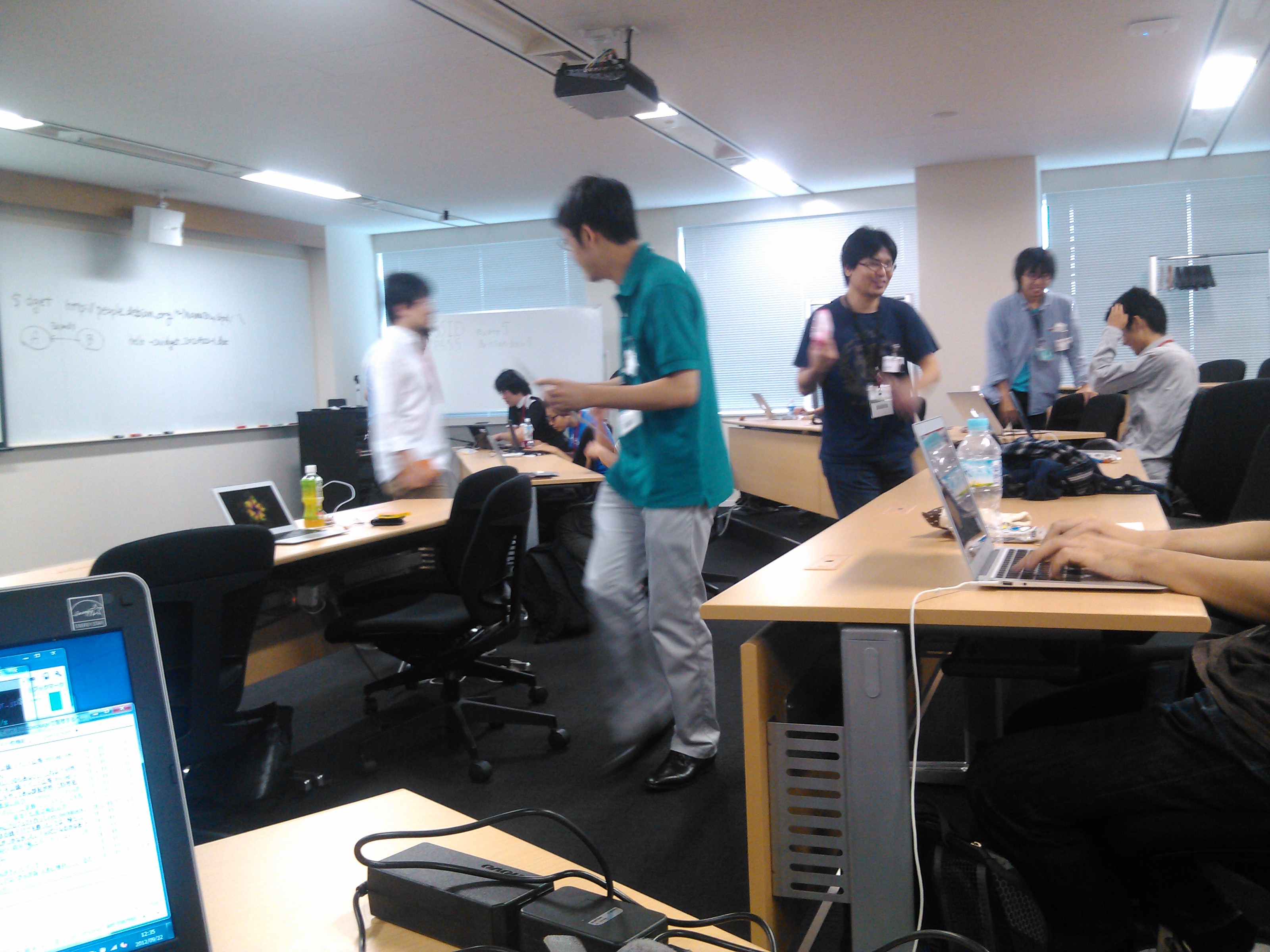
I attended Debian Packaging Dojo at 22 Aug. Dojo ( ) means a training hall for karate, judo, and/or kendo in Japanese. The event is a training for Debian packaging. Attendants were about 15 people. I could learn modern packaging methods. The place is Rakuten Tower in Shinagawa, thank you Rakuten company and Taku YASUI <tach at debian.org>.

24 September 2012

Felipe Augusto van de Wiel: 24 Sep 2012

A new journey ahead
Changing jobs and moving to a new country... it's just the beginning.

On September 30th, 2012 I'm moving to Menlo Park, CA, USA because back in December 2011 I accepted a job offer as a sysadmin (the name is fancier: Operations Engineer) in Silicon Valley. Since then I'm working on the required documentation, so far everything had worked out. I'm starting at the new work on October 8th, and as I'm arriving on October 1st, I'll have a week to take a look around and get to know a tiny bit of San Francisco Bay Area.


In different levels and aspects it is a big opportunity for me, and I'm confident it'll be an unique experience, not only professional, which of course involves working in a bigger company with more complex scenarios and bigger challenges, and on the personal side, I'll live abroad, be an expat.


As you may imagine, I'm working on this process for more or less 10 months, but in the last 30 days it got more intense. Quitting my jobs, organizing my stuff, cleaning part of backlog (and finding out a have a huge to-do list awaiting for me). Spending quality time with family and friends, and also saying goodbye to them. Finishing some aspects of the move (travel tickets, temporary living).


It's new, it's different! I'm super excited and I do want to change a few things to make it easier for family and friends to keep up, make it easier to follow the news, which might help with the distance.
And now for something completely different! See you all pretty soon! :-)

20 September 2012

Matthew Garrett: UEFI Bootkits

The Register covered a story on a UEFI-based attack on Windows 8. It's actually covering this technical writeup, which is a discussion of a proof of concept implementation of an attack on the Windows 8 kernel from the firmware environment. The first approach they describe is pretty straightforward, in that they simply patch the Windows bootloader directly. Since this is what's reading the kernel off disk and launching it, patching that code means you can modify the kernel in-place and run it with built-in privilege elevation exploits.

The second approach is a little more interesting, and is based on their observation that the UEFI ExitBootServices() function is called after the kernel is loaded but before it's executed. UEFI calls are simply function pointers, so if you can run code in the firmware environment it's trivial to simply replace the function pointer with one to code of your own which does whatever you want before calling the original code. This makes it pretty straightforward to add a hook that gets run when ExitBootServices() is called, finds the kernel, patches it and then continues on its way. Since the kernel is patched after it's been read, this gets around any kind of signature checking that the bootloader might carry out.

But both these cases have something in common: they rely on the ability to run arbitrary code in the firmware environment, and that's precisely the thing that UEFI Secure Boot prevents. A system with a correct implementation of Secure Boot isn't vulnerable to the described attacks, but it's fairly unsurprising that running UEFI without Secure Boot is vulnerable. UEFI on its own doesn't provide any additional security. You're as vulnerable to bootkits as you are with BIOS.

So this isn't really a story about a surprising vulnerability. It's a story about someone taking the logical step of implementing a bootkit on top of UEFI, which is what everyone should have been expecting all along. Computers that are configured to run arbitrary code will run arbitrary code, and if that arbitrary code happens to modify your kernel so your credit card details are automatically posted to pastebin, well, that's a plausible outcome.

comment count unavailable comments

19 September 2012

Stefano Zacchiroli: bits from the DPL for August 2012

DPL August report, posted on d-d-a a while ago (yep, I forgot to blog it up to now!, sorry for the oldies).
Dear project members, August has been a month with a good deal of vacations for many of us, including yours truly. Therefore the monthly report of DPL activities will be briefer than usual. Which is good, as it'll leave all my readers more time to do NMUs and fix RC bugs! Ongoing discussions Assets Core teams Legal and RC fun Hardware See? It's been quick(er)! Talk to you here next month, with a much lower count of Wheezy RC Bugs on the horizon, hopefully.
Cheers.
PS the boring day-to-day activity log for August 2012 is available at master:/srv/leader/news/bits-from-the-DPL.txt.201208

Raphael Geissert: More mirrors, slightly better IPv6 support and more

As announced in the Debian Project News of September more mirrors have recently joined Debian's mirrors network. Two more have been added since that issue of DPN was released, and about four more might be added any day now. Many thanks to those sponsoring them!

The mirrors redirector has also received some improvements, and around 2.5 million requests a week.
Among the improvements, users of teredo and 6to4 tunnels are now handled as IPv4 users. Not only it gives them access to a wider range of mirrors, but it also avoids the tunnel overhead.

Another improvement is the prompt detection of mirrors that drop architectures without prior notification. This is thanks to a new version of ftpsync, the standard and recommended tool to create Debian mirrors suitable for Debian's mirrors network.
As more mirror administrators upgrade to the newer version, or switch to it, http.debian.net and other tools become more reliable: they no longer need to perform some checks and hope the results mean the mirrors actually include the architectures they say they include.

In this regard, http.debian.net is an improvement over debian-installer's mirrors selection menu: not only it chooses a mirror that is close to the user and up to date, it also ensures the mirror provides the files for an architecture even after the installer image has been built. debian-installer's mirrors list is static and hard-coded into the installation media.

There's more to come, stay tuned.

18 September 2012

Wouter Verhelst: Mel Gorman is my hero

It's taken years to get here, but Mel finally got a series of patches into the kernel, including this one, which should prevent deadlocks of machines doing swap-over-NBD. This means that one of my longest-running wishlist items has finally been attended to. Mel, I owe you a beer. Update: Mel seems to think I don't owe him beer. Obviously he's wrong.

17 September 2012

Tanguy Ortolo: Naming LVM volume groups

From Tango Desktop Project When you start using Linux' logical volume manager, one of the first question you have to answer is: what name will you give to your volume group? The usual answer is: vg1, vg2, etc. Although it does not bear any specific meaning, this naming convention is simple and seems functional enough. In fact, this is a bad idea, which can have nasty consequences on the long term. Here is why: one day, your computer will eventually give out. To save your precious data, you will remove its drives and plug them into another computer. If you are using LVM with the same naming convention on that second computer, you will then get a name conflict, which will prevent you from seeing the volume group you want to recover. The solution is to name volume groups uniquely across all your computers, and if possible other people's. An elegant way to achieve this is to use your host names as a basis. For instance, on a machine called Pi acolada , you would name a single volume group pinacolada , or two volume groups pinacolada1 and pinacolada2 . Or perhaps vg-pinacolada0 or whatever, you get the idea.

Andrea Veri: Building Debian packages with Deb-o-Matic

Today I ll be telling you about an interesting way to build your Debian packages using Deb-o-Matic, a tool developed and maintained by Luca Falavigna. Some more details about this tool from the package s description:
Deb-o-Matic is an easy to use build machine for Debian source packages based on pbuilder, written in Python. It provides a simple tool to automate build of source packages with limited user interaction and a simple configuration. It has some useful features such as automatic update of pbuilder, automatic scan and selection of source packages to build and modules support.
The setup. 1. Download the package.
apt-get install debomatic
2. Modify the main configuration file as follows:
[default]
builder: pbuilder
packagedir: /home/john/debomatic # Take note of the following path since we'll need it for later use.
configdir: /etc/debomatic/distributions
pbuilderhooks: /usr/share/debomatic/pbuilderhooks
maxbuilds: 3 # The number of builds you can perform at the same time.
inotify: 1
sleep: 60 # The sleep time between one build and another.
logfile: /var/log/debomatic.log
[gpg]
gpg: 0 # Change to 1 if you want Deb-O-Matic to check the GPG signature of the uploaded packages.
keyring: /etc/debomatic/debomatic.gpg # Add the GPG Keys you want Deb-O-Matic to accept in this keyring.
[modules]
modules: 1 # A list of all the available modules will follow right after.
modulespath: /usr/share/debomatic/modules
[runtime]
alwaysupdate: unstable experimental precise
distblacklist:
modulesblacklist: Lintian Mailer
mapper:  'sid': 'unstable',
'wheezy': 'testing',
'squeeze': 'stable' 
[lintian]
lintopts: -i -I -E --pedantic # Run Lintian in Pedantic mode.
[mailer] # You need an SMTP server running on your machine for the mailer to work. You can have a look at the 'Ssmtp' daemon which is a one-minute-setup MTA, check an example over here.
fromaddr: debomatic@localhost
smtphost: localhost
smtpport: 25
authrequired: 0
smtpuser: user
smtppass: pass
success: /etc/debomatic/mailer/build_success.mail-template # Update the build success or failure mails as you wish by modifying the relevant files.
failure: /etc/debomatic/mailer/build_failure.mail-template
[internals]
configversion = 010a
The available modules are:
  1. Contents , which acts as a dpkg -c over the built packages.
  2. DateStamp , which displays build start and finish times into a file in the build directory.
  3. Lintian , which stores Lintian output on top of the built package in the pool directory.
  4. Mailer , which sends a reply to the uploader once the build has finished.
  5. PrevBuildCleaner , which deletes all files generated by the previous build.
  6. Repository , which generates a local repository of built packages.
2. Configure dput to upload package s sources to your local repository, edit the /etc/dput.cf file and add this entry:
[debomatic]
method = local
incoming = /home/john/debomatic
or the following if you are going to upload the files to a different machine through SSH:
[debomatic]
login = john
fqdn = debomatic.example.net
method = scp
incoming = /debomatic
3. Add a new Virtual Host on Apache and access the repository / built packages directly through your browser:
<VirtualHost *:80>
ServerAdmin john@example.net
ServerName debomatic.example.net
DocumentRoot /home/john/debomatic
<Directory /home/john/debomatic>
Options Indexes FollowSymLinks MultiViews
AllowOverride None
Order allow,deny
allow from all
</Directory>
</VirtualHost>
4. Start the daemon:
sudo /etc/init.d/debomatic start
5. (Optional) Add your repository to APT s sources.list:
deb http://debomatic.example.net/ unstable main contrib non-free
6. (Optional) Start Deb-O-Matic at system s startup by modifying the /etc/init.d/debomatic file at line 21:
- [ -x "$DAEMON" ]   exit 0
- [ "$DEBOMATIC_AUTOSTART" = 0 ] && exit 0
+ [ -x "$DAEMON" ]   exit 0
+ [ "$DEBOMATIC_AUTOSTART" = 1 ] && exit 0
and finally add it to the desired runlevels:
update-rc.d debomatic defaults
Enjoy!

Craig Small: Careful with PIDs

Quick question, what is the lowest Process ID you will find? Most people (myself included until recently) would be able to say that the lowest number is 1 for the init process. Plenty of programs including ps and pstree have this assumption. This assumption bit me this week with Debian Bug 687829 where pstree on a kFreeBSD would not return and used 100% CPU. What was happening? Well it seems that kFreeBSD has a process ID of 0 and pstree used 0 for a fake root to the tree. So with a real and fake process #0 hanging around in pstree there was a strange parent-child circle (I m my own grandad!) between init and process 0 meaning when the tree was walked things go around in circles. The fix is basically to assume the tree starts at 0 and not 1 and that keeps things into perspective. So if you are wondering how inconsistent this goes, here is the list. So Linux the root is init PID 1, FreeBSD it is kernel PID 0 and Hurd its init PID 1 with a child with PID 0. Nothing like consistency! I do like the crazyness of Hurd where a child is created before a parent; nothing is normal in Hurd-land. I have some temporary code going proving the problem with psmisc and FreeBSD, the tree now looks like what you can see below. This fix will also show up processes hidden under init that were previously hiding.
?()-+-acpi_cooling0(16)
     -acpi_thermal(15)
     -audit(10)
     -bufdaemon(18)
     -flowcleaner(22)
     -g_down(4)
     -g_event(2)
     -g_up(3)
     -hald-runner(547)---hald-addon-storag(569)
     -hald(546)-+-hald(548)---hald(549)
                 -hald-runner(547)---hald-addon-storag(569)
     -hald(548)---hald(549)
     -idle(11)
     -init(1)-+-etc....

16 September 2012

Russell Coker: Servers in the Office

I just had a conversation with someone who thinks that their office should have no servers. The office in question has four servers, an Internet gateway/firewall system, the old file server (and also Xen server), the new file server, and the VOIP server. The Internet gateway system could possibly be replaced by a suitably smart ADSL modem type device, but that would reduce the control over the network and wouldn t provide much of a benefit. The VOIP server has to be a separate system for low latency IMHO. In theory you could use a Xen DomU for running Asterisk or you could run Asterisk on the Dom0 of the file/Xen server. But that just makes things difficult. A VOIP server needs to be reliable and is something that you typically don t want to touch once it s working, in this case the Asterisk server has been a few more years without upgrades than the Xen server. An Asterisk system could be replaced by a dedicated telephony device which some people might consider to be removing a server, but really a dedicated VOIP server device is just as much of a server as a P4 running Asterisk but with greater expense. A major advantage of a P4 running Asterisk is that you can easily replace the system at no cost if there is a hardware problem. Having two file servers is excessive for a relatively small office. But running two servers is the common practice when one server is being replaced. The alternative is to just immediately cut things over which has the potential for a lot of people to arrive at work on Monday and find multiple things not working as desired. Having two file servers is a temporary problem. File Servers The first real problem when trying to remove servers from an office is the file server. ADSL links with Annex M can theoretically upload data at 3Mb/s which means almost 400KB/s. So if you have an office with a theoretically perfect ADSL2+ Annex M installation then you could save a 4MB file to a file server on the Internet in not much more than 10 seconds if no-one else is using the Internet connection. Note that 4MB isn t THAT big by today s standards, the organisation in question has many files which are considerably bigger than that. Large files include TIFF and RAW files used for high quality image processing, MS-Office documents, and data files for most accounting programs. Saving a 65MB quick-books file in 3 minutes (assuming that your Annex M connection is perfect and no-one else is using the Internet) would have to suck. Then there s the issue of reading files, video files (which are often used for training and promotion) are generally larger than 100MB which would be more than 30 seconds of download time at ADSL2+ speed but if someone sends an email to everyone in the office saying please watch this video then the average time to load it would be a lot more. Through quickly examining my collection of Youtube downloads I found a video which averaged 590KB/s, if an office using a theoretically perfect ADSL2+ connection giving 24Mb/s (3MB/s) download speed had such a file on a remote file server then a maximum of five people could view it at one time if no-one else in the office was using the Internet. Now when the NBN is connected (which won t happen in areas like the Melbourne CBD for at least another 3 years) it will be possible to get speeds like 100Mb/s download and 25Mb/s upload. That would allow up to 20 people to view videos at once and a 65MB quick-books file could be saved in a mere 22 seconds if everyone else was idle. Of course that relies on the size of data files remaining the same for another 3 years which seems unlikely, currently no Youtube videos use resolutions higher than 1920*1080 (so they don t take full advantage of a $400 Dell monitor) and there s always potential for storing more financial data. I expect that by the time we all have 100Mb/25Mb speeds on the NBN it will be as useful to us as 24Mb/3Mb ADSL2+ Annex M speeds are today (great for home use but limited for an office full of people). There are of course various ways of caching data, but all of them involve something which would be considered to be a server and I expect that all of them are more difficult to install and manage than just having a local file server. Of course instead of crunching the numbers for ADSL speeds etc you could just think for a moment about the way that 100baseT networking to the desktop has been replaced by Gigabit networking. When people expect each workstation to have 1000Mb/s send and receive speed it seems quite obvious that one ADSL connection shared by an entire office isn t going to work well if all the work that is done depends on it. Management could dictate that there is to be no server in the office, but if that was to happen then the users would create file shares on their workstations so you would end up with ad-hoc servers which aren t correctly managed or backed up. That wouldn t be an improvement and technically wouldn t achieve the goal of not having servers. Home Networking Without Servers It is becoming increasingly common to have various servers in a home network. Due to a lack of space and power and the low requirements a home file server will usually be a workstation with some big disks, but there are cheap NAS devices which some people are installing at home. I don t recommend the cheap NAS devices, I m merely noting that they are being used. Home entertainment is also something that can benefit from a server. A MythTV system for recording TV and playing music has more features than a dedicated PVR box. But even the most basic PVR ($169 for a 1TB device in Aldi now) is still a fairly complex computer which would probably conflict with any aim to have a house free of servers. The home network design of having a workstation run as a file and print server can work reasonably well as long as the desktop tasks aren t particularly demanding (IE no games) and the system doesn t change much (IE don t track Debian/Testing or otherwise have new versions of software). But this is really something that only works if you only have a few workstations. Running an office without servers seems rather silly as it seems that none of my friends are able to have a home without a server. Running Internet Services Hypothetically speaking if one was to run an office without servers then that would require running all the servers in question on the Internet somewhere. For some things this can work better than a local server, for example most of my clients who insist on running a mail server in their office would probably get a better result if they had a mail server running on Linode or Hetzner or one of the Hosted Exchange offerings if they want a Windows mail sever. But for a file server if you were to get around the issue of bandwidth required to access the files in normal use there s the issue of managing a server (which is going to take more effort and expense than for a server on the LAN). Then there s the issue of backups. In my previous post about Hard Drives for Backup [1] I considered some of the issues related to backing data up over the Internet. The big problem however is a complete restore, if you have even a few dozen gigs of data that you want to transfer to a remote server in a hurry it can be a difficult problem. If you have hundreds of gigs then it becomes a very difficult problem. I m sure that I could find a Melbourne based Data Center (DC) that gives the option of bringing a USB attached SATA disk for a restore but even that case would give a significant delay when compared to backing things up on a LAN. If a server on the office LAN breaks in the afternoon my client can make arrangements to let me work in their office in the evening to fix it, but sometimes DCs don t allow 24*7 access and sometimes when they do allow access there are organisational problems that make it impossible when you want it (EG the people at the client company who are authorised become unavailable). The Growth of Servers Generally it s a really bad idea to build a server that has exactly the hardware you need. The smart thing to do is to install more of every resource (disk, RAM, CPU, etc) than is needed and to allow expansion when possible (EG have some RAM slots and drive bays free). No matter how well you know your environment and it s users you can get surprised by the way that requirements change. Buying a slightly bigger server at the start costs hardly any money but upgrading a server will cost a lot. Once you have a server that s somewhat over-specced you will always find other things to run on it. Many things could be run elsewhere at some cost, but if you have unused hardware then you may as well use it. Xen and other virtualisation systems are really good in this regard as they allow you to add more services without making upgrades difficult. This means that it s quite common to have a server that is purchased for one task but which ends up being used for many tasks. Anyone who would aspire to an office without servers would probably regard adding extra features in such a manner to be a problem. But really if you want to allow the workers to do their jobs then it s best to be able to add new services as needed without going through a budget approval process for each one. Conclusion There probably are some offices where no-one does any serious file access and everyone s work is based around a web browser or some client software that is suited to storing data on the Internet. But for an office where the workers use traditional Office software such as MS-Office or Libre-Office a file server is necessary. Some sort of telephony server is necessary no matter how you do things. If you have a traditional telephone system then you might try not to call the PABX a server , but really that s what it is. Then when the traditional phone service becomes too expensive you have to consider whether to use Asterisk or a proprietary system, in either case it s really a server. In almost every case the issue isn t whether to have a server in the office, but how many servers to have and how to manage them. Related posts:
  1. Planning Servers for Failure Sometimes computers fail. If you run enough computers then you...
  2. a good security design for an office One issue that is rarely considered is how to...
  3. Efficiency of Cooling Servers One thing I had wondered was why home air-conditioning systems...

15 September 2012

Martin-&#201;ric Racine: HTML5: Firefox without Flash

Over the past few days, I decided to purge Gnash and LightSpark from my laptop to see whether my Internet experience would be affected in any dramatic way. Amazingly, a number of sites seem to offer video content encoded in Theora (VP3) or WebM (VP8). Sadly, a handful of popular sites such as Vimeo insist upon using the H.264 (MPEG-4) CODEC, which cannot be safely supported on Free Software because of unclear licensing issues that might impose an ulterior usage fee onto the end-users.

The good news is that the Mozilla Foundation has decided to avoid the issue together: starting with the most recent release of the mobile version of Firefox, content decoding is offloaded to the platform's native media CODEC library. On most Free Software platforms, this means that Gstreamer will handle the content and, in turn, use gstreamer-plugins-bad to perform the decoding. However, Gstreamer support is still rather sketchy, as attested by this Debian bug report and thus disabled by default. This leaves me wondering how little is missing for this to properly work. Would either Canonical or Red Hat perhaps be interested in funding this?

Next.

Previous.