Search Results: "agi"

24 April 2008

Dirk Eddelbuettel: smtm maintenance release 1.6.9.1

A new version of smtm went to Debian yesterday. And after some pondering, I also just uploaded it to CPAN even though it only contains minor Debian packaging fixes rather than genuine code changes. In order to signal that the core Perl code hasn't changed, I simply added a new minor to move the version from 1.6.9 to 1.6.9.1.

Gunnar Wolf: Password security, data safety - A government perspective

One week ago, I went to a branch office of Servicio de Administraci n Tributaria, the government office in charge of processing taxes. This year, I plan on doing something quite bold, as my Mexican friends will acknowledge: I will prepare my (quite simple, I hope) tax declaration by myself. I do not want to be held hostage of the accountant guild - So I might end doing some fuckup which in the end costs me money or time. I hope it is not the case.
Anyway... Last week I went to this office, as I needed either a CIECF (Clave de Identificaci n Electr nica Confidencial Fortalecida - Strengthened Confidential Electronic Identification Key) or a FIEL (Firma Electr nica Avanzada - Advanced Electronic Signature). No, please don't believe it is a security token, a card with printed numbers, a one-time-pad or the sort - The CIECF is... A password. Why is it strengthened? Because it has the feature of including a question, in case you forget the key, to allow you to change it. I guess the FIEL is a more reliable device, but I prefer not to even request it.
And as far as the questions go, the emergency questions for CIECF suck. First, I was not even asked the meta-question - I was not told why this information was needed. So imagine the clerk saying: Full name? ... Date of birth? ... RFC (Tax ID)? ... Favorite color? I was there just... Stunned. Why do you need it? Oh, just in case you forget your password. Ok... Don't you have any other questions which I am not prone to answer a different thing, and that are not dead obvious for a casual passer-by? (I guess that at least 1/4 of the public will say blue. Feel like brute-forcing SAT to its knees?) Other questions include your fathers' second family name, your favorite soccer team, your pet's name... It seems they took the first "security dos and don'ts" book off the wall, and started reading backwards.
But anyway, that's the system, and I must play nice with it. So I get back home, and decide to start hacking up my declaration. No, Mr. Policeman, I'm not saying I would try to break into the SAT - I just say it is a complex and non-obvious task to do. Now please release me. Thanks.
And I enter the system. Of course, I tried first with Iceweasel, knowing it would fail (it is documented: MSIE 5.5 recommended). I tried again with Konqueror. I tried, sigh, with MSIE from inside Wine. No luck. Well, even from within qemu's Windows 2000. Wrong password. WTF?! Stranger: It worked with SAT's My portal, although it didn't with the declaration, which is what matters now.
I cannot take the time every day to come to the SAT and move my data - It was a full week until I came back again. I insisted on fully logging in to the system, to be sure the password I entered this time was right. As well as my ber-secret safety question, of course.
And it failed.
Twice.
Until the clerk noticed something strange in the way I typed...
Sir, excuse me..., he muttered, why are you typing such a long password? Well, basically because I value my tax declaration, and I know brute force is a powerful force. (explain it, of course, in simple terms) Oh... No, the password must be eight characters long.
No wonder.
So I entered the first eight characters of my password, which was a true work of prose for their standards, at around 20 characters. And it worked.
Now, for bonus points: What do we gather from the fact that the long password works fine in one system, but in another system it only the short version? Why, but of course! I guess the passwords for every economically active Mexican is stored in their master database in plain text. Isn't it just beautiful?
Anyway, it seems I have a lot of work to do. If all goes as planned, maybe next year I will be for hire as a public accountant? Hmh, does not sound too much like fun, does it?

Stefano Zacchiroli: unexpected kudos from TBL

Sir Tim Berners-Lee kudos the Debian packaging system I'm currently in Beijing to deliver a talk at the WWW2008 conference, and I just came back from the usual magnificent banquet of big conferences. Before the banquet it was scheduled a keynote talk by Sir Tim Berners-Lee. What is the least thing you expect to hear from Sir Tim mouth in such a talk? I for sure hadn't expected to hear kudos to the Debian packaging system! But in fact I did hear that and apparently I was not the only one (though probably I was the only one who got excited about it, attracting the attention of my table-mates). He was talking about various shortcoming to be addressed in the future of the Web, and one was the hackish way in which Javascript/AJAX applications are deployed on the web, with no encapsulation/packaging of libraries. Well, as an example to tend to he then mentioned the packaging system of our beloved distribution. It is really the time to say: we are just one step away from the total world (wide web) domination.

Theodore Ts'o: Organic vs. Non-organic Open Source

Brian Aker dropped by and replied to my previous essay by making the following comment:
I believe you are hitting the nail on the organic vs nonorganic open source. I do not believe we have a model for going from one to the other. Linux and Apache both have very different models for contribution but I don t believe either are really optimized at this point. Optimization to me would lead to a system of less priests and more inclusion.
I made an initial reply as comment, and then decided it was so long that I should promote it to a top-level post. I assume that when Brian talks about “organic open source” what he means is what I was calling an “open source development community”. Some googling turned up the following definition from Mozilla Firefox’s organic software page: “Our most well-known product, Firefox, is created by an international movement of thousands, only a small percentage of whom are actual employees.” This puts it in contrast with “non-organic” software, where all or nearly all of the developers are employed by one company. (And anyone who proves talented at adding features to that source base soon gets a job offer by that one company. :-) By that definition we can certainly see projects like Wine, Mysql, Ghostscript (at one time), and others as fitting into that model, and being quite successful. There’s nothing really wrong with the non-organic software model, although many of them have struggled to make enough money when competing with pure proprietary softare competitors, with MySQL perhaps being the exception which proves the rule. In most of these cases, though, the project started more as an organic open source, and then transitioned into the non-organic model when there was a desire to monetize the project and/or when the open source programmers decided that it would be nice if they could turn their avocation into a vocation, and let their hobby put food on the family table. Solaris, of course, is doing something else quite different, though. They are trying to make the transition from a proprietary customer/supplier relationship to trying to develop an Open Source community and what John s candidate statement pointed out is that they weren t really interested in creating an organic open source developer community at all, but they wanted the fruits of an open source community with plenty of application developers, end-users, etc., all participating in that community. We don t have a lot of precedent for projects who try to go in this direction, but I suspect they are skipping a step when they try to go to the end step without bothering to try to make themselves open to outside developers. And by continuing to act like a corporation, they end up shooting themselves in the foot. For example, the OpenSolaris license still prohibits people from publishing benchmarks or comparisons with other operating systems. Very common in closed-source operating systems and databases, but it discourages people from even trying to make things better, both within and outside of the Open Solaris core team. Instead, they respond to posts like David Miller s with Have you ever kissed a girl? . (Thanks, Simon, for that quote; I had seen it before, but not for a while, and it pretty well sums up the sheer arrogance of the Open Solaris development team.) So while Linux may not be completely optimized in terms of less priests and more inclusion, at least over 1200 developers contributed to 2.6.25 during its development cycle. Compared to that, Open Solaris is positively dominated by high priests and with a you may not touch the holy-of-holies attitude; heck, they won t even allow you to compare them to other religions without branding you a heretic and suing you for licensing violations!

23 April 2008

Christian Perrier: More news from the lenny l10n NMU campaign

A few news from the campaign of NMU's targeted at bringing po-debconf translation ratio as high as possible for as many languages as possible (and also improve packaging quality quite significantly on many loosely maintained packages). Maintainers are incredibly cooperative (at least those who are active..:-)). l10n NMUs are always welcomed. Some prefer uploading themselves which is of course perfectly OK. I will now also focus my efforts to minimize uncoordinated changes to debconf templates. Those are generally motivated by the will to follow writing style guidelines, which is perfectly OK. I however still suggest maintainers to send call for translation updates *before* uploading packages with modified templates. Will probably soon post that suggestion to -release.

Joey Hess: cdbs killer (design phase)

simple case Imagine a very simple debian/rules, that should work for most packages w/o modification:
#!/usr/bin/make -f
build:
    dh build
clean:
    dh clean
binary-arch:
    dh binary-arch
binary-indep:
    dh binary-indep
binary: build binary-arch binary-indep
absurdly simple case
AKA debian/rules zen guru level.
#!/usr/bin/make -f
%:
    dh %@
the complex cases Often you'll want to handle configuring by hand. (And maybe, run automake too.)
build:
    dh build --before configure
    #aclocal
    #autoheader
    #automake --add-missing
    #autoconf
    ./configure --kitchen-sink=yes
    dh build --after configure
Here's how to skip two steps in a row (configure and build):
build:
    dh build --before configure
    ./mondoconfig
    make universe-explode-in-delight GROOVINESS=420
    dh build --after build
Another common case is wanting to run some code manually after a particular debhelper command is run.
binary: build
    dh binary --until dh_fixperms
    # dh_fixperms has run, now override it for one program
    chmod 4755 debian/foo/usr/bin/foo
    # and continue
    dh binary
Suppose you hate dh_strip, and just don't want it to run. (This might be a contrived example; if people frequently don't want to run a few commands in a set, it may be better to have -X exclude them.)
binary: build
    dh binary --before dh_strip
    dh binary --after dh_strip
Maybe you want to run a command out of order. This should be no problem:
binary: build
    dh binary --until dh_fixperms
    dh_install foo usr/bin
    dh binary --after dh_fixperms
A separate install target can be added if you like. And maybe you want to run make install by hand in it. (This is tricky because dh binary needs to avoid running dh_auto_install which was skipped over in the install target.)
install: build
    dh install --before install
    $(MAKE) install PREFIX=debian/tmp
    dh install --after install
binary: install
    dh binary
Once you have an install target, you can do this to run some commands manually after the install target runs, and before the remaining steps are run to build a binary.
binary: install
    dh_strip -X foo
    dh_fixperms -X bar
    dh binary --remaining
If the --remaining was left off, dh binary would only run commands in its list after dh_fixperms. With --remaining, it runs commands that haven't run before, avoiding running dh_strip and dh_fixperms again. A more elaborate way to do the same thing, without needing a separate install target is this.
binary: build
    dh binary --before dh_strip
    dh_strip -X foo
    dh binary --after dh_strip --before dh_fixperms
    dh_fixperms -X bar
    dh binary --after dh_fixperms
the dh_auto_* commands dh_auto_* are thin wrappers, with enough intelligence to handle 90% of cases (autofoo, perl/python packages, etc) automatically. These will rarely be run by hand, instead if they don't do what is needed, they can just be skipped. the dh command dh runs a set of other debhelper commands in order (and prints their names as it does so). The set that it runs is determined by its parameter. The sets of commands are: Possibly dh does smart optimisations to avoid running lesser-used commands if they will do nothing. (Or not.) Each debhelper command will record when it's successfully run in debian/package.log.debhelper. (Which dh_clean deletes.) So dh can tell which commands have already been run, for which packages, and skip those. Options passed to dh are passed on to each command it runs, which is useful for common options like -v, -X, and the like. For that matter, you can use it for uncommon options as well, since commands will ignore options that don't apply to them. dh has a few options of its own: cmd can be a full name of a debhelper command, or a substring. It'll first search for a command exactly matching the name, to avoid any ambiguity. For example, "--before dh_installdeb" does not refer to dh_installdebconf. Otoh, "--before build" is much easier to type, and clearer, than "--before dhautobuild". If there are multiple substring matches, the last in the command list is taken. So "--before install" stops before dh_auto_install, and not before the earlier dh_install. Each time dh is run, it examines the log, and finds the last logged command that is in its list of commands to run. It then continues with the following command in its list. (Or the one after --after, if that was specified. Or if --remaining was specified, start at the first command in the list that is not in the log.) So... If you run debian/rules build twice, and it just has "dh build" in it, the second run will be a no-op. The same as if the build target touched a build-stamp. This is generally considered a feature, so I'll consider it a feature in dh too. (To force a rebuild, run dh_clean to remove the log.) If you run debian/rules binary, and a build hasn't happened yet, it will run the build steps first. Even if the rules file is a bit lame (or over-golfed), and doesn't have the binary target explicitly depend on the build target. Ditto for the install target. If a rules file runs a command out of order, it'll need to use --after to get dh back on track. If you manually run a debhelper command at the command line, running debian/rules binary will skip forward until after that command. Similarly, if debian/rules binary is interrupted (or fails), running it again will resume after the last debhelper command run. This is a bit of a behavior change, and could be considered a bug, but is easy enough to work around by running debian/rules clean binary. (Or by manually deleting the log.)

22 April 2008

Evan Prodromou: 3 Flor al CCXVI

I'm happy to point to the announcement that Wikitravel Press now has a guide to Paris. Paris has long been a targeted city for Wikitravel Press, and I'm really happy we were able to get this book out. Bonus: the Wikitravel Guide to Paris includes maps from OpenStreetMap, the Open Content geo database and mapping system. We've got some new software to overlay Wikitravel listings onto the maps, and it's working really well. Thanks to OSM, editor Mark Jaroski, and managing editor Jani Patokallio for getting this great book out... just in time for Paris spring! tags:

Podcasts I asked a couple of days ago (Journal/30 Germinal CCXVI) about podcasts on the subject of Open Source and Open Content. I wanted to summarize a few that came in through comments on my blog: This has turned into a pretty decent list, but I'd love to see some more diverse discussion of Open Content and Open Source in general. Please, feel free to send more tips. tags:

Vinismo For some reason Vinismo went over some tipping point with StumbleUpon this weekend, and we had a real flood of users from that bookmarking site. I can't say why that happens; I find SU to be a totally opaque Web site and service. In other news, Stevey likes our business cards. Me too! I think they look great. M-C Doyon, the Montreal graphic designer who laid out our Web site, also did our paper branding, and I think she did a great job. tags:

Yay Firefox 3.0 I don't know when it happened, but Firefox 3.0 beta does non-ASCII characters in the address bar correctly. So, if you're reading this entry on my site with FF3, you'll see the in "Flor al" rather than the URL-encoded "Flor%c3%a9al". I also like seeing Japanese Wikipedia pages in the address bar showing up correctly. Nice job, FF3 team. tags:

Planet software should preserve categories So, apparently there's once again rising problems with content drift on Planet Debian. Personally, I think this is a problem with a technical solution. All three main flavours of RSS support post categorization. Many, many kinds of feed software provide categories (see, for example, this feed). If the Planet software would preserve these categories and pass them through to the output RSS feeds, then people who really only want to read about Debian could filter the output feeds for category "debian". People who wanted to know about other parts of their fellow Debianistas' lives would just leave the feeds unfiltered. I'm not sure if the Planet software doesn't support categories in output at all, or if it's just an option that's turned off on Planet Debian. If nobody else wants to take a look, I can look into making this work. It seems like a pretty simple fix. tags:

21 April 2008

Russell Coker: The Purpose of Planet Debian

An issue that causes ongoing discussion is what is the purpose of a Planet installation such as Planet Debian [1]. The discussion usually seems to take the less effective form of what is “appropriate” content for the Planet or what is considered to be “abuse” of the Planet. Of course it’s impossible to get anything other than a rough idea of what is appropriate is the purpose is not defined, and abuse can only be measured on the most basic technical criteria. My personal use of Planet Debian and Planet Linux Australia [2] is to learn technical things related to Linux (how to use new programs, tricks and techniques, etc), to learn news related to Linux, and to read personal news about friends and colleagues. I think that most people have some desire to read posts of a similar nature (I have received a complaint that my blog has too many technical posts and not enough personal posts), but some people want to have a Planet with only technical articles. In a quick search of some planets the nearest I found to a stated purpose of a Planet installation was from the Wiki to document Planet Ubuntu [3] which says ‘Subscribed feeds ought to be at least occasionally relevant to Ubuntu, although the only hard and fast rule is “don’t annoy people”‘. Planet Perl [4] has an interesting approach, they claim to filter on Perl related keywords, I initially interpreted this to mean that if you are on their list of blogs and you write a post which seems to refer to Perl then it will appear - but a quick browse of the Planet shows some posts which don’t appear to match any Perl keywords. Gentoo has implemented a reasonable system, they have a Universe [5] configuration which has all blog posts by all Gentoo bloggers as well as a Planet installation which only has Gentoo related posts. It seems to me that the a reasonable purpose for Planet Debian would be to have blog feeds which are occasionally specific to Debian and often relevant to Debian. Personal blog posts would be encouraged (but not required). Posts which are incomprehensible or have nothing to say (EG posts which link to another post for the sole purpose of agreeing or disagreeing) would be strongly discouraged and it would be encouraged to make links-posts rare. Having two installations of the Planet software, one for posts which are specific to Debian (or maybe to Debian or Linux) and one for all posts by people who are involved with Debian would be the best option. Then people who only want to read the technical posts can do so, but other people can read the full list. Most blog servers support feeds based on tag or category (my blog already provides a feed of Debian-specific posts). If we were going to have a separate Planet installation for only technical posts then I expect that many bloggers would have to create a new tag for such posts (for example my posts related to Debian are in the categories Benchmark, Linux, MTA, Security, Unix-tips, and Xen) and the tag Debian is applied to only a small portion of such posts. But it would be easy to create a new tag for technical posts. Ubuntu is also the only organisation I’ve found to specify conditions upon which blogs might be removed from the feed, they say: We reserve the right to remove any feed that is inaccessible, flooding the page, or otherwise interfering with the operation of the Planet. We also have the right to move clearly offensive content or content that could trigger legal action. That is reasonable, although it would be good to have a definition for “flooding the page” (I suggest “having an average of more than two posts per day appear over the period of a week or having posts reappear due to changing timestamps”). Also the “could trigger legal action” part is a minor concern - product reviews are often really useful content on a Planet… Some time ago my blog was removed from Planet Fedora for some reason. I was disappointed that the person who made that change didn’t have the courtesy to inform me of the reason for their action and by the fact that there is no apparent way of contacting the person who runs the Planet to ask them about it. Needless to say this did not encourage me to write further posts about Fedora. If a blog has to be removed from a feed due to technical reasons then the correct thing to do is to inform the blogger of why it’s removed and what needs to be fixed before it can be added again. If a blog is not meeting the content criteria then I expect that in most cases the blogger could be convinced to write more content that matches the criteria and tag it appropriately. Having criteria for some aspects of blog quality and encouraging the bloggers to meet the criteria can only improve the overall quality. Currently there is a Planet installation on debian.net being recommended which is based on Planet Debian, but with some blogs removed (with no information available publicly or on debian-private as to what the criteria are for removing the blogs in question). It seems to me that if it’s worth using Debian resources to duplicate the Planet Debian then it should be done in a way that benefits readers (EG by going to the Planet vs Universe model that Ubuntu follows), and that if blogs are going to be removed from the feed then there should be criteria for the removal so that anyone who wants their blog to be syndicated can make whatever changes might be necessary.

20 April 2008

Pablo Lorenzzoni: So... it's over

And fisl9.0 is over. This was a great one not only because of its size, but there were so many things at stake that I am positively surprised such a few went wrong. We ve got a lot to think until next one To begin with, there s a major difference between this inter-fisl time: we already know where next s going to be and how much it ll cost us. The event-center cost, as you can imagine, is the most expensive part of our budget, and knowing that in advance, I believe, will play an important role in our planning. Also, we got more time to plan for the next one: it ll be in June, not April, as usual. Moving back to PUCRS (from FIERGS) as fisl s event-center now I can say was scaring me to death. PUCRS is smaller and we were foreseeing a huge event. Guess what! The event was bigger than first imagined, and PUCRS held it without major drawbacks. Sure, lectures were crowded but they were already crowded at FIERGS anyway The expo had more people than FIERGS, but I am sure our sponsors did not think that was a problem ;-) Of course, not everything went OK I think we had two important problems to solve for next fisl: our network must be born already correctly configured for the streaming, and our wireless infrastructure must be stronger. The first one I already wrote about and I think it had to to with the inexperience of the network people this year: apparently they ve put everything under a crappy load-balancing and while this might work for web-surfing or sending small amounts of data, it just hurts anything that should be continuously transfered, like real-time videos. Here is a piece of advice: network planning involves the right amount of everything (the right amount of cables, the right amount of bandwidth, the right amount of uplinks), including the right amount of configuration! I think our network problems were more a case of overconfiguration than one of lack of skills. The problem with the wi-fi is deeper. Maybe I don t completely understand the technology (and people handling it were not very helpful). How do you manage an event like fisl in the wireless front? PUCRS have provided us with enough wi-fi to hold 1500 concurrent connections (so they say), and have reported we never had more than 400 concurrent connections and yet, as many people have reported, to connect our laptops was a hassle. I don t have a laptop, but I ve seem a lot of my friends trying to connect with no luck. During the second day, PUCRS wi-fi technicians told us that the problem was the Access-Points people brought to fisl (according to them there were more than 30) that were, somehow, messing with the channels they were using. So we reserved some channels to PUCRS and asked people to use other ones. I tend to believe that the majority of the people listened to our appeal and reconfigured their Access-Points but no improvement were reported. So, either PUCRS cannot hold more than 400 concurrent connections in their wi-fi system, or there s some other problem we ve not identified. What is the right thing to do? To forbid people to bring their own Access-Points? No way I am going to see the day fisl organizing committee will disallow people to carry their own communication devices!! There must be a better solution I think I am going to study wi-fi at least not to be easily fooled around by this messing the channels crap (please, comment to this article if you have any ideas). Finally, people are dreaming of a 10-thousand people fisl next year. I think it s not more than a dream but hey! When we made the first fisl, there were only 300 people it has been a 9-year long dream Maybe that 10-thousand one will come true, as the previous ones did. I will just add one more problem to our list: the first day long lines to get people s badges must be addressed in a creative way Thanks to all that came to fisl. See you next year!

19 April 2008

Christian Perrier: Samba week

I spent the entire week at the SambaXP conference in G ttingen, Germany. The conference is the annual conference of the community of developers, contributors and users of Samba. I general call it "my annual german pilgrimage" as I attended all seven editions of the conference, the only FLOSS conference I attend on my work time, as my daily work involves quite a lot of uses of samba. This year featured a workshop or training session held by John Terpstra, longstanding FLOSS evangelist and member of the Samba Team for over 10 years, and Karolin Seeger, the brand new release manager of Samba. This has indeed been an incredible opportunity to have discussions with them about the packaging work for Samba. Actually, the work we did in the last 3 years to bring Samba Debian packages in a very good shape (when I don't screw up) is much appreciated. I think these days have been another opportunity to keep that link very closed. I have been impressed by the promising work of Karolin with respect to the preparation of the release and the very serious way she has to do that work....as well as her very friendly, while still discreet approach to technical discussion. Some work was done on Samba package bugs, though less than usually (the remaining ones are harder and harder to tackle!). I mostly work on Debian packages as well as .deb packages prepared by Sernet (the services company that organises the conference and employer of some Samba Team members), as these could some day become the packages provided by the Samba Team. Talks at the conference were pretty interesting, to keep connected with Samba 3.2 and 4.0 development. News from Andrew Tridgell about exchanges with Microsoft (yes, The Evil) and access to MS documentation, are very promising. The collaboration between Samba developers and Microsoft enginneers is now working well again, at the engineers level (as Tridge says: "lawyers are away, now, we can talk at the engineers level and restore the link that existed in the early 90's"). I also could measure the progress of the Openchange project whose ultimate aim is to provide a complete Microsoft Exchange replacement solution. They currently have working MAPI libraries and an Evolution plugin for Exchange is under development, while the bricks to build a server are patiently being put together. Good discussions with Julien Kerihuel, the lead (and French) developer and manager of the project. Jelmer Vernooij and I also settled the final plans to get Samba4 packages in Debian. I proposed to make a first upload to experimental, but quite soon to upload to unstable, the point being a largest as possible exposure of that code, so that upstream developers (Jelmer himself, Andrew Bartlett and a few others...) get as much feedback as possible. That upload will not be targeted for lenny (we'll block it from entering testing). For that reason and also because Samba 3 and 4 will certainly coexist for years, the source package will be named "samba4". Expect more news quite soon. And final conclusion of that week: I've also been delighted to be able to visit Alex and Meike in Hildesheim, as well as Andreas in Wernigerode. It's always a great pleasure to see longstanding Debian friends. At the beginning of the week, I planned to see *two DD and finally, at the end of the week, I can tell I've seen *three* Debian developers, finally!

18 April 2008

Gregor Herrmann: surprise

when I woke up today (after sleeping in for the first time with my new roll-top in front of my bedroom window) I was surprised & confused by a couple of "congratulations!" messages in my irc away-log. it took me a bit of time & coffee (& looking into my mailbox) to begin to realize that my Debian account had indeed been created while I was asleep. — in fact I guess I still haven't completely realized my new status as Debian Developer.

as others I'd like to follow the good tradition of taking the opportunity to thank some of the people who helped me to get there: some final thoughts about the NM process from my point of view: & now it's time first to celebrate & then to try to fully grasp my new rights & responsibilities.

Julien Blache: Dear Jaldhar, Debian is alive and kicking asses.

Dear Jaldhar, I wrote the post you’re referring to knowing that only one person had been stupid enough to title his post “Is Debian dying?”, so before you go on writing I’m insulting a group of people (at least I’m reading your post this way), please do your research. Lucas’ post is about the worst PR we can imagine. There’s nothing more stupid to do than what he did. That’s the PR equivalent of committing suicide, mostly. It’s seriously hindering the work some of us are doing, publicizing Debian, going to trade shows, etc. It’s not only stupid, it’s hurting people who do this work. What’s worse, the post comes with comments from random nobodies, who have nothing to do with Debian, don’t have the first clue about how the Project works internally, yet they can tell that Debian is dying and grinding to a halt. Not to mention it’s been publicized yet again by some “journalist”. I’ve known Lucas for a long time now. I know where I stand. And I maintain my previous post in full, like it or not. Kthxbye.

Martín Ferrari: I am finally a DD!

*Ahem*... I'm soooo excited! After 884 days, I just became a DD. It was almost two years and a half of much work, learning, patience, struggling to keep the morale up, and more work. In fact, Debian is already taking almost all my free time since months ago, something I don't regret at all. I was able to do most of the things I wanted to do, even without an account, including: DebConf organisation, team-maintaining packages (sorry pkg-perl folks, dc8 didn't leave me much time lately), some QA work, coding tools, etc. But this small feat has a huge symbolic importance to me, now the project as a whole is recognising me as a full member; many people already did individually, but sometimes you need the "official" stuff. So thanks to all the people that helped me during the way (sorry for the omissions!): maxy, for introducing me to Debian, marga for encouraging me to apply to NM —and all the moral support—, des for the help and the sarcasm, damog for being my first AM, even if we had our problems, ana for being my second AM and being so supportive, the Perl-lings for being such a nice bunch of people to work with and to learn from. Thanks also to all the nice people I've met along the way (dudes!), you make Debian a nicer place. Update: There was another paragraph that I butchered after noticing that the actual process in the last 24 hours was different than what I thought. But anyway, my thanks to Sam, Myon and Ganneff for their respective help in this process. Also, I don't want to forget to thank Ganneff for the trust he'd put on me during this time. Tags: Planet Lugfi, Planet Debian, Debian

Julien Blache: Analysis of NagVis 1.2.x

NagVis is a visualization add-on for Nagios, offering a somewhat better summary view compared to Nagios. As we are faced with abysmal performance on a “large” setup here, I conducted a quick analysis. Given what I found pretty early on during this analysis, I’ve given up trying to salvage NagVis. We’re looking at alternatives and considering writing our own tool to cover our needs.

17 April 2008

Mike O'Connor: im in ur keyring, uploading ur packages

YAY! I'm now a Debian Developer. I started celebrating by uploading an NMU for the oldest patch of a RC bug I had sitting in the BTS. Thanks to Ari for advocating my membership, to Ari, Clint, Free, Piotr for sponsoring my uploads, and TomV. for managing my application. Also a special thanks to sam for making the last minute DAM appointments, which probably sped up my account creation, thus, finally 'making debian sexier' :).

Neil Williams: Data Centric programming - a new start at Alioth.

It's time for me to stop complaining about the commercialisation of SourceForge and vote with my code. I'm leaving for brighter, bluer pastures at Alioth.

Query Object Framework is first (libqof1). The others will follow. I'm leaving because of unusable mailing list archives, impossibly slow web pages and wiki and the general amount of work involved in the SF interface. I'm gaining sane mailing lists, a friendly and usable ikiwiki and a simpler (although very similar) interface.

I'm also migrating most of those packages to subversion. With so many other changes, it's not exactly a problem to add cvs2svn into the mix.

Now, of course, this does not mean that these upstream packages suddenly become Debian-only or Debian-native. It does mean that I have a chance of encouraging new developers to join the team by providing the kinds of services and support that people need when starting off with a new project. (I suppose the one thing I don't yet have is an IRC channel. Not sure if it is worthwhile but I'll see what happens.)

QOF will form the basis of the support available for each of the other projects - all will share the same low-volume QOF-devel mailing list and QOF Wiki as provided by Alioth. I'll also migrate QuickList because I'm looking at restarting development on a stalled project allied to QOF and which could provide missing functionality in QuickList. I did look at Gaby in this mix but a botched Gtk1->Gtk2 transition that ended up with two incompatible forks running different parts of the original codebase put me off completely (and neither of the forks actually worked). (Some packages deserve to be dead upstream.)

I'm looking for new blood, fresh faces and a new desire to take these projects forwards. The driving force is data freedom - creating data-driven applications that are completely agnostic to where and how the data happens to be stored. It is user data, it should be as free as the source code that wrote it. Who cares what format it is in? Let's get it into a format that some other program can use and make use of the existing data instead of duplicating it all the time. (The observant will note that my old haunt of GnuCash is stubbornly ignorant of the merits of a decent import/export implementation that actually covers more than 50% of the data in the application. No wonder I took the chance to sponsor homebank.)

DWI Data With Interaction (aka DUI -- Data Under the Interface) is what can provide the missing interfaces. It'll take a while to get it back up to date and available in Debian but it can provide the link between data and interfaces. GNU/Linux users should be able to design an interface purely on the basis of the data that it needs to handle and not care one jot about how that data comes from one free software app and goes on to the next free software app. QOF is gaining a connection to libgda which means that data can go to and fro between a whole range of databases and file formats. Homebank and pilot-qof can gain new data inputs (and possibly outputs) by utilising the existing import/export support in new ways via DWI/QOF (as libqof2). That can give a complete interface for all PIM and financial data for a typical SOHO user and all based on SQL-type queries so that every stage of the process can be tweaked and optimised according to user requirements at runtime.

(Where does Emdebian come into this? Well, many people like me need to record and process PIM/financial data on the move so Emdebian means that those users can have the same data processing on their handhelds as on the desktop. Smaller apps to capture the data quickly and efficiently whilst on the move; larger apps to refine, optimise and filter the data on the desktop entirely under user control but with a simple, scriptable, interface based on runtime queries so that the user can do exactly the same conversions tomorrow with new data but none of the configuration. Easy!)

Is this groupware ? No - it is personal, ultimately flexible and entirely customised for particular users by the users themselves. It's about small niche markets, about independent business people with bespoke and highly specialised requirements. No one is going to spend time writing their reports in Scheme or Haskell, because they are the only people who need that particular report. Instead, that individual user needs to be empowered through a simple and intuitive interface to take a piece of data from one source, correlate it with a static piece of data from individual configuration sources, calculate a result according to a third piece of data from a completely separate source and combine them all into a new set of objects that can be used in other queries. It's about preparing invoices from Palm data, it's about handling customer accounts for a one-man company or handling a stocks and shares portfolio for a partnership. Ultimately customised, ultimately flexible and completely format-agnostic.

These are the kind of applications that hold people back from GNU/Linux migrations - bespoke applications that are developed for just a few small companies or just a few situations. Free software finds it hard to provide those apps because free software depends (currently) on someone else being motivated to write a bespoke program and that person rarely understands the niche. This is a chance to put the development into the hands of those with the motivation to do the work, by making the development process more WYSIWYG.

The question is: Can we come up with a better name for DWI, dear lazyweb?

"DWI is a fairly simple environment for quickly creating data-driven applications, that is, graphical applications that manipulate and show info from a database. This environment differs from others in that it is focused on native GTK/Gnome support through the Glade GUI designer, and thus allows you to build user interfaces as elegant as you can make them in Glade."
http://dwi.sourceforge.net/

The big appeal is that DWI is database-agnostic - it only cares about the data structure, not the file format. Ally that with QOF which provides data-centric SQL-based queries and conversions between objects (including combining elements from one object into one or more other objects without having to hardcode the connection between the objects at compile time) and we have an interesting and powerful combination of engines, frontends and backends that are all data-centric.

Please, if this sparks your interest, join the QOF-devel mailing list, have a play with the ikiwiki at http://qof.alioth.debian.org/ and have a go with the code. This whole area is begging for development but it is just so far from being usable by the target audience at this stage. There is a lot of programming to be done by current developers before the principles can be let loose on the masses.
:-)

This is about working between existing projects and between distributions - no longer dedicated to a single application, platform or file format, no more tunnel vision. Work on the edges of existing applications (and indeed projects), remove the sharp edges of applications that should work together but can't. The majority of the code in these libraries and applications is already stable and mature. Like so many parts of free software, it is time, IMHO, to put aside our egotistical devotion to the one-true-executable and come up with an actual solution.

Bah! I'm beginning to sound like a PR exec instead of a dedicated geek. What does it take to motivate people and get things done around here?
:-)

Matthew Garrett

This week I'm in Mountain View for the X Developers' Conference, where I gave a presentation on things graphics drivers have to care about in order to make suspend/resume work reliably. Various people suggested that I write up an explanation of the current situation, along with some best practices for manufacturers.

One of the major differences between the ACPI specification and the older APM specification is that saving and restoring hardware state is generally left up to the operating system, with the firmware playing a much more passive role. Linux is now able to handle this state restoration for the majority of hardware, but we still have issues with graphics. Modern graphics hardware can be hugely complicated, which to a large extent we've been able to ignore because the platform will initialise it on boot. Many X drivers know how to switch a card from text mode to graphics mode (and vice-versa), but that's not adequate.

What can make this situation even more awkward is that the ACPI specification makes no guarantees about what state the hardware comes up in. It may still be in PCI D3. It may be powered up, but the registers may all be zeroed. It's even valid for the hardware to come up in text mode. A driver has to be able to deal with all of these situations.

So far, we've mostly tried to deal with this situation by running chunks of the video BIOS with applications like vbetool. This is hacky and often works badly - in some cases, it won't work at all (nvidia rewrite the entry point to their video BIOS after boot, in order to prevent situations where someone attempts to POST the card and it tries to jump to bits of the system BIOS that no longer exist). The only long-term option is for the kernel to handle the graphics suspend/resume. There's several levels at which this can be supported:
Since 2.6.25, i915 and later Intel hardware can manage basic mode reprogramming without requiring any external assistance. The radeon kernel modesetting code is also heading in this direction, and we ought to be able to manage something there before too long. The nouveau developers are heading towards the stage of being able to do native mode programming, so there's some hope of progress there as well.

It's not all plain sailing, though. Vendors can wire up hardware in different ways. AMD and Nvidia hardware provides scripts in the ROM that, in theory, abstract this away. The downside to this is that we'll have to put the interpreters for these scripts in kernel space, though this is probably needed for kernel modesetting work anyway. Even then, it's possible that we'll need workarounds for specific pieces of hardware that don't quite behave as we expect them to.

As far as making graphics work over suspend/resume, we have a pretty good idea where we are now (failing on anything other than modern Intel hardware), where we need to be in the future (triumph, huge success, cake) and how to get there (?). However, hardware manufacturers can still help.
Chipset vendors:Tell us how to reinitialise your hardware. If that involves parsing BIOS tables, then please let us know how to do that. Expecting us to jump into your ROM and execute x86 code is ok if that's genuinely the only way to do it, but for any modern hardware that's clearly not the case.
System vendors:Try not to alter your system behaviour too wildly. Requiring magic register writes in order to light up the VGA output does not classify as value add. Please don't have your firmware program text mode directly - we're trying to get away from that. And do not attempt to detect that you're running on Linux and alter your system behaviour. If it's possible for you to tell that you're not running on Windows, that's a bug in Linux. If you rely on that bug, you will break. I'm not joking here in the slightest. The closest thing to a "standard" interface between an OS and the hardware is whatever Windows does, and we're basically aiming for bug-for-bug compatibility there.

16 April 2008

Simon McVittie: Implementing D-Bus services with telepathy-glib

16:46 < epmf> tp-glib is made of magic

—#telepathy, 2008-04-15

Rob pointed out today that I'd been promising to blog about telepathy-glib for several months and still haven't done so. I think there's too much to cover in one blog post, so I'll start with the oldest part - implementing a service (typically a Telepathy connection manager).

While telepathy-glib is (obviously) intended for Telepathy implementors, I think the ideas we've been implementing are likely to be useful for any D-Bus API, particularly flexible/complex APIs where an object implements many interfaces.

Introduction to telepathy-glib telepathy-glib started out as a collection of code extracted from our XMPP connection manager, telepathy-gabble, but at some point it grew beyond that into a wrapper around/partial replacement for dbus-glib. We've been quite pleased with it, really :-) My first major round of work on telepathy-glib, during the first half of 2007, was to split it out from telepathy-gabble (versions up to 0.5.9 were released as part of Gabble 0.5.x tarballs, in fact), leading to the release of the 0.6.x stable branch in late September. This was very helpful for implementing connection managers - Salut, Idle and telepathy-sofiasip (our connection managers for link-local XMPP, IRC and SIP) all started off by forking/cargo-culting from Gabble, and achieved huge code reductions by porting to telepathy-glib. Also, Will Thompson used it in his Summer of Code project, telepathy-haze, to go from nothing to a working and useful Telepathy implementation based on libpurple in a matter of a few months. The second major round of work, which I'll discuss in a later article, added client code to telepathy-glib, obsoleting the older/worse libtelepathy and allowing client programs like Empathy and telepathy-stream-engine to be written using telepathy-glib. In the process, I accidentally reinvented DBusGProxy :-) More details to come later!
Some background: service-side code generation
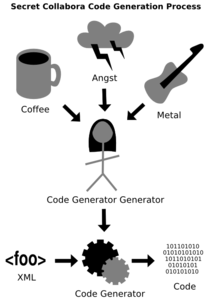
The secret Collabora code-generation process

(credit: daf)

Supporting D-Bus in the GObject world has always involved quite a lot of code generation. The core API of dbus-glib is heavily reliant on varargs functions, which aren't type-safe and are easy to get wrong. dbus-glib contains a program called dbus-binding-tool, which is meant to generate reasonably sane GObject APIs for D-Bus objects. Unfortunately, it seems to be intended to generate a whole GObject at a time. Early versions of telepathy-gabble used dbus-binding-tool plus a script called gengobject.py to generate API stubs for the exported objects; developers then filled in the blanks, and hey presto, we had a GObject on D-Bus. This was fine up to a point, but had a couple of major drawbacks. Whenever we changed the D-Bus API (quite common during the early development of Telepathy), there was a very laborious and error-prone merging process. We ended up with the following process:
  • copy the D-Bus introspection XML from the telepathy-spec repository into a directory xml/pristine (actually, the canonical form for the spec was Python for a while, and we had a script that exported a contrived object onto D-Bus and introspected itself to get the XML - but that's another story!)
  • preprocess the introspection XML to add the dbus-glib CFunctionName annotation, resulting in a directory xml/modified
  • run dbus-binding-tool and a Python script gengobject.py to generate C source in xml/src
  • three-way-diff the old version of xml/src, the new version of xml/src, and the real C code in src to create a new version of src
  • pray that the diff process hadn't randomly exchanged functions' implementations
  • update the resulting code in src so it worked
  • check the whole mess back into darcs
  • hope that nobody else had made changes that would result in darcs conflicts
If you haven't yet gathered, this was a bit of a nightmare. Also, it was very easy to return the wrong thing from a method without noticing - because all the APIs were varargs, the compiler didn't notice, and the first we'd know about it was a mysterious segfault under certain circumstances.
How telepathy-glib fixes code generation telepathy-glib improves on this by taking advantage of this innocuous-looking feature in dbus-glib:
commit 355ef78d98d6fc65715845d56232199162cab12a
Author: Steve Frécinaux <steve istique net>
Date:   Thu Aug 17 11:48:20 2006 +0200
    Interface support for bindings.
Instead of running dbus-binding-tool or creating GObjects with D-Bus interfaces, we put the entire Telepathy spec through glib-ginterface-gen.py, a distant descendant of Gabble's gengobject.py. For each interface in the spec, we generate a GInterface that mirrors the D-Bus interface. Any GObject that implements the GInterface automatically gets the D-Bus interface if it's exported onto D-Bus. There are a few non-obvious refinements, though:
  • The signature of the method implementation is always in the mode that dbus-glib calls "asynchronous", where the method implementation can either send a reply message before or after it returns. For "slow" methods, this is the only thing you can do. For instance, many Telepathy D-Bus methods can't return anything until some TCP round-trips to the server have happened. This is also the only thing you can do if you want to extract extra information, like the sender's unique name, from the method-call message (dbus-glib's "synchronous" API doesn't allow this to be done). For "fast" methods, sending a reply message before returning is just as easy as using the "synchronous" API (it's just a difference of syntax), and has an API consistent with that of the "slow" methods, making it easier for service authors.

  • The layout of the GInterface vtable is private, and (auto-generated) accessor functions are used to fill in implementations. This means our ABI doesn't change just because we re-ordered functions in the spec.

  • If no implementation is provided for a method, we just raise an appropriate error (org.freedesktop.Telepathy.Errors.NotImplemented), rather than suffering an assertion failure. This means we can safely add methods to an interface.

  • While we're generating code anyway, we generate some static inline wrapper functions which wrap dbus_g_method_return(), to have type-safe method returns. You can easily check that a method replies with correct types, by checking that the implementation of Foo() replies by calling tp_svc_some_interface_return_from_foo().

  • Similarly, we generate wrapper functions to emit signals, to get type-safe signal emission.

Not all interfaces are stable enough to be included in telepathy-glib's stable API and ABI, so some of our other projects include a copy of the telepathy-glib code-generation tools, and generate their own "mini-telepathy-glib" (traditionally in a /extensions/ directory) for their implementation-specific (drafts of) interfaces. This isn't yet as polished as it ought to be (mainly because we don't want to freeze the augmented-introspection-XML format that we write the Telepathy spec in, because it's rather ad-hoc and hackish in places) but it works quite well in practice. To see what this looks like in practice, have a look at the examples in telepathy-glib, or at a Telepathy connection manager like telepathy-gabble.
Mixins and base classes Another feature of telepathy-glib which makes life easier for connection manager authors is that it provides "mixins" and base classes which implement some of the GInterfaces. There's absolutely nothing magic about the base classes - they don't have any access to private implementation details of the GInterfaces, they just implement them like everyone else does. The "mixins" are only slightly more magical - they store some extra state inside the structures representing GObjects and their classes, and use it to provide default implementations of some or all of the methods on a particular interface (or two interfaces, in the case of the new TpMessageMixin). I'll leave it up to Rob to explain those in greater detail, since I seem to remember that he invented them :-P The examples and regression tests in telepathy-glib are quite good examples of how these work in practice.

15 April 2008

Neil Williams: PS - on keeping interested during the wait

Something I want to add to a post by Slyvian LeGall - motivation does not have to disappear during the wait.
I was lucky, my advocate is project-lead for a Debian sub-project (Emdebian in this case) and I was able to contribute to Emdebian before my DD status was completed. This included uploads to Emdebian that Debian people could use. It included policy decisions, infrastructure development and programming of bespoke utilities.
i.e. my interest was maintained because I had an outlet and an encouraging, supportive, advocate.
When a DD advocates a particular person in NM, there should be some common ground, some experience of working with that person and it should be possible to find a way to maintain a working relationship within that environment.
My experience of the end of NM was one of increasing responsibility, increasing activity, increasing motivation and constant affirmation and assistance from my advocate and others in the sub-project.
So a big thank you to Wookey and debian-embedded in general. It bodes well for the other prospective DD's currently being mentored and encouraged through NM within Emdebian itself.
(Mind you, my NM timescale shows that I didn't wait anywhere near as long as the current delays.)
I fully appreciate that the horrendous delays currently being inflicted on people in NM and upon Debian in general are abominable. If there are ways that existing teams in Debian can adopt and encourage these prospective developers, it can only help in keeping these people interested. It may be a more productive way of helping with the NM problems than just carping on a blog.

Next.

Previous.