Search Results: "bod"

15 December 2005

Martin 'Joey' Schulze: It is done

Somebody may have noticed, we've sent out kernel updates for sarge yesterday. It's been a lot of work that eventually lead to this update. Thanks to everybody involved, you've helped Debian a lot. Thanks for being patient when things weren't looking so well. The new 2.4 kernel fixes 13 and the new 2.6 kernel fixes 28 identified vulnerabilities. Both kernels are compiled for all affected architectures. It has been quite some work to identify and document all problems, test all packages and kernels, correct those with bugs and get them uploaded. The woody kernel still needs an update, even for older issues. I've already had prepared an update for one of the six 2.4 woody kernels and asked for help porting it a couple of months ago. Unfortunately, the person who offered help took two months to tell me and got pissed in the meantime. Currently, Dann Frazier is working on this, and he's done a lot of work for the recent sarge kernel update as well.

14 December 2005

Gunnar Wolf: oa-(k)ste-PEC - oakstepéc (or the attack of the nested parenthesis)

Yes, you can surely tell I am no guru when it comes to describing sounds - maybe that's because in Spanish every letter has one, or at most two, sounds? Anyway, Christian, that's the way to say it - The O sometimes sounds a little bit U-ish, in some places you could see this same sound (coming from N huatl, Mexico's main indigenous language) as huaks. The k (in the x) is usually pronounced, but quite soft - sometimes we just refer to the place as "Oastepec", and nobody gets hurt (or worse, sent to Oaxaca (Huajaka - yes, the X is the only letter whose sound truly changes (and that is because Spaniards used it as a wildcard for S, KS, SH, J - In fact, M xico is pronounced M jico, but never (EVER) spelt that way besides what other Spanish speakers say. The original sound, though, was closer to M shico)))
And, yes, I am also one of many thousands of people longing to ride through the Copper Canyon. It's supposed to be really, really beautiful. Too bad Chihuahua is ~20 hours away from Mexico City :(
And about Oaxtepec's location: It's 60km south of Mexico City, not of Downtown Mexico (that would still be out of the city, but not by that much). The best route is not straight, so from my house (in South-Western Mexico City, ~15m away from where the Cuernavaca highway begins) it's about 90 minutes. The highway is _very_ good and safe, don't worry. I do expect people coming by car from the USA. Here you have a good map of Morelos state. Oaxtepec is on the third column, second row, near Cuautla. Just for completeness sake, just North of Morelos you have Distrito Federal, where Mexico City (partly) lies. The airport, where most of you will arrive is again in the second row, third column (hmmm... A pattern starts to emerge! Lets see what that means...) - We are working so we don't have to explain to you all how to get from there to Oaxtepec, I hope we can provide buses covering the route, at least in the days with most arrivals.

13 December 2005

Bernhard R. Link: Why not CVS?

With this rcs debate currently on planet.debian.org I feeled the need to add some toughts.

My point is mainly: Why not simply stick to plain old CVS?

The pros are easily collected: it's installed everywhere, almost everyone know at least the basic commands, and it is rock solid technology without all those little nasty bugs the newer ones have all the time.

Most of the contra arguments are not applicaple to me, so how can they to anybody else? ;-)

Like changelog messages: I write a Changelog after a patch, because I look at the patch for doing so. After all, that is what the Changelog is supposed to document, not what I though I did. (And looking at this is always a good way to catch some obvious mistakes one did).

Making multiple patched off other people's projects: Two versions of the directories you are working on is all that is needed. Change the one, make diffs compared to the other. Revert the diff (patch -R or just answer often enough), change the diff to what it should be, reapply it to make sure it still works, test it, revert it again. To make another patch for the same original software, continue from the begining, otherwise apply the patch to both copies. Just works. Easier than any darcs or co, even if that would not core dump, go into endless loops or play dead dog.

Even the non-exotic new systems still have plenty of features I never needed:

Something has to be really big moving files around is needed at all. And if it is needed, just delete it here and add it there. That looses a bit of history, but that is still found in the older place's history. Moving whole files is there only a special case of moving routines between files while refactorisation, one sometimes just has to look somewhere else.

Even for svn's global revision numbers I have not yet found a use. Being used to cvsish tagging removes the need if thinking before, and between commits there is normaly at least a quarter of an hour, so date based indexing always works.

So, what are we talking about?

Matthew Palmer: Diversity in Revision Control

Josselin Mouette has thrown down the gauntlet -- Subversion is the One True Revision Control System and we should all just Stop Worrying and Learn To Love The Handcuffs. In particular:
[...] just use subversion, and if you feel it's missing features, please contribute them. By standardizing on subversion, we lower the barrier for people wanting to contribute, instead of increasing it by asking them to install and understand new tools.
Quick thought experiment, Josselin: replace "subversion" with "Java". Or "Perl", or "C", or even "Python" or "Ruby". Or any other language. It doesn't matter which one. Even if the language you substitute is a good one, and one you happen to like, it's still a fairly obviously braindead idea -- that there can possibly be One True Programming Language for all problems, and that there can never be any improvement that can't be bolted into the existing OTPL. Revision control isn't so much different from programming languages. Different systems will provide different advantages and disadvantages. There's also incremental and revolutionary improvement that will take place over time -- machine code to symbolic to procedural to object oriented -- that can never take place within the established framework. I happen to really like the distributed model -- it reduces (though, naturally, cannot eliminate) the division between the Blessed and the Peons in a project (those with direct commit access vs. the rest of us). You can get disconnected operation for (almost) free. Also, despite the assertions contained in your article, the "barrier to entry", ironically, is actually lower with a good distributed RCS than with Subversion. The barrier isn't what you think, though -- sure, using an unfamiliar RCS is troublesome, but it's a lot less hassle than learning a new language, and people do that on occasion to hack on a particularly interesting problem. The real barrier to entry is forcing anyone who isn't blessed with direct access to The One And Only Repository to use inferior development support tools. "An example!" I hear you cry. Gladly. This morning (literally) I got enough of a handle on the internals of Ruby on Rails to actually track down a bug that was irritating the crap out of me. Being a good developer, I wanted to use revision control to track my changes. In the All Subversion, All The Time "utopia", that would involve getting an anonymous checkout, making a copy, hacking on the copy, then (when all was done) running diff -urN between the original and the copy, and sending it all upstream with a manually-created log message (assuming I could remember everything I'd done). You also need to manually remember (or encode it in your directory or something) the source of your tree, so upstream can merge it reliably (and compare it against other equivalent work that may have been done in the meantime). Doing it better, I could do an anonymous checkout, and then import it all into a new Subversion repository (or directory) of my very own, and hack on it in there. Benefit: revision control of my changes. But it's non-trivial to create a new repo and import everything into it, and there's still no automatic record made of the upstream source of my new repo. Wanting to make a second change is even worse -- I either have to make a whole new copy of my source tree (disk is cheap, but this is getting silly) or just keep forging ahead with changing my existing tree -- so this second set of changes can end up being dependent on the first (which is Not So Great if upstream don't merge your first patch). In the "new repo" scenario, you can branch from the root of your new repo and continue hacking on your newly created branch, which is a good start, but it's still icky. And good luck having the system track new commits from upstream while you're working, too. If the project was using a DRCS, in contrast, the problem would reduce to making a branch into your local archive, hacking (committing at will), updating with new upstream commits as you go along, and then publishing your changes to a public place for reintegration (or, in some cases, sending your changeset via e-mail). Oh, and before anyone starts screaming "if anyone can branch, it will encourage forking!", consider which is more likely to result in a permanent fork (rather than a temporary independent line of development): a local set of changes in a tarball or local subversion repo, both of which are hard for anyone else to collaborate on without major pain; or a branch in a simple-to-publish (or push) designed-to-be-shared DRCS archive, which automatically keeps all of your interesting metadata intact and coherent across archives, merges, time, and space (and possibly even dimensions). This utopia doesn't really exist, and is hampered by everybody having their own Pet DRCS, but the problem, I'm fairly sure, is transient, and my main point isn't even so much against the choice of Final Ultimate Solution, or even the problem space, but more about the attitude that everyone should get behind Any One System and stay there. I can't imagine the world of pain we'd be in if Josselin had posted his message a few years ago (but with s/subversion/CVS/i, naturally) and everyone had followed his advice -- can you imagine per-file changesets with no effective merge capability for the rest of eternity? <shudder />

Uwe Hermann: Play-Doh fingers can fool 90% of all fingerprint scanners

Oops. Engadget reports that Play-Doh fingers can fool 90% of all fingerprint scanners. This is nothing really new. The remarkable thing is that more and more companies and government organizations rely on such biometric authentication. Now, they all have been told about the problems, but nobody seems to want to listen... (via Techdirt)

11 December 2005

Jose Carlos Garcia Sogo: Social Network a.k.a. Web 2.0

There have been a lot of hype lately about Social Network or Web 2.0. Of course this is not anything new, but a translation of natural social relationships to the network. Haven't you ever showed your travel photos to your friends or family? Well, in an exercise of exhibitionism you can now show them to the World using a tool like Flickr. Yeah, you could show them before using your blog, which it is also a way of Social Network, but now you can see not only your friend's and family's photos, but a set of them made by people from all around the globe. At the same time, you can still publish your thoughts in your blog, and read other people's thoughts in these different Planets or using an RSS aggregator. Was blogging what started all this? Well, talking with a friend of mine the other day we realized that the impulse of publishing in people is amazing. Before blogs started to exist everyone wanted to have his own personal webpage in Internet. And the revolution was GeoCities. With it anybody could publish his homemade webpage... which usually was a webpage talking about a hobby, or the family, with different links, but few live content. People want to share... want to share experiences, photos, ideas, bookmarks, ... want to talk with friends and family, wherever they are, and this is why IM now (and VoIP in a near future) have had so great success. First half of the 21th century is going to be voyeurs epoch!

10 December 2005

Martin F. Krafft: Epicondylitis

Turns out that I may have never had tendonitis or carpal tunnel syndrome, but lateral epicondylitis, aka. the tennis elbow. I do play squash regularly, but the cause still appears to be typing. I was not using a wrist pad, and I never developed a proper typing style, meaning that 4-8 of my fingers chaotically fly over the keys to yield almost 100 words/minute. Anyway, combine all of the above with a notoriously bad posture and myogelosis (google that yourself, I could not find a representative link) in the shoulder region, and you get suboptimal blood flow in the bones and muscles of my extensor muscles, which not only had to pull my back of the hand upwards, but also lift the fingers as I was typing. At 10-14 hours per day, and it's no wonder that the tendons connecting my extensor muscles to the lateral elbow got inflamed. Anyway, I am optimistic, now that I finally found a therapist who seems to understand what she's doing. I am also intensively training my upper body musculature in combination with massages, so in the end, when I finally broke the vicious cycle of such an inflammation, it'll actually have improved my life. I never thought I would ever lift weights. Now I am beginning to enjoy it.

Andrew Pollock: [life/americania] Three weeks

I've been so busy, I haven't had time to blog. Rather than putting it off any longer, I'll just dump what I can remember. Last Wednesday, Sarah arrived after her holiday in Singapore, and from all accounts, had a great time. Photos as well. Sticking with the whirlwind theme, the next day, we had a "building warming" party at work for the new building we'd moved into the week before Michael and I started. The next night we had the work Christmas party, which blew the socks off any work Christmas party I'd ever been to before, and then on Saturday night we went to a party in San Francisco that we'd been invited to. On a life in general front, I'm still waiting for a Social Security number. The lack of one makes life a bit difficult for a lot of things. It also turns out that Sarah's work permit will take about 90 days to approve, so she's going to be a lady of leisure for the next few months. I've finally been issued with a work mobile phone (or "cell phone" as they call them), and so can stop roaming and paying through the nose for the privilege. We've found somewhere to live. We take possession of a 2 bedroom townhouse (split-level) in a complex in Mountain View that is 3 miles from work on the 18th. The rent is $1725 a month, which is a bit better than we were expecting. The complex we're renting in does have shared laundries, which we'd not too keen on before getting over here, but they're quite modern and secure, and there's a laundry block close to our townhouse, so hopefully it won't be too bad. The whole place had been renovated about 5 years ago, so it's all in good condition. We could have rented a 3 bedroom apartment (single level) in the same complex for about $125 a month more, but we're trying to actually make some money while we're over here... Driving on the other side of the road becomes fairly "normal" after about a week of doing it regularly. Sarah's adapted fine. Lane placement is the hardest thing, because your body's used to being in a certain spot on the road, and it's all different sitting on the other side of the car. We've managed to open a rudimentary bank account, even with my lack of Social Security number. Unfortunately I can't get paid until I have an SSN. Upside of that is that if it doesn't happen until next year, I presumably won't have to worry about income tax for this US financial year. Downside is kind of obvious... By far one of the stranger things of everyday life here is the lighting situation in the average residence. Lamps are all the rage, to the point that light switches don't exist in some rooms (notably bedrooms). Take where we're currently living for example. There's a light switch at the bottom of the stairs, there's one at the top. There's a bank of four in the living room, two of which control lights in the kitchen, and one the hallway. The last one controls a lamp in the corner of the living room, which is connected to a power socket (or power point as we'd call it). The bedroom with the attached bathroom (en suite) has two bedside lamps, and that is the sole source of light. The bathroom attached has light switches, and the walk-in robe has a light switch. It's so weird. So walking into a darkened bedroom involves walking all the way in, and fumbling around with a lamp. It's often easier to turn on the light in the wardrobe so you can see what you're doing first. I can't think of any reason for it, except tradition. It's not like they're avoiding wiring the walls or the ceiling, because it's done partially already. The bedroom has a ceiling fan, but where in Australia, there'd be a knob on the wall near the light switch to control it, it has a little chain you yank on. To add to the strangeness, there are two switches on the wall, one of which seems to allow you to turn off the ceiling fan if it's already been switched on by pulling the chain. The townhouse we're renting has a similar lamp dependency, so we're going to be making a trip to Ikea for some lamps it would seem. That's about everything I can recollect right now... Oh, I should point out that I'm really loving it over here.

9 December 2005

Martin 'Joey' Schulze: Volunteer for Timeline 2004?

I'm looking for somebody who would be willing to work on a timeline for 2004, similar to the one from 2003 since I still haven't been able to allocate time for it on my own. Additionally, I'm looking for somebody who would is interested in the same for 2005, since this year only has a couple of weeks left over. I don't anticipate to be able to write it on my own as well, so a volunteer is definitively welcome. While we're at it, I'm also in need of people contributing to Debian Weekly News. Regular contribution would be best, if people want to be added to dwn@, please drop me a note as well.

John Goerzen: If America Left Iraq

I got an e-mail yesterday evening with a link to this article at the Atlantic Monthly: If America Left Iraq: The Case for Cutting and Running by Nir Rosen. This article does a good job of explaining what just about everybody else has failed to do: why leaving Iraq now actually does more towards building a stable, free, and peaceful Iraq than keeping our military there does. (And does less to embolden terrorists.)

8 December 2005

Decklin Foster: Really Bad Joke

I think #342502 would have read better in poem format:
this is just to say

i have recompiled
the bonnie++
which was linked
against libstdc++5

and which
you were probably
saving
until etch freezes

forgive me
g++-3.4 has a new ABI
so portable
and so fast
Somebody shoot me for doing that, please.

Aigars Mahinovs: A couple shots from Tokyo girls concert from the...

Lead singer Dark wisper

A couple shots from Tokyo girls concert from the closing ceremony of the Animefest3. This ends my photostream from the event, now I'll have to shoot something new to show you. BTW: there are also some photos that I did upload to Flickr, but didn't link to the blog - you can go to my photostream to see all of them.

Last week a idea came to my mind - promoting open source is most rewarding if we do it to developers who then come to open source and help us move forward, the biggest identifiable bunch of developers in Latvia are the web developers (LAMPers, ASPers, J2EEers, ...) and these developers are quite interesed in that new "Web 2.0" buzzword. So I thought - why cann't Latvian Open Source Association organise a event dedicated to Web 2.0: what it is all about, what open source solutions empower you to develop Web 2.0 sites, how and why should you use them and also why and how do you contribute back to the community that created these tools. Nobody else stepped up for the task, so if I want this to happen - I will have to organise that. I have defined the master theme and format of the conference and now I am going around the potential sponsors asking for few hundred $ to fund the coffee breaks and a lunch. If I get that, then we can start thinking about specific topics, speakers, participant registration forms and all the rest of the stuff. If I don't get that 'till Christmas, then I will not be able to get the event going at the planed time in the last week of February. Well - a bunch of job to do.

BTW: this reminds me - what's up with USA and Christmas??? As you probably know, mine only source of information about world events is The Daily Show (along with the Colbert Report, and _sometimes_ BBC news) and now it seams that USA have gone to the extremes of ridiculousness (I guess, president sets the mark). Banning use of word Christmas? How about cancelling New Year? You do know that in some religions the year changes at a different day, don't you? And don't get me started about "Plan for success" two years after the "Mission Accomplished" by the man personally!

7 December 2005

Radu Spineanu: Maps

I was thinking of building a web application on top of Google Local, however i couldn't find out for sure if i can ask money for some kind of service like this. It would probably be a free version and a subscription based one. All i found on google laws was something like:
"Except where you have been specifically licensed to do so by Google, you may not use Google Local with any products, systems, or applications installed or otherwise connected to or in communication with vehicles, capable of vehicle navigation, positioning, dispatch, real time route guidance, fleet management or similar applications".

Does anybody know if this is possible ? If not with Google Maps, maybe with something different (Microsoft has something as i recall, Yahoo too).

Frank Sinatra is cool...

5 December 2005

Martin F. Krafft: Drugs and the law

It is my strong belief that the law should diversify more when it comes to drugs and their use. In particular, the law should differentiate between
  • drugs that are dangerous to the taker, or can cause long-term damages, such as physical or mental addictions. This class would be primarily made up of the so-called hard drugs: opiates, entactogens, inhalants, steroids, sedatives, and stimulants.
  • drugs that cause hightened awareness and give the taker the ability to approach life, society, or any sort of philosophical question from different angles. In places, these are referred to as intellectual drugs: hallucinogens and (some) herbals.
If the law differentiates this way, each country could make it explicit whether it tries to protect the individual (which it should), or whether it protects the equilibrium of society (which could be considered fascist). Important: this is all about use of a drug. Cultivation, dealing, and related acts must be under separate and harsher legislation. The black-white approach taken by most governments these days really just pisses me off. Who are they to decide what an individual may do (or not) with his/her own body, assuming no harm comes to third parties? PS: No, I am not a junkie. I just get annoyed when someone is jailed for smoking pot or eating magic mushrooms in the forest. Especially if you know and respect that someone. NP: Mono, Under a Pipal Tree

Martin 'Joey' Schulze: Past LinuxTag Commitment

For me this year's event was the most successful and wonderful LinuxTag I've eve been to. I've worked during LinuxTag as much as I could and did my best to make it the best event ever. If I commit myself to something, I try to work properly and generate proper results. This was the same for LinuxTag. As a result, this year I had many tasks to work on. First of all I managed the community and free projects so that they had an opportunity to present themselves to the broad audience during LinuxTag. This required months of communication with members of all attending projects and negotiating their needs. It also required to gather information about the various parts of LinuxTag that also affected projects. Since it is boring having to answer the same questions all the time I decided not doing that anymore and once started to maintain an FAQ that intends to contain all important information for exhibiting projects. Last year I've also added an location plan with information about shops and restaurants nearby and this year I contributed a map for getting to the AKK where the legendary KaLUG party was organised. Being responsible for the projects I was required to decide which project are suited to get a sponsored booth, its size and its location. This year we have had the opportunity to use the ground floor of the conference building in addition to the regular exhibition ground, so that we've could use about 700m in total for the projects exhibition. I've worked nearly two entire weekends to get the booths assigned properly and to have proper graphics. For the conference building I also created the "official" booth map, booth naming, booth signs and booth numbering. One weekend was planned, the other was an accident since we had to rearrange some booths. Exhibiting projects and other community and Free Software oriented projects also had the opportunity to use two workshop rooms for workshops, BoF sessions, meetings and talks. For these I maintained the schedule and negotiated with the speakers and projects, and also acquired moderators for both rooms for the entire time. The people who organised the Accessibility booth people managed to get green light for building a large booth and a so called forum, which is an open talk area, but without any support. Since they couldn't fill in all slots and you can't dismantle a forum in the middle of the show, I've taken over its maintenance and schedule and managed to complete it with interesting talks, setting up, looking for moderators and dismantling. One of these talks I've even held on my own. Fortunately, a DJ contacted us and was able to provide his PA, boxes, microphone and stuff. Without him, the forum would have been an utter disaster. To support the projects we had to build up the network in the main exhibition hall for them on our own. Otherwise it would have cost us several thousand euro, which we didn't have. So I had to draw plans containing the cables we had to lay, calculated the length and decide where to deposit switches and stuff. On the day before the show opened, several supporters went around with a large ladder laying the cable. In the conference building this was done by the KaLUG. I've also coached the supporters during LinuxTag, and was even present at a special short meeting for and with supporters in order to reflect the past day and talk about the next day. This year was the first time I really had the time to attend the meeting and thank our supporters. Before the show started I've also negotiated food arrangements with a restaurant and a colleague so that we had lunch during the show. I ate from it as well, but didn't manage to eat every day unfortunately. Most additional signs of A4 and A3 size that we used during LinuxTag in order to help visitors and officials to find their way were designed and printed by me. Many of them were the result of last year's aftermath. Most of them were fixed with adhesive tape by our supporters. The Coding Marathon was supervised by me as LinuxTag representative. It was organised by HP, intel and Red Hat and, of course, negotiated with the acquise team of LinuxTag. The Coding Marathon was a half day programming session for visitors. The resulting code is released under the GNU GPL and winners were awarded with prizes at the end of each day. This required me to attend several phone conferences, name one or two interested people from "LinuxTag" who would propose a task and head the marathon during one day. Last year already, when I took over this job, With p2 and Arne I've already found two competent people, and this year also added Alex Schmehl for a task I proposed. Naturally, it was not possible for me to moderate the Coding Marathon during LinuxTag due to other obligations. When I arrived at LinuxTag the week before it officially started my first job was to build up the office and prepare the rooms so that the entire "team" could work inside properly. The first office should be used by supporters for general requests and customers, with a desk for me as well. The next room was meant to host the speakers office and the other rooms were intended to be back offices or private rooms. In order to be able to work properly in the office I've also brought with my some of my network equipment and set up the office LAN, server and printer. I had already experienced cable problems last year, that prevented us to use 100MBit/s switches, so that antiquated 10MBit/s hubs had to be used. I've also supervised our daily shopping tours and collected demand for various items from others. The most important items were fluids since it was quite warm during LinuxTag and collapsing core members and supporters are no fun. Other food had to be fetched as well. A lot of other items had to be purchased as well, in order to run LinuxTag and be able to fix or improve various areas. One or two supporters were taking the car for the shopping tours. When I arrived in Karlsruhe the HP booth was already being built. The other, smaller booths followed on Monday. Hence, on Monday and Tuesday I also supervised the building of the booths. It's important that somebody is around for questions, both from booth builders and from officials of the fairground. One also has to check if the booths are built properly and that they don't cause a risk for the exhibition hall, neighbour booths, smoke detectors and stuff. Issues should be corrected as soon as possible so that they don't become problems later. As soon as I arrived I also took over our own storage area and maintained deliveries for booths that haven't built up yet. Several companies negotiated with me before the show so that I knew which deliveries to expect and could move them to their respective booths as soon as they were built up. This year the first X.Org developers conference took place right before LinuxTag as well. I negotiated with both the X.Org people and the fairground people so that this developers conference could really take place. Unfortunately the plans and acknowledgements were sent out quite late so we were in a hurry getting everything set up and organised. Since we experienced network problems this year, they had not network as well, so did we in the office. Two days without a network connection. Pure horror. On Thursday the legendary KaLUG party took place. The location had to be prepared for the party, for which several supporters went there before the party has started. It was planned that I attend the party, so I went there at about 1 a.m. For some reason I didn't manage to leave the fairground earlier, and on the way to the AKK some of my friends who were also supporters were on their way home, excusing themselves for leaving before I arrived. Eumh... When I arrived at the party I first checked the situation and saw loads of uncleaned pots and stuff. Since nobody was cleaning them, I jumped into the mobile kitchen and started cleaning before I even ate or drank anything. That was fun, though a bit unplanned. The social event on Friday was organised by Claudia from a service provider who got some support from me before the show and during the show. Several supporters helped her clean the area that was unused for several years. During the evening I only gave away free tickets for the supporters and moved inside afterwards, always looking around if everything was ok, negotiating with her, of course. Very well managed, I can only say. This year I gave three talks during LinuxTag. Usually I only give zero or one during such an event, due to my other obligations. However, this time I felt, that I should make a maximum use of LinuxTag, anticipating the future. Hence, it started with Debian Security held during this year's Debian day, followed by Howto LinuxTag on the following day and finally Debian Internals together with other Debian developers. After the last talk I had about two hours to calm down again and initiate the general dismantling. Fortunately I've already planned a lot before the event because after my final talk I was a bit exhausted and needed to calm down and get into LinuxTag organisation again. Dismantling is the most parallel work at LinuxTag because all booths are dismantled at once and many people are running around with arbitrary stuff. One really has to take care of ones own stuff or it gets lost faster than one can shout. During the evening the entire fairground was cleaned, from all conference rooms the audio and video technique was removed again, all bottles and glasses were moved back into the office, the movable walls collected and moved back to their owners, the Internet caf was dismantled and computers moved back into their respective boxes. Some exhibitors had to use extra storage space temporarily. The Community forum in the conference hall had to be dismantled and chairs stacked properly. The same goes for tables and chairs used by the projects booths in both, the exhibition hall and the conference building. The network for projects had to be removed again, cables and switches secured. All additional signs had to be removed again. Since we have used some durable signs that could be used for future events again these had to be removed carefully and secured again. We've also ordered a container for paper since a lot of paper had to be thrown away and throwing away large amounts of junk is expensive. This way we were able to get rid of paper stuff a bit cheaper, but had to take extra care so that only paper went into this container. Hence, we needed a supporter who stayed with the container until it was fetched again. When the internal LinuxTag party in the office was nearly over, I came back into the office with all other areas finished, ready to start dismantling the office - usually the colleagues don't let me because they want to party and don't have any obligations anymore. That sucks a lot. So, again the internal party went on nearly without notice by me, but I'm used to that. This year I had already taken this into account and organised some stuff for an after work party (contrary to the other while-others-work party) outside of the office with supporters, friends and some team members that were still sober. This night we went to bed after 5a.m. and hence had a chance to get a quick breakfast already (we didn't use it, though). It was when we thought "Yes, this was a hell of an event!" I usually went to bed at 1 to 3a.m. and got up again at 5 or 6a.m. so that I was able to work on the important stuff that I committed myself to, and so that I was able to chat with friends and supporters in the evening. That was something I really missed on past events. Last year I probably wouldn't have spoken to Alfie if he hadn't placed himself into my way as a brake block. Thanks Alfie! This year such a maneuver wasn't required. In order to be able to work on so many areas during LinuxTag I tried to optimise the workflow and the processing as much as I could. I also used several sheets and paper to write down stuff for later processing so that my brain was kept clear and I don't become insane (or more insane, for what it's worth). That worked quite well and all areas I worked in worked fine as well, since I had time to talk to people even during the day. Even after my talks I wasn't flooded by phone requests like last year. After the event I had to drive some 750km back, after having only little sleep. Getting to Karlsruhe is always the easy part. Driving back is exhausting because I'm usually quite exhausted and in need of a lot of sleep. I won't disclose how long it took me to reach Oldenburg but it was faster than last year.

John Goerzen: Aunt Viola's Choir

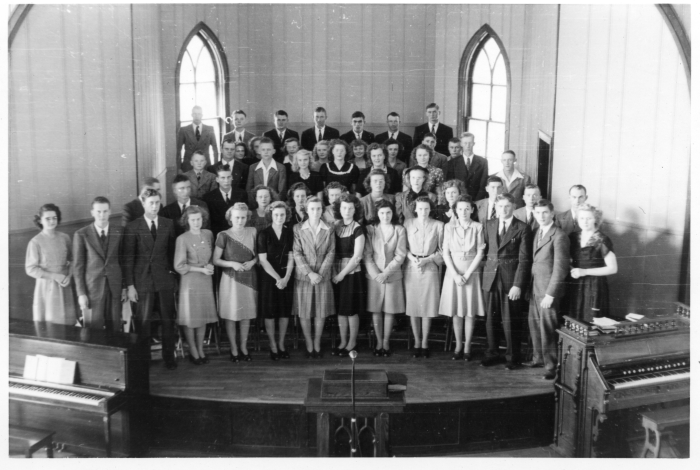
Terah and I are in the adult choir at church. The current choir director's aunt, Viola, is also in the choir. So she is Aunt Viola to quite a few people. Aunt Viola was the director of the choir herself for many years, back in the "old" church. That church was torn down to make room for a new building in 1965. Not long ago, I heard from someone that she was looking for a picture of the old choir. She thought it was in the church archives, but nobody could find it. But I happened to have a copy. Another person that was in the choir had given it to me to scan for a book project a few weeks before. So I uploaded it and ordered an 8x10 print for Aunt Viola. Terah and I sat behind Viola and her husband the next Sunday. As people were visiting before church started, I handed over the envelope and told her there was a little surprise in it. She opened the envelope, and knew right away what it was. And was she ever excited to have it! It made us very happy to have made her day. She was talking about it for the rest of the day -- actually, for a few weeks. So here it is, the choir of Tabor Mennonite Church in 1946. Aunt Viola is on the far right in the front row.

4 December 2005

Matthias Urlichs: No, I will NOT support M$ users any more.

Yet another item on the already-too-long list of blatantly unethical behavior by Micro$oft.

This says everything, and should surprise nobody.

Matthew Palmer: "Average" skills in a resume

Just reading another painfully funny The Daily WTF[1] entry. Instead of a code snippet, this was a resume snippet instead. Apart from listing skills in such heavyweight corporate tools as Emule, Kazza, Paint, WordPad, Acrobat Reader, and Winzip, the candidate also listed "Average" knowledge in a very, very wide variety of skills. The important question is, over what collection of the population is this average taken? Considering the usual demonstration of these "Average" skills, I think that the average is taken over the entire mammalian population, including all of those dolphins who (thankfully) have never even heard of "Micro Soft Visuals: Basics", and that dog at puppy training this morning that spent most of the time licking it's own genitals. Self assessments are always bollocks. Nobody's seriously going to rate themselves "half-assed" at every programming language they know. I've seen one interesting way to describe your language proficiency, though -- group languages into "used in the last 6 months", "1 year", "3 years", and "dim, dark distant past". It gives a reasonable idea of what languages you might be useful in, either through current knowledge, a past knowledge that can be polished, or perhaps knowing a language similar to the one that the company needs skills in that you can be cross-trained into.
1. A site dedicated to archiving, for posterity, the worst of the code that controls the world. Scary and hilarious all at once.

Clint Adams: She comes waltzing in the nighttime made of wings

She is composed of sharp angles. Her limbs are thin and long, and her elbows curve into rose thorn-like points. Her face is a smooth void of black, but you can make out the prominent cheekbones and sharp chin. Her hair is shiny and silver like spiderweb. Slim braids run from the crown of her head and wind up around her horns resulting in two horn-shaped mounds of braids on the top of her head. The rest of her hair is braided and looped in the back. Her fingers are long and thin with four joints. She wears a midnight black velvet gown with a high silk fin-like collar rising out from behind the neck. The bodice is fitted tightly and has an angular U-neckline that dips down into a V. The sleeves are long and tight, and form a V to reach the middle finger and cover the knuckles. The skirt clings to the hips and fans out at the bottom with a shredded hem, revealing red satin underneath; the effect appears remniscent of flames. It has a long train that trails in the back. Silver spiderweb lace hangs from the sleeves like fins and from the collar like a cloak. It is for you.

3 December 2005

Matthias Urlichs: Web servers are annoying

So I'm setting up a new web server. It need to be secure (no user A spying in user B's files). It needs to run PHP. Yes, you may run away now. Oh yes, it also needs to be fast...

So how to do that? I'm not going to run Apache+mod_php on the thing. :-/

I've started with Apache2, FastCGI, PHP via FCGI, installed eaccelerator for 60% speed-up.

All of this works reasonably well, except for PHP scripts that want PATH_INFO (like http://.../blog.php/2005/12/03/some_random_gunk). mod_fcgi passes the whole thing's pseudo file system path in PATH_TRANSLATED. The PHP FCGI process checks that path, sees that it doesn't exist (blog.php is a file after all), and immediately returns an unhelpful error.

I've worked around that thing with an ugly hack, but I suspect that the real fix would be to add this same hack to PHP instead.

Opinions, anybody?

NB: Oh, and if somebody could tell me why my mysql server's kernel randomly ignores incoming TCP connections for a few seconds every minute (and yes, it's the kernel), I'd be grateful. I suspect that the solution is going to be "upgrade to something newer than 2.6.12-9-686-smp (Ubuntu Breezy's kernel)"... :-/

NB2: There's also a mod_fcgid for Apache2. Hint: It's crap -- if all FCGI processes happen to be busy, I want new requests to be delayed. I do not want them to be rejected with a terse, hard-coded error message.

Next.

Previous.