Search Results: "mak"

11 January 2015

Diego Escalante Urrelo: Practical contentment and art

I was browsing Eric Kim s street photography blog, when I stumbled across one article about the well-known Gear Acquisition Syndrome that plagues enthusiast photographers. Gear Acquisition Syndrome is the obsession that enthusiasts tend to have for new gear, new gadgets, new stuff, as an excuse for not developing their skills or taking action. You can recognize it by phrases like: If only I had that new gear, I would be better at what I do I can t do that project until I buy this gear My super expensive camera is not good for that, I need an even more expensive one (etc). The article, How to Be Grateful For What You Have is a funny and well argued look on why photographers, or artists in general, can get lost in what they don t have, instead of what they have. The article is a recommended read in itself and delivers the point whether you are into photography or not. That said, inside the article I found three nice links worth noting: The Tiny Collective
A group of photographers that use only their phones as their camera. It s inspiring to see a specific, curated, selection of images made with phones. It definitely makes you wonder why would you need anything but a phone to make great images (answer: phones work great, even old ones). A Guide to Practical Contentment
One of the most simple and effective messages about contentment that I have read. It s not about not wanting things or settling for whatever . It s all about taking a step back and realizing that life is not about absolutes. If you are not a billionaire, that doesn t mean you have failed in life. Perhaps you are just a millionaire, and that s fine :).
( ) if you start in this place of fixing what s wrong with you, you keep looking for what else is wrong with you, what else you need to improve. So maybe now feel like you don t have enough muscles, or six pack abs, or you think your calves don t look good, or if it s not about your body, you ll find something else. So it s this never-ending cycle for your entire life. You never reach it. If you start with a place of wanting to improve yourself and feeling stuck, even if you re constantly successful and improving, you re always looking for happiness from external sources. You don t find the happiness from within, so you look to other things. If you re externally looking for happiness, it s easy to get too into food, or shopping, or partying, or overwork, to try to be happy. If instead, you can find contentment within and not need external sources of happiness, then you ll have a reliable source of happiness.
So, instead of looking at sources of external happiness, why don t you look into sources of internal happiness? It s one of the hardest things to learn how to do, but I m personally slowly getting there. It s life changing. Bonus points: quotes on simplification and minimalism
For extra credit, here are some interesting quotes on the above topics, note that as every internet quote page it might be filled with false quotes. I happen to like the one attributed to Donald Horban, who apparently doesn t exist outside quote pages in the internet. Maybe that s the biggest minimalism? Not existing?
We don t need to increase our goods nearly as much as we need to scale down our wants. Not wanting something is as good as possessing it.
Anyway, take these with a grain of salt, and just read them as interesting phrases. Just take it easy :).

Steve McIntyre: UEFI Debian installer work for Jessie, part 5

Time for another update on my work for UEFI improvements in Jessie! I've spent more time on the integration of 32-bit grub-efi with a 64-bit Debian system, and just published a new test image on pettersson. I've added: These remove the manual steps that were necessary for a 64-bit installation with the previous build. I've just used this exact image (and a network mirror) to install a fully-functional 64-bit Gnome system on the X205TA, simply by selecting "64-bit install" from the GRUB menu and following prompts. Yay! Visit http://cdimage.debian.org/cdimage/unofficial/efi-development/jessie-upload3/ to download and test the image. Now, there's no guarantee that the kernel patch I've submitted to the linux-efi folks will be accepted in its current form, and even if it is I'll have to get it and the other code I've written accepted into the various packages and then into Jessie! But for now this image should work just fine for Bay Trail folks I hope! WARNING: this CD is provided for testing only. Use at your own risk! If you have appropriate (U)EFI hardware, please try this image and let me know how you get on, via the debian-cd and debian-boot mailing lists. For now, I'm going to pause development here. The core code I'm using to make these images is all in the debian-cd and d-i repos, and I'll push the other patches once I know they'll work with the kernel. But I've got a slew of other things that I need to work on in the next few weeks, in no particular order: I'm currently not planning to make all of Debian's amd64 images bootable using 32-bit UEFI like this image - I'm happy to leave this as just an option for our multi-arch i386/amd64 images (netinst or DVD only). I think that's a reasonable compromise here, and it's also the easiest thing for me to do with the current debian-cd build system. Finally, apologies if you've asked me questions about the earlier images in this series and I've not responded yet. Fixing that ASAP!

10 January 2015

Dirk Eddelbuettel: RcppClassic 0.9.6

A maintenance release of RcppClassic, now at version 0.9.6, went out to CRAN today. This package provides a maintained version of the otherwise deprecated first Rcpp API; no new projects should use it. No changes were in user-facing code. The Makevars file was change to accomodate a request by the CRAN Maintainer to keep it free of GNU Make extensions. At the same time, we overhauled the look and feel of the (very short) vignette. Build instructions were updated both in the vignette and in the included example package. Other accumulated changes since the last release were updates to the DESCRIPTION and NAMESPACE file as well two namespace-related R code updates. Courtesy of CRANberries, there is the set of changes relative to the previous release. Questions, comments etc should go to the rcpp-devel mailing list off the R-Forge page.

This post by Dirk Eddelbuettel originated on his Thinking inside the box blog. Please report excessive re-aggregation in third-party for-profit settings.

Mike Gabriel: Shifting my Focus in X2Go

Dear X2Go Community, dear friends, as many of you may know, I have been contributing a considerable amount
of time to upstream-maintaining X2Go over the past 4 years. I provided
new X2Go components (Python X2Go, PyHoca X2Go Client, a publicly
available X2Go Session Broker, X2Go MATE Bindings, etc.) and focused on
making X2Go a wide-spread community project. For the last 2-3 years I
have been in the role of the X2Go project coordinator and various other
roles. With the beginning of 2015, I will pass on several of those roles to
other people in the project, see the below list for already assigned and
unassigned roles: The reasons for tremendously reducing my workload on X2Go are these: In several internal exchanges we (Heinz, Stefan, Mihai, Mike#2, read more

9 January 2015

Diego Escalante Urrelo: Link Pack #02

First sequel to my Link Pack series (I ll remove the quotes when it s LP#05): Link Pack #01. This time I m going for fewer articles, to try to keep things less overwhelming. There s no special theme, and I m actually leaving out some nice things I read recently. On the plus side, that means I have good material for a Link Pack #03. Also, I m gonna stick with Link Pack as a name, because it s good enough :-).
A Teenager s View on Social Media: Written by an actual teen
A well thought and realistic take on how social media is being used nowadays by teenagers. I have seen the patterns the author describes, and actually follow many of them. Does that mean I m still a teenager? It s interesting that the messaging and group-messaging part of the article is very US centric, or at least very US centric from my point of view. WhatsApp is the default messenger application south of the states, and fills the role of somewhere you can chat with people without having to give them your full personal information , that is, a place where you can chat with someone without running out of SMS and without adding them on Facebook (which would open them to stalk your whole profile and other friends). Some carriers in South Am rica offer unlimited plans for specific applications like WhatsApp. What Would Jesus Buy? (2007) Full movie
Reverend Billy Talen from the Church of Stop Shopping Gospel is trying to prevent the Shopocalypse from happening. It s an entertaining story of a group of funny guys and girls trying to share a message with comedy (that means A+ on my list). Simple and independent, a nice film. 13 Nutrition Lies That Made The World Sick And Fat
A pet peeve of mine. Nutrition is not really that complicated, but unfortunately there are a lot of myths that make people take really bad decisions. If you only read one thing in 2014 2015, read this.
Bottom Line: The low-fat, high-carb diet recommended by the mainstream nutrition organizations is a miserable failure and has been repeatedly proven to be ineffective. ( ) Bottom Line: Low-carb diets are the easiest, healthiest and most effective way to lose weight and reverse metabolic disease. It is pretty much a scientific fact at this point.
GM s hit and run: How a lawyer, mechanic, and engineer blew open the worst auto scandal in history
Cars are so complex nowadays, and dependent on electronics, that I m honestly afraid of them. I have made software for many years and I know how hard, impossible, it is to get things perfect . I can t imagine how hard it is for something so critical as brakes, steering wheels, etc. Even cameras can t get focus right some times, and it s been many many years.
Countless articles have been written about General Motors and its massive recalls earlier this year. What hasn t been fully told is how GM might have gotten away with multiple counts of consumercide were it not for the efforts of three men: a Georgia lawyer, a Mississippi mechanic, and a Florida engineer. ( ) Brooke Melton needn t have died that night. She was killed by a corporation s callous disregard for the safety of its customers, made worse by a regulatory agency reluctant to regulate.
The Long Game: Part 1 and The Long Game: Part 2
Two very short (less than 5 minutes) video essays about how notable people in the story of creativity are always celebrated without mentioning the boring years when they were nothing but losers. It s a fun little video, worth a watch for the idea and the interesting editing. It feels like someone really wanted to create these.

Richard Hartmann: Release Critical Bug report for Week 02

The UDD bugs interface currently knows about the following release critical bugs: How do we compare to the Squeeze and Wheezy release cycles?
Week Squeeze Wheezy Jessie
43 284 (213+71) 468 (332+136) 319 (240+79)
44 261 (201+60) 408 (265+143) 274 (224+50)
45 261 (205+56) 425 (291+134) 295 (229+66)
46 271 (200+71) 401 (258+143) 427 (313+114)
47 283 (209+74) 366 (221+145) 342 (260+82)
48 256 (177+79) 378 (230+148) 274 (189+85)
49 256 (180+76) 360 (216+155) 226 (147+79)
50 204 (148+56) 339 (195+144) ???
51 178 (124+54) 323 (190+133) 189 (134+55)
52 115 (78+37) 289 (190+99) 147 (112+35)
1 93 (60+33) 287 (171+116) 140 (104+36)
2 82 (46+36) 271 (162+109) 157 (124+33)
3 25 (15+10) 249 (165+84)
4 14 (8+6) 244 (176+68)
5 2 (0+2) 224 (132+92)
6 release! 212 (129+83)
7 release+1 194 (128+66)
8 release+2 206 (144+62)
9 release+3 174 (105+69)
10 release+4 120 (72+48)
11 release+5 115 (74+41)
12 release+6 93 (47+46)
13 release+7 50 (24+26)
14 release+8 51 (32+19)
15 release+9 39 (32+7)
16 release+10 20 (12+8)
17 release+11 24 (19+5)
18 release+12 2 (2+0)
Graphical overview of bug stats thanks to azhag:

Uwe Hermann: My GPG key transition to a 4096-bit key

This is long overdue, so here goes:
-----BEGIN PGP SIGNED MESSAGE-----
Hash: SHA1,SHA512
I'm transitioning my GPG key from an old 1024D key to a new 4096R key.
The old key will continue to be valid for some time, but I prefer
all new correspondance to be encrypted to the new key, and will be making
all signatures going forward with the new key.
This transition document is signed with both keys to validate the transition.
If you have signed my old key, I would appreciate signatures on my new
key as well, provided that your signing policy permits that without
re-authenticating me.
Old key:
pub   1024D/0x5DD5685778D621B4 2000-03-07
      Key fingerprint = 0F3C 34D1 E4A3 8FC6 435C  01BA 5DD5 6857 78D6 21B4
New key:
pub   4096R/0x1D661A372FED8F94 2013-12-30
      Key fingerprint = 9A17 578F 8646 055C E19D  E309 1D66 1A37 2FED 8F94
-----BEGIN PGP SIGNATURE-----
Version: GnuPG v1
iEYEARECAAYFAlSwEaIACgkQXdVoV3jWIbQW5QCgoFHVU/D4fKSbvmGv3nNy3MAW
S2UAn075ztmxQ8Y9/22crbUug1sEjfh5iQIcBAEBCgAGBQJUsBGiAAoJEB1mGjcv
7Y+U9PgP/29jPvrNcdWsLI8YK9U6+JzS+TMXNyfp6CQXc8O/+zJwqvvxNpqY3rLM
5otRLIEJ2EVdiF8sCWTDGusS9NkMePzumR0AFAR0iltIkekO5O0HbHhK0sXJQv0s
EipDpFRO9k4/CBpJEy6Pkkxwd3ndtmwrL1/oKeVmM4E62PJd9ofMpQb/gMUsrA8u
F8xoOXY8Os82Rrd759PypSxNecjd6SYaVJTHgFbZ0QIMJkdKaufifzARdw+v5jwg
8Q11BhpYxvUSugZgiciKA6RjRK5bfRnT8VQPFd0zneilsIW13zz/jub9df/vtM5L
vY/6jHvXczYXSG8EGpHJQCD3KtQJPWZ0Nz9rAm4emEPmR2qav6KGARatYAm0RBqZ
Y81YUEuiWzGli6DH1m9SQe8bqM/J94vQAAX9VqUn2gz0Z0Ey25kVQE7NOGsbbGVS
vD/E74FSk1At9/RGpstrfEjsDKPRman2xk/oZe+08sRB22CJl40N4tZV9AkCJNom
HHGZKp+VEKaCEiLUIRjKTHt2HTThg39zmxl+OnoTSFYvloxrDJyi9SxZgCAmBhbD
7kLkaSDmdUj6CmoilGU+gd2zmQl2D+RHinYZBxOUf1vi1MDLWNcLIMgrz4mRXgzE
YKkG0newf9UbyJw42sXe2ukNQBIqBcL/DmAhG7V+r0RD7MQnMEYy
=09bN
-----END PGP SIGNATURE-----
The new key is available from keyservers, e.g. pgp.mit.edu or others. In other news: Yes, I've not been blogging much recently, will try to do updates more often. In the mean time, you can also refer to my Twitter account for random stuff or the new sigrok Twitter account for sigrok-related posts.

Peter Eisentraut: Directing output to multiple files with zsh

Normally, this doesn t work as one might naively expect:
program > firstfile > secondfile
The second redirection will override the first one. You d have to use an external tool to make this work, maybe something like:
program   tee firstfile secondfile
But with zsh, this type of thing actually works. It will duplicate the output and write it to multiple files. This feature also works with a combination of redirections and pipes. For example
ls > foo   grep bar
will write the complete directory listing into file foo and print out files matching bar to the terminal. That s great, but this feature pops up in unexpected places. I have a shell function that checks whether a given command produces any output on stderr:
! myprog "$arg" 2>&1 >/dev/null   grep .
The effect of this is: (Note the ordering of 2>&1 >/dev/null to redirect stderr to stdout and silence the original stdout, as opposed to the more common incantation of >/dev/null 2>&1, which silences both stderr and stdout.) The reason for this is that myprog has a bug that causes it to print errors but not produce a proper exit status in some cases. Now how will my little shell function snippet behave under zsh? Well, it s quite confusing at first, but the following happens. If there is stderr output, then only stderr is printed. If there is no stderr output, then stdout is passed through instead. But that s not what I wanted. This can be reproduced simply:
ls --bogus 2>&1 >/dev/null   grep .
prints an error message, as expected, but
ls 2>&1 >/dev/null   grep .
prints a directory listing. That s because zsh redirects stdout to both /dev/null and the pipe, which makes the redirection to /dev/null pointless. Note that in bash, the second command prints nothing. This behavior can be changed by turning off the MULTIOS option (see zshmisc man page), and my first instinct was to do that, but options are not lexically scoped (I think), so this would break again if the option was somehow changed somewhere else. Also, I think I kind of like that option for interactive use. My workaround is to use a subshell:
! ( myprog "$arg" 2>&1 >/dev/null )   grep .
The long-term fix will probably be to write an external shell script in bash or plain POSIX shell.

8 January 2015

Wouter Verhelst: ExtreMon example

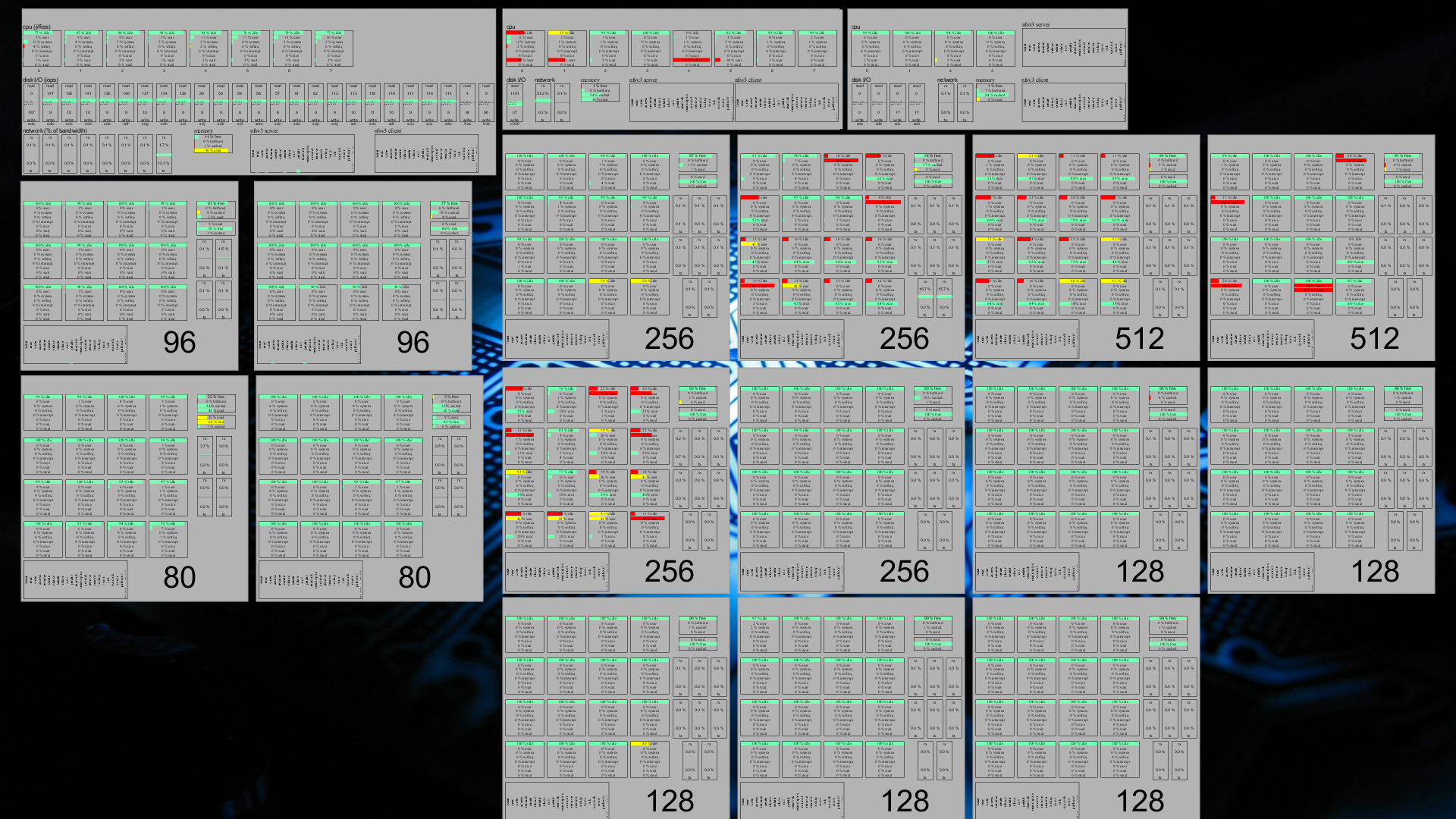
About a month ago, I blogged about extremon. As a reminder, ExtreMon is a monitoring tool that allows you to view things as they are happening, rather than with the ~5 minute delay that munin gives you, and also avoiding the quad-state limitation of Nagios' "good", "bad", "ugly", and "unknown" states. No, they're not really called that. Yes, I know you knew that. Anyway. In my blog post, I explained how you can set up ExtreMon, and I also set up a fairly limited demo version on my own server. But I have since realized that while it is functional, it doesn't actually show why ExtreMon is so great. In an effort to remedy that, I present you an example of what ExtreMon can do. Let's start with a screenshot of the ExtreMon console at the customer for which I spent time trying to figure out how to get it up and running: Click for full sized version. You'll note that even in that full-sized version, many things are unreadable. This is because the ExtreMon console allows one to move around (right mouse button drag for zoom; left mouse button drag for moving around; control+RMB for rotate; center mouse button to reset to default); so what matters is that everything fits on the screen, not whether it is all readable (if you need to read, you zoom). The image shows 18 rectangles. Each rectangle represents a single machine in this particular customer's HPC cluster. The top three rectangles are the cluster's file servers; the rest are its high performance nodes. You'll note that the left fileserver has 8 processor cores (top row), 8 network cards (bottom row, left part), and it also shows information on its memory usage (bottom row, small rectangle in the middle) as well as its NFS client and server procedure calls (bottom row, slightly larger rectangles to the right). This file server is the one on which I installed ZFS a while back; hence the large amount of disks visible in the middle row. The leftmost disk is the root filesystem (which is an ext4 off a hardware RAID1); the two rightmost "disks" are the PCIe-attached SSDs which are used for the ZFS L2ARC and write log. The other disks in this file server nicely show how ZFS does write load balancing over all its disks. The second file server has a hardware RAID1 on which it stores all its data; as such, there is only one disk graph there. It is also somewhat more limited in network, as it has only two NICs. It does, however, also have 8 cores. The last file server has no more than four processor cores; in addition, it also does not have a hardware RAID controller, so it must use software RAID over its four hard disks. This server is used for archival purposes, mostly, since it is insufficient for most anything else. As said, the other nodes are the "compute nodes", where the hard work is done. Most of these compute nodes have 16 cores each; two have 12 instead. When this particular screenshot was taken, four of the nodes (the ones showing red in their processor graphs) were hard at work; the others seem to have been mostly idling. In addition to the familiar memory, NFS (client only), network, and processor graphs, these nodes also show a "swap space" graph (just below the memory one), which seems fine for most nodes, except for the bottom left one (which shows a few bars that are coloured yellow rather than green). The green/yellow/red stuff is supposed to represent the "ok", "warning", "bad" states that would be familiar from Nagios. In this particular case, however, where "processor is busy all the time" is actually a wanted state, a low amount of idleness on the part of the processor isn't actually a problem, on the contrary. I did consider, therefore, to modify the ExtreMon configuration so that the processor graphs would not show red when the system was under high load; however, I found that differences in colour like this actually makes it more easy to see, at a glance, which machines are busy -- and that's one of the main reasons why we wanted to set this up. If you look carefully, you can find a particular processor core in the graph which shows 100% usage for "idle", "system", and "softirq", at the same time. Obviously that can't be the case, so there's a bug somewhere. Frank seems to believe it is a bug in CollectD; I haven't verified that. At any rate, though, this isn't usually a problem, due to the high update frequency of ExtreMon. The amount of data that's flowing through ExtreMon is amazing: Which renders a grand total of 2887 data points that are shown in this particular screenshot; and then I'm not even counting all the intermediate values, some of which also pass through ExtreMon. Nor am I counting the extra bits which have since been added (this screenshot is a few days old, now, and I'm still finetuning things). Yet even so, ExtreMon manages to update those values once every few seconds, in the worst case. As a result, the display isn't static for a moment, constantly moving and updating data so that what you see is never out of date for more than a second or two. Awesome.

Russell Coker: Conference Suggestions

LCA 2015 is next week so it seems like a good time to offer some suggestions for other delegates based on observations of past LCAs. There s nothing LCA specific about the advice, but everything is based on events that happened at past LCAs. Don t Oppose a Lecture Question time at the end of a lecture isn t the time to demonstrate that you oppose everything about the lecture. Discussion time between talks at a mini-conf isn t a time to demonstrate that you oppose the entire mini-conf. If you think a lecture or mini-conf is entirely wrong then you shouldn t attend. The conference organisers decide which lectures and mini-confs are worthy of inclusion and the large number of people who attend the conference are signalling their support for the judgement of the conference organisers. The people who attend the lectures and mini-confs in question want to learn about the topics in question and people who object should be silent. If someone gives a lecture about technology which appears to have a flaw then it might be OK to ask one single question about how that issue is resolved, apart from that the lecture hall is for the lecturer to describe their vision. The worst example of this was between talks at the Haecksen mini-conf last year when an elderly man tried at great length to convince me that everything about feminism is wrong. I m not sure to what degree the Haecksen mini-conf is supposed to be a feminist event, but I think it s quite obviously connected to feminism which is of course was why he wanted to pull that stunt. After he discovered that I was not going to be convinced and that I wasn t at all interested in the discussion he went to the front of the room to make a sexist joke and left. Consider Your Share of Conference Resources I ve previously written about the length of conference questions [1]. Question time after a lecture is a resource that is shared among all delegates. Consider whether you are asking more questions than the other delegates and whether the questions are adding benefit to other people. If not then send email to the speaker or talk to them after their lecture. Note that good questions can add significant value to the experience of most delegates. For example when a lecturer appears to be having difficulty in describing their ideas to the audience then good questions can make a real difference, but it takes significant skill to ask such questions. Dorm Walls Are Thin LCA is one of many conferences that is typically held at a university with dorm rooms offered for delegates. Dorm rooms tend to have thinner walls than hotel rooms so it s good to avoid needless noise at night. If one of your devices is going to make sounds at night please check the volume settings before you start it. At one LCA I was startled at about 2AM but the sound of a very loud porn video from a nearby dorm room, the volume was reduced within a few seconds, but it s difficult to get to sleep quickly after that sort of surprise. If you set an alarm then try to avoid waking other people. If you set an early alarm and then just get up then other people will get back to sleep, but pressing snooze repeatedly for several hours (as has been done in the past) is anti-social. Generally I think that an alarm should be at a low volume unless it is set for less than an hour before the first lecture in which case waking people in other dorm rooms might be doing them a favor. Phones in Lectures Do I need to write about this? Apparently I do because people keep doing it! Phones can be easily turned to vibrate mode, most people who I ve observed taking calls in LCA lectures have managed this but it s worth noting for those who don t. There are very few good reasons for actually taking a call when in a lecture. If the hospital calls to tell you that they have found a matching organ donor then it s a good reason to take the call, but I can t think of any other good example. Many LCA delegates do system administration work and get calls at all times of the day and night when servers have problems. But that isn t an excuse for having a conversation in the middle of the lecture hall while the lecture is in progress (as has been done). If you press the green button on a phone you can then walk out of the lecture hall before talking, it s expected that mobile phone calls sometimes have signal problems at the start of the call so no-one is going to be particularly surprised if it takes 10 seconds before you say hello. As an aside, I think that the requirement for not disturbing other people depends on the number of people who are there to be disturbed. In tutorials there are fewer people and the requirements for avoiding phone calls are less strict. In BoFs the requirements are less strict again. But the above is based on behaviour I ve witnessed in mini-confs and main lectures. Smoking It is the responsibility of people who consume substances to ensure that their actions don t affect others. For smokers that means smoking far enough away from lecture halls that it s possible for other delegates to attend the lecture without breathing in smoke. Don t smoke in the lecture halls or near the doorways. Also using an e-cigarette is still smoking, don t do it in a lecture hall. Photography Unwanted photography can be harassment. I don t think there s a need to ask for permission to photograp people who harass others or break the law. But photographing people who break the social agreement as to what should be done in a lecture probably isn t. At a previous LCA a man wanted to ask so many questions at a keynote lecture that he had a page of written notes (seriously), that was obviously outside the expected range of behaviour but probably didn t justify the many people who photographed him. A Final Note I don t think that LCA is in any way different from other conferences in this regard. Also I don t think that there s much that conference organisers can or should do about such things.

MJ Ray: Social Network Wishlist

All I want for 2015 is a Free/Open Source Software social network which is: Is this too much to ask for? Does it exist already?

6 January 2015

Steve McIntyre: Bootstrapping arm64 in Debian

I promised to write about this a long time, ooops... :-) Another ARM port in Debian - yay! arm64 is officially a release architecture for Jessie, aka Debian version 8. That's taken a lot of manual porting and development effort over the last couple of years, and it's also taken a lot of CPU time - there are ~21,000 source packages in Debian Jessie! As is often the case for a brand new architecture like arm64 (or AArch64, to use ARM's own terminology), hardware can be really difficult to get hold of. In time this will cease to be an issue as hardware becomes more commoditised, but in Debian we really struggled to get hold of equipment for a very long time during the early part of the port. First bring-up in Debian Ports To start with, we could use ARM's own AArch64 software models to build the first few packages. This worked, but only very slowly. Then Chen Baozi and the folks running the Tianhe-2 supercomputer project in Guangzhou, China contacted us to offer access to some arm64 hardware, and this is what Wookey used for bootstrapping the new port in the unofficial Debian Ports archive. This has now become the normal way for new architectures to get into Debian. We got most of the archive built in debian-ports this way, and we could then use those results to seed the initial core set of packages in the main Debian archive. Second bring-up - moving into the main Debian archive By the time that first Debian bring-up was done, ARM was starting to produce its own "Juno" development boards, and with the help of my boss^4 James McNiven we managed to acquire a couple of those machines for use as official Debian build machines. The existing machines in China were faster, but for various reasons quite difficult to maintain as official Debian machines. So I set up the Junos as buildds just before going to DebConf in August 2014. They ran very well, and (for dev boards!) were very fast and stable. They built a large chunk of the Debian archive, but as the release freeze for Jessie grew close we weren't quite there. There was a small but persistent backlog of un-built packages that were causing us issues, plus the Juno machines are/were not quite suitable as porter boxes for Debian developers all over the world to use for debugging their packages on the new architecture. More horsepower - Linaro machines This is where Linaro came to our aid. Linaro's goal is to help improve Free and Open Source Software on ARM, and one of the more recent projects in Linaro is a cluster of servers that are made available for software developers to use to get early access to ARMv8 (arm64) hardware. It's a great way for people who are interested in this new architecture to try things out, port their software or indeed just help with the general porting effort. As Debian is seen as such an important part of the FLOSS ecosystem, we managed to negotiate dedicated access to three of the machines in that cluster for Debian's use and we set those up in October, shortly before the freeze for Jessie. Andy Doan spent a lot of his time getting these machines going for us, and then I set up two of them as build machines and one as the porter box we were still needing. With these extra machines available, we quickly caught up with the ever-busy "Needs-Build" queue and we've got sufficient build power now to keep things going for the Jessie release. We were officially added to the list of release architectures at the Cambridge mini-Debconf in November, and all is looking good now! And in the future? I've organised the loan of another arm64 machine from AMD for Debian to use for further porting and/or building. We're also expecting that more and more machines will be coming out soon as vendors move on from prototyping to producing real customer equipment. Once that's happened, more kit will be available and everybody will be able to have arm64-powered computers in the server room, on their desk and even inside their laptop! Mine will be running Debian Jessie... :-) Thanks! There's been a lot of people involved in the Debian arm64 bootstrapping at various stages, so many that I couldn't possibly credit them all! I'll highlight some, though. :-) First of all, Wookey's life has revolved around this port for the last few years, tirelessly porting, fixing and hacking out package builds to get us going. We've had loads of help from other teams in Debian, particularly the massive patience of the DSA folks with getting early machines up and running and the prodding of the ftpmaster, buildd and release teams when we've been grinding our way through ever more package builds and dependency loops. We've also had really good support from toolchain folks in Debian and ARM, fixing bugs as we've found them by stressing new code and new machines. We've had a number of other people helping by filing bugs and posting patches to help us get things built and working. And (last but not least!) thanks to all the folks who've helped us beg and borrow the hardware to make the Debian arm64 port a reality. Rumours of even more ARM ports coming soon are entirely scurrilous... *grin*

Holger Levsen: 20150106-lts-december-2014

My LTS December In December 2014 I spent 11h on Debian LTS work and managed to get six DLAs released and another one almost done... I did: Thanks to everyone who is supporting Squeeze LTS in whatever form! Even just expressing that you or the company or project you're working with is using LTS, is useful, as it's always nice to hear once work is used and appreciated. If you can contribute more, please do so. If you can't, that's also fine. It's free software after all :-)

Tiago Bortoletto Vaz: A few excerpts from The Invisible Committe's latest article

Just sharing some points from "2. War against all things smart!" and "4. Techniques against Technology" by The Invisible Committee's "Fuck off Google" article. You may want to get the "Fuck off Google" pdf and watch that recent talk at 31C3. "...predicts The New Digital Age, there will be people who resist adopting and using technology, people who want nothing to do with virtual profiles, online data systems or smart phones. Yet a government might suspect that people who opt out completely have something to hide and thus are more likely to break laws, and as a counterterrorism measure, that government will build the kind of hidden people registry we described earlier. If you don t have any registered social-networking profiles or mobile subscriptions, and on-line references to you are unusually hard to find, you might be considered a candidate for such a registry. You might also be subjected to a strict set of new regulations that includes rigorous airport screening or even travel restrictions. " I've been introduced to following observations about 5 years ago when reading "The Immaterial" by Andr Gorz. Now The Invisible Committee makes that even clearer in a very few words: "Technophilia and technophobia form a diabolical pair joined together by a central untruth: that such a thing as the technical exists. [...] Techniques can t be reduced to a collection of equivalent instruments any one of which Man, that generic being, could take up and use without his essence being affected." "[...] In this sense capitalism is essentially technological; it is the profitable organization of the most productive techniques into a system. Its cardinal figure is not the economist but the engineer. The engineer is the specialist in techniques and thus the chief expropriator of them, one who doesn t let himself be affected by any of them, and spreads his own absence from the world every where he can. He s a sad and servile figure. The solidarity between capitalism and socialism is confirmed there: in the cult of the engineer. It was engineers who drew up most of the models of the neoclassical economy like pieces of contemporary trading software."

Russ Allbery: Review: Code Complete, Second Edition

Review: Code Complete, Second Edition, by Steve McConnell
Publisher: Microsoft
Copyright: June 2004
ISBN: 0-7356-1967-0
Format: Kindle
Pages: 960
As mentioned in the title, this is a review of the second edition of Code Complete, published in 2004. There doesn't appear to be a later edition at the time of this writing. I should say, as a prefix to this review, that I'm the sort of person who really likes style guides. When learning a language, a style guide is usually the second or third document I read. I enjoy debates over the clearest way to express a concept in code, trying to keep all the code in a large project consistent, and discussing the subtle trade-offs that sit on the boundary between mechanical style issues and the expressiveness of programming. I try to spend some time reading good code and getting better at expressing myself in code. Presumably, therefore, I'm the target audience for this book. It sounded good from the descriptions, so I picked it up during one of the Microsoft Press sales. The stated goal of Code Complete is to collect in one place as much as possible of the oral tradition and lore of the programming field, to try to document and communicate the techniques and approaches that make someone a good programmer. The table of contents sounds like a style guide, with entire sections on variables and statements in addition to topics like how to improve existing code and how to design a new program. If you're starting to think that a 960 page style guide sounds like a bad idea, you're wiser than I. (In my defense, I grabbed this as an ebook and didn't realize how large it was before I bought it.) I have not actually finished this book. I hate to do this: I don't like reviewing books I haven't finished (this will be the first), and I hate starting books and not finishing them. (This is probably not particularly wise, since some books aren't worth finishing, but I've gotten into a rhythm of reading and reviewing that works for me, so I try not to mess with it.) But I've been trying to finish this book off and on for about a year, I don't think it's worth the time investment, and I think I've gotten far enough in it to provide some warnings by others who are deceived by the very high ratings that it gets on Amazon and other places. The primarily problem with Code Complete is its sheer, mind-numbing comprehensiveness. It tries to provide a set of guidelines and a checklist to think about at each level of writing code. This is one of those ideas that might sound good on paper, but which completely doesn't work for me. There is no way I'm going to keep this many rules in my head, in the form of rules, while programming. Much of good style has to be done by feel, and the book I'm looking for is one that improves my feel and my sense of taste for code. What Code Complete seems to provide instead is a compilation of every thought that McConnell has ever had about programming. There's a lot of basic material, a few thoughtful statements, a ton of style advice, an endless compilation of trade-offs and concepts that one should keep in mind, and just a massive, overwhelming pile of stuff. Each chapter (and there are a lot of chapters) ends in a checklist of things that you should think about when doing a particular programming task. To give you a feel for the overwhelming level of trivia here, this is the checklist at the end of the chapter where I stopped reading, on quality assurance in software. This is one picked at random; a lot of them are longer than this.
  • Have you identified specific quality characteristics that are important to your project?
  • Have you made others aware of the project's quality objectives?
  • Have you differentiated between external and internal quality characteristics?
  • Have you thought about the ways in which some characteristics might compete with or complement others?
  • Does your project call for the use of several different error-detection techniques suited to finding several different kinds of errors?
  • Does your project include a plan to take steps to assure software quality during each stage of software development?
  • Is the quality measured in some way so that you can tell whether it's improving or degrading?
  • Does management understand that quality assurance incurs additional costs up front in order to save costs later?
I'm not saying those are bad things to think about with quality assurance, but you may notice a few issues immediately. They're very general and vague, they're not phrased in a particularly compelling or memorable way, and there are a lot of them. This falls between two stools: it's too much for the programmer who is thinking about quality as part of an overall project but not focusing on it (particularly when you consider that the book is full of checklists like this for everything from variable naming to how to structuring if statements to program debugging), but it's not nearly specific or actionable enough for someone who is focusing on quality assurance. It's not that the information isn't organized: there's a lot of structure here. And there are bits and pieces here that are occasionally interesting. McConnell is very data-driven and tries to back up recommendations with research on error rates and similar concrete measurements. It's just insufficiently filtered and without elegant or memorable summary. There is far too much here, an overwhelming quantity, and hopelessly mixed between useful tidbits and obvious observations that anyone who has been programming for a while would pick up, all presented in the same earnest but dry tone. It didn't help that there's a lot here I didn't agree with. Some of that is to be expected: I've never agreed completely with any style guide. But McConnell kept advocating variable and function naming conventions that I find rather ugly and tedious, and the general style of code he advocates feels very "bureaucratic" to me. It's not exactly wrong, but one of the things that I look for in style discussions is to be inspired by the elegant and simple way someone finds to phrase something in code. A lot of the code in this book just felt mind-numbing. It's functional, but uninteresting; perfectly adequate for a large project, but not the sort of discussion that inspires me to improve the quality of my craft. So, I didn't finish this. I gave up about halfway through. It's frustrating, since I was occasionally finding an interesting nugget of information. But they were too few and far between, and the rest of the book was mostly... boring. It's possible that I just know too much about programming to be the person for whom that McConnell was writing this book. It's certainly true that the book has not aged particularly well; it's focused on fairly old-school languages (C, C++, Java, and Visual Basic) and says almost nothing about modern language techniques, although it does have a bit about extreme programming. But whatever the reason is, it didn't work for me at all. I would rate it as one of the worst books about programming I've tried to read. And that's notably different enough from its reviews that it seems worth throwing this out there as a warning. I'm quite disappointed, since I'd heard nothing but praise for this book before picking it up. But it's not for me, and I'm now dubious of its value for any programmer outside of a fairly narrow, large-team, waterfall development process involving large numbers of people writing very large quantities of code in languages that aren't very expressive. And, well, in that situation I think one would get more benefit from changing that environment than reading this book. Rating: unfinished

5 January 2015

Ben Hutchings: Debian LTS work, December 2014

This was my first month working on Debian LTS. My first project at Codethink was winding down, so Freexian's Debian LTS initiative was able to hire me via Codethink. I spent all of the assigned 11.5 hours working on an update to the kernel package (linux-2.6, version 2.6.32-48squeeze9). We had stopped following the upstream stable branch maintained by Willy Tarreau after 2.6.32.60 (released October 2012). Since then, we have only applied specific security fixes and other critical fixes. Rapha l Hertzog and Holger Levsen started to rebase our package on 2.6.32.64 (released November 2014), bringing in a few security fixes we didn't yet have and a larger number of fixes for functional and performance issues. I spent most of my time reviewing the several hundred changes from the upstream stable branch. I found a number of mistakes that would have caused regressions. Those should all be fixed in the update to linux-2.6, though I did not have nearly enough time for a thorough regression test. I sent my fixes to Willy for inclusion in 2.6.32.65. I also reviewed and applied fixes for several security flaws in the kernel entry and exit paths. Andy Lutomirski identified and fixed a number of problems upstream, the most serious of which was CVE-2014-9322 (though this is not listed in the changelog because the details weren't yet public). Willy found and backported the upstream fixes for inclusion in 2.6.32.65. I checked that these make sense (so far as I understand this code) and verified that Andy's test cases now have the expected results when run on the new kernel version. Updated: Added references to Codethink and Freexian.

Raphaël Hertzog: My Free Software Activities for December 2014

My monthly report covers a large part of what I have been doing in the free software world. I write it for my donators (thanks to them!) but also for the wider Debian community because it can give ideas to newcomers and it s one of the best ways to find volunteers to work with me on projects that matter to me. Debian LTS This month I have been paid to work 20 hours on Debian LTS. I did the following tasks: Not in the paid hours, but still related to Debian LTS, I kindly asked Linux Weekly News to cover Debian LTS in their security page and this is now live. You will see DLA on the usual security page and there s also a dedicated page tracking this: http://lwn.net/Alerts/Debian-LTS/ I modified the LTS wiki page to have a dedicated Funding sub-page. This avoids having a direct link to Freexian s offer on the main LTS page (which surprised a few persons) and allows to give some more background information and makes it possible for other persons/companies to also get listed in the same way (since there s no exclusive relationship between Debian and Freexian here!). And I also answered some questions of Nguyen Cong (a new LTS contributor, employed by Toshiba with explicit permission to contribute to LTS during work hours! \o/), on IRC, on ask.debian.net (again) and on the mailing list! It s great to see the LTS project expanding beyond current members of the Debian project. Distro Tracker I want to give again some more priority to Distro Tracker at least to complete the transition from the old PTS to this new service last month has been a bit better than November but not by much. I reviewed a patch in #771604 (about displaying long descriptions), I merged another patch in #757443 (fixing bad markup which rendered the page unusable with Konqueror), I fixed #760382 where package gone through NEW would never lose their version in NEW. Kali related contributions I m not covering my Kali work here but only some things which got contributed upstream (or to Debian). First I ensured that we could build the Kali ISO with live-build 4.x in jessie. This resulted in multiple patches merged to the Debian live project (1 2 3 4). I also submitted a patch for a regression in the handling of conditionals in package lists, it got dropped and has been fixed differently instead. I also filed #772651 to report a problem in how live-build decided of the variant of the live-config package to install. Kali has forked the sysvinit package to be able to disable the services by default and I was investigating how to port this feature in the new systemd world. It turns out systemd has such a feature natively: it s called Preset files. Unfortunately it s not usable in Debian because Debian does not call systemctl preset during package installation. I filed bug #772555 to get this fixed (in Stretch, it s too late for Jessie :-(). Saltstack I m using salt to automate some administration task in Kali, at home and at work. I discovered recently that the project tries to collect Salt Formulas : those are ready to use instructions for as many services as possibles. I started using this for some simple services and quickly felt the need to extend salt-formula , the set of states used to configure salt with salt. I submitted 5 pull requests (#73 and #74 to configure salt in standalone mode, #75 to enable the upstream package repositories, #76 to automatically download and enable the desired salt formulas, #77 for some bugfixes) and they have all been merged in less than 24 hours (that s the kind of thing that motivates you to contribute again in the future!). I also submitted a bug fix for samba-formula and a bug report in salt itself (#19180). BTW I have some salt states to setup schroot and sbuild. I will try to package those as proper salt formulas in the future Misc stuff Mailing list governance. In Debian, we often complain about meta-discussion on mailing lists (i.e. discussions about how we discuss together) and at the same time we need to have that kind of discussions from time to time. So I suggested to host those discussions in a new mailing list and to get this new list setup, our rules require to have other people interested in having this list. The idea had some support when we discussed it on debian-private, so I relaunched it on debian-project while filing the official request in the BTS: #772645. Unfortunately, I only got one second. So if you re interested in pursuing this idea, speak up now Sponsorship. I sponsored another Galette plugin this month: galette-plugin-fullcard. Thanks to Fran ois-R gis Vuillemin for his work. Publican. Following one of my bug report against Publican and with the help of the upstream author, we identified the problem and I submitted a patch. Thanks See you next month for a new summary of my activities.

One comment Liked this article? Click here. My blog is Flattr-enabled.

NOKUBI Takatsugu: Use Module::Build::Tiny as Debian policy compliant

I tried to make Google::API::Client deb package, it requires Module::Build::Tiny, and dh-make-perl don t suppot it, so I worte a override code in debian/rules. [sourcecode]
override_dh_auto_install:
./Build install destdir=$$(pwd)/debian/$pkgname installdirs=vendor
[/sourcecode] More elegant answer should be to add Module::Build::Lite support to dh-make-perl. Update: This probrem is only wheezy, I don t need such workaround on sid. Thank you greoga.

Russ Allbery: Review: Ancillary Sword

Review: Ancillary Sword, by Ann Leckie
Series: Imperial Radch #2
Publisher: Orbit
Copyright: October 2014
ISBN: 0-316-24665-4
Format: Trade paperback
Pages: 354
This is the second book in the Imperial Radch series and a direct sequel to Ancillary Justice. You don't want to read this book out of order, since the previous book sets up the background of everything that happens here. Besides, Ancillary Justice is an amazing book. It's going to be challenging to review Ancillary Sword without spoiling the previous book. If you're planning on reading Ancillary Justice but haven't gotten to it, you may want to stop here and come back to this review after you've read it. Or, even better, just read both books. They're some of the best science fiction I've read. Ancillary Justice started small, with one person and their quixotic search for revenge, and grew large, to encompass conflicts and confrontations that would shake the Radch. Ancillary Sword returns to a smaller scale and stays there. This means that much of what was left unresolved at the end of the previous book is still unresolved; Leckie does not continue escalating into large-scale conflict. It also means that we see a lot more of Breq making personal choices and trying to work out her own sense of morality, plus semi-adopting a couple more injured people along the way. One of my favorite types of stories is where I get to watch someone who is very good at something do the thing that they're very good at. Breq's unique background and experience makes her a wildcard outsider with vast experience in her new role. (Not to mention the special advantages she has from her implants.) Her long experience with people, similarly from a unique perspective, lets her use her power to effectively navigate political situations while keeping people slightly off-balance. And now she has some real power, made more potent for being somewhat ill-defined. In short, this is a story of political agency, given to someone who hasn't had it before but who is very good at using it. It's immensely satisfying, in part because it's not a simple wish fulfillment. Breq can't just reshape the world to her preferences; in fact, she can't do much about one of the social conflicts she runs into, except treat the people involved with unexpected respect. But she can occasionally do something, and she can always upset existing power structures in subtle ways, and the way Leckie writes this makes it so much fun to read. I think one of the reasons why I enjoyed this so much is that Breq is not relentlessly introspective. She just acts. Usually this sort of book involves lots of soul-searching and analysis, and the lack is refreshing. The other people in the story analyze Breq much more than she analyzes herself, sometimes incorrectly, and Breq finds the whole thing faintly amusing. Not only does this keep the story from bogging down in too much internal drama, it means that Breq frequently surprises the reader, usually in ways that had me grinning. And, despite not mulling things over incessantly, she is growing and developing, finding her own sense of morality and and ethics in a way that's sometimes only apparent in retrospect. The one caveat I will mention is that this is a book that concerns itself a great deal with colonialism and racial slavery, but it's a fantasy of political agency focused on someone who's part of the dominant culture. While it's not quite accurate to say that Breq is this world's equivalent of white, she can pass, and she's Radchaai. I thought the book handles the issues reasonably well, but it is still using oppressed cultures to focus on the agency and power of someone who is, comparatively, privileged. This didn't bother me while I was reading the story, but it started to bother me a little afterwards once it was pointed out. There's nothing inherently wrong with that story, but it's a rather common pattern, and I'm afraid Ancillary Sword doesn't do much to broaden the pattern. That said, it's a caveat rather than a fatal flaw, at least for me. Ancillary Sword is obviously the middle book of a trilogy, and normally the lack of forward progress on the overarching story and the sense of filling in background and setting the scene would undermine the book. But Breq and the other characters in this world are so fascinating that I didn't mind. The ending was not quite what I expected, but worked better the more that I thought about it. I'm really looking forward to the next book. Followed by Ancillary Mercy. Rating: 9 out of 10

4 January 2015

Russ Allbery: faq2html 1.33 and release 1.48

These changes to a couple of my scripts were done some time ago, but I never pushed them out or announced them. faq2html, which I use to convert package README files and other documentation to something suitable for the web, no longer tries to parse the document for leading headers when a title is specified with -t. This makes the web page generation for new copyright-format 1.0 LICENSE files a little less awful, although I really need to write an HTML converter specifically for that file format. (That will require me to figure out what a reasonable web conversion of that file format actually is.) You can get the latest version of faq2html from my web tools page. The release script I use to prepare and move around copies of my software releases has been updated to handle Perl distributions that use Build.PL a little better, and to generate xz-compressed tarballs if the upstream build system only generates gzip-compressed tarballs (as Perl's does). I'm moving towards standardizing on xz compression for all of my software releases, although I'll also provide gzip-compressed tarballs for the forseeable future. You can get the latest version of release from my scripts page.

Next.

Previous.