Search Results: "ag"

28 July 2020

Jonathan Carter: Free Software Activities for 2020-06

Hmm, this is the latest I ve posted my monthly updates yet (nearly by a month!). June was both crazy on the incoming side, and at the same time I just wasn t that productive (at least since then I caught up a lot). In theory, lockdown means that I spend less time in traffic, in shops or with friends and have more time to do stuff, in practice I go to bed later and later and waste more time watching tv shows and playing mobile games. A cycle that I have at least broken free from since June.

Debian Package Uploads 2020-06-04: Upload package btfs (2.21-1) to Debian unstable. 2020-06-04: Upload package gnome-shell-extension-disconnect-wifi (24-1) to Debian unstable. 2020-06-18: Sponsor package gamemode (1.5.1-5) for Debian unstable (Games team request). 2020-06-21: Upload package calamares (3.2.26-1) to Debian unstable. 2020-06-21: Upload package s-tui (1.0.1-1) to Debian unstable. 2020-06-29: Sponsor package libinih (48-1~bpo10+1) for Debian buster-backports. 2020-06-30: Upload packge calamares (3.2.26-1~bpo10+1) to Debian buster-backports. 2020-06-30: Upload package toot (0.27.0-1) to Debian unstable. 2020-06-30: Upload package calamares (3.2.26.1-1) to Debian unstable.

Steve Kemp: I'm a bit of a git (hacker?)

Sometimes I enjoy reading the source code to projects I like, use, or am about to install for the first time. This was something I used to do on a very regular basis, looking for security issues to report. Nowadays I don't have so much free time, but I still like to inspect the source code to new applications I install, and every now and again I'll find the time to look at the source to random projects. Reading code is good. Reading code is educational. One application I've looked at multiple times is redis, which is a great example of clean and well-written code. That said when reading the redis codebase I couldn't help noticing that there were a reasonably large number of typos/spelling mistakes in the comments, so I submitted a pull-request: Sadly that particular pull-request didn't receive too much attention, although a previous one updating the configuration file was accepted. I was recently reminded of these pull-requests when I was when I was doing some other work. So I figured I'd have a quick scan of a couple of other utilities. In the past I'd just note spelling mistakes when I came across them, usually I'd be opening each file in a project one by one and reading them from top to bottom. (Sometimes I'd just open files in emacs and run "M-x ispell-comments-and-strings", but more often I'd just notice them with my eyes). It did strike me that if I were to do this in a more serious fashion it would be good to automate it. So this time round I hacked up a simple "dump comments" utility, which would scan named files and output the contents of any comments (be they single-line, or multi-line). Once I'd done that I could spell-check easily:
 $ go run dump-comments.go *.c > comments
 $ aspell -c comments
Anyway the upshot of that was a pull-request against git: We'll see if that makes its way live sometime. In case I get interested in doing this again I've updated my sysbox-utility collection to have a comments sub-command. That's a little more robust and reliable than my previous hack:
$ sysbox comments -pretty=true $(find . -name '*.c')
..
..
The comments sub-command has support for: Adding new support would be trivial, I just need a start and end pattern to search against. Pull-requests welcome:

Russ Allbery: Review: The City in the Middle of the Night

Review: The City in the Middle of the Night, by Charlie Jane Anders
Publisher: Tor
Copyright: February 2019
Printing: February 2020
ISBN: 1-4668-7113-X
Format: Kindle
Pages: 366
January is a tidally-locked planet divided between permanent night and permanent day, an unfortunate destination for a colony starship. Now, humans cling to a precarious existence along the terminator, huddling in two wildly different cities and a handful of smaller settlements, connected by a road through the treacherous cold. The novel opens with Sophie, a shy university student from the dark side of the city of Xiosphant. She has an overwhelming crush on Bianca, her high-class, self-confident roommate and one of the few people in her life to have ever treated her with compassion and attention. That crush, and her almost non-existent self-esteem, lead her to take the blame for Bianca's petty theft, resulting in what should have been a death sentence. Sophie survives only because she makes first contact with a native intelligent species of January, one that the humans have been hunting for food and sport. Sadly, I think this is enough Anders for me. I've now bounced off two of her novels, both for structural reasons that I think go deeper than execution and indicate a fundamental mismatch between what Anders wants to do as an author and what I'm looking for as a reader. I'll talk more about what this book is doing in a moment, but I have to start with Bianca and Sophie. It's difficult for me to express how much I loathed this relationship and how little I wanted to read about it. It took me about five pages to peg Bianca as a malignant narcissist and Sophie's all-consuming crush as dangerous codependency. It took the entire book for Sophie to figure out how awful Bianca is to her, during which Bianca goes through the entire abusive partner playbook of gaslighting, trivializing, contingent affection, jealous rage, and controlling behavior. And meanwhile Sophie goes back to her again, and again, and again, and again. If I hadn't been reading this book on a Kindle, I think it would have physically hit a wall after their conversation in the junkyard. This is truly a matter of personal taste and preference. This is not an unrealistic relationship; this dynamic happens in life all too often. I'm sure there is someone for whom reading about Sophie's spectacularly poor choices is affirming or cathartic. I've not personally experienced this sort of relationship, which doubtless matters. But having empathy for someone who is making awful and self-destructive life decisions and trusting someone they should not be trusting and who is awful to them in every way is difficult work. Sophie is the victim of Bianca's abuse, but she does so many stupid and ill-conceived things in support of this twisted relationship that I found it very difficult to not get angry at her. Meanwhile, Anders writes Sophie as so clearly fragile and uncertain and devoid of a support network that getting angry at her is like kicking a puppy. The result for me was spending nearly an entire book in a deeply unpleasant state of emotional dissonance. I may be willing to go through that for a close friend, but in a work of fiction it's draining and awful and entirely not fun. The other viewpoint character had the opposite problem for me. Mouth starts the book as a traveling smuggler, the sole survivor of a group of religious travelers called the Citizens. She's practical, tough, and guarded. Beneath that, I think the intent was to show her as struggling to come to terms with the loss of her family and faith community. Her first goal in the book is to recover a recording of Citizen sacred scripture to preserve it and to reconnect with her past. This sounds interesting on the surface, but none of it gelled. Mouth never felt to me like someone from a faith community. She doesn't act on Citizen beliefs to any meaningful extent, she rarely talks about them, and when she does, her attitude is nostalgia without spirituality. When Mouth isn't pursuing goals that turn out to be meaningless, she aimlessly meanders through the story. Sophie at least has agency and makes some important and meaningful decisions. Mouth is just there, even when Anders does shattering things to her understanding of her past. Between Sophie and Bianca putting my shoulders up around my ears within the first few pages of the first chapter and failing to muster any enthusiasm for Mouth, I said the eight deadly words ("I don't care what happens to these people") about a hundred pages in and the book never recovered. There are parts of the world-building I did enjoy. The alien species that Sophie bonds with is not stunningly original, but it's a good (and detailed) take on one of the alternate cognitive and social models that science fiction has dreamed up. I was comparing the strangeness and dislocation unfavorably to China Mi ville's Embassytown while I was reading it, but in retrospect Anders's treatment is more decolonialized. Xiosphant's turn to Circadianism as their manifestation of order is a nicely understated touch, a believable political overreaction to the lack of a day/night cycle. That touch is significantly enhanced by Sophie's time working in a salon whose business model is to help Xiosphant residents temporarily forget about time. And what glimmers we got of politics on the colony ship and their echoing influence on social and political structures were intriguing. Even with the world-building, though, I want the author to be interested in and willing to expand the same bits of world-building that I'm engaged with. Anders didn't seem to be. The reader gets two contrasting cities along a road, one authoritarian and one libertine, which makes concrete a metaphor for single-axis political classification. But then Anders does almost nothing with that setup; it's just the backdrop of petty warlord politics, and none of the political activism of Bianca's student group seems to have relevance or theoretical depth. It's a similar shallowness as the religion of Mouth's Citizens: We get a few fragments of culture and religion, but without narrative exploration and without engagement from any of the characters. The way the crew of the Mothership was assembled seems to have led to a factional and racial caste system based on city of origin and technical expertise, but I couldn't tell you more than that because few of the characters seem to care. And so on. In short, the world-building that I wanted to add up to a coherent universe that was meaningful to the characters and to the plot seemed to be little more than window-dressing. Anders tosses in neat ideas, but they don't add up to anything. They're just background scenery for Bianca and Sophie's drama. The one thing that The City in the Middle of the Night does well is Sophie's nervous but excited embrace of the unknown. It was delightful to see the places where a typical protagonist would have to overcome a horror reaction or talk themselves through tradeoffs and where Sophie's reaction was instead "yes, of course, let's try." It provided an emotional strength to an extended first-contact exploration scene that made it liberating and heart-warming without losing the alienness. During that part of the book (in which, not coincidentally, Bianca does not appear), I was able to let my guard down and like Sophie for the first time, and I suspect that was intentional on Anders's part. But, overall, I think the conflict between Anders's story-telling approach and my preferences as a reader are mostly irreconcilable. She likes to write about people who make bad decisions and compound their own problems. In one of the chapters of her non-fiction book about writing that's being serialized on Tor.com she says "when we watch someone do something unforgivable, we're primed to root for them as they search desperately for an impossible forgiveness." This is absolutely not true for me; when I watch a character do something unforgivable, I want to see repudiation from the protagonists and ideally some clear consequences. When that doesn't happen, I want to stop reading about them and find something more enjoyable to do with my time. I certainly don't want to watch a viewpoint character insist that the person who is doing unforgivable things is the center of her life. If your preferences on character and story arc are closer to Anders's than mine, you may like this book. Certainly lots of people did; it was nominated for multiple awards and won the Locus Award for Best Science Fiction Novel. But despite the things it did well, I had a truly miserable time reading it and am not anxious to repeat the experience. Rating: 4 out of 10

27 July 2020

Matthew Garrett: Filesystem deduplication is a sidechannel

First off - nothing I'm going to talk about in this post is novel or overly surprising, I just haven't found a clear writeup of it before. I'm not criticising any design decisions or claiming this is an important issue, just raising something that people might otherwise be unaware of.

With that out of the way: Automatic deduplication of data is a feature of modern filesystems like zfs and btrfs. It takes two forms - inline, where the filesystem detects that data being written to disk is identical to data that already exists on disk and simply references the existing copy rather than, and offline, where tooling retroactively identifies duplicated data and removes the duplicate copies (zfs supports inline deduplication, btrfs only currently supports offline). In a world where disks end up with multiple copies of cloud or container images, deduplication can free up significant amounts of disk space.

What's the security implication? The problem is that deduplication doesn't recognise ownership - if two users have copies of the same file, only one copy of the file will be stored[1]. So, if user a stores a file, the amount of free space will decrease. If user b stores another copy of the same file, the amount of free space will remain the same. If user b is able to check how much free space is available, user b can determine whether the file already exists.

This doesn't seem like a huge deal in most cases, but it is a violation of expected behaviour (if user b doesn't have permission to read user a's files, user b shouldn't be able to determine whether user a has a specific file). But we can come up with some convoluted cases where it becomes more relevant, such as law enforcement gaining unprivileged access to a system and then being able to demonstrate that a specific file already exists on that system. Perhaps more interestingly, it's been demonstrated that free space isn't the only sidechannel exposed by deduplication - deduplication has an impact on access timing, and can be used to infer the existence of data across virtual machine boundaries.

As I said, this is almost certainly not something that matters in most real world scenarios. But with so much discussion of CPU sidechannels over the past couple of years, it's interesting to think about what other features also end up leaking information in ways that may not be obvious.

(Edit to add: deduplication isn't enabled on zfs by default and is explicitly triggered on btrfs, so unless it's something you've enabled then this isn't something that affects you)

[1] Deduplication is usually done at the block level rather than the file level, but given zfs's support for variable sized blocks, identical files should be deduplicated even if they're smaller than the maximum record size

comment count unavailable comments

Martin Michlmayr: ledger2beancount 2.4 released

I released version 2.4 of ledger2beancount, a ledger to beancount converter. There are two notable changes in this release:
  1. I fixed two regressions introduced in the last release. Sorry about the breakage!
  2. I improved support for hledger. I believe all syntax differences in hledger are supported now.
Here are the changes in 2.4: Thanks to Kirill Goncharov for pointing out one regressions, to Taylor R Campbell for for a patch, to Stefano Zacchiroli for some input, and finally to Simon Michael for input on hledger! You can get ledger2beancount from GitHub

Russ Allbery: Summer haul

I'm buying rather too many books at the moment and not reading enough of them (in part because I got back into Minecraft and in part because I got a bit stuck on a few difficult books). I think I've managed to get myself unstuck again, though, and have started catching up on reviews. 2020. It's kind of a lot. And I'm not even that heavily affected. Katherine Addison The Angel of the Crows (sff)
Marie Brennan A Natural History of Dragons (sff)
Kacen Callender Queen of the Conquered (sff)
Jo Clayton Diadem from the Stars (sff)
Jo Clayton Lamarchos (sff)
Jo Clayton Irsud (sff)
Clifford D. Conner The Tragedy of American Science (nonfiction)
Kate Elliott Unconquerable Sun (sff)
Rory Fanning & Craig Hodges Long Shot (nonfiction)
Michael Harrington Socialism: Past & Future (nonfiction)
Nalo Hopkinson Brown Girl in the Ring (sff)
Kameron Hurley The Stars Are Legion (sff)
N.K. Jemisin Emergency Skin (sff)
T. Kingfisher A Wizard's Guide to Defensive Baking (sff)
T. Kingfisher Nine Goblins (sff)
Michael Lewis The Fifth Risk (nonfiction)
Paul McAuley War of the Maps (sff)
Gretchen McCulloch Because Internet (nonfiction)
Hayao Miyazaki Nausica of the Valley of the Wind (graphic novel)
Annalee Newitz The Future of Another Timeline (sff)
Nick Pettigrew Anti-Social (nonfiction)
Rivers Solomon, et al. The Deep (sff)
Jo Walton Or What You Will (sff)
Erik Olin Wright Stardust to Stardust (nonfiction) Of these, I've already read and reviewed The Fifth Risk (an excellent book).

Russ Allbery: Review: Rise of the Warrior Cop

Review: Rise of the Warrior Cop, by Radley Balko
Publisher: PublicAffairs
Copyright: 2013
ISBN: 1-61039-212-4
Format: Kindle
Pages: 336
As the United States tries, in fits and starts, to have a meaningful discussion about long-standing police racism, brutality, overreach, corruption, and murder, I've realized that my theoretical understanding of the history of and alternative frameworks for law enforcement is woefully lacking. Starting with a book by a conservative white guy is not the most ideal of approaches, but it's what I already had on hand, and it won't be the last book I read and review on this topic. (Most of my research so far has been in podcast form. I don't review those here, but I can recommend Ezra Klein's interviews with Ta-Nehisi Coates, Paul Butler, and, most strongly, sujatha baliga.) Rise of the Warrior Cop is from 2013 and has had several moments of fame, no doubt helped by Balko's connections to the conservative and libertarian right. One of the frustrating facts of US politics is that critiques of the justice system from the right (and from white men) get more media attention than critiques from the left. That said, it's a generally well-respected book on the factual history of the topic, and police brutality and civil rights are among the points on which I have stopped-clock agreements with US libertarians. This book is very, very libertarian. In my callow youth, I was an ardent libertarian, so I've read a lot of US libertarian literature. It's a genre with its own conventions that become obvious when you read enough of it, and Rise of the Warrior Cop goes through them like a checklist. Use the Roman Republic (never the Roman Empire) as the starting point for any political discussion, check. Analyze the topic in the context of pre-revolutionary America, check. Spend considerable effort on discerning the opinions of the US founders on the topic since their opinions are always relevant to the modern world, check. Locate some point in the past (preferably before 1960) where the political issue was as good as it has ever been, check. Frame all changes since then as an erosion of rights through government overreach, check. Present your solution as a return to a previous era of respect for civil rights, check. Once you start recognizing the genre conventions, their prevalence in libertarian writing is almost comical. The framing chapters therefore leave a bit to be desired, but the meat of the book is a useful resource. Starting with the 1970s and its use as a campaigning tool by Nixon, Balko traces a useful history of the war on drugs. And starting with the 1980s, the number of cites to primary sources and the evidence of Balko's own research increases considerably. If you want to know how US police turned into military cosplayers with body armor, heavy weapons, and armored vehicles, this book provides a lot of context and history. One of the reasons why I view libertarians as allies of convenience on this specific issue is that drug legalization and disgust with the war on drugs have been libertarian issues for decades. Ideologically honest libertarians (and Balko appears to be one) are inherently skeptical of the police, so when the police overreach in an area of libertarian interest, they notice. Balko makes a solid argument, backed up with statistics, specific programs, legislation, and court cases, that the drug war and its accompanying lies about heavily-armed drug dealers and their supposed threat to police officers was the fuel for the growth of SWAT teams, no-knock search warrants, erosion of legal protections for criminal defendants, and de facto license for the police to ignore the scope and sometimes even the existence of warrants. This book is useful support for the argument that fears for the safety of officers underlying the militarization of police forces are imaginary. One telling point that Balko makes repeatedly and backs with statistical and anecdotal evidence is that the police generally do not use raid tactics on dangerous criminals. On the contrary, aggressive raids are more likely to be used on the least dangerous criminals because they're faster, they're fun for the police (they provide an adrenaline high and let them play with toys), and they're essentially risk-free. If the police believe someone is truly dangerous, they're more likely to use careful surveillance and to conduct a quiet arrest at an unexpected moment. The middle-of-the-night armed break-ins with battering rams, tear gas, and flash-bangs are, tellingly, used against the less dangerous suspects. This is part of Balko's overall argument that police equipment and tactics have become untethered from any realistic threat and have become cultural. He traces an acceleration of that trend to 9/11 and the resulting obsession with terrorism, which further opened the spigot of military hardware and "special forces" training. This became a point of competition between police departments, with small town forces that had never seen a terrorist and had almost no chance of a terrorist incident demanding their own armored vehicles. I've encountered this bizarre terrorism justification personally; one of the reasons my local police department gave in a public hearing for not having a policy against shooting at moving vehicles was "but what if terrorism?" I don't believe there has ever been a local terrorist attack. SWAT in such places didn't involve the special training or dedicated personnel of large city forces; instead, it was a part-time duty for normal police officers, and frequently they were encouraged to practice SWAT tactics by using them at random for some otherwise normal arrest or search. Balko argues that those raids were more exciting than normal police work, leading to a flood of volunteers for that duty and a tendency to use them as much as possible. That in turn normalizes disconnecting police tactics from the underlying crime or situational risk. So far, so good. But despite the information I was able to extract from it, I have mixed feelings about Rise of the Warrior Cop as a whole. At the least, it has substantial limitations. First, I don't trust the historical survey of policing in this book. Libertarian writing makes for bad history. The constraints of the genre require overusing only a few points of reference, treating every opinion of the US founders as holy writ, and tying forward progress to a return to a previous era, all of which interfere with good analysis. Balko also didn't do the research for the historical survey, as is clear from the footnotes. The citations are all to other people's histories, not to primary sources. He's summarizing other people's histories, and you'll almost certainly get better history by finding well-respected historians who cover the same ground. (That said, if you're not familiar with Peel's policing principles, this is a good introduction.) Second, and this too is unfortunately predictable in a libertarian treatment, race rarely appears in this book. If Balko published the same book today, I'm sure he would say more about race, but even in 2013 its absence is strange. I was struck while reading by how many examples of excessive police force were raids on west coast pot farms; yes, I'm sure that was traumatic, but it's not the demographic I would name as the most vulnerable to or affected by police brutality. West coast pot growers are, however, mostly white. I have no idea why Balko made that choice. Perhaps he thought his target audience would be more persuaded by his argument if he focused on white victims. Perhaps he thought it was an easier and less complicated story to tell. Perhaps, like a lot of libertarians, he doesn't believe racism has a significant impact on society because it would be a market failure. Perhaps those were the people who more readily came to mind. But to talk about police militarization, denial of civil rights, and police brutality in the United States without putting race at the center of both the history and the societal effects leaves a gaping hole in the analysis. Given that lack of engagement, I also am dubious of Balko's policy prescriptions. His reform suggestions aren't unreasonable, but they stay firmly in the centrist and incrementalist camp and would benefit white people more than black people. Transparency, accountability, and cultural changes are all fine and good, but the cultural change Balko is focused on is less aggressive arrest tactics, more use of mediation, and better physical fitness. I would not object to those things (well, maybe the last, which seemed odd), but we need to have a discussion about police white supremacist organizations, the prevalence of spousal abuse, and the police tendency to see themselves not as public servants but as embattled warriors who are misunderstood by the naive sheep they are defending. And, of course, you won't find in Rise of the Warrior Cop any thoughtful wrestling with whether there are alternative approaches to community safety, whether punitive rather than restorative justice is effective, or whether crime is a symptom of deeper societal problems we could address but refuse to. The most radical suggestion Balko has is to legalize drugs, which is both the predictable libertarian position and, as we have seen from recent events in the United States, far from the only problem of overcriminalization. I understand why this book is so frequently mentioned on-line, and its author's political views may make it more palatable to some people than a more race-centered or radical perspective. But I don't think this is the best or most useful book on police violence that one could read today. I hope to find a better one in upcoming reviews. Rating: 6 out of 10

26 July 2020

Russ Allbery: Review: Paladin's Grace

Review: Paladin's Grace, by T. Kingfisher
Publisher: Red Wombat Studio
Copyright: 2020
ASIN: B0848Q8JVW
Format: Kindle
Pages: 399
Stephen was a paladin. Then his god died. He was a berserker, an unstoppable warrior in the service of his god. Now, well, he's still a berserker, but going berserk when you don't have a god to control the results is not a good idea. He and his brothers were taken in by the Temple of the Rat, where they serve as guards, watch out for each other, and try to get through each day with an emptiness in their souls where a god should be. Stephen had just finished escorting a healer through some of the poorer parts of town when a woman runs up to him and asks him to hide her. Their awkward simulated tryst is sufficient to fool the two Motherhood priests who were after her for picking flowers from the graveyard. Stephen then walks her home and that would have been the end of it, except that neither could get the other out of their mind. Despite first appearances, and despite being set in the same world and sharing a supporting character, this is not the promised sequel to Swordheart (which is apparently still coming). It's an entirely different paladin story. T. Kingfisher (Ursula Vernon's nom de plume when writing for adults) has a lot of things to say about paladins! And, apparently, paladin-involved romances. On the romance front, Kingfisher clearly has a type. The general shape of the story will be familiar from Swordheart and The Wonder Engine: An independent and occasionally self-confident woman with various quirks, a hunky paladin who is often maddeningly dense, and a lot of worrying on both sides about whether the other person is truly interested in them and if their personal liabilities make a relationship a horrible idea. This is not my preferred romance formula (it provokes the occasional muttered "for the love of god just talk to each other"), but I liked this iteration of it better than the previous two, mostly because of Grace. Grace is a perfumer, a trade she went into by being picked out of a lineup of orphans by a master perfumer for her sense of smell. One of Kingfisher's strengths as a writer is showing someone get lost in their routine day-to-day competence. When mixed with an inherently fascinating profession, this creates a great reading experience. Grace is also an abuse survivor, which made the communication difficulties with Stephen more interesting and subtle. Grace has created space and a life for herself, and her unwillingness to take risks on changes is a deep part of her sense of self and personal safety. As her past is slowly revealed, Kingfisher puts the reader in a position to share Stephen's anger and protectiveness, but then consistently puts Grace's own choices, coping mechanisms, and irritated refusal to be protected back into the center of the story. She has to accept some help as she gets entangled in the investigation of a highly political staged assassination attempt, but both that help and the relationship come on her own terms. It's very well-done. The plot was enjoyable enough, although it involved a bit too much of constantly rising stakes and turns for the worst for my taste, and the ending had a touch of deus ex machina. Like Kingfisher's other books, though, the delight is in the unexpected details. Stephen knitting socks. Grace's frustrated obsession with why he smells like gingerbread. The beautifully practical and respectful relationship between the Temple of the Rat and Stephen's band of former paladins. (After only two books in which they play a major role, the Temple of the Rat is already one of my favorite fantasy religions.) Everything about Bishop Beartongue. Grace's friend Marguerite. And a truly satisfying ending. The best part of this book, though, is the way Grace is shown as a complete character in a way that even most books with well-rounded characterization don't manage. Some things she does make the reader's heart ache because of the hints they provide about her past, but they're also wise and effective safety mechanisms for her. Kingfisher gives her space to be competent and prickly and absent-minded. She has a complete life: friends, work, goals, habits, and little rituals. Grace meets someone and falls in love, but one can readily imagine her not falling in love and going on with her life and that result wouldn't be tragic. In short, she feels like a grown adult who has made her own peace with where she came from and what she is doing. The book provides her an opportunity for more happiness and more closure without undermining her independence. I rarely see this in a novel, and even more rarely done this well. If you haven't read any of Kingfisher's books and are in the mood for faux-medieval city romance involving a perfumer and a bit of political skulduggery, this is a great place to start. If you liked Swordheart, you'll probably like Paladin's Grace; like me, you may even like it a bit more. Recommended, particularly if you want something light and heart-warming. Rating: 8 out of 10

25 July 2020

Niels Thykier: Support for Debian packaging files in IDEA (IntelliJ/PyCharm)

I have been using the community editions of IntelliJ and PyCharm for a while now for Python or Perl projects. But it started to annoy me that for Debian packaging bits it would revert into a fancy version of notepad. Being fed up with it, I set down and spent the last week studying how to write a plugin to fix this.

After a few prototypes, I have now released IDEA-debpkg v0.0.3 (Link to JetBrain s official plugin listing with screenshots). It provides a set of basic features for debian/control like syntax highlighting, various degree of content validation, folding of long fields, code completion and CTRL + hover documentation. For debian/changelog, it is mostly just syntax highlighting with a bit of fancy linking for now. I have not done anything for debian/rules as I noted there is a Makefile plugin, which will have to do for now.

The code is available from github and licensed under Apache-2.0. Contributors, issues/feature requests and pull requests are very welcome. Among things I could help with are:

I hope you will take it for spin if you have been looking for a bit of Debian packaging support to your PyCharm or other IDEA IDE.  Please do file bugs/issues if you run into issues, rough edges or unhelpful documentation, etc.

Andrew Cater: How to use the signed checksum files to verify Debian media images

Following on from the blog post the other day in some sense: someone has asked on the debian-user list: "I do not understand from the given page (https://www.debian.org/CD/verify) how to use .sign files and gpg in order to check verify the authenticity of debian cds. I understand the part with using sha256sum or sha512sum or md5sum to check whether the files were downloaded correctly."

Distributed with the CD and other media images on Debian CD mirrors, there are files like MD5SUM, MD5SUM.sign, SHA256SUM, SHA256SUM.sign and so on.

SHA512SUM is a plain text list of the SHA512SUMs for each of the files in the directory. SHA512SUM.sign is the GPG-signed version of that file. This allws for non-repudiation - if the signature is valid, then the plain text file has been signed by the owner of that key. Nothing has tampered with the checksums file since it was signed.

After downloading the SHA1SUM, SHA256SUM and SHA512SUM files and the corresponding .sign files from, say, the prime Debian CD mirror at
http://cdimage.debian.org

Assuming that you already have GPG installed: sha256sum and sha512sum are installed by the coreutils package, which Debian installs by default.

gpg --verify SHA512SUMS.sign SHA512SUMS will verify the .sign signature file against the signed file.

gpg --verify SHA512SUMS.sign SHA512SUMS
gpg: Signature made Sun 10 May 2020 00:16:52 UTC
gpg: using RSA key DF9B9C49EAA9298432589D76DA87E80D6294BE9B

The signature is as given on the Debian CD verification page given above.

You can import that key from the Debian key servers if you wish.

gpg --keyserver keyring.debian.org --recv-keys DF9B9C49EAA9298432589D76DA87E80D6294BE9B

You can import the signature for checking from the SKS keyservers which are often more available:

gpg --keyserver pool.sks-keyservers.net --recv-keys DF9B9C49EAA9298432589D76DA87E80D6294BE9B

and you then get:

gpg --verify SHA512SUMS.sign SHA512SUMS
gpg: Signature made Sun 10 May 2020 00:16:52 UTC
gpg: using RSA key DF9B9C49EAA9298432589D76DA87E80D6294BE9B
gpg: Good signature from "Debian CD signing key " [unknown]
gpg: WARNING: This key is not certified with a trusted signature!
gpg: There is no indication that the signature belongs to the owner.
Primary key fingerprint: DF9B 9C49 EAA9 2984 3258 9D76 DA87 E80D 6294 BE9B

My own key isn't in the Debian CD signing key ring - but this does now show me that this is a good signature from the primary key fingerprint as given.

Repeating the exercise from the other day and producing a Debian amd64 netinst file using jigdo, I can now check the checksum on the local .iso file against the checksum file distributed by Debian. If they match, it's a good sign that the CD I've generated is bit for bit identical. For my locally generated file:

sha512sum debian-10.4.0-amd64-netinst.iso
ec69e4bfceca56222e6e81766bf235596171afe19d47c20120783c1644f72dc605d341714751341051518b0b322d6c84e9de997815e0c74f525c66f9d9eb4295 debian-10.4.0-amd64-netinst.iso

and for the file checksum as distributed by Debian:

less SHA512SUMS grep *iso
ec69e4bfceca56222e6e81766bf235596171afe19d47c20120783c1644f72dc605d341714751341051518b0b322d6c84e9de997815e0c74f525c66f9d9eb4295 debian-10.4.0-amd64-netinst.iso

and they match!

As ever, I hope this blog post will help somebody.

[Edit: Someone has kindly pointed out that grep *iso SHA512SUMS sha512sum -c will check this more efficiently.]


Craig Small: 25 Years of Free Software

When did I start writing Free Software, now called Open Source? That s a tricky question. Does the time start with the first file edited, the first time it compiles or perhaps even some proto-program you use to work out a concept for the real program formed later on. So using the date you start writing, especially in a era before decent version control systems, is problematic. That is why I use the date of the first release of the first package as the start date. For me, that was Monday 24th July 1995. axdigi and before My first released Free Software program was axdigi which was a layer-2 packet repeater for hamradio. This was uploaded to some FTP server, probably UCSD in late July 1995. The README is dated 24th July 1995. There were programs before this. I had written a closed-source (probably undistributable) driver for the Gracilis PackeTwin serial card and also some sort of primitive wireshark/tcpdump thing for capturing packet radio. Funny thing is that the capture program is the predecessor of both axdigi and a system that was used by a major Australian ISP for their internet billing system. Choosing Free Software So you have written something you think others might like, what software license will you use to distribute it? In 1995 it wasn t that clear. This was the era of strange boutique licenses including ones where it was ok to run the program as a hamradio operator but not a CB radio operator (or at least they tried to work it that way). A friend of mine and the author of the Linux HAM HOWTO amongst other documents, Terry Dawson, suggested I use GPL or another Free Software license. He explained what this Free Software thing was and said that if you want your program to be the most useful then something like GPL will do it. So I released axdigi under the GPL license and most of my programs since then have used the same license. Something like MIT or BSD licenses would have been fine too, I was just not going to use something closed or hand-crafted. That was a while ago, I ve written or maintained many programs since then. I also became a Debian maintainer (23 years so far) and adopted both procps and psmisc which I still maintain as both the Debian developer and upstream to this day. What Next? So it has been 25 years or a quarter of a century, what will happen next? Probably more of the same, though I m not sure I will be maintaining Free Software by the end of the next 25 years (I ll be over 70 then). Perhaps the singularity will arrive and writing software will be something people only do at Rennie Festivals. Come to the Festival! There is someone making horseshoes! Other there is a steam engine. See this other guy writing computer programs on a thing called keyboard!

24 July 2020

Dirk Eddelbuettel: anytime 0.3.8: Minor Maintenance

A new minor release of the anytime package arrived on CRAN overnight. This is the nineteenth release, and it comes just over six months after the previous release giving further indicating that we appear to have reached a nice level of stability. anytime is a very focused package aiming to do just one thing really well: to convert anything in integer, numeric, character, factor, ordered, format to either POSIXct or Date objects and to do so without requiring a format string. See the anytime page, or the GitHub README.md for a few examples. This release mostly plays games with CRAN. Given the lack of specification for setups on their end, reproducing test failures remains, to put it mildly, somewhat challenging . So we eventually gave up and weaponed up once more and now explicitly test for the one distribution where tests failed (when they clearly passed everywhere else). With that we now have three new logical predicates for various Linux distribution flavours, and if that dreaded one is seen in one test file the test is skipped. And with that we now score twelve out of twelve OKs. This being a game of cat and mouse, I am sure someone somewhere will soon invent a new test The full list of changes follows.

Changes in anytime version 0.3.8 (2020-07-23)
  • A small utility function was added to detect the Linux distribution used in order to fine-tune tests once more.
  • Travis now uses Ubuntu 'bionic' and R 4.0.*.

Courtesy of CRANberries, there is a comparison to the previous release. More information is on the anytime page. The issue tracker tracker off the GitHub repo can be use for questions and comments. If you like this or other open-source work I do, you can now sponsor me at GitHub. For the first year, GitHub will match your contributions.

This post by Dirk Eddelbuettel originated on his Thinking inside the box blog. Please report excessive re-aggregation in third-party for-profit settings.

Mike Gabriel: Ayatana Indicators / IDO - Menu Rendering Fixed with vanilla GTK-3+

At DebConf 17 in Montreal, I gave a talk about Ayatana Indicators [1] and the project's goal to continue the by then already dropped out of maintenance Ubuntu Indicators in a separate upstream project, detached from Ubuntu and its Ubuntu'isms. Stalling The whole Ayatana Indicators project received a bit of a show stopper by the fact that the IDO (Indicator Display Object) rendering was not working in vanilla GTK-3 without a certain patch [2] that only Ubuntu has in their GTK-3 package. Addressing GTK developers upstream some years back (after GTK 3.22 had already gone into long term maintenance mode) and asking for a late patch acceptance did not work out (as already assumed). Ayatana Indicators stalled at a level of 90% actually working fine, but those nice and shiny special widgets, like the calendar widget, the audio volume slider widgets, switch widgets, etc. could not be rendered appropriately in GTK based desktop environments (e.g. via MATE Indicator Applet) on other distros than Ubuntu. I never really had the guts to sit down without a defined ending and find a patch / solution to this nasty problem. Ayatana Indicators stalled as a whole. I kept it alive and defended its code base against various GLib and what-not deprecations and kept it in Debian, but the software was actually partially broken / dysfunctional. Taking the Dog for a Walk and then It Became all Light+Love Several days back, I received a mail from Robert Tari [3]. I was outside on a hike with our dog and thought, ah well, let's check emails... I couldn't believe what I read then, 15 seconds later. I could in fact, hardly breathe... I have known Robert from earlier email exchanges. Robert maintains various "little" upstream projects, like e.g. Caja Rename, Odio, Unity Mail, etc. that I have looked into earlier regarding Debian packaging. Robert is also a Manjaro contributor and he has been working on bringing Ayatana Indicators to Manjaro MATE. In the early days, without knowing Robert, I even forked one of his projects (indicator-notification) and turned it into an Ayatana Indicator. Robert and I also exchanged some emails about Ayatana Indicators already a couple of weeks ago. I got the sense of him maybe being up to something already then. Oh, yeah!!! It turned out that Robert and I share the same "love" for the Ubuntu Indicators concept [4]. From his email, it became clear that Robert had spent the last 1-2 weeks drowned in the Ayatana IDO and libayatana-indicator code and worked him self through the bowels of it in order to understand the code concept of Indicators to its very depth. When emerging back from his journey, he presented me (or rather: the world) a patch [5] against libayatana-indicator that makes it possible to render IDO objects even if a vanilla GTK-3 is installed on the system. This patch is a game changer for Indicator lovers. When Robert sent me his mail pointing me to this patch, I think, over the past five years, I have never felt more excited (except from the exact moment of getting married to my wife two-to-three years ago) than during that moment when my brain tried to process his email. "Like a kid on Christmas Eve...", Robert wrote in one of his later mails to me. Indeed, like a "kid on Christmas Eve", Robert. Try It Out As a proof of all this to the Debian people, I have just done the first release of ayatana-indicator-datetime and uploaded it to Debian's NEW queue. Robert is doing the same for Manjaro. The Ayatana Indicator Sound will follow after my vacation. For fancy widget rendering in Ayatana Indicator's system indicators, make sure you have libayatana-indicator 0.7.0 or newer installed on your system. Credits One of the biggest thanks ever I send herewith to Robert Tari! Robert is now co-maintainer of Ayatana Indicators. Welcome! Now, there is finally a team of active contributors. This is so delightful!!! References P.S. Expect more Ayatana Indicators to appear in your favourite distro soon...

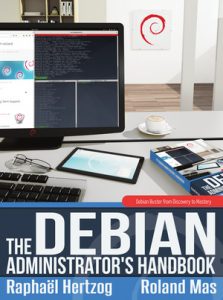
Raphaël Hertzog: The Debian Handbook has been updated for Debian 10

Better late than never as we say thanks to the work of Daniel Leidert and Jorge Maldonado Ventura, we managed to complete the update of my book for Debian 10 Buster. You can get the electronic version on debian-handbook.info or the paperback version on lulu.com. Or you can just read it online. Translators are busy updating their translations, with German and Norvegian Bokmal leading the way
One comment Liked this article? Click here. My blog is Flattr-enabled.

Evgeni Golov: Building documentation for Ansible Collections using antsibull

In my recent post about building and publishing documentation for Ansible Collections, I've mentioned that the Ansible Community is currently in the process of making their build tools available as a separate project called antsibull instead of keeping them in the hacking directory of ansible.git. I've also said that I couldn't get the documentation to build with antsibull-docs as it wouldn't support collections yet. Thankfully, Felix Fontein, one of the maintainers of antsibull, pointed out that I was wrong and later versions of antsibull actually have partial collections support. So I went ahead and tried it again. And what should I say? Two bug reports by me and four patches by Felix Fontain later I can use antsibull-docs to generate the Foreman Ansible Modules documentation! Let's see what's needed instead of the ugly hack in detail. We obviously don't need to clone ansible.git anymore and install its requirements manually. Instead we can just install antsibull (0.17.0 contains all the above patches). We also need Ansible (or ansible-base) 2.10 or never, which currently only exists as a pre-release. 2.10 is the first version that has an ansible-doc that can list contents of a collection, which antsibull-docs requires to work properly. The current implementation of collections documentation in antsibull-docs requires the collection to be installed as in "Ansible can find it". We had the same requirement before to find the documentation fragments and can just re-use the installation we do for various other build tasks in build/collection and point at it using the ANSIBLE_COLLECTIONS_PATHS environment variable or the collections_paths setting in ansible.cfg1. After that, it's only a matter of passing --use-current to make it pick up installed collections instead of trying to fetch and parse them itself. Given the main goal of antisibull-docs collection is to build documentation for multiple collections at once, it defaults to place the generated files into <dest-dir>/collections/<namespace>/<collection>. However, we only build documentation for one collection and thus pass --squash-hierarchy to avoid this longish path and make it generate documentation directly in <dest-dir>. Thanks to Felix for implementing this feature for us! And that's it! We can generate our documentation with a single line now!
antsibull-docs collection --use-current --squash-hierarchy --dest-dir ./build/plugin_docs theforeman.foreman
The PR to switch to antsibull is open for review and I hope to get merged in soon! Oh and you know what's cool? The documentation is now also available as a preview on ansible.com!

  1. Yes, the paths version of that setting is deprecated in 2.10, but as we support older Ansible versions, we still use it.

Martin Michlmayr: beancount2ledger 1.1 released

Martin Blais recently announced that he'd like to re-organize the beancount code and split out some functionality into separate projects, including the beancount to ledger/hledger conversion code previously provided by bean-report. I agreed to take on the maintenance of this code and I've now released beancount2ledger, a beancount to ledger/hledger converter. You can install beancount2ledger with pip:
pip3 install beancount2ledger
Please report issues to the GitHub tracker. There are a number of outstanding issues I'll fix soon, but please report any other issues you encounter. Note that I'm not very familiar with hledger. I intend to sync up with hledger author Simon Michael soon, but please file an issue if you notice any problems with the hledger conversion. Version 1.1 contains a number of fixes compared to the latest code in bean-report: 1.1 (2020-07-24) 1.0 (2020-07-22)

Reproducible Builds (diffoscope): diffoscope 153 released

The diffoscope maintainers are pleased to announce the release of diffoscope version 153. This version includes the following changes:
[ Chris Lamb ]
* Drop some legacy argument styles; --exclude-directory-metadata and
  --no-exclude-directory-metadata have been replaced with
  --exclude-directory-metadata= yes,no .
* Code improvements:
  - Make it easier to navigate the main.py entry point.
  - Use a relative import for get_temporary_directory in diffoscope.diff.
  - Rename bail_if_non_existing to exit_if_paths_do_not_exist.
  - Rewrite exit_if_paths_do_not_exist to not check files multiple times.
* Documentation improvements:
  - CONTRIBUTING.md:
    - Add a quick note about adding/suggesting new options.
    - Update and expand the release process documentation.
    - Add a reminder to regenerate debian/tests/control.
  - README.rst:
    - Correct URL to build job on Jenkins.
    - Clarify and correct contributing info to point to salsa.debian.org.
You find out more by visiting the project homepage.

23 July 2020

Sean Whitton: keyboardingupdates

Marks and mark rings in GNU Emacs I recently attempted to answer the question of whether experienced Emacs users should consider partially or fully disabling Transient Mark mode, which is (and should be) the default in modern GNU Emacs. That blog post was meant to be as information-dense as I could make it, but now I d like to describe the experience I have been having after switching to my custom pseudo-Transient Mark mode, which is labelled mitigation #2 in my older post. In summary: I feel like I ve uncovered a whole editing paradigm lying just beneath the surface of the editor I ve already been using for years. That is cool and enjoyable in itself, but I think it s also helped me understand other design decisions about the basics of the Emacs UI better than before in particular, the ideas behind how Emacs chooses where to display buffers, which were very frustrating to me in the past. I am now regularly using relatively obscure commands like C-x 4 C-o. I see it! It all makes sense now! I would encourage everyone who has never used Emacs without Transient Mark mode to try turning it off for a while, either fully or partially, just to see what you can learn. It s fascinating how it can come to seem more convenient and natural to pop the mark just to go back to the end of the current line after fixing up something earlier in the line, even though doing so requires pressing two modified keys instead of just C-e. Eshell I was amused to learn some years ago that someone was trying to make Emacs work as an X11 window manager. I was amazed and impressed to learn, more recently, that the project is still going and a fair number of people are using it. Kudos! I suspect that the basic motivation for such projects is that Emacs is a virtual Lisp machine, and it has a certain way of managing visible windows, and people would like to be able to bring both of those to their X11 window management. However, I am beginning to suspect that the intrinsic properties of Emacs buffers are tightly connected to the ways in which Emacs manages visible windows, and the intrinsic properties of Emacs buffers are at least as fundamental as its status as a virtual Lisp machine. Thus I am not convinced by the idea of trying to use Emacs ways of handling visible windows to handle windows which do not contain Emacs buffers. (but it s certainly nice to learn it s working out for others) The more general point is this. Emacs buffers are as fundamental to Emacs as anything else is, so it seems unlikely to be particularly fruitful to move something typically done outside of Emacs into Emacs, unless that activity fits naturally into an Emacs buffer or buffers. Being suited to run on a virtual Lisp machine is not enough. What could be more suited to an Emacs buffer, however, than a typical Unix command shell session? By this I mean things like running commands which produce text output, and piping this output between commands and into and out of files. Typically the commands one enters are sort of like tiny programs in themselves, even if there are no pipes involved, because you have to spend time determining just what options to pass to achieve what you want. It is great to have all your input and output available as ordinary buffer text, navigable just like all your other Emacs buffers. Full screen text user interfaces, like top(1), are not the sort of thing I have in mind here. These are suited to terminal emulators, and an Emacs buffer makes a poor terminal emulator what you end up with is a sort of terminal emulator emulator. Emacs buffers and terminal emulators are just different things. These sorts of thoughts lead one to Eshell, the Emacs Shell. Quoting from its documentation:

The shell s role is to make [system] functionality accessible to the user in an unformed state. Very roughly, it associates kernel functionality with textual commands, allowing the user to interact with the operating system via linguistic constructs. Process invocation is perhaps the most significant form this takes, using the kernel s fork' andexec functions. Emacs is a user application, but it does make the functionality of the kernel accessible through an interpreted language namely, Lisp. For that reason, there is little preventing Emacs from serving the same role as a modern shell. It too can manipulate the kernel in an unpredetermined way to cause system changes. All it s missing is the shell-ish linguistic model.
Eshell has been working very well for me for the past month or so, for, at least, Debian packaging work, which is very command shell-oriented (think tools like dch(1)). The other respects in which Eshell is tightly integrated with the rest of Emacs are icing on the cake. In particular, Eshell can transparently operate on remote hosts, using TRAMP. So when I need to execute commands on Debian s ftp-master server to process package removal requests, I just cd /ssh:fasolo: in Eshell. Emacs takes care of disconnecting and connecting to the server when needed there is no need to maintain a fragile SSH connection and a shell process (or anything else) running on the remote end. Or I can cd /ssh:athena\ sudo:root@athena: to run commands as root on the webserver hosting this blog, and, again, the text of the session survives on my laptop, and may be continued at my leisure, no matter whether athena reboots, or I shut my laptop and open it up again the next morning. And of course you can easily edit files on the remote host.

Sean Whitton: Kinesis Advantage 2 for heavy Emacs users

A little under two months ago I invested in an expensive ergonomic keyboard, a Kinesis Advantage 2, and set about figuring out how to use it most effectively with Emacs. The default layout for the keyboard is great for strong typists who control their computer mostly with their mouse, but less good for Emacs users, who are strong typists that control their computer mostly with their keyboard. It took me several tries to figure out where to put the ctrl, alt, backspace, delete, return and spacebar keys, and aside from one forum post I ran into, I haven t found anyone online who came up with anything much like what I ve come up with, so I thought I should probably write up a blog post. The mappings Sequences of two modified keys on different halves of the keyboard It is desirable to input sequences like C-x C-o without switching which hand is holding the control key. This requires one-handed chording, but this is trecherous when the modifier keys not under the thumbs, because you might need to press the modified key with the same finger that s holding the modifier! Fortunately, most or all sequences of two keys modified by ctrl or alt/meta, where each of the two modifier keys is typed by a different hand, begin with C-c, C-x or M-g, and the left hand can handle each of these on its own. This leaves the right hand completely free to hit the second modified key while the left hand continues to hold down the modifier. My rebindings for ordinary keyboards I have some rebindings to make Emacs usage more ergonomic on an ordinary keyboard. So far, my Kinesis Advantage setup is close enough to that setup that I m not having difficulty switching back and forth from my laptop keyboard. The main difference is for sequences of two modified keys on different halves of the keyboard which of the two modified keys is easiest to type as a one-handed chord is different on the Kinesis Advantage than on my laptop keyboard. At this point, I m executing these sequences without any special thought, and they re rare enough that I don t think I need to try to determine what would be the most ergonomic way to handle them.

Rapha&#235;l Hertzog: Freexian s report about Debian Long Term Support, June 2020

A Debian LTS logo Like each month, here comes a report about the work of paid contributors to Debian LTS. Individual reports In June, 202.00 work hours have been dispatched among 12 paid contributors. Their reports are available: Evolution of the situation June was the last month of Jessie LTS which ended on 2020-06-20. If you still need to run Jessie somewhere, please read the post about keeping Debian 8 Jessie alive for longer than 5 years.
So, as (Jessie) LTS is dead, long live the new LTS, Stretch LTS! Stretch has received its last point release, so regular LTS operations can now continue.
Accompanying this, for the first time, we have prepared a small survey about our users and contributors, who they are and why they are using LTS. Filling out the survey should take less than 10 minutes. We would really appreciate if you could participate in the survey online! On July 27th 2020 we will close the survey, so please don t hesitate and participate now! After that, there will be a followup with the results. The security tracker for Stretch LTS currently lists 29 packages with a known CVE and the dla-needed.txt file has 44 packages needing an update in Stretch LTS. Thanks to our sponsors New sponsors are in bold. We welcome CoreFiling this month!

No comment Liked this article? Click here. My blog is Flattr-enabled.

Next.

Previous.


