Russ Allbery: Review: The Last Emperox
| Series: | Interdependency #3 |
| Publisher: | Tor |
| Copyright: | April 2020 |
| ISBN: | 0-7653-8917-7 |
| Format: | Kindle |
| Pages: | 318 |
| Series: | Interdependency #3 |
| Publisher: | Tor |
| Copyright: | April 2020 |
| ISBN: | 0-7653-8917-7 |
| Format: | Kindle |
| Pages: | 318 |
It's the end of the world as we know it, twice as fast
After Homemade Instruments Week on the facebook page, here is an article with some PVC pipes instruments! Percussion on PVC pipes A classic, long pipes for big bass, easy to tune by changing the length
"Ut queant laxis" or "Hymnus in Ioannem" is a Latin hymn in honor of John the Baptist, written in Horatian Sapphics and traditionally attributed to Paulus Diaconus, the eighth-century Lombard historian. It is famous for its part in the history of musical notation, in particular solmization. The hymn belongs to the tradition of Gregorian chant.
The third video (following the announcement, the shell colors) one as well as last week s shell prompt one, is up in the stil new T^4 series of video lightning talks with tips, tricks, tools, and toys. Today we cover customizing the shell some more.
The slides are here. This repo at GitHub support the series: use it to open issues for comments, criticism, suggestions, or feedback. If you like this or other open-source work I do, you can now sponsor me at GitHub. For the first year, GitHub will match your contributions.
This post by Dirk Eddelbuettel originated on his Thinking inside the box blog. Please report excessive re-aggregation in third-party for-profit settings.
apt install vlc-plugin-bittorrentAfter it is installed, you can try to use it to play a file downloaded live via bittorrent like this:
vlc https://archive.org/download/Glass_201703/Glass_201703_archive.torrentIt also support magnet links and local .torrent files. As usual, if you use Bitcoin and want to show your support of my activities, please send Bitcoin donations to my address 15oWEoG9dUPovwmUL9KWAnYRtNJEkP1u1b.
I found a detailed
explanation
of what might be causing this which pointed the finger at transparent
images, a PDF 1.4 feature which apparently requires a more recent version of
PostScript than what my printer
supports.
Using Okular's Force rasterization option
(accessible via the print dialog) does work by essentially rendering
everything ahead of time and outputing a big image to be sent to the
printer. The quality is not very good however.
pdfinfo, I found that
it is in PDF 1.5 format and so the transparency effects could be the cause
of the out-of-memory printer error.
Here's how I converted it to a high-quality DjVu file I could print without
problems using Evince:
pdf2djvu -d 1200 2002.04049.pdf > 2002.04049-1200dpi.djvu
pdf2djvu -d 600 dow-faq_v1.1.pdf > dow-faq_v1.1-600dpi.djvu
In this case, I used a different technique and simply converted the PDF to
version 1.3 (from version 1.6 according to pdfinfo):
ps2pdf13 -r1200x1200 dow-faq_v1.1.pdf dow-faq_v1.1-1200dpi.pdf
This eliminates the problematic transparency and rasterizes the elements
that version 1.3 doesn't support.
Like each month, here comes a report about the work of paid contributors to Debian LTS.
Individual reports
In April, 284.5 work hours have been dispatched among 14 paid contributors. Their reports are available:
No comment Liked this article? Click here. My blog is Flattr-enabled.
A new RcppSimdJson release with updated upstream simdjson code just arrived on CRAN. RcppSimdJson wraps the fantastic and genuinely impressive simdjson library by Daniel Lemire and collaborators. Via some very clever algorithmic engineering to obtain largely branch-free code, coupled with modern C++ and newer compiler instructions, it results in parsing gigabytes of JSON parsed per second which is quite mindboggling. The best-case performance is faster than CPU speed as use of parallel SIMD instructions and careful branch avoidance can lead to less than one cpu cycle use per byte parsed; see the video of the recent talk by Daniel Lemire at QCon (which was also voted best talk).
This release brings updated upstream code (thanks to Brendan Knapp) plus a new example and minimal tweaks. The full NEWS entry follows.
Courtesy of CRANberries, there is also a diffstat report for this release. For questions, suggestions, or issues please use the issue tracker at the GitHub repo. If you like this or other open-source work I do, you can now sponsor me at GitHub. For the first year, GitHub will match your contributions.Changes in version 0.0.5 (2020-05-23)
This post by Dirk Eddelbuettel originated on his Thinking inside the box blog. Please report excessive re-aggregation in third-party for-profit settings.
145. This version includes the following changes:
[ Chris Lamb ]
* Improvements:
- Add support for Apple Xcode mobile provisioning .mobilepovision files.
(Closes: reproducible-builds/diffoscope#113)
- Add support for printing the signatures via apksigner(1).
(Closes: reproducible-builds/diffoscope#121)
- Use SHA256 over MD5 when generating page names for the HTML directory
presenter, validate checksums for files referenced in .changes files
using SHA256 too, and move to using SHA256 in "Too much input for diff"
output too. (Closes: reproducible-builds/diffoscope#124)
- Don't leak the full path of the temporary directory in "Command [..]
exited with 1". (Closes: reproducible-builds/diffoscope#126)
- Identify "iOS App Zip archive data" files as .zip files.
(Closes: reproducible-builds/diffoscope#116)
* Bug fixes:
- Correct "differences" typo in the ApkFile handler.
(Closes: reproducible-builds/diffoscope#127)
* Reporting/output improvements:
- Never emit the same id="foo" TML anchor reference twice, otherwise
identically-named parts will not be able to linked to via "#foo".
(Closes: reproducible-builds/diffoscope#120)
- Never emit HTML with empty "id" anchor lements as it is not possible to
link to "#" (vs "#foo"). We use "#top" as a fallback value so it will
work for the top-level parent container.
- Clarify the message when we cannot find the "debian" Python module.
- Clarify "Command [..] failed with exit code" to remove duplicate "exited
with exit" but also to note that diffoscope is interpreting this as an
error.
- Add descriptions for the 'fallback' Debian module file types.
- Rename the --debugger command-line argument to --pdb.
* Testsuite improvements:
- Prevent CI (and runtime) apksigner test failures due to lack of
binfmt_misc on Salsa CI and elsewhere.
* Codebase improvements:
- Initially add a pair of comments to tidy up a slightly abstraction level
violating code in diffoscope.comparators.mising_file and the
.dsc/.buildinfo file handling, but replace this later by by inlining
MissingFile's special handling of deb822 to prevent leaking through
abstraction layers in the first place.
- Use a BuildinfoFile (etc.) regardless of whether the associated files
such as the orig.tar.gz and the .deb are present, but don't treat them as
actual containers. (Re: reproducible-builds/diffoscope#122)
- Rename the "Openssl" command class to "OpenSSLPKCS7" to accommodate other
commands with this prefix.
- Wrap a docstring across multiple lines, drop an inline pprint import and
comment the HTMLPrintContext class, etc.
[ Emanuel Bronshtein ]
* Avoid build-cache in building the released Docker image.
(Closes: reproducible-builds/diffoscope#123)
[ Holger Levsen ]
* Wrap long lines in older changelog entries.
Almost three years ago I wrote my first linux-security-module, inspired by a comment I read on LWN
I did a little more learning/experimentation and actually produced a somewhat useful LSM, which allows you to restrict command-execution via the use of a user-space helper:
The last time I'd touched them they were built against 5.1, which was itself a big jump forwards from the 4.16.7 version I'd initially used.Finally I updated the
can-exec module to make it gated, which means you can turn it on, but not turn it off without a reboot. That was an obvious omission from the initial implementation #11.
Anyway updated code is available here:
I'd kinda like to write more similar things, but I lack inspiration.
We are very excited to announce that Debian has selected nine interns to work
under mentorship on a variety of
projects with us during the
Google Summer of Code.
Here are the list of the projects, students, and details of the tasks to be performed.
The KDE Plasma desktop is soon getting an update to 5.19, and beta versions are out for testing.
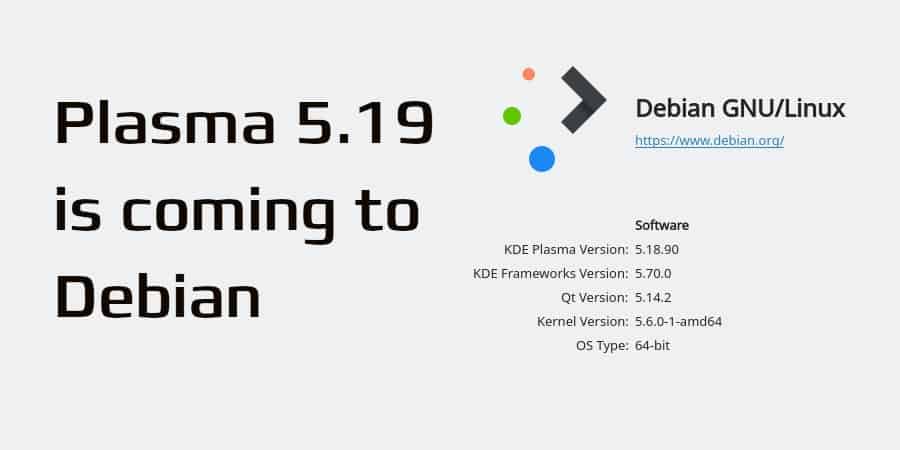
In this release, we have prioritized making Plasma more consistent, correcting and unifying designs of widgets and desktop elements; worked on giving you more control over your desktop by adding configuration options to the System Settings; and improved usability, making Plasma and its components easier to use and an overall more pleasurable experience.
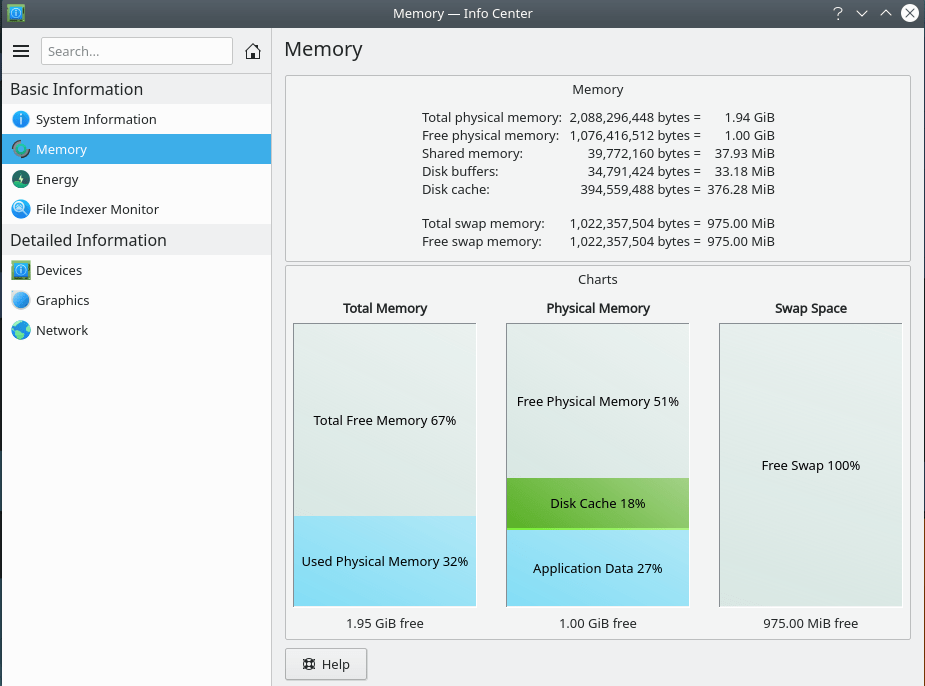
There are lots of new features mentioned in the release announcement, I like in particular the much more usable settings application as well as the new info center.
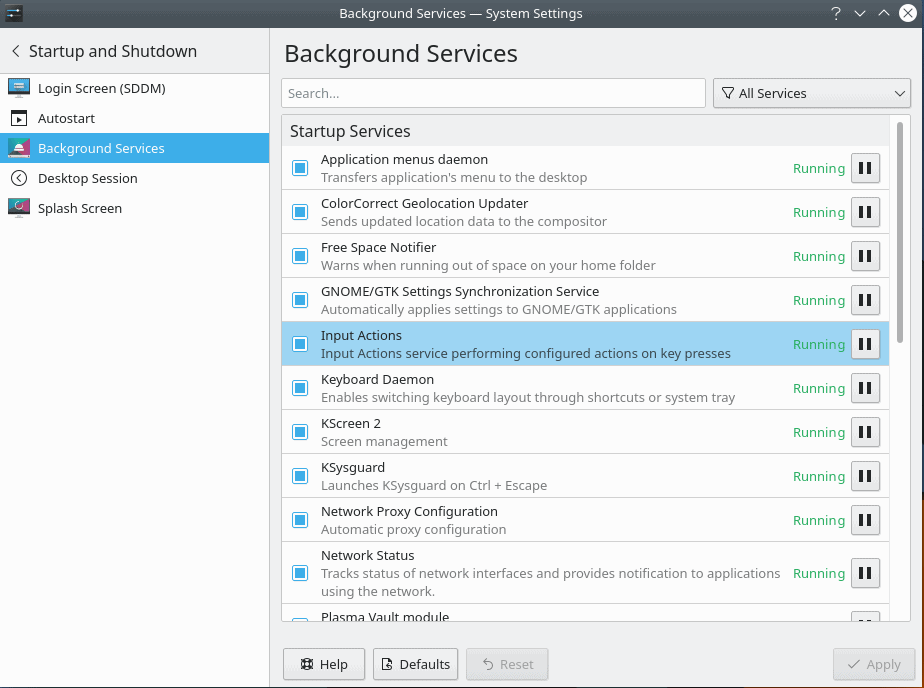
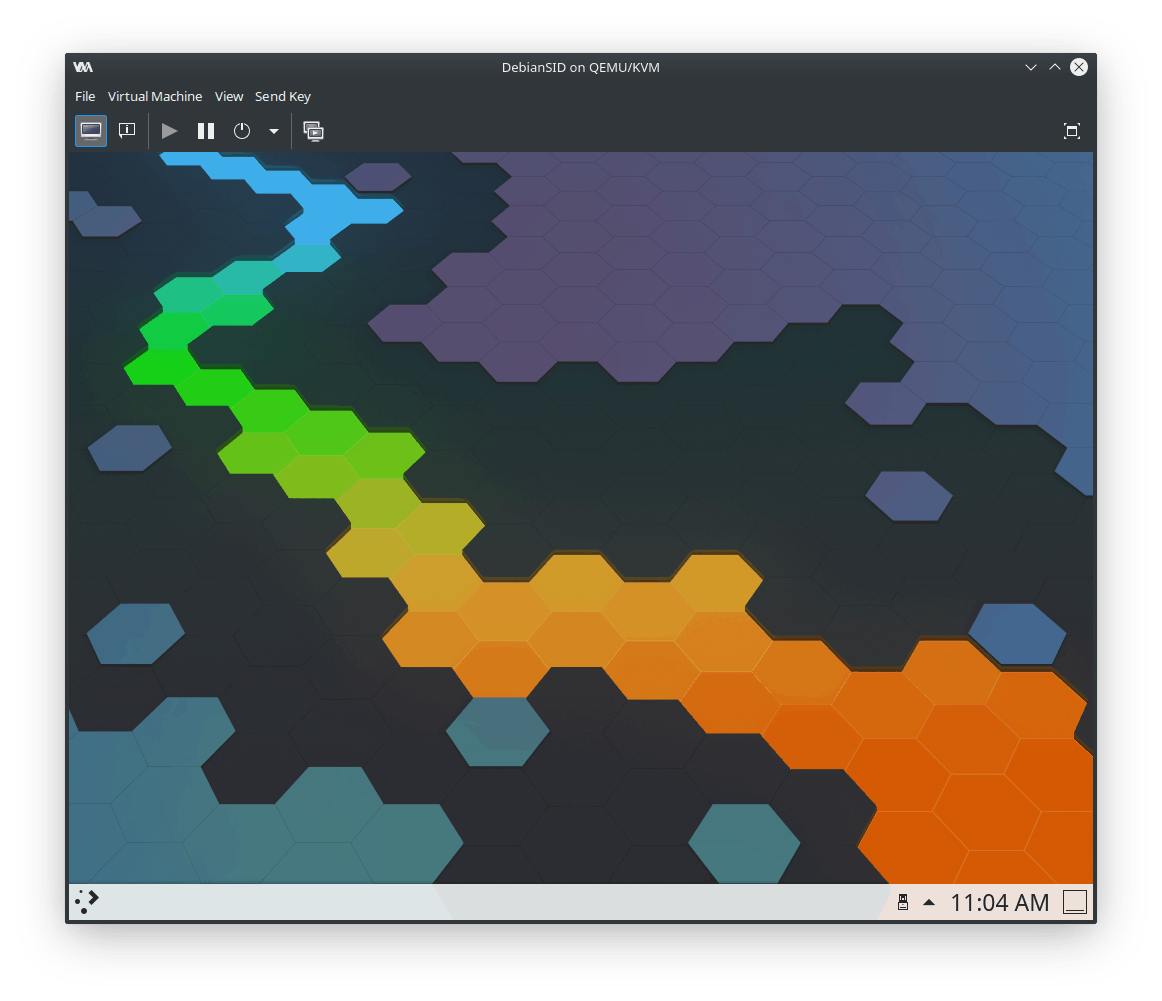
These packages require Qt 5.14, which is only available in the experimental suite, and there is no way to simply update to Qt 5.14 since all Qt related packages need to be recompiled. So as long as Qt 5.14 doesn t hit unstable, I cannot really run these packages on my main machine, but I tried a clean Debian virtual machine installing only Plasma 5.18.90 and depending packages, plus some more for a pleasant desktop experience. This worked out quite well, the VM runs Plasma 5.18.90.
I don t have 3D running on the VM, so I cannot really check all the nice new effects, but I am sure on my main system they would work.
Well, bottom line, as soon as we have Qt 5.14 in Debian/unstable, we are also ready for Plasma 5.19!
/etc/apache2/conf-available/ssi.conf:
AddType text/html .shtml
AddOutputFilter INCLUDES .shtml
and making that configuration file active:
a2enconf ssi
Then, find the vhost file where you want to enable SSI and add the following
options to a Location or Directory section:
<Location /ssi_files>
Options +IncludesNOEXEC
SSLRequireSSL
Header set Content-Security-Policy: "default-src 'none'"
Header set X-Content-Type-Options: "nosniff"
</Location>
before adding the necessary modules:
a2enmod headers
a2enmod include
and restarting Apache:
apache2ctl configtest && systemctl restart apache2.service
Create an shtml page
With the web server ready to process SSI instructions, the following HTML
blurb can be used to display the client IP address:
<!--#echo var="REMOTE_ADDR" -->
or any other built-in
variable.
Note that you don't need to write a valid HTML for the variable to be
substituted and so the above one-liner is all I use on my server.
IncludesNOEXEC option in order to disable arbitrary command
execution via
SSI. In addition, you can also make sure that the cgi module is disabled
since that's a dependency of the more dangerous side of SSI:
a2dismod cgi
Of course, if you rely on this IP address to be accurate, for example
because you'll be putting it in your DNS, then you should make sure that you
only serve this page over HTTPS, which can be enforced via the
SSLRequireSSL
directive.
I included two other headers in the above vhost config
(Content-Security-Policy
and
X-Content-Type-Options)
in order to limit the damage that could be done in case a malicious file was
accidentally dropped in that directory.
Finally, I suggest making sure that only the root user has writable
access to the directory which has server-side includes enabled:
$ ls -la /var/www/ssi_includes/
total 12
drwxr-xr-x 2 root root 4096 May 18 15:58 .
drwxr-xr-x 16 root root 4096 May 18 15:40 ..
-rw-r--r-- 1 root root 0 May 18 15:46 index.html
-rw-r--r-- 1 root root 32 May 18 15:58 whatsmyip.shtml
This post was originally published in the Wikimedia Tech blog, and
is authored by Arturo Borrero Gonzalez and Brooke Storm.
One of the most successful and important products provided by the Wikimedia
Cloud Services team at the Wikimedia Foundation is
Toolforge. Toolforge is a platform that allows users and
developers to run and use a variety of applications that help the Wikimedia
movement and mission from the technical point of view in general. Toolforge is
a hosting service commonly known in the industry as a Platform as a Service
(PaaS). Toolforge is powered by two different backend engines,
Kubernetes and GridEngine.
This article focuses on how we made a better Toolforge by integrating a newer
version of Kubernetes and, along with it, some more modern workflows.
The starting point in this story is 2018. Yes, two years ago! We identified
that we could do better with our Kubernetes deployment in Toolforge. We were
using a very old version, v1.4. Using an old version of any software has more
or less the same consequences everywhere: you lack security improvements and
some modern key features.
Once it was clear that we wanted to upgrade our Kubernetes cluster, both the
engineering work and the endless chain of challenges started.
It turns out that Kubernetes is a complex and modern technology, which adds
some extra abstraction layers to add flexibility and some intelligence to a
very old systems engineering need: hosting and running a variety of
applications.
Our first challenge was to understand what our use case for a modern Kubernetes
was. We were particularly interested in some key features:
The second video (following the announcement and last week s shell colors) is up in the stil new T^4 series of video lightning talks with tips, tricks, tools, and toys. Today we cover customizing shell prompts.
The slides are available here. Next week we likely continue on shell customization with aliases. This repo at GitHub support the series: use it to open issues for comments, criticism, suggestions, or feedback. If you like this or other open-source work I do, you can now sponsor me at GitHub. For the first year, GitHub will match your contributions.
This post by Dirk Eddelbuettel originated on his Thinking inside the box blog. Please report excessive re-aggregation in third-party for-profit settings.
heimdal-history command
to interrogate history without modifying it and increases the default hash
iterations used when storing old passwords. explicit_bzero is now
used, where available, to clear the memory used for passwords after
processing. krb5-strength can now optionally be built without CrackLib
support at all, if you only want to use the word list, edit distance, or
length and character class rules.
It's been a few years since the previous release, so this release also
updates all the portability code, overhauls valgrind testing, and now
passes tests when built with system CrackLib (by skipping tests for
passwords that are rejected by the stronger rules of the embedded CrackLib
fork).
You can get the latest release from the
krb5-strength distribution page.
New packages will be uploaded to Debian unstable shortly (as soon as a
Perl transition completes enough to make the package buildable in
unstable).
Armadillo is a powerful and expressive C++ template library for linear algebra aiming towards a good balance between speed and ease of use with a syntax deliberately close to a Matlab. RcppArmadillo integrates this library with the R environment and language and is widely used by (currently) 719 other packages on CRAN.
Conrad released a new upstream version 9.880.1 of Armadillo on Friday which I packaged and tested as usual (result log here in the usual repo). The R package also sports a new OpenMP detection facility once again motivated by macOS which changed its setup yet again.
Changes in the new release are noted below.
Courtesy of CRANberries, there is a diffstat report relative to previous release. More detailed information is on the RcppArmadillo page. Questions, comments etc should go to the rcpp-devel mailing list off the R-Forge page. If you like this or other open-source work I do, you can now sponsor me at GitHub. For the first year, GitHub will match your contributions.Changes in RcppArmadillo version 0.9.880.1.0 (2020-05-15)
- Upgraded to Armadillo release 9.880.1 (Roasted Mocha Detox)
- expanded
qr()to optionally use pivoted decomposition- updated physical constants to NIST 2018 CODATA values
- added
ARMA_DONT_USE_CXX11_MUTEXconfguration option to disable use ofstd::mutex- OpenMP capability is tested explicitly (Kevin Ushey and Dirk in #294, #295, and #296 all fixing #290).
This post by Dirk Eddelbuettel originated on his Thinking inside the box blog. Please report excessive re-aggregation in third-party for-profit settings.
I started work on sysbox again recently, adding a couple of simple utilities. (The whole project is a small collection of utilities, distributed as a single binary to ease installation.)
Imagine you want to run a command for every line of STDIN, here's a good example:
$ cat input sysbox exec-stdin "youtube-dl "
Here you see for every (non-empty) line of input read from STDIN the command "youtube-dl" has been executed. " " gets expanded to the complete line read. You can also access individual fields, kinda like awk.
(Yes youtube-dl can read a list of URLs from a file, this is an example!)
Another example, run groups for every local user:
$ cat /etc/passwd sysbox exec-stdin --split=: groups 1
Here you see we have split the input-lines read from STDIN by the : character, instead of by whitespace, and we've accessed the first field via " 1 ". This is certainly easier for scripting than using a bash loop.
On the topic of bash; command-completion for each subcommand, and their arguments, is now present:
$ source <(sysbox bash-completion)
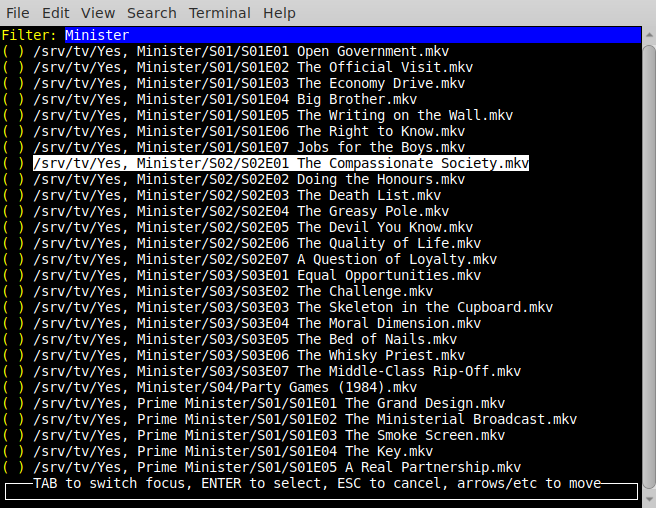
And I've added a text-based UI for selecting files. You can also execute a command, against the selected file:
$ sysbox choose-file -exec "xine " /srv/tv
This is what that looks like:
You'll see:
" is the selected item.)
Other commands received updates, so the calculator now allows storing results in variables:
$ sysbox calc
calc> let a = 3
3
calc> a / 9 * 3
1
calc> 1 + 2 * a
7
calc> 1.2 + 3.4
4.600000
Some people believe that automatic contact tracing apps will
help contain the Coronavirus epidemic. They won t.
Sorry to bring the bad news, but IT and mobile phones and artificial
intelligence will not solve every problem.
In my opinion, those that promise to solve these things with
artificial intelligence / mobile phones / apps / your-favorite-buzzword
are at least overly optimistic and blinder Aktionismus (*),
if not naive, detachted from reality,
or fraudsters that just want to get some funding.
(*) there does not seem to be an English word for this doing something
just for the sake of doing something, without thinking about whether it makes sense to do so
Here are the reasons why it will not work:
Because posting private keys on the Internet is a bad idea, some
people like to redact their private keys, so that it looks kinda-sorta like a private key,
but it isn t actually giving away anything secret. Unfortunately, due to the way that
private keys are represented, it is easy to redact a key in such a way that it
doesn t actually redact anything at all. RSA private keys are particularly bad at this,
but the problem can (potentially) apply to other keys as well.
I ll show you a bit of Inside Baseball with key formats, and then demonstrate the practical
implications. Finally, we ll go through a practical worked example from an actual not-really-redacted
key I recently stumbled across in my travels.
-----BEGIN RSA PRIVATE KEY----- MGICAQACEQCxjdTmecltJEz2PLMpS4BXAgMBAAECEDKtuwD17gpagnASq1zQTYEC CQDVTYVsjjF7IQIJANUYZsIjRsR3AgkAkahDUXL0RSECCB78r2SnsJC9AghaOK3F sKoELg== -----END RSA PRIVATE KEY-----Obviously, there s some hidden meaning in there computers don t encrypt things by shouting BEGIN RSA PRIVATE KEY! , after all. What is between the
BEGIN/END lines above is, in fact, a
base64-encoded
DER format
ASN.1 structure representing a PKCS#1 private
key.
In simple terms, it s a list of numbers very important numbers. The list
of numbers is, in order:
n ;e (which is almost always 65,537, for various unimportant reasons);d ;p and q ;dmp1 and dmq1 ; andiqmp .e, p, and q.
Of the other numbers, most of them are at least about the same size as each
of p and q. So of the total data in an RSA key, less than a quarter of the
data is required. Let me show you with the above toy key, by breaking it
down piece by piece1:
MGI DER for this is a sequence CAQ version (0)CxjdTmecltJEz2PLMpS4BX nAgMBAA eECEDKtuwD17gpagnASq1zQTY dECCQDVTYVsjjF7IQ pIJANUYZsIjRsR3 qAgkAkahDUXL0RS dmp1ECCB78r2SnsJC9 dmq1AghaOK3FsKoELg== iqmpe, p, and q and e is pretty much always 65,537. So I could redact
almost all of this key, and still give all the important, private bits of this
key. Let me show you:
-----BEGIN RSA PRIVATE KEY----- ..............................................................EC CQDVTYVsjjF7IQIJANUYZsIjRsR3.................................... ........ -----END RSA PRIVATE KEY-----Now, I doubt that anyone is going to redact a key precisely like this but then again, this isn t a typical RSA key. They usually look a lot more like this:
-----BEGIN RSA PRIVATE KEY----- MIIEogIBAAKCAQEAu6Inch7+mWtKn+leB9uCG3MaJIxRyvC/5KTz2fR+h+GOhqj4 SZJobiVB4FrE5FgC7AnlH6qeRi9MI0s6dt5UWZ5oNIeWSaOOeNO+EJDUkSVf67wj SNGXlSjGAkPZ0nRJiDjhuPvQmdW53hOaBLk5udxPEQbenpXAzbLJ7wH5ouLQ3nQw HwpwDNQhF6zRO8WoscpDVThOAM+s4PS7EiK8ZR4hu2toon8Ynadlm95V45wR0VlW zywgbkZCKa1IMrDCscB6CglQ10M3Xzya3iTzDtQxYMVqhDrA7uBYRxA0y1sER+Rb yhEh03xz3AWemJVLCQuU06r+FABXJuY/QuAVvQIDAQABAoIBAFqwWVhzWqNUlFEO PoCVvCEAVRZtK+tmyZj9kU87ORz8DCNR8A+/T/JM17ZUqO2lDGSBs9jGYpGRsr8s USm69BIM2ljpX95fyzDjRu5C0jsFUYNi/7rmctmJR4s4uENcKV5J/++k5oI0Jw4L c1ntHNWUgjK8m0UTJIlHbQq0bbAoFEcfdZxd3W+SzRG3jND3gifqKxBG04YDwloy tu+bPV2jEih6p8tykew5OJwtJ3XsSZnqJMwcvDciVbwYNiJ6pUvGq6Z9kumOavm9 XU26m4cWipuK0URWbHWQA7SjbktqEpxsFrn5bYhJ9qXgLUh/I1+WhB2GEf3hQF5A pDTN4oECgYEA7Kp6lE7ugFBDC09sKAhoQWrVSiFpZG4Z1gsL9z5YmZU/vZf0Su0n 9J2/k5B1GghvSwkTqpDZLXgNz8eIX0WCsS1xpzOuORSNvS1DWuzyATIG2cExuRiB jYWIJUeCpa5p2PdlZmBrnD/hJ4oNk4oAVpf+HisfDSN7HBpN+TJfcAUCgYEAyvY7 Y4hQfHIdcfF3A9eeCGazIYbwVyfoGu70S/BZb2NoNEPymqsz7NOfwZQkL4O7R3Wl Rm0vrWT8T5ykEUgT+2ruZVXYSQCKUOl18acbAy0eZ81wGBljZc9VWBrP1rHviVWd OVDRZNjz6nd6ZMrJvxRa24TvxZbJMmO1cgSW1FkCgYAoWBd1WM9HiGclcnCZknVT UYbykCeLO0mkN1Xe2/32kH7BLzox26PIC2wxF5seyPlP7Ugw92hOW/zewsD4nLze v0R0oFa+3EYdTa4BvgqzMXgBfvGfABJ1saG32SzoWYcpuWLLxPwTMsCLIPmXgRr1 qAtl0SwF7Vp7O/C23mNukQKBgB89DOEB7xloWv3Zo27U9f7nB7UmVsGjY8cZdkJl 6O4LB9PbjXCe3ywZWmJqEbO6e83A3sJbNdZjT65VNq9uP50X1T+FmfeKfL99X2jl RnQTsrVZWmJrLfBSnBkmb0zlMDAcHEnhFYmHFuvEnfL7f1fIoz9cU6c+0RLPY/L7 n9dpAoGAXih17mcmtnV+Ce+lBWzGWw9P4kVDSIxzGxd8gprrGKLa3Q9VuOrLdt58 ++UzNUaBN6VYAe4jgxGfZfh+IaSlMouwOjDgE/qzgY8QsjBubzmABR/KWCYiRqkj qpWCgo1FC1Gn94gh/+dW2Q8+NjYtXWNqQcjRP4AKTBnPktEvdMA= -----END RSA PRIVATE KEY-----People typically redact keys by deleting whole lines, and usually replacing them with
[...] and the like. But only about 345 of those 1588 characters
(excluding the header and footer) are required to construct the entire key.
You can redact about 4/5ths of that giant blob of stuff, and your private parts
(or at least, those of your key) are still left uncomfortably exposed.
e, p,
and q could be derived from those three numbers? Let s talk about one
of those numbers: n.
This is known as the public modulus (because, along with e, it is also
present in the public key). It is very easy to calculate: n = p * q. It
is also very early in the key (the second number, in fact).
Since n = p * q, it follows that q = n / p. Thus, as long
as the key is intact up to p, you can derive q by simple division.
johanfinn/scripts.
For a while, his repo contained a script that contained a poorly-redacted private
key. He since deleted it, by making a new commit, but of course because
git never really deletes anything, it s
still available.
Of course, Mr. Finn may delete the repo, or force-push a new history without
that commit, so here is the redacted private key, with a bit of the surrounding
shell script, for our illustrative pleasure:
#Add private key to .ssh folder cd /home/johan/.ssh/ echo "-----BEGIN RSA PRIVATE KEY----- MMMMMMMMMMMMMMMMMMMMMMMMMMMMMMMMMMMMMMMMMMMMMMMMMMMMMMMMMMMMMMMM NNNNNNNNNNNNNNNNNNNNNNNNNNNNNNNNNNNNNNNNNNNNNNNNNNNNNNNNNNNNNNNN KKKKKKKKKKKKKKKKKKKKKKKKKKKKKKKKKKKKKKKKKKKKKKKKKKKKKKKKKKKKKKKK MIIJKgIBAAKCAgEAxEVih1JGb8gu/Fm4AZh+ZwJw/pjzzliWrg4mICFt1g7SmIE2 TCQMKABdwd11wOFKCPc/UzRH/fHuQcvWrpbOSdqev/zKff9iedKw/YygkMeIRaXB fYELqvUAOJ8PPfDm70st9GJRhjGgo5+L3cJB2gfgeiDNHzaFvapRSU0oMGQX+kI9 ezsjDAn+0Pp+r3h/u1QpLSH4moRFGF4omNydI+3iTGB98/EzuNhRBHRNq4oBV5SG Pq/A1bem2ninnoEaQ+OPESxYzDz3Jy9jV0W/6LvtJ844m+XX69H5fqq5dy55z6DW sGKn78ULPVZPsYH5Y7C+CM6GAn4nYCpau0t52sqsY5epXdeYx4Dc+Wm0CjXrUDEe Egl4loPKDxJkQqQ/MQiz6Le/UK9vEmnWn1TRXK3ekzNV4NgDfJANBQobOpwt8WVB rbsC0ON7n680RQnl7PltK9P1AQW5vHsahkoixk/BhcwhkrkZGyDIl9g8Q/Euyoq3 eivKPLz7/rhDE7C1BzFy7v8AjC3w7i9QeHcWOZFAXo5hiDasIAkljDOsdfD4tP5/ wSO6E6pjL3kJ+RH2FCHd7ciQb+IcuXbku64ln8gab4p8jLa/mcMI+V3eWYnZ82Yu axsa85hAe4wb60cp/rCJo7ihhDTTvGooqtTisOv2nSvCYpcW9qbL6cGjAXECAwEA AQKCAgEAjz6wnWDP5Y9ts2FrqUZ5ooamnzpUXlpLhrbu3m5ncl4ZF5LfH+QDN0Kl KvONmHsUhJynC/vROybSJBU4Fu4bms1DJY3C39h/L7g00qhLG7901pgWMpn3QQtU 4P49qpBii20MGhuTsmQQALtV4kB/vTgYfinoawpo67cdYmk8lqzGzzB/HKxZdNTq s+zOfxRr7PWMo9LyVRuKLjGyYXZJ/coFaobWBi8Y96Rw5NZZRYQQXLIalC/Dhndm AHckpstEtx2i8f6yxEUOgPvV/gD7Akn92RpqOGW0g/kYpXjGqZQy9PVHGy61sInY HSkcOspIkJiS6WyJY9JcvJPM6ns4b84GE9qoUlWVF3RWJk1dqYCw5hz4U8LFyxsF R6WhYiImvjxBLpab55rSqbGkzjI2z+ucDZyl1gqIv9U6qceVsgRyuqdfVN4deU22 LzO5IEDhnGdFqg9KQY7u8zm686Ejs64T1sh0y4GOmGsSg+P6nsqkdlXH8C+Cf03F lqPFg8WQC7ojl/S8dPmkT5tcJh3BPwIWuvbtVjFOGQc8x0lb+NwK8h2Nsn6LNazS 0H90adh/IyYX4sBMokrpxAi+gMAWiyJHIHLeH2itNKtAQd3qQowbrWNswJSgJzsT JuJ7uqRKAFkE6nCeAkuj/6KHHMPsfCAffVdyGaWqhoxmPOrnVgECggEBAOrCCwiC XxwUgjOfOKx68siFJLfHf4vPo42LZOkAQq5aUmcWHbJVXmoxLYSczyAROopY0wd6 Dx8rqnpO7OtZsdJMeBSHbMVKoBZ77hiCQlrljcj12moFaEAButLCdZFsZW4zF/sx kWIAaPH9vc4MvHHyvyNoB3yQRdevu57X7xGf9UxWuPil/jvdbt9toaraUT6rUBWU GYPNKaLFsQzKsFWAzp5RGpASkhuiBJ0Qx3cfLyirjrKqTipe3o3gh/5RSHQ6VAhz gdUG7WszNWk8FDCL6RTWzPOrbUyJo/wz1kblsL3vhV7ldEKFHeEjsDGroW2VUFlS asAHNvM4/uYcOSECggEBANYH0427qZtLVuL97htXW9kCAT75xbMwgRskAH4nJDlZ IggDErmzBhtrHgR+9X09iL47jr7dUcrVNPHzK/WXALFSKzXhkG/yAgmt3r14WgJ6 5y7010LlPFrzaNEyO/S4ISuBLt4cinjJsrFpoo0WI8jXeM5ddG6ncxdurKXMymY7 :::::::::::::::::::::::::::::::::::::::::::::::::::::::::::::.:: :::::::::::::::::::::::::::.:::::::::::::::::::::::::::::::::::: LLLLLLLLLLLLLLLLLLLLLLLLLLLLLLLLLLLLLLLLLLLLLLLLLLLLLLLLLLLLLLlL YYYYYYYYYYYYYYYYYYYYYyYYYYYYYYYYYYYYYYYYYYYYYYYYYYYYYYYYYYYYYY gff0GJCOMZ65pMSy3A3cSAtjlKnb4fWzuHD5CFbusN4WhCT/tNxGNSpzvxd8GIDs nY7exs9L230oCCpedVgcbayHCbkChEfoPzL1e1jXjgCwCTgt8GjeEFqc1gXNEaUn O8AJ4VlR8fRszHm6yR0ZUBdY7UJddxQiYOzt0S1RLlECggEAbdcs4mZdqf3OjejJ 06oTPs9NRtAJVZlppSi7pmmAyaNpOuKWMoLPElDAQ3Q7VX26LlExLCZoPOVpdqDH KbdmBEfTR4e11Pn9vYdu9/i6o10U4hpmf4TYKlqk10g1Sj21l8JATj/7Diey8scO sAI1iftSg3aBSj8W7rxCxSezrENzuqw5D95a/he1cMUTB6XuravqZK5O4eR0vrxR AvMzXk5OXrUEALUvt84u6m6XZZ0pq5XZxq74s8p/x1JvTwcpJ3jDKNEixlHfdHEZ ZIu/xpcwD5gRfVGQamdcWvzGHZYLBFO1y5kAtL8kI9tW7WaouWVLmv99AyxdAaCB Y5mBAQKCAQEAzU7AnorPzYndlOzkxRFtp6MGsvRBsvvqPLCyUFEXrHNV872O7tdO GmsMZl+q+TJXw7O54FjJJvqSSS1sk68AGRirHop7VQce8U36BmI2ZX6j2SVAgIkI 9m3btCCt5rfiCatn2+Qg6HECmrCsHw6H0RbwaXS4RZUXD/k4X+sslBitOb7K+Y+N Bacq6QxxjlIqQdKKPs4P2PNHEAey+kEJJGEQ7bTkNxCZ21kgi1Sc5L8U/IGy0BMC PvJxssLdaWILyp3Ws8Q4RAoC5c0ZP0W2j+5NSbi3jsDFi0Y6/2GRdY1HAZX4twem Q0NCedq1JNatP1gsb6bcnVHFDEGsj/35oQKCAQEAgmWMuSrojR/fjJzvke6Wvbox FRnPk+6YRzuYhAP/YPxSRYyB5at++5Q1qr7QWn7NFozFIVFFT8CBU36ktWQ39MGm cJ5SGyN9nAbbuWA6e+/u059R7QL+6f64xHRAGyLT3gOb1G0N6h7VqFT25q5Tq0rc Lf/CvLKoudjv+sQ5GKBPT18+zxmwJ8YUWAsXUyrqoFWY/Tvo5yLxaC0W2gh3+Ppi EDqe4RRJ3VKuKfZxHn5VLxgtBFN96Gy0+Htm5tiMKOZMYAkHiL+vrVZAX0hIEuRZ JJJJJJJJJJJJJJJJJJJJJJJJJJJJJJJJJJJJJJJJJJJJJJJJJJJJJJJJJJJJJJJJ MMMMMMMMMMMMMMMMMMMMMMMMMMMMMMMMMMMMMMMMMMMMMMMMMMMMMMMMMMMMMMMM -----END RSA PRIVATE KEY-----" >> id_rsaNow, if you try to reconstruct this key by removing the obvious garbage lines (the ones that are all repeated characters, some of which aren t even valid base64 characters), it still isn t a key at least,
openssl pkey
doesn t want anything to do with it. The key is very much still in there,
though, as we shall soon see.
Using a gem I wrote and a quick bit of
Ruby, we can extract a complete private key. The irb session looks something
like this:
>> require "derparse"
>> b64 = <<EOF
MIIJKgIBAAKCAgEAxEVih1JGb8gu/Fm4AZh+ZwJw/pjzzliWrg4mICFt1g7SmIE2
TCQMKABdwd11wOFKCPc/UzRH/fHuQcvWrpbOSdqev/zKff9iedKw/YygkMeIRaXB
fYELqvUAOJ8PPfDm70st9GJRhjGgo5+L3cJB2gfgeiDNHzaFvapRSU0oMGQX+kI9
ezsjDAn+0Pp+r3h/u1QpLSH4moRFGF4omNydI+3iTGB98/EzuNhRBHRNq4oBV5SG
Pq/A1bem2ninnoEaQ+OPESxYzDz3Jy9jV0W/6LvtJ844m+XX69H5fqq5dy55z6DW
sGKn78ULPVZPsYH5Y7C+CM6GAn4nYCpau0t52sqsY5epXdeYx4Dc+Wm0CjXrUDEe
Egl4loPKDxJkQqQ/MQiz6Le/UK9vEmnWn1TRXK3ekzNV4NgDfJANBQobOpwt8WVB
rbsC0ON7n680RQnl7PltK9P1AQW5vHsahkoixk/BhcwhkrkZGyDIl9g8Q/Euyoq3
eivKPLz7/rhDE7C1BzFy7v8AjC3w7i9QeHcWOZFAXo5hiDasIAkljDOsdfD4tP5/
wSO6E6pjL3kJ+RH2FCHd7ciQb+IcuXbku64ln8gab4p8jLa/mcMI+V3eWYnZ82Yu
axsa85hAe4wb60cp/rCJo7ihhDTTvGooqtTisOv2nSvCYpcW9qbL6cGjAXECAwEA
AQKCAgEAjz6wnWDP5Y9ts2FrqUZ5ooamnzpUXlpLhrbu3m5ncl4ZF5LfH+QDN0Kl
KvONmHsUhJynC/vROybSJBU4Fu4bms1DJY3C39h/L7g00qhLG7901pgWMpn3QQtU
4P49qpBii20MGhuTsmQQALtV4kB/vTgYfinoawpo67cdYmk8lqzGzzB/HKxZdNTq
s+zOfxRr7PWMo9LyVRuKLjGyYXZJ/coFaobWBi8Y96Rw5NZZRYQQXLIalC/Dhndm
AHckpstEtx2i8f6yxEUOgPvV/gD7Akn92RpqOGW0g/kYpXjGqZQy9PVHGy61sInY
HSkcOspIkJiS6WyJY9JcvJPM6ns4b84GE9qoUlWVF3RWJk1dqYCw5hz4U8LFyxsF
R6WhYiImvjxBLpab55rSqbGkzjI2z+ucDZyl1gqIv9U6qceVsgRyuqdfVN4deU22
LzO5IEDhnGdFqg9KQY7u8zm686Ejs64T1sh0y4GOmGsSg+P6nsqkdlXH8C+Cf03F
lqPFg8WQC7ojl/S8dPmkT5tcJh3BPwIWuvbtVjFOGQc8x0lb+NwK8h2Nsn6LNazS
0H90adh/IyYX4sBMokrpxAi+gMAWiyJHIHLeH2itNKtAQd3qQowbrWNswJSgJzsT
JuJ7uqRKAFkE6nCeAkuj/6KHHMPsfCAffVdyGaWqhoxmPOrnVgECggEBAOrCCwiC
XxwUgjOfOKx68siFJLfHf4vPo42LZOkAQq5aUmcWHbJVXmoxLYSczyAROopY0wd6
Dx8rqnpO7OtZsdJMeBSHbMVKoBZ77hiCQlrljcj12moFaEAButLCdZFsZW4zF/sx
kWIAaPH9vc4MvHHyvyNoB3yQRdevu57X7xGf9UxWuPil/jvdbt9toaraUT6rUBWU
GYPNKaLFsQzKsFWAzp5RGpASkhuiBJ0Qx3cfLyirjrKqTipe3o3gh/5RSHQ6VAhz
gdUG7WszNWk8FDCL6RTWzPOrbUyJo/wz1kblsL3vhV7ldEKFHeEjsDGroW2VUFlS
asAHNvM4/uYcOSECggEBANYH0427qZtLVuL97htXW9kCAT75xbMwgRskAH4nJDlZ
IggDErmzBhtrHgR+9X09iL47jr7dUcrVNPHzK/WXALFSKzXhkG/yAgmt3r14WgJ6
5y7010LlPFrzaNEyO/S4ISuBLt4cinjJsrFpoo0WI8jXeM5ddG6ncxdurKXMymY7
EOF
>> b64 += <<EOF
gff0GJCOMZ65pMSy3A3cSAtjlKnb4fWzuHD5CFbusN4WhCT/tNxGNSpzvxd8GIDs
nY7exs9L230oCCpedVgcbayHCbkChEfoPzL1e1jXjgCwCTgt8GjeEFqc1gXNEaUn
O8AJ4VlR8fRszHm6yR0ZUBdY7UJddxQiYOzt0S1RLlECggEAbdcs4mZdqf3OjejJ
06oTPs9NRtAJVZlppSi7pmmAyaNpOuKWMoLPElDAQ3Q7VX26LlExLCZoPOVpdqDH
KbdmBEfTR4e11Pn9vYdu9/i6o10U4hpmf4TYKlqk10g1Sj21l8JATj/7Diey8scO
sAI1iftSg3aBSj8W7rxCxSezrENzuqw5D95a/he1cMUTB6XuravqZK5O4eR0vrxR
AvMzXk5OXrUEALUvt84u6m6XZZ0pq5XZxq74s8p/x1JvTwcpJ3jDKNEixlHfdHEZ
ZIu/xpcwD5gRfVGQamdcWvzGHZYLBFO1y5kAtL8kI9tW7WaouWVLmv99AyxdAaCB
Y5mBAQKCAQEAzU7AnorPzYndlOzkxRFtp6MGsvRBsvvqPLCyUFEXrHNV872O7tdO
GmsMZl+q+TJXw7O54FjJJvqSSS1sk68AGRirHop7VQce8U36BmI2ZX6j2SVAgIkI
9m3btCCt5rfiCatn2+Qg6HECmrCsHw6H0RbwaXS4RZUXD/k4X+sslBitOb7K+Y+N
Bacq6QxxjlIqQdKKPs4P2PNHEAey+kEJJGEQ7bTkNxCZ21kgi1Sc5L8U/IGy0BMC
PvJxssLdaWILyp3Ws8Q4RAoC5c0ZP0W2j+5NSbi3jsDFi0Y6/2GRdY1HAZX4twem
Q0NCedq1JNatP1gsb6bcnVHFDEGsj/35oQKCAQEAgmWMuSrojR/fjJzvke6Wvbox
FRnPk+6YRzuYhAP/YPxSRYyB5at++5Q1qr7QWn7NFozFIVFFT8CBU36ktWQ39MGm
cJ5SGyN9nAbbuWA6e+/u059R7QL+6f64xHRAGyLT3gOb1G0N6h7VqFT25q5Tq0rc
Lf/CvLKoudjv+sQ5GKBPT18+zxmwJ8YUWAsXUyrqoFWY/Tvo5yLxaC0W2gh3+Ppi
EDqe4RRJ3VKuKfZxHn5VLxgtBFN96Gy0+Htm5tiMKOZMYAkHiL+vrVZAX0hIEuRZ
EOF
>> der = b64.unpack("m").first
>> c = DerParse.new(der).first_node.first_child
>> version = c.value
=> 0
>> c = c.next_node
>> n = c.value
=> 80071596234464993385068908004931... # (etc)
>> c = c.next_node
>> e = c.value
=> 65537
>> c = c.next_node
>> d = c.value
=> 58438813486895877116761996105770... # (etc)
>> c = c.next_node
>> p = c.value
=> 29635449580247160226960937109864... # (etc)
>> c = c.next_node
>> q = c.value
=> 27018856595256414771163410576410... # (etc)
What I ve done, in case you don t speak Ruby, is take the two chunks of
plausible-looking base64 data, chuck them together into a variable named b64,
unbase64 it into a variable named der, pass that into a new DerParse
instance, and then walk the DER value tree until I got all the values I need.
Interestingly, the q value actually traverses the split in the two chunks,
which means that there s always the possibility that there are lines missing
from the key. However, since p and q are supposed to be prime, we can
sanity check them to see if corruption is likely to have occurred:
>> require "openssl" >> OpenSSL::BN.new(p).prime? => true >> OpenSSL::BN.new(q).prime? => trueExcellent! The chances of a corrupted file producing valid-but-incorrect prime numbers isn t huge, so we can be fairly confident that we ve got the real
p
and q. Now, with the help of another one of my
creations we can use e, p,
and q to create a fully-operational battle key:
>> require "openssl/pkey/rsa" >> k = OpenSSL::PKey::RSA.from_factors(p, q, e) => #<OpenSSL::PKey::RSA:0x0000559d5903cd38> >> k.valid? => true >> k.verify(OpenSSL::Digest::SHA256.new, k.sign(OpenSSL::Digest::SHA256.new, "bob"), "bob") => trueand there you have it. One fairly redacted-looking private key brought back to life by maths and far too much free time. Sorry Mr. Finn, I hope you re not still using that key on anything Internet-facing.
Next.