Search Results: "pm"

3 December 2007

Michael Prokop: git[-svn] in 30 minutes

… or something like that… I planned to write a short note about how to start with using git-svn so I can provide a pointer to some of my colleagues. It turned out that git has too many nice features that you should be aware of. :) Hopefully my notes (now being a reference for myself as well, thx to gebi for all the help and feedback) are useful anyway. If you think something (more or less essential, or at least something most of us should be aware of) is missing: please feel free to mention that in the comment section of my blog entry, thanks. Disclaimer: I’m still happy with mercurial for what I - and we at grml in general - use it: linear, but anyway distributed development. git on the other hand provides some really nice features. Rebasing and branching with git is really great - so non-linear development just works. As usual: use the right tool for the right job. git is a bit complicate to use. Not only but especially in the beginning. On the other hand I’m not such a big friend of subversion. If you wanthave to use subversion (Graz University of Technology for example provides a svn service to their students and employees) but prefer to work with git instead you should be aware of git-svn. git-svn gives you bidirectional operation between subversion and git. First of all make sure you have all you might need when working with git. Make sure to use a current version of git (I’m refering to version >=1.5.3). Just execute the following command line on your Debian system to install all relevant packages:
aptitude install \
git-buildpackage git-core git-cvs git-daemon-run \
git-doc git-email git-gui git-load-dirs git-svn \
gitk gitweb qgit
Now let’s start with some general and basic configuration:
# Remove directories from the SVN tree if there
# are no files left behind, configure it globaly:
git config --global svn.rmdir=true
# Want some more global, personal git configuration?
for line in  
  user.name=Michael Prokop 
  user.email=foo@example.invalid 
  color.diff=auto 
  color.diff.new=cyan 
  color.diff.old=magenta 
  color.diff.frag=yellow 
  color.diff.meta=green 
  color.diff.commit=normal 
do
  git config --global $line
done
Check out man git-config for much more details about configuration options. First tip: set ‘g’ as an alias for git so you don’t have to type that much. I’ll write the long version in the following examples so copy/paste works for everyone. Make sure to use the short options of git itself as well: use ‘git co’ for example instead of ‘git checkout’. You can define your own aliases inside git as well - either manually in ~/.gitconfig or running something like:
git config --global alias.st status
Enough pre-configuration for now. It’s time to checkout the SVN repository:
# Check out the SVN repository and set 'svn/' as
# prefix for the branches:
git svn clone -s --prefix=svn/ \
https://svn.tugraz.at/svn/$project foobar && 
cd foobar
# Adjust svn:ignore settings within git:
git svn show-ignore >> .git/info/exclude
# List all branches:
git branch -a
# List all remote branches:
git branch -r
# Rebase your local changes against the
# latest changes in SVN (kind of 'svn up'):
git svn rebase
# Checkout a specific branch:
git checkout $branch
Ok so far? But what do we have to do if we want to work on the upstream source and are allowed to commit/push directly to the repository? Let’s see how to work on that without using branches:
# Hack:
$EDITOR foobar
# Check status
git st[atus]
# List diff:
git diff [foobar]
# Commit it with a commit message using $EDITOR:
git commit -a
# Now commit your changes (that were committed
# previously using git) to SVN, as well as
# automatically updating your working HEAD:
git svn dcommit
But what should we do if we do not have commit rights? Let’s create our own branch and send a patch via mail to upstream:
# Make a new branch:
git checkout -b mikas_demo_patch
# and hack...
$EDITOR
# Commit all changes:
git ci -a -m 'Best patch but worst commit msg ever'
# ... and prepare patch[es]:
git format-patch -s -p -n master
# Now send mail(s) either use git-send-email:
git send-email --to foo@example.invalid *.patch
# ... or if you prefer mutt instead (short zsh syntax):
for f in *.patch ; mutt -H $f
You got a mail from someone else and would like to incorporate changes from the attached patch in your repository? Just store the mail in a seperate mailbox (use save-message in mutt for example, keybinding ’s’ by default), then execute:
# Apply a [series of] patch[es] from a mailbox
git am /path/to/mailbox
Want to work on a seperate branch and rebase your work with upstream?
# First of all make sure to use recent sources...
# So pull when using plain git:
git pull -u
# .. or when using git-svn use:
git svn rebase
# Then create a new branch:
git checkout -b mika
# Hack:
$EDITOR
# Commit:
git ci -a -m 'Best patch but worst commit msg ever'
# Switch to master branch:
git checkout master
# Pull again when using plain git:
git pull -u
# .. or when using git-svn use:
git svn rebase
# Finally switch back
git checkout mika
# Now rebase it with plain git using:
git rebase origin/master
# ... or when using git-svn:
git svn rebase
# Now check out the last 5 commits:
git log -n5
Another branch-session might look like:
git co -b foo
$EDITOR
git ci -a -m 'foo changes'
git co master
git co -b bar
$EDITOR
git ci -a -m 'bar changes''
git co foo
git rebase bar
git log -n5
git st
git branch
Pfuhhh? Right. :) Now it’s time to check out another cool feature: git stash, which is just great when pulling into a dirty tree or when suffering from interrupted workflow. Demo:
git stash
git pull / fetch+rebase
$EDITOR # fix conflicts
git commit -a -m "Fix in a hurry"
git stash apply
git stash clear # unless you want to keep the stash
git reset rocks as well:
# List all recent actions:
git reflog
# Now undo the last action:
git reset --hard HEAD@ 0 
How to get rid of branches?
# Delete a branch. The branch must be fully merged:
git branch -d remove_me_branch
# Delete a branch irrespective of its index status:
git branch -D remove_me_branch
# Delete a remote branch:
git push reponame :branch
Repack a git repository to minimize its disk usage:
git pack-refs --prune
git reflog expire --all
git repack -a -d -f -l
git prune
git rerere gc
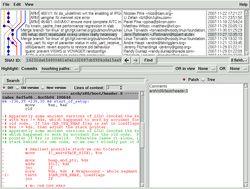
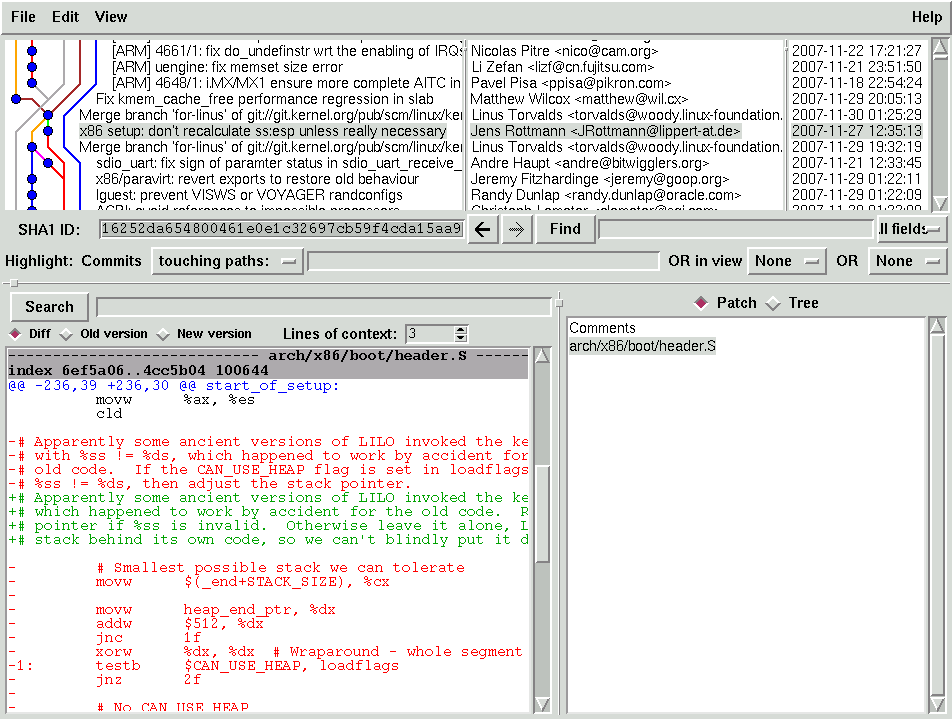
Use git cherry to find commits not merged upstream. Another really cool feature is the interactive rebasing: git rebase –interactive Make sure you are aware of gitk: Screenshot of gitk … and don’t forget to set readable fonts for gitk, like:
[ -r ~/.gitk ]   cat > ~/.gitk << EOF
set mainfont  Arial 10 
set textfont   Courier 10 
set uifont  Arial 10 bold 
EOF
If you prefer a Qt based interface check out qgit. Useful ressources:
Enrico Zini: mod-proxy-html-and-gzip

mod_proxy_html and compressed pages After putting it behind a reverse proxy, our phpmyadmin setup started showing empty pages. After one morning of deep cursing, this is what happened:
  1. the web server where phpmyadmin runs generates compressed html pages;
  2. modproxyhtml tries to edit them, and "normalises" them, adding <html>...</html> headers around the compressed data;
  3. Firefox fails to decompress because there is extra garbage, and shows a blank page instead of complaining.
Other things to note: How I found it:
  1. nc -l -p 444;
  2. configure mod_proxy to send connections to netcat instead of the web browser;
  3. compare curl headers and Firefox headers;
  4. add the headers from Firefox to curl one by one, until the output breaks.
How to solve it:
  1. a2enmod deflate
  2. Replace SetOutputFilter proxy-html with SetOutputFilter DEFLATE;proxy-html;INFLATE so that we always have mod_proxy_html work on decompressed HTML.

Miriam Ruiz: Software patents are buggy

Patents are the best way to improve development, and software inventors have just the natural right to their algorithms and designs. Research and Development in industry wouldn’t just work without patent protection, and technology improvements would just stop, right? Well, I’m not so sure of that. Key arguments against software patents, stolen from Pieter Hintjens’ article:

2 December 2007

Brandon Holtsclaw: Brandon s Holiday Computer Fund

I’m a developer, and my primary tool is my computer. Unfortunately, about 3 months ago, my computer died an untimely death, and I have resorted to using a pentium 200MHz machine with 256MB Ram, which lets me keep up with regular communications, but significantly slows the pace of development. As a computer is a big purchase, and represents most of what I want to receive for the holidays, I’ve set up a fundraiser so that people who wanted to help towards this gift could do so without needing to purchase the entire thing (and to avoid the all too common problem of receiving 8 video cards and no RAM). www.fundable.com allows me to accept pledges via paypal but NOT collect any unless the goal is met, so if you feel giving and pledge something, it will only be charged if the goal is met ( this is set at $250, which seems to be the minimum for a decent system, if more is collected, I can look at something better). You can read more about how fundable works from www.fundable.com/faq, and I’m more than happy to answer any questions via email, IRC, Jabber, etc.

30 November 2007

Adrian von Bidder: Groupware suite

The topic of a groupware with SyncML support is still bothering me. What are people using, and with how many users? Please tell me (I'll update this article.) Looking around, it seems there aren't that many open source (or even commercial) projects if it should be usable on Linux (Clients, too) and be reasonable priced (which pretty much kills Lotus and similar big enterprise solutions AFAIK.). Oh, and a web frontend is an absolute necessity, too, but that's usually not a problem. There are some other groupware projects out there, and I might do them injustice, but on a first glance development seemed to either have stalled as a whole or at least regarding their SyncML support. I know of OpenGroupware.org (last news of SyncML support from 2005), Kolab (No production quality Web frontend, and I can't find much about SyncML either), Horde (Hmm. I didn't like the classical horde webmail very much, but "Horde Groupware" might be worth another look. The status of the SyncML part is not clear, judging from the website.) and phpGroupWare (egw's ancestor, when I last looked development seemed to stall, and the information I found about its SyncML support is somewhat scant.) The open direcory project lists some more, but I haven't looked at these.

28 November 2007

Lucas Nussbaum: Re: Two years of Python

Andrew writes about Python, Perl and Ruby:
Ruby has some nice things (like Perlish regular expression handling), but it brings back all that punctuation noise again.
He gives an example of punctuation noise in Perl:
I go back to Perl and my eyes bleed after trying to dereference a reference to a scalar, or something like that. It’s just ugly in Perl.
I don’t think that’s fair to compare Perl’s ponctuation noise with Ruby. Ruby has a feature that could qualify as punctuation noise, but it’s really a feature: variables are prefixed with their scope. For example, class variables start with @@ (@@var), instance variables start with @ (@var), global variables start with $ ($var), and constants are in CAPS. I don’t know if Ruby “invented” that, or if it comes from another language (it’s probably the case: Ruby takes a lot of good ideas everywhere). Also, Andrew, joining elements of an array in ruby is written myarray.join(” “), and Ruby has =~. So you should definitely give Ruby a try ;) No, seriously, Ruby is a really interesting language. It’s really a shame that it’s still so japanese-centric (most development decisions are taken on a japanese mailing list !!), since it’s not really help a wide adoption.

Michal &#268;iha&#345;: New databases in phpMyAdmin demo

I just added all MySQL example databases to phpMyAdmin demo, so if you want to play with some more or less real data in phpMyAdmin, you now have great opportunity. Especially interesting is sakila database which exposes many new MySQL features. All databases are automatically periodically restored, so you don't have to be afraid to play with it :-).

Andrew McMillan: Which is the more interesting hackspace: X or Linux?

A curiously interesting thread has sprung up on the Xorg mailing list recently regarding the lack of bandwidth the developers might have for accepting patches. Bernardo Innocenti, who hacks on OLPC stuff amongst other things, wants to get some patches reviewed for acceptance, but there aren't enough people around with the time and inclination to review and accept his work. He did a quick and dirty analysis of Xorg LoC vs Linux LoC, to give a "X codebase is roughly 1/2 Linux codebase" (which surprised me, actually, I'd always thought it was larger) and then a similarly rough analysis that suggests that Xorg has roughly 1/20th of the developer base. To some extent Bernardo's metrics are arguable, but the basic facts are that Linux gets the lions share of the developers. Is this what we should expect? Is this a healthy way for the free and open source software community to support the development of what I personally would like to see as the future desktop base? Linux does a fantastic job as an OS, right now. It's been doing it for years, really, but we still need to get behind some of the differential further up the stack. And all credit to those stalwarts of X development who are shouldering more than their fair share of the burden. So if you were looking for an open source software project where you can be appreciated, don't overlook X.

Ingo Juergensmann: Recovering buildd passwords

Frans Pop pointed me to etch arch qualify page where I saw m68k having just about 92% archive coverage.

After ftpmaster.d.o aka ries.d.o has been brought back again there was a problem for buildds without static IP address: the passwords for accessing incoming.d.o were apparently lost.

At least two weeks ago the right person to handle this issue has been informed, but as it seems that nothing happened yet. And it's difficult to keep the arch up to date when you can't access incoming and builds fail because of missing build-deps and are set to dep-wait.

Oh well... I wish that days would have 48 hours for some people who do seem to have too less time for all their work. sigh

27 November 2007

Neil Williams: GPE in Emdebian

These are all just 'first-builds' so problems could well lie ahead but I have now built a set of cross built packages for Emdebian (ARM) that edos-debcheck says is installable for a basic GPE installation. Only one package remains as a problem - gpe-filemanager builds fine but the current dependencies of libgnomevfs mean that gconf is required which doesn't give an option to disable ldap which is something I would rather do without. Certainly, existing GPE installations do without ldap but that could just be because these tend to use older versions of the particular libraries.

The GPE team status report covers the rest of the package set with links to the Debian and Emdebian packages.
I've got a few ITP's to close and a few more to open and close before the full GPE toolset is available (and I need to work out what has happened to the source package for gpe-terminal) but things are looking good.
All the cross building problems were in the base packages and a few of the lower level system libraries - the X libraries and GPE applications cross build very easily, thanks mainly to CDBS support in emdebian-tools.
The hard task lies ahead - configuring the packages so that Emdebian can support pre-built installation images for specific devices with their specific hardware configuration (and nothing else).
I'm expecting a 70% reduction in the amount of space required for the same package set relative to Debian.
When browsing the Emdebian package set you may think that 1,736 packages (or so) is a lot but this is mainly down to the Emdebian Tdeb implementation which splits out each translation for each package into a package of its own.
The next stage of the Tdeb process is to migrate those packages into a separate repository and finish the development of langupdate. Then, each user can choose to install only the .mo files required for their specific needs instead of getting 250Mb of translations for languages that are unsupported on their machine anyway.
The main deviation from the existing tdeb proposal is that Emdebian needs finer granularity so that gettext translations are separate from translated manpages - because Emdebian doesn't include any manpages.

Michal &#268;iha&#345;: Binary packages for Gammu, Wammu and python-gammu

When Ubuntu announced public availability of Personal Package Archives, I thought it might be good to use it to provide up to date Gammu related packages. After successful registration I uploaded Gammu package and no reaction so far, so I'll wait. However this memorised me that I wanted to use OpenSUSE Build Service for same purpose some time ago. I filled in registration and as I didn't receive any email about being accepted, I absolutely forgot about that. Now just tried to log in and it works. So you can now have access to latest Gammu, python-gammu and Wammu packages for most recent RPM distributions (Fedora 7, Fedora 8, Mandriva 2006, Mandriva 2007, openSUSE 10.2, openSUSE 10.3, openSUSE Factory, SLES 9 and SLE 10). I could not test them so any feedback is welcome :-). You can find all packages on overview page or directly in download folders. Playing with spec files after long time was quite painful, but I got to it after I managed the hardest thing - how to make build dependencies which will work on all these distros. I hope I will be able to announce similar service for Ubuntu users using PPA, but now I have to wait for some reaction on my source uploads.

26 November 2007

Andrew Pollock: [life/americania] Thanksgiving below zero

We got home from our week in Arizona late last night. We decided to drive non-stop yesterday, and get home in a day, rather than split it over two days like we did getting there. It ended up taking around 15 hours (we had an unexpected delay at Lost Hills because we found a stray dog (we initially thought it to be injured to boot) and Sarah was trying to get hold of some local animal control people to do something about it), otherwise it'd have taken closer to 14 hours. The drive to Phoenix was pretty uneventful. We took our time leaving Mountain View on Sunday (we had an early Thanksgiving dinner with all of our neighbours on Saturday night), and decided to call it a night at Cabazon. For about the same price that we stayed in a crappy motel last time we went this way, we stayed at the Morongo Casino, which was really nice. We were in a "Canyon View" room, and, well this is what the view looked like... We arrived at Craig and Sarah's place at about 5pm on Monday afternoon. Their new place is really nice. It's huge, with a huge yard, and a nice view of the hills. I've found suburban Phoenix (well Peoria to be precise) to be the closest looking thing to what I consider "normal Australian suburbia" that I've seen so far in the US. Granted, Peoria's a bit upmarket (at least the part that Craig and Sarah live in). So we spent a day and a half vegging out at Craig and Sarah's place, then on Wednesday afternoon, we headed off to Woods Canyon Lake, in the Sitgreaves National Forests. I rode most of the way with Craig in their new motor home, and then swapped to drive our car after we got close to our destination. It turns out that the headlights in RVs are universally crap, so it was better for the Prius to be out front lighting the way on the gravel road. I'd always associated Arizona with cacti and sand, but as it turns out, the majority of the state is forest. We arrived at the campsite after nightfall, and set up shop. We met some of Craig and Sarah's friends that night, who were all very friendly towards us. It was ridiculously cold that night. We went to bed rather under-dressed for the temperature, and absolutely froze. The next day (Thursday), we all drove from the campsite (Craig towed their Jeep behind the RV) to Woods Canyon Lake itself, and went fishing. Arizona fishing licences for non-Arizona residents were a bit on the expensive side, so Sarah and I just hung out on the rocks and chatted to people and took photos. The collective haul of trout from about 5 hours fishing was pretty impressive. I'm not quite sure why, but Friday was the group Thanksgiving dinner. Everyone pitched in, and cooked up a storm. They deep-fried three turkeys (which came out very nice and looking much less like KFC than I expected), and we had way more food than we needed. We all ate outdoors at around 3:30pm, and it was about 33°F (0.55°C). The only downside of this (aside from it being bloody cold) was the leftovers went cold almost instantly, so going back for seconds was a bit of a disappointment. Everyone gravitated back to the fire pretty quickly afterwards. It got pretty cold that night. I think it was down around -4°C when we went to bed that night. We left a bit before 8am the next morning, and the car thought it was -7°C outside. One of the other campers told Sarah his thermometer was reading something closer to -14°C. I'm not sure how cold it was when we were in New York in January, but I didn't think it was that cold. It was a good week away. The mix of camping and not camping was about just right. Now it's back to work for two weeks before we head off to Australia. Photos from the trip are here.

25 November 2007

Adam Rosi-Kessel: timbl on the graph

timbl’s blog may have the highest signal-to-noise ratio on the web. Not a whole lot of signal, but zero noise. This piece on the “graph” puts the development of social networking services in solid historical perspective. It’s not great propaganda, but covers all the key conclusions. In particular:
In the long term vision, thinking in terms of the graph rather than the web is critical to us making best use of the mobile web, the zoo of wildy differing devices which will give us access to the system. Then, when I book a flight it is the flight that interests me. Not the flight page on the travel site, or the flight page on the airline site, but the URI (issued by the airlines) of the flight itself. That’s what I will bookmark. And whichever device I use to look up the bookmark, phone or office wall, it will access a situation-appropriate view of an integration of everything I know about that flight from different sources. The task of booking and taking the flight will involve many interactions. And all throughout them, that task and the flight will be primary things in my awareness, the websites involved will be secondary things, and the network and the devices tertiary.
Technorati Tags: , , , ,

Roland Mas: Gforge news, November 2007

Apparently some people worry that Gforge may be abandoned, or on the verge of being superseded with the proprietary "Gforge Advanced Server" rewrite. Let it be known that I for one have no plans to switch to Gforge AS, for all the reasons you'd expect from a free software user and advocate: I don't have access to the source code (it's made illegible by some sort of industrial PHP obfuscator), I can't hack it because the license doesn't allow me to, I can't audit it for security flaws, I can't adapt it to particular needs, etc. Since a significant part of my income comes from maintaining Gforge instances for clients, with local modifications for their particular needs, it's an economical necessity that Gforge stays free. And evolving. Right. Having said that, I guess I have to show concrete evolutions in addition to principles and ideals. So what changed recently? All this has committed and uploaded to Debian. As usual, please test and report failures. Plans for my foreseeable future include: Places where help would be most welcome: There. That was the news. Now for a bit of trivia: it's amazing how having a metric of one's productivity gives an incentive to increase it. I found mine on Ohloh, which provides code and license analyses and statistics on free software projects, as well as statistics on commits by contributors. They even have a shiny widget with a scrollable timeline showing commits over time, as well as comparative commit graphs. My obvious personal goal is to get up to the first position among the contributors, but of course I wouldn't complain if the current top committer stayed ahead by springing back into activity.

Christian Perrier: News from D-I i18n

It's quite some time since I didn't blog about D-I i18n and the number of new languages we'll support in the next Debian version, lalala... A few works are on their way, indeed:
24 November 2007

Lucas Nussbaum: Where is the NM bottleneck?

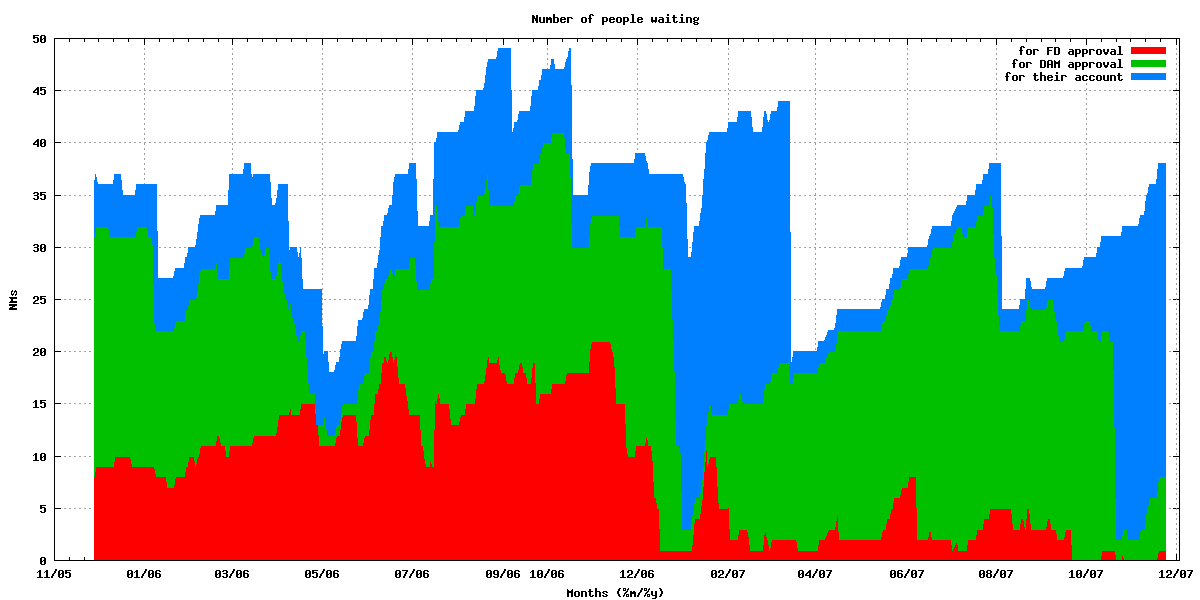
The current status of the NM process, with 1 NM awaiting FD approval, 7 awaiting DAM approval, and 30 waiting for their accounts to be created, leads people to thinking that the big bottleneck is the account creation stage. However, when you look at what happened since december 2005, it’s not that simple. NM queues status See the graph linked above, which shows where people are waiting. While it seems that the FD stage hasn’t been blocking people for nearly a year, it’s the DAM stage which has been the biggest blocker. Indeed, on average, 8.3 NMs have been blocked by FD, 16.2 by DAM, and 9.0 by account creation. I understand that processing NM reports in batch mode makes it more efficient. However, I’m wondering if processing them 20 per 20, is really that more efficient than processing them 5 per 5, which would justify such long queues. The NEW queue, which used to be a problem, is now being processed on a very regular basis, and hasn’t grown widely recently, except after Debconf when the ftpmaster processing NEW was on VAC. Couldn’t we have the same thing for DAM, account creations, and while we are at it, removals from unstable? Having clearly defined human-crontab-jobs would certainly make working on Debian less frustrating.

22 November 2007

Russell Coker: Drugs and an Election

As mentioned in my previous post [1] the government is using our money to advertise its policies. I previously covered the “Internet as a threat to children” issue, the other big one is drugs. The first significant message in the “Talking with your kids about drugs” document concerns the criminal penalties for drug use. That could largely be removed if the penalties were dramatically decreased and if hard drugs were administered to registered addicts for a nominal fee. Forcing addicts to commit crimes or work as prostitutes to pay for their addiction just doesn’t work, economically or socially. The next message is that parents should be involved in their children’s lives and be trusted enough that their children will accept advice. A large part of this would be related to the amount of time spent with children which is determined to a large degree by the amount of time not spent working. As I mentioned in my previous post it seems that the actions of the Howard government over the last 10 years has made things significantly worse in this regard by forcing more parents to spend large amounts of their time working (including situations where both parents work full-time) just to pay for a home. One notable omission from the document was any mention of alcohol problems (apart from when mixed with illegal drugs). By many metrics alcohol causes more harm than all the illegal drugs combined. The US attempted to prohibit alcohol and failed dismally, and alcohol is legal in most countries. The government doesn’t want to adopt a harm-minimisation approach to drugs (which bears some similarities to the approach taken to alcohol) and therefore is stuck trying to claim that one somewhat addictive mind-altering substance is somehow inherently different to all other mind-altering substances. The document provided no information at all on harm minimisation. The idea seems to be that it’s better for some children to die of overdoses than for other children to potentially be less scared of the consequences of drug use. The problem is that children are very bad at assessing personal risk so they simply won’t be scared off. It’s best to provide equipment for testing drug purity etc to reduce the harm. The list of reasons for young people to try drugs starts with “availability and acceptability of the drug“, Parmesan cheese is more available and acceptable than any drug but I’ve been avoiding it at every opportunity since I was very young. :-# More serious reasons in the list include “rebellion“, “depression“, “as a way to relax or cope with stress, boredom or pain“, and “to feel OK, at least temporarily (self-medication)“. But predictably there was nothing in the document about why children might consider that their life sucks to badly that they want to rebel in that way, be depressed, stressed, bored, or in pain to a degree that drugs seem like the solution. It seems unreasonable to believe that the school system isn’t a significant part of the cause of teenage problems. Flag poles for flying the Australian Flag [2] seems to be John Howard’s idea of a solution to school problems. I believe that the solution to school problems (both in terms of education and protection of children) is smaller classes, better supervision, an active program to eradicate bullying, and better salaries for teachers. I’ve written about related issues in my school category. I believe that the best thing for individual families to do is to home-school their children from the age of 12 instead of sending them to a high-school (which is much more damaging than a primary school). Another significant issue is drug pushers. They are usually drug users who try to finance their own drug use by selling to others. As most drug users get the same idea there is a lot of competition for sales and therefore they try to encourage more people to use drugs to get more customers. In the Netherlands, Coffee Shops sell a range of the milder drugs at reasonable prices which removes the street market and therefore the pushers. When drugs are produced commercially the quality is standardised which dramatically reduces the risk of infection and overdoses. When drugs are sold by legal companies they are not sold to children (a typical pusher can be expected to sell to anyone). The document has 3.5 pages of information about some of the illegal drugs (out of 23 pages total). They include all the most severe symptoms that most users don’t encounter. If someone reads that information and then talks to a drug user they will be laughed at. They also group drugs in an unreasonable way, for example listing “marijuana” and “hashish” as synonyms and list problems that are caused indirectly. If alcohol was included in that list it would include beer and methylated spirits (ethanol mixed with methanol to supposedly make it undrinkable - rumoured to be consumed by homeless people) in the same section and imply that blindness and other bad results of drinking “metho” apply to beer. It would also say that alcohol kills many people through drunk-driving and is responsible for rapes, wife-beating, and any other crime which can statistically shown to be more likely to be committed by a drunk person. A final issue with the document is that it advises parents to be “informed, up-front and honest” when talking to their children about drugs. Unfortunately the document itself doesn’t demonstrate such qualities. By omitting all information on harm minimisation it is not being up-front at all, and by not mentioning alcohol it’s simply being dishonest. Anyone who tries to convince someone else to not use illegal drugs can expect to hear “but you drink alcohol” as the immediate response from the drug user, it’s necessary to have sensible answers to that issue if you want to be effective in discouraging drug use.

Russell Coker: Internet and an Election

Before the election was called the Howard government (being unethical in every way) started using public money to campaign. Part of this election campaign was two documents sent out to every home (AFAIK) coupled with a media campaign, one was about children and drugs, the other was about children and the Internet. I have to wonder how many people were fooled by this, including a picture of John Howard on the first page after the index made it pretty clear what the purpose was. Before I analyse the content of the documents one thing to keep in mind is the cost of the Iraq war, which the Sydney Morning Herald [1] estimates at $3,000,000,000. Note that this doesn’t include the life-long medical and psychiatric care that some veterans will require or the cost to the economy of such people not being productive tax-payers. It does note that 121 employees of the Australian military have been discharged on medical grounds. If each of those 121 people was disabled in a way that significantly impacted their life then the cost could be as much as $242,000,000. Let’s not assume that everyone who is currently serving and regarded as completely fit will be fine in 10 years time either. The Prime Minister gives a personal introduction to each document, the “NetAlert” document states that $189,000,000 is being spent to protect children on the Internet. The “Talking with your kids about drugs” document states that “more than $1.4 billion” has been spent to combat illicit drug use, I’m not sure what time period that covers - it seems to be his entire 10 years as PM so that would be $140,000,000 per annum. Obviously declaring a war of aggression against Saddam Hussein is something that he considers to be more important than protecting Australian children. Now the content of the NetAlert document. It starts with $84,800,000 to provide access to “the best available internet filtering technology“. I have to wonder, how much would it cost to develop some new Internet filtering software from scratch, or what the opportunity cost might be to re-assign resources from organisations such as CSIRO to the task. I expect that in either case the total would be a lot less than $84,800,000. Developing free software for the task would be a much better use of resources and would also allow cooperation with similar programs in other countries. In the unlikely event that $40,000,000 was required to develop such free software it probably wouldn’t be difficult to get a few other governments to kick in some money and make it $10,000,000 per country. Of course saving $70,000,000 doesn’t sound like much (a mere $3 per person in the country), but it is significantly more than the Free Trade Agreement with the US [2] was supposed to bring in (from memory it was promoted as improving the economic position of the country by $50,000,000 but the best available information is that it made our balance of trade worse). $43,500,000 in additional funding for the police to combat online child sex exploitation is small but OK (it would be better if some of that $84,800,000 had been saved on filtering software and allowed greater expenditure in this area). But it should be noted how child rape in Aboriginal communities is used as a political issue and nothing constructive is done about the problem [3]. I believe that protecting children against rape is far more important than controlling illegal porn (which is where the majority of that $43,500,000 will go). Another possible avenue of research would be on more secure computer systems for Australian homes. It’s all very well to install some filtering software, but if the PC running the software in question is hacked then it’s immediately turned off. Attacks that involve turning web cameras on without the knowledge or consent of the owner are not uncommon either, it’s not unreasonable for a child to get out of bed and then do some homework on their computer before getting dressed - with an insecure computer and a web-cam connected this could be a bad thing… If the Australian government was to mandate that all government data be stored in open formats and that all communication with government computer systems can be done with free software (as a matter of principle you should not have to buy expensive software to communicate with your government) then the incidence of insecure desktop OSs would decrease. The document does recommend some basic OS security mechanisms, but if you use an OS that is insecure by design it’s not going to work. The core message of NetAlert is that children should be supervised when using the net. There is one significant problem with this, full supervision of children requires that at least one parent is not working full-time. In a previous post I compared median house prices and median incomes [4] with the conclusion that even with both parents working it’s difficult to afford a house. It would be difficult for a single income that is below the median to be used to pay the rent on a decent house. So it seems that a significant portion (maybe the vast majority) of Australian families will be forced to do what the government would consider to be a compromise of the Internet safety of their children by having both parents working full-time jobs to pay off a large mortgage (or in some cases merely to pay rent). I believe that making houses more affordable would improve the protection of children and provide other significant benefits for society. If you look at chart 1 and chart 2 on the House Prices research note from the Australian Parliamentary Library [5] you can see a significant increase in the difference between CPI increases and house prices increases since 1996 (when John Howard became Prime Minister) and a significant increase in the ratio of house prices to average income. The charts only include data up to 2006 so don’t show the effects of the Howard government’s “workplace reform” which lowers wages for many people who are below the median income. John Howard is responsible for houses being less affordable and parents being forced to spend more time working and less time supervising their children, I find it offensive that he now tells people to spend more time supervising their children. The document does have some good basic advice about how to supervise children and what level of supervision is necessary. The problem is that children from an early age know more than the typical parents. I doubt the ability of typical Australian parents to implement some of the supervision suggestions on 12yo children. I have been considering writing my own documents on how to filter and monitor child Internet access but the main problem is determining ways of doing so that can be implemented by someone who is not a computer expert. In summary, the Howard government is responsible for reducing the supervision of children and therefore exacerbating the problems that they are claiming to solve. Their NetAlert program provides some information that can’t be implemented by the majority of Australians and entirely skips some of the most sensible steps such as using only secure OSs on machines that will be used on the Internet. I believe that Fedora and CentOS should be recommended by the government in this regard because of the combination of good security by default (of which SE Linux is only one component) and the ease of use. Computers are cheap enough that most families with good Internet connections (the ones at risk in this regard) have multiple computers so no extra cost would be incurred.

21 November 2007

Luciano Bello: It's a party... and you are invited!

Better than just a party, it s a bug squashing party! Imagemagick needs your help. It a very important package for Debian and its really outdated. It has more than 100 bugs.


The objective, is to reduce the bugs to less than 20 in a month in the current development version. Let s go for them! :)

Dirk Eddelbuettel: Several new Rmetrics packages

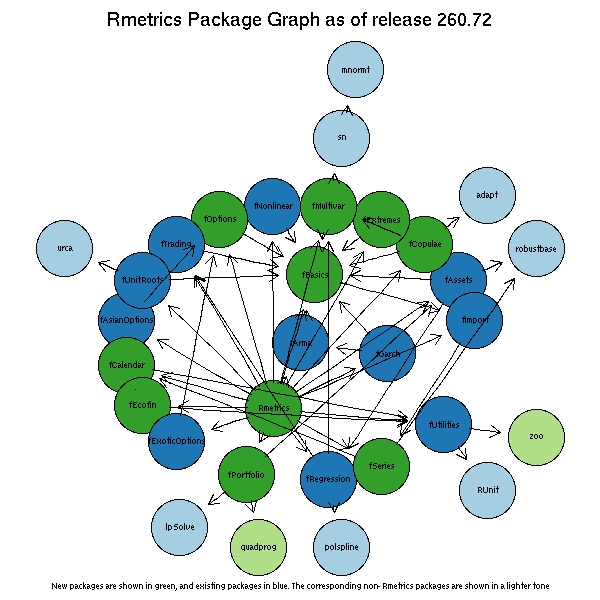
Debian has provided Rmetrics packages for financial engineering and computational finance since the Rmetrics release for R 1.9.0 in the summer of 2004. Over the years, Rmetrics has gotten more granular and changed from a handful of packages to two handfuls --- and the most recent release extended this trend even further to almost two dozen packages as shown in this chart. Dependency chart for Rmetrics packages Rmetrics now comprosises over twenty individual packages. Eleven new packages were added in the 260.72 release for R 2.6.0, and they required eight other new packages from CRAN. While I would have preferred a more spread-out approach than the shotgun approach of having to introduce all these new packages at once (which took the last four weeks), I am in support of the reorganisation which should make maintenance more easy going forward. So to get all of these packages onto a Debian box, a quick sudo apt-get install r-cran-rmetrics is all it takes. Currently supported only in the always-fresh unstable flavour, but hopefully soon in testing too. A big Thank You goes to the Debian FTPmasters. Of the 20-some packages that I added to Debian during this Rmetrics expansion, many were added within a day or two. Lastly, thanks also to Florian Hahne, Robert Gentleman and Elijah Wright for much appreciated help with R's Rgraphviz and graph packages to create the chart above. It only takes a handful of lines to create the basic graph, and another few lines for the colours and titles. The code is available on request, of course, but you need the current development versions of the BioConductor packages Rgraphviz and graph (which are not in Debian yet).

Next.

Previous.