Search Results: "ina"

4 November 2015

Raphaël Hertzog: My Free Software Activities in October 2015


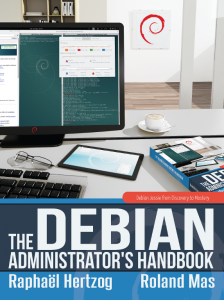
My monthly report covers a large part of what I have been doing in the free software world. I write it for my donators (thanks to them!) but also for the wider Debian community because it can give ideas to newcomers and it s one of the best ways to find volunteers to work with me on projects that matter to me. Debian LTS This month I have been paid to work 13.25 hours on Debian LTS. During this time I worked on the following things: I also started a conversation about what paid contributors could work on if they have some spare cycle as the current funding level might allow us to invest some time on work outside of just plain security updates. The Debian Administrator s Handbook I spent quite some time finalizing the Jessie book update, both for the content and for the layout of the printed book. Debian Handbook: cover of the jessie edition Misc Debian work GNOME 3.18. I uploaded a new gnome-shell-timer working with GNOME Shell 3.18 and I filed bugs #800660 and #802480 about an annoying gnome-keyring regression I did multiple test rounds with the Debian maintainers (Dmitry Shachnev, kudos to him!) and the upstream developers (see here and here). Apart from those regressions, I like GNOME 3.18! Python-modules team migration to Git. After the Git migration, and since the team policy now imposes usage of git-dpm on all members, I made some tries with it on the python-django package while pushing version 1.8.5 to experimental. And the least I can say is that I m not pleased with the result. I thus filed 3 bugs summarizing the problems I have with git-dpm: #801666 (no way to set the upstream branch names from within the repository), #801667 (no clean way to merge between packaging branches), #801668 (does not create upstream tag immediately on tarball import). That is on top of other randomly stupid bugs that were already reported like #801548 (does not work with perfectly valid pre-existing upstream tags). Django packaging. I filed bugs on all packages build-depending on python-django that fail to build with Django 1.8 and informed them that I would upload Django 1.8 to unstable in early November (it s done already). Then I fixed python-django-jsonfield myself since Distro Tracker relies on this package. Following this small mass-bug filing, I filed a wishlist bug on devscripts to improve the mass-bug helper script (see #801926). And since I used ratt to rebuild the packages, I filed a wishlist issue on this new tool as well. Tryton 3.6 upgrade. I upgraded my own Tryton installation to version 3.6 and filed bug #803066 because the SysV init script was not working properly. That also reminded me that the DD process of Matthias Behrle (the tryton package maintainer) was stalled due to a bug in the NM infrastructure so I pinged the NM team and we sorted out a way for me to advocate him and get his process going Distro Tracker. I continued my work to refactor the way we handle incoming mail processing (branch people/hertzog/mailprocessing). It s now mostly finished and I need to deploy it in a test environment before being able to roll it out on tracker.debian.org. Thanks See you next month for a new summary of my activities.

No comment Liked this article? Click here. My blog is Flattr-enabled.

Johannes Schauer: Let's Encrypt with Pound on Debian

TLDR: mister-muffin.de (and all its subdomains), bootstrap.debian.net and binarycontrol.debian.net are now finally signed by "Let's Encrypt Authority X1" \o/ I just tried out the letsencrypt client Debian packages prepared by Harlan Lieberman-Berg which can be found here: My server setup uses Pound as a reverse proxy in front of a number of LXC based containers running the actual services. Furthermore, letsencrypt only supports Nginx and Apache for now, so I had to manually setup things anyways. Here is how. After installing the Debian packages I built from above git repositories, I ran the following commands:
$ mkdir -p letsencrypt/etc letsencrypt/lib letsencrypt/log
$ letsencrypt certonly --authenticator manual --agree-dev-preview \
    --server https://acme-v01.api.letsencrypt.org/directory --text \
    --config-dir letsencrypt/etc --logs-dir letsencrypt/log \
    --work-dir letsencrypt/lib --email josch@mister-muffin.de \
    --domains mister-muffin.de --domains blog.mister-muffin.de \
    --domains [...]
I created the letsencrypt directory structure to be able to run letsencrypt as a normal user. Otherwise, running this command would require access to /etc/letsencrypt and others. Having to set this up and pass all these parameters is a bit bothersome but there is an upstream issue about making this easier when using the "certonly" option which in princible should not require superuser privileges. The --server option is necessary for now because "Let's Encrypt" is still in beta and one needs to register for it. Without the --server option one will get an untrusted certificate from the "happy hacker fake CA". The letsencrypt program will then ask me for my agreement to the Terms of Service and then, for each domain I specified with the --domains option present me the token content and the location under each domain where it expects to find this content, respectively. This looks like this each time:
-------------------------------------------------------------------------------
NOTE: The IP of this machine will be publicly logged as having requested this
certificate. If you're running letsencrypt in manual mode on a machine that is
not your server, please ensure you're okay with that.
Are you OK with your IP being logged?
-------------------------------------------------------------------------------
(Y)es/(N)o: Y
Make sure your web server displays the following content at
http://mister-muffin.de/.well-known/acme-challenge/XXXX before continuing:
 "header":  "alg": "RS256", "jwk":  "e": "AQAB", "kty": "RSA", "n": "YYYY" , "payload": "ZZZZ", "signature": "QQQQ" 
Content-Type header MUST be set to application/jose+json.
If you don't have HTTP server configured, you can run the following
command on the target server (as root):
mkdir -p /tmp/letsencrypt/public_html/.well-known/acme-challenge
cd /tmp/letsencrypt/public_html
echo -n ' "header":  "alg": "RS256", "jwk":  "e": "AQAB", "kty": "RSA", "n": "YYYY" , "payload": "ZZZZ", "signature": "QQQQ" ' > .well-known/acme-challenge/XXXX
# run only once per server:
$(command -v python2   command -v python2.7   command -v python2.6) -c \
"import BaseHTTPServer, SimpleHTTPServer; \
SimpleHTTPServer.SimpleHTTPRequestHandler.extensions_map =  '': 'application/jose+json' ; \
s = BaseHTTPServer.HTTPServer(('', 80), SimpleHTTPServer.SimpleHTTPRequestHandler); \
s.serve_forever()" 
Press ENTER to continue
For brevity I replaced any large base64 encoded chunks of the messages with YYYY, ZZZZ and QQQQ. The token location is abbreviated with XXXX. After temporarily stopping Pound on my webserver I created the directory /tmp/letsencrypt/public_html/.well-known/acme-challenge and then opened two shells on my server, both at /tmp/letsencrypt/public_html. In one, I kept a tiny HTTP server running (like the suggested Python SimpleHTTPServer which will also work if one has Python installed). In the other I copy pasted the echo line that the letsencrypt program suggested me to run. I had to copypaste that echo command for each domain I wanted to verify. This could easily be automated, so I filed an issue about this with upstream. It seems that the letsencrypt servers query each of these tokens twice: once directly each time after having hit enter after seeing the message above and another time once all tokens are in place. At the end of this ordeal I get:
2015-11-04 11:12:18,409:WARNING:letsencrypt.client:Non-standard path(s), might not work with crontab installed by your operating system package manager
IMPORTANT NOTES:
 - If you lose your account credentials, you can recover through
   e-mails sent to josch@mister-muffin.de.
 - Congratulations! Your certificate and chain have been saved at
   letsencrypt/etc/live/mister-muffin.de/fullchain.pem. Your cert will
   expire on 2016-02-02. To obtain a new version of the certificate in
   the future, simply run Let's Encrypt again.
 - Your account credentials have been saved in your Let's Encrypt
   configuration directory at letsencrypt/etc. You should make a
   secure backup of this folder now. This configuration directory will
   also contain certificates and private keys obtained by Let's
   Encrypt so making regular backups of this folder is ideal.
I can now scp the content of letsencrypt/etc/live/mister-muffin.de/* to my server. Unfortunately, Pound (and also my ejabberd XMPP server) requires the private key to be in the same file as the certificate and the chain, so on the server I also had to do:
cat /etc/ssl/private/privkey.pem /etc/ssl/private/fullchain.pem > /etc/ssl/private/private_fullchain.pem
And edit the Pound config to use /etc/ssl/private/private_fullchain.pem. But that's all, folks! EDIT It seems that manually copying over the echo commands as I described above is not necessary. Instead of using the certonly plugin, I can use the webroot plugin. That plugin takes the --webroot-path option and will copy the tokens to there. Since my webroot is on a remote machine, I could just mount it locally via sshfs and pass the mountpoint as --webroot-path. That I didn't realize that the webroot plugin does what I want (and not the certonly plugin) can easily be explained by the only documentation of the webroot plugin in the help output and the man page generated from it being "Webroot Authenticator" which is not very helpful. Another user seems to have run into similar problems. Better documenting the plugins so that these situations can be prevented in the future is tracked in this upstream bug.

Julien Danjou: Gnocchi 1.3.0 release

Finally, Gnocchi 1.3.0 is out. This is our final release, more or less matching the OpenStack 6 months schedule, that concludes the Liberty development cycle.
This release was supposed to be released a few weeks earlier, but our integration test got completely blocked for several days just the week before the OpenStack Mitaka summit. New website We build a new dedicated website for Gnocchi at gnocchi.xyz. We want to promote Gnocchi outside of the OpenStack bubble, as it a useful timeseries database on its own that can work without the rest of the stack. We'll try to improve the documentation. If you're curious, feel free to check it out and report anything you miss! The speed bump Obviously, if it was a bug in Gnocchi that we have hit, it would have been quick to fix. However, we found a nasty bug in Swift caused by the evil monkey-patching of Eventlet (once again) blended with a mixed usage of native threads and Eventlet threads in Swift. Shake all of that, and you got yourself pretty race conditions when using the Keystone middleware authentication. In the meantime, we disabled Swift multi-threading by using mod_wsgi instead of Eventlet in devstack. New features So what's new in this new shiny release? A few interesting things: And that's all we did in the last couple of months. We have a lot of things on the roadmap that are pretty exciting, and I'll sure talk about them in the next weeks.

3 November 2015

Daniel Pocock: How much of Linux will be illegal in the UK?

This week I've been in the UK again, giving a talk about Lumicall and JSCommunicator in Manchester last night and a talk about Free Real-Time Communications at the mini-DebConf in Cambridge on the weekend of 7-8 November. An interesting backdrop to these activities has been a national debate about Internet privacy. The UK Government and police are demanding laws to mandate back doors in all communications products and services. It leaves me wondering about a range of issues:
  • Will overzealous UK police, reknowned for singling out and bullying people who don't conform with their idea of normality, start taking a more sinister attitude to people using software like Linux? For example, if airport security asks to inspect a laptop and doesn't see the familiar Windows or Mac OS desktop, will the owner of the laptop be delayed or told to leave it behind? Some people may feel this is extreme, but workers in these roles are known for taking initiative in their own special way, such as the infamous baby pat-down. If the owner of a Linux laptop is a Muslim, like the Texas schoolboy recently arrested because his clock looks suspicious to the untrained eye of a policeman, the chances of a rough encounter with authority probably rise even further.
  • Will developers still be able to use technologies like PGP and ZRTP in the UK? Will PGP key-signing parties become illegal or have to be held 20 miles offshore on a boat like the legendary pirate radio stations of the sixties?
  • Will Linux distributions such as Debian and Fedora have to avoid distributing packages such as Enigmail?
  • Will updates to Android and iOS on smartphones seek to automatically disable or remove apps like Lumicall?
  • Even if a user chooses a secure app like Lumicall for communication, will the vendor of the operating system be required to provide alternative ways to monitor the user, for example, by intercepting audio before it is encrypted by the app?
  • Without strong encryption algorithms, digital signatures will no longer be possible either and it will be impossible for software vendors to securely distribute new versions of their software.
  • Why should the police be the only workers to have their job done for them by Internet snooping? Why shouldn't spouses have a right to all their partner's communications to periodically verify they are not cheating and putting themselves at risk of diseases? Why shouldn't employers be able to check on employee's private communications and home computers to help prevent leaks of customer data? Why shouldn't the NHS be able to go through people's garbage to monitor what they eat given the WHO warning that bacon is more likely to kill you than a terrorist?
  • While the authorities moan about the internet being a "safe" place for terrorists and paedophiles, what is their real motivation for trying to bring in these new laws, even when their best technical advisors must surely be telling them about the risks and negative consequences for compatibility of UK systems in a global Internet? If the terrorist scare story is not so credible, is it more likely they are seeking to snoop on people who may not be paying taxes or to maintain the upper hand over rival political parties like the Greens and the UKIP in a time of prolonged and increasingly punitive austerity?
  • Australia already introduced similar laws a few weeks ago, despite widespread criticism from around the world. With cricket and rugby now over, is the UK just looking to go one up on Australia in the game of snooping?
Island mentality in the Internet age Politics aside, what would this mean from a technical perspective? The overwhelming consensus among experts is that secure technology that people use and expect in many other parts of the world, including the US, simply won't be compatible with the products and services that UK residents will be permitted to use. Bigger companies like Google and Apple may be able to offer differentiated versions of their services for the UK but smaller companies or companies who have built their reputation on technical excellence simply won't be able or willing to offer crippled versions of their products with backdoors for the UK. The UK's island geography will become a metaphor for its relationship with the global marketplace. The first thing to take note of is that encryption and authentication are closely related. Public-key cryptography, for example, simply swaps the public key and private key when being used to authenticate instead of encrypt. An effective and wide-reaching legal ban on encryption would also potentially prohibit the algorithms used for authentication. Many methods of distributing software, including packages distributed through Linux distributions or apps distributed through the Google Play store are authenticated with such algorithms. This is often referred to as a digital signature. Digital signatures help ensure that software is not corrupted, tampered with by hackers or infected by viruses when it is transmitted and stored in the public Internet. To correctly implement these mechanisms for installing software safely, every device running an operating system such as Debian, Ubuntu, Fedora or Android needs to include some software modules implementing the algorithms. In Linux, for example, I'm referring to packages like GnuPG, OpenSSL and GnuTLS. Without these components, it would be hard or even impossible for developers in the UK to contribute or publish new versions of their software. Users of the software would not be able to securely receive vital updates to their systems. An opportunity for free software? Some people say that any publicity can be good publicity. Now the Government has put the ball into play, people promoting secure solutions based on free software have an opportunity to participate in the debate too. While laws may or may not change, principles don't. It is a perfect time to remind users that many of the principles of software freedom were written down many years ago, before the opportunity for mass surveillance came into existence. These principles remain relevant to this day. The experts who developed these principles back then are also far more likely to offer insights and trustworthy solutions for the road ahead. If you'd like to discuss these issues or ask questions, please join the Free-RTC mailing list.

2 November 2015

Lunar: Reproducible builds: week 27 in Stretch cycle

What happened in the reproducible builds effort this week: Toolchain fixes Packages fixed The following packages became reproducible due to changes in their build dependencies: maven-plugin-tools, norwegian, ocaml-melt, python-biom-format, rivet. The following packages became reproducible after getting fixed: Some uploads fixed some reproducibility issues but not all of them: The following package is currently failing to build from source but should now be reproducible: Patches submitted which have not made their way to the archive yet: reproducible.debian.net A quick update on current statistics: testing is at 85% of packages tested reproducible with our modified packages, unstable on armhf caught up with amd64 with 80%. The schroot name used for running diffoscope when testing OpenWrt, NetBSD, Coreboot, and Arch Linux has been fixed. (h01ger, Mattia Rizzolo) Documentation update Paul Gevers documented timestamps in unit files created by the Free Pascal Compiler. reproducible-builds.org is now live. It contains a comprehensive documentation on all aspects that have been identified so far of what we call reproducible builds . It makes room for pointers to projects working on reproducible builds, news, dedicated tools, and community events. Package reviews 206 reviews have been removed, 171 added and 196 updated this week. Chris Lamb reported 28 failing to build from source issues. New issues identified this week: timestamps_in_pdf_content, different_encoding_in_html_by_docbook_xsl, timestamps_in_ppu_generated_by_fpc, method_may_never_be_called_in_documentation_generated_by_javadoc. Misc. Andrei Borzenkov has proposed a fix for uninitialized memory in GRUB's mkimage. Uninitialized memory is one source of hard to track down reproducibility errors. Holger Levsen presented the efforts on reproduible builds at Festival de Software Libre in Puerto Vallarta, Mexico.

Daniel Pocock: FOSDEM 2016 Real-Time Communications dev-room and lounge

FOSDEM is one of the world's premier meetings of free software developers, with over five thousand people attending each year. FOSDEM 2016 takes place 30-31 January 2016 in Brussels, Belgium. This call-for-participation contains information about:
  • Real-Time communications dev-room and lounge,
  • speaking opportunities,
  • volunteering in the dev-room and lounge,
  • related events around FOSDEM, including the XMPP summit,
  • social events (including the Saturday night dinner),
  • the Planet aggregation sites for RTC blogs
Call for participation - Real Time Communications (RTC) The Real-Time dev-room and Real-Time lounge is about all things involving real-time communication, including: XMPP, SIP, WebRTC, telephony, mobile VoIP, codecs, privacy and encryption. The dev-room is a successor to the previous XMPP and telephony dev-rooms. We are looking for speakers for the dev-room and volunteers and participants for the tables in the Real-Time lounge. The dev-room is only on Saturday, 30 January 2016 in room K.3.401. The lounge will be present for both days in building K. To discuss the dev-room and lounge, please join the FSFE-sponsored Free RTC mailing list. Speaking opportunities Note: if you used Pentabarf before, please use the same account/username Main track: the deadline for main track presentations was midnight on 30 October. Leading developers in the Real-Time Communications field are encouraged to consider submitting a presentation to the main track. Real-Time Communications dev-room: deadline 27 November. Please also use the Pentabarf system to submit a talk proposal for the dev-room. On the "General" tab, please look for the "Track" option and choose "Real-Time devroom". Other dev-rooms: some speakers may find their topic is in the scope of more than one dev-room. It is permitted to apply to more than one dev-room but please be kind enough to tell us if you do this. See the full list of dev-rooms. Lightning talks: deadline 27 November. The lightning talks are an excellent opportunity to introduce a wider audience to your project. Given that dev-rooms are becoming increasingly busy, all speakers are encouraged to consider applying for a lightning talk as well as a slot in the dev-room. Pentabarf system to submit a lightning talk proposal. On the "General" tab, please look for the "Track" option and choose "Lightning Talks". First-time speaking? FOSDEM dev-rooms are a welcoming environment for people who have never given a talk before. Please feel free to contact the dev-room administrators personally if you would like to ask any questions about it. Submission guidelines The Pentabarf system will ask for many of the essential details. Please remember to re-use your account from previous years if you have one. In the "Submission notes", please tell us about:
  • the purpose of your talk
  • any other talk applications (dev-rooms, lightning talks, main track)
  • availability constraints and special needs
You can use HTML in your bio, abstract and description. If you maintain a blog, please consider providing us with the URL of a feed with posts tagged for your RTC-related work. We will be looking for relevance to the conference and dev-room themes, presentations aimed at developers of free and open source software about RTC-related topics. Please feel free to suggest a duration between 20 minutes and 55 minutes but note that the final decision on talk durations will be made by the dev-room administrators. As the two previous dev-rooms have been combined into one, we may decide to give shorter slots than in previous years so that more speakers can participate. Please note FOSDEM aims to record and live-stream all talks. The CC-BY license is used. For any questions, please join the FSFE-sponsored Free RTC mailing list. Volunteers needed To make the dev-room and lounge run successfully, we are looking for volunteers:
  • FOSDEM provides video recording equipment and live streaming, volunteers are needed to assist in this
  • organizing one or more restaurant bookings (dependending upon number of participants) for the evening of Saturday, 30 January
  • participation in the Real-Time lounge
  • helping attract sponsorship funds for the dev-room to pay for the Saturday night dinner and any other expenses
  • circulating this Call for Participation to other mailing lists
FOSDEM is made possible by volunteers and if you have time to contribute, please feel free to get involved. Related events - XMPP and RTC summits The XMPP Standards Foundation (XSF) has traditionally held a summit in the days before FOSDEM. There is discussion about a similar summit taking place on 28 and 29 January 2016. Please see the XSF Summit 19 wiki and join the mailing list to discuss. We are also considering a more general RTC or telephony summit, potentially on 29 January. Please join the Free-RTC mailing list and send an email if you would be interested in participating, sponsoring or hosting such an event. Social events and dinners The traditional FOSDEM beer night occurs on Friday, 29 January On Saturday night, there are usually dinners associated with each of the dev-rooms. Most restaurants in Brussels are not so large so these dinners have space constraints. Please subscribe to the Free-RTC mailing list for further details about the Saturday night dinner options and how you can register for a seat. Spread the word and discuss If you know of any mailing lists where this CfP would be relevant, please forward this email. If this dev-room excites you, please blog or microblog about it, especially if you are submitting a talk. If you regularly blog about RTC topics, please send details about your blog to the planet site administrators:
http://planet.jabber.org ralphm@ik.nu
http://planet.sip5060.net daniel@pocock.pro
http://planet.opentelecoms.org daniel@pocock.pro
Please also link to the Planet sites from your own blog or web site. Contact For discussion and queries, please subscribe to the Free-RTC mailing list. The dev-room administration team:

1 November 2015

Steinar H. Gunderson: YUV color primaries

Attention: If these two videos don't both look identical (save for rounding errors) to each other and to this slide, it has broken understanding of YUV color primaries, and will render lots of perfectly normal video subtly off in color, one way or the other. Remux in MP4 instead of MPEG-TS here, for easier testing in browsers etc.: First, second. Chrome passes with perfect marks, Iceweasel segfaults on both (GStreamer's quality or lack thereof continues to amaze me). MPlayer and VLC both get one of them wrong (although VLC gets it more right if you use its screenshot function to save a PNG to disk, so check what's actually on the screen); ffmpeg with PNG output gets it right but ffplay doesn't. Edit to add: The point is the stable picture, not the flickering in the first few frames, of course. The video was encoded quite hastily.

31 October 2015

Dirk Eddelbuettel: RcppArmadillo 0.6.200.2.0

armadillo image Yet another monthly upstream Armadillo update gets us the first changes to the new the 6.* series. This was preceded by two uploads of test released to GitHub-only. These two were tested both against all reverse-dependencies as usual. A matching upload to Debian will follow shortly. Armadillo is a powerful and expressive C++ template library for linear algebra aiming towards a good balance between speed and ease of use with a syntax deliberately close to a Matlab. This release is fairly straightforward with few changes:
Changes in RcppArmadillo version 0.6.200.2.0 (2015-10-31)
  • Upgraded to Armadillo 6.200.0 ("Midnight Blue Deluxe")
    • expanded diagmat() to handle non-square matrices and arbitrary diagonals
    • expanded trace() to handle non-square matrices
Courtesy of CRANberries, there is also a diffstat report for the most recent CRAN release. As always, more detailed information is on the RcppArmadillo page. Questions, comments etc should go to the rcpp-devel mailing list off the R-Forge page.

This post by Dirk Eddelbuettel originated on his Thinking inside the box blog. Please report excessive re-aggregation in third-party for-profit settings.

Chris Lamb: Free software activities in October 2015

Here is my monthly update covering a large part of what I have been doing in the free software world (previously):
Debian My work in the Reproducible Builds project was also covered in more depth in Lunar's weekly reports (#23, #24, #25, #26).
LTS

This month I have been paid to work 11 hours on Debian Long Term Support (LTS). In that time I did the following:
  • DLA 326-1 for zendframework fixing an SQL injection vulnerability.
  • DLA 332-1 for optipng correcting a use-after-free issue.
  • DLA 333-1 for cakephp preventing a remote Denial of Service attack.
  • DLA 337-1 for busybox fixing a vulnerability when unzipping a specially crafted zip file/
  • DLA 338-1 for xscreensaver preventing a crash when hot-swapping monitors.

Uploads
  • redis New upstream release as well as changing the default UNIX socket location and correctly supporting "cluster" mode config file hardening and redis-sentinel's runtime directory handling under systemd. An update for jessie was also uploaded.
  • python-redis Attempting to get the autopkgtest tests to finally pass.
  • debian-timeline Making the build reproducible.
  • gunicorn New upstream release.


Russ Allbery: Vacation book haul

Reading on vacation always puts me in the mood to buy more books, including a couple that I picked up while on vacation. (I only read one, but that one, Ancillary Mercy, was certainly worth it.) Ta-Nehisi Coates Between the World and Me (non-fiction)
Kameron Hurley Empire Ascendant (sff)
Kameron Hurley Rapture (sff)
Jenny Lawson Furiously Happy (non-fiction)
Ann Leckie Ancillary Mercy (sff)
Kaori Mori Bride's Story: Volume 2 (graphic novel)
Kaori Mori Bride's Story: Volume 3 (graphic novel)
Randall Munroe xkcd: Volume 0 (strip collection)
Jo Walton The Philosopher Kings (sff)
Fumi Yoshinaga oku: Volume 3 (graphic novel) Infidel, the middle book of the Bel Dame Apocrypha trilogy by Kameron Hurley, was out of stock, so I'll have to re-order. I might put in another book order shortly to get that plus a few other things, although really I could just take that time to go read more books. Back from vacation now, so fell out of the reading habit a bit. I've been doing other stuff on the train, but shortly I'll get back into it.

Jonathan McDowell: Thoughts on the LG G Watch R Android smartwatch

Back in March I was given an LG G Watch R, the first Android Wear smartwatch to have a full round display (the Moto 360 was earlier, but has a bit cut off the bottom of the actual display). I d promised I d get round to making some comments about it once I d had it for a while and have failed to do so until now. Note that this is very much comments on the watch from a user point of view; I haven t got to the point of trying to do any development or other hacking of it. Firstly, it s important to note I already was wearing a watch and have been doing so for all of my adult life. Just a basic, unobtrusive analogue watch (I ve had a couple since I was 18, before that it was pretty much every type of calculator watch available at some point), but I can t remember a period where I didn t. The G Watch R is bulkier than what I was previously wearing, but I haven t found it obtrusive. And I love the way it looks; if you don t look closely it doesn t look like a smart watch (and really it s only the screen that gives it away). Secondly, I already would have taken my watch off at night and when I was showering. So while the fact that the battery on the G Watch R will really only last a day and a half is by far and away its most annoying problem, it s not as bad as it could be for me. The supplied charging dock is magnetic, so it lives on my beside table and I just drop the watch in it when I go to bed. With those details out of the way, what have I thought of it? It s certainly a neat gadget. Being able to see my notifications without having to take my phone out of my pocket is more convenient than I expected - especially when it s something like an unimportant email that I can then easily dismiss by swiping the watch face. My agenda being just a flick away, very convenient, particularly when I m still at the stage of trying to remember where my next lecture is. Having walking directions from Google Maps show up on the watch (and be accompanied by a gentle vibration when I need to change direction) is pretty handy too. The ability to take pictures via the phone camera, not so much. Perhaps if it showed me roughly what I was about to photograph, but without that it s no easier than using the phone interface. It s mostly an interface for consuming information - I ve tried the text to SMS interface a few times, but it s just not reliable enough that I d choose to use it. I ve also been pleased to see it get several updates from LG in the time I ve had it. First the upgrade from Wear 4.4 to Wear 5.1 (probably via 5.0 but I forget), but also the enabling of wifi support. The hardware could always support this, but initially Android Wear didn t and then there was some uncertainty about the FCC certification for the G Watch R. I can t say I use it much (mostly the phone is within range) but it s nice to see the improvements in support when they re available. What about the downsides? Battery life, as mentioned above, is definitely the major one. Mostly a day is fine, but the problem comes if I m ever away. There s no way to charge without the charging dock, so that becomes another things I have to pack. And it s really annoying to have your watch go dead on you midday when you forget to do so. I also had a period where I d frequently (at least once a week) find an Android Wear isn t responding. Wait/Restart? error on the watch screen. Not cool, but thankfully seems to have stopped happening. Finally there s the additional resource requirements it puts on the phone. I have a fairly basic Moto G 4G that already struggles with Ingress and Chrome at the same time, so adding yet another thing running all the time doesn t help. I m sure I could make use of a few more apps if I was more comfortable with loading the phone. The notable point for me with the watch was DebConf. I d decided not to bring it, not wanting the hassle of dealing with the daily charging. I switched back to my old analogue watch (a Timex, if you care). And proceeded to spend 3 days looking at it every time my phone vibrated before realising that I couldn t do that. That marked the point where I accepted that I was definitely seeing benefits from having a smart watch. So when I was away for a week at the start of September, I brought the charger with me (at some point I ll get round to a second base for travel). I was glad I d done so. I m not sure I m yet at the point I d replace it in the event it died, but on the whole I m more of a convert that I was expecting to be.

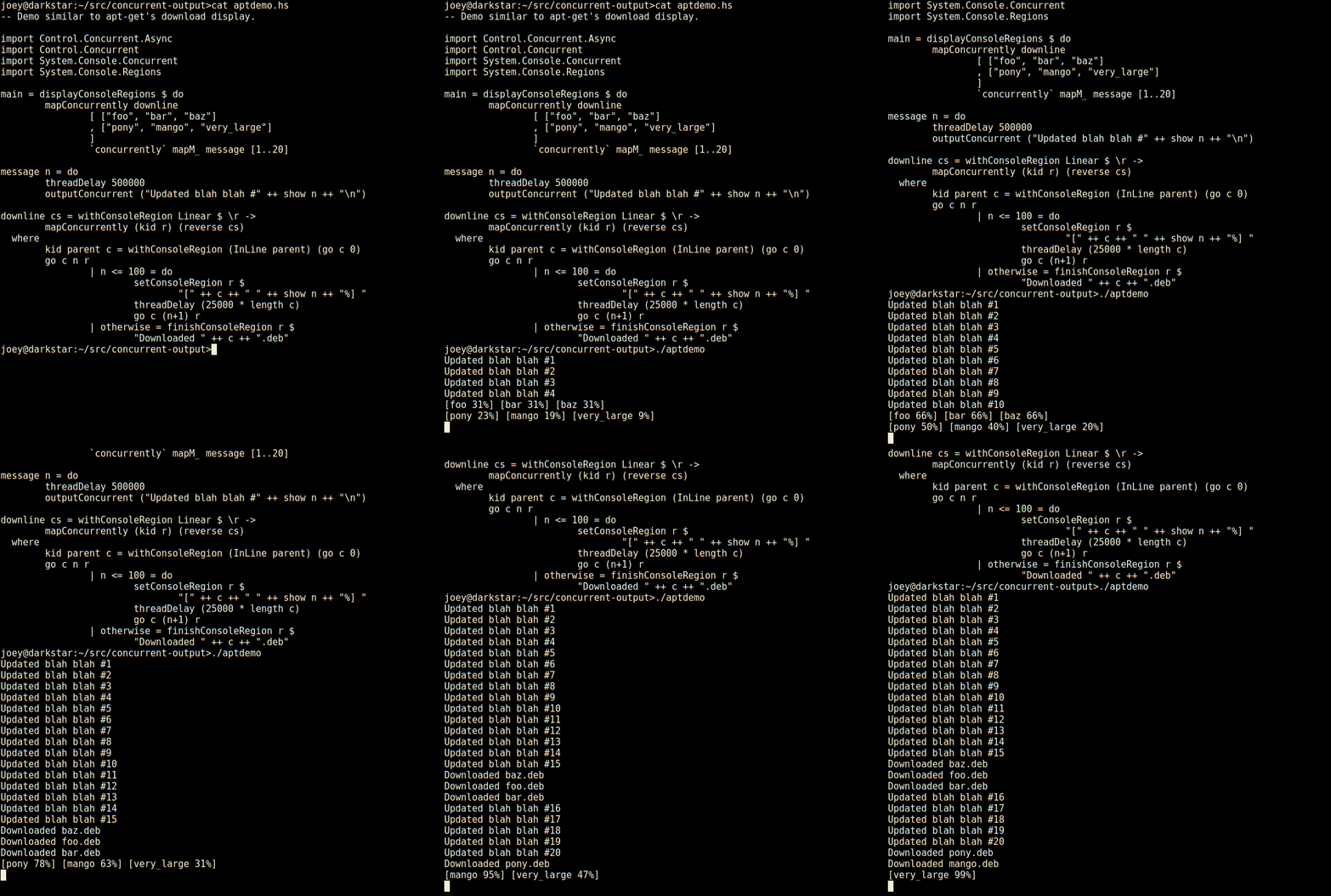
Joey Hess: a tiling region manager for the console

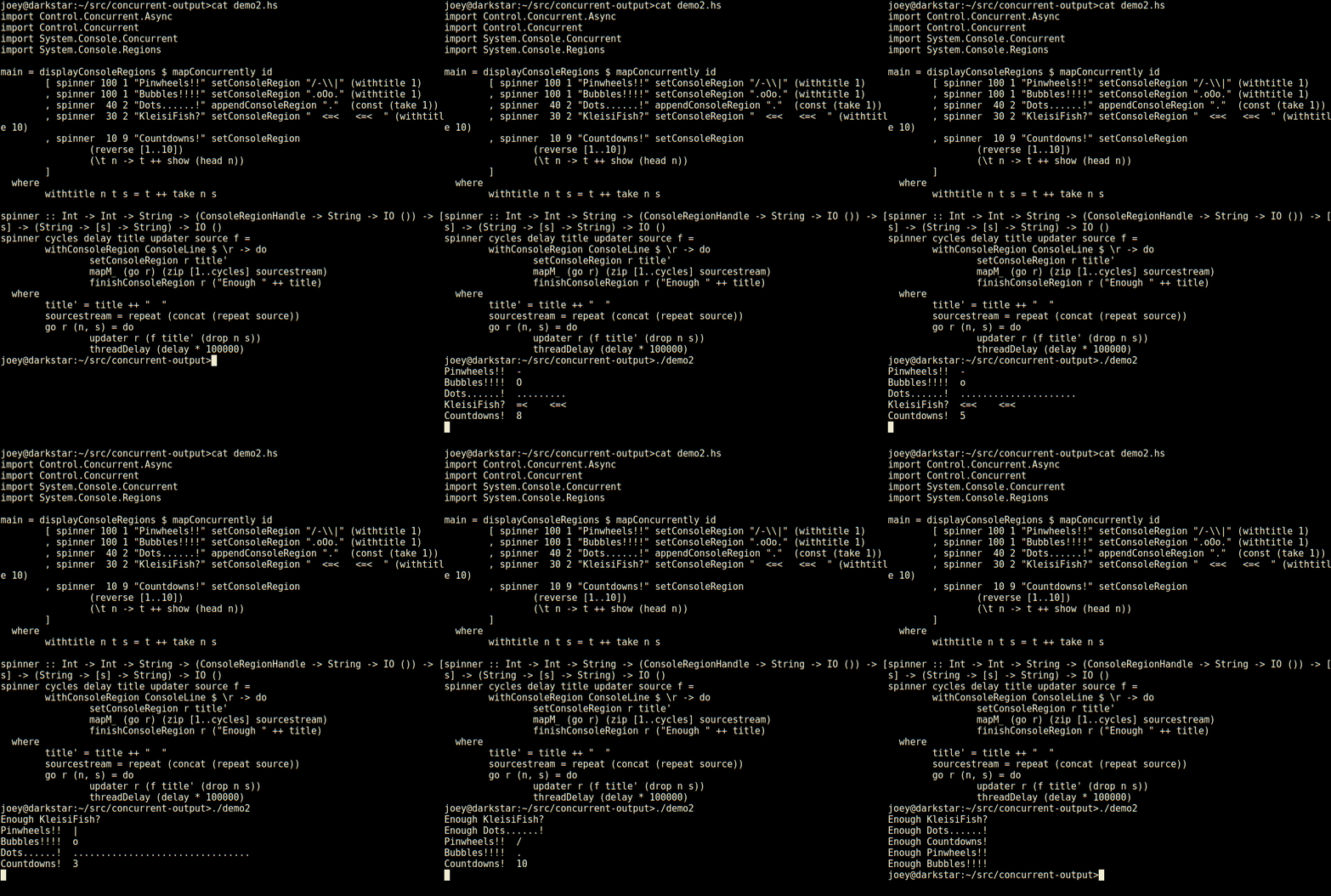
Building on top of concurrent-output, and some related work Joachim Breitner did earlier, I now have a kind of equivilant to a tiling window manager, except it's managing regions of the console for different parts of a single program. Here's a really silly demo, in an animated gif: demo2.gif Not bad for 23 lines of code, is that? Seems much less tedious to do things this way than using ncurses. Even with its panels, ncurses requires you to think about layout of various things on the screen, and many low-level details. This, by contrast, is compositional, just add another region and a thread to update it, and away it goes. So, here's an apt-like download progress display, in 30 lines of code. aptdemo.gif Not only does it have regions which are individual lines of the screen, but those can have sub-regions within them as seen here (and so on). And, log-type messages automatically scroll up above the regions. External programs run by createProcessConcurrent will automatically get their output/errors displayed there, too. What I'm working on now is support for multiline regions, which automatically grow/shrink to fit what's placed in them. The hard part, which I'm putting the finishing touches on, is to accurately work out how large a region is before displaying it, in order to lay it out. Requires parsing ANSI codes amoung other things. STM rules There's so much concurrency, with complicated interrelated data being updated by different threads, that I couldn't have possibly built this without Software Transactional Memory. Rather than a nightmare of locks behind locks behind locks, the result is so well behaved that I'm confident that anyone who needs more control over the region layout, or wants to do funky things can dive into to the STM interface and update the data structures, and nothing will ever deadlock or be inconsistent, and as soon as an update completes, it'll display on-screen. An example of how powerful and beuatiful STM is, here's how the main display thread determines when it needs to refresh the display:
data DisplayChange
        = BufferChange [(StdHandle, OutputBuffer)]
          RegionChange RegionSnapshot
          TerminalResize (Maybe Width)
          EndSignal ()
    ...
                change <- atomically $
                        (RegionChange <$> regionWaiter origsnapshot)
                                 orElse 
                        (RegionChange <$> regionListWaiter origsnapshot)
                                 orElse 
                        (BufferChange <$> outputBufferWaiterSTM waitCompleteLines)
                                 orElse 
                        (TerminalResize <$> waitwidthchange)
                                 orElse 
                        (EndSignal <$> waitTSem endsignal)
                case change of
                        RegionChange snapshot -> do
                ...
                        BufferChange buffers -> do
                ...
                        TerminalResize width -> do
                ...
So, it composes all these STM actions that can wait on various kinds of changes, to get one big action, that waits for all of the above, and builds up a nice sum type to represent what's changed. Another example is that the whole support for sub-regions only involved adding 30 lines of code, all of it using STM, and it worked 100% the first time.
Available in concurrent-output 1.1.0.

30 October 2015

Dirk Eddelbuettel: littler 0.3.0 -- on CRAN !!

max-heap image A new major release of littler is now available. And for the first time in the nine years since 2006 when Jeff started the effort (which I joined not long after) we are now a CRAN package. This required a rewrite of the build system, foregoing the calls to aclocal, autoheader, automake and leaving just a simpler autoconf layer creating a configure script and a simple src/Makevars.in. Not only does R provide such a robust and well-understood build system (which I got to understand reasonably well given all my R packages, but being on CRAN and leveraging its mechanism for installation and upgrades is clearly worth the change. There may be a moment or two of transition. While we can create a binary in an R package, we cannot (generally) copy to /usr/bin or /usr/local/bin as part of the build process (for lack of write-rights to those directories). So if you do not have r in the $PATH and load the package, it makes a suggestion (which needs a linebreak which I added here):
R> library(littler)
The littler package provides 'r' as a binary.
You could link to the 'r' binary installed in
'/usr/local/lib/R/site-library/littler/bin/r' from
'/usr/local/bin' in order to use 'r' for scripting.
R> 
Similarly, you could copy (or softlink) r to ~/bin if that is in your $PATH. The Debian (and Ubuntu) packages will continue to provide /usr/bin/r as before. Note thah these packages will now be called r-cran-littler to match all other CRAN packages. The NEWS file entry is below.
Changes in littler version 0.3.0 (2015-10-29)
  • Changes in build system
    • First CRAN Release as R package following nine years of source releases
    • Script configure, src/Makevars.in and remainder of build system rewritten to take advantage of the R package build infrastructure
    • Reproducible builds are better supported as the (changing) compilation timestamps etc are only inserted for 'verbose builds' directly off the git repo, but not for Debian (or CRAN) builds off the release tarballs
  • Changes in littler functionality
    • Also source $R_HOME/etc/Rprofile.site and ~/.Rprofile if present
  • Changes in littler documentation
    • Added new vignette with examples
Full details for the littler release are provided as usual at the ChangeLog page. The code is available via the GitHub repo, from tarballs off my littler page and the local directory here -- and now of course all from its CRAN page and via install.packages("littler"). A fresh package has gone to the incoming queue at Debian where it will a few days as the binary packages was renamed from littler to r-cran-littler matching all other CRAN packages. Michael Rutter will probably have new Ubuntu binaries at CRAN once the source package gets into Debian proper. Comments and suggestions are welcome at the GitHub repo.

This post by Dirk Eddelbuettel originated on his Thinking inside the box blog. Please report excessive re-aggregation in third-party for-profit settings.

Laura Arjona: Look at that nice looking FreedomBox!

This is a guest post by Alberto Fuentes, Debian contributor. Thanks!! I m rebuilding one my home server and decided to take a look at the FreedomBox project as the base for it. The 0.6 version was recently released and I wasn t aware of how advanced the project is already! They have a virtualbox image ready for some quick test. It took me longer to download it than to start using it. Here s is a pic of what it looks like to entice you to try it :) Selection_175
All this is already on debian right now and you can turn any debian sid installation into a FreedomBox just by installing a package. The setup generates everything private on the first run, so even the virtualbox image can be used as the final thing They use Plinth (Django) to integrate the applications into the web interface. More info on how to help integrate more Debian packages here. A live demo is going to be streamed this Friday 30 Oct 2015 and a hackaton is scheduled for this saturday 31 Oct 2015. Cheers!
Filed under: My experiences and opinion Tagged: Debian, English, Freedom, FreedomBox, selfhosting

29 October 2015

Joey Hess: concurrent output library

concurrent-output is a Haskell library I've developed this week, to make it easier to write console programs that do a lot of different things concurrently, and want to serialize concurrent outputs sanely. It's increasingly easy to write concurrent programs, but all their status reporting has to feed back through the good old console, which is still obstinately serial. Haskell illustrates problem this well with this "Linus's first kernel" equivilant interleaving the output of 2 threads:
> import System.IO
> import Control.Concurrent.Async
> putStrLn (repeat 'A')  concurrently  putStrLn (repeat 'B')
BABABABABABABABABABABABABABABABABABABABABABABABABABABABABABABABABABABABABABABA
...
That's fun, but also horrible if you wanted to display some messages to the user:
> putStrLn "washed the car"  concurrently  putStrLn "walked the dog"
walwkaesdh etdh et hdeo gc
ar
To add to the problem, we often want to run separate programs concurrently, which have output of their own to display. And, just to keep things interesting, sometimes a unix program will behave differently when stdout is not connected to a terminal (eg, ls cat). To tame simple concurrent programs like these so they generate readable output involves a lot of plumbing. Something like, run the actions concurrently, taking care to capture the output of any commands, and then feed the output that the user should see though some sort of serializing channel to the display. Dealing with that when you just wanted a simple concurrent program risks ending up with a not-so-simple program. So, I wanted an library with basically 2 functions:
outputConcurrent :: String -> IO ()
    
createProcessConcurrent :: CreateProcess -> IO whatever
The idea is, you make your program use outputConcurrent to display all its output, and each String you pass to that will be displayed serially, without getting mixed up with any other concurrent output. And, you make your program use createProcessConcurrent everywhere it starts a process that might output to stdout or stderr, and it'll likewise make sure its output is displayed serially. Oh, and createProcessConcurrent should avoid redirecting stdout and stderr away from the console, when no other concurrent output is happening. So, if programs are mostly run sequentially, they behave as they normally would at the console; any behavior changes should only occur when there is concurrency. (It might also be nice for it to allocate ttys and run programs there to avoid any behavior changes at all, although I have not tried to do that.) And that should be pretty much the whole API, although it's ok if it needs some function called by main to set it up:
import Control.Concurrent.Async
import System.Console.Concurrent
import System.Process
main = withConcurrentOutput $
    outputConcurrent "washed the car\n"
         concurrently 
    createProcessConcurrent (proc "ls" [])
         concurrently 
    outputConcurrent "walked the dog\n"
$ ./demo
washed the car
walked the dog
Maildir/  bin/  doc/  html/  lib/  mail/  mnt/  src/  tmp/
I think that's a pretty good API to deal with this concurrent output problem. Anyone know of any other attempts at this I could learn from? I implemented this over the past 3 days and 320 lines of code. It got rather hairy: It seems to work pretty great though. I got Propellor using it, and Propellor can now run actions concurrently!

28 October 2015

Simon Richter: CEC remote control with Onkyo Receivers

For future reference: if you have an Onkyo AV receiver, these are picky about the CEC logical address of the player. If you have a default installation of Kodi, the default type is "recording device", and the logical address is 14 -- this is rejected. If you change the CEC device configuration, which can be found in .kodi/userdata/peripheral_data/ to use a device_type of 4 (which maps to a logical address of 4), then the receiver will start sending key events to Kodi. You may also need to set your remote control mode to 32910, by pressing the Display button in combination with the input source selector your Pi is connected to for three seconds, and then entering the code. This setting is not available from the GUI, so you really have to change the XML file. Next step: finding out why Kodi ignores these key presses. :(

Martin-&#201;ric Racine: xf86-video-geode: Last call, dernier s vice

I guess that the time has finally come to admit that, as far as upstream development is concerned, the Geode X.Org driver is reaching retirement age:

While there have indeed been recent contributions by a number of developers to keep it compilable against recent X releases, the Geode driver has accumulated too much cruft from the Cyrix and NSC days, and it hasn't seen any active contribution from AMD in a long time. Besides, nowadays, Xserver pretty much assumes that its runs on an X driver that leverages its matching kernel driver and thus won't require root priviledges to launch. This isn't the case with the Geode driver, since it directly probes FBDEV and MSR, both of which reside in /dev and require root priviledges to access.
On Debian, as a stopgap measure, the package now Recommends a legacy wrapper that enforces operation as root. Meanwhile, other distributions are mercilessly droping all X drivers that don't leverage KMS. Basically, unless a miracle happens really quick, Geode will soon become unusable on X.
Back when AMD was still involved, a concensus had been reached that, since the Geode series doesn't offer any sort of advanced graphic capabilities, the most sensible option would indeed be to make a KMS driver and let Xserver use its generic modeline driver on top of that, then drop the Geode X driver entirely. Amazingly enough, someone did start working on a KMS driver for Geode LX, but it never made it as far as the Linux kernel tree (additionally, Gitorious seems to be down, but I have a copy of the driver's Git tree on hand, if anyone is interested). While I'll still be accepting and merging patches to the Geode X driver, our best long-term option would be to finalize the KMS driver and have it merged into Linux ASAP.

John Goerzen: The Train to Galesburg

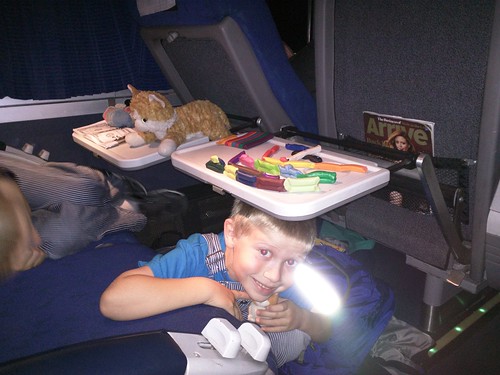
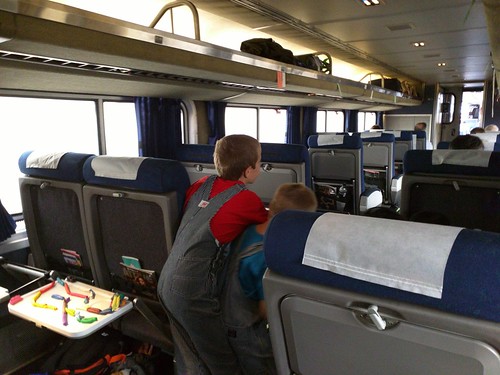
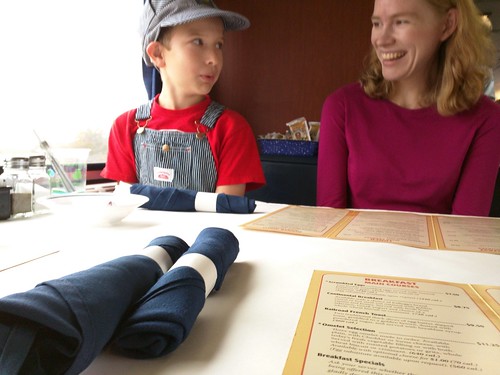
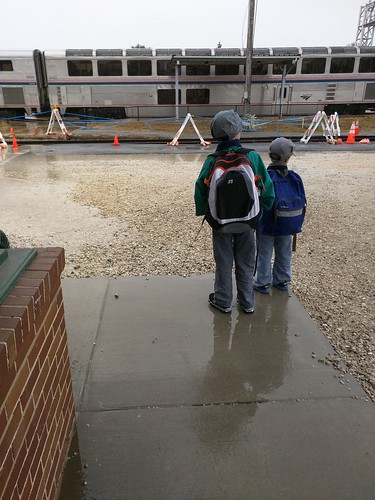
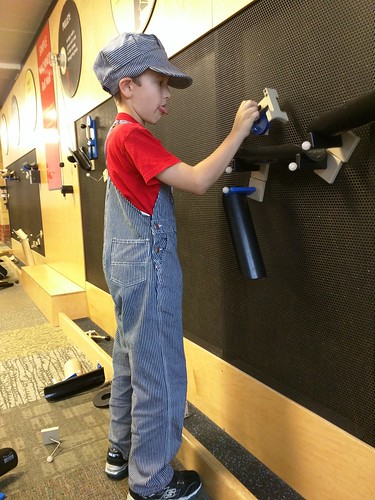
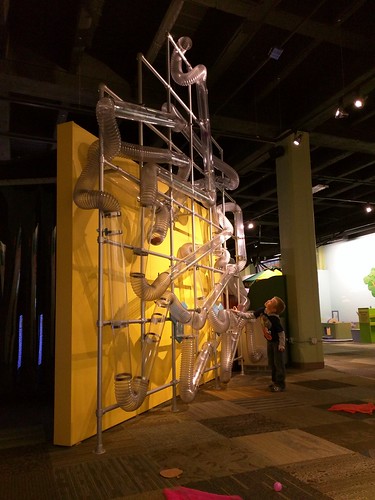
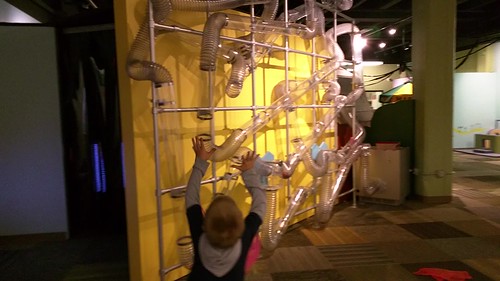
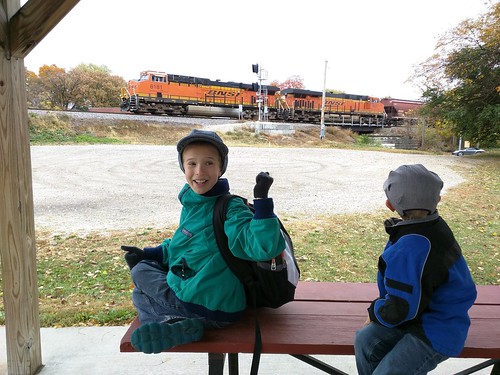
Sometimes, children are so excited you just can t resist. Jacob and Oliver have been begging for a train trip for awhile now, so Laura and I took advantage of a day off school to take them to the little town of Galesburg, IL for a couple days. Galesburg is a special memory for me; nearly 5 years ago, it was the first time Jacob and I took an Amtrak trip somewhere, just the two of us. And, separately, Laura s first-ever train trip had been to Galesburg to visit friends. There was excitement in the air. I was asked to supply a bedtime story about trains I did. On the way to the train station in the middle of the night there was excited jabbering about trains. Even when I woke them up, they lept out of bed and raced downstairs, saying, Dad, why aren t you ready yet? As the train was passing through here at around 4:45AM, and we left home with some time to spare, we did our usual train trip thing of stopping at the one place open at such a time: Druber s Donuts. IMG_20151023_040731 Much as Laura and I might have enjoyed some sleep once we got on the train, Jacob and Oliver weren t having it. Way too much excitement was in the air. Jacob had his face pressed against the window much of the time, while Oliver was busy making snake trains from colored clay complete with eyes. IMG_20151023_062304 The boys were dressed up in their train hats and engineer overalls, and Jacob kept musing about what would happen if somebody got confused and thought that he was the real engineer. When an Amtrak employee played along with that later, he was quite thrilled! We were late enough into Galesburg that we ate lunch in the dining car. A second meal there what fun! Here they are anxiously awaiting the announcement that the noon reservations could make their way to the dining car. Oh, and jockeying for position to see who would be first and get to do the all-important job of pushing the button to open the doors between train cars. IMG_20151023_120143 Even waiting for your food can be fun. IMG_20151023_120728 Upon arriving, we certainly couldn t leave the train station until our train did, even though it was raining. IMG_20151023_145755 Right next to the train station is the Discovery Depot Children s Museum. It was a perfect way to spend a few hours. Jacob really enjoyed the building wall, where you can assemble systems that use gravity (really a kinetic/potential energy experiment wall) to funnel rubber balls all over the place. He sticks out his tongue when he s really thinking. Fun to watch. IMG_20151023_153113 Meanwhile, Oliver had a great time with the air-powered tube system, complete with several valves that can launch things through a complicated maze of transparent tubes. IMG_20151024_150309 VID_20151024_150159 They both enjoyed pretending I was injured and giving me rides in the ambulance. I was diagnosed with all sorts of maladies a broken leg, broken nose. One time Jacob held up the pretend stethoscope to me, and I said ribbit. He said, Dad, you ve got a bad case of frog! You will be in the hospital 190 days! Later I would make up things like I think my gezotnix is all froibled and I was ordered to never leave the ambulance again. He told the story of this several times. After the museum closed, we ate supper. Keep in mind the boys had been up since the middle of the night without sleeping and were still doing quite well! They did start to look a bit drowsy I thought Oliver was about to fall asleep, but then their food came. And at the hotel, they were perfectly happy to invent games involving jumping off the bed. Saturday, we rode over to Peck Park. We had heard about this park from members of our church in Kansas, but oddly even the taxi drivers hadn t ever heard of it. It s well known as a good place to watch trains, as it has two active lines that cross each other at a rail bridge. And sure enough, in only a little while, we took in several trains. IMG_20151024_110035 VID_20151024_110229 The rest of that morning, we explored Galesburg. We visited an antique mall and museum, saw the square downtown, and checked out a few of the shops my favorite was the Stray Cat, featuring sort of a storefront version of Etsy with people selling art from recycled objects. But that wasn t really the boys thing, so we drifted out of there on our way to lunch at Baked, where we had some delicious deep-dish pizza. After that, we still had some time to kill before getting back on the train. We discussed our options. And what do you know we ended up back at the children s museum. We stopped at a bakery to get the fixins for a light supper on the train, and ate a nice meal in the dining car once we got on. Then, this time, they actually slept. Before long, it was 3AM again and time to get back off the train. Oliver was zonked out sleepy. Somehow I managed to get his coat and backpack on him despite him being totally limp, and carried him downstairs to get off the train. Pretty soon we walked to our car and drove home. We tucked them in, and then finally tucked ourselves in. Sometimes being really tired is well worth it.

27 October 2015

Dirk Eddelbuettel: Rcpp now used by over 500 CRAN packages

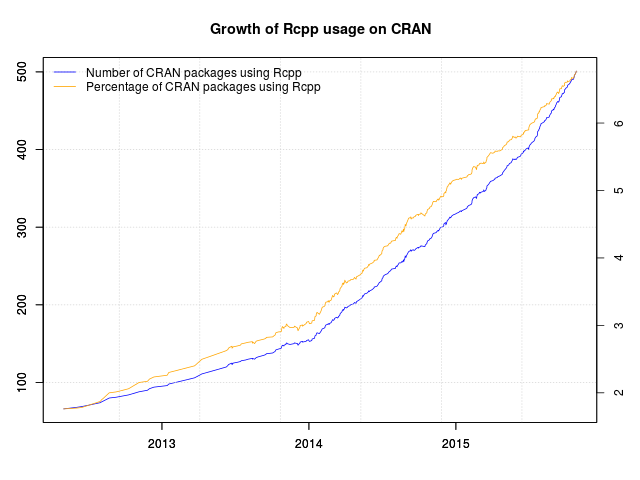
500 Rcpp packages This morning, Rcpp reached another round milestone: 501 packages on CRAN now depend on it (as measured by Depends, Imports and LinkingTo declarations, and even excluding one or two packages with an accidental declaration that do not use it). The graph is on the left depicts the growth of Rcpp usage over time. And there are a full seventy more on BioConductor in its development branch (but BioConductor is not included in the chart). Rcpp cleared 300 packages less than a year ago. It passed 400 packages in June when I only tweeted about it this June (while traveling for Rcpp training at U Zuerich, the R Summit at CBS, and the fabulous useR! 2015 at U Aalborg; so no blog post). The first and less detailed part uses manually saved entries, the second half of the data set was generated semi-automatically via a short script appending updates to a small file-based backend. A list of user package is kept on this page. Also displayed in the graph is the relative proportion of CRAN packages using Rcpp. The four per-cent hurdle was cleared just before useR! 2014 where I showed a similar graph (as two distinct graphs) in my invited talk. We passed five percent in December of last year, six percent this July and now stand at 6.77 percent, or about one in fourteen R packages. 500 user packages is very humbling, a staggering number and a big responsibility. We will out best try to keep Rcpp as performant and reliable as it has been so that the next set of packages can rely on it---just like these 500 do. So with that a very big Thank You! to all users and contributors of Rcpp for help, suggestions, bug reports, documentation or, of course, code.

This post by Dirk Eddelbuettel originated on his Thinking inside the box blog. Please report excessive re-aggregation in third-party for-profit settings.

Lunar: Reproducible builds: week 26 in Stretch cycle

What happened in the reproducible builds effort this week: Toolchain fixes Mattia Rizzolo created a bug report to continue the discussion on storing cryptographic checksums of the installed .deb in dpkg database. This follows the discussion that happened in June and is a pre-requisite to add checksums to .buildinfo files. Niko Tyni identified why the Vala compiler would generate code in varying order. A better patch than his initial attempt still needs to be written. Packages fixed The following 15 packages became reproducible due to changes in their build dependencies: alt-ergo, approx, bin-prot, caml2html, coinst, dokujclient, libapreq2, mwparserfromhell, ocsigenserver, python-cryptography, python-watchdog, slurm-llnl, tyxml, unison2.40.102, yojson. The following packages became reproducible after getting fixed: Some uploads fixed some reproducibility issues but not all of them: reproducible.debian.net pbuilder has been updated to version 0.219~bpo8+1 on all eight build nodes. (Mattia Rizzolo, h01ger) Packages that FTBFS but for which no open bugs have been recorded are now tested again after 3 days. Likewise for depwait packages. (h01ger) Out of disk situations will not cause IRC notifications anymore. (h01ger) Documentation update Lunar continued to work on writing documentation for the future reproducible-builds.org website. Package reviews 44 reviews have been removed, 81 added and 48 updated this week. Chris West and Chris Lamb identified 70 fail to build from source issues. Misc. h01ger presented the project in Mexico City at the 3er Congreso de Seguridad de la Informaci n where it became clear that we lack academic papers related to reproducible builds. Bryan has been doing hard work to improve reproducibility for OpenWrt. He wrote a report linking to the patches and test results he published.

Next.

Previous.