Daniel Pocock: Storage controllers for small Linux NFS networks

While contemplating the disk capacity upgrade for my Microserver at home, I've also been thinking about adding a proper storage controller.
Currently I just use the built-in controller in the Microserver. It is an AMD SB820M SATA controller. It is a bottleneck for the SSD IOPS.
On the disks, I prefer to use software RAID (such as md or BtrFs) and not become dependent on the metadata format of any specific RAID controller. The RAID controllers don't offer the checksumming feature that is available in BtrFs and ZFS.
The use case is NFS for a small number of workstations. NFS synchronous writes block the client while the server ensures data really goes onto the disk. This creates a performance bottleneck. It is actually slower than if clients are writing directly to their local disks through the local OS caches.
SSDs on an NFS server offer some benefit because they can complete write operations more quickly and the NFS server can then tell the client the operation is complete. The more performant solution (albeit with a slight risk of data corruption) is to use a storage controller with a non-volatile (battery-backed or flash-protected) write cache.
Many RAID controllers have non-volatile write caches. Some online discussions of BtrFs and ZFS have suggested staying away from full RAID controllers though, amongst other things, to avoid the complexities of RAID controllers adding their metadata to the drives.
This brings me to the first challenge though: are there suitable storage controllers that have a non-volatile write cache but without having other RAID features?
Or a second possibility: out of the various RAID controllers that are available, do any provide first-class JBOD support?
Observations
I looked at specs and documentation for various RAID controllers and identified some of the following challenges:
- HP Smart Array: many discussions suggest they don't support genuine JBOD disks (without metadata) and users have had to use workarounds like creating single-disk RAID0 volumes.
- Adaptec: the 5445Z controller appears like a good physical fit for the Microserver and supports up to 250,000 IOPS. However, according to the manual, it supports JBOD but won't allow booting from JBOD disks. It is necessary to configure the disks as Simple Volumes (which involves writing some metadata) to have them bootable.
- LSI: it appears that they also had a problem with booting from JBOD but it was fixed in a firmware update (bug reference: SCGCQ00424928). The 9280-4i4e card fits the Microserver and offers 150,000 IOPS and 512MB battery-backed cache. The newer 9271-4i also appears to fit, offering 465,000 IOPS and 1GB flash-backed cache. However, some discussions also suggest that MegaRAID doesn't offer real JBOD although those comments are from 2010 so maybe the newer card/newer firmware is suitable.
- A discussion of ZFS, NFS and write caches but without mention of stable/battery-backed write cache.
- Cache flushes, ZFS and NFS
- Some deprecated comments about write barriers
- A forum discussion about HBAs with non-volatile write cache
- A blog about using LSI controllers with disks in RAID0 for ZFS / FreeBSD
 Every now and then we get reports from
 What s that? The third edition of


 I stumbled upon this site thanks to
 Unfortunately I could not go



 What works out of the box: Audio, Telephony, SMS, Data (GSM/3G), Back Camera, NFC. 2D Graphics is somewhat slow compared to stock ROM, but I m using it daily and can live with that so it isn t too onerus. Stability is fine, similar to other Android device I m used to. Video playback does not work (due to non-free media decoders?), which is not a serious problem for me but still likely the biggest outstanding issue except for freedom concerns. 3D graphics apparently doesn t work, and I believe it is what prevents Firefox from working properly (it crashes). I m having one annoying but strange problem with telephony: when calling one person I get scrambled audio around 75% of the time. I can still hear what the other person is saying, but can barely make anything out of it. This only happens over 3G, so my workaround when calling that person is to switch to 2G before and switch back after. I talk with plenty other people, and have never had this problem with anyone else, and it has never happened when she talks with anyone else but me. If anyone has suggestion on how to debug this, I m all ears.
Important apps to get through daily life for me includes K9Mail (email), DAVDroid (for ownCloud CalDav/CardDAV), CalDav Sync Adapter (for Google Calendars), Conversations (XMPP/Jabber chat), FDroid (for apps), ownCloud (auto-uploading my photos), SMS Backup+, Xabber (different XMPP/Jabber accounts), Yubico Authenticator, MuPDF and oandbackup. A couple of other apps I find useful are AdAway (remove web ads), AndStatus, Calendar Widget, NewsBlur and ownCloud News Reader (RSS readers), Tinfoil for Facebook, Twidere (I find its UI somewhat nicer than AndStatus s), and c:geo.
A number of things requires non-free components. As I discussed
 I moved back from the California Bay Area to Belfast a while back and for various reasons it looks like I m going to be here a while, so it made sense to have my belongings shipped over here. They haven t quite arrived yet, and I ll do another post about that process once they have, but I ve been doing various tweets prefixed with [shipping] during the process. Various people I ve spoken to (some who should know me better) thought this was happening manually. It wasn t. If you care about how it was done, read on.
I d been given details of the ship carrying my container, and searching for that turned up the excellent


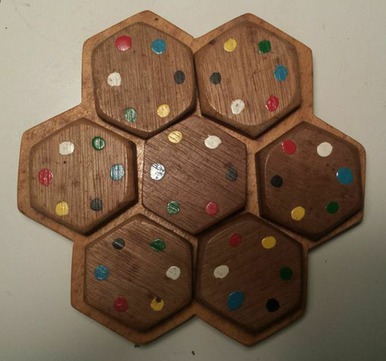 Over Christmas I found the above puzzle at my parent's house. I don't know if it has a name but it seemed apt to name it after