Search Results: "ron"

2 May 2013

Russ Allbery: Review: The System of the World

Review: The System of the World, by Neal Stephenson
Series: The Baroque Cycle #3
Publisher: William Morrow
Copyright: 2004
ISBN: 0-06-052387-5
Format: Hardcover
Pages: 892
This is the third book of the three-volume Baroque Cycle. I think you could, if you really wanted, read it without reading the previous volumes; Stephenson is certainly long-winded enough that you can pick up most of what's going on while you read. It's been a year since I read the second volume, and I only resorted to Wikipedia a couple of times to remember plot elements (and mostly from the first book). However, I wouldn't recommended starting here. Many of the character relationships, and most of the underpinning of the plot, is established in the previous volumes and given more significance by them. You would also miss The Confusion, which is the best book of the series, although none of this series rises to the level at which I'd recommend it except under specific circumstances. Quicksilver establishes the characters of Daniel Waterhouse, a fictional Puritan whose family was close to Cromwell and who became a friend to Isaac Newton in the days following the Restoration; Jack Shaftoe, a vagabond who wanders Europe in a sequence of improbable adventures; and Eliza, who becomes a friend to Leibniz and a spy for William of Orange. The Waterhouse sections are prominent in Quicksilver: full of the early history of the Royal Society, alchemy, and a small amount of politics. Of those three characters, Eliza is by far the most interesting, which meant that I was delighted when The Confusion dropped Waterhouse almost entirely and mixed Eliza's further story with more improbable but entertaining sea adventures of Jack Shaftoe. You will immediately sense my root problem with The System of the World when you hear that it is almost entirely about Daniel Waterhouse. While Eliza and Jack both appear, they play supporting roles at best, and Eliza's wonderful sharp intelligence and pragmatic survival skills are left out almost entirely. Instead, this is a novel about Waterhouse's return to England after spending quite a bit of time in the American colonies working on calculating machines. He is almost immediately entangled in dangerous politics from multiple directions: the precarious national politics in England near the end of the reign of Queen Anne, Isaac Newton's attempts to maintain the currency of England as Master of the Mint, and a bombing attempt that may have been aimed at him, may have been aimed at Newton, and may have been aimed at someone else entirely. Much of the book consists of an extended investigation of this bombing plot, skullduggery involving counterfeiters, and attempts to use the currency and the Mint as part of the political conflict between Whigs and Tories, mixed in with attempts to construct a very early computer (this is Stephenson, after all). Leibniz and Eliza come into this only as confidants of the Hanoverians. All this may sound exciting, and there are parts of it that hold the attention. But this book sprawls as badly as Quicksilver did. There's just too much detail without either enough plot or enough clarity. Stephenson tries to make you feel, smell, and hear the streets of London and the concerns of an idiosyncratic group of semi-nobles during one of the more interesting junctures of British history, but he does that by nearly drowning you in it, and without providing enough high-level guidance. For most of the book, I felt like I was being given a tour of a house on my hands and knees with a magnifying glass. It's a bad sign when the reader of a historical novel is regularly resorting to Wikipedia, not to follow interesting tangents of supporting material, but to try to get a basic sense of the players and the politics involved because the author never explains them clearly. If you're more familiar with the details of British history than I am, and can more easily follow the casual intermixing of two or three forms of address for the same historical figure, you may not have that problem. But I think other structural issues remain, and one of the largest is Waterhouse himself. Jack Shaftoe, and particularly Eliza, are more interesting characters because they're characters. They're not always particularly believable, but they attack the world with panache and are constantly squirming into the center of things. Stephenson's portrayals of Newton, Leibniz, the Duke of Marlborough, Sophia of Hanover, Peter the Great, and the other historical figures who show up here are interesting for different reasons: Stephenson has history to draw on and elaborate, and it's fascinating to meet those people from a different angle than dry lists of accomplishments. History has a way of providing random details that are too bizarre to make up; Isaac Newton, for example, actually did disguise himself to infiltrate London criminal society in pursuit of counterfeiters while he was Master of the Mint! Waterhouse, for me, has none of these advantages. He is an invented character in whom I have no pre-existing interest. He drifts through events largely through personal connections, all of which seem to be almost accidental. He's welcome in the councils of the Royal Society because he's apparently a scientist, but the amount of actual science we see him doing is quite limited. His nonconformist background allies him squarely with the Whigs, but his actual position on religious matters seems much less set than the others around him. What he seems to want, more than anything else, is to help Leibniz in the development of a computer and to reconcile Newton and Leibniz. And he's not particularly effective at either. In short, he has little in the way of memorable character or dynamism, despite being the primary viewpoint character, and seems to exist mostly to know everyone and be everywhere that's important to the story. He feels like an authorial insertion more than a character. It's quite easy to believe that Stephenson himself would have loved to be in exactly the role and situation that Waterhouse finds himself in throughout the book, in the middle of the councils of the wise and powerful, in just the right position to watch the events of history. I can sympathize, but it doesn't make for engrossing reading. Novels live and die by the strength of their characters, particularly their protagonists; I want more than just a neutral viewpoint. The third major structural problem that I had with this book is that I think Stephenson buries his lede. After finishing it, I think this is a book with a point, a central premise around which all the events of the story turn, and which is the philosophical culmination of The Baroque Cycle as a whole. But Stephenson seems oddly unwilling to state that premise outright until the very end of the book. For the first half, one could be forgiven in thinking this is a story about alchemy and the oddly heavy gold that's been a part of the story since The Confusion, or perhaps about foundational but forgotten work on computation that preceded Babbage by a century. But those all turn out to be side stories, sometimes even without a proper conclusion. I appreciate honoring the intelligence of the reader, and I presume that Stephenson would like to guide the reader through the same process of realization that the characters go through, but I think he takes this much too far and fails to make the realization clear. I'll therefore state what I believe is the premise outright, since I think it's a stronger book with this idea in mind: The System of the World is a continuation of the transformational economics shown in The Confusion into the realm of politics. Specifically, it's about the replacement of people with systems, about the journey towards Parliamentary supremacy, central banking, and the persistent state, and about the application of scientific principles of consistency and reproducibility to politics and economics (however fitfully and arbitrarily). Quicksilver was about the rise of science; The Confusion was, in retrospect, about the rise of economics; and The System of the World tries to be about the rise of technocratic modern politics, barely perceptible among the squabbles between Tories and Whigs. I think that's a fascinating premise, and I would have loved to read a book that tackles it head-on. That's a concept that is much more familiar from the late 19th and early 20th centuries in the context of Marxism, early socialism, technological utopianism, and similar attempted applications of scientific analysis to political and human behavior for the betterment of human civilization. Shifting that 200 years earlier and looking at a similar question from the perspective of the giants of the Enlightenment feels full of of potential. There are moments when I think Stephenson captures the sense of a seismic shift in how economies are run, knowledge is established, and civilizations are knit together. But, most of the time, it just isn't clear. There's so much other stuff in this book, and in the whole series: so many false starts, digressions, abandoned plots, discarded characters, and awkward attempts at romance (as much as I like the characters, Stephenson's portrayal of the relationship between Eliza and Jack is simply ridiculous and not particularly funny) that the whole weight of the edifice crushes what I think is the core concept. Stephenson is never going to be sparse. When you start a Stephenson novel, you know it's going to be full of chunks of partly digested encyclopedia and random research findings that may have nothing to do with the plot. But his best books (Snow Crash, The Diamond Age, even Cryptonomicon) have an underlying structure off of which all of those digressions are hung. You can see the bones beneath the flesh, and the creature they create is one you want to get to know. I'm not sure there are any bones here, and that may be the peril, for Stephenson, of writing historical fiction. I wonder if he felt that the structure of history would provide enough structure by itself that he could wrap a few plots around the outside of it and call it good. If so, it didn't work, at least for me. A lot of things happen. Some of them are even exciting and tense. A lot of people meet, interact, and show off their views of the world. A great deal of history, research, and sense of place is described in painstaking detail. But at the end of the book, I felt like I had to reach for some sort of point and try to retrofit it to the story. Lots happened, but there wasn't a novel. And that makes it quite hard to get enthused by the book. If you adored Quicksilver, I suspect you will also like this. I think they're the most similar. If, like I did, you thought The Confusion was a significant step up in enjoyment in the series and were hoping the trend will continue, I'm sad to report that it didn't. If you were considering whether to read the whole series and were waiting to see what I thought of the end, my advice is to give The Baroque Cycle a pass unless you absolutely love Stephenson's digressions, don't care if they're about history instead of current technology, and cannot live without 3,000 pages of them. It's not that they're bad books, but they're very long books, they take a significant investment of time and attention, and I think that, for most readers, there are other books that would repay a similar investment with more enjoyment. Rating: 5 out of 10

Paul Tagliamonte: Me, as an Ubuntu Community Member

Recently, some folks have brought it to my attention that I m not so good at making my work with Ubuntu known. I d like to clarify my role. Yes, I m still an Ubuntu member. Yes, I m still active. Yes, I care about Ubuntu. A lot. To insinuate otherwise is wholly wrong. I ve been with Ubuntu for just about 5 years now, and to misrepresent that would be a damn shame. I mostly do work in Debian these days, where I make sure packages upstream support Ubuntu, and work to help create a solid Debian, which provides a strong base for Ubuntu to work from.


Every Debian developer is also an Ubuntu developer, because one way to contribute to Ubuntu is to contribute to Debian.

- SABDFL

I also spend time to make sure Ubuntu / Debian relations remain strong, and that Debian folks know they can count on a friendly face to interface with the Ubuntu ers, or the Ubuntu ers knowing they can count on a friend to help.

To be clear; I m not active in the Ubuntu community channels anymore. I m still very much active with Ubuntu on the whole.

Hope that clears things up for folks.

1 May 2013

Raphaël Hertzog: My Free Software Activities in April 2013

This is my monthly summary of my free software related activities. If you re among the people who made a donation to support my work (102.70 , thanks everybody!), then you can learn how I spent your money. Otherwise it s just an interesting status update on my various projects. Debian France Work on Galette. I spent quite some time on Debian France s galette installation (the web application handling its member database), first converting its Postgres database to UTF-8, then upgrading to 0.7.4 while working-around many known problems. I also created Debian packages of three Galette plugins that we have been using (galette-plugin-paypal, galette-plugin-admintools, galette-plugin-fullcard). But every time I use galette, I tend to find something to report. This month I filed 5 tickets: I tested quite some fixes prepared by the upstream author (3 of the above bugs are already fixed) and this lead to the 0.7.4.1 bugfix release. Preliminary work on new bylaws. I have setup a git repository to make it easier to collaborate on new versions of our bylaws and internal rules. The goal is to make Debian France a trusted organization of Debian and to update everything to be compliant with the association 1901 law (we currently have a special statute reserved to associations from Alsace/Moselle). Kali Linux Improve accessibility support in Debian Wheezy. Offensive Security wanted Kali Linux to be fully accessible to disabled people. Since Wheezy was suffering from some serious regressions in that area, we hired Emilio Pozuelo Monfort to fix #680636 and #689559 in gdm3. On my side, I updated debian-installer s finish-install to correctly pre-configure the system when you make an install with speech synthesis (patch submitted in #705599).

Thanks to accommodating release managers, this work has already been integrated in Wheezy and won t have to wait the first point release. Fix bugs in Debian s live desktop installer. We also wanted to enable the desktop installer in the Kali live DVD. While our first tries a few months ago failed, this time it worked almost out of the box (thanks to Ben Armstrong who fixed it). I still identified a few issues that I fixed in debian-installer-launcher s git repository. Packaging and misc Debian work I also spent a significant number of hours to answer questions of students who want to participate in Google s summer of code and who are interested by the rewrite of the Package Tracking System with Python and Django. Some of the discussions happened on debian-qa@lists.debian.org. Thanks See you next month for a new summary of my activities.

One comment Liked this article? Click here. My blog is Flattr-enabled.

Russ Allbery: Review: Questions for a Soldier

Review: Questions for a Soldier, by John Scalzi
Publisher: Subterranean
Copyright: 2005
Printing: 2012
ISBN: 1-59606-468-4
Format: Kindle
Pages: 28
Yet another short story from the Subterranean Scalzi Super Bundle collection, which is padding out my numbers this year since I don't seem to be writing as many reviews. Unlike some of the others, this one is fairly hard to come by if you didn't buy the original chapbook or the issue of Subterranean Magazine that included it. But don't worry, you're not really missing anything. Questions for a Soldier is really a short story, and slight even for that. It's a pendant to Old Man's War, a close-up of one stop in a good will tour that John Perry, the protagonist of that novel, does during it. In universe, it's basically a propaganda piece for the Colonial Defense Force that fleshes out some more of the background, mainly from the CDF side, of Scalzi's future universe. What Scalzi is doing here is mildly interesting: he's trying to capture the style of this sort of public affairs, feel-good speaking engagement but balance that against his portrayal of Perry as an honest straight shooter. Perry does a lot of the careful presentation of both sides that one would expect from someone who knows he's standing up to represent one side of an issue but doesn't want to make the propaganda too obvious. As a portrayal of a political speech of the subgenre "trying not to act like a politician," I think Scalzi successfully captures the tone. That's probably also why I found it vaguely annoying, since I think such speeches are a classic form of manipulation. Take someone (who may even honestly be a person of good will), put them up in front of a crowd, don't tell them what they have to say but make sure they're representing something that they're at least somewhat proud of, and let social pressure and expectations take care of the rest. The person will come across as honest and open (since they consider themselves to be), they don't actually know anything damaging, and they'll want to present their side in a good light. Humans are wonderful at rationalizations. The audience comes away feeling like the people they may be politically opposed to are human, and good people, and they can't be doing anything that upsetting since that fellow was a nice, upstanding person who told some great war stories and was clearly putting themselves in danger to protect the rest of us. It blunts political outrage and anger, justified or not, with a bit of "we're all on the same side and we're all good people" emotional camaraderie without any danger of any real revelations, uncomfortable information, or dangerous theories being expressed. Scalzi does a good job holding up a mirror here, and he also gives Perry the opportunity to make the solid (if quite predictable and dangerously incomplete) case for a professional military (and a completely cliched case for world, or galactic, peace). It all sounds quite believable because Perry obviously believes it. (That does not mean that Scalzi believes it; he's writing a character in a time, place, and role when the character believed those things.) But, at the end, it's a bit of political fluff that isn't really a story (no plot) and adds little to the larger series in which it was embedded. The later novels in the Old Man's War series raise the questions asked here in a much more forceful and direct way, in ways that produce at least a few answers. The general style is the sort of speech that you could find almost anywhere in US politics. If you have the collection anyway, it's mildly interesting to take apart what Scalzi is portraying here and think about it a bit, but it's completely missable. Rating: 5 out of 10

30 April 2013

Steve Kemp: After you've started it seems like a bad idea?

To recap: given the absence of other credible alternatives I had two options: I think there is room for a new console client, because mutt is showing its age and does feel like it should have a real extension language - be it guile, lisp, javascript(!), Lua, or something else. So I distilled what I thought I wanted into three sections: So how did I do? I wrote a ncurses-based client which has Lua backed into it. You can fully explore the sidebar-mode - which lets you select multiple folders. From there you can view the messages in a list. What you can't do is anything "real": For a two-day hack it is remarkably robust, and allowing scripting shows awesomeness. Consider this:
--
-- show all folders in the Maildir-list.
--
function all()
   -- ensure that the sidebar displays all folders
   sidebar_mode = "all";
   -- we're going to be in "maildir browsing mode"
   cmail_mode = "sidebar";
   reset_sidebar();
   refresh_screen();
end
--
-- Test code, show that the pattern-searching works.
--
-- To use this press ":" to enter the prompt, then enter "livejournal".
--
-- OR press "l" when in the sidebar-mode.
--
function livejournal()
   sidebar_pattern = "/.livejournal.2";
   sidebar_mode = "pattern";
   reset_sidebar();
   refresh_screen();
end
--
-- There is a different table for each mode.
--
keymap =  
keymap['sidebar'] =  
keymap['index']   =  
keymap['message'] =  
--
-- In the sidebar-mode "b" toggles the sidebar <-> index.
--
-- ":" invokes the evaluator.
-- "q" quits the browser and goes to the index-mode.
-- "Q" quits the program entirely.
--
keymap['sidebar'][':'] = "prompt-eval"
keymap['sidebar']['b'] = "toggle"
keymap['sidebar']['q'] = "toggle"
keymap['sidebar']['Q'] = "exit"
-- show all/unread/livejournal folders
keymap['sidebar']['a'] = "all"
keymap['sidebar']['u'] = "unread"
keymap['sidebar']['l'] = "livejournal"
Neat, huh? See the cmail.lua file on github for more details. My decision hasn't really progressed any further, though I can see that if this client were complete I'd love to use it. Its just that the remaining parts are the fiddly ones. I guess I'll re-hack mutt, and keep this on the back-burner. The code is ropey in places, but should you wish to view: And damn C is kicking my ass.

29 April 2013

Thomas Goirand: Jenkins: building debian packages after a git push (my 2cents of a howto)

The below is written in the hope it will be helpful for my fellow DDs. Why using build after push ? Simple answer: to save time, to always use a clean build environment, to automate more tests. Real answer: because you are lazy, and tired of always having to type these build commands, and that watching the IRC channel is more fun than watching the build process. Other less important answers: building takes some CPU time, and makes your computer run slower for other tasks. It is really nice that building doesn t consume CPU cycles on your workstation/laptop, and that a server does the work, not disturbing you while you are working. It is also super nice that it can maintain a Debian repository for you after a successful build, available for everyone to use and test, which would be harder to achieve on your work machine (which may be behind a router doing NAT, or even sometimes turned off, etc.). It s also kind of fun to have an IRC robot telling everyone when a build is successful, so that you don t have to tell them, they can see it and start testing your work. Install a SID box that can build with cowbuilder
Install Jenkins WARNING: Probably, before really installing, you should read what s bellow (eg: Securing Jenkins). Simply apt-get install jenkins from experimental (the SID version has some security issues, and has been removed from Wheezy, on a request of the maintainer). Normally, after installing jenkins, you can access it through:
http://<ip-of-your-server>:8080/
There is no auth by default, so anyone will be able to access your jenkins web GUI and start any script under the jenkins user (sic!). Jenkins auth
Before doing anything else, you have to enable Jenkins auth, otherwise, you have everything accessible from the outside, meaning that more or less, anyone browsing your jenkins server could be allowed to run any command. It might sound simple, but in fact, Jenkins auth is tricky to activate, and it is very easy to get yourself locked out, with no working web access. So here s the steps: 1. Click on Manage Jenkins then on Configure system 2. Check the enable security checkbox 3. Under security realm select Jenkins s own user database and leave allow users to sign up . Important: leave Anyone can do anything for the moment (otherwise, you will lock yourself out). 5. At the bottom of the screen, click on the SAVE button. 6. On the top right, click to login / create an account. Create yourself an account, and stay logged in. 7. Once logged-in, go back again in the Manage Jenkins -> Configure system , under security. 8. Switch to Project based matrix authentication strategy . Under User/group to add , enter the new login you ve just created, and click on Add . 9. Select absolutely all checkboxes for that user, so that you make yourself an administrator. 10. For the Anonymous user, for Job, check Read, Build and Workspace. For Overall select Read. 11. At the bottom of the screen, hit save again. Now, anonymous (eg: not logged-in) users should be able to see all projects, and be able to click on the build now button. Note that if you lock yourself out, the way to fix is to turn off Jenkins, edit config.xml, remove the useSecurity thing, and all what is in authorizationStragegy and securityRealm , then restart Jenkins. I had to do that multiple times until I had it right (as it isn t really obvious you got to leave Jenkins completely insecure when creating a new user). Securing Jenkins: Proxy Jenkins through apache to use it over SSL
When doing a quick $search-engine search, you will see lots of tutorials to use apache as a proxy, which seems to be the standard way to run Jenkins. Add the following to /etc/apache2/sites-available/default-ssl:
ProxyPass / http://localhost:8080/
ProxyPassReverse / http://localhost:8080/
ProxyRequests Off
Then perform the following commands on the shell:
htpasswd -c /etc/apache2/jenkins_htpasswd <your-jenkins-username>
a2enmod proxy
a2enmod proxy_http
a2enmod ssl
a2ensite default-ssl
a2dissite default
apache2ctl restart
Then disable access to the port 8080 of jenkins from outside:
iptables -I INPUT -d <ip-of-your-server> -p tcp --dport 8080 -j REJECT
Of course, this doesn t mean you shouldn t take the steps to activate Jenkins own authentication, which is disabled by default (sic!). Build a script to build packages in a cowbuilder I thought it was hard. In fact it was not. All together, this was kind of fun to hack. Yes hack. What I did yet another kind of 10km ugly shell script. The way to use it is simply: build-openstack-pkg <package-name>. On my build server, I have put that script in /usr/bin, so that it is accessible from the default path.Ugly, but it does the job! Jenkins build script for openstack At the end of the script, scan_repo() generates the necessary files for a Debian repository to work under /home/ftp. I use pure-ftpd to serve it. /home/ftp must be owned by jenkins:jenkins so that the build script can copy packages in it. This build script is by no mean state of the art, and in fact, it s quite hack-ish (so I m not particularly proud of it, but it does its job ). If I am showing it in this blog post, it is just to show an example of what can be done. It is left as an exercise to the reader to create another build script adapted to its own needs, and write something cleaner and more modular. Dependency building Let s say that you are using the Built-Using: field, and that package B needs to be built if package A changes. Well, Jenkins can be configured to do that. Simply edit the configuration of project B (you will find it, it s easy ). My use case: In my case, for building Glance, Heat, Keystone, Nova, Quantum, Cinder and Ceilometer, which are all components of Openstack, I have written a small (about 500 lines) library of shell functions, and an also small (90 lines) Makefile, which are packaged in openstack-pkg-tools (so Nova, Glance, etc. all build-depends on openstack-pkg-tools). The shell functions are included in each maintainer scripts (debian/*.config and debian/*.postinst mainly) to avoid having some pre-depends that would break debconf flow. The Makefile of openstack-pkg-tools is included in debian/rules of each packages. In such a case, trying to manage the build process by hand is boring and time consuming (spending your time watching the build process of package A, so that you can manually start the build of package B, then wait again ). But it is also error prone: it is easy to do a mistakes in the build order, you can forget to dpkg -i the new version of package A, etc. But that s not it. Probably at some point, you will want Jenkins to rebuild everything. Well, that s easy to do. Simply create a dummy project, and have other project to build after that one. The build steps could simply be: echo Dummy project as a shell script (I m not even sure that s needed ). Configuring git to start a build on each push In Jenkins, pass your mouse over the Build now URL. Well, we just need to wget that URL in your Alioth repository. A small drawing is better than long explanation:
for i in  ls /git/openstack  ; do
    echo "wget -q --no-check-certificate \
    https://<ip-of-your-server>/job/$ PROJ_NAME /build?delay=0sec \
    -O /dev/null" >/git/openstack/$ i /hooks/post-receive \
        && chmod 0770 /git/openstack/$ i /hooks/post-receive;
done
The chmod 0770 is necessary if you don t want every Alioth users to have access to your Jenkins server web interface and see an eventual htpassword protection that you can add to your jenkins box (I m not covering that, but it is fairly easy to add such protection). Note that all of the members of your Alioth group will then have access to this post-receive hook, containing the password of your htaccess, so you must trust everyone in your Alioth group to not do nasty things with your Jenkins. Bonus point: IRC robot If you would like to see the result of your build published on IRC, Jenkins can do that. Click on Manage Jenkins , then on Manage Plugins . Then click on available and check the box in front of IRC plugin . Go at the bottom of the screen and click on Add . Then check the box to restart Jenkins automatically. Once it is restarted, go again under Manage jenkins then Configure system . Select the IRC Notification and configure it to join the network and the channel you want. Click on Advanced to select the IRC nick name of your bot, and make sure you change the port (by default jenkins has 194, when IRC normally uses 6667). Be patient when waiting for the IRC robot to connect / disconnect, this can take some time. Now, for each jenkins Job, you can tick the IRC Notification option. Doing piuparts after build One nice thing with automated builds, is that most of the time, you don t need to wait starring at them. So you can add as many tests as you want, the Jenkins IRC robot will anyway let you know sooner or later the result of your build. So adding piuparts tests in the build script seems the correct thing to do. Though that is still on my todo, so maybe that will be for my next blog post.

26 April 2013

Keith Packard: Shared Memory Fences

Shared Memory Fences In our last adventure, dri3k first steps, one of the future work items was to deal with synchronization between the direct rendering application and the X server. DRI2 handles this by performing a round trip each time the application starts using a buffer that was being used by the X server. As DRI3 manages buffer allocation within the application, there s really no reason to talk to the server, so this implicit serialization point just isn t available to us. As I mentioned last time, James Jones and Aaron Plattner added an explicit GPU serialization system to the Sync extension. These SyncFences serializing rendering between two X clients, but within the server there are hooks provided for the driver to use hardware-specific serialization primitives. The existing Linux DRM interfaces queue rendering to the GPU in the order requests are made to the kernel, so we don t need the ability to serialize within the GPU, we just need to serialize requests to the kernel. Simple CPU-based serialization gating access to the GPU will suffice here, at least for the current set of drivers. GPU access which is not mediated by the kernel will presumably require serialization that involves the GPU itself. We ll leave that for a future adventure though; the goal today is to build something that works with the current Linux DRM interfaces. SyncFence Semantics The semantics required by SyncFences is for multiple clients to block on a fence which a single client then triggers. All of the blocked clients start executing requests immediately after the trigger fires. There are four basic operations on SyncFences: SyncFences are the same as Events as provided by Python and other systems. Of course all of the names have been changed to keep things interesting. I ll call them Fences here, to be consistent with the current X usage. Using Pthread Primitives One fact about pthreads that I recently learned is that the synchronization primitives (mutexes, barriers and semaphores) are actually supposed to work across process boundaries, if those objects are in shared memory mapped by each process. That seemed like a great simplification for this project; allocate a page of shared memory, map into the X server and direct rendering application and use the existing pthreads APIs. Alas, the pthread objects are architecture specific. I m pretty sure that when that spec was written, no-one ever thought of running multiple architectures within the same memory space. I went and looked at the code to check, and found that each of these objects has a different size and structure on x86 and x86_64 architectures. That makes it pretty hard to use this API within X as we often have both 32- and 64- bit applications talking to the same (presumably 64-bit) X server. As a last resort, I read through a bunch of articles on using futexes directly within applications and decided that it was probably possible to implement what I needed in an architecture-independent fashion. Futexes Linux Futexes live in this strange limbo of being a not-quite-public kernel interface. Glibc uses them internally to implement locking primitives, but it doesn t export any direct interface to the system call. Certainly they re easy to use incorrectly, but it s unusual in the Linux space to have our fundamental tools locked away for our own safety . Fortunately, we can still get at futexes by creating our own syscall wrappers.
static inline long sys_futex(void *addr1, int op, int val1,
                 struct timespec *timeout, void *addr2, int val3)
 
    return syscall(SYS_futex, addr1, op, val1, timeout, addr2, val3);
 
For this little exercise, I created two simple wrappers, one to block on a futex:
static inline int futex_wait(int32_t *addr, int32_t value)  
    return sys_futex(addr, FUTEX_WAIT, value, NULL, NULL, 0);
 
and one to wake up all futex waiters:
static inline int futex_wake(int32_t *addr)  
    return sys_futex(addr, FUTEX_WAKE, MAXINT, NULL, NULL, 0);
 
Atomic Memory Operations I need atomic memory operations to keep separate cores from seeing different values of the fence value, GCC defines a few such primitives and I picked _syncboolcompareandswap and _syncvalcompareandswap. I also need fetch and store operations that the compiler won t shuffle around:
#define barrier() __asm__ __volatile__("": : :"memory")
static inline void atomic_store(int32_t *f, int32_t v)
 
    barrier();
    *f = v;
    barrier();
 
static inline int32_t atomic_fetch(int32_t *a)
 
    int32_t v;
    barrier();
    v = *a;
    barrier();
    return v;
 
If your machine doesn t make these two operations atomic, then you would redefine these as needed. Futex-based Fences These wake-all semantics of Fences greatly simplify reasoning about the operation as there s no need to ensure that only a single thread runs past Await, the only requirement is that no threads pass the Await operation until the fence is triggered. A Fence is defined by a single 32-bit integer which can take one of three values: With those, I built the fence operations as follows. Here s Await:
int fence_await(int32_t *f)
 
    while (__sync_val_compare_and_swap(f, 0, -1) != 1)  
        if (futex_wait(f, -1))  
            if (errno != EWOULDBLOCK)
                return -1;
         
     
    return 0;
 
The basic requirement that the thread not run until the fence is triggered is met by fetching the current value of the fence and comparing it with 1. Until it is signaled, that comparison will return false. The compareandswap operation makes sure the fence is -1 before the thread calls futex_wait, either it was already -1 in the case where there were other waiters, or it was 0 before and is now -1 in the case where there were no waiters before. This needs to be an atomic operation so that the fence value will be seen as -1 by the trigger operation if there are any threads in the syscall. The futex_wait call will return once the value is no longer -1, it also ensures that the thread won t block if the trigger occurs between the swap and the syscall. Here s the Trigger function:
int fence_trigger(int32_t *f)
 
    if (__sync_val_compare_and_swap(f, 0, 1) == -1)  
        atomic_store(f, 1);
        if (futex_wake(f) < 0)
            return -1;
     
    return 0;
 
The atomic compareandswap operation will make sure that no Await thread swaps the 0 for a -1 while the trigger is changing the value from 0 to 1; either the Await switches from 0 to -1 or the Trigger switches from 0 to 1. If the value before the compareandswap was -1, then there may be threads waiting on the Fence. An atomic store, constructed with two memory barriers and a regular store operation, to mark the Fence triggered is followed by the futex_wake call to unblock all Awaiting threads. The Query function is just an atomic fetch:
int fence_query(int32_t *f)
 
    return atomic_fetch(f) == 1;
 
Reset requires a compareandswap so that it doesn t disturb things if the fence has already been reset and there are threads waiting on it:
void fence_reset(int32_t *f)
 
    __sync_bool_compare_and_swap(f, 1, 0);
 
A Request for Review Ok, so we ve all tried to create synchronization primitives only to find that our obvious implementations were full of holes. I d love to hear from you if you ve identified any problems in the above code, or if you can figure out how to use the existing glibc primitives for this operation.

Russ Allbery: WebAuth 4.5.0

Time to finally release three months of work! This is a very large feature release for the multifactor support in WebAuth and for the integration with the user information service, which is the way that WebAuth interacts with local site policy. (Currently, you still have to write your own to a well-defined protocol, although we do hope to provide Perl modules to help with this in the future.) The major driving motivation for this release is to add the infrastructure required to set long-lived persistent cookies in a browser that contribute factors to authentications, which allows WebAuth to support "remember this device" functionality and to only require multifactor from devices from which a user has not previously authenticated. This includes a new token type, new attributes the user information service can send (including a way to invalidate such tokens), and new data that's sent back to the user information service. The user information service also now has the ability to add arbitrary additional factors to the current authentication, something that is intended to provide a hook for a local help desk to bypass multifactor for a user for some time if required. This release also contains substantial contributions by Benjamin Coddington at UVM to improve multifactor interactions, including sending the OTP type back to the user information service if WebLogin knows it, a mechanism for the user information service to communicate a message to the user that's displayed on the multifactor login page, opaque state that can be sent back and forth between WebLogin and the user information service, and the ability for the user information service to add specific authentication factors to the required set for a particular authentication. Other improvements in multifactor handling include the ability to set a lifetime on factors obtained via OTP login, a fix for a long-standing bug where an initial multifactor factor would satisfy a session requirement for random multifactor, and logging of even ignored errors when contacting the user information service. There are other changes too. This release touches almost every part of WebAuth. The change to WebAuthForceLogin in 4.4.0 was reverted since, on further consideration, the original semantics seemed more useful. Password change handling in WebLogin was fixed (it's been broken for some time). Apache 2.4 error logging for all modules is much improved, and mod_webauth and mod_webkdc now produce better error logs for all versions of Apache. And WebLogin now communicates password expiration times to its templates in seconds since epoch in addition to a pre-formatted English time for better localization support. William Orr contributed a new WebAuthLdapOperationalAttribute directive for mod_webauthldap that allows it to query operational attributes and include them in the environemnt. There are two backward-incompatible changes for WebLogin. First, WebAuth now supports a user checkbox indicating either to remember their login on that device or to not remember their login (local site templates can present it either way). However, proper implementation of this matching the normal expected wording of "remember me on this device" required changing the default, so a straight upgrade from an earlier version will result in no single sign-on. To preserve behavior, either a template change to add the checkbox (checked by default) or a configuration change are required. Second, support for getting password expiration times directly with remctl to a kadmin-remctl backend has been removed in favor of using data from the user information service by way of the WebKDC. Finally, I got to do a lot of cleanup of the API, fix diagosis of undef passed to Perl XS functions, and fixed a compilation error with Heimdal. You can get the latest release from the official WebAuth distribution site or from my WebAuth distribution pages.

Vincent Sanders: When you make something, cleaning it out of structural debris is one of the most vital things you do.

Collabora recently had a problem with a project's ARM build farm. In a nice change of pace it was not that the kernel was crashing, nor indeed any of the software or hardware.
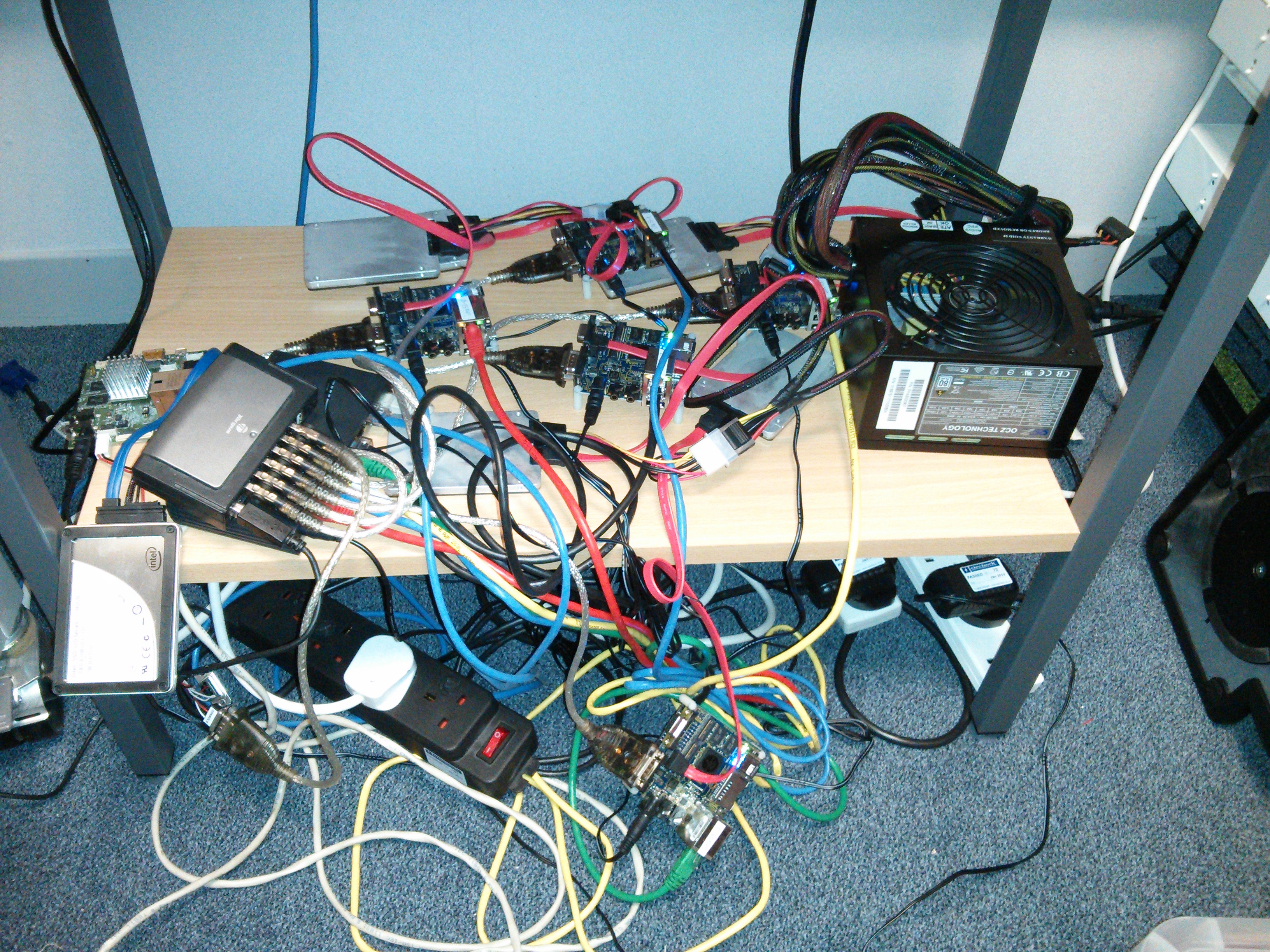
The ProblemInstead our problem was our build farm could best be described as "a pile of stuff" and we wanted to add more systems to it and have switched power control for automated testing.

Which is kinda where the Christopher Alexander quote comes into this. I suggested that I might be able to come up with a better, or at least cleaner, solution.
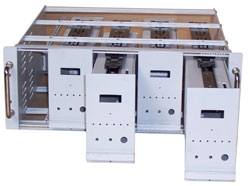
The IdeaA subrack with sub modulesPrevious experience had exposed me to the idea of using 19 inch subracks for mounting circuits inside submodules.

I originally envisaged the dev boards individually mounted inside these boxes. However preliminary investigation revealed that the enclosures were both expensive and used a lot of space which would greatly increase the rack space required to house these systems.

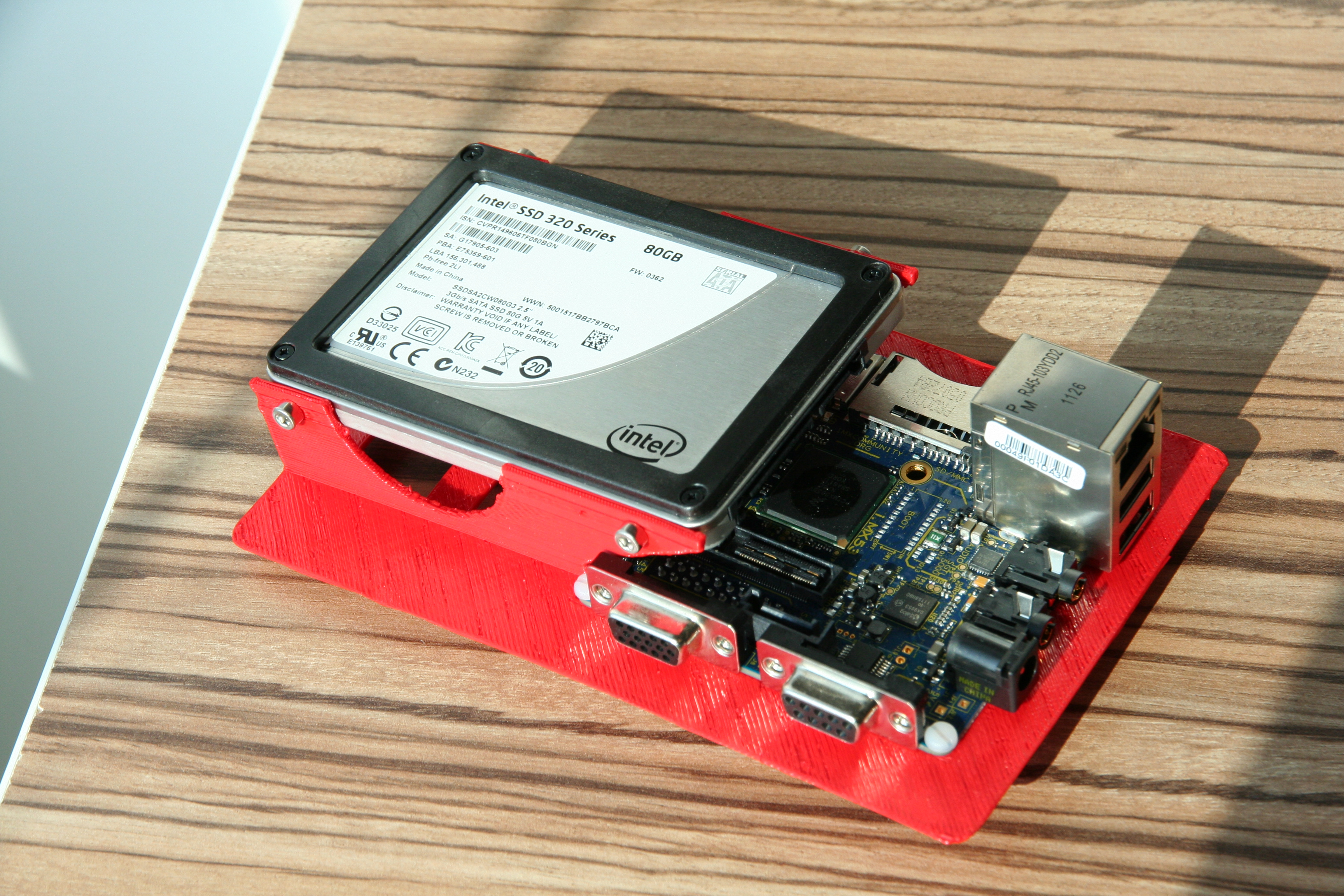
imx53 QSB eurocard carrier
I decided to instead look at eurocard type subracks with carriers for the systems. Using my 3D printer I came up with a carrier design for the imx53 QSB and printed it. I used the basic eurocard size of 100mm x 160mm which would allow the cards to be used within a 3U subrack.

Once assembled it became apparent that each carrier would be able to share resources like power supply, ethernet port and serial console via USB just as the existing setup did and that these would need to be housed within the subrack.
The Prototype
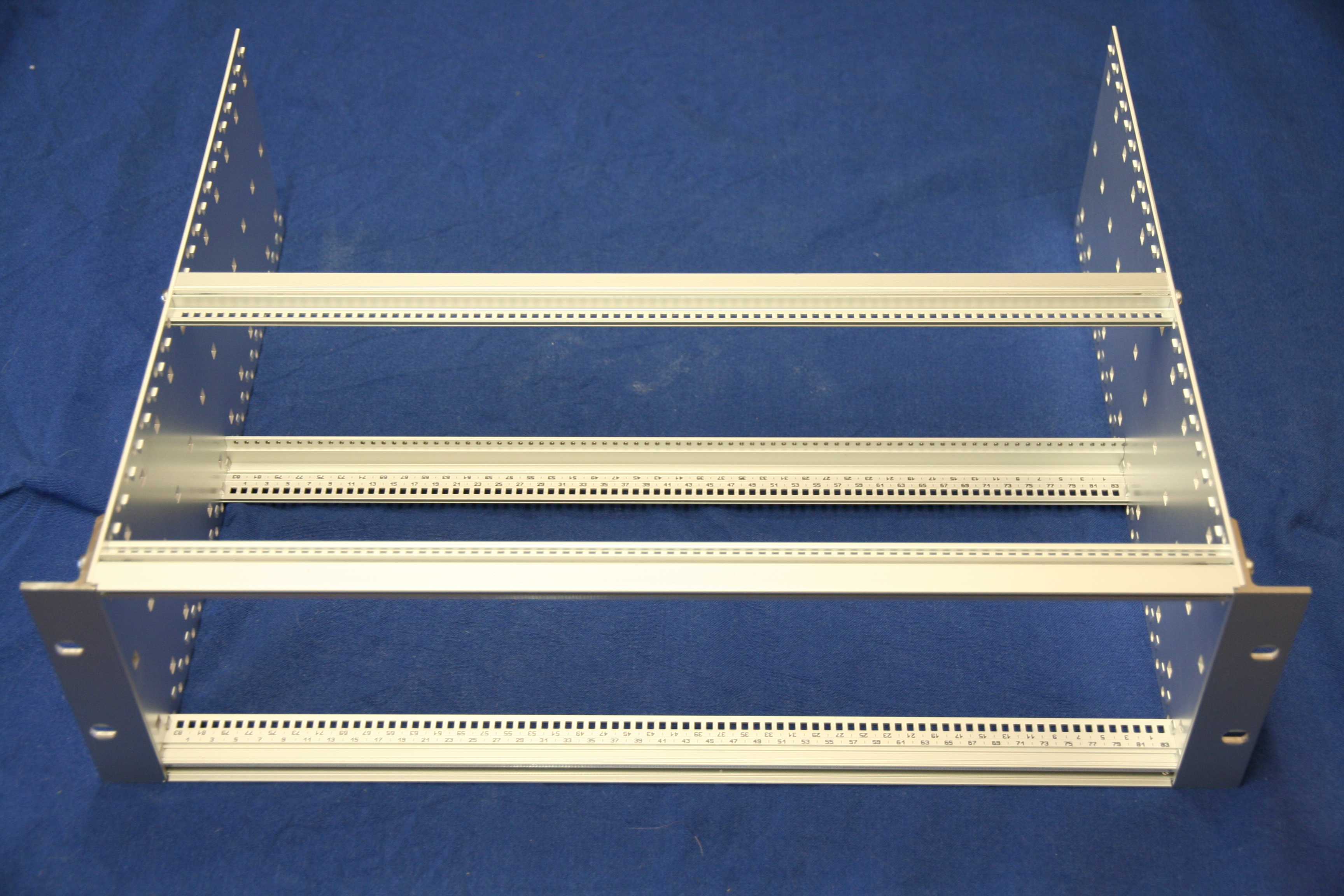
The carrier prototype was enough to get enough interest to allow me to move on to the next phase of the project. I purchased a Schroff 24563-194 subrack kit and three packs of guide rails from Farnell and assembled it.

Initially I had envisaged acquiring additional horizontal rails from Schroff which would enable constructing an area suitable for mounting the shared components behind the card area.

Rear profile for Schroff subrackUnfortunately Schroff have no suitable horizontal profiles in their catalog and are another of those companies who seem to not want to actually sell products to end users but rather deal with wholesalers who do not have their entire product range!

Printed rear profile for Schroff subrack
Undaunted by this I created my own horizontal rail profile and 3D printed some lengths. The profile is designed to allow a 3mm thick rear cover sheet attached with M2.5 mounting bolts and fit rack sides in the same way the other profiles do.

At this point I should introduce some information on how these subracks are dimensioned. A standard 19 inch rack (as defined in IEC 60297) has a width of 17.75 inches(450.85mm) between the vertical posts. The height is measured in U (1.75 inches)

A subrack must obviously fit in the horizontal gap while providing as much internal space as possible. A subrack is generally either 3 or 6 U high. The width within a subrack is defined in units called HP (Horizontal Pitch) which are 0.2 inches(5.08 mm) and subracks like the Schroff generally list 84 usable HP.

However we must be careful (or actually just learn from me stuffing this up ;-) as the usable HP is not the same thing as the actual length of the horizontal rails! The enclosures actually leave and additional 0.1 inch at either end giving a total internal width of 85HP (17 inches, 431.8 mm) which leaves 0.75 inches for the subrack sides and some clearance.

The Schroff subrack allows eurocards to be slotted into rails where the card centre line is on HP boundaries, hence we describe the width of a card in the slot in terms of HP

I cannot manufacture aluminium extrusions (I know it is a personal failing) nor produce more than 100 mm long length of the plastic profile on my printer.

Even if full lengths are purchased from a commercial service (120 euros for a pair including tax and shipping) the plastic does not have sufficient mechanical strength.

The solution I came up with was somewhat innovative, as an alternative a M5 bolt into a thread in the aluminium extrusion I used a 444mm long length of 4mm threaded rod with nuts at either end. This arrangement puts the extrusion under compression and gives it a great deal of additional mechanical strength as the steel threaded rod is very strong.

Additionally to avoid having to print enough extrusion for the entire length I used some 6mm aluminium tube as a spacer between 6HP(30.48mm) wide sections of the printed extrusion.

It was intended to use a standard modular PC power supply which is 150mm wide which is pretty close to 30HP (6 inches) so it was decided to have a 6HP section of rail at that point to allow a rear mounting plate for the PSU to be attached.

This gives 6HP of profile, 21HP(106.68mm) of tube spacer, 6HP of profile, 46HP(233.68 mm) of tube spacer and a final 6HP profile summing to our total of 85HP. Of course this would be unnecessary if a full continuous 85HP rail had been purchased, but 6 of 6 HP long profile is only 51 euro a saving of 70 euro.

To provide a flat area on which to mount the power switching, Ethernet switch and USB hubs I ordered a 170 x 431 mm sheet of 3mm thick aluminium from inspiredsteel who, while being an ebay company, were fast, cheap and the cutting was accurate.

Do be sure to mention you would prefer it if any error made the sheet smaller rather than larger or it might not fit, for me though they were accurate to the tenth of a mm! If you would prefer the rear section of the rack to be enclosed when you are finished, buy a second sheet for the top. For my prototype I only purchased a 170 x 280mm sheet as I was unsure if I wanted a surface under the PSU (you do, buy the longer sheet)

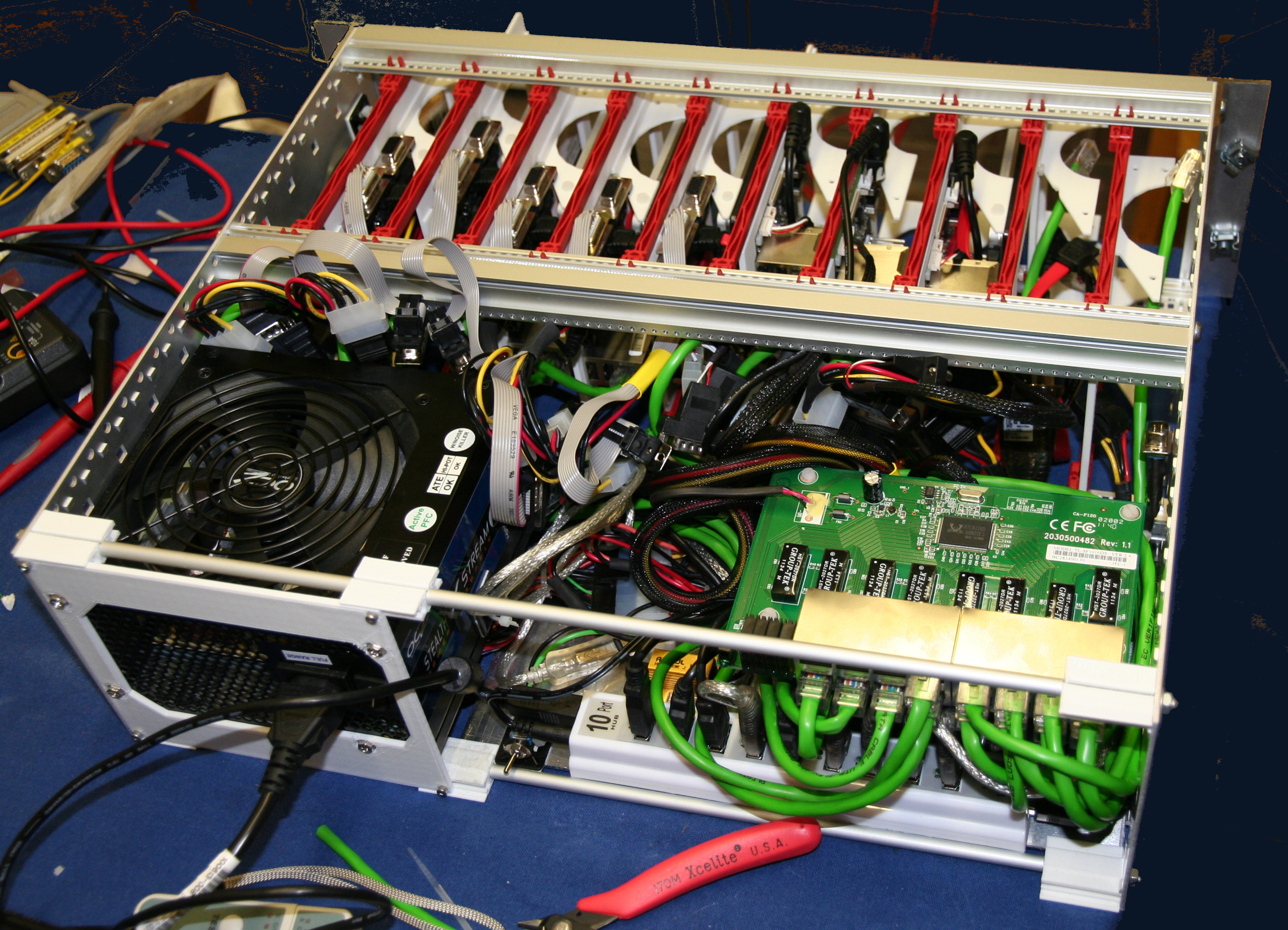
PC power supply mounted to back plateMounting the PSU was a simple case of constructing a 3 mm thick plate with the correct cutouts and mounting holes for an ATX supply. Although the images show the PSU mounted on the left hand side of the rack this was later reversed to improve cable management.

The subrack needed to provide Ethernet switch ports to all the systems. A TP-Link TL-SF1016DS 16-Port 10/100Mbps Switch was acquired and the switch board removed from its enclosure. The switch selected has an easily removed board and is powered by a single 3.3V input which is readily available from the ATX PSU.

Attention now returned to the eurocard carriers for the systems, the boards to be housed were iMX53 QSB and iMX6 SABRE Lite and a Raspberry Pi control system to act as USB serial console etc.

The carriers for both main boards needed to be 8HP wide, comprised of:
Although only 38 mm this is 7.5HP and fractions of an HP are not possible with the selected subrack.

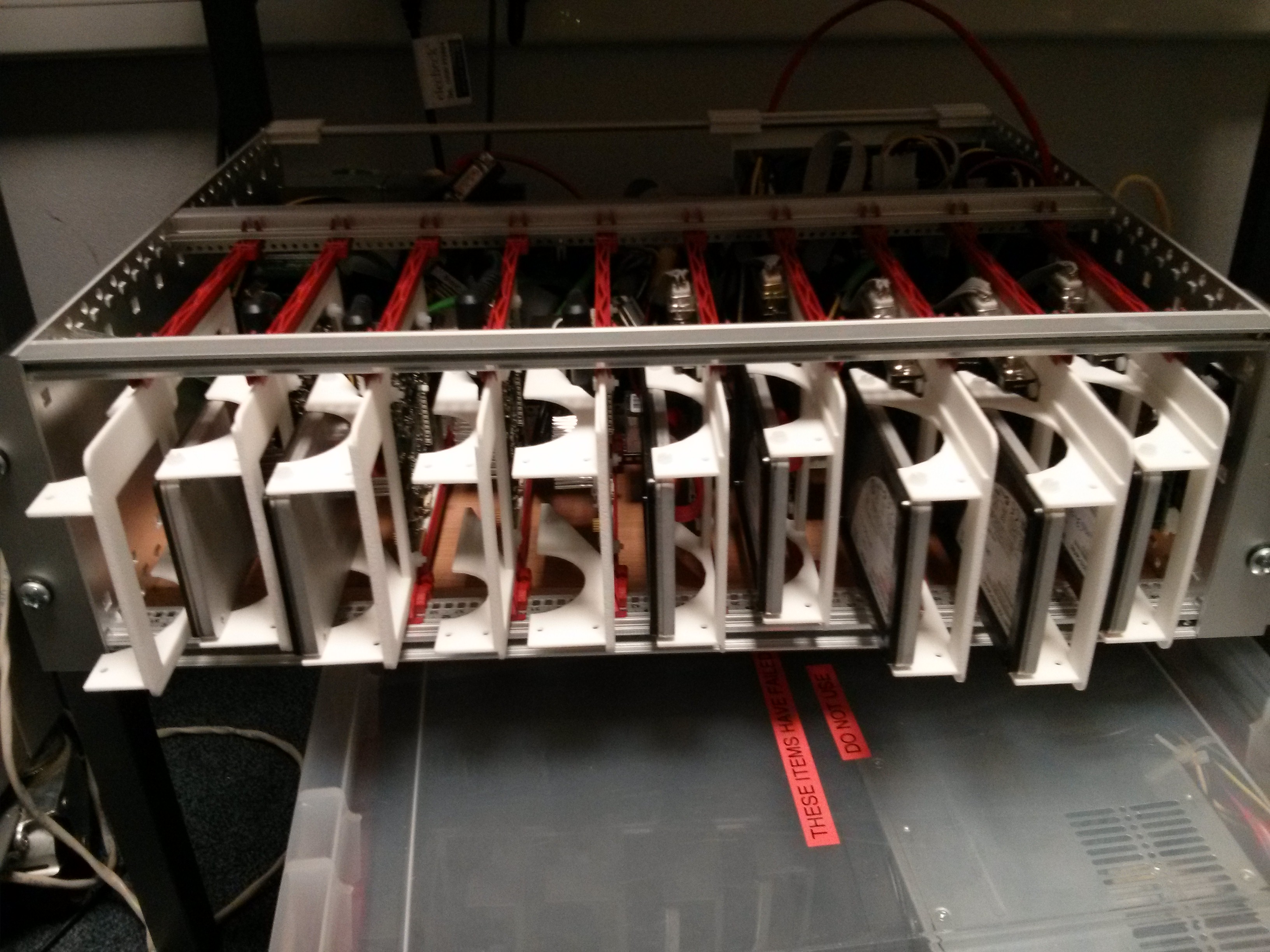
With 8HP wide modules this would allow for ten slots, within the 84 usable HP, and an eleventh 4HP wide in which the Raspberry Pi system fits.

iMX6 SABRE Lite eurocard carrierCarrier designs for both the i.MX53 QSB and the i.MX6 SABRE Lite boards were created and fabricated at a professional 3D print shop which gave a high quality finish product and removed the perceived risk of relying on a personal 3D printer for a quantity of parts.

This resulted in changes in the design to remove as much material as possible as commercial 3D services charge by the cubic cm. This Design For Manufacture (DFM) step removed almost 50% from the price of the initial design.

i.MX53 QSB carriers with wiring loom
The i.MX6 design underwent a second iteration to allow for the heatsink to be mounted and not mechanically interfere with the hard drive (although the prototype carrier has been used successfully for a system that does not require a hard drive). The lesson learned here is to be aware that an design iteration or two is likely and that it is not without cost.

The initial installation was to have six i.MX53 and two i.MX6 this later changed to a five/four split, however the carrier solution allows for almost any combination, the only caveat (discovered later) is the imx53 carriers should be to the right hand side with the small 4HP gap at that end as they have a JTAG connector underneath the board which otherwise foul the hard drive of the next carrier.

Racked cards showing unwanted cable tails
A wiring loom was constructed for each board giving them a connector tail long enough to allow them to be removed. This was the wrong approach! if you implement this design (or when I do it again) the connector tails on the wiring loom should present all the connections to the rear at the same depth as the Ethernet connection.

The rack cables themselves should be long enough to allow the slides to be removed but importantly it is not desirable to have the trailing cable on the cards. I guess the original eurocard designers figured this out as they designed the cards around the standard fixed DIN connectors at the back of the card slots.

USB relay board with wiring loom attached
We will now briefly examine a misjudgement that caused the initially deployed solution to be reimplemented. As the design was going to use USB serial converters to access the serial console a USB connected relay board was selected to switch the power to each slot. I had previously used serial controlled relay boards with a USB serial convertor however these were no longer available.

Initial deployment with USB controlled relay board
All the available USB relay boards were HID controlled, this did not initially seem to be an issue and Linux software was written to provide a reasonable interface. However it soon became apparent that the firmware on the purchased board was very buggy and crashed the host computer's USB stack multiple times.

Deployed solutionOnce it became apparent that the USB controlled power board was not viable a new design was conceived. As the Ethernet switch had ports available Ethernet controlled relay boards were acquired.

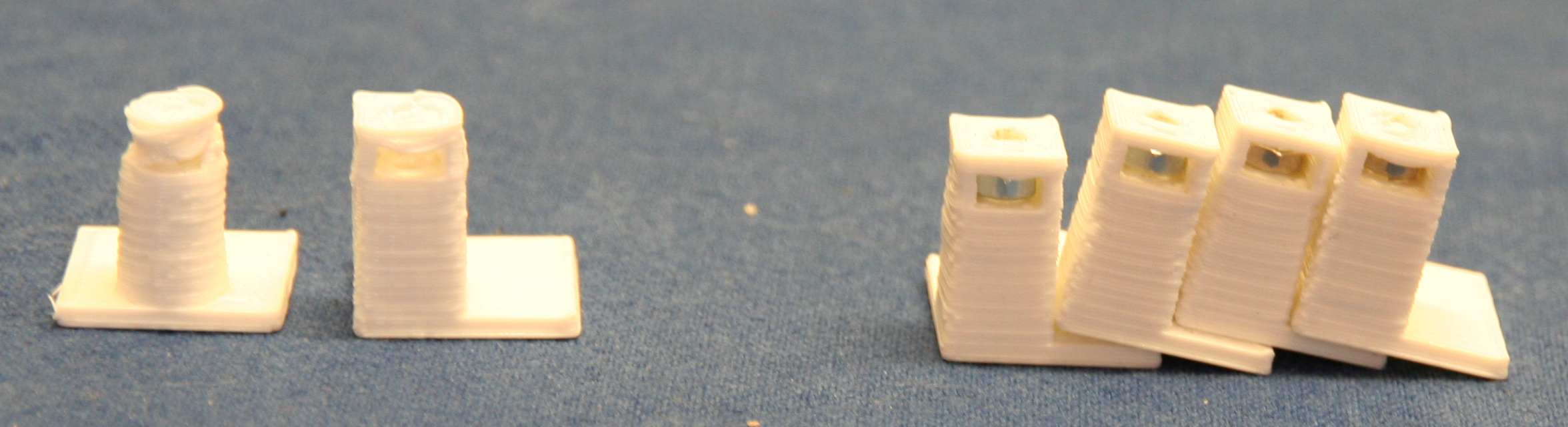
Evolution of 3mm PCB pillars
It did prove necessary to design and print some PCB support posts with M3 nut traps to allow the relay boards to be easily mounted using double sided adhesive pads.

By stacking the relay boards face to face and the Ethernet switch on top separated using nylon spacers it was possible to reduce the cable clutter and provide adequate cable routing space.

A busbar for Ground (black) and unswitched 12V (yellow) was constructed from two lengths of 5A chock block.

An issue with power supply stability was noted so a load resistor was added to the 12V supply and an adhesive thermal pad used to attach it to the aluminium base plate.

Completed redesign
It was most fortunate that the ethernet switch mounting holes lined up very well with the relay board mounting holes allowing for a neat stack.

This second edition is the one currently in use, it has proved reliable in operation and has been successfully updated with additional carriers.

The outstanding issues are mainly centered around the Raspberry Pi control board:
  • Needs its carrier fitting. It is currently just stuck to the subrack end plate.
  • Needs its Ethernet cable replacing. The existing one has developed a fault post installation.
  • Needs the USB hub supply separating from the device cable. The current arrangement lets the hub power the Pi which means you cannot power cycle it.
  • Connect its switched supply separately to the USB hub/devices.
Shopping listThe final bill of materials (excluding labour and workshop costs) which might be useful to anyone hoping to build their own version.

Prices are in GBP currency converted where appropriate and include tax at 20% and delivery to Cambridge UK and were correct as of April 2013.

The purchasing was not optimised and for example around 20GBP could be saved just by ordering all the shapeways parts in one order.
Base subrack
ItemSupplierQuantityLine Price
Schroff 24563-194 subrack kitFarnell141.28
Schroff 24560-351 guide railsFarnell313.65
Schroff rack rear horizontal railShapeways2100.00
1000mm length of 4mm threaded rodB and Q11.48
170mm x 431mm x 3mm Aluminium sheetinspired steel240.00
PSU mounting plateShapeways135.42
PCB standoffShapeways422.30
160mm Deep Modular PC supplyCCL155.76
TP-Link TL-SF1016DS 16-Port 10/100Mbps-SwitchCCL123.77
8 Channel 16A Relay Board Controlled Via EthernetRapid2126.00
Raspberry PiFarnell126.48
USB Serial convertersCCL1037.40
10 port strip style USB HUBEbay17.00
Parts for custom Ethernet cablesRS1326.00
Parts for custom molex power cables (salvaged from scrap ATX PSU)Workshop1111.00
33R 10W wirewound resistor for dummy loadRS11.26
24pin ATX female connector pre-wiredMaplin12.99
Akasa double sided thermal padMaplin15.00
Small cable tie basesMaplin16.49
Miscellaneous cable, connectors, nylon standoffs, solder, heatshrink, zip ties, nuts, washers etc. Workshop120.00
Total for subrack603.28

The carriers are similarly not optimally priced as over five GBP each can be saved by combining shipping on orders alone. Also the SSD drive selection was made some time ago and a newer model may be more suitable.
i.MX53 QSB carrier
ItemSupplierQuantityLine Price
i.MX53 QSBFarnell1105.52
Intel 320 SSD 80GCCL1111.83
Carrier boardShapeways130.00
combined sata data and power (15 to 20cm version)EBay15.00
Low profile right angle 5.5mm x 2.1mm barrel jackEBay10.25
Parts for 9pin serial cable extensionRS15.00
Miscellaneous solder, heatshrink, nylon nuts, bolts and washersWorkshop15.00
Total for carrier262.60

i.MX6 SABRE Lite carrier
ItemSupplierQuantityLine Price
i.MX6 SABRE LiteFarnell1128.06
Intel 320 SSD 80GCCL1111.83
Carrier boardShapeways135.00
combined sata data and power (15 to 20cm version)EBay15.00
Low profile right angle 5.5mm x 2.1mm barrel jackEBay10.25
Parts for 9pin serial cable modificationRS12.00
Miscellaneous solder, heatshrink, nylon nuts, bolts and washersWorkshop15.00
Total for carrier287.14
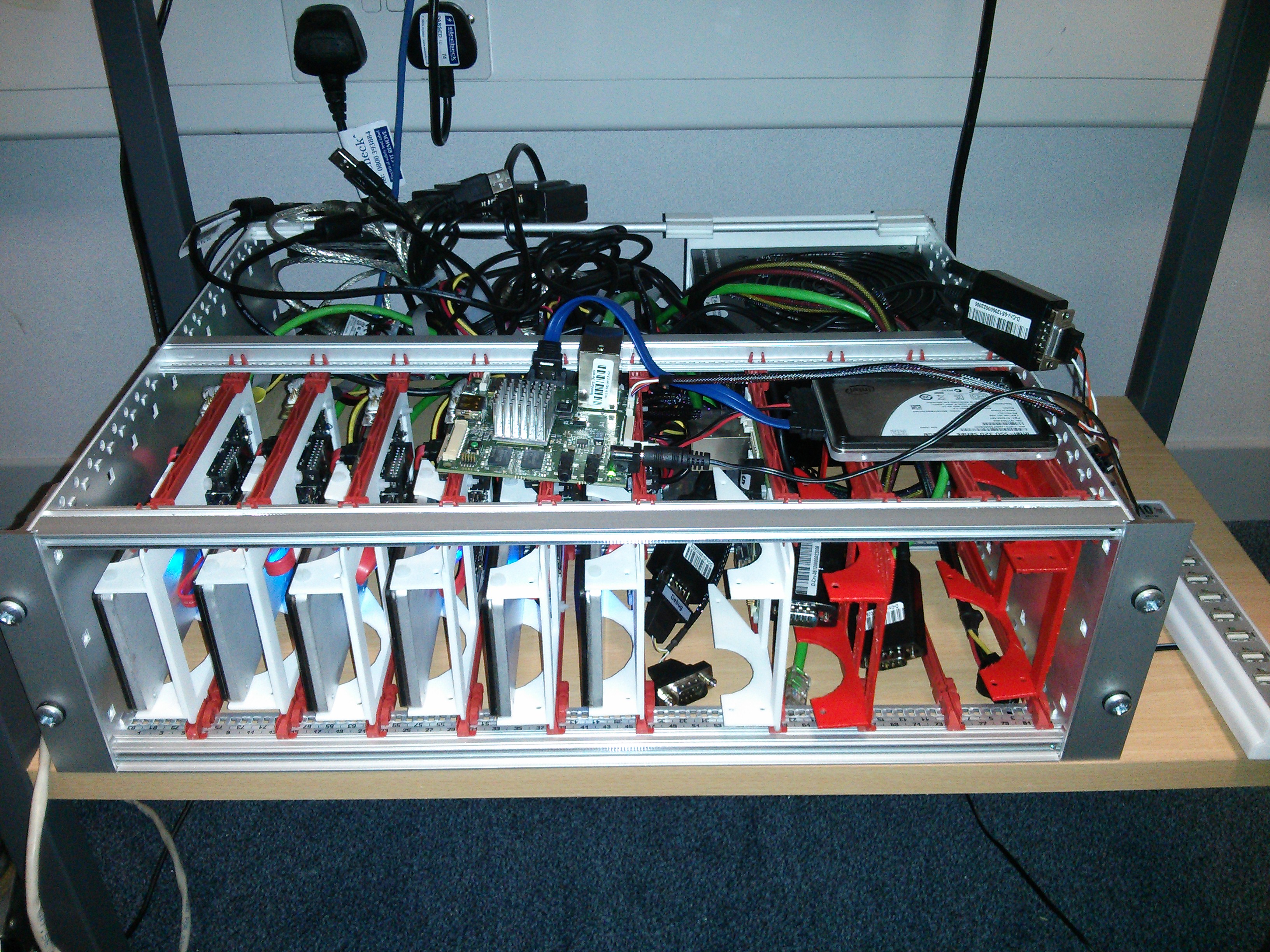
ConclusionThe solution works and in a 3U high 355mm deep subrack ten ARM development boards can be racked complete with local ethernet switching, power control and serial consoles.

Deployed system in situ configured as a build and test farm
The solution is neat and provides flexibility, density and reproducibility the "pile of stuff" solution failed to do.

For current prototype with nine filled slots the total cost was around 3000GBP or around 330GBP per slot which indicates a 100GBP per slot overhead over the "pile of stuff" solution. These figures omit the costs of the engineer and workshop time, which are estimated at an additional 1500GBP. Therefore a completed rack, fully filled with i.MX6 carriers costs around 5000GBP

Density could be increased if boards with lower height requirements were used however above twelve units there issues with Ethernet switch, power switch and USB port availability become a factor. For Example the 16 port Ethernet switch requires a port for uplink, one for each relay board and one for the console server which leaves only 12 ports for systems.

Addressing the outstanding issues would result in a much more user friendly solution. As the existing unit is in full time use and downtime is not easily scheduled for all ten systems, the issues are not likely to be fixed on the prototype and would have to be solved on a new build.

The solution is probably not suitable for turning into a product but that was not really the original aim. A commercial ARM blade server using this format would almost certainly use standard DIN connectors and a custom PCB design rather than adapting existing boards.

Petter Reinholdtsen: First alpha release of Debian Edu / Skolelinux based on Debian Wheezy

The Debian Edu / Skolelinux project is still going strong and made its first Wheezy based release today. This is the release announcement: New features for Debian Edu ~7.0.0 alpha0 released 2013-04-26 This is the release notes for for Debian Edu / Skolelinux ~7.0.0 edu alpha0, based on Debian with codename "Wheezy". About Debian Edu and Skolelinux Debian Edu, also known as Skolelinux, is a Linux distribution based on Debian providing an out-of-the box environment of a completely configured school network. Immediatly after installation a school server running all services needed for a school network is set up just waiting for users and machines being added via GOsa , a comfortable Web-UI. A netbooting environment is prepared using PXE, so after initial installation of the main server from CD, DVD or USB stick all other machines can be installed via the network. This is the first test release based on Wheezy (which currently is not released yet). Basically this is an updated and slightly improved version compared to the Squeeze release. Software updates Documentation LDAP related changes Other changes Regressions No updated artwork Where to get it To download the multiarch netinstall CD release you can use The MD5SUM of this image is: c5e773ddafdaa4f48c409c682f598b6c The SHA1SUM of this image is: 25934fabb9b7d20235499a0a51f08ce6c54215f2 How to report bugs http://wiki.debian.org/DebianEdu/HowTo/ReportBugs

25 April 2013

David Bremner: Exporting Debian packaging patches from git, (redux)*

(Debian) packaging and Git. The big picture is as follows. In my view, the most natural way to work on a packaging project in version control [1] is to have an upstream branch which either tracks upstream Git/Hg/Svn, or imports of tarballs (or some combination thereof, and a Debian branch where both modifications to upstream source and commits to stuff in ./debian are added [2]. Deviations from this are mainly motivated by a desire to export source packages, a version control neutral interchange format that still preserves the distinction between upstream source and distro modifications. Of course, if you're happy with the distro modifications as one big diff, then you can stop reading now gitpkg $debian_branch $upstream_branch and you're done. The other easy case is if your changes don't touch upstream; then 3.0 (quilt) packages work nicely with ./debian in a separate tarball. So the tension is between my preferred integration style, and making source packages with changes to upstream source organized in some nice way, preferably in logical patches like, uh, commits in a version control system. At some point we may be able use some form of version control repo as a source package, but the issues with that are for another blog post. At the moment then we are stuck with trying bridge the gap between a git repository and a 3.0 (quilt) source package. If you don't know the details of Debian packaging, just imagine a patch series like you would generate with git format-patch or apply with (surprise) quilt. From Git to Quilt. The most obvious (and the most common) way to bridge the gap between git and quilt is to export patches manually (or using a helper like gbp-pq) and commit them to the packaging repository. This has the advantage of not forcing anyone to use git or specialized helpers to collaborate on the package. On the other hand it's quite far from the vision of using git (or your favourite VCS) to do the integration that I started with. The next level of sophistication is to maintain a branch of upstream-modifying commits. Roughly speaking, this is the approach taken by git-dpm, by gitpkg, and with some additional friction from manually importing and exporting the patches, by gbp-pq. There are some issues with rebasing a branch of patches, mainly it seems to rely on one person at a time working on the patch branch, and it forces the use of specialized tools or workflows. Nonetheless, both git-dpm and gitpkg support this mode of working reasonably well [3]. Lately I've been working on exporting patches from (an immutable) git history. My initial experiments with marking commits with git notes more or less worked [4]. I put this on the back-burner for two reasons, first sharing git notes is still not very well supported by git itself [5], and second Gitpkg maintainer Ron Lee convinced me to automagically pick out what patches to export. Ron's motivation (as I understand it) is to have tools which work on any git repository without extra metadata in the form of notes. Linearizing History on the fly. After a few iterations, I arrived at the following specification. Condition (4) suggests we want something roughly like git format-patch upstream..head, removing those patches which are only about Debian packaging. Because of (3), we have to be a bit careful about commits that touch upstream and ./debian. We also want to avoid outputting patches that have been applied (or worse partially applied) upstream. git patch-id can help identify cherry-picked patches, but not partial application. Eventually I arrived at the following strategy.
  1. Use git-filter-branch to construct a copy of the history upstream..head with ./debian (and for technical reasons .pc) excised.
  2. Filter these commits to remove e.g. those that are present exactly upstream, or those that introduces no changes, or changes unrepresentable in a patch.
  3. Try to revert the remaining commits, in reverse order. The idea here is twofold. First, a patch that occurs twice in history because of merging will only revert the most recent one, allowing earlier copies to be skipped. Second, the state of the temporary branch after all successful reverts represents the difference from upstream not accounted for by any patch.
  4. Generate a "fixup patch" accounting for any remaining differences, to be applied before any if the "nice" patches.
  5. Cherry-pick each "nice" patch on top of the fixup patch, to ensure we have a linear history that can be exported to quilt. If any of these cherry-picks fail, abort the export.
Yep, it seems over-complicated to me too. TL;DR: Show me the code. You can clone my current version from
git://pivot.cs.unb.ca/gitpkg.git
This provides a script "git-debcherry" which does the history linearization discussed above. In order to test out how/if this works in your repository, you could run
git-debcherry --stat $UPSTREAM
For actual use, you probably want to use something like
git-debcherry -o debian/patches
There is a hook in hooks/debcherry-deb-export-hook that does this at source package export time. I'm aware this is not that fast; it does several expensive operations. On the other hand, you know what Don Knuth says about premature optimization, so I'm more interested in reports of when it does and doesn't work. In addition to crashing, generating multi-megabyte "fixup patch" probably counts as failure. Notes
  1. This first part doesn't seem too Debian or git specific to me, but I don't know much concrete about other packaging workflows or other version control systems.
  2. Another variation is to have a patched upstream branch and merge that into the Debian packaging branch. The trade-off here that you can simplify the patch export process a bit, but the repo needs to have taken this disciplined approach from the beginning.
  3. git-dpm merges the patched upstream into the Debian branch. This makes the history a bit messier, but seems to be more robust. I've been thinking about trying this out (semi-manually) for gitpkg.
  4. See e.g. exporting. Although I did not then know the many surprising and horrible things people do in packaging histories, so it probably didn't work as well as I thought it did.
  5. It's doable, but one ends up spending about a bunch lines of code on duplicating basic git functionality; e.g. there is no real support for tags of notes.
  6. Since as far as I know quilt has no way of deleting files except to list the content, this means in particular exporting upstream should yield a DFSG Free source tree.

Jeff Licquia: Linux Is Hard, Except When It Isn t

Online tech news site Ars Technica (which I recommend, by the way) recently reviewed the Dell XPS 13 Developer Edition. Its unique feature: it ships with Ubuntu Linux as the default operating system. This preload deal had a few unique properties: That last point deserves some explanation. A few vendors have grabbed a Windows computer they sell and allowed the option to preload Linux on it, but without support; you re on your own if it doesn t work in some way, which is likely. Essentially, they save you the time of wiping Windows off the box and doing a fresh install, but not much more. But this laptop comes out of Dell s Project Sputnik, a project to put out Linux machines for developers with a DevOps flavor, and they felt the machine had to work as well as their regular products. So they actually put effort and testing into getting the laptop to run Ubuntu well, with all the drivers configured properly and tweaked to support the machine s quirks, just like they do for Windows. And so, the review is surprised to learn that Ubuntu on the XPS 13, well, just works! It s even in the title of the review. Here s reviewer Lee Hutchinson s observations:
I ve struggled before with using Linux as my full-time operating environment both at work and at home. I did it for years at work, but it was never quite as easy as I wanted it to be on an older Dell laptop, keeping dual monitor support working correctly across updates required endless fiddling with xorg.conf, and whether or not it was Nvidia s fault was totally irrelevant to swearing, cursing Past Lee, trying desperately to get his monitors to display images so he could make his 10am conference call without having to resort to running the meeting on the small laptop screen.
And thence comes the astonishment: on this Linux laptop, everything just works. Most of the review is spent on the kinds of hardware features that distinguish this from other laptops: the keyboard is like this, the screen is that resolution, it has this CPU and this much RAM and so on. Some space is devoted to impressions of the default Ubuntu 12.04 install, and some space is given to the special DevOps software, which helps the developer reproduce the software environment on the laptop when deploying apps. But before all that, Hutchinson has to put in a dig:
It s an impressive achievement, and it s also a sad comment on the overall viability of Linux as a consumer-facing operating system for normal people. I don t think anyone is arguing that Linux hasn t earned its place in the data center it most certainly has but there s no way I d feel comfy installing even newbie-friendly Ubuntu or Mint on my parents computers. The XPS 13 DE shows the level of functionality and polish possible with extra effort, and that effort and polish together means this kind of Linux integration is something we won t see very often outside of boutique OEMs.
Of course, Windows is actually worse than Linux on the hardware front when you don t get it pre-installed. Imagine if more vendors put as much effort into preinstalled Linux as they did into preinstalled Windows. In that alternate reality, I imagine people would react more like this:
Isn t that what you re looking for in a mainstream product? Rick chided. In 1996 it was: Wow look at this, I got Linux running on xxxxxxxx. Even in 2006 that was at times an accomplishment When was the last time you turned on an Apple or Windows machine and marveled that it just worked? It should be boring.
Which was, of course, the reaction Hutchinson got when discussing the review with a Linux-using friend. With Microsoft being less of a friend to the hardware vendors every day, here s a case study more of them should be paying attention to.

22 April 2013

Daniel Pocock: Action week for Google Summer of Code students

This week (22 - 28 April) is the week that really matters most for those students who want to participate in Google Summer of Code. The deadline for student applications is next Friday (3 May), but if you don't spend time exploring project ideas this week, you won't be able to make a strong enough application. Here are the key things I need to see for potential students for the project areas I have offered to co-mentor in:
  1. Register on the Google site, Click here to register yourself (registration opens 22 April and closes 3 May).
  2. Create a page about yourself on the Debian wiki, you must copy the template used by the other students. Make sure you create a link from the student list to your own page. Think carefully about your project: what will be the final result of your work this summer? Describe what it will look like, how Debian people will use it, and explain these things on your wiki page, this will be critical to having Debian accept you.
Those are the essential things you must do before the deadline on 3 May. There are other things you should do as well:
  • Join the Summer of Code co-ordination mailing list
  • Join the mailing lists for whichever open source project and/or Debian packaging team is relevant to your proposed GSoC project
  • On the mailing list, send an email introducing yourself, giving us the link to your wiki page.
To maximize the chance that the Debian project will accept you, it is very important that you interact with us and show us that you understand software development. I am going to try and make this easier: for each of my projects, I've put some wishlist items in the Debian bug tracker. These are all easy tasks that a student can potentially complete. Just do the following:
  • Pick a task from the bug tracker
  • Send an email to the bug tracker (e.g. <bug-number>@bugs.debian.org>) explaining that you will work on the task (and make sure nobody else is already working on it, just look to see if any other emails are attached to the bug report)
  • Write the patch, test it and email the patch to the bug report
Here are the links to the bug lists for each of the packages. You can also pick any other wishlist bug in any related package, but if you are not sure, just pick one of these: If you already have a history of contributing to free software, it is essential that you tell us about it. This will increase the chances that your application is successful. Specifically, on your Debian wiki page, you should include links to any of the following:
  • Emails you sent to open source communities contributing patches or analysis of bugs (give a link to your message in the email archive for the list)
  • Your github account profile page, if you have one
  • Your Sourceforge account profile page, if you have one
  • Any other similar links
Debian receives many applications every year. To help you succeed, you need to think about how Debian will benefit from your work. Use Google to search the Debian site for previous discussions about your idea. Find out the names of Debian Developers who are interested in the same subjects, and email us or email the public mailing lists of the Debian project, for example, debian-devel. Make sure your email includes links to previous discussions or wiki pages about the idea, explain how you can help and ask the community for suggestions and guidance to refine your project proposal. Debian is an open community and we are all very keen to discuss your ideas and help you get involved. DebConf For all students, attending free software events is a great opportunity to meet the community. Of particular relevance for those in Europe, attending DebConf13 in Switzerland is a great way to meet GSoC mentors and other developers. Switzerland's central location is extremely convenient for anybody in Western Europe and it is also Debian's 20th birthday, so it is anticipated DebConf could be more special than usual this year. Please put it in your calendar and subscribe to the debconf-discuss mailing list so you will know when registration opens and other practical details are announced.

19 April 2013

Rog rio Brito: Some recent Debian activities

I have been occasionally working on some Debian-related tasks. Chrony One of those was to get chrony is a slightly better shape, by using, at least, a patch system (indeed, I "modernized" its packaging with the format "3.0 (quilt)"), put it in a git repository and would like to receive some comments on what I have so far. The bug Debian bug #694690 contains a very brief description of my intentions and of the problems that I see in the current package. IMVHO, it is a very nice NTP client and server and it could even be used as the default for Debian, once it gets in shape. There is at least another high-profile distribution, namely Fedora, that switched to chrony as its default NTP software. We can certainly take a look at what they are doing and join forces here. MongoDB Another package where I spent some time was with mongodb: MongoDB is a tricky package that is only built for 2 arches: amd64 and i386. The version in unstable for i386 was 2.0.x (roughly the same as for wheezy), which the version in unstable for amd64 was 2.4.1, which has many features that 2.0 lacks. The packaging of it is a bit tricky, since the source tree has bazillion embedded/convenience libraries (e.g., Google's v8, Mozilla's spidermonkey, BOOST, Google's Snappy, PCRE 3 etc.). Up to version 2.4.1-2, it used all these convenience copies, which is of course, a problem for a distribution like Debian. I changed part of the build process to use the libraries that we already have in Debian and, as Antonin Kral uploaded this newer version, unsurprisingly the binary packages are smaller (especially if you take into account that a handful of the libraries may already be installed on the system). A few hours later, Antonin uploaded a new upstream version, which means that we now have better MongoDB packages to play with. I am, in fact, really playing with MongoDB as my first NoSQL database, since 10gen is giving an introductory course on how it works and my motivation was to get what we have in Debian in shape for the course. You can say that I am a firm believer of the "eat your own dogfood" principle. Regarding MongoDB only being built for i386 and amd64, the BTS has a patch to enable building for kFreeBSD, but the patch is for the 2.0 series and the code has changed so drastically in relation to the 2.4 series that there is no hope of it applying. It would be super nice to have MongoDB working on kFreeBSD and on HURD also, though. nocache There is a very nice command line program called nocache that was packaged by Dmitry Smirnov (and just approved by the FTP masters!) whose packaging I briefly reviewed per Dmitry's request and this is an amazing utility whose purpose is to bypass/minimize file system caching for a program. This is especially useful when you are making backups (reading lots of files that would, otherwise, fill the filesystem cache, even if they are not used frequently) or if you are just streaming one file (possibly larger than the system's RAM) to another computer and you have no need to use the file immediately after that. It performs its job by using the LD_PRELOAD mechanism and using posix_fadvise's flag POSIX_FADV_DONTNEED for the files that will be touched. Post note Oh, just one aside: for the readers of Debian Planet and other aggregation services which are not Debian Developers/Maintainers, I contributed to these packages without being the maintainer of them, just scratching some itches and contributing back what I produced.

17 April 2013

Daniel Pocock: Bitcoin grabbing headlines

Seeking Alpha has published my contribution rebutting Paul Krugman's recent comments on Bitcoin. While there is no prediction what the future holds for Bitcoin prices (and no investment advice), the compelling message here is that Bitcoin does have technical value as a distributed messaging system for electronic payment. This may be compared to the value of other intangible services like a mobile phone contract that provides communications service. There are still risks: a better solution (faster, with backwards compatibility) could be developed by a powerful company like Google and Bitcoins would become redundant. Or somebody could crack the algorithm. However, crypto-currency, as a concept, deserves a much deeper analysis into how it could be useful to society.

Daniel Pocock: Switzerland Schilthorn with 007 (leg 3)

Friday's video of the 2nd leg of the cable car journey was quite popular, Ganglia stats for the video server can't be wrong: The first leg was skipped because of the low cloud cover. Weather reports in Switzerland, such as www.meteosuisse.ch often show a distinction between the low clouds and high clouds, because many Swiss mountain resorts are high enough to enjoy ample sunshine by virtue of their altitude even when cities like Zurich and Geneva are overcast. Now for the third leg, rising up to Berg. In the video, it is hard to gauge the size of the rocky cliffs along the route, but looking at the cable car's shadow will give a clue. As the cable car approaches the station in Berg, it feels like it takes forever to complete the journey. That is because the rocks are so much bigger than they appear from a distance. <video controls="" height="340" poster="http://upload.wikimedia.org/wikipedia/commons/thumb/0/03/Schilthorn_with_Bernese_Alps%2C_2012_August.jpg/800px-Schilthorn_with_Bernese_Alps%2C_2012_August.jpg" width="560">
<source src="http://video.danielpocock.com/VID_20121025_122453.m4v" type="video/mp4"></source>
<source src="http://video.danielpocock.com/VID_20121025_122453.webm" type="video/webm"></source>
</video> The final leg to the Schilthorn summit will appear shortly. I understand many people are starting to contemplate their DebConf13 travel and summer holidays - please feel free to email me if you'd like me to post a video of some other feature in Switzerland.
AttachmentSize
ganglia-schilthorn2.png8.71 KB

Joey Hess: Template Haskell on impossible architectures

Imagine you had an excellent successful Kickstarter campaign, and during it a lot of people asked for an Android port to be made of the software. Which is written in Haskell. No problem, you'd think -- the user interface can be written as a local webapp, which will be nicely platform agnostic and so make it easy to port. Also, it's easy to promise a lot of stuff during a Kickstarter campaign. Keeps the graph going up. What could go wrong? So, rather later you realize there is no Haskell compiler for Android. At all. But surely there will be eventually. And so you go off and build the webapp. Since Yesod seems to be the pinnacle of type-safe Haskell web frameworks, you use it. Hmm, there's this Template Haskell stuff that it uses a lot, but it only makes compiles a little slow, and the result is cool, so why not. Then, about half-way through the project, it seems time to get around to this Android port. And, amazingly, a Haskell compiler for Android has appeared in the meantime. Like the Haskell community has your back. (Which they generally seem to.) It's early days and rough, lots of libraries need to be hacked to work, but it only takes around 2 weeks to get a port of your program that basically works. But, no webapp. Cause nobody seems to know how to make a cross-compiling Haskell compiler do Template Haskell. (Even building a fully native compiler on Android doesn't do the trick. Perhaps you missed something though.) At this point you can give up and write a separate Android UI (perhaps using these new Android JNI bindings for Haskell that have also appeared in the meantime). Or you can procrastinate for a while, and mull it over; consider rewriting the webapp to not use Yesod but some other framework that doesn't need Template Haskell. Eventually you might think this: If I run ghc -ddump-splices when I'm building my Yesod code, I can see all the thousands of lines of delicious machine generated Haskell code. I just have to paste that in, in place of the Template Haskell that generated it, and I'll get a program I can build on Android! What could go wrong? And you even try it, and yeah, it seems to work. For small amounts of code that you paste in and carefully modify and get working. Not a whole big, constantly improving webapp where every single line of html gets converted to types and lambdas that are somehow screamingly fast. So then, let's automate this pasting. And so the EvilSplicer is born! That's a fairly general-purpose Template Haskell splicer. First do a native build with -ddump-splices output redirected to a log file. Run the EvilSplicer to fix up the code. Then run an Android cross-compile. But oh, the caveats. There are so many ways this can go wrong.. Anyway, if you struggle with it, or pay me vast quantities of money, your program will, eventually, link. And that's all I can promise for now.
PS, I hope nobody will ever find this blog post useful in their work. PPS, Also, if you let this put you off Haskell in any way .. well, don't. You just might want to wait a year or so before doing Haskell on Android.

16 April 2013

Petter Reinholdtsen: First Debian Edu / Skolelinux developer gathering in 2013 take place in Trondheim

This years first Skolelinux / Debian Edu developer gathering take place the coming weekend in Trondheim. Details about the gathering can be found on the FRiSK wiki. The dates are 19-21th of April 2013, and online participation for those unable to make it in person is very welcome, and I plan to participate online myself as I could not leave Oslo this weekend. The focus of the gathering is to work on the web pages and project infrastructure, and to continue the work on the Wheezy based Debian Edu release. See you on IRC, #debian-edu on irc.debian.org, then?

Johannes Schauer: botch - the debian bootstrap software has a name

After nearly one year of development, the "Port bootstrap build-ordering tool" now finally has a name: botch. It stands for Bootstrap/Build Order Tool CHain. Now we dont have to call it "Port bootstrap build-ordering tool" anymore (nobody did that anyways) and also dont have to talk about it by referring to it as "the tools" in email, IRC or in my master thesis which is due in a few weeks. With this, the issue also doesnt block the creation of a Debian package anymore. Since only a handful of people have a clone of it anyway, I also renamed the gitorious git repository url (and updated all links in this blog and left a text file informing about the name change in the old location). The new url is: https://gitorious.org/debian-bootstrap/botch Further improvements since my last post in January include: In the mean time a paper about the theoretical aspects of this topic which Pietro Abate and I submitted to the CBSE 2013 conference got accepted (hurray!) and I will travel to the conference in Canada in June. Botch (yeey, I can call it by a name!) is also an integral part of one of the proposals for a Debian Google Summer of Code project this year, mentored by Wookey and co-mentored by myself. Lets hope it gets accepted and produces good results in the end of the summer!

14 April 2013

Vasudev Kamath: Handling C++ symbols that vary across architectures

Disclaimer I'm no symbol expert and dealing with symbol files for first time from the time I started packaging. What I did here is depending on some suggestions I got in #debian-mentors. If you think what I did was wrong please enlighten me :-). Problem Recently 2 of my library packages pugixml and ctpp2 got accepted into Debian archive and when buildd tried to build them on remaining architectures other than one for which I uploaded (amd64) builds failed. This was expected as symbols file which I generated was for amd64. As usual I got 2 serious bug reports #704718 and #705135. Solution First I was not sure how to handle this. I read article on symbols files handling by rra [1] and tried to use pkgkde-symbolshelper tool only to quickly figure out that I need to use pkgkde_symbolshelper addon for dh sequencer. But this was not possible for me as I was using CDBS for packaging. I did a quick chat on #debian-mentors and some one suggested me to tag symbols which vary across architecture with (c++) tag. First I was not sure but after reading dpkg-gensymbols man page understood that I need to replace the entire mangled symbols lines with de-mangled version tagged with (c++) in the beginning. But this was hectic job searching for each deleted symbols and replacing it. So I thought of writing a script to do the job and after struggling for 3 days (yeah I was bit dumb that I didn't read manual date: "2013-04-14 18:39:20 +0530" pugixml and ctpp2 package using it, which is now waiting for Jonas for uploading it. Here is the script
#!/bin/bash
set +x
if [ $# -lt 3 ]; then
    echo "Usage: $0 failed_buildlogs_directory symbols_file package_version"
    exit 2
fi
    
BUILD_LOG_DIRECTORY=$1
SYMBOLS_FILE=$2
PACKAGE_VERSION=$3
VERSION_TO_REPLACE=" $PACKAGE_VERSION\""
for LOGFILE in $(ls $BUILD_LOG_DIRECTORY/*.build); do
    for i in $(grep '^-\s_Z' $LOGFILE   perl -pe 's/-//g;'); do
        if [ $i = $PACKAGE_VERSION ];then
            continue
        fi
        demangled_version="\""$(echo $i" "$PACKAGE_VERSION   c++filt)"\""
        tagged_version="(c++)"$ demangled_version%$VERSION_TO_REPLACE "\" "$PACKAGE_VERSION
        escaped_tagged_version=$(echo $tagged_version   sed 's/\&/\\\&/')
        sed -i "s#$i $PACKAGE_VERSION#$escaped_tagged_version#" $SYMBOLS_FILE
   done
done
So basically to make this work we need all buildlogs to be downloaded from buildd's again this was easy thanks to rra for developing pkgkde-getbuildlogs :-). Once you have build logs directory run the above script as follows
cppsymbol_replace.sh path_to_buildlogs path_to_symbol_file upstream_version
After replacing symbols I tried to build package on i386 chroot and build passed successfully but lintian told me that there are symbols which have Debian version appended to it and this might lead to date: "2013-04-14 18:42:42 +0530" back to mentors :-). It is this time I really understood concept of mangled names generated by compiler and why it vary across the architecture ;-). This time some one by nick pochu suggested me to pass option -v with package version to dpkg-gensymbols to make it generate symbols with package version and not Debian version. The following probably needs to be done if package uses dh sequencer but I'm not sure as I've not tested it. If wrong please correct me.
override_dh_makeshlibs:
    dh_makeshlibs -- -v$PACKAGEVERION #package version needs to be either extracted using parsechangelog or manually fed
If you are using CDBS this is pretty simple. Just add following to rules
DEB_DH_MAKESHLIBS_ARGS_$(pkgname) += -- -v$(DEB_UPSTREAM_VERSION)
I noticed that when I provide (c++) tagged de-mangled name dpkg-gensymbols simply replaces it with proper mangled name but the deletion doesn't trigger an error in dpkg-gensymbols. This script me allowed to replace 128 symbols which were very tricky and long with de-mangled and tagged version in ctpp2, so I hope it should work across different packages without any problem. Only silly mistake I did was occurrence of & symbol in function making sed go mad which I took one full day to debug :facepalm:. So that's it folks, if you see something wrong in what I did please let me know through the comments. [1] http://www.eyrie.org/~eagle/journal/2012-01/008.html

Next.

Previous.