Search Results: "ina"

13 November 2015

Jaldhar Vyas: New Year Resolutions

Now this could just be the prodigious amounts of sugar and ghee I've been eating the past few days, but I'm bursting with energy for working on Debian so here is a list of things I want to do in the upcoming year. This will happen soon. Sooner if you people will stop filing bugs all the time. The rest of the items are more long term. To keep all of this on track, I shall adopt the practice lately seen on Debian Planet of periodically posting a report of my Debian activities.

11 November 2015

Lucy Wayland: Differences bring us together

On the 13th of May this year, I legally became Lucy Wayland. I d been living as a woman full time a couple of months before that, but that is when two dear friends witnessed my name change. I am going to post about the whole experience when it is finally into the completion zone. However, this last weekend just gone, I was helping out with the Cambridge (UK) MiniDebConf. I was mostly gophering and front-desk-helpering, with side orders of beverages, so I missed most of the talks. Which is not the point. I met nearly everybody at the conference. Many of them knew me as Jon, a goateed man. I was there as Lucy, a woman. And nobody batted an eyelid. The only time I had to produce my Deed Poll out was for keysigning, as I still do not have photo ID with my new name on. I proffered it along with my passport, so there was no embarrassment. I know other people within Debian have gone through the same process. However, I just have to say how wonderful it is, to be accepted just that way. And hence the title of my article. Our differences bring us together. So many different people from so many different cultures came together, wanted to create, and my change of gender was just irrelevant. And that s how it should be.

Jonathan Dowland: Useful Mac programs

A little over a year ago I wrote about how I'd been using a Mac as my main work machine. I hadn't written anything on the subject since. Here are four useful Mac programs that I can recommend to people. Sizeup, from Irradiated Software. A bit Like Windows' aero snap, but on steroids. I love this. I regularly move windows between two desktops (external and internal display), resize and centre them or put them in one quarter of the screen with just a few presses. The "snapback" feature is also great. X Lossless Decoder (XLD). A handy transcoder that can use QuickTime encoders and so can write out Apple/Quicktime/iTunes-encoded AAC/MP4 files en-mass, translating file meta-data.
LimeChat LimeChat
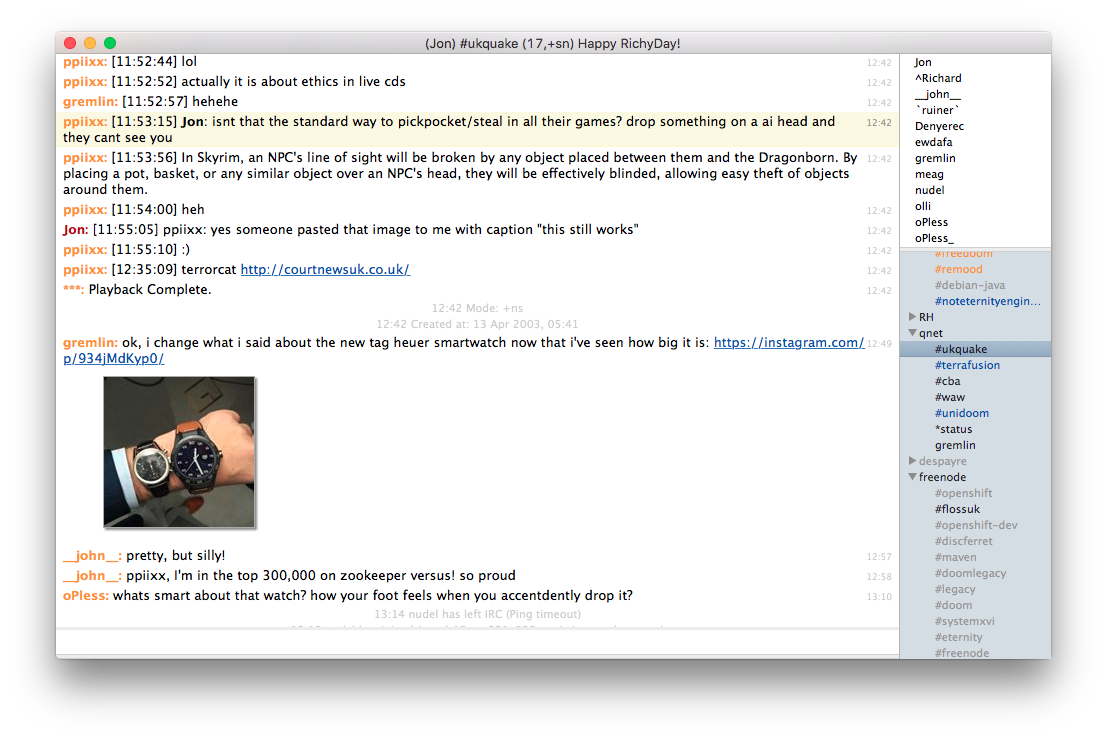
LimeChat, an IRC client. I theme it to look like Colloquy. The net result is pretty clean. I like using a proportional-font for text things, so getting IRC out of a terminal is a win for me. LimeChat automatically fetches and thumbnails URIs to images that people paste in channels, which is either incredibly convenient or a curse, depending on the channel. You can toggle that behaviour but only across the whole client, not on a channel or network basis. Finally, 1Password is an incredibly slick password manager. I use it in a very basic fashion: no mobile client, no syncing to anything outside of my workstation. You could also use LastPass which is similar and has a Linux client. I haven't tried it, but there's a third party tool to read 1Password password stores on Linux written by Ryan Coleman of SDL fame called 1pass.

10 November 2015

John Goerzen: Wow. I did that!

It s now official: I m a pilot. This has been one of the most challenging, and also most rewarding, journeys I ve been on. It had its moments of struggle, moments of joy, moments of poetry. I wrote about the poetry of flying at night recently. Here is the story of my first landing on a grass runway, a few months ago. Grass
Where the air is so pure, the zephyrs so free,
The breezes so balmy and light,
That I would not exchange my home on the range
For all of the cities so bright. John A. Lomax
We are used to seeing planes in these massive palaces of infrastructure we call airports. We have huge parking garages, giant terminals, security lines hundreds of people deep, baggage carts, jetways, video screens, restaurants, and miles and miles of concrete. But most of the world s airports are not like that. A pilot of a small plane gets to see the big airports, sure, but we also get to use the smaller airports hidden in plain sight to most. Have you ever taken off from a strip of grass? As I told my flight instructor when I tried it for the first time, I know this will work, but somehow I will still be amazed if it actually does. I took off from a strip of grass not long ago. The airport there had one paved runway, and the rest were grass. Short runways, narrow runways, grass runways. No lights. No paint. No signs. No trucks, no jetways, nothing massive. In fact, no people. Just a mowed path and a couple of yellow or white markers. I taxied down the grass runway, being careful to never let the plane s wheels stop moving lest the nose gear get stuck in a pothole. I felt all the bumps in the ground as we moved. End of runway. Turn the plane around. A little bit of flap for more lift, full throttle, mind the centerline imaginary centerline, this time. It starts picking up speed, slower than usual, bump bump bump. Those buildings at the end of the runway are staring me down. More speed, and suddenly the runway feels smooth; it has enough lift to keep from falling into every bump. Then we lift off just a touch; I carefully keep the plane down until we pick up enough speed to ascend farther, then up we go. I keep a watchful eye on those buildings straight ahead and that water tower just slightly off to the one side. We climb over a lake as I watch that water tower pass safely below and to the side of the plane. It had worked, and I had a smile of amazement. With a half mile of grass, you really can go anywhere. Many times I had driven within half a mile of that runway, but never seen it. Never wondered where people go after using it. Never realizing that, although it s a 45-minute drive from my house, it s really pretty close. Never understanding that where people go after taking off from that runway is everywhere .

Steinar H. Gunderson: HTTPS-enabling gitweb

If you have a HTTPS-enabling proxy in front of your gitweb, so that it tries to do <base href="http://..."> (because it doesn't know that the user is actually using HTTPS), here's the Apache configuration variable to tell it otherwise:
SetEnv HTTPS ON
So now git.sesse.net works with HTTPS after Let's Encrypt, without the CSS being broken. Woo. (Well, the clone URL still says http. So, halfway there, at least.)

Steinar H. Gunderson: Launch

We launched Offline Maps!

9 November 2015

Jonathan McDowell: The Joy of Recruiters

Last week Simon retweeted a link to Don t Feed the Beast the Great Tech Recruiter Infestation. Which reminded me I d been meaning to comment on my own experiences from earlier in the year. I don t entertain the same level of bile as displayed in the post, but I do have a significant level of disappointment in the recruitment industry. I had conversations with 3 different agencies, all of whom were geographically relevant. One contacted me, the other 2 (one I d dealt with before, one that was recommended to me) I contacted myself. All managed to fail to communicate with any level of acceptability. The agency hat contacted me eventually went quiet, after having asked if they could put my CV forward for a role and pushing very hard about when I could interview. The contact in the agency I d dealt with before replied to say I was being passed to someone else who would get in contact. Who of course didn t. And the final agency, who had been recommended, passed me between 3 different people, said they were confident they could find me something, and then went dark except for signing me up to their generic jobs list which failed to have anything of relevance on it. As it happens my availability and skill set were not conducive to results at that point in time, so my beef isn t with the inability to find a role. Instead it s with the poor levels of communication presented by an industry which seems, to me, to have communication as part of the core value it should be offering. If anyone had said at the start Look, it s going to be tricky, we ll see what we can do or Look, that s not what we really deal in, we can t help , that would have been fine. I m fine with explanations. I get really miffed when I m just left hanging. I d love to be able to say I ll never deal with a recruiter again, but the fact of the matter is they do serve a purpose. There s only so far a company can get with word of mouth recruitment; eventually that network of personal connections from existing employees who are considering moving dries up. Advertising might get you some more people, but it can also result in people who are hugely inappropriate for the role. From the company point of view recruiters nominally fulfil 2 roles. Firstly they connect the prospective employer with a potentially wider base of candidates. Secondly they should be able to do some sort of, at least basic, filtering of whether a candidate is appropriate for a role. From the candidate point of view the recruiter hopefully has a better knowledge of what roles are out there. However the incentives to please each side are hugely unbalanced. The candidate isn t paying the recruiter. If you re not paying for it, you re the product may be bandied around too often, but I believe this is one of the instances where it s very applicable. A recruiter is paid by their ability to deliver viable candidates to prospective employers. The delivery of these candidates is the service. Whether or not the candidate is happy with the job is irrelevant beyond them staying long enough that the placement fee can be claimed. The lengthy commercial relationship is ideally between the company and the recruitment agency, not the candidate and the agency. A recruiter wants to be able to say Look at the fine candidate I provided last time, you should always come to me first in future . There s a certain element of wanting the candidate to come back if/when they are looking for a new role, but it s not a primary concern. It is notable that the recommendations I d received were from people who had been on the hiring side of things. The recruiter has a vested interest in keeping the employer happy, in the hope of a sustained relationship. There is little motivation for keeping the candidate happy, as long as you don t manage to scare them off. And, in fact, if you scare some off, who cares? A recruiter doesn t get paid for providing the best possible candidate. Or indeed a candidate who will fully engage with the role. All they re required to provide is a hire-able candidate who takes the role. I m not sure what the resolution is to this. Word of mouth only scales so far for both employer and candidate. Many of the big job websites seem to be full of recruiters rather than real employers. And I m sure there are some decent recruiters out there doing a good job, keeping both sides happy and earning their significant cut. I m sad to say I can t foresee any big change any time soon. [Note I m not currently looking for employment.] [No recruitment agencies were harmed in the writing of this post. I have deliberately tried to avoid outing anyone in particular.]

Lunar: Reproducible builds: week 28 in Stretch cycle

What happened in the reproducible builds effort this week: Toolchain fixes Chris Lamb filled a bug on python-setuptools with a patch to make the generated requires.txt files reproducible. The patch has been forwarded upstream. Chris also understood why the she-bang in some Python scripts kept being undeterministic: setuptools as called by dh-python could skip re-installing the scripts if the build had been too fast (under one second). #804339 offers a patch fixing the issue by passing --force to setup.py install. #804141 reported on gettext asks for support of SOURCE_DATE_EPOCH in gettextize. Santiago Vila pointed out that it doesn't felt appropriate as gettextize is supposed to be an interactive tool. The problem reported seems to be in avahi build system instead. Packages fixed The following packages became reproducible due to changes in their build dependencies: celestia, dsdo, fonts-taml-tscu, fte, hkgerman, ifrench-gut, ispell-czech, maven-assembly-plugin, maven-project-info-reports-plugin, python-avro, ruby-compass, signond, thepeg, wagon2, xjdic. The following packages became reproducible after getting fixed: Some uploads fixed some reproducibility issues but not all of them: Patches submitted which have not made their way to the archive yet: Chris Lamb closed a wrongly reopened bug against haskell-devscripts that was actually a problem in haddock. reproducible.debian.net FreeBSD tests are now run for three branches: master, stable/10, release/10.2.0. (h01ger) diffoscope development Support has been added for Free Pascal unit files (.ppc). (Paul Gevers) The homepage is now available using HTTPS, thanks to Let's Encrypt!. Work has been done to be able to publish diffoscope on the Python Package Index (also known as PyPI): the tlsh module is now optional, compatibility with python-magic has been added, and the fallback code to handle RPM has been fixed. Documentation update Reiner Herrmann, Paul Gevers, Niko Tyni, opi, and Dhole offered various fixes and wording improvements to the reproducible-builds.org. A mailing-list is now available to receive change notifications. NixOS, Guix, and Baserock are featured as projects working on reproducible builds. Package reviews 70 reviews have been removed, 74 added and 17 updated this week. Chris Lamb opened 22 new fail to build from source bugs. New issues this week: randomness_in_ocaml_provides, randomness_in_qdoc_page_id, randomness_in_python_setuptools_requires_txt, gettext_creates_ChangeLog_files_and_entries_with_current_date. Misc. h01ger and Chris Lamb presented Beyond reproducible builds at the MiniDebConf in Cambridge on November 8th. They gave an overview of where we stand and the changes in user tools, infrastructure, and development practices that we might want to see happening. Feedback on these thoughts are welcome. Slides are already available, and the video should be online soon. At the same event, a meeting happened with some members of the release team to discuss the best strategy regarding releases and reproducibility. Minutes have been posted on the Debian reproducible-builds mailing-list.

Ben Hutchings: Debian LTS work, October 2015

For my 11th month working on Debian LTS, I carried over 5.5 hours from September and was assigned another 13.5 hours of work by Freexian's Debian LTS initiative. I worked 14 of a possible 19 hours. As I mentioned in the report for September, I uploaded binutils and issued DLA-324-1 early in October. I fixed a few security issues in the kernel, uploaded and issued DLA-325-1. I had some email discussions about long-term support of the Linux kernel with Willy Tarreau (Linux 2.6.32 maintainer) and Greg Kroah-Hartman (overall stable maintainer). Greg normally selects one version per year to maintain as a 'longterm' branch for 2 years, after which he may hand it over to another maintainer. A few upstream versions have received long-term support entirely from another developer. We were in agreement that it's desirable to have fewer of these branches with more developers and distributions contributing to each, but didn't come to a conclusion about how to coordinate this. The topic came up again at the Kernel Summit, and Greg then agreed to select the first kernel version of each calendar year, starting with Linux 4.4 (expected in January). This doesn't fit well with Debian's current release schedule, but I mean to discuss with the release team whether the freeze date can be set to allow inclusion of 2017's LTS kernel. I spent another week in the 'front desk' role, where I triaged new security issues for squeeze. There was a mixture of serious and trivial, old and new (not affecting squeeze) issues. The many ntp issues announced in October were fixed in unstable by a new upstream release. I spent a long time digging out the specific commits that fixed them and comparing with the older version in squeeze. Several of the issues had been introduced in ntp 4.2.7 or 4.2.8 and therefore didn't affect squeeze (or the newer stable releases). Of the fixes that were needed, most applied with minimal changes. Having prepared an update, I asked the ntp maintainer, Kurt Roeckx, to review my work. (The package has a limited test suite and none of the fixes added new tests.) Following this review he added a few more patches, uploaded and issued DLA-335-1. MySQL 5.1, as shipped in squeeze, no longer receives security support from upstream, and the security fixes they do issue are mixed with other changes that make it impractical to backport them. The LTS team is planning to backport the mysql-5.5 package to squeeze while avoiding conflicts with the binaries built from mysql-5.1. Santiago Ruano Rinc n has prepared a backport and I spent some time reviewing this, but haven't yet sent my review comments.

Vasudev Kamath: Forwarding host port to service in container

Problem I've lxc container running distcc daemon and I would like to forward the distcc traffic coming to my host system to container.
Solution Following simple script which uses iptable did the job.
 #!/bin/sh
 set -e
usage()  
    cat <<EOF
    $(basename $0) [options] <in-interface> <out-interface> <port> <destination>
    --clear           Clear the previous rules before inserting new
                      ones
    --protocol        Protocol for the rules to use.
    in-interface      Interface on which incoming traffic is expected
    out-interface     Interface to which incoming traffic is to be
                      forwarded.
    port              Port to be forwarded. Can be integer or string
                      from /etc/services.
    destination       IP and port of the destination system to which
                      traffic needs to be forwarded. This should be in
                      form <destination_ip:port>
(C) 2015 Vasudev Kamath - This program comes with ABSOLUTELY NO
WARRANTY. This is free software, and you are welcome to redistribute
it under the GNU GPL Version 3 (or later) License
EOF
 
setup_portforwarding ()  
    local protocol="$1"
    iptables -t nat -A PREROUTING -i $IN_INTERFACE -p "$protocol" --dport $PORT \
           -j DNAT --to $DESTINATION
    iptables -A FORWARD -p "$protocol" -d $ DESTINATION%%\:*  --dport $PORT -j ACCEPT
    # Returning packet should have gateway IP
    iptables -t nat -A POSTROUTING -s $ DESTINATION%%\:*  -o \
           $IN_INTERFACE -j SNAT --to $ IN_IP%%\/* 
 
if [ $(id -u) -ne 0 ]; then
    echo "You need to be root to run this script"
    exit 1
fi
while true; do
    case "$1" in
      --clear)
          CLEAR_RULES=1
          shift
          ;;
      --protocol --protocol=*?)
      if [ "$1" = "--protocol" -a -n "$2" ];then
          PROTOCOL="$2"
          shift 2
      elif [ "$ 1#--protocol= " != "$1" ]; then
          PROTOCOL="$ 1$--protocol= "
          shift 1
      else
          echo "You need to specify protocl (tcp udp)"
          exit 2
      fi
      ;;
      *)
          break
          ;;
    esac
done
if [ $# -ne 4 ]; then
    usage $0
    exit 2
fi
IN_INTERFACE="$1"
OUT_INTERFACE="$2"
PORT="$3"
DESTINATION="$4"
# Get the incoming interface IP. This is used for SNAT.
IN_IP=$(ip addr show $IN_INTERFACE \
             perl -nE '/inet\s(.*)\sbrd/ and print $1')
if [ -n "$CLEAR_RULES" ]; then
    iptables -t nat -X
    iptables -t nat -F
    iptables -F
fi
if [ -n "$PROTOCOL" ]; then
    setup_portforwarding $PROTOCOL
else
    setup_portforwarding tcp
    setup_portforwarding udp
fi
Coming to systemd-nspawn I see there is --port option which takes argument in form proto:hostport:destport where proto can be either tcp or udp, hostport and destport are number from 1-65535. This option assumes private networking enabled in the container. I've not tried this option yet but that simplifies quite a lot of thing, its like -p switch used by docker.

Daniel Pocock: debian.org RTC: announcing XMPP, SIP presence and more

Announced 7 November 2015 on the debian-devel-announce mailing list. The Debian Project now has an XMPP service available to all Debian Developers. Your Debian.org email identity can be used as your XMPP address. The SIP service has also been upgraded and now supports presence. SIP and XMPP presence, rosters and messaging are not currently integrated. The Lumicall app has been improved to enable rapid setup for Debian.org SIP users. This announcement concludes the maintenance window on the RTC services. All services are now running on jessie (using packages from jessie-backports). XMPP and SIP enable a whole new world of real-time multimedia communications possibilities: video/webcam, VoIP, chat messaging, desktop sharing and distributed, federated communication are the most common use cases. Details about how to get started and get support are explained in the User Guide in the Debian wiki. As it is a wiki, you are completely welcome to help it evolve. Several of the people involved in the RTC team were also at the Cambridge mini-DebConf (7-8 November). The password for all these real time communication services can be set via the LDAP control panel. Please note that this password needs to be different to any of your other existing debian.org passwords. Please use a strong password and please keep it secure. Some of the infrastructure, like the TURN server, is shared by clients of both SIP and XMPP. Please configure your XMPP and SIP clients to use the TURN server for audio or video streaming to work most reliably through NAT. A key feature of both our XMPP and SIP services is that they support federated inter-connectivity with other domains. Please try it. The FedRTC service for Fedora developers is one example of another SIP service that supports federation. For details of how it works and how we establish trust between domains, please see the RTC Quick Start Guide. Please reach out to other communities you are involved with and help them consider enabling SIP and XMPP federation of their own communities/domains: as Metcalfe's law suggests, each extra person or community who embraces open standards like SIP and XMPP has far more than just an incremental impact on the value of these standards and makes them more pervasive. If you are keen to support and collaborate on the wider use of Free RTC technology, please consider joining the Free RTC mailing list sponsored by FSF Europe. There will also be a dedicated debian-rtc list for discussion of these technologies within Debian and derivatives. This service has been made possible by the efforts of the DSA team in the original SIP+WebRTC project and the more recent jessie upgrades and XMPP project. Real-time communications systems have specific expectations for network latency, connectivity, authentication schemes and various other things. Therefore, it is a great endorsement of the caliber of the team and the quality of the systems they have in place that they have been able to host this largely within their existing framework for Debian services. Feedback from the DSA team has also been helpful in improving the upstream software and packaging to make them convenient for system administrators everywhere. Special thanks to Peter Palfrader and Luca Filipozzi from the DSA team, Matthew Wild from the Prosody XMPP server project, Scott Godin from the reSIProcate project, Juliana Louback for her contributions to JSCommunicator during GSoC 2014, Iain Learmonth for helping get the RTC team up and running, Enrico Tassi, Sergei Golovan and Victor Seva for the Prosody and prosody-modules packaging and also the Debian backports team, especially Alexander Wirt, helping us ensure that rapidly evolving packages like those used in RTC are available on a stable Debian system.

8 November 2015

Andrew Cater: MiniDebconf 2015 ARM, Cambridge - ARM, Cambridge 1640 - final wrap-up - thanks to all

Two days worth of sprints - lots of hugely good work done.

Two days worth of open days with talks - lots of interest, feedback, chatting out of earshot in the breakout rooms.

Two days worth of monetary and other input from all the sponsors: ARM, Codethink, Cosworth, Hewlett Packard Enterprise Collabora - PRICELESS

Sociableness in pubs and so on overnight

Thanks also to Steve and Jo McIntyre for a houseful of guests and to all on front desk

And also lastly, again to ARM, as in all these posts because of this great venue and for the small army of ARM pass holders who have let us in and out of doors all this time.

Daniel Pocock: Problems observed during Cambridge mini-DebConf RTC demo

A few problems were observed during the demo of RTC services at the Cambridge mini-DebConf yesterday. As it turns out, many of them are already documented and solutions are available for some of them. Multiple concurrent SIP registrations I had made some test calls on Friday using rtc.debian.org and I still had the site open in another tab in another browser window. When people tried to call me during the demo, both tabs were actually ringing but only one was visible. When a SIP client registers, the SIP registration server sends it a list of all other concurrent registrations in the response message. We simply need to extend JSCommunicator to inspect the response message and give some visual feedback about other concurrent registrations. Issue #69. SIP also provides a mechanism to clear concurrent registrations and that could be made available with a button or configuration option too (Issue #9). Callee hears ringing before connectivity checks completed The second issue during the WebRTC demo was that the callee (myself) was alerted about the call before the ICE checks had been performed. The optimal procedure to provide a slick user experience is to run the connectivity checks before alerting the callee. If the connectivity checks fail, the callee should never be alerted with a ringing sound and would never know somebody had tried to call. The caller would be told that the call was unable to be attempted and encouraged to consider trying again on another wifi network. RFC 5245 recommends that connectivity checks should be done first but it is not mandatory. One reason this is problematic with WebRTC is the need to display the pop-up asking the user for permission to share their microphone and webcam: the popup must appear before connectivity checks can commence. This has been discussed in the JsSIP issue tracker. Non-WebRTC softphones, such as Lumicall, do the connectivity checks before alerting the callee. Dealing with UDP blocking It appears the corporate wifi network in the venue was blocking the UDP packets so the connectivity checks could never complete, not even using a TURN server to relay the packets. People trying to use the service on home wifi networks, in small offices and mobile tethering should not have this problem as these services generally permit UDP by default. Some corporate networks, student accommodation and wifi networks in some larger hotels have blocked UDP and in these cases, additional effort must be made to get through the firewall. The TURN server we are running for rtc.debian.org also supports a TLS transport but it simply isn't configured yet. At the time we originally launched the WebRTC service in 2013, the browsers didn't support TURN over TLS at all but now they do. This is probably the biggest problem encountered during the demo but it does not require any code change to resolve this, just configuration, so a solution is well within reach. During the demo, we worked around the issue by turning off the wifi on my laptop and using tethering with a 4G mobile network. All the calls made successfully during the demo used the tethering solution. Add a connectivity check timeout The ICE connectivity checks appeared to keep running for a long time. Usually, if UDP is not blocked, the ICE checks would complete in less than two seconds. Therefore, the JavaScript needs to set a timeout between two and five seconds when it starts the checks and give the user a helpful warning about their network problems if the timeout is exceeded. Issue #73 in JSCommunicator. While these lengthy connectivity checks appear disappointing, it is worth remembering that this is an improvement over the first generation of softphones: none of them made these checks at all, they would simply tell the user the call had been answered but audio and video would only be working in one direction or not at all. Microphone issues One of the users calling into the demo, Juliana, was visible on the screen but we couldn't hear her. This was a local audio hardware issue with her laptop or headset. It would be useful if the JavaScript could provide visual feedback when it detects a voice (issue #74) and even better, integrating with the sound settings so that the user can see if the microphone is muted or the gain is very low (issue #75). Thanks to participants in the demo I'd like to thank all the participants in the demo, including Juliana Louback who called us from New York, Laura Arjona who called us from Madrid, Daniel Silverstone who called from about three meters away in the front row and Iain Learmonth who helped co-ordinate the test calls over IRC. Thanks are also due to Steve McIntyre, the local Debian community, ARM and the other sponsors for making another mini-DebConf in the UK this year.

7 November 2015

Stig Sandbeck Mathisen: Let's Encrypt with Hitch and Varnish

Let's Encrypt is now in beta. Here's how to use the automated CA with Hitch TLS proxy, and Varnish HTTP accelerator as a backend for Hitch.
Let's Encrypt Let's Encrypt is a free, automated and open Certificate Authority (CA), run for the public's benefit.
Varnish Varnish is a HTTP accelerator. I use it as a web server, and it serves content from various backends. Varnish is used on a lot of high-traffic web servers, and supports simple and complex web site configurations.
Hitch Hitch is a TLS proxy, by Varnish Software. It terminates TLS connections, and forwards them to a backend, unencrypted. The TLS proxy is simple to configure, and handles many thousands of requests per second on commodity hardware. Hitch was originally called stud and was written by Jamie Turner at Bump.com.
Varnish plugin for Let's Encrypt Let's Encrypt Varnish Plugin is needed for the Let's Encrypt client to authenticate against their service, for getting the certificates. You can skip this if you have the option of temporarily disabling your web service, when registering and renewing your certificates.
Hitch TLS proxy Hitch must be configured to listen on the https port (TCP/443), with a list of strong ciphers. To get Forward Secrecy, we need ciphers with EECDH or EDH. To use these, we need to generate a set of DH Parameters. In /etc/hitch/hitch.conf:
      
# Listening
frontend = "[*]:443"
ciphers  = "EECDH+AESGCM:EDH+AESGCM:AES256+EECDH:AES256+EDH"
      
    
Varnish as backend for Hitch Hitch will forward traffic to Varnish on localhost:6082, using the PROXY protocol. Here's a snippet for /etc/hitch/hitch.conf to do this:
      
# Send traffic to the varnish backend
backend        = "[::1]:6086"
write-proxy-v2 = on
      
    
For varnish, I've added a separate port for the "PROXY" protocol, by adding an extra "-a" argument for port 6086. The -a :80 handles the existing http traffic, while the -a '[::1]:6086,PROXY' adds a listener on localhost, which will be used by hitch.
      
/usr/sbin/varnishd -j unix,user=vcache -a :80 -a '[::1]:6086,PROXY' ...
      
    
Let's Encrypt install letsencrypt First, install the letsencrypt client. The beta program sends you a mail with instructions. When it is generally available, I suspect it'll be something like:
      
apt install letsencrypt
      
    
install varnish plugin Then, get the let's encrypt varnish plugin. The plugin will extend the letsencrypt software to be able to rewrite the VCL and reload Varnish to satisfy the authentication challenge of the Let's Encrypt server.
      
cd /usr/local/src
git clone http://git.sesse.net/letsencrypt-varnish-plugin
. ~/.local/share/letsencrypt/bin/activate
pip install -e /usr/local/src/letsencrypt-varnish-plugin
      
    
get certificate Get certificates. Let's Encrypt is still in beta, so I had to add a few more command line arguments than the documentation specifies:
      
~/.local/share/letsencrypt/bin/letsencrypt --agree-dev-preview \
    --server https://acme-v01.api.letsencrypt.org/directory \
    -a letsencrypt-varnish-plugin:varnish -d example.org certonly
      
    
Adding certificates to Hitch Hitch requires one PEM file per domain we serve. Each .pem file contains the private key, the signed certificate and any required intermediates. Create a file with DH parameters:
      
openssl dhparam -out /etc/hitch/dhparam.pem 2048
      
    
This file may take a long while to generate. Combine the key, the signed certificate, and the dhparam file to something hitch can use:
      
cat \
    /etc/letsencrypt/live/example.org/privkey.pem \
    /etc/letsencrypt/live/example.org/fullchain.pem \
    /etc/hitch/dhparam.pem \
    > /etc/hitch/example.org.pem
chmod 0600 /etc/hitch/example.org.pem
      
    
and configure hitch to use the file, by adding it to /etc/hitch/hitch.conf:
      
# List of PEM files, each with key, certificates and dhparams
pem-file = "/etc/hitch/example.org.pem"
pem-file = "/etc/hitch/www.example.org.pem"
pem-file = "/etc/hitch/example.com.pem"
pem-file = "/etc/hitch/www.example.com.pem"


Mart n Ferrari: Tales from the SRE trenches: Coda

This is the fifth -and last- part in a series of articles about SRE, based on the talk I gave in the Romanian Association for Better Software. Previous articles can be found here: part 1, part 2, part 3, and part 4.

Other lessons learned Apart from these guidelines for SRE I have described in previous posts, there were a few other practices I learned at google that I believe could benefit most operations teams out there (and developers too!).

Automate everything It's worth repeating, it is not sustainable to do things manually. When your manual work grows linearly with your usage, either your service is not growing enough, or you will need to hire more people than there are available in the market.

Involve Ops in systems design Nobody knows better than Ops the challenges of a real production environment, getting early feedback from your operations team can save you a lot of trouble down the road. They might give you insights about scalability, capacity planning, redundancy, and the very real limitations of hardware.

Give Ops time and space to innovate If there is so much emphasis on limiting the amount of operational load put on SRE, that freed time is not only used for creating monitoring dashboards or writing documentation. As I said in the beginning, SRE is an engineering team. And when engineers are not running around putting fires off all day long, they get creative. Many interesting innovations come from SREs even when there is no requirement for them.

Write design documents Design documents are not only useful for writing software. Fleshing out the details of any system on paper is a very useful way to find problems early in the process, communicate with your team exactly what are you building, and convince them why it is a great idea.

Review your code, version your changes This is something that is ubiquitous at Google, and not exclusive to SRE: everything is committed into source control: big systems, small scripts, configuration files. It might not seem worth it at the beginning, but having complete history of all your production environment is invaluable. And with source control, another rule comes into play: no change is committed without first being reviewed by a peer. It can be frustrating having to find a reviewer and wait for the approval for every small change, and some times reviews will be suboptimal, but once you get used to it, the benefits greatly out-weights any annoyances.

Before touching, measure Monitoring is not only for sending alerts, it is an essential tool of SRE. It allows you to gauge your availability, evaluate trends, forecast growth, perform forensic analysis. Also very importantly, it should give you the data needed to take decisions based on reality and not on guesses. Before optimising, find really where the bottleneck is; do not decide which database instance to use until you saw the utilisation of the past few months, etc. And speaking of that... We really need to have a chat about your current monitoring system. But that's for another day.
I hope I did not bore you too much with these walls of text! Some people told me directly they were enjoying these posts, so soon I will be writing more about related topics. In particular I would like to write about modern monitoring and Prometheus. I would love to hear your comments, questions, and criticisms. Comment

6 November 2015

Mike Gabriel: Do Jolla Smartphones really exist?

Having ordered a Jolla smartphone in the last week of September 2015, I already accepted by now that possibly Jolla smartphones don't really exist. But today (finally!) after six weeks of acceptance... / waiting... I received a mail with the below subject:
    Subject: Jolla Shop: Shipping confirmation for order #500010511
Maybe Jolla smartphones do really exist... Let's see if that phone will be a venerable successor for my beloved N900.
\o/ .oO ( Hurray ! )
I will keep you posted, so stay tuned...
light+love
Mike

Matthew Garrett: Why improving kernel security is important

The Washington Post published an article today which describes the ongoing tension between the security community and Linux kernel developers. This has been roundly denounced as FUD, with Rob Graham going so far as to claim that nobody ever attacks the kernel.

Unfortunately he's entirely and demonstrably wrong, it's not FUD and the state of security in the kernel is currently far short of where it should be.

An example. Recent versions of Android use SELinux to confine applications. Even if you have full control over an application running on Android, the SELinux rules make it very difficult to do anything especially user-hostile. Hacking Team, the GPL-violating Italian company who sells surveillance software to human rights abusers, found that this impeded their ability to drop their spyware onto targets' devices. So they took advantage of the fact that many Android devices shipped a kernel with a flawed copy_from_user() implementation that allowed them to copy arbitrary userspace data over arbitrary kernel code, thus allowing them to disable SELinux.

If we could trust userspace applications, we wouldn't need SELinux. But we assume that userspace code may be buggy, misconfigured or actively hostile, and we use technologies such as SELinux or AppArmor to restrict its behaviour. There's simply too much userspace code for us to guarantee that it's all correct, so we do our best to prevent it from doing harm anyway.

This is significantly less true in the kernel. The model up until now has largely been "Fix security bugs as we find them", an approach that fails on two levels:

1) Once we find them and fix them, there's still a window between the fixed version being available and it actually being deployed
2) The forces of good may not be the first ones to find them

This reactive approach is fine for a world where it's possible to push out software updates without having to perform extensive testing first, a world where the only people hunting for interesting kernel vulnerabilities are nice people. This isn't that world, and this approach isn't fine.

Just as features like SELinux allow us to reduce the harm that can occur if a new userspace vulnerability is found, we can add features to the kernel that make it more difficult (or impossible) for attackers to turn a kernel bug into an exploitable vulnerability. The number of people using Linux systems is increasing every day, and many of these users depend on the security of these systems in critical ways. It's vital that we do what we can to avoid their trust being misplaced.

Many useful mitigation features already exist in the Grsecurity patchset, but a combination of technical disagreements around certain features, personality conflicts and an apparent lack of enthusiasm on the side of upstream kernel developers has resulted in almost none of it landing in the kernels that most people use. Kees Cook has proposed a new project to start making a more concerted effort to migrate components of Grsecurity to upstream. If you rely on the kernel being a secure component, either because you ship a product based on it or because you use it yourself, you should probably be doing what you can to support this.

Microsoft received entirely justifiable criticism for the terrible state of security on their platform. They responded by introducing cutting-edge security features across the OS, including the kernel. Accusing anyone who says we need to do the same of spreading FUD is risking free software being sidelined in favour of proprietary software providing more real-world security. That doesn't seem like a good outcome.

comment count unavailable comments

Norbert Preining: Japanese TeX User Meeting Support for Japanese in TeX (Live) present state and future?

Tomorrow the Japanese TeX User Meeting 2015 will be held in Tokyo. Since I have come to Japan I have attended more or less every year this meeting, and in 2013 we could get the (international) TeX User Group Meeting to Tokyo and had a joint conference TUG 2013, which was a great success. (update 2015-11-09: slides added at the end) Japanese-TeX
During tomorrows meeting I will give a talk on Support for Japanese in TeX (Live) present state and future?:
The support for typesetting Japanese in TeX, in particular TeX Live, has been improved over the last few years considerably, so that at the current point we can ask ourselves what is next? This talk reviews a bit of the history of Japanese typesetting support in TeX Live, and discusses future development directions.
For those interested, here is a bit of an extended abstract. With a set of Japan specific TeX engines, the Japanese TeX Users always had a hard time setting up a proper TeX environment. Besides compiling the programs for each new version again, users had to install packages from a variety of sources, which often involved complicated routines. Fortunately, due to the excellent support on the TeX Q&A these difficulties were manageable. Compiling the Japanese TeX engines was first part of the pteTeX project, which adjusted teTeX to include also the required programs. Compilation was done by obtaining the source code of teTeX, plus patches that implement the Japanese TeX engines and support in driver programs. After the end of development of teTeX, TeX Live became the main TeX distribution system, and ptexlive was born to adjust the TeX Live sources to include the Japanese TeX engines. But fundamentally the same procedure remain: Get the source code, patch in additional functionality, compile and install. The last five years have seen a step-wise inclusion of various Japan-related programs in the main TeX Live source repository. Starting with pTeX (and pbibtex etc) and adjustments to dvipdfmx, followed by upTeX, and later on also (u)pmetapost, the main TeX Live source repository now contains all (with the exception of pxdvi) programs related to the Japanese TeX environment. At the same time, developers of various packages started to upload their packages to CTAN, which automatically made these packages available in TeX Live. Thus, the current status is quite satisfactory, since a normal TeX Live installation, without the need for any compilation, provides all necessary programs and packages. What remains a problem are inter-release updates of the binaries, when bugs in various engines are found. Future developments Besides the actual development of packages, and in particular luatexja, I see possible improvements in the following area: Summing up, I am quite happy to see that both the Japanese community, as well as the Korean community, have now taken the step to make their achievements available in an easy and straightforward way for everyone using TeX Live, and I am sure that the future will bring further improvements!
The slides accompanying the talk can be downloaded here: texconf15-texlive-japan.pdf. I also talked briefly on CJK font integration for Ghostscript, these slides can be downloaded here: texconf15-cjk-gs.pdf.

5 November 2015

Steinar H. Gunderson: Let's Encrypt Varnish plugin

I made a Varnish authentication plugin for the Let's Encrypt client. I dislike the huge amount of magic and layers of, well, stuff in the client, but the project is hugely important for the web, and I doubt there will be another ACME client anytime soon, so I can just as well get on the bandwagon. :-) It's really ugly. But it works for me.

4 November 2015

Yves-Alexis Perez: Uploading source-only packages built with pbuilder

Thanks to Mehdi Dogguy, here's a nice hook to generate a source change file at build time (with pbuilder), so one can upload source-only packages to the archive and have buildds rebuild for all the architectures. Put it in .pbuilder/hooks/B10_source-build so it gets called once the builds succeeds
#! /bin/sh
generate_change_file()
 
  local version=$(dpkg-parsechangelog -Sversion)
  local package=$(dpkg-parsechangelog -Ssource)
  echo "Generating source changes file"
  dpkg-genchanges -S > ../$ package _$ version _source.changes
 
cd /tmp/buildd/*/debian/..
generate_change_file
Next time you build a package, you should find, alongside the <package>_<version>_<arch>.changes file, a <package>_<version>_source.changes which you can use with usual tools (lintian, debsign, dput ) to upload it to the Debian archive. Note that if you do that, you have to make sure that your debian/rules support building separately the arch-dependent and arch-independant packages. To check that, you can call pdebuild like this:
pdebuild --debbuildopts -A # binary-only build, limited to arch-independant packages
pdebuild --debbuildopts -B # binary-only build, limited to arch-dependant packages

Next.

Previous.