Search Results: "agi"

8 June 2008

Axel Beckert: Bath Tub, Rubber Keyboard, Ratpoison and Opera

I recently noticed that a very good way to safely read webcomics in the bath tub is an old laptop with a big screen (e.g. a IBM ThinkPad A-series like my 15” A31 which has a nice 1400×1050 resolution), a water proof keyboard, the screen-alike, keyboard only driven (hence the name) window manager ratpoison (other keyboard driven window managers like wmii or awesome probably will do as well as ratpoison) and a good keyboard driven web browser which can bind or by default has bound a key to follow <link rel="next" ... /> tags. Like Opera. Opera has bound the space bar to scroll one page down and if you reach the bottom of the page to go to the next page as labeled in the link tag. Additionally the full screen mode is helpful, too. Or the dream browser of all Emacs addicts, Conkeror, which has bound the function browser-follow-next to ]]. (Conkeror packages will hit Debian Experimental quite soon.) Or the GNOME feed reader Liferea which has bound Ctrl-Space by default to scroll down the content by one page and if you reach the bottom of the content go to the next unread item. With that equipment I can read my favourite web comics like Questionable Content (whose content seldomly is questionable :-) or Ozy and Millie (Think of a mixture of Calvin & Hobbes, Peanuts and Kevin & Kell) in the bath tub without drying my hands before reading the next comic or fearing water or health damage by the combination of water and computer. I just press one or two keys on the keyboard floating over my lap and have a good time.
a keyboard floatiing in the bath tub close up of the floatiing keyboard
BTW: I’ve got a blue, non-branded one (packaging reveals it as “AirTouch Keyboard”, probably manufactured by SanChuan Electronics, China) with swiss-german layout from ARP Datacom (whose website offers no permanent links and insists on session cookies *puke*), but those from Keysonic or from ROCK seem to be very similar — nowadays they are also available in illuminated, miscellaneous colors and wireless, but only IP65, probably because of the necessarily accessible battery compartment. But this kind of having fun still has optimisation potential: non-flexibel water-proof keyboard (IP67 recommended, so those IP66 keyboards and mice recently posted at UF LOTD are probably not tight enough), flat screen mounted above the bath tub, etc. ;-) Or maybe a completely water proof laptop if such thing exists — Does it? One more note: In Debian Sid and Lenny recently a new tool called keynav has been added, which allows you to control the mouse quickly using the keyboard only. So with Sid or Lenny, I don’t even need an waterproof mouse or trackball if an application insists on mouse usage. ;-)

7 June 2008

David Nusinow: The Cognitive Load Of Web Development

The most dynamic segment of the software industry that I'm aware of is web programming. Flamewars rage about frameworks and browsers and standards and whatnot, and the openness of the whole thing feels like some of the things that made me fall in love with computing as a whole and Free Software in particular. The problem with all that openness is that it's rather difficult to navigate. Aside from the obvious issues with browser incompatibilities, there's an enormous amount of software solutions on the server side, spanning languages, libraries, and frameworks. Each one is an ecosystem to itself, often being large and complicated.

This makes it rather difficult to do certain aspects of web programming well. You are constantly switching between tools and languages, as well as coding paradigms, in order to build a web app in full. You'll be writing HTML, CSS, and Javascript on the client side, each with its own peculiarities. On the server side you'll probably have settled on one language with its own very different varieties of coding style and patterns. Some, like Ruby on Rails, are their own unique brand of language that makes you work both in the DSL (Rails in this case) and the parent language (Ruby here). Template engines often will do the same thing, such as in the case of Django.

It's pretty obvious that having to juggle all these tools places a fairly large burden on the coder. Much to their credit, it's not difficult to work in any of these languages, but to work in them at a high level becomes more difficult the deeper and wider the software stack reaches. You get this a bit in systems programming, juggling C/C++ with a build system and a scripting language, but that's usually it. You can get that number of moving parts just on the client side of the web with HTML, CSS, and Javascript.

Something interesting that seems to be happening is that people are moving to decrease this cognitive burden. One good example is the Google Web Toolkit which lets you write all your AJAXy client-side stuff in Java, and let it get compiled in to Javascript. That way you cut the languages you have to work in. A similar concept is behind Microsoft allowing Ruby (and Python, if I've heard correctly) in Silverlight. Alternately, you can bring Javascript (back) to the server side, which is the motivation behind Helma and Rhino on Rails (the latter of which I hope sees the light of day).

Personally, I'm rooting for Javascript to not become an assembly language, but to take over the server side again. It's a capable and powerful language (much better than Java in my opinion), and we're collectively leveraging it very poorly. Rhino is interesting and has enormous potential, but it needs library binds in the worst way. Currently it's basically using Javascript to write Java, which is rather atrocious (COBOL in any language, etc) but with some Javascript-style wrappers around the Java classes it could be phenomenal. Alternately, there's Spidermonkey, which could be wrapped in a more capable shell with a good FFI, and we could easily have wrappers to our favorite Free Software libraries. This project seems far along here, but it's currently very windows-centric.

There's a lot of potential here though. Unifying the development language for both web and system apps would benefit the Free Software desktop, and give us the ability to better integrate our stuff with the web. One of the best things about Free Software is that it dropped the barrier to entry in software development. I think we can repeat that success again here.

Jeff Bailey: Oil, Technology, Inevitability

So apparently we hit $138/barrel on oil futures on Friday. Reading a CBC Post on the subject I think there are a couple interesting quotes:
Matt Simmons, chairman of an energy financing company in Houston, believes oil prices are still too low. He told CBC News there are "very strong signs" that the global supply of crude oil has leveled out and is probably now in a gentle decline.
Simmons said he finds it interesting that so many people blame speculators and a weak U.S. dollar for rising prices. "These same lame excuses have been going on for the last nine years, since [the price of oil] has gone up 13-fold," he said
I commented earlier that I'm looking forward to $10/litre (The CBC article shows petrol in Montr al at $1.40). A number of commenters brought up economic accessibility - which is a real concern. So, dear lazyweb: I remember seeing once that there were orgs doing carbon offsets by going into low-income areas and doing volunteer work on houses to fix up insulation, replace aging furnaces and major appliances. I haven't been able to find a reference to it again, though. Given that $10/litre seems inevitable (Heya Brits! Any of you still driving cars at ~ 1.15 according to the Daily Mail), what do we do to prepare for it? We got Angie's bike up and running yesterday, and she went to her day's visits that way. I'm finally cleared to ride a bike, but am not yet up to tackling Rengstorff. I'm practicing by biking around the campus at work and getting used to the changes in my body. The biggest disappointment in going back to Vancouver is just the apathy about smog and fuel consumption there. We saw a total of 2 Prius' (Prii?) on the road across the entire 12 days versus a half-dozen Hummers. I remember in the early 90's being downtown and everyone being shocked when there was a bit of brown haze in the air around the Sears Tower (Sorry, I can never remember WTH it's called now). Now the city is not only permanently like that, but people just expect it to get worse without any real feeling that they could do anything about it. I find myself starting to think again about hacking and what differences I can make. It's unexpected but logical that efficiency results in greater consumption: You can afford to do more, and have time to do more. Is the trick, then, to develop something efficient that takes up time? (Should I work on a text adventure?) Or perhaps the answer is to get away from computers for entertainment. Jim Morrison (Phython) and I have been talking about taking up bagpipes as a fun pre-work activity in the field by the office. But now he's moved to the San Francisco office. Anyone else at in Mountain View interested? =)

5 June 2008

Gunnar Wolf: I've fallen and I can't get up!

I think I should follow up on Victor's lament. Yes, we have a Rails application which works fine most of the time... But quite often, throws out a segmentation fault I just have been unable to pin-point. It might be related to rmagick, the only non-pure-Ruby component I am using (and I'm tempted to try minimagick instead, even if I prefer in-memory operations than on-disk, piping an image and slurping it again).
Victor came up with an easy script to check the server - but to reduce the impact it has (I was running a single Mongrel instance, which meant, whenever it dies the whole system becomes inaccessible for everybody; I replaced it with a mongrel_cluster of five processes, plus pound as a easy-to-use balancer which looks quite nice), the very simplistic and to-the-point script did no longer work.
Anyway... Ruby rocks ;-) I'm sharing this with you mostly because I am sure some readers will find more than one useful construct, not because it is precisely beautiful code. And besides, we should work on fixing the cause, not the consequence, of the bug! :)
  1. #!/usr/bin/ruby
  2. require 'yaml'
  3. confdir = '/etc/mongrel-cluster/sites-enabled'
  4. restart_cmd = '/etc/init.d/mongrel-cluster restart'
  5. needs_restart = false
  6.  
  7. (Dir.open(confdir).entries - ['.', '..']).each do site
  8. conf = YAML.load_file "# confdir /# site "
  9. pid_location = [conf['cwd'], conf['pid_file']].join('/').gsub(/\.pid$/, '*.pid')
  10. pid_files = Dir.glob(pid_location)
  11.  
  12. pid_files.each do pidf
  13. pid = File.read(pidf)
  14. begin
  15. Process.getpgid(pid.to_i)
  16. rescue Errno::ESRCH
  17. warn "Process # pid (cluster # site ) is dead!"
  18. File.unlink pidf
  19. needs_restart = true
  20. end
  21. end
  22. end
  23.  
  24. system(restart_cmd) if needs_restart

Works out of the box for any Debian-packaged mongrel-cluster. Sadly, mongrel-cluster does not provide a way to restart individual servers - Of course, I could (should, even) work it out to build the specific command-line... but at least, it works for now.
Uh-oh... Does that mean it's permanent?

Adeodato Sim : Credits

Managing a transition is not always easy, because many times they are bigger than you, and have parts you can’t directly take care of yourself because it’s not your area of expertise, you don’t have access, or whatever else. You end up, then, nagging people to do stuff for you, which for types like me is slightly uneasy. It is a pleasure, though, when you find supportive fellow developers on the other side, just willing to help you, even if you always have more work for them. Thomas and Michael, thank you! (And thanks, in general, to everybody who helps the release team, past and future. We just can’t do everything!) On reflection, I notice that I also find very gratifying to do stuff for others myself (particularly if I enjoy the task, of course), because it has an immediate payoff. Highly recommended.

4 June 2008

Robert Collins: 4 Jun 2008

So I've been playing with Mnemosyne recently, using it to help brush up on my woeful Latin vocabulary. I thought it would be a good idea to get some of that data out of my head an into Ubuntu (which has a Latin translation). Imagine my surpise when, after installing the latin language pack (through the gui), I could not log into Ubuntu in Latin?! It turns out that there is no Latin locale in Ubuntu, or indeed in glibc. This is kind of strange (there is an esperanto locale). Remember that locales combine language and location - they describe how to format money, numbers, telephone details and so on. So clearly, I needed to add a latin locale. I could add one for just me (e.g. la_AU), or I could add a generic one (helpfully using AU values) on the betting chance that at this point there are not enough folk wishing to log in in latin (after all you can't!) for us to need one per country. And even more so, doing la_AU doesn't make a lot of sense - there isn't a pt_AU locale even though there are portuguese speakers living in Australia. (The root issue here is that location and language are conflated. POSIX I hate thee). So, a quick crash course in locales, some copy and paste later, and there is a Latin locale. Installing that on my system got me a latin locale, but gdm still wouldn't let me select it. It turns out that gdm feels the urge to maintain its own list of what locales exist, and what to call them. I thought duplication in software was a bad idea, but perhaps I don't understand the problem space enough. Anyhow, time to fix it. And because this is something other people may be interested in, and the patches are not yet in Ubuntu because upstream glibc may choose a different locale code (e.g. la_AU), I've finally had reason to activate my ppa on launchpad, so there are now binary packages for hardy for anyone that wants to play with this!

3 June 2008

Marc 'Zugschlus' Haber: Serial Console Server for the Poor I

The serial port is still the way to access network components out of band. It is slow, but reliable, and remarkably well standardized. It does not have technical whiz-bangs that can fail when one needs things to just work. That makes it the natural way to access critical infrastructure and still being sure that this access vector still works when most other things are down. Every communication link has two sides, so there is a market for devices with a network link and a bigger number of serial ports to connect the actual devices to. Commercial vendors have a broad choice of serial console servers. Most of them, especially the small products with five to ten ports, are quite expensive, so I have been investigating how do build a serial console server with el cheapo hardware. USB comes to mind here, of course.
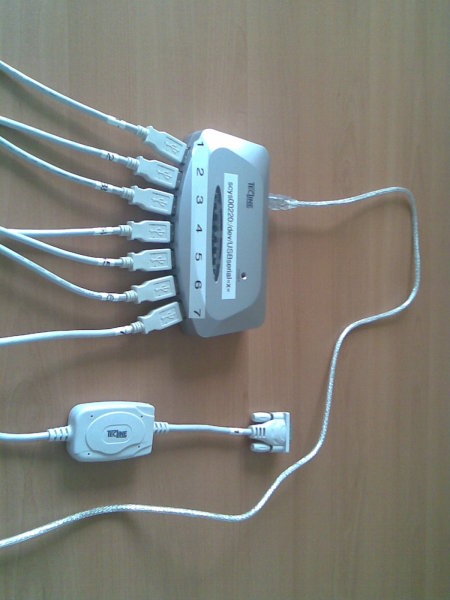
Picture of the fully equipped USB hub
The hardware side is actually quite easy: A seven-port USB hub, and seven USB-to-serial adaptors (using the widely-deployed Prolific PL2303) are easily purchased for well below a hundred Euros, and naively connected. In my test setup, connected to the hp compaq nc8000 that my blog readers should know only too well by now, the hub does not even need to have its power supply connected. The notebook can power the hub and the seven adaptors just fine. When the UMTS card is plugged in, the ttyUSBx device nodes appear in the order of plugging in the devices. When the system is booted, the order is not very predictable, so one needs - again - udev to give predictable device node names. udevinfo is an important tool to obtain the data set of an USB device which is available to match a device and to act appropriately when it is connected. udevinfo sorts the devices into a tree and shows the relationship of the devices, which device is “behind” which other device from the system’s point of view. udevinfo’s output starts at the leaf of the device tree and shows the information for each node up the tree until its root is reached. One pitfall is that one can only match against the leaf and _one_ other node more up the tree. So you cannot do matches like “the pl2303-based device connected to port 3 on hub 2-3 will be designated USBserial3”. If you try this, your rule will silently be ignored. This is a major turn-off in udev’s implementation. I didn’t try it on sid, but etch definetely shows this behavior. So one can only match like “the tty on the USB subsystem connected to port 3 on hub 2-3 will be designated USBserial3”, but that’s probably as good as it’ll get. The cause for my hub having only seven ports clearly shows itself when one looks at the udevinfo outputs of the fully equipped USB hub: The adapters are connected to ports 1, 2, 3, 4.1, 4.2, 4.3 and 4.4. The seven-port hub is actually two four-port hubs in a single case, with the second one connected to the first one’s port 4. This reflects itself, of course, in the udev rules necessary to address the adapters by the hub port they’re plugged in:
SUBSYSTEM==“tty”, SUBSYSTEMS==“usb”, DRIVERS==“usb”, \
   KERNELS==“*-*.1”, \
   SYMLINK=“USBserial1”
SUBSYSTEM==“tty”, SUBSYSTEMS==“usb”, DRIVERS==“usb”, \
   KERNELS==“*-*.2”, \
   SYMLINK=“USBserial2”
SUBSYSTEM==“tty”, SUBSYSTEMS==“usb”, DRIVERS==“usb”, \
   KERNELS==“*-*.3”, \
   SYMLINK=“USBserial3”
SUBSYSTEM==“tty”, SUBSYSTEMS==“usb”, DRIVERS==“usb”, \
   KERNELS==“*-*.4.1”, \
   SYMLINK=“USBserial4”
SUBSYSTEM==“tty”, SUBSYSTEMS==“usb”, DRIVERS==“usb”, \
   KERNELS==“*-*.4.2”, \
   SYMLINK=“USBserial5”
SUBSYSTEM==“tty”, SUBSYSTEMS==“usb”, DRIVERS==“usb”, \
   KERNELS==“*-*.4.3”, \
   SYMLINK=“USBserial6”
SUBSYSTEM==“tty”, SUBSYSTEMS==“usb”, DRIVERS==“usb”, \
   KERNELS==“*-*.4.4”, \
   SYMLINK=“USBserial7”
These rules will only work for a similary structured hub that is directly connected to the notebook. If there are more hubs in between the “final” hub and the host, the address matched against in the KERNELS matches are going to have a different structure. In the test setup, the first two parts of the address needed to be wildcarded since these addresses keep changing when the host is booted or the hub plugged out and in. So I guess that these udev rules are probably going to fail miserably when more hubs and/or USB-to-serial adaptors are connected. But if one does not do too many changes, things are just fine, and it is possible to put numbers on the USB hub ports and be sure that the USB-to-serial adaptor connected to port 4 is going to be /dev/USBserial4 in the host system. I tried plugging in and out the adaptors in random order, unplugged and plugged the hub itself, booted the host, and the relationship between the port and the device node was stable. In the test environment, I only tested one adapter at a time, but all these tests were successful as well. I guess that many more of these adaptors will eventually need a powered USB hub, but with seven adaptors on a single hub, the power from the USB host is sufficient to live without extra power on the hub. And, I guess, there is some hard limit for the number of USB adapters being used, and some soft limit when managing the ports and adapters is going to get harder. But, I think that a site in need of more than, say, sixteen serial ports on the console server can afford a “real” console server from one of the major vendors, which can be accessed via ethernet, UMTS, ISDN and whatever you can think of. This concludes the hardware part of my serial console server for the poor. Tomorrow, I’ll blog about the software side needed on the host to allow the serial ports to be accessed from the network while still being reasonably secure. The next article will involve ssh, /etc/passwd shells, /etc/shells, a small perl script, ser2net and telnet. And, shell escape is the cue word for grey hairs sprouting on my head.

Marc 'Zugschlus' Haber: Works with a more recent card as well

Today, I had the opportunity to try my UMTS initialization mechanism that I built this weekend with more recent hardware, a newer Option Globetrotter 3G Express Card with Vodafone branding (reporting itself to be a “Globetrotter HSDPA Modem” with Vendor ID 0xaf0 and Product ID 0x6701). To get the card connected to my test Notebook, a hp compaq nc8000, I had a “Expresscard in a PC card slot” adapter and a passive “Expresscard at a normal USB port” adapter. The USB adapter had cost about ten Euros, and I don’t imagine the PC card adapter to be much more expensive. The later Option card is recognized as three USB-connected serial ports by the Option kernel driver (CONFIG_USB_SERIAL_OPTION) as the older one is, and it works just fine. The only difference is that the udev rule needs a different value for the ATTRS modalias setting. My umts-pin script complains about an “illegal seek” after entering the PIN, but the card registers itself with the network nevertheless. Both gammu to send SMS and pppd for IP connectivity worked out of the box. Especially the “Expresscard-to-USB” adapter setup is very sexy for setups where neither an Expresscard nor a PC Card slot is available, and USB cables can be nice and long. So one could even mount the UMTS interface near the window and pull a longer USB cable to the actual system. I decided on putting the UMTS interface into a notebook, though, and mount the notebook near the window to be able to monitor the monitoring systems and send out SMS even when the whole datacenter is without power (by virtue of the notebook having a built-in UPS).

2 June 2008

Russell Coker: Moving a Mail Server

Nowadays it seems that most serious mail servers (IE mail servers suitable for running an ISP) use one file per message. In the old days (before about 1996) almost all Internet email was stored in Mbox format [1]. In Mbox you have a large number of messages in a single file, most users would have a single file with all their mail and the advanced users would have multiple files for storing different categories of mail. A significant problem with Mbox is that it was necessary to read the entire file to determine how many messages were stored, as determining the number of messages was the first thing that was done in a POP connection this caused significant performance problems for POP servers. Even more serious problems occurred when messages were deleted as the Mbox file needed to be compacted. Maildir is a mail storage method developed by Dan Bernstein based around the idea of one file per message [2]. It solves the performance problems of Mbox and also solves some reliability issues (file locking is not needed). It was invented in 1996 and has since become widely used in Unix messaging systems. The Cyrus IMAP server [3] uses a format similar to Maildir. The most significant difference is that the Cyrus data is regarded as being private to the Cyrus system (IE you are not supposed to mess with it) while Maildir is designed to be used by any tools that you wish (EG my Maildir-Bulletin project [4]). One down-side to such formats that many people don’t realise (except at the worst time) is the the difficulty in performing backups. As a test I used LVM volume stored on a RAID-1 array of two 20G 7200rpm IDE disks with 343M of data used (according to “df -h” and 39358 inodes in use (as there were 5000 accounts with maildir storage that means 25,000 directories for the home directories and Maildir directories). So there were 14,358 files. To create a tar file of that (written to /dev/null via dd to avoid tar’s optimisation of /dev/null) took 230.6 seconds, 105MB of data was transferred for a transfer rate of 456KB/s. It seems that tar stores the data in a more space efficient manner than the Ext3 filesystem (105MB vs 343MB). For comparison either of the two disks can deliver 40MB/s for the inner tracks. So it seems that unless the amount of used space is less than 1% of the total disk space it will be faster to transfer a filesystem image. If you have disks that are faster than your network (EG old IDE disks can sustain 40MB/s transfer rates on machines with 100baseT networking and RAID arrays can easily sustain hundreds of megabytes a second on machines with gigabit Ethernet networking) then compression has the potential to improve the speed. Of course the fastest way of transferring such data is to connect the disks to the new machine, this is usually possible when using IDE disks but the vast number of combinations of SCSI bus, disk format, and RAID controller makes it almost impossible on systems with hardware RAID. The first test I made of compression was on a 1GHz Athlon system which could compress (via gzip -1) 100M of data with four seconds of CPU time. This means that compression has the potential to reduce the overall transfer time (the machine in question has 100baseT networking and no realistic option of adding Gig-E). The next test I made was on a 3.2GHz Pentium-4 Xeon system. It compressed 1000M of data in 77 seconds (it didn’t have the same data as the Athlon system so it can’t be directly compared), as 1000M would take something like 10 or 12 seconds to transfer at Gig-E speeds that obviously isn’t a viable option. The gzip -1 compression however compressed the data to 57% of it’s original size, the fact that it compresses so well with gzip -1 suggests to me that there might be a compression method that uses less CPU time while still getting a worth-while amount of compression. If anyone can suggest such a compression method then I would be very interested to try it out. The goal would be a program that can compress 1G of data in significantly less than 10 seconds on a 3.2GHz P4. Without compression the time taken to transfer 500G of data at Gig-E speeds will probably approach two hours. Not a good amount of down-time for a service that runs 24*7. Particularly given that some time would be spent in getting the new machine to actually use the data. As for how to design a system to not have these problems, I’ll write a future post with some ideas for how to alleviate that.

Fabio Tranchitella: Am I doing it wrong?

When I moved in Hungary in 2006, I started a direct marketing company. In fact, it is the local local branch of an Italian marketing company where I worked since 2003. The company is growing very slowly: we faced a lot of issues with the local market (I'll probably talk about this topic in another post) and only in the last months things started going on the right path.

I still remember the old days when I spent the whole working day alone, in the office, struggling to find the good motivation to work on something which almost everybody around me considered a failure even before starting. I always considered my company as a family, where trust and respect are the glue for the team members. I remember the old times when Aron, my first employee and now business partner, started learning the internals of the direct marketing: he trusted me, sharing with me the duties of starting up the company.  Looking back I feel proud of what we did and more conscious about what we can do in the future.

Growing also means enlarging the team. To say the truth, I didn't expect to have so many problems looking for new people to add to our team: I interviewed a lot of people for our "python programmer" position, spending a lot of time and energy. I know that living in Hungary also means dealing with a local, small, atypical environment, but we offer the possibility to learn and develop IT and non-IT skills in a young, international environment.

We finally found an interesting guy, with PHP experiences but willing to learn Python. He told us that he could leave his job by the 16th of June, and he could work with us part-time till that date. Everything worked fine for three weeks then, suddenly, he disappeared. For one week, his mobile phone rang, but nobody picked up the line. No answer to e-mails, IRC, MSN or any other communication channel. I was worried, I hoped he was fine somewhere. This morning he called Aron telling him that he was sick, he had an issue with his eye. He visited a lot of doctors. He was busy. So busy that he couldn't call us to tell us so. For one week. After he started working with us four weeks ago. What is more annoying is that he didn't appear worried about his position, about our project, about our company. If I'd have quit from my job, I'd be very very worried about my new employer who is looking for me for one whole week without being able to reach me.

We are a growing company based on a small team, without a strict organigram and a horizontal structure. I trust my workmates, I trust them so much to put in their hands my investments, my reputation, my customers. The best team members knows that errors in this phase (eg. lost customers) can influence the company future and their job position

In this case, I gave out trust, but I didn't get back respect. I'm starting to think that being friendly and building a collaborative environment, a horizontal structure is not helping but damaging the company. Maybe if I'd be a boss with strong authority, then people wouldn't behave in this way.

And yes, of course, the problem with the eye was just an excuse.

Romain Beauxis: About KDE4...

Well, I feel I have been too rude with my recent comment on the KDE4 transition, so I feel the need to clarify a bit. First, I must declare that I am, and have always been KDE-enthusiastic. Since the very begining of my linux experience, KDE has always been my favorite desktop environement. I have been trying others, but couldn't only but stick back to it. And, yes, I am still, and looking forward for KDE4. So, I enthusiastically decided few months ago to give it a try. This was long after the big release party organised at google's. Man, a desktop environement released at google's, I was really expecting something breaking new out of it ! Some apt-get wizardry later, invoking experimental stuff, and I was done. Yes, on that point, it has always been clear that KDE packagers do a great job. But the desktop experience was on the opposite completely disapointing. First of all I must admit that I don't like those "all is everything" theory. I have never been able to reduce everything to a single concept so far. Hence, the "all is widget" didn't really convinced me. I guess that the fact that files in the desktop are widgets "icons" that couldn't be draged and droped into an file navigator window nor deleted when the widget was removed was somehow ironic... But well, this is a desktop experience, it's mostly a matter of taste, and I don't pretend to have a more relevant one than anyone. And, so far, the discussions I've seen on the pro and cons for KDE4 against KDE 3.9 focused mainly on this desktop experience. Very well. But, I don't think KDE can be reduced to how to configure this panel or to add that fancy widget. In particular, KDE has always been very popular for the strong integration of the various applications available, and the variety of those. And that's where I'm concerned. Peter pointed out some limitations or bugs he has encoutered. I also pointed out one other about kopete not being able to connect to IRC anymore. A comment on the same blog explained that I was free to keep using kde 3.9. I would. But, from the actual packaging structure as available in experimental, it seems the new KDE4 packages are meant to replace KDE 3.9 packages. So, where is the choice then ? Besides, for the "unfinished" criticism, I didn't mean that KDE 4.1 is beta, but that KDE4 itself is not mature enough. When KDE4 went out and people started using it, they discovered several things that weren't finished. The release was done : 4.0 was out as the first stable release, but developers kept answering to the "missing feature" requests : "Well, the main change is inside the engine, we will make use of it very soon. Besides, we needed feedback and an inital release for helping external developers to port their applications." So, clearly, KDE 4.0 was not ready for common use. And even at this time, I could read "KDE is ready for daily usage" posts here and there. And, also again, this raised the question of the number of external applications ported to KDE 4.0... Ha, it was also claimed that "KDE 4.1 would be far more complete", indeed acknowledging that KDE 4.0, the first release, was in fact not a release ready for full consumption. Hence, I believe that all I said about KDE 4.0 above are might be fixed in KDE 4.1. But, why pushing now for KDE 4.1 whereas it's not even out, and we don't really know if everything that was promised will be ready ? I personally don't believe it is wise. We better wait for the actual release, and see what it worth. So, to sumarize my point, it would be :
  • KDE rocks :-)
  • KDE 4.0 is breaking new, and will compete with modern desktops for sure
  • But it has not matured enough and the release cycle is not reliable enough to know if it will be worth the inclusion in lenny
  • The scope of usage is large. And it does not only matter for kde enthusiastics, but for day-to-day users. That also shall need some concertation.
PS : I've finally done it.. A blog for a simple answer... I guess that was meant to be.. Anyway, hi to my fellow devels :)

1 June 2008

Axel Beckert: Debian and GPRS with the Nokia E51

A while ago I wanted to have internet over GPRS (either EDGE or UMTS) via my Nokia E51 working before I leave for the weekend. But whatever I tried, I always got an ERROR if I sent any AT command. Even ATZ and ATH resulted in errors. So started googling for all components: I found AT commands which are said to work with the Nokia E51, I found AT commands which are said to work with Swisscom GPRS and I found many sites describing how to setup a bluetooth modem. But since the even those AT commands which should work with both, Swisscom GPRS and Nokia E51 didn’t work at all, I noticed that all the Nokia E51 howtos were using the USB cable. So I tried that, too, and it worked immediately. It looks very strange to me that the set of AT commands is dependend on which way you connect to the phone. :-/ So here’s my working PPP config:
hide-password
noauth
connect "/usr/sbin/chat -e -f /etc/chatscripts/swisscom-gprs"
/dev/ttyACM0
460800
defaultroute
crtscts
user "guest"
usepeerdns
noccp
bsdcomp 0,0
lcp-echo-failure 10000
lcp-echo-interval 1000
asyncmap 0
novj
nomagic
and the chat script (/etc/chatscripts/swisscom-gprs):
TIMEOUT 5
ABORT BUSY
ABORT 'NO CARRIER'
ABORT VOICE
ABORT 'NO DIALTONE'
ABORT 'NO ANSWER'
ABORT DELAYED
ABORT ERROR
'' \nAT
TIMEOUT 12
OK ATH
OK ATE1
OK 'AT+CGDCONT=1,"IP","gprs.swisscom.ch"'
OK ATD*99#
CONNECT ""
So I have now four levels of mobile computing available: Fixing servers while sitting on a park bench at Schanzengraben Should suffice in nearly all situations. ;-)

Marc 'Zugschlus' Haber: Automatic initialization of a Option 3G Datacard

For mobile UMTS/GSM, I have been using an Option 3G Data Card for two and a half years now. I blogged about getting the card to work (in German, sorry) on Linux in July 2005. I never found the time - until now - to automate the card initialization so that I had been using a horrible chat script for card initialization when the PPP connection was built. I recently took the time to automate this, so that the PIN is transmitted to the card automatically when the card is plugged in. This article documents what I did. On a side note: Unfortunately, the vendors’ attitude towards Linux hasn’t changed since 2005. Their Hotlines still deny that their products can be used with Linux at all, and they surely do not publish any documentation that can be of help. Otoh, Vodafone has published a software that supposedly aids usage of their products under Linux. I haven’t tried it yet since it is not packaged yet for Debian. Additionally, Vodafone support media and sales do not seem to know about this effort, they still deny that their products work with Linux. Windows users happily install proprietary software products that do little more than sending a handful of AT commands to the emulated USB modem and hand over the connection to Windows’ PPP Stack. A very unsatisfying situation. Just for the record: Dear Vodafone DE, a week ago you missed the sale of a new USB UMTS interface because you don’t even document it on Linux. This motivated me to look into the drawer that holds the old, non-HSDPA PC cards that have been decommissioned at the customers’ site and use an old, used device. Your fault. But now back on topic: For a data center monitoring system, I want to send out alerts as text message (for German speakers: SMS - we have a rather strange vocabulary for mobile communications), and am reluctant to do so via IP: IP is one of the things that can fail, so it is preferred to directly inject the text messages into the network of the operator that provides service to the recipients of the text messages. Fortunately, most of the recipients are in the same network. After evaluating current hardware solutions that could be plugged directly into the “real” server doing the monitoring and running into the wall of non-support provided by the network operators and hardware vendors, I decided on taking things a little further and to build an Ethernet-Connected text message device. An old hp compaq nc8000 (no, not mine, mine still works fine and is in daily use) and an old, first generation Option Datacard 3G will be mounted near the datacenter’s windows and equipped with Debian and Nagios. That way, the text message device can itself monitor the monitoring system and even send out a warning message when the data center goes out of power: It has a built-in UPS. But now back on topic: For the text messages to go out reliably, it is necessary that the UMTS card is initialized automatically when the system comes up. A great opportunity to finally address this issue for Linux, on customers’ expense **grins**. UMTS card initialization is done in two steps: First, when the card is plugged in, the virtual OHCI host port appears. Initialization of the virtual OHCI happens automatically. Most documentation on the web says that you now need to load an appropriately parametrized usbserial module, and I did it this way for years, but that’s not necessary any more. CONFIG_USB_SERIAL_OPTION is a dedicated kernel module for the Option 3G data card, which gets automatically loaded if it is available. If you don’t have the Option module for some reason, you still need the following udev rule to automatically load the generic USB serial module. I figured that out yesterday before I learned about the Option module in a comment made to the original version of this article.
SUBSYSTEM==“usb”, \
   SYSFS idProduct ==“5000”, SYSFS idVendor ==“0af0”, \
   ACTION==“add”, \
   RUN+=“/sbin/modprobe usbserial vendor=0x$attr idVendor  product=0x$attr idProduct ”
SUBSYSTEM==“usb”, \
   SYSFS idProduct ==“5000”, SYSFS idVendor ==“0af0”, \
   ACTION==“remove”, \
   RUN+=“/sbin/modprobe -r usbserial”
Unfortunately, the usbserial and option modules stay around after the card is pulled. This doesn’t hurt though. Next, we see three virtual serial interfaces, which we can detect via udev, and assign “speaking” device names and transmit the PIN. This goes into /etc/udev/rules.d/50-option3g.rules:
SUBSYSTEM==“tty”, SUBSYSTEMS==“usb”, DRIVERS==“option”, \
   ATTRS bInterfaceNumber ==“00”, \
   ATTRS modalias ==“usb:v0AF0p5000d0000dc00dsc00dp00icFFiscFFipFF”, \
   SYMLINK=“UMTS-DATA”
SUBSYSTEM==“tty”, SUBSYSTEMS==“usb”, DRIVERS==“option”, \
   ATTRS bInterfaceNumber ==“02”, \
   ATTRS modalias ==“usb:v0AF0p5000d0000dc00dsc00dp00icFFiscFFipFF”, \
   SYMLINK=“UMTS-CONTROL”, RUN+=“/usr/local/sbin/umts-pin --device %k”
I am not sure what the modalias attribute identifies, but it looks like it identifies the hardware model: An identical Option Datacard 3G, plugged into the other PC Card Slot gets properly initialized as well. These two udev stanzas do two different things: First, they make sure that the new devices are symlinked to /dev/UMTS-DATA and /dev/UMTS-CONTROL, suggesting the intended use of the interface. The second virtual interface of the 3G Data Card does not seem to be useable at all, and you cannot build an actual data connection over the third. So, we baptize the first interface /dev/UMTS-DATA and ignore the second. The third gets called /dev/UMTS-CONTROL. Now to the real magic: /usr/local/sbin/umts-pin is a perl script that sends the PIN to the Card. %k gets expanded to the device name of the device that has just been detected, so umts-pin gets called with “--device ttyUSB2”. It makes use of Cosimo Streppone’s Device::Modem module (Device::Gsm is not yet packaged for Debian and might be of better use here) to talk to the UMTS device. Unfortunately, I have not yet fully understood the logging and answer processing features of Device::Modem, so the implementation might look a little clumsy. I hope that it can be clearly understood anyway. The actual PIN is read from a configuration file in an apache-like format, which is by default looked for in /etc/umts/pin.conf:
<pin>
        <default>
                pin xyzw
        </default>
</pin>
The reason I settled for this rather complex configuration file format is that the ultimate goal is to automatically detect which of my SIMs is currently inserted in the UMTS card and to automatically send the correct PIN. I haven’t been successful in doing so since I didn’t find an AT command yet to get the UMTS card to divulge the SIM serial number or the IMSI before the PIN is transmitted to the SIM. So currently, the only things that are supported are the “default” stanza and an identically formatted “override” stanza which takes precedence over the default stanza if present. If the first attempt to send the PIN fails, the script tries again ten seconds later. On my test system, this happens about once in twenty times. That must be some weird timing issue. So, if you have the wrong PIN configured, you’ll need the PUK after plugging in the card for the second time, since the first try will eat two of your three attempts. Beware. If you feel uncomfortable with all this scripting and the “quality” of my code, you can also use gammu’s entersecuritycode function. I discovered this after my PIN script was already written, and gammu currently forces you to expose the PIN on the command line (see #484102), and of course my script’s PIN handling is vastly superior **grins**. And one end note: More current hardware, most notably the Huawei series of cards, are reported to show themselves as virtual USB storage first to allow identification and installation of Windows drivers, and need an explicit command to show their virtual USB serial side. I have read web pages where people have managed to do this in Linux, but since I use an older card and do not have a current card available (again, Vodafone, your fault!) I cannot comment about this. But there are reports that this can be done, so don’t panic if you have more recent hardware.

31 May 2008

Kyle McMartin: it s like a party in my compiler, and i wasn t invited

I’ve spent more or less the last few days of spare time trying to figure out why gcc-4.3 built kernels were so unhappy on parisc. Basically the symptom was that any IPv4 networking operation would only complete once and a while, for example, ping would drop 90% of packets. This turned out to be a really troublesome bug to track down, and the fix was only 7 characters long. gcc-4.2 wasn’t problematic, so that provided an interesting base. A bit of thinking ruled out some obvious parts of the kernel that would likely not be an issue. For instance, ARP appeared to be fine, so it likely wasn’t an issue at the network driver level. So rebuilding net/built-in.o on gcc-4.2, copying it to the gcc-4.3 tree, and rebuilding the tree using it resulted in a working kernel. Ok, excellent, we know it’s likely an issue in net/, what else can we rule out, and what do we know? ICMP is affected, so it’s probably not a TCP problem… Rebuilding the kernel with IPv6 enabled, and testing ping6? Ok, works. So it looks like an IPv4 issue. Test that assertion… yup, net/ipv4/built-in.o compiled with gcc-4.2 works. Ok, peachy. What now? Bisecting the contents of the directory results in ip_output.c being the problematic file… Not all that helpfully, the differences between the code generated by 4.2 and 4.3 are extensive. Well, ok, let’s try turning off a variety of the added compiler options… nope, no luck, but the file works when compiled at -O0. Next, I bisected the file until I found the problematic function (unfortunately for me starting in the middle, it ended up being the first function in the file.) Which was in a chain of inline functions, eventually calling some architecture specific inline assembly for ip_fast_csum. Ok, that looks like our canary in the coal mine… Look it up… SIGH. The routine touches memory, but didn’t have “memory” in the list of clobbers. Adding the clobber and everything magically works again. Wasn’t that a party? [ Of course, this makes things sound almost easy, except that at around 10 minutes to boot a test kernel, reboot, and boot a working kernel, this gets extremely tedious. I also didn't bother to talk about how many hours I probably wasted twiddling compiler flags trying to figure out which optimization pass might be broken... ]

30 May 2008

Russell Coker: Links May 2008

The Daily WTF has published an interesting essay on why retaining staff is not always a good thing [1]. The main point is that good people get bored and want to move on while mediocre people want to stay, but there are other points and it’s worth reading. Following the links from that article led me to an article comparing managing IT departments to managing professional sports teams [2]. They chose US football (a sport I know little about and have no interest in) so I probably missed some of the content. But they have some good points. John Goerzen gave a good presentation to the idea of increasing petrol taxes and decreasing other taxes to have a revenue neutral result while also discouraging petrol use [3]. I credit him with presenting the idea not inventing it because I have heard similar ideas several times before (but not nearly as well written and not written from a right-wing perspective). Hopefully some people who read his presentation will be more receptive than they were to the other versions of the same idea. Craig Venter spoke at TED about his work in creating artificial life [4]. He spent some time talking about the possibilities of creating artificial organisms to produce fuels directly from CO2 and sunlight. Nick Bostrom published a paper explaining why he hopes that the SETI projects find nothing [5]. His theory is that the fact that our solar system has not been colonised and that we have seen no immediate evidence of extra-terrestrial life indicates that there is a “Great Filter” which is a stage of evolution for which it is most unlikely that any species will pass. If the Great Filter is in our past (he cites the evolution of multi-celled life as one of the possibilities, and the evolution of prokaryotes into eukaryotes as another) then it means that our future might be more successful than if the Great Filter was something that tended to happen to advanced societies. Jared Diamond (the author of Collapse), has written an interesting article about vengeance [6]. He focuses on an example in New Guinea and uses it to explain why personal vendettas tend to run wildly out of control and how society is best served by having the state punish criminals.

Sune Vuorela: reply to reply to KDE 4.1 experience

Fathi blogged a reply to Peter in where he kind of “tagged” me to also reply. So I will. You can as Fathi writes, but it is … a bit well hidden. My encrypted IMAP accounts works without any problems on 3 seperate machines. (home workstation, laptop, work workstation). There is a slight packaging issue here though, not all shlibs were proper bumped, so make sure you have 4.0.80-something of all packages. You have moon applet and fifteen puzzle in extragear-plasma. Eyes-widget seems gone though. Not a big loss. (Or which ones are you talking about?) - and yes, I do see kde4 in Lenny.

Chris Lawrence: Nothing is ever simple

Reading CRANberries this morning I remembered that I’d never gotten around to packaging Amelia for Debian. So I dutifully filed my ITP and got to work on adapting the package to build with Debian, which thanks to Dirk’s hackery on R support in cdbs was pretty easy—copy over the debian directory from my Zelig package, update the copyright file, fix up the control file, update the Debian changelog, fix a lintian warning or two (FSF address in the copyright file), and it’s basically done. Then I discovered that Amelia also throws in a couple of Tcl/Tk libraries. One, BWidget is already packaged, so all I had to do was delete the copy that’s installed by the Amelia package and add a dependency on it. The other is Combobox, the exact license of which follows:
completely, totally, free. I retain copyright but you are free to use the code however you see fit. Don’t be mean.
Yay. I get to play license negotiator again. I really love creating extra work I really don’t need for myself…

Peter Eisentraut: KDE 4.1 experience

I tried the installation of KDE 4.1 beta 1 on Debian, as described here. I ended up undoing this about an hour later. The environment isn't really usable yet, so my advice to the public is: don't do it, on a system you plan to actually use.

Here is a random assortment of problems I encountered:
So it was quite obvious that that various pieces don't really fit together all that well yet. On the upside, I noticed many really good ideas that I would look forward to using if the overall environment worked.

The good news is that the packaging appears to be really robust (I found one packaging bug with a file conflict) and the upgrade and downgrade works well (you have to use aptitude, as described in Ana's post; apt craps out completely).
So when KDE 4 is actually usable, Debian will be ready. But not for lenny; that would be suicide in my opinion.

29 May 2008

MJ Ray: Getting Linux InfraRed Beaming to a Palm III with a Belkin USB Device

I lent someone my old Palm IIIe as a data entry device for an exhibition this week. I don't use it much since I got a Samsung K608i last year. They weren't comfortable with using their smart phone as a data entry device. I can understand that: I'm still pretty slow at phone-typing and it corrupted data when its memory filled recently. The batteries had been removed from the Palm to avoid them leaking, so it needed reloading with useful Palm free software for data entry. The first problem was that I decommissioned bouncing a while ago and that was the last machine to sync with the Palm. I wasn't keen to pull it out of the store cupboard and connect all the wires, but my current desktop machine nail doesn't have a 9-pin serial port for the cradle and that's the only connector on the Palm. Actually, it's not the only connector: the Palm has an InfraRed emitter and I have a Belkin F5U230 USB-IrDA dongle thing. I don't use it that often, but it worked enough to connect nail to the internet through my old mobile phone. That was a while ago and I forgot the specifics, but eventually I noticed the key phrase in the irattach man page:-
"Note that there is another USB driver for those devices called ir-usb which is NOT compatible with the IrDA stack and conflicts with irda-usb. Because it always loads first, you have to remove ir-usb completely."
Sure enough, I checked the lsmod output and found ir-usb there, screwing stuff up. A few modprobe -r commands, then I simply ran
"irattach irda-usb"
and saw the irda0 network device appear. Still one thing to do: beam the actual applications. This was pretty easy because I remembered reading that obexftp defaulted to IRDA sending when I was getting bluetooth working. All I had to do was enter a command like
"obexftp --irda --put db.prc"
and the Palm asked if I wanted to accept it! Yes! First test with obexftpd for receiving files wasn't encouraging, though and I can't see how to use sobexsrv for this: I'll probably write next week whether we get any data off the Palm! The Palm IIIe is too old to hotsync over infra-red, as far as I can tell. I've got a roundabout route through the K608i but it doesn't seem to be very reliable. Anyone got any expert tips?

26 May 2008

Jaldhar Vyas: We Are At War With Eastasia. We Have Always Been At War With Eastasia.

John Goerzen reminds me of what from my perspective is one of the most amusing parts of watching the Democrats squabble over whether estrogen or melanin is more important in a presidential candidate. Apparently, the same people who just a few short months ago were the progressive vanguard of the peoples struggle to speak truth to the fascist power of Bushitlerburton are, in fact, STUPID EVIL RACISTS!1!!! Of course on August 25, they will magically turn back into audacious hope changers but until then I LOL.

Next.

Previous.