Julian Andres Klode: Porting APT to CMake
Ever since it s creation back in the dark ages, APT shipped with it s own build system consisting of autoconf and a bunch of makefiles. In 2009, I felt like replacing that with something more standard, and because nobody really liked autotools, decided to go with CMake. Well, the bazaar branch was never really merged back in 2009.
Fast forward 7 years to 2016. A few months ago, we noticed that our build system had trouble with correct dependencies in parallel building. So, in search for a way out, I picked up my CMake branch from 2009 last Thursday and spent the whole weekend working on it, and today I am happy to announce that I merged it into master:
Filed under: Debian, Uncategorized
123 files changed, 1674 insertions(+), 3205 deletions(-)More than 1500 lines less build system code. Quite impressive, eh? This also includes about 200 lines of less code in debian/, as that switched from prehistoric debhelper stuff to modern dh (compat level 9, almost ready for 10). The annoying Tale of Targets vs Files Talking about CMake: I don t really love it. As you might know, CMake differentiates between targets and files. Targets can in some cases depend on files (generated by a command in the same directory), but overall files are not really targets. You also cannot have a target with the same name as a file you are generating in a custom command, you have to rename your target (make is OK with the generated stuff, but ninja complains about cycles because your custom target and your custom command have the same name). Byproducts for the (time) win One interesting thing about CMake and Ninja are byproducts. In our tree, we are building C++ files. We also have .pot templates depending on them, and .mo files depending on the templates (we have multiple domains, and merge the per-domain .pot with the all-domain .po file during the build to get a per-domain .mo). Now, if we just let them depend naively, changing a C++ file causes the .pot file to be regenerated which in turns causes us to build .mo files for every freaking language in the package. Even if nothing changed. Byproducts solve this problem. Instead of just building the .pot file, we also create a stamp file (AKA the witness) and write the .pot file (without a header) into a temporary name and only copy it to its final name if the content changed. The .pot file is declared as a byproduct of the command. The command doing the .pot->.mo step still depends on the .pot file (the byproduct), but as that only changes now if strings change, the .mo files only get rebuild if I change a translatable string. We still need to ensure that that the .pot file is actually built before we try to use it the solution here is to specify a custom target depending on the witness and then have the target containing the .mo build commands depend on that target. Now if you use make, you might now this trick already. In make, the byproducts remain undeclared, though, while in CMake we can now actually express them, and they are used by the Ninja generator and the Ninja build tool if you chose that over make (try it out, it s fast). Further Work Some command names are hardcoded, I should find_program() them. Also cross-building the package does not yet work successfully, but it only requires a tiny amount of patches in debhelper and/or cmake. I also tried building the package on a Fedora docker image (with dpkg installed, it s available in the Fedora sources). While I could eventually get the programs build and most of the integration test suite to pass, there are some minor issues to fix, mostly in the documentation building and GTest department: Fedora ships its docbook stylesheets in a different location, and ships GTest as a pre-compiled library, and not a source tree. I have not yet tested building on exotic platforms like macOS, or even a BSD. Please do and report back. In Debian, CMake is not up-to.date enough on the non-Linux platforms to build APT due to test suite failures, I hope those can be fixed/disabled soon (it appears to be a timing issue AFAICT). I hope that we eventually get some non-Debian backends for APT. I d love that.
Filed under: Debian, Uncategorized
 A book that goes further behind the walls that surround North Korea than anything else I have seen.
 Most of us in the connected world are well aware about the incredibly backwardness of North Korea, and the harsh living conditions despite the praise that is bombarded onto us through the official channels. But reading about the incredibly underdeveloped students at PUST, Pyongyang University of Science and Technology, the elite of the country, who never heard about the most basic techniques, is still surprising.
 Hi,
I am in two minds of what to write about Doha. My job has been vastly simplified by a friend when he shared with me


 A couple of quick wins
There are a couple of little fixes and improvements on which I m not going to spend too much time on, but which I list for completeness anyway just in case they come in handy for a similar project of yours:
 I maintain Debian packages for several projects which are hosted on
GitHub. I have a master packaging branch containing both upstream s
code, and my

 Add the Ethereum APT repository using these commands:
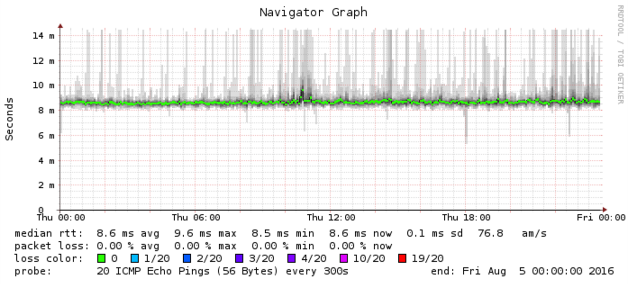
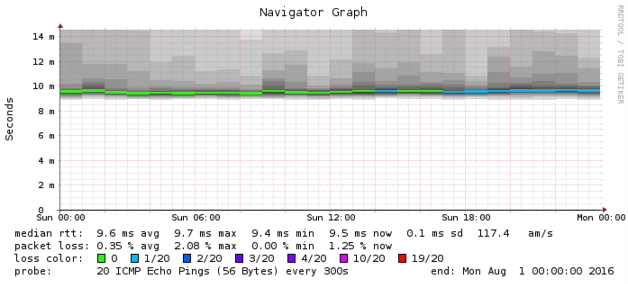 It didn't drop packets at random, though. Some traffic would be
deterministically dropped, such as the parallel A/AAAA DNS lookups generated by
the glibc DNS stub resolver. For instance, in the following
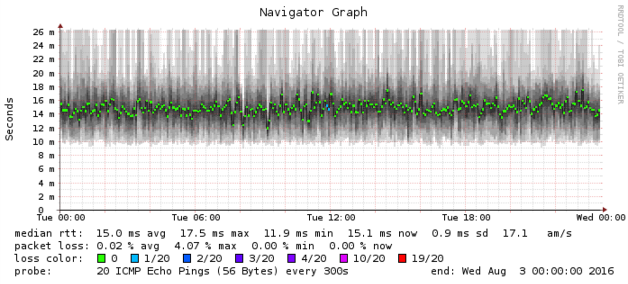 It seemed unlikely that Arris would fix the firmware issues in the SB6190 before
the end of my 30-day return window, so I returned the SB6190 and purchased a
 It's not clear which company is to blame for the problems in the Arris modem.
Looking at the DOCSIS drivers in the SB6190 firmware source reveals copyright
statements from ARRIS Group, Texas Instruments, and Intel. However, I would
recommend avoiding cable modems produced by Arris in particular, and cable
modems based on the Intel Puma SoC in general.
 This package also sees the (third) revision of how config files for pdftex and luatex are structured, since then we have settled down. Hopefully this will close some of the issues that have appeared.
New packages
 Recently somebody reported that my

 I've been funded for two years by the
 Debian LTS
July marked the fifteenth month I contributed to


 For a few years I did not attempt any serious task on the Amazon cloud. It
took me a bit of time to get back my automatisms and adapt myself to the
changes. In particular, the cheapest instances,