Search Results: "sf"

6 March 2007

Marc 'Zugschlus' Haber: Best-of-Mailing-Lists

Mailing lists of big and successful open source projects are these days flooded with clueless requests from newbies which obviously have not spent a second getting acquainted with the tool or with the basics of the underlying protocols. I’m going to publish some of the “best” of these messages in irregular intervals her, tagges with “best-of-mailing-list”. All articles tagged appropriately can be seen as blog entries. There is also an RSS feed.

Christian Perrier: My suspend to disk works again

There are days like this where you get inspiration. Since about January (strange that one cannot never remember the beginning of such annoyances), neither suspend-to-ram nor suspend-to-disk were working anymore on my Dell latitude X1. Suspend to RAM indeed stopped working back in August 2006 for an unknown reason. The laptop indeed goes into sleep mode but, when waking up, the video card is not restored properly. A quite common problem, unfortunately. Why it suddenly stopped working is hard to explainn but as my laptop runs unstable and, usually, the latest Debian kernel, there may be an explanation somewhere betwwen kernel stuff and Xorg stuff. Since then, I had suspend to disk working pretty well until it suddenly stopped working back in January. The system was printing "Snapshotting system" on the screen and that's all. So, since then, I keep my laptop ON all the time, which is pretty bad when travelling (and I travel a lot all day long as I use public transportation with 3 connections morning and evening). Moreover, I cannot even completely close it because some moron at Dell has decided to hardcode in the BIOS that the laptop should enter suspend to RAM when the LID is closed. So, closing the laptop means....no more screen when opening it up. As a consequence, during last weeks, I had my laptop hald-closed in my bag with some random device inserted between the screen and the keyboard to prevent it to be entirely closed. Absolutely stupid. However, this morning, the Holy Grace touched me. I finally remembered that, for last New Year's Eve week-end, I did setup the Conexant HSF modem drivers on the laptop because I was staying at my mom's place with nothing but a phone line to get my mail. And, definitely, this was the explanation. As soon as I unload the Conexant driver before going to suspend to disk mode, the suspend to disk magically works again. Dammit. Once again a proof that Thou Shalt Never Use Non-Free Drivers. I'm now again a happy suspend to disk user. If someone, some day, can bring me back a working suspend to RAM, I'll hug kiss her him to death.

Jeff Bailey: Birth Announcement

The important thing first:

I'm pleased to announce the birth of our child, Leif Alexander Bailey. Leif is a bio-boy, so we've chosen the male pronoun. He was born at 12:41 (-0500) at the Lasalle hospital by cesarean. Angie is recovering from the surgery. Father is stunned, but has learned how to change a diaper and how to cuddle a newborn to sleep.

For those who want it by the numbers: Leif was born 60 hours after the membranes first ruptured (which was significant, but still just a trickle once we saw what water breaking is *really* like, holy crap). After 49 hours, we transfered from the birthing centre to the hospital since labour had stalled (7cm dilation). Angie was in active labour (4 cm dilated) for 39 hours. At the hospital, after 8 hours, the doctor determined that she was fully dilated and encouraged her to push. Labour had stalled (head was transverse), and so the c-section was ordered.

The result - A healthy baby weighing 4660grams/10 pounds, 4 ounces. 55.5 cm long / 22 inches.

Pictures are up on my flickr account at http://www.flickr.com/photos/jbailey/

We're still not answering emails, calls, or taking visitors yet, really. The messages are being received however, and are much appreciated.

5 March 2007

MJ Ray: Bad Tech: CGI Scripts and Line Endings

Brett Parker suggested educating all users about line-endings - sadly, I think there are more users than I have time to educate (even with a web page that makes the basic point, I think there will still be lots of questions) and also, I think stuff on the Windows side should handle their bad decision - they came along last, didn't they? Jon Atkinson commented:
"WinSCP deals with line endings properly, and is free software. It also has a NC-style interface, which I prefer to the Filezilla interface. http://www.winscp.net/"
Thanks. I'll suggest that some users try WinSCP instead of Filezilla. Ben Hutchings commented:
"Version 4 of SFTP introduced the SSH_FXF_TEXT open flag, but OpenSSH is still stuck at version 3."
Why no version 4 in OpenSSH yet, then?

David Nusinow: Because You Probably Don't Track Experimental

Julien Cristau and I have finished putting Xorg 7.2 in to experimental, so have at it! Julien did most of the work on this release, including the server and libs. The transition to git appears to be paying off already, as we're all moving towards running the bleeding edge stuff mainly because it's so easy to do now. This should give us the ability to take a more active role in upstream development. I've already sorta taken on responsibility for some of the upstream documentation (don't ask me how that happened) but now that things are moving I'll be looking to do work in the code as well. I wouldn't be surprised if other XSF members start to do the same.

3 March 2007

Brett Parker: Of CGI Scripts and Line Endings

MJ Ray said in Bad Tech: CGI Scripts and Line Endings, "Problem: CGI scripts uploaded with the MS Windows version of FileZilla over SFTP don't work until converted. Either there's some FileZilla settings wrong by default, or it just doesn't work." - the problem is that unlike with traditional FTP, which in ASCII mode would automagically translate line endings in to a sane format, SFTP (as far as I can tell) will always send them as binary, and thus if they were in DOS format before the transfer, they'll be in DOS format after the transfer. So, your choices are (other than the evil perl^M symlink)... Teach users about line endings - get them to do the equivalent of a :set fileformat=unix in vim before saving ;) (I'm not sure which editors out there let you set what line endings to use - might be worth finding out what the users use and looking it up) When they upload, rather than them uploading directly in to FTP space it hits an area that is checked every x minutes - that area is then copied to the right area with the transformation being done server side Something else.

2 March 2007

MJ Ray: Bad Tech: CGI Scripts and Line Endings

Bad Tech: DOS using different line end character sequences. Problem: CGI scripts uploaded with the MS Windows version of FileZilla over SFTP don't work until converted. Either there's some FileZilla settings wrong by default, or it just doesn't work. Solution: Evilly, I made a perl^M symlink to stop having to convert users' files. Surely there's a better way I'm not seeing?

MJ Ray: Bad Tech Links for 2007-03-02

NTL blocking web sites?
Is ntl blocking access to thepiratebay or was ntl's Norwich cache broken? (Is this ntl Virgin Media now?)
BBC NEWS World Europe Gorbachev wades into piracy row
How not to make friends and influence people, the Microsoft way. With the result that:
BBC NEWS World Europe Piracy case collapses in Russia
Well, that was always going to happen!
Microsoft standards bid faces failure - Computeract!ve
and while I'm grumbling about Microsoft (which I don't do very often, but I may have a pop at Vista in a week or so), here's Open XML failing to get fast-tracked.
Denmark mandates open standards by 2008
...but they've still got friends in Denmark's standards body.
Random thought: Roomba scare
Self-improvement for Vacuum Cleaners! Now that would be bad tech.
This is a multi-part message in MIME format.
I always sign up for plain text if it's available. HTML-only is a big discouragement. HTML with a useless plain text part like that is nearly always deleted unread. Protx, this means you!
VOIP IP Telephony: Skype dumps you BIOS info and sends home!
Yet another way that Skype is evil. See also:
pagetable.com Skype Reads Your BIOS and Motherboard Serial Number
Internet phones have a lot to answer for, including my imminent router upgrade:
Bagel Belly Blog: Future proof
The browser-awkwardness of the current router's web interface is another reason I'm looking at OpenWRT-like replacements.
FastMail.FM weblog: More greylisting details
Greylisting seems good, but xbl is a terrible blacklist. I don't know how it works and it has often listed new ISP mail relays (which were not open relays or exploited). Avoid xbl.
debian.org and SPAM - MadBlog
Using RBLs to trigger greylisting seems like a good idea to me.
Sue them all.
Finally, this would be funny if it wasn't so silly. Advertisers: be careful of your music placements or you might start a bomb scare. Although, musical bombs? Wouldn't that be a bit of a Hollywood film stunt?

28 February 2007

Ian Murdock: How about a Gmail Contacts API?

Since I’m on a Google kick these last few days, let me ask a question I’ve been kicking around in my head for a long time: When are we going to get an API for our Gmail contacts? Like scads of other people, I use Gmail as my primary mail “client” these days, and that means I want things like email autocomplete to work, which means Gmail has to know about my contacts (or at least their email addresses). Gmail actually has a really slick interface to contact management that I’d happily use as my main address book. Trouble is, it’s not synchronized with anything, most importantly my cell phone, where I also want that address book to be available. So, for now, I have to maintain two address books—one in Gmail (with just the email addresses), and one in my phone (with everything else). Invariably, it takes effort to keep them “synchronized”, and I’m not always successful at doing so. I was hopeful that the new “APIs to integrate with existing infrastructure” introduced in Google Apps Premier would finally address this shortcoming—after all, integration with corporate directories would seem to be a feature high on the “must have” list for any enterprise looking at Google. Alas, the APIs appear to only deal with single sign on and account provisioning, and do not appear to do any sort of deeper directory integration. With an API, Plaxo could presumably synchronize contacts between Gmail and phones (and Outlook etc.), or even better, someone could do over the air synchronization. There have certainly been a wave of interesting products doing similar things using the Google Calendar API. I’ve thought about doing a synchronizer with libgmail, by I’m not sure what would happen (e.g., would I somehow trip the “lockdown in sector 4” alarm, which given my reliance on Gmail, would be pretty darned disruptive). Thoughts? Anyone else in a similar situation?

27 February 2007

Meike Reichle: Deutsche Post - when fact beats fiction

Sometimes it happens, that items that are handeled by the German Mail (Deutsche Post) get damaged by their technical installations. When this happens, the item is put into a transparent plastic bag, together with a letter excusing the accident and telling the recipient how to file a request for investigation. So far so good. Unfortunately the envelope that got ripped in that case included two pendants that fell out and got lost. I didn't expect this to be much of a problem, but when I tried to file my request at the mail office it turned out, that there is no form for that kind of incident. The regular form used for requests for investigation assumes that the whole shipment got lost. There is no way to indicate, that it is not an envelope that is missing but merely its content. Trying to exlpain that to the lady there also wasn't successful. Except for repeatedly telling me that I had no right to claim compensation when posting things via regular mail (I know!!) she wasn't of much help. In the end I filled out the form as good as possiblei, gave comments where necessary and the lady promised me I would at least get a confirmation from the service centre. So today, after waiting for more then two weeks I finally got a letter from the service centre. Guess what it said:
"Dear Mister(!) Reichle.
The investigation can not be carried out at the moment, since the information you provided is not complete. Please complete and correct the information according the missing item ..."
And now, guess how I got it. Ripped, in a transparent plastic bag.

Simon Law: Reminder: DemoCamp Montr al 1

DemoCamp Montr al 1
Tuesday 27 February 2007
18:30 20:30
Societ des arts technologiques
1195 boul. St-Laurent
Free admission
( Sign up Upcoming.org Google Maps ) Just a reminder that Montr al's first DemoCamp is happening this evening! We've got five excellent demonstrations lined up, so do sign up and join the fun. You can just come and watch people talk, but it's also a great opportunity to meet people who are interesting and do exciting things. For more information, please see my original post.

Erich Schubert: Driver woes

I always liked pretending that nowadays, there are no driver issues with Linux (well, except for ATI and NVidia not releasing specifications, so for some of their product there are no good drivers available). Well, thats not entirely true. Just these days, I've been running into some driver issues with my Intel hardware; and Intel recently has been the favourite of Linux developers for actually publishing driver source code under a free license. Some details on the driver issues I had: IPW3945 wireless with WPA on dual core. Apparently, there is some kind of race condition in the dual core setup under load, when two interrupts end up being handled by different CPUs. The WPA path probably is a bit slower, I read that theoretically it should also happen with WEP. The effect is as this: when transferring data quickly, e.g. from a local machine on a WPA encrypted network (such as my parents wireless; basic WPA via the common AVM Fritz!Box), it will drop the connection every minute or so, and take another minute to reconnect. Obviously, that makes the wireless rather useless... This is what the errors looked like:
TKIP: ICV error detected: STA=...
N/A: Michael MIC verification failed for MSDU from ... keyidx=0
wifi0: MSDU decryption/MIC verification failed (SA=... keyidx=0)
TKIP: received packet without ExtIV flag from ...
Upgrading to Kernel 2.6.20 turned these errors into something like Firmware bug detected; reconnect already was a bit faster. Upgrading the firmware past the Debian-packaged (in non-free) version to a newer one change them again (I think the ICV error remained) and made the reconnects even faster; still large transfers don't work reliably with WPA. Another reason I upgraded to 2.6.20 was that the microphone didn't work on my Dell 640m. The upgrade helped here, I now can record from my microphone. Every now and then, my system kind of freezes on resume; it seems that some interrupts (especially the keyboard interrupt) remain disabled... I also tried the newer i810-modesetting driver, that should be able to handle the 1440x900 resolution without the aid of i915resolution (which basically overwrites part of the video BIOS to add the resolution to the supported resolutions list). The screen remained black (with both unstable and experimental versions of the driver). Another reason why I was trying this driver is that the current driver has like a default gamma 1.5 for XV, apparently - all XV using apps playback videos way too bright. Even if they don't have an XV gamma control. Well, on the other hand, thats what Windows users might be exposed to every day. 99% of the time, everything works fine for me, too. It just remains open whether 2.6.18 is actually the right kernel to use for the upcoming release... 2.6.20 improved on some of my issues. On the other hand, yaird failed to make a proper initrd for my computer, because CBC (cipher block chaining, a common choice if you encrypt your harddisk) became a module and wasn't added. There are just so many details to iron out when upgrading the kernel... that would pretty much mean an unfreeze, I guess. :-( If we would release more often, that wouldn't be as essential, but for a release interval of two years, we really should have a kernel with few driver issues. And even if we're going to ship newer kernels with "dot releases" of etch, we'll have to avoid issues such as the CBC-module being unknown to yaird.

26 February 2007

Biella Coleman: Critical Mass in Computing

Social Studies of Science just published an article by on the importance of reaching a critical mass for recruiting women to study computer science. Below is the abstract: The Strength of Numbers
Strategies to Include Women into Computer Science
Vivian Anette Lagesen Vivian Anette Lagesen, Norwegian University of Science and Technology (NTNU), Norway, Vivian.Lagesen@hf.ntnu.no This paper investigates four different inclusion strategies used to recruit women to computer science: achieving a critical mass, educational reform, redefining the gendered symbolism of computer science and changing the content of the discipline. The relationship between and the relative importance of these four strategies are explored by looking at the extensive and successful Women and Computing Initiative (WCI) that was run by the Norwegian University of Science and Technology (NTNU), starting in 1996, to recruit and retain more women in computer science. The findings suggest that a direct effort to increase the relative number of women is the most important strategy. While raising the number of women recruited seems to affect the symbolic perception of computer science, this effect is difficult to achieve through attempts to directly change the symbolic image of the discipline. In addition, a substantial increase in the number of women appears to cause an improvement in their learning environment, probably because minority problems such as too much visibility and unwanted attention became less prominent. Key Words: computer science critical mass gender higher education inclusion

23 February 2007

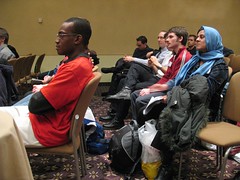
Simon Law: DemoCamp Montr al 1


Audience
Originally uploaded by sfllaw.
There's less than a week before Montr al's next little technology un-conference. DemoCamp Montreal 1 (Fran ais) follows in the footsteps of Toronto's DemoCamp, bringing neat demonstrations to the spotlight. What is DemoCamp? It's a mini-conference where you show up and get to see people present the cool things that they're doing. Be it some software they wrote, a robot they built, or even a live tutorial, there's always something interesting happening. And you need to know. All you have to do is show up. We'll be at the Societ des arts technologiques which has been cool enough to donate their space for us. Just show up on Tuesday 27 February 2007 at 18:30, after putting your name down on the registration list. Don't be shy, it's free! Demonstrations are short, sweet, and PowerPoint slides are forbidden. You get to actually see something happen, which is a much more exciting than your usual conference lecture. In addition, we'll hang out afterwards to shoot the breeze and discuss what we saw. I'll be there with my camera, helping my friends [info]gorbash_dragon and [info]peaceful_dragon run the show. Jonathan Kopanas, who went to Concordia, is coming up to introduce the presenters and Austin Hill is drumming up publicity. DemoCamp Montr al 1
Tuesday 27 February 2007
18:30 20:30
Societ des arts technologiques
1195 boul. St-Laurent
Free admission
( Sign up Upcoming.org Google Maps ) I'll see you there!

MJ Ray: Debian: Links for 2007-02-23

While we're fixing some network problems, here is a musical interlude^W^Wset of links...
Explaining Debian at parties
'Do not try to convince people to try it out or you will become a support hotline. Instead, tell them about LUGs and mailing lists (and how cool it can be) and put the challenge on them: "if you try it, those are your support channels. Are you up for it?"'
Index of /~joerg/templates
Explanations of some common reasons for getting REJECT from ftp-master.
gravityboy: Politics
"If we're going to make interactions between developers more civil and friendly and less personally hostile then we need a different kind of stick. Maybe a carrot of sorts is in order too?"
Consensus and community review in open source and open standards Decentralized Information Group (DIG) Breadcrumbs
'this is quite a stretch with respect to the normal dictionary meaning of "consensus"'
Social Drag
How many Debian Developers are dressed in Social Drag?
debian Gender Research
More research to add to the surveys page
#354950 - ITP: gauche-readline -- A readline-like library for the Gauche Scheme implementation - Debian Bug report logs
Contemplating sponsoring again.
The joys of English cuisine are abomination in God's sight Ted Walther's Private Diary
Blast from debian past: Ted Walther's gullibility for stereotyping is an abomination in God's sight and those foods are hardly typical English. For instance, the only one on his PS list that I've eaten recently is flapjack (not flapjacks, which is something else and not English AFAIK) and I can only remember eating five of the list in the last year. Also, the linked site seems to concentrate on processed pap from multinationals and supermarkets, rather than real trad English food. Example: "Yorkshire puddings are basically a bread type product. You can use them in place of dinner rolls." Why not make 'em a bit harder, cook 'em a bit longer and you can use them for cobbling the street instead? Yorkshire pudding should be a baked batter with a soft middle and a crisp puffy edge. Nothing like bread. And don't get me started about the pasties. Honestly, if you learn about food from such sources, no wonder you'd think it an abomination.
Re: Position Statement to the Dunc-Tanc "experiment"
"had somebody wanted to kill (or inflict maximum damage) to the project, he couldn't have done any better than the current DPL"
Releas-o-meter
Interesting idea - why no cron-run copy on the web?
EUPL v 1.0 revokable ?
One that may appear in a future 'bits from debian-legal' - it seems the EU are popularising a type of termination clause. Yay.
Future of Debian Weekly News
As I hoped, Joey is explicitly calling for sponsorship for DWN production.
DPL 2007, Current Candidates
still don't have a title is keeping a list of DPL candidates, so I won't put one up this year.
#411041 - request for debian-l10n-persian mailing list - Debian Bug report logs
Tell all your persian-speaking friends to show their support!
Interprete I cite, you cite, I rant
Lack of references is a problem on lists like debian-legal where explaining everything again can drive you insane and still not convince some people.
Lucas Nussbaum's Blog State of software for Suspend to RAM/Disk ?
More tips on the "Will I Work Or Not?" suspend problems.
only on debian-devel - she.geek.nz
> Am I mistaken or this is a flame on how to flame ?

20 February 2007

Norbert Tretkowski: New features on our Jabber server

During the last two weeks I spent some time to add a few new features to jabber.lusc.de, the Jabber server of our local Linux User Group. The new features are ICQ, AIM, MSN and IRC transports and a file transfer proxy. Just use the discover service function of your Jabber client to use them. Still on my TODO list are pubsub, pyrss, a user directory and multi user chats.

Benjamin Mako Hill: Novartis, Stop It

Swiss pharmaceutical company Novartis is currently suing the Indian government over its patent law in an effort to further limit production of generic drugs in India. Among other drugs, the company is trying to stop India's production of generic AIDS medicines that supplies more than half of the developing world. M decins Sans Fronti res (MSF) has a great FAQ and bunch of other information on their access to essential medicines (AEM) site that you should check out if you are unfamiliar with the case. Mika has been working on a variety of AEM projects for a while with quite a few important successes. From a certain perspective, some of the core calls for access to knowledge share common ground with free software, free culture, and anti software patent advocacy that I've been involved in. Of course, it puts things in perspective to see Mika and others in the AEM community point to millions of people and say that those people will die because of an IP maximilist position. Last week, I went with Mika to a protest of Novartis near MIT. It was just below freezing, slushy, raining, sleeting, and probably the worst weather I've ever experienced in Cambridge. Despite all that, it was wonderful to join a large group of activists in Cambridge/Boston and around the world to send a strong message to Novartis. You can watch a video of the protest or see a set of photographs. Both were taken by my friend Jay.

15 February 2007

Thijs Kinkhorst: AB+

Yesterday I've made my 38th blood donation. I can heartily recommend it to (almost) everyone. Especially if you are a "simple" full blood donor, it will take at most half an hour, a couple of times a year, at a moment you choose within a two-week interval. Oh, it doesn't really hurt and you get free coffee and sandwiches. If you're in the Netherlands, you can register on line. I think it's an easy way to do some good for society. I'm not a full blood but a plasma donor myself. I have the most rare blood type (AB), which means I can receive all other types but my blood can only be given to the 3% of the population that also has AB. That makes it not quite useful for donation, but it is useful to make medicine out of. During the donation the blood is filtered and only the plasma is kept, all other parts are pumped back into my circulation. This allows for a larger volume of plasma to be donated at a time, but has as a drawback that it needs an appointment and takes longer. The most commonly asked question is whether you get paid. You're not. The reasoning is that this could motivate people to be a bit too positive about their health situation when they need money, and thus could hold back relevant risk information. The selection procedure depends on a reduction of chances. This also leads to homosexuals being completely excluded from donations. While sound from a purely statistical reasoning, it is debatable whether this is fair on an individual level.

Jordi Mallach: Tunisia

Last month, Bel n and I managed to secure our trip to Tunisia on the very last moment. So, planning trips on the very last moment isn't nothing new around this place, but we made a big effort to take things to the limit. I can't remember why exactly, but on January 31 we were *so* close to fucking everything up before it started, when we packed our stuff just a pair of hours before having to leave to the train station. My luggage was prepared in a rush, so while I think I took everything I thought I'd need, I didn't really select my clothes too much. The idea was to have our suitcases mostly empty to bring back stuff from the markets: smoking cachimbas, lamps, leather stuff, etc. At that time I didn't know that would end up being a great strategy. Anyway, like 9 minutes before the train's departure we were stuck in Nuevo Centro without a taxi and at that point I really had lost hope about being on time. For some reason, there were no taxis in the area, when it's normally a place where there's tons of them. Suddenly one appeared, we rushed in and I asked the taxi driver to please fly to the station. Happily, we got an incredible green wave around the avenues, he drove us at like 80 Km/h and we even had to wait for a few minutes at the station. In Barcelona, we prepared our small New Year's Eve dinner with my cousin Laia and Marc, and while the plan was to go to sleep pretty early to be in good shape to go to the airport next morning, the bottles of wine and cava emptied quite fast, and around 4:30 we were quite drunk when we decided it was enough. When some annoying sound woke us up next morning, it was really late, so we again rushed out to the empty streets of Barcelona, sneaked into a regional train, without knowing it was the only way to get in time in El Prat airport, and after some initial confusion trying to find the travel's agency desk in the wrong terminal, we managed to check into our flight, being the very last to do so. With all the rush, I couldn't get some clothes from my suitcase transfered into my hand luggage, which I really wanted to do after my nice lost luggage experience during Debconf 5 in Helsinki. Anyway, chances are small that your luggage gets lost, right? But of course, Murphy is always vigilant, and this was a great opportunity to fuck me up. After a short but horrible (due to our really bad hangover) to Tunis/Carthage airport, we were in the long security/passport check. When Bel n picked up her bag and mine didn't appear, I tried to tell myself hey, it'll appear, no worries! . After 15 minutes, the stupid suitcase was nowhere to be found. Apparently, another two pieces of luggage had the same luck, which made us contact a group of four Uruguayans who were missing one of them. Nothing too terrible; it'll surely come on tomorrow's flight. After reclaiming our lost luggage, we went out to the parking where a bus was waiting for us, and on the way there, the six of us nearly fell into the first Tunisian scam, involving a dude selling jasmine flowers at 2 each. The bus took us down to Jasmine Hammamet, the most touristic place in Tunisia. Valencians might have an easy imagining the atrocity of the area by picturing what twice Marina d'Or plus Benidorm including Terra M tica would look like. Kilometres and kilometres of a disgusting Who can build the most horrible giant hotel right next to the beach contest. So it was pretty clear we had to spend as little time as possible in the area. We soon learned about how transport works in Tunisia. The cheapest is to use the public busses and the luagge collective taxis, we soon found out. Our first morning there, our guide Rejeb, working for Iberojet and Solplan touroperators, gave a talk where he advised us against travelling alone, specially around the South, while he offered organised trips around the country for every day of the week. Although we expected this danger! speech, we decided to book the two day trip to the South and Great South of the country, basically because it was the best way to see many places in a short time, even if it meant having limited time in each destination. We wandered around Jasmine Hammamet and discovered Carthage Land, sort of a Disneyland set in the age of Anibal and Carthage's empire, which was inside a newly built medina complex. This was a really bad place to practice the art of haggling, as the place was so desert, merchants really tried hard to get you buy something. Again, we were close to fucking up after our first negotiation, but we finally decided we weren't so interested. Lucky, we later found out the price was outrageous. Sadly, we spent way too much time in that tourist trap, and we found it was too late to go to the real Hammamet town to see a real medina and real stuff, so we had a long walk around the immense beach until sunset. On Wednesday, we did organise a bit with the Uruguayans and some others we had met: Mar a and Santi Kuchi Kuchy , Cristina and Pedro and an Argentinian family, and managed to hire a van driver to drive us all over the North. For quite a good price, we were taken to a few ruin sites in Carthago, now mostly a residential area, and it was really impressive. While the condition of many of the remainings is not optimal, it was exciting to see things which had been built by Phoenicians and Romans 2,000 years ago. I really enjoyed the remainings of the Antonine thermal baths of the city. It had been a huge building right next to the sea; one of the standing columns helps figuring out how big it had been. Right next to this site, the Presidential Palace dominated the whole gulf. Military places are treated zealously in Tunisia, and it is against the law to take pictures of any bit of it, not even a barbwire of the fence. The Palace had a great Tunisian flag waving over it, and many signs advised you against taking pictures in that direction. I couldn't resist.


The ruins of the Roman Antonine Baths After Carthage, we went to Sidi Bou Said, a small touristic town, which had the peculiarity and beauty of having all windows and doors painted in a beautiful light blue colour. Our last stop for the day was in Tunis, where we visited the most amazing medina of the whole week. Unlike the new medina in Jasmine Hammamet, this one was literally packed with people going up and down the maze of very narrow streets. Every few metres you'd come across a new, attractive smell coming from the few salons de th or spice, leather or perfume shops. Here we finally started developing our haggling skills, and managed to get a few items for reasonable amounts.


Streets of Sidi Bou Said Back at our hotel, everyone tried to get a quick dinner and go early to bed, as next morning we were taking a bus for our trip around the South. There was time to call yet another time to the Airport, to find out that one of the luggage pieces had been found. While there was no news about my suitcase, we shared a taxi to the airport to pick the found suitcase, and see if mine was actually there by any chance. Unluckily, it wasn't, so I wouldn't have any clothes for the desert visit. Some people in the group were kind enough to lend me some t-shirts and pants. For my underwear, I actually resorted to using some of Bel n's (no kidding, it was way too sexy :P), while mine dried up after some manual washing. The alarm clock went off at 5:15 or so, and soon after we were ready in the hall with our small bags. When the bus was ready to pick us up, the guide said we weren't allowed in, as we weren't on the list. WTF? We were nearly the first ones to book and pay for it! So he finally let us in, for a short while, until he realised there was no space for everyone, so he demanded that we got off. Of course, we didn't, and a long and very disgusting argument started between the guide, us and a few people who had seen us pay for our trip, and were trying to support us. To make a long story short, we ended up stepping down when I noticed the bus driver calling the police, and after Rejeb, our guide, told us the other bus would be waiting for us at the travel agency if we quickly took a taxi there. We of course knew that was a fantasy to get the bus moving, but dealing with the police at 6:30AM wasn't on my list of activities for the day, so we finally gave up to let the rest of the people get in time to their visits, as they were very tightly scheduled to make everything fit in two days. Nobody was waiting for us at the travel agency, but we were promised our money back, which did happen in the evening; our plans for Thursday and Friday were a bit broken though, and the rest of the morning was spent looking for alternatives. When we had managed to book a new trip in a different agency for Saturday, we took the bus to Nabeul, the capital of the province, well known for their medina specialised in pottery. In Nabeul, we lived a tourist trap which I found to be quite original. Not having walked 3 metres into the city walls, some young dude stops us and tells us that he knows us, as he works in the restaurant of our hotel . I totally didn't remember his face at all, but why not? So he quickly tells us Nabeul has good carpet workshops, and her sister is working in one which is regulated by the Government, and you can only visit two days a week. Coincidentally, Thursday is one of them! So he literally grabs us by the arm and takes us to one of the streets perpendicular to the main market street, and we enter a carpet shop. To the right, his sister probably being like 45 years older, is knitting a nice carpet on the loom. And a few seconds after, we're taken upstairs, where a Teletienda show starts before us. Without being asked if we want to buy a carpet, some other dude starts to unroll carpets and more carpets before us, talking in some very basic Spanish. While we're offered jasmine tea, which is really nice, Ali the brother quickly excuses himself and vanishes, leaving us with the salesman, which continues unrolling more and more before us, now helped by someone else. When 10 minutes later we convince them that we won't buy any carpet, he asks a donative for his young employee, who has unrolled and will now roll back a zillion carpets. Back in the hotel, we have dinner with a pair of Catalans from our flight, and when we tell us about the carpet place, they tell us they went over the same story like one hour before us! On Friday, we got some advice on other places to visit, and decided to go up to Cape Bon and visit Kerkuan, the only important remainings of a Punic city which, when conquered by the Romans, was destroyed to the grounds, but not rebuilt on top (they were busy with Carthage). Romans did an excellent job when destroying cities, and the result is a site which still lets you see perfectly how a small town (around 1,500) looked like 2,000 years ago.


Ruins of a Kerkuan neighbourhood, with their red bathrooms nearly intact To reach Kerkuan we had taken the bus up to Nabeul and then our first luagge to Kelibia, where we took a taxi (after no less than half an hour arguing in French with the taxi driver to settle on a rate for a ride to Kerkuan and then to the tip of the Cape in El Haouaria. Luagges are undoubtedly the best way to travel medium distances for very little money, while getting mixed with locals. During our ride up North, we chatted with a nursing student from Kelibia who was going back to her town for the weekend. She was really open, like most of the people we found in Tunisia, and we ended up exchanging our post addresses; we still need to send her a postcard from Val ncia soonish. This area wasn't so touristic, so the roads, while totally acceptable, weren't as good as the highway from Tunis to Sfax we were used to. We had seen some bits of the local driving skills , but the luagge driver performed some of the most extreme overtakings I've ever seen. These happened every three of four minutes, so after a while I was actually amused about what was going on. We would overtake two lorries on one go when there was absolutely no visibility; if things went too far, people would just slow down to let the overtaker get back into his lane on time, and those coming ahead would just use their headlamps to make them know it was just a bit too close. The taxi driver, annoyed at us, took us to Kerkuan but didn't wait for us; he immediately left, leaving us without any transportation in the middle of nowhere. After a visit at the site, we walked around 2.5 kilometres back to the main road, where we decided it was too late and risky to continue the journey up to El Haouaria, so we waited on the road gutter for a taxi. The first one which stopped was, to our surprise, the same bastard who left us one hour before, who stopped, laughing at us a little. Luckily some other taxi came by in the correct direction, and soon forgot about that man. After a taxi, luagge and bus ride, we were back in Hammamet, and the desert group had already got back from the two day trip. We were asked over and over what happened, what did we do, etc. People who hadn't talked to us before would come over and see; we were really surprised about the warm welcome we had. After dinner, we improvised a customes party, and many people managed to dress up in Tunisian/arabic fashions using bed sheets and so on. We had to wake up at 5AM next morning, but didn't go to bed until 2AM. Nothing could go wrong this time. We had our tickets, we had confirmed we would be going on Sunday the night before, so at 6:15, our new guide came in, and came straight towards me. He said something in German, and after I told him I spoke absolutely no German, he said huh, well you know the bus is full of Germans, and my indications will be in German? . Pretty incredible, but again a fuckup by the agency. My ticket said, clearly: Sahara safari. Bus + 4x4. (ALL). Turns out ALL meant Allemand, not everything included , although we had requested English pretty clearly. This was quite a minor problem though, after having no clothes for a whole week and having been left behind two days before. I think we were really lucky getting that German group, though. We were only 16 people on the minibus, making the stops a lot faster than the normal ones, where 55 persons need to get out and in of the bus. We had our own Routard guide for Tunisia, so we could read about the places we were about to visit before getting ther. Also, I surprisingly knew much of what our guide was talking about, just missing the details he talked about oil production in Tunisia compared to Spain's, among other topics . When the landscape was becoming drier and drier, Bel n and I spotted something dark far away ahead in the completely straight road. As it became bigger, I started thinking it might be the #1 place to visit for me in Tunisia: El Djem's impressive Roman amphitheatre. When we got off the bus, I was totally excited. Before me, the walls of an incredibly well preserved, huge Roman building; in fact, the best Roman ruins in the whole continent. El Djem's amphitheatre was the third biggest of the Roman empire with 35,000 seats, only surpased by Rome's and Capua's. It remained mostly intact until the 17th century, when some of its stones were used to build the city and some of the treasures taken to the Great Mosque of Kairouan, but when it took more damage was during two consequent wars, when the Turks didn't have many problems to blow part of the wall away using cannons to end up a siege of the city.


The Roman amphitheatre of El Djem The underground tunnels are intact, and it's difficult to not have flashes of Gladiator while walking under the arena's trapdoors. Sadly, there was little time to spend there, and we had to continue the journey after just 45 minutes. I would have spent half of the day there. From here, the landscape truly started to get drier and more desertic. The south of Tunisia is a giant olive field, until you reach the Great South, where it's dry enough that the only thing that grows in the land are rocks. Hours later we arrived in Matm ta, the very famous troglodyte village of small holes in the ground. Although I was curious about being there, watching how organised and massive tourism has destroyed these Berber's ways of life dissapointed me greatly. Our guide stopped the bus in one of the pits, which was decorated with white and light blue. In the first room, an old woman was grinding something in a small, stone mill. The dwellers of the few pits still used by their original inhabitants now make a living by letting people into their homes and getting dinar as a payment for taking photographs. What the woman was doing was just a bit of theatre, part of the show. After this first room, we got into the middle of the pit, which had a series of other passages to some rooms, some of which were simply open so we could get in and have a look. I felt a little bit like violating someone's privacy, and wondered how much the house had changed in the last years.


Inside a troglodyte underground house in Matm ta After our visit, we continued up the mountains of Matm ta, and after going by a giant "WELCOME TO MATMATA" sign drawn in white in the middle of a mountain, Hollywood style (!), we stopped for a brief photo-stop (sic). Indeed, the view was quite impressive, and is universally famous as one of the filming spots of Tatoonie scenes in Star Wars: A New Hope. Speaking of famous places, a few minutes later we stopped at the top of one of the hills, were we'd have lunch in the Hotel Sidi Driss, a place of pilgrimage for Star Wars fans, as it was the troglodyte pit which served as the Skywalker's home. The place is full of references to the film saga, and one of the open pits is full of set pieces stuck into the walls. We were served couscous, which wasn't bad, but was cooked and served in the most genuine fast-food fashion. Everyone there gets couscous to eat, apparently, and it's the same in many other touristic places in the area.


Matm ta's lunar landscape From here, our journey headed straight West, in the middle of the rocky desert, until after some time, you could start to see lines of palm tree branches planted here and there, a sign that rocks would soon disappear, being replaced by sand and dunes. As when we were approaching El Djem, at some point a huge, dark spot appeared on the horizon. Douz, probably named after some 12th French batallion which stayed there, is a small town in the very limit of the Sahara desert, built right next to a huge oasis, exclusively dedicated to palm tree plantations, making dates production a big source of income, along with, of course tourism. The travel agencies use Douz as the starting point for several-day trips into the desert, camel rides and stuff like this. Our guide offered us getting a camel and carriage ride in Tozeus for 20 dinar, but Bel n and I declined. He didn't seem to be too happy about it, and had no problem commenting this in German and Arab with the driver (Spanisch and Spanien were clear to me). We learned that the agency (or the guide) makes around 3 Dinar for everyone who contracts the camel rides, after speaking to one native young kid who worked in the camel place. While our German trip mates got dressed in berber fashion, we opted to walk into the desert and play around in the sand on our own. I discovered a few desert insects which were unlike anything I've seen anywhere, and their diminute trails were all over the dunes. Looking West, the view was astonishing, with only thousands of kilometres of yellow dunes ahead us.


The evening sun over the dunes After they came back, we were taken to our hotel, which was really impressive. After leaving our stuff in our room, we headed back to the desert, which was like 300 metres away, to see the sunset over the Great Dune . There's a street which literally serves as the frontier between the rocky ground and the sand desert. From there, you could see many lines of palm tree branches, which are planted by locals in a futile attempt to stop the inexorable advance of the desert. Women in Douz and other towns in the desert limit spend their days sweeping the entrances to their homes, as sand gets in really fast. A small village next to Douz even had to be abandoned and rebuilt in some other place, with the old one being finally devoured by the dunes. When it got dark, we still had some time to kill before dinner, and we discovered a hammam in our hotel. I got in, and saw there was a bored young man inside. He informed us about the prices, and after some short deliberation, we realised we'd spent half of the camel money in some Arab relaxation; while I got a really cool massage, Bel n enjoyed a Turkish bath. I spoke to the guy for a while, and he said not that many people used that hammam. He actually handed the list of services since 2002, which easily fitted in one piece of paper. People don't know what they are missing; he explained that most of the hotel's clients just showed no interest in the baths. I wonder how Fins or Norwegians would react, given their sauna culture. The dinner and breakfast in that hotel was absolutely awesome, and I actually ate too much to have an easy sleep. Next morning we had to be ready at 5:30. That's pushing my limits. The bus started crossing the Chott Jerid when it was still quite dark. The chotts are dry, salt lakes in the middle of the desert, which during some seasons do get some water, sometimes from the underground. The Chott Jerid is the biggest of the three chotts in the area, and the views are fantastic. It's like a giant, totally flat muddy sea which reflects light creating dangerous mirages of oasis-like dark patterns. Before the construction of the recent road that links Douz and Tozeur, crossing the chott was so risky that many people died in the attempt. We had the unique opportunity to see the sun rise over the salty horizon.


Sunrise at the Chott Jerid Again, on our way to Tozeur, we were offered a carriage ride for ten dinar, and again we declined. The guide then asked us if we had no money or what. So in Tozeur we basically wanted to walk around the oasis fields, and ended up talking most of the time with some old man who sold drums and desert roses. On a 4x4, we went up North to Chebika, a really cool town with a small oasis of thermal water, which I guess was around 40 C. The short walk to the wall where the oasis surfaced was packed with children who insistently begged for money or offered necklaces and other items. It was difficult to make them understand you didn't want anything. We then went up the mountain behind Chebika through a road which had its own piece of history. It seems that during WWII, Rommel suffered an Allied siege in Chebika, with a range of mountains behind their backs. The Allies gave him one month to surrender, and he took his time to answer. During that time, he ordered his engineers to design and build a road which would let them escape Chebika through the steep mountains, and they managed. When the ultimatum expired, the Allies apparently found out Chebika had been abandoned by the Germans, including tanks and most of their equipment. So, on the way up, a few kilometres away from the Algerian border, there was another typical visit to the biggest oasis waterfall in Tunisia, which was several metres high.


The oasis at Chebika Our Sahara trip would soon end, and after lunch we headed Northeast on our way to Hammamet. On our way back, we stopped in Kairouan, one of the key Islam pilgrimace spots, with the Great Mosque as the biggest attraction. Unluckily, as we arrived after lunch, we didn't had a chance to see it. Apparently it is really impressive. We haggled a bit for a pair of babouches and a small leather couch in the medina. We came back to our hotel around 7, and found most of the people around the hall. After the obligatory update on how it went, we went to bed as we were exhausted, and of course we had to get up really early to head to the airport. The airport was at that early time of the morning a total chaos, and while people stood in the checkin lines, I tried to find out what was going on with my still lost luggage. I went back to the lost luggage window, which would be closed for 5 more minutes. When they finally opened, they told me once again they had no clue about what was going on with my luggage. I finally understood they had no clue: my tracking number wasn't in their database. I asked them if I could have a look at the unreclaimed luggage storage room. They kindly opened a small door for me, and invited me to go inside and have a look. The view was gross: hundreds of lost bags all over the place. As I was in a bit of a hurry (I actually had to get back to Barcelona), I asked him where to find the bags of one week ago, and he nearly bursted into laugher. Okay, I had to look all over the place, scanning every piece of luggage in an attempt to spot mine. There were bags of absolutely every type in there. In one of the corridors, I sensed a disgusting smell, and figured out some poor guy may have food or something in one of their lost bags, which was rotting in that horrible room. So wrong: soon after I found myself nearly stepping on a puddle of shit, as if someone had literally dumped it right there. Oh my... luckily my search was nearly over and unsuccessful, and I got back to Barcelona with the hope of finding my bag in El Prat. After looking in their two storage rooms I realised I'd probably not see the luggage again, which is a real pain in the ass. A few hours of train later we were back in Val ncia, with a feeling of having spent 3 or 4 weeks in Tunisia, not just 8 days. Really a great place to visit, not only for their cultural treasures, both current and ancient, but for the openness of their people. I hope I'll be back at some point!

12 February 2007

Ross Burton: GUADEC 2007 Call For Papers

The GNOME Users and Developers European Conference (GUADEC) invite you to participate in the 8th annual conference on the 15-21st July 2007 in Birmingham, England. The deadline for proposals is Monday 12th March. Successful candidates will be selected and notified by the GUADEC organising committee. Unsuccessful candidates will still have an opportunity for their session to be scheduled during the Approach Weekend or After Hours. For more information, and to submit a proposal, please go to http://www.guadec.org/callforpapers.

Next.

Previous.