Search Results: "ron"

14 May 2013

Matthew Palmer: A Modest Vocabulary Proposal

I would like to suggest that the word unprofessional be struck from the dictionary and anyone who uses it struck with a dictionary. It is a word which conveys no useful information or proposal for action, and is thus nothing but meaningless noise. The purpose of communication is to adjust another person s process of cognition. I ve heard it said that all communication is persuasion , which is quite true you re trying to persuade someone to change what they think. We can consider the intention and effectiveness of an attempt to communicate in this light. What is someone trying to achieve when they label a person or behaviour unprofessional ? If we re being charitable, we would probably say that they re trying to highlight that something is bad, or could be better. However, just stamping our foot and saying bad! isn t enough it s also important to provide some information that the recipient can act upon. The problem with the word unprofessional is that it really isn t specific enough on the subject of what is wrong . Have you ever had someone say something like, your behaviour yesterday was really unprofessional ? They re assuming you know what they re talking about and you might well have a reasonable guess but what if you guess wrong? Should you never do anything you did yesterday, just in case that particular thing was unprofessional? When I ve caught myself thinking, that was unprofessional , of my own behaviour, or someone else s, I think about what caused me to think that. Once I drill down into it, I usually come to the conclusion that what I really meant was, I don t like that . Since I m not paid to like things, that s pretty much irrelevant as a reason to tell someone not to do something. On the occasions when I come up with something more concrete, it is invariably a more useful expression than unprofessional . Things like, it frustrates the customer , or it pisses off the person sitting in the next cube are a much better expression of why something is bad than unprofessional . I d encourage everyone to keep a careful watch over themselves and those around them for use of the word. When you catch yourself saying it (or thinking it), examine your motives more closely. Whatever the more specific adjective is, use that instead. If it just comes down to I don t like that , at the very least say that to the person you re talking to. Don t try and hang anything grandiose on your personal prejudices. You might come off as being petty, but at least you ll be honest.

13 May 2013

Jan Wagner: 500 OOPS: vsftpd: refusing to run with writable root inside chroot ()

If you updated recently your system to Debian wheezy and you are using vsftpd with enabled chrooted local users ...
[~] # grep -i  ^chroot_local_user=yes /etc/vsftpd.conf   tail -1
chroot_local_user=YES
... you maybe faced with the following problem:
500 OOPS: vsftpd: refusing to run with writable root inside chroot()
Login failed.
This problem raised already in Bug #656900 and it was fixed by adjusting the documentation. Beside that there maybe configurations you want to relax such a strict check. Unfortunately this feature was implemented in version 3.0.0 which is not part of Debian wheezy:
- Add new config setting "allow_writeable_chroot" to help people in a bit of
a spot with the v2.3.5 defensive change. Only applies to non-anonymous.
The Frontier Group created a patched package of vsftpd for Ubuntu. After reviewing the patch we decided to also create a Debian package for wheezy. You can easily install the package by the following sniplet:
echo "deb http://ftp.cyconet.org/debian wheezy-updates main non-free contrib" >> \
/etc/apt/sources.list.d/wheezy-updates.cyconet.list; \
aptitude update; aptitude install -t wheezy-updates debian-cyconet-archive-keyring vsftpd && \
echo "allow_writeable_chroot=YES" >> /etc/vsftpd.conf && /etc/init.d/vsftpd restart
Updates, in case of bugfixes in Debian wheezy, should be also available through this distribution channel.

12 May 2013

Matthias Klumpp: PackageKit, AppStream and Listaller A status report

I was asked by some people to write a status report about the whole PK/AS/LI stuff sorry guys that it took so much time to write it ;-) . PackageKit (PackageKit is an abstraction layer for package-management systems, allowing applications to access the package-manager using simple DBus calls)Package (with list) PackageKit is an incredibly successful project. With the 0.8.x series, it received many performance improvements, and has now the same speed on my computer than the distribution s native tools. PackageKit is used in almost all major Linux distributions, except for Ubuntu[1]. But even Ubuntu has written some compatibility layer, so most calls to PackageKit will work. The only major distro where PackageKit is currently not available, seems to be Gentoo (and I am not sure about the shape of the Gentoo PackageKit backend too). Debian Wheezy includes PackageKit by default, and in Jessy we are going to replace some distribution-specific tools with PackageKit frontends (mostly the old and unmaintained update-notifier and Software-Updater no worries, we are not going for a Synaptic replacement ;-) (currently this won t be possible with PK anyway)) Unfortunately, some PackageKit backends are still not adjusted for the 0.8.x API and are only running on 0.7.x. This is bad, since 0.8.x is a huge step forward for PackageKit. But the situation is slowly improving, with the latest OpenSUSE release, the Zypper backend is now available on 0.8.x too. Being able to run a PackageKit from the 0.8.x series is a requirement for both AppStream and Listaller. AppStream (AppStream is a cross-distro effort for building Software-Center-like Software Center Logoapplications. It contains stuff like a screenshot-service, ratings&reviews etc. The most important component is a Xapian database, storing information about all available applications in the distribution s repositories. The Xapian DB is distro-agnostik, but distributors need to provide data to fill it. AppStream offers an application-centric way to look at a package database) The AppStream side doesn t look incredibly great, but the situation is improving. As far as I know, OpenSUSE is shipping AppStream XML to generate the database. Ubuntu ships the desktop-files, and I am working on AppStream support in Debian s Archive Kit. On the Fedora side, negotiations with the infrastructure-team are still going on. I haven t heard anything from Mageia and other AppStream participants yet. Unfortunately, at least for OpenSUSE, the AppStream efforts seem to be stalled, due to people having moved to different tasks. But efforts to add the remaining missing things exist. On the software side, Apper (KDE PackageKit frontend) has full support for AppStream. Apper just needs to be compiled with some extra flags to make it use the AppStream database. On the GNOME-side, GNOME-Software is being developed. The tool will make use of the AppStream database, on distributions where it is available. Also, a Software-Center for Elementary and other GTK+-based desktops is being developed, which is based on AppStream (already quite usable!). Using the Ubuntu Software Center on not-Ubuntu-based distributions ist still not much fun, but with the AppStream database available and a working PackageKit 0.8.x with a backend which supports parallel transactions, it is possible to use it. On the infrastructure side: I recently landed some patches in AppStream-Core, which will improve the search function a lot. AppStream-Core contains all tools necessary to generate the AppStream database. It also contains libappstream, a GObject-based library which can be used to access the AppStream database. Also, we discuss dropping PackageKit s internal desktop-file-cache in favour of using the AppStream database. If we do that, we will also add software descriptions to the AppStream db, to improve search results and to speed up search for applications. Because we have to deprecate API for that, I expect this change to happen with PackageKit 0.9.x. As soon as the Freedesktop-Wiki is alive again and my account is re-enabled, I will create compatibility-list, showing which distribution implements what of the PK/AS/LI stuff, especially focusing on components needed for AppStream. Only a few distributions package AppStream-Core so far. Although it is beta-software, creating packages for it and shipping the required data to generate the AppStream database would be a very huge step forward. Listaller (Listaller is a cross-distro 3rd-party software installer, which integrates into Listaller-LogoPackageKit and AppStream. It allows installing 3rd-party applications, which are not part of the distributor s repositories, using standard tools used also for native-package handling. Everything which uses PackageKit can make use of Listaller packages too. Listaller also allows sandboxing of new applications, and uses an AppDir-like approach for installing software.) Listaller is currently undergoing it s last transition before a release with stable API and specifications can be made. Dependency solving will be improved a lot during the current release-cycle, making it less powerful, but working on all distributions instead. (Fedora always had an advantage in dependency-solving, due to RPM providing more package metadata for Listaller to use) This change was delayed due to discussing a possible use of ZeroInstall-feeds to provide missing dependencies with the ZeroInstall team. We did not come to a conclusion about extending the XML, so Listaller will contain an own format to define a dependency, which can reference a ZeroInstall feed. That should be a good solution for everyone. All these changes will result in IPK1.2, a new version of the IPK spec with small changes in the pkoptions file syntax and huge changes in dependency-handling. The new code is slowly stabilizing in a separate branch, and will soon be merged into master. The next Listaller release will be the last one of the 0.5.x series, we will start 0.6.x then. KDE currently has support for Listaller through Apper, which is enabled on a few distributions. In GNOME, optional Listaller support is being developed and will be available in one of the upcoming releases. Currently, to my knowledge, only a few distributions package Listaller. This should improve, so it is easier for application developers to deploy IPK packages. The upcoming changes in KDE and GNOME to build stable developer platforms will help Listaller a lot in finding matching dependencies, and for stuff which only depends on one software frameworks, installations should be a matter of seconds. As you can see, lots of things are happening, and there is improvement in all components related to installing and presenting software on Linux machines. However, all these projects have a severe lack of manpower, especially AppStream and Listaller have the lowest number of developers working on the tools (at time, only two active developers). This is the main reason for the slow development. But I am confident that we will have something shipped in the next distribution releases. At least AppStream should be ready then. [1]: I don t blame Ubuntu for that during the time they wrote an own solution, PackageKit did not have all the required features. (This situation has changed now, fortunately.) NOTE: I might extend this post with feedback from the different distributions, as soon as I get it.

11 May 2013

Petter Reinholdtsen: Debian, the Linux distribution of choice for LEGO designers?

In January, I announced a new IRC channel #debian-lego, for those of us in the Debian and Linux community interested in LEGO, the marvellous construction system from Denmark. We also created a wiki page to have a place to take notes and write down our plans and hopes. And several people showed up to help. I was very happy to see the effect of my call. Since the small start, we have a debtags tag hardware::hobby:lego tag for LEGO related packages, and now count 10 packages related to LEGO and Mindstorms:
brickosalternative OS for LEGO Mindstorms RCX. Supports development in C/C++
leocadvirtual brick CAD software
libnxtutility library for talking to the LEGO Mindstorms NX
lnpddaemon for LNP communication with BrickOS
nbccompiler for LEGO Mindstorms NXT bricks
nqcNot Quite C compiler for LEGO Mindstorms RCX
python-nxtpython driver/interface/wrapper for the Lego Mindstorms NXT robot
python-nxt-filersimple GUI to manage files on a LEGO Mindstorms NXT
scratcheasy to use programming environment for ages 8 and up
t2nsimple command-line tool for Lego NXT
Some of these are available in Wheezy, and all but one are currently available in Jessie/testing. leocad is so far only available in experimental. If you care about LEGO in Debian, please join us on IRC and help adding the rest of the great free software tools available on Linux for LEGO designers.

10 May 2013

Julien Danjou: Rant about Github pull-request workflow implementation

One of my recent innocent tweet about Gerrit vs Github triggered much more reponses and debate that I expected it to. I realize that it might be worth explaining a bit what I meant, in a text longer than 140 characters. <script async="async" charset="utf-8" src="http://platform.twitter.com/widgets.js"></script> The problems with Github pull-requests I always looked at Github from a distant eye, mainly because I always disliked their pull-request handling, and saw no value in the social hype it brings. Why? One click away isn't one click effort The pull-request system looks like an incredible easy way to contribute to any project hosted on Github. You're a click away to send your contribution to any software. But the problem is that any worthy contribution isn't an effort of a single click. Doing any proper and useful contribution to a software is never done right the first time. There's a dance you will have to play. A slowly rhythmed back and forth between you and the software maintainer or team. You'll have to dance it until your contribution is correct and can be merged. But as a software maintainer, not everybody is going to follow you on this choregraphy, and you'll end up with pull-request you'll never get finished unless you wrap things up yourself. So the gain in pull-requests here, isn't really bigger than a good bug report in most cases. This is where the social argument of Github isn't anymore. As soon as you're talking about projects bigger than a color theme for your favorite text editor, this feature is overrated. Contribution rework If you're lucky enough, your contributor will play along and follow you on this pull-request review process. You'll make suggestions, he will listen and will modify his pull-request to follow your advice. At this point, there's two technics he can use to please you. Technic #1: the Topping Github's pull-requests invite you to send an entire branch, eclipsing the fact that it is composed of several commits. The problem is that a lot of one-click-away contributors do not masterize Git and/or do not make efforts to build a logical patchset, and nothing warns them that their branch history is wrong. So they tend to change stuff around, commit, make a mistake, commit, fix this mistake, commit, etc. This kind of branch is composed of the whole brain's construction process of your contributor, and is a real pain to review. To the point I quite often give up. <figure> <figcaption> A typical case: 3 commits to build a 4 lines long file. </figcaption> </figure> Without Github, the old method that all software used, and that many software still use (e.g. Linux), is to send a patch set over e-mail (or any other medium like Gerrit). This method has one positive effect, that it forces the contributor to acknowledge the list of commits he is going to publish. So, if the contributor he has fixup commits in his history, they are going to be seen as first class citizen. And nobody is going to want to see that, neither your contributor, nor the software maintainers. Therefore, such a system tend to push contributors to write atomic, logical and self-contained patchset that can be more easily reviewed. Technic #2: the History Rewriter This is actually the good way to build a working and logical patchset using Git. Rewriting history and amending problematic patches using the famous git rebase --interactive trick. The problem is that if your contributor does this and then repush the branch composing your pull-request to Github, you will both lose the previous review done, each time. There's no history on the different versions of the branch that has been pushed. In the old alternative system like e-mail, no information is lost when reworked patches are resent, obviously. This is far better because it eases the following of the iterative discussions that the patch triggered. Of course, it would be possible for Github to enhance this and fix it, but currently it doesn't handle this use case correctly.. <figure> <figcaption> Exercise for the doubtful readers: good luck finding all revisions of my patch in the pull-request #157 of Hy.</figcaption> </figure> A quick look at OpenStack workflow It's not a secret for anyone that I've been contributing to OpenStack as a daily routine for the last 18 months. The more I contribute, the more I like the contribution workflow and process. It's already well and longly described on the wiki, so I'll summarize here my view and what I like about it. Gerrit To send a contribution to any OpenStack project, you need to pass via Gerrit. This is way simpler than doing a pull-request on Github actually, all you have to do is do your commit(s), and type git review. That's it. Your patch will be pushed to Gerrit and available for review. Gerrit allows other developers to review your patch, add comments anywhere on it, and score your patch up or down. You can build any rule you want for the score needed for a patch to be merged; OpenStack requires one positive scoring from two core developers before the patch is merged. Until a patch is validated, it can be reworked and amended locally using Git, and then resent using git review again. That simple. The historic and the different version of the patches are available, with the whole comments. Gerrit doesn't lose any historic information on your workflow. Finally, you'll notice that this is actually the same kind of workflow projects use when they work by patch sent over e-mail. Gerrit just build a single place to regroup and keep track of patchsets, which is really handy. It's also much easier for people to actually send patch using a command line tool than their MUA or git send-email. Gate testing Testing is mandatory for any patch sent to OpenStack. Unit tests and functionnals test are run for each version of each patch of the patchset sent. And until your patch passes all tests, it will be impossible to merge it. Yes, this implies that all patches in a patchset must be working commits and can be merged on their own, without the entire patchset going in! With such a restricution, it's impossible to have "fixup commits" merged in your project and pollute the history and the testability of the project. Once your patch is validated by core developers, the system checks that there is not any merge conflicts. If there's not, tests are re-run, since the branch you are pushing to might have changed, and if everything's fine, the patch is merged. This is an uncredible force for the quality of the project. This implies that no broken patchset can ever sneak in, and that the project pass always all tests. Conclusion: accessibility vs code review In the end, I think that one of the key of any development process, which is code review, is not well covered by Github pull-request system. It is, along with history integrity, damaged by the goal of making contributions easier. Choosing between these features is probably a trade-off that each project should do carefully, considering what are its core goals and the quality of code it want to reach. I tend to find that OpenStack found one of the best trade-off available using Gerrit and plugging testing automation via Jenkins on it, and I would probably recommend it for any project taking seriously code reviews and testing.

9 May 2013

Benjamin Mako Hill: The Remixing Dilemma: The Trade-off Between Generativity and Originality

This post was written with Andr s Monroy-Hern ndez. It is a summary of a paper just published in American Behavioral Scientist. You can also read the full paper: The remixing dilemma: The trade-off between generativity and originality. It is part of a series of papers I have written with Monroy-Hern ndez using data from Scratch. You can find the others on my academic website.
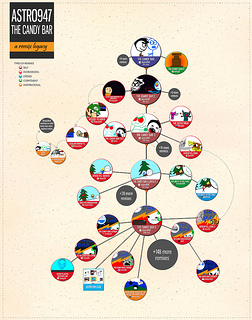
Remixing the reworking and recombination of existing creative artifacts represents a widespread, important, and controversial form of social creativity online. Proponents of remix culture often speak of remixing in terms of rich ecosystems where creative works are novel and highly generative. However, examples like this can be difficult to find. Although there is a steady stream of media being shared freely on the web, only a tiny fraction of these projects are remixed even once. On top of this, many remixes are not very different from the works they are built upon. Why is some content more attractive to remixers? Why are some projects remixed in deeper and more transformative ways?
Remix Diagram
We try to shed light on both of these questions using data from Scratch a large online remixing community. Although we find support for several popular theories, we also present evidence in support of a persistent trade-off that has broad practical and theoretical implications. In what we call the remixing dilemma, we suggest that characteristics of projects that are associated with higher rates of remixing are also associated with simpler and less transformative types of derivatives.

Our study is focused on two interrelated research questions. First, we ask why some projects shared in remixing communities are more or less generative than others. Generativity a term we borrow from Jonathan Zittrain describes creative works that are likely to inspire follow-on work. Several scholars have offered suggestions for why some creative works might be more generative than others. We focus on three central theories:
  1. Projects that are moderately complicated are more generative. The free and open source software motto release early and release often suggests that simple projects will offer more obvious opportunities for contribution than more polished projects. That said, projects that are extremely simple (e.g., completely blank slates) may also uninspiring to would-be contributors.
  2. Projects by prominent creators are more generative. The reasoning for this claim comes from the suggestion that remixing can act as a form of cultural conversation and that the work of popular creators can act like a common medium or language.
  3. Projects that are remixes themselves are more generative. The reasoning for this final claim comes from the idea that remixing thrives through the accumulation of contributions from groups of people building on each other s work.
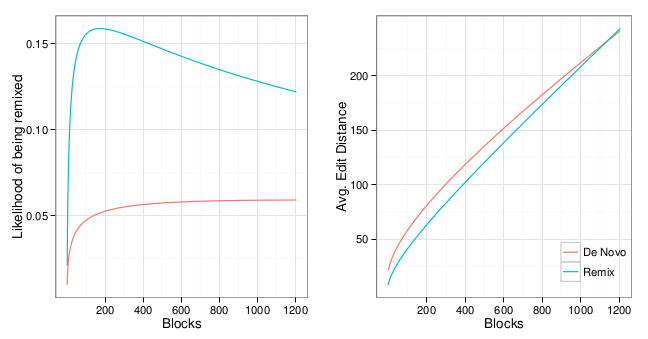
Our second question focuses on the originality of remixes and asks when more or less transformative remixing occurs. For example, highly generative projects may be less exciting if the projects produced based on them are all near-identical copies of antecedent projects. For a series of reasons including the fact that increased generativity might come by attracting less interested, skilled, or motivated individuals we suggest that each of the factors associated with generativity will also be associated with less original forms of remixing. We call this trade-off the remixing dilemma. We answer both of our research questions using a detailed dataset from Scratch, where young people build, share, and collaborate on interactive animations and video games. The community was built to support users of the Scratch programming environment, a desktop application with functionality similar to Flash created by the Lifelong Kindergarten Group at the MIT Media Lab. Scratch is designed to allow users to build projects by integrating images, music, sound, and other media with programming code. Scratch is used by more than a million users, most of them under 18 years old. To test our three theories about generativity, we measure whether or not, as well as how many times, Scratch projects were remixed in a dataset that includes every shared project. Although Scratch is designed as a remixing community, only around one tenth of all Scratch projects are ever remixed. Because more popular projects are remixed more frequently simply because of exposure, we control for the number of times each project is viewed. Our analysis shows at least some support for all three theories of generativity described above. (1) Projects with moderate amounts of code are remixed more often than either very simple or very complex projects. (2) Projects by more prominent creators are more generative. (3) Remixes are more likely to attract remixers than de novo projects. To test our theory that there is a trade-off between generativity and originality, we build a dataset that includes every Scratch remix and its antecedent. For each pair, we construct a measure of originality by comparing the remix to its antecedent and computing an edit distance (a concept we borrow from software engineering) to determine how much the projects differ. We find strong evidence of a trade-off: (1) Projects of moderate complexity are remixed more lightly than more complicated projects. (2) Projects by more prominent creators tend to be remixed in less transformative ways. (3) Cumulative remixing tends to be associated with shallower and less transformative derivatives. That said, our support for (1) is qualified in that we do not find evidence of the increased originality for the simplest projects as our theory predicted.
Two plots of estimated values for prototypical projects. Panel 1 (left) display predicted probabilities of being remixed. Panel 2 (right) display predicted edit distances. Both panels show predicted values for both remixes and de novo projects from 0 to 1,204 blocks (99th percentile).

Two plots of estimated values for prototypical projects. Panel 1 (left) displays predicted probabilities of being remixed. Panel 2 (right) displays predicted edit distances. Both panels show predicted values for both remixes and de novo projects from 0 to 1,204 blocks (99th percentile).

We feel that our results raise difficult but important challenges, especially for the designers of social media systems. For example, many social media sites track and display user prominence with leaderboards or lists of aggregate views. This technique may lead to increased generativity by emphasizing and highlighting creator prominence. That said, it may also lead to a decrease in originality of the remixes elicited. Our results regarding the relationship of complexity to generativity and originality of remixes suggest that supporting increased complexity, at least for most projects, may have fewer drawbacks. As supporters and advocates of remixing, we feel that although highly generative works that lead to highly original derivatives may be rare and difficult for system designers to support, understanding remixing dynamics and encouraging these rare projects remain a worthwhile and important goal. Benjamin Mako Hill, Massachusetts Institute of Technology
Andr s Monroy-Hern ndez, Microsoft Research
For more, see our full paper, The remixing dilemma: The trade-off between generativity and originality. Published in American Behavioral Scientist. 57-5, Pp. 643 663. (Official Link, Pay-Walled ).

Gunnar Wolf: Still more e-voting related rants

Some weeks ago, I contacted Rosa Mart nez, a tech journalist with some questions regarding what I regarded as a trick interview with an e-voting salesman. Well, not only she offered me to publish an answer to that interview, but she also offered me to write another article on a second site she also works with. So, I accepted. Being quite time-deprived, although I managed to send her the first answer quickly, by April 22, I only sent the second article yesterday night. Anyway, the links. The texts are published in Spanish:

8 May 2013

Lior Kaplan: Debian in space

One more step at being the universal operating system: getting Debian to space:
Specifically, the International Space Station astronauts will be using computers running Debian 6.

Filed under: Debian GNU/Linux

Joey Hess: faster dh

With wheezy released, the floodgates are opened on a lot of debhelper changes that have been piling up. Most of these should be pretty minor, but I released one yesterday that will affect all users of dh. Hopefully in a good way. I made dh smarter about selecting which debhelper commands it runs. It can tell when a package does not use the stuff done by a particular command, and skips running the command entirely. So the debian/rules binary of a package using dh will now often look like this:
dh binary
   dh_testroot
   dh_prep
   dh_auto_install
   dh_installdocs
   dh_installchangelogs
   dh_perl
   dh_link
   dh_compress
   dh_fixperms
   dh_installdeb
   dh_gencontrol
   dh_md5sums
   dh_builddeb
Which is pretty close to the optimal hand-crafted debian/rules file (and just about as fast, too). But with the benefit that if you later add, say, cron job files, dh_installcron will automatically start being run too. Hopefully this will not result in any behavior changes, other than packages building faster and with less noise. If there is a bug it'll probably be something missing in the specification of when a command needs to be run. Beyond speed, I hope that this will help to lower the bar to adding new commands to debhelper, and to the default dh sequences. Before, every such new command slowed things down and was annoying. Now more special-purpose commands won't get in the way of packages that don't need them.
The way this works is that debhelper commands can include a "PROMISE" directive. An example from dh_installexamples
# PROMISE: DH NOOP WITHOUT examples
Mostly this specifies the files in debian/ that are used by the command, and whose presence triggers the command to run. There is also a syntax to specify items that can be present in the package build directory to trigger the command to run. (Unfortunatly, dh_perl can't use this. There's no good way to specify when dh_perl needs to run, short of doing nearly as much work as dh_perl would do when run. Oh well.) Note that third-party dh_ commands can include these directives too, if that makes sense.
I'm happy how this turned out, but I could be happier about the implementation. The PROMISE directives need to be maintained along with the code of the command. If another config file is added, they obviously must be updated. Other changes to a command can invalidate the PROMISE directive, and cause unexpected bugs. What would be ideal is to not repeat the inputs of the command in these directives, but instead write the command such that its inputs can be automatically extracted. I played around with some code like this:
$behavior = main_behavior("docs tmp(usr/share/doc/)", sub  
       my $package=shift;
       my $docs=shift;
       my $docdir=shift;
       install($docs, $docdir);
 );
$behavior->($package);
But refactoring all debhelper commands to be written in this style would be a big job. And I was not happy enough with the flexability and expressiveness of this to continue with it. I can however, dream about what this would look like if debhelper were written in Haskell. Then I would have a Debhelper a monad, within which each command executes.
main = runDebhelperIO installDocs
installDocs :: Monad a => Debhelper a
installDocs = do
    docs <- configFile "docs"
    docdir <- tmpDir "usr/share/doc"
    lift $ install docs docdir
To run the command, runDebhelperIO would loop over all the packages and run the action, in the Debhelper IO monad. But, this also allows making an examineDebhelper that takes an action like installDocs, and runs it in a Debhelper Writer monad. That would accumulate a list of all the inputs used by the action, and return it, without performing any side effecting IO actions. It's been 15 years since I last changed the language debhelper was written in. I did that for less gains than this, really. (The issue back then was that shell getopt sucked.) IIRC it was not very hard, and only took a few days. Still, I don't really anticipate reimplementing debhelper in Haskell any time soon. For one thing, individual Haskell binaries are quite large, statically linking all Haskell libraries they use, and so the installed size of debhelper would go up quite a bit. I hope that forthcoming changes will move things toward dynamically linked haskell libraries, and make it more appealing for projects that involve a lot of small commands. So, just a thought experiment for now..

Steve Langasek: Plymouth is not a bootsplash

Congrats to the Debian release team on the new release of Debian 7.0 (wheezy)! Leading up to the release, a meme making the rounds on Planet Debian has been to play a #newinwheezy game, calling out some of the many new packages in 7.0 that may be interesting to users. While upstart as a package is nothing new in wheezy, the jump to upstart 1.6.1 from 0.6.6 is quite a substantial change. It does bring with it a new package, mountall, which by itself isn't terribly interesting because it just provides an upstart-ish replacement for some core scripts from the initscripts package (essentially, /etc/rcS.d/*mount*). Where things get interesting (and, typically, controversial) is the way in which mountall leverages plymouth to achieve this. What is plymouth? There is a great deal of misunderstanding around plymouth, a fact I was reminded of again while working to get a modern version of upstart into wheezy. When Ubuntu first started requiring plymouth as an essential component of the boot infrastructure, there was a lot of outrage from users, particularly from Ubuntu Server users, who believed this was an attempt to force pretty splash screen graphics down their throats. Nothing could be further from the truth. Plymouth provides a splash screen, but that's not what plymouth is. What plymouth is, is a boot-time I/O multiplexer. And why, you ask, would upstart - or mountall, whose job is just to get the filesystem mounted at boot - need a boot-time I/O multiplexer? Why use plymouth? The simple answer is that, like everything else in a truly event-driven boot system, filesystem mounting is handled in parallel - with no defined order. If a filesystem is missing or fails an fsck, mountall may need to interact with the user to decide how to handle it. And if there's more than one missing or broken filesystem, and these are all being found in parallel, there needs to be a way to associate each answer from the user to the corresponding question from mountall, to avoid crossed signals... and lost data. One possible way to handle this would be for mountall to serialize the fsck's / mounts. But this is a pretty unsatisfactory answer; all other things (that is, boot reliability) being equal, admins would prefer their systems to boot as fast as possible, so that they can get back to being useful to users. So we reject the idea of solving the problem of serializing prompts by making mountall serialize all its filesystem checks. Another option would be to have mountall prompt directly on the console, doing its own serialization of the prompts (even though successful mounts / fscks continue to be run in parallel). This, too, is not desirable in the general case, both because some users actually would like to have pretty splash screens at boot time, and this would be incompatible with direct console prompting; and because mountall is not the only piece of software that need to prompt at boot time (see also: cryptsetup). Plymouth: not just a pretty face Enter plymouth, which provides the framework for serializing requests to the user while booting. It can provide a graphical boot splash, yes; ironically, even its own homepage suggests that this is its purpose. But it can also provide a text-only console interface, which is what you get automatically when booting without a splash boot argument, or even handle I/O over a serial console. Which is why, contrary to the initial intuitions of the s390 porters upon seeing this package, plymouth is available for all of Debian's Linux architectures in wheezy, s390 and s390x included, providing a consistent architecture for boot-time I/O for systems that need it - which is any machine using a modern boot system, such as upstart or systemd. Room for improvement Now, having a coherent architecture for your boot I/O is one thing; having a bug-free splash screen is another. The experience of plymouth in Ubuntu has certainly not been bug-free, with plymouth making significant demands of the kernel video layer. Recently, the binary video driver packages in Ubuntu have started to blacklist the framebuffer kernel driver entirely due to stability concerns, making plymouth splash screens a non-starter for users of these drivers and regressing the boot experience. One solution for this would be to have plymouth offload the video handling complexity to something more reliable and better tested. Plymouth does already have an X backend, but we don't use that in Ubuntu because even if we do have an X server, it normally starts much later than when we would want to display the splash screen. With Mir on the horizon for Ubuntu, however, and its clean separation between system and session compositors, it's possible that using a Mir backend - that can continue running even after the greeter has started, unlike the current situation where plymouth has to cede the console to the display manager when it starts - will become an appealing option. This, too, is not without its downsides. Needing to load plymouth when using crypted root filesystems already makes for a bloated initramfs; adding a system compositor to the initramfs won't make it any better, and introduces further questions about how to hand off between initramfs and root fs. Keeping your system compositor running from the initramfs post-boot isn't really ideal, particularly for low-memory systems; whereas killing the system compositor and restarting it will make it harder to provide a flicker-free experience. But for all that, it does have its architectural appeal, as it lets us use plymouth as long as we need to after boot. As the concept of static runlevels becomes increasingly obsolete in the face of dynamic systems, we need to design for the world where the distinction between "booting" and "booted" doesn't mean what it once did.

7 May 2013

Timo Jyrinki: Qt 5 in Debian and Ubuntu, patches upstreaming

PackagesI quite like the current status of Qt 5 in Debian and Ubuntu (the links are to the qtbase packages, there are ca. 15 other modules as well). Despite Qt 5 being bleeding edge and Ubuntu having had the need to use it before even the first stable release came out in December, the co-operation with Debian has gone well. Debian is now having the first Qt 5 uploads done to experimental and later on to unstable. My work contributed to pkg-kde git on the modules has been welcomed, and even though more work has been done there by others, there haven't been drastic changes that would cause too big transition problems on the Ubuntu side. It has of course helped to ask others what they want, like the whole usage of qtchooser. Now with Qt 5.0.2 I've been able to mostly re-sync all newer changes / fixes to my packaging from Debian to Ubuntu and vice versa.

There will remain some delta, as pkg-kde plans to ask for a complete transition to qtchooser so that all Qt using packages would declare the Qt version either by QT_SELECT environment variable (preferable) or a package dependency (qt5-default or qt4-default). As a temporary change related to that, Debian will have a debhelper modification that defaults QT_SELECT to qt4 for the duration of the transition. Meanwhile, Ubuntu already shipped the 13.04 release with Qt 5, and a shortcut was taken there instead to prevent any Qt 4 package breakage. However, after the transition period in Debian is over, that small delta can again be removed.

I will also need to continue pushing any useful packaging I do to Debian. I pushed qtimageformats and qtdoc last week, but I know I'm still behind with some "possibly interesting" git snapshot modules like qtsensors and qtpim.

PatchesMore delta exists in the form of multiple patches related to the recent Ubuntu Touch efforts. I do not think they are of immediate interest to Debian let's start packaging Qt 5 apps to Debian first. However, about all of those patches have already been upstreamed to be part of Qt 5.1 or Qt 5.2, or will be later on. Some already were for 5.0.2.

A couple of months ago Ubuntu did have some patches hanging around with no clear author information. This was a result of the heated preparation for the Ubuntu Touch launches, and the fact that patches flew (too) quickly in place into various PPA:s. I started hunting down the authors, and the situation turned out to be better than I thought. About half of the patches were already upstreamed, and work on properly upstreaming the other ones was swiftly started after my initial contact. Proper DEP3 fields do help understanding the overall situation. There are now 10 Canonical individuals in the upstream group of contributors, and in the last week's sprint it turned out more people will be joining them to upstream their future patches.

Nowadays about all the requests I get for including patches from developers are stuff that was already upstreamed, like the XEmbed support in qtbase. This is how it should be.

One big patch still being Ubuntu only is the Unity appmenu support. There was a temporary solution for 13.04 that forward-ported the Qt 4 way of doing it. This will be however removed from the first 13.10 ('saucy') upload, as it's not upstreamable (the old way of supporting Unity appmenus was deliberately dropped from Qt 5). A re-implementation via QPA plugin support is on its way, but it may be that the development version users will be without appmenu support for some duration. Another big patch is related to qtwebkit's device pixel ratio, which will need to be fixed. Apart from these two areas of work that need to be followed through, patches situation is quite nice as mentioned.
ConclusionFree software will do world domination, and I'm happy to be part of it.

5 May 2013

Michael Banck: 5 May 2013

Debian 7.0 "wheezy" has been released this weekend!

Quite a few new Debichem packages are now available in a stable Debian release for the first time:

Petter Reinholdtsen: Debian Wheezy is out - and Debian Edu / Skolelinux should soon follow! #newinwheezy

When I woke up this morning, I was very happy to see that the release announcement for Debian Wheezy was waiting in my mail box. This is a great Debian release, and I expect to move my machines at home over to it fairly soon. The new debian release contain heaps of new stuff, and one program in particular make me very happy to see included. The Scratch program, made famous by the Teach kids code movement, is included for the first time. Alongside similar programs like kturtle and turtleart, it allow for visual programming where syntax errors can not happen, and a friendly programming environment for learning to control the computer. Scratch will also be included in the next release of Debian Edu. And now that Wheezy is wrapped up, we can wrap up the next Debian Edu/Skolelinux release too. The first alpha release went out last week, and the next should soon follow.

Bits from Debian: Debian 7.0 Wheezy released!

Alt Keep calm and install Wheezy The new stable version of Debian, codenamed Wheezy, is finally here.
Main features of Debian 7.0 Wheezy are multiarch support, specific tools to deploy private clouds, a greatly improved installer and a complete set of multimedia codecs and front-ends which remove the need for third-party repositories.
For a complete list of new features and updated software, take a look at the official announcement. Want to give it a try?
Check out the live images! Want to install it?
Choose your favourite installation media among Blu-ray Discs, DVDs, CDs and USB sticks.
Already a happy Debian user and you only want to upgrade?
You are just an apt-get dist-upgrade away from Wheezy! Find how, reading the installation guide and the release notes. Some useful links:

4 May 2013

Joerg Jaspert: Wheezy release

There was Lenny, there was Squeeze, now there is Wheezy. Another major release of Debian where I had the pleasure to do the ftpmaster work for the release. Like the last times, Mark joined to help with the work. But 2 FTPMasters aren t enough for one Wheezy, or so, so Ansgar had his first run aside from point releases. With the whole load of work the release team did in the past to prepare this, combined with all the changes in dak we had since Squeeze, it turned out to be rather easy for us. Again, a few moments and not a detailed log (times in CEST): Right now (that is, 21:08 CEST) I am mostly waiting for the CD build to finish. Current schedule seems to have that in some two and a half hours, after which we can push the mirrors and our press people announce it. Except if Murphy wants to show up, but lets hope that not. Thanks go out to everyone involved in preparing this release, be it in the past by fixing bugs, uploading packages, doing whatever was needed, as well as doing the work today.

Ian Campbell: Taking over qcontrol upstream, releasing qcontrol 0.5.0

Taking over Qcontrol upstream When I took over the qcontrol package in Debian, back in October 2012, I was aware that upstream hadn't been active for quite a while (since late 2009). I figured that would be OK since the software was pretty simple and pretty much feature complete. Nevertheless since I've been maintaining the package I've had a small number of wishlist bugs (many with patches, thanks guys!) which are really upstream issues. While I could carry them as patches in the Debian package they would really be better taken care of by an upstream. With that in mind I mailed the previous upstream (and original author) Byron Bradley back in February to ask if he would mind if I took over as upstream. Unfortunately I haven't yet heard back, given how long upstream has been inactive for this isn't terribly surprising so having waited several months I have decided to just go ahead and take over upstream development. Thanks Byron for all your work on the project, I hope you don't mind me taking over. Since it is unlikely that I will be able to access the old website or Subversion repository I have converted the repository to git and uploaded it to gitorious: I don't expect I'll be doing an awful lot of proactive upstream development but at least now I have a hat I can put on when someone reports an "upstream" issue against qcontrol and somewhere which can accept upstream patches from myself and others. I'm still deciding what to do about a website etc. I may just enable the gitorious wiki or I may setup an ikiwiki software site type setup, which has the advantage of being a little more flexible and providing a neat way of dealing with bug reports without being too much overhead to setup up. In the meantime its been almost 5 years since the last release, so... New Release: qcontrol 0.5.0 This is a rollup of some changes which were made in the old upstream SVN repository but never released and some patches which had been made in the Debian packaging. What's here corresponds to the Debian 0.4.2+svn-r40-3 package. The 0.4.2 release was untagged in SVN, but corresponds to r14, new stuff since then includes: As well as the change of maintainer I think the addition of the daemon mode warrants the bump to 0.5.0. Get the new release from git or http://www.hellion.org.uk/qcontrol/releases/0.5.0/.

Russ Allbery: Review: Democracy at Work

Review: Democracy at Work, by Richard Wolff
Publisher: Haymarket
Copyright: 2012
ISBN: 1-60846-247-1
Format: Kindle
Pages: 220
I've been reading (mostly on-line) and thinking quite a bit lately about workplace governance models, economic structure, and why the current organization of the US workplace bothers me so intensely, partly triggered by reading John Kenneth Galbraith's The Affluent Society. The economic monoculture has made that process particularly frustrating. It's rare to find a discussion, even in the context of organizational strategies that are considered radical, that avoids the standard frame of productivity and business value. Most discussion is long on tactics and short on strategy and examination of goals. Wolff's appearance on Moyers & Company was a rare breath of fresh air, enough so that I grabbed his book shortly afterwards. Wolff is a Marxian economist (meaning that he makes use of Marxist analysis of economics and capitalism while separating them from Marxist politics and Marx's advocacy of revolutionary socialism), which for me was part of the interest. Marxist thought of any branch is not common in the United States; we're regularly deprived of several sides in the international conversation on economic models. I was taught Marxist theory in elementary and high school (in retrospect, surprisingly even-handedly and well, despite the biases of my schooling), but none of the later developments of Marxist thought. I think that's a typical experience here; in the United States, Marxism culminated in Mao and Stalin, and no further development of the underlying theories is ever mentioned. Democracy at Work is subtitled A Cure for Capitalism and does indeed advocate a concrete alternative to capitalist business structures. But this is only the last third of the book (and in some ways the least useful, as I'll discuss in a moment). The first two-thirds of the book is basically a remedial education in modern, as opposed to historic, Marxian economics for US readers like myself who have never heard it before, cast in the context of the current financial crisis. This may well be old hat for Europeans, but if you've been wondering what (at least some) modern-day Marxists actually believe, or are saying to yourself "there are modern-day Marxists after the collapse of the Soviet Union?", I recommend this book to your attention. It's an excellent summary, which I read with the delightful feeling of an expanding viewpoint and the discovery of new directions from which to look at a problem. There's quite a bit in this section that's worth thinking about, including another take on the nature of the recent economic collapse and how that fits into a Marxian analysis of capitalist crises. But there was one point in Wolff's explanation that I found particularly helpful. He completely restructured my understanding of the Marxian analysis of worker exploitation and profit allocation. There are two angles of Marxist economic thought and socialist economics that get a great deal of attention, at least in the United States, in history and economics classes: the role (or lack thereof) of markets in price setting, and the ownership of the means of production. Defenders of capitalism like to focus on the former, since it's quite easy to identify the advantages of theoretical free markets in finding ideal prices and balancing supply and demand, whereas central planning of prices and production has resulted in some catastrophic and deadly failures. (Although I will note, with passing interest, that those failures predate large-scale computing, and there are now large corporations that manage budgets larger than some countries via centralized command-and-control economic practices.) Defenders of socialism are more likely to focus on the ownership of the means of production, since it's easy to show prima facie unfairness in owners of capital extracting vast profits without having to do any work themselves, only be lucky enough to start with large quantities of money. Wolff, however, argues that both of these focuses misses a core critique by Marx of the workplace structure in capitalism, and that, by ignoring that critique, supposedly Marxist countries did not create anything that was actually Marxist in implementation. The Soviet Union was just as much a capitalist country as the United States is. It was state capitalism rather than private capitalism, but the core capitalist structure was intact. Wolff arrives at this conclusion, which may be well-trodden ground in parts of the world that include active Marxist thought but which was quite startling to this American, by treating the ownership of capital as a partial distraction. He focuses on a more direct question and practical question: who determines what a worker does on a day-to-day basis and how that product is used? Who determines what profits are collected and how they are spent? In private capitalism, this is done by the owners of the capital: large shareholders, major investors, and the managerial class that they hire. In Soviet state capitalism, this is done by national politicians, bureaucrats, and the managerial class that they hire. In neither model is it done by the workers themselves. The Soviet model gives theoretical ownership of the capital to the workers, but that ownership is diffused, centralized, and politicized, redirected through the mechanisms of the state, and therefore is effectively ignored. Ownership and control is entirely captured by the political class. Both of these systems are capitalist in Wolff's view of Marx: there is a class of owners and managers, who control the terms and nature of work and who allocate the profits, and a class of workers, who have to do what they're told, are not paid full value for their labor, and don't have a say in how the profits their work generates are spent. At the most important level of day-to-day autonomy and empowerment, they are functionally identical. They are both equally hierarchical and exploitative; the only difference is in whether the system is controlled by rich individuals or by well-connected politicians. (And, as any study of modern politics quickly reveals, the distinction between those two groups in most countries is murky at best.) Wolff convincingly recasts modern economic history as a constant pendulum swing between private capitalism and state capitalism. Crises in one system push countries towards the other system; subsequent crises push the country back towards the first system. Regulation grows and shrinks, companies are nationalized and then privatized, but both systems are united in excluding the worker from any meaningful control over their work life. The first two-thirds of the book was full of insights like this for me. I didn't agree with all of it, but all of it was worthwhile and thought-provoking. But I was a bit leery of Wolff's proposed solution. My past experience with critics of capitalism is that the critique is often quite compelling, but the proposed solution is much less believable. And, sadly, that concern was warranted here as well. The core of Wolff's proposal is predictable but possibly sound: a restructuring of the workplace to be radically democratic. The business would be owned entirely and exclusively by the people who work for it, equally regardless of the job of the worker, and the workers would decide democratically or via elected repesentatives from among the workers how to allocate the profits of the business, what standards and business practices should be followed, and how the work is to be done. I was particularly interested to hear that this model (workers' self-directed enterprises) has apparently been successful in Spain in the form of the Mondragon Cooperative. Given all the tricky, small details that have to be resolved in an actual workplace, an existence proof is worth more than pounds of theory. Unfortunately, like a lot of proposed alternatives, Wolff's description of WSDEs is quite fuzzy and involves a lot of hand-waving. I was never able to build, from this book, a coherent and complete mental model of how such a workplace would function. Wolff tends to surround every specific in a halo of contingencies, possibilities, and alternative models, and is maddeningly nonspecific on such practical matters as how line management would work, how such a business would do financial planning or project approval, how competing interests in different parts of the organization would be balanced, and other practical governance matters that fill my work life. Maybe the answer to all of that is just "democracy," but I'm dubious. Democracy has a number of well-known flaws that I thought weren't adequately addressed. For example, democracies are often quite happy to further and reinforce existing prejudice (such as sexism or racism), and are prone to yielding control to the most charismatic. Democracies also have an informed voter problem, which seems like it would be particularly acute if democracy is going to make detailed business decisions. And, for larger organizations, control by pre-existing money could re-enter the equation via propaganda and campaigning around votes. Some of this gap in the book could be addressed via a more in-depth look at how Mondragon and any other real-life examples work, but that is sadly missing here. (I am interested enough now, though, that I'd read a good popular treatment of the history and methodology of Mondragon, although I don't think I'm up to working through an academic study.) The hierarchical, dictatorial management structure imposed by capitalism is so awful that WSDEs don't have a particularly high bar to meet to be fairer and more empowering than what we have today. The question, rather, is would they function sufficiently well that the business would be able to make effective decisions, and that's unclear to me from this book. This is, as Wolff spends some time discussing, particularly difficult when in direct competition with capitalist enterprises. This sort of endeavor will probably trade some degree of economic efficiency and raw marketplace power for improvements to fairness and empowerment, but that means it's going to require support from the surrounding society, which is a huge obstacle. I doubt there's a free lunch here: true fairness and equity also leading to improved economic efficiency in a capitalist context is a nice dream, but not horribly practical. Wolff also seems to suffer from something else I associate with Marxist thought: a preferential focus on a very narrowly-defined type of productive worker, apparently left over from Marx's original critique in the context of industrialization. Wolff inserts a very odd and quite awkward distinction in his WSDE model between workers who directly produce the product that's sold, and who in his model therefore produce the profits of the business, and all other workers in the business. He then gives special privileges to the former group to decide how much profit to return in worker compensation and how much to use for other purposes, thus making the supporting workers second-class citizens within this supposedly equal workplace. Speaking as someone who works in IT, and hence would be classified by Wolff into the supporting rather than directly productive category, I do not find this division at all convincing, and Wolff never provides a coherent explanation for why he introduced it. He only says that it's necessary for the governance of the business to not be exploitative, which seems to assume that there is a special economic role played by the workers who work directly on a saleable product. Maybe there is some analysis that could convince me of this, but, if so, it's not present in this book. It struck me as a recipe for continuing the exploitation of the most invisible and powerless workers in capitalism: janitors, groundskeepers, and other low-paid service jobs. I wish the whole book were as insightful and pointed as the first two-thirds, but alas I found the WSDE discussion to be somewhat muddled and utopian. "How do we get there from here" is always the hardest part of this type of discussion, and Wolff has no special skill in that department. But, despite that, I got a lot of fascinating ideas and new conceptual frameworks out of this book, and I'm tempted to read it again. I suspect some of this, similar to my discovery of promises and infinite streams in programming, is filling in of odd gaps in my personal education rather than a discovery of unusual, new ideas. But if you too have gotten your political education within the US capitalism ber alles bubble, this book may fill in similar gaps in your knowledge. If so, it's a very rewarding experience. If you're curious about a preview of Wolff's perspective without paying for the book, I recommend watching the first episode of Moyers & Company in which he appeared. Wolff is a clear and engaging speaker, and his interview provides a good feel for his discussion style and his general perspective. Rating: 8 out of 10

3 May 2013

Soeren Sonnenburg: Shogun Student Applications Statistics for Google Summer of Code 2013

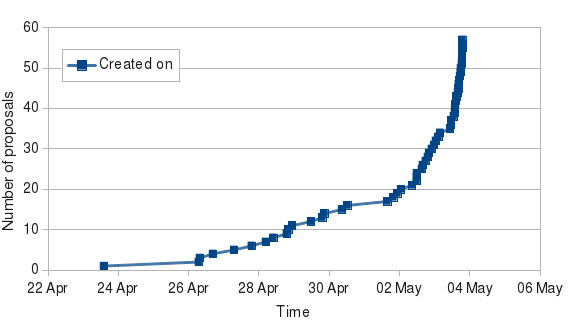
Almost a month has passed since SHOGUN has been accepted for Google Summer of Code 2013. Student application deadline was today (May 6) and shogun received 57 proposals from 52 students. This is quite some increase compared to 2012 (48 applications from 38 students). What is interesting though is that it didn't look that good in the very beginning (see the figure below): Comparing this to 2012, this curve is much more flat in the beginning but exponentially increasing towards the end. Why is that? We didn't change the way we engaged with students (even though we tried to improve the instructions and added lots of entrance tagged tasks to github issues). We still require patches to be submitted to even be considered. So it is similarly tough to get into gsoc 2013 with us as it was in the previous year. What is interesting though is that various organizations complained about a slow uptake in the beginning. And it turns out that google did limit the number of student applications from 20 (last year) to 5 (in 2013). This might explain the shape of the curve: Students are more cautious to apply but once the deadline is near the apply to the maximum of 5 to improve their chances. This goes hand-in-hand with the observation that the quality of newly submitted student applications tends to decrease towards the deadline. So did this new limit hurt? To the contrary! In the end the quality of proposals increased a lot and we were able to even way before the student application deadline start to score/rank students. We are happy to have many very strong candidates this year again. Lets hope we get enough slots to accommodate all of the excellent students and then lets start the fun :)

2 May 2013

Axel Beckert: New web browsers in Wheezy

Since there is so much nice new stuff in Debian Wheezy, I have to split up my contributions to Mika s #newinwheezy game on Planet Debian. Here s the next bunch, this time web browsers:
Dillo Screenshot
dillo
The FLTK-based lightweight GUI web browser Dillo comes with its own rendering engine (no JavaScript, incomplete CSS support) was already in Debian before, but was removed before the release of Debian Squeeze, because Dillo 2 relied on FLTK 2.x which had an unclear license situation back then and never made it into Debian. In the meanwhile Dillo 3 relies on FLTK 1.3 as FLTK upstream abandoned the 2.0 branch and continued development on the 1.3 branch. So I brought Dillo back into Debian with its 3.0.x release.

Netsurf Screenshot
netsurf
The RiscOS-originating lightweight GUI web browser Netsurf was already in Debian, too, but didn t make it into Debian Squeeze as it needed the Lemon parser generator (part of the SQLite source) to build back then and a change in Lemon caused Netsurf to no more build properly in the wrong moment. Netsurf supports CSS 2.1, but has no JavaScript support either. I d consider its rendering engine more complete than Dillo s.

XXXTerm Screenshot
surf and xxxterm
Surf and XXXTerm are both simple and minimalistic webkit-based browsers. Surf is easy to embed in other applications and XXXTerm features vi-like keybindings for heavy keyboard users.
To be continued ;-)

Axel Beckert: New SSH-related stuff in Wheezy

Mika had the nice idea of doing a #newinwheezy game on Planet Debian, so let s join: There are (at least) two new SSH related tools new in Debian Wheezy:
mosh
is the mobile shell , an UDP based remote shell terminal which works better than SSH in case of lag, packet loss or other forms of bad connection. I wrote about mosh in more detail about a year ago. mosh is also available for Debian Squeeze via squeeze-backports.
sshuttle
is somewhere between port-forwarding and VPN. It allows forward arbitrary TCP connections over an SSH connection without the need to configure individual port forwardings. It does not need root access on the server-side either. I wrote about sshuttle in more detail about a year ago.
To be continued ;-)

Next.

Previous.