Search Results: "ms"

1 May 2016

C.J. Adams-Collier: OMG Maven 3.0.4 on stretch

Why? , you might ask, would one want to run something other than the most recent version of Maven on the very newest and fangledest breed of the linux distribution we have all loved for so long. Because! , I might answer, I m trying to get the nexus-apt-plugin working on nexus.fd.io, and the version of nexus we re running there explained to me in quite uncertain terms that it would talk to no other version of maven than 3.0.4 or something else that is not packaged for debian. So I grabbed the source for version 3.0.4 from wheezy and patched it up to work with stretch:
$ cd /usr/src/deb
$ dget http.debian.net/debian/pool/main/m/maven/maven_3.0.4-3+deb7u1.dsc
$ cd maven-3.0.4
$ perl -i -pe 's/(libmodello-maven-plugin)1.4(-java)/$1$2/' debian/control
$ quilt pop -a
$ quild push 1
$ perl -i -pe 's/-1.4.x\.jar/.jar/' build.xml
$ perl -i -pe 's/google-collections/guava/' build.xml
$ perl -i -pe 's/\s+$//' build.xml
$ quilt refresh
$ quilt pop
$ quilt push -a
$ debuild -uc -us
$ sudo apt-get remove maven libmaven3-core-java
$ sudo dpkg -i ../maven_3.0.4-3+deb7u1_all.deb
And now I can build the silly nexus-apt-plugin
$ mkdir -p /usr/src/git/github
$ git clone git@github.com:LLC-Technologies-Collier/nexus-apt-plugin.git /usr/src/git/github/nexus-apt-plugin
$ cd /usr/src/git/github/nexus-apt-plugin
$ mvn compile && mvn -q test

Ben Hutchings: Debian LTS work, April 2016

This month was still quiet for me in terms of uploads, as "wheezy" was only handed over to the LTS team near the end of the month. I carried over 5.5 hours from March and was assigned another 15 hours of work by Freexian's Debian LTS initiative, but only worked a total of 12.25 hours. I have returned the spare hours to the pool. As last month, I prepared a stable update for Linux 3.2 on kernel.org, which will be released soon as 3.2.80. I also triaged the open security issues and backported a few individual patches to our wheezy-security branch. However I expect to rebase the wheezy-security branch onto Linux 3.2.80 before making the next upload. I also participated in discussion of supporting armel/armhf in wheezy LTS. I don't expect many LTS users to be using the Debian kernel packages, as we only supported a small range of ARM hardware before the introduction of the multiplatform flavours in jessie. However, those architectures rarely require any extra effort to support in linux stable updates so I had no objection to including them.

30 April 2016

Chris Lamb: Free software activities in April 2016

Here is my monthly update covering a large part of what I have been doing in the free software world (previously):
Debian My work in the Reproducible Builds project was covered in our weekly reports. (#48, #49, #50, #51 & #52)
Uploads
  • redis (2:3.0.7-3) Adding, amongst some other changes, systemd LimitNOFILE support to allow a higher number of open file descriptors.


FTP Team

As a Debian FTP assistant I ACCEPTed 135 packages: aptitude, asm, beagle, blends, btrfs-progs, camitk, cegui-mk2, cmor-tables, containerd, debian-science, debops, debops-playbooks, designate-dashboard, efitools, facedetect, flask-testing, fstl, ganeti-os-noop, gnupg, golang-fsnotify, golang-github-appc-goaci, golang-github-benbjohnson-tmpl, golang-github-dchest-safefile, golang-github-docker-go, golang-github-dylanmei-winrmtest, golang-github-hawkular-hawkular-client-go, golang-github-hlandau-degoutils, golang-github-hpcloud-tail, golang-github-klauspost-pgzip, golang-github-kyokomi-emoji, golang-github-masterminds-semver-dev, golang-github-masterminds-vcs-dev, golang-github-masterzen-xmlpath, golang-github-mitchellh-ioprogress, golang-github-smartystreets-assertions, golang-gopkg-hlandau-configurable.v1, golang-gopkg-hlandau-easyconfig.v1, golang-gopkg-hlandau-service.v2, golang-objx, golang-pty, golang-text, gpaste, gradle-plugin-protobuf, grip, haskell-brick, haskell-hledger-ui, haskell-lambdabot-haskell-plugins, haskell-text-zipper, haskell-werewolf, hkgerman, howdoi, jupyter-client, jupyter-core, letsencrypt.sh, libbpp-phyl, libbpp-raa, libbpp-seq, libbpp-seq-omics, libcbor-xs-perl, libdancer-plugin-email-perl, libdata-page-pageset-perl, libevt, libevtx, libgit-version-compare-perl, libgovirt, libmsiecf, libnet-ldap-server-test-perl, libpgobject-type-datetime-perl, libpgobject-type-json-perl, libpng1.6, librest-client-perl, libsecp256k1, libsmali-java, libtemplates-parser, libtest-requires-git-perl, libtext-xslate-perl, linux, linux-signed, mandelbulber2, netlib-java, nginx, node-rc, node-utml, nvidia-cuda-toolkit, openfst, openjdk-9, openssl, php-cache-integration-tests, pulseaudio, pyfr, pygccxml, pytest-runner, python-adventure, python-arrayfire, python-django-feincms, python-fastimport, python-fitsio, python-imagesize, python-lib389, python-libtrace, python-neovim-gui, python3-proselint, pythonpy, pyzo, r-cran-ca, r-cran-fitbitscraper, r-cran-goftest, r-cran-rnexml, r-cran-rprotobuf, rrdtool, ruby-proxifier, ruby-seamless-database-pool, ruby-syslog-logger, rustc, s5, sahara-dashboard, salt-formula-ceilometer, salt-formula-cinder, salt-formula-glance, salt-formula-heat, salt-formula-horizon, salt-formula-keystone, salt-formula-neutron, salt-formula-nova, seer, simplejson, smrtanalysis, tiles-autotag, tqdm, tran, trove-dashboard, vim, vulkan, xapian-bindings & xapian-core.

Daniel Stender: What I've worked on for Debian this month

This month I've worked on the following things for Debian: To begin with that, I've set up a Debhelper sequencer script for dh-buildinfo1, this add-on now can be used with dh $@ --with buildinfo in deb/rules instead of having to explicitly call it somewhere in an override. Debops I've set up initial Debian packages of Debops2, a collection of fine crafted Ansible roles and playbooks especially for Debian servers, shipped with a couple of convenience and wrapper scripts in Python3. There are two binary packages, one for the toolset (debops), and the other for the playbooks and roles of the project (debops-playbooks). The application is easy to use, just initialize a new project with debops-init foo and add your server(s) to foo/ansible/inventory/hosts belonging to groups representing services and things you want to employ on them. Like the group [debops_gitlab] automatically installs a complete running Gitlab setup on one or a multitude of servers in the same run with the debops command4. Use other groups like [debops_mariadb_server] accordingly in the same host inventory. Ansible runs agent less, so you don't have to prepare freshly setup servers with nothing special to use that tool randomly (like on localhost). The list of things you could deploy with Debops is quite amazing and you've got dozens of services at your hand. The new packages are currently in experimental because they need some more fine tuning, like there are a couple of minor error messages which recently occur using it, but it works well. The (early staged) documentation unfortunately couldn't be packaged because of the scattered resp. collective nature of the project (all parts have their own Github repositories)5, and also how to generate the upstream tarball remains a bit of a challenge (currently, it's the outcome of debops-init)6. I'll have this package in unstable soon. More info on Debops is coming up, then. Hashicorp's Packer I'm very glad to announce that Packer7 is ready being available in unstable, and the two year old RFP bug could be finally closed8. It's another great and much convenient devops tool which does a lot of different things in an automated fashion using only a single "one-argument" CLI tool in combination with a couple of lines in a configuration script (thanks to Yaroslav Halchenko for the tip). Packer helps creating machine images for different platforms. This is like when you use e.g. Debian installations in a Qemu box for testing or development purposes. Instead of setting up a new virtual machine manually like installing Debian on another computer this process could be automated with Packer, like I've written about in this blog entry here9. You just need a template containing instructions for the included Qemu-builder and a preseeding script for the Debian installer, and there you go drinking your coffee while Packer does all the work for you: downloading the installation ISO image, creating the new virtual harddrive, booting the emulator, running the whole installation process automatically like answering questions, selecting things, rebooting without ISO image to complete the installation etc. A couple of minutes and you have a new pre-baked virtual machine image like from a vendoring machine, a fresh one everytime you need it. Packer10 supports a number of builders for different target platforms (desktop virtualization solutions as much as public cloud providers and private cloud software), can build in parallel, and also the full range of common provisioners can be employed in the process to equip the newly installed OSs. Vagrant boxes could be generated by one of the included postprocessors. I'll write more on Packer here on this blog, soon. There were more then two dozens of packages missing to complete Packer11, which is the achievement of combined forces within the pkg-go group. Much thanks esp. to Alexandre Viau who have worked on the most of the needed new packages. Thanks also to the FTP-masters which were always very quick in reviewing the Go packages, so that it could be proceeded to build and package the sub dependent new ones always consecutively. Squirrel3 I've didn't had the most work with it and just sponsored this for Fabian Wolff, but want to highlight here that there's a new package of Squirrel12 now available in Debian13. Squirrel is a lightweight scripting language, somewhat comparable to Lua. It's fully object-oriented and highly embeddable, it's used in a lot of commerical computer games under the hood for implementing intelligence for bots next to other things14, but also for the Internet of Things (it's embedded in hardware from Electric Imp). Squirrel functions could be called from C++15. I've filed an ITP bug for Squirrel already in 2011 (#651195), but always something else got in the way, and it ended up being an RFP. I'm really glad that it got picked up and completed. misc There were a couple of uploads on updated upstream tarballs and for fixing bugs, namely afl/2.10b-1 and 2.11b-1, python-afl/0.5.3-1, pyutilib/5.3.2-1, pyomo/4.3.11327-1, libvigraimpex/1.10.0+git20160211.167be93dfsg-2 (fix of #820429, thanks for Tobias Frost), and gamera/3.4.2+svn1454-1. For the pkg-go group, I've set up a new package of github-mitchellh-ioprogress (which is needed by the official DigitalOcean CLI tool doctl, now RFP #807956 instead of ITP due to the lack of time - again facing a lot of missing packages), and provided a little patch for dh-make-golang updating some standards16. For Packer I've also updated azure-go-autorest and azure-sdk as team upload (#821938, #821832), but it came out that the project which is currently under heavy development towards a new official release broke a lot in the past weeks (and no Git branching have been used), so that Packer as a matter of fact needed a vendored snapshot, although there have been only a couple of commits in between. Docker-registry hat the same problem with the new package of azure-sdk/2.1.1~beta1, so that it needed to be fixed, too (#822146). By the way, the tool ratt17 comes very handy for automatically test building down all reverse dependencies, not only for Go packages (thanks to Tianon Gravi for the tip). Finally, I've posted the needed reverse depencies as RFP bugs for Terraform18 (again quite a lot), Vuls19, and cve-dictionary20, which is needed for Vuls. I'll let them rest a while waiting to get picked up before working anything down.

Daniel Stender: My work for Debian in April

This month I've worked on the these things for Debian: To begin with that, I've set up a Debhelper sequencer script for dh-buildinfo1, this add-on now can be used with dh $@ --with buildinfo in deb/rules instead of having to explicitly call it somewhere in an override. Debops I've set up initial Debian packages of Debops2, a collection of fine crafted Ansible roles and playbooks especially for Debian servers (servers which run on Debian), which are shipped with a couple of helper and wrapper scripts in Python3. There are two binary packages, one for the toolset (debops), and the other for the playbooks and roles of the project (debops-playbooks). The application is easy to use, just initialize a new project with debops-init foo and add your server(s) to foo/ansible/inventory/hosts belonging to groups representing services and things you want to employ on them. For example, the group [debops_gitlab] automatically installs a complete running Gitlab setup on one or a multitude of servers in the same run with the debops command4. Other groups like [debops_mariadb_server] could be used accordingly in the same host inventory. Ansible works without agent, so you don't have to prepare freshly setup servers with nothing special to use that tool randomly (like on localhost). The list of things you could deploy with Debops is quite amazing and dozens of services are at hand. The new Debian packages are currently in experimental because they need some more fine tuning, e.g. there are a couple of minor error messages which recently occur using it, but it works well. The (early staged) documentation unfortunately couldn't be packaged because of the scattered resp. collective nature of the project (all parts have their own Github repositories)5, and also how to generate the upstream tarball remains a bit of a challenge (currently, it's the outcome of debops-init)6. I'll have this package in unstable soon. More info on Debops is coming up, then. HashiCorp's Packer I'm very glad to announce that Packer7 is ready being available in unstable, and the RFP bug could be finally closed after I've taken it over8. It's another great and much convenient devops tool which does a lot of different things in an automated fashion using only a single "one-argument" CLI tool in combination with a couple of lines in a configuration script (thanks to Yaroslav Halchenko for the tip). Packer helps creating machine images for different platforms. This is like when you use e.g. Debian installations in a Qemu box for testing or development purposes. Instead of setting up a new virtual machine manually the same way as installing Debian on another computer this process can be completely automated with Packer, like I've written about in this blog entry here9. You just need a template which contains instructions for the included Qemu builder and a preseeding script for the Debian installer, and there you go drinking your coffee while Packer does all the work: download the ISO image for installation, create the new virtual harddrive, boot the emulator, run the whole installation process automatically like with answering questions, selecting things, reboot without ISO image to complete the installation etc. A couple of minutes and you have a new pre-baked virtual machine image like from a vendoring machine, another fresh one could be created anytime. Packer10 supports a number of builders for different target platforms (desktop virtualization solutions as much as public cloud providers and private cloud software), can build in parallel, and also the full range of common provisioners can be employed in the process to equip the newly installed OSs with services and programs. Vagrant boxes could be generated by one of the included postprocessors. I'll write more on Packer here on this blog, soon. There were more then two dozens of packages missing to complete Packer11, which is the achievement of combined forces within the pkg-go group. Much thanks esp. to Alexandre Viau who have worked on the most of the needed new packages. Thanks also to the FTP masters which were always very quick in reviewing the Go packages, so that it could be proceeded to build and package the sub dependent new ones always consecutively. Squirrel3 I've didn't had the major work of that and just sponsored this for Fabian Wolff, but want to highlight here that there's a new package of Squirrel12 now available in Debian13. Squirrel is a lightweight scripting language, somewhat comparable to Lua. It's fully object-oriented and highly embeddable, it's used in a lot of commerical computer games under the hood for implementing intelligence for bots next to other things14, but also for the Internet of Things (it's embedded in hardware from Electric Imp). Squirrel functions could be called from C++15. I've filed an ITP bug for Squirrel already in 2011 (#651195), but always something else had a higher priority, and it ended up being an RFP. I'm really glad that it got picked up and completed quickly afterwards. misc There were a couple of uploads on updated upstream tarballs and for fixing bugs, namely afl/2.10b-1 and 2.11b-1, python-afl/0.5.3-1, pyutilib/5.3.2-1, pyomo/4.3.11327-1, libvigraimpex/1.10.0+git20160211.167be93dfsg-2 (fix of #820429, thanks to Tobias Frost), and gamera/3.4.2+svn1454-1. For the pkg-go group, I've set up a new package of github-mitchellh-ioprogress (which is needed by the official DigitalOcean CLI tool doctl, now RFP #807956 instead of ITP due to the lack of time, again a lot of missing packages are missing for that), and provided a little patch for dh-make-golang updating some standards16. For Packer I've also updated azure-go-autorest and azure-sdk as team upload (#821938, #821832), but it came out that the project which is currently under heavy development towards a new official release broke a lot in the past weeks (no Git branching have been used), so that Packer as a matter of fact needed a vendored snapshot, although there have been only a couple of commits in between. Docker-registry has the same problem with the new package of azure-sdk/2.1.1~beta1, so that it needed to be fixed, too (#822146). By the way, the tool ratt17 comes very handy for automatically test building down all reverse dependencies, not only for Go packages (thanks to Tianon Gravi for the tip). Finally, I've posted the needed reverse depencies as RFP bugs for Terraform18 (again quite a lot), Vuls19, and cve-dictionary20, which is needed for Vuls. I'll let them rest a while waiting to get picked up before working anything down.

28 April 2016

Michal Čihař: Weblate 2.6

Going back to faster release cycle, Weblate 2.6 has been just released. There is improved support for Python 3 or brand new HTTP REST API. Full list of changes for 2.6: If you are upgrading from older version, please follow our upgrading instructions. You can find more information about Weblate on https://weblate.org, the code is hosted on Github. If you are curious how it looks, you can try it out on demo server. You can login there with demo account using demo password or register your own user. Weblate is also being used https://hosted.weblate.org/ as official translating service for phpMyAdmin, OsmAnd, Aptoide, FreedomBox, Weblate itself and many other projects. Should you be looking for hosting of translations for your project, I'm happy to host them for you or help with setting it up on your infrastructure. Further development of Weblate would not be possible without people providing donations, thanks to everybody who have helped so far! The roadmap for next release is just being prepared, you can influence this by expressing support for individual issues either by comments or by providing bounty for them.

Filed under: English phpMyAdmin SUSE Weblate 0 comments

Holger Levsen: Voctomix available in Debian sid

Yesterday evening CarlFK prodded me to package Voctomix, which is a live video mixer written by the Chaos Communication Congress' Video Operation Crew. It's written in Python using GStreamer and was started when they realised dvswitch was not suitable anymore for them. The DebConf16 video team plans to test it in Cape Town (for covering the BoF room), so I figured I'd help now with packaging the software. Less than 24h after I started, voctomix made it through NEW and is now available in sid and hopefully will be available in stretch soon too! And by DebConf16 it should also finally be available in jessie-backports. Wheeehooo! Thanks to Stefano Rivera who helped me with some dh_python3 detail and the Debian ftpmasters for letting it though NEW so quickly (and btw, for their general awesome work on NEW processing in the last years too!) - may the winkekatze be with you! ;-)

Dirk Eddelbuettel: RcppRedis 0.1.7

A new release of RcppRedis arrived on CRAN today. And just like for the previous release, Russell Pierce contributed a lot of changes via several pull requests which make for more robust operations. In addition, we have started to add support for MessagePack by relying on our recently-announced RcppMsgPack package.
Changes in version 0.1.7 (2016-04-27)
  • Added support for timeout constructor argument (PR #14 by Russell Pierce)
  • Added new commands exists, ltrim, expire and pexpire along with unit tests (PR #16 by Russell Pierce)
  • Return NULL for empty keys in serialized get for consistency with lpop and rpop (also PR #16 by Russell Pierce)
  • Minor corrections to get code and hget and hset documentation (also PR #16 by Russell Pierce)
  • Error conditions are now properly forwarded as R errors (PR #22 by Russell Pierce)
  • Results from Redis commands are now checked for NULL (PR #23 by Russell Pierce)
  • MessagePack encoding can now be used which requires MessagePackage headers of version 1.0 or later; the (optional) RcppMsgPack package can be used.
Courtesy of CRANberries, there is also a diffstat report for the most recent release. More information is on the RcppRedis page.

This post by Dirk Eddelbuettel originated on his Thinking inside the box blog. Please report excessive re-aggregation in third-party for-profit settings.

27 April 2016

Mike Hommey: Announcing git-cinnabar 0.3.2

Git-cinnabar is a git remote helper to interact with mercurial repositories. It allows to clone, pull and push from/to mercurial remote repositories, using git. Get it on github. These release notes are also available on the git-cinnabar wiki. This is mostly a bug and regression-fixing release. What s new since 0.3.1?

Niels Thykier: auto-decrufter in top 5 after 10 months

About 10 months ago, we enabled an auto-decrufter in dak. Then after 3 months it had become the top 11th remover . Today, there are only 3 humans left that have removed more packages than the auto-decrufter impressively enough, one of them is not even an active FTP-master (anymore). The current score board:
 5371 Luca Falavigna
 5121 Alexander Reichle-Schmehl
 4401 Ansgar Burchardt
 3928 DAK's auto-decrufter
 3257 Scott Kitterman
 2225 Joerg Jaspert
 1983 James Troup
 1793 Torsten Werner
 1025 Jeroen van Wolffelaar
  763 Ryan Murray
For comparison, here is the number removals by year for the past 6 years:
 5103 2011
 2765 2012
 3342 2013
 3394 2014
 3766 2015  (1842 removed by auto-decrufter)
 2845 2016  (2086 removed by auto-decrufter)
Which tells us that in 2015, the FTP masters and the decrufter performed on average over 10 removals a day. And by the looks of it, 2016 will surpass that. Of course, the auto-decrufter has a tendency to increase the number of removed items since it is an advocate of remove early, remove often! .:) Data is from https://ftp-master.debian.org/removals-full.txt. Scoreboard computed as:
  grep ftpmaster: removals-full.txt   \
   perl -pe 's/.*ftpmaster:\s+//; s/\]$//;'   \
   sort   uniq -c   sort --numeric --reverse   head -n10
Removals by year computed as:
 grep ftpmaster: removals-full.txt   \
   perl -pe 's/.* (\d 4 ) \d 2 :\d 2 :\d 2 .*/$1/'   uniq -c   tail -n6
(yes, both could be done with fewer commands)
Filed under: Debian

26 April 2016

Jonathan McDowell: Notes on Kodi + IR remotes

This post is largely to remind myself of the details next time I hit something similar; I found bits of relevant information all over the place, but not in one single location. I love Kodi. These days the Debian packages give me a nice out of the box experience that is easy to use. The problem comes in dealing with remote controls and making best use of the available buttons. In particular I want to upgrade the VDR setup my parents have to a more modern machine that s capable of running Kodi. In this instance an AMD E350 nettop, which isn t recent but does have sufficient hardware acceleration of video decoding to do the job. Plus it has a built in fintek CIR setup. First step was finding a decent remote. The fintek is a proper IR receiver supported by the in-kernel decoding options, so I had a lot of flexibility. As it happened I ended up with a surplus to requirements Virgin V Box HD remote (URC174000-04R01). This has the advantage of looking exactly like a STB remote, because it is one. Pointed it at the box, saw that the fintek_cir module was already installed and fired up irrecord. Failed to get it to actually record properly. Googled lots. Found ir-keytable. Fired up ir-keytable -t and managed to get sensible output with the RC-5 decoder. Used irrecord -l to get a list of valid button names and proceed to construct a vboxhd file which I dropped in /etc/rc_keymaps/. I then added a
fintek-cir * vboxhd
line to /etc/rc_maps.cfg to force my new keymap to be loaded on boot. That got my remote working, but then came the issue of dealing with the fact that some keys worked fine in Kodi and others didn t. This seems to be an issue with scancodes above 0xff. I could have remapped the remote not to use any of these, but instead I went down the inputlirc approach (which is already in use on the existing VDR box). For this I needed a stable device file to point it at; the /dev/input/eventN file wasn t stable and as a platform device it didn t end up with a useful entry in /dev/input/by-id. A quick
udevadm info -a -p $(udevadm info -q path -n /dev/input/eventN)
provided me with the PNP id (FIT0002) allowing me to create /etc/udev/rules.d/70-remote-control.rules containing
KERNEL=="event*",ATTRS id =="FIT0002",SYMLINK="input/remote"
Bingo, a /dev/input/remote symlink. /etc/defaults/inputlirc ended up containing:
EVENTS="/dev/input/remote"
OPTIONS="-g -m 0"
The options tell it to grab the device for its own exclusive use, and to take all scancodes rather than letting the keyboard ones through to the normal keyboard layer. I didn t want anything other than things specifically configured to use the remote to get the key presses. At this point Kodi refused to actually do anything with the key presses. Looking at ~kodi/.kodi/temp/kodi.log I could see them getting seen, but not understood. Further searching led me to construct an Lircmap.xml - in particular the piece I needed was the <remote device="/dev/input/remote"> bit. The existing /usr/share/kodi/system/Lircmap.xml provided a good starting point for what I wanted and I dropped my generated file in ~kodi/.kodi/userdata/. (Sadly it turns out I got lucky with the remote; it seems to be using the RC-5x variant which was broken in 3.17; works fine with the 3.16 kernel in Debian 8 (jessie) but nothing later. I ve narrowed down the offending commit and raised #117221.) Helpful pages included:

Pau Garcia i Quiles: Is KDE the right place for Thunderbird?

For years, Mozilla has been saying they are no longer focused on Thunderbird and its place is outside of Mozilla. Now it seems they are going to act on what they said: Mozilla seeks new home for e-mail client Thunderbird. The candidates they are exploring are the Software Freedom Conservancy, The Document Foundation, and I expect at least the Apache Software Foundation to be a serious candidate, and Gnome to propose. Some voices in KDE say we should also propose the KDE eV as a candidate hosting organization. What follows is my opinion, not the official opinion of the eV or the board s, or the KDE Community s opinion. Take it with a grain (or more) of salt. I am not so sure. I am trying to think what the KDE eV can offer to Mozilla to be appealing to them and if my analysis is correct, we are too far and Thunderbird would pose many risks to the other projects in KDE. (I am blurring the lines between KDE eV , KDE community , KDE Frameworks , etc as it has no relevance for the discussion) Thunderbird is an open source project/product with a lot of commercial users and has (still has?) many paid contributors. IMHO what Mozilla is looking for is an organization with a well-oiled funding machine, able to campaign for money (even if in a tight circle, something like ours Patron program), and accept and process funds in a way that directly benefits Thunderbird. I e. hiring developers to implement X or Y, or work on some area full-time, or at least, half-time. KDE does not work like that. KDE has few commercial users (other than distros, if you want to count them as commercial users). Other than Blue Systems, I don t think we have any developer working for KDE. Also, the eV is not exactly a well-oiled funding machine. We have been talking about that for years. And we do not hire developers directly to work on X or Y (at most, we pay for part of the expenses of sprints). All of that makes me think we are not the right host for Thunderbird. But it does not stop there! Let s say Thunderbird comes to KDE and suddenly we are offered USD 1 M from several organizations who want to be Patrons of Thunderbird , or influence Thunderbird, or whatever. First problem: do we allow funds to go to a specific project rather than the eV deciding how to distribute them? AFAIK we do not allow that and at least one KDE sub-project has had trouble with that in the past. Then there is the thing about Patrons of Thunderbird : no such thing. Either you are a Patron of KDE, including Plasma Mobile, OwnCloud, and whatnot, or you are nothing. You cannot be a Patron of Partial KDE, namely Thunderbird . Influencing, did I say? The eV is by its own rules not an influencer on KDE s direction, just an entity to provide legal and economic support. Quite the opposite from what Mozilla does today for Thunderbird. Even if funders would not mind all that, there is the huge risk this poses for all the other projects. With as little as USD 200K donated towards Thunderbird (and USD 200K is not much for a product with so many commercial users, which means a healthy ecosystem of companies making money on support, development, etc, and thus donating to somehow influence or be perceived as important players), Thunderbird becomes the most important project in KDE. How would we manage this? In any sensible organization, Thunderbird would become the main focus and all the other KDE projects would be relegated. Even if we decide not to, external PR would make that look like it happened. For all those reasons, I think KDE is not the right place for Thunderbird at the moment. It would require a big change in what the eV can do and how it operates. And that change may be for good but it s not there now and it will not be by the time Mozilla has to decide if KDE is the right place. All that, and I have not even talked about technology and what any sensible Thunderbird customer would think today: what is the medium and long-term roadmap? Migrate Thunderbird users to Kontact/KDE PIM? Port Thunderbird to Qt + KF5, maybe including moving to QtWebEngine? Will Windows support be deteriorated by that change? Or maybe the plan is to cancel KMail and Akregator? Those are second-thoughts, unimportant right now. Update If you want to contribute to the discussion, please join the KDE-Community mailing list.

Niels Thykier: Putting Debian packages in labelled boxes

Lintian 2.5.44 was released the other day and (to most) the most significant bug fix was probably that Lintian learned about Policy 3.9.8. I would like to thank Axel Beckert for doing that. Notably it also made me update the test suite so to make future policy releases less painful. For others, it might be the fact that Lintian now accepts (valid) versioned provides (which seemed prudent now that Britney accepts them as well). Newcomers might appreciate that we are giving a much more sensible warning when they have extra spaces in their changelog sign off line (rather than pretending it is an improper NMU). But I digress What I am here to talk about is that Lintian 2.5.44 started classifying packages based on various facts or properties , we can determine. Therefore: Here are some of the labelled boxes your packages will be put into[0]: The tags themselves are (as mentioned) mere classifications and their primary purpose is to classify or measure certain properties. With them any body can download the data set and come with some bold statement about Debian packages (hopefully without relying too much on lies, damned lies and statistics ). Lets try that immediately! In the next release, we will also add tracking of auto-generated snippets from dh_*-tools. Currently unversioned, but I hope to add versioning to that so we can find and rebuild packages that have been built with buggy autoscripts (like #788098) If you want to see the classification tags for your package, please run lintian with like this:
# Add classification tags
$ lintian -L +classification <pkg-or-changes>
# Or if you want only classification tags$ lintian -L =classification <pkg-or-changes>
Please keep in mind that classification tags ( C ) are not issues in themselves. Lintian is simply attempting to add a visible indicator about a given fact or property in the package nothing more, nothing less. Future work help (read: patches) welcome: [0] Mind you, the reporting framework s handling of these tags could certainly be improved. [1] Please note how it distinguishes 1.0 into native and non-native based on whether the package has a diff.gz. Presumably that can be exploited somehow [2] Disclaimer: At the time of writing, only ~80% of the archive have been processed. This is computed as: NS / (NS + WS), where NS and WS are the number of unique packages with the tags no-ctrl-scripts and ctrl-script respectively. [3] or maybe not, but we got two packages classified as using both CDBS and the dh-sequencer. I have not looked at it in detail. For the curious: libmecab-java and ctioga2.
Filed under: Debian, Lintian

Matthias Klumpp: Why are AppStream metainfo files XML data?

This is a question raised quite quite often, the last time in a blogpost by Thomas, so I thought it is a good idea to give a slightly longer explanation (and also create an article to link to ). There are basically three reasons for using XML as the default format for metainfo files: 1. XML is easily forward/backward compatible, while YAML is not This is a matter of extending the AppStream metainfo files with new entries, or adapt existing entries to new needs. Take this example XML line for defining an icon for an application:
<icon type="cached">foobar.png</icon>
and now the equivalent YAML:
Icons:
  cached: foobar.png
Now consider we want to add a width and height property to the icons, because we started to allow more than one icon size. Easy for the XML:
<icon type="cached" width="128" height="128">foobar.png</icon>
This line of XML can be read correctly by both old parsers, which will just see the icon as before without reading the size information, and new parsers, which can make use of the additional information if they want. The change is both forward and backward compatible. This looks differently with the YAML file. The foobar.png is a string-type, and parsers will expect a string as value for the cached key, while we would need a dictionary there to include the additional width/height information:
Icons:
  cached: name: foobar.png
          width: 128
          height: 128
The change shown above will break existing parsers though. Of course, we could add a cached2 key, but that would require people to write two entries, to keep compatibility with older parsers:
Icons:
  cached: foobar.png
  cached2: name: foobar.png
          width: 128
          height: 128
Less than ideal. While there are ways to break compatibility in XML documents too, as well as ways to design YAML documents in a way which minimizes the risk of breaking compatibility later, keeping the format future-proof is far easier with XML compared to YAML (and sometimes simply not possible with YAML documents). This makes XML a good choice for this usecase, since we can not do transitions with thousands of independent upstream projects easily, and need to care about backwards compatibility. 2. Translating YAML is not much fun A property of AppStream metainfo files is that they can be easily translated into multiple languages. For that, tools like intltool and itstool exist to aid with translating XML using Gettext files. This can be done at project build-time, keeping a clean, minimal XML file, or before, storing the translated strings directly in the XML document. Generally, YAML files can be translated too. Take the following example (shamelessly copied from Dolphin):
<summary>File Manager</summary>
<summary xml:lang="bs">Upravitelj datoteka</summary>
<summary xml:lang="cs">Spr vce soubor </summary>
<summary xml:lang="da">Filh ndtering</summary>
This would become something like this in YAML:
Summary:
  C: File Manager
  bs: Upravitelj datoteka
  cs: Spr vce soubor 
  da: Filh ndtering
Looks manageable, right? Now, AppStream also covers long descriptions, where individual paragraphs can be translated by the translators. This looks like this in XML:
<description>
  <p>Dolphin is a lightweight file manager. It has been designed with ease of use and simplicity in mind, while still allowing flexibility and customisation. This means that you can do your file management exactly the way you want to do it.</p>
  <p xml:lang="de">Dolphin ist ein schlankes Programm zur Dateiverwaltung. Es wurde mit dem Ziel entwickelt, einfach in der Anwendung, dabei aber auch flexibel und anpassungsf hig zu sein. Sie k nnen daher Ihre Dateiverwaltungsaufgaben genau nach Ihren Bed rfnissen ausf hren.</p>
  <p>Features:</p>
  <p xml:lang="de">Funktionen:</p>
  <p xml:lang="es">Caracter sticas:</p>
  <ul>
  <li>Navigation (or breadcrumb) bar for URLs, allowing you to quickly navigate through the hierarchy of files and folders.</li>
  <li xml:lang="de">Navigationsleiste f r Adressen (auch editierbar), mit der Sie schnell durch die Hierarchie der Dateien und Ordner navigieren k nnen.</li>
  <li xml:lang="es">barra de navegaci n (o de ruta completa) para URL que permite navegar r pidamente a trav s de la jerarqu a de archivos y carpetas.</li>
  <li>Supports several different kinds of view styles and properties and allows you to configure the view exactly how you want it.</li>
  ....
  </ul>
</description>
Now, how would you represent this in YAML? Since we need to preserve the paragraph and enumeration markup somehow, and creating a large chain of YAML dictionaries is not really a sane option, the only choices would be: In both cases, we would loose the ability to translate individual paragraphs, which also means that as soon as the developer changes the original text in YAML, translators would need to translate the whole bunch again, which is inconvenient. On top of that, there are no tools to translate YAML properly that I am aware of, so we would need to write those too. 3. Allowing XML and YAML makes a confusing story and adds complexity While adding YAML as a format would not be too hard, given that we already support it for DEP-11 distro metadata (Debian uses this), it would make the business of creating metainfo files more confusing. At time, we have a clear story: Write the XML, store it in /usr/share/metainfo, use standard tools to translate the translatable entries. Adding YAML to the mix adds an additional choice that needs to be supported for eternity and also has the problems mentioned above. I wanted to add YAML as format for AppStream, and we discussed this at the hackfest as well, but in the end I think it isn t worth the pain of supporting it for upstream projects (remember, someone needs to maintain the parsers and specification too and keep XML and YAML in sync and updated). Don t get me wrong, I love YAML, but for translated metadata which needs a guarantee on format stability it is not the ideal choice. So yeah, XML isn t fun to write by hand. But for this case, XML is a good choice.

Michal &#268;iha&#345;: Weekly phpMyAdmin contributions 2016-W16

Last week was again focused on bug fixing due to increased amount of received bug reports on 4.6.0 release. Fortunately most of the annoying bugs are already fixed in git and will be soon released as 4.6.1. Another bigger task which was started last week was wiki migration. So far we've been using own wiki running MediaWiki and we're migrating it to GitHub wiki. The wiki on GitHub is way simpler, but it seems as better choice for us. During the migration all user documentation will be merged into our documentation, so that it's all in one place and wiki will be targeted on developers. Handled issues:

Filed under: English phpMyAdmin 2 comments

Reproducible builds folks: Reproducible builds: week 52 in Stretch cycle

What happened in the Reproducible Builds effort between April 17th and April 23rd 2016: Toolchain fixes Thomas Weber uploaded lcms2/2.7-1 which will not write uninitialized memory when writing color names. Original patch by Lunar. The GCC 7 development phase has just begun, so Dhole reworked his patch to make gcc use SOURCE_DATE_EPOCH if set which prompted interesting feedback, but it has not been merged yet. Alexis Bienven e submitted a patch for sphinx to strip Python object memory addresses from the generated documentation. Packages fixed The following packages have become reproducible due to changes in their build dependencies: cobertura, commons-pool, easymock, eclipselink, excalibur-logkit, gap-radiroot, gluegen2, jabref, java3d, jcifs, jline, jmock2, josql, jtharness, libfann, libgroboutils-java, libjemmy2-java, libjgoodies-binding-java, libjgrapht0.8-java, libjtds-java, liboptions-java, libpal-java, libzeus-jscl-java, node-transformers, octave-msh, octave-secs2d, openmama, rkward. The following packages have become reproducible after being fixed: Patches submitted that have not made their way to the archive yet: tests.reproducible-builds.org diffoscope development diffoscope 52 was released with changes from Mattia Rizzolo, h01ger, Satyam Zode and Reiner Herrmann, who also did the release. Notable changes included: As usual, diffoscope 52 is available on Debian, Archlinux and PyPI, other distributions will hopefully soon update. Package reviews 28 reviews have been added, 11 have been updated and 94 have been removed in this week. 14 FTBFS bugs were reported by Chris Lamb (one being was a duplicate of a bug filed by Sebastian Ramacher an hour earlier). Misc. This week's edition was written by Lunar, Holger 'h01ger' Levsen and Chris Lamb and reviewed by a bunch of Reproducible builds folks on IRC.

Rhonda D'Vine: Prince

Last week we lost another great musician, song writer, artist. It's painful to realise that more and more of the people you grew up with aren't there anymore. We lost Prince, TAFKAP, Symbol, Prince. He wrote a lot of great music, even some you wouldn't attribute to him, like Sinead O'Connor's Nothing Compares To You, Bangles' Manic Monday or Chaka Khan's I Feel For You. But I actually would like to share some songs that are also performed by himself, so without further ado here are the songs: Rest in peace, Prince. And you, enjoy.

/music permanent link Comments: 0 Flattr this

Steinar H. Gunderson: Full stack

As I'm nearing the point where Nageru, my live video mixer, can produce a stream directly that is actually suitable to streaming directly to clients (without a transcoding layer in the chain), it struck me the other day how much of the chain I've actually had to touch: In my test setup, the signal comes into a Blackmagic Intensity Shuttle. At some point, I found what I believe is a bug in the card's firmware; I couldn't fix it, but a workaround was applied in the Linux kernel. (I also have some of their PCI cards, in which I haven't found any bugs, but I have found bugs in their drivers.) From there, it goes into bmusb, a driver I wrote myself. bmusb uses libusb-1.0 to drive the USB card from userspace but for performance and stability reasons, I patched libusb to use the new usbfs zerocopy support in the Linux kernel. (The patch is still pending review.) Said zerocopy support wasn't written by me, but I did the work to clean up the support and push it upstream (it's in the 4.6-rc* series). Once safely through bmusb, it goes of course into Nageru, which I wrote myself. Nageru uses Movit for pixel processing, which I also wrote myself. Movit in turn uses OpenGL; I've found bugs in all three major driver implementations, and fixed a Nageru-related one in Mesa (and in the process of debugging that, found bugs in apitrace, a most useful OpenGL debugger). Sound goes through zita-resampler to stretch it ever so gently (in case audio and video clocks are out of sync), which I didn't wrote, but patched to get SSE support (patch pending upstream). So now Nageru chews a bit on it, and then encodes the video using x264 (that's the new part in 1.3.0 of course, you need a fast CPU to do that as opposed to using Quick Sync). I didn't write x264, but I had to redo parts of the speedcontrol patch (not part of upstream; awaiting review semi-upstream) because of bugs and outdated timings, but I also found a bug in x264 proper (fixed by upstream, pending inclusion). Muxing is done through ffmpeg, where I actually found multiple bugs in the muxer (some of which are still pending fixes). Once the stream is safely encoded and hopefully reasonably standards-conforming (that took me quite a while), it goes to Cubemap, which I wrote, for reflection to clients. For low-bitrate clients, it takes a detour through VLC to get a re-encode on a faster machine to lower bitrate I've found multiple bugs in VLC's streaming support in the past (and also fixed some of them, plus written the code that interacts with Cubemap). From there it goes to any of several clients, usually a browser. I didn't write any browsers (thank goodness!), but I wrote the client-side JavaScript that picks the closest relay, and the code for sending it to a Chromecast. I also found a bug in Chrome for Android (will be fixed in version 50 or 51, although the fix was just about turning on something that was already in the works), and one in Firefox for Linux (fixed by patching GStreamer's MP4 demuxer, although they've since switched away from that to something less crappy). IE/Edge also broke at some point, but unfortunately I don't have a way to report bugs to Microsoft. There's also at least one VLC bug involved on the client side (it starts decoding frames too late if they come with certain irregular timestamps, which causes them to drop), but I want to verify that they still persist even after the muxer is fixed before I go deep on that. Moral of the story: If anyone wants to write a multimedia application and says I'll just use <framework, language or library XYZ>, and I'll get everything for free; I just need to click things together! , they simply don't know what they're talking about and are in for a rude awakening. Multimedia is hard, an amazing amount of things can go wrong, complex systems have subtle bugs, and there is no silver bullet.

Matthias Klumpp: A GNOME Software Hackfest report

Two weeks ago was the GNOME Software hackfest in London, and I ve been there! And I just now found the time to blog about it, but better do it late than never  . Arriving in London and finding the Red Hat offices After being stuck in trains for the weekend, but fortunately arriving at the airport in time, I finally made it to London with quite some delay due to the slow bus transfer from Stansted Airport. After finding the hotel, the next issue was to get food and a place which accepted my credit card, which was surprisingly hard in defence of London I must say though, that it was a Sunday, 7 p.m. and my card is somewhat special (in Canada, it managed to crash some card readers, so they needed a hard-reset). While searching for food, I also found the Red Hat offices where the hackfest was starting the next day by accident. My hotel, the office and the tower bridge were really close, which was awesome! I have been to London in 2008 the last time, and only for a day, so being that close to the city center was great. The hackfest didn t leave any time to visit the city much, but by being close to the center, one could hardly avoid the London experience  . Cool people working on great stuff towerbridge2016That s basically the summary for the hackfest  . It was awesome to meet with Richard Hughes again, since we haven t seen each other in person since 2011, but work on lots of stuff together. This was especially important, since we managed to solve quite some disagreements we had over stuff Richard even almost managed to make me give in to adding <kudos/> to the AppStream spec, something which I was pretty against supporting (it didn t make it yet, but I am no longer against the idea of having that the remaining issues are solvable). Meeting Iain Lane again (after FOSDEM) was also very nice, and also seeing other people I ve only worked with over IRC or bug reports (e.g. William, Kalev, ) was great. Also lots of new people were there, like guys from Endless, who build their low-budget computer for developing/emerging countries on top of GNOME and Linux technologies. It s pretty cool stuff they do, you should check out their website! (they also build their distribution on top of Debian, which is even more awesome, and something I didn t know before (because many Endless people I met before were associated with GNOME or Fedora, I kind of implicitly assumed the system was based on Fedora  )). The incarnation of GNOME Software used by endless looks pretty different from what the normal GNOME user sees, since it s adjusted for a different audience and input method. But it looks great, and is a good example for how versatile GS already is! And for upstream GNOME, we ve seen some pretty great mockups done by Endless too I hope those will make it into production somehow.

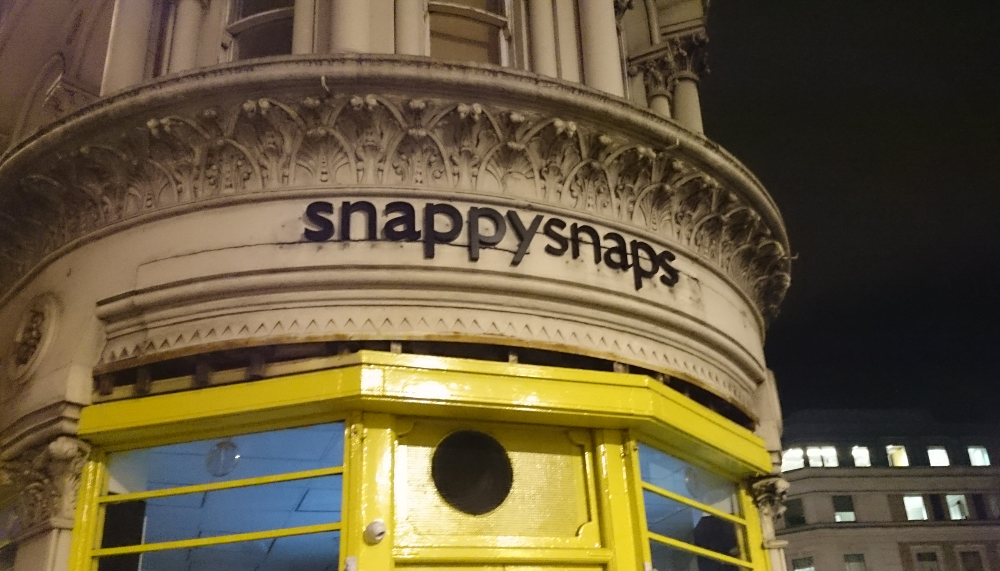
Ironically, a "snapstore" was close to the office ;-)

Ironically, a snapstore was close to the office ;-)

XdgApp and sandboxing of apps was also a big topic, aside from Ubuntu and Endless integration. Fortunately, Alexander Larsson was also there to answer all the sandboxing and XdgApp-questions. I used the time to follow up on a conversation with Alexander we started at FOSDEM this year, about the Limba vs. XdgApp bundling issue. While we are in-line on the sandboxing approach, the way how software is distributed is implemented differently in Limba and XdgApp, and it is bad to have too many bundling systems around (doesn t make for a good story where we can just tell developers ship as this bundling format, and it will be supported everywhere ). Talking with Alex about this was very nice, and I think there is a way out of the too-many-solutions dilemma, at least for Limba and XdgApp I will blog about that separately soon. On the Ubuntu side, a lot of bugs and issues were squashed and changes upstreamed to GNOME, and people were generally doing their best to reduce Richard s bus-factor on the project a little  . I mainly worked on AppStream issues, finishing up the last pieces of appstream-generator and running it against some sample package sets (and later that week against the whole Debian archive). I also started to implement support for showing AppStream issues in the Debian PTS (this work is not finished yet). I also managed to solve a few bugs in the old DEP-11 generator and prepare another release for Ubuntu. We also enjoyed some good Japanese food, and some incredibly great, but also suddenly very expensive Indian food (but that s a different story  ). The most important thing for me though was to get together with people actually using AppStream metadata in software centers and also more specialized places. This yielded some useful findings, e.g. that localized screenshots are not something weird, but actually a wanted feature of Endless for their curated AppStore. So localized screenshots will be part of the next AppStream spec. Also, there seems to be a general need to ship curation information for software centers somehow (which apps are featured? how are they styled? added special banners for some featured apps, app of the day features, etc.). This problem hasn t been solved, since it s highly implementation-specific, and AppStream should be distro-agnostic. But it is something we might be able to address in a generic way sooner or later (I need to talk to people at KDE and Elementary about it). In summary It was a great event! Going to conferences and hackfests always makes me feel like it moves projects leaps ahead, even if you do little coding. Sorting out issues together with people you see in person (rather than communicating with them via text messages or video chat), is IMHO always the most productive way to move forward (yeah, unless you do this every week, but I think you get my point  ). For me, being the only (and youngest ^^) developer at the hackfest who was not employed by any company in the FLOSS business, the hackfest was also motivating to continue to invest spare time into working on these projects. So, the only thing left to do is a huge shout out of THANK YOU to the Ubuntu Community Fund and therefore the Ubuntu community for sponsoring me! You rock! Also huge thanks to Canonical for organizing the sponsoring really quickly, so I didn t get into trouble with paying my flights.

Laney and attente walking on the Millennium Bridge after we walked the distance between Red Hat and Canonical's offices.

Laney and attente on the Millennium Bridge after we walked the distance between Red Hat and Canonical s offices.

To worried KDE people: No, I didn t leave the blue side I just generally work on cross-desktop stuff, and would like all desktops to work as well as possible

Francois Marier: Using DNSSEC and DNSCrypt in Debian

While there is real progress being made towards eliminating insecure HTTP traffic, DNS is a fundamental Internet service that still usually relies on unauthenticated cleartext. There are however a few efforts to try and fix this problem. Here is the setup I use on my Debian laptop to make use of both DNSSEC and DNSCrypt.

DNSCrypt DNSCrypt was created to enable end-users to encrypt the traffic between themselves and their chosen DNS resolver. To switch away from your ISP's default DNS resolver to a DNSCrypt resolver, simply install the dnscrypt-proxy package and then set it as the default resolver either in /etc/resolv.conf:
nameserver 127.0.2.1
if you are using a static network configuration or in /etc/dhcp/dhclient.conf:
supersede domain-name-servers 127.0.2.1;
if you rely on dynamic network configuration via DHCP. There are two things you might want to keep in mind when choosing your DNSCrypt resolver:
  • whether or not they keep any logs of the DNS traffic
  • whether or not they support DNSSEC
I have personally selected a resolver located in Iceland by setting the following in /etc/default/dnscrypt-proxy:
DNSCRYPT_PROXY_RESOLVER_NAME=ns0.dnscrypt.is

DNSSEC While DNSCrypt protects the confidentiality of our DNS queries, it doesn't give us any assurance that the results of such queries are the right ones. In order to authenticate results in that way and prevent DNS poisoning, a hierarchical cryptographic system was created: DNSSEC. In order to enable it, I have setup a local unbound DNSSEC resolver on my machine and pointed /etc/resolv.conf (or /etc/dhcp/dhclient.conf) to my unbound installation at 127.0.0.1. Then I put the following in /etc/unbound/unbound.conf.d/dnscrypt.conf:
server:
    # Remove localhost from the donotquery list
    do-not-query-localhost: no
forward-zone:
    name: "."
    forward-addr: 127.0.2.1@53
to stop unbound from resolving DNS directly and to instead go through the encrypted DNSCrypt proxy.

Reliability In my experience, unbound and dnscrypt-proxy are fairly reliable but they eventually get confused (presumably) by network changes and start returning errors. The ugly but dependable work-around I have found is to create a cronjob at /etc/cron.d/restart-dns.conf that restarts both services once a day:
0 3 * * *    root    /usr/sbin/service dnscrypt-proxy restart
1 3 * * *    root    /usr/sbin/service unbound restart

Captive portals The one remaining problem I need to solve has to do with captive portals. This can be quite annoying when travelling because it requires me to use the portal's DNS resolver in order to connect to the splash screen that unlocks the wifi connection. The dnssec-trigger package looked promising but when I tried it on my jessie laptop, it wasn't particularly reliable. My temporary work-around is to comment out this line in /etc/dhcp/dhclient.conf whenever I need to connect to such annoying wifi networks:
#supersede domain-name-servers 127.0.0.1;
If you've found a better solution to this problem, please leave a comment!

Next.

Previous.