Search Results: "gt"

17 January 2021

Enrico Zini: OpenStreetMap maps links

Some interesting renderings of OpenStreetMap data: If you want to print out local maps, MyOSMatic is a service to generate maps of cities using OpenStreetMap data. The generated maps are available in PNG, PDF and SVG formats and are ready to be printed. On a terminal? Sure: MapSCII is a Braille & ASCII world map renderer for the console: telnet mapscii.me and explore the map with the mouse, keyboard arrows, and a and z to zoom, c to switch to block character mode, q to quit. Alternatively you can fly over it, and you might have to dodge the rare map editing bug, or have fun landing on it: A typo created a 212-story monolith in Microsoft Flight Simulator

Wouter Verhelst: SReview 0.6

... isn't ready yet, but it's getting there. I had planned to release a new version of SReview, my online video review and transcoding system that I wrote originally for FOSDEM but is being used for DebConf, too, after it was set up and running properly for FOSDEM 2020. However, things got a bit busy (both in my personal life and in the world at large), so it fell a bit by the wayside. I've now also been working on things a bit more, in preparation for an improved administrator's interface, and have started implementing a REST API to deal with talks etc through HTTP calls. This seems to be coming along nicely, thanks to OpenAPI and the Mojolicious plugin for parsing that. I can now design the API nicely, and autogenerate client side libraries to call them. While at it, because libmojolicious-plugin-openapi-perl isn't available in Debian 10 "buster", I moved the docker containers over from stable to testing. This revealed that both bs1770gain and inkscape changed their command line incompatibly, resulting in me having to work around those incompatibilities. The good news is that I managed to do so in a way that keeps running SReview on Debian 10 viable, provided one installs Mojolicious::Plugin::OpenAPI from CPAN rather than from a Debian package. Or installs a backport of that package, of course. Or, heck, uses the Docker containers in a kubernetes environment or some such -- I'd love to see someone use that in production. Anyway, I'm still finishing the API, and the implementation of that API and the test suite that ensures the API works correctly, but progress is happening; and as soon as things seem to be working properly, I'll do a release of SReview 0.6, and will upload that to Debian. Hopefully that'll be soon.

Wouter Verhelst: Dear Google

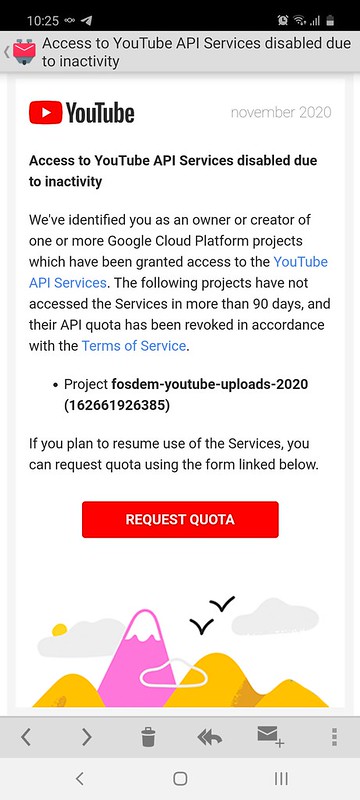
... Why do you have to be so effing difficult about a YouTube API project that is used for a single event per year? FOSDEM creates 600+ videos on a yearly basis. There is no way I am going to manually upload 600+ videos through your webinterface, so we use the API you provide, using a script written by Stefano Rivera. This script grabs video filenames and metadata from a YAML file, and then uses your APIs to upload said videos with said metadata. It works quite well. I run it from cron, and it uploads files until the quota is exhausted, then waits until the next time the cron job runs. It runs so well, that the first time we used it, we could upload 50+ videos on a daily basis, and so the uploads were done as soon as all the videos were created, which was a few months after the event. Cool! The second time we used the script, it did not work at all. We asked one of our key note speakers who happened to be some hotshot at your company, to help us out. He contacted the YouTube people, and whatever had been broken was quickly fixed, so yay, uploads worked again. I found out later that this is actually a normal thing if you don't use your API quota for 90 days or more. Because it's happened to us every bloody year. For the 2020 event, rather than going through back channels (which happened to be unavailable this edition), I tried to use your normal ways of unblocking the API project. This involves creating a screencast of a bloody command line script and describing various things that don't apply to FOSDEM and ghaah shoot me now so meh, I created a new API project instead, and had the uploads go through that. Doing so gives me a limited quota that only allows about 5 or 6 videos per day, but that's fine, it gives people subscribed to our channel the time to actually watch all the videos while they're being uploaded, rather than being presented with a boatload of videos that they can never watch in a day. Also it doesn't overload subscribers, so yay. About three months ago, I started uploading videos. Since then, every day, the "fosdemtalks" channel on YouTube has published five or six videos. Given that, imagine my surprise when I found this in my mailbox this morning... Google lies, claiming that my YouTube API project isn't being used for 90 days and informing me that it will be disabled This is an outright lie, Google. The project has been created 90 days ago, yes, that's correct. It has been used every day since then to upload videos. I guess that means I'll have to deal with your broken automatic content filters to try and get stuff unblocked... ... or I could just give up and not do this anymore. After all, all the FOSDEM content is available on our public video host, too.

Wouter Verhelst: Software available through Extrepo

Just over 7 months ago, I blogged about extrepo, my answer to the "how do you safely install software on Debian without downloading random scripts off the Internet and running them as root" question. I also held a talk during the recent "MiniDebConf Online" that was held, well, online. The most important part of extrepo is "what can you install through it". If the number of available repositories is too low, there's really no reason to use it. So, I thought, let's look what we have after 7 months... To cut to the chase, there's a bunch of interesting content there, although not all of it has a "main" policy. Each of these can be enabled by installing extrepo, and then running extrepo enable <reponame>, where <reponame> is the name of the repository. Note that the list is not exhaustive, but I intend to show that even though we're nowhere near complete, extrepo is already quite useful in its current state:

Free software
  • The debian_official, debian_backports, and debian_experimental repositories contain Debian's official, backports, and experimental repositories, respectively. These shouldn't have to be managed through extrepo, but then again it might be useful for someone, so I decided to just add them anyway. The config here uses the deb.debian.org alias for CDN-backed package mirrors.
  • The belgium_eid repository contains the Belgian eID software. Obviously this is added, since I'm upstream for eID, and as such it was a large motivating factor for me to actually write extrepo in the first place.
  • elastic: the elasticsearch software.
  • Some repositories, such as dovecot, winehq and bareos contain upstream versions of their respective software. These two repositories contain software that is available in Debian, too; but their upstreams package their most recent release independently, and some people might prefer to run those instead.
  • The sury, fai, and postgresql repositories, as well as a number of repositories such as openstack_rocky, openstack_train, haproxy-1.5 and haproxy-2.0 (there are more) contain more recent versions of software packaged in Debian already by the same maintainer of that package repository. For the sury repository, that is PHP; for the others, the name should give it away. The difference between these repositories and the ones above is that it is the official Debian maintainer for the same software who maintains the repository, which is not the case for the others.
  • The vscodium repository contains the unencumbered version of Microsoft's Visual Studio Code; i.e., the codium version of Visual Studio Code is to code as the chromium browser is to chrome: it is a build of the same softare, but without the non-free bits that make code not entirely Free Software.
  • While Debian ships with at least two browsers (Firefox and Chromium), additional browsers are available through extrepo, too. The iridiumbrowser repository contains a Chromium-based browser that focuses on privacy.
  • Speaking of privacy, perhaps you might want to try out the torproject repository.
  • For those who want to do Cloud Computing on Debian in ways that isn't covered by Openstack, there is a kubernetes repository that contains the Kubernetes stack, the as well as the google_cloud one containing the Google Cloud SDK.

Non-free software While these are available to be installed through extrepo, please note that non-free and contrib repositories are disabled by default. In order to enable these repositories, you must first enable them; this can be accomplished through /etc/extrepo/config.yaml.
  • In case you don't care about freedom and want the official build of Visual Studio Code, the vscode repository contains it.
  • While we're on the subject of Microsoft, there's also Microsoft Teams available in the msteams repository. And, hey, skype.
  • For those who are not satisfied with the free browsers in Debian or any of the free repositories, there's opera and google_chrome.
  • The docker-ce repository contains the official build of Docker CE. While this is the free "community edition" that should have free licenses, I could not find a licensing statement anywhere, and therefore I'm not 100% sure whether this repository is actually free software. For that reason, it is currently marked as a non-free one. Merge Requests for rectifying that from someone with more information on the actual licensing situation of Docker CE would be welcome...
  • For gamers, there's Valve's steam repository.
Again, the above lists are not meant to be exhaustive. Special thanks go out to Russ Allbery, Kim Alvefur, Vincent Bernat, Nick Black, Arnaud Ferraris, Thorsten Glaser, Thomas Goirand, Juri Grabowski, Paolo Greppi, and Josh Triplett, for helping me build the current list of repositories. Is your favourite repository not listed? Create a configuration based on template.yaml, and file a merge request!

Wouter Verhelst: On Statements, Facts, Hypotheses, Science, Religion, and Opinions

The other day, we went to a designer's fashion shop whose owner was rather adamant that he was never ever going to wear a face mask, and that he didn't believe the COVID-19 thing was real. When I argued for the opposing position, he pretty much dismissed what I said out of hand, claiming that "the hospitals are empty dude" and "it's all a lie". When I told him that this really isn't true, he went like "well, that's just your opinion". Well, no -- certain things are facts, not opinions. Even if you don't believe that this disease kills people, the idea that this is a matter of opinion is missing the ball by so much that I was pretty much stunned by the level of ignorance. His whole demeanor pissed me off rather quickly. While I disagree with the position that it should be your decision whether or not to wear a mask, it's certainly possible to have that opinion. However, whether or not people need to go to hospitals is not an opinion -- it's something else entirely. After calming down, the encounter got me thinking, and made me focus on something I'd been thinking about before but hadn't fully forumlated: the fact that some people in this world seem to misunderstand the nature of what it is to do science, and end up, under the claim of being "sceptical", with various nonsense things -- see scientology, flat earth societies, conspiracy theories, and whathaveyou. So, here's something that might (but probably won't) help some people figuring out stuff. Even if it doesn't, it's been bothering me and I want to write it down so it won't bother me again. If you know all this stuff, it might be boring and you might want to skip this post. Otherwise, take a deep breath and read on... Statements are things people say. They can be true or false; "the sun is blue" is an example of a statement that is trivially false. "The sun produces light" is another one that is trivially true. "The sun produces light through a process that includes hydrogen fusion" is another statement, one that is a bit more difficult to prove true or false. Another example is "Wouter Verhelst does not have a favourite color". That happens to be a true statement, but it's fairly difficult for anyone that isn't me (or any one of the other Wouters Verhelst out there) to validate as true. While statements can be true or false, combining statements without more context is not always possible. As an example, the statement "Wouter Verhelst is a Debian Developer" is a true statement, as is the statement "Wouter Verhelst is a professional Volleybal player"; but the statement "Wouter Verhelst is a professional Volleybal player and a Debian Developer" is not, because while I am a Debian Developer, I am not a professional Volleybal player -- I just happen to share a name with someone who is. A statement is never a fact, but it can describe a fact. When a statement is a true statement, either because we trivially know what it states to be true or because we have performed an experiment that proved beyond any possible doubt that the statement is true, then what the statement describes is a fact. For example, "Red is a color" is a statement that describes a fact (because, yes, red is definitely a color, that is a fact). Such statements are called statements of fact. There are other possible statements. "Grass is purple" is a statement, but it is not a statement of fact; because as everyone knows, grass is (usually) green. A statement can also describe an opinion. "The Porsche 911 is a nice car" is a statement of opinion. It is one I happen to agree with, but it is certainly valid for someone else to make a statement that conflicts with this position, and there is nothing wrong with that. As the saying goes, "opinions are like assholes: everyone has one". Statements describing opinions are known as statements of opinion. The differentiating factor between facts and opinions is that facts are universally true, whereas opinions only hold for the people who state the opinion and anyone who agrees with them. Sometimes it's difficult or even impossible to determine whether a statement is true or not. The statement "The numbers that win the South African Powerball lottery on the 31st of July 2020 are 2, 3, 5, 19, 35, and powerball 14" is not a statement of fact, because at the time of writing, the 31st of July 2020 is in the future, which at this point gives it a 1 in 24,435,180 chance to be true). However, that does not make it a statement of opinion; it is not my opinion that the above numbers will win the South African powerball; instead, it is my guess that those numbers will be correct. Another word for "guess" is hypothesis: a hypothesis is a statement that may be universally true or universally false, but for which the truth -- or its lack thereof -- cannot currently be proven beyond doubt. On Saturday, August 1st, 2020 the above statement about the South African Powerball may become a statement of fact; most likely however, it will instead become a false statement. An unproven hypothesis may be expressed as a matter of belief. The statement "There is a God who rules the heavens and the Earth" cannot currently (or ever) be proven beyond doubt to be either true or false, which by definition makes it a hypothesis; however, for matters of religion this is entirely unimportant, as for believers the belief that the statement is correct is all that matters, whereas for nonbelievers the truth of that statement is not at all relevant. A belief is not an opinion; an opinion is not a belief. Scientists do not deal with unproven hypotheses, except insofar that they attempt to prove, through direct observation of nature (either out in the field or in a controlled laboratory setting) that the hypothesis is, in fact, a statement of fact. This makes unprovable hypotheses unscientific -- but that does not mean that they are false, or even that they are uninteresting statements. Unscientific statements are merely statements that science cannot either prove or disprove, and that therefore lie outside of the realm of what science deals with. Given that background, I have always found the so-called "conflict" between science and religion to be a non-sequitur. Religion deals in one type of statements; science deals in another. The do not overlap, since a statement can either be proven or it cannot, and religious statements by their very nature focus on unprovable belief rather than universal truth. Sure, the range of things that science has figured out the facts about has grown over time, which implies that religious statements have sometimes been proven false; but is it heresy to say that "animals exist that can run 120 kph" if that is the truth, even if such animals don't exist in, say, Rome? Something very similar can be said about conspiracy theories. Yes, it is possible to hypothesize that NASA did not send men to the moon, and that all the proof contrary to that statement was somehow fabricated. However, by its very nature such a hypothesis cannot be proven or disproven (because the statement states that all proof was fabricated), which therefore implies that it is an unscientific statement. It is good to be sceptical about what is being said to you. People can have various ideas about how the world works, but only one of those ideas -- one of the possible hypotheses -- can be true. As long as a hypothesis remains unproven, scientists love to be sceptical themselves. In fact, if you can somehow prove beyond doubt that a scientific hypothesis is false, scientists will love you -- it means they now know something more about the world and that they'll have to come up with something else, which is a lot of fun. When a scientific experiment or observation proves that a certain hypothesis is true, then this probably turns the hypothesis into a statement of fact. That is, it is of course possible that there's a flaw in the proof, or that the experiment failed (but that the failure was somehow missed), or that no observance of a particular event happened when a scientist tried to observe something, but that this was only because the scientist missed it. If you can show that any of those possibilities hold for a scientific proof, then you'll have turned a statement of fact back into a hypothesis, or even (depending on the exact nature of the flaw) into a false statement. There's more. It's human nature to want to be rich and famous, sometimes no matter what the cost. As such, there have been scientists who have falsified experimental results, or who have claimed to have observed something when this was not the case. For that reason, a scientific paper that gets written after an experiment turned a hypothesis into fact describes not only the results of the experiment and the observed behavior, but also the methodology: the way in which the experiment was run, with enough details so that anyone can retry the experiment. Sometimes that may mean spending a large amount of money just to be able to run the experiment (most people don't have an LHC in their backyard, say), and in some cases some of the required materials won't be available (the latter is expecially true for, e.g., certain chemical experiments that involve highly explosive things); but the information is always there, and if you spend enough time and money reading through the available papers, you will be able to independently prove the hypothesis yourself. Scientists tend to do just that; when the results of a new experiment are published, they will try to rerun the experiment, partially because they want to see things with their own eyes; but partially also because if they can find fault in the experiment or the observed behavior, they'll have reason to write a paper of their own, which will make them a bit more rich and famous. I guess you could say that there's three types of people who deal with statements: scientists, who deal with provable hypotheses and statements of fact (but who have no use for unprovable hypotheses and statements of opinion); religious people and conspiracy theorists, who deal with unprovable hypotheses (where the religious people deal with these to serve a large cause, while conspiracy theorists only care about the unprovable hypotheses); and politicians, who should care about proven statements of fact and produce statements of opinion, but who usually attempt the reverse of those two these days :-/ Anyway... [[!img Error: Image::Magick is not installed]]
Junichi Uekawa: Yesterday was our monthly Debian meeting.

Yesterday was our monthly Debian meeting. We do one every month for Tokyo and Kansai combined, because it's online and no reason to split for now. I presented what I learnt about nodejs packaging in Debian. This time, I started using Emacs for presentation, presenting PDF file. This week I switched most of my login shells to emacsclient, and experimenting. It's interesting how much things break, and how much I depended on .bashrc and .profile being loaded. But most things work and I don't need most things outside of emacs...
16 January 2021

Christian Kastner: Keeping your Workstation Silent

I require moderately powerful boxes for my work. Moderately powerful boxes generate a non-negligible amount of heat, and therefore require appropriate cooling. Most cooling solutions involve a certain degree of noise, which I dislike. Water-cooling is supposed to be the most effective solution for noise reduction, but it always felt like too much of a hassle to try to me. Considering the various solutions I've tried in the past years, two observations I've made really stick out:
  1. Noctua's reputation for CPU cooling is well-earned.
  2. A "silent" (meaning sound-proofed) case, isn't. At least, not anymore.
I've tried numerous coolers in the past, some of monstrous proportions (always thinking that more mass must be better, and reputable brands are equally good), but I was never really satisfied; hence, I was doubtful that trying yet another cooler would make a difference. I'm glad I tried the Noctua NH-D15 anyway. With some tweaking to the fan profile in the BIOS, it's totally inaudible at normal to medium workloads, and just a very gentle hum at full load subtle enough to disappear in the background. For the past decade, I've also regularly purchased sound-proofed cases, but this habit appears anachronistic now. Years ago, sound-proofed cases helped contain the noise of a few HDDs. However, all of my boxes now contain NVMe drives (which, to me, are the biggest improvement to computing since CPUs going multi-core). On the other hand, some of my boxes now contain powerful GPUs used for GPGPU computing, and with the recent higher-end Nvidia and AMD cards all pulling in over 300W, there is a lot of heat to manage. The best way to quickly dump heat is with good airflow. Sound-proofing works against that. Its insulation restricts airflow, which ultimately causes even more noise, as the GPU's fans need to spin at very high RPMs. This is, of course, totally obvious in hindsight. I removed the front cover from a new GPU box, and the noise went down from almost-hair-dryer to acceptable-whoosh levels. I'm wondering whether a completely open box might not be even more effective.

Abhijith PA: Transition from Thunderbird to Mutt

I was going OK with Thunderbird and enigmail(though it have many problems). Normally I go through changelogs before updating packages and rarely do a complete upgrage of my machine. Couple of days ago I did a complete upgrade of system which updated my Thunderbird to latest version and throwing of enigmail plugin for using their native openPGP support. There is a blog from Mozilla which I should ve read earlier. Thunderbird s builtin openPGP functionality is still in experimental, atleast not ready for my workflow. I could ve downgrade to version 68. But I chose to move to my secondary MUA, mutt. I was using mutt for emails and newsletters that I check twice in a year a so. So I started configuring mutt to handle my big mailboxes. It took three evenings to configure mutt to my workflow. Though the basic setup can be done in less than an hour it is the small nitpicks consumed much of my time. Currently I have isync to pull and keep mails offline. Mutt to read, msmtp to send, abook as the email address book and urlview to see the links in mail. I am still learning notmuch and virtual mailbox ways to filter. Mutt There are ton of articles out there to configure mutt and all related things to it. But I find certain configs very hard to get. So I will write down those. So far, everything going okay.

Cons
  • some times mbsync throws EOF and secret key not found error.
  • searching is still a pain in mutt
  • nano s spell checker also check things which I am replying to.

More to come Well for now I moved mail from part of the Thunderbird. But Thunderbird was more than a MUA to me. It was my RSS reader, calendar and to-do list manager. I will write more about those once I make a complete transition.

Junichi Uekawa: It's been 20 years since I became a Debian Developer.

It's been 20 years since I became a Debian Developer. Lots of fun things happened, and I think fondly of the team. I am no longer active for the past 10 years due to family reasons, and it's surprising that I have been inactive for that long. I still use Debian, and I still participate in the local Debian meetings.

15 January 2021

Dirk Eddelbuettel: Rcpp 1.0.6: Some Updates

rcpp logo The Rcpp team is proud to announce release 1.0.6 of Rcpp which arrived at CRAN earlier today, and has been uploaded to Debian too. Windows and macOS builds should appear at CRAN in the next few days. This marks the first release on the new six-months cycle announced with release 1.0.5 in July. As reminder, interim dev or rc releases will often be available in the Rcpp drat repo; this cycle there were four. Rcpp has become the most popular way of enhancing R with C or C++ code. As of today, 2174 packages on CRAN depend on Rcpp for making analytical code go faster and further (which is an 8.5% increase just since the last release), along with 207 in BioConductor. This release features six different pull requests from five different contributors, mostly fixing fairly small corner cases, plus some minor polish on documentation and continuous integration. Before releasing we once again made numerous reverse dependency checks none of which revealed any issues. So the passage at CRAN was pretty quick despite the large dependency footprint, and we are once again grateful for all the work the CRAN maintainers do.

Changes in Rcpp patch release version 1.0.6 (2021-01-14)
  • Changes in Rcpp API:
    • Replace remaining few uses of EXTPTR_PTR with R_ExternalPtrAddr (Kevin in #1098 fixing #1097).
    • Add push_back and push_front for DataFrame (Walter Somerville in #1099 fixing #1094).
    • Remove a misleading-to-wrong comment (Mattias Ellert in #1109 cleaning up after #1049).
    • Address a sanitizer report by initializing two private bool variables (Benjamin Christoffersen in #1113).
    • External pointer finalizer toggle default values were corrected to true (Dirk in #1115).
  • Changes in Rcpp Documentation:
    • Several URLs were updated to https and/or new addresses (Dirk).
  • Changes in Rcpp Deployment:
    • Added GitHub Actions CI using the same container-based setup used previously, and also carried code coverage over (Dirk in #1128).
  • Changes in Rcpp support functions:
    • Rcpp.package.skeleton() avoids warning from R. (Dirk)

Thanks to my CRANberries, you can also look at a diff to the previous release. Questions, comments etc should go to the rcpp-devel mailing list off the R-Forge page. Bugs reports are welcome at the GitHub issue tracker as well (where one can also search among open or closed issues); questions are also welcome under rcpp tag at StackOverflow which also allows searching among the (currently) 2616 previous questions. If you like this or other open-source work I do, you can sponsor me at GitHub. My sincere thanks to my current sponsors for me keeping me caffeinated.

This post by Dirk Eddelbuettel originated on his Thinking inside the box blog. Please report excessive re-aggregation in third-party for-profit settings.

Michael Prokop: Revisiting 2020

* Mainly to recall what happened last year and to give thoughts and plan for the upcoming year(s) I m once again revisiting my previous year (previous editions: 2019, 2018, 2017, 2016, 2015, 2014, 2013 + 2012). Due to the Coronavirus disease (COVID-19) pandemic, 2020 was special for several reasons, but overall I consider myself and my family privileged and am very grateful for that. In terms of IT events, I planned to attend Grazer Linuxdays and DebConf in Haifa/Israel. Sadly Grazer Linuxdays didn t take place at all, and DebConf took place online instead (which I didn t really participate in for several reasons). I took part in the well organized DENOG12 + ATNOG 2020/1 online meetings. I still organize our monthly Security Treff Graz (STG) meetups, and for half of the year, those meetings took place online (which worked OK-ish overall IMO). Only at the beginning of 2020, I managed to play Badminton (still playing in the highest available training class (in german: Kader ) at the University of Graz / Universit ts-Sportinstitut, USI). For the rest of the year except for ~2 weeks in October or so the sessions couldn t occur. Plenty of concerts I planned to attend were cancelled for obvious reasons, including the ones I would have played myself. But I managed to attend Jazz Redoute 2020 Dom im Berg, Martin Grubinger in Musikverein Graz and Emiliano Sampaio s Mega Mereneu Project at WIST Moserhofgasse (all before the corona situation kicked in). The concert from Ton Feinig & RTV Slovenia Big Band occurred under strict regulations in Summer, as well as Elektra Opera by Richard Strau in a very special setting (only one piano player instead of the orchestra because of a Corona case in the orchestra) in Autumn. At the beginning of 2020, I also visited Literaturshow Roboter mit Senf at Literaturhaus Graz. The lack of concerts and rehearsals also severely impacted my playing the drums (including at HTU BigBand Graz), which pretty much didn t take place. :( Grml-wise we managed to publish release 2020.06, codename Ausgehfuahangl. Regarding jenkins-debian-glue I tried to clarify its state and received some really lovely feedback. I consider 2020 as the year where I dropped regular usage of Jabber (so far my accounts still exist, but I m no longer regularly online and am not sure for how much longer I ll keep my accounts alive as such). Business-wise it was our seventh year of business with SynPro Solutions GmbH. No big news but steady and ongoing work with my other business duties Grml Solutions and Grml-Forensic. As usual, I shared childcare with my wife. Due to the corona situation, my wife got a new working schedule, which shuffled around our schedule a bit on Mondays + Tuesdays. Still, we managed to handle the homeschooling/distance learning quite well. Currently we re sitting in the third lockdown, and yet another round of homeschooling/distance learning is going on those days (let s see how long ). I counted 112 actual school days in all of 2020 for our older daughter with only 68 school days since our first lockdown on 16th of March, whereas we had 213(!) press conferences by our Austrian government in 2020. (Further rants about the situation in Austria snipped.) Book reading-wise I managed to complete 60 books (see Mein Lesejahr 2020 ). Once again, I noticed that what felt like good days for me always included reading books, so I ll try to keep my reading pace for 2021. I ll also continue with my hobbies Buying Books and Reading Books , to get worse at Tsundoku. Hoping for vaccination and a more normal 2021, Schwuppdiwupp!

Mike Gabriel: UBports: Packaging of Lomiri Operating Environment for Debian (part 04)

Before and during FOSDEM 2020, I agreed with the people (developers, supporters, managers) of the UBports Foundation to package the Unity8 Operating Environment for Debian. Since 27th Feb 2020, Unity8 has now become Lomiri. Things got delayed a little recently as my main developer contact on the upstream side was on sick leave for a while. Fortunately, he has now fully recovered and work is getting back on track. Recent Uploads to Debian related to Lomiri Over the past 3 months I worked on the following bits and pieces regarding Lomiri in Debian: The next projects / packages ahead are lomiri-ui-toolkit, integrating changes required for Lomiri into Ayatana Indicators and then moving on with several other, smaller packages. Credits Many big thanks go to Marius and Dalton for their work on the UBports project and being always available for questions, feedback, etc. Thanks to Florian Leeber for being my point of contact for topcis regarding my cooperation with the UBports Foundation.

13 January 2021

Antoine Beaupr : New phone: Pixel 4a

I'm sorry to announce that I gave up on the Fairphone series and switched to a Google Phone (Pixel 4a) running CalyxOS.

Problems in fairy land My fairphone2, even if it is less than two years old, is having major problems:
  • from time to time, the screen flickers and loses "touch" until I squeeze it back together
  • the camera similarly disconnects regularly
  • even when it works, the camera is... pretty bad: low light is basically unusable, it's slow and grainy
  • the battery can barely keep up for one day
  • the cellular coverage is very poor, in Canada: I lose signal at the grocery store and in the middle of my house...
Some of those problems are known: the Fairphone 2 is old now. It was probably old even when I got it. But I can't help but feel a little sad to let it go: the entire point of that device was to make it easy to fix. But alas, because it's sold only in Europe, local stores don't carry replacement parts. To be fair, Fairphone did offer to fix the device, but with a 2 weeks turnaround, I had to get another phone anyways. I did actually try to buy a fairphone3, from Clove. But they did some crazy validation routine. By email, they asked me to provide a photo copy of a driver's license and the credit card, arguing they need to do this to combat fraud. I found that totally unacceptable and asked them to cancel my order. And because I'm not sure the FP3 will fix the coverage issues, I decided to just give up on Fairphone until they officially ship to the Americas.

Do no evil, do not pass go, do not collect 200$ So I got a Google phone, specifically a Pixel 4a. It's a nice device, all small and shiny, but it's "plasticky" - I would have prefered metal, but it seems you need to pay much, much more to get that (in the Pixel 5). In any case, it's certainly a better form factor than the Fairphone 2: even though the screen is bigger, the device itself is actually smaller and thinner, which feels great. The OLED screen is beautiful, awesome contrast and everything, and preliminary tests show that the camera is much better than the one on the Fairphone 2. (The be fair, again, that is another thing the FP3 improved significantly. And that is with the stock Camera app from CalyxOS/AOSP, so not as good as the Google Camera app, which does AI stuff.)

CalyxOS: success The Pixel 4a not not supported by LineageOS: it seems every time I pick a device in that list, I manage to miss the right device by one (I bought a Samsung S9 before, which is also unsupported, even though the S8 is). But thankfully, it is supported by CalyxOS. That install was a breeze: I was hesitant in playing again with installing a custom Android firmware on a phone after fighting with this quite a bit in the past (e.g. htc-one-s, lg-g3-d852). But it turns out their install instructions, mostly using a AOSP alliance device-flasher works absolutely great. It assumes you know about the commandline, and it does require to basically curl sudo (because you need to download their binary and run it as root), but it Just. Works. It reminded me of how great it was to get the Fairphone with TWRP preinstalled... Oh, and kudos to the people in #calyxos on Freenode: awesome tech support, super nice folks. An amazing improvement over the ambiance in #lineageos! :)

Migrating data Unfortunately, migrating the data was the usual pain in the back. This should improve the next time I do this: CalyxOS ships with seedvault, a secure backup system for Android 10 (or 9?) and later which backs up everything (including settings!) with encryption. Apparently it works great, and CalyxOS is also working on a migration system to switch phones. But, obviously, I couldn't use that on the Fairphone 2 running Android 7... So I had to, again, improvised. The first step was to install Syncthing, to have an easy way to copy data around. That's easily done through F-Droid, already bundled with CalyxOS (including the privileged extension!). Pair the devices and boom, a magic portal to copy stuff over. The other early step I took was to copy apps over using the F-Droid "find nearby" functionality. It's a bit quirky, but really helps in copying a bunch of APKs over. Then I setup a temporary keepassxc password vault on the Syncthing share so that I could easily copy-paste passwords into apps. I used to do this in a text file in Syncthing, but copy-pasting in the text file is much harder than in KeePassDX. (I just picked one, maybe KeePassDroid is better? I don't know.) Do keep a copy of the URL of the service to reduce typing as well. Then the following apps required special tweaks:
  • AntennaPod has an import/export feature: export on one end, into the Syncthing share, then import on the other. then go to the queue and select all episodes and download
  • the Signal "chat backup" does copy the secret key around, so you don't get the "security number change" warning (even if it prompts you to re-register) - external devices need to be relinked though
  • AnkiDroid, DSub, Nextcloud, and Wallabag required copy-pasting passwords
I tried to sync contacts with DAVx5 but that didn't work so well: the account was setup correctly, but contacts didn't show up. There's probably just this one thing I need to do to fix this, but since I don't really need sync'd contact, it was easier to export a VCF file to Syncthing and import again.

Known problems One problem with CalyxOS I found is that the fragile little microg tweaks didn't seem to work well enough for Signal. That was unexpected so they encouraged me to file that as a bug. The other "issue" is that the bootloader is locked, which makes it impossible to have "root" on the device. That's rather unfortunate: I often need root to debug things on Android. In particular, it made it difficult to restore data from OSMand (see below). But I guess that most things just work out of the box now, so I don't really need it and appreciate the extra security. Locking the bootloader means full cryptographic verification of the phone, so that's a good feature to have! OSMand still doesn't have a good import/export story. I ended up sharing the Android/data/net.osmand.plus/files directory and importing waypoints, favorites and tracks by hand. Even though maps are actually in there, it's not possible for Syncthing to write directly to the same directory on the new phone, "thanks" to the new permission system in Android which forbids this kind of inter-app messing around. Tracks are particularly a problem: my older OSMand setup had all those folders neatly sorting those tracks by month. This makes it really annoying to track every file manually and copy it over. I have mostly given up on that for now, unfortunately. And I'll still need to reconfigure profiles and maps and everything by hand. Sigh. I guess that's a good clearinghouse for my old tracks I never use... Update: turns out setting storage to "shared" fixed the issue, see comments below!

Conclusion Overall, CalyxOS seems like a good Android firmware. The install is smooth and the resulting install seems solid. The above problems are mostly annoyances and I'm very happy with the experience so far, although I've only been using it for a few hours so this is very preliminary.

Vincent Fourmond: Taking advantage of Ruby in QSoas

First of all, let me all wish you a happy new year, with all my wishes of health and succes. I sincerely hope this year will be simpler for most people as last year ! For the first post of the year, I wanted to show you how to take advantage of Ruby, the programming language embedded in QSoas, to make various things, like:

Summing the values in a column When using commands that take formulas (Ruby code), like apply-formula, the code is run for every single point, for which all the values are updated. In particulier, the state of the previous point is not known. However, it is possible to store values in what is called global variables, whose name start with an $ sign. Using this, we can keep track of the previous values. For instance, to create a new column with the sum of the y values, one can use the following approach:
QSoas> eval $sum=0
QSoas> apply-formula /extra-columns=1 $sum+=y;y2=$sum
The first line initializes the variable to 0, before we start summing, and the code in the second line is run for each dataset row, in order. For the first row, for instance, $sum is initially 0 (from the eval line); after the execution of the code, it is now the first value of y. After the second row, the second value of y is added, and so on. The image below shows the resulting y2 when used on:
QSoas> generate-dataset -1 1 x


Extending values in a column Another use of the global variables is to add "missing" data. For instance, let's imagine that a files given the variation of current over time as the potential is changed, but the potential is only changed stepwise and only indicated when it changes:
## time	current	potential
0	0.1	0.5
1	0.2
2	0.3
3	0.2
4	1.2	0.6
5	1.3
...
If you need to have the values everywhere, for instance if you need to split on their values, you could also use a global variable, taking advantage of the fact that missing values are represented by QSoas using "Not A Number" values, which can be detected using the Ruby function nan?:
QSoas> apply-formula "if y2.nan?; then y2=$value; else $value=y2;end"
Note the need of quotes because there are spaces in the ruby code. If the value of y2 is NaN, that is it is missing, then it is taken from the global variable $value else $value is set the current value of y2. Hence, the values are propagated down:
## time	current	potential
0	0.1	0.5
1	0.2	0.5
2	0.3	0.5
3	0.2	0.5
4	1.2	0.6
5	1.3	0.6
...
Of course, this doesn't work if the first value of y2 is missing.

Renaming using a pattern The command save-datasets can be used to save a whole series of datasets to the disk. It can also rename them on the fly, and, using the /mode=rename option, does only the renaming part, without saving. You can make full use of meta-data (see also a first post here)for renaming. The full power is unlocked using the /expression= option. For instance, for renaming the last 5 datasets (so numbers 0 to 4) using a scheme based on the value of their pH meta-data, you can use the following code:
QSoas> save-datasets /mode=rename /expression='"dataset-# $meta.pH "' 0..4
The double quotes are cumbersome but necessary, since the outer quotes (') prevent the inner ones (") to be removed and the inner quotes are here to indicate to Ruby that we are dealing with text. The bit inside # ... is interpreted by Ruby as Ruby code; here it is $meta.pH, the value of the "pH" meta-data. Finally the 0..4 specifies the datasets to work with. So theses datasets will change name to become dataset-7 for pH 7, etc...

About QSoas QSoas is a powerful open source data analysis program that focuses on flexibility and powerful fitting capacities. It is released under the GNU General Public License. It is described in Fourmond, Anal. Chem., 2016, 88 (10), pp 5050 5052. Current version is 3.0. You can download its source code there (or clone from the GitHub repository) and compile it yourself, or buy precompiled versions for MacOS and Windows there.

12 January 2021

John Goerzen: Remote Directory Tree Comparison, Optionally Asynchronous and Airgapped

Note: this is another article in my series on asynchronous communication in Linux with UUCP and NNCP. In the previous installment on store-and-forward backups, I mentioned how easy it is to do with ZFS, and some of the tools that can be used to do it without ZFS. A lot of those tools are a bit less robust, so we need some sort of store-and-forward mechanism to verify backups. To be sure, verifying backups is good with ANY scheme, and this could be used with ZFS backups also. So let s say you have a shiny new backup scheme in place, and you d like to verify that it s working correctly. To do that, you need to compare the source directory tree on machine A with the backed-up directory tree on machine B. Assuming a conventional setup, here are some ways you might consider to do that: The first two options are not particularly practical for large datasets, though I note that the second is compatible with airgapping. Using rsync requires both systems to be online at the same time to perform the comparison. What would be really nice here is a tool that would write out lots of information about the files on a system: their names, sizes, last modified dates, maybe even sha256sum and other data. This file would be far smaller than the directory tree itself, would compress nicely, and could be easily shipped to an airgapped system via NNCP, UUCP, a USB drive, or something similar. Tool choices It turns out there are already quite a few tools in Debian (and other Free operating systems) to do this, and half of them are named mtree (though, of course, not all mtrees are compatible with each other.) We ll look at some of the options here. I ve made a simple test directory for illustration purposes with these commands:
mkdir test
cd test
echo hi > hi
ln -s hi there
ln hi foo
touch empty
mkdir emptydir
mkdir somethingdir
cd somethingdir
ln -s ../there
I then also used touch to set all files to a consistent timestamp for illustration purposes. Tool option: getfacl (Debian package: acl) This comes with the acl package, but can be used with other than ACL purposes. Unfortunately, it doesn t come with a tool to directly compare its output with a filesystem (setfacl, for instance, can apply the permissions listed but won t compare.) It ignores symlinks and doesn t show sizes or dates, so is ineffective for our purposes. Example output:
$ getfacl --numeric -R test
...
# file: test/hi
# owner: 1000
# group: 1000
user::rw-
group::r--
other::r--
...
Tool option: fmtree, the FreeBSD mtree (Debian package: freebsd-buildutils) fmtree can prepare a specification based on a directory tree, and compare a directory tree to that specification. The comparison also is aware of files that exist in a directory tree but not in the specification. The specification format is a bit on the odd side, but works well enough with fmtree. Here s a sample output with defaults:
$ fmtree -c -p test
...
# .
/set type=file uid=1000 gid=1000 mode=0644 nlink=1
.               type=dir mode=0755 nlink=4 time=1610421833.000000000
    empty       size=0 time=1610421833.000000000
    foo         nlink=2 size=3 time=1610421833.000000000
    hi          nlink=2 size=3 time=1610421833.000000000
    there       type=link mode=0777 time=1610421833.000000000 link=hi
... skipping ...
# ./somethingdir
/set type=file uid=1000 gid=1000 mode=0777 nlink=1
somethingdir    type=dir mode=0755 nlink=2 time=1610421833.000000000
    there       type=link time=1610421833.000000000 link=../there
# ./somethingdir
..
..
You might be wondering here what it does about special characters, and the answer is that it has octal escapes, so it is 8-bit clean. To compare, you can save the output of fmtree to a file, then run like this:
cd test
fmtree < ../test.fmtree
If there is no output, then the trees are identical. Change something and you get a line of of output explaining each difference. You can also use fmtree -U to change things like modification dates to match the specification. fmtree also supports quite a few optional keywords you can add with -K. They include things like file flags, user/group names, various tipes of hashes, and so forth. I'll note that none of the options can let you determine which files are hardlinked together. Here's an excerpt with -K sha256digest added:
    empty       size=0 time=1610421833.000000000 \
                sha256digest=e3b0c44298fc1c149afbf4c8996fb92427ae41e4649b934ca495991b7852b855
    foo         nlink=2 size=3 time=1610421833.000000000 \
                sha256digest=98ea6e4f216f2fb4b69fff9b3a44842c38686ca685f3f55dc48c5d3fb1107be4
If you include a sha256digest in the spec, then when you verify it with fmtree, the verification will also include the sha256digest. Obviously fmtree -U can't correct a mismatch there, but of course it will detect and report it. Tool option: mtree, the NetBSD mtree (Debian package: mtree-netbsd) mtree produces (by default) output very similar to fmtree. With minor differences (such as the name of the sha256digest in the output), the discussion above about fmtree also applies to mtree. There are some differences, and the most notable is that mtree adds a -C option which reads a spec and converts it to a "format that's easier to parse with various tools." Here's an example:
$ mtree -c -K sha256digest -p test   mtree -C
. type=dir uid=1000 gid=1000 mode=0755 nlink=4 time=1610421833.0 flags=none 
./empty type=file uid=1000 gid=1000 mode=0644 nlink=1 size=0 time=1610421833.0 flags=none 
./foo type=file uid=1000 gid=1000 mode=0644 nlink=2 size=3 time=1610421833.0 flags=none 
./hi type=file uid=1000 gid=1000 mode=0644 nlink=2 size=3 time=1610421833.0 flags=none 
./there type=link uid=1000 gid=1000 mode=0777 nlink=1 link=hi time=1610421833.0 flags=none 
./emptydir type=dir uid=1000 gid=1000 mode=0755 nlink=2 time=1610421833.0 flags=none 
./somethingdir type=dir uid=1000 gid=1000 mode=0755 nlink=2 time=1610421833.0 flags=none 
./somethingdir/there type=link uid=1000 gid=1000 mode=0777 nlink=1 link=../there time=1610421833.0 flags=none 
Most definitely an improvement in both space and convenience, while still retaining the relevant information. Note that if you want the sha256digest in the formatted output, you need to pass the -K to both mtree invocations. I could have done that here, but it is easier to read without it. mtree can verify a specification in either format. Given what I'm about to show you about bsdtar, this should illustrate why I bothered to package mtree-netbsd for Debian. Unlike fmtree, the mtree -U command will not adjust modification times based on the spec, but it will report on differences. Tool option: bsdtar (Debian package: libarchive-tools) bsdtar is a fascinating program that can work with many formats other than just tar files. Among the formats it supports is is the NetBSD mtree "pleasant" format (mtree -C compatible). bsdtar can also convert between the formats it supports. So, put this together: bsdtar can convert a tar file to an mtree specification without extracting the tar file. bsdtar can also use an mtree specification to override the permissions on files going into tar -c, so it is a way to prepare a tar file with things owned by root without resorting to tools like fakeroot. Let's look at how this can work:
$ cd test
$ bsdtar --numeric -cf - --format=mtree .

. time=1610472086.318593729 mode=755 gid=1000 uid=1000 type=dir
./empty time=1610421833.0 mode=644 gid=1000 uid=1000 type=file size=0
./foo nlink=2 time=1610421833.0 mode=644 gid=1000 uid=1000 type=file size=3
./hi nlink=2 time=1610421833.0 mode=644 gid=1000 uid=1000 type=file size=3
./ormat\075mtree time=1610472086.318593729 mode=644 gid=1000 uid=1000 type=file size=5632
./there time=1610421833.0 mode=777 gid=1000 uid=1000 type=link link=hi
./emptydir time=1610421833.0 mode=755 gid=1000 uid=1000 type=dir
./somethingdir time=1610421833.0 mode=755 gid=1000 uid=1000 type=dir
./somethingdir/there time=1610421833.0 mode=777 gid=1000 uid=1000 type=link link=../there
You can use mtree -U to verify that as before. With the --options mtree: set, you can also add hashes and similar to the bsdtar output. Since bsdtar can use input from tar, pax, cpio, zip, iso9660, 7z, etc., this capability can be used to create verification of the files inside quite a few different formats. You can convert with bsdtar -cf output.mtree --format=mtree @input.tar. There are some foibles with directly using these converted files with mtree -U, but usually minor changes will get it there. Side mention: stat(1) (Debian package: coreutils) This tool isn't included because it won't operate recursively, but is a tool in the similar toolbox. Putting It Together I will still be developing a complete non-ZFS backup system for NNCP (or UUCP) in a future post. But in the meantime, here are some ideas you can reflect on: I will further develop at least one of these ideas in a future post. Bonus: cross-tool comparisons In my mtree-netbsd packaging, I added tests like this to compare between tools:
fmtree -c -K $(MTREE_KEYWORDS)   mtree
mtree -c -K $(MTREE_KEYWORDS)   sed -e 's/\(md5\ sha1\ sha256\ sha384\ sha512\)=/\1digest=/' -e 's/rmd160=/ripemd160digest=/'   fmtree
bsdtar -cf - --options 'mtree:uname,gname,md5,sha1,sha256,sha384,sha512,device,flags,gid,link,mode,nlink,size,time,uid,type,uname' --format mtree .   mtree

Petter Reinholdtsen: Latest Jami back in Debian Testing, and scriptable using dbus

After a lot of hard work by its maintainer Alexandre Viau and others, the decentralized communication platform Jami (earlier known as Ring), managed to get its latest version into Debian Testing. Several of its dependencies has caused build and propagation problems, which all seem to be solved now. In addition to the fact that Jami is decentralized, similar to how bittorrent is decentralized, I first of all like how it is not connected to external IDs like phone numbers. This allow me to set up computers to send me notifications using Jami without having to find get a phone number for each computer. Automatic notification via Jami is also made trivial thanks to the provided client side API (as a DBus service). Here is my bourne shell script demonstrating how to let any system send a message to any Jami address. It will create a new identity before sending the message, if no Jami identity exist already:
#!/bin/sh
#
# Usage: $0  
#
# Send  to , create local jami account if
# missing.
#
# License: GPL v2 or later at your choice
# Author: Petter Reinholdtsen
if [ -z "$HOME" ] ; then
    echo "error: missing \$HOME, required for dbus to work"
    exit 1
fi
# First, get dbus running if not already running
DBUSLAUNCH=/usr/bin/dbus-launch
PIDFILE=/run/asterisk/dbus-session.pid
if [ -e $PIDFILE ] ; then
    . $PIDFILE
    if ! kill -0 $DBUS_SESSION_BUS_PID 2>/dev/null ; then
        unset DBUS_SESSION_BUS_ADDRESS
    fi
fi
if [ -z "$DBUS_SESSION_BUS_ADDRESS" ] && [ -x "$DBUSLAUNCH" ]; then
    DBUS_SESSION_BUS_ADDRESS="unix:path=$HOME/.dbus"
    dbus-daemon --session --address="$DBUS_SESSION_BUS_ADDRESS" --nofork --nopidfile --syslog-only < /dev/null > /dev/null 2>&1 3>&1 &
    DBUS_SESSION_BUS_PID=$!
    (
        echo DBUS_SESSION_BUS_PID=$DBUS_SESSION_BUS_PID
        echo DBUS_SESSION_BUS_ADDRESS=\""$DBUS_SESSION_BUS_ADDRESS"\"
        echo export DBUS_SESSION_BUS_ADDRESS
    ) > $PIDFILE
    . $PIDFILE
fi &
dringop()  
    part="$1"; shift
    op="$1"; shift
    dbus-send --session \
        --dest="cx.ring.Ring" /cx/ring/Ring/$part cx.ring.Ring.$part.$op $*
 
dringopreply()  
    part="$1"; shift
    op="$1"; shift
    dbus-send --session --print-reply \
        --dest="cx.ring.Ring" /cx/ring/Ring/$part cx.ring.Ring.$part.$op $*
 
firstaccount()  
    dringopreply ConfigurationManager getAccountList   \
      grep string   awk -F'"' ' print $2 '   head -n 1
 
account=$(firstaccount)
if [ -z "$account" ] ; then
    echo "Missing local account, trying to create it"
    dringop ConfigurationManager addAccount \
      dict:string:string:"Account.type","RING","Account.videoEnabled","false"
    account=$(firstaccount)
    if [ -z "$account" ] ; then
        echo "unable to create local account"
        exit 1
    fi
fi
# Not using dringopreply to ensure $2 can contain spaces
dbus-send --print-reply --session \
  --dest=cx.ring.Ring \
  /cx/ring/Ring/ConfigurationManager \
  cx.ring.Ring.ConfigurationManager.sendTextMessage \
  string:"$account" string:"$1" \
  dict:string:string:"text/plain","$2" 
If you want to check it out yourself, visit the the Jami system project page to learn more, and install the latest Jami client from Debian Unstable or Testing. As usual, if you use Bitcoin and want to show your support of my activities, please send Bitcoin donations to my address 15oWEoG9dUPovwmUL9KWAnYRtNJEkP1u1b.

Russell Coker: PSI and Cgroup2

In the comments on my post about Load Average Monitoring [1] an anonymous person recommended that I investigate PSI. As an aside, why do I get so many great comments anonymously? Don t people want to get credit for having good ideas and learning about new technology before others? PSI is the Pressure Stall Information subsystem for Linux that is included in kernels 4.20 and above, if you want to use it in Debian then you need a kernel from Testing or Unstable (Bullseye has kernel 4.19). The place to start reading about PSI is the main Facebook page about it, it was originally developed at Facebook [2]. I am a little confused by the actual numbers I get out of PSI, while for the load average I can often see where they come from (EG have 2 processes each taking 100% of a core and the load average will be about 2) it s difficult to work out where the PSI numbers come from. For my own use I decided to treat them as unscaled numbers that just indicate problems, higher number is worse and not worry too much about what the number really means. With the cgroup2 interface which is supported by the version of systemd in Testing (and which has been included in Debian backports for Buster) you get PSI files for each cgroup. I ve just uploaded version 1.3.5-2 of etbemon (package mon) to Debian/Unstable which displays the cgroups with PSI numbers greater than 0.5% when the load average test fails.
System CPU Pressure: avg10=0.87 avg60=0.99 avg300=1.00 total=20556310510
/system.slice avg10=0.86 avg60=0.92 avg300=0.97 total=18238772699
/system.slice/system-tor.slice avg10=0.85 avg60=0.69 avg300=0.60 total=11996599996
/system.slice/system-tor.slice/tor@default.service avg10=0.83 avg60=0.69 avg300=0.59 total=5358485146
System IO Pressure: avg10=18.30 avg60=35.85 avg300=42.85 total=310383148314
 full avg10=13.95 avg60=27.72 avg300=33.60 total=216001337513
/system.slice avg10=2.78 avg60=3.86 avg300=5.74 total=51574347007
/system.slice full avg10=1.87 avg60=2.87 avg300=4.36 total=35513103577
/system.slice/mariadb.service avg10=1.33 avg60=3.07 avg300=3.68 total=2559016514
/system.slice/mariadb.service full avg10=1.29 avg60=3.01 avg300=3.61 total=2508485595
/system.slice/matrix-synapse.service avg10=2.74 avg60=3.92 avg300=4.95 total=20466738903
/system.slice/matrix-synapse.service full avg10=2.74 avg60=3.92 avg300=4.95 total=20435187166
Above is an extract from the output of the loadaverage check. It shows that tor is a major user of CPU time (the VM runs a ToR relay node and has close to 100% of one core devoted to that task). It also shows that Mariadb and Matrix are the main users of disk IO. When I installed Matrix the Debian package told me that using SQLite would give lower performance than MySQL, but that didn t seem like a big deal as the server only has a few users. Maybe I should move Matrix to the Mariadb instance. to improve overall system performance. So far I have not written any code to display the memory PSI files. I don t have a lack of RAM on systems I run at the moment and don t have a good test case for this. I welcome patches from people who have the ability to test this and get some benefit from it. We are probably about 6 months away from a new release of Debian and this is probably the last thing I need to do to make etbemon ready for that.

Russell Coker: RISC-V and Qemu

RISC-V is the latest RISC architecture that s become popular. It is the 5th RISC architecture from the University of California Berkeley. It seems to be a competitor to ARM due to not having license fees or restrictions on alterations to the architecture (something you have to pay extra for when using ARM). RISC-V seems the most popular architecture to implement in FPGA. When I first tried to run RISC-V under QEMU it didn t work, which was probably due to running Debian/Unstable on my QEMU/KVM system and there being QEMU bugs in Unstable at the time. I have just tried it again and got it working. The Debian Wiki page about RISC-V is pretty good [1]. The instructions there got it going for me. One thing I wasted some time on before reading that page was trying to get a netinst CD image, which is what I usually do for setting up a VM. Apparently there isn t RISC-V hardware that boots from a CD/DVD so there isn t a Debian netinst CD image. But debootstrap can install directly from the Debian web server (something I ve never wanted to do in the past) and that gave me a successful installation. Here are the commands I used to setup the base image:
apt-get install debootstrap qemu-user-static binfmt-support debian-ports-archive-keyring
debootstrap --arch=riscv64 --keyring /usr/share/keyrings/debian-ports-archive-keyring.gpg --include=debian-ports-archive-keyring unstable /mnt/tmp http://deb.debian.org/debian-ports
I first tried running RISC-V Qemu on Buster, but even ls didn t work properly and the installation failed.
chroot /mnt/tmp bin/bash
# ls -ld .
/usr/bin/ls: cannot access '.': Function not implemented
When I ran it on Unstable ls works but strace doesn t work in a chroot, this gave enough functionality to complete the installation.
chroot /mnt/tmp bin/bash
# strace ls -l
/usr/bin/strace: test_ptrace_get_syscall_info: PTRACE_TRACEME: Function not implemented
/usr/bin/strace: ptrace(PTRACE_TRACEME, ...): Function not implemented
/usr/bin/strace: PTRACE_SETOPTIONS: Function not implemented
/usr/bin/strace: detach: waitpid(1602629): No child processes
/usr/bin/strace: Process 1602629 detached
When running the VM the operation was noticably slower than the emulation of PPC64 and S/390x which both ran at an apparently normal speed. When running on a server with equivalent speed CPU a ssh login was obviously slower due to the CPU time taken for encryption, a ssh connection from a system on the same LAN took 6 seconds to connect. I presume that because RISC-V is a newer architecture there hasn t been as much effort made on optimising the Qemu emulation and that a future version of Qemu will be faster. But I don t think that Debian/Bullseye will give good Qemu performance for RISC-V, probably more changes are needed than can happen before the freeze. Maybe a version of Qemu with better RISC-V performance can be uploaded to backports some time after Bullseye is released. Here s the Qemu command I use to run RISC-V emulation:
qemu-system-riscv64 -machine virt -device virtio-blk-device,drive=hd0 -drive file=/vmstore/riscv,format=raw,id=hd0 -device virtio-blk-device,drive=hd1 -drive file=/vmswap/riscv,format=raw,id=hd1 -m 1024 -kernel /boot/riscv/vmlinux-5.10.0-1-riscv64 -initrd /boot/riscv/initrd.img-5.10.0-1-riscv64 -nographic -append net.ifnames=0 noresume security=selinux root=/dev/vda ro -object rng-random,filename=/dev/urandom,id=rng0 -device virtio-rng-device,rng=rng0 -device virtio-net-device,netdev=net0,mac=02:02:00:00:01:03 -netdev tap,id=net0,helper=/usr/lib/qemu/qemu-bridge-helper
Currently the program /usr/sbin/sefcontext_compile from the selinux-utils package needs execmem access on RISC-V while it doesn t on any other architecture I have tested. I don t know why and support for debugging such things seems to be in early stages of development, for example the execstack program doesn t work on RISC-V now. RISC-V emulation in Unstable seems adequate for people who are serious about RISC-V development. But if you want to just try a different architecture then PPC64 and S/390 will work better.

John Goerzen: The Good, Bad, and Scary of the Banning of Donald Trump, and How Decentralization Makes It All Better

It is undeniable that banning Donald Trump from Facebook, Twitter, and similar sites is a benefit for the moment. It may well save lives, perhaps lots of lives. But it raises quite a few troubling issues. First, as EFF points out, these platforms have privileged speakers with power, especially politicians, over regular users. For years now, it has been obvious to everyone that Donald Trump has been violating policies on both platforms, and yet they did little or nothing about it. The result we saw last week was entirely forseeable and indeed, WAS forseen, including by elements in those companies themselves. (ACLU also raises some good points) Contrast that with how others get treated. Facebook, two days after the coup attempt, banned Benjamin Wittes, apparently because he mentioned an Atlantic article opposed to nutcase conspiracy theories. The EFF has also documented many more egregious examples: taking down documentation of war crimes, childbirth images, black activists showing the racist messages they received, women discussing online harassment, etc. The list goes on; YouTube, for instance, has often been promoting far-right violent videos while removing peaceful LGBTQ ones. In short, have we simply achieved legal censorship by outsourcing it to dominant corporations? It is worth pausing at this point to recognize two important princples: First, that we do not see it as right to compel speech. Secondly, that there exist communications channels and other services that nobody is calling on to suspend Donald Trump. Let s dive into those a little bit. There have been no prominent calls for AT&T, Verizon, Gmail, or whomever provides Trump and his campaign with cell phones or email to suspend their service to him. Moreover, the gas stations that fuel his vehicles and the airports that service his plane continue to provide those services, and nobody has seriously questioned that, either. Even his Apple phone that he uses to post to Twitter remains, as far as I know, fully active. Secondly, imagine you were starting up a small web forum focused on raising tomato plants. It is, and should be, well within your rights to keep tomato-haters out, as well as people that have no interest in tomatoes but would rather talk about rutabagas, politics, or Mars. If you are going to host a forum about tomatoes, you have the right to keep it a forum about tomatoes; you cannot be forced to distribute someone else s speech. Likewise in traditional media, a newspaper cannot be forced to print every letter to the editor in full. In law, there is a notion of a common carrier, that provides services to the general public without discrimination. Phone companies and ISPs fall under this. Facebook, Twitter, and tomato sites don t. But consider what happens if Facebook bans you. You might be using Facebook-owned Whatsapp to communicate with family and friends, and suddenly find yourself unable to ask someone to pick you up. Or your treasured family photos might be in Facebook-owned Instagram, lost forever. It s not just Facebook; similar things happen with Google, locking people out of their phones and laptops, their emails, even their photos. Is it right that Facebook and Google aren t regulated as common carriers? Perhaps, or perhaps we need some line of demarcation between their speech-to-the-public services (Facebook timeline posts, YouTube) and private communication (Whatsapp, Gmail). It s a thorny issue; should government be regulating speech instead? That s also fraught. So is corporate control. Decentralization Helps Dramatically With email, you get to pick your email provider (yes, there are two or three big ones, but still plenty of others). Each email provider will have its own set of things it considers acceptable, and its own set of other servers and accounts it s willing to exchange mail with. (It is extremely common for mail providers to choose not to accept mail from various other mail servers based on ISP, IP address, reputation, and so forth.) What if we could do something like that for Twitter and Facebook? Let you join whatever instance you like. Maybe one instance is all about art and they don t talk about politics. Or another is all about Free Software and they don t have advertising. And then there are plenty of open instances that accept anything that s respectful. And, like email, people of one server can interact with those using another just as easily as if they were using the same one. Well, this isn t hypothetical; it already exists in the Fediverse. The most common option is Mastodon, and it so happens that a month ago I wrote about its benefits for other reasons, and included some links on getting started. There is no reason that we must all let our online speech be controlled by companies with a profit motive to keep hate speech on their platforms. There is no reason that we must all have a single set of rules, or accept strong corporate or government control, either. The quality of conversation on Mastodon is far higher than either Twitter or Facebook; decentralization works and it s here today.

11 January 2021

Dirk Eddelbuettel: BH 1.75.0-0: New upstream release, added Beast

Boost Boost is a very large and comprehensive set of (peer-reviewed) libraries for the C++ programming language, containing well over 100 individual libraries. The BH package provides a sizeable subset of header-only libraries for use by R. Version 1.75.0 of Boost was released in December, right on schedule with their April, August and December releases. I now try to follow these releases at a lower (annual) cadence and prepared BH 1.75.0-0 in mid-December. Extensive reverse-depends checks revealed a need for changes in a handful of packages whose maintainers I contacted then. With one exception, everybody responded in kind and brought updated packages to CRAN which permitted us to upload the package there two days ago. And thanks to this planned and coordinated upload, the package is now available on CRAN a mere two days later. My thanks to the maintainers of these packages for helping it along; this prompt responses really are appreciated. The version on CRAN is the same as the one the drat announced in this tweet asking for testing help. If you installed that version, you are still current as no changes were required since December and CRAN now contains same file. This release adds one new library: Boost Beast, an http and websocket library built on top of Boost Asio. Other changes are highlighed below.

Changes in version 1.75.0-0 (2020-12-12)
  • Removed file NAMESPACE as the package has neither R code, nor a shared library to load
  • The file LICENSE_1_0.txt is now included (as requested in #73)
  • Added new beast library (as requested in #74)
  • Upgraded to Boost 1.75.0 (#75)

Via CRANberries, there is a diffstat report relative to the previous release. Its final line is quite impressive: 3485 files changed, 100838 insertions(+), 84890 deletions(-). Wow. Comments and suggestions about BH are welcome via the issue tracker at the GitHub repo. If you like this or other open-source work I do, you can now sponsor me at GitHub.

This post by Dirk Eddelbuettel originated on his Thinking inside the box blog. Please report excessive re-aggregation in third-party for-profit settings.

Next.

Previous.