Search Results: "will"

2 August 2015

John Goerzen: The Time Machine of Durango

The airplane may be the closest thing we have to a time machine. Brian J. Terwilliger
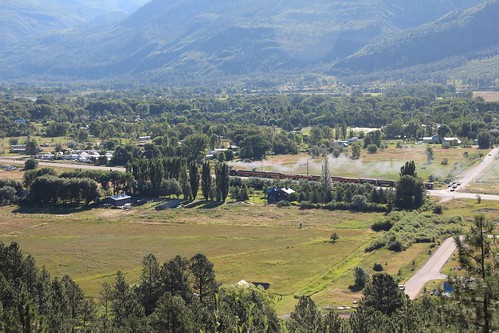
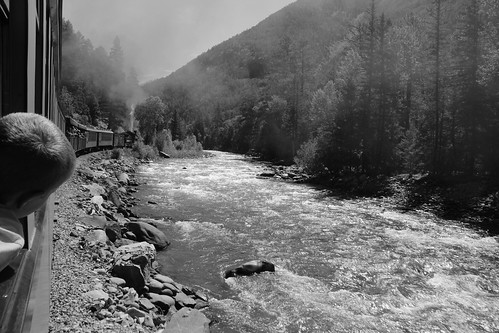
IMG_5731_v1 There is something about that moment. Hiking in the mountains near Durango, Colorado, with Laura and the boys, we found a beautiful spot with a view of the valley. We paused to admire, and then The sound of a steam locomotive whistle from down below, sounding loud all the way up there, then echoing back and forth through the valley. Then the quieter, seemingly more distant sound of the steam engine heading across the valley, chugging and clacking as it goes. More whistles, the sight of smoke and then of the train full of people, looking like a beautiful model train from our vantage point. IMG_5515 I ve heard that sound on a few rare recordings, but never experienced it. I ve been on steam trains a few times, but never spent time in a town where they still run all day, every day. It is a different sort of feeling to spend a week in a place where Jacob and Oliver would jump up several times a day and rush to the nearest window in an attempt to catch sight of the train. IMG_5719_v1 Airplanes really can be a time machine in a sense what a wondrous time to be alive, when things so ancient are within the reach of so many. I have been transported to L beck and felt the uneven 700-year-old stones of the Marienkirche underneath my feet, feeling a connection to the people that walked those floors for centuries. I felt the same in Prague, in St. George s Basilica, built in 1142, and at the Acropolis of Lindos, with its ancient Greek temple ruins. In Kansas, I feel that when in the middle of the Flint Hills rolling green hills underneath the pure blue sky with billowing white clouds, the sounds of crickets, frogs, and cicadas in my ears; the sights and sounds are pretty much as they ve been for tens of thousands of years. And, of course, in Durango, arriving on a plane but seeing the steam train a few minutes later. IMG_5571_v1 It was fitting that we were in Durango with Laura s parents to celebrate their 50th anniversary. As we looked forward to riding the train, we heard their stories of visits to Durango years ago, of their memories of days when steam trains were common. We enjoyed thinking about what our lives would be like should we live long enough to celebrate 50 years of marriage. Perhaps we would still be in good enough health to be able to ride a steam train in Durango, telling about that time when we rode the train, which by then will have been pretty much the same for 183 years. Or perhaps we would take them to our creek, enjoying a meal at the campfire like I ve done since I was a child. Each time has its unique character. I am grateful for the cameras and airplanes and air conditioning we have today. But I am also thankful for those things that connect us with each other trough time, those rocks that are the same every year, those places that remind us how close we really are to those that came before.

1 August 2015

Lars Wirzenius: Obnam 1.13 released (backup software)

I have just released version 1.13 of Obnam, my backup program. See the website at http://obnam.org for details on what it does. The new version is available from git (see http://git.liw.fi) and as Debian packages from http://code.liw.fi/debian, and uploaded to Debian, and soon in unstable. The NEWS file extract below gives the highlights of what's new in this version. Version 1.13, released 2015-08-01 Bug fixes: Improvements:

Russ Allbery: Review: The Pyramid Waltz

Review: The Pyramid Waltz, by Barbara Ann Wright
Series: Katya and Starbride #1
Publisher: Bold Strokes
Copyright: September 2012
ISBN: 1-60282-792-3
Format: Kindle
Pages: 264
Princess Katya Nar Umbriel is publicly a bored, womanizing, and difficult daughter to the rulers of Farraday. It's all an act, though, with the full knowledge of her parents. As the second child, she's the leader of the Order of Vestra: the equivalent of the Secret Service, devoted to protecting the royal family and, by extension, the kingdom, particularly against magical attacks. Starbride is new to court and entirely out of place. From a northern neighboring country, and far more comfortable in practical clothing than the frilled court dresses that her mother wants her to wear, she has been sent to court to make contacts. Her people are getting the bad side of various trade contracts and desperately need some political maneuvering space of their own. Starbride's best hope for this is to study law in the palace library when she can manage to avoid the other courtiers. But then she and Katya stumble across each other, outside of the roles they're playing, and might have an opportunity for a deeper connection. One that neither of them want to entangle in their personal worries. This is the last of a set of books I picked up while looking for lesbian romance with fantasy or science fiction elements. On the romance front, it's one of the better entries in that set. Both Katya and Starbride are likeable, in large part due to their mutual exasperation with the trappings of the court. (Making the protagonists more serious, thoughtful, and intelligent than the surrounding characters is an old trick, but it works.) Wright has a good ear for banter, particularly the kind when two people of good will are carefully feeling each other out. And despite Katya's need to keep a deep secret from Starbride for some of the book, The Pyramid Waltz mostly avoids irritating communication failures as a plot driver. The fantasy portion and the plot drivers, alas, are weaker. The world building is not exactly bad, but it's just not that interesting. There are a couple of moderately good ideas, in the form of pyramid magic and secret (and dangerous) magical powers that run in the royal family, but they're not well-developed. Pyramid magic turns out to look much like any other generic fantasy magic system, with training scenes that could have come from a Valdemar or Wheel of Time novel (and without as much dramatic tension). And the royal family's secret, while better-developed and integral to the plot, still felt rather generic and one-sided. Maybe that's something Wright develops better in future novels in this series, but that was another problem: the ending of The Pyramid Waltz was rather weak. Partly, I think, this is because the cast is too large and not well-developed. I cared about Katya and Starbird, and to a lesser extent their servants and one of the Order members. (Wright has a moderately interesting bit of worldbuilding about how servants work in Starbride's culture, which I wish we'd seen more of.) But there are a bunch of other Order of Vesta members, Katya's family, and various other bits of history and hinted world views, none of which seemed to get much depth. The ending climax involved a lot of revelations and twists that primarily concerned characters I didn't care about. It lost something in the process. This book is clearly set up for a sequel. There is an ending, but it's not entirely satisfying. Unfortunately, despite liking Katya and Starbird a lot, the rest of the story wasn't compelling enough to make me want to buy it, particularly since the series apparently goes through another three books before reaching a real ending. I enjoyed parts of this book, particularly Katya and Starbird feeling each other out and discovering similarities in their outlook. Katya teasing Starbird, and Starbird teasing herself, over her mother's choice of her clothing was probably the best part. It's not bad for what it's trying to do, but I think it's a bit too generic and not satisfying enough to really recommend. Followed by For Want of a Fiend. Rating: 6 out of 10

31 July 2015

Scott Kitterman: Plasma 5 (KDE) In Testing

A few days ago, fellow Qt/KDE team member Lisandro gave an update on the situation with migration to Plasma 5 in Debian Testing (AKA Stretch). It s changed again. All of Plasma 5 is now in Testing. The upgrade probably won t be entirely smooth, which we ll work on that after the gcc5 transition is done, but it will be much better than the half KDE4 SC half Kf5/Plasma 5 situation we ve had for the last several days. The issues with starting kwin should be resolved once users upgrade to Plasma 5. To use the current kwin with KDE SC 4, you will need to add a symlink from /usr/bin/kwin to /usr/bin/kwin_x11. That will be included in the next upload after gcc5. Systemsettings and plasma-nm now work. In my initial testing, I didn t see anything major that was broken. One user reported an issue with sddm starting automatically, but it worked fine for me. During the upgrade you should get a debconf prompt asking if you want to use kdm or sddm. Pick sddm. When I tried to dist-upgrade, apt wanted to remove task-kde-desktop. I let it remove it and some other packages and then in a second step did apt-get install task-kde-desktop. That pulled it back in successfully along with adding and removing a reasonably large stack of packages. Obviously we need to make that work better before Stretch is released, but as long as you don t restart KDE in between those two steps it should be fine. Lastely, I used apt-get autoremove to clear out a lot of no longer needed KDE4 things (when it asks if you want to stop the running kdm, say no). Here are a few notes on terminology and what I understand of the future plans: What used to be called KDE is now three different things (in part because KDE is now the community of people, not the software): KDE Frameworks 5 (Kf5): This is a group of several dozen small libraries that as a group, roughly equate to what used to be kdelibs. Plasma (Workspaces) 5: This is the desktop that we ve just transitioned to. Applications: These are a mix of kdelibs and Kf5 based applications. Currently in Testing there are some of both and this will evolve over time based on upstream development. As an example, the Kf5 based version of konsole is in Unstable and should transition to Testing shortly. Finally, thanks to Maximiliano Curia (maxy on IRC) for doing virtually all of the packaging of Kf5, Plasma 5, and applications. He did the heavy lifting, the rest of us just nibbled around the edges to keep it moving towards testing.

Steve McIntyre: Linaro VLANd v0.3

VLANd is a python program intended to make it easy to manage port-based VLAN setups across multiple switches in a network. It is designed to be vendor-agnostic, with a clean pluggable driver API to allow for a wide range of different switches to be controlled together. There's more information in the README file. I've just released v0.3, with a lot of changes included since the last release: VLANd is Free Software, released under the GPL version 2 (or any later version). For now, grab it from git; tarballs will be coming shortly.

Raphaël Hertzog: My Free Software Activities in July 2015

My monthly report covers a large part of what I have been doing in the free software world. I write it for my donators (thanks to them!) but also for the wider Debian community because it can give ideas to newcomers and it s one of the best ways to find volunteers to work with me on projects that matter to me. Debian LTS This month I have been paid to work 15 hours on Debian LTS. In that time I did the following: Kali Linux / Debian Stretch work kaliKali Linux wants to experiment something close to Debian Constantly Usable Testing: we have a kali-rolling release that is based on Debian Testing and we want to take a new snapshot every 4 months (in order to have 3 releases per year). More specifically we have a kali-dev repository which is exactly Debian Stretch + our own Kali packages (the kali package take precedence) updated 4 times a day, just like testing is. And we have a britney2 setup that generates kali-rolling out of kali-dev (without any requirement in terms of delay/RC bugs, it just ensures that dependencies are not broken), also 4 times a day. We have jenkins job that ensures that our metapackages are installable in kali-dev (and kali-rolling) and that we can build our ISO images. When things break, I have to fix them and I try to fix them on the Debian side first. So here are some examples of stuff I did in response to various failures: If you analyze this list, you will see that a large part of the issues we had come down to package getting removed from testing due to RC bugs. We should be able to anticipate those issues and monitor the packages that have an impact on Kali. We will probably add new jenkins job that installs all the metapackages and then run how-can-i-help -s testing-autorm --old I just submitted #794238 as a wishlist against how-can-i-help. At the same time, there are bugs that make it into testing and that I fix / work around on the Kali side. But those fixes / work around might be more useful if they were pushed to testing via testing-proposed-updates. I tried to see whether other derivatives had similar needs to see if derivatives could join their efforts at this level but it does not look like so for now. Last but not least, bugs reported on the Kali side also resulted in Debian improvements: Other Debian work Sponsorship. I sponsored multiple packages for Daniel Stender who is packaging prospector, a software that I requested earlier (through RFP bug). So I reviewed and uploaded python-requirements-detector, python-setoptconf, pylint-celery and pylint-common. During a review I also discovered a nice bug in dh-python (#793609a comment in the middle of a Build-Depends could break a package). I also sponsored an upload of notmuch-addrlookup (new package requested by a Freexian customer). Packaging. I uploaded python-django 1.7.9 in unstable and 1.8.3 in experimental to fix security issues. I uploaded a new upstream release of ditaa through a non-maintainer uploaded (again at the request of a Freexian customer). Distro Tracker. Beside the work to integrate detailed security status, I fixed the code to be compatible with Django 1.8 and modified the tox configuration to ensure that the test suite is regularly run against Django 1.8. I also merged multiple patches of Christophe Siraut (cf #784151 and #754413). Thanks See you next month for a new summary of my activities.

2 comments Liked this article? Click here. My blog is Flattr-enabled.

Simon Kainz: DUCK challenge: week 4

The DUCK challenge is making a quite stable progress: in the last 4 weeks there were approximately 12.25 packages fixed and uploaded per week. In the current week the following packages were fixed and uploaded into unstable: So we had 14 packages fixed and uploaded by 10 different uploaders. A big "Thank You" to you!! Since the start of this challenge, a total of 49 packages, uploaded by 31 different persons were fixed. Here is a quick overview:
Week 1 Week 2 Week 3 Week 4 Week 5 Week 6 Week 7
# Packages 10 15 10 14 - - -
Total 10 25 35 49 - - -
The list of the fixed and updated packages is availabe here. I will try to update this ~daily. If I missed one of your uploads, please drop me a line. DebConf15 is approaching quite fast, so please get involved: The DUCK Challenge is running until end of DebConf15! Pevious articles are here: Week 1, Week 2, Week 3.

30 July 2015

DebConf team: DebConf15 Schedule Published and Additional Featured Speakers Announced (Posted by DebConf Content Team)

DebConf15 Schedule The DebConf content team is pleased to announce the schedule of DebConf15, the forthcoming Debian Developers Conference. From a total of nearly 100 talk submissions, the team selected 75 talks. Due to the high number of submissions, several talks had to be shortened to 20 minute slots, of which a total of 30 talks have made it to the schedule. In addition, around 50 meetings and discussions (BoFs) have been submitted so far, as well as several other events like lightning talk sessions, live demos, a movie screening, a poetry night or stand-up comedy. The Schedule is available online at the DebConf15 conference site. Further changes to the schedule can and will be made, but today s announcement represents the first stable version. Featured Speakers In addition to the previously announced invited speakers, the content team also announces the following list of additional featured speakers: The full list of invited and featured speakers, including the invited speakers profiles and the titles of their talks is available here.

Daniel Pocock: Free Real-time Communications (RTC) at DebConf15, Heidelberg

The DebConf team have just published the first list of events scheduled for DebConf15 in Heidelberg, Germany, from 15 - 22 August 2015. There are two specific events related to free real-time communications and a wide range of other events related to more general topics of encryption and privacy. 15 August, 17:00, Free Communications with Free Software (as part of the DebConf open weekend) The first weekend of DebConf15 is an open weekend, it is aimed at a wider audience than the traditional DebConf agenda. The open weekend includes some keynote speakers, a job fair and various other events on the first Saturday and Sunday. The RTC talk will look at what solutions exist for free and autonomous voice and video communications using free software and open standards such as SIP, XMPP and WebRTC as well as some of the alternative peer-to-peer communications technologies that are emerging. The talk will also look at the pervasive nature of communications software and why success in free RTC is so vital to the health of the free software ecosystem at large. 17 August, 17:00, Challenges and Opportunities for free real-time communications This will be a more interactive session people are invited to come and talk about their experiences and the problems they have faced deploying RTC solutions for professional or personal use. We will try to look at some RTC/VoIP troubleshooting techniques as well as more high-level strategies for improving the situation. Try the Debian and Fedora RTC portals Have you registered for rtc.debian.org? It can successfully make federated SIP calls with users of other domains, including Fedora community members trying FedRTC.org. You can use rtc.debian.org for regular SIP (with clients like Empathy, Jitsi or Lumicall) or WebRTC. Can't get to DebConf15? If you can't get to Heidelberg, you can watch the events on the live streaming service and ask questions over IRC. To find out more about deploying RTC, please see the RTC Quick Start Guide. Did you know? Don't confuse Heidelberg, Germany with Heidelberg in Melbourne, Australia. Heidelberg down under was the site of the athlete's village for the 1956 Olympic Games.

Steve Kemp: The differences in Finland start at home.

So we're in Finland, and the differences start out immediately. We're renting a flat, in building ten, on a street. You'd think "10 Streetname" was a single building, but no. It is a pair of buildings: 10A, and 10B. Both of the buildings have 12 flats in them, with 10A having 1-12, and 10B having 13-24. There's a keypad at the main entrance, which I assumed was to let you press a button and talk to the people inside "Hello I'm the postmaster", but no. There is no intercom system, instead you type in a magic number and the door opens. The magic number? Sounds like you want to keep that secret, since it lets people into the common-area? No. Everybody has it. The postman, the cleaners, the DHL delivery man, and all the ex-tenants. We invited somebody over recently and gave it out in advance so that they could knock on our flat-door. Talking of cleaners: In the UK I lived in a flat and once a fortnight somebody would come and sweep the stair-well, since we didn't ever agree to do it ourselves. Here somebody turns up every day, be it to cut the grass, polish the hand-rail, clean the glass on the front-door, or mop the floors of the common area. Sounds awesome. But they cut the grass, right outside our window, at 7:30AM. On the dot. (Or use a leaf-blower, or something equally noisy.) All this communal-care is paid for by the building-association, of which all flat-owners own shares. Sounds like something we see in England, or even like Americas idea of a Home-Owners-Association. (In Scotland you own your own flat, you don't own shares of an entity which owns the complete building. I guess there are pros and cons to both approaches.) Moving onwards other things are often the same, but the differences when you spot them are odd. I'm struggling to think of them right now, somebody woke me up by cutting our grass for the second time this week (!) Anyway I'm registered now with the Finnish government, and have a citizen-number, which will be useful, I've got an appointment booked to register with the police - which is something I had to do as a foreigner within the first three months - and today I've got an appointment with a local bank so that I can have a euro-bank-account. Happily I did find a gym to join, the owner came over one Sunday to give me a tiny-tour, and then gave me a list of other gyms to try if his wasn't good enough - which was a nice touch - I joined a couple of days later, his gym is awesome. (I'm getting paid in UK-pounds, to a UK-bank, so right now I'm getting local money by transferring to my wifes account here, but I want to do that to my own, and open a shared account for paying for rent, electricity, internet, water, & etc). My flat back home is still not rented, because the nice property management company lost my keys. Yeah you can't make that up can you? With a bit of luck the second set of keys I mailed them will arrive soon and the damn thing can be occupied, while I'm not relying on that income I do wish to have it.

28 July 2015

Lisandro Damián Nicanor Pérez Meyer: Plasma/KF5 : Testing situation

Dear Debian/KDE users,

We are aware that the current situation in testing is very unfortunate, with two main issues:

  1. systemsettings transitioned to testing before the corresponding KDE Control Modules. The result is that systemsettings displays an empty screen. This is tracked in the following bug https://bugs.debian.org/cgi-bin/bugreport.cgi?bug=790703.
  2. plasmoids such as plasma-nm transitioned to testing before plasma-desktop 5. The result is that the plasmoid are no longer displayed in the system tray.

We are working on getting plasma-desktop to transition to testing as soon as possible (hopefully in 2 days time), which will resolve both those issues. We appreciate that the transition to KF5 is much rougher than we would have liked, and apologize to all those impacted.

On behalf of the Qt/KDE team,
Lisandro.

Norbert Preining: ePub editor Sigil landed in Debian

Long long time ago I wanted to have Sigil, an epub editor, to appear in Debian. There was a packaging wishlist bug from back in 2010 with intermittent activities. But thanks to concerted effort, especially by Mattia Rizzolo and Don Armstrong, packaging progressed to a state that I could sponsor the upload to experimental about 4 months ago. And yesterday, after long waiting, finally Sigil passed the watchful eyes of the Debian ftp-masters and has entered Debian/experimental. sigil-debian I have already updated the packaging for the latest version 0.8.7, which will be included in Debian/sid rather soon. Thanks again especially Mattia for his great work.
Email this to someonePrint this pageShare on FacebookShare on Google+Tweet about this on TwitterShare on LinkedInFlattr the author

27 July 2015

Dirk Eddelbuettel: Evading the "Hadley tax": Faster Travis tests for R

Hadley is a popular figure, and rightly so as he successfully introduced many newcomers to the wonders offered by R. His approach strikes some of us old greybeards as wrong---I particularly take exception with some of his writing which frequently portrays a particular approach as both the best and only one. Real programming, I think, is often a little more nuanced and aware of tradeoffs which need to be balanced. As a book on another language once popularized: "There is more than one way to do things." But let us leave this discussion for another time. As the reach of the Hadleyverse keeps spreading, we sometimes find ourselves at the receiving end of a cost/benefit tradeoff. That is what this post is about, and it uses a very concrete case I encountered yesterday. As blogged earlier, the RcppZiggurat package was updated. I had not touched it in a year, but Brian Ripley had sent a brief and detailed note concerning something flagged by the Solaris compiler (correctly suggesting I replace fabs() with abs() on integer types). (Allow me to stray from the main story line here for a second to stress just how insane a work load he is carrying, essentially for all of us. R and the R community are so just so indebted to him for all his work---which makes the usual social media banter about him so unfortunate. But that too shall be left for another time.) Upon making the simple fix, and submitting to GitHub the usual Travis CI was triggered. And here is what I saw: first travis build in a year
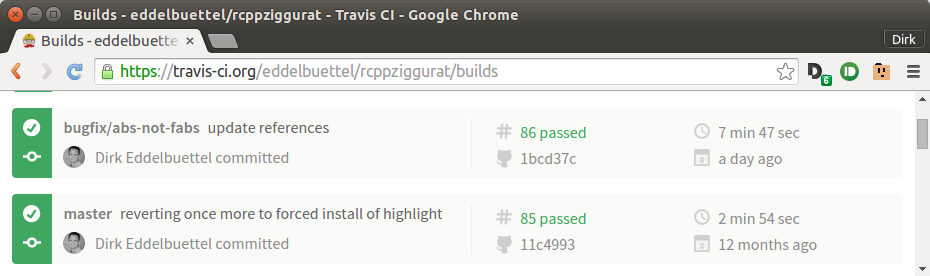
All happy, all green. Previous build a year ago, most recent build yesterday, both passed. But hold on: test time went from 2:54 minutes to 7:47 minutes for an increase of almost five minutes! And I knew that I had not added any new dependencies, or altered any build options. What did happen was that among the dependencies of my package, one had decided to now also depend on ggplot2. Which leads to a chain of sixteen additional packages being loaded besides the four I depend upon---when it used to be just one. And that took five minutes as all those packages are installed from source, and some are big and take a long time to compile. There is however and easy alternative, and for that we have to praise Michael Rutter who looks after a number of things for R on Ubuntu. Among these are the R builds for Ubuntu but also the rrutter PPA as well as the c2d4u PPA. If you have not heard this alphabet soup before, a PPA is a package repository for Ubuntu where anyone (who wants to sign up) can upload (properly setup) source files which are then turned into Ubuntu binaries. With full dependency resolution and all other goodies we have come to expect from the Debian / Ubuntu universe. And Michael uses this facility with great skill and calm to provide us all with Ubuntu binaries for R itself (rebuilding what yours truly uploads into Debian), as well as a number of key packages available via the CRAN mirrors. Less know however is this "c2d4u" which stands for CRAN to Debian for Ubuntu. And this builds on something Charles Blundell once built under my mentorship in a Google Summer of Code. And Michael does a tremdous job covering well over a thousand CRAN source packages---and providing binaries for all. Which we can use for Travis! What all that means is that I could now replace the line
 - ./travis-tool.sh install_r RcppGSL rbenchmark microbenchmark highlight
which implies source builds of the four listed packages and all their dependencies with the following line implying binary installations of already built packages:
 - ./travis-tool.sh install_aptget libgsl0-dev r-cran-rcppgsl r-cran-rbenchmark r-cran-microbenchmark r-cran-highlight
In this particular case I also needed to build a binary package of my RcppGSL package as this one is not (yet) handled by Michael. I happen to have (re-)discovered the beauty of PPAs for Travis earlier this year and revitalized an older and largely dormant launchpad account I had for this PPA of mine. How to build a simple .deb package will also have to left for a future post to keep this more concise. This can be used with the existing r-travis setup---but one needs to use the older, initial variant in order to have the ability to install .deb packages. So in the .travis.yml of RcppZiggurat I just use
before_install:
## PPA for Rcpp and some other packages
- sudo add-apt-repository -y ppa:edd/misc
## r-travis by Craig Citro et al
- curl -OL http://raw.github.com/craigcitro/r-travis/master/scripts/travis-tool.sh
- chmod 755 ./travis-tool.sh
- ./travis-tool.sh bootstrap
to add my own PPA and all is good. If you do not have a PPA, or do not want to create your own packages you can still benefit from the PPAs by Michael and "mix and match" by installing from binary what is available, and from source what is not. Here we were able to use an all-binary approach, so let's see the resulting performance: latest travis build
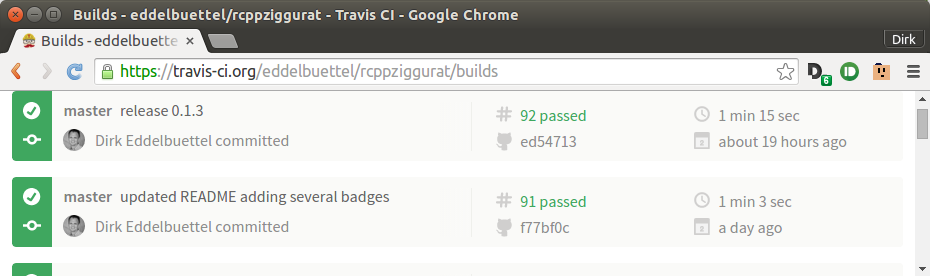
Now we are at 1:03 to 1:15 minutes---much better. So to conclude, while the every expanding universe of R packages is fantastic for us as users, it can be seen to be placing a burden on us as developers when installing and testing. Fortunately, the packaging infrastructure built on top of Debian / Ubuntu packages can help and dramatically reduce build (and hence test) times. Learning about PPAs can be a helpful complement to learning about Travis and continued integration. So maybe now I need a new reason to blame Hadley? Well, there is always snake case ...

Follow-up: The post got some pretty immediate feedback shortly after I posted it. Craig Citro pointed out (quite correctly) that I could use r_binary_install which would also install the Ubuntu binaries based on their R packages names. Having built R/CRAN packages for Debian for so long, I am simply more used to the r-cran-* notations, and I think I was also the one contributing install_aptget to r-travis ... Yihui Xie spoke up for the "new" Travis approach deploying containers, caching of packages and explicit whitelists. It was in that very (GH-based) discussion that I started to really lose faith in the new Travis approach as they want use to whitelist each and every package. With 6900 and counting at CRAN I fear this simply does not scale. But different approaches are certainly welcome. I posted my 1:03 to 1:15 minutes result. If the "New School" can do it faster, I'd be all ears.

This post by Dirk Eddelbuettel originated on his Thinking inside the box blog. Please report excessive re-aggregation in third-party for-profit settings.
26 July 2015

Lunar: Reproducible builds: week 12 in Stretch cycle

What happened in the reproducible builds effort this week: Toolchain fixes Eric Dorlan uploaded automake-1.15/1:1.15-2 which makes the output of mdate-sh deterministic. Original patch by Reiner Herrmann. Kenneth J. Pronovici uploaded epydoc/3.0.1+dfsg-8 which now honors SOURCE_DATE_EPOCH. Original patch by Reiner Herrmann. Chris Lamb submitted a patch to dh-python to make the order of the generated maintainer scripts deterministic. Chris also offered a fix for a source of non-determinism in dpkg-shlibdeps when packages have alternative dependencies. Dhole provided a patch to add support for SOURCE_DATE_EPOCH to gettext. Packages fixed The following 78 packages became reproducible in our setup due to changes in their build dependencies: chemical-mime-data, clojure-contrib, cobertura-maven-plugin, cpm, davical, debian-security-support, dfc, diction, dvdwizard, galternatives, gentlyweb-utils, gifticlib, gmtkbabel, gnuplot-mode, gplanarity, gpodder, gtg-trace, gyoto, highlight.js, htp, ibus-table, impressive, jags, jansi-native, jnr-constants, jthread, jwm, khronos-api, latex-coffee-stains, latex-make, latex2rtf, latexdiff, libcrcutil, libdc0, libdc1394-22, libidn2-0, libint, libjava-jdbc-clojure, libkryo-java, libphone-ui-shr, libpicocontainer-java, libraw1394, librostlab-blast, librostlab, libshevek, libstxxl, libtools-logging-clojure, libtools-macro-clojure, litl, londonlaw, ltsp, macsyfinder, mapnik, maven-compiler-plugin, mc, microdc2, miniupnpd, monajat, navit, pdmenu, pirl, plm, scikit-learn, snp-sites, sra-sdk, sunpinyin, tilda, vdr-plugin-dvd, vdr-plugin-epgsearch, vdr-plugin-remote, vdr-plugin-spider, vdr-plugin-streamdev, vdr-plugin-sudoku, vdr-plugin-xineliboutput, veromix, voxbo, xaos, xbae. The following packages became reproducible after getting fixed: Some uploads fixed some reproducibility issues but not all of them: Patches submitted which have not made their way to the archive yet: reproducible.debian.net The statistics on the main page of reproducible.debian.net are now updated every five minutes. A random unreviewed package is suggested in the look at a package form on every build. (h01ger) A new package set based new on the Core Internet Infrastructure census has been added. (h01ger) Testing of FreeBSD has started, though no results yet. More details have been posted to the freebsd-hackers mailing list. The build is run on a new virtual machine running FreeBSD 10.1 with 3 cores and 6 GB of RAM, also sponsored by Profitbricks. strip-nondeterminism development Andrew Ayer released version 0.009 of strip-nondeterminism. The new version will strip locales from Javadoc, include the name of files causing errors, and ignore unhandled (but rare) zip64 archives. debbindiff development Lunar continued its major refactoring to enhance code reuse and pave the way to fuzzy-matching and parallel processing. Most file comparators have now been converted to the new class hierarchy. In order to support for archive formats, work has started on packaging Python bindings for libarchive. While getting support for more archive formats with a common interface is very nice, libarchive is a stream oriented library and might have bad performance with how debbindiff currently works. Time will tell if better solutions need to be found. Documentation update Lunar started a Reproducible builds HOWTO intended to explain the different aspects of making software build reproducibly to the different audiences that might have to get involved like software authors, producers of binary packages, and distributors. Package reviews 17 obsolete reviews have been removed, 212 added and 46 updated this week. 15 new bugs for packages failing to build from sources have been reported by Chris West (Faux), and Mattia Rizzolo. Presentations Lunar presented Debian efforts and some recipes on making software build reproducibly at Libre Software Meeting 2015. Slides and a video recording are available. Misc. h01ger, dkg, and Lunar attended a Core Infrastructure Initiative meeting. The progress and tools mode for the Debian efforts were shown. Several discussions also helped getting a better understanding of the needs of other free software projects regarding reproducible builds. The idea of a global append only log, similar to the logs used for Certificate Transparency, came up on multiple occasions. Using such append only logs for keeping records of sources and build results has gotten the name Binary Transparency Logs . They would at least help identifying a compromised software signing key. Whether the benefits in using such logs justify the costs need more research.

Norbert Preining: Challenging riddle from The Talos Principle

When I recently complained that Portal 2 was too easy, I have to say, The Talos Principle is challenging. For a solution that, if known, takes only a few seconds, I often have to wring my brain about the logistics for long long time. Here a nice screenshot from one of the easier riddles, but with great effect. TTP-screenshot A great game, very challenging. A more length review will come when I have finished the game.
Email this to someonePrint this pageShare on FacebookShare on Google+Tweet about this on TwitterShare on LinkedInFlattr the author

25 July 2015

Sandro Tosi: How to change your Google services location

Several services in Google depends on your location, in particular on Google Play (things like apps, devices, contents can be restricted to some countries), but what to do if you relocate and want to update your information to access those exclusive services? Lots of stories out there to make a payment on the playstore with updated credit card info etc etc, it's actually a bit different, but not that much.

There are 3 places where you need to update your location information, all of them on Google Payments:

  1. in Payment Methods, change the billing address of all your payment methods;
  2. in Address Book, change the default shipping address;
  3. in Settings, change your home address.
Once that's done, wait some minutes, and you might also want to logout/login again in your Google account (even tho Google support will tell it's not necessary, it didnt work for me otherwise) and you should be ready to go.

Sandro Tosi: DICOM viewer and converter in Debian

DICOM is a standard for your RX/CT/MRI scans and the format most of the times your result will be given to you, along with Win/MacOS viewers, but what about Debian? the best I could find is Ginkgo CADx (package ginkgocadx).

If you want to convert those DICOM files into images you can use convert (I dont know why I was surprised to find out imagemagik can handle it).

PS: here a description of the format.

Michal Čihař: Migrating phpMyAdmin from SourceForge.net

Some time ago we've decided to move phpMyAdmin out of SourceForge.net services. This was mostly motivated by issues with sf.net bundling crapware with installers (though we were not affected), but also we've missed some features that we would like to have and were not possible there. The project relied on SourceForge.net with several services. The biggest ones being website and downloads hosting, issue tracking and mailing lists. We've chosen different approach for each of these. As first, we've moved away website and downloads. Thanks to generous offer of CDN77.com, everything went quite smoothly and we now have HTTPS secured website and downloads, see our announcement. Oh and on the way we've started to PGP sign the releases as well, so you can verify the download. Shortly after this SourceForge.net was hit by major problems with infrastructure. Unfortunately we were not yet completely ready with rest of the migration, but this has definitely pushed us to make progress faster. During the outage, we've opened up issue tracker on GitHub, to be able to receive bug reports from our users. On the background I've worked on the issue migration. The good news is that as of now almost all issues are migrated. There are few missing ones, but these will be hopefully handled in upcoming days as well. Last but not least, we had mailing lists on SourceForge.net. We've shortly discussed available options and decided to run own mail server with these. It will allow us greater flexibility while still using well know software in background. Initial attempts with Mailman 3 failed, so we got back to Mailman 2, which is stable and easy to configure. See also our news posts for official announcement. Thanks to SourceForge.net, it has been great home for us, but now we have better places to live.

Filed under: English phpMyAdmin 0 comments

24 July 2015

Simon Kainz: DUCK challenge: week 3

One more update on the the DUCK challenge: In the current week, the following packages were fixed and uploaded into unstable: So we had 10 packages fixed and uploaded by 8 different uploaders. A big "Thank You" to you!! Since the start of this challenge, a total of 35 packages, uploaded by 25 different persons were fixed. Here is a quick overview:
Week 1 Week 2 Week 3 Week 4 Week 5 Week 6 Week 7
# Packages 10 15 10 - - - -
Total 10 25 35 - - - -
The list of the fixed and updated packages is availabe here. I will try to update this ~daily. If I missed one of your uploads, please drop me a line. There is still lots of time till the end of DebConf15 and the end of the DUCK Challenge, so please get involved. Pevious articles are here: Week 1, Week 2.

23 July 2015

Antoine Beaupr : Is it safe to use open wireless access points?

I sometimes get questions when people use my wireless access point, which, for as long as I can remember, has been open to everyone; that is without any form of password protection or encryption. I arguably don't use the access point much myself, as I prefer the wired connection for the higher bandwidth, security and reliability it provides. Apart from convenience for myself and visitors, the main reason why I leave my wireless access open is that I believe in a free (both as in beer and freedom) internet, built with principles of solidarity rather than exploitation and profitability. In these days of ubiquitous surveillance, freedom often goes hand in hand with anonymity, which implies providing free internet access to everyone. I also believe that, as more and more services get perniciously transferred to the global internet, access to the network is becoming a basic human right. This is therefore my small contribution to the struggle, now also part of the R seau Libre project. So here were my friends question, in essence:
My credit card info was stolen when I used a wifi hotspot in an airport... Should I use open wifi networks? Is it safe to use my credit card for shopping online?
Here is a modified version of an answer I sent to a friend recently which I thought could be useful to the larger internet community. The short answer is "sorry about that", "it depends, you generally can, but be careful" and "your credit card company is supposed to protect you".

Sorry! First off, sorry to hear that our credit card was stolen in an airport! That has to be annoying... Did the credit card company reimburse you? Normally, the whole point of credit cards is that they protect you in case of theft like this and they are supposed to reimburse you if you credit card gets stolen or abused...

The complexity and unreliability of passwords Now of course, securing every bit of your internet infrastructure helps in protecting against such attacks. However: there is a trade-off! First off, it does makes it more complicated for people to join the network. You need to make up some silly password (which has its own security problems: passwords can be surprisingly easy to guess!) that you will post on the fridge or worst, forget all the time! And if it's on the fridge, anyone with a view to that darn fridge, be it one-time visitor or sneaky neighbor, can find the password and steal your internet access (although, granted, that won't allow them to directly spy on your internet connection). In any case, if you choose to use a password, you should use the tricks I wrote in the koumbit wiki to generate the password and avoid writing it on the fridge.

The false sense of security of wireless encryption Second, it can also give a false sense of security: just because a wifi access point appears "secure" (ie. that the communication between your computer and the wifi access point is encrypted) doesn't mean the whole connection is secure. In fact, one attack that can be done against access points is exactly to masquerade as an existing access point, with no security security at all. That way, instead of connecting to the real secure and trusted access point, you connect to an evil one which spies on our connection. Most computers will happily connect to such a hotspot even with degraded security without warning. It may be what happened at the airport, in fact. Of course this particular attack would be less likely to happen if you live in the middle of the woods than an airport, but it's some important distinction to keep in mind, because the same attack can be performed after the wireless access point, for example by your countryside internet access provider or someone attacking it. Your best protection for your banking details is to rely on good passwords (for your back account) but also, and more importantly, what we call end-to-end encryption. That is usually implemented using the "HTTPS" with a pad lock icon in your address bar. This ensures that the communication between your computer and the bank or credit card company is secure, that is: that no wifi access point or attacker between your computer and them can intercept your credit card number.

The flaws of internet security Now unfortunately, even the HTTPS protocol doesn't bring complete security. For example, one attack that can be done is similar to the previous one and that is to masquerade as a legitimate bank site, but either strip out the encryption or even fake the encryption. So you also need to look at the address of the website you are visiting. Attackers are often pretty clever and will use many tricks to hide the real address of the website in the address bar. To work around this, I always explicitly type my bank website address (https://accesd.desjardins.com/ in my case) directly myself instead of clicking on links, bookmarks or using a search engine to find my bank site. In the case of credit cards, it is much trickier because when you buy stuff online, you end up putting that credit card number on different sites which you do not necessarily trust. There's no good solution but complaining to your credit card company if you believe a website you used has stolen your credit card details. You can also use services like Paypal, Dwolla or Bitcoin that hide your credit card details from the seller, if they support the service. I usually try to avoid putting my credit card details on sites I do not trust, and limit myself to known parties (e.g. Via Rail, Air Canada, etc). Also, in general, I try to assume the network connection between me and the website I visit is compromised. This forced me to get familiar with online security and use of encryption. It is more accessible to me than trying to secure the infrastructure i am using, because i often do not control it at all (e.g. internet cafes...). Internet security is unfortunately a hard problem, and things are not getting easier as more things move online. The burden is on us programmers and system administrators to create systems that are more secure and intuitive for our users so, as I said earlier, sorry the internet sucks so much, we didn't think so many people would join the acid trip of the 70s. ;)

Next.

Previous.