
Search Results: "pm"

23 January 2008

Matthew Palmer: A Wheel With Corners

How often have you said to yourself "this programming language's if statement is too flexible, I need to make it more rigid, and with a syntax nobody else understands"? If you've ever said that to yourself, then take a look at this Rails plugin. From the brief description of the plugin:
Allows developers to execute or not execute given code block depending on a set of conditions, written in intuitive manner. Especially useful within view templates, where it can eliminate the need for multiple if ... else ... statements.
That screams "overkill" to me, but for the sake of my morbid curiousity (and on the very, very off chance that it's something not entirely ridiculous) I took a look at the detailed documentation. At least there is detailed documentation for this plugin. I didn't get any further than the first example, though. Take a look at this monster:
How often do you find yourself writing something like that in your views:
	  <% if current_user != :false && (current_user.administrator?   current_user == @profile.user) %>
	    <%= button_to('Big Red Button', destroy_everything_path) %>
	  <% else %>
	    <%= button_to('Hands off!!!', access_denied_path) %>
	   <% end %>
	
It works, but, you know, it's not what you would call beautiful, is it? What about something like that:
	  <% access.to_administrator.or_user_of(@profile) do %>
	    <%= button_to('Big Red Button', destroy_everything_path) %>
	  <% end.else do %>
	    <%= button_to('Hands off!!!', access_denied_path) %>
	  <% end %>
	
At least conditions are looking much better, aren't they?
Hopefully, most people out there answered a resounding "no" to that last question. A plugin which causes you to write just as many lines and very nearly as many characters, whilst using a completely different minilanguage to what every Ruby programmer already knows, does not sound "much better" to me. Ruby people tend to love little minilanguages to get things done, but this... I just don't have the words to properly describe it. I'm going to start a list of "poison plugins" -- ones that, if I see any of them in or around the code of a Rails project I'm looking at working on, immediately doubles the hourly rate and the time estimates. Stupidity is toxic, and working with hazardous substances is always more expensive. Other current candidates include the old-world auth generator I gutted while I was at Vquence, and annotate_models -- the former because it's shocking code, and the latter because anyone who uses it has some seriously scary ideas about what constitutes acceptable documentation and development practices.

21 January 2008

Rudy Godoy: involucrate.org - the first release

For the time being offline I've been doing a lot of things, and some of them involve free software of course. I'm glad to announce that this march Peru will be heading the direction from its current status-quo to, what we expect, is the first step into a real and sustainable ecosystem where our talented people (from academy, and others) get their hands dirty into to real contribution to free software projects. involucrate.org has born as a project focused on building an environment to foster a real free software community focused on technical contribution and making our country have a larger spot on the free software contributors world-map. The lack of appropiate models and the inhability to stablish a link between the real actors on such scenary have led to a poor involvement and groups atomization for "ideological" or political means, making room for "religionization" of a very technical and licensing model matter where debate over technical aspects have gone 0. Our manifesto (in Spanish) explains our vision and mission, and also how we expect to achieve such a challenging goal. Is in our will to link our academic people, who was somehow behind the walls (a luxury for a country like mine), and the other actors here and globally. We want our talented people to see globally, and offer our life-experience on the field to make them aware and show them the opportunities that they can have and how other people near us who are making it right!. This time, thanks to the wonderful guys at GNOME Foundation, we are having our very first international conference called involucrate+GOME focused on free software development and, as we expect to be, be the first step of a series of world-class events where we expect to set a yearly world-known free software event here in Peru. Something we dodn't have after more than 10 years since the first group of people gathered together to discuss which is the best distro or something like that and the discussion is still ongoing. As noted the conference will be focused mostly, well almost 90%, in GNOME, but we expect to have more editions dedicated to one or more projects. So, I invite you to check our program and our cool speakers, all from south america and all contributing on GNOME. Of course you are invited to attend to, if you happen to like us! Bring your questions and contributions to this initiative to both our project web or DebianPeru web who is coordinating this initiative, I mean this is almost a debianite sub-project ;) I want to say as a side-note, that despite what media has made people think, we are making a real cool relationship with the chilean community. Expect to hear from us soon, and not because we've buying more wine from Chile and they are importing real pisco from Peru, or because we'll mimic our presidents. I really like this time, it comes 10 years late, however!

20 January 2008

Andrew Pollock: [tech] Zonbu, zonbug

So it's been a few days since I swapped in the Zonbu I bought, as my ATA over Ethernet "head". It hasn't been all ponies and roses, but it hasn't been a total loss either. The main problem I was having was a lot of
usb 5-2: reset high speed USB device using ehci_hcd and address 2
type of errors during moderate I/O to the RAID10, which was connected to the four USB ports on the back of the unit (similar errors for all four USB devices). Initial Googling suggested that it was a USB mass-storage thing, and that lowering the maximum number of sectors read (and/or written?) a once in /sys/block/sd[a-d]/device/max_sectors would fix the problem. Well that didn't really seem to make a difference. Then I did some rummaging in the Zonbu forums, and it became apparent that there were some problems with the four USB ports on the back of the unit and USB 2.0 mass-storage devices. One of the forum threads pointed me at this bug, which had been subsequently fixed in a newer release of the Zonbu OS. I apprehensively emailed the Zonbu support folks lateish on Friday evening, not expecting to hear anything back until Monday, and half expecting to be unsupported because I was running Debian on it, when I got a reply fairly promptly telling me this kernel patch would fix the problem. It turns out that the VIA CX700 is a wee bit buggy, or the BIOS support for it is or something. Anyway, I spent the better part of two days compiling a new Debian 2.6.22 kernel with this patch applied (took me two goes, the first time the patch wasn't applied), but the Zonbu is now running a 2.6.22 kernel with this patch. Notably you get this message during bootup now:
PCI: VIA CX700 PCI parking/caching fixup on 0000:00:11.7
It's a bit early to tell how it's going to work out. I don't have a scheduled recording until tonight, but I've just scheduled something random to see how it works out. Playing back a recording made before I swapped the Zonbu in seemed to go fine.

19 January 2008

David Nusinow: On Visualizing Biological Data

The following is a brain dump of some of the things I've been thinking about lately.

One of the biggest changes over the past several years in biology has been the incredible deluge of information. In response to this there's been a rise in bioinformatics to cope with all this. While this has led to some major successes, where it's failed is in its ability to impart a greater understanding of the subject at hand. Biologists still learn primarily from reading papers, the same way we always have. There are massive databases full of wonderful information but most of it is encoded with minimal or no context so you're always forced to go back to the papers to understand what the database is actually telling you. In that sense, these databases are fantastic at indexing information, but very poor at organizing it in such a way as to teach people about the topic at hand. We're still forced to slog through papers for just about everything.

What's striking about this is that the most informative bits in any biological paper I've ever read are encapsulated in the figures. The images themselves, provided you have sufficient background knowledge, show the basic data and give you the most understanding for the smallest investment of time. You can skim an article's abstract, it's figures and figure legends and gain a fair understanding of the topic before deciding whether or not to go further.

Now, there's a contradiction of sorts here. Many of these figures are generated via computers, usually an excel-made graph. The rest are actual photographs of things, such as blots, gels, or stained tissues, eventually inserted and processed via the computer. The contradiction is that the computer is used intensively to organize this data for publication, but we have a hard time extracting the essence of that visualization for indexing in "big picture" sorts of ways. That almost always has to be done by hand (and brain) by the biologist. This, of course, is suboptimal when you have thousands of individual genes.

The fundamental reason for all of this is that biological information depends wholly on context. For example, you can sequence the whole genome, but it's totally unclear what genes will be expressed at any given time unless you have much more information about the cell type, developmental stage, pathologies, and so forth. As far as I can see, all our bioinformatics tools have failed completely at providing any sort of context for their information. A common thing to see is so-called "wiring diagrams" that display molecular interactions. These diagrams are full of nodes and edges and it looks almost impossible to understand such things. While there is a great deal of complexity, contextual information provides us with a framework to understand what's actually working. Looking at these diagrams, there's no sense of this though, it looks instead like complexity overrun.

So that presents us with the challenge for the future. What's required of bioinformatics is to not only index the raw data, but also the context, and then present the data to us in a context-dependent manner. I am convinced that the key to presenting data this way is to come up with novel visualization methods because it's the visualizations in the papers that we use today to get the most out of our time. I believe that this problem is tractable and that there is a solution. More than likely we'll need several solutions, and I look forward to seeing them develop.

Russell Coker: Gifts for Strangers

Leon writes about giving a stranger $1 to help him get a train ticket. Recently I saw something similar, a lady was giving balloons to children in the Bourke St Mall in Melbourne just after 9PM. I asked her about this (I couldn’t see a logo on the balloons and wondered how she was making money). It turned out that unlike almost everyone else who gives out balloons in shopping areas she wasn’t trying to advertise a product to parents, but her hobby was to give out balloons to children. I regret not asking her more questions, I wonder why she was doing this after 9PM (there aren’t many children out then), whether she always hangs out at Bourke St, and what gave her the idea to start doing this.

18 January 2008

Russell Coker: Bruce Schneier Advocates no Encryption

Bruce has written an interesting post about wireless encryption [1]. His main ideas seem to be that it’s nice to provide emergency net access for random people, that attempting to secure a wireless network only causes more problems when (not if) it is broken, and that your machines which are mobile need to be secure against a hostile LAN anyway. These all make sense. I’d probably be doing the same if it wasn’t for the problems I had getting 802.11b gear working in my house (maybe conflicts with some of the other wireless equipment I run) and for the fact that I run NFS over my home network (which needs decent performance and has no security).

17 January 2008

Lior Kaplan: Why does Oracle s applications needs xscreensaver in order to run ?


Working with some of Oracle’s products, made me wonder about their installation requirements as appears in the documentation. Let start with Oracle Database 10g Release 2. The installation guide for linux x86 says under “Checking the Software Requirements” it needs the following RPMs for RHEL 4.0:
  • binutils
  • compat-db
  • compat-libstdc++-296
  • control-center
  • gcc
  • gcc-c++
  • glibc
  • glibc-common
  • gnome-libs
  • libstdc++
  • libstdc++-devel
  • make
  • pdksh
  • sysstat
  • xscreensaver
  • setarch
Most of them are valid requirements when needing to compile C/C++ code (as it may be done inside the database). But why do I need to install gnome’s libraries, gnome’s control-center and xscreensaver? I fail to see how are these 3 are related to running a database. It is reasonable to require these packages for running a graphical installation, but that’s not a runtime requirement! I even tested that with checking the database opened files while it’s been running. I really don’t want to have these packages installed on servers unless I must, as I believe server should contain the minimal software required on top of the distribution default installation. Another funny (and weird) fact is that for SELS 9.0 there isn’t any requirement for gnome’s control-center. For RHEL 3.0 there aren’t any requirements for the 3 packages… Mentioning optional requirements are probably the best why to solve this, unless there’s some real requirement that eludes me. John Smiley’s “Installing Oracle Database 10g Release 2 on Linux x86″ has this for openmotif21 which is mentioned as needed only for Oracle demos. The same happens for Oracle Enterprise Manager in installation guide for linux x86 10g Release 2 (10.2), but this time the package requirements for RHEL 3.0 and SELS 9.0 don’t mention any of the 3 packages, whilst they are required for RHEL 4.0. Very weird. The status for Oracle Application Server 10g Release 3 is similar. I would be happy if someone could shed some light on the issue.

16 January 2008

Miriam Ruiz: Sexism? Hostility?

The story seems to have started with Damog supporting sexism and xenophobia in Debian, followed by Bernhard’s comment about that not being tolerable under Debian’s flag. Aigarius replied kinda shocked that stopping verbal abuses and violence would be censorship. AJ clearly explained the reasons why that shouldn’t be tolerated in Debian, but Aigarius seems to keep thinking that poor jerks are being discriminated when they’re not allowed to insult us. Wouter seems to be tired of the whole topic. Am I missing any chapter? Now my turn: We are on the right way. Since the Debian-Women project started, we have being able to achieve a friendly and non-sexist environment inside Debian, which is something that I’d really like to keep. It doesn’t really mind that a couple of people try to go back to a hostile environment. Trolls just do exist, I guess, but they are not representative of the general feeling of the people inside Debian. Damog, I won’t get the fuck out of here, like it or not. It seems to me that it’s just a couple of you who are happy to be in such an aggressive environment as the one you’re promoting. For what I know, most of Debian people are happy to live in peace. You don’t have social life? You don’t like it? That’s your problem, dude, but don’t ask us to leave ours. I respect you, you know I have always done. I’m just very disappointed with your comment. Really. Making fun of other people’s problems and traumas is simply bullying. I hope you think about it. For the rest of Debian, keep up the good job. Right now my feeling is that the level of sexism, racism, ageism, homophobia, hostility and unfriendliness in general inside Debian development’s world is below the average in the Free Software world. It’s nice to be there, and I’m really proud of belonging here, which is something I cannot say about every group in Free Software. I’d like to keep it that way. Sorry for the aggressiveness in this weblog entry.

Lucas Nussbaum: Help us get rid of dash build failures in Debian!

Following my rebuild of all packages using /bin/dash as /bin/sh, we now have a nice list of bugs. Those bugs are cool: So, if you want to get involved in Debian development, try to submit NMU patches for those bugs. If you want me to sponsor the upload, please Cc me when you submit the patch. And even if you don’t care about Debian, but only about Ubuntu (which is fondamentally wrong, as everybody knows that Ubuntu is based on Debian), fixing these bugs also helps Ubuntu a lot: all those bugs hurt Ubuntu, since Ubuntu uses dash as /bin/sh by default, and, even if the packages in Ubuntu have been patched, it’s still causing additional work every time a new package is uploaded to Debian, and has to imported in Ubuntu. If you have questions with the process, please ask them using the comments below. Notes:
I use the following process on those bugs, and it’s probably a good idea that you do the same if you intent to submit patches: If you submit NMU patches, please also have a look at the other bugs in the package, or at the lintian output. I don’t mind sponsoring small fixes for non-cosmetic/non-wishlist stuff at the same time.

15 January 2008

Michal &#268;iha&#345;: phpMyAdmin has export to Texy!

I just commited export to Texy! into phpMyAdmin SVN. I originally wrote it only as an example for article on Czech phpMyAdmin pages (to be published next Monday), but at the end it turned to be interesting for more people and it ended in SVN, so you can expect it 3.0 release. To see how it actually looks like, you can go to Texy! demo.

13 January 2008

Chris Lamb: GNOME applet for monitoring Debian bugs


Sometimes I don’t particulary want to follow a bug intimately and just want to be notified of the interesting changes; when it’s closed, when someone attaches a fix, etc. Take, for example, #454935. I didn’t subscribe to the bug at the time I noticed it, as it would have taken a couple of minutes to email 454935-subscribe (and send the confirmation back, wait on the fscking greylisting, delete the ACKs, etc.) and I could have always been overrun with annoying “severity wars”, merges with various duplicates, etc. In the event, this didn’t happen, but the perceived cost of subscribing to the bug was much greater than the benefit. Anyway, as I’m fairly certain I’m not alone in encountering bugs like this, my solution was to put together a GNOME panel applet for monitoring specific Debian bugs. It’s pretty fully-featured already: Perhaps something like this can lure some Debian users into following development a little closer and put them on the path to becoming a regular contributor, who knows.. Source (GPLv3) is available in Git:
% git-clone git://git.chris-lamb.co.uk/debian-bts-applet  # or
% git-clone http://git.chris-lamb.co.uk/repo/debian-bts-applet.git
It comes with a debian/ directory, which is highly recommended over configuring Bonobo manually. What would be really useful right now is testing. If you want to contribute, please run your eyes over the TODO and HACKING files as well as the (OMGWTFBBQ) unit tests. If no major issues are found in the next few days, I’ll file an ITP and make a call for translations.

Holger Levsen: Running Etch on the XO-1

As blogged on friday, it's quite easy to run Etch on the OLPC XO-1 laptop. I've now put my notes describing the neccessary steps on my own webspace - the OLPC page on the wiki needs some more cleanup to make it more useful again and I created that webpage of mine anyway, to document my backports for the XO. So this was just an easy step to share my notes with the world.

Before creating a d-i image for the XO, I'll probably finish the sugar-base packaging and upload it, as this is more urgent (or relevant for development) than having a(nother) native installation method. ("Another" because I think there is some debootstrap based shell script somewhere...)

12 January 2008

Antti-Juhani Kaijanaho: A visit at the emergency room

At 9pm Thursday my heart went into overdrive. At the emergency room I was diagnosed with acute atrial fibrillation and was scheduled for electric cardioversion but the problem went away on its own (as it sometimes does) so I was discharged in late afternoon yesterday, after a 16 hours long hospitalisation with no food or drink (cardioversion requires anesthesia). A noninvasive echocardiogram detected no faults in my heart, and no reason for the attack was identified. I am told this is a good thing and means I have a very good prognosis (it is likely that the problem will never recur). I feel fine now. The hospital visit was educational. I learned stuff about hospital procedures and some things about the equipment they use there, and met various people. I’m glad I had to make the call (if you have to go to the ER, it’s best if it’s for something nontrivial so they don’t feel you’re wasting their time but still something relatively dangerless). A bit more detailed report in Finnish is available.

11 January 2008

Holger Levsen: about Debian on the OLPC and OLPC Europe and more

Originally I planned to post this with the title "Last night I slept with 300 people" but this night happened two weeks ago... It was the night before the fourth and last day of the 24C3 were I slept in the gym :-) Actually I also planned to blog on the third day but then this day turned out to be really busy... and then I arrived home on new years eve and suddenly it was a week later and now it's the 10th of January. Time flies when you're having fun. And as you might have noticed it's not even the 10th anymore...

Timewarp back to the chaos communication congress! I think it's safe to say that the Debian booth at the 24C3 was a success. It was a nice meeting (and storage) point for Debian people, we collected quite some donations for t-shirts and stuff (the exact amount needs to be examined still) and we were able to help various users and contributors answering Debian specific questions of both kinds: how to install/configure/fix foo and packaging and other development questions from a number of people.. And we had a babelbox setup which was much better understood and perceived, once I added a sign explaining it :-)

Thanks a lot to the 24C3 organizers and the angels (thats how the congress volunteers are called) for making such a smooth and interesting conference as well as giving such a great space to the Debian booth! And equally thanks a lot to all the people operating our booth! For those who are interested to attend next year: roughly 64 talks were held in english, and 26 in german. I saw about five events live...


The sign hung for about an hour unmodified...

On the third day of the congress we had an OLPC.de meeting, which was quite productive and resulted in us founding OLPC Germany this monday. In the aftermath of this meeting I came up with the idea of having an OLPC Europe event at FOSDEM in Brussels in February, which by now has been accepted and scheduled by the FOSDEM organizers. Yay! So if you are in Europe and involved or interested in the OLPC, please mark the 23rd of February 15-17 localtime in your calendar :-) The idea of these projects is probably best summarized with "think global, act local and global", for more detail please read our vision. (And keep in mind this is in its very early stages.) OLPC Europe should also become an interface for all those european OLPC efforts which have been popping up recently and which all take up ressources in Cambridge, the OLPC "mothership", taking ressources away from the children of the world.

Then on the last day of the 24C3 congress I also gave the DebConf7 "thank you, Sponsor"-package to those four people from the freifunk community, who helped us out with accesspoints for Edinburgh. Much to my surprise and joy, they were really happy about it! Funnily two of those four are also among the three OpenWRT developers who ported OpenWRT to the OLPC laptop, which I borrowed to them somewhat in return :-) And now we work together in OLPC.de and .eu. Networking is sometimes really really fun.

Fast forward to 2008. Two days ago I finanlly had the time to to run etch, lenny and sid on the OLPC laptop (with wireless (including WPA), xorg and sound working and dualbooting with the original fedora install) and then yesterday I've created a usbstick which successfully booted a "d-i prototype". Yay! And best of all (for me), most of the actual work was done by other people, I just had to collect the pieces. My next steps will be documenting what I did and prepare a d-i image which actually works. I don't have pics yet (it's Debian running on a laptop, I guess you can imagine this), so for now I will just post another picture I received some three months ago and which made me incredibly happy at that time:


When I have a working d-i running on it, I'll post more pics.

Felipe Augusto van de Wiel: 11 Jan 2008

Bits from the Debian i18n meeting (Extremadura 2007)
From December 12th to December 15th, Junta de Extremadura hosted another one of the Debian Meetings; five i18n guys shared ideas, food, buses and fun with the Debian KDE maintainers. We would like to thank Extremadura for hosting us during the Hispalinux Meeting 2007, the event was held at Universad de Derecho (Law University) in Caceres, Spain.

These are the minutes, results and notes from our work, it is a brief description but hopefully complete of what we have done and what is still missing/pending.

Thanks to Cesar (cek) we had the chance to work on churro (i18n.debian.net) locally; the server is still running a 2.4 kernel because of some "tick" problems with 2.6 series, the last one tried was 2.6.21 and we should try newer ones, in order to support upgrades and not get stuck with 2.4, we hope Cesar will find time to test new Debian kernels.

First, let me introduce everybody to the services, robots and resources being hosted by i18n.d.n:

  • MoinMoin wiki for local and simple reference documentation, it contains all the links to the below resources. (http://i18n.debian.net/wiki/)
  • Pootle experimental server
  • dl10n scripts, aka dl10n robots (codename Lion), these scripts are responsible for the status of pseudo URLs used by some translation teams, by the Project Smith and by the NMU Priority List for i18n NMU Campaign
  • Synchronization of the i18n material used by the Debian website to generate translation statistics about PO and PO-debconf
  • Generation of Compendium PO files per-language
  • Different types of statistics
  • Other non user-visible services like a full source mirror for stable, testing, unstable and experimental, used by the scripts and robots.
  • DDTP, Debian Descriptions Translation Project
  • DDTSS, The Debian Distributed Translation Server Satellite, a web front-end for DDTP, now integrated to DDTP to use the Database back-end instead of the e-mail interface.


And, at some point, we found important to state clear the acronyms and names used in related DDTP projects/tools:
  • DDTS, Debian Description Translation Server, this is the main "back-end" used in DDTP, it tends to be the interface between translator tools (present and future ones) and the database;
  • ddt.cgi is a CGI interface that is able to provide info for specific packages or translations, including diffs, related packages and active/inactive descriptions.
  • DDTC which is the old (and still functional) command line client for DDTP.


We took the chance to organize a few things on churro, old accounts were cleaned out and removed, we moved from /org to /srv and got more GBs of space to the "playground". Old files were also removed and some are schedule to deletion on early 2008. With the reallocation of /org we also find some more space to /home and /var, we reorganize some of the links on the web space (specially to remove services from people's accounts), and we changed the mirror script to also synchronize the Packages and Contents files.

Grisu and Martijn worked mainly on DDTP and DDTSS integration. DDTSS now provides statistics for stable, testing and unstable, we are also working with Debian Med to provide support and infrastructure to a specific audience, like packages related to Medicine. The conversion to talk directly with DDTP/DDTS database also provided:

  • Fetching new translations is almost instantaneous and marks translation as requested (avoiding duplicated works via the e-mail interface).
  • After sufficient reviews occurred, the upload is instant
  • Committed DDTS / DDTSS / DDTP website generation into SVN
    • Added READMEs for the above directories


DDTSS now announces the user using authentication because of its integration with the Database backend used by DDTP. Quick trivia: DDTP is now a compound of 25 languages occupying 18 GBytes.

A few days before the meeting we had the offer to use "AUTOBYHAND" to upload a package with the Translation-* files. The package is now called 'ddtp-translations' and we worked during the meeting to create scripts to build the package and to test it on the archive side. This approach allow Debian i18n Team to upload new translations and remove old ones (or inactive ones) without bother FTP Master Team. Special thanks to Anthony Town, he has been working with us to prove tips, fixes and info on how to produce the package and the scripts. The code is available in the debian-l10n SVN under pkg-ddtp-translations:
http://svn.debian.org/viewsvn/debian-l10n/pkg-ddtp-translations

In our case, "BYHAND" processing consists of a simple tarball of the main,contrib,non-free /i18n/Translation-*, we decide to work on a set of scripts to make it easier to create new packages (ddtp-translations) in a consistent way and keeping debian/changelog up-to-date. We also made some suggestions to the script what will run on the archive side to check the tarball structure, base on the examples of debian-maintainers and debtags (tags-override).

One of our initial targets for the meeting with regards to Pootle and Debian was to try big PO files per language, fortunately, Nicolas and Friedel were able to increase Pootle performance enough to get a few languages from DDTP loaded in Pootle. Using the upstream Pootle-diet branch, which uses a database back-end for the generation of statistics, the time to browse the DDTP POs of a language (~20.000 files) went down to a dozen of seconds.

Speaking about Pootle, Friedel gave us a good picture of what is coming next in terms of Pootle's development. There are improvements planned in the areas of permissions and rights delegation, as well as file management (for projects and templates). Improved management of terminology projects is also planned.

Improvements in the QA capabilities of the translate toolkit and Pootle are planned to help with the "false positives" of the pofilter checks. Better reuse of existing translations will become possible by using better translation memory techniques. There is also work planned on formats and converters involving, for example, XLIFF, TMX, TRADOS and WordFast.

Another pending task for quite a while was the CVS migration to SVN, it is now done, with a new layout. Commits to the CVS were disabled and every single script or resource depending on CVS should be changed to use SVN. For now, we are publishing (via HTTP) the status files generated by the pseudo-urls robots until we can fix the scripts to re-enable the commit of the files. You can find them here: http://i18n.debian.net/debian-l10n/status/

We are pretty happy with the changes and results of the work during those days, but we still have some items pending on our TODO list:

  • More advertisement and usage information about PO Compendiums
    There are two use cases are identified:
    • Filling new PO files.
    • QA work to find inconsistent translations.
    Maybe Eddy would love to do that? :-)
  • Extend the duration of the statistics history. (Nekral)
  • Debian packages of the services running on churro
    • DDTP (Grisu)
    • DDTSS (Martijn)
    • dl10n (Nekral)
  • DDTP: add some scripts to handle packages with version in the description (e.g. kernel and kernel modules) (Martijn)
  • DDTP: Standard generation of the translation tarballs (faw)
  • DDTP: document the bracketed stats on the main page (faw)
  • DDTC: should be updated to match the current features. Documentation to ease integration with procmail. (Nekral - low priority)
  • Implement mail service for translation teams with their own robots (e.g. Dutch) (faw)
  • Collect data from http://www.debian.org/devel/website/stats/ (Nekral)
  • http://www.debian.org/intl/l10n/po/,
    http://www.debian.org/intl/l10n/po-debconf/
    are built based on the churro material. It would make more sense to build these statistics on churro (Nekral)
    • We could "fork" the page and add some fancy new features on these pages (Nekral)
    • Add information from the coordination page to indicate that a translation is ongoing. (Nekral)
  • Pootle: missing review indication. Hard with PO back-end. (Friedel)


There are a couple more reports to be sent but they are more focused on i18n specific questions, tools and plans for 2008. So, probably those will be sent only to debian-i18n mail list. If you are interested, please, stay tuned. :-)
Posted on d-d-a: http://lists.debian.org/debian-devel-announce/2008/01/msg00002.html
And a big thanks to Nicolas François (aka nekral), he helped me a lot making notes, preparing the text and reviewing it; and was patient enough to wait for the report while I was solving some personal problems.

10 January 2008

Christine Spang: MIT Athena: Not Dead Yet

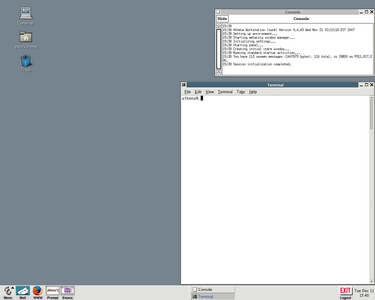
(Disclaimer: I work for MIT Information Services & Technology blah blah blah I am a student blah blah these are only my words and do not represent the opinion(s) of my employer.) Way back in the day in 1983, MIT started something it called Project Athena, which had the goal of investigating how computers could be used to enhance education at MIT. This project became the origin of such pieces of software as the X Window System and Kerberos, as well as a campus-wide network of workstations all running similar software. In 1991, Project Athena ended, but the Athena system continued on, taken over by MIT Information Systems. It’s 2008, and Athena still exists at MIT—walk into a computing cluster, and chances are all the machines will be running Athena software. (Unless that particular cluster has been taken over be Athena’s evil sibling, often referenced as “WinAthena”, which often seems to be maintained by no one, and whose existence is sometimes denied by those who maintain and support Real Athena. Not many machines have suffered this agonizing fate, luckily.) Unfortunately, as the years have progressed recently, fewer and fewer resources have been put into the development of Athena. In many ways it is no longer on the cutting edge of things as it has been in the past, though it is certainly still useful. Some students these days, however, even think of Athena as only “their MIT email” or maybe use it occasionally to print something in a cluster on the way to class. I’ve seen people grow frustrated and storm out of a cluster due to things like instructions for using a flash drive that involve more steps than just plugging it in. While on the one hand it’s easy to laugh at people for a lack of patience or being open to a computing system that is not either Windows or Mac and perhaps a bit more complicated on the surface, on the other hand, some of these things really should just work by now, and on other UNIX-based systems they do—but Athena has lagged behind. When you log into an Athena workstation for the first time, you are confronted with what looks like this: Clean MIT Athena login That’s GNOME 2.8, and it looks kind of like the GNOME 2.8 default but uglier. When you look under the hood, there are pieces of the system that obviously originated in a time where nothing better existed and so something new had to be created—the “xlogin” login system doesn’t support PAM, and the login path involves a hairy maze of scripts that perform various tasks. Under the hood, the base OS is currently RHEL 4 or Solaris 10. I still can’t remember what the right options are to feed RPM whenever I need some information that I think I should be able to get from it. These things were once necessary but today just look crufty. Some people have tossed around the idea that everyone has a laptop these days and thus clusters are uselessly expensive, but it’s been met with a lot of resistance. I’m all for progress, but I use clusters all the time! They’re one thing that makes it an easy choice for me to have a really portable laptop, because when I really need computing power or screen space on campus away from my room, there is always a cluster nearby. They’re also nice isolated places that can be associated with “work mode”, which is good for productivity. Beyond all this, Athena provides a common platform that all technical classes can depend on, from providing standard and specialized academic software to standing as a baseline of “make sure your code works on this before handing it in because that is how it will be graded”. At any rate, things are finally happening on this front. Athena can’t stay RHEL 4 forever—while AFS allows non-system software to be easily updated for all machines without requiring any OS release, hardware moves on and compatibility is lost, and the rest of the world is coming up with new awesome things that Athena machines are missing out on. A student group that I am vaguely involved with, SIPB, took the early initiative with this and created DebAthena, which takes stock Debian and Ubuntu and allows it to closely resemble an Athena environment. We even run a campus Linux dialup using the packages. (I won’t claim to have done much work on DebAthena myself because, well, I didn’t.) Amazingly, the Athena release team has decided to work with the SIPB on the next release of Athena. So, what I really just wasted over 600 words prepping for is to say that Athena 10 will be based on Ubuntu. This is only relatively new news, but I am lame about finishing blog posts. There are a variety of reasons why Ubuntu was chosen over Debian. Some of them are lame and some of them are not. Even so, I am excited about this prospect—and it should be possible to peripherally support Debian in such a way that was not possible with Athena 9.4. I really like Athena. Even coming to MIT with a background in Linux there has been a steep learning curve, though, and I think that things could be better. Lots of people here have their first encounter with a ‘nix system in the form of Athena, and we should strive to make that experience as good as possible. I’m kind of skeptical on the expected release date of this upcoming summer, but as long as it happens soon it will be a big step forward. In some ways it’s kind of sad that I’m excited about a big part of a research institution catching up with others—but inertia is a strong force, and dealing with thousands of workstations is no trivial task. I kind of long for the exciting days of creating new big pieces of free software like X. I bet I imagine those days as being better than they actually were.
9 January 2008

Robert Collins: 10 Jan 2008

Dear lazyweb, In bzr development we are now working primarily on network performance. One of the key things about being sure we have improved things is automated, repeatable benchmarks. And for that to be useful in networking environments we need to control latency and bandwidth and packet loss. I know this isn't a new problem, but it was about 5 years ago that I last did this sort of thing. What are the best tools today (for linux :)). Ideally I'd be able to bring up a bunch of local addresses like 127.0.1.1 or 127.0.0.2, with different properties - such that traffic from 127.0.0.1 to 127.0.0.2 will simulate being uploaded over adsl, and 127.0.0.2 to 127.0.0.1 will simulate being downloaded over adsl.

Andrew Pollock: [life] Post-op, Day 6

Discharged! Sarah was discharged almost bang on 11am, the advertised discharge time, which is less than 6 full days after she got out of surgery. Pretty amazing stuff, and not a moment too soon, if you ask Sarah. She had a final chest x-ray this morning, and that was about it. We took a non-highway route home, and stopped via the supermarket to get a few things and get her prescriptions filled, so we got home at about 12:20pm. The rest of her recovery can be followed on her blog. We both feel forever indebted to the wonderful doctors and nursing staff at Stanford Hospital. Being in a hospital is certainly a lot better when you're not grieving, and the outcome is positive.

7 January 2008

Andrew Pollock: [life] Post-op, Day 4

Sarah slept better overnight, but still not great. She was certainly more lively this morning when I got in, than yesterday. She's resigned to the fact that you don't come to a hospital to get rest, which is kind of ironic. She did need to get put back on the oxygen overnight because her O2 saturation dropped. She was off it again by the time I got in. Today's big achievement was getting the external pacing wires removed. They were put in during the procedure as a precaution, I think because if her heart played up, they didn't want to have to use defibrillator paddles, and because they'd cracked her chest open, manual CPR wasn't an option. The wires could be attached to an external pacemaker if necessary (but it never was). I watched the removal quite closely, as I was pretty curious. Basically the physician's assistant just came in and yanked them out. Judging from the look on Sarah's face, it was an interesting sensation. We were both amazed at how long the wires were. There was probably 30 centimetres of wire under the skin. The last bit was loosely spiralled. I was just really surprised, because the PA's hand started off at Sarah's chest, and ended up at the PA's shoulder. It was just a lot longer than we both expected. All the extra length was because the wires wrap around the heart. The wires came out at about 2:30pm. Sarah had another chest x-ray and a CT scan today. The CT scan looked good. The x-ray showed some fluid in her lungs, and her lung capacity is still sub-par. It seems when she's fully horizontal, her breathing isn't so crash hot, but it's fine when she's sitting up or walking around. All Sarah's got left is one peripheral line now. There was some talk of her possibly going home on Wednesday. She has an echocardiogram tomorrow, and I guess it'll all hinge on how her lungs are going.

6 January 2008

Andrew Pollock: [life] Post-op, Day 3

Slow day today. I slept at home, and got in at around 9:40am. Sarah didn't sleep well again overnight, her O2 saturation levels kept dropping below 90% because she wasn't breathing deeply enough in her sleep, and that causes an alarm to go off. So she was pretty flat when I first got in, but she picked up as the day went along, and was fairly chirpy by around 11am. The doctor came by and explained the photos that we've been given, so I'll have to try and regurgitate all of it and update the captions. Her lungs are still looking a bit suboptimal. The third lobe on the right lung isn't inflating well apparently. They said something about there being some fluid as well, although the nurse said she can't hear anything. All that said, she spent a lot of time in a chair today, and her O2 saturation levels have been the best they've been since she was in the ICU. So good, that they're trialing having her off oxygen while she attempts to take a nap as I write. Her blood sugar levels are settling down. I think they're still slightly elevated, but not to the point that insulin is required. She only needed insulin with lunch yesterday, so it definitely looks like it's improving. She's already been on her three walks today, by 4pm. An occupational therapist came by, and went through the sternal precautions again, and showed us how to get in and out of bed without putting undue pressure on the sternum, and Sarah's been getting out of bed unassisted from horizontal since. Her pain has been quite manageable. So while today started out looking like it was going to be a small backward step, I think it's still a good move forward. Sarah's continuing her breathing exercises, so I'm sure her lungs will sort themselves out in the next day or two. I guess they'll take another chest x-ray this afternoon, although it's getting a bit late in the day. Sarah's starting to get a bit of cabin fever, but I think today's been pretty slow, in part because we deferred having visitors on account of her being not up to it in the morning.

Next.

Previous.

