Search Results: "nic"

18 May 2013

Francois Marier: Three wrappers to run commands without impacting the rest of the system

Most UNIX users have heard of the nice utility used to run a command with a lower priority to make sure that it only runs when nothing more important is trying to get a hold of the CPU:
nice long_running_script.sh
That's only dealing with part of the problem though because the CPU is not all there is. A low priority command could still be interfering with other tasks by stealing valuable I/O cycles (e.g. accessing the hard drive).

Prioritizing I/O Another Linux command, ionice, allows users to set the I/O priority to be lower than all other processes. Here's how to make sure that a script doesn't get to do any I/O unless the resource it wants to use is idle:
sudo ionice -c3 hammer_disk.sh
The above only works as root, but the following is a pretty good approximation that works for non-root users as well:
ionice -n7 hammer_disk.sh
You may think that running a command with both nice and ionice would have absolutely no impact on other tasks running on the same machine, but there is one more aspect to consider, at least on machines with limited memory: the disk cache.

Polluting the disk cache If you run a command (for example a program that goes through the entire file system checking various things, you will find that the kernel will start pulling more files into its cache and expunge cache entries used by other processes. This can have a very significant impact on a system as useful portions of memory are swapped out. For example, on my laptop, the nightly debsums, rkhunter and tiger cron jobs essentially clear my disk cache of useful entries and force the system to slowly page everything back into memory as I unlock my screen saver in the morning. Thankfully, there is now a solution for this in Debian: the nocache package. This is what my long-running cron jobs now look like:
nocache ionice -c3 nice long_running.sh

Turning off disk syncs Another relatively unknown tool, which I would certainly not recommend for all cron jobs but is nevertheless related to I/O, is eatmydata. If you wrap it around a command, it will run without bothering to periodically make sure that it flushes any changes to disk. This can speed things up significantly but it should obviously not be used for anything that has important side effects or that cannot be re-run in case of failure. After all, its name is very appropriate. It will eat your data!

17 May 2013

Rob Bradford: GNOME in Moblin: People panel

Previously i d talked about how we use GNOME technologies in the Moblin Myzone. Now i m going to talk about another component that i m responsible for, the People Panel. An important aspect of the Moblin user experience is about communicating with others and this panel provides quick access to do this. The core of the content is provided by an abstraction, simplification and aggregation library called Anerley. This provides a feed of items (an addressbook of people) that aggregates across the system addressbook, powered by EDS, and your IM roster, powered by Telepathy. You have small set of actions you can do on these people such as start an IM conversation / email / edit them with Contacts. The core of our IM experience is supplied by the awesome Empathy. We ve been working with the upstream maintainers to accomodate some of the needs of Moblin into the upstream source. This included the improvements to the accounts dialog and wizard that landed for GNOME 2.28. One of the biggest problems with the IM experience in Moblin 2.0 was that it was easy to miss when somebody was talking to you. If you were looking away when the notification popped up, whoops, it s gone. With our switch to Mission Control 5 I was able to integrate a Telepathy Observer into Anerley and the People Panel. An Observer will be informed of channels that are requested on the system. This allows us to show ongoing conversations in the panel and by exploiting channel requests and window presentation allow the user to switch between ongoing conversations. This wouldn t have been possible without the assistance of the nice folks in #telepathy and at Collabora: Sjoerd, Will, Jonny and countless others.

Daniel Pocock: Zermatt, Matterhorn and Gornergrat

The DebConf13 registration deadline for developers requesting sponsorship has been extended up to Sunday, so for those still undecided or anybody else thinking about a visit to .ch, I'm sharing some more pictures today. The Matterhorn is one of the iconic symbols of Switzerland's natural beauty and appears on many postcards. The car-free town of Zermatt is at the bottom and is the final stop on the Matterhorn Gotthard Bahn railway, so it is really easy to get there with one or two trains every hour of the day. One of the most exciting places to view the Matterhorn is from the nearby observatory at Gornergrat, which is 3,089m above sea level. It is great for a single day trip of hiking and there is a convenient train station there too. The scenic train to Zermatt is included in any of the Swiss rail passes, but the train up to Gornergrat is a private railway and a special ticket must be purchased. Discounts are sometimes offered at rail stations in Swiss cities or online or it is possible to hike up and down.

16 May 2013

DebConf team: DebConf13 registration extended and DebConf12 Final Report (Posted by Didier Raboud)

Dear all,
Going to DebConf13!
DebConf13 sponsorship application date extended As communicated through the debconf-announce@lists.debconf.org mailing list, the deadline to apply for DebConf13 sponsorship has been extended to the end of this week, May 19th. If you intend to attend DebConf13 in August and would like to apply for sponsored registration, now is the time to register in Penta! After this deadline you will no longer be able to apply for sponsored food, accomodation or travel. Please refer to the announcement and to the registration documentation for details. Please contact us on the debconf-discuss mailing list if you have any questions. DebConf12 final report The DebConf team is also happy to announce the release of the DebConf12 Final Report. It s a 39-page document which gives the reader an idea about the conference as a whole. It includes descriptions of talks, DebCamp and Debian Day activities, personal impressions, attendee and budgeting numbers, the work of various teams, social events and so on. If you attended Debconf12, the report may refresh some of your memories and bring you closer to the organization team work. If not, it will certainly encourage you to be part of future Debian events. We thank the Universidad Centroamericana, the Government of Nicaragua, Google and all other DebConf12 sponsors for their support that made the event possible. The DebConf team

Vincent Sanders: True art selects and paraphrases, but seldom gives a verbatim translation

In my professional life I am sometimes required to provide technical support to one of our salesmen. I find this an interesting change in pace though sometimes challenging.

Occasionally I fail to clearly convey the solution we are trying to sell because of my tendency to focus on detail the customer probably does not need to understand but I think is the interesting part of the problem.

Conversely sometimes the sales people gloss over important technology choices which have a deeper impact on the overall solution. I was recently in such a situation where as part of a larger project the subject of internationalisation (you can see why it gets abbreviated to i18n) was raised.

I had little direct personal experience with handling this within a project workflow so could not give any guidance but the salesman recommended the Transifex service as he had seen it used before, indicated integration was simple and we moved onto the next topic.

Unfortunately previous experience tells me that sometime in the near future someone is going to ask me hard technical questions about i18n and possibly how to integrate Transifex into their workflow (or at least give a good estimate on the work required).
LearningBeing an engineer I have few coping strategies available for situations when I do not know how something works. The approach I best know how to employ is to give myself a practical crash course and write up what I learned...so I did.

I proceeded to do all the usual things you do when approaching something unfamiliar (wikipedia, google, colleagues etc.) and got a basic understanding of internationalisation and localisation and how they fit together.

This enabled me to understand that the Transifex workflow proposed only covered the translation part of the problem and that, as Aldrich observed in my title quote, there is an awful lot more to translation than I suspected.
PlatformsMy research indicated that there are numerous translation platforms available for both open source and commercial projects and Transifex is one of many solutions.

Although the specific platform used was Transifex most of these observations apply to all these other platforms. The main lesson though is that all platforms are special snowflakes and once a project invests effort and time into one platform it will result in the dreaded lock in. The effort to move to another platform afterwards is at least as great as the initial implementation.

It became apparent to me that all of these services, regardless of their type, boil down to a very simple data structure. They appear to be a trivial table of Key:Language:Value wrapped in a selection of tools to perform format conversions and interfaces to manipulate the data.

There may be facilities to attach additional metadata to the table such as groupings for specific sets of keys (often referred to as resources) or translator hints to provide context but the fundamental operation is common.

The pseudo workflow is:
The first three steps are almost always performed together by the uploading of a resource file containing an initial set of translations in the "default" language and due to the world being the way it is this is almost always english (some services are so poorly tested with other defaults they fail if this is not the case!)

The platforms I looked at generally follow this pattern with a greater or lesser degree of freedom in what the keys are, how the groupings into resources are made and the languages that can be used. The most common issue with these platforms (especially open source ones) is that the input convertors will only accept a very limited number of formats and often restricted to just GNU gettext PO files. This means that to use those platforms a project would have to be able to convert any internal resources into gettext translatable format.

The prevalence of the PO format pushes assumptions into almost every platform I examined, mainly that a resource is for a single language translation and that the Key (msgid in gettext terms) is the untranslated default language string in the C locale.

The Transifex service does at least allow for the Key values to be arbitrary although the resources are separated by language.

Even assuming a project uses gettext PO files and UTF-8 character encoding (and please can we kill every other character encoding and move the whole world to UTF-8) the tools to integrate the import/export into the project must be written.

A project must decide some pretty important policies, including:
These are project policy decisions and, as I discovered, just as difficult to answer as the technical challenges.

Armed with my basic understanding it was time to move on and see how the transifex platform could be integrated into a real project workflow.
ImplementingProof of conceptMy first exercise was to take a trivial command line tool, use xgettext to generate a PO file and add the relevant libintl calls to produce gettext internationalised tool.

A transifex project was created and the english po file uploaded as the initial resource. A french language was added and the online editor used to provide translations for some strings. The PO resource file for french was exported and the tool executed with LANGUAGE=fr and the french translation seen.

This proved the trivial workflow was straightforward to implement. It also provided insight into the need to automate the process as the manual website operation would soon become exceptionally tedious and error prone.
Something more usefulTo get a better understanding of a real world workflow I needed a project that:
I selected the NetSurf web browser as it best fit this list.

Internally NetSurf keeps all the translated messages in a simple associative array this is serialised to an equally straightforward file named FatMessages. The file is UTF-8 encoded with keys separated from values by a colon. The Key is constrained to be ASCII characters with no colons and is structured as language.toolkit.identifier and is unique on identifier part alone.

This file is processed at build time into a simple identifier:value dictionary for each language and toolkit.

Transifex can import several resource formats similar to this, after experimenting with YAML and Android Resource format I immediately discovered a problem, the services import and export routines were somewhat buggy.

These routines coped ok with simple use cases but having more complex characters such as angle brackets and quotation marks in the translated strings would completely defeat the escaping mechanisms employed by both these formats (through entity escaping in android resource format XML is problematic anyway)

Finally the Java property file format was used (with UTF-8 encoding) which while having bugs in the import and export escaping these could at least be worked around. The existing tool that was used to process the FatMessages file was rewritten to cope with generating different output formats and a second tool to merge the java property format resources.

To create these two tools I enlisted the assistance of my colleague Vivek Dasmohapatra as his Perl language skills exceeded my own. He eventually managed to overcome the format translation issues and produce correct input and output.
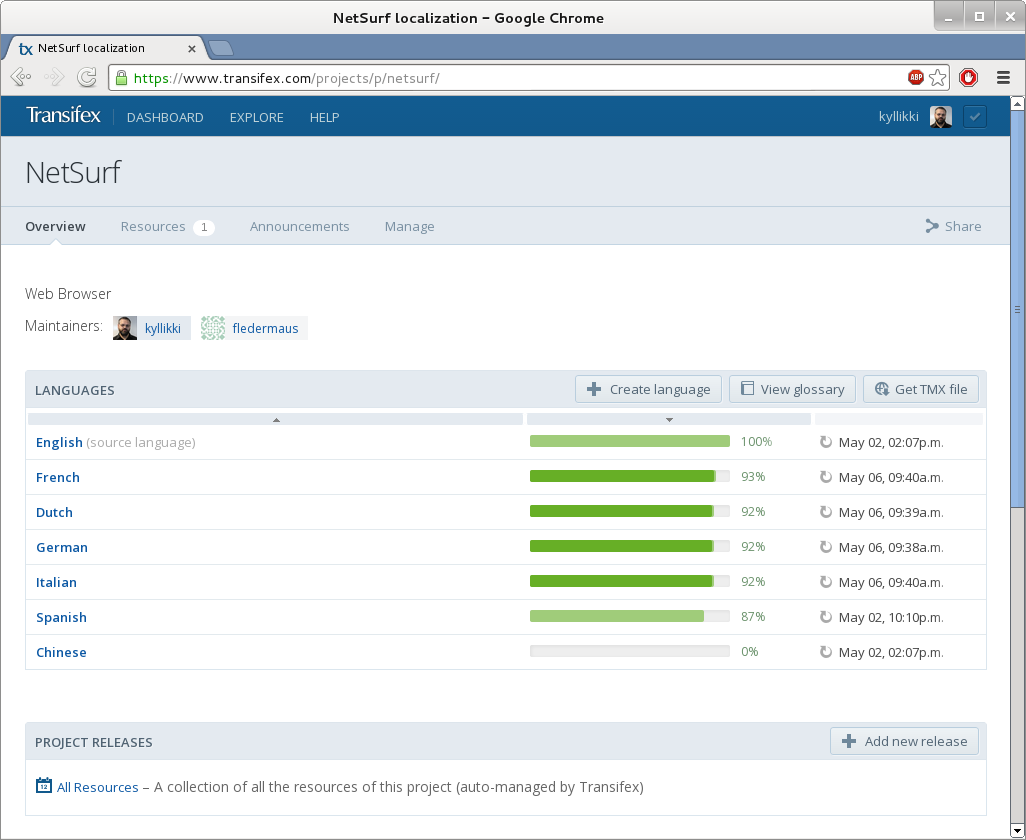
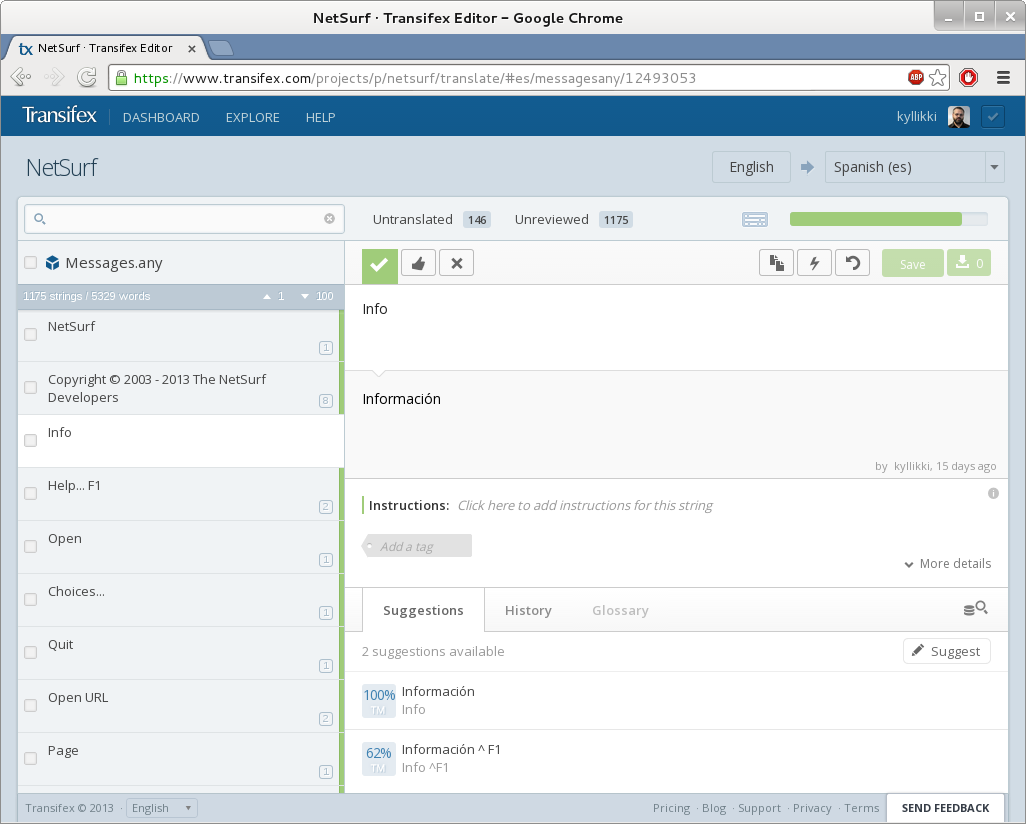
I used the Transifex platforms free open source product, created a new project and configured it for free machine translation from the Microsoft service, all of which is pretty clearly documented by Transifex.

Once this was done the messages file was split up tinto resources for the supported languages and uploaded to the transifex system.

I manually marked all the uploaded translations as "verified" and then added a few machine translations to a couple of languages. I also created spanish as a new language and machine translated most of the keys.

The resources for each language were then downloaded and merged and the resulting FatMessages file checked for differences and verified only the changes I expected appeared.

I quickly determined that manually downloading the language resources every time was not going to work with any form of automation, so I wrote a perl script to retrieve the resources automatically (might be useful for other projects too).

Once these tools were written and integrated into the build system I could finally make an evaluation as to how successful this exercise had been.
ConclusionsThe main things I learned from this investigation were:

Overall I think the final observation has to be that integrating translation services is not a straightforward operation and each project has unique challenges and requirements which reduce the existing platforms to compromise solutions.

Daniel Pocock: Debian to rescue Skype users?

Last year at DebConf12 and the Paris mini-DebConf I mentioned some of the sophisticated techniques that the likes of Microsoft and Facebook are using to monitor their customers. So when Skype was busted spying on the content of chat messages, it was no surprise for many people in the Debian community. People are already rushing to find alternatives like XMPP and Jitsi. Debian 7 has been released just in time, with powerful features like TURN support that finally allow users to make free calls and chats with seamless NAT traversal. Sadly, Debian's built-in VoIP/RTC client, Empathy, only uses Google's TURN servers and not native Debian servers, but hopefully a solution will come soon, but it is easy enough to install Jitsi instead and configure it to use any of the free TURN server software on Debian. It should be emphasized that Skype does not just spy on URLs in chat - it has simply been possible to detect this form of spying by detecting when the URL is accessed. Microsoft has taken out various patents for secretive monitoring of Internet phone calls and the analysis of speech patterns to detect both the content and emotions during a conversation. This allows them to get a very thorough analysis of the state of mind of every user at almost every moment and fine-tune the type of advertising and branding that is delivered to that person through conventional means and also through biased news' reporting and other means.

Russ Allbery: Review: Asimov's, July 2011

Review: Asimov's Science Fiction, July 2011
Editor: Sheila Williams
Issue: Volume 35, No. 7
ISSN: 1065-2698
Pages: 112
Williams's editorial is a mildly interesting piece about story titles. Silverberg's column is a more interesting (and rather convincing) rebuttal of the joke that fiction authors are "professional liars," combined with an examination of a fake and fantastic 14th travelogue that (at least in Silverberg's telling) was widely believed at the time. The precis of Silverberg's argument is that lying requires an intent to deceive, which is a property of deceptive memoir writers but not of fiction authors. Di Filippo's review column, as usual, is devoted almost entirely to esoterica, although I was moderately interested to hear of Stableford's continued work on translating early French SF. None of it seems compelling enough to go buy, but good translations of early works seem like a good thing to have in the world. "Day 29" by Chris Beckett: The conceit of this novelette is an interstellar travel system akin to a transporter that allows near-instantaneous travel between worlds. The drawback is that all memories from somewhere between 40 and 29 days before transit up until transit are wiped. The progatonist is a data analyst who is about to travel, and therefore by agency rule is required to stop doing work on day 40 before transmission since he can't be held legally liable for anything he has no recollection of doing. (I would like to say that I find this implausible, since one could always keep records, but it's exactly the sort of ass-covering regulation that a human resources department would come up with.) The premise is quite interesting: what do you do during that period that you're going to forget? Beckett wisely mixes Stephen's current waiting period on the colony world with his diary of his original waiting period on Earth the first time he went through the transmission process, and the latter adds greatly to the reader's appreciation of the weirdness of the forgotten interval. Unfortunately, this is a story more about psychological exploration than about plot, and Stephen just isn't very interesting. The telepathic but possibly nonsentient aliens add weirdness but not much else, and the ending of the story provided little sense of closure or conclusion for me. A good idea, but not the execution I wanted. (5) "Pug" by Theodora Goss: Since I grew up with a pug, I have a soft spot for a story featuring one; sadly, though, this story has insufficient pug in it. This is a quiet fantasy (Asimov's calls it SF, presumably on the basis of parallel worlds and a hypothesized scientific explanation, but it reads like fantasy to me) featuring Victorian girls, including one with a bad heart. They discover a hidden door to other versions of their world and do some minor exploration. There's little or nothing in the way of plot; the story is more of an attempt to capture a mood. It's mildly diverting, but I wish it had gone somewhere more substantial. (5) "Dunyon" by Kristine Kathryn Rusch: A Rusch story is often the highlight of an issue, and this is no exception. The protagonist is the owner of a bar in a space station that's become a combination of a refugee camp and a slum. War and chaos have created desperate people, most of whom are attempting to find some way to resources and get out of the bottom of society. The story is about a rumor: a mythical system named Dunyon that's safe and far away. And it's about how people react to that rumor. There's nothing particularly surprising about the direction the story goes (it's fairly short), but Rusch is always a good storyteller. (7) "The Music of the Sphere" by Norman Spinrad: I've had mixed feelings about Spinrad's fiction (and some of his essays), but I liked this story, despite its implausibility. It's set in the near future, featuring an expert in cetaceans and dolphin perception and a composer obsessed with both loud music and classical musical style. Just from that description, you can probably predict much of the story, but I thought it had some neat ideas about dolphins, whales, and alternate perception and aesthetics. (Note: neat, not necessarily biologically plausible.) Enjoyable. (6) "Bring on the Rain" by Josh Roseman: In a change of pace from the rest of the issue, this is a post-apocalyptic story of caravans of wheeled ships traversing a scorched and ruined landscape in search of weather systems and rain. The feel is of an inverted Waterworld, but with more emphasis on military tactics and cooperating fleets. The transposition of fleet maneuvers to huge ground vehicles adds some extra fun. The plot has little to do with the background and is a fairly stock military adventure scenario, but it's reasonably well-told. The story feels like an excerpt from a larger military-SF-inspired adventure, but the length keeps the quantity of tactics and maneuvering below the threshold where I would get bored. (6) "Twelvers" by Leah Cypess: This is a sharp and occasionally mean story of adolescent cruelty and alienation. Darla is a "twelver," a child who was carried an extra three months in the womb using newly-invented medical technology because of a belief in the advantages this would bring in later life. Unfortunately for all those who used this technique, what it also brought was a preternatural calm and an unusual reaction to emotions. Darla finds it almost impossible to get upset at anything, and that, of course, prompts the cruelty and abuse of other children. Most of the story is a description of that abuse, leading up to Darla stumbling into a nasty solution to her immediate problem. It's all very believable (well, apart from the motivating biology), but I didn't enjoy reading about it, and I'm certainly not convinced that the ending will lead to anything good. (5) "The Messenger" by Bruce McAllister: This is a very short time travel story, where time travel is used to try to unwind old family pain. This world follows the unalterable history model: no changes to the past are possible, and anything you do in the past has already happened. The mechanics are mostly avoided. Instead, McAllister concentrates on his mother, his father, and their complex relationship. I would have needed a bit more background on the characters to care enough about them for the story to be fully effective, but while the heartstring-pulling is kind of obvious, it's still a solid story. (6) "The Copenhagen Interpretation" by Paul Cornell: This is the most ingenious of the stories in this issue. It's set in a future world that extends what seemed to me to be pre-World-War-I great power politics, although there may be a hint of the Cold War. Great nations have reached a careful balance of power, and spies and secret services work to sustain that balance. The progatonist is one of those agents, making use of advanced technology like space folds in the service of a cause that he doesn't entirely believe in. Cornell mixes in mental conditioning, artificial people, space travel, and even aliens (maybe) in a taut thriller plot that, for me, gained a great deal from the unexplained strangeness of its background. If you like diving into the deep end and following a fast-moving plot against a background of strangeness, this is the sort of SF you'll enjoy. (7) Rating: 6 out of 10

15 May 2013

Lisandro Damián Nicanor Pérez Meyer: Qt 4.8.4 in experimental.

Since a few days we have Qt 4.8.4 (4:4.8.4+dfsg-3) in some archs of the experimental Debian archive. This release allows Qt4 to coexist with Qt5 while avoiding FTBFSs of current Qt4 packages in the archive.

So if you maintain a Qt4 app and want to check how it works with 4.8.4, you should be ready to go.

Benjamin Mako Hill: Sounds Like a Map

Colored visualization of the puzzle. I love maps something that became clear to me when I was looking at the tag cloud of my bookmarks a few years back. One of my favorite blogs (now a book) is Frank Jabobs Strange Maps. So it s no coincidence that a number of my favorite MIT Mystery Hunt puzzles are map based. Trying to connect the two worlds, I sent Jacobs a write-up of the hunt and of a particularly strange sound-based map puzzle called White Noise that I worked with Don Armstrong to solve in the 2006 hunt. While I wasn t paying attention, Jacobs did a very nice writeup of my writeup of the puzzle for Strange Maps!

Bastian Venthur: How to get the most precise time, comparable between processes in Python?

Let s consider the following scenario: I have two Python processes receiving the same events and I have to measure the delay between when process A received the event and when process B received it, as precisely as possible (i.e. less than 1ms). Using Python 2.7 and a Unix system you can use the time.time method which provides the time in seconds since Epoch and has a typical resolution of a fraction of a ms on Unix. You can use it on different processes and still compare the results, since both processes receive the time since Epoch, a defined and fixed time in the past. On Windows time.time also provides the time since Epoch, but the resolution is in the range of 10ms, which is not suitable for my application. There is also time.clock which is super precise on Windows, and much less precise on Unix. The mayor drawback is that it returns the time since the process started or since the first call of time.clock within that processes. This means you cannot compare the results of time.clock between two processes as they are not calibrated to a common t-zero. I had high hopes for Python 3.3 where the time module was revamped and I was reading about time.monotonic and time.perf_counter. Especially time.perf_counter looked like it would suit my needs as the documentation said it provides the highest available resolution for the system and was system-wide , in contrast to for example the new time.process_time which was process_wide . Unfortunately it turned out that time.perf_counter acts similar to time.clock on Python 2.7 as it provides you with the time since the process started or the first time the method was called within the process. The results of time.monotonic are comparable between processes, but again not precise enough on Windows. Here is a small script which demonstrates how the times provided by time.clock and time.perf_counter are not comparable between processes. It starts two processes and lets both of them print out the output of the timer to stdout. In the output the times should be monotonically increasing. Since I let process 2 sleep for one second before calling the timer method for the first time, the output of this process is usually one second smaller when using time.clock or time.perf_counter.
#!/usr/bin/env python
from multiprocessing import Process
import time
timers = ['clock', 'time', 'monotonic', 'perf_counter']
def proc(timer):
    timer = getattr(time, timer)
    time.sleep(1)
    for i in range(3):
        print('P2  time '.format(time=timer()))
        time.sleep(1)
if __name__ == '__main__':
    for t in timers:
        print("Using  timer ".format(timer=t))
        p = Process(target=proc, args=(t,))
        timer = getattr(time, t)
        p.start()
        for i in range(3):
            print('P1  time '.format(time=timer()))
            time.sleep(1)
        p.join()
The result when running on Windows with Python 3.3:
$ python timertest.py
Using clock
P1 6.146032526480321e-06
P1 0.9926582847820045
P2 2.9612702173041547e-05
P1 1.9941743992602412
P2 1.0008579302676737
P2 2.0022709590185346
Using time
P1 1368614235.509732
P1 1368614236.511172
P2 1368614236.601301
P1 1368614237.512612
P2 1368614237.602741
P2 1368614238.604181
Using monotonic
P1 484.636
P1 485.63800000000003
P2 485.738
P1 486.639
P2 486.73900000000003
P2 487.741
Using perf_counter
P1 12.390910576623565
P1 13.39050745276285
P2 7.542858100680394e-06
P1 14.39190763071843
P2 1.0014012954160376
P2 2.0041399116368144
So as far as I see it, there is no way of getting comparable times between two processes on Windows with more precision than 10ms. Is that correct or am I missing something?

Daniel Kahn Gillmor: OpenPGP User ID Comments considered harmful

Most OpenPGP User IDs look like this:

Jane Q. Public <jane@example.org>
This is clean, clear, and unambiguous. However, some tools (gpg, enigmail among others) ask the user to provide a "Comment:" field when they are choosing a new User ID (e.g. when making a new key). These UI prompts are evil. The savvy user knows to avoid entering anything in this field, so that they can end up with a User ID like the one above. The user who provides something here (perhaps even something inconsequential like "I like strawberries", due to not being sure what should go in this little box) will instead end up with a User ID like:
Jane Q. Public (I like strawberries) <jane@example.org>
This is bad. This means that Jane is asking the people who certify her key+userid to certify whether she actually likes strawberries (how could they know? what if she changes her mind? should they revoke their certifications?) and anywhere that she is referred to by name will include this mention of strawberries. This is not Jane's identity, and it doesn't belong in an OpenPGP User ID packet. Furthermore, since User IDs are atomic, if Jane wants to change the comment field (but leave her name and e-mail address the same), she will instead need to create a new User ID, publish it, get everyone who has certified her old key+userid to certify the key+newuserid, and then revoke the old one. It is difficult already to help people understand and participate in the certification network that forms that backbone of OpenPGP's so-called "web of trust". These bogus comment fields make an already-difficult task harder. And all because of strawberries! Tools like enigmail and gpg should not expose the "Comment:" field to users who are generating keys or choosing new User IDs. If they feel it absolutely must be present for some weird corner case that 0.1% of their users will have, they could require that the user enters some sort of "expert mode" before prompting the user to do something that is likely to be a mistake. There is almost no legitimate reason for anyone to use this field. Let's go through some examples of this people use, taken from some examples i have lying around (identifying marks have been changed to protect the innocent who were duped by this bad UI choice, but you can probably find them on the public keyserver network if you want to hunt around):
domain repetition
John Q. Public (Debian) <johnqpublic@debian.org>
We know you're with debian already from the @debian.org address. If this is in contrast to your other address (johnqpublic@example.org) so that people know where to send you debian-related e-mail, this is still not necessary. Lest you think i'm just calling out debian developers, people with @ubuntu.com addresses and (Ubuntu) comments (as well as @example.edu addresses and (Example University) comments and @example.com addresses and (Example Corp) comments) are out there too.
nicknames already evident
John Q. Public (Johnny) <johnqpublic@example.net>
John Q. Public (wackydude) <wackydude@example.net>
Again, the information these comments are providing offers no clear disambiguation from the info already contained in the name and e-mail address, and just muddies the water about what the people who certify this identity should actually be trying to verify before they make their certification.
"Work"
John Q. Public (Work) <johnqpublic@example.com>
if John's correspondents know that he works for Example Corp, then "Work" isn't helpful to them, because they already know this as the address that they're writing to him with. If they don't know that, then they probably aren't writing to him at work, so they don't need this comment either. The same problem appears (for example) with literal comments of (School) next to their @example.edu address.
This is my nth try at this crazy system!
John Q. Public (This is my second key) <johnqpublic@example.com>
John Q. Public (This is my primary key) <johnqpublic@example.com>
John Q. Public (No wait really use this one) <johnqpublic@example.com>
OpenPGP is confusing, and it can be tricky to get it right. We all know :) This is still not part of John's identity. If you want to designate a key as your preferred key, keep it up-to-date, get people to certify it, and revoke or expire your old keys. People who care can look at the timestamps on your keys and tell which ones are the most recent ones. You do have a revocation certificate for your key handy just in case you lose it, right?
Don't use this key
John Q. Public (Old key, do not use) <johnqpublic@example.com>
John Q. Public (Please only use this through September 2004) <johnqpublic@example.com>
This kind of sentiment is better expressed by revoking the key in question or setting an expiration time on the key or User ID self-sig directly. This sentiment is not part of John's identity, and shouldn't be included as though it were.
"none"
John Q. Public (none) <johnqpublic@example.com>
sigh. This is clearly someone getting mixed up by the UI.
I use strong crypto!
John Q. Public (3092 bits of RSA) <johnqpublic@example.com>
This comment refers to the strength of the key material, or the algorithms preferred by the user. Since the User ID is associated with the key material already, people who care about this information can get it from the key directly. This is also not part of the user's actual identity.
"no comment"
John Q. Public (no comment) <johnqpublic@example.com>
This is actually not uncommon (some keyservers reply "too many matches!"). It shows that the user is witty and can think on their feet (at least once), but it is still not part of the user's identity.
But wait (i hear you say)! I have a special case that actually is a legitimate use of the comment field that cannot be expressed in OpenPGP in any other way! I'm sure that such cases exist. I've even seen one or two of them. The fact that one or two cases exist does not excuse the fact that that overwhelming majority of these comments in OpenPGP User IDs are a mistake, caused only by bad UI design that prompts people to put something (anything!) in the empty box (or on the command prompt, depending on your preference). And this mistake is one of the thousand papercuts that inhibits the robust growth of the OpenPGP certification network that some people call the "web of trust". Let's avoid them so we can focus on the other 999 papercuts. Please don't use comments in your OpenPGP User ID. And if you make a user interface for OpenPGP that prompts the user to decide on a new User ID, please don't include a prompt for "Comment" unless the user has already certified that they are really and truly a special special snowflake. Thanks!Tags: openpgp, ui

14 May 2013

Mart&iacute;n Ferrari: A new life

A week ago, I made the big step and presented my resignation letter at Google. It was not an easy decision, to leave a good job to pursue a blurry plan that sounds a bit infeasible, but I feel this what I want to do: it's a dream becoming reality. After the 31st of May, I will become self-employed, working as a freelancer, while travelling around the world. I plan to live with a small budget, working with my laptop from wherever I am, instead of stressing about getting many clients to keep an expensive lifestyle. I've had the travelling bug for some time, always thinking about my next trip, leaving for the airport just after finishing work, coming back on Monday and going directly to the office. You end up wishing for more vacation days all the time (and I had a fair amount of them). Now, for different reasons I want to spend some time in my old house in Nice, and in Argentina. There was no way I could do that with my current job, and that was the trigger for my decision. After that, I will come back to Ireland, just to think where my next destination will be. I know this is going to be a great experience, we'll see how well it works! If you think you -or your employer- might need my services, I'd be more than happy to talk! I'll be concentrating on the kind of work I've been doing at Google and before: finding creative solutions for difficult problems, be it systems administration, or (systems) programming. Think of hiring an SRE for just a few hours or days.

M nica Ram rez Arceda: Outreach Program for Women talk

Last Saturday (2013-05-11), I gave a talk about Outreach Program for Women (OPW) at the Ubuntu Party Festa Raring Ringtail. I was invited to give this talk because I'm one of the coordinators of this program in Debian side. This was a small talk and was split in three parts. During the first part I talked about the problem in general: lack of women in technology world. In the second part I talked about the paradox that there are even less women in FLOSS, giving Debian as an example: a very wonderful project, where techie (or non-techie) women should be in love with (at least I am!), has only about 1.6% of women DD. The last part was focused in OPW itself, the successful experience of GNOME with an increasing number of women in their organization and how the program works. I hope that women attendees will think about applying to OPW or collaborating actively in FLOSS :-) Here you have the slides (in Catalan): talk_debian_opw

Matthew Palmer: A Modest Vocabulary Proposal

I would like to suggest that the word unprofessional be struck from the dictionary and anyone who uses it struck with a dictionary. It is a word which conveys no useful information or proposal for action, and is thus nothing but meaningless noise. The purpose of communication is to adjust another person s process of cognition. I ve heard it said that all communication is persuasion , which is quite true you re trying to persuade someone to change what they think. We can consider the intention and effectiveness of an attempt to communicate in this light. What is someone trying to achieve when they label a person or behaviour unprofessional ? If we re being charitable, we would probably say that they re trying to highlight that something is bad, or could be better. However, just stamping our foot and saying bad! isn t enough it s also important to provide some information that the recipient can act upon. The problem with the word unprofessional is that it really isn t specific enough on the subject of what is wrong . Have you ever had someone say something like, your behaviour yesterday was really unprofessional ? They re assuming you know what they re talking about and you might well have a reasonable guess but what if you guess wrong? Should you never do anything you did yesterday, just in case that particular thing was unprofessional? When I ve caught myself thinking, that was unprofessional , of my own behaviour, or someone else s, I think about what caused me to think that. Once I drill down into it, I usually come to the conclusion that what I really meant was, I don t like that . Since I m not paid to like things, that s pretty much irrelevant as a reason to tell someone not to do something. On the occasions when I come up with something more concrete, it is invariably a more useful expression than unprofessional . Things like, it frustrates the customer , or it pisses off the person sitting in the next cube are a much better expression of why something is bad than unprofessional . I d encourage everyone to keep a careful watch over themselves and those around them for use of the word. When you catch yourself saying it (or thinking it), examine your motives more closely. Whatever the more specific adjective is, use that instead. If it just comes down to I don t like that , at the very least say that to the person you re talking to. Don t try and hang anything grandiose on your personal prejudices. You might come off as being petty, but at least you ll be honest.

11 May 2013

Petter Reinholdtsen: Debian, the Linux distribution of choice for LEGO designers?

In January, I announced a new IRC channel #debian-lego, for those of us in the Debian and Linux community interested in LEGO, the marvellous construction system from Denmark. We also created a wiki page to have a place to take notes and write down our plans and hopes. And several people showed up to help. I was very happy to see the effect of my call. Since the small start, we have a debtags tag hardware::hobby:lego tag for LEGO related packages, and now count 10 packages related to LEGO and Mindstorms:
brickosalternative OS for LEGO Mindstorms RCX. Supports development in C/C++
leocadvirtual brick CAD software
libnxtutility library for talking to the LEGO Mindstorms NX
lnpddaemon for LNP communication with BrickOS
nbccompiler for LEGO Mindstorms NXT bricks
nqcNot Quite C compiler for LEGO Mindstorms RCX
python-nxtpython driver/interface/wrapper for the Lego Mindstorms NXT robot
python-nxt-filersimple GUI to manage files on a LEGO Mindstorms NXT
scratcheasy to use programming environment for ages 8 and up
t2nsimple command-line tool for Lego NXT
Some of these are available in Wheezy, and all but one are currently available in Jessie/testing. leocad is so far only available in experimental. If you care about LEGO in Debian, please join us on IRC and help adding the rest of the great free software tools available on Linux for LEGO designers.

Russell Coker: Geographic Sorting Lessons to Learn from Ingress

I ve recently been spending a bit of my spare time playing Ingress (see the Wikipedia page if you haven t heard of it). A quick summary is that Ingress is an Android phone game that involves geo-location of portals that you aim to control and most operations on a portal can only be performed when you are within 40 meters so you do a lot of travelling to get to portals at various locations. One reasonably common operation that can be performed remotely is recharging a portal by using it s key, after playing for a while you end up with a collection of keys which can be difficult to manage. Until recently the set of portal keys was ordered alphabetically. This isn t particularly useful given the fact that portal names are made up by random people who photograph things that they consider to be landmarks. If people tried to use a consistent geographic naming system (which was short enough to fit in large print on a phone display) then it would be really difficult to make it usable. But as joke names are accepted there s just no benefit in having a sort by name. A recent update to the Ingress client (the program which runs on the Android phone and is used for all game operations) changed the sort order to be by distance. This makes it really easy to see the portals which are near you (which is really useful) but also means that the order changes whenever you move which isn t such a good idea for use on a mobile phone. It s quite common for Ingress players to recharge portals while on public transport. But with the new Ingress client the list order will change as you move so anyone who does recharging on a train will find the order of the list changing during the process and it s really difficult to find items in a list which is in a different order each time you look at it. This problem of ordering by location has a much greater scope than Ingress. One example is collections of GPS tagged photographs, it wouldn t make any sense to mix the pictures of two different sets of holiday pictures because they were both taken in countries that are the same distance from my current location (as the current Ingress algorithm would do). It seems to me that the best way of sorting geo-tagged items (Ingress portals, photos, etc) is to base it on the distance from a fixed point which the user can select. It could default to the user s current location but in that case the order of the list should remain unchanged at least until the user returns to the main menu and I think it would be ideal for the order to remain unchanged until the user requests it. I think that most Ingress players would agree with me that fixing annoying mis-features of the Ingress client such as this one would be better for the game than adding new features. While most computer games have some degree of make-work (in almost every case a computer could do things better than a person) I don t think that finding things in a changing list should be part of the make-work. Also it would be nice if Google released some code for doing this properly to reduce the incidence of other developers implementing the same mistakes as the Ingress developers in this regard.

Joachim Breitner: How to play Rock-Paper-Scissors online?

There was an interesting question by Fool recently on the StackExchange site for Boardgames: How do you play a game like Rock-Paper-Scissors with friends online? Or any other game where players have to simultaneously submit their moves (e.g. Diplomacy, or Rock-Paper-Scissors-Lizzard-Spock), which, as I just learned, are simultaneous action selection games. While there are websites dedicated to playing specific games, such as webdiplomacy.net, we could not find a generic one that you can use if you, for example, invent your own variants of a game.
So I created one: At you-say-first.nomeata.de you can enter rooms and share the URL with your friends. On the one hand, you have a regular chat room there. But there is also the possibility to enter moves (whatever a move may be to you) and only when all players have done that and marked the move as final, it is shown to everyone. If you want to try it out: There is an integrated, not very fancy Rock-Paper-Scissors-playing bot. Just enter a room, join and say I want to play!
Note that this site can be used for more than just for games. Have you ever observed that persons would often want other to express their preference (e.g. where to dine) first to not reveal their own preference, so that they can (or pretend to) change their mind if they would contradict? In such situations simultaneous action selection can be a fairer method. A technical note: I created this web app using meteor (a JavaScript framework building on node.js and MongoDB that allows for reactive programming), and it is also hosted on meteor.com. I chose Meteor after someone mentioned Firebase to me, which looked very slick, but was not Free Software, so I looked for alternatives. I did not do any cross-browser-testing, and the UI design could be improved, so if you want to help out (or just complain), please use the GitHub code repository and issue tracker.

Bastian Venthur: Wee! Wheezy is out (better late than never)

Last week we released Wheezy, roughly two years after our last release Squeeze. I d like to thank all the contributors in- and outside of Debian for your fine work! Every single contribution no matter how big or small summed up to the wonderful release we finished last week. Without you this release would not have been possible. Keep up the good work guys and make Jessie rock even harder! PS: It is very nice to see once again fresh packages rolling into unstable and spending some time fixing broken dependencies :)

10 May 2013

Julien Danjou: Rant about Github pull-request workflow implementation

One of my recent innocent tweet about Gerrit vs Github triggered much more reponses and debate that I expected it to. I realize that it might be worth explaining a bit what I meant, in a text longer than 140 characters. <script async="async" charset="utf-8" src="http://platform.twitter.com/widgets.js"></script> The problems with Github pull-requests I always looked at Github from a distant eye, mainly because I always disliked their pull-request handling, and saw no value in the social hype it brings. Why? One click away isn't one click effort The pull-request system looks like an incredible easy way to contribute to any project hosted on Github. You're a click away to send your contribution to any software. But the problem is that any worthy contribution isn't an effort of a single click. Doing any proper and useful contribution to a software is never done right the first time. There's a dance you will have to play. A slowly rhythmed back and forth between you and the software maintainer or team. You'll have to dance it until your contribution is correct and can be merged. But as a software maintainer, not everybody is going to follow you on this choregraphy, and you'll end up with pull-request you'll never get finished unless you wrap things up yourself. So the gain in pull-requests here, isn't really bigger than a good bug report in most cases. This is where the social argument of Github isn't anymore. As soon as you're talking about projects bigger than a color theme for your favorite text editor, this feature is overrated. Contribution rework If you're lucky enough, your contributor will play along and follow you on this pull-request review process. You'll make suggestions, he will listen and will modify his pull-request to follow your advice. At this point, there's two technics he can use to please you. Technic #1: the Topping Github's pull-requests invite you to send an entire branch, eclipsing the fact that it is composed of several commits. The problem is that a lot of one-click-away contributors do not masterize Git and/or do not make efforts to build a logical patchset, and nothing warns them that their branch history is wrong. So they tend to change stuff around, commit, make a mistake, commit, fix this mistake, commit, etc. This kind of branch is composed of the whole brain's construction process of your contributor, and is a real pain to review. To the point I quite often give up. <figure> <figcaption> A typical case: 3 commits to build a 4 lines long file. </figcaption> </figure> Without Github, the old method that all software used, and that many software still use (e.g. Linux), is to send a patch set over e-mail (or any other medium like Gerrit). This method has one positive effect, that it forces the contributor to acknowledge the list of commits he is going to publish. So, if the contributor he has fixup commits in his history, they are going to be seen as first class citizen. And nobody is going to want to see that, neither your contributor, nor the software maintainers. Therefore, such a system tend to push contributors to write atomic, logical and self-contained patchset that can be more easily reviewed. Technic #2: the History Rewriter This is actually the good way to build a working and logical patchset using Git. Rewriting history and amending problematic patches using the famous git rebase --interactive trick. The problem is that if your contributor does this and then repush the branch composing your pull-request to Github, you will both lose the previous review done, each time. There's no history on the different versions of the branch that has been pushed. In the old alternative system like e-mail, no information is lost when reworked patches are resent, obviously. This is far better because it eases the following of the iterative discussions that the patch triggered. Of course, it would be possible for Github to enhance this and fix it, but currently it doesn't handle this use case correctly.. <figure> <figcaption> Exercise for the doubtful readers: good luck finding all revisions of my patch in the pull-request #157 of Hy.</figcaption> </figure> A quick look at OpenStack workflow It's not a secret for anyone that I've been contributing to OpenStack as a daily routine for the last 18 months. The more I contribute, the more I like the contribution workflow and process. It's already well and longly described on the wiki, so I'll summarize here my view and what I like about it. Gerrit To send a contribution to any OpenStack project, you need to pass via Gerrit. This is way simpler than doing a pull-request on Github actually, all you have to do is do your commit(s), and type git review. That's it. Your patch will be pushed to Gerrit and available for review. Gerrit allows other developers to review your patch, add comments anywhere on it, and score your patch up or down. You can build any rule you want for the score needed for a patch to be merged; OpenStack requires one positive scoring from two core developers before the patch is merged. Until a patch is validated, it can be reworked and amended locally using Git, and then resent using git review again. That simple. The historic and the different version of the patches are available, with the whole comments. Gerrit doesn't lose any historic information on your workflow. Finally, you'll notice that this is actually the same kind of workflow projects use when they work by patch sent over e-mail. Gerrit just build a single place to regroup and keep track of patchsets, which is really handy. It's also much easier for people to actually send patch using a command line tool than their MUA or git send-email. Gate testing Testing is mandatory for any patch sent to OpenStack. Unit tests and functionnals test are run for each version of each patch of the patchset sent. And until your patch passes all tests, it will be impossible to merge it. Yes, this implies that all patches in a patchset must be working commits and can be merged on their own, without the entire patchset going in! With such a restricution, it's impossible to have "fixup commits" merged in your project and pollute the history and the testability of the project. Once your patch is validated by core developers, the system checks that there is not any merge conflicts. If there's not, tests are re-run, since the branch you are pushing to might have changed, and if everything's fine, the patch is merged. This is an uncredible force for the quality of the project. This implies that no broken patchset can ever sneak in, and that the project pass always all tests. Conclusion: accessibility vs code review In the end, I think that one of the key of any development process, which is code review, is not well covered by Github pull-request system. It is, along with history integrity, damaged by the goal of making contributions easier. Choosing between these features is probably a trade-off that each project should do carefully, considering what are its core goals and the quality of code it want to reach. I tend to find that OpenStack found one of the best trade-off available using Gerrit and plugging testing automation via Jenkins on it, and I would probably recommend it for any project taking seriously code reviews and testing.

Next.

Previous.