Search Results: "mak"

16 February 2015

Julien Danjou: Hacking Python AST: checking methods declaration

A few months ago, I wrote the definitive guide about Python method declaration, which had quite a good success. I still fight every day in OpenStack to have the developers declare their methods correctly in the patches they submit. Automation plan The thing is, I really dislike doing the same things over and over again. Furthermore, I'm not perfect either, and I miss a lot of these kind of problems in the reviews I made. So I decided to replace me by a program a more scalable and less error-prone version of my brain. In OpenStack, we rely on flake8 to do static analysis of our Python code in order to spot common programming mistakes. But we are really pedantic, so we wrote some extra hacking rules that we enforce on our code. To that end, we wrote a flake8 extension called hacking. I really like these rules, I even recommend to apply them in your own project. Though I might be biased or victim of Stockholm syndrome. Your call. Anyway, it's pretty clear that I need to add a check for method declaration in hacking. Let's write a flake8 extension! Typical error The typical error I spot is the following:
class Foo(object):
# self is not used, the method does not need
# to be bound, it should be declared static
def bar(self, a, b, c):
return a + b - c

That would be the correct version:
class Foo(object):
@staticmethod
def bar(a, b, c):
return a + b - c

This kind of mistake is not a show-stopper. It's just not optimized. Why you have to manually declare static or class methods might be a language issue, but I don't want to debate about Python misfeatures or design flaws. Strategy We could probably use some big magical regular expression to catch this problem. flake8 is based on the pep8 tool, which can do a line by line analysis of the code. But this method would make it very hard and error prone to detect this pattern. Though it's also possible to do an AST based analysis on on a per-file basis with pep8. So that's the method I pick as it's the most solid. AST analysis I won't dive deeply into Python AST and how it works. You can find plenty of sources on the Internet, and I even talk about it a bit in my book The Hacker's Guide to Python. To check correctly if all the methods in a Python file are correctly declared, we need to do the following: Flake8 plugin In order to register a new plugin in flake8 via hacking, we just need to add an entry in setup.cfg:
[entry_points]
flake8.extension =
[ ]
H904 = hacking.checks.other:StaticmethodChecker
H905 = hacking.checks.other:StaticmethodChecker

We register 2 hacking codes here. As you will notice later, we are actually going to add an extra check in our code for the same price. Stay tuned. The next step is to write the actual plugin. Since we are using an AST based check, the plugin needs to be a class following a certain signature:
@core.flake8ext
class StaticmethodChecker(object):
def __init__(self, tree, filename):
self.tree = tree

def run(self):
pass

So far, so good and pretty easy. We store the tree locally, then we just need to use it in run() and yield the problem we discover following pep8 expected signature, which is a tuple of (lineno, col_offset, error_string, code). This AST is made for walking The ast module provides the walk function, that allow to iterate easily on a tree. We'll use that to run through the AST. First, let's write a loop that ignores the statement that are not class definition.
@core.flake8ext
class StaticmethodChecker(object):
def __init__(self, tree, filename):
self.tree = tree

def run(self):
for stmt in ast.walk(self.tree):
# Ignore non-class
if not isinstance(stmt, ast.ClassDef):
continue

We still don't check for anything, but we know how to ignore statement that are not class definitions. The next step need to be to ignore what is not function definition. We just iterate over the attributes of the class definition.
for stmt in ast.walk(self.tree):
# Ignore non-class
if not isinstance(stmt, ast.ClassDef):
continue
# If it's a class, iterate over its body member to find methods
for body_item in stmt.body:
# Not a method, skip
if not isinstance(body_item, ast.FunctionDef):
continue

We're all set for checking the method, which is body_item. First, we need to check if it's already declared as static. If so, we don't have to do any further check and we can bail out.
for stmt in ast.walk(self.tree):
# Ignore non-class
if not isinstance(stmt, ast.ClassDef):
continue
# If it's a class, iterate over its body member to find methods
for body_item in stmt.body:
# Not a method, skip
if not isinstance(body_item, ast.FunctionDef):
continue
# Check that it has a decorator
for decorator in body_item.decorator_list:
if (isinstance(decorator, ast.Name)
and decorator.id == 'staticmethod'):
# It's a static function, it's OK
break
else:
# Function is not static, we do nothing for now
pass

Note that we use the special for/else form of Python, where the else is evaluated unless we used break to exit the for loop.
for stmt in ast.walk(self.tree):
# Ignore non-class
if not isinstance(stmt, ast.ClassDef):
continue
# If it's a class, iterate over its body member to find methods
for body_item in stmt.body:
# Not a method, skip
if not isinstance(body_item, ast.FunctionDef):
continue
# Check that it has a decorator
for decorator in body_item.decorator_list:
if (isinstance(decorator, ast.Name)
and decorator.id == 'staticmethod'):
# It's a static function, it's OK
break
else:
try:
first_arg = body_item.args.args[0]
except IndexError:
yield (
body_item.lineno,
body_item.col_offset,
"H905: method misses first argument",
"H905",
)
# Check next method
continue

We finally added some check! We grab the first argument from the method signature. Unless it fails, and in that case, we know there's a problem: you can't have a bound method without the self argument, therefore we raise the H905 code to signal a method that misses its first argument. Now you know why we registered this second pep8 code along with H904 in setup.cfg. We have here a good opportunity to kill two birds with one stone. The next step is to check if that first argument is used in the code of the method.
for stmt in ast.walk(self.tree):
# Ignore non-class
if not isinstance(stmt, ast.ClassDef):
continue
# If it's a class, iterate over its body member to find methods
for body_item in stmt.body:
# Not a method, skip
if not isinstance(body_item, ast.FunctionDef):
continue
# Check that it has a decorator
for decorator in body_item.decorator_list:
if (isinstance(decorator, ast.Name)
and decorator.id == 'staticmethod'):
# It's a static function, it's OK
break
else:
try:
first_arg = body_item.args.args[0]
except IndexError:
yield (
body_item.lineno,
body_item.col_offset,
"H905: method misses first argument",
"H905",
)
# Check next method
continue
for func_stmt in ast.walk(body_item):
if six.PY3:
if (isinstance(func_stmt, ast.Name)
and first_arg.arg == func_stmt.id):
# The first argument is used, it's OK
break
else:
if (func_stmt != first_arg
and isinstance(func_stmt, ast.Name)
and func_stmt.id == first_arg.id):
# The first argument is used, it's OK
break
else:
yield (
body_item.lineno,
body_item.col_offset,
"H904: method should be declared static",
"H904",
)

To that end, we iterate using ast.walk again and we look for the use of the same variable named (usually self, but if could be anything, like cls for @classmethod) in the body of the function. If not found, we finally yield the H904 error code. Otherwise, we're good. Conclusion I've submitted this patch to hacking, and, finger crossed, it might be merged one day. If it's not I'll create a new Python package with that check for flake8. The actual submitted code is a bit more complex to take into account the use of abc module and include some tests. As you may have notice, the code walks over the module AST definition several times. There might be a couple of optimization to browse the AST in only one pass, but I'm not sure it's worth it considering the actual usage of the tool. I'll let that as an exercise for the reader interested in contributing to OpenStack. Happy hacking!
The Hacker's Guide to Python
A book I wrote talking about designing Python applications, state of the art, advice to apply when building your application, various Python tips, etc. Interested? Check it out.

Vincent Sanders: To a child, often the box a toy came in is more appealing than the toy itself.

I think Allen Klein might not have been referring to me when he said that but I do seem to like creating boxes for my toys.

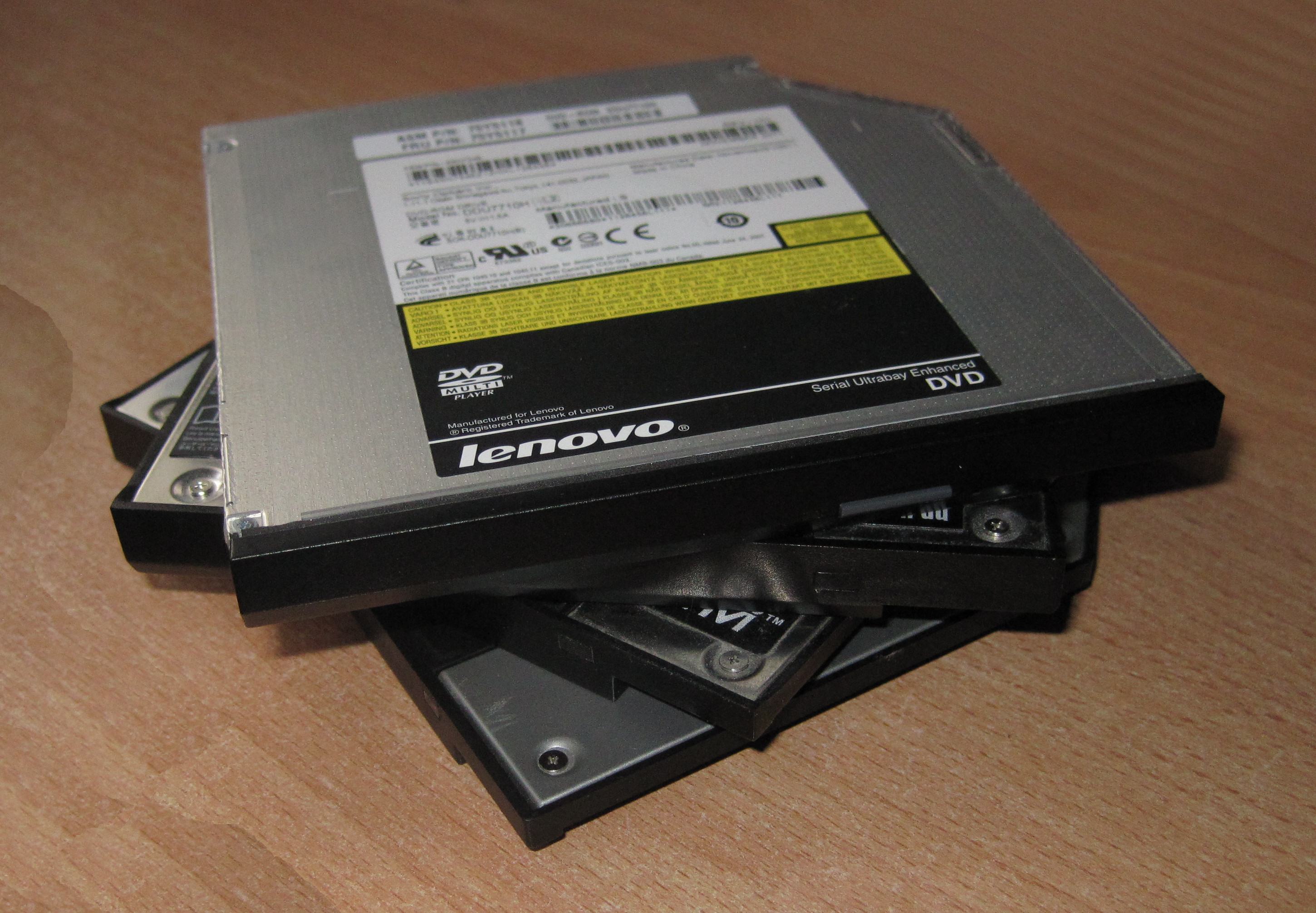
Lenovo laptop with ultrabay ejected
My Lenovo laptop has an Ultrabay, these are a way to easily swap optical and hard drives drives. They allow me to carry around additional storage and, providing I remembered to pack the drive, access optical media.
Over time I have acquired several additional hard drives housed in Ultrabay caddies. Generally I only need to access one at a time but increasingly I want to have more than one available.

Lenovo used to sell docking stations with multiple Ultrabays but since Series 3 was introduced this is no longer the case as the docks have been reduced to port replicators.

One solution is to buy a SATA to USB convertor which lets you use the drive externally. However once you have more than one drive this becomes somewhat untidy, not to mention all those unhoused drives on your desk become something of a hazard.

Recently after another close call I decided what I needed was a proper external enclosure to house all my drives. After some extensive googling I found nothing suitable ready to buy. Most normal people would give up at this point, I appear to be an abnormal person so I got the CAD package out.

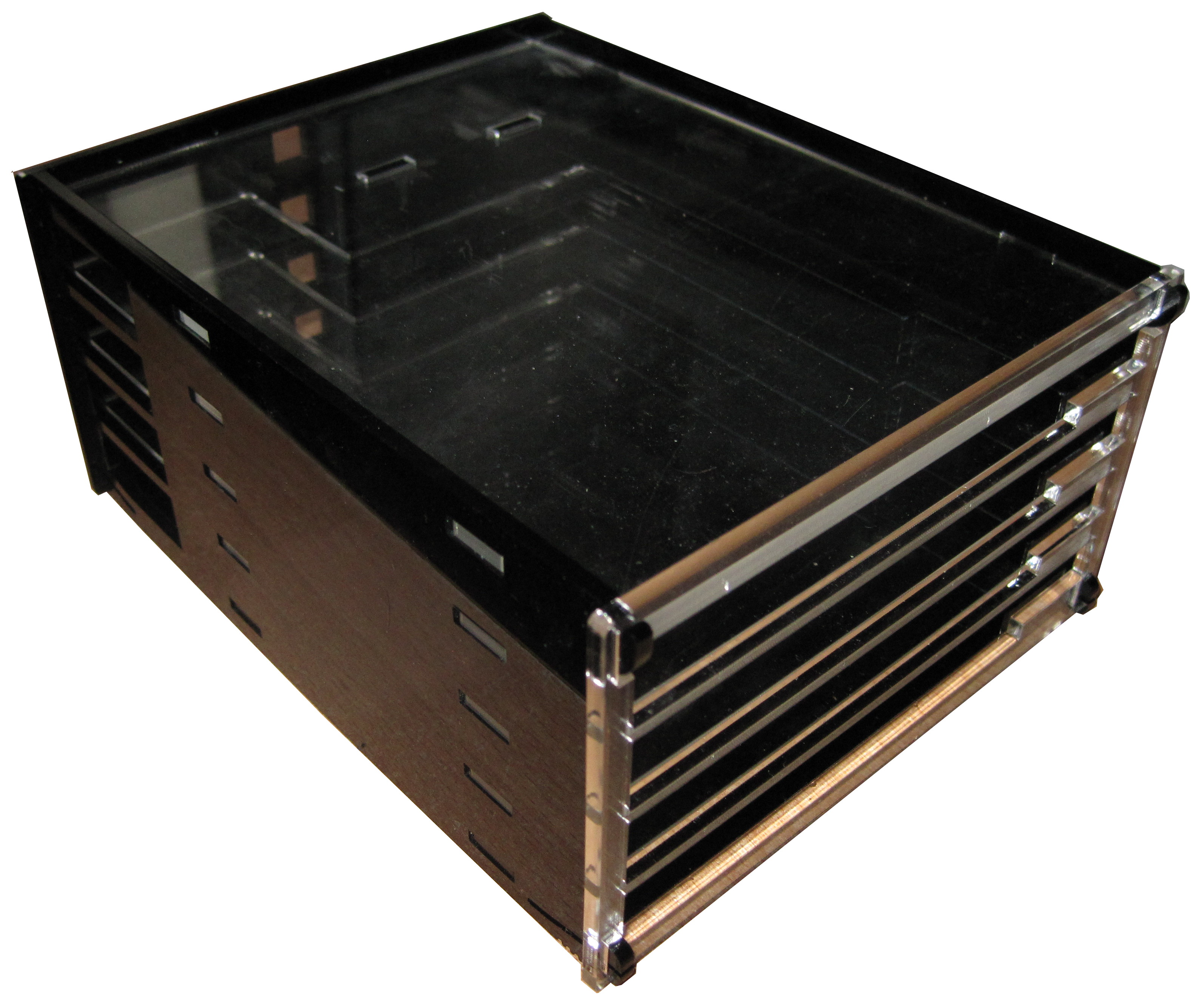
A few hours of design and a load of laser cutting later I came up with a four bay enclosure that now houses all my Ultrabay caddies.

The design was slightly evolved to accommodate the features of some older caddies and allow a pencil to be used to eject the drives (I put a square hole in the back)

The completed unit uses about 10 of plastic and takes 30 minutes to lasercut.

The only issue with the enclosure as manufactured is that Makespace ran out of black plastic stock and I had to use transparent to finish so it is not in classic black as lenovo intended.

As usual all the design files are publicly available from my design repo.

15 February 2015

Antonio Terceiro: rmail: reviving upstream maintaince

It is always fun to write new stuff, and be able to show off that shiny new piece of code that just come out of your brilliance and/or restless effort. But the world does not spin based just on shiny things; for free software to continue making the world work, we also need the dusty, and maybe and little rusty, things that keep our systems together. Someone needs to make sure the rust does not take over, and that these venerable but useful pieces of code keep it together as the ecosystem around them evolves. As you know, Someone is probably the busiest person there is, so often you will have to take Someone s job for yourself. rmail is a Ruby library able to parse, modify, and generate MIME mail messages. While handling transitions of Ruby interpreters in Debian, it was one of the packages we always had to fix for new Ruby versions, to the point where the Debian package has accumulated quite a few patches. The situation became ridiculous. It was considered to maybe drop it from the Debian archive, but dropping it would mean either also dropping feed2imap and sup or porting both to other mail library. Since doing this type of port is always painful, I decided instead to do something about the sorry state in which rmail was on the upstream side. The reasons why it was not properly maintained upstream does not matter: people lose interest, move on to other projects, are not active users anymore; that is normal in free software projects, and instead of blaming upstream maintainers in any way we need to thank them for writing us free software in the first place, and step up to fix the stuff we use. I got in touch with the people listed as owner for the package on rubygems.org, and got owner permission, which means I can now publish new versions myself. With that, I cloned the repository where the original author had imported the latest code uploaded to rubygems and had started to receive contributions, but that repository was inactive for more than one year. It had already got some contributions from the sup developers which never made it in a new rmail release, so the sup people started using their own fork called rmail-sup . Already in my repository, I have imported all the patches that still made sense from the Debian repository, did a bunch of updates, mainly to modernize the build system, and did a 1.1.0 release to rubygems.org. This release is pretty much compatible with 1.0.0, but since I did not test it with Ruby versions older than than one in my work laptop (2.1.5), I bumped the minor version number as warning to prospective users still on older Ruby versions. In this release, the test suite passes 100% clean, what always gives my mind a lot of comfort:

$ rake
/usr/bin/ruby2.1 -I"lib:." -I"/usr/lib/ruby/vendor_ruby" "/usr/lib/ruby/vendor_ruby/rake/rake_test_loader.rb" "test/test*.rb"
Loaded suite /usr/lib/ruby/vendor_ruby/rake/rake_test_loader
Started
...............................................................................
...............................................................................
........
Finished in 2.096916712 seconds.
166 tests, 24213 assertions, 0 failures, 0 errors, 0 pendings, 0 omissions, 0 notifications
100% passed
79.16 tests/s, 11546.95 assertions/s

And in the new release I have just uploaded to the Debian experimental suite (1.1.0-1), I was able to drop all of the patches and just use the upstream source as is. So that s it: if you use rmail for anything, consider testing version 1.1.0-1 from Debian experimental, or 1.1.0 from rubygems.org if you into that, and report any bugs to the [github repository](https://github.com/terceiro/rmail). My only commitment for now is keep it working, but if you want to add new features I will definitively review and merge them.

Sergio Talens-Oliag: Retooling

I haven't blogged for a long time, but I've decided that I'm going to try to write again, at least about technical stuff. My plan was to blog about the projects I've been working on lately, the main one being the setup of the latest version of Kolab with the systems we already have at work, but I'll do that on the next days. Today I'm just going to make a list of the tools I use on a daily basis and my plans to start using additional ones in the near future. Shells, Terminals and Text Editors I do almost all my work on Z Shell sessions running inside tmux; for terminal emulation I use gnome-terminal on X, VX ConnectBot on Android systems and iTerm2 on Mac OS X. For text editing I've been using Vim for a long time (even on Mobile devices) and while I'm aware I don't know half of the things it can do, what I know is good enough for my day to day needs. In the past I also used Emacs as a programming editor and my main tool to write HTML, SGML and XML, but since I haven't really needed an IDE for a long time and I mainly use Lightweight Markup Languages I haven't used it for a long time (I briefly tried to use Org mode, but for some reason I ended up leaving it). Documentation formats and tools Since a long time ago I've been an advocate of Lightweight Markup Languages; I started to use LaTeX and Lout, then moved to SGML/XML formats (LinuxDoc and DocBook) and finally moved to plain text based formats. I started using Wiki formats (parsewiki) and soon moved to reStructuredText; I also use other markup languages like Markdown (for this blog, aka ikiwiki) and tried MultiMarkdown to replace reStructuredText for general use, but as I never liked Markdown syntax I didn't liked an extended version of it. While I've been using ReStructuredText for a long time, I recently found Asciidoctor and the Asciidoc format and I guess I'll be using it instead of rst whenever I can (I still need to try the slide backends and conversions to ODT, but if that works I guess I'll write all my new documents using Asciidoc). Programming languages I'm not a developer, but I read and patch a lot of free software code written on a lot of different programming languages (I wouldn't be able to write whole programs on most of them, but thanks to Stack Overflow I'm usually able to fix what I need). Anyway, I'm able to program in some languages; I write a lot of shell scripts and I go for Python and C when I need something more complicated. On the near future I plan to read about javascript programming and nodejs (I'll probably need it at work) and I already started looking at Haskell (I guess it was time to learn about functional programming and after reading about it, it looks like haskell is the way to go for me). Version Control For a long time I've been a Subversion user, at least for my own projects, but seems that everything has moved to git now and I finally started to use it (I even opened a github account) and plan to move all my personal subversion repositories at home and at work to git, including the move of all my debian packages from svn-buildpackage to git-buildpackage. Further Reading With the previous plans in mind, I've started reading a couple of interesting books: Now I just need to get enough time to finish reading them ... ;)

14 February 2015

Wouter Verhelst: Docker

... is the new hype these days. Everyone seems to want to be part of it; even Microsoft wants to allow Docker to run on its platform. How they visualise that is slightly beyond me, seen as how Docker is mostly a case of "run a bunch of LXC instances", which by their definition can't happen on Windows. Presumably they'll just run a lot more VMs, then, which is a possible workaround. Or maybe Docker for Windows will be the same in concept, but not in implementation. I guess the future will tell. As I understand the premise, the idea of Docker is that getting software to run on "all" distributions is a Hard Problem[TM], so in a Docker thing you just define that this particular stuff is meant to run on top of this and this and that environment, and Docker then compartmentalises everything for you. It should make things easier to maintain, and that's a good thing. I'm not a fan. If the problem that Docker tries to fix is "making software run on all platforms is hard", then Docker's "solution" is "I give up, it's not possible". That's sad. Sure, having a platform which manages your virtualisation for you, without having to manually create virtual machines (or having to write software to do so) is great. And sure, compartmentalising software so that every application runs in its own space can help towards security, manageability, and a whole bunch of other advantages. But having an environment which says "if you want to run this applicaiton, I'll set up a chroot with distribution X for you; if you want to run this other application, I'll set up a chroot with distribution Y for you; and if you want to run yet this other application yere, I'll start doing a chroot with distribution Z for you" will, in the end, get you a situation where, if there's another bug in libc6 or libssl, you now have a nightmare trying to track down all the different versions in all the docker instances to make sure they're all fixed. And while it may work perfectly well on the open Internet, if you're on a corporate network with a paranoid firewall and proxy, downloading packages from public mirrors is harder than just creating a local mirror instead. Which you now have to do not only for your local distribution of choice, but also for the distributions of choice of all the developers of the software you're trying to use. Which may result in more work than just trying to massage the software in question to actually bloody well work, dammit. I'm sure Docker has a solution for some or all of the problems it introduces, and I'm not saying it doesn't work in practice. I'm sure it does fix some part of the "Making software run on all platforms is hard" problem, and so I might even end up using it at some point. But from an aesthetical point of view, I don't think Docker is a good system. I'm not very fond of giving up.

13 February 2015

Richard Hartmann: Release Critical Bug report for Week 07

The UDD bugs interface currently knows about the following release critical bugs: How do we compare to the Squeeze and Wheezy release cycles?
Week Squeeze Wheezy Jessie
43 284 (213+71) 468 (332+136) 319 (240+79)
44 261 (201+60) 408 (265+143) 274 (224+50)
45 261 (205+56) 425 (291+134) 295 (229+66)
46 271 (200+71) 401 (258+143) 427 (313+114)
47 283 (209+74) 366 (221+145) 342 (260+82)
48 256 (177+79) 378 (230+148) 274 (189+85)
49 256 (180+76) 360 (216+155) 226 (147+79)
50 204 (148+56) 339 (195+144) ???
51 178 (124+54) 323 (190+133) 189 (134+55)
52 115 (78+37) 289 (190+99) 147 (112+35)
1 93 (60+33) 287 (171+116) 140 (104+36)
2 82 (46+36) 271 (162+109) 157 (124+33)
3 25 (15+10) 249 (165+84) 172 (128+44)
4 14 (8+6) 244 (176+68) 187 (132+55)
5 2 (0+2) 224 (132+92) 175 (124+51)
6 release! 212 (129+83) 161 (109+52)
7 release+1 194 (128+66) 147 (106+41)
8 release+2 206 (144+62)
9 release+3 174 (105+69)
10 release+4 120 (72+48)
11 release+5 115 (74+41)
12 release+6 93 (47+46)
13 release+7 50 (24+26)
14 release+8 51 (32+19)
15 release+9 39 (32+7)
16 release+10 20 (12+8)
17 release+11 24 (19+5)
18 release+12 2 (2+0)
Graphical overview of bug stats thanks to azhag:

Olivier Berger: Testing the RuneStone interactive Python courses server in docker

I ve been working on setting up a Docker container environment allowing to test the RuneStone Interactive server. RuneStone Interactive allows the publication of courses containing interactive Python examples, and while most of the content is static (the Python examples are run innside a Python interpreter implemented in JavaScript, hence locally in the JS VM of the Web browser), the tool also offers an environment allowing to monitor the progress of learners in a course, which is dynamic and is queried by the browser over AJAX APIs. That s the part which I wanted to be able to operate for test purposes. As it is a web2py application, it s not exactly obvious to gather all dependencies and run locally. Well, in fact it is, but I want to understand the architecture of the tool to be able to understand the deployment constraints, so making a docker image will help in this purpose. The result is the following : Now, it s easier to test the writing of a new course (yet another container above the latter one), and directly test for real.

Daniel Leidert: Motion picture capturing: Debian + motion + Logitech C910 - part II

In my recent attempt to setup a motion detection camera I was disappointed, that my camera, which should be able to record with 30 fps in 720p mode only reached 10 fps using the software motion. Now I got a bit further. This seems to be an issue with the format used by motion. I've check the output of v4l2-ctl ...
$ v4l2-ctl -d /dev/video1 --list-formats-ext
[..]
ioctl: VIDIOC_ENUM_FMT
Index : 0
Type : Video Capture
Pixel Format: 'YUYV'
Name : YUV 4:2:2 (YUYV)
[..]
Size: Discrete 1280x720
Interval: Discrete 0.100s (10.000 fps)
Interval: Discrete 0.133s (7.500 fps)
Interval: Discrete 0.200s (5.000 fps)
[..]

Index : 1
Type : Video Capture
Pixel Format: 'MJPG' (compressed)
Name : MJPEG
[..]
Size: Discrete 1280x720
Interval: Discrete 0.033s (30.000 fps)
Interval: Discrete 0.042s (24.000 fps)
Interval: Discrete 0.050s (20.000 fps)
Interval: Discrete 0.067s (15.000 fps)
Interval: Discrete 0.100s (10.000 fps)
Interval: Discrete 0.133s (7.500 fps)
Interval: Discrete 0.200s (5.000 fps)
[..]
... and motion:
$ motion
[..]
[1] [NTC] [VID] v4l2_set_pix_format: Config palette index 17 (YU12) doesn't work.
[1] [NTC] [VID] v4l2_set_pix_format: Supported palettes:
[1] [NTC] [VID] v4l2_set_pix_format: (0) YUYV (YUV 4:2:2 (YUYV))
[1] [NTC] [VID] v4l2_set_pix_format: 0 - YUV 4:2:2 (YUYV) (compressed : 0) (0x56595559)
[1] [NTC] [VID] v4l2_set_pix_format: (1) MJPG (MJPEG)
[1] [NTC] [VID] v4l2_set_pix_format: 1 - MJPEG (compressed : 1) (0x47504a4d)
[1] [NTC] [VID] v4l2_set_pix_format Selected palette YUYV
[1] [NTC] [VID] v4l2_do_set_pix_format: Testing palette YUYV (1280x720)
[1] [NTC] [VID] v4l2_do_set_pix_format: Using palette YUYV (1280x720) bytesperlines 2560 sizeimage 1843200 colorspace 00000008
[..]
Ok, so both formats YUYV and MJPG are supported and recognized and I can choose both via the v4l2palette configuration variable, citing motion.conf:
# v4l2_palette allows to choose preferable palette to be use by motion
# to capture from those supported by your videodevice. (default: 17)
# E.g. if your videodevice supports both V4L2_PIX_FMT_SBGGR8 and
# V4L2_PIX_FMT_MJPEG then motion will by default use V4L2_PIX_FMT_MJPEG.
# Setting v4l2_palette to 2 forces motion to use V4L2_PIX_FMT_SBGGR8
# instead.
#
# Values :
# V4L2_PIX_FMT_SN9C10X : 0 'S910'
# V4L2_PIX_FMT_SBGGR16 : 1 'BYR2'
# V4L2_PIX_FMT_SBGGR8 : 2 'BA81'
# V4L2_PIX_FMT_SPCA561 : 3 'S561'
# V4L2_PIX_FMT_SGBRG8 : 4 'GBRG'
# V4L2_PIX_FMT_SGRBG8 : 5 'GRBG'
# V4L2_PIX_FMT_PAC207 : 6 'P207'
# V4L2_PIX_FMT_PJPG : 7 'PJPG'
# V4L2_PIX_FMT_MJPEG : 8 'MJPEG'
# V4L2_PIX_FMT_JPEG : 9 'JPEG'
# V4L2_PIX_FMT_RGB24 : 10 'RGB3'
# V4L2_PIX_FMT_SPCA501 : 11 'S501'
# V4L2_PIX_FMT_SPCA505 : 12 'S505'
# V4L2_PIX_FMT_SPCA508 : 13 'S508'
# V4L2_PIX_FMT_UYVY : 14 'UYVY'
# V4L2_PIX_FMT_YUYV : 15 'YUYV'
# V4L2_PIX_FMT_YUV422P : 16 '422P'
# V4L2_PIX_FMT_YUV420 : 17 'YU12'
#
v4l2_palette 17
Now motion uses YUYV as default mode as shown by its output. So it seems that all I have to do is to choose MJPEG in my motion.conf:
v4l2_palette 8
Testing again ...
$ motion
[..]
[1] [NTC] [VID] vid_v4lx_start: Using V4L2
[1] [NTC] [ALL] image_ring_resize: Resizing pre_capture buffer to 1 items
[1] [NTC] [VID] v4l2_set_control: setting control "Brightness" to 25 (ret 0 )
Corrupt JPEG data: 5 extraneous bytes before marker 0xd6
[1] [CRT] [VID] mjpegtoyuv420p: Corrupt image ... continue
[1] [NTC] [VID] v4l2_set_control: setting control "Brightness" to 14 (ret 0 )
Corrupt JPEG data: 1 extraneous bytes before marker 0xd5
[1] [CRT] [VID] mjpegtoyuv420p: Corrupt image ... continue
[1] [NTC] [VID] v4l2_set_control: setting control "Brightness" to 36 (ret 0 )
Corrupt JPEG data: 3 extraneous bytes before marker 0xd2
[1] [CRT] [VID] mjpegtoyuv420p: Corrupt image ... continue
[1] [NTC] [VID] v4l2_set_control: setting control "Brightness" to 58 (ret 0 )
Corrupt JPEG data: 1 extraneous bytes before marker 0xd7
[1] [CRT] [VID] mjpegtoyuv420p: Corrupt image ... continue
[1] [NTC] [VID] v4l2_set_control: setting control "Brightness" to 80 (ret 0 )
Corrupt JPEG data: 4 extraneous bytes before marker 0xd7
[1] [CRT] [VID] mjpegtoyuv420p: Corrupt image ... continue
[1] [ERR] [ALL] motion_init: Error capturing first image
[1] [NTC] [ALL] image_ring_resize: Resizing pre_capture buffer to 16 items
Corrupt JPEG data: 4 extraneous bytes before marker 0xd1
[1] [CRT] [VID] mjpegtoyuv420p: Corrupt image ... continue
Corrupt JPEG data: 11 extraneous bytes before marker 0xd1
[1] [CRT] [VID] mjpegtoyuv420p: Corrupt image ... continue
Corrupt JPEG data: 3 extraneous bytes before marker 0xd4
[1] [CRT] [VID] mjpegtoyuv420p: Corrupt image ... continue
Corrupt JPEG data: 7 extraneous bytes before marker 0xd1
[..]
... and another issue is turning up :( The output above goes on and on and on and there is no video capturing. So accordingly to $searchengine the above happens to a lot of people. I just found one often suggested fix: pre-load v4l2convert.so from libv4l-0:
$ LD_PRELOAD=/usr/lib/x86_64-linux-gnu/libv4l/v4l2convert.so motion
But the problem persists and I'm out of ideas :( So atm it lokks like I cannot use the MJPEG format and don't get 30 fps at 1280x720 pixels. During writing I then discovered a solution by good old trial-and-error: Leaving the v4l2_palette variable at its default value 17 (YU12) and pre-loading v4l2convert.so makes use of YU12 and the framerate at least raises to 24 fps:
$ LD_PRELOAD=/usr/lib/x86_64-linux-gnu/libv4lg/v4l2convert.so motion
[..]
[1] [NTC] [VID] v4l2_do_set_pix_format: Testing palette YU12 (1280x720)
[1] [NTC] [VID] v4l2_do_set_pix_format: Using palette YU12 (1280x720) bytesperlines 1280 sizeimage 1382400 colorspace 00000008
[..]
[1] [NTC] [EVT] event_new_video FPS 24
[..]
Finally! :) The results are nice. It would maybe even be a good idea to limit the framerate a bit, to e.g. 20. So that is a tested configuration for the Logitech C910 running at a resolution of 1280x720 pixels:
v4l2_palette 17
width 1280
height 720
framerate 20
minimum_frame_time 0
pre_capture 10 # 0,5 seconds pre-recording
post_capture 50 # 2,5 seconds after-recording
auto_brightness on
ffmpeg_variable_bitrate 2 # best quality
Now all this made me curious, which framerate is possible at a resolution of 1920x1080 pixels now and how the results look like. Although I get 24 fps too, the resulting movie suffers of jumps every few frames. So here I got pretty good results with a more conservative setting. By increasing framerate - tested up to 15 fps with good results - pre_capture needed to be decreased accordingly to values between 1..3 to minimize jumps:
v4l2_palette 17
width 1920
height 1080
framerate 12
minimum_frame_time 0
pre_capture 6 # 0,5 seconds pre-recording
post_capture 30 # 2,5 seconds after-recording
auto_brightness on
ffmpeg_variable_bitrate 2 # best quality
Both configurations lead to satisfying results. Of course the latter will easily fill your hardrive :) TODOI guess, the results can be optimzed further by playing around with ffmpeg_bps and ffmpeg_variable_bitrate. Maybe then it is possible to record without jumps at higher framerates too(?). I also didn't test the various norm settings (PAL, NTSC, etc.).

Steve McIntyre: Linaro VLANd v0.2

I've been working on this for too long without really talking about it, so let's fix that now! VLANd is a simple (hah!) python program intended to make it easy to manage port-based VLAN setups across multiple switches in a network. It is designed to be vendor-agnostic, with a clean pluggable driver API to allow for a wide range of different switches to be controlled together. There's more information in the README file. I've just released v0.2, with a lot of changes included since the last release: I've demonstrated this code today in Hong Kong at the Linaro Connect event, and now I'm going on vacation for 4 weeks. Australia here I come! :-)

12 February 2015

Sven Hoexter: Out of the comfort zone: What I learned from my net-snmp backport on CentOS 5 and 6

This is a short roundup of things I learned after I've rolled out the stuff I wrote about here. Bugs and fighting with multiarch rpm/yum One oversight led me to not special case the perl-devel dependency on the net-snmp-devel package for CentOS 5, to depend on perl instead. That was easily fixed but afterwards a yum install net-snmp-devel still failed because it tried to install the stock CentOS 5 net-snmp-devel package and its dependencies. Closer investigation showed that it did so because I only provided x86_64 packages in our internal repository but it wanted to install i386 and x86_64 packages. Looking around this issue is documented in the Fedora Wiki. So the modern way to deal with it is to make the dependency architecture dependend with the
% ?_isa 
macro. That is evaluated at build time of the src.rpm and then the depedency is hardcoded together with the architecture. Compare
$ rpm -qRp net-snmp-devel-5.7.2-18.el6.x86_64.rpm grep perl
perl-devel(x86-64)
to
$ rpm -qRp net-snmp-devel-5.7.2-19.el5.centos.x86_64.rpm  grep perl
perl
As you can see it's missing for the el5 package and that's because it's too old, or more specific, rpm is too old to know about it. The workaround we use for now is to explicitly install only the x86_64 version of net-snmp-devel on CentOS 5 when required. That's a
yum install net-snmp-devel.x86_64
Another possible workaround is to remove i386 from your repository or just blacklist it in your yum configuration. I've read that's possible but did not try it. steal time still missing on CentOS 6 One of the motivations for this backport is support for steal time reporting via SNMP. For CentOS 5 that's solved with our net-snmp backport but for CentOS 6 we still do not see steal time. A short look around showed that it's also missing in top, vmstat and friends. Could it be a kernel issue? Since we're already running on the CentOS Xen hypervisor we gave the Linux 3.10.x packages a spin in a domU and now we also have steal time reporting. Yes, a kernel issue with the stock CentOS 6/RHEL 6 kernel. I'm not sure where and how to fill it since RedHat moved to KVM.

Daniel Leidert: Setting up a network buildd with pbuilder ... continued

Last year I'd described my setup of a local network-buildd using pbuilder, ccache, inoticoming and NFS. One then-still-open goal was to support different Debian releases. This is especially necessary for backports of e.g. bluefish. The rules to contribute backports require to include all changelog entries since the last version on debian-backports or since stable if it's the first version in an uploaded package. Therefor one needs to know the last version in e.g. wheezy-backports. Because I'm not typing the command (the source package only gets uploaded and inoticoming starts the build process) I was looking for a way to automatically retrieve that version and add the relevant -vX.Y-Z switch to dpkg-buildpackage.The solution I found requires aptitude and a sources.list entry for the relevant release. If you are only interested in the solution, just jump to the end :)I'm going to add the version switch to the DEBBUILDOPTS variable of pbuilder. In my setup I have a common (shared) snippet called /etc/pbuilderrc.inc and one configuration file per release and architecture, say /etc/pbuilderrc.amd64.stable. Now the first already contains ...
DEBBUILDOPTS="-us -uc -j2"
... and DEBBUILDOPTS can be extended in the latter:
DEBBUILDOPTS+="..."
Because the config file is parsed pretty early in the process the package name has not yet been assigned to any variable. The last argument to pbuilder is the .dsc file. So I use the last argument and parse the file to retrieve the source package name.
cat $ @: -1    grep -e ^Source   awk -F\  '  print $2  '
The solution above works, because pbuilder is a BASH script. Otherwise it maybe needs some tweaking. I use the source package name, because it is unique and there is just one :) Now with this name I check for all versions in wheezy* and stable* and sort them. The sort order of aptitude is from low to high, so the last line shopuld contain the highest version. This covers the possibility that there has not yet been a backport or that there is one:
aptitude versions -F '%p' --show-package-names=never --group-by=none --sort=version \
"?narrow(?source-package(^PACKAGE\$), ?or(?archive(^wheezy.*), ?archive(^stable.*)))" \
tail -n 1 sed -e 's#~bpo.*$##g'
The sed-part is necessary because otherwise dh_genchanges will add a superfluous changelog entry (the last one of the last upload). To make things easier, I assign the name and version to variables. So this is the complete solution:

[..]
MYPACKAGE=" cat $ @: -1 grep -e ^Source awk -F\ ' print $2 ' "
MYBPOVERS=" aptitude versions -F '%p' --show-package-names=never --group-by=none --sort=version "?narrow(?source-package(^$MYPACKAGE\$), ?or(?archive(^wheezy.*), ?archive(^stable.*)))" tail -n 1 sed -e 's#~bpo.*$##g' "

log "I: Package is $MYPACKAGE and last stable/bpo version is $MYBPOVERS"

DEBBUILDOPTS+=" -v$MYBPOVERS"
[..]
ExamplesI've recently built a new bluefish backport. The last backport version is 2.2.6-1~bpo70+1. There is also the stable version 2.2.3-4. So the version I need is 2.2.6-1 (2.2.6-1~bpo70+1 < 2.2.6-1!!). Checking the log it works:
I: Package is bluefish and last stable/bpo version is 2.2.6-1
A different example is rsync. I've recently locally rebuilt it for a stable system (wanted to make use of the --chown switch). There is not yet a backport. So the version I (would) need is 3.0.9-4. Checking the logs again and works too:
I: Package is rsync and last stable/bpo version is 3.0.9-4
Feedback appreciated ... Links

11 February 2015

John Goerzen: Reactions to Has modern Linux lost its way? and the value of simplicity

Apparently I touched a nerve with my recent post about the growing complexity of issues. There were quite a few good comments, which I ll mention here. It s provided me some clarity on the problem, in fact. I ll try to distill a few more thoughts here. The value of simplicity and predictability The best software, whether it s operating systems or anything else, is predictable. You read the documentation, or explore the interface, and you can make a logical prediction that when I do action X, the result will be Y. grep and cat are perfect examples of this. The more complex the rules in the software, the more hard it is for us to predict. It leads to bugs, and it leads to inadvertant security holes. Worse, it leads to people being unable to fix things themselves one of the key freedoms that Free Software is supposed to provide. The more complex software is, the fewer people will be able to fix it by themselves. Now, I want to clarify: I hear a lot of talk about ease of use. Gnome removes options in my print dialog box to make it easier to use. (This is why I do not use Gnome. It actually makes it harder to use, because now I have to go find some obscure way to just make the darn thing print.) A lot of people conflate ease of use with ease of learning, but in reality, I am talking about neither. I am talking about ease of analysis. The Linux command line may not have pointy-clicky icons, but at least at one time once you understood ls -l and how groups, users, and permission bits interacted, you could fairly easily conclude who had access to what on a system. Now we have a situation where the answer to this is quite unclear in terms of desktop environments (apparently some distros ship network-manager so that all users on the system share the wifi passwords they enter. A surprise, eh?) I don t mind reading a manpage to learn about something, so long as the manpage was written to inform. With this situation of dbus/cgmanager/polkit/etc, here s what it feels like. This, to me, is the crux of the problem: It feels like we are in a twisty maze, every passage looks alike, and our flashlight ran out of battieries in 2013. The manpages, to the extent they exist for things like cgmanager and polkit, describe the texture of the walls in our cavern, but don t give us a map to the cave. Therefore, we are each left to piece it together little bits at a time, but there are traps that keep moving around, so it s slow going. And it s a really big cave. Other user perceptions There are a lot of comments on the blog about this. It is clear that the problem is not specific to Debian. For instance: This stuff is really important, folks. People being able to maintain their own software, work with it themselves, etc. is one of the core reasons that Free Software exists in the first place. It is a fundamental value of our community. For decades, we have been struggling for survival, for relevance. When I started using Linux, it was both a question and an accomplishment to have a useable web browser on many platforms. (Netscape Navigator was closed source back then.) Now we have succeeded. We have GPL-licensed and BSD-licensed software running on everything from our smartphones to cars. But we are snatching defeat from the jaws of victory, because just as we are managing to remove the legal roadblocks that kept people from true mastery of their software, we are erecting technological ones that make the step into the Free Software world so much more difficult than it needs to be. We no longer have to craft Modelines for X, or compile a kernel with just the right drivers. This is progress. Our hardware is mostly auto-detected and our USB serial dongles work properly more often on Linux than on Windows. This is progress. Even our printers and scanners work pretty darn well. This is progress, too. But in the place of all these things, now we have userspace mucking it up. We have people with mysterious errors that can t be easily assisted by the elders in the community, because the elders are just as mystified. We have bugs crop up that would once have been shallow, but are now non-obvious. We are going to leave a sour taste in people s mouth, and stir repulsion instead of interest among those just checking it out. The ways out It s a nasty predicament, isn t it? What are your ways out of that cave without being eaten by a grue? Obviously the best bet is to get rid of the traps and the grues. Somehow the people that are working on this need to understand that elegance is a feature a darn important feature. Sadly I think this ship may have already sailed. Software diagnosis tools like Enrico Zini s seat-inspect idea can also help. If we have something like an ls for polkit that can reduce all the complexity to something more manageable, that s great. The next best thing is a good map good manpages, detailed logs, good error messages. If software would be more verbose about the permission errors, people could get a good clue about where to look. If manpages for software didn t just explain the cavern wall texture, but explain how this room relates to all the other nearby rooms, it would be tremendously helpful. At present, I am unsure if our problem is one of very poor documentation, or is so bad that good documentation like this is impossible because the underlying design is so complex it defies being documented in something smaller than a book (in which case, our ship has not just sailed but is taking on water). Counter-argument: progress One theme that came up often in the comments is that this is necessary for progress. To a certain extent, I buy that. I get why udev is important. I get why we want the DE software to interact well. But here s my thing: this already worked well in wheezy. Gnome, XFCE, and KDE software all could mount/unmount my drives. I am truly still unsure what problem all this solved. Yes, cloud companies have demanding requirements about security. I work for one. Making security more difficult to audit doesn t do me any favors, I can assure you. The systemd angle To my surprise, systemd came up quite often in the discussion, despite the fact that I mentioned I wasn t running systemd-sysv. It seems like the new desktop environemt ecosystem is the systemd ecosystem in a lot of people s minds. I m not certain this is justified; systemd was not my first choice, but as I said in an earlier blog post, jessie will still boot . A final note I still run Debian on all my personal boxes and I m not going to change. It does awesome things. For under $100, I built a music-playing system, with Raspberry Pis, fully synced throughout my house, using a little scripting and software. The same thing from Sonos would have cost thousands. I am passionate about this community and its values. Even when jessie releases with polkit and all the rest, I m still going to use it, because it is still a good distro from good people.

Mike Hommey: Announcing git-cinnabar 0.1.0

As you may or may not know, I have been working on this project for quite some time, but actually really started the most critical parts a couple months ago. After having looked for (and chosen) a new name for what was a prototype project, it s now time for a very first release. So what is this all about? Cinnabar is the common natural form in which mercury can be found on Earth. It contains mercury sulfide and its powder is used to make the vermillion pigment. What does that have to do with git? Hint: mercury. Git-cinnabar is a git remote helper (you can think of that as a plugin) to interact with mercurial repositories. It allows to clone, pull and push from/to mercurial remote repositories, using git. Numerous such tools already exist. Where git-cinnabar stands out is that it doesn t use a local mercurial clone under the hood (unlike all the existing other such tools), and is close to an order of magnitude faster to clone a repository like mozilla-central than the git-remote-hg that used to be shipped as a contrib to git. I won t claim it is exempt of problems and limitations, which is why it s not a 1.0. I m however confident enough with its state to make the first official release. Get it on github. If you ve been using the prototype, you can actually continue to use that clone and update it. Github conveniently keeps things working after a rename. You can update the remote url if you feel like it, though. If you are a Gecko developer, you can take a look at a possible workflow.

10 February 2015

Enrico Zini: systemd-default-rescue

seat-inspect Four months ago I wrote this somewhere:
Seeing a DD saying "this new dbus stuff scares me" would make most debian users scared. Seeing a DD who has an idea of what is going on, and who can explain it, would be an interesting and exciting experience. So, let's be exemplary, competent and patient. Or at least, competent. Some may like or not like the changes, but do we all understand what is going on? Will we all be able to support our friends and customers running jessie? I confess that although I understand the need for it, I don't feel competent enough to support systemd-based machines right now. So, are we maybe in need of help, cheat sheets, arsenals of one-liners, diagnostic tools? Maybe a round of posts on -planet like "one debian package a day" but with new features that jessie will have, and how to understand them and take advantage of them?
That was four months ago. In the meantime, I did some work, and it got better for me. Yesterday, however, I've seen an experienced Linux person frustrated because the shutdown function of the desktop was doing nothing whatsoever. Today I found John Goerzen's post on planet. I felt like some more diagnostic tools were needed, so I spent the day making seat-inspect. seat-inspect tries to make the status of the login/seat system visible, to help with understanding and troubleshooting. The intent of running the code is to have an overview of the system status, both to see what the new facilities are about, and to figure out if there is something out of place. The intent of reading the code is to have an idea of how to use these facilities: the code has been written to be straightforward and is annotated with relevant bits from the logind API documentation. seat-inspect is not a finished tool, but a starting point. I put it on github hoping that people will fork it and add their own extra sanity checks and warnings, so that it can grow into a standard thing to run if a system acts weird. As it is now, it should be able to issue warnings if some bits are missing for network-manager or shutdown functions to work correctly. I haven't really tested that, though, because I don't have a system at hand where they are currently not working fine. Another nice thing of it is that when running seat-inspect -v you get a dump of what logind/consolekit think about your system. I found it an interesting way to explore the new functionalities that we recently grew. The same can be done, and in more details, with loginctl calls, but I lacked a summary. After writing this I feel a bit more competent, probably enough to sit at somebody's computer and poke into loginctl bits. I highly recommend the experience.

Benjamin Mako Hill: Kuchisake-onna Decision Tree

Mika recently brought up the Japanese modern legend of Kuchisake-onna ( ). For background, I turned to the English Wikipedia article on Kuchisake-onna which had the following to say about the figure (the description matches Mika s memory):
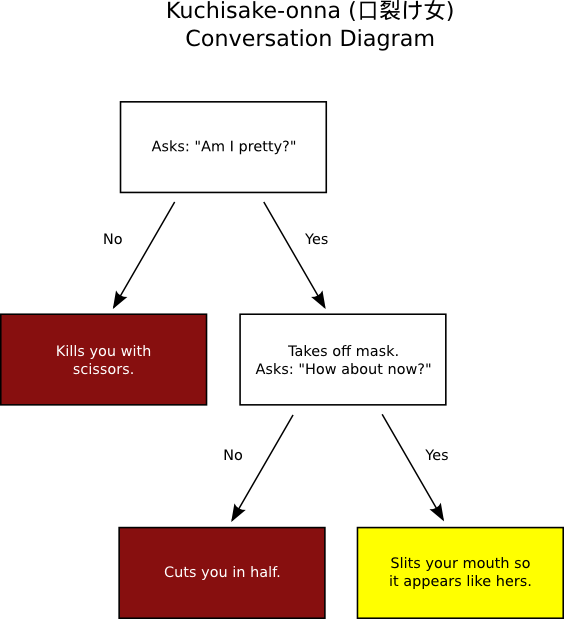
According to the legend, children walking alone at night may encounter a woman wearing a surgical mask, which is not an unusual sight in Japan as people wear them to protect others from their colds or sickness. The woman will stop the child and ask, Am I pretty? If the child answers no, the child is killed with a pair of scissors which the woman carries. If the child answers yes, the woman pulls away the mask, revealing that her mouth is slit from ear to ear, and asks How about now? If the child answers no, he/she will be cut in half. If the child answers yes, then she will slit his/her mouth like hers. It is impossible to run away from her, as she will simply reappear in front of the victim.
To help anyone who is not only frightened, but also confused, Mika and I made the following decision tree of possible conversations with Kuchisake-onna and their universally unfortunate outcomes.
Decision tree of conversations with Kuchisake-onna.Decision tree of conversations with Kuchisake-onna.
Of course, we uploaded the SVG source for the diagram to Wikimedia Commons and used the diagram to illustrate the Wikipedia article.

John Goerzen: Has modern Linux lost its way? (Some thoughts on jessie)

For years, I used to run Debian sid (unstable) on all my personal machines. Laptops, workstations, sometimes even my personal servers years ago ran sid. Sid was, as its name implies, unstable. Sometimes things broke. But it wasn t a big deal, because I could always get in there and fix it fairly quickly, whatever it was. It was the price I paid for the latest and greatest. For the last number of months, I ve dealt with a small but annoying issue in jessie: None of Nautilus, Thunar, or digikam (yes, that represents Gnome, XFCE, and KDE) can mount USB drives I plug in anymore. I just get Not authorized to perform operation. I can, of course, still mount -o uid=1000 /dev/sdc1 /mnt, but I miss the convenience of doing it this way. One jessie system I switched to systemd specifically to get around this problem. It worked, but I don t know why. I haven t had the time to switch my workstation, and frankly I am concerned about it. Here s the crux of the issue: I don t even know where to start looking. I ve googled this issue, and found all sorts of answers pointing to polkit, or dbus, or systemd-shim, or cgmanager, or lightdm, or XFCE, or I found a bug report of this exact problem Debian #760281, but it s marked fixed, and nobody replied to my comment that I m still seeing it. Nowhere is it documented that a Digikam mounting issue should have me looking in polkit, let alone cgmanager. And even once I find those packages, their documentation suffers from Bad Unix Documentation Disease: talking about the nitty-gritty weeds view of something, without bothering to put it in context. Here is the mystifying heading for the cgmanager(8) manpage:
cgmanager is a daemon to manage cgroups. Programs and users can make D-Bus requests to administer cgroups over which they have privilege. To ensure that users may not exceed their privilege in manipulating cgroups, the cgroup manager accepts regular D-Bus requests only from tasks within its own process-id and user namespaces. For tasks in private namespaces (such as containers), SCM-enhanced D-Bus calls are available. Using these manually is not recommended. Rather, each container is advised to run a cgproxy, which will forward plain D-Bus requests as SCM-enhanced D-Bus requests to the host cgmanager.
That s about as comprehensible as Vogon poetry to me. How is cgmanager started? What does SCM-enhanced mean? And I even know what a cgroup is. This has been going on for months, which has me also wondering: is it only me? (Google certainly suggests it s not, and there are plenty of hits for this exact problem with many distros, and some truly terrible advice out there to boot.) And if not, why is something so basic and obvious festering for so long? Have we built something that s too complex to understand and debug? This is, in my mind, orthogonal to the systemd question. I used to be able to say Linux was clean, logical, well put-together, and organized. I can t really say this anymore. Users and groups are not really determinitive for permissions, now that we have things like polkit running around. (Yes, by the way, I am a member of plugdev.) Error messages are unhelpful (WHY was I not authorized?) and logs are nowhere to be found. Traditionally, one could twiddle who could mount devices via /etc/fstab lines and perhaps some sudo rules. Granted, you had to know where to look, but when you did, it was simple; only two pieces to fit together. I ve even spent time figuring out where to look and STILL have no idea what to do. systemd may help with some of this, and may hurt with some of it; but I see the problem more of an attitude of desktop environments to add features fast without really thinking of the implications. There is something to be said for slower progress if the result is higher quality. Then as I was writing this, of course, my laptop started insisting that it needed the root password to suspend when I close the lid. And it s running systemd. There s another quagmire Update: Part 2 with some reactions to this and further thoughts is now available.

9 February 2015

Eddy Petri&#537;or: uClibc based toolchain using Gentoo for NSLU2

I was asked in the previous post why I didn't used the Debian armel port for my NSLU2.

My intention was to create a uclibc based system (and a uclibc based toolchain) for my NSLU2. This was not obvious in the post because building the uclibc based toolchain resulted in this error:
crossdev armv5-softfloat-linux-uclibceabi
[..]/var/tmp/portage/cross-armv5-softfloat-linux-uclibceabi/gcc-4.9.2/work/gcc-4.9.2/libsanitizer/sanitizer_common/sanitizer_platform_limits_posix.cc:67:21: fatal error: wordexp.h: No such file or directory
#include
^
compilation terminated.
Makefile:416: recipe for target 'sanitizer_platform_limits_posix.lo' failed
make[4]: *** [sanitizer_platform_limits_posix.lo] Error 1
make[4]: *** Waiting for unfinished jobs....

So, yesterday, to not forget what I did, I tried building a glibc based toolchain and posted that.

Today, after looking at the offending error, it seems gcc 4.9.2 assumes wordexp.h is always available on non-Android platforms and Gentoo does not make that file availble when installing uclibc.


I think the problem was introduced in gcc in 2013 with this commit, but I haven't cheked in detail. What I know for sure is that gcc 4.8.3 works at this moment with uclibc and the buildroot guys are still using gcc 4.8.4 in their default uClibc based toolchain. So here it is the command that generated the uClibc based toolchain:

crossdev --g 4.8.3 armv5-softfloat-linux-uclibceabi

I hope this helps other people. Yes, I know I should report the issue to GCC/Gentoo after further investigation.

8 February 2015

Gregor Herrmann: RC bugs 2015/04-06

my small contributions around RC bugs during the last weeks:

Diego Escalante Urrelo: Link Pack #06

The story of Mel Blanc being saved by Bugs Bunny
Such a fantastic and romantic story. Mel Blanc, voice of half the Looney Tunes characters was in an car crash and hanging from a thread in a comma. And it took his characters to save him. It s a very interestingly edited podcast too:
( ) a crazy story about Mel nearly dying in a crash on Dead Man s Curve on Hollywood Boulevard and about the moment two weeks later when Bugs Bunny emerged from Mel s coma before Mel did. In fact, according to neurosurgeon Louis Conway who attended to Mel at the time, it seemed as though Bugs Bunny was trying to save his life.
The audacious rescue plan that might have saved space shuttle Columbia
This is probably the best documentary/kinda fiction article I have read in a long time. It s a long read going over the hypothetical, and nail bitting, plan to rescue the Columbia if it ever got in trouble. It s really intense, and something to sit down and read fully focused, book style.
But imagine an alternate timeline for the Columbia mission in which NASA quickly realized just how devastating the foam strike had been. Could the Columbia astronauts have been safely retrieved from orbit?
Ocean Gravity: Riding sea currents
Cool video of a sea diver running through seafloor currents, really cool and fascinating :). El chavo del ocho en el infierno
This one is in Spanish, and it s a funny take on El chavo del ocho and how it follows some classic models and myths of literature. Chespirito was very fond of classics, so this would make sense. But, of course, the whole article is written on a tongue in cheek style.
En El Chavo del Ocho, Bola os, o el Camus azteca, cre su propia versi n del mito de S sifo. El chavo y compa a est n condenados a empujar por una empinada colina todos los d as esta piedra enorme que siempre regresa, obligandolos al tormento del eterno retorno. La piedra de Quico es cuadrada, no rueda, se desliza. Es c mico, a pesar de tr gico.

Go for some more Link Pack, it s sugar free

Keith Packard: Altos1.6

AltOS 1.6 TeleDongle v3.0 support and bug fixes Bdale and I are pleased to announce the release of AltOS version 1.6. AltOS is the core of the software for all of the Altus Metrum products. It consists of firmware for our cc1111, STM32L151, STMF042, LPC11U14 and ATtiny85 based electronics and Java-based ground station software. This is a major release of AltOS, including support for our new TeleDongle v3.0 board and a selection of bug fixes AltOS Firmware TeleDongle v3.0 added along with some fixes Our updated ground station, TeleDongle v3.0, works just like the original TeleDongle, but is an all-new design: AltOS Bug Fixes We also fixed a few bugs in the firmware: AltosUI and TeleGPS applications A few minor new features are in this release Bug Fixes There are a bunch of minor bug fixes, including the usual collection of attempts to make stuff behave better on Windows platforms.

Next.

Previous.